“you’re not family anymore,” my sister said at her wedding—then sat me by the coat rack; her mil laughed, “only vips sit inside”; so i stood up, took back my gift, and said, “strangers don’t leave ave presents”; she whispered, “please… don’t”; but i was already gone; her wedding collapsed before the cake was even cut…
Like I was a distant cousin she had invited out of obligation. Like I had not spent the last 18 months answering her three-in-the-morning phone calls when she was fighting with Preston. Like I had not co-signed the lease on her first apartment in 2018 when our father refused to help her. Like I had not been the one who identified our mother’s body at the hospital because Delaney could not stop crying long enough to walk into the room.
“Of course I made it,” I whispered back, holding up the emergency kit. “I brought everything you asked for.”
One of the Bride Tribe women, a tall blonde with a face that looked professionally sculpted, stepped between us and put a hand on my sister’s shoulder.
“Dell, we need to finish your lashes, babe. The photographer wants us downstairs in twenty.”
Dell.
Nobody had ever called my sister Dell. Her name was Delaney Rose Prescott, named after our grandmother, and she had corrected teachers and boyfriends and coworkers for 29 years about the pronunciation. But this stranger called her Dell, and my sister smiled like she had been called that her whole life.
I set the kit on the vanity. Delaney did not turn around.
I stood there for a full 30 seconds, waiting for her to say something, anything, and then I walked out.
The ceremony was beautiful. I sat in the third row on the bride’s side because the second row was reserved for family, and a woman with a clipboard told me quietly that there had been a mix-up. I did not argue.
I watched my sister walk down the aisle on the arm of our father, who had not spoken more than ten sentences to me since 2021, and I cried the appropriate amount. When Delaney said her vows to Preston Whitfield, heir to a chain of luxury car dealerships across three states, I cried harder.
When Preston slipped the ring onto her finger, I thought about how our mother would have loved this moment. I let the tears fall without wiping them because I did not want to smudge my mascara before pictures.
There were no pictures with me.
The photographer, a young man with a man bun and a leather satchel, called for the family shots after the ceremony. Preston’s family went first, then the wedding party, then Delaney and our father, then Delaney and her new mother-in-law, then Delaney and the Bride Tribe.
I stood at the edge of the lawn in my champagne dress, holding my little clutch, waiting to be called.
The photographer packed up his camera.
Delaney walked past me toward the cocktail hour without stopping.
I told myself she was overwhelmed. Brides get overwhelmed. That is what everyone says. I have watched enough wedding videos on YouTube to know that brides forget things.
So I walked into the reception tent alone, and I looked for my seat.
The reception was in a white tent strung with fairy lights and hundreds of hydrangeas the color of Sunday morning sky. The tables were arranged in a horseshoe around a polished dance floor. Table one was the head table, where the bride and groom and their wedding party sat. Tables two through nine circled it, each one with a hand-lettered number in gold ink.
I looked for my card at table two, where I assumed the immediate family would be seated.
My name was not there.
I looked at table three. Not there.
Table four. Not there.
A woman in a black dress with a headset asked if she could help me.
“I’m looking for my seat,” I explained. “Marlo Prescott. I’m the sister of the bride.”
She frowned at her clipboard, ran her finger down the list, frowned again. Then her eyes flicked up to mine, and I saw the pity land there before she could hide it.
“Ma’am, you’re at table twelve.”
“There are only nine tables.”
She turned and pointed toward the back of the tent, where a small round table had been set up near the entrance, between the coat rack and the door to the portable restrooms.
Two chairs.
Not four. Not eight.
Two.
And on that table, in the same gold ink as the others, was a small number 12. Beside one of the chairs was a folded place card with my name written in cursive.
I walked toward it slowly because my legs did not feel like my legs.
The other chair had a card, too. I picked it up.
Roland Prescott.
My father’s cousin’s ex-husband. A man I had not seen since 1998. A man who was not on my sister’s Christmas card list. A man who, according to the empty chair, had not even bothered to show up.
I sat down. I put my clutch on the table.
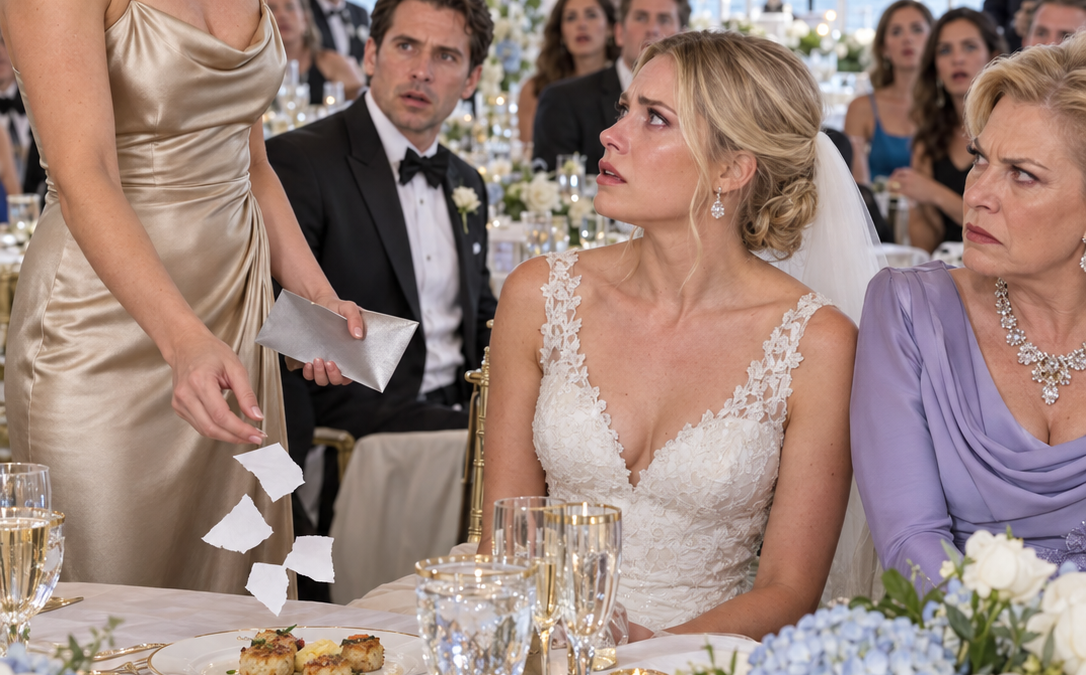
I looked at the head table 40 feet away, and I saw my sister take her seat in the center between Preston and his mother, a woman named Karine Whitfield, who wore a lavender dress and a diamond necklace the size of a small country.
Karine looked over at me, caught my eye, and leaned toward my sister to whisper something.
Delaney glanced back.
Their eyes met mine.
And then both of them laughed.
I sat at that table by the coat rack for the entire cocktail hour.
Three separate guests handed me their jackets, thinking I was the coat-check girl. A drunk uncle asked me where the bathroom was. A flower girl tripped over my chair leg and cried until her mother came to collect her without so much as glancing at me.
I smiled at all of them because that is what I had been trained to do my whole life.
Smile through it.
Do not make a scene.
Do not embarrass the family.
But something was building in my chest. Something that had been building since the bridal suite, since the third row, since the missing pictures, since the moment I understood that my mother was dead and my father did not want me and my sister had traded me in for a Bride Tribe and a diamond necklace.
The envelope with $15,000 in it was still in my clutch.
I put my hand on top of the clutch. I felt the outline of it through the satin.
And I waited to see what my sister would do next.
Preston stood up to make his welcome toast around 6:30, holding a glass of champagne that cost more than my monthly rent. He thanked his parents. He thanked his groomsmen. He thanked the caterer by name. He thanked Delaney’s father—my father—for raising the most beautiful woman he had ever known.
He did not mention my mother.
He did not mention me.
Delaney stood up next.
She was glowing in that way brides glow when everything is going exactly the way they scripted it on a Pinterest board. She thanked Preston. She thanked Karine, her new mother-in-law, for welcoming her into “a real family.”
Those were her exact words.
A real family.
She thanked her Bride Tribe by name, all six of them, and called out sweet inside jokes about brunches and bachelorette trips to Miami and a girls’ weekend in Aspen last winter that I had never heard about.
She thanked her father.
And this is the part that finally cracked something open in me.
“I want to thank my dad,” she said, “for being the only parent I ever needed.”
The only parent.
Our mother, Coraline Prescott, worked two jobs from 1991 until 2017 to put both of us through college. She sewed Delaney’s prom dress in 2011 by hand because Delaney wanted a specific shade of coral that did not exist in any store. She drove Delaney to cheerleading practice four times a week for six years. She held Delaney’s hair back through every bad breakup and every stomach flu and every night before finals.
And my sister, standing under fairy lights in a $15,000 dress, erased her from existence in front of 200 people.
I looked down at my hands.
My knuckles were white around the edge of the table.
The toast ended.
Applause.
Delaney sat down.
And then Karine Whitfield stood up, which was strange because the mother of the groom does not usually toast. But Karine was the kind of woman who did not care what was usual.
She tapped her glass with a butter knife until the room quieted.
“I just want to say,” she began in a voice like syrup poured over ice, “how thrilled we are to welcome Delaney into the Whitfield family. A real family, as she so beautifully put it. We believe family is not about blood. It is about who shows up, who fits, who belongs at the table.”
Her eyes drifted very deliberately to the back of the tent.
To table 12.
To me.
“And we’re just so glad,” she continued, “that only our closest VIPs are here inside with us tonight, sharing this moment.”
A ripple of polite laughter came from the head table.
Preston chuckled.
My sister smiled into her glass.
And Karine sat down.
I stood up.
I did not decide to stand up. My body just did it.
My clutch was in my hand. The silver envelope was inside my clutch.
I walked very slowly across the polished dance floor, past table three and table two, right up to the head table, and I stopped in front of my sister.
The music dipped because the DJ had seen me coming and did not know what was happening.
Two hundred faces turned.
My sister’s smile froze.
“Marlo,” she whispered. “What are you doing?”
I did not answer her yet.
I reached into my clutch and took out the silver envelope. I held it up so that the whole head table could see it.
Karine’s eyes narrowed.
Preston looked confused.
My father, seated at the far end of the head table with a woman I did not recognize, would not meet my eyes.
“Delaney,” I began, and my voice was steadier than I expected. “I brought you a gift.”
She swallowed.
“Marlo, please sit down.”
“This envelope has $15,000 in it,” I continued.
I heard someone gasp at the table nearest to me.
“It is every dollar I saved from the last two years of my business. I was going to give it to you for your honeymoon because you told me in April that you and Preston could not afford Santorini. Do you remember that phone call, Delaney? You were crying.”
Her face went the color of paper.
Karine cleared her throat.
“This is really not the appropriate moment for a family discussion.”
I turned to face her.
“But that is exactly the point, Karine. You said family is about who fits at the table, and I have been sitting by the coat rack for the last two hours. So I’m not family tonight. I’m a stranger. And strangers do not leave gifts.”
I opened the envelope.
I took out the check.
I tore it in half.
Then I tore it in half again.
Then I dropped the four pieces onto the head table, right in front of my sister’s untouched plate of miniature crab cakes.
The whole tent went silent.
Not polite silent.
Not stunned silent.
That specific silence that happens when 200 people realize they are watching something they will tell their grandchildren about.
Delaney reached for my wrist.
“Please,” she whispered. “Marlo, please don’t do this.”
I pulled my wrist away.
“You already did it,” I answered. “I just made it official.”
I turned to walk away.
And that was when Karine Whitfield made her second mistake of the evening.
She laughed.
A small, sharp, disbelieving laugh. The kind of laugh a woman makes when she thinks the trash has just spoken back to her.
“Oh, sweetie,” she called after me, loud enough for the whole tent to hear. “You can keep your little check. We don’t need it.”
I stopped walking.
I turned around.
And I smiled at her because, for the first time all day, I had clarity.
“Karine,” I answered in a voice that carried all the way to the back of the tent, “I didn’t tear that check up because you needed it. I tore it up because my sister needed to see what she just threw away.”
I walked out of the tent.
I did not run.
I did not cry.
I walked at the exact pace I would have walked if I were leaving a job interview that had gone well.
My heels clicked on the wooden dance floor and then sank into the grass outside, and I kept walking until I reached the gravel parking lot and my little silver Honda Civic that had 140,000 miles on it and a coffee stain on the passenger seat.
I sat down in the driver’s seat.
I closed the door.
I put my hands on the steering wheel.
And then—only then—did I let myself shake.
But here is what nobody at that wedding knew yet.
Here is what my sister did not know.
Here is what Karine Whitfield did not know.
Here is what Preston Whitfield, in his imported Italian tuxedo, did not know.
Two weeks before the wedding, I had received an email at my business address from a woman named Judith Marsh. Judith was the executor of my grandmother’s estate. Not my mother’s mother, who had passed in 2003. My father’s mother, Vivien Prescott, who had passed in November of 2024 after a long illness.
And Vivien had left specific instructions in her will about a certain trust fund that had been established in 1998, when Delaney and I were still small children.
I had not told Delaney about the email.
I had not told my father.
I had not told anyone.
Because when I read the terms of the trust, I understood that my grandmother, who everyone assumed had loved Delaney more, had actually seen everything.
All of it.
The favoritism.
The way our father chose.
The way our mother suffered.
And she had done something about it.
I sat in my Honda in the gravel parking lot, pulled out my phone, and opened the email from Judith Marsh one more time.
The subject line read: “Regarding the Prescott Family Trust—Please Review Before June 15.”
I had eight days.
I started the car.
I did not drive home to Charlotte that night. I could not face the six-hour drive on adrenaline and heartbreak and one glass of terrible cocktail-hour wine.
So I checked into a Hampton Inn twenty minutes down the road, sat on the bed in my champagne dress, and stared at my reflection in the mirror across the room until I did not recognize the woman staring back.
My phone started buzzing at 8:14.
Delaney.
I let it ring.
It rang again at 8:19, and again at 8:26.
By 9:00, she had called 11 times and sent 47 text messages.
I read the first three.
How could you do this to me?
You’ve ruined my wedding.
Everyone is asking where you went and I don’t know what to tell them.
I did not respond.
I turned the phone facedown on the nightstand. I took off the dress. I took a shower so hot my skin turned red. I ordered a grilled cheese from the 24-hour diner across the parking lot, and I ate it in bed while watching a home-renovation show with the volume too low to hear.
At 11:40, my phone buzzed one more time.
A different number.
Unknown.
I almost let it go to voicemail.
Something made me pick up.
“Marlo Prescott?”
“Yes.”
“This is Judith Marsh. I’m so sorry to call this late. I’ve been trying to reach your father for three days about the trust, and I finally got him on the phone tonight. He mentioned you might be at your sister’s wedding this weekend, so I took a chance.”
She paused.
“Is now a bad time?”
I laughed.
It was not a happy laugh.
“Judith, this is the best time you could possibly have called. Please tell me exactly what my grandmother left me.”
She hesitated.
“You haven’t read the trust documents I emailed you?”
“I read the summary. I didn’t open the attachments yet. I wanted to be sitting somewhere with a clear head.”
“Understandable.”
A rustle of papers.
“Marlo, before I explain, I need to confirm something. Your grandmother, Vivien Prescott, established this trust in June of 1998, when you were seven years old and your sister was five. The trust was funded initially with $200,000 from the sale of a commercial property she owned in Asheville. Over the last 27 years, it has been managed by a firm called Bellweather Capital, and the balance has grown considerably.”
“How considerably?”
“As of the last statement, the trust holds approximately $2.4 million.”
I did not respond.
I could not.
“Marlo, are you there?”
“I’m here. Please keep going.”
“Your grandmother left very specific instructions. The trust was originally intended to be split evenly between you and your sister when the older grandchild—which is you—turned 35. That was the original 1998 language. However, in March of 2023, your grandmother amended the trust. I have the amended documents in front of me. Would you like me to read the relevant clause?”
“Yes.”
Judith Marsh read from the document in a calm, careful voice, the way lawyers read things when they know the words are about to change someone’s life.
“‘The trust shall be distributed as follows: 100% of the principal and accumulated interest shall pass to my granddaughter, Marlo Coraline Prescott, upon her 35th birthday or upon the death of the grantor, whichever occurs later. My granddaughter Delaney Rose Prescott is explicitly excluded from any distribution under this trust for reasons set forth in the accompanying letter.’”
I sat up straight in the hotel bed.
“Judith, what letter?”
“Your grandmother wrote a letter in March of 2023 that is to be read by you upon distribution. I have a sealed copy. She wrote a second letter to be given to your father. I gave that one to him tonight on the phone—well, I mailed it to him yesterday. He would have received it this morning.”
The morning of the wedding.
My father had known all day.
Through the ceremony.
Through the toasts.
Through his own daughter erasing her mother from history.
My father had known that Vivien Prescott had cut Delaney out of a $2.4 million trust and left every penny to me.
And he had said nothing.
“Judith,” I whispered, “when is my 35th birthday?”
She checked something.
“August 3rd, 2025.”
“So the money distributes in less than two months.”
“That is correct.”
“And Delaney doesn’t know?”
“Correct. The letter to your father instructed him that the terms of the trust should be shared with you first. Whether he chooses to share them with your sister is up to him. But legally, no one else has any right to this money. It is yours.”
I closed my eyes.
“Judith, I need to ask you something, and I need you to be honest. The reasons my grandmother excluded my sister—are they detailed in the letter to me?”
“They are.”
“And are they, in your professional opinion, the kind of reasons a court would uphold if someone contested the trust?”
Judith Marsh laughed softly.
“Marlo, your grandmother spent 40 years running her own accounting firm, and she hired me personally in 1994. She did not amend a $2.4 million trust without making it airtight. Yes. It would hold.”
I thanked her.
I set an appointment to meet at her office in Asheville the following Tuesday.
I hung up, sat in that Hampton Inn bed, stared at the ceiling, and thought about my grandmother.
Vivien Prescott was a small, sharp woman who wore red lipstick every day of her life, even in the hospital. She had come to every one of my dance recitals from 1998 to 2004, sitting in the front row, and she had come to exactly zero of Delaney’s cheerleading competitions.
When I graduated from art school in 2013, she took me out for lobster at a restaurant in Asheville. Over dessert, she told me I had my mother’s steadiness and my father’s stubbornness, and that combination was going to save me one day.
When Delaney graduated from a state university with a business degree in 2015, my grandmother sent a card.
Just a card.
I had always thought Vivien was cold to my sister.
Everyone had thought that.
Delaney used to complain about it at holidays, and our mother would smooth her hair and tell her that Grandma just had a hard time with soft people.
But now, sitting in a hotel bed at midnight with a phone full of unanswered texts, I understood something I had never understood before.
My grandmother had not been cold.
My grandmother had been watching.
I picked up my phone.
I did not open Delaney’s messages.
Instead, I opened my email, and I opened the attachment I had been avoiding for two weeks. Judith had sent me the amended trust document and the letter my grandmother had written for me.
I skipped the trust document.
I opened the letter.
“Marlo, if you are reading this, I am gone, and Judith has done her job, and you are about to be a woman with more freedom than you have ever had in your life. I want you to sit with that for a moment before you do anything with the money.
“Freedom is a thing most people never taste, and it is very easy to swallow it too fast.
“I want to explain why I did what I did.
“I loved your sister. I want that on the record. I loved her the way anyone loves a beautiful, charming, self-serving child. But I watched her for 27 years, Marlo. And I watched what she did to your mother. And I watched what she did to you. And I watched what she did to her friends and her boyfriends and anyone who was inconvenient to her ambition.
“Delaney does not have a family. She has an audience.
“Your mother knew this. She never said it out loud because she could not bear to, but she knew.
“On the day she died, I was in the room. You were downstairs getting coffee. Delaney had not come to the hospital that day because she said she could not handle it. Your mother took my hand and looked at me and said, ‘Vivien, please look after my Marlo. She is the one who will need it because she is the only one who gives.’
“I promised her I would.
“This trust is me keeping that promise.
“Do not feel guilty. Do not try to be fair. Fair is what people say when they want you to give up something you have earned.
“Your grandmother loved you.
“Take the money. Build a life.
“And if your sister ever comes to you with her hand out, you tell her that fairness is a thing people earn, not a thing they demand.
“All my love,
“Vivien.”
I read the letter three times.
Then I closed my eyes and whispered into the empty hotel room, “Okay, Grandma. Okay.”
The next morning, I drove home to Charlotte with the letter in the passenger seat and a headache the size of a fist behind my left eye.
I did not check my phone until I was in my own kitchen with a cup of coffee in my hand and my two cats, Bishop and Margold, weaving around my ankles.
There were 143 text messages.
Sixty-two of them were from Delaney.
Thirty-one were from my father.
The rest were from various aunts, cousins, and two of Delaney’s bridesmaids, one of whom I had not spoken to since 2016.
I read my father’s messages first.
They started angry and got angrier.
He called me selfish.
He called me dramatic.
He said I had humiliated the family.
He said Karine Whitfield had spent an hour that morning on the phone with him, threatening to postpone the honeymoon and rethink the whole marriage because of what I had done.
In his ninth message, at 3:11 in the morning, he had switched tactics.
He begged me to call Delaney. He said she had cried herself to sleep. He said Preston was furious with her and Karine was furious with him and the whole family was falling apart because of me.
Nowhere—not in a single one of those 31 messages—did he mention the trust.
My father knew.
He had known for a full day, and he was pretending he did not because he thought if he could shame me back into being the family shock absorber, I would fold the way I had always folded.
I put the phone facedown.
I drank my coffee.
I fed the cats.
I took a long shower.
Then I picked up the phone and called my father.
He answered on the first ring.
“Marlo, thank God. You need to fix this. Your sister is destroyed.”
“Dad.”
“She has locked herself in the honeymoon suite and she won’t come out. Karine is threatening to—”
“Dad. Stop.”
Something in my voice must have been different because he did stop.
“When did you get the letter from Judith Marsh?”
There was a very long silence.
I could hear him breathing.
“Marlo, this is not the time to—”
“When, Dad?”
“Friday afternoon. It came certified mail. I signed for it around three.”
“And you didn’t tell me.”
“I was going to after the wedding. I didn’t want to distract you.”
“You didn’t want to distract me, or you didn’t want me to know I had leverage before I sat down at a table with your other daughter and her new mother-in-law?”
He did not answer.
“Dad, did you tell Delaney about the trust?”
“No. Absolutely not.”
“Are you going to?”
Another long silence.
And in that silence, I heard everything I needed to hear.
“Dad, listen to me carefully. If you tell Delaney about that trust, if you tell Karine, if you tell Preston, if you tell one single person, I will use every dollar Grandma left me to make sure you never see any of it. And you were counting on some of it, weren’t you? You thought once I got it, I would share because that’s what steady, generous Marlo always does.”
“Marlo—”
“I’m hanging up now.”
“Marlo, please.”
I hung up.
I set the phone on the counter.
Bishop, my orange tabby, jumped up and headbutted my elbow. I stroked his fur and looked out the kitchen window at the little dogwood tree in my backyard, the tree I had planted in 2020 when I bought this house with money I had saved by myself, without help from anyone.
And I thought about what my grandmother had written.
Freedom is a thing most people never taste. And it is very easy to swallow it too fast.
I did not want to swallow it too fast.
I wanted to be very careful, very deliberate, and very honest with myself about what came next.
Because here is the thing about the wedding.
The wedding was not the problem.
The wedding was a symptom.
The problem was 34 years of me being told I was too much and Delaney being told she was just right.
The problem was a father who had chosen a favorite when we were still in matching Easter dresses and had never once questioned that choice.
The problem was a sister who had learned before either of us could tie our own shoes that Marlo would always give and Delaney would always take, and both of us would call that love.
I was not going to fix that with a phone call.
I was not going to fix it with a text message.
I was not going to fix it by showing up at the honeymoon suite with a fruit basket and an apology.
I opened my laptop.
I logged into my email.
I wrote three messages.
The first was to Judith Marsh, confirming our meeting on Tuesday and asking her to prepare a full inventory of the trust assets, including a list of every quarterly statement from Bellweather Capital going back to 1998.
I wanted to see the whole picture.
The second was to a woman named Halston Ray, an attorney in Charlotte who had helped me set up my LLC in 2022. I asked her if she took on estate consultations and if she had time for a phone call on Monday afternoon.
The third was to my sister.
Delaney,
I am home safe.
I am not going to explain what happened last night because you were there.
I am also not going to answer your calls or your texts for the next week. I need time to think about what our relationship looks like going forward, and I do not think that thinking is going to happen with you crying on my voicemail at 3:00 in the morning.
I will reach out when I am ready.
Marlo
I hit send.
I closed the laptop.
Then I sat down at my kitchen table and made a list.
I am a graphic designer by profession, and I make lists for a living. I write them out on paper with a real pen because the physical act of writing something down forces my brain to slow down and be honest.
At the top of the paper, I wrote:
What do I actually want?
Then I sat there for a long time.
I did not want revenge.
That surprised me because standing in front of that head table with the torn check in my hand, I had felt something that looked like revenge.
But sitting at my kitchen table in a T-shirt and old sweatpants, I understood that what I had felt in the tent was not revenge.
It was refusal.
I had refused to keep being the woman my family had trained me to be.
And that refusal had felt like power because I had never done it before.
Under the question, I wrote three things.
I want to be free of my father.
I want my sister to understand, in a way she cannot spin, what she has been for the last 30 years.
I want to build something with the money that would make my mother proud.
I looked at the list for a long time.
Then I added a fourth line.
I want to do all of this without becoming the kind of person my grandmother warned me about.
I circled the fourth line twice.
The rest of Sunday I spent cooking. I made a big pot of chicken and dumplings the way my mother had taught me, and I ate two bowls of it standing at the counter.
I called my best friend, Perpetua Vance, whom I had known since ninth grade, and I told her everything.
Perpetua listened without interrupting for 45 minutes.
When I finally stopped talking, she was quiet for a beat.
Then she said very simply, “Marlo, I have been waiting 15 years for you to stop letting them do this to you. I am proud of you. Whatever comes next, I’m in.”
I cried a little after we hung up.
Not the ugly crying from the parking lot.
A softer crying.
The crying that happens when someone finally sees you.
Then I opened my laptop again, and I started to plan.
Monday morning, Halston Ray called me back at 10:15.
I liked her the moment she said hello.
She had a low, careful voice, the voice of a woman who had been in a lot of rooms with a lot of angry families, and she did not waste time on pleasantries.
“Marlo, walk me through it.”
I walked her through it.
The trust.
The letter.
The wedding.
The check.
The $15,000 I had torn up in front of 200 people.
My father’s messages.
My decision to go quiet on Delaney.
When I finished, Halston asked me three questions.
“Do you have a copy of the amended trust document?”
“Yes.”
“Have you signed anything since your grandmother’s death?”
“No.”
“Has anyone in your family attempted to contact you with financial documents, powers of attorney, or requests for signatures?”
“Not yet. But my father knows about the trust, and he called me yesterday.”
She made a small sound of approval.
“Good. You did the right thing shutting that down. Marlo, I want to be very clear with you. $2.4 million is what we call a significant provoking event. Meaning, once your family learns about it—and they will—everyone who has ever been marginally related to you is going to remember that they love you very much.
“You need to be ready for that. Some of them are going to be sincere. Most of them are not. And the ones who are not are going to use guilt, family history, religion, and every other lever they know how to pull.”
“I understand.”
“I want to set up a formal representation agreement with you. I’ll handle any communication from family members who make financial requests or threats. I’ll also help you set up a proper receiving structure for the trust distribution when it happens in August. Have you thought about that?”
I had not.
She walked me through it.
She recommended I set up a separate trust of my own to receive the distribution so that the money would be protected from anything that might come at me down the line, including the possibility of my sister or father contesting the trust after the fact.
“They can’t contest it,” I mentioned. “Judith said it was airtight.”
“Anyone can contest anything, Marlo. Airtight just means it will win. Winning still costs time and money and heartache. We want to make sure the structure is set up so that even if someone files a nuisance suit, your day-to-day life is not disrupted.”
I hired her by the end of the phone call.
Tuesday morning, I drove to Asheville to meet Judith Marsh.
Her office was on the second floor of a converted Victorian house on a shady street with a coffee shop on the corner.
She was a tall woman in her 60s with silver hair cut short and a pair of tortoiseshell glasses pushed up on top of her head.
She hugged me when I walked in, which surprised me.
And she smelled like lavender and old books.
“Your grandmother would be so glad you came in person,” she said. “Come on. I have everything laid out.”
Everything, as it turned out, was a lot.
Vivien Prescott had not just left me the trust. She had left me a filing cabinet’s worth of documentation about how she wanted me to think about the money.
There were quarterly statements from Bellweather Capital dating back to 1998.
There were handwritten notes she had made in the margins of some of the statements, tiny observations in her sharp cursive.
There was a folder labeled MARLO—IDEAS ONLY, NO PRESSURE, which contained newspaper clippings about a scholarship fund at a community college in Asheville, a real estate listing for a small building downtown, and a printout of my own business website with a note that said, She is talented. Watch this one.
Judith gave me a full afternoon.
She walked me through the trust structure, the timeline for distribution, the tax implications, and the specific instructions my grandmother had left about how she hoped I might use the money.
Hoped.
Not required.
My grandmother had been very careful to make sure the money was mine to do with as I saw fit.
But she had left ideas the way a good friend leaves a book on your nightstand.
At the end of the afternoon, Judith slid one more folder across the desk to me.
“There is one more thing. Your grandmother left a letter for your sister. She asked that it be delivered to Delaney only after the trust distributes and only if you agree to it. If you say no, the letter is destroyed unread. If you say yes, I will deliver it in person. It is entirely up to you.”
I looked at the folder.
My sister’s name was written on the front in my grandmother’s handwriting.
“What’s in it?”
Judith shook her head.
“I don’t know. It was sealed when she gave it to me. But I can tell you that Vivien spent three days working on it. Whatever is in there, she thought carefully about it.”
I did not open the folder.
I set it on the corner of the desk.
“I need to think about it. Can I decide later?”
“You have until the distribution date, August 3rd.”
I drove home to Charlotte that night with the folders in a box in my trunk and my grandmother’s voice in my head.
I did not know yet whether I would deliver the letter to Delaney.
I did not know yet what I would do with the money.
But I knew one thing very clearly, and it was this:
I was not going to make a single move out of anger.
Every decision I made from here forward was going to be made from the person I wanted to become, not from the person my sister had tried to make me feel like in that tent.
Wednesday, my sister showed up at my house.
I was on a video call with a client, a small bakery in Raleigh that had hired me to redesign their brand, when I heard the doorbell ring.
I ignored it.
It rang again.
Then again.
Then I heard the front door open because my father had a key from 2020, when I had first moved in and asked him to check on the cats when I traveled.
And I heard footsteps in my living room.
I told my client I would call her back.
I closed the laptop.
I walked out of my home office.
And there was Delaney in leggings and a sweatshirt, standing in my living room like she had every right to be there.
She had been crying.
Her eyes were swollen.
She was holding a paper bag from a bakery.
“Dad let me use his key,” she offered. “I brought muffins.”
I looked at her.
I looked at the muffins.
I looked at the door.
“Delaney, how did you get here from your honeymoon?”
“I didn’t go on the honeymoon. Preston and I are…”
She stopped and swallowed.
“We’re figuring things out. His mother is being impossible. Marlo, I need to talk to you.”
I crossed my arms.
“I told you in my email that I needed a week.”
“I know, I know, but I couldn’t wait. Marlo, I have been going over and over what happened Saturday, and I know I made mistakes. I know the seating was wrong. I know I should have said something to Karine about her toast. But you have to understand, weddings are so stressful, and Karine was really running the whole thing, and I was just trying to keep everyone happy, and—”
I held up a hand.
“Stop.”
She stopped.
“Delaney, sit down.”
She sat down on my couch.
I sat down in the armchair across from her.
Bishop hopped up on the back of the couch and stared at her because Bishop has always been an excellent judge of character.
“I want you to tell me something,” I began. “And I want you to be very honest because I will know if you are lying. When you designed the seating chart for your wedding, did you put me at table 12 next to the coat rack on purpose?”
She opened her mouth.
Closed it.
Opened it again.
“Karine suggested it.”
“That’s not what I asked.”
“It wasn’t personal.”
“That’s also not what I asked.”
She looked down at her hands.
“Yes,” she whispered. “I approved it.”
There it was.
I sat back in my chair.
Bishop climbed down and settled in my lap.
“And when you gave your toast,” I continued, “and you said Dad was the only parent you ever needed, what did you mean by that?”
Delaney’s eyes filled.
“Marlo, I didn’t mean it like that. I was just—I was trying to make Dad feel special. He has been so—”
“You erased Mom.”
“I didn’t.”
“You did. In front of 200 people. You erased the woman who worked two jobs so you could go to college. You erased her memory on the biggest day of your life. And you did it because your husband’s mother does not like to be reminded that you come from a family that once counted quarters at the grocery store.”
Delaney started to cry.
I did not move to comfort her.
I let her cry for a while.
Not because I was cruel.
Because I understood, sitting in that armchair with the cat in my lap and my sister sobbing into a paper bag of grocery-store muffins, that if I moved to comfort her the way I had comforted her a thousand times before, I would lose every inch of ground I had gained on Saturday night.
So I stayed where I was.
I let the tears run their course.
And when she was finally quiet, I spoke.
“Delaney, I want to tell you what I’m going to do. Not what I want you to do, because I have stopped hoping you will do anything. What I am going to do.”
She wiped her nose on her sleeve.
“Okay.”
“I’m not going to be your emergency contact anymore. When you fight with Preston at three in the morning, don’t call me. When your car breaks down, don’t call me. When you can’t make rent, don’t call me. Whatever role I have played in your life for the last 30 years, that role is closed.”
“Marlo—”
“I’m not finished. I’m also not going to attend family events where I am not treated as a full member of the family. That means no Christmases at Dad’s house until Dad and I have a very different conversation than the one we had on Sunday. That means no birthday parties at your new house. That means no baby showers, no housewarmings, no anniversaries. Not because I’m punishing you. Because I do not enjoy being furniture.”
She was staring at me like she had never seen me before.
In a way, she had not.
Because this version of me had been living inside me for probably 20 years, and I had never once let her out.
“Marlo—”
“This is the third thing, and this is the important one. I don’t want anything from you. I don’t want an apology. I don’t want a do-over. I don’t want a promise that you’ll be different. I have watched you make those promises to boyfriends and roommates and coworkers for two decades, and you always meant them in the moment, and you never followed through. I am not going to give you the chance to promise me something and then break it. That is a kindness to both of us.”
She was quiet for a long time.
“Are you saying you don’t want a relationship with me at all?”
I thought about the question.
I thought about my grandmother’s letter.
I thought about my mother.
“I’m saying I want a relationship with you the way I would want a relationship with a coworker I liked but didn’t fully trust. Cordial. Boundaried. Honest. If you can be that with me, we can have holidays across a restaurant table twice a year. If you can’t be that, we can be nothing. Those are the two options.”
Delaney looked at the floor for a long time.
When she spoke, her voice was smaller than I had ever heard it.
“Karine is going to want me to cut you off. She was so angry Saturday night. She said you embarrassed the whole family, and that you had a lot of nerve, and that if I ever spoke to you again, she would have real problems with it.”
“Then you have a decision to make.”
“Marlo, she has money. Her family has money. Preston is in line to run three dealerships. If I—”
“Delaney.”
“What?”
“You just told me out loud that whether you keep your sister depends on what your husband’s mother is willing to allow. Do you hear yourself?”
She started to cry again.
I stood up.
I gathered up the paper bag of muffins.
I walked her to the door.
On the porch, I gave her a small, tight hug because she was still my sister, and my grandmother had told me that fairness was earned, not that cruelty was required.
“Delaney, go home. Talk to Preston. Figure out what your marriage is going to be. And ask yourself something. If Preston’s mother told him tomorrow that she did not approve of you, would he choose you or would he choose her? Because that’s the same question you’re asking yourself about me, and I would like you to notice that.”
She walked to her car.
She looked back at me twice.
I closed the door.
Then I went into my kitchen and threw the muffins in the trash because they were from the same bakery Karine had used for her son’s rehearsal dinner, and I did not need that energy in my kitchen.
I sent my father a text.
Dad, please return your key. You may leave it in the mailbox by Friday. Do not enter my home again without my invitation.
He wrote back within a minute.
Marlo, this is your family.
I did not respond.
Thursday, my aunt Rowena called.
Aunt Rowena is my father’s older sister, a woman I had always liked but had never been close to. She lives in a small town in Virginia, and she calls me on my birthday every year and forgets Delaney’s, which is a fact I had never noticed before but was noticing now.
“Marlo, honey, I heard about the wedding.”
“Aunt Rowena. Hi.”
“I want you to know something. Your grandmother told me back in 2023 about the trust. She swore me to secrecy. I have kept that secret for two years. And I want you to know I think what she did was right. And I think what you did on Saturday night was right, too. Your sister has been coasting on charm since she was three years old, and someone in this family needed to stop applauding.”
I sat down on my kitchen floor because my knees went funny.
“Aunt Rowena, why are you telling me this now?”
“Because your father called me yesterday and asked me to talk to you. He wanted me to convince you to reconcile with Delaney and give her some of the trust money once it distributes. I told him no. I told him, ‘I love you and I love him, but I love your grandmother’s wishes more, and I will not be a tool in that plan.’”
I started to laugh.
It was the first real laugh I had had in a week.
“Aunt Rowena, thank you.”
“Sweetheart, you do what your grandmother told you to do. Build a life. And if you ever want to come stay with me in Virginia for a weekend, I have a spare bedroom and a very good bottle of bourbon.”
We talked for another hour.
She told me stories about my grandmother I had never heard.
She told me about the time Vivien had refused to lend my father $20,000 in 2008 because she said he had already burned through every gift she had given him.
She told me about the time Vivien had privately paid for my mother’s chemotherapy in 2018 without ever telling my father.
She told me about a conversation she had had with Vivien in October of 2024, three weeks before Vivien died, in which my grandmother had held her hand and said, “Rowena, when I’m gone, keep an eye on Marlo. She’s going to try to give it all away. Don’t let her.”
I hung up the phone and sat on my kitchen floor for a long time.
Friday afternoon, my father returned the key.
He did not leave it in the mailbox.
He knocked on the door and stood on my porch, and he looked older than I had ever seen him.
“Marlo.”
“Dad.”
“I brought your key. And I brought this.”
He held out a manila envelope.
“It’s the letter your grandmother wrote me. I want you to read it.”
I did not want to read it.
But I took it, and I invited him in for coffee because he was still my father, and something in his face told me he had actually been thinking, maybe for the first time in his life.
He sat at my kitchen table.
I made him coffee.
Bishop wandered over, sniffed his shoe, and wandered away, which was Bishop’s version of a review.
I opened the envelope.
I read my grandmother’s letter to my father.
“Malcolm,
“You have been a disappointment to me for most of your adult life. And I say that not to hurt you, but because at your age, if I do not say it, no one else will.
“You had two daughters.
“You chose one.
“You watched the other one carry your family, and you never once thanked her. When Coraline was dying, you leaned on Marlo for everything and gave the credit to Delaney. When Coraline was gone, you kept doing it.
“I watched you do it.
“I have left the trust to Marlo alone.
“This is not a punishment of Delaney. It is a correction.
“Delaney has always had more than her share of what this family gave. Marlo has always had less. I am balancing the scales because you would not.
“I want you to know that I loved you. I always loved you.
“But love is not the same as approval.
“And I hope you will spend whatever time you have left figuring out the difference.
“Do better by both of your daughters, starting with Marlo.
“Mom.”
I looked up from the letter.
My father was crying silently into his coffee.
“Dad.”
“I know.”
“I’m not going to reconcile with Delaney the way you want me to. I’m not going to give her the money.”
“I know.”
“But I would like to have a father.”
He looked up.
His face was wet.
“I would like to have a daughter.”
The next three weeks were the strangest weeks of my life.
I went to work every morning in my little home office.
I met with Halston Ray twice a week to finalize the receiving-trust structure.
I met with a financial adviser Halston recommended, a woman named Simone Kesler, who walked me through how to invest the distribution in a way that would give me an income stream for the rest of my life without ever touching the principal.
Simone was in her 40s and had built her practice around women who came into unexpected money, and she had a way of talking about millions of dollars that made it feel manageable, not overwhelming.
I did not tell any of my friends about the money.
Not Perpetua.
Not my clients.
Not the barista at my coffee shop who knew my order by heart.
Halston had warned me that money changes friendships whether you want it to or not, and she recommended I keep a very small circle of confidants for at least the first year.
I took her advice.
Perpetua knew there was family drama.
She did not know there was a trust.
My father called me twice a week.
Small calls.
Fifteen minutes.
He asked about my work. He asked about the cats. He did not ask about the trust, and he did not mention Delaney.
It was the first time in my life he had ever called me just to hear my voice, and I did not know how to feel about it.
Some days I was warm to him.
Some days I was cool.
I let myself be however I felt without pretending, because I had spent 34 years pretending and I was done.
Delaney texted me on June 18th.
One message.
I have been thinking about what you said. I am going to therapy. Preston and I are going to couples counseling. I do not expect anything from you. I just wanted you to know.
I read the message three times.
Then I wrote back:
I hope the therapy helps. Take care of yourself.
That was all.
Just kindness.
No promises.
No opening of doors.
She did not respond, and I did not expect her to.
The wedding fallout, meanwhile, had spread through my extended family like wildfire.
I heard about it from Aunt Rowena, who called me every Sunday now for our new tradition.
Karine Whitfield had gone on a full campaign after the wedding to explain to everyone she knew that the whole scene had been my fault, that I was jealous of my sister, that I had been drinking, that I had a history of instability.
My aunt Rowena thought it was hilarious.
“Marlo, that woman is telling anyone who will listen that you have a drinking problem. You haven’t had more than one glass of wine at a family event since 2015. Everyone knows it. She’s making a fool of herself.”
But something else had happened, too.
Two of Delaney’s bridesmaids had privately reached out to me.
Not the tall blonde who called her Dell.
Two of the quieter ones, women named Priscilla Boon and Genevieve Alcott, whom I had met a few times over the years.
They had both sent me long text messages apologizing for not saying anything at the wedding, for laughing at Karine’s toast, for being complicit.
Priscilla wrote that she had cried in her car on the way home from the reception because she had watched me sit alone at that table by the coat rack for two hours and had done nothing, and she was ashamed of herself.
Genevieve wrote that she had unfollowed Karine on all social media and had told my sister privately that what had happened to me was cruel.
I wrote back to both of them.
Not warmly.
Not coldly.
Just honestly.
I thanked them for reaching out. I told them I appreciated their honesty.
I did not offer them a friendship because I was not looking for new friends among my sister’s tribe, but I let them know I had heard them.
By the end of June, I had a plan.
I sat down with Simone Kesler on the 27th at her office in Uptown Charlotte, and I told her what I wanted to do with the distribution.
I had thought about it for weeks.
I had made lists.
I had rejected the lists and started over.
I had prayed about it, which surprised me because I am not a very religious woman.
But I had knelt down in my bedroom at three in the morning one night and asked my mother to help me get it right.
Here is what I decided.
I would keep the principal invested and live off a modest portion of the annual return.
Nothing extravagant.
My life was small, and I liked it small.
My house was paid off already. My car was paid off. My only debts were a business credit card I paid every month and a small student loan I could clear in one check.
I did not want a mansion or a yacht or a designer wardrobe.
I wanted freedom.
And freedom, for me, looked like never having to take a client I did not respect ever again.
I would use $200,000 of the distribution to establish a scholarship at the community college in Asheville that my grandmother had left the clipping about.
The scholarship would go to women returning to school after a divorce, a death in the family, or a long absence from the workforce.
I would name it the Coraline Prescott Scholarship, after my mother.
Simone helped me draft the initial paperwork.
I would use another $100,000 to buy the small building in downtown Asheville my grandmother had circled in her notes.
It was a two-story brick building with a bakery on the ground floor and an empty apartment upstairs.
I did not know yet what I would do with it, but my grandmother had circled it, and I trusted her instincts.
I would set aside $50,000 for my father.
Not because he had earned it.
Because my grandmother had loved him in her way, and I did not want to be the kind of woman who inherited $2.4 million and let her father struggle in retirement while she sat on top of it.
He would not know it was coming.
It would arrive in his bank account quietly on his 65th birthday in September of 2025 from an anonymous source.
Simone said she could arrange that.
I would set aside nothing for my sister.
That was the hardest decision.
I sat with it for two full weeks.
I asked myself on my worst days whether I was punishing her.
I asked myself whether my grandmother would have wanted me to soften the correction.
I asked myself whether my mother would have wanted me to.
And every time I asked those questions, I came back to the same answer.
My sister did not need money.
Delaney had married into one of the wealthiest families in the Carolinas. Preston Whitfield’s trust fund alone was larger than my grandmother’s estate. Karine Whitfield owned three houses.
If I gave Delaney money, it would not change her life.
It would only confirm for her, and for everyone watching, that the way you get things from Marlo is by hurting Marlo and then waiting for Marlo to feel bad.
So no.
No money for Delaney.
Not now.
Maybe not ever.
If she came to me in five years or ten, having actually changed, having actually done the work my grandmother had spent 40 years hoping she would do, I would revisit the question.
But she would have to earn her way back to my door.
The rest of the trust I would invest and grow quietly for the rest of my life.
I would use the annual returns to fund my scholarship, to maintain the Asheville building once I bought it, and to give myself the kind of professional freedom my mother had never had.
Simone approved the plan.
Halston approved the plan.
On July 3rd, we filed all the paperwork.
I turned 35 on August 3rd, 2025.
I did not have a party.
I did not want one.
I spent the morning at a bakery in my neighborhood with Perpetua and her wife, eating croissants and drinking coffee and laughing about a story from ninth grade I had not thought about in 20 years.
Perpetua gave me a small silver bracelet with the word grounded engraved on the inside.
I wore it home.
At 11:14 in the morning, my phone buzzed with an email from Judith Marsh.
The distribution had cleared.
The $2.4 million, minus taxes and fees and the small legal costs, had transferred from Bellweather Capital into the receiving trust Halston had set up in my name.
I stood on my back porch looking at my little dogwood tree, and I read the email twice.
I did not feel triumphant.
I felt still.
Very, very still.
The way a lake feels early in the morning before the wind picks up.
I whispered thank you to my grandmother.
I whispered thank you to my mother.
Then I went inside and made myself a sandwich because I was hungry and because I understood, standing at my kitchen counter in a T-shirt with mustard on the knife, that money does not change what you eat for lunch.
Money changes what you refuse.
And I had already done the refusing on June 7th, in a tent by a lake, in a champagne-colored dress, in front of 200 people.
The news reached my sister on August 6th, three days after distribution.
And it did not reach her through me.
It reached her through Karine Whitfield.
I do not know exactly how Karine found out.
I have theories.
Halston believed someone at Bellweather Capital was gossiping to someone at a country club.
Aunt Rowena believed my father let it slip to his cousin, who let it slip to his wife, who played tennis with Karine on Wednesday mornings.
I did not really care how she found out.
What mattered was what she did when she did.
Karine called my father on the afternoon of August 6th.
My father called me the same night.
He was rattled.
“Marlo, Karine knows. She called me at 4:30 this afternoon, and she asked me directly if it was true that your grandmother had left the trust entirely to you. I didn’t know what to say. I told her yes.”
I closed my eyes.
I was on my couch with Bishop asleep on my chest.
“Dad, it’s okay. She was going to find out eventually. You didn’t do anything wrong.”
“Marlo, she’s furious. She kept saying things like, ‘This is not right. This is not how families work. This needs to be corrected. Delaney was owed her share.’ She’s going to push Delaney to contest the trust.”
My father called to say Karine wanted a family meeting to negotiate a resolution since Delaney refused to contest Grandma’s trust.
I laughed.
Six weeks ago, Karine had publicly humiliated me at my sister’s wedding.
Now that $2.4 million was in my account, she wanted to play family.
I told my father to say no and directed any legal issues to my attorney, Halston.
Two days later, Delaney showed up at my house looking exhausted.
She confessed that Karine had tried to bully her into hiring a lawyer to fight me, calling her a coward.
Delaney refused.
She was finally realizing that Karine was not defending her.
Karine was hunting me.
Worse, her new husband, Preston, demanded that she sue me for “our financial security” and threatened their marriage when she refused.
She had moved into a hotel.
I told her I would not let her move in because I refused to be her safety net again.
However, when she tearfully apologized for 30 years of selfishness and for the humiliation at the wedding, I accepted her apology as a start.
We did not speak for six weeks.
Then she texted me about her divorce and a new entry-level job.
I replied that I was listening.
We slowly began rebuilding a genuine, tentative bond.
Meanwhile, my father started therapy.
He admitted he had unfairly burdened me with his emotional needs after my mother died, and he sincerely apologized.
On his 65th birthday, he received an anonymous deposit of $50,000, which I hinted was from Grandma.
By October, I bought the building in downtown Asheville.
Standing outside with my friend Perpetua, I finally knew my plans.
I would turn the upstairs into a scholarship office, keep the ground-floor bakery, provide the owner with health insurance, and place a plaque with my mother’s name above the door.
Perpetua looked at me.
“Marlo.”
“What?”
“You are exactly the person your grandmother knew you were.”
I did not cry because I had cried enough that year.
But something warm moved through my chest that felt very close to my mother’s hand on my back.
I met with Judith Marsh again in November.
It had been almost a year since Vivien’s death, and Judith was doing an anniversary review of the estate.
At the end of our meeting, she reminded me about the sealed letter my grandmother had written for Delaney.
“You still haven’t decided.”
I looked at the folder, which had been sitting on Judith’s desk for five months.
“I have decided. I want you to deliver it. But I want you to deliver it to me first. I want to bring it to Delaney myself.”
Judith smiled.
“That’s what your grandmother hoped you would say.”
I drove home to Charlotte with the sealed letter in my passenger seat.
I called Delaney that night and asked her to come over on Saturday for coffee.
She agreed.
She did not ask why.
Saturday morning, she rang my doorbell at 10:00.
She looked good.
Not the sculpted, filtered good she had spent her 20s chasing.
Real good.
Her hair was longer. Her eyes were rested. She was wearing a cardigan I had never seen before, oversized and comfortable, and she was carrying a paper bag from a different bakery than the one Karine used.
I let her in.
I made coffee.
We sat at the kitchen table.
Bishop wandered over and, for the first time, allowed my sister to scratch behind his ears.
Margold followed.
I took it as a very good sign.
We talked for an hour.
She told me about her therapist.
She told me about her divorce, which was moving faster than she had expected because Preston, as it turned out, had been unfaithful during their engagement, and her attorney had documented enough to negotiate a settlement in her favor that she had not asked for.
She told me about her new apartment, which was small and had bad plumbing but had a window that faced east and got beautiful morning light.
She told me she had started running.
She told me she had made two new friends who did not know Karine and did not care about weddings.
Then I took the sealed letter out of the drawer where I had been keeping it.
I set it on the table between us.
“Delaney, this is from Grandma. She left it with Judith in 2023. She left one for me, too, back in June. I have read mine. I have not read yours. But she wanted you to have it if I agreed. And I agree.”
Delaney went very still.
She reached for the envelope.
Her hands were shaking.
She opened it.
She read it.
Her lips moved a little as she read, and I saw tears in her eyes, but she did not sob.
She just read.
And read.
Then she folded the letter carefully and put it back in the envelope.
She did not offer to show it to me.
I did not ask.
“Marlo, Grandma was harder on me than I knew.”
“Was she fair?”
Delaney thought about that.
She actually thought about it.
“Yes. She was fair. She said a lot of things I didn’t want to hear, but she was fair. And she said something at the end I want to tell you.”
“You don’t have to.”
“I want to,” she said. “‘Delaney, your sister is the best gift I ever gave you. Do not waste her a second time.’”
I could not speak for a long moment.
Delaney reached across the table and took my hand.
“I’m not going to waste you again. I know I have to earn this. I know it’s going to take years. But I’m here, and I’m going to keep coming, and you can push me back as far as you need to. I’ll keep coming.”
I squeezed her hand.
“Delaney, I want you to know something. I haven’t put you in the will I’m making. Not yet. But I have set up something Halston is calling a review structure. Every three years, I sit down with her and look at where things stand. And in three years, if we’re still doing this, still growing, still working, we’ll talk about what changes.”
She nodded very seriously.
“That’s more than fair. That’s more than I deserve.”
“That’s what earning looks like.”
She smiled.
A small, tired, honest smile.
It looked like our mother’s smile.
The last week of November, I hosted Thanksgiving.
It was the first time I had ever hosted a family holiday.
I had always been a guest at my father’s house or at an aunt’s house or at Delaney’s various apartments.
This year, I told everyone that if they wanted to come to Thanksgiving, they were coming to my kitchen in Charlotte, and I was cooking.
Take it or leave it.
Six people came.
My father.
My sister.
Aunt Rowena, who drove down from Virginia with a case of her good bourbon in the trunk.
Perpetua and her wife, Solé.
And a woman named Ailia Hart, who managed the bakery in the Asheville building I now owned and who had become an unlikely friend over the fall, as I had spent weekends up there working on the scholarship office upstairs.
The turkey was overcooked.
The stuffing was underseasoned.
The pie was perfect because Perpetua had brought it.
Nobody cared about the turkey.
My father made a toast at the table that was three sentences long.
He did not mention my mother because he was not there yet.
But he said very quietly that he was grateful to be at his daughter’s table, and that he was grateful his daughters were speaking again, and that he was grateful for his own mother, who had loved this family harder than any of them had known.
I looked across the table at Delaney.
She was passing the mashed potatoes to Aunt Rowena.
She was wearing a green sweater that made her look like she was 22 again.
She caught my eye.
She smiled.
I smiled back.
And we did not need to say anything.
After dinner, Aunt Rowena and Ailia and Perpetua and Solé moved into the living room to argue about a movie none of them had actually seen.
My father went out to the back porch to sit in the cold.
Delaney and I stayed in the kitchen doing the dishes.
We did not talk much.
She washed.
I dried.
Bishop and Margold sat on the counter in blatant violation of the rules, and neither of us reprimanded them.
Finally, Delaney set down the sponge and turned to me.
“Marlo, can I tell you something?”
“Yes.”
“I have thought a lot about that night. The wedding. The moment you stood up in front of the head table with the check. I have replayed it a hundred times.”
“So have I.”
“You know what I keep coming back to? It wasn’t the check. It wasn’t the words. It was your face.”
She stopped.
“You looked, for the first time in my life, like you weren’t afraid of me. And I didn’t know until I saw your face that I had been counting on you being afraid of me my whole life. Because if you were afraid of losing me, I could get anything from you. And when you weren’t afraid anymore, I had nothing.”
She swallowed.
“That is the truest thing I have ever said to you.”
I set down the dish towel.
“Delaney, I was afraid of you for a very long time. And I want you to know something. My grandmother taught me at the end of her life that fear is what family looks like when love has gone missing. If we do this right from here forward, neither of us is going to be afraid of the other. That is what we are building.”
Slowly, she nodded.
Slowly, we finished the dishes.
We joined the others in the living room.
Aunt Rowena poured bourbon for everyone who wanted it.
Ailia told a story about a customer at the bakery who had proposed to his boyfriend over a croissant.
Perpetua and Solé held hands on the couch.
My father laughed for the first time in months.
I sat in my armchair with Bishop in my lap and Margold on the back of the chair, and I looked around the room at the six people who had chosen to be there.
And I understood something my grandmother had understood 40 years before I did.
Family is not blood.
Family is the people who sit at your table when you build one.
Family is the people who show up when there is no wedding to be photographed.
Family is the person washing dishes with you at 10:00 on a Thursday night, telling you the truest thing they have ever said.
Later that night, after everyone had gone home or gone to bed, I sat on my back porch by myself.
It was cold and clear, and there was a thin moon over my little dogwood tree.
I thought about the tent by the lake.
I thought about the champagne dress still hanging in my closet, still with the small grass stain on the hem where I had stood on the lawn waiting to be included in family pictures that never happened.
I thought about the four pieces of a torn check, which Judith Marsh had informed me, months later, my sister had picked up off the head table after I walked out and had kept in a small envelope in her nightstand drawer through the entire wedding night and every night after.
I thought about my mother.
I thought about my grandmother.
I thought about the two women who had made me, and the one who had corrected me, and the one who had loved me most quietly.
And how neither of them had ever asked me to be less than I was in order to keep the peace.
And how both of them had spent their whole lives being asked to be less by people who did not deserve them.
I whispered a promise to both of them into the cold air.
“I will not spend my life being less.
“I will build a table.
“I will invite the right people.
“I will keep the light on for the ones who are still learning.
“And when someone tries to seat me by the coat rack, I will stand up every time.”
I want to say something to whoever is watching this.
If you are in a family where you are the giver and everyone has trained themselves to depend on your giving, hear me clearly.
Your generosity is not a debt you owe.
Your kindness is not a service subscription.
You are allowed to stand up in front of 200 people, or in front of a family of five, or in front of one person, and say the words that are true for you.
You will not lose the people who love you.
You will only lose the people who were feeding on you.
Those are not the same people.
And it is important, as you go through your one and only life, that you learn to tell the difference.
My grandmother left me a letter that said, “Freedom is a thing most people never taste, and it is very easy to swallow it too fast.”
I have tried this year to swallow it slowly.
I have tried to build something quiet and lasting.
I have tried to keep the door open for my sister without unlocking it all the way.
I have tried to be a daughter to a father who did not know how to be a father until his own mother wrote him a letter from beyond the grave.
I have tried to be worthy of a grandmother who saw me before anyone else did.
I am 35 years old.
I own a small house in Charlotte, a small building in Asheville, a scholarship fund in my mother’s name, two cats, one dogwood tree, and a life that is finally entirely mine.
I do not have a husband.
I do not have children.
I do not know if I will ever have those things, and I have stopped believing that a life without them is a life that has failed.
My mother did not fail.
My grandmother did not fail.
And the woman I am becoming at the end of this year is not failing either.
If you have gotten this far in my story, thank you for staying with me.
This has been the hardest year of my life and also the truest one.
And telling it out loud has helped me understand it better than any therapist has.
If any part of this touched you, if you have your own coat-rack story, your own torn-check moment, your own family that trained you to shrink, I would love to hear about it in the comments.
Tell me what you did.
Tell me what you wish you had done.
Tell me what you are still working up the courage to do.
And if you found something here that helped you, please consider liking this video and subscribing to the channel.
I read every comment, and I write these stories because I believe that the people who have been trained to give are the same people who most need to hear that they are allowed to stop.
Take care of yourself.
Stand up when you need to.








