I flew home for the holidays—the house was dark. no one waited, no lights, no food. grandpa sat alone in the living room. holding a note that said, “thank you for never leaving me.” everyone left but me.
So while I learned to budget and sacrifice, Ethan continued his baseball leagues and gaming subscriptions. I didn’t resent it then. He was just a kid.
By 19, I’d saved enough for my community college nursing prerequisites while working as a hospital orderly. Every month, I transferred $800 to what Mom called my “future fund,” an account she insisted on managing.
“Banks prey on young people,” she’d warn. “We’ll keep it safe until you need it for something important.”
Four years of transfers accumulated into $23,000, money earmarked for paying down my nursing school loans after graduation.
Grandpa Walter was my lifeline through those years. He was my mom’s father, a retired mechanical engineer with calloused hands and limitless patience. He taught me how to change my oil, fix a leaky faucet, and stand my ground.
“Backbone before wishbone, kiddo,” he’d say while helping me with homework at his kitchen table when my parents were “busy”—their code for Dad’s poker nights and Mom’s wine club.
Grandpa’s modest ranch house became my sanctuary.
Ethan’s path diverged drastically from mine. At 14, his teachers called about missing assignments. At 16, it was marijuana in his backpack. By 18, he’d been to three different high schools, each transfer following disciplinary issues my parents minimized as “misunderstandings.”
Last Christmas, Ethan didn’t even come downstairs until dinner was served, his eyes bloodshot, mumbling his responses.
Mom filled his plate first, as always.
“He’s just finding himself,” she’d explain. “College isn’t for everyone.”
Meanwhile, Grandpa Walter’s health deteriorated. His hands developed tremors. Early Parkinson’s, the doctor said.
My parents rarely visited him despite living only 15 minutes away. When I mentioned helping him with house modifications during my brief visits home, Mom changed the subject.
“Did I tell you Ethan might try community college next fall?”
My career flourished despite everything. Pediatric nursing suited my organized mind and nurturing instincts. Children responded to my calm efficiency, and parents to my honest explanations.
Last month, I was offered a leadership position at Portland Children’s Hospital, a validation that nearly moved me to tears during the Zoom interview.
Two Christmases ago, I discovered Grandpa Walter alone on December 25th, making a turkey sandwich.
“Mom said you were invited for dinner,” I’d said, confused after driving straight from the airport to his house.
“They called this morning. Ethan wasn’t feeling well, so they postponed.”
He shrugged, but I caught the hurt behind his casual tone.
We drove to my parents’ house unannounced, finding the family—including a perfectly healthy Ethan—watching a Christmas movie. Mom seemed annoyed by our arrival, muttering about “not enough ham,” while Dad awkwardly cleared a space on the couch.
That night, as Grandpa and I sat on his porch swing despite the December chill, he squeezed my hand.
“Someday we’ll both stand up for ourselves, little bird, when it matters most.”
I nodded but wondered what that moment would look like.
Now, standing in my childhood kitchen, reading that callous note while Grandpa struggled to eat a dry sandwich with trembling hands, I understood completely.
The moment had arrived.
The note crumpled in my fist as reality crashed through my carefully constructed composure. Four years of double shifts, skipped vacations, and ramen dinners had vaporized for Ethan’s latest crisis.
My knees buckled, and I sank against the refrigerator, sliding down until I hit the linoleum floor.
“They’ve gone too far,” I whispered, tears blurring the kitchen lights. “That money was for my student loans. I trusted them.”
Grandpa Walter lowered himself painfully beside me, his arthritic knee popping in protest. His embrace felt frailer than I remembered, his once-sturdy frame diminished. Still, his voice carried the same quiet strength.
“Been eating sandwiches since Tuesday,” he confessed. “Can’t manage the stove anymore. Hands shake too much when I try to lift the pans.”
He flexed his fingers demonstratively, the tremor more pronounced than during my last visit.
“Didn’t want to bother anyone.”
Wiping my eyes, I surveyed the kitchen through new, critical lenses. Unwashed dishes filled the sink. Mail cascaded across the counter, including several envelopes stamped FINAL NOTICE. The refrigerator contained only condiments, processed cheese slices, and a nearly empty bread bag.
No fresh food. No prepared meals for an elderly man with deteriorating motor skills.
“Where’s Ethan?” I asked, suddenly remembering my supposed responsibility.
Grandpa’s expression tightened.
“Haven’t seen him since yesterday morning. Came by to borrow $20 and my car. Said he’d be back in a few hours.”
He checked his watch meaningfully.
“That was 30 hours ago.”
My attempt to call my parents produced the artificial cheerfulness of Verizon’s voicemail system. Neither answered their phones, and their outgoing message provided no emergency contact.
Just: “We’re making memories in Cancun. Leave a message.”
Ethan’s bedroom offered disturbing clues about his current state. Alongside an expensive new gaming system and designer clothes with the tags still attached, I found prescription bottles with the labels torn off, razor blades on his nightstand, and a small digital scale.
The basement reeked of marijuana, with empty beer cans scattered around the couch where he presumably spent his time.
The doorbell interrupted my inventory of neglect.
Brenda Jensen from next door stood on the porch, concern etching her features beneath a practical gray bob.
“Thank goodness you’re here, Chloe,” she said, hugging me tightly. “I’ve been worried sick about your grandfather.”
She lowered her voice.
“And that brother of yours has been having some loud parties. Three nights ago, I saw at least 15 cars parked up and down the street. Called your parents, but they said boys need to blow off steam.”
After Brenda left, I called my best friend Jessica, who listened as I unloaded the situation between sobs.
“You need to check your credit report immediately,” she advised, her legal background sharpening her tone. “If they accessed your student loan money, they might have taken other liberties with your financial information.”
The credit check revealed no additional damage, but the bank confirmed my worst fears: systematic withdrawals from my savings account over six months, culminating in a final transfer three days ago that emptied it completely.
Each withdrawal was authorized by Sharon Miller, my mother, who had maintained joint access to the account since my teenage years.
As night fell, Grandpa Walter and I sat at the kitchen table with the household’s only food—peanut butter sandwiches and lukewarm tap water.
“How will you manage your loans now?” he asked, concern deepening the lines around his eyes.
I stared at my half-eaten sandwich.
“I don’t know. The deferment ends in February.”
And Ethan?
The question hung in the stale air.
My irresponsible, troubled brother, enabled by parents who’d sacrificed my future to sustain his dysfunction.
Where was he now? What state would he be in when we found him?
As if sensing my thoughts, Grandpa Walter covered my hand with his. Despite the tremor, his touch conveyed certainty.
“We’ll find him,” he promised. “But this time, things will be different.”
I nodded, exhaustion and betrayal forming a leaden weight in my chest. Tomorrow would bring searching, confrontations, and difficult decisions.
Tonight, I needed to ensure Grandpa Walter had a proper meal and his medications.
The pills.
Where were his pills?
A frantic search revealed no prescription bottles, no medication organizer—just another failure of care in a house full of them.
“Ethan,” Grandpa sighed when I asked. “Said he’d pick up my refills yesterday. Never came back with them either.”
I glanced at the clock.
11:42 p.m.
Too late for pharmacies. Too late for solutions.
The weight of responsibility settled across my shoulders as I helped Grandpa Walter to the guest room, his dignified independence warring with physical limitations.
“I’m sorry,” I whispered as he settled against the pillows.
His weathered hand patted mine.
“Not your burden to carry, Little Bird.”
But as I closed his door and faced the silent, neglected house, I knew differently.
It was absolutely my burden now, and I would transform it into purpose.
Morning sunlight filtered through dusty blinds, highlighting years of neglect in my childhood home. Cobwebs adorned ceiling corners. Water stains marked the living room ceiling, and the banister wobbled when I descended the stairs.
Physical manifestations of emotional patterns.
Problems ignored until they became crises, then inadequately patched without addressing root causes.
Grandpa Walter sat at the kitchen table with an old photo album, his coffee untouched. His fingers traced a faded image—my mother as a teenager, scowling beside her jubilant younger brother, Uncle Michael.
“History repeats,” he murmured as I joined him. “Sharon always resented Michael getting special treatment. Now she’s creating the same dynamic with her own children.”
The album contained visual evidence of our family’s dysfunction.
My fifth birthday: Ethan, barely a toddler, unwrapping my presents while I watched from the background.
My high school graduation: my parents flanking Ethan in the foreground while I stood slightly apart in my valedictorian regalia.
Last Christmas: Ethan sprawled in the center of the couch, surrounded by expensive gifts, while my modest sweater and bookstore gift card sat nearly forgotten on the side table.
“I never wanted to see the pattern,” I admitted, flipping through memories reframed by yesterday’s betrayal. “I told myself they were protecting him because he struggled more than I did.”
Grandpa Walter closed the album gently.
“Protection becomes a prison when it prevents growth. Ethan never developed resilience because they shielded him from consequences.”
My phone chimed with a bank notification: scheduled student loan payment due in 30 days.
The $23,000 that should have covered nearly half my debt now funded my parents’ tropical vacation and whatever expensive distractions they’d purchased for Ethan.
My financial safety net had vaporized.
“I should have transferred that money years ago,” I said, the familiar weight of self-recrimination settling on my shoulders.
“Hindsight’s worthless without action,” Grandpa countered. “What matters is what you do now.”
A methodical search of the house revealed the extent of my parents’ enabling.
Ethan’s closet contained clothes worth thousands—designer brands with tags still attached. His room featured the latest gaming system, high-end headphones, and a new laptop.
Meanwhile, Grandpa Walter’s medications sat unfilled at the pharmacy, and final notices threatened utility disconnection.
The landline rang sharply, startling us both.
Mrs. Garcia, the counselor from Ethan’s former high school, introduced herself with practiced professionalism.
“I’m calling because Ethan missed his weekly check-in again. It’s a condition of his diploma equivalency program.”
Her voice conveyed concern beneath the official protocol.
“This is his third absence this month.”
After assuring her I’d handle the situation, I turned to find Grandpa Walter staring at a bank statement.
“They took my money, too,” he said quietly, pushing the paper toward me. “Last year, when they remodeled the kitchen. Said it was a loan.”
The statement showed a $30,000 withdrawal, nearly half his retirement savings.
“Did they repay any of it?” I asked, though I already knew the answer.
He shook his head.
“Sharon said they’d pay me back monthly, but there was always some emergency with Ethan. Eventually, I stopped asking.”
My anger crystallized into something cold and focused.
This wasn’t just about my stolen savings. It was a pattern of exploitation spanning decades.
My parents had depleted their own resources enabling Ethan, then systematically drained mine and Grandpa’s to maintain their dysfunctional system.
“Remember when Ethan wrecked Dad’s car at 16?” I asked, memories surfacing with new clarity. “They used my college fund to replace it rather than letting him face the consequences.”
Grandpa nodded.
“And your senior year, when they borrowed your graduation money to pay for Ethan’s third stint in that wilderness therapy program—which he left after two days because Sharon couldn’t bear him being upset with her.”
Grandpa’s expression hardened.
“She was the same with Michael. Couldn’t stand disapproval. So she gave him everything, solved all his problems, until…”
He trailed off, but I knew the unspoken ending.
Until Uncle Michael died of an overdose at 23.
The cautionary family tale referenced in hushed tones. The tragedy that should have been a lesson rather than a pattern to repeat.
As morning stretched into afternoon with no sign of Ethan, we pieced together our family’s financial autopsy.
Beyond my vanished savings and Grandpa’s loan, we discovered my parents had remortgaged the house twice, maxed out multiple credit cards, and taken payday loans at exorbitant interest rates—all to fund Ethan’s escalating needs and their own inability to face reality.
“We can’t solve this for them,” I realized aloud. “Any money we give them now will just disappear into the same black hole.”
Grandpa’s weathered hand covered mine.
“Some lessons can only be learned through consequences.”
The doorbell interrupted our grim accounting.
Through the peephole, I recognized Nathan West, Ethan’s friend since middle school, nervously shifting on the porch.
“Mrs. Miller asked me to feed the fish while they’re gone,” he explained, clearly surprised to see me.
“We don’t have fish,” I almost said before understanding dawned.
Nathan was my brother’s drug dealer and had been for years, operating under this transparent pretense.
“Ethan’s not here,” I said coolly. “And he won’t be buying anything else from you. Ever.”
Nathan’s facade dropped instantly.
“He owes me $800. Your parents said they’d leave it.”
The pieces aligned with sickening clarity.
My parents had withdrawn my final savings partially to fund their vacation, but also to pay Ethan’s drug debts—enabling his addiction rather than addressing it.
After sending Nathan away with a firm warning about trespassing, I returned to find Grandpa Walter looking suddenly older, the weight of generational failure evident in his slumped shoulders.
“I helped create this,” he admitted, his voice barely audible. “I gave Sharon everything because her mother died young. Overcompensated. Never taught her financial responsibility or emotional regulation.”
He looked up, his eyes damp but resolute.
“But we can end this cycle, Chloe. Right now.”
In that moment, with sun streaming through dusty windows onto decades of dysfunctional family photos, our path forward clarified.
This wasn’t just about reclaiming stolen money. It was about breaking destructive patterns that threatened to claim another generation.
Ethan needed intervention, not enablement.
My parents needed boundaries, not bailouts.
Grandpa needed care, not neglect.
And I needed to stand firm rather than capitulate.
“Where do we start?” I asked.
Grandpa Walter straightened, determination replacing resignation.
“By finding Ethan. Then we change everything.”
Locating my brother began with digital reconnaissance. His Instagram revealed geotagged posts from last night—a house party at the old Simmons property on Lake View Drive.
Photos showcased Ethan with glassy eyes, surrounded by equally intoxicated strangers, flashing new Jordan sneakers and a designer watch I recognized from a shopping channel Mom frequently watched.
“Those cost at least $300,” Grandpa muttered, pointing at the shoes.
“And the watch is nearly $2,000,” I added, recognizing it from Mom’s wish catalog.
My brother had literally been walking around in my stolen savings.
We compiled a list of Ethan’s usual haunts: the skate park behind the community center, Riverside Mall’s food court, the abandoned train depot where local kids smoked and drank.
After a quick breakfast for Grandpa Walter and a stop at the pharmacy for his overdue medications, our search began.
The skate park yielded nothing but discarded energy drink cans and teenagers who scattered when my car approached. The mall security guard recognized Ethan’s photo but hadn’t seen him in days.
Three coffee shops and two record stores later, we found Kyle Frasier, Ethan’s childhood friend, who’d managed to maintain some semblance of direction despite their association.
“He’s been staying at Maxwell Thompson’s place,” Kyle revealed reluctantly, glancing around as though concerned about being overheard. “His parents are in Europe for a month. It’s basically been nonstop partying there.”
Maxwell Thompson lived in Oakridge Estates, the affluent neighborhood across town where sprawling homes sat on manicured acres. His parents, successful real estate developers, traveled frequently, leaving their son with minimal supervision and maximum resources.
The Thompson house looked deceptively serene—a pristine white colonial, impeccable landscaping, luxury vehicles in the circular driveway.
Only the overflowing recycling bin stuffed with liquor bottles and beer cans hinted at the activities inside.
When no one answered the bell, I tried the door.
Unlocked.
The interior presented a stark contrast to the orderly facade. Furniture sat askew. Food containers scattered across surfaces. The air was thick with marijuana smoke and stale alcohol.
In the sunken living room, three unconscious figures sprawled across leather couches, oblivious to our entrance.
Ethan wasn’t among them.
We found my brother upstairs in a guest bathroom, hunched over the toilet. Maxwell sat nearby on the edge of the bathtub, looking only marginally more coherent.
“Chloe.”
Ethan squinted up at me, his face pale and sweaty, eyes struggling to focus.
“What are you doing here?”
“Taking you home,” I answered, surveying the prescription bottles lined up on the counter.
Oxycodone. Xanax. Adderall.
None prescribed to Ethan.
Maxwell stood unsteadily.
“He’s fine. Just had a rough night.”
“He’s coming with me,” I said, my nurse’s assessment noting Ethan’s dilated pupils, shallow breathing, and disorientation. “Now.”
My brother protested weakly as Grandpa and I guided him downstairs, but he lacked the coordination to resist effectively.
The drive home passed in tense silence, punctuated only by Ethan’s occasional groans from the back seat.
At home, I settled him with water, ibuprofen, and plain toast, ignoring his complaints about the brightness and noise. Once he’d showered and changed into clean clothes, we convened at the kitchen table for the conversation I’d rehearsed mentally all morning.
“Where’s my car?” Grandpa asked, his voice firm despite his fatigue.
Ethan stared at his untouched toast.
“At Max’s. I think. Maybe at Riverfront Park. I don’t remember.”
“And my medications? The ones you were supposed to pick up?”
A sullen shrug.
“Forgot.”
I placed the empty savings-account statement before him.
“Do you know what this is?”
His bloodshot eyes barely focused on the paper.
“Mom said she wanted to help me.”
“I never agreed to give you $23,000, Ethan.”
“You don’t understand,” he muttered, defensiveness rising. “I had debts. People were threatening me.”
“Because of your choices,” I countered, maintaining calm despite my simmering anger. “Choices Mom and Dad keep enabling instead of helping you address the actual problem.”
His face flushed.
“What problem? That I’m not perfect like you? That I don’t want to spend my life playing by everyone else’s rules?”
“The problem is that you’re destroying yourself while our parents fund the destruction,” I said evenly. “And now they’ve spent my student loan money on your drug habit and their vacation.”
“It’s not a habit,” he snapped reflexively. “I can stop whenever I want.”
Grandpa Walter, who had remained silent, finally spoke.
“When’s the last time you went 24 hours without something in your system, Ethan?”
My brother’s gaze dropped to the table.
His silence provided the answer.
“You’re killing yourself,” Grandpa continued gently. “Just like Michael did.”
Ethan flinched at the mention of our uncle, the family cautionary tale.
“I’m nothing like him. I have everything under control.”
“Is that why you owe drug dealers money? Why you’re failing your GED program? Why you’ve stolen from people who love you?”
My voice cracked despite my efforts to remain clinical.
“This isn’t control, Ethan. It’s a free fall.”
For a brief moment, vulnerability replaced defiance in his expression.
“I don’t know how to stop,” he whispered so quietly I almost missed it.
Then, as though regretting this honesty, his walls slammed back into place.
“Whatever. You’ve always thought you were better than me anyway.”
“I’ve never thought that,” I said softly. “I’ve only wanted you to be healthy and happy.”
“By your definition,” he scoffed. “College, career, responsibility, boring adult stuff.”
“By the definition of not being constantly high, in debt, or in danger,” I corrected. “By the definition of having actual choices instead of being controlled by addiction.”
Ethan stood abruptly, his chair scraping against the linoleum.
“I’m not having this intervention. You’re not my mother.”
“No,” I agreed. “Because if I were your mother, I would have gotten you help years ago instead of enabling you until you reached this point.”
He stormed out, slamming the back door with enough force to rattle the windows.
Through the kitchen window, I watched him pace the backyard, kicking at dead leaves, gesturing angrily as he argued with himself—or perhaps with the truth I’d presented.
Grandpa Walter sighed heavily.
“Reminds me of Sharon at that age. Couldn’t hear anything that contradicted what she wanted to believe.”
“Will he run?” I asked, calculating our next move.
“Eventually,” Grandpa nodded. “But he has nowhere to go. No money, no car, and he knows Max’s parents return tomorrow.”
Sure enough, 20 minutes later, Ethan slunk back inside, equal parts defiant and defeated. He raided the refrigerator, then slumped at the table with a string cheese and stale crackers—the house’s meager offerings.
“So what now?” he asked, avoiding eye contact. “You’re going to lock me up in some rehab center? Tell Mom and Dad I’m the family disappointment?”
I studied my brother—really looked at him, perhaps for the first time in years.
Beneath the bravado and substance abuse, glimpses of the sensitive, creative child remained. The boy who built elaborate Lego worlds. Who cried when we found an injured bird. Who drew comic strips about a superhero who could fix broken things.
“You’re not a disappointment, Ethan,” I said quietly. “You’re struggling. There’s a difference.”
He picked at the crackers, his walls temporarily lowered by hunger and the aftereffects of whatever substances still lingered in his system.
“It wasn’t supposed to be your money,” he admitted finally. “Mom said they’d pay you back before you even noticed it was gone.”
The familiar justification pattern.
Temporary solutions. Perpetual problems. Always borrowing from tomorrow to fund today’s dysfunction.
“And the other times?” I asked. “My graduation money? The college fund? Christmas bonuses?”
His gaze remained fixed on the table.
“They always said it was just temporary. That once Dad’s business took off, or Mom’s promotion came through, or their investment matured…”
He trailed off, perhaps hearing the hollow excuses for the first time himself.
“Ethan,” Grandpa interjected gently. “Do you want to keep living like this?”
My brother’s facade cracked for just a moment.
Beneath the defensive anger and practiced indifference, naked fear surfaced.
“I don’t know how to live any other way,” he whispered.
That vulnerable confession, so honest it seemed wrenched from somewhere Ethan rarely accessed, created the first genuine connection between us in years.
Not siblings divided by parental favoritism. Not responsible sister versus troubled brother.
Simply two people acknowledging a painful truth.
Before we could explore this opening further, Ethan’s phone chimed. He checked it reflexively, his shoulders tensing at whatever he saw.
“I need to go,” he said, the mask sliding back into place. “Just for a couple of hours. There’s something I need to handle.”
“Your dealer?” I guessed, noticing his nervous fidgeting.
He avoided my gaze.
“It’s not what you think.”
“Then explain it,” I challenged. “Because from where I’m sitting, it looks exactly like what I think.”
Ethan’s expression hardened.
“You don’t know anything about my life.”
“I know you’re killing yourself,” I replied evenly. “And I know our parents are funding it.”
“Whatever.”
He stood, defensive barriers fully restored.
“I’m going out. You can’t stop me.”
Technically, he was right. At 19, Ethan was legally an adult. I couldn’t physically restrain him or legally commit him without clear evidence he presented an immediate danger. Prevention required his cooperation or, at minimum, his presence.
“Actually,” Grandpa Walter interjected, his voice firm despite his frailty. “You’re not going anywhere until you return my car and house keys.”
Ethan’s posture stiffened.
“Or what? You’ll call the cops on me? Your own grandson?”
“If necessary,” Grandpa confirmed without hesitation. “Theft is theft, Ethan. Even from family.”
The standoff stretched, tension crackling between my defiant brother and my surprisingly resolute grandfather.
Finally, Ethan broke eye contact, fishing keys from his pocket and tossing them carelessly onto the table.
“Happy now? I’m still leaving.”
“Without transportation or money?” I asked. “To do what, exactly?”
He glared but offered no answer.
“Stay,” I said, softening my approach. “Have dinner with us. Sleep in a real bed. Tomorrow we’ll figure out next steps together.”
The mention of food, perhaps the reminder of basic comfort, seemed to deflate his immediate resistance. Ethan hadn’t eaten properly in days, based on his gaunt appearance.
“One night,” he conceded grudgingly. “But I’m not promising anything else.”
It wasn’t a breakthrough, merely a temporary ceasefire.
But as we assembled sandwiches from the groceries I’d purchased that morning, I recognized the opportunity presented by his presence.
We needed Ethan to formulate our plan—not just to protect him, but to ensure our strategy addressed the full scope of our parents’ dysfunctional system.
The first step toward change had been taken, shaky and reluctant though it was.
Whether it would lead to genuine transformation or collapse back into familiar patterns remained to be seen.
But watching Ethan devour his sandwich, I glimpsed momentary clarity in his eyes—the faintest recognition that his current path led nowhere worth going.
It wasn’t much.
But it was something.
A starting point.
After Ethan fell into an exhausted sleep, his body finally surrendering to days of abuse and neglect, Grandpa Walter and I convened in the kitchen.
Midnight approached as we spread documents across the table: bank statements, property records, medical reports, and hastily scribbled notes.
“We need legal advice,” I said, reviewing the systematic draining of my savings. “This goes beyond a family disagreement into financial abuse.”
Grandpa nodded grimly.
“The house is still in my name. Never transferred it after your grandmother died, though Sharon’s been pressuring me for years.”
This revelation sparked a potential strategy.
My hand hovered over my phone, calculating time zones.
“I’m calling Rachel.”
Rachel Goldstein, my college roommate turned corporate attorney, answered despite the late hour.
Her analytical mind quickly grasped our situation.
“Document everything,” she advised, her professionalism overriding sleepiness. “Bank records, text messages, emails—anything proving they took your money without proper authorization. Same for your grandfather’s finances.”
Her voice sharpened.
“And Chloe, get power of attorney for your grandfather immediately. If your parents realize you’re pushing back, they might try to claim he’s incompetent.”
After hanging up, I created a shared digital folder, scanning every relevant document with my phone.
We photographed the empty refrigerator, the stack of unpaid bills, and Grandpa’s unfilled prescriptions—evidence of neglect alongside financial exploitation.
“The house is worth approximately $350,000,” Grandpa calculated, reviewing property assessments. “If I sell it, I could pay off the remaining mortgage, settle the outstanding bills, and still have enough for assisted living.”
“Are you sure?” I asked, knowing how much independence meant to him.
His weathered hands trembled slightly as he arranged papers with methodical precision.
“This house has become a prison, Chloe. I can’t maintain it with my condition, and your parents use it as collateral for their poor decisions.”
Determination firmed his voice.
“It’s time.”
We researched assisted-living facilities near my Portland apartment, identifying three with immediate availability and quality ratings.
The prospect of having Grandpa Walter nearby rather than subjected to my parents’ sporadic attention lightened something in my chest.
“What about Ethan?” I asked, the most complex piece of our puzzle.
“He needs rehabilitation,” Grandpa stated flatly. “Not another chance or excuse.”
While true, execution remained problematic.
At 19, Ethan couldn’t be forced into treatment without court intervention. Any plan required either his cooperation or a deterioration significant enough to justify involuntary commitment.
“I know a place,” I said, pulling up the website for Riverstone Recovery Center. “Evidence-based treatment, dual-diagnosis support for addiction and mental-health issues.”
I scrolled through testimonials.
“It’s not punishment. It’s actual help.”
“Which your parents will never support,” Grandpa noted.
“But my insurance would cover 60% as his immediate family member,” I countered. “The rest could come from selling this house.”
Around 1:00 a.m., I called Aunt Susan, my father’s sister, who had distanced herself from the family years ago after repeated financial impositions.
Her surprise at hearing from me quickly transformed into validation of our concerns.
“They did the same to me,” she confirmed. “Borrowed $12,000 for Ethan’s private-school tuition after his second expulsion. Promised monthly repayments that never materialized.”
Her voice hardened.
“When I finally refused another loan, Mark called me selfish and blocked my number.”
Susan promised to email documentation of her experiences, strengthening our case about the pattern of financial exploitation.
She also offered her guest room if needed during the confrontation we knew was coming.
“Have you considered a restraining order?” she asked before hanging up. “Sharon can become volatile when challenged.”
The question lingered as I prepared a makeshift bed on the couch.
Sleep eluded me, my mind calculating potential scenarios and counterstrategies.
By dawn, I’d outlined a comprehensive approach.
One: secure Grandpa Walter’s assets and health immediately.
Two: document all financial abuse for potential legal action.
Three: arrange appropriate living situations for both Grandpa and Ethan.
Four: establish non-negotiable boundaries with my parents.
And five: implement consequences if those boundaries were violated.
Morning brought Rachel’s promised legal documents via email: power-of-attorney forms, a healthcare-proxy designation, and a property-transfer agreement that would protect Grandpa’s assets from further exploitation.
We’d need notarization, but the framework existed.
Ethan emerged from his room around noon, hollow-eyed but more coherent than yesterday. He picked at the breakfast I’d prepared, avoiding conversation until caffeine rendered him marginally sociable.
“Were Mom and Dad really…?”
He finally asked, skepticism edging his voice.
I showed him their Instagram posts: beachfront cocktails, parasailing excursions, spa treatments, all tagged with “deserved getaway” and “best parents ever.”
“Must be nice,” he muttered, something shifting behind his eyes.
“Using your money for their vacation while leaving you to deal with me.”
This crack in his perception, this recognition of the dysfunction, provided an opening.
“It’s a pattern, Ethan,” I said gently. “They enable your destructive behaviors, then abandon the actual solution to someone else. It’s not helping you. It’s not even really about you.”
He stared into his coffee.
“What do you mean?”
“It’s about their need to feel like good parents without doing the difficult parts of parenting,” Grandpa explained. “Giving you money and freedom seems loving, but it’s actually neglect when what you need is structure and accountability.”
Ethan’s defenses visibly wavered.
“So what? You want me to just magically get better? Stop everything cold turkey?”
“We want you to get proper help,” I clarified. “Professional treatment for your addiction and underlying issues. Not punishment. Actual healing.”
I explained Riverstone’s program, emphasizing its approach to root causes rather than just symptoms.
Ethan listened with surprising attentiveness, asking pertinent questions about methods and restrictions.
“I’d lose my phone,” he observed, his primary objection revealing both an addiction to connectivity and a fear of isolation.
“For the first two weeks,” I confirmed. “Then supervised usage as you progress.”
He fidgeted with his empty cup.
“I can’t afford something like that.”
“I can help with insurance,” I said. “And Grandpa is selling this house anyway.”
Ethan’s head snapped up.
“What? Mom and Dad will freak out.”
“It’s my house,” Grandpa stated simply. “And it’s my decision.”
The conversation paused as Ethan processed this information—the first concrete consequence of our changing family dynamic.
To my surprise, after initial resistance, he seemed almost relieved by the prospect of definitive action.
“Would you really pay for rehab for me?” he asked quietly. “After everything?”
The question revealed how thoroughly our parents had poisoned our relationship, positioning us as competitors rather than allies.
In Ethan’s mind, my help seemed implausible given his role in depleting my savings.
“You’re my brother,” I said simply. “I want you healthy more than I want that money back.”
Something crumbled in his expression—the practiced indifference, the defensive posturing.
For a moment, I glimpsed the vulnerable child beneath the addict’s armor.
“I don’t know if I can do it,” he admitted, his voice barely audible.
“You don’t have to decide right now,” Grandpa said. “But think about what your current path looks like five years from now.”
The question lingered as we proceeded with our preparations.
I contacted a real estate agent who agreed to assess the house the following day. Rachel connected us with a local notary for the legal documents.
Ethan alternated between engagement in these discussions and anxious pacing, checking his silent phone and gazing longingly toward the door.
By evening, our strategy had solidified.
We would secure Grandpa’s legal and medical autonomy first, then proceed with the house sale. Ethan would have the option of treatment or independent living without financial support. My parents would be presented with these changes as decisions already implemented rather than points for negotiation.
“They’ll fight this,” Ethan warned as we reviewed our timeline. “Mom especially.”
“They can fight all they want,” Grandpa replied with unexpected steel. “But they can’t stop it.”
I scheduled a video conference with Rachel for the following morning to finalize details and ensure we’d addressed potential legal challenges.
As we prepared for bed, a fragile sense of purpose had replaced yesterday’s despair.
We weren’t just reacting to a crisis anymore.
We were reclaiming agency.
“Will this actually work?” Ethan asked as I checked Grandpa’s evening medications.
“It has to,” I answered, meeting his gaze directly. “Because we can’t continue as we have been.”
He nodded slowly.
Perhaps the first time we’d genuinely agreed in years.
The temporary alignment felt significant.
Three generations united, not by blind family loyalty, but by a recognition of necessary change.
That night, I slept more soundly despite the uncomfortable couch. Psychological exhaustion finally overrode anxiety.
Tomorrow would bring conflict and challenges, but also the first steps toward healing for all of us.
The crash of breaking glass shattered the predawn silence.
I bolted upright, momentarily disoriented on the unfamiliar couch before processing the sound’s implications.
Rushing upstairs, I found Ethan’s bedroom empty, the window open. The bedside lamp lay smashed on the floor, presumably knocked over during his hasty exit.
Grandpa Walter appeared in the hallway, alarmed by the commotion.
“He’s gone.”
A quick survey confirmed our fears.
Ethan had disappeared along with Grandpa’s car keys—the spare set from the kitchen drawer—his medication bottles, and approximately $80 from my purse.
“Call the police,” Grandpa urged.
But I hesitated.
“If they arrest him for theft, it could complicate everything,” I reasoned, a nurse’s instincts calculating scenarios. “Let me try locating him first.”
I called Ethan repeatedly.
Straight to voicemail.
Texts went undelivered, suggesting his phone was off or dead.
With growing dread, I contacted Kyle, Maxwell, and three other friends. None of them had seen him since yesterday.
By 8:00 a.m., my worry overcame my legal concerns.
I reported Grandpa’s car stolen but specified the driver was a family member in potential medical distress rather than a criminal.
The officer documented the silver Toyota’s information without promising immediate action for what she clearly viewed as a family dispute.
“Call the hospitals,” Grandpa suggested, giving voice to my unspoken fear.
Three calls yielded nothing.
But the fourth—St. Luke’s Regional Medical Center—confirmed a John Doe matching Ethan’s description had been brought to their emergency department at 4:17 a.m.
The 20-minute drive to St. Luke’s stretched into an eternity, my knuckles white against the steering wheel.
Grandpa sat silently beside me, his expression vacillating between worry and resignation, as though he’d always anticipated this outcome.
The emergency department chaos enveloped us.
Beeping monitors. Hurried medical personnel. Moaning patients behind thin curtains.
The charge nurse directed us to Bay 3, where we found Ethan unconscious and intubated, cardiac monitors beeping in a steady rhythm above his pale form.
Dr. Evans, an emergency physician with kind eyes and a direct manner, outlined the situation clinically.
“Polysubstance overdose. Opioids, benzodiazepines, and alcohol. He was found unresponsive in a park restroom by early-morning joggers. Paramedics administered Narcan, which temporarily improved his breathing, but he required intubation upon arrival.”
My clinical knowledge provided understanding my emotions couldn’t process.
Ethan had taken Grandpa’s medications—heart medication, anti-anxiety pills, and pain relievers prescribed for his Parkinson’s symptoms—alongside whatever substances he’d already been using.
“Prognosis?” I managed, my nurse mode engaging as protective armor.
“Cautiously optimistic,” Dr. Evans replied. “His liver function is concerning, but he’s young and otherwise healthy. We’re transferring him to the ICU shortly for continued monitoring and ventilator support.”
After providing insurance information and confirming my status as next of kin, I settled Grandpa Walter in the vinyl waiting-room chair, his complexion alarmingly gray beneath the fluorescent lights.
“This isn’t your fault,” I assured him, noting his trembling had intensified. “Did you take your morning medications?”
He shook his head.
“Ethan took them all.”
Another crisis on top of existing ones.
I located the hospital pharmacy, explained our situation to the sympathetic pharmacist, and obtained emergency replacements for Grandpa’s essential medications.
The delay meant his Parkinson’s symptoms would worsen temporarily, but preventing cardiac complications took precedence.
While waiting for Ethan’s transfer to the ICU, I attempted calling my parents again.
Their phones remained off.
Voicemails full.
My final message conveyed unmistakable urgency.
“Ethan is in the intensive care unit at St. Luke’s following an overdose. He may not survive. Call immediately.”
Hours crawled by without a response.
Grandpa dozed fitfully in the uncomfortable chair while I maintained a vigil beside Ethan’s bed, watching the mechanical breaths inflate his chest in a rhythmic intervention between life and death.
By afternoon, my body demanded sustenance despite the emotional numbness.
In the cafeteria, purchasing tasteless sandwiches and watery coffee, my phone finally rang.
“Chloe.”
Mom’s voice carried the slightly slurred quality of day drinking. Resort noise pulsed in the background.
“What’s this dramatic message about Ethan?”
I explained the situation with brutal clarity, detailing his critical condition and the stolen medications.
“We’ll catch the next flight,” she said, seemingly sobered by the reality. “Should be home by tomorrow evening.”
“Tomorrow evening?” I repeated incredulously. “Your son might not survive until tomorrow evening.”
“There aren’t any immediate flights,” she defended. “We’re doing our best.”
“Like you did when you stole my savings? When you left Grandpa without food or medications? When you enabled Ethan’s addiction instead of getting him help?”
My voice rose despite the public setting, years of suppressed confrontation finally breaking through.
“We’ll discuss that when we get home,” she deflected. “Just take care of Ethan until then.”
“Like I’ve been doing his entire life,” I responded bitterly, “while you and Dad pretend problems will solve themselves.”
She hung up without responding, leaving me shaking with rage and helplessness.
My sandwich remained untouched as I returned to the ICU, where Melissa Jenkins, the hospital social worker, waited outside Ethan’s room.
“Ms. Miller, I’d like to discuss your brother’s situation.”
Melissa’s gentle professionalism broke through my fragile composure.
In her small office, surrounded by resource pamphlets and inspirational posters, I finally surrendered to tears.
For Ethan.
For Grandpa.
For my stolen savings.
For the family that existed only in my imagination.
“This pattern has continued for years,” I explained between sobs. “My parents enable his addiction, clean up superficial messes without addressing the root causes, then disappear when the actual work is required.”
Melissa documented everything—Ethan’s history, my parents’ enabling behaviors, Grandpa Walter’s neglect, and the financial exploitation.
Her expression remained neutral, but her rapid note-taking suggested recognition of reportable issues.
“The state has strong laws against elder financial exploitation,” she noted. “And your brother clearly needs supervised medical detox followed by inpatient treatment.”
“Which my parents will resist,” I predicted. “They’ll claim he just made a mistake, needs family support, not strangers intervening.”
“Their permission isn’t necessary,” Melissa clarified. “Ethan’s condition meets the criteria for involuntary treatment under the imminent-danger provisions, and I’m required to report the suspected elder abuse.”
This procedural lifeline—external systems engaging where family boundaries had failed—provided temporary relief.
Professional intervention might accomplish what years of conversation couldn’t: disrupting destructive patterns and establishing consequences.
By evening, Ethan’s condition had stabilized sufficiently for ventilator removal. He remained unconscious but breathing independently, the medical crisis evolving into a recovery phase.
Grandpa Walter, however, had deteriorated noticeably.
Missing multiple medication doses combined with stress and inadequate nutrition manifested in increased tremors and cognitive confusion.
The hospital admitted him for observation despite limited beds, recognizing the compounding medical and social emergencies.
I alternated between their rooms, advocate and caretaker for both, running on vending-machine snacks and determination.
Near midnight, my father finally called.
“This is excessive drama, Chloe,” he began without a greeting. “Ethan’s had problems before and always pulls through just fine without hospitals and social workers.”
“He’s never overdosed on multiple substances before,” I countered. “And pulling through isn’t the same as getting better.”
“Your mother’s upset about your accusations,” he continued, ignoring my point. “We’ve always done our best for both of you.”
“By stealing my savings? By leaving Grandpa without food or medication? By enabling Ethan instead of helping him?”
“We borrowed your savings,” he corrected defensively. “We’ll pay it back once this vacation is paid off.”
The absurdity—prioritizing their vacation repayment over returning stolen money—crystallized everything wrong with their perspective.
“Dad, listen carefully,” I said, my voice deadly calm. “Ethan nearly died today. Grandpa’s been admitted for medical complications resulting from your neglect. I’ve involved hospital social services, who are reporting the suspected elder abuse. Things are changing with or without your cooperation.”
His sputtering objections dissolved into background noise as I outlined the new boundaries.
Ethan would enter treatment directly from hospital discharge.
Grandpa would transition to assisted living near my apartment.
Their access to any financial information would be permanently revoked.
“You can’t make these decisions,” he protested.
“I already have,” I replied, ending the call as he escalated to threats.
Hours later, Ethan finally regained consciousness, disoriented and distressed by the unfamiliar surroundings.
I explained his situation with compassionate directness, watching comprehension and shame war across his features.
“Am I in trouble?” he whispered hoarsely, his voice damaged from the intubation.
“With the law? No. With your health and your future? Absolutely.”
I held his gaze steadily.
“This isn’t sustainable, Ethan. You nearly died.”
His cracked lips trembled.
“I didn’t mean to. I just wanted to stop feeling for a while.”
“I know,” I acknowledged, recognizing the desperation behind his actions. “But this can’t continue.”
For the first time in our adult relationship, Ethan didn’t argue or deflect.
Perhaps proximity to death had stripped away the pretense. Or perhaps the withdrawal was beginning to clear the mental fog.
Whatever the cause, he simply nodded, tears tracking silently down his hollow cheeks.
“What happens now?” he asked.
“Treatment,” I answered without hesitation. “Real treatment. Not another half measure or a temporary solution.”
“Mom and Dad won’t let me.”
“Mom and Dad don’t get to decide anymore,” I said firmly. “This is between you and living.”
His fingers weakly sought mine on top of the hospital blanket, the first voluntary physical contact between us in years.
The gesture, so small yet so significant, communicated what words couldn’t.
Acknowledgment.
Agreement.
A surrender to necessary change.
By morning, both Ethan and Grandpa had stabilized medically, though each faced a long recovery.
I coordinated with Melissa regarding treatment options, insurance coverage, and transitional care, operating on sheer determination despite my physical exhaustion.
When my phone rang again, I expected more parental resistance.
Instead, it was Whitney Thompson, my nursing supervisor from Portland, responding to my emergency leave request.
“Take whatever time you need,” she assured me. “Family medical emergencies qualify for protected leave. Your position will be waiting when you return.”
This professional grace, such a stark contrast to my parents’ abdication of responsibility, triggered unexpected tears.
“Thank you,” I managed. “Things are complicated here.”
“Family crises usually are,” Whitney replied with knowing kindness. “Remember your own oxygen mask, Chloe. You can’t help them if you collapse.”
Her reminder punctured my adrenaline-fueled functionality.
I’d been operating continuously for nearly 48 hours, managing multiple medical crises while processing emotional and financial trauma.
My body screamed for rest, even as my mind calculated the next steps.
In Ethan’s room, I found him awake, watching the morning sunlight filter through the Venetian blinds. His expression carried something I hadn’t seen in years.
Clarity.
“I remember now,” he said quietly as I checked his IV lines. “Taking Grandpa’s pills. Driving to Riverside Park. Thinking it would just make everything stop hurting for a while.”
His voice cracked.
“I didn’t mean to die.”
“But you nearly did,” I replied gently. “And that’s why things have to change.”
He nodded, unexpected tears spilling.
“I’m scared, Chloe.”
The childhood nickname, unused since he entered his rebellious adolescence, cracked something in my professional veneer.
Beside his bed, still in yesterday’s rumpled clothes, I finally surrendered to my own exhaustion and fear.
“Me, too,” I admitted. “But we’ll figure it out together.”
In that sterile hospital room, surrounded by medical equipment and uncertainty, the first fragile foundation of a new relationship formed between us.
Not the enabling codependence our parents had modeled, but something potentially healthier.
Two adults acknowledging fear while committing to necessary change.
Whatever came next, whatever storm awaited when our parents finally arrived, this moment of genuine connection provided something to build upon.
Not fixing or enabling.
But witnessing and supporting.
The distinction made all the difference.
The distinctive click of designer heels against the hospital linoleum announced my mother’s arrival before she appeared.
Sharon Miller swept into the ICU waiting area in full resort wear—a flowered sundress, a straw hat, and tan shoulders incongruously festive amid the medical crisis.
My father, Mark, followed perpetually in her wake, his golf polo and khaki shorts similarly out of place.
“Where is he?” she demanded without a greeting, as though Ethan’s location constituted my first failure.
“Room 427,” I answered calmly. “The doctor’s with him now.”
“And you let this happen,” she accused, gesturing vaguely. “Left in charge for three days, and he ends up hospitalized.”
The injustice of her framing—her abdication recast as my negligence—ignited my carefully banked anger.
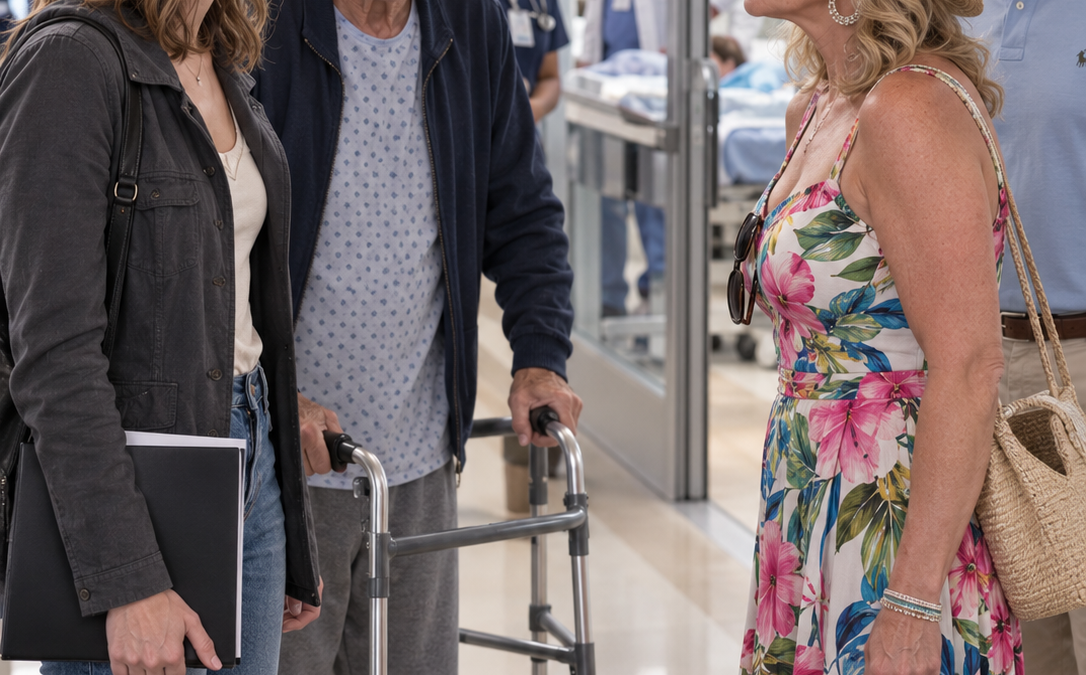
Before I could respond, Grandpa Walter emerged from the elevator using a hospital-issued walker, his discharge paperwork clutched in trembling hands.
“Sharon,” he acknowledged his daughter flatly. “Quite a homecoming.”
My mother’s attention pivoted, cataloging her father’s condition with visible dismay.
“Daddy, what happened to you? Why are you in a hospital gown?”
“Complications from my missed medications,” he replied evenly. “The ones Ethan took before overdosing.”
“This is ridiculous,” my father interjected. “Everyone’s overreacting. Ethan made a mistake.”
“A mistake that nearly killed him,” I interrupted, “and exposed years of enabling that’s destroying him.”
A hospital security officer, Officer Martinez, appeared, responding to the escalating voices.
“Everything all right here, folks?”
My mother’s public facade instantly replaced her raw emotion.
Sweet smile. Modulated voice.
“Just a concerned family, Officer. Our son is recovering upstairs.”
“Perhaps this conversation should continue somewhere private,” he suggested pointedly.
The hospital chapel provided neutral territory, empty at midmorning on a Wednesday. Its interfaith symbols watched our family implode beneath the stained glass.
I positioned myself protectively beside Grandpa Walter, noting his increased tremor and fatigue.
“You stole my savings,” I stated without preamble once the door closed behind us. “$23,000 I’d been saving for student loans.”
“Borrowed,” my mother corrected reflexively. “It was an emergency.”
“Your Cancun vacation was an emergency?”
She flushed beneath her tan.
“Ethan needed help with some financial situations, and we deserved a break after everything we’ve dealt with.”
“While leaving your own father without food or medication,” I continued. “While expecting me to manage the crisis you created.”
“He could have called us if there was a problem,” my father deflected.
Grandpa Walter’s voice cut through the parental justifications.
“I did call. Six times. You didn’t answer.”
My mother’s expression hardened.
“This ambush is inappropriate. Ethan needs family support, not accusations and drama.”
“Ethan needs professional treatment for his addiction,” I corrected. “Not another round of enabling that nearly killed him yesterday.”
“He doesn’t have an addiction,” she insisted, the denial fundamental to her worldview. “He’s just sensitive, like your Uncle Michael was. He needs understanding, not strangers labeling him.”
The comparison—invoking her brother, who died from an overdose, as justification for enabling Ethan’s identical path—highlighted her psychological blindness.
History wasn’t a cautionary tale, but a rationale for repetition.
“Mrs. Miller.”
Dr. Evans appeared at the chapel door.
“Your son is asking for you.”
My mother seized this interruption as an escape, hurrying toward Ethan’s room with my father trailing behind.
The temporary reprieve allowed Grandpa Walter to sink onto a bench, exhaustion evident in his slumped posture.
“She’ll never see it,” he murmured. “Sharon reconstructs reality rather than facing it.”
The observation, so insightful despite his physical deterioration, captured my mother’s fundamental character.
Confrontation wouldn’t penetrate psychological defenses constructed over decades.
Only consequences might eventually communicate what words couldn’t.
Upstairs, we found Ethan awake but subdued, his hospital bed inclined slightly.
My parents flanked him protectively, my mother stroking his hair as though he were still a child rather than a 19-year-old who’d nearly died from voluntary substance abuse.
“The doctor says you can come home tomorrow,” she announced triumphantly. “We’ll take care of everything.”
Ethan’s gaze found mine across the room.
Something unspoken passed between us.
To my surprise, he shook his head slightly.
“I’m not coming home,” he stated quietly.
My mother’s hand froze mid-stroke.
“What?”
“I’m going to rehab,” he continued, his voice strengthening. “The Riverstone program Chloe found. I already talked to the admissions coordinator.”
“That’s unnecessary,” my father dismissed. “You made a mistake. Learned your lesson. We’re moving forward.”
“I’m an addict, Dad.”
Ethan interrupted, the admission visibly costing him.
“Have been for years. Pills mostly, but whatever works when those aren’t available.”
His hands twisted nervously in the blanket.
“I need actual help, not another chance to pretend everything’s fine.”
My mother’s expression cycled rapidly through disbelief, anger, and a calculated recalibration.
“If you really feel that way, we’ll find somewhere appropriate. A private facility with—”
“Riverstone has an opening tomorrow,” Ethan interjected. “They take my insurance, with Chloe as guarantor.”
“We’re your parents,” my mother snapped. “We make these decisions.”
“I’m 19,” he reminded her. “Legally, I decide. And I’ve decided.”
The assertion of autonomy, so foreign to our family’s dynamic, momentarily silenced the parental objections.
Ethan, perpetually positioned as incapable, had claimed agency precisely when they sought to remove it.
Grandpa Walter saw the opening.
“And while we’re discussing changes, I’m selling the house.”
“What?”
My father’s attention whiplashed between the emerging rebellions.
“You can’t.”
“It’s my house,” Grandpa stated flatly. “I’ve already contacted Robertson Realty. They’re listing it next week.”
“Where will you live?” my mother demanded, her strategy shifting from denial to practical obstruction.
“Park View Assisted Living in Portland,” he replied. “Near Chloe’s apartment. I’ve toured it virtually and submitted the application paperwork.”
“This is absurd,” my father blustered. “You’re being manipulated, both of you. Chloe’s turned you against us because she’s jealous of Ethan getting attention.”
The accusation, so wildly disconnected from reality, might have wounded me previously.
Now, it merely confirmed the dysfunction I’d recognized too late.
“Actually,” interjected Whitney Thompson, my nursing supervisor, who’d arrived unnoticed during the confrontation, “I’ve been documenting concerning behavior since I arrived.”
She held up her phone.
“Including accusations against a healthcare worker advocating for her vulnerable family members.”
My mother’s public persona instantly re-engaged.
Pleasant smile. Modulated voice.
“I’m sorry, who are you?”
“Whitney Thompson, pediatric nursing supervisor at Portland Children’s Hospital,” she introduced herself crisply. “I came to support my colleague during a family medical crisis. What I’ve witnessed raises significant concerns about elder neglect and enabling behaviors.”
“This is a private family matter,” my father attempted.
“Not when it involves potential elder abuse and medical neglect,” Whitney countered professionally. “As mandatory reporters, healthcare workers are required to document and report such concerns to the appropriate authorities.”
The introduction of external consequences—professional observation beyond family manipulation—visibly destabilized my parents’ unified front.
My mother’s practiced charm faltered.
My father’s blustering authority deflated.
Ethan seized this momentary advantage.
“I’m going to Riverstone tomorrow,” he stated firmly. “I’ve already signed the paperwork.”
“And I’m selling the house,” Grandpa Walter reaffirmed. “The decisions are made.”
My mother’s composure cracked entirely, decades of carefully constructed control disintegrating.
“You can’t do this. You’re manipulating the situation while we were away. Ethan needs us, not some facility with strangers. Daddy, you can’t possibly manage your own affairs anymore.”
“Actually,” I interjected calmly, “that’s why he’s granted me power of attorney and a healthcare proxy.”
I removed the notarized documents from my bag, legally executed yesterday.
“We’ll contest this,” my father threatened. “You’ve taken advantage of an elderly man’s confusion.”
“I’m 76, not incapacitated,” Grandpa retorted sharply. “My neurologist has documented my cognitive competence despite my physical limitations. These decisions reflect my wishes, not Chloe’s influence.”
My mother’s strategy pivoted again, her anger transforming into theatrical tears.
“After everything we’ve done for this family,” she sobbed. “This is how you repay us? Turning against your own parents?”
“You stole my savings,” I reminded her evenly. “You neglected your father’s basic needs. You enabled Ethan’s addiction until it nearly killed him. Those aren’t accusations. They’re documented facts.”
“We borrowed the money,” my father insisted desperately. “We intended to repay it.”
“With what?” Grandpa challenged. “You’ve remortgaged your house twice, maxed out your credit cards, and drained your retirement accounts. Where exactly would the repayment come from?”
Their financial house of cards, built on borrowed money, delayed consequences, and magical thinking, couldn’t withstand direct examination.
My parents exchanged glances that contained panicked recognition.
The system they’d maintained through manipulation had finally collapsed.
“What do you want?” my mother finally asked, calculations visible behind her tears. “To punish us? To take Ethan and Grandpa away? To make us suffer?”
“I want accountability,” I answered honestly. “I want Ethan to get actual help instead of enabling. I want Grandpa to receive proper care instead of neglect. I want my savings returned so I can pay my student loans.”
“We don’t have the money,” my father admitted reluctantly. “It’s gone.”
“Then you’ll create a repayment plan,” I stated. “With interest, documented legally.”
“Or what?” my mother challenged, desperation edging her voice.
“Or I’ll file police reports for financial exploitation and elder neglect,” I replied calmly. “The documentation exists. The witnesses exist. The choice is yours.”
The hospital room fell silent as decades of dysfunctional family dynamics reached an inevitable crossroads.
My parents, stripped of their familiar evasions and manipulations, faced genuine consequences perhaps for the first time in their adult lives.
Ethan broke the tense silence.
“I need help,” he said quietly. “Real help. Not another cover-up or a temporary solution. I’m going to Riverstone tomorrow, with or without your support.”
His assertion—the first healthy boundary he’d established in years—visibly impacted my mother.
Something shifted in her expression, calculation giving way to a momentary clarity.
“You nearly died,” she whispered, perhaps truly seeing her son’s condition for the first time.
“Yes,” he acknowledged simply. “And I will die if nothing changes.”
In that unguarded moment, maternal protectiveness finally aligned with reality rather than denial.
My mother’s carefully constructed narrative—a perfect family temporarily inconvenienced by minor challenges—couldn’t survive a direct confrontation with her son’s near-death experience.
“What do we do?” she asked.
The question was directed not at me, but at Ethan.
Perhaps the first time she genuinely sought his perspective rather than imposing her interpretation.
“Let me get help,” he answered. “Real help. And start fixing what’s broken, including with Chloe and Grandpa.”
My father, sensing the shifting alliances, attempted a reassertion.
“We’ll discuss options when everyone’s calmer.”
“No more. Discussions are over,” Grandpa interrupted firmly. “Decisions have been made. Ethan enters treatment tomorrow. I am selling the house and moving to assisted living. Chloe has the legal authority to ensure these changes happen.”
His gaze fixed on my parents with unexpected steel.
“Your only choice is whether you’ll accept these changes gracefully or fight them futilely.”
The ultimatum, delivered by the family patriarch they’d systematically exploited, carried an authority they couldn’t easily dismiss.
My mother’s resistant posture gradually softened into resignation.
My father’s blustering objections faded into uncomfortable silence.
Officer Martinez arrived, responding to the hospital’s request for documentation of potential elder abuse.
His presence transformed theoretical consequences into immediate reality, his official notebook recording statements that could potentially lead to criminal charges.
“We’ll cooperate,” my father finally conceded, self-preservation overriding his resistance. “Whatever repayment plan you think is fair.”
I pressed, securing a commitment while the leverage existed.
“And Ethan’s treatment?”
“If that’s what he wants,” my mother agreed reluctantly, glancing at her son with something approaching genuine concern.
The confrontation hadn’t produced a magical transformation or a tearful reconciliation.
Those belong to fiction, not the messy reality of family dysfunction.
But it had established boundaries, consequences, and the initial steps toward accountability.
Not healing yet, but the preconditions for its possibility.
As Officer Martinez completed his report and my parents retreated to process their diminished authority, Ethan caught my gaze across the hospital room.
“Thank you,” he said simply. “For not giving up on me.”
“Never,” I promised.
The single word encompassed a complicated truth.
I hadn’t enabled him like our parents, but neither had I abandoned him to their dysfunction.
The middle path of loving accountability offered our only chance for genuine healing.
Three days after finding Grandpa Walter alone with that sandwich, reading that callous note on the refrigerator, everything had changed.
Not through a magical intervention or a single theatrical confrontation, but through a steady commitment to necessary boundaries and consequences.
The journey ahead remained long and uncertain.
Ethan’s recovery would include setbacks alongside progress.
My parents might revert to manipulation once the immediate pressure faded.
Grandpa’s health would continue declining despite his improved circumstances.
But for the first time in our family’s history, we faced reality together rather than enabling a collective denial.
The foundation, however fragile, had been established for something healthier to build upon.
That night, as Grandpa Walter slept soundly in his hospital room and Ethan prepared mentally for his treatment admission tomorrow, I finally allowed myself genuine rest.
Not because the problems were solved, but because appropriate boundaries meant I no longer carried everyone’s burdens alone.
Here is the lesson.
Sometimes the most loving thing you can do for your family is to stop saving them from the consequences of their own actions.
Establishing firm, clear boundaries isn’t an act of cruelty. It’s an act of profound love for both yourself and for them.
It creates the space where real growth and healing can finally begin.
Enabling may feel like kindness in the moment, but it’s a slow poison that prevents anyone from getting better.
True strength lies in holding people accountable even when it’s the hardest thing you’ll ever do.
Have you ever had to set difficult boundaries with family members? I’d love to hear your experiences and what you learned in the comments below.
If this story resonated with you, please like and subscribe for more authentic conversations about family dynamics.
Remember that healing is rarely linear, but with courage and boundaries, it’s always possible.
Thank you for joining me on this journey, and I wish you strength in your own path toward healthier relationships.