Never trusted my parents with my bank account. but they used a 20-year power of attorney to drain $120,000. at the teller window, my lake house died. fortunately, the manager set a trap. i watched them get caught. family lost everything.
The smile vanished. Her fingers stopped moving. She squinted at the screen, tapped a few more keys, and then her face went pale. She didn’t look at me. She looked at the partitions separating her from the drive-through tellers.
“Is there a problem?” I asked.
My stomach did a slow, heavy roll.
“Is the system down?”
“I—I need to get the manager,” Kayla stammered.
She stepped back from the counter, leaving my withdrawal slip sitting there like an accusation.
“Please wait here.”
She disappeared into the back office.
A minute passed, then two. I looked around the lobby. An elderly man was filling out a deposit slip. A mother was wrestling a toddler into a stroller. Everything was normal, yet the air around me suddenly felt thin.
The door to the back office opened, and Mrs. Loretta Sterling stepped out.
I knew Mrs. Sterling by reputation. She was a fixture in our town, a woman in her late 50s with steel-gray hair cut in a sharp bob, rimless glasses, and a reputation for being tough but fair.
She wasn’t smiling.
She held a file folder tight against her chest, her eyes locked on mine with an expression that terrified me. It wasn’t annoyance. It was pity.
“Maxine,” Mrs. Sterling said, her voice low and controlled. “Please come into my office.”
“What’s wrong?” I asked, my voice rising an octave. “I just need my check. The closing is at noon.”
“Come with me,” she repeated, gesturing toward her glass-walled office.
She waited until I was seated in the stiff leather chair across from her desk before she closed the door and blinds. The room went dim.
Mrs. Sterling sat down, folded her hands on the desk, and took a deep breath.
“Maxine, there is no easy way to say this. We cannot issue the cashier’s check.”
“Why not?” I demanded, leaning forward. “The funds are there. I checked the balance on the app yesterday. It was $120,450.”
“It was there yesterday,” Mrs. Sterling said gently. “But as of 9:15 this morning, the balance in your savings account is zero.”
The world tilted.
Zero.
“That’s impossible. I didn’t authorize anything.”
Mrs. Sterling turned her monitor so I could see it.
“A transfer was initiated electronically and through a signed override at our downtown branch less than an hour ago. The entire balance was moved to a joint account held by Bernice and Harold Miller.”
My parents.
I felt the blood drain from my face, leaving my hands cold and numb.
My parents took my money.
“The transfer was authorized,” Mrs. Sterling said, watching me closely. “But looking at your reaction, I’m guessing you didn’t know about it.”
I couldn’t breathe.
Thirty years of overtime. Thirty years of driving a clunker car. Thirty years of eating sandwiches at my desk.
Gone in an hour.
“I didn’t give them permission,” I whispered. “How… how could they do this?”
Mrs. Sterling’s eyes narrowed behind her glasses.
“That is exactly what we are going to find out. Because if this is fraud, Maxine, I’m not just getting your money back. I’m going to make sure the people who did this regret ever walking into my bank.”
To understand why my parents would rob their own daughter, you have to understand the Miller family dynamic. It’s a story as old as time, but that doesn’t make it hurt any less.
In the Miller household, there were two roles, and they were assigned at birth.
I, Maxine, was the provider. I was the sturdy one, the reliable one, the one who didn’t need anything because Maxine can handle it.
I started babysitting at 12, working retail at 16, and paying my own way through community college. I was the background noise of the family, the hum of the refrigerator that keeps the food cold but gets ignored until it breaks.
Then there was Arlene.
Arlene, eight years my junior, was the golden child. She was beautiful, charismatic, and completely incapable of managing her own life.
She was 44 years old now, but in my parents’ eyes, she was still a fragile porcelain doll that needed to be protected from the harsh realities of the world.
My parents, Bernice and Harold, worshiped the ground Arlene walked on.
When Arlene crashed her car at 17 because she was texting, they used my college fund to buy her a new one so she wouldn’t be traumatized.
When Arlene got evicted from her apartment at 25 because she spent her rent money on a trip to Cabo, I was forced to let her sleep on my couch for six months.
“You have so much space, Maxine,” my mother, Bernice, had said. “Why are you so selfish? She’s your sister.”
That was the word they used to beat me into submission.
Selfish.
If I bought a new coat, I was selfish because Arlene needed dental work. If I took a vacation, I was selfish because Arlene was going through a rough patch with her latest boyfriend.
For decades, I had swallowed my anger. I had played the role of the good daughter. I paid for their anniversary dinners. I fixed their roof when it leaked. I was the safety net they used so they could pour all their resources into Arlene’s endless void.
But Arlene’s failures were getting more expensive.
In her 20s, it was credit card debt. In her 30s, it was a failed bakery that cost my parents their second mortgage.
Now, in her 40s, Arlene had decided she was an influencer and a lifestyle coach. She had convinced my parents to invest in her inventory of high-end wellness products, essentially a pyramid scheme wrapped in beige packaging.
I watched from the sidelines as Bernice and Harold drained their retirement accounts to fund Arlene’s delusions.
I warned them.
God, I warned them.
“She’s going to bleed you dry,” I told my father, Harold, just last Thanksgiving.
We were in the kitchen, and I was washing dishes while Arlene held court in the living room, showing off a new designer handbag.
“You’re just jealous,” Harold had snapped, his face red. “Your sister has a vision. She’s an entrepreneur. You’ve been working the same gray desk job for 30 years. You don’t understand ambition.”
That hurt.
My gray desk job was the reason I had a fully funded 401(k) and a savings account ready to buy a home. My gray desk job was the reason they called me whenever their car broke down.
But I kept my mouth shut.
I kept saving.
I kept dreaming of the lake house.
It was my escape plan.
I told myself that once I bought the house, I would move an hour away. I would be unavailable. I would finally cut the cord.
I just didn’t realize that they were watching me, too.
They saw my stability not as a virtue, but as a resource—a resource they felt entitled to harvest.
Sitting in Mrs. Sterling’s office, the memory of a specific dinner two weeks ago came flooding back. It was the night the trap was set, though I was too blind to see it.
The signs were there: the desperation in my mother’s eyes, the aggressive silence of my father.
They weren’t just asking for help that night.
They were testing the lock on the vault.
It was a Sunday, two weeks before the incident at the bank. Bernice had called me three times that morning, insisting I come over for a family meeting.
Her voice had that frantic, breathless quality that usually meant Arlene had done something illegal or expensive.
When I arrived at their split-level house in the suburbs, the atmosphere was thick enough to choke on. The curtains were drawn. The television, usually blaring Fox News, was silent.
Arlene wasn’t there.
It was just Bernice and Harold sitting at the kitchen table with untouched cups of coffee.
“Sit down, Maxine,” Harold said.
He didn’t look at me. He was staring at a stack of unopened mail—past-due notices, I assumed.
I sat.
“Where’s Arlene?”
“She’s resting,” Bernice said, dabbing her eyes with a tissue. “She’s in a very bad place, Maxine. A very dark place.”
“What happened now?” I asked, checking my watch. I had plans to meet my realtor later.
“The business,” Harold grunted. “The inventory didn’t sell. The suppliers… they aren’t nice people, Maxine. They aren’t regular banks. She borrowed money from private lenders.”
“Loan sharks.”
My stomach turned.
“How much?”
Bernice looked at Harold, then at me.
“$100,000.”
I laughed.
I couldn’t help it. It was a bark of pure disbelief.
“She borrowed a hundred grand for essential oils and yoga mats? Are you insane?”
“Don’t you dare laugh!” Bernice slammed her hand on the table. “These people are threatening her, Maxine. They said they’d hurt her. They said they’d come to the house.”
“Then call the police,” I said calmly.
“We can’t,” Harold said, his voice trembling. “There are complications. The contracts she signed… it’s messy. If we go to the police, Arlene could end up in jail for fraud.”
Of course.
It wasn’t just debt.
It was criminal stupidity.
“So pay them,” I said, crossing my arms. “Sell the RV. Sell the boat.”
“We already did,” Harold whispered. “It’s gone. All of it. The equity in the house, the 401(k). We have nothing left.”
A chill went down my spine.
My parents, who had worked for 40 years, were destitute because of Arlene.
“Then I don’t know what to tell you,” I said, standing up. “She’s 44. She made her bed.”
“Sit down!” Bernice shrieked.
It was a sound I hadn’t heard since I was a teenager.
“We know you have the money, Maxine. We know you’re buying that house.”
I froze.
I hadn’t told them about the lake house.
I had been so careful.
“How do you know about that?”
“Aunt Roberta told us,” Bernice said, wiping her nose. “She said, ‘You’ve been bragging about having over $100,000 in cash ready for a down payment.'”
I mentally cursed my aunt Roberta.
“That is my retirement,” I said slowly. “That is my home. That is my life.”
“Your sister’s life is in danger!” Bernice cried, reaching across the table to grab my hand.
Her grip was clammy and desperate.
“Maxine, please. You’re the strong one. You always figure it out. Just give us the money. You can save again. You have a good job. Arlene has nothing. If you don’t help, she’s dead.”
Harold looked up, his eyes pleading.
“It’s just a loan, Max. We’ll pay you back. I promise. Once the market turns around.”
They were delusional.
There was no market.
There was no payback.
They were asking me to throw my future into the incinerator to buy Arlene another six months of freedom.
For the first time in my life, I looked at my parents and didn’t feel the crushing weight of obligation.
I just felt tired.
I looked at the kitchen where I had cooked thousands of meals, the table where I had done my homework alone while they cheered for Arlene at talent shows.
“No,” I said.
The word hung in the air, heavy and absolute.
Bernice blinked.
“What did you say?”
“I said no,” I repeated, my voice steady. “I am not giving you my money. I am not bailing Arlene out again. I have bailed her out of credit card debt, car accidents, and evictions. I have given you thousands of dollars over the years, but this—this is my future. I am 52 years old. I am not starting over.”
“You selfish little—” Harold spat.
The transformation was instant.
The pleading father vanished, replaced by the bitter, angry man I knew so well.
“You’d let your sister get hurt for a house? A vacation house?”
“It’s not a vacation house, Dad. It’s my home. And yes, if Arlene committed fraud, she goes to jail. If she borrowed money from criminals, she deals with the consequences. I am done.”
“We raised you!” Bernice screamed, standing up. “We fed you! We clothed you!”
“And I have paid you back tenfold!” I shouted back, finally losing my cool. “I bought your car, Mom. I paid for the new roof. I paid for Arlene’s rehab. I have paid my dues to this family. I am not setting myself on fire just to keep Arlene warm anymore.”
I grabbed my purse and headed for the door.
“If you walk out that door,” Bernice yelled after me, her voice dropping to a low, venomous register, “don’t you dare call us family. You are dead to us.”
I paused with my hand on the doorknob.
My heart was pounding so hard I thought it would crack a rib.
“I can live with that,” I said.
And I walked out.
I drove home shaking. I expected them to call. I expected them to show up at my apartment screaming.
But they didn’t.
For two weeks, there was silence.
Radio silence.
I thought the silence meant they were finally respecting my boundary. I thought they were figuring it out on their own.
I was so naive.
The silence wasn’t respect.
It was the quiet of a predator stalking its prey.
They weren’t fighting me anymore because they had realized they didn’t need my permission.
They just needed access.
Sitting in Mrs. Sterling’s office, the realization hit me like a physical blow.
“The power of attorney,” I whispered.
Mrs. Sterling looked up from her computer screen.
“Excuse me?”
“Twenty years ago,” I said, feeling sick. “I was 32. I was sent to Europe for a six-month work assignment. I signed a limited power of attorney so my father could handle my bills and renew my car registration while I was gone.”
Mrs. Sterling’s face hardened.
“And you never revoked it.”
“I—I thought it expired,” I stammered. “It was for a specific time period. Or at least I thought it was. When I came back, I took my checkbook back, and we never talked about it again. I changed banks for my checking account, but this savings account—the lake account—I’ve had it at this bank since I was 18.”
Mrs. Sterling typed furiously.
“If they presented a document that didn’t have a specific expiration date, or if the teller didn’t check the date closely… Maxine, did you sign a formal revocation form?”
“No,” I said, tears finally spilling over. “I trusted them. They’re my parents.”
Mrs. Sterling stopped typing.
She spun her chair around to face me.
“They used an old document to impersonate your authority. They came into the downtown branch where they aren’t known, found a junior teller, and drained you dry.”
“So it’s gone,” I sobbed, burying my face in my hands. “It’s legal. They had the paper. I’m destitute.”
“It might be legal on paper,” Mrs. Sterling said, her voice turning into cold iron. “But it is predatory. And lucky for you, Maxine, I happen to be the regional manager, not just a branch manager, and I know exactly where that money is right now.”
Mrs. Sterling stood up and walked to the window, peering out through the blinds.
“The transfer was initiated at 9:15 a.m. Because it is a large sum, over $10,000, it triggers a federal reporting requirement. It also has to clear our internal fraud division before it actually leaves the bank’s ledger and settles in their account.”
She turned back to me, a glint of something dangerous in her eyes.
“The money hasn’t left the building yet, Maxine. It’s in digital limbo. It’s sitting in a pending status until 11:00 a.m.”
I looked at the clock on the wall.
It was 10:25 a.m.
“Can you stop it?” I begged. “Just cancel it.”
“If I cancel it without cause, they can sue the bank,” Mrs. Sterling said pragmatically. “They have a signed POA. Technically, they acted as you. If I reverse it, I need proof that you are revoking that POA now and that this transaction is disputed.”
She paused, tapping her chin.
“But more importantly, if I just reverse it, they will try again, or they will come after you legally. We need to end this today.”
“What do you suggest? We catch them?”
Mrs. Sterling said, “I’m going to call them. I’m going to tell them there is a snag with the verification of the transfer because of the age of the document. I will tell them they need to come in person to this branch to verify their identities so we can release the funds immediately.”
“They’ll come,” I said bitterly. “For that money, they’d run through fire.”
“Exactly.”
Mrs. Sterling smoothed her blazer.
“And when they get here, we will have a conversation.”
“I can’t face them,” I said, shrinking into my chair. “I can’t handle the screaming.”
“You won’t have to handle anything,” Mrs. Sterling said. “I am going to handle it. You just need to sit there and witness it. Are you brave enough for that, Maxine? To save your house?”
I thought about the lake.
I thought about the peace I had been working toward for 30 years. I thought about Arlene laughing at me for driving an old car while she spent my inheritance.
I sat up straight.
I wiped my face.
“Make the call.”
Mrs. Sterling picked up the phone.
She put it on speaker.
I held my breath.
“Hello?”
It was Bernice. Her voice sounded high, jittery.
“Good morning, Mrs. Miller. This is Loretta Sterling, branch manager at First Merchants Bank on Main Street.”
“Is—is there a problem?” Bernice sounded terrified.
“Not a problem, just a procedural verification,” Mrs. Sterling lied smoothly.
Her voice was professional, helpful, and completely deceptive.
“We see the transfer of $120,450 initiated by your husband using a power of attorney. Because the document is dated quite some time ago, our compliance officer just needs a quick in-person signature from you and Harold to clear the hold. Otherwise, the funds might be stuck for seven to ten business days.”
“Seven days?” Bernice squawked. “No, no, we need it today. It’s an emergency.”
“I understand,” Mrs. Sterling said soothingly. “If you can get to my branch in the next 30 minutes, I can override the hold and release the funds to you by noon.”
“We’re on our way,” Bernice said. “We’re ten minutes away. We have—we have our other daughter with us, too. Is that okay?”
“Bring everyone,” Mrs. Sterling said, her eyes locking with mine. “The more the merrier.”
She hung up.
“They brought Arlene,” I whispered. “They brought her to collect the loot.”
“Good,” Mrs. Sterling said.
She opened her drawer and pulled out a form.
“While they are driving here, I need you to sign this. It is a formal revocation of all power of attorney privileges, effective immediately.”
I signed it.
The ink looked black and final.
“Now,” Mrs. Sterling said, pressing a button on her intercom. “Security. This is Sterling. I have two individuals coming in for a meeting. Harold and Bernice Miller. Please have Officer Davidson stand outside my office door just in case.”
The next 20 minutes were the longest of my life.
I sat in the corner of Mrs. Sterling’s office, out of direct sight of the door. My hands were shaking, so I tucked them under my thighs.
Mrs. Sterling typed away at her computer, cool as a cucumber.
At 10:48 a.m., I heard them.
“We’re here to see Mrs. Sterling. It’s urgent.”
It was Arlene’s voice—loud, entitled, demanding.
The door swung open.
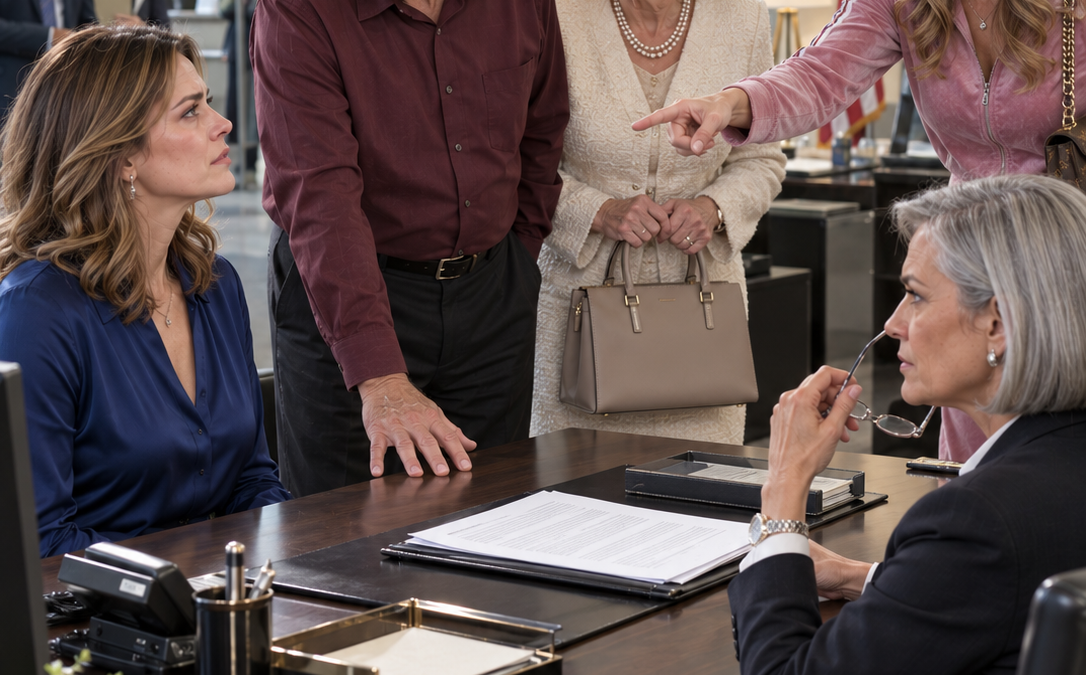
Mrs. Sterling didn’t stand up. She just gestured to the chairs.
“Mr. and Mrs. Miller.”
Then she looked at Arlene.
“Arlene. Their daughter,” Arlene said, flipping her hair.
She was wearing a tracksuit that I knew cost more than my monthly grocery budget. She looked manic, her eyes darting around the room.
Bernice and Harold rushed in, looking disheveled. Harold was sweating. Bernice was clutching her purse like a shield.
“Where is the paper?” Harold demanded. “We need to sign it. We need the money released now.”
They hadn’t seen me yet.
I was sitting in a high-backed wing chair in the dim corner.
“Please have a seat,” Mrs. Sterling said calmly.
“We don’t want to sit,” Arlene snapped. “Just give us the money. My parents have rights.”
“Actually,” Mrs. Sterling said, “before we proceed, we need to verify the beneficiary of the account, since the account holder is present.”
Mrs. Sterling pointed a pen at me.
Bernice turned.
Harold turned.
Arlene froze.
“Maxine.”
Bernice gasped. Her face went from flushed to chalk white in a second.
“What? What are you doing here?”
“I’m banking, Mother,” I said, surprised by how steady my voice sounded. “It is my account.”
“She’s trying to stop it!” Arlene screamed, pointing a manicured finger at me. “Mom, Dad, she’s trying to kill me. She wants the loan sharks to get me.”
“Maxine.”
Harold stepped forward, his face twisting into that familiar bullying scowl.
“You ungrateful child. You came here to embarrass us after we raised you. You signed that power of attorney. It’s legal. We have the right.”
“It was for when I was in Europe, Dad,” I said. “Twenty years ago.”
“It doesn’t have an expiration date!” Harold yelled, slamming his hand on Mrs. Sterling’s desk. “I checked. It’s valid. Process the transfer, lady, or I’ll sue this bank for every dime you have.”
Mrs. Sterling didn’t flinch.
She slowly removed her glasses and set them on the desk.
“Mr. Miller,” she said, her voice dropping to a temperature that could freeze helium, “I think you have misunderstood the purpose of this meeting.”
“We’re here to sign the release,” Bernice cried.
“No,” Mrs. Sterling said. “You are here so I could tell you face-to-face that I have just flagged your accounts—all of them—for suspicious activity.”
The room went silent.
“What?” Arlene whispered.
“The transfer you initiated has been canceled,” Mrs. Sterling said. “The funds have been returned to Maxine’s account. Furthermore, I have placed a victim-of-fraud alert on Maxine’s profile. No one can access her money without her being physically present with a government ID.”
“You can’t do that!” Harold roared. “I have the power of attorney.”
“And Maxine has just revoked it.”
Mrs. Sterling held up the paper I had signed.
“But that’s the least of your problems, Mr. Miller.”
Mrs. Sterling leaned forward.
“Using a 20-year-old document to liquidate a vulnerable person’s life savings against their known wishes, attempting to circumvent banking protocols by going to a different branch—that is called elder financial abuse. Although, in this case, it’s just plain theft.”
“She’s our daughter!” Bernice wailed. “It’s family money. We needed it for Arlene.”
“It is not family money,” Mrs. Sterling snapped. “It is Maxine’s money. And here is where we stand. I have frozen the $120,000, but Mr. and Mrs. Miller, I have also administratively frozen your joint checking account at this bank pending an investigation into fraudulent use of banking instruments.”
“You froze our money?”
Harold looked like he was having a stroke.
“We have bills. We have—”
He looked at Arlene.
“We have to pay them today.”
Arlene shrieked.
“They’re coming for me!”
“Then perhaps you should have gotten a job instead of stealing your sister’s retirement,” Mrs. Sterling said.
I had never loved a stranger more than I loved Mrs. Loretta Sterling in that moment.
“Maxine.”
Bernice threw herself at my knees.
She actually fell to the floor and grabbed my legs.
“Maxine, stop her. Tell her it was a misunderstanding. Tell her we had permission. Arlene will be hurt. They’ll break her legs.”
I looked down at my mother.
I saw the tears, the terror.
But for the first time, I saw what was underneath.
She wasn’t crying for me.
She wasn’t sorry she stole from me.
She was sorry she got caught.
She was willing to bankrupt me, ruin my old age, and destroy my dreams just to keep Arlene from facing the consequences of her own actions.
“Get up, Mom,” I said coldly.
“Please, Max.”
Arlene was crying now, ugly sobbing.
“I’m sorry. I’m sorry. Just give me the money. I’ll pay you back. I swear.”
“You’ve never paid back a dime in your life,” I said.
Mrs. Sterling stood up.
“Here are your options. Option A: Maxine presses charges for attempted grand larceny and fraud. I hand over the security footage and the documents to the police, who are currently waiting in the lobby.”
My parents whipped their heads around to look at the door.
Through the glass, they could see a uniformed officer talking to the receptionist.
“Option B,” Mrs. Sterling continued. “You sign a document right now admitting that the withdrawal was unauthorized. You agree to a permanent ban from First Merchants Bank. We close your accounts, cut you a cashier’s check for your remaining balance, which I see is only about $400, and you leave. And you never, ever contact Maxine again.”
The silence in the office was heavy, broken only by Arlene’s ragged breathing.
“Maxine,” my father hissed, his voice trembling with rage. “If you do this, if you let this happen, you have no father. Do you understand? You are an orphan.”
“I’ve been an orphan for a long time, Dad,” I said. “I just didn’t realize it until today.”
“You’re killing your sister,” Bernice sobbed.
I looked at Arlene.
She didn’t look like a victim.
She looked like a parasite that had finally run out of host.
“Arlene is an adult,” I said. “She can figure it out. Or you can sell your furniture. Or you can deal with the loan sharks. But you are not taking my house.”
I turned to Mrs. Sterling.
“Option B. But I want a restraining order included in the police report if they ever come near me.”
“We aren’t doing the police report if they sign Option B,” Mrs. Sterling corrected gently. “But if they harass you, we release the evidence. Do we have a deal?”
Harold looked at me with pure hatred.
He snatched the pen from Mrs. Sterling’s desk.
He signed the admission of guilt with such force the paper ripped.
Bernice signed it too, weeping the whole time.
“Get out,” Mrs. Sterling said. “The teller at the front has your check for $412. Your accounts are closed.”
They scrambled out of the office.
Arlene lingered for a second, looking at me.
“I hope you rot in that lake house,” she spat.
“I intend to,” I replied.
They left.
I watched them argue with the teller, take their meager check, and walk out into the bright sunlight.
I watched my family disintegrate through a glass wall.
When they were gone, Mrs. Sterling sat back down and let out a long breath. She opened her drawer and pulled out a tissue box, sliding it toward me.
“You did good, Maxine.”
“I feel like I’m going to throw up,” I admitted.
“That’s normal. It’s the adrenaline leaving your body.”
She typed a few keys.
“Your funds are fully restored. The hold is lifted. I can cut that cashier’s check for your house closing now.”
I nodded.
“Please.”
She printed the check.
$120,000.
It was a piece of paper, but it felt heavier than lead.
It was the price of my freedom.
“Mrs. Sterling?” I asked as I stood up to leave.
“Call me Loretta.”
“Loretta, thank you. You saved my life today.”
“No.”
She shook her head, a small, sad smile playing on her lips.
“I just froze the account. You saved yourself. You finally said enough.”
Three years passed.
The first year was the hardest.
The silence was deafening.
Every time my phone rang, I jumped, thinking it was them.
But it never was.
I had changed my number, blocked their emails, and moved an hour away to the lake.
I threw myself into the house.
It was a fixer-upper, a small A-frame right on the water. I spent my weekends sanding floors, painting walls a soft sage green, and planting hydrangeas.
I learned to use a power saw.
I learned to kayak.
I learned to breathe.
I retired early at 54. It was tight, but with the house paid off and my frugality, I made it work.
I found a part-time job at the local library just for social interaction. I made friends—real friends, not people who wanted something from me.
I heard snippets of news about my family through the grapevine, mostly from Aunt Roberta, who couldn’t help herself.
The news was never good.
Without my savings to plunder, the loan sharks, who turned out to be a very litigious, predatory lending company, not mafia breakers, had sued Arlene.
My parents had sold their house, the house I grew up in, to pay her legal fees and settle the debt.
They were living in a two-bedroom rental apartment now.
Harold had to go back to work as a greeter at a hardware store at age 75.
Bernice was cleaning houses.
And Arlene? She had moved in with them, dragging her chaos into their small apartment, refusing to work, blaming the world for her misfortune.
They were miserable.
They were broke.
And they were still stuck in the same toxic cycle they had built.
Sometimes I felt a pang of guilt.
I would sit on my dock, watching the sunset over the water, and think about my elderly parents scrubbing toilets and standing on concrete floors.
But then I would remember the look in my father’s eyes when he tried to steal my life.
I would remember Bernice tackling me to the ground to save Arlene.
And I would take a sip of my tea and let the guilt float away with the current.
It was a Tuesday in October.
The leaves were turning brilliant shades of orange and gold.
I was in my front yard raking leaves, wearing an old flannel shirt and muddy boots, when a car pulled into my gravel driveway.
It was a rusted sedan, sputtering and coughing smoke.
My heart stopped.
I knew that car.
It was the one I had helped them buy ten years ago.
The driver’s door opened, and Bernice stepped out.
She looked shocking.
She had aged 20 years in three.
Her hair was thin and white. Her clothes hung loosely on her frame, and she walked with a stoop.
She didn’t look like the monster who had screamed at me in the bank.
She just looked like a tired, broken old woman.
I leaned on my rake, watching her.
I didn’t walk to the gate.
I didn’t smile.
She stopped at the edge of my property line, gripping the wooden fence.
“Maxine.”
Her voice was a rasp.
“Bernice,” I said.
I couldn’t call her Mom.
Not anymore.
“It’s a beautiful house,” she said, looking past me at the cabin. “You did a good job.”
“I did.”
She shifted her weight.
“Your father… he’s not doing well. His heart. The stress.”
I said nothing.
“Arlene left,” she whispered. “She met a man online. Moved to Florida. She stole your father’s Social Security check before she left. We have nothing, Maxine. The rent is due. We’re going to be evicted.”
She looked at me, her eyes filling with tears.
“We’re your parents. We made a mistake, but we’re suffering. Can’t you… can’t you help us? Just a little, for old times’ sake?”
I looked at this woman who had used me as an ATM for decades.
I looked at the hands that had signed a fraudulent document to ruin me.
I felt a profound sense of sadness.
Not for me, but for them.
They had bet everything on Arlene, and they had lost.
“I can’t help you,” I said softly.
“You have this house,” she cried, a flash of the old anger surfacing. “You have land. You could let us stay in the guest room. You could give us a few thousand.”
“I could,” I agreed. “But I won’t.”
“How can you be so cruel?” she wept.
“It’s not cruelty, Bernice,” I said, gripping the rake handle. “It’s consequences. You chose Arlene. You chose to steal from me. You made your choice that day in the bank. You burned the bridge. You don’t get to cross it just because you’re cold now.”
She stared at me, her mouth open.
She was waiting for me to crack.
She was waiting for the beautiful daughter to surface.
But that daughter was gone.
She had died in Mrs. Sterling’s office.
“Go home, Bernice,” I said. “I have leaves to rake.”
I turned my back on her.
I heard her sobbing.
I heard her calling my name.
But I didn’t turn around.
Eventually, I heard the car door slam.
The engine sputtered to life.
The tires crunched on the gravel, and the sound faded away.
I stood there in the silence of my garden.
The wind rustled the trees. A bird called out across the lake.
I took a deep breath of the crisp autumn air.
It smelled like wood smoke and water.
It smelled like peace.
I went back to raking.
I had a lot of work to do, and for the first time in my life, I was doing it all for myself.
Sometimes the hardest thing you will ever do is accept that the people who are supposed to love you are the ones hurting you the most.
Walking away isn’t about hate.
It’s about self-preservation.
Do you think Maxine was too harsh turning her mother away at the end, or was it necessary for her survival?
Have you ever had to draw a financial boundary with a family member?
How did they react?
Let me know in the comments below. If this story resonated with you, please like and subscribe for…