Nobody cheered when i built their life. but dad mocked me at the podium, so i walked out with my dignity. a stranger offered me a real table. family adopted me—legally. i never wrote the rescue check. they lost everything.
Brenda, seven years my junior, was wearing a shimmering gold cocktail dress that was perhaps a bit too short for a daytime luncheon, but as usual, she looked stunning. She didn’t have a job. Well, she had a title at our family’s logistics company, Director of Creative Vision, but no one, including Brenda, knew what that actually entailed. She was currently holding a glass of champagne, leaning against a pillar, and looking bored.
“Rosemary.”
My mother’s voice cut through the ambient jazz music. She didn’t wave. She just snapped her fingers in my direction. I hurried over, clutching my clipboard.
“Yes, Mother. Is everything all right? Is the temperature okay?”
Constance sighed, adjusting her pearl necklace.
“The lighting is too harsh near the cake. It’s washing me out in the photos. Fix it, and tell the waiters to stop circulating the crab cakes. Save them for the VIP table.”
“I can’t really adjust the sun, Mom. It’s a skylight,” I said gently. “But I’ll ask them to dim the sconces, and I’ll handle the crab cakes.”
“Good,” she said, already turning away. “Oh, and Rosemary, try to stand in the back during the toast. That suit is—well, it’s very severe. It ruins the aesthetic.”
I felt the familiar sting in my chest, a dull ache I had carried since childhood.
“Okay, Mom.”
I spent the next hour running interference. I smoothed over a dispute between the photographer and the venue manager. I helped my great-aunt Muriel find her hearing-aid battery. I ensured that my father’s favorite scotch was restocked.
By the time the guests were seated for the speeches, I was exhausted. I hadn’t eaten a bite of the food I had paid for—not with my money, but with my labor.
The clinking of a spoon against a crystal glass silenced the room. My father stood up at the head table. The room erupted in polite applause. He beamed, raising his hands for silence.
“Thank you. Thank you all for coming,” Clifford boomed, his voice rich and confident. “Forty years. Can you believe it? Constance hasn’t aged a day. And I—well, I’ve just gained a few pounds of wisdom.”
The crowd chuckled.
I stood near the kitchen doors as instructed, watching from the shadows.
“We built a life from nothing,” Clifford continued. “We built a business, Cliffcon Logistics, that serves this entire state. But our greatest achievement isn’t the business. It’s our family.”
He looked down at the table where Brenda was sitting. She smiled, looking appropriately demure.
“Our daughter Brenda,” he said, his voice softening. “Beautiful, spirited, full of life. She reminds me so much of her mother. She brings the sparkle to our lives and the fresh ideas to the boardroom. Stand up, sweetheart.”
Brenda stood up, did a little wave, and the room applauded enthusiastically. She had never spent a full day in the boardroom in her life.
Then Clifford went on, his tone shifting slightly, becoming more jocular.
“We have Rosemary.”
He gestured vaguely toward the back of the room. Heads turned. I froze.
“Rosemary is our—well, she’s the worker bee.”
He laughed, and it wasn’t a kind laugh.
“She’s married to her desk. I keep telling her, ‘Rosemary, if you smiled more and worked less, maybe you’d find a husband instead of just finding shipping errors.’”
A ripple of uncomfortable laughter went through the room. My stomach dropped.
“But hey,” he continued, emboldened by the reaction, “someone has to keep the lights on so the rest of us can shine, right? Look at her back there. Probably checking her watch to see when she can get back to the spreadsheets. No sense of fun, that one, but we keep her around because she’s cheap labor.”
He laughed loudly at his own joke.
My mother was laughing too, dabbing her eyes with a napkin. Brenda was smirking behind her champagne flute.
Something inside me snapped.
It wasn’t a loud snap, like a bone breaking. It was a quiet, final severing, like a thread that had been pulled too tight for too long.
I looked at the clipboard in my hand. I looked at the gift table, where a box containing a vintage watch I had spent three months tracking down for my father sat beautifully wrapped in silver paper.
I realized with absolute clarity that I was not a daughter to them. I was an employee they could humiliate for sport.
I didn’t storm the stage. I didn’t scream. I simply placed the clipboard on the nearest waiter’s tray. I walked over to the gift table, picked up the silver box, and tucked it under my arm.
“Miss,” the waiter whispered. “Where are you going? They’re about to serve the main course.”
“I’m resigning,” I whispered back.
I turned and walked out the double doors, the sound of my father’s booming laughter fading behind me. I walked straight to my car, threw the gift into the passenger seat, and drove away.
I didn’t look back.
That was the last time I saw the inside of that country club. And it was the first moment of the rest of my life.
My hands were shaking so hard I could barely grip the steering wheel. I drove without a destination in mind for the first ten minutes, just needing to put physical distance between myself and the sound of that laughter.
The humiliation burned on my skin like a sunburn. It wasn’t just the words. It was the casualness of it. It was the fact that my father thought degrading me in front of our city’s elite was a bonding experience for everyone else.
I found myself heading north, away from the suburbs and toward the city limits, where the noise of traffic gave way to the quiet of the Greenwood Arboretum. It was a place I used to go in college when the pressure became too much.
I parked my modest sedan in the nearly empty lot—most people were at football games or family lunches on a Saturday afternoon—and just sat there, staring at the hood of the car.
The engine ticked as it cooled, and in the silence, the memories I had suppressed for decades began to flood in.
It was like a dam had broken.
I thought about my high school graduation. I was valedictorian. I had prepared a speech about hard work and dedication. When I walked across the stage, looking for my parents in the front row where I had reserved seats, the chairs were empty.
They arrived 20 minutes after the ceremony ended.
Brenda, who was ten at the time, had thrown a tantrum about her shoes hurting, so they had stopped to buy her ice cream to calm her down.
“Don’t be dramatic, Rosemary,” my mother had said when I cried. “We’re here now. Take a picture.”
I thought about my 30th birthday. I had invited them to dinner at my apartment. I cooked a roast. I waited until midnight.
They never showed up.
The next day, Brenda called to tell me that she and Mom had gone on a spontaneous shopping trip to New York and lost track of time. There was no apology, just a request for me to pick up Dad’s dry cleaning because Mom wasn’t back yet.
But the professional abuse was the most insidious.
I had joined Cliffcon Logistics straight out of business school, turning down offers from major firms because my father said he needed me.
“This is your legacy, Rosemary,” he had said.
For 20 years, I built that company. When the recession hit in 2008, I was the one who renegotiated our vendor contracts to keep us afloat. When the digital revolution happened, I was the one who implemented the tracking software that saved us millions.
My father played golf. Brenda played dress-up.
I was the vice president of operations, a title I had to beg for, while Brenda was made a director the summer she flunked out of art school. Her salary was only 10% less than mine, and she came into the office maybe twice a week to renovate the break room or plan the Christmas party—tasks she usually abandoned halfway through for me to finish.
I realized now, sitting in the cooling car, why they had invited me today.
They didn’t want Rosemary their daughter.
They wanted Rosemary the event planner. Rosemary the buffer. Rosemary the punchline.
I was 42 years old. I had a 401(k). I rarely checked. A cat named Baxter was my only confidant, and there was a distinct lack of joy. I was the responsible one, the spinster, the frumpy sister.
“God,” I said aloud, the word cracking in the empty car. “I hate them.”
Saying it felt terrifying. It felt like a sin. But as the echo faded, it also felt like the truest thing I had ever spoken.
I hated the way they made me feel small so they could feel big. I hated that I had spent my life waiting for a crumb of affection while they fed Brenda the whole cake.
I grabbed my purse and the silver gift box. Why did I even take it? Spite.
I stepped out of the car.
The air was crisp, smelling of dying leaves and damp earth. I walked toward the entrance of the arboretum. I needed to see something beautiful. I needed to see something that grew and thrived without asking for permission.
I walked past the Japanese maples, their leaves burning red and orange. I walked past the koi pond, where the fish swam lazily, indifferent to my crisis.
I found myself in the rose garden, which was mostly dormant this late in the year, save for a few stubborn blooms refusing to bow to the coming winter.
There was a wrought-iron bench beneath the trellis. It looked secluded. Perfect.
I sat down, placing the silver box next to me. I leaned my head back, closed my eyes, and for the first time in 20 years, I let myself cry.
Not a polite, silent cry.
I wept.
I sobbed until my chest hurt, mourning the little girl who tried so hard, mourning the woman who wasted so much time, mourning the family I never actually had.
I didn’t hear the footsteps on the gravel path. I was too lost in my grief.
“My dear,” a voice said, cutting through my sobs.
It wasn’t sharp or pitying. It was low, cultured, and surprisingly firm.
“You are going to ruin your silk blouse if you keep that up, and that is a very fine cut of silk.”
I jumped, hastily wiping my eyes, terrified that I had been caught making a scene. My mother’s voice echoed in my head.
Control yourself, Rosemary. You look hysterical.
I looked up to see an older woman standing a few feet away. She must have been in her 70s, but she stood with the posture of a ballerina. She wore a charcoal wool coat tailored perfectly and a silk scarf tied effortlessly around her neck.
Her hair was a striking silver bob, sharp and chic. She leaned on a cane that looked like it was made of ebony and silver.
“I—I’m sorry,” I stammered, reaching for a tissue I didn’t have. “I thought I was alone.”
“The gardens are public,” the woman said, stepping closer. “But grief is usually private. Though, frankly, holding it in causes wrinkles.”
She reached into her handbag, a vintage leather structure that looked like it had seen boardrooms in Paris, and pulled out a handkerchief.
Not a tissue. A handkerchief. White linen with blue embroidery.
She held it out to me.
“Take it. It’s fresh. I always carry two. One for me and one for emergencies.”
I hesitated, then took it. The linen was cool and smelled faintly of lavender.
“Thank you.”
“May I?”
She pointed to the empty space on the bench right next to the gift box.
“Oh, please.”
I shifted, moving the box.
“I’m Rosemary.”
She sat down with a grace that belied her age.
“I’m Gwendalyn. And that—” she pointed her cane at the silver box “—looks like a gift that was never given.”
“It was.”
“What?”
I wiped my nose.
“It’s a vintage Patek Philippe. 1958.”
Gwendalyn raised an eyebrow, her eyes sharp and assessing.
“An exquisite choice. A watch for a man who appreciates precision. Or perhaps a man who is obsessed with time.”
“A man who doesn’t deserve the time I gave him,” I blurted out.
I shocked myself. I covered my mouth.
“I’m sorry. I don’t know why I said that.”
Gwendalyn didn’t look shocked. She smiled, a small, knowing curve of her lips.
“Sometimes strangers are the best confessionals, Rosemary. We have no stake in the game.”
She turned her body slightly toward me.
“Tell me, why are you crying in a rose garden on a Saturday afternoon when you should be wearing that lovely suit to a power lunch?”
And for the second time that day, the dam broke.
But this time, instead of tears, it was words.
I told her everything. It poured out of me like a pressurized valve had been released. I told Gwendalyn about the anniversary lunch, the toast, the worker-bee comment.
I told her about the 20 years of missed holidays and the way my father took credit for the logistics tracking system I had coded with our IT team over three sleepless weekends in 2012.
“I built the cross-docking protocol that saved us 30% on fuel costs,” I said, my voice trembling with residual anger. “I negotiated the union contracts when Dad wanted to fire everyone. And today he stood up and told 150 people that I’m just the woman who keeps the lights on.”
Gwendalyn listened without interrupting. She didn’t offer empty platitudes like, “Oh, I’m sure they love you deep down.”
She listened with the intensity of a judge reviewing evidence. Her eyes, a piercing shade of gray, tracked my face.
When I finished, I felt drained. I stared at the handkerchief in my hands, now twisted into a knot.
“You’re the VP of operations at Cliffcon Logistics,” Gwendalyn stated.
It wasn’t a question.
I blinked.
“I—I didn’t say the company name. How did you know?”
“I know the industry,” Gwendalyn said smoothly. “And I know Clifford, a man with a big voice and a small vision. I’ve watched Cliffcon for years. It’s a messy ship. I always wondered who was down in the engine room keeping it from sinking. It appears I found her.”
I stared at her.
“You know my father?”
“I know of him. We run in adjacent circles—or we used to. I retired five years ago.”
She adjusted her scarf.
“My name is Gwendalyn Sterling.”
My mouth fell open.
“Sterling as in Sterling Global Distribution?”
Sterling Global was a giant. They were the premier logistics and supply chain consultancy in the Northeast. If Cliffcon was a tugboat, Sterling Global was an aircraft carrier.
“The very same,” she said. “Though my son Harrison runs it now. I just offer unsolicited advice and tend to my hydrangeas.”
I felt a sudden rush of embarrassment. I had just whined about my daddy issues to the matriarch of the most successful logistics family in the region.
“Miss Sterling, I am so sorry. I had no idea. You must think I’m pathetic.”
“On the contrary,” Gwendalyn said, tapping her cane on the pavement. “I think you are a wasted asset. And I hate waste. It offends my sensibilities.”
She reached out and tapped the silver box with her gloved finger.
“You have a vintage Patek there. That tells me you have taste and attention to detail. You built a cross-docking protocol for a midsized firm in 2012. That tells me you have foresight. And you walked out of a toxic environment today. That tells me you finally found your spine.”
She looked me dead in the eye.
“Rosemary, how much equity do you have in Cliffcon?”
“None,” I admitted, looking down. “Dad said he’d leave it to us in the will. He didn’t want to complicate the taxes by giving me shares now.”
Gwendalyn let out a short, derisive sound.
“The oldest trick in the book. The carrot on the stick. He will never give you that company. He will leave it to the pretty one, the one who reminds him of himself, and expect you to run it for her as a salaried employee until you die of a stress-induced stroke at 55.”
The brutality of her words hit me like a slap.
But it was the truth.
I knew it. I had always known it.
“What do I do?” I whispered.
“You stop being the victim,” Gwendalyn said firmly. “You have the skills. You have the knowledge. Why are you building a castle for a king who locks you in the dungeon?”
She stood up, brushing a stray leaf from her coat. She reached into her handbag again and pulled out a cream-colored business card. It was heavy stock, embossed with gold lettering.
Gwendalyn Sterling, Chairman Emeritus.
“I’m having a casual lunch at my home tomorrow. Sunday, 1:00. My son Harrison will be there, along with his wife, Audrey. Harrison has been complaining about a bottleneck in our pharmaceutical distribution arm. I think you might have some insights.”
“You want me to consult?” I asked, bewildered. “I’m still technically employed by my father.”
“You walked out,” Gwendalyn corrected. “And frankly, my dear, until you hand in a written resignation, you are just a woman having a conversation with a new friend. Come to lunch, not for a job interview, just to see what a table looks like when people actually respect the person sitting across from them.”
She looked at the silver box one last time.
“And sell the watch. Buy yourself a spa day. You look tense.”
With that, she turned and walked away down the gravel path, the click-clack of her cane fading into the distance.
I sat on the bench for another hour, holding her card like it was a lifeline.
The Sterling estate was less of a house and more of a sanctuary. Located in the hills of Westover, it was a sprawling stone manor surrounded by manicured lawns that looked like they had been trimmed with nail scissors.
I pulled up to the gate at 12:55 p.m. on Sunday, my heart hammering against my ribs.
I almost didn’t come.
The voice of insecurity—my mother’s voice—had whispered that it was a trap, or a pity invite, or that I wasn’t fancy enough for the Sterlings. But then I remembered the way my father had laughed at the podium.
I put on my best casual dress, a soft blue wrap dress that I usually saved for church, and drove.
A housekeeper opened the door.
“Ms. Rosemary, please come in. Mrs. Sterling is in the sunroom.”
The house smelled of lemon polish and fresh lilies. It was grand, yes, but it didn’t feel like a museum. There were photos on the mantel, candid shots of children laughing, a dog covered in mud, Gwendalyn holding a large fish on a boat.
It felt lived in.
I was led to a sunroom at the back of the house. It was a wall of glass overlooking a valley of autumn trees. In the center was a round oak table set for four.
Gwendalyn rose from a wicker chair. She was wearing soft linen trousers and a cashmere sweater.
“Rosemary, you came. I’m delighted.”
“Thank you for having me,” I said, handing her a bottle of wine I had picked up. “It’s not much.”
“But it’s lovely,” she said, accepting it with a smile. “Rosemary, please meet my son, Harrison, and his wife, Audrey.”
Harrison was a tall man in his late 40s with a kind face and his mother’s sharp gray eyes. He stood up immediately and extended a hand.
“Mom told me she met a logistics wizard in the rose garden. It’s nice to meet the legend.”
I blushed.
“Hardly a legend. Just a tired manager.”
“Nonsense,” Audrey said.
She was a petite woman with warm brown skin and a smile that lit up the room.
“Harrison has been stressing about this supply-chain issue all week. He needs a fresh brain.”
We sat down. The lunch was simple but delicious: roasted chicken, a kale salad, fresh crusty bread.
But what shocked me wasn’t the food. It was the conversation.
At my parents’ house, dinner was a monologue. Clifford spoke, and we listened. If we spoke, we were interrupted or corrected.
Here, it was a symphony.
“Rosemary, pass the butter, please,” Harrison asked. “So, Mom mentioned you implemented a rolling inventory system at Cliffcon. How did you handle the pushback from the warehouse managers? That’s my biggest headache right now.”
“Well,” I hesitated, “I actually spent a week working the forklift shifts with them. I realized their issue wasn’t the software. It was that the tablets were too bulky to hold while wearing safety gloves. We switched to voice-activated headsets, and efficiency went up 40%.”
Harrison stopped chewing. He looked at Audrey.
“Voice headsets? Why didn’t we think of that?”
“Because you’ve never driven a forklift, honey,” Audrey teased, patting his hand.
Harrison laughed a real belly laugh.
“Touché. Rosemary, that is brilliant.”
“It was common sense,” I said, shrugging.
“It’s not common sense,” Gwendalyn corrected gently. “It’s empathy. You looked at the problem from the perspective of the worker, not the owner. That is a rare gift.”
For the next two hours, we talked. We talked about business, yes, but also about books, about gardening, about the best place to get coffee in the city.
No one made fun of my outfit. No one asked why I wasn’t married. No one checked their watch while I was speaking.
When dessert—a homemade pear tart—was served, I felt a strange sensation in my chest. It was warmth, but it was also a profound sadness.
“Is something wrong?” Audrey asked, noticing my expression.
“No,” I said, my voice thick. “It’s just… is this what it’s like?”
“What? What is like?” Harrison asked.
“Family,” I said. “Just eating and talking and not hurting each other.”
The table went quiet.
Gwendalyn reached across and covered my hand with hers. Her skin was paper-thin but warm.
“Yes, Rosemary. This is what it’s supposed to be. It’s not always perfect. Harrison is terrible at remembering birthdays, and Audrey steals the covers, but it is safe. A family table should be a safe harbor, not a battlefield.”
I looked at these three people, strangers yesterday, yet kinder to me than the people who shared my DNA.
“I need to quit,” I said, the realization hardening into steel. “I need to really quit, not just walk out.”
“Then do it,” Harrison said. “And once you’re free, call me. Sterling Global is always looking for consultants. I’d hire you tomorrow just for the headset idea.”
“One step at a time,” Gwendalyn said. “First, you cut the cord. Monday morning. Can you do it?”
I thought of my father’s face. I thought of Brenda’s smirk. I looked at the pear tart and the kind faces around me.
“Yes,” I said. “I can do it.”
Monday morning arrived with a gray, drizzling sky that matched the atmosphere inside the Cliffcon Logistics headquarters.
I parked in my usual spot, which was notably farther from the door than Brenda’s reserved spot, despite her rarely being there. I carried a single cardboard box.
I didn’t need much.
Most of the things in my office were company property. The only things that were mine were a framed photo of my cat, a succulent Gwendalyn had told me was called a jade plant, which I bought on Sunday to celebrate my new life, and my Rolodex of personal contacts.
I walked through the bullpen. The staff looked down as I passed. They knew something had happened at the anniversary party. Gossip travels faster than light in a company like this.
I saw pity in the eyes of Mrs. Higgins, the receptionist.
I gave her a small, reassuring smile.
I walked straight to the executive suite.
My father’s door was open. He was yelling into the phone.
“I don’t care what the union rep says. Tell them overtime is mandatory if they want the Christmas bonus.”
He slammed the receiver down. He looked up and saw me. His face relaxed into a smug grin.
“Ah, the prodigal daughter returns. I assume you’re here to apologize for the little dramatic exit on Saturday. Your mother was mortified, Rosemary. Mortified.”
He leaned back in his leather chair, linking his fingers behind his head.
“But we’re willing to move past it. Brenda is upset, of course. You really rained on her parade. You should probably go buy her some flowers. Maybe organize a spa day for the two of you to make up for it.”
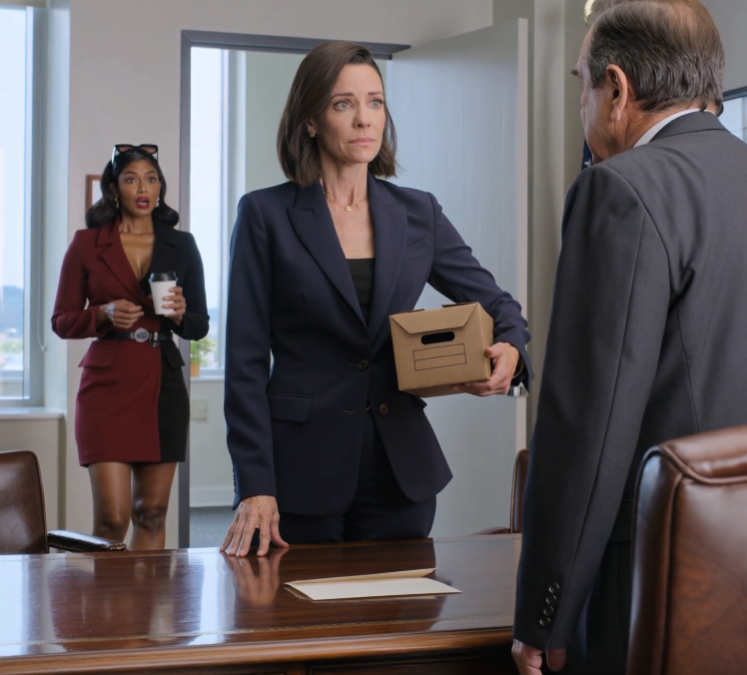
I stood in the doorway, the box in my hands.
The arrogance was breathtaking.
He truly believed I had no other option. He thought I was a fixture, like the copier or the coffee machine.
“I’m not here to apologize, Dad,” I said.
My voice was steady. Surprisingly steady.
“Oh? Then what’s the box for? Cleaning out your desk to move to the basement? I was thinking a demotion might be in order to teach you some humility.”
I walked forward and placed a single white envelope on his mahogany desk.
“I’m resigning. Effective immediately.”
Clifford stared at the envelope.
Then he laughed. A bark of a laugh.
“Resigning? Don’t be ridiculous. Where would you go? Who would hire you? You’re 42 years old, and you’ve never worked anywhere else. You’re institutionalized.”
“I’m skilled, Dad, and I’m tired.”
“You’re ungrateful,” he sneered, the smile vanishing. “I gave you a job when no one else would look twice at you. I put food on your table.”
“I put millions in your bank account,” I countered. “I fixed the supply chain. I automated the warehouse. I managed the vendors. I did your job and Brenda’s job and my job.”
“You did what you were told!” he shouted, standing up. “You are a mid-level manager at best. You are nothing without the Cliffcon name.”
Just then, Brenda walked in. She was holding a latte and wearing designer sunglasses indoors.
“Why is everyone yelling? My head hurts.”
She saw the box.
“Oh, is she finally leaving? Can I have her office? It has better light for my selfies.”
That was the nail in the coffin.
“Yes, Brenda,” I said, turning to her. “You can have the office. You can have the spreadsheets. You can have the payroll issues, the union negotiations, and the supplier disputes. It’s all yours.”
I looked back at my father.
“I’m done. My keys are on the desk. Do not contact me.”
“If you walk out that door,” Clifford threatened, his face turning red, “you are cut off. No inheritance. No family gatherings. You are dead to us.”
I looked at him, really looked at him, and saw a small, frightened bully losing his favorite punching bag.
“I was dead to you anyway,” I said softly. “I was just a ghost who paid the bills.”
I turned and walked out.
“Rosemary!” he screamed after me. “You’ll be back crawling on your knees in a week. You’ll starve!”
I kept walking past Brenda, who was already eyeing my ergonomic chair, past Mrs. Higgins, who gave me a secret thumbs-up, and out the glass doors into the rain.
I got into my car, placed my box on the passenger seat, and exhaled.
I didn’t have a job. I didn’t have a family. I didn’t have a safety net.
But as I turned the key in the ignition, I realized I had something else.
I had silence.
The screaming in my head had finally stopped.
I pulled out my phone and dialed a number.
“Sterling Global, Harrison speaking.”
“Hi, Harrison,” I said, watching the rain wash down my windshield. “It’s Rosemary, about that consulting offer. Is it too early to start on a Tuesday?”
Two years is a strange amount of time.
In the grand scheme of the universe, it’s a blink, but in a human life, it can be an entire metamorphosis.
I launched Rosemary Consulting three months after leaving Cliffcon. With Gwendalyn’s guidance and Harrison’s initial contract, I had credibility instantly.
It turned out that “mid-level manager” was a gross undervaluation of my skill set.
I wasn’t just fixing supply chains. I was fixing businesses.
I had a knack for seeing where money was leaking and plugging the holes. I rented a small, chic office downtown, a space with exposed brick and huge windows filled with plants. My jade plant had grown into a monster.
I hired an assistant, a bright young man named Leo, who actually did his job and thanked me when I paid him.
I was busy. I was successful. And for the first time in my life, I was wealthy on my own terms.
I bought a condo near the waterfront. I bought clothes that fit me and made me feel powerful, not sensible.
Meanwhile, the inevitable entropy had set in at Cliffcon Logistics.
It started slowly. Without me there to micromanage the vendor relationships, shipments started arriving late. Then the inventory software, which required weekly overrides that only I knew how to do, began to glitch.
Brenda predictably didn’t know how to fix it.
Instead of hiring a replacement for me, Clifford had arrogantly assumed Brenda could figure it out, or that he could intimidate the staff into working harder.
Staff turnover skyrocketed. The union threatened a strike. Key clients, including the regional grocery chain that was their bread and butter, began to look elsewhere.
I heard all of this through the grapevine.
The industry is small. People talk.
Then the calls started.
It was a Tuesday afternoon. I was reviewing a proposal for a tech startup when my personal cell rang.
Mom.
I hadn’t spoken to them in two years.
I stared at the screen, my heart doing a traitorous little flutter. I silenced it.
A minute later, a voicemail popped up. I debated deleting it, but curiosity is a curse.
I pressed play.
“Rosemary.”
My mother’s voice sounded shrill, stressed.
“This is ridiculous. It’s been long enough. Your father is willing to forgive you. We need you to come in this week. There’s a password for the server that Brenda can’t find. And the IRS is auditing the payroll from 2023. Call me back immediately. We’re willing to discuss a salary adjustment.”
No hello. No, “How are you?”
Just demands and a bribe.
I deleted the message.
Two days later, my father called.
“Rosemary, pick up the phone. This is childish. The business is your legacy, too. If this ship goes down, you lose your inheritance. Do you hear me? We have a crisis with the shipping manifest. Get down here.”
Delete.
Then Brenda, via text:
“Hey, Rose. Seriously, Dad is freaking out. Can you just send the password? Also, where did we keep the file for the insurance renewal? THX.”
Block.
It was satisfying, yes, but it was also tragic.
They were drowning, and they were still trying to order the water to stop rising. They couldn’t ask for help. They could only demand compliance.
I met Gwendalyn for tea that Friday. She looked frail. Her health had declined slightly over the last year, but her eyes were as sharp as ever.
“They’re circling,” I told her, stirring honey into my Earl Grey. “Cliffcon lost the Peterson account yesterday.”
“I heard,” Gwendalyn said. “Harrison picked it up this morning.”
I choked on my tea.
“You did?”
“Business is business, darling. If Clifford can’t guarantee delivery, the market corrects itself. You aren’t responsible for their failure, Rosemary. You were the only thing holding that house of cards together. You removed the foundation. Gravity did the rest.”
“I feel guilty,” I admitted. “Is that stupid?”
“It’s not stupid. It’s conditioned.”
She reached across the table.
“They trained you to be responsible for their emotions and their success. Unlearning that is harder than learning new software.”
“They want me to come back and fix the audit,” I said.
“And if you went back, would they thank you?” Gwendalyn asked. “Or would they blame you for the mess happening in the first place?”
“They’d blame me,” I said immediately.
“Exactly. Stay the course, Rosemary. You are building something real now. Don’t let the ghosts of the past haunt your new house.”
She paused, looking at me with a tenderness that always made my throat tight.
“Speaking of houses, Thanksgiving is coming up. Harrison and Audrey are hosting this year, but I insisted on the menu. We’re having you, of course.”
“I wouldn’t miss it,” I said.
“Good.” She smiled enigmatically. “Because there is a matter of some paperwork we need to discuss. Nothing bad, just housekeeping.”
I didn’t know it then, but that Thanksgiving would be the final seal on my new life.
Thanksgiving at the Sterling House was everything my childhood Thanksgivings were not.
There was no screaming about the turkey being dry. There was no passive-aggressive commentary about weight or career choices.
There was a fire crackling in the massive stone hearth, jazz playing softly on the stereo, and the smell of sage butter and laughter.
Harrison was carving the turkey with the precision of a surgeon. Audrey was teaching me how to make her grandmother’s cranberry chutney.
Even Leo, my assistant, had been invited because he had mentioned his family was out of state.
We ate until we were stuffed, telling stories and debating movies. For the first time, the holiday felt like a celebration, not an obligation.
After dinner, when the plates were cleared and we were sitting in the library with coffee and pumpkin pie, Gwendalyn cleared her throat.
She was sitting in her favorite wingback chair, a tartan blanket over her knees.
“Harrison, bring me the portfolio, please,” she said.
Harrison stood up and retrieved a leather folder from the desk. He handed it to his mother with a solemn smile.
He knew what was coming.
“Rosemary, come sit by me.”
Gwendalyn patted the ottoman near her chair. I sat down, feeling a sudden wave of nervousness.
“Is everything okay? Is it your health?”
“My health is as boring as ever.” She waved a hand. “This is about the future.”
She opened the folder. Inside were thick legal documents with blue backing.
“I have been thinking a lot about family,” Gwendalyn began, her voice slightly tremulous but strong. “I lost my husband 20 years ago. I have Harrison, and I have Audrey, and I love them more than life. But in the last two years, I have found another daughter.”
I froze, my eyes locked on hers.
“You have been a godsend to us, Rosemary. Not just in business, but in spirit. You have a kindness that the world tried to beat out of you, and yet it remains. That is a rare courage.”
She slid the papers toward me.
“This is not just a will, though I have updated that to include you. This is an adult adoption petition.”
The room spun.
“A what? Adult adoption?”
Harrison explained gently from the sofa.
“It’s a legal process. It severs your legal ties to your biological parents and establishes Mom as your legal parent. A new birth certificate is issued. You become, in the eyes of the law, a Sterling.”
“It creates a next-of-kin relationship,” Gwendalyn added. “It means that if I end up in the hospital, you can visit me as family. It means no one can contest your place at this table. It means you belong to us, if you want to.”
I stared at the papers.
Petitioner: Gwendalyn Sterling.
Adoptee: Rosemary.
Tears, hot and fast, spilled down my cheeks.
I had spent 42 years begging Clifford and Constance to just see me, to just like me. And here was this woman, this titan of industry, this elegant stranger turned savior, offering to legally bind herself to me.
“Why?” I choked out. “You don’t have to do this. I’m already here.”
“Because symbols matter,” Gwendalyn said fiercely. “And because I want to give you the one thing they never did: certainty. I want you to know, with the full weight of the law and my heart, that you are chosen.”
I looked at Harrison and Audrey.
They were beaming.
“We’ve always wanted a sister,” Audrey said, wiping her own eyes. “Harrison is tired of being the only child.”
“It’s true,” Harrison grinned. “I need someone to share the burden of Mom’s critiques of our fashion choices.”
I looked back at Gwendalyn.
Her hand was shaking slightly as she held the pen out to me.
“Will you be my daughter, Rosemary?”
I took the pen.
My hand wasn’t shaking.
For the first time in my life, I wasn’t scared of the answer.
“Yes,” I whispered. “Yes, Mom.”
I signed the paper.
And as the ink dried, I felt the last heavy chain of the past fall away.
I was Rosemary Sterling now, and I was home.
Spring arrived with a flurry of activity.
The adoption had been finalized in a quiet courtroom ceremony in February, followed by a raucous dinner at an Italian restaurant.
I had changed my name legally.
Rosemary Sterling.
It looked good on a business card.
And speaking of business cards, mine were being handed out everywhere. Rosemary Consulting had just landed a massive contract with the state to overhaul their transit logistics.
It was the kind of deal that makes headlines, which led to the letter I received in April.
The Chamber of Commerce is pleased to announce that you have been selected as the Businesswoman of the Year.
It was a prestigious honor. The luncheon was the event of the season, held at the Grand Hotel downtown. The governor would be there.
I was terrified.
“You’re going to be fine,” Audrey said, adjusting the collar of my emerald-green dress.
We were in the hotel suite getting ready.
“You look powerful. You look like money.”
“I feel like I’m going to throw up,” I admitted.
“That’s just the adrenaline,” Gwendalyn said from the sofa.
She looked frailer today, using a wheelchair for long distances, but she refused to miss this.
“You earned this, Rosemary. Every late night, every problem solved. This is your victory lap.”
We went down to the ballroom.
It was packed.
Five hundred people.
I saw competitors, clients, and local politicians.
Harrison guided us to the front table reserved for the honoree. We were seated, drinking iced tea, waiting for the program to start.
The lights dimmed.
Then I saw them.
Walking in through the side entrance, arguing with a confused usher, were Clifford and Constance.
My stomach dropped to the floor.
They looked terrible.
My father’s suit was ill-fitting. He had lost weight, and not in a healthy way. His face was gray.
My mother looked frantic. Her hair was dyed a harsh, cheap yellow that didn’t match her skin tone. She was wearing a dress I recognized from five years ago, looking slightly tattered.
They spotted me.
Their eyes lit up like wolves seeing a wounded deer.
They pushed past the usher. They didn’t have tickets. I could tell by the way they were scanning the room, looking for a weakness.
They marched straight toward my table.
“Rosemary!”
Constance’s voice was too loud in the quiet room.
“Oh, thank God. We saw the article in the paper. Businesswoman of the Year. We knew you could do it.”
She reached out to hug me.
I stayed seated, stiff as a board.
Harrison stood up, blocking her path.
“Mr. and Mrs…. I’m sorry, I don’t recall your names,” Harrison said coldly, though he knew exactly who they were.
“We’re her parents,” Clifford blustered, trying to shove past Harrison. “Get out of the way. We’re here to celebrate our daughter, and frankly, we need to have a word with her. Rosemary, tell this brute to move.”
“Rosemary doesn’t want to speak to you,” Harrison said, his voice low but menacing.
“Don’t be ridiculous,” Clifford scoffed.
He looked at me, his eyes desperate.
“Rosemary, please. The bank is foreclosing on the house. The company is in receivership. We need a bridge loan. Just a small one. You’re rich now. You owe us. We raised you. We made you who you are.”
People were staring.
The governor turned around.
The silence in the immediate vicinity was deafening.
“You owe us!” Constance shrieked, tears streaming down her face.
Tears of panic, not love.
“We’re your family. How can you let us lose everything?”
They thought they could shame me.
They thought that by causing a scene in front of my peers, I would crumble, write a check, and hide them away just to stop the noise.
That’s what the old Rosemary would have done.
But I wasn’t that Rosemary anymore.
I stood up. I smoothed my emerald dress. I looked at Gwendalyn, who gave me a single, sharp nod.
I walked around the table and stood face-to-face with the people who had made me feel small for 40 years.
The room was silent.
Even the waiters had stopped moving.
Everyone loves a spectacle, but the tension here was thick enough to choke on.
“You want to talk about what you made me?” I asked, my voice projecting clearly without shouting.
I had learned that from Gwendalyn: power whispers. It doesn’t scream.
“Rosemary, don’t make a scene,” Clifford hissed, suddenly aware of the audience. “Just write the check, and we’ll go.”
“No,” I said.
Clifford blinked.
“What?”
“No check. No loan. No rescue.”
“You ungrateful little—”
Constance started stepping forward.
“I am not ungrateful,” I interrupted her. “I am actually very grateful. You taught me resilience. You taught me how to survive in a hostile environment. You taught me that loyalty must be earned, not just expected because of shared DNA.”
“We are your parents!” Clifford bellowed, his face turning purple. “We gave you life!”
I saw the emcee approaching the microphone, looking nervous, but I held up a hand.
I wasn’t done.
“You gave me biology,” I corrected. “But you didn’t give me a life. You gave me a job. You gave me a complex. And when I stopped being useful to you, you discarded me.”
I turned to the room, then gestured to the table behind me.
“These people,” I said, pointing to Gwendalyn, Harrison, and Audrey. “They are my family. Gwendalyn Sterling is my mother, legally and emotionally.”
A gasp rippled through the room.
Constance looked like she had been slapped.
“Legally?” she whispered. “You… you let her adopt you? She’s a stranger.”
Gwendalyn stood up then.
It took effort. She gripped the table, but she stood tall.
Harrison offered an arm, but she waved him off.
She looked at Clifford and Constance with the imperious disdain of a queen looking at peasant thieves.
“I am not a stranger,” Gwendalyn said, her voice cutting through the air like a diamond cutter. “I am the woman who picked up the diamond you threw in the trash. You planted weeds in her mind for 40 years. I simply watered the flower, and look at how she has bloomed.”
She turned her gaze to Clifford.
“You had a brilliant, capable, loyal daughter, and you broke her for sport. You deserve your bankruptcy. It is the only fitting return on your investment.”
“Security?” Harrison called out, snapping his fingers.
Two large men in suits materialized from the edges of the room.
Harrison had anticipated this.
He protected his own.
“Please escort these trespassers out,” Harrison said. “They are disturbing the honoree.”
“You can’t do this!” Clifford shouted as a guard grabbed his arm. “I’m Clifford. I’m—”
“You’re leaving,” the guard said, dragging him toward the exit.
Constance looked at me one last time. Her eyes were wide, terrified, realizing the bridge was not just burned, but vaporized.
“Rosemary, please.”
“Goodbye, Constance,” I said.
The doors closed behind them, cutting off their protests.
A heavy silence hung in the room.
I stood there, heart pounding, wondering if I had gone too far, wondering if I looked cruel.
Then a single pair of hands started clapping.
It was the governor.
Then Harrison.
Then Audrey.
Then the entire room.
It wasn’t polite applause. It was a standing ovation.
They weren’t clapping for the drama. They were clapping for the boundary. They were clapping for the woman who finally stood up.
I turned to Gwendalyn.
She sat back down, looking exhausted but triumphant.
I hugged her, burying my face in her shoulder.
“I’m proud of you,” she whispered. “My daughter.”
I went up to the podium to accept my award.
I didn’t use the speech I had written.
I looked out at the sea of faces, at my new family in the front row.
“Family,” I said into the microphone, “is not defined by whose blood you carry. It is defined by who holds your hand when you are bleeding. Thank you.”
Five years have passed since that luncheon.
I am sitting on the same bench in the arboretum where I met Gwendalyn. The roses are in full bloom this time, heavy, fragrant heads of crimson, yellow, and peach.
The air smells of summer and cut grass.
It is quiet here.
Gwendalyn passed away last winter.
It was peaceful.
She died in her sleep, in her own bed, holding my hand and Harrison’s.
We buried her next to her husband.
The stone reads:
Gwendalyn Sterling, mother of Harrison and Rosemary. She built empires and families.
I miss her every day, but I don’t feel lost.
Harrison and I run Sterling Global together now. Audrey and I have sister spa days once a month. I am the cool aunt to their kids, who are now in college.
I spend my holidays surrounded by noise and love and people who actually want me there.
I heard that Clifford died a year ago, a heart attack.
I didn’t go to the funeral.
I sent a modest arrangement of lilies with no card.
Brenda sold the house to pay off the debts and moved to Florida. I haven’t heard from her, and I don’t look for her.
Some might say that’s cold.
Some might say you should always forgive family, but I learned that forgiveness doesn’t mean access.
I forgive them for being who they were—broken, selfish people.
But I will not let them break me again.
I learned that you can survive the people who are supposed to love you.
And more importantly, you can find the people who do love you.
I looked down at my wrist.
I’m wearing the vintage Patek Philippe watch, the one I tried to give my father that day.
Gwendalyn made me keep it.
“Wear it,” she had said. “To remind yourself that your time is valuable. Never give it to someone who wastes it.”
I check the time.
1:00 p.m.
I’m meeting Harrison for lunch.
I stand up, smoothing my skirt.
I am Rosemary Sterling.
I am chosen.
I am loved.
And for the first time in my life, I am free.
Thank you for reading my story. It wasn’t easy to live through, but writing it down has been its own kind of therapy.
I know I’m not alone in this.
I have a question for you all.
Have you ever had to choose your chosen family over your biological one? At what point did you realize enough was enough?
Please let me know in the comments below. I read every single one.
And if this story resonated with you, please like and subscribe to the channel so we can keep sharing these truths.
Take care of yourselves, and remember: you are worth a seat at a table where you are respected.
My name is Rosemary, and I’m signing…