No one cheered my mba—they clapped for her sash. but i didn’t beg; i walked out mid-toast. and years later, a real family chose me. from that altar, i was legally adopted. i let mom speak—then security removed her. disowned at my wedding.
Priscilla was 22, blonde, and possessed the kind of helpless beauty that made people want to do things for her. She was wearing a sash, a sash I hadn’t seen before.
“We have a surprise announcement,” my mother, Muriel, chimed in, standing up and practically vibrating with excitement. She turned her back to me to face the guests. “We didn’t want to steal the thunder, but we just got the news this morning, and we simply cannot contain ourselves. Our Priscilla has just been named first runner-up for the Miss Regional Sweetheart Pageant.”
There was scattered, confused applause. My professor, Dr. Galloway, looked at me with furrowed brows.
“Oh, stop it,” Priscilla giggled, waving a manicured hand as she glided to the front of the room, effectively blocking me from view. “It’s just runner-up, Mom.”
“Nonsense.”
Muriel beamed, clapping her hands together.
“Out of 50 girls, it is the crowning achievement of this family. We always knew you were destined for greatness, Priscilla. You are the only one who truly knows how to shine.”
The silence that followed was deafening. It wasn’t the silence of awe. It was the silence of embarrassment.
We were at a graduation party. My graduation party, celebrating an advanced degree. And my mother had just declared a runner-up beauty pageant sash the crowning achievement of the family.
“Mom,” I said, my voice barely a whisper. “This is my graduation lunch.”
Muriel turned to me, her expression shifting from radiant pride to mild annoyance, as if I were a fly buzzing around a wedding cake.
“Oh, Estelle, don’t be so dour. You have your little piece of paper. Let your sister have her moment. She’s worked so hard on her poise.”
“Her poise,” I repeated, the words tasting like ash. “I worked for three years on a thesis regarding macroeconomic shifts in postwar industrial sectors.”
“And isn’t that nice?” Reginald said, patting my shoulder with a heavy, dismissive hand. “But let’s be honest, honey. Priscilla’s win puts the family name out there. It’s public. It’s tangible. It’s, well, it’s worth praising.”
I looked around the room. I saw the pity in my colleagues’ eyes. I saw the smirk on Priscilla’s face, not malicious, just entirely self-absorbed, as if it were the most natural thing in the world for the sun to revolve around her.
And in that moment, something inside me didn’t just break. It evaporated.
The hope I had been nurturing for 25 years, the desperate child inside me begging for a crumb of validation, finally starved to death. I didn’t make a scene. I didn’t flip the table. I simply nodded, picked up my purse, and walked toward the door.
“Where are you going?” Muriel called out, her voice sharp. “We haven’t cut the cake yet. Priscilla needs to pose with it.”
“I’m leaving, Mother,” I said, not looking back. “You can pay the bill.”
The decision to leave that afternoon wasn’t impulsive. It was the inevitable collapse of a structure that had been rotting for decades.
As I drove my sedan down the familiar streets of our small town, heading toward the apartment I shared with a roommate, the highlight reel of my life played against the windshield.
I remembered being 10 years old, standing in the kitchen with a report card that boasted straight A’s. I had waited for Muriel to get off the phone, my heart pounding with anticipation. When she finally hung up, she looked at my grades, nodded, and said, “That’s fine, Estelle. Now go help your sister practice her tap routine. She has a recital, and her rhythm is off.”
That’s fine.
That was the ceiling of their praise for me. My achievements were expected, utilitarian, and boring. Priscilla’s achievements were events.
I remembered my 16th birthday. I had asked for a quiet dinner at the Italian place downtown. Instead, we spent the evening in the emergency room waiting area because Priscilla had tripped over the cat and thought she might have sprained her ankle.
She hadn’t.
But Reginald sat holding her hand for four hours, buying her vending-machine chocolates, while I sat in a plastic chair reading a textbook, entirely invisible.
When we finally got home at midnight, Muriel said, “Thank God she’s okay. We can just order pizza tomorrow. Estelle, don’t look so selfish. Your sister was in pain.”
But the memory that stung the most, the one that hardened my resolve as I pulled into my driveway that afternoon, was my high school valedictorian speech.
It was supposed to be the proudest moment of my teenage life. I stood on that stage looking out into the blinding auditorium lights, searching for my parents in the second row, where their tickets were assigned.
The seats were empty.
I found out later they were at the mall. A local talent scout was holding open auditions for a catalog shoot, and they didn’t want Priscilla to miss the window.
“We knew you’d do fine,” Reginald had said later, shrugging as he ate the celebratory dinner I had cooked myself. “You’re smart, Estelle. You don’t need us holding your hand. Priscilla needs support. She’s fragile.”
Fragile.
That was the weapon they used against me. Priscilla was fragile like a porcelain doll that needed a velvet pillow. I was sturdy like a draft horse. I was useful. I was reliable. But I was not cherished.
I walked into my apartment, the silence of the afternoon contrasting with the chaos in my mind. I didn’t cry. I think I was past the point of tears.
I went to my bedroom and pulled my suitcases out of the closet. I didn’t pack everything. I packed my clothes, my degree, my laptop, and the few books that meant something to me. I left the furniture. I left the photo albums that were filled with pictures of Priscilla, with me lurking in the background like a ghost.
My phone rang. It was Muriel. I let it go to voicemail.
Then it rang again.
Reginald.
I turned the phone off.
I wrote a check for my share of the rent for the next two months and left it on the counter for my roommate. Then I got back into my car.
I didn’t know exactly where I was going, but I knew I was driving toward a city big enough to swallow me whole. I needed to be somewhere where nobody knew the name Priscilla. I needed to be somewhere where merit actually mattered.
I drove north.
I drove until the sun went down and the gas light came on. I drove until the landscape changed from the rolling green hills of my disappointment to the steel-and-gray skyline of Philadelphia.
I had no job lined up, no apartment, and a bank account depleted by a party that had celebrated my own erasure. But as I merged onto the highway, watching the city lights twinkle in the distance, I felt the first breath of true oxygen I had inhaled in years.
I was alone, yes, but for the first time, I wasn’t second place.
I was just me.
Three years later, I had carved a life out of the granite of the city.
Philadelphia suited me. It was historic, industrious, and unsentimental. I had landed a job as a junior marketing director at a firm that appreciated efficiency and rewarded results, two things I had in abundance.
I worked 60-hour weeks, not because I had to, but because work was safe. Work didn’t promise to love you and then forget your birthday. Work was a contract. I gave them effort. They gave me a paycheck and a title.
However, the holidays were the chink in my armor.
For three years, I had successfully avoided returning home. I sent generic cards to Muriel and Reginald. I ignored Priscilla’s sporadic friend requests on social media. I told them I was too busy with the merger or traveling for a conference.
They didn’t push back. In fact, they seemed relieved to be absolved of the obligation of dealing with me.
But sitting alone in a penthouse apartment on Christmas Eve, watching snow dust the city below, has a way of hollowing a person out.
It was December 24th. The city was quiet, a rare hush falling over the usually bustling streets. I had decided to treat myself to lunch at the Barclay, one of the oldest and most elegant hotels in the city.
I put on my best cashmere coat, applied a shade of red lipstick that felt like armor, and walked the six blocks to the hotel.
The dining room was a masterpiece of mahogany and velvet, smelling of pine needles and roasting duck. It was filled with families, large boisterous tables of people passing bread baskets and laughing at inside jokes.
I felt that familiar ache in my chest, the phantom pain of an amputated limb.
“Just one for lunch, madame?” the maître d’ asked, his face a mask of professional neutrality.
“Yes, just one,” I said, keeping my chin high.
He led me to a small table near a window. It was a good table, but it felt like an island. I ordered a glass of wine and opened a book, using the pages as a shield against the festive joy surrounding me.
I was halfway through my appetizer when I felt eyes on me.
I looked up.
At the table directly across from mine sat an older couple. The woman was striking, silver hair cut into a chic bob, wearing a suit that cost more than my first car and observing me with an intensity that was piercing but not unkind.
The man beside her was reading a newspaper, occasionally pointing something out to her.
I went back to my book, feeling self-conscious.
A few minutes later, a waiter approached my table.
“Pardon me, miss,” he said softly. “The lady at the adjacent table would like to know if you would care to join them for dessert. She says she hates to see a young woman dining alone on a holiday.”
My instinct was to decline. I was Estelle the independent, Estelle the fortress. I didn’t need charity.
But then I looked over at the woman.
She smiled, a genuine, warm expression that crinkled the corners of her eyes. It wasn’t pity. It looked like an invitation.
I hesitated, then closed my book.
“Tell her. Tell her I would be honored.”
I moved my wine glass to their table. The woman stood up to greet me, extending a hand that was cool and dry.
“I’m Beatrice,” she said, her voice possessing the confident cadence of someone who was used to being listened to. “And this is my husband, Theodore. We noticed you were reading The Age of Innocence. It’s my favorite.”
“I’m Estelle,” I said, shaking her hand. “And it’s one of mine, too.”
“Please sit,” Theodore said, folding his newspaper. He had kind eyes behind wire-rimmed glasses. “Beatrice insists that eating alone on Christmas Eve is against the bylaws of the universe, and since she’s a retired judge, I’ve learned not to argue with her rulings.”
“A judge?” I asked, settling into the chair.
“Superior Court,” Beatrice said, waving a hand as if it were a minor detail. “Retired now. Theodore was an architect. Now we mostly just critique buildings and spoil our grandchildren. But tell us about you, Estelle. What brings you to the Barclay alone with Edith Wharton?”
“I… I’m working,” I lied, then stopped.
There was something about Beatrice’s gaze that demanded the truth.
“Actually, I’m not working. I just didn’t have anywhere else to be.”
“Family far away?” Theodore asked gently.
“You could say that,” I replied, taking a sip of wine. “Geographically, about four hours. Emotionally, about a million miles.”
Beatrice nodded, and she didn’t offer a platitude. She didn’t say, Oh, but family is everything.
Instead, she said, “Blood is an accident of biology, Estelle. Loyalty is a choice. It sounds like you’ve made some difficult choices.”
I stared at her.
In three minutes, this stranger had validated my life more than my mother had in three decades.
“Our son Julian will be joining us shortly,” Beatrice continued, changing the subject with graceful precision. “He’s running late, as usual. He’s a surgeon, so he has a decent excuse, but I still think he just loses track of time.”
As if on cue, a man in a charcoal coat hurried toward the table. He was tall, with dark hair swept back from a forehead that looked like it worried too much. He looked breathless and flustered.
“Mother, Father, I am so sorry,” he said, unwinding a scarf. “The traffic on Broad Street is a nightmare.”
He stopped when he saw me.
“Oh, hello. Julian, this is Estelle,” Beatrice said. “We kidnapped her. Sit down and try to be charming.”
Julian smiled, and it transformed his face from stressed to boyish.
“I’ll do my best. Hi, Estelle. I hope my parents haven’t been interrogating you.”
“Only a little,” I said.
I smiled back.
For the next two hours, I sat in that warm golden light, eating sticky toffee pudding and talking. We talked about architecture, about the ethics of law, about the marketing trends in urban development.
They listened to me.
When I spoke about my job, Theodore asked follow-up questions. When I made a joke, Julian laughed a real, deep laugh.
I wasn’t the smart sister or the plain one or the difficult one.
I was just Estelle.
And for the first time in my life, that was enough to earn a seat at the table.
That lunch should have been a singular event, a nice memory to tuck away. But Beatrice was not a woman who did things by halves.
As we were putting on our coats, she handed me a card.
“We live in Chestnut Hill,” she said. “We host Sunday dinner every week. It’s informal. Usually just us, Julian, and whoever else we drag in. I expect to see you this Sunday, 6 p.m. Don’t be late. Theodore gets grumpy if the roast sits too long.”
“Oh, I couldn’t impose,” I stammered.
“Estelle,” Beatrice said, her tone taking on that judicial weight. “I am a very good judge of character. You are intelligent, poised, and surprisingly funny. You are not an imposition. You are a refreshing addition. We’ll see you Sunday.”
I went.
I told myself I wouldn’t, but Sunday came and I found myself driving toward the affluent, leafy suburb of Chestnut Hill.
Their house was a sprawling stone manor that managed to be imposing and welcoming all at once. When I walked in, the smell of garlic and rosemary hit me.
Julian opened the door wearing a sweater and jeans, holding a glass of red wine.
“You came,” he said, sounding genuinely pleased. “Mom wasn’t sure you would. She thought she might have come on too strong with the whole judge persona.”
“It was persuasive,” I admitted, stepping into the foyer.
That first dinner was a revelation.
In my house growing up, dinner was a battlefield. It was where Muriel criticized my posture, where Reginald complained about his clients, and where we all had to listen to Priscilla talk about her hair for 20 minutes.
Here, dinner was a symposium.
Theodore spoke about a historic preservation project he was consulting on. Beatrice debated the nuances of a recent Supreme Court ruling. Julian talked about a complex surgery, but he spoke about the patient with such empathy it made my throat tight.
And they asked me questions. Real questions.
“Estelle, what do you think about the gentrification in West Philly?” Theodore asked as he passed the potatoes.
“I think it’s complicated,” I said, hesitating. “From a marketing standpoint, it’s growth. From a human standpoint, it’s displacement.”
“Exactly.” Theodore pointed his fork at me. “That tension is where the architecture fails or succeeds.”
We argued. We laughed. We debated.
I realized halfway through the meal that my shoulders, which had been up by my ears for three years, had finally dropped.
After dinner, Beatrice and I sat in the library with tea.
“You have a good mind, Estelle,” she said quietly. “It’s sharp. Who sharpened it?”
“I did,” I said. “I had to. It was the only thing I had that my sister didn’t.”
Beatrice looked at me over her teacup.
“Competition between sisters is a failure of the parents, not the children. You know that, right?”
I felt tears prick my eyes.
“I know it intellectually. Emotionally, it’s harder.”
“You’re safe here,” she said simply. “We don’t do competition. We do support. You’ll get used to it.”
I looked at this woman, this stranger who was offering me the maternal warmth I had starved for, and I was terrified.
Terrified it was a trick. Terrified I would mess it up.
“Why?” I asked. “Why are you doing this?”
“Because…” Beatrice set her cup down. “When I saw you in that restaurant, I saw myself 40 years ago, driven, solitary, and hiding a lot of pain behind a very expensive coat. Someone opened a door for me once. I’m just holding it open for you.”
Two years passed in a blur of Sunday dinners, gallery openings, and quiet evenings by the fire.
I became a fixture in the lives of the Darlingtons. I stopped waiting for the other shoe to drop. I stopped waiting for them to realize I wasn’t as charming or pretty as they thought.
Beatrice became my mentor. She taught me how to navigate the shark-infested waters of corporate politics with grace. She taught me that setting boundaries wasn’t an act of aggression, but an act of self-respect.
“You don’t apologize for taking up space, Estelle,” she told me once when I apologized for interrupting Theodore. “Men never apologize for it. Neither should you.”
Theodore became the father figure I never knew I needed. He didn’t care about beauty pageants. He cared that I knew how to change a tire and how to appreciate a flying buttress.
He read my marketing briefs and gave me genuine, constructive feedback.
And then there was Julian.
Our relationship was a slow burn. For the first year, we were just friends who sat next to each other at dinner. We texted about books and politics. He helped me move into a new condo. I helped him pick out a birthday gift for Beatrice.
But there was a shift one autumn evening.
We were walking in the garden behind the estate, the leaves crunching under our boots.
“My parents adore you, you know,” Julian said, his hands in his pockets.
“I adore them,” I said. “They saved me.”
“They think you’re brilliant,” he continued. “And so do I.”
I stopped walking.
I looked at him. Julian with his kind eyes and his gentle hands. Julian who listened when I spoke and remembered that I hated cilantro and loved vintage jazz.
“Estelle.” He stepped closer. “I know you’re guarded. I know you expect people to let you down, but I am very stubborn, and I have no intention of letting you down.”
He kissed me then.
It wasn’t fireworks and drama. It was steady. It was warm. It felt like coming home to a house where the lights were already on.
We started dating.
It was the healthiest relationship of my life. There were no games, no vying for attention.
When I got a promotion at work, Julian took me out for champagne and bragged about me to the waiter. When he lost a patient, I held him while he cried, and he didn’t pull away.
I was happy.
Terrifyingly, wondrously happy.
But happiness, I learned, makes you protective.
And I knew that somewhere four hours south, a different kind of family existed. One that would despise this happiness if they ever found out about it.
It was a Tuesday in May, three years after I had first met Beatrice and Theodore.
Julian had invited me over for lunch at the estate. The gardens were in full bloom, a riot of roses and peonies. We were sitting on the stone patio drinking iced tea. Beatrice and Theodore were there reading the paper, maintaining a comfortable silence.
Julian stood up.
“Estelle, walk with me to the rose garden. I want to show you the new trellis.”
I knew.
I think a part of me knew the moment he stood up. My heart started hammering against my ribs.
We walked to the center of the garden, where the air smelled sweet and heavy. Julian turned to me, his face serious.
“Estelle,” he said, taking my hands. “Three years ago, you walked into our lives, and you changed the temperature of this family. You made us sharper, happier, better. I don’t want to do a single day without you.”
He knelt.
He pulled out a ring, a vintage sapphire that had belonged to his grandmother.
“Will you marry me?”
“Yes,” I whispered, tears spilling over. “Yes, absolutely.”
We walked back to the patio, where Beatrice and Theodore were already popping a bottle of champagne.
They knew.
Of course they knew.
“Finally!” Beatrice laughed, hugging me tight. “I thought he’d never ask.”
The wedding planning began immediately.
It was going to be an elegant affair in Newport, Rhode Island, at a vineyard estate. But as we started drafting the invitations, a shadow fell over me.
We were sitting in Beatrice’s study looking at cardstock samples.
“The wording,” I said, staring at the sample text. “Mr. and Mrs. Reginald Vance request the honor of your presence…”
I felt sick.
“I can’t put their names on this. Beatrice, I haven’t spoken to them in five years. They don’t know I’m engaged. They don’t even know where I live.”
“Then don’t,” Beatrice said firmly. “Put your name. Put our names together with their families.”
“But technically…” I hesitated. “Convention dictates—”
“To hell with convention,” Beatrice snapped, then softened.
“Estelle, look at me.”
I looked up.
“There is another option,” she said. “I’ve been thinking about this for a while. Theodore and I have discussed it.”
She folded her hands on the desk.
“Adult adoption.”
I blinked.
“What?”
“It’s a legal process,” she explained, her lawyer mode activating. “You are an adult, so you can consent to be adopted by another set of adults. It severs the legal tie to your biological parents and creates a new one with us. A new birth certificate, a new legal standing. You would be, in the eyes of the law, our daughter.”
I sat in stunned silence.
To be legally theirs.
To erase the names of the people who had rejected me and replace them with the names of the people who had cherished me.
“Why would you do that?” I asked, my voice trembling. “I’m 30 years old. I’m marrying your son. I’m already family.”
“Because symbols matter,” Theodore said from the doorway.
He walked in and put a hand on my shoulder.
“Because we want the world to know, and because, frankly, you are our daughter, Estelle. We just want the paperwork to match the reality.”
I looked at the invitation sample again. Then I looked at Beatrice and Theodore.
“Okay,” I said, the tears coming fast now. “Let’s do it.”
The process was surprisingly simple. A few court appearances, some paperwork, and just like that, I was no longer Estelle Vance.
I was Estelle Darlington.
We tried to keep the engagement quiet, but in the age of the internet, secrets are like water. They find the cracks.
Six months before the wedding, my engagement announcement ran in The New York Times. It was a small blurb, but it mentioned Julian’s lineage and his profession. It mentioned the Darlington estate.
Two days later, my phone, which had been silent for five years regarding the Vance family, began to buzz.
First, a text from a number I didn’t have saved but recognized instantly.
Priscilla.
“So I hear you bagged a doctor. Nice of you to tell us. Mom is crying.”
Then a voicemail from Muriel.
“Estelle, it’s your mother. Mrs. Henderson from church saw your picture in the paper. We are shocked. Shocked that you would keep such news from your own flesh and blood. And he’s a surgeon. We need to talk. Call me immediately.”
I didn’t call.
I showed the messages to Julian.
“They smell money,” he said, his jaw tightening. “They don’t care about you. They care about the Darlington name.”
“I know,” I said, feeling a cold dread settle in my stomach. “They think they’ve been invited to a gala.”
The messages escalated.
Muriel: “We expect an invitation. We are the parents of the bride. We have rights. Priscilla is available to be the maid of honor. She’s done some modeling, so she knows how to handle photographs.”
Reginald: “Don’t be spiteful, Estelle. It’s unbecoming. We’re happy for you. We just want to be part of the celebration. It looks bad if we aren’t there.”
It was always about how it looked, never about how I felt.
I blocked the numbers.
But then the letters started coming to my office. Long, guilt-ridden missives about family duty and Christian forgiveness.
I sat down with Beatrice.
“They aren’t going to stop,” I said. “They feel entitled to this wedding.”
“Let them come,” Beatrice said, her eyes narrowing.
“What if they show up?”
“Let them try,” she said. “We have security. We have control. If you ban them, they become martyrs. If they come and see the reality, that you are ours, not theirs, that is a far more effective punishment.”
“I don’t want a scene,” I said.
“There won’t be a scene,” Beatrice promised. “Or rather, if there is, it will be the last one they ever make.”
The day of the wedding was perfect.
The Newport sky was a piercing blue. The ocean glittered, and the air smelled of salt and roses.
I was in the bridal suite having my makeup done. Beatrice was fastening a diamond necklace around my neck, her mother’s diamonds.
“You look regal,” she whispered. “Like a queen.”
“I feel like one,” I smiled.
Then a knock came at the door.
It was the head of security, a large man named Frank.
“Mrs. Darlington,” he said to Beatrice. “We have a situation at the main gate.”
“Let me guess,” I said, turning around. “The Vances.”
“Yes, ma’am. A man, a woman, and a younger woman. They claim to be the bride’s parents and sister. They aren’t on the list, but they are making quite a noise. They’re threatening to call the press.”
I closed my eyes.
Of course they were.
“Shall I remove them?” Frank asked.
I looked at Beatrice. Then I looked at myself in the mirror.
I wasn’t the 25-year-old girl who ran away anymore. I was a 30-year-old executive, a wife-to-be, and a Darlington.
“No,” I said, opening my eyes. “Let them in.”
“Estelle, are you sure?” Beatrice asked.
“Let them in,” I repeated. “But do not seat them in the front. Seat them in the back row, the very back. And keep a guard on them.”
“Understood,” Frank said.
“They want to see the wedding,” I said to Beatrice. “Fine. Let them see exactly what they lost.”
I walked down the aisle on Theodore’s arm.
I saw the faces of our friends, my colleagues, Julian’s family.
And then, as I passed the back row, I saw them.
Muriel was wearing a dress that was too bright and too tight. Priscilla was wearing white, an actual white cocktail dress. The sheer audacity of it almost made me laugh.
Reginald looked uncomfortable, tugging at a tie that didn’t match his suit.
They looked shocked.
Shocked to see me looking expensive, confident, and loved.
Shocked to see Theodore, a distinguished silver-haired man, walking me with pride.
When we reached the altar, the officiant began, “Who gives this woman to be married?”
Theodore’s voice rang out clear and strong.
“Her mother and I do.”
I heard a gasp from the back row.
I didn’t turn around.
The ceremony was beautiful. I focused on Julian. I focused on the vows we had written. When he kissed me, the world fell away.
But I knew the reception would be the battlefield.
We held the dinner under a massive white tent. The speeches were heartfelt.
Beatrice gave a toast that made half the room cry.
Then the DJ took the microphone.
“Ladies and gentlemen, please welcome the parents of the bride, Theodore and Beatrice Darlington.”
The room applauded.
And that was when Muriel snapped.
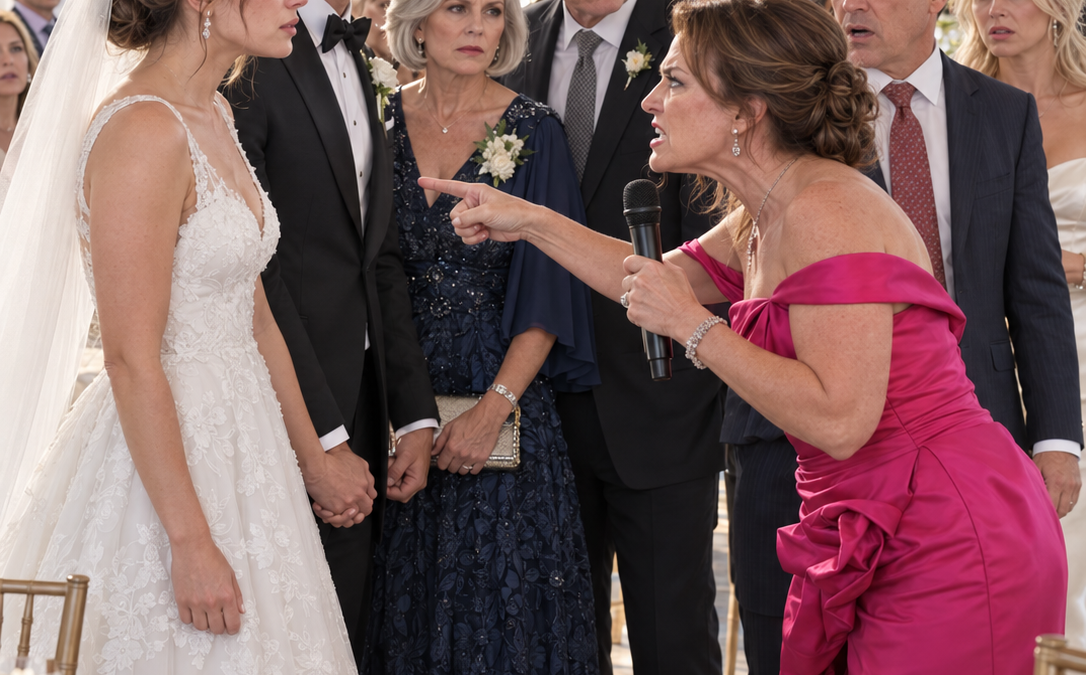
She marched across the dance floor, dragging Reginald behind her, with Priscilla trailing like a confused ghost. She grabbed the microphone from the startled DJ.
The music cut out.
The room went silent.
“Excuse me!” Muriel’s voice screeched through the speakers. “There seems to be a mistake. I am the mother of the bride, Muriel Vance, and this is her father, Reginald. Those people”—she pointed a shaking finger at Beatrice and Theodore—”are impostors.”
A murmur went through the crowd.
I stood up, my hand gripping Julian’s.
“Mom, stop,” I said, my voice projecting without a microphone.
“No, I will not stop!” Muriel shouted. “You ungrateful girl. We raised you. We fed you, and you invite us here, shove us in the back, and let these strangers take credit. After everything we did for you—”
“Everything you did for me?”
I walked onto the dance floor.
I stood five feet from her. I looked her in the eye.
“You mean ignoring my graduation to go to a modeling audition? You mean telling me my sister was the only one worth praising? You mean three years of silence while I built a life from scratch?”
“We were busy,” Muriel sputtered. “Priscilla needed us. She is delicate.”
“Priscilla is a 30-year-old woman wearing white to her sister’s wedding,” I said, glancing at Priscilla, who suddenly looked very small. “That isn’t delicate. That’s pathetic.”
The crowd gasped.
“How dare you?” Reginald stepped forward, his face red. “We are your parents. You owe us respect.”
“I owe you nothing,” I said calmly. “And actually, you aren’t my parents. Not legally.”
“What?”
Muriel froze.
Beatrice stepped up beside me. She didn’t shout. She didn’t need to.
“Estelle was legally adopted by Theodore and myself six months ago. The paperwork is filed with the state. She is a Darlington. You have no legal claim to her, and after tonight, you will have no social access to her either.”
Muriel looked at me, her eyes wide with horror.
“You… you replaced us.”
“I didn’t replace you,” I said, my voice steady, finally delivering the truth I had carried for years. “You vacated the position. Beatrice and Theodore simply applied for the job, and they were overqualified.”
The room was deadly silent.
“Now,” Theodore said, stepping up on my other side and signaling the security guards, “I believe you are trespassing at my daughter’s wedding. Please remove yourselves, or the police will be called.”
“You can’t do this,” Priscilla cried, tears finally falling. “We’re family.”
“No,” I said, looking at the three of them. “You share my DNA. These people”—I gestured to the room, to Julian, to Beatrice and Theodore—”they share my life. Goodbye, Muriel. Goodbye, Reginald.”
The security guards moved in.
They escorted the screaming Vances out of the tent.
As they disappeared into the night, the band hesitated.
“Play,” I said to the bandleader. “Play something loud.”
And they did.
The night didn’t end in ruin.
It ended in dancing.
I danced with Theodore. I danced with Julian. I danced until my feet hurt, feeling lighter than air.
Five years have passed since that night.
I never heard from Muriel or Reginald again. I suspect Beatrice might have had her old law firm send a cease-and-desist letter, but I never asked.
I didn’t need to know.
I am sitting in the sunroom of our own home now. The light is filtering through the oak trees. On the floor, my 2-year-old daughter Clara is building a tower of blocks.
Beatrice is sitting on the floor with her, cheering every time she adds a block.
“Good job, Clara,” Beatrice claps. “Look at that structure. You have your grandfather’s eye for engineering.”
Clara knocks the tower over and giggles.
Beatrice laughs with her.
“Oh, wonderful crash. Let’s build it again.”
I watch them, and I feel a profound, quiet peace.
Clara will never know what it feels like to be second best. She will never know what it feels like to have her achievements weighed against her looks.
She will grow up knowing that her worth is inherent, not conditional.
I look at the photo on the mantle. It’s from the wedding. Me, Julian, Beatrice, and Theodore laughing in the middle of the dance floor.
It is a portrait of a family built not by blood, but by choice.
There is a misconception that family is a fixed point in the universe, an unchangeable gravity. We are told that we must endure toxicity because of shared history.
But history is just what happened yesterday.
It doesn’t dictate tomorrow.
I learned that worthiness isn’t a trophy you win at a pageant. It isn’t a grade on a report card. It is the quiet certainty that you deserve to be heard, to be seen, and to be loved without fine print.
I had to walk away from the people who gave me life to find the people who would give me a life worth living.
If you are listening to this and you feel like you are standing in the shadows of someone else’s spotlight, waiting for a crumb of praise that never comes, please stop waiting.
Step out of the room.
Get in your car.
Find your own table.
There are people out there who will look at you and see the whole sun, not just the runner-up.
I found mine.
And I dare say the view from here is magnificent.
Have you ever felt like the extra in your own family’s movie? Or have you found a chosen family that understands you better than your biological one?
Let me know in the comments below. I’d love to hear your story.
And if you enjoyed this journey, please like and subscribe to support the channel.