“You’re just not wedding material,” my sister laughed as the family uninvited me again — so when i got engaged, i booked my dream venue… and sent invitations to everyone but them; the rage texts started before the cake was even cut…
I remember showing up early in a decent suit—nothing flashy, but neat—and being stopped at the door by one of the planners with a clipboard, who asked if I was Daniel, the plus-one.
I wasn’t even listed on the seating chart.
When I found my place, it was at the overflow table with the groom’s distant cousins and a few college roommates they didn’t know where to place.
During her speech, Brooke actually said, “To everyone who made today beautiful. You know who you are, and you’re sitting right here in front of me.”
I wasn’t.
I was three tables back, next to the bathroom line.
Later that night, while people were drunk-dancing and the cake was being sliced, Brooke pulled me aside. She was tipsy, glowing, and dripping with self-satisfaction.
“You know, Danny,” she said, holding her wine glass like it was a scepter, “some people just aren’t wedding material. But it’s okay. Not everyone needs the spotlight.”
She laughed, then kissed my cheek like it was a compliment, not a gut punch.
I smiled.
I always smiled.
But that night, I went home and didn’t speak to her for six months.
Fast-forward five years. I met someone.
Her name’s Laya.
She’s calm where I’m anxious, firm where I hesitate, and she looks at me like I’m enough—not someone to be polished or explained away.
We dated for three years before I proposed. Quietly. No fanfare, just the two of us on a trail overlooking the lake. She cried, said yes, and then asked the question I’d been dreading.
“Will your family be there?”
I hesitated, not because I didn’t want her to meet them—she already had—but because I knew what inviting them would mean: the same jabs, the backhanded compliments, the performative hugs.
I told her we’d think about it.
When we started planning the wedding, I kept stalling on the guest list. Laya noticed.
“Is it really that complicated?” she asked one night while highlighting vendors in a wedding magazine.
I told her the truth.
I told her about Brooke’s wedding, about the comment, about the way my family always made me feel like a side character in their play.
She listened. She didn’t judge. She just held my hand and said, “Then maybe it’s time you write your own story.”
Something in me shifted.
Not out of anger. Not yet. But clarity.
I realized I’d spent years being hurt by people who didn’t even notice the damage. They didn’t hate me. They just didn’t value me.
And I was done buying my ticket to a table I wasn’t welcome at.
We booked a venue upstate. Not flashy, but stunning. Rustic cabins, fairy lights strung between trees, a clearing for the ceremony with a view of the hills.
It felt like us.
We kept the guest list small. Laya’s friends, a few of mine, her parents, a couple of mentors, coworkers who’d become family.
I debated adding Brooke. I really did.
I even stared at the cursor blinking next to her name on the spreadsheet.
But then I remembered the smirk, the bathroom table, the “not wedding material” comment, and I deleted it.
Not in anger.
In peace.
And then I deleted the rest of them, too.
My mom, who always forgot to mention me in family updates. My dad, who called once a year to remind me how proud he was of my sister’s success. My brother-in-law, who made passive jokes about how I’d finally caught up.
We sent the invitations.
All of them.
Not a single one went to my family.
The backlash didn’t come immediately. I guess they assumed I’d just do what I always did: be quiet, be late, be thankful for a seat.
Any seat at the table.
But the moment Laya posted the save-the-date photo with her hand on my chest and the caption, “Can’t wait to say I do in the hills with the people who truly matter,” all hell broke loose.
Brooke was the first to text.
“Wait, you’re getting married?”
Then another one.
“No invite?”
Then one that just said, “Well.”
I didn’t respond.
My mom called three times the next morning. Left one voicemail.
“Daniel, this isn’t how families do things. Please call me.”
My dad emailed.
Emailed.
Who even does that?
The subject line was: A disappointment.
I didn’t open it.
And then Brooke sent the big one.
“You’re really excluding your whole family after everything we’ve done for you. Fine, but don’t come crying when you need something later. Have fun playing husband to your little boho girlfriend. Must be nice to finally feel important.”
I stared at that message for a long time.
I didn’t reply.
I didn’t need to.
For the first time in my life, I had nothing to explain.
A few days after the text storm, I got a call from my uncle Ray, the only relative I’d ever halfway trusted. He’s my mom’s older brother, a retired electrician with a sharp tongue and a heart that only shows itself when you least expect it.
We hadn’t spoken in a while, but I answered mostly out of curiosity.
“Hey, Danny,” he said, voice gravelly like he was still clearing sleep even though it was mid-afternoon. “Listen, I know I probably shouldn’t get involved, but your mom’s been going around telling people you’re having some kind of mental breakdown. Says Laya’s got you isolated or something. You okay?”
I laughed.
I actually laughed.
“Uncle Ray, I’m fine. I’m more than fine. I just didn’t want the people who spent years making me feel invisible to sit in the front row of my wedding like they earned it.”
There was a pause.
A long one.
Then, “Good. About damn time.”
I blinked.
“Wait, what?”
“Kid,” he said, “you think I didn’t see it? Every Christmas, you’d show up with gifts for their kids and they’d act like you were the mailman. Every time you brought a girl home, they made her feel like a charity case. And don’t even get me started on what Brooke said at her wedding. I told your mother that was out of line. She said, ‘Daniel’s not the sensitive type.’ That’s when I knew she stopped seeing you as a person and started seeing you as an ATM.”
It hit me harder than I expected.
Not the insult, but the fact that someone—anyone—had noticed.
“I just wanted a peaceful wedding,” I said quietly.
“And you’re going to have one,” he replied. “You earned it. I’m not calling to guilt you, Danny. I’m calling to say thank you for finally standing up. They’re losing it not because you hurt them, but because you stopped letting them hurt you.”
That night, I told Laya what he said.
She just wrapped her arms around me and whispered, “I’m so proud of you.”
But the messages kept coming—from cousins I barely knew, from Brooke’s husband, even from my mom’s church friend who once asked if I was “the artistic one,” because apparently being single and quiet equates to painting portraits in the attic.
Each message had a different flavor. Some were veiled guilt trips. Others were flat-out rants.
But all of them boiled down to the same toxic stew.
How dare I remove myself from their narrative?
Then came the group message.
Yep. A full-on nuclear family group text.
A group chat I hadn’t seen activity in for years suddenly lit up like a Christmas tree.
My sister started it.
“Just wanted everyone to know Danny’s getting married and didn’t invite his family.”
She attached a screenshot of Laya’s save-the-date.
My mom chimed in with, “We’re all just heartbroken. It’s like we don’t even know who he is anymore.”
Then my dad, with his usual emotional finesse:
“He’s always been selfish. We just didn’t want to admit it.”
I stared at the thread for a solid ten minutes.
Not because I didn’t know what to say, but because I knew exactly what not to say.
I left the group chat without a word.
That’s when it got serious.
Brooke, unable to let go of the spotlight she thought I’d stolen, went online. She didn’t name us directly, but she posted a cryptic caption over a photo of her in a bridesmaid dress.
“When your little brother throws a wedding but forgets who helped raise him. #fakefamily #noclass.”
That one got traction.
Her friends commented things like, “Ugh, families can be the worst,” and, “You’re such a saint, Brooke.”
A few even tagged me directly.
I didn’t respond to those either.
But then Laya’s mother, bless that woman, entered the chat.
She commented, “Interesting take, especially since I’ve watched Laya and Daniel pay for everything themselves, plan everything themselves, and support each other without asking a soul for a dime. Seems like they know exactly who their real family is.”
That comment got more likes than Brooke’s post.
Now, here’s where it started getting weird.
A week before the wedding, I got a card in the mail. No return address, but I recognized the handwriting immediately.
It was my mom’s.
Inside was a three-paragraph letter scribbled in blue ink.
The first paragraph was an emotional guilt trip. How she carried me for nine months. How she stayed up with me during fevers. How she always tried her best.
The second paragraph shifted into veiled scolding. How family isn’t something you can opt out of. How I was embarrassing myself in front of the extended relatives. And how I needed to think about the image I was projecting.
And the final paragraph?
That one was the kicker.
“If you marry this girl without inviting your family, don’t bother coming back. Don’t call when you need help. Don’t expect us to welcome you at Christmas. Actions have consequences, Daniel.”
I folded the letter carefully, put it back in the envelope, and slid it into the drawer next to the old RSVP cards.
I didn’t show Laya right away, not because I wanted to protect her, but because I didn’t want her to carry the weight I’d already spent years learning to bear.
The morning of the wedding, I woke up earlier than I expected.
The air was cool, the sky overcast in that perfect, soft-photograph kind of way. Laya was getting ready in another cabin, and I had a moment to myself.
No noise. No buzzing phone. Just the hum of wind through pine trees and the scent of something fresh beginning.
And then my phone lit up.
A new number.
I almost ignored it, but something told me to answer.
It was Brooke.
“I just want to know why,” she said immediately.
No greeting.
“Why would you do this to us? To me? After everything?”
I sat down on the edge of the porch.
“You really don’t know?”
“No, I don’t. This is the most vindictive thing you’ve ever done. Not inviting your own family. You’ve humiliated us. People are asking questions. They’re wondering if something’s wrong with you.”
I let the silence stretch.
Then I said, “Brooke, you told me I wasn’t wedding material, that I didn’t belong in the spotlight. You made me feel small for years. And now that I’m finally happy, you’re upset I didn’t hand you a front-row seat to it.”
“You’re overreacting,” she snapped. “It was a joke. God, you’re so sensitive.”
There it was.
The phrase I’d heard my whole life.
“I’m not sensitive,” I said quietly. “I’m just done.”
She started to speak again, but I hung up.
And then I turned off my phone.
By the time guests started arriving, I felt lighter than I had in years. The music played. Soft laughter filled the air. And one by one, people who chose to be in my life showed up looking like joy incarnate.
Just as I stepped behind the trees, waiting for my cue to walk down the aisle, the coordinator rushed over to me, wide-eyed and breathless.
“There’s someone at the gate.”
I raised an eyebrow.
“Who?”
She hesitated.
“Your mom and your sister, and I think your dad’s parked across the road. They’re not on the list, but they’re saying it’s a family emergency.”
I stared at her, my heartbeat steady.
Then I smiled.
“Tell them the guest list is final.”
And then I walked down the aisle.
The ceremony itself was everything I didn’t know I needed.
No flower walls, no drone footage, no six-piece string quartet. Just close friends, warm glances, and the kind of vows that come from weathering storms together.
When I saw Laya walking toward me, hair braided with tiny wildflowers and that calm, radiant smile, it hit me just how far I’d come.
Not just from the awkward kid at the back table, but from the man who used to bend over backward just to be tolerated.
I didn’t think about my family at all during the vows.
Not once.
My hands weren’t shaking. My voice didn’t falter. The weight of their absence didn’t feel like a loss.
It felt like space.
Room to breathe, to stand up straight, to finally take center stage without someone rolling their eyes in the background.
The ceremony ended with cheers and laughter, and the kind of hugs that linger a little longer because the people giving them mean it.
Everyone slowly made their way to the reception area, a beautifully lit outdoor setup with long wooden tables, hanging lights, and soft music drifting through the dusk.
It looked like something out of a quiet dream. Elegant, but not pretentious. Intimate, but not small.
Then came the photographer, pulling me aside with a puzzled look.
“Hey,” she said gently. “There’s a group of people kind of lingering near the trees at the edge of the venue. They haven’t come in, but they’re watching. Do you want me to do anything?”
My jaw clenched before I even turned to look.
I already knew.
Sure enough, across the small gravel road and half-concealed behind the tree line were three figures.
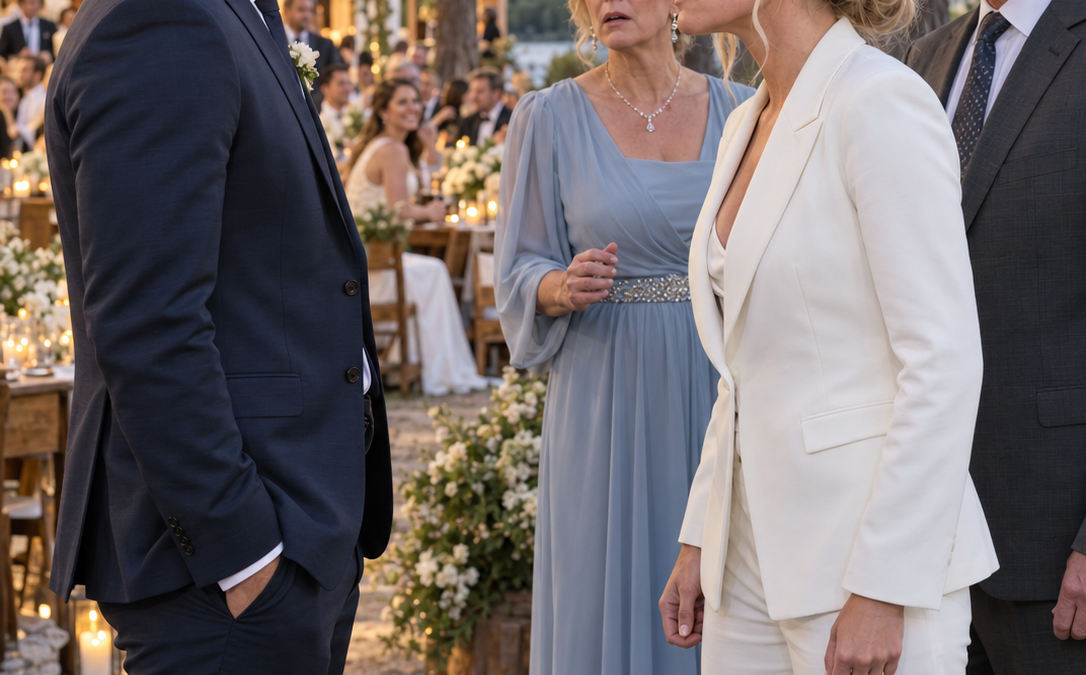
My mother, in a pale blue dress I’d seen her wear to a gala years ago, standing stiffly with her arms crossed.
My father, hands in his pockets, pretending to study a brochure from the lodge nearby like he wasn’t staring daggers at the wedding tent.
And Brooke, of course, in a white pantsuit.
White.
I could see her face even from that distance. Lips pursed, nostrils flared, scanning the tables like she was calculating who knew her, who might notice she wasn’t included.
I turned back to the photographer and smiled.
“You don’t need to do anything. Just crop wide if they’re in the background.”
She laughed a little, relieved, and went back to her camera.
But as I watched the three of them standing there like uninvited spirits haunting the perimeter of my joy, something in me shifted.
Not anger.
Not fear.
Not even satisfaction.
Just clarity.
These people didn’t show up out of love. They didn’t show up because they missed me or because they regretted anything.
They came to witness the thing they thought they were entitled to and weren’t.
They wanted to stand at the edge of my happiness and decide how much of it they’d allow me to have. And now that they had no say, they didn’t know what to do with themselves.
The speeches started as the sun set, painting everything in that golden hue photographers chase like treasure.
Laya’s dad gave a heartfelt toast that had everyone laughing and tearing up in equal measure.
Then my best friend Oliver stood, raised his glass, and said something that silenced the whole tent.
“To Daniel, the most loyal friend I’ve ever had, who spent years giving love to people who didn’t see it for what it was. Who finally found someone who saw him and chose him. This guy has taken more punches from life than most people twice his age and still showed up for everyone. But today, he showed up for himself. And man, it’s about time.”
People clapped.
Some stood.
I didn’t cry, but I could have.
Because in that moment, I realized the version of me who once begged to be seen was gone.
The person sitting at that table wasn’t trying to prove anything to anyone.
I had already won.
Not out of revenge, but by reclaiming the life they always told me I wasn’t meant to have.
Just as dessert was being served—mini apple tarts and tiramisu squares—my phone buzzed.
One message from Brooke.
It read, “You are seriously going to regret this.”
No context. No explanation.
Just venom distilled into one sentence.
I turned the screen to Oliver.
He read it, then let out a low whistle.
“Wow. She really thought this was about her.”
I smiled, then hit block without another word.
Later that night, as the sky filled with stars and people swayed to music under the string lights, I walked back toward the cabins to get something from the lodge.
As I rounded the path near the edge of the property, I heard voices.
Sharp, hushed, and angry.
“He should have just let us in. I don’t care what he thinks he’s doing. That’s our family.”
It was my mom.
Still there.
Still furious.
Then Brooke.
“I hope he chokes on his perfect little moment. Let’s see how long it lasts once real life kicks in.”
I stood there for a second, just out of view.
I should have walked away.
Should have let it go.
But something inside me—the years of silence, the swallowed pride, the countless times I accepted being the afterthought—told me to step forward.
And I did.
I stepped through the trees and into their view, startling all three of them.
My mother gasped.
Brooke’s eyes narrowed.
My dad just stared.
“I know you’re upset,” I said calmly, my voice steady. “But you weren’t uninvited. You were never invited. Because this day wasn’t about correcting your version of me. It was about celebrating the person I’ve become without you. And the fact that you’re here hiding behind trees instead of being surrounded by love tells me I made the right choice.”
Brooke’s jaw clenched.
“You think you’re better than us now?”
“No,” I said. “I think I’m finally free of you.”
Then I turned around and walked away, back toward the laughter, the light, and the people who actually showed up.
I didn’t look back.
As I walked away from the shadows of my past, each step felt like an exhale I’d been holding in for years.
The wedding was still alive behind me. Music drifting through the trees. Fairy lights glowing like soft stars. Laya’s laughter echoing with the kind of warmth that no family function ever gave me.
I didn’t need to see their faces to know what I left behind.
I could feel it.
Three people standing in silence, stunned by the one person they thought would always come crawling back, finally walking away.
When I returned to the reception, Laya caught my eye from across the dance floor.
She was barefoot now, shoes abandoned under a table, dress flowing as she twirled in a slow circle with her niece on her hip.
She smiled at me like nothing in the world was missing.
And for the first time in my life, I agreed.
We danced. We laughed. We cut the cake without a single passive-aggressive comment or forced photo.
Our friends gave awkward, funny toasts. Someone spilled red wine and blamed it on the ghosts of exes past.
People stayed late, long past when the music should have stopped. Nobody was checking their watches or pretending to care.
They just were there.
And so was I.
When the night finally wound down and the last lanterns were dimmed, I sat with Laya on the cabin porch, wrapped in a blanket in silence.
Just the two of us.
She leaned her head on my shoulder.
“I saw them,” she said quietly.
“I know.”
“I wanted to say something, but I didn’t want to ruin it.”
“You didn’t?” I whispered.
“They couldn’t ruin it even if they tried.”
She reached into her pocket and pulled out a small white envelope.
“This came while you were getting ready. I didn’t want to hand it to you before the ceremony.”
I took it slowly.
My name was written in my mother’s handwriting again.
Inside was a check for $10,000 and a note.
“For the wedding expenses. We know things are probably tight. Don’t let your pride ruin your marriage before it starts. Think about your future. Mom.”
There was no signature. No warmth.
Just an assumption that I was still for sale.
I chuckled and slid the check into the fire pit beside us.
The flames caught quickly, curling the paper into black wisps that flew into the sky.
Laya didn’t say anything.
She just pulled the blanket tighter around us, and we sat there until the fire died down, the last ember glowing like the last word I never needed to say.
A week later, we were back home.
Married.
Peacefully married.
The venue had cleaned up. The deposit cleared. The photos were being edited.
And the silence from my family was deafening.
At first, I thought maybe they’d finally accepted it—my choice to cut the cord they’d been yanking my whole life.
But then the fallout started.
Not from them directly, but from everyone around them.
It began with a voicemail from my cousin Rachel.
“Hey, I don’t want to be weird, but your mom’s been telling people you had a mental breakdown at the wedding. She said you kicked them out and that you banned family because Laya doesn’t like them. But I saw the photos. You guys looked happy, so I just wanted to check. Are you okay?”
I played the message twice.
Then I checked Facebook.
Sure enough, my mother had posted a vague status the day after the wedding.
“When you raise someone with love and they repay you with exile, you have to let go and pray they find their way back before it’s too late. #heartbroken #familyfirst.”
The comments were full of sympathy.
“Praying for you.”
“Kids can be so selfish these days.”
“You’re such a strong woman.”
And, of course, one from Brooke’s best friend.
“Ugh. I still can’t believe he didn’t even let you stay. Disgusting.”
It would have been laughable if it hadn’t been so calculated.
They were spinning the story, trying to regain control over a narrative they’d lost.
In their version, I was unstable, dramatic, controlled by a manipulative wife.
A cautionary tale.
So I did something I hadn’t planned on.
I responded.
Not with a Facebook post or a text thread.
No.
I wrote a letter. A real one.
Printed it out, sealed it in an envelope, and mailed it to my parents, Brooke, and a few of the relatives who had reached out in concern.
No drama.
Just facts.
“Dear family,
You’ve made it clear that your version of my life makes more sense to you than the truth ever did. So let me tell it once, plainly.
I did not have a breakdown. I did not exclude you out of spite or manipulation. I chose to begin a new chapter of my life surrounded by people who love me for who I am, not who they expect me to be.
Brooke, you once told me I wasn’t wedding material, that I didn’t belong in the spotlight. You laughed as you said it, but the damage was real. For years, I internalized every offhand comment, every backhanded compliment, every time I was made to feel like an afterthought.
I stayed quiet because I was taught that family forgives, but forgiveness requires remorse. And you have never once acknowledged your words or actions.
Mom, your check didn’t come from love. It came with strings. It was a leash disguised as a gift. I don’t need it. We never did.
You weren’t uninvited from my wedding. You were simply never included in a moment you had no hand in building.
I’ve spent my life trying to be accepted by people who see me as the family wallet, the emotional punching bag, the one who doesn’t fit the aesthetic.
Well, I’m done fitting into a mold you built from resentment and entitlement.
I didn’t cut you out of my life to punish you. I let you go because carrying you is breaking me, and I won’t carry that anymore.
Daniel.”
I sent the letter, and then I moved on.
There was no reply.
No apology.
Not even a text.
But slowly, over the next few months, something surprising started happening.
A cousin I hadn’t seen in years messaged me to say she’d always thought I was treated unfairly. An old family friend reached out and said she was proud of how I stood up for myself.
Even my uncle Ray called again, this time with something softer in his voice.
“They won’t say it,” he told me, “but they know. Deep down, they know.”
And that was enough.
Laya and I moved into a new apartment three months after the wedding.
It wasn’t big, but it had a balcony and morning light and enough space for a piano she found at a thrift store.
She plays while I cook.
Sometimes I stop just to watch her hands glide across the keys like they’re rewriting the soundtrack of my life.
And every now and then, when the music drifts through the open window, the world feels too quiet.
I remember that folding chair at Brooke’s wedding.
I remember the smirk, the side comments, the way they always acted like love was something I had to earn.
And I smile because I finally understand.
Love isn’t earned through suffering.
It’s chosen.
And I chose a life without them.
No more waiting for approval. No more shrinking to fit. No more setting a place at a table I was never truly welcome at.
This life—imperfect, joyful, mine—is the one I built when I stopped asking for permission.
And I wouldn’t trade it for a seat at anyone’s table.
Not even theirs.








