“Your sister’s family gets the guest room; you can sleep on the floor,” mom tossed 2 sleeping bags at me and my 6-year-old; my sister laughed, “should’ve booked a hotel”; i looked at my children kneeling and whispered, “pack your things, babies”; we left at 11 pm; 3 days later, mom discovered what i quietly cancelled; 98 missed calls.
Ben, my ex-husband, left three years ago. Or rather, I found the texts, packed his duffel, and set it on the porch before he got home from work.
He didn’t argue. Men who get caught rarely do.
The divorce was clean. I kept the apartment. He kept the truck and a woman named Shayla who didn’t last six months.
I rebuilt from a two-bedroom apartment with secondhand furniture and a refrigerator covered in Lily’s crayon drawings. I don’t own a single thing from the marriage. Everything in my home, I earned after he left.
The week before Thanksgiving, I packed the car at five in the morning. Snacks. Blankets. Two car seats. A casserole dish wrapped in foil, because you don’t show up to your mother’s house empty-handed. Not in the Shenandoah Valley. Not ever.
Lily was buckled in the back with her chapter book. Owen was already asleep.
Four hours on I-81 north. I’d made this drive a hundred times, and every time I told myself it was worth it.
Somewhere around mile marker 80, Lily said it from the back seat, quiet, almost to herself.
“Mommy, does Grandma like us?”
I didn’t answer her.
I adjusted the mirror so I could see her face and said, “We’re almost there, baby.”
That’s what nurses do. We redirect. We stabilize. We don’t always fix.
My mother’s house sits at the end of a gravel road outside Bridgewater, Virginia. A colonial farmhouse my father bought in 1987 with a VA loan and thirty years of stubbornness. White clapboard. Green shutters. A wraparound porch he built with his own hands the summer I turned nine.
He died four years ago.
A stroke at the kitchen table on a Tuesday morning. The paramedics got him to Augusta Health, but he never came back all the way. He was 61.
My mother was sitting across from him eating oatmeal when it happened.
I pulled into the gravel drive at 9:15. Paige’s Tahoe was already parked in the good spot, the one closest to the porch steps. I parked on the shoulder near the fence post.
The front door was open. I could smell it before I was halfway up the walk. Brown sugar ham glaze, the kind my mother brushes on slow with a silicone brush she’s had since I was ten.
I used to stand on a step stool beside her and watch.
“Brush it slow, baby,” she’d say. “That’s where the love goes.”
I hadn’t stood beside her in that kitchen in years.
Owen woke up when I unbuckled him and said, “Gamma!” with his whole chest. Lily carried her backpack like she was reporting for duty.
We walked in.
The living room smelled like pine cleaner. Paige’s kids’ bags were stacked on the couch, shoes in the hallway. I could hear Paige’s voice in the kitchen and my mother laughing at something she’d said.
Neither of them came to the door.
Owen toddled into the kitchen ahead of me.
“Gamma.”
My mother glanced up from the counter.
“Put your shoes by the door, sweetie.”
That was her hello.
Paige came around the corner, wiping her hands on a dish towel.
“Oh, you made it. Traffic bad?”
She said it the way you’d greet a delivery driver. Polite enough. Barely interested.
Her husband, Derek, was in my father’s recliner with the football game on. He didn’t get up.
“Hey, Gwen. Kids getting big.”
He looked at Lily.
“You got a boyfriend yet?”
Lily froze midstep and looked at me.
“She’s six, Derek,” I said.
He shrugged.
“Just making conversation.”
Paige’s kids, Madison, eight, and Tyler, ten, were sprawled on the living room rug with matching tablets. Owen walked toward them and reached for Tyler’s screen.
Tyler yanked it away.
“Get your own.”
Paige didn’t say a word.
My mother came out of the kitchen.
“Dinner’s at six. Set the table, Gwen.”
No “How was the drive?”
No “Are you hungry?”
No “Let me take Owen for a minute.”
Just set the table.
I set the table for nine.
I found the plates in the same cabinet they’d been in my whole life. The good china, white with blue forget-me-nots, was already stacked on the counter.
My mother had set out name cards at each seat.
I picked one up.
Paige and Derek flanked my mother on either side. Madison and Tyler next to them.
Lily, Owen, and I were at the far end near the kitchen door, where the draft comes through.
I heard the front door open and a familiar voice.
Aunt Connie, my father’s younger sister, came in stamping cold off her boots. She saw me first, walked right past Paige, past Derek, past my mother, and wrapped her arms around me.
Then she whispered so close I could smell her cold cream.
“Four hours. She didn’t even say hello, did she?”
Dinner happened. I’ll tell you about that in a minute.
But first, the moment that changed everything.
It was 8:30.
Lily was yawning into my sleeve. Owen was asleep on my shoulder, mouth open, one fist curled around my collar.
I found my mother in the hallway wiping down the banister with a rag she’d used since 1998.
“Mom, where are we sleeping?”
She didn’t look up.
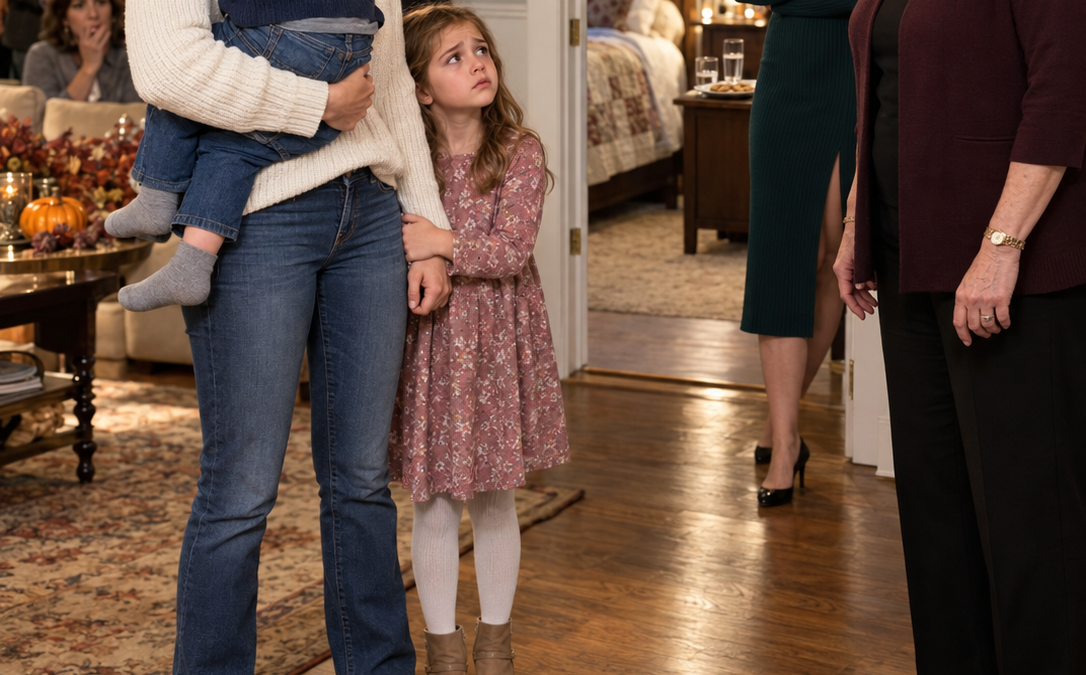
“Your sister’s family gets the guest room. You can sleep on the floor.”
She said it the way you’d say the mail came.
Then she turned, walked to the hall closet, and pulled out two rolled-up sleeping bags. The blue nylon ones my father used to take camping.
She carried them to the living room and tossed them at my feet.
They hit the hardwood with a sound I will hear for the rest of my life.
A dull, flat thud.
The grandfather clock in the hallway ticked.
Lily looked up at me.
Then she looked at the sleeping bags on the floor.
Then she looked at the guest-room door, closed, with Paige’s matching luggage visible through the crack.
“On the floor, Mommy?”
My mother was already walking back toward the kitchen.
Over her shoulder, she said, “The living room floor is fine. I used to sleep on worse growing up.”
Owen stirred against my neck.
I stood there holding my son in one arm and my daughter’s gaze in the other. And for a moment, the only sound in that house was the clock and the furnace clicking on.
I opened my mouth.
I was going to say something calm. Something measured. Something a nurse would say when the room is going sideways and everyone’s watching.
But Paige got there first.
She was leaning against the doorframe with her arms crossed, one socked foot propped behind her. She looked at me. She looked at the sleeping bags on the floor.
And she smiled.
“Should have booked a hotel.”
Then she laughed.
Not a mean laugh exactly.
Worse than that.
An amused one.
Like I was a sitcom she was watching from a comfortable distance.
Derek snorted from the recliner. Didn’t even look up from the game.
I didn’t respond.
I looked at Lily.
She was staring at the sleeping bags the way a child stares at something she doesn’t understand yet but will remember forever.
Her chin was trembling.
Not crying. Just trembling.
Like the rest of her was holding still and her chin couldn’t keep up.
I knelt.
I unrolled one sleeping bag slowly, carefully. The nylon scraped against the hardwood. Owen whimpered in his sleep, so I laid him down on the unrolled bag, tucking my jacket around him.
Lily watched me.
“Are we really sleeping here, Mommy?”
I smoothed her hair behind her ear.
“Just for now, baby.”
Paige walked past us toward the guest room. I heard her open the door.
I saw it.
Clean sheets. A queen bed with a patchwork quilt. A nightstand with two glasses of water and a plate of cookies my mother had arranged on a saucer.
Cookies on a saucer for Paige.
The door closed.
The guest-room light went off.
The furnace hummed.
I lay on the hardwood next to my children, my daughter curled on one sleeping bag, my son on the other, and me between them on bare floor.
The ceiling had a crack I’d never noticed before. It ran from the light fixture to the corner, thin and dark.
Let me go back to dinner.
I need you to understand what happened at that table before the sleeping bags, because it matters.
My mother brought out the ham at six on the dot. The glaze glistened under the overhead light. Brown sugar and clove and something that smelled like every Thanksgiving I’d ever known.
She set it in the center of the table and began slicing.
Paige’s kids got served first. Madison. Tyler. Then Paige. Then Derek. Then my mother. Then Aunt Connie. Then me. Then Lily.
Owen was in a high chair with cut-up pieces I’d prepared myself.
But it wasn’t the order that got me.
It was the plates.
Madison and Tyler ate off the blue forget-me-not china. Lily and Owen got the plastic plates from the kids’ drawer, the ones with cartoon dinosaurs that my mother bought at a dollar store five years ago.
My daughter is six years old.
She can eat off a real plate. She’s been doing it at home since she was four.
I didn’t say anything.
I cut Lily’s ham into small pieces with one hand and held Owen’s sippy cup with the other.
My mother turned to Aunt Connie across the table.
“Have you met my Paige? She’s been my rock since Harold passed. Don’t know what I’d do without her.”
She put her hand on Paige’s shoulder.
Paige beamed.
I waited.
My mother moved on to the yams.
There was no, “And this is Gwen.”
Across the table, Aunt Connie caught my eye. She gave a small, tight shake of her head.
She saw it.
I picked up my fork, ate, helped Lily cut her food, wiped Owen’s face, did what I always do.
Managed.
But something shifted under my ribs.
A thought quiet as a pilot light clicking on.
I drove four hours for plastic plates.
Later that night, after the sleeping bags, after Paige’s door closed, after the house went dark, I got up from the floor.
My back already ached.
I walked to the kitchen.
My mother was at the sink washing the last pan. The overhead light made her look older than 64. Her hands were red from the hot water.
“Mom.”
She didn’t turn around.
“Lily asked me something in the car today. She asked if Grandma likes us.”
My mother’s shoulders tightened.
“That’s ridiculous. I love all my grandchildren.”
“Then why are my kids on the floor while Paige’s kids are in a bed with cookies on the nightstand?”
She turned off the water, dried her hands on the towel hanging from the oven handle, then turned to face me.
“This is just how it is, Gwen.”
She said it the way you close a file.
“Paige is here every week. She brings groceries. She takes me to the doctor. She sits with me on Sundays when the house gets too quiet. Where are you?”
“I’m four hours away, Mom. Working nights, too.”
“Exactly.”
She folded the towel into a perfect square.
“You chose that. You chose to move to Richmond. You chose to leave your husband. Paige chose to stay.”
There’s a thing they teach you in nursing school about not reacting to a patient who’s escalating. You keep your hands at your sides. You speak low. You don’t match their energy.
I used every second of that training in my mother’s kitchen.
I said nothing.
I walked back to the living room and lay down on the hardwood between my children.
The clock in the hallway ticked like it always had.
Steady. Indifferent.
Counting time the way time gets counted in houses where nobody says what they mean.
I was lying on that floor listening to my mother’s clock tick and my daughter breathe when I realized something.
This isn’t love.
This is a hierarchy.
And I was done climbing.
If you’ve ever been the one who gives everything and gets the floor, tell me in the comments. I need to know I’m not alone in this.
Morning came gray through the living-room curtains.
My back was locked up from the hardwood, the kind of stiffness that makes you move like you’re eighty.
Owen had woken at three, crying because he was cold. I’d wrapped him in my coat and held him against my chest until he stopped shaking.
Lily slept through it, curled tight, her chapter book under her head like a pillow.
I stood up slowly, cracked my neck, and walked to the kitchen.
My mother was already there, rolling dough.
Cinnamon rolls.
The smell hit me the way that house always hits me—with memory first, information second.
She used to make them for us every Saturday.
Both of us.
Paige and me, side by side at the counter, fingers sticky with sugar.
That was a different kitchen.
A different mother.
These rolls were for Madison and Tyler.
I knew it before Lily even walked in.
Lily appeared in the doorway, hair tangled, sleep still on her face.
“Can I have one, Grandma?”
My mother didn’t look up from the baking sheet.
“Those are for Madison and Tyler, sweetie. There’s cereal in the pantry.”
Lily nodded, walked to the pantry, got the Cheerios, and poured herself a bowl.
Across the table, Madison sat down and picked up a warm cinnamon roll with both hands.
Lily didn’t complain.
That’s the part that got me.
Not the denial.
The acceptance.
My six-year-old had already learned to expect less.
I went outside and sat in my car, hands on the steering wheel, engine off.
I didn’t cry.
I pulled out my phone and scrolled to a saved contact.
The Millhouse Inn.
I pressed call.
“Hi, this is Gwen York. I’m just calling to confirm the deposit for the December 14th reservation.”
“Yes, ma’am. $3,200 on the Visa ending in 4471, under Gwen York. Everything’s confirmed.”
I hung up and sat in that car for a long time.
$3,200.
My name.
My card.
For a party my mother didn’t know I was building.
Let me tell you what she didn’t know.
Three months before that Thanksgiving, I’d started planning Helen York’s 65th birthday celebration.
Not a dinner.
Not a cake in the kitchen.
A real gathering.
Forty-two guests at the Millhouse Inn, a restored stone grist mill outside Staunton with oak beams and a covered porch overlooking the river.
I booked the venue.
I hired a caterer. Shenandoah Catering, full dinner service for 42.
I ordered a custom carrot cake with cream cheese frosting from a bakery in Harrisonburg because that’s been her favorite since before I was born.
I rented tables, chairs, linens.
Hired a photographer.
Reserved a photo booth.
Arranged flowers.
Built a custom playlist of my father’s favorite songs—Johnny Cash, Patsy Cline, the gospel hymns he hummed while mowing.
I hand-addressed 42 invitations.
I called Uncle Dave in Ohio, Cousin Rachel in Georgia, Aunt Pam in Delaware.
I coordinated flights.
I assembled a framed photo collage of my parents’ life together.
Their wedding.
Us as kids.
The grandchildren.
The porch my father built.
Every contract was in my name.
Every dollar came from my account, from the extra overnight shifts I’d been picking up every two weeks since September.
Twelve hours of chest compressions and intake charts traded for vendor deposits.
Total: $8,247.
Nobody knew it was just me.
I told people, “The family is putting something together,” because I didn’t want credit.
I wanted my mother to walk into that room and feel loved by everyone, not obligated to one daughter.
I crossed out “new winter coats for kids” on my budget spreadsheet to cover the deposit.
That afternoon, back in the house, more family arrived.
My mother gave a tour.
“Paige decorated the guest room. Isn’t it lovely?”
No mention of Gwen.
Aunt Connie found me on the porch.
She was holding two cups of coffee, one for each of us.
She sat on the swing my father installed the summer he got sick, the one he never got to finish staining.
“Honey.”
She handed me the mug.
“I see what’s happening in there. It’s not right.”
“I know, Aunt Connie.”
“Your daddy would have never let her…”
She stopped and pressed her lips together.
Tears.
I put my hand on hers.
“I know.”
She didn’t say anything else.
She didn’t need to.
Later that evening, the house emptied out.
Cousins left.
Dishes got washed.
By me.
Leftovers got wrapped.
By me.
The kitchen got wiped down.
By me.
Paige and Derek retired behind the guest-room door.
My mother went to her room without saying good night.
The house was dark except for the hallway light and the blue glow of the guest-room TV leaking under the door.
I lay on the living-room floor.
Owen asleep on my coat again.
Lily beside me, whispering, “Mommy, my back hurts.”
She was kneeling on the sleeping bag, trying to find a position that didn’t press bone against hardwood.
I looked at my children.
My daughter kneeling in my mother’s house.
My son curled on a nylon bag on a cold floor.
Something clicked.
Not rage.
Something quieter.
The sound a lock makes when it finally turns.
I stood up and leaned down close to Lily’s ear.
“Pack your things, babies.”
She looked at me.
Didn’t question it.
She grabbed her backpack.
I lifted Owen, still asleep, heavy and warm.
We walked through the dark hallway, past the guest room, past the grandfather clock.
I stopped and looked at the face.
11:00.
I said it under my breath.
“Eleven.”
I opened the front door.
I put the sleeping bags in the trunk.
They landed with a thud, the same sound they’d made on the floor.
But this time, I’d put them there.
My hands.
My choice.
I buckled the kids in and started the engine.
The gravel crunched under my tires.
I cracked the window and let the cold November air push through.
Somewhere in that rush, the smell of brown sugar glaze lifted off my coat and disappeared into the dark.
Interstate 81 south at one in the morning is a specific kind of lonely.
No headlights for miles, just the white lane markers counting off under my bumper like a heartbeat.
Lily fell asleep twenty minutes in.
Owen hadn’t woken up at all.
I drove in silence.
No radio.
No phone calls.
Just the engine and the dark and the kind of thinking that only happens on empty highways after midnight.
Three months earlier, I’d been sitting at my kitchen table in Richmond with a calculator and a list.
The list had 14 lines.
Each line was a vendor.
Each vendor was a piece of my mother’s 65th birthday party.
A party I was building from scratch because nobody else would.
Not Paige, who lived thirty minutes from our mother and couldn’t be bothered to plan a dinner.
Not Uncle Dave, who called on birthdays and forgot the rest.
Not Derek, who had opinions about everything and initiative for nothing.
Me.
The daughter who lived four hours away and still called every vendor herself.
I remember the night I paid the deposit.
Lily was asleep.
Owen was in his crib.
I was at the kitchen table with my laptop open to the venue’s booking portal.
$3,200.
My Visa.
I looked at the budget spreadsheet taped to the fridge next to Lily’s drawing of a house with a yellow door.
On the spreadsheet, I’d written “winter coats” and “Owen” in the November column.
I looked at the deposit amount.
I looked at the coats.
I picked up a pen and drew a single line through “winter coats.”
Then I clicked Confirm.
I told myself my mother would never know it was me.
That was the point.
The party wasn’t supposed to be from Gwen.
It was supposed to be from the family, because I wanted her to feel loved by everyone, not indebted to the daughter she already overlooked.
I pulled into my apartment complex at three in the morning.
I carried Owen first, dead weight, his head on my shoulder, drool on my collar.
Tucked him in.
Went back for Lily, who woke up just enough to walk with her eyes half closed.
I guided her to bed, pulled the blanket up, stood in the doorway, and watched them sleep.
Two kids in their own beds.
Clean sheets.
A night-light shaped like a moon that Lily picked out herself.
No hardwood floor.
No sleeping bag.
My phone buzzed on the counter.
A text from my mother.
You left without saying goodbye. That was rude.
Not “Are you safe?”
Not “Is Lily okay?”
Not “Why did you leave?”
Just rude.
I placed the phone face down on the counter, sat at the kitchen table, and opened my laptop.
The spreadsheet was still there.
Fourteen vendor lines, each one hyperlinked to a contract or confirmation email.
I scrolled through them slowly.
The Millhouse Inn.
Shenandoah Catering.
Harrisonburg Custom Cakes.
Valley Rentals.
Bloom and Stem Florals.
A photographer named Deborah who’d sent three sample galleries.
A photo-booth company out of Charlottesville.
A playlist service that made memorial compilations.
Forty-two hand-addressed invitations already mailed.
A framed collage I’d spent three weekends assembling, cutting photos, arranging layouts, writing captions in my father’s favorite font.
Total on the spreadsheet:
$8,247.
I stared at it.
Then I looked at my mother’s text.
That was rude.
I closed the laptop, stood up, walked to my bedroom, and set my alarm for seven.
I wasn’t going to make a decision at three in the morning.
That’s not how I work.
I’m a nurse.
I don’t make calls in the dark when I’m tired and angry.
I sleep first.
Then I decide.
Friday morning, I made pancakes for the kids.
Mickey Mouse shapes for Owen. He calls them “mouse cakes.”
Plain rounds for Lily because she’s decided she’s too old for shapes.
We ate at the kitchen table.
Normal.
Quiet.
The kind of morning I protect like a perimeter.
After breakfast, I checked my phone.
Seven missed calls from my mother.
Three from Paige.
Two texts from Paige.
Mom says you just left. Really mature, Gwen.
And:
Way to ruin Thanksgiving.
I didn’t respond.
I set the phone on the counter and went to the hall closet where I kept the birthday-party supplies I hadn’t shipped yet.
There were two boxes.
The first held the place cards.
Forty-two of them.
Handwritten in blue ink on cream cardstock.
Each one had a guest’s name in my handwriting with a small sketch of a forget-me-not in the corner.
It had taken me four evenings after the kids were in bed.
The second box held the photo-collage frame.
I pulled it out and leaned it against the wall.
Forty years of my parents’ life in one frame.
The wedding photo where my dad looked stunned and my mom looked certain.
Us as kids.
Paige in pigtails.
Me holding a kitten that ran away the next day.
The grandchildren.
The porch.
The last photo I have of my father, taken six days before the stroke.
Standing in the garden with dirt on his knees and a grin I’d give anything to see again.
Behind the frame, tucked into a manila folder, were the contracts.
I pulled the folder out and opened it.
Every page had my name at the bottom.
Gwen York.
Gwen York.
Gwen York.
Fourteen contracts.
Fourteen signatures.
Every receipt printed and paper-clipped to its confirmation email.
$8,247 in black and white.
I called Aunt Connie.
She picked up on the second ring.
“I was waiting for this call,” she said.
“Aunt Connie, I need to ask you something. Has Mom ever thanked me for anything I’ve done for the family?”
The line was quiet.
I could hear her kitchen clock. She has one of those cat clocks with the eyes that move.
Finally, she said, “Honey, no. She tells people Paige handles everything. Last week, she told Barbara Sullivan at church that Paige is the one organizing her birthday party.”
I closed my eyes.
“Mom thinks Paige is organizing the party?”
“Isn’t she?”
“No, Aunt Connie. I am. Every vendor, every dollar, every phone call. Eight thousand dollars. It’s all me.”
Silence.
A long one.
“Oh, Gwen.”
“She threw sleeping bags at my six-year-old on the same floor I used to sit on making cinnamon rolls with her. And my sister laughed.”
Aunt Connie didn’t tell me what to do.
She’s not that kind of woman.
What she said was, “Whatever you decide, your daddy would understand.”
I hung up.
Sat at the table with the contract folder open in front of me.
Fourteen pages.
My name on every one.
I thought about Lily pouring herself Cheerios while Madison ate a warm cinnamon roll.
I thought about Owen shivering at three in the morning on a nylon bag.
I thought about my mother saying, “This is just how it is.”
And Paige saying, “Should have booked a hotel.”
And Derek not even looking up from the game.
I thought about the woman who crossed out winter coats on a budget spreadsheet to give her mother a birthday party she didn’t deserve.
Then I picked up the phone and dialed the Millhouse Inn.
“Hi, this is Gwen York. I’m calling about the reservation for December 14th. I need to cancel the reservation.”
The woman on the line paused.
“Ma’am, the deposit is nonrefundable per the signed agreement.”
“I understand. Cancel it.”
She confirmed.
I wrote CANCELED in red pen on the first contract.
Then I called the caterer.
Same conversation.
Different voice.
Same ending.
Cancel.
I called the photographer.
The cake bakery.
The rental company.
I worked down the spreadsheet line by line.
No rage.
No shaking hands.
The way I’d chart a medication change.
Careful.
Sequential.
Final.
Each call lasted between two and four minutes.
Each one was polite.
Each one ended the same way.
“Change of plans.”
One vendor, the florist, asked if everything was all right.
“Everything’s fine,” I said. “Just a change of plans.”
By the end of Friday, I’d canceled nine of the fourteen vendors.
The remaining five—the photo booth, playlist service, invitations already mailed, place cards in my closet, and the collage leaning against my wall—I’d handle Saturday.
I sat at the kitchen table.
The spreadsheet had red lines through nine entries.
The folder was thinner now.
Lighter.
Lily walked in from her room.
“Mommy, who are you calling?”
“Just work stuff, baby.”
She nodded and went back to her coloring.
I closed the laptop and sat in the quiet.
No satisfaction.
No regret.
Just a kind of stillness that comes after you’ve been carrying something heavy for a long time and you finally set it down.
Before I shut my phone off for the night, one email came in from the Millhouse Inn.
Cancellation confirmed.
Please note, per our policy, we will send a confirmation letter to the event address on file.
The event address on file was my mother’s farmhouse.
Saturday morning, I canceled the photo booth and the playlist service.
I called the custom frame shop where I’d ordered the collage mat.
They’d already shipped the mounting hardware to my mother’s house.
But it didn’t matter now.
Every contract dissolved.
$8,247 either refunded where policies allowed or lost where they didn’t.
I’d lose roughly $2,000 in nonrefundable deposits.
I accepted it the way I accept a copay.
The cost of a decision I needed to make.
My phone buzzed all day.
Paige:
Mom’s been crying all day because you left. Are you happy?
Then:
She’s 64, Gwen. She could be dead next year. Is that what you want on your conscience?
I read it.
Then I read it again.
Could be dead next year.
The kind of sentence designed to make you feel like a monster for having boundaries.
Derek texted for the first time in the three years I’d known him.
Hey, you should probably apologize. Your mom’s really upset. Just saying.
I put the phone in the kitchen drawer.
I took Lily and Owen to the park two blocks from our apartment.
I pushed Owen on the swing while Lily chased leaves across the brown grass.
She caught one, a red maple leaf, still mostly whole, and held it up like a trophy.
“Look, Mommy. It’s perfect.”
“It is, baby.”
We stayed until the sun started going orange behind the tree line.
I bought them hot chocolate from the gas station on the way home.
They fell asleep with milk mustaches.
I tucked them in and sat on the couch.
My phone was still in the drawer.
Tomorrow was Sunday.
Day three.
And somewhere in a stone grist mill outside Staunton, a woman was about to make a phone call to a farmhouse in Bridgewater.
That would change everything.
I spent two days on the phone canceling a birthday party my mother didn’t even know I was building.
Eight thousand dollars.
Forty-two invitations.
A framed collage I made with my own hands.
She never asked who was paying.
She just assumed.
If you know what that feels like—being the one who funds the love they give to someone else—drop a comment.
Let’s talk about it.
Sunday afternoon, my mother’s phone rang in the kitchen of the farmhouse.
She was alone.
Paige had gone home to Staunton.
Derek was watching football in his own house.
The Thanksgiving guests had scattered back to their lives.
The caller ID showed a local number she didn’t recognize.
She picked up.
“Mrs. York, this is Amanda from the Millhouse Inn. I’m calling because we received a cancellation for a private event scheduled here on December 14th. This address was listed as the event address, so I wanted to reach out in case there was any confusion.”
My mother’s hand went flat on the counter.
“What event? What cancellation?”
“I’m sorry, ma’am. I can’t share the account holder’s booking details. Privacy policy. But it was a birthday celebration. If you have questions, the person who made the reservation would be your best contact.”
“Who booked it? Was it—was it Gwen?”
Amanda paused.
“I’m not able to confirm that, ma’am. I apologize for any confusion.”
My mother hung up.
But she didn’t need Amanda to confirm it.
There was only one person in the family who planned anything.
My mother stood in the kitchen where she’d washed that pan two nights ago, where she’d told me, “This is just how it is, Gwen.”
Where she’d said I chose to leave.
She picked up the phone again and dialed Paige.
It rang twice.
“Mom, what’s wrong?”
“Did you know Gwen was planning my birthday party?”
“What? No. I thought Uncle Dave was handling— Wait, what do you mean was?”
“She planned the whole thing. The venue. The catering. Forty-two guests. All of it.”
Silence.
“And she just canceled everything.”
I wasn’t there for that call.
I don’t know exactly what Paige said next, but Aunt Connie told me later that when Paige hung up, she sat in her kitchen and didn’t speak for fifteen minutes.
My phone rang.
My mother’s number.
I watched it ring.
The screen bright on the kitchen counter.
It went to voicemail.
It rang again.
Voicemail again.
I picked up my coffee and took another sip.
I don’t know what she said in the messages.
I didn’t listen to them until weeks later.
What I know is what happened on her end, because Aunt Connie called me that evening and told me every piece of it.
My mother called Aunt Connie next.
“Did you know about this, Connie?”
“I found out the same way you did. But I’m not surprised.”
“What does that mean?”
“It means Gwen’s been carrying this family on her back and you’ve been stepping on her.”
My mother hung up on her.
Paige called me.
Voicemail.
She texted:
Gwen, call Mom right now. What did you do?
Derek called.
Voicemail.
Even Derek, who had never once dialed my number for anything other than a group text about Christmas scheduling, felt compelled to weigh in.
My mother started calling the extended family.
Uncle Dave in Ohio.
“Did you know about the party? Did you know Gwen was behind it?”
Uncle Dave said, “We got invitations a month ago. Beautiful ones. Cream cardstock with little flowers in the corner. We assumed the family was putting it together.”
Cousin Rachel in Georgia:
“I already booked a flight.”
Aunt Pam in Delaware:
“The carrot cake was from Gwen? Harold’s favorite?”
The truth spread the way truth does in families.
Quickly.
Unevenly.
And with the force of something that should have been obvious all along.
Gwen booked everything.
Gwen paid for everything.
Gwen organized travel for out-of-state relatives.
And Gwen just canceled it all.
Paige sat in her kitchen in Staunton.
Derek was across from her, arms folded, the way he sits when he’s processing something he doesn’t like.
“So Gwen was paying for everything?”
“I didn’t know.”
“Eight thousand dollars for your mom’s party?”
He shook his head.
“She’s a nurse, Paige. A single mom. She doesn’t have eight grand lying around.”
“How do you know what she has?”
“Because Connie just called me. She said Gwen crossed out buying the kids winter coats to cover the deposit.”
Paige didn’t respond for a moment.
Just a moment.
She thought about Thanksgiving dinner.
Gwen at the far end of the table, cutting Lily’s food with one hand, holding Owen’s sippy cup with the other.
Lily on a plastic plate.
Owen in a high chair with no cushion.
Paige in the good seat, eating off blue forget-me-not china.
Saying nothing.
Should have booked a hotel.
She’d said that laughing to a woman who’d spent three months building a party that would never happen now.
But Paige didn’t call me to apologize.
She called to manage.
She called the Millhouse Inn.
“Hi, I’d like to rebook for December 14th.”
“I’m sorry, ma’am. That date is no longer available. We’ve already released the booking to another client.”
“Then the 15th? The 16th?”
“We’re fully booked through the New Year. December is our busiest season. You’d need to look at late January at the earliest.”
Paige tried three caterers.
All booked.
She called the cake bakery.
The carrot cake.
The one with cream cheese frosting.
The one that was my mother’s favorite.
It required a six-week lead time.
There were three weeks until December 14th.
Everything Gwen had built took three months of planning.
Paige couldn’t rebuild it in three weeks.
Nobody could.
Sunday night, I knew the numbers without looking.
Aunt Connie gave me the play-by-play in a forty-minute phone call while I folded laundry.
My mother had called me 23 times.
Paige had called 14.
Derek, six.
Uncle Dave called twice, not to scold, but to ask if I was okay.
Various aunts, uncles, and cousins accounted for the rest.
By the time I went to bed Sunday night, there were 47 missed calls on my phone.
Back in Bridgewater, my mother sat alone at her kitchen table.
The grandfather clock ticked in the hallway.
The same clock I’d watched at 11:00 the night I left.
The house was quiet the way it gets quiet when you’re the only person in it and you’ve just realized you might have caused that yourself.
She pulled a framed photo from the shelf above the stove.
My parents’ 40th anniversary.
My father’s arm around her.
Both of them smiling.
His grin wider than hers, the way it always was.
He wore a flannel shirt.
She wore the pearl earrings he’d given her on their tenth anniversary.
My father loved me.
He didn’t say it often.
Men of his generation didn’t.
But he showed it in the way he drove to Richmond every other month to fix something in my apartment.
A leaky faucet.
A stuck window.
The screen door that never latched right.
After the divorce, he came more often.
He’d play with Lily in the living room while I napped after a night shift.
He called me his steady one.
My mother looked at that photo for a long time.
She set it down and picked up her phone.
This time, she didn’t call me.
She called Paige.
“We need to go to Richmond.”
Monday, I worked a twelve-hour shift.
Chest pain in Bay Three.
A toddler with a febrile seizure in pediatrics.
A man who fell off a ladder and broke his wrist in two places.
He told me the same joke three times while I splinted it.
I told the charge nurse, “If anyone named York calls the hospital, tell them I’m with a patient.”
She didn’t ask questions.
Nurses understand family.
Back at the farmhouse, my mother and Paige tried to salvage the party.
Paige called six catering companies.
Every one of them was booked through December.
One dispatcher said something that Aunt Connie relayed to me with a laugh she tried to suppress.
“For 42 people in three weeks, ma’am, you should have booked months ago.”
The irony hung in the air like the smell of something burning.
My mother called the bakery in Harrisonburg.
“The carrot cake with cream cheese frosting for the 65th?”
“That order was canceled by Gwen York. We’ve already allocated our December capacity. We could possibly do a rush order for early January, but it wouldn’t be the same tier.”
My mother hung up.
Every vendor told the same story.
Gwen’s name.
Gwen’s money.
Gwen’s planning.
All of it undone.
By Monday night, my phone showed 71 missed calls.
I drove home from the hospital, picked up Lily from after-school care and Owen from daycare, and made chicken nuggets and applesauce.
Owen’s favorite.
I read Lily a chapter of Charlotte’s Web.
Tucked them in.
Stood in the doorway of their room and listened to them breathe.
Then I went to the kitchen, pulled my phone from my pocket, and scrolled through the call log.
Seventy-one calls from thirteen different numbers.
I set the phone on the counter.
Sat down.
Thought about it.
Not yet.
Tuesday afternoon was my day off.
Lily, Owen, and I were at the park.
The same one with the good swings and the maple trees that drop leaves like confetti in November.
Owen was on the slide.
Lily was reading on a bench, her chapter book propped against her knees.
My phone vibrated.
A text from my neighbor, Mrs. Padilla, who waters my plants when I’m on night shifts.
Two women at your door. Older one and a younger one. They look upset.
I knew.
I loaded the kids into the car, drove the two blocks home, and saw my mother’s old Buick—a sand-colored LeSabre with a dent in the rear bumper from a shopping cart—parked crooked in the visitor spot.
Paige’s black Tahoe was behind it.
They’d driven four hours.
Paige spotted me pulling in.
She walked toward my car before I’d even turned off the engine.
“Gwen, we’ve been calling.”
“I know.”
I got out, unbuckled Owen, and took Lily’s hand.
My mother was standing at the apartment door.
She wore her church coat, the navy one with gold buttons, which meant she’d dressed for this.
“Gwen Marie York, you have some explaining to do.”
I walked past her and unlocked the door.
“Come in. But the kids go to their room first.”
I carried Owen to his bed.
Lily followed without being told.
I closed their door gently and turned around.
My mother and sister stood in my living room.
My small, clean, built-from-nothing living room.
Lily’s drawings on the fridge.
The budget spreadsheet still taped next to them with a red line through WINTER COATS.
The apartment of a woman who gave away $8,000 and got a sleeping bag in return.
My mother sat on the edge of my couch.
Paige stood behind her like a bodyguard.
I leaned against the kitchen counter.
My counter.
In my apartment.
In my city.
“You canceled my birthday party.”
My mother’s voice was thin, tight.
“My birthday. How could you do this to me?”
“Sit down, Mom.”
“I don’t want to sit down. I want an explanation.”
“Then I’ll stand, too.”
Paige stepped forward.
“Gwen, this is insane. You planned this whole thing and just—what? Torpedoed it because you had to sleep on the floor for one night?”
I looked at her.
Let the silence sit for three full seconds.
Nurses count.
“You threw sleeping bags at my children, Paige.”
“Mom threw the sleeping bags. I just—”
“You laughed. You said, ‘Should have booked a hotel,’ to a six-year-old and a three-year-old who’d been in a car for four hours.”
“I was joking.”
“Lily wasn’t laughing.”
Something shifted in the room.
The heating vent clicked on.
My mother looked at the fridge.
At Lily’s drawings.
At the spreadsheet with the red line.
I don’t know if she read it, but she looked at it for a long time.
I reached behind me and picked up the contract folder from the counter.
The same folder I’d pulled from my closet on Friday.
Fourteen contracts.
Fourteen signatures.
Every receipt.
Every confirmation.
I walked to the coffee table and set it down between us.
“This is what I canceled. Sit down. Both of you.”
My mother sat.
Paige sat.
They looked at the folder the way you look at something you’re not sure you want to open.
I opened it.
Pulled out the first contract.
Laid it flat on the coffee table.
“The Millhouse Inn. December 14th. Forty-two guests. Deposit: $3,200.”
I tapped the page.
“My Visa.”
I pulled out the next one and set it beside the first.
“Shenandoah Catering. Full dinner service. $2,300. My Visa.”
Next.
“Photographer. $500.”
Next.
“Custom carrot cake. Cream cheese frosting. $350.”
Next.
“Flowers. $400.”
“Rentals—tables, chairs, linens. $800.”
“Photo booth. $350.”
I kept going.
Steady.
Contract after contract lined up on my coffee table like medical charts.
Clinical.
Precise.
“Playlist service. Dad’s favorite songs. Johnny Cash. Patsy Cline. The gospel hymns he hummed when he mowed the lawn. $150.”
“Custom photo-collage frame. $97, plus three weekends of my time.”
I set the last receipt on the pile.
“Total: $8,247.”
My mother’s mouth was open.
Paige hadn’t moved.
“I crossed out buying Lily and Owen winter coats to pay the deposit.”
My voice didn’t rise.
Didn’t crack.
I was charting a patient, not pleading a case.
“I worked an extra overnight shift every two weeks for three months to cover the rest. I handwrote 42 place cards with forget-me-not flowers in the corner because Mom loves forget-me-nots. I built a collage of you and Dad. Every photo I could find, from the wedding to the last one I took of him in the garden.”
I looked at my mother.
“And you tossed sleeping bags at my feet and told my children to sleep on the floor.”
“I didn’t—I didn’t know.”
“You didn’t ask.”
I paused.
“You never ask.”
Paige shifted on the couch.
I turned to her.
Quiet.
Level.
“Maybe you should have been kinder.”
My mother stood up so fast the coffee table shifted.
“You’re punishing me.”
Her voice cracked the way cheap glass does.
Sudden.
Sharp.
Ugly.
“That’s what this is. You’re punishing your own mother.”
“No, Mom. I’m just not funding a family that treats me like furniture.”
“I raised you!”
She was shaking now, hands balled at her sides.
“I gave you everything. I carried you for nine months. I fed you. I stayed up with you when you were sick. And this is what I get?”
“You raised me, and then you stopped seeing me.”
“That’s not fair. I have two daughters.”
“One of them slept on your floor.”
She stared at me.
Her jaw worked the way it does when she’s trying to say something large, but the words are too small.
Tears now.
Angry ones.
The kind that come from being caught.
Not sorry.
“Your father would be ashamed of you.”
I felt it.
The hit landed.
For half a second, my chest tightened and the room tilted and I was twelve years old again, standing in this woman’s kitchen, being told I wasn’t enough.
Then I came back.
I’m not twelve.
I’m 33.
I’m an ER nurse.
I hold people’s hands while they code.
I don’t flinch.
“Dad called me his steady one. He told me that the last time I visited him in the hospital.”
I paused.
Let the silence work.
“You weren’t there that night, Mom. Paige drove you home early because she had a hair appointment the next morning.”
My mother’s mouth opened.
Closed.
Opened again.
Nothing came out.
From the couch, Paige said, “That’s not—that’s not relevant.”
I looked at her.
“It’s all relevant.”
My mother sat back down.
The fight left her body the way air leaves a tire.
Slowly.
All at once.
Until she was just a woman on a secondhand couch in her daughter’s apartment.
Her hands were in her lap.
Her shoulders were curved.
She looked older than 64.
She looked like someone who had just been shown a photograph of herself from an angle she’d never seen.
“I’m scared, Gwen.”
A whisper.
Barely there.
“Since your father died, I’m scared every single day. The house is so quiet. And Paige—she’s right here. She comes every Wednesday. She brings soup. She sits with me when the walls feel like they’re closing in.”
I softened.
Just a fraction.
“I know, Mom.”
“I can’t lose Paige. If I don’t—if I’m not—she’ll stop coming. She’ll find reasons.”
Her hands twisted the strap of her purse.
“I know I’m not fair. I know I lean on her more. But she’s here, Gwen. And you?”
“I’m four hours away.”
“Yes.”
And there it was.
The thing under all of it.
Not cruelty.
Not malice.
Fear.
My mother was a 64-year-old widow in a farmhouse at the end of a gravel road.
Terrified of dying alone.
She clung to the daughter within reach and pushed away the one who reminded her most of the man she’d lost.
Because I look like my father.
Talk like him.
Set my jaw the way he did.
Every time she looked at me, she saw Harold.
And Harold was gone.
I understood it.
I did.
But understanding isn’t the same as accepting.
And accepting isn’t the same as forgiving someone who threw sleeping bags at your children.
“So fix it.”
Her voice hardened again.
“Call the venue back. Rebook it. Do it for your father’s memory.”
Using Harold.
Even now.
“No.”
The word sat between us like a stone.
“No,” I said again, because she needed to hear it twice.
“I’m not canceling my relationship with you, Mom. I’m canceling the version of it where I give everything and get a sleeping bag.”
“What do you want?”
She said it like a negotiation.
Like a transaction she could close if she found the right terms.
“I want my children to have a grandmother who puts cookies on their nightstand, too. I want to walk into your house and not wonder which piece of floor we’ll get this time. I want you to call me once—just once—and ask how my shift went. Not because you need a ride or a check or someone to organize a party, but because you want to know.”
My mother looked at me.
Really looked.
Maybe for the first time since my father died.
“I’m not asking for an apology right now. I know you’re not ready for that. But I need you to hear this. The next time I come to your house, my children will have a bed. A real bed, with sheets and a pillow and room to turn over without hitting hardwood. If they don’t, we won’t come.”
I paused.
“That’s not a threat. It’s a boundary.”
I turned to Paige.
She was sitting very still, her hands folded, her eyes on the carpet.
“And Paige, I don’t need you to feel guilty. I need you to stop laughing when my kids hurt.”
Paige opened her mouth.
Closed it.
Nodded.
Just barely.
Enough.
I picked up my phone, opened the text thread with my mother, typed a single line, and sent it.
The phone in my mother’s purse buzzed.
She pulled it out.
Read the screen.
This is how it is now.
She looked at me.
I looked back.
“You can let yourselves out. The kids need dinner.”
My mother stood, picked up her purse, and walked to the door.
She paused there, her hand on the knob, her back to me, her church coat catching the hallway light.
I thought she might say something.
She didn’t.
She opened the door and walked through it.
Paige followed.
At the threshold, she stopped.
Turned.
Looked at me the way you look at someone you’re seeing clearly for the first time.
Not the sister you competed with.
Not the divorce you used as evidence.
But a woman standing in a two-bedroom apartment with crayon drawings on the fridge and a line through WINTER COATS.
“I didn’t know about the winter coats,” she said.
“I know.”
She left.
The door closed.
The apartment was quiet.
I stood in my kitchen listening to nothing for what felt like a full minute.
Then Lily’s voice came through the bedroom door, muffled but clear.
“Mommy, is Grandma mad?”
I walked to their room and opened the door.
Owen was playing with blocks on the floor.
Lily was sitting on her bed, knees to her chest.
“Grandma’s learning something new, baby. It takes time.”
She nodded.
She’s six.
She doesn’t understand.
But she trusts me.
And right now, that’s enough.
I went back to the kitchen and pulled up my phone.
Call log scrolling.
Helen York.
Helen York.
Helen York.
Paige Kendrick.
Derek Kendrick.
David York.
Rachel Pruitt.
Pamela Foster.
Connie York.
Names I’d known my whole life calling from area codes across the Eastern Seaboard.
Ninety-eight missed calls.
Ninety-eight moments when my family picked up a phone because they’d finally realized what they’d lost.
I set the phone on the counter.
Opened the fridge.
Pulled out butter, milk, and a box of elbow macaroni.
Made dinner.
Lily set the table.
Real plates.
Real forks.
Real napkins.
Her idea.
December 14th came.
The Millhouse Inn hosted a party that night.
I don’t know whose.
The stone grist mill with the oak beams and the river view held a celebration that wasn’t my mother’s.
Paige tried.
She organized a dinner at a restaurant in Staunton, a place with vinyl booths and laminated menus and a waitress named Cheryl who called everyone “hon.”
Eight people came.
Uncle Dave flew in from Ohio because he’d already bought the ticket.
Cousin Rachel didn’t come. She’d rescheduled her flight when she heard about the cancellation and couldn’t rebook.
Aunt Pam sent a card.
My mother sat at the head of a table that should have held 42.
The cake was a sheet cake from the grocery-store bakery.
White frosting.
Blue lettering.
Not carrot.
Not cream cheese.
Not from the bakery in Harrisonburg, where a woman named Carol makes every layer from scratch.
My mother blew out her candles.
Paige posted a photo.
In it, my mother is smiling.
But her eyes aren’t.
That same night, I was home in Richmond.
Lily and I made a cake together.
Chocolate from a box.
But Lily cracked the eggs herself and stirred the batter until her arm got tired.
We sang “Happy Birthday” over a video call.
Owen waved at the screen and said, “Gamma bird.”
My mother’s chin trembled.
She said, “Thank you, Gwen.”
Quiet.
No conditions.
No demands.
Just thank you.
It wasn’t a fix.
But it was the first honest thing she’d said to me in four years.
Two weeks after the birthday, Aunt Connie called.
“Your mother asked me something yesterday.”
I was folding laundry.
Owen’s tiny socks.
Lily’s school uniform.
“She asked, ‘Does Gwen think I’m a bad mother?’”
I stopped folding.
“What did you say?”
“I told her, ‘You’re not bad, Helen. You’re blind. And Gwen just turned the lights on.’”
I didn’t say anything for a moment.
“Then how did she take it?”
“She got quiet. Then she asked how to make cinnamon rolls for four.”
“For four?”
“Four grandchildren. All of them.”
The week after Christmas, a package arrived at my apartment.
Brown box.
No return address.
But the handwriting on the label was Paige’s.
The same loopy cursive she’d had since high school.
I opened it at the kitchen table.
Two winter coats.
One purple.
Lily’s size.
One red.
Owen’s size.
Good quality.
Tags still on.
No note inside.
Just the coats.
I held the purple one up and ran my thumb over the zipper.
Thought about the spreadsheet.
The red line.
The deposit.
The sleeping bags.
I hung both coats in the hall closet next to their rain jackets.
I didn’t call Paige to say thank you.
But I didn’t throw them away either.
That evening, I returned Aunt Connie’s four missed calls from Thanksgiving weekend.
We talked for an hour.
She told me about her cat.
I told her about Owen’s new word, “magnificent,” which he pronounced in his own three-year-old way.
Before she hung up, she said, “Harold would have clapped, honey. Standing ovation.”
I didn’t scream.
I didn’t curse.
I didn’t slam a single door or burn a single bridge.
I whispered, “Pack your things, babies.”
And I meant every syllable.
Sometimes the softest words carry the heaviest weight.
And sometimes the most powerful thing you can do for your children is show them—without raising your voice, without breaking anything, without even waking the people asleep behind the guest-room door—that you will never let anyone make them kneel on a cold floor again.
My mother lost a birthday party.
But she found something she’d been missing for four years.
The understanding that love isn’t loyalty you can demand.
It’s respect you have to earn.
Paige didn’t send a note with those coats.
But she sent the coats.
And that’s a start.
Me?
I still drive to Bridgewater.
Not every month.
Not out of guilt.
When I go, my children have a bed.
Sheets.
Pillows.
Once, there were cookies on the nightstand.
Oatmeal raisin.
Still warm.
On a saucer my mother set out before we arrived.
Lily ate three.
The floor she gave me to sleep on became the ground I stood on when I said no more.
That’s my story.
Two sleeping bags.
One whisper.
And 98 missed calls.
If this story reminded you that your peace is worth more than a seat at someone else’s table, share it with someone who needs to hear it.
If you’ve ever been the invisible one who funded the love someone else got credit for, I see you.
Drop a comment, hit subscribe, and I’ll see you in the next one.








