“you don’t belong here,” my sister, a captain, snapped before striking me across the face; our father even smirked, the whole room went silent, ten minutes later, the doors opened, two generals walked in, called me “ma’am,” and removed her from command.
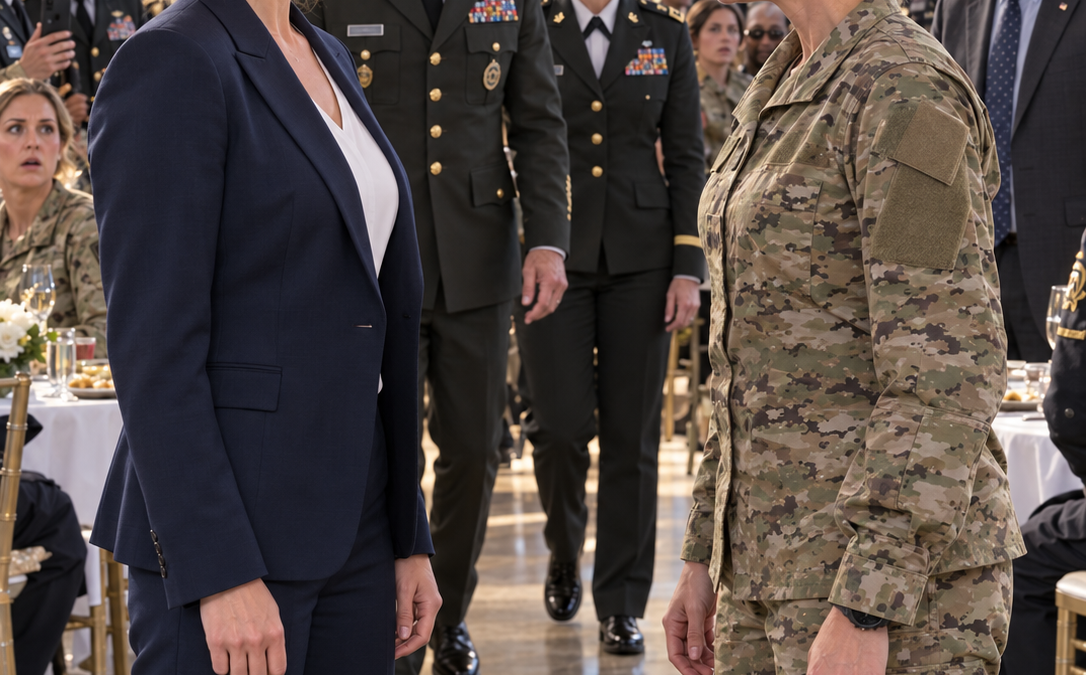
We were inside the Phantom Warrior Center at Fort Cavazos. A command social was winding down on one side of the building while several senior leaders prepared for an evening briefing in another room. I had arrived early. That was all. No secret operation, no trap, no dramatic entrance.
My driver had dropped me off twenty-five minutes before I was supposed to meet Lieutenant General Thomas Grady and the review team. I was wearing a dark blue suit, low heels, and carrying a plain leather folder. No uniform. No stars. Dana had no reason to know what rank I wore now.
We had barely spoken in six years. Apparently, she had filled in the missing years herself.
“You show up here dressed like this,” she said, looking me up and down, “and you think nobody sees what you’re doing.”
“I’m here for work.”
She laughed. “For work?”
“Yes.”
“At my installation?”
“It isn’t your installation.”
That got a few eyes on us. Dana smiled without humor.
“There it is.”
“What?”
“That tone.”
I knew the tone she meant. The one she had been accusing me of since we were teenagers. The tone that supposedly said I thought I was smarter, better, above everyone. Most of the time, I was just trying not to argue.
Dana never believed that.
Dad finally spoke. “Emily, this isn’t the place.”
I looked at him. He was seventy now, still straight-backed, still wearing the same expression he had used when I was sixteen and Dana had wrecked his truck. Somehow, I had been the one who needed to calm down then, too.
“I agree,” I said.
Dana turned toward him. “See? She does this every time. She comes in and acts innocent, and everybody expects me to take it.”
“Take what?” I asked.
The words came fast. Then everything behind them followed.
“You left Texas. You left Mom. You left Dad. You left me to deal with everything while you ran off and built your perfect Army career.”
I kept my voice low. “This is not the place for that conversation.”
“You don’t get to decide that.”
“Dana, no.”
“You don’t get to disappear for years, then walk into my command like you own the place.”
“Your command?”
“You know what I mean.”
Unfortunately, I did. A captain gets company command and sometimes forgets the Army existed before the change-of-command ceremony. I almost smiled. Almost.
Dana was too angry to notice.
“You heard about the complaints, didn’t you?” she said.
That caught my attention.
I hadn’t heard any details. I knew the review team had broader concerns involving logistics reporting and command climate. That was all I was authorized to know before the briefing.
Dana saw my pause and took it as confirmation.
“I knew it. You know something. You called somebody.”
“No.”
“You always know somebody.”
“That’s how twenty-two years in the Army works.”
“Don’t talk down to me.”
“I’m not.”
“You always do.”
A captain across the room quietly moved closer to the exit. Smart man.
My father stepped halfway between us. “Enough.”
For one second, I thought he meant Dana. Then he turned to me.
“Emily, maybe you should go.”
There it was.
Forty-two years old, more than two decades in uniform, and somehow I was twelve again, being told to leave the room because Dana was upset.
I stared at him. “You want me to leave?”
“Just until she settles down.”
Dana gave a small smile. Not a happy one. A victorious one.
I looked back at her.
“No.”
That was the moment she slapped me.
Not because I threatened her. Not because I insulted her. Because I said no.
The room stayed silent. Dana breathed hard. My father looked stunned now, though he had watched the whole thing happen. I lowered my hand from my face.
“Dana, walk away.”
“You think you can order me around?”
“No.”
“Then stop acting like you can.”
“I’m giving you good advice.”
She shook her head. “You always thought you were better than me.”
“I never said that.”
“You didn’t have to.”
She stepped back at last. One of her officers approached carefully.
“Ma’am, maybe we should—”
“I’m fine,” Dana snapped.
He stopped talking.
That told me more than I wanted to know.
I checked the clock mounted near the reception desk. Seven minutes until the briefing. I picked up my folder from the chair where I had left it.
Dana laughed again. “Running away?”
“No.”
“Good. Stay. Maybe for once you can watch someone else succeed.”
Dad rubbed his forehead. “Dana.”
She ignored him.
“You know what your problem is, Emily? You think because you spent your whole life chasing rank, everybody has to be impressed.”
I opened my folder and checked the briefing note. Nothing had changed. Grady was still scheduled for 1800. General Ward was coming with him.
Three minutes.
Dana kept talking.
I stopped listening. Not because I didn’t care. Because arguing with somebody who wants a fight is like negotiating with a smoke alarm. It makes noise. It doesn’t take feedback.
The doors opened behind me.
Conversation near the entrance stopped.
Lieutenant General Thomas Grady walked in first, still in duty uniform. Brigadier General Melissa Ward entered beside him, with two staff officers following a few steps back.
Dana straightened immediately. So did several officers around us. Her entire posture changed—shoulders back, chin level, professional smile. It was almost impressive.
Grady scanned the room.
Then he saw me.
“General Harwood.”
Dana’s smile disappeared.
Grady walked over. “I heard you got here early.”
“I did, sir.”
Melissa Ward reached us and handed one of her folders to an aide.
“Ma’am, the review team is ready whenever you are.”
Nobody said anything.
I didn’t look at Dana right away. I didn’t need to. I could hear the change in her breathing.
Grady noticed my lip. His eyes narrowed.
“What happened?”
Before I could answer, First Sergeant Daniel Ruiz stepped forward from near the wall.
“Sir.”
Grady turned.
Ruiz looked at Dana once, then at me. “I witnessed an altercation involving Captain Harwood.”
Dana’s face went pale.
“It was a family disagreement.”
Grady looked at her.
“Captain, nobody asked you yet.”
That ended that.
Within minutes, Dana’s battalion leadership had been contacted. She was directed to step away from company duties while the incident was reviewed, and her executive officer was told to assume routine responsibilities until further notice.
No handcuffs. No one tore rank off her uniform. No general gave a speech about destroying her career. The Army is usually less dramatic than television.
It is also much better at paperwork.
I gave my initial statement. Then I made one thing clear.
“Sir, she’s my sister. I’m the person she struck. I want no role in any decision involving her.”
Grady studied me. “You’re requesting recusal?”
“Yes.”
“Understood.”
Dana stared at me from across the room. I could see what she was thinking. She still believed this was about us—about Texas, about Dad, about the ranch, about all the things we had never settled.
Then First Sergeant Ruiz stopped one of the investigators near the hallway. His voice was low. I still heard him.
“Sir, before you close this out as a family incident, there’s something you need to know.”
The investigator turned.
Ruiz glanced toward Dana’s company officers.
“What happened tonight wasn’t the first time Captain Harwood crossed the line.”
Another NCO standing nearby slowly nodded.
Then a lieutenant did the same.
The investigator opened his notebook. “Start from the beginning.”
Ruiz pulled a chair closer and sat down without looking at Dana. The investigator clicked his pen.
“Go ahead.”
Ruiz rubbed both hands over his knees. For a first sergeant, that was unusual. Men like Ruiz usually had an answer before you finished asking the question. This time, he took a few seconds.
“Captain Harwood gets results,” he said.
The investigator waited.
“She works harder than almost anyone in the company. She knows supply. She knows maintenance. She knows exactly what higher headquarters wants to see.”
“That sounds like a compliment.”
“It is.”
Ruiz looked toward the hallway.
“It’s also part of the problem.”
I wasn’t in that room. I had already made my statement and stepped away. That mattered. Dana was my sister. I was the person she had hit. I was also a general officer sitting on the senior review team.
That combination had conflict of interest written all over it.
So while investigators started interviewing Dana’s people, I went to the briefing I had actually come to Fort Cavazos for.
General Ward sat across from me. Grady stood near the screen. Nobody brought up Dana for the first ten minutes. I appreciated that.
There were logistics reports on the table. Maintenance trends, readiness rates, command-climate indicators. Normal Army business.
Normal, except for one thing.
Dana’s company looked unusually good on paper.
Very good.
Almost annoyingly good.
“Harwood’s company has been one of the strongest performers in the battalion,” Ward said.
I kept my eyes on the slide. “Noted.”
She looked at me. “You’re staying out of this.”
“Yes, ma’am.”
“Completely?”
“Yes.”
Grady gave me a short nod. “Good.”
That was all. No speech, no concern about family feelings. Just boundaries.
The Army could be wonderfully unromantic that way.
Across the building, Staff Sergeant Nicole Avery sat down for her interview.
Nicole had worked in Dana’s logistics section for almost two years. She was thirty-four, sharp, calm, the kind of NCO who kept a unit running while everybody else was still looking for the right spreadsheet.
The investigator asked her a simple question.
“What kind of commander is Captain Harwood?”
Nicole answered quickly. “Capable.”
Then she stopped.
The investigator waited. “Anything else?”
Nicole looked at the closed door.
“She remembers everything.”
“Meaning?”
“If you bring her a problem, she remembers who brought it.”
That got written down.
Nicole leaned back. “She can be good to soldiers. That’s the part people miss.”
“Give me an example.”
“Last year, one of our specialists was facing separation after a family emergency wrecked his attendance. Captain Harwood stepped in. She helped get him legal support, worked with the first sergeant, got him a second chance.”
“So she supports her people.”
“When she thinks you’re loyal.”
There it was.
The investigator didn’t react. Nicole continued.
“If she thinks you’re against her, everything changes.”
“What happened to you?”
Nicole looked down at her hands.
“A maintenance report about six months ago.”
She explained that several vehicles had unresolved issues. Nothing dramatic. No exploding engines, no movie stuff. Just equipment that was not fully mission capable.
Nicole refused to sign off on a status entry she believed made the numbers look better than reality.
“What did Captain Harwood say?”
“She never told me to fake anything.”
That answer mattered.
The investigator leaned forward. “What did she say?”
Nicole gave a small, tired smile.
“She said, ‘I need people who solve problems, not people who create them.’ After that, my duty schedule changed.”
“How?”
“More weekends. More late shifts.”
“Anything else?”
“I got pulled from a training course.”
“Reason?”
“Mission requirements.”
“Was there a mission requirement?”
Nicole gave him a look.
“That’s the nice thing about mission requirements. You can make them sound like weather.”
The investigator almost smiled.
Almost.
Nicole continued. “My counseling changed, too. Suddenly I had communication problems, attitude issues, lack of flexibility.”
“Had any of that been documented before the maintenance report?”
“No.”
That got written down, too.
Another lieutenant gave a similar statement. Different issue, same pattern.
He had questioned whether a supply discrepancy should be closed before the paperwork was complete. Dana had called him into her office.
She never threatened him. She never raised her voice. She simply told him he needed to decide whether he wanted to be known as an officer who helped the company move forward or one who slowed everyone down.
Two weeks later, he lost a key responsibility.
No regulation violation on its face. No smoking gun.
Just pressure.
That was how things often worked. Not with one big illegal order, but with ten small choices that taught everybody what happened when they pushed back.
Ruiz gave the clearest description.
“People stopped bringing her bad news.”
The investigator looked up. “That’s serious.”
“Yes.”
“Why didn’t you report it?”
Ruiz breathed out.
“I tried.”
He explained that he had spoken to Dana more than once. He told her junior leaders were getting nervous. He told her soldiers were starting to edit what they said before coming into her office.
Dana dismissed it. Said people were too sensitive. Said commanders were not supposed to be liked.
That part was true.
Command was not a popularity contest.
The problem was that fear and discipline were not the same thing. Dana had started treating them like they were.
I understood that better than I wanted to.
Growing up, Dad had one solution for conflict between us.
Emily, be the bigger person.
Dana took my clothes without asking. Be the bigger person.
Dana wrecked something and blamed me. Be the bigger person.
Dana screamed. Don’t make it worse.
I had heard those phrases so often that I started mistaking silence for strength.
The Army rewarded discipline. It rewarded restraint. Those were good things. But restraint could become avoidance if you used it long enough.
I had.
That was on me.
Dana had learned a different lesson.
If she pushed hard enough, somebody else usually stepped back.
That was on her.
By the next morning, investigators had reviewed three prior complaints tied to Dana’s leadership. One involved retaliation after a disagreement. Another involved alleged intimidation. The third came from an officer who claimed professional opportunities disappeared after he challenged Dana during a readiness meeting.
None had resulted in major action.
One had been categorized as a personality conflict. Another had been handled informally. The third never moved beyond the initial review.
That did not prove Dana had committed misconduct.
It proved something else.
The concerns existed before she slapped me.
And one date mattered more than the rest.
The most recent complaint had been submitted twelve days before I arrived at Fort Cavazos.
Twelve days before Dana saw me.
Before she hit me.
Before General Grady called me General Harwood.
The investigator placed the complaint beside Dana’s statement.
Her statement said I had come to Fort Cavazos because I wanted revenge.
The paperwork said otherwise.
Nicole was called back in. The investigator slid the complaint across the table.
“Did Captain Harwood know this had been filed?”
Nicole looked at the date.
Her expression changed.
“Yes.”
“How do you know?”
“Because the day after it was filed, she called a meeting.”
“What kind of meeting?”
Nicole sat straighter. “She told us somebody in the company was trying to damage the unit.”
The investigator stopped writing.
“What exactly did she say?”
Nicole thought for a moment, then looked straight at him.
“She said if people wanted to play games with her career, they should be ready when she started paying attention to theirs.”
The room stayed quiet.
Ruiz, sitting near the wall, closed his eyes for half a second.
The investigator turned the page. “Who else heard that?”
Nicole answered without hesitation.
“Almost everybody in leadership.”
He picked up his phone.
“Get me the company roster.”
The company roster hit the table twenty minutes later, followed by maintenance reports, supply records, and enough spreadsheets to ruin anyone’s morning.
Investigators started matching names.
Who had complained?
Who had been reassigned?
Who had lost duties?
Who had signed readiness reports?
The same names kept showing up.
Not everywhere.
Just enough to make people uncomfortable.
By noon, the review team had moved past leadership complaints and into numbers.
That was where Dana usually looked strongest.
Her company had excellent readiness rates. Vehicles were up. Parts were flowing. Deadlines were met. Problems were closed fast.
On paper, Captain Dana Harwood looked like exactly the kind of commander senior leaders liked.
Efficient. Focused. No excuses.
General Ward stared at one slide for a long time.
“This company recovered from maintenance issues faster than every other company in the battalion.”
A logistics analyst nodded. “Yes, ma’am.”
“How much faster?”
“Sometimes twenty to thirty percent.”
Grady leaned back.
“That’s either very good leadership or very good paperwork.”
Nobody laughed.
That was the problem with generals. They could make a joke sound like an inspection finding.
I sat at the far end of the table, still recused from anything involving Dana personally, but the broader command review had existed before the slap. That work continued, and Dana’s company was already part of it.
The analyst pulled up another chart.
“Look here. Three vehicles were listed as not mission capable on a Monday. By Wednesday, all three were back in service.”
“Is that possible?” Ward asked.
“Yes.”
“Likely?”
The analyst hesitated. “Depends on the repairs.”
They opened the maintenance notes.
One vehicle needed a transmission-related component. Another had an electrical control issue. The third had a suspension problem.
All three were marked resolved.
Documentation was thin.
Not missing.
Thin.
That difference mattered.
People hear military fraud and imagine secret briefcases full of cash. Most real problems start much more boring than that.
A date.
A signature.
A number that looks a little too clean.
Nobody in the room said fraud.
Not yet.
They said irregularity.
They said discrepancy.
They said follow-up required.
Army language has many ways to say, This smells wrong, but prove it.
Staff Sergeant Nicole Avery was brought back in. The investigator showed her one of the maintenance entries.
“Do you remember this vehicle?”
Nicole looked at the number. “Yes.”
“Was it repaired by this date?”
She paused. “Not fully.”
“What does that mean?”
“It was running.”
“That’s not the same thing.”
“No.”
She pointed at the form.
“The original issue wasn’t fully resolved. We had a temporary fix. It could move. It could operate. But I would not have called it fully mission capable yet.”
The investigator looked at the entry.
Someone had.
The signature belonged to another NCO. Nicole knew him.
“Why would he sign it?”
She shook her head. “You’d have to ask him.”
They did.
The NCO said he believed the issue had been cleared at the time. He did not admit pressure. He did not accuse Dana. He simply said the company had been under heavy pressure to improve readiness before a major reporting deadline.
That was not illegal.
Every commander wanted better numbers.
The question was how those numbers got better.
Another record showed a replacement part entered into inventory. A mechanic said he remembered waiting three more days for that same part.
The dates did not match.
Maybe memory was wrong.
Maybe paperwork was late.
Maybe the system updated incorrectly.
All possible.
One strange record means nothing.
Five means you start asking questions.
Ten means somebody starts having a very bad week.
My phone vibrated.
Dad.
I let it ring.
He called again.
Then again.
I stepped outside.
“What?”
No hello. No small talk. Straight to the family tradition.
“What did you do?”
I closed my eyes. “Good afternoon to you, too.”
“Don’t get smart with me.”
“I’m forty-two.”
“You’re still my daughter.”
“Unfortunately, that doesn’t make your opening question better.”
He ignored that.
“Dana says she’s been removed from command temporarily because of you.”
“Because she hit somebody in front of witnesses.”
“You?”
“Yes, Dad. I was there.”
He lowered his voice. “She made a mistake.”
“She did.”
“So fix it.”
I looked through the glass toward the conference room. Analysts were still working. Nobody inside knew what my father was saying.
Good.
“I’m recused.”
“What does that mean?”
“You know exactly what it means.”
“You have access to Grady.”
“I’m not calling him.”
“Emily, she has a career.”
“So do I.”
“You’ve already made yours.”
There it was.
Dana still had a future.
Mine apparently counted as completed inventory.
He kept going.
“She could lose command. She could lose promotion opportunities. You know how this works.”
“Yes.”
“Then help her.”
“I’m recused.”
“You’re her sister.”
“Exactly.”
He went quiet.
That answer landed harder than yelling would have.
When he spoke again, his voice was colder.
“You always do this.”
“Do what?”
“Walk away when family gets difficult.”
That one found its target because part of it was true.
I had walked away.
Not from responsibility.
From conflict.
There is a difference, but not always as much as we want there to be.
“I have work,” I said.
“Emily—”
I ended the call.
No dramatic goodbye.
I went back inside.
Nicole was waiting near the table with printed emails.
“I found something,” she said to the investigator.
He took the pages.
One email was six months old. Nicole had written Dana about a maintenance-status entry. The language was careful, professional. She stated that the vehicle should not be reported fully mission capable because the repair had not been completed.
Dana’s reply was shorter.
We’ll discuss whether you still belong in this section when I return.
No order to falsify anything.
No admission.
Just pressure.
General Ward read it twice.
“Was this ever reported?”
Nicole nodded. “Informally.”
“To whom?”
“Battalion staff.”
“What happened?”
“I was told Captain Harwood had a demanding leadership style.”
Ward set the email down.
That phrase had started showing up too often.
An analyst at another table raised his hand.
“Ma’am.”
Everyone turned.
“I’ve got a pricing issue.”
He projected an invoice.
Replacement component. Quantity four. Vendor price much higher than comparable purchases.
“How much higher?” Grady asked.
“About forty percent. Single purchase so far.”
The vendor name appeared on the screen.
Lonear Tactical Supply.
I had never heard of it.
The analyst opened the vendor contact record.
“Primary representative is Marcus Vale.”
Nicole looked up immediately.
The investigator noticed.
“You know him?”
She hesitated. “I know the name.”
“From where?”
“He served with Captain Harwood years ago.”
That changed the room.
Not dramatically. Nobody gasped. Professionals rarely gasp.
They just start asking better questions.
The analyst opened three more invoices.
Same vendor.
Same unit.
Different parts.
Each priced higher than similar purchases from other suppliers.
Grady pointed at the screen.
“Don’t assume misconduct.”
“No, sir.”
“Verify everything.”
“Yes, sir.”
Ward looked at the maintenance reports again, then at Nicole’s email, then at the invoices.
“Leadership complaints. Readiness pressure. Purchasing anomalies.”
She tapped the table once.
“Keep those lanes separate until evidence connects them.”
The analyst nodded.
Another technician entered with a laptop.
“Ma’am, we found something else.”
He turned the screen toward Ward.
A batch of equipment statuses had changed within hours of the last quarterly reporting cutoff.
Ward leaned closer.
“How many?”
“Eleven.”
“Who approved the changes?”
The technician scrolled down.
“Different people.”
“Who initiated most of them?”
He stopped.
His finger stayed on one name.
Captain Dana Harwood.
The technician kept his finger on Dana’s name while General Ward asked for the full audit trail.
“Who changed the statuses?”
“Several people, ma’am.”
“Who requested the changes?”
He looked at the screen again.
“Captain Harwood initiated nine of the eleven.”
Ward didn’t react.
“Document it. Don’t interpret it.”
“Yes, ma’am.”
That was the right answer.
A strange number was not a crime.
An aggressive commander was not automatically corrupt.
And my sister being difficult did not give anyone permission to invent a case around her.
That distinction became important sooner than I expected.
Two days later, Dana filed a formal complaint against me.
I learned about it from General Grady. He called me into a small conference room and closed the door.
“Emily, your sister alleges you used your position to initiate an investigation against her because of a family dispute.”
I sat down.
“Okay.”
He raised an eyebrow. “That’s all?”
“What would you like me to do? Flip the table?”
“No.”
“Good. It’s government property.”
He almost smiled.
Almost.
Then he pushed the folder toward me.
Dana’s complaint was detailed.
Very detailed.
She claimed I had arrived at Fort Cavazos without telling her.
True.
She claimed we had unresolved family conflict involving property in Texas.
Also true.
She claimed I had deliberately allowed our confrontation to escalate so senior officers would witness the result.
False.
She claimed I used my relationship with Grady to expand a private family fight into an official review.
Also false.
But false allegations still had to be examined, especially when the accused person wore a star.
Maybe more so.
“I want an independent review,” I said.
“That’s already being arranged.”
“Good.”
“You understand this could temporarily limit what you see.”
“I’m already recused from Dana’s case.”
“I mean parts of the broader review, too.”
That irritated me.
Not because it was wrong.
Because Dana knew exactly where to aim.
She could not stop investigators from looking at records, but she could make my involvement look contaminated. And if she convinced enough people that I had a personal motive, every legitimate finding could start looking like revenge.
Smart.
Annoying.
Very Dana.
My phone started filling up that afternoon.
An aunt I had not heard from in three years sent me a message.
Dana is your sister. Don’t destroy her over one mistake.
A cousin wrote, You already have everything you wanted. Why take her career, too?
Then another relative called.
I let that one go to voicemail.
Dad did not leave voicemail. He preferred live combat.
I ignored him.
The family version of events was spreading fast.
Emily came back with stars.
Emily embarrassed Dana.
Emily used powerful friends.
Emily wanted the ranch.
Emily wanted revenge.
Nobody mentioned the slap.
That part had become inconvenient.
By evening, I was sitting across from an independent reviewing officer with my calendar open on the table.
“General, when was your Fort Cavazos visit scheduled?”
“Three weeks before the incident.”
I handed over the travel authorization.
“When did you learn Captain Harwood would be at the reception?”
“I didn’t.”
“Did you request that she attend?”
“No.”
“Did General Grady know about your family relationship before the incident?”
“No.”
“Did General Ward?”
“No.”
“Did you contact Staff Sergeant Avery before arriving?”
“No.”
“First Sergeant Ruiz?”
“No.”
“Any member of Captain Harwood’s company?”
“No.”
The officer looked at me.
“Do you have phone records?”
“Yes.”
“Emails?”
“Yes.”
“Messages?”
“Yes.”
“Anything involving the property dispute?”
“I can provide those, too.”
He paused.
“You’re comfortable with that?”
“No.”
That got his attention.
I continued.
“But comfortable isn’t the standard.”
He nodded once.
“If I expect scrutiny from everyone else, I don’t get to complain when it reaches me.”
So I gave them everything relevant.
Calendar entries.
Travel orders.
Briefing schedules.
Official emails.
Personal communications tied to Dana.
The review confirmed something quickly.
The senior command review had been scheduled before I arrived.
Concerns involving logistics reporting had existed before I arrived.
Dana’s prior leadership complaints had existed before I arrived.
I had not contacted the complainants.
I had not requested an investigation into Dana.
I had not even been briefed on the details before she hit me.
That should have settled the issue.
It didn’t.
Dana had already moved the argument somewhere else.
The ranch.
Our mother had left an interest in family property in Texas when she died. Years later, Dad pressured me to sign documents while I was overseas. I never finished resolving it.
Dana knew that.
Now her complaint suggested I blamed her for the dispute and had carried that resentment into my Army responsibilities.
The independent officer asked me directly.
“Do you resent your sister?”
I considered lying.
Not officially. Just the polite kind.
“No.”
Then I stopped.
“Yes.”
He waited.
“She hit me in public. We haven’t had a healthy relationship in years. Of course I resent some things.”
“Do you want her punished?”
“I want the process to work.”
“That wasn’t my question.”
“No.”
He watched me.
“I don’t want to decide what happens to her. That’s the reason I recused myself.”
That answer was harder than it sounded because part of me was angry.
Part of me wanted Dana to finally face something Dad could not fix.
But wanting consequences and controlling consequences were different things.
I knew the difference.
Dana did, too.
That was why she was trying to erase it.
Three days later, the independent review found no evidence that I had used my position to target her. My official travel had been approved before the confrontation. The command review already existed. The complainants had no prior contact with me.
The allegation that I had set Dana up had nowhere left to go.
Grady handed me the preliminary finding.
“You’re clear.”
I put the paper down. “Good.”
“That doesn’t mean you’re going back into her case.”
“I know.”
He studied me.
“You seem disappointed.”
“I’m tired.”
“Same thing at our age.”
“I’m forty-two.”
He stared at me.
“Get out of my office.”
I did.
Downstairs, the financial team had kept working while everybody else argued about my motives.
Lonear Tactical Supply appeared on more invoices.
Not every price was suspicious.
Several were normal.
That mattered.
Then the analyst checked Marcus Vale.
He had served with Dana years earlier. Same logistics environment, same overseas assignment for part of that period.
Again, not illegal.
People in Army logistics know people in Army logistics. It is a small world filled with very large spreadsheets.
But one analyst found something that did not fit.
Payments from Lonear Tactical Supply had gone to a small consulting company.
The company had no obvious role in the Fort Cavazos transactions. No warehouse. No equipment inventory. No technical staff anyone could identify.
General Ward looked at the business registration.
“Owner?”
The analyst turned his laptop.
“A woman named Kelly Mercer.”
Nicole, sitting with an investigator nearby, heard the name. Her head came up.
“I know Kelly.”
Ward looked over.
“How?”
Nicole pointed at the screen.
“She’s Captain Harwood’s best friend.”
The analyst started typing again.
A second record opened.
Same company.
Same address.
Then another payment.
And another.
Ward pulled a chair closer.
“How much went through that LLC?”
The analyst began adding the transactions.
“Still calculating, ma’am.”
“Who authorized the original vendor purchases?”
He opened the approval chain.
Several names appeared.
Then Dana’s.
Ward leaned toward the screen.
“Pull every payment between Lonear Tactical Supply and that LLC.”
The analyst nodded.
“And check where the money went after it reached the company.”
His hand stopped for a second.
“Ma’am.”
“What?”
“I already have one transfer.”
Ward moved closer.
“Where did it go?”
He rotated the screen toward her.
The destination account carried another name everyone in the room recognized.
Dana Harwood.
Nobody spoke while the analyst opened the transfer record again and checked the account number.
Dana Harwood.
Same name.
Same account.
Same transaction.
General Ward leaned over the laptop.
“How much?”
“Eight thousand four hundred.”
“One transfer?”
“So far.”
“Source?”
“Kelly Mercer’s LLC.”
Ward straightened.
“Do not call that proof of fraud.”
The analyst nodded. “Yes, ma’am.”
“Trace it.”
That became the job.
Not to guess.
Not to assume.
Trace everything.
CID and the financial investigators took over the criminal side while the command team kept the administrative review separate.
That separation mattered.
A bad commander was one problem.
A commander taking government money was another.
People love simple stories. One villain, one crime, one dramatic confession.
Real investigations are mostly people comparing boring documents until one boring document refuses to match another.
Three weeks passed.
Dana remained away from command. Her executive officer kept the company running.
The world did not stop.
Vehicles still broke.
Parts still arrived late.
Soldiers still complained about coffee.
The Army remained the Army.
Investigators pulled purchase records from the previous eighteen months. They reviewed invoices, inventory receipts, equipment-disposal documents, maintenance logs, approvals, emails, vendor contacts, and bank records obtained through proper legal process.
They also interviewed mechanics.
That changed the picture.
One specialist remembered waiting nearly a week for a steering component. According to the paperwork, the part had arrived three days earlier.
“Could you be mistaken?” the investigator asked.
“Sure.”
“You sound confident.”
“I remember because Captain Harwood chewed out our lieutenant over that vehicle.”
“Why?”
“It hurt the readiness numbers.”
Another mechanic remembered opening a shipment that contained cheaper replacement components than the paperwork listed.
“Did you report it?”
“To my section sergeant.”
“What happened?”
“He said supply would handle it.”
“Did supply handle it?”
“I don’t know.”
That answer showed up a lot.
I don’t know.
I thought somebody else handled it.
I assumed it was fixed.
Those sentences can keep a bad system alive for years.
Investigators went back through the purchasing records.
Lonear Tactical Supply had sold several categories of parts to the unit. Some prices were normal. Some were high. A few were much too high.
One component had been billed nearly forty percent above comparable purchases. Another had a different manufacturer listed on the invoice than the part entered into the maintenance record.
Still not enough.
Mistakes happen.
Supply systems are not holy books. They contain typos. They contain old data. They contain things entered at two in the morning by a tired specialist who would rather be anywhere else.
So investigators kept going.
Then they found disposal records.
A group of components had been marked damaged beyond economical repair. The paperwork said they had been properly removed from government inventory, but the documentation trail was incomplete.
A civilian warehouse employee remembered seeing some of those items stacked separately.
“Why?”
“He said they were waiting for pickup.”
“Who said that?”
“Mr. Vale.”
Marcus Vale.
His name was becoming familiar.
Too familiar.
The investigator asked for shipment records.
There were gaps.
Now the picture had pieces.
Inflated invoices.
Questionable substitutions.
Incomplete disposal records.
Payments from Lonear Tactical Supply to Kelly Mercer’s consulting company.
Then transfers out.
The numbers were not millions.
They did not need to be.
Over more than a year, investigators identified roughly $280,000 in transactions that required explanation.
Some could still be legitimate.
Some could not.
Nicole was interviewed again.
She described one month when her section kept waiting for parts that the system claimed had already been issued.
“I thought we had a software problem,” she said.
“Did you tell Captain Harwood?”
“Yes.”
“What did she say?”
“She told me to stop chasing paperwork and get the vehicles moving.”
“Did she know the parts were missing?”
“I told her.”
“What happened after that?”
Nicole looked at the table.
“She asked whether I wanted to be in logistics or auditing.”
That sounded like Dana.
Sharp enough to hurt.
Clean enough to deny later.
Meanwhile, Dad asked to meet me.
Not call me.
Meet me.
That was new.
We sat in a quiet restaurant outside the installation. He arrived ten minutes early.
Of course he did.
Retired colonels consider being late a personal attack on civilization.
He waited until the server left.
“Dana needs help.”
I took a sip of water.
“She has counsel.”
“That’s not what I mean.”
“I know.”
He leaned forward.
“This is getting out of control.”
“No. It’s getting investigated.”
“She made mistakes.”
“Maybe.”
“Emily, you know how these things work. Once investigators decide what they think happened, they keep digging until they prove themselves right.”
“That’s why she has a lawyer.”
“You could talk to Grady.”
“No.”
“You could at least tell him this started as a family problem.”
“It didn’t.”
“She hit you.”
“Yes.”
“That was the beginning.”
“No, Dad. The complaints were already there.”
His jaw tightened.
“You always have an answer.”
“That’s generally considered useful.”
He did not appreciate that.
I wasn’t surprised.
He lowered his voice.
“No one has to lie.”
I stared at him.
“What does that mean?”
“It means things can be handled quietly.”
There it was.
The Harwood family solution.
Keep it quiet.
Keep it inside.
Keep everyone respectable.
We had spent years polishing problems instead of solving them.
“I’m not touching her case.”
Dad sat back.
“You’re really going to let your own sister go down?”
“I’m going to let the process work.”
“She could lose everything.”
“That depends on what she did.”
His face hardened.
Then he changed direction.
“The ranch.”
I stopped moving.
“What about it?”
“You still want your mother’s share settled?”
I said nothing.
“If you help Dana, I’ll make sure the property issue gets resolved fairly.”
For a second, I honestly wondered whether he had heard himself.
“You’re offering me the ranch.”
“I’m offering to settle a family dispute.”
“In exchange for me interfering in a military investigation.”
“I didn’t say that.”
“You didn’t have to.”
His eyes narrowed.
“You’re twisting my words.”
“No. I’m finally listening to them.”
He started to speak again.
I stood.
“You need to leave.”
“Emily—”
“You need to leave.”
I put cash on the table and walked out before anger made the decision for me.
Back at Fort Cavazos, the financial team had found another transfer.
Then another.
Kelly Mercer’s LLC had received payments tied to Lonear Tactical Supply. Within days of several payments, money moved into accounts Dana controlled.
Different amounts.
Different dates.
Same pattern.
The lead CID investigator spread the transactions across the table.
“Total direct transfers?”
The analyst checked.
“Just over sixty-three thousand we can currently trace into accounts connected to Captain Harwood.”
“Currently?”
“There are more transactions we’re still reviewing.”
“Any legitimate explanation documented?”
“Not in the records we have.”
The investigator looked at the invoices again.
“Get the full bank history. Preserve the vendor emails. I want every message between Vale, Mercer, and Harwood.”
The analyst started building the request.
Another investigator pulled up Dana’s earlier financial disclosure forms. He read one line twice.
Then he slid the document across the table.
“She reported no outside business income.”
The lead investigator looked at him.
“Compare every deposit against that statement.”
The keyboards started clicking again.
By the end of that week, Dana knew the financial investigation had reached her personal accounts.
Her response changed almost overnight.
No more angry calls through Dad.
No more statements about family revenge.
No more accusations that I had set her up.
Her lawyer took over.
That was probably the smartest decision Dana had made in months.
Counsel argued that several transfers were legitimate reimbursements tied to private expenses she had covered for Kelly Mercer and Marcus Vale. Some deposits, they said, had nothing to do with Army purchasing.
Others were payments connected to personal investments.
It sounded possible.
That mattered.
An investigation is not supposed to prove the story investigators like best.
It is supposed to test every explanation.
So they tested hers.
Receipts were requested.
Tax records were reviewed.
Dates were matched.
Messages were compared to transactions.
Some of Dana’s explanations checked out.
That surprised people.
One eight-hundred-dollar transfer was exactly what she said it was. Another deposit came from selling a privately owned trailer. A third had nothing to do with Lonear Tactical Supply.
For about two days, people around the command review spoke more carefully.
Good.
Dana was still entitled to facts, not assumptions.
The same thing happened with witnesses.
A former platoon sergeant described her as demanding but fair. A staff officer said Dana had once stayed up most of a night helping a young lieutenant correct a serious inventory mistake before it became a career-ending problem.
One soldier said Dana had personally fought to keep him in the Army after a messy divorce wrecked his performance.
“She could be hard,” he told investigators. “But she didn’t give up on people.”
That statement bothered me more than I expected.
Not because I thought it was false.
Because I believed it.
Dana had always been capable of kindness.
That was part of what made everything else harder.
People prefer villains who are terrible every day.
Real people are inconvenient.
They can help one person on Monday and crush another on Friday.
They can be loyal, funny, generous, then walk into a room and make everyone afraid to speak.
I knew Dana had good in her.
I also knew good did not erase damage.
While her lawyers challenged the financial case, the independent review of my conduct expanded. This time they wanted everything connected to the ranch.
I met with the reviewing officer again.
He placed a copy of Dana’s complaint in front of me.
“She says you have a financial motive.”
“I know.”
“Do you?”
“I have a property dispute.”
“That wasn’t my question.”
I leaned back.
“I want what my mother legally left me.”
“Does your sister currently benefit from you not having it?”
“Yes.”
“Does that create resentment?”
“Yes.”
He wrote something down.
I smiled without humor.
“You people really enjoy direct questions.”
“It saves paper.”
“That would be a first for the Army.”
He ignored that.
“Did you ever threaten Captain Harwood over the property?”
“No.”
“Did you ever connect the ranch dispute to her military career?”
“No.”
“Did you discuss the property with anyone in her chain of command?”
“No.”
He asked for records.
I gave them to him again.
Emails.
Old messages.
Copies of letters from Dad.
Anything relevant.
Then something arrived that I had not expected.
A Texas attorney named Martin Keller contacted me. He had handled part of my mother’s estate years earlier.
I remembered him vaguely.
Quiet voice.
“General Harwood,” he said on the phone. “I’m cleaning out archived estate files. Your name came up.”
“That sounds ominous.”
“It’s mostly boring.”
“Better.”
He sent me scanned documents.
One was an old ownership agreement. Another was correspondence from Dad.
Then I saw the date.
I had been overseas when those papers were being pushed through.
Keller’s notes showed that Dad had repeatedly asked whether my signature could be obtained quickly because I was difficult to reach. There was also an email from Dad describing my military schedule as an opportunity to settle the matter without dragging this out.
Nothing in the file proved criminal conduct.
That was not the point.
It proved pressure.
Move fast.
Keep it quiet.
Get the inconvenient person to sign.
I sat with those documents for a long time.
Not because of the land.
Because the pattern felt familiar.
Nicole had been pressured to stop asking about maintenance.
Junior officers had been pressured to stop challenging readiness numbers.
I had been pressured years earlier to stop fighting over the ranch.
Different systems.
Different stakes.
Same habit.
Make resistance exhausting enough and people eventually give in.
For years, I had called that keeping the peace.
Now I had a less flattering name for it.
Avoidance.
I forwarded everything to a civilian estate attorney in Texas.
That was where the ranch belonged.
Not in Dana’s military case.
Not in Grady’s office.
Not in an Army investigation.
Two lanes.
Keep them separate.
The independent review reached the same conclusion a few days later.
There was no evidence I had used my position to target Dana. No improper contact. No pressure on investigators. No attempt to influence command decisions.
My recusal remained in place.
The finding cleared my conduct.
I read it once, then put it away.
There was no victory in being cleared of something you did not do.
Mostly, I felt tired.
Dana’s lawyer probably felt worse because while everyone had been arguing about motive, CID had been working on Marcus Vale.
He had retained counsel.
Then he asked for a meeting.
The room was small.
Vale sat beside his attorney with a bottle of water he never opened.
The lead investigator placed a folder on the table.
“We need to know whether Captain Harwood understood where the money was going.”
Vale stared at the folder.
His lawyer leaned toward him.
“You can answer.”
Vale swallowed.
“Yes.”
The investigator did not move.
“Yes, what?”
“She knew.”
“From the beginning?”
“Not the beginning.”
Vale looked down.
“When the invoices started getting padded.”
“Who proposed it?”
Vale rubbed both hands together.
“It wasn’t one conversation.”
“Then give me the first one.”
Vale reached into his briefcase. His attorney stopped him long enough to nod.
Vale pulled out a printed stack of messages and set it on the table.
“I kept everything.”
The investigator looked at the pages.
“Why?”
“Because I stopped trusting her.”
He slid the first message across.
“Start with this one.”
Vale kept his hand on it for a second before letting go.
The investigator read it.
Then read it again.
It wasn’t dramatic.
That made it worse.
No threat.
No confession.
No line saying, Let’s steal government money.
Just Dana asking why a vendor price had increased and whether the difference could be handled the same way as last quarter.
The investigator looked up.
“What does that mean?”
Vale stared at the table.
“It meant she knew.”
His attorney said nothing.
Vale continued.
“The first time, she didn’t ask questions. Later, she started asking how much was left after the invoice was paid.”
“And the payments through Kelly Mercer’s company?”
“She knew about those, too.”
“Did Captain Harwood receive money directly?”
“Yes.”
“How often?”
“Not every time.”
“Why not?”
“Because she wasn’t stupid.”
That line ended up in the notes.
Vale explained that Dana had never acted like someone running a criminal empire.
She acted like a commander who believed she deserved a private reward for making things happen.
That was somehow more believable and more disappointing.
CID compared Vale’s messages with bank records.
The dates matched.
Then invoices.
Then Dana’s communications.
Enough pieces started lining up that investigators no longer had to depend on Vale’s word alone.
By then, Dana had received formal notice that the investigation had expanded. Her command status was still temporary.
Her lawyer knew that could change.
Dad knew, too.
He called me twice.
I didn’t answer.
Dana didn’t call at all.
Then, unexpectedly, she sent a message through counsel asking to meet.
No discussion of evidence.
No discussion of charges.
Just family.
I almost said no.
Then I remembered how often I had used distance as a solution.
So I agreed.
We met in a private conference room off post.
No uniforms.
No aides.
No father.
Just two sisters sitting across from each other for the first time in years without somebody else controlling the conversation.
Dana looked tired.
Not movie tired.
No dark makeup under the eyes. No trembling hands. Just the kind of tired that comes from sleeping badly for weeks.
She looked at my suit.
“So this is really you now?”
“What? The general thing?”
I almost laughed.
“Yes, Dana. It’s real.”
She looked away.
“I didn’t know.”
“I know.”
“If I had known—”
“Don’t.”
She stopped.
I leaned forward.
“If you had known my rank, you wouldn’t have hit me.”
“That’s not what I meant.”
“It’s exactly what you meant.”
She looked back at me.
“You always do that.”
“Do what?”
“Make me sound stupid.”
“I didn’t make you say it.”
Her jaw tightened.
There she was.
The Dana I remembered.
But she didn’t explode.
She sat back.
“Dad always talked about you.”
I said nothing.
“Even when you were gone.”
“That surprises me.”
“It shouldn’t.”
She laughed once. There was no humor in it.
“You think I was the favorite?”
“You were.”
“Maybe.”
That answer caught me.
Dana looked at the table.
“He gave me things. Helped me. Made calls. Introduced me to people.”
“Yes.”
“And every time I did something good, he compared it to you.”
I stayed quiet.
“First promotion? Emily made rank faster.”
She looked at me.
“First command? Emily had already done bigger jobs.”
Her voice tightened.
“If I got praise, somehow you still came into the conversation.”
I hadn’t known that.
Not fully.
Dana continued.
“You left, but you never really left.”
“That wasn’t my choice.”
“No. No, you never came home. That part was.”
She nodded.
At least she accepted that.
“I hated you for it.”
“I know.”
“No, you don’t.”
“Then tell me.”
She stared at me.
“I stayed. I dealt with Dad. I dealt with the ranch. I dealt with Mom’s things. Every holiday. Every family problem. Every stupid argument.”
“And I should have been there more.”
“Yes.”
“I agree.”
That stopped her.
Dana expected resistance.
I gave her none.
“I used the Army,” I said.
“For what?”
“To avoid this family.”
She frowned.
“I told myself I was busy. Sometimes I was.”
I paused.
“Other times, I just didn’t want to come home.”
Dana looked almost satisfied.
“So you admit it.”
“Yes.”
“You abandoned us.”
“No.”
Her expression changed again.
“I left. I avoided conversations. I let Dad tell his version of everything because fighting him was exhausting.”
I leaned forward.
“That is mine.”
She stayed silent.
“But what happened to your soldiers is yours.”
Her face closed.
“You don’t know what happened.”
“I’m not talking about case facts.”
“You’re judging me.”
“I’m talking about us.”
“That’s convenient.”
“Dana.”
She shook her head.
“You always get to be calm. You always get to be reasonable.”
“I’m not always reasonable.”
“You sure act like it.”
“Because somebody in this family had to learn that volume wasn’t an argument.”
That actually got a tiny laugh from her.
Then it disappeared.
She looked at me.
“Do you want me to lose everything?”
The question came quietly.
Career.
Rank.
Reputation.
Freedom.
She didn’t have to name them.
I took a breath.
“What I want is irrelevant.”
“That’s a nice answer.”
“It’s the true one.”
“You’re telling me you don’t care?”
“I care too much.”
She looked confused.
“That’s why I stepped out of your case.”
Dana said nothing.
I continued.
“You were allowed to be angry with me.”
She looked down.
“You were allowed to hate me.”
Her eyes came back to mine.
“You were never allowed to make other people pay for it.”
Her mouth tightened.
“You think that’s what I did?”
“I think you need to answer that for yourself.”
Before she could respond, her phone vibrated on the table.
She looked at the screen.
Her expression changed.
“What?”
She didn’t answer.
She stood.
“My counsel.”
I stood, too.
Dana took the call outside.
I waited.
Five minutes later, she came back.
Whatever anger she had brought into that room was gone.
Her face looked flat.
“What happened?”
She grabbed her purse.
“They finalized the command review.”
I said nothing.
She looked at me.
“I’m relieved.”
Not temporary.
Formal.
Captain Dana Harwood was no longer the company commander.
The substantiated findings cited retaliation concerns, abuse of authority, and leadership failures.
The criminal investigation remained separate.
Dana put the phone away.
For the first time, she looked smaller.
Not weak.
Just stripped of the role she had used to define herself.
I walked with her to the hallway.
Her attorney was waiting near the exit. He pulled her aside.
I caught only one sentence.
“Dana, losing command is not the part we need to worry about now.”
She looked at him.
“What is?”
He lowered his voice.
“CID is preparing the criminal referral.”
Dana stared at her attorney for a few seconds, then asked him to repeat it.
“CID is preparing the criminal referral.”
This time, she heard every word.
She left without looking at me.
I let her.
There are moments when following someone feels like support.
That was not one of them.
By then, nearly three months had passed since the night at the Phantom Warrior Center.
The slap felt almost small now.
Not unimportant.
Small.
Dana’s real problem was no longer what she had done to me in front of a room full of people.
It was what investigators believed she had been doing long before I arrived.
CID completed another round of financial interviews.
Bank records were verified.
Vendor invoices were compared against actual purchases.
Marcus Vale’s messages were authenticated.
The command review had already substantiated retaliation and abuse-of-authority concerns.
Now lawyers had to decide what the evidence could actually support in court.
That process moves slower than people imagine.
Nobody walked into an office and said, She’s guilty. Lock her up.
Evidence had to survive questions.
Witnesses had to survive cross-examination.
Dates had to match.
Money had to go where people claimed it went.
And every person involved had a lawyer telling someone else why the other side was wrong.
Dana’s defense counsel attacked Vale immediately.
That made sense.
Vale had admitted his own involvement. He had a reason to cooperate. He had a reason to make himself look less responsible.
During one interview, Dana’s counsel asked him directly, “You expect consideration for cooperating, correct?”
Vale looked at his attorney, then answered.
“Yes.”
“So blaming Captain Harwood helps you?”
“No. Telling the truth helps me.”
Dana’s lawyer leaned back.
“That sounded rehearsed.”
Vale shrugged.
“I’ve had a lot of time to think about it.”
His credibility became a real issue.
Investigators knew that, so they did not rely on him.
They checked his messages against financial records.
They checked his dates against purchase approvals.
They checked his descriptions of meetings against calendars and phone-location data where lawfully available.
Some details were wrong.
Human memory usually is.
But the important parts kept lining up.
Nicole had her own problems.
Not legal ones.
Social ones.
People in the company knew she had cooperated.
Nobody openly threatened her.
Nobody needed to.
Some coworkers stopped inviting her to lunch. One NCO who used to call her every week stopped answering messages.
A former friend told her she had made the whole unit look dirty.
Nicole told an investigator about it.
“Do you feel threatened?”
“No.”
She thought about that.
“Yes.”
“By whom?”
“That’s the problem.”
The investigator frowned.
Nicole explained.
“Nobody. You don’t need somebody to say anything when the whole room goes quiet because you walked in.”
That was hard to document.
But it was real.
She worried about promotion.
Assignments.
Her reputation.
She worried that five years from now, somebody would still call her the NCO who brought down a commander.
The investigator reminded her of something simple.
“You didn’t bring anyone down.”
Nicole gave him a tired smile.
“People keep saying that.”
I understood why she did not fully believe it yet.
I also understood why I could not call her.
I wanted to.
Not about evidence. Just to tell her she had done the right thing.
But I was still Dana’s sister.
Still the original victim.
Still a general officer.
So I stayed away.
Some days, doing nothing was harder than taking action.
Dad came to see me again.
He had changed, too.
The anger was gone.
He looked older.
Not physically by much.
Just less certain.
We sat in the lobby of my hotel. He held a cup of coffee but never drank it.
“They’re talking about prison.”
“They’re talking about charges.”
“You know what I mean.”
“I do.”
He rubbed his thumb over the edge of the cup.
“Can you help her?”
“No, Dad.”
“I’m not asking you to interfere.”
“You are.”
“I’m asking you to make sure they understand who she is.”
“They know who she is.”
“She served this country.”
“So have the people she hurt.”
His eyes dropped.
“She’s your sister.”
“Yes.”
“She could lose years of her life.”
“I know.”
“Then help her.”
I looked at him.
“Helping her now would mean asking someone else to carry the consequences for what she did.”
“That’s not fair.”
“It is exactly fair.”
He shook his head.
“She’s not some criminal.”
I waited.
Dad realized what he had said.
His face tightened.
“She made bad decisions.”
“Maybe the court will agree with you.”
“The court?”
He said it like the word itself offended him.
Our family had spent years handling everything privately.
Arguments stayed inside.
Mistakes stayed inside.
Embarrassment stayed inside.
Now Dana’s choices had moved beyond the family.
Dad could not order them back home.
Neither could I.
The pretrial process brought the evidence into sharper focus.
Vale’s testimony was challenged.
Financial analysts were questioned.
Nicole’s statements were compared against earlier counseling records.
Dana’s lawyers argued that command pressure had been misinterpreted as retaliation.
True.
They argued that logistics errors were common.
Also true.
They argued that some payments had legitimate explanations.
Also true.
They argued that Vale had manipulated invoices for his own benefit and was now trying to save himself.
Possible.
For a while, that argument had weight.
Then prosecutors introduced one of Dana’s own messages.
It was not a confession.
That would have been too easy.
The message was short.
Businesslike.
Sent to Vale after a disputed vendor transaction.
Dana wrote:
The extra on this one needs to go through Kelly, not directly. Same split as before.
Her defense counsel stared at the screen.
Vale had already described what same split meant.
Now the bank records showed matching transfers within days.
The intermediary LLC received the money.
Part moved elsewhere.
Part reached an account Dana controlled.
No witness had to interpret that part.
The dates did it.
The amounts did it.
The records did it.
Dana’s lawyer requested time to review the new evidentiary package.
He got it.
Due process did not disappear because the evidence looked bad.
Weeks passed.
The command authority reviewed the investigative materials and legal recommendations.
I was not in the room.
I did not ask anyone what they thought.
I did not call Grady.
I did not call Ward.
I waited like everyone else who had no lawful role in the decision.
The notification arrived through official channels.
The case would be referred to a general court-martial.
Dana’s attorney received the paperwork.
He read the first page while she sat across from him.
Her assault on me was there.
So were allegations tied to false official information, improper financial conduct, government property, and the transactions investigators had spent months tracing.
Dana read the document without speaking.
Her lawyer turned another page.
“We need to go through every specification.”
Dana kept staring at her name.
Captain Dana Harwood.
For years, that title had opened doors.
Now it sat at the top of a charge sheet.
Her attorney moved his legal pad closer.
“Start with Vale.”
Dana finally looked up.
“What about him?”
“I need every conversation you remember having with him. Not the version you wish happened. The actual conversations.”
She drew in a slow breath, then reached for the first folder.
Dana opened it and started marking the conversations she could no longer explain away.
Months later, those same messages were sitting on a courtroom screen.
The general court-martial did not look dramatic.
No shouting.
No pounding on tables.
No last-second witness running through the door.
Just lawyers, records, testimony, and long stretches where everybody listened.
That was enough.
Nicole testified first.
She wore her uniform.
Her voice stayed steady.
The prosecutor asked about the maintenance report she refused to approve.
Nicole explained what was wrong with the equipment, why the status mattered, and what Dana said afterward.
Then Dana’s defense counsel stood.
“Staff Sergeant Avery, Captain Harwood never ordered you to falsify a record.”
“Correct.”
“She never told you to lie.”
“Not directly.”
“Please answer the question.”
“No, sir.”
“She also supported your career before this disagreement.”
“Yes.”
“Recommended you for training?”
“Yes.”
“Trusted you with important responsibilities?”
“Yes.”
“So it is possible that the later changes in your duties had legitimate command reasons.”
Nicole paused.
“Possible.”
The defense attorney nodded.
That was his job.
Make uncertainty visible.
Then the prosecutor asked one final question.
“Staff Sergeant, why did you stop bringing problems directly to Captain Harwood?”
Nicole looked toward the panel.
“Because I learned that bad news came with a price.”
No speech followed.
None was needed.
Marcus Vale was harder.
He had his own exposure.
Everyone knew it.
Defense counsel spent nearly an hour reminding the panel that Vale had participated in the transactions.
“You benefited financially.”
“Yes.”
“You lied about invoices.”
“Yes.”
“You’re cooperating now because it helps you.”
“I’m cooperating because I got caught.”
That answer earned a few looks.
Vale continued.
“I’m not asking anyone to call me innocent.”
The defense attorney leaned closer.
“But you want them to believe Captain Harwood is guilty.”
Vale shook his head.
“I want them to read the messages.”
So they did.
The prosecution did not ask the panel to trust Vale alone.
They put bank records beside his testimony.
Invoice dates beside his messages.
Transfers beside Dana’s approvals.
One financial investigator explained the trail in plain English.
Government purchase.
Vendor payment.
Money to Kelly Mercer’s LLC.
Money out.
Part of it into accounts Dana controlled.
Not every transaction followed the same path.
That mattered, too.
The prosecution did not claim more than it could prove.
Dana’s defense team fought hard.
They showed her entire record.
Good evaluations.
Deployments.
Awards.
Soldiers she had helped.
A former battalion officer testified that Dana had once been one of the strongest young logistics officers he had supervised.
“She was aggressive,” he said. “But I saw that as drive.”
Another soldier testified that Dana had protected him when his personal life collapsed.
“She gave me a second chance when she didn’t have to.”
I watched that testimony from the back, and it hurt because Dana had done those things.
They were real.
Nothing good in her record had to be erased for the bad to matter.
That was something people struggle with.
We want a guilty person to have always been guilty.
We want the story neat.
Dana was not neat.
She had served well.
She had helped people.
She had also abused authority and made choices that crossed lines she understood perfectly.
Both could be true.
When I was called, my testimony was limited.
The assault.
The reception.
What I said.
What Dana said.
What happened when General Grady entered.
Her defense attorney asked whether we had a long family conflict.
“Yes.”
Whether I resented her.
“Yes.”
Whether there was a dispute involving family property.
“Yes.”
He paused.
“You wanted consequences for what she did to you?”
I looked at him.
“I wanted an investigation.”
“That wasn’t my question.”
“No.”
He waited.
I continued.
“I did not want to decide the consequences.”
He looked at the panel.
“No further questions.”
I stepped down.
No dramatic eye contact with Dana.
No silent victory.
I sat in the back again.
The case continued.
By then, the slap at the Phantom Warrior Center felt almost secondary.
It mattered because it started the scrutiny.
It mattered because it showed Dana losing control in public.
But the career-ending evidence was not in my face.
It was in the records.
The messages.
The money.
The people who had learned to stop speaking.
The panel convicted Dana on multiple offenses supported by the evidence.
Not everything the government alleged.
That mattered.
The process was not there to give anyone a perfect revenge ending.
It was there to decide what could be proven.
At sentencing, the defense returned to Dana’s service record.
Her years in uniform.
Her previous performance.
The people she had helped.
The prosecution returned to trust.
A logistics officer handles readiness, property, money, people.
Once that trust is deliberately abused, the damage travels farther than one person.
Dana spoke before sentencing.
She did not apologize to me.
Not then.
She apologized to the soldiers who had served under her.
Her voice broke once.
She stopped.
Started again.
“I thought pressure was leadership.”
The courtroom stayed quiet.
“I thought if the numbers were good, I was doing my job.”
She looked down.
“I was wrong.”
The sentence included a substantial period of confinement and dismissal from the United States Army.
Not a dishonorable discharge.
Dana was a commissioned officer.
Dismissal was the punishment that ended her military status.
Nobody ripped off her captain bars.
Nobody celebrated.
When she was escorted from the courtroom, she looked toward me for maybe two seconds.
I could not read her expression.
Then she turned and kept walking.
Dad sat several rows away.
He looked down at the floor.
Weeks later, I was back in Texas for a completely different reason.
The ranch case had continued through civilian attorneys while Dana’s military case moved through its own system.
Separate courts.
Separate records.
Separate issues.
That was exactly how I wanted it.
The estate attorney had found enough documentation to establish that my mother had left me a legitimate property interest and that the old paperwork had never cleanly erased it.
There was negotiation.
More paperwork.
A lot of money paid to lawyers for the privilege of reading sentences no normal person would ever use in conversation.
Eventually, the ownership dispute was resolved.
I received the share I was legally entitled to.
No more.
Dad could no longer use the ranch as leverage.
That felt stranger than winning.
I drove out there alone one afternoon.
The place looked smaller than I remembered.
The barn needed work.
A fence leaned badly near the south field.
Mom would have hated that.
I stood near the old house with my hands in my coat pockets.
My phone buzzed.
A message from my attorney.
I opened it.
Dana had been transferred to begin serving her sentence.
Her counsel had contacted mine.
She wanted to send me a letter.
I stared at the screen for a moment.
Then another message arrived.
He already had it.
Scanned copy attached.
I opened the file.
The first line was simple.
Emily, I’ve spent a lot of time thinking about who I blamed.
I read it again.
Emily, I’ve spent a lot of time thinking about who I blamed.
Dana’s letter was only three pages.
No excuses.
No attack on the Army.
No claim that Vale had framed her.
No accusation that I had used my rank to destroy her.
For the first time in years, she wrote about herself.
She said she had confused being respected with being obeyed.
She had treated criticism like disrespect.
She had convinced herself that good readiness numbers meant she was a good commander.
And whenever someone challenged the picture she wanted people to see, she treated that person like the problem.
Then she wrote something I never expected.
You didn’t end my career. I did.
I sat there for a while.
I didn’t cry.
I didn’t suddenly forgive everything, either.
Real forgiveness does not work on command.
Neither does trust.
I closed the letter and looked across the ranch my mother had once hoped would keep our family together.
For years, that land had done the opposite.
Dad used it as leverage.
Dana saw it as proof that I had abandoned the family.
I used it as another reason to stay away.
We all had our own version.
That was probably the first lesson I finally understood.
Silence is not always peace.
Sometimes silence is discipline.
Sometimes walking away is the smartest thing you can do.
But sometimes silence is just avoidance with better manners.
I had spent years telling myself that staying away from Dad and Dana made me mature.
In some ways, it did protect me.
But it also allowed old problems to sit untouched.
It allowed other people to tell my story for me.
You do not have to scream to defend yourself.
You do not have to fight every argument.
But you do need boundaries.
You need facts.
And when something matters, you need to speak clearly enough that silence cannot be used against you.
I learned something else from Dana.
Pain can explain cruelty.
It cannot excuse it.
My sister had reasons to be angry with me.
Some of them were fair.
I had missed years of family life.
I had avoided conversations.
I had let my career become an easy place to hide.
But none of that gave Dana the right to punish soldiers who disagreed with her.
It did not give her the right to manipulate records.
It did not give her the right to take money.
And it definitely did not give her the right to hit me.
Understanding why somebody hurts you is not the same as giving them permission to keep doing it.
That applies in families, at work, in friendships—anywhere power gets involved.
And power was the biggest lesson of all.
Rank did not turn Dana into someone else.
It revealed parts of her that had been easy to hide before.
When you have authority, fewer people tell you no.
That is exactly when you need people who will.
A good leader does not punish bad news.
A good leader does not confuse fear with respect.
And a good leader should pay close attention to what happens inside them when someone with less power says something they do not want to hear.
That lesson is bigger than the Army.
It matters to managers.
Parents.
Business owners.
Teachers.
Anyone who has control over someone else’s future.
The other lesson took me longer.
Accountability is not revenge.
People hear a story like mine and think this is one of those revenge stories where the powerful sister finally gets humiliated.
I understand why.
My sister struck me in public.
Ten minutes later, generals walked through the door.
It looked like the perfect military revenge story.
But that was never what actually happened.
I did not order Dana arrested.
I did not take her rank.
I did not control her investigation.
I stepped away.
I gave my statement.
The soldiers spoke.
The records spoke.
The money trail spoke.
And eventually, the court did its job.
That difference matters.
If someone has wronged you, anger can make you want immediate payback.
But evidence lasts longer than anger.
Keep records.
Save messages.
Know the proper reporting channels.
Get professional or legal help when you need it.
Protect yourself.
Do not destroy your own credibility trying to destroy somebody else.
And if the truth is strong enough, let the truth carry the weight.
There was one final lesson my family taught me.
Loving someone does not require protecting them from the consequences of their own choices.
Dad spent years rescuing Dana.
I spent years giving in because I wanted peace.
Neither helped her.
Sometimes love means support.
Sometimes it means forgiveness.
And sometimes it means saying no and refusing to move.
I eventually used part of my share of the ranch to support a local nonprofit working with veterans and military families.
Nothing huge.
No monument.
No sign with my name on it.
Just something useful that felt right.
As for Dana, I answered her letter.
Not immediately.
I needed time.
I told her I believed people could change.
I also told her rebuilding trust would take more than one apology.
She understood.
At least, I think she did.
And when I think back to that night at Fort Cavazos, I no longer remember the slap first.
I remember the moment Dana realized the people walking through those doors knew exactly who I was.
Everyone in that room probably thought those generals had just ended my sister’s career.
They hadn’t.
Dana had been ending it herself for years.
Those generals simply walked in at the moment she could no longer hide the choices that had been destroying it.
If you enjoy military stories built around family drama, family revenge, betrayal, accountability, and consequences that actually mean something, subscribe to the channel.
There are more stories here about people facing the truth when rank, money, family loyalty, and excuses can no longer protect them.
And if this story leaves you with one thing, let it be this:
You do not need revenge to win.
Sometimes you just need to stop standing between someone and the consequences they earned.








