While i was traveling for work, my 14-year-old daughter woke up to a note from my parents: “pack your things and move out. we need to make space for your cousin. you’re not welcome.” three hours later, i handed them this. my parents went pale. “wait, what? how…?”
You know that voice you put on as a parent? The one where you convince yourself that if you sound steady enough, maybe everything else will become steady too?
“Hey, sweetheart,” I said. “What happened?”
She didn’t answer right away.
She swallowed, looked down, then lifted a piece of paper with both hands.
“I got a note,” she said.
“A note from who?”
She stared at it as if she still couldn’t believe it was real.
“Grandma and Grandpa.”
My parents.
My brain tried to make sense of that.
“What does the note say?” I asked.
Ella took a breath like she was about to walk onto a stage in front of a thousand people.
Then she read it.
“Pack your things and move out. We need to make space for your cousin. You’re not welcome.”
That was it.
No please.
No “Let’s talk about this.”
No “We’re sorry.”
Just pack your things, move out, and you’re not welcome.
Written to a fourteen-year-old girl.
I sat there for a second staring at my screen, genuinely wondering whether I had misheard her.
Maybe the note actually said, “Pack your things and move out. We need to make space for your cousin. We love you.”
It did not.
“Ella,” I said, keeping my voice low. “Did you talk to them?”
She shook her head.
“No. I didn’t go out. I don’t want to see them.”
Her voice cracked on the last word, and she started blinking quickly, like if she blinked the wrong way she might start sobbing again.
That hurt more than the note.
Because she wasn’t only upset about being told to leave.
These were her grandparents.
People she thought were safe.
“Okay,” I said. “Listen to me. You did nothing wrong. Nothing. Do you hear me?”
She nodded.
But she still looked like she was holding herself together with tape.
“Why would they do that?” she whispered. “I thought they liked me.”
I took a slow breath.
Because if I let my anger loose while my daughter was watching me through that screen, I would scare her. And right then, the only thing that mattered was making her feel safe.
“I’m going to call them,” I said. “Right now.”
Ella’s eyes widened.
“Mom, please—”
“Stay right there. I’ll handle it.”
Then I ended the call and called my mother.
She answered as casually as if I were calling to ask what she wanted for dinner.
“Hello?”
“Mom,” I said, “did you leave Ella a note telling her to move out?”
There was a pause.
Not a confused pause.
A pause like she was deciding how much she wanted to admit.
“Yes,” she said finally.
I stared at the wall.
“Right. What is going on?”
“We need the room.”
“The room for what?”
“For Nicole, obviously,” my mother said, as though that explained everything. “Nicole needs to move in. Nicole and Leila.”
Nicole is my sister. Leila is her seven-year-old daughter.
I was stunned.
“Since when?”
“She had an emergency.”
“What emergency?”
“She had a fight with Justin,” my mother said. “And she needs space.”
Justin is Nicole’s husband. Leila’s father.
“And you decided the solution was to throw my daughter out? Where exactly is she supposed to go?”
My mother sounded irritated now, as though I were the one making the situation difficult.
“She can go to her father.”
Ryan.
My ex.
My parents knew exactly how uninvolved Ryan was. They knew Ella wouldn’t want to stay with him. They knew the idea would upset her. They knew it would scare her.
And my mother said it like she was suggesting a fun weekend activity.
I could feel my hands beginning to shake.
“You’re telling my child she isn’t welcome,” I said, “because Nicole wants the room, and your solution is to send Ella to Ryan?”
“Oh, listen,” my mother snapped. “Don’t make this into some big drama.”
Then she added, like she had been saving this part up:
“And she’s been rude. She doesn’t listen. I asked her to do the dishes, and she loaded the dishwasher completely wrong.”
I blinked.
“What?”
“Cups full of water. Bowls facing the wrong way. The pan was still greasy. I had to redo the whole thing.”
I stared at nothing.
“That’s what this is about?” I said. “A dishwasher?”
“It’s the attitude,” my mother replied quickly. “And we need the room.”
“Mom, Ella cooks for herself. She cleans up after herself. Even if she loaded the dishwasher wrong, she’s fourteen. You correct her. You teach her. You don’t write her a note telling her she isn’t welcome.”
My mother’s voice went cold.
“Listen,” she said. “Just come home and deal with it.”
I stood there in my hotel room staring at the neutral walls, the generic carpet, the tiny bottle of hand soap that probably cost the hotel five dollars and somehow made me feel even farther away from home.
Something inside me went very quiet.
“Fine,” I said. “I’m coming home.”
My mother sighed as though I had finally decided to be reasonable.
“Good.”
I ended the call before I said what I really wanted to say.
Then I called my manager, said I had a family emergency, threw my things into my suitcase, and left.
I drove for two hours with my jaw clenched the entire way.
And when I finally pulled into my parents’ driveway, I didn’t feel nervous.
I felt calm.
The kind of calm that usually means you’re about to do something you can’t undo.
I walked into the house.
My mother looked at me and actually smiled.
“Oh,” she said. “See? That wasn’t so difficult. I don’t know why you made such a scene.”
She said it like I had come home early from a spa weekend.
My dad stood behind her with his arms crossed.
From the living room, I could hear Nicole laughing.
They didn’t know it yet, but an hour later I was going to hand them something that would change their lives.
But we’ll come back to that.
This next part matters because if all you hear is the story about the note, you might assume my parents simply snapped.
They didn’t.
This was a pattern.
The note was only the loudest version of it.
Nicole and I grew up in the same house with the same parents, but if you asked me to describe our childhoods, I would tell you they felt like two completely different lives.
Nicole cried, and my parents rushed in like there had been a fire.
I cried, and I was told to stop making a scene.
Nicole needed something, and it was urgent.
I needed something, and the answer was, “Figure it out.”
Then I turned eighteen.
My parents didn’t kick me out aggressively. There was no screaming or dramatic ultimatum.
It was more like they simply couldn’t wait for me to leave.
“You’re an adult now,” they told me. “Time to stand on your own.”
So I did.
I worked.
I saved.
I tried to build a life.
Then Nicole went to college, and suddenly my parents seemed to discover they had endless energy for parenting again.
They were involved. Supportive. Helpful.
They helped her with everything, and they actually seemed to enjoy doing it.
I remember watching them and thinking, Oh.
So they do have this in them.
Just not for me.
Then I married Ryan.
I’m not going to get into that entire story here.
Let’s just say that three years ago, I had to leave him in a hurry.
I had Ella with me, and I had nowhere else to go.
So I asked my parents whether we could stay with them.
You would have thought I had asked them to buy me a mansion.
“We don’t have space,” my mother said.
My father did that long-sigh thing he always did, as though my existence itself had created an inconvenience he now had to solve.
When I tried to explain why I needed to leave Ryan, my mother looked at me as if she didn’t believe me.
“You were with him for twelve years,” she said. “So why now?”
Then came the sentence that really hit me.
“If it was really that bad, you would have left him earlier.”
I wasn’t asking for a debate.
I wasn’t asking them to analyze my marriage.
I was asking my parents to be, well, my parents.
Eventually they agreed to let Ella and me move in, but there were conditions.
My parents owned the house outright. There was no traditional mortgage, although at some point they had taken equity out of the property and were making payments on a loan secured against the house.
Once I moved in, suddenly I was expected to contribute toward half of that payment.
Then utilities.
Then groceries.
Then everything else.
And on top of that, I became the default housekeeper.
Deep cleaning.
Scrubbing.
Organizing.
My mother loved deep cleans.
Not normal cleaning.
The kind that never ends.
The kind where you finish one room, stand there exhausted, and she immediately points toward another one like you have accidentally signed up for an endless cleaning sentence.
And every time, she used the same line.
“You’re an adult living with your parents. You have to compensate.”
Meanwhile, Nicole could have one perfectly normal argument with Justin, show up at the front door with a bag, and my parents would practically roll out a red carpet.
This happened even before I left Ryan.
Nicole had once had a fight with Justin. Nothing dangerous. Nothing serious. Just a relationship fight.
She showed up carrying an overnight bag.
My parents treated her like she had arrived for a vacation.
Fresh sheets.
Snacks.
Sympathy.
No lectures.
No bills.
Nicole never paid.
Nicole never deep-cleaned the attic.
Nicole never had to “compensate.”
She simply existed in their house, and they were happy she was there.
Then Nicole and Justin had Leila, and the favoritism rolled straight down into the next generation.
Leila was the favorite granddaughter.
Ella was tolerated.
And Ella knew it.
Kids always know.
Now, here’s the part I didn’t understand until recently.
Two weeks before the note, my mother asked me to deep-clean the attic.
Because, of course, she did.
So I went upstairs with a trash bag, a cardboard box, and my usual attitude of, If I just do this, maybe everyone will stay calm.
I found old photographs.
Boxes of random things.
Papers nobody had touched in years.
Then I found a folder buried underneath a stack of documents.
I opened it because I assumed it contained tax records or old property paperwork. Something boring.
It was not boring.
The first thing I saw was my grandmother’s legal name.
My grandmother had died ten years earlier.
I had always believed she left the house to my parents.
That was the story.
That was what I had been told.
But the documents in my hands said something different.
They said there was a trust.
They said beneficiary.
And they said Ella.
My daughter.
Ella was listed as the sole beneficiary.
I remember standing there in that dusty attic, completely frozen, thinking, No. That can’t be right.
It has to mean something else.
So I did what I always do when I find something too big to process immediately.
I documented it.
I took pictures of everything.
Then I carefully put the papers back exactly where I had found them.
I went downstairs.
And I acted normal.
After that, I called a lawyer.
Her name was Ms. Collins.
She listened.
She asked questions.
She didn’t gasp or act shocked.
She became focused.
“We need to request everything,” she told me. “All of the paperwork. The accounting. Every document related to what they did as trustees.”
She drafted a formal demand letter for me.
And I didn’t send it.
I didn’t give it to my parents.
Because they were still my parents, and I needed time to wrap my head around the fact that for ten years they had never told me.
Not once.
Then they handed my child a note saying, “You’re not welcome.”
And the part of me that had been thinking, Maybe I can handle this gently, was gone.
Back at my parents’ house, my mother was still acting as if I were being dramatic.
My father was still standing there with his arms crossed.
Nicole was still somewhere in the living room, loud and cheerful, behaving as though we weren’t in the middle of a crisis.
I walked straight past all of them and went to Ella’s room.
She opened the door almost immediately, like she had been standing there listening for me.
Her face fell the moment she saw me.
Then she tried to pull herself together.
Because Ella always did that.
“Mom,” she whispered. “Are they really making me leave?”
“No,” I said. “We’re leaving together. Right now.”
Her shoulders shook with relief and fear at the same time.
Then she said the thing that broke me.
“They said I could go to Dad.”
My chest tightened.
“I know,” I said. “And you’re not going. I promise.”
Ella nodded hard.
Her eyes filled with tears again.
“Why don’t they want me?”
I pulled her into my arms.
“I don’t know,” I said. “But it has nothing to do with you.”
I helped her pack the essentials.
Clothes.
Her charger.
Toiletries.
Her favorite hoodie.
The things you grab when your life suddenly has to fit inside a suitcase.
Then I stood, took one long breath, and walked back into the hallway.
My mother looked at the bag in Ella’s hand and rolled her eyes.
“Oh, for goodness’ sake,” she said. “Stop turning this into a production.”
I didn’t argue.
I reached into my own bag and pulled out an envelope.
Inside was the letter Ms. Collins had prepared.
The letter I had been too hesitant to use.
I held it out to my father.
“This is from my lawyer,” I said.
My father’s face changed immediately.
It was like the word lawyer tasted bad in his mouth.
“Your lawyer?” he repeated.
“Yes. Ms. Collins.”
My mother stepped forward quickly.
“What is that?” she demanded.
“It’s a formal request. For the trust paperwork. The accounting. Everything.”
Nicole appeared in the hallway, phone still in her hand and irritation written all over her face.
“What is going on now?” she snapped.
I looked at her.
For the first time since I had arrived, she looked slightly nervous.
My father opened the envelope.
He scanned the first page.
The color drained from his face so quickly it was almost impressive.
My mother snatched the pages from him and started reading.
Then she froze.
Nicole leaned closer.
“What is it?” she asked, her voice sharper now.
My mother didn’t answer.
Nicole took the pages and read them herself.
Her face went pale.
“Wait,” she said.
She looked at the papers.
Then at me.
“What?”
And then, quietly, like she genuinely could not understand how the ground beneath her had shifted so quickly:
“How?”
I didn’t explain.
Not there.
Not with Ella standing behind me holding her bag, watching the adults in her life fall apart.
I took my daughter’s hand.
“We’re leaving,” I said.
My mother’s voice immediately rose into a shout.
My father started yelling too.
Nicole stood there pale and motionless, like someone had unplugged her.
And I walked out of that house with my daughter.
Three hours after Ella found that note, everything had changed.
That night, we stayed with my friend Erica.
Erica had been in my life for a long time.
She was safe.
Ella knew her.
She didn’t interrogate us or ask us to explain every detail.
She simply opened the door, let us come inside, and gave us room to breathe.
My phone did not stop buzzing.
Mom.
Dad.
Nicole.
Mom again.
Dad again.
They had never cared about contacting me this much before.
That evening, I called Ms. Collins, the lawyer I had spoken with after finding the trust documents.
I told her everything.
“Send me a photograph of the note right now,” she said.
I did.
There was silence while she read it.
Then she said, “Okay. We’re filing first thing. Emergency.”
“How fast can this move?” I asked.
“Fast enough to ask for a temporary order.”
Three days later, we were in court.
It was exactly as unpleasant as you would imagine.
Cold room.
Hard benches.
Everyone pretending to be calm while trying to destroy each other politely.
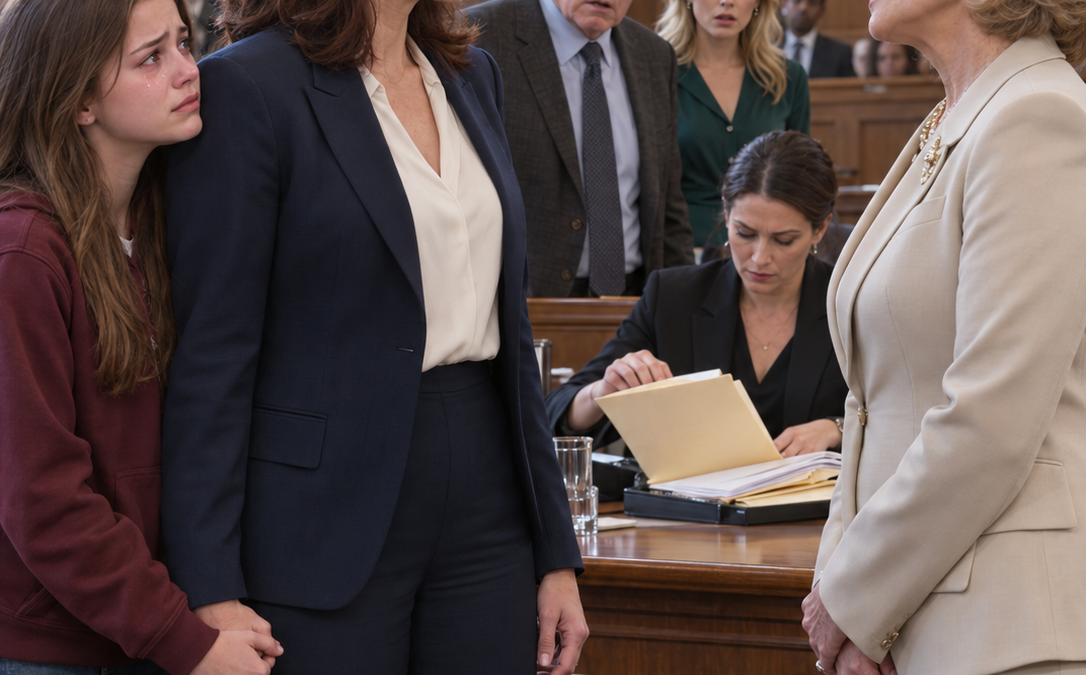
Ella sat beside me in her hoodie, shoulders tight.
My parents sat across the room like they were the injured party.
Nicole sat behind them.
She looked tense.
Not guilty.
Not sorry.
Just tense, as though she still couldn’t believe her temporary stay at my parents’ house had somehow turned into a legal battle.
When my parents started speaking, their explanations were all over the place.
First my mother said, “Of course Allison knew about the trust. She’s pretending.”
Then my father said, “We never kicked anyone out. They chose to leave.”
Then my mother said, “Ella was difficult. She wasn’t cleaning up properly. That’s why we told her to go.”
Ella went still beside me.
Not shocked, exactly.
More embarrassed.
Like she was doing that very fourteen-year-old calculation in her head:
Wait. This is really what they’re using against me?
I felt her fingers tighten around mine.
Ms. Collins stood and handed the judge the note.
The actual note.
The one that said:
“You’re not welcome.”
The judge read it silently.
And you could feel the air in the room change.
It was as if the room itself had decided that this was no longer some ordinary family disagreement.
The judge looked toward Ella.
She shrank back slightly.
Then she straightened herself because she had that in her.
That stubborn bravery.
“Do you feel safe living with them?” the judge asked.
Ella’s voice was small but clear.
“No.”
My mother made a sound of annoyance, like Ella was being dramatic.
Ella flinched.
The judge noticed.
I saw it happen.
That tiny moment when somebody in authority finally sees the dynamic instead of only seeing paperwork.
Ms. Collins spoke calmly.
“The beneficiary is a minor. She needs stable housing. The trustees’ actions have been hostile and destabilizing. We’re asking for temporary relief so that the child can live in the home without intimidation.”
My father snapped.
“That is our house.”
The judge looked directly at him.
“From what I am seeing today, this property is held in a trust, and the sole beneficiary is the child.”
He tapped the documents in front of him.
“You have been acting as if this is your personal property. But you are here as trustees. That is different.”
My parents’ faces tightened.
My mother leaned forward.
“This is outrageous,” she said. “We live there.”
“And you wrote a note telling a fourteen-year-old girl that she was not welcome in that same house,” the judge said, lifting the paper. “You attempted to force her out while her mother was away. That is not a safe or stable situation for a minor.”
My mother opened her mouth.
Then closed it.
And then the judge said the words I hadn’t realized I had been holding my breath to hear.
“This is a temporary order. It is not a final ruling on the entire trust matter. But the housing situation needs to be stabilized immediately.”
He looked directly at my parents.
“You will vacate the house within seven days.”
My mother went white.
The judge continued.
“That gives you time to remove the belongings you need, and it allows the child to return to stable housing. If you believe you have legal arguments to make in the longer term, you can make those arguments through the proper process. But right now, the priority is the minor.”
My father half stood, looking like he wanted to argue with gravity itself.
“You can’t do that.”
The judge didn’t blink.
“I can,” he said. “And I am.”
Then, very clearly:
“You have seven days.”
We walked out of that courtroom, and Ella squeezed my hand again.
Not because she was happy.
She wasn’t happy.
She squeezed my hand because, for the first time, she felt like somebody believed her.
My parents moved out quickly.
Not gracefully.
Not quietly.
But quickly.
Nicole and Leila never moved in, because once a judge effectively says, No, not like this, the whole plan tends to fall apart.
And honestly, Nicole’s “emergency” didn’t even last.
At first she was furious, swearing she was done with Justin forever.
Then later, they were fine again.
Apparently the massive crisis involved something like Justin not backing her up during a minor argument or not saying the right thing quickly enough.
Normal couple stuff.
My family had simply treated it like a national emergency.
And that was when the next part of the story began.
Not the legal part.
The social part.
Because when my parents lost control of the house, they tried to control the narrative.
The flying monkeys appeared almost immediately.
People I barely spoke to.
Relatives I saw once in a blue moon.
They would call me and begin with, “I’m just worried…”
You know that tone.
The one that means they have already chosen a side.
“Your parents are devastated.”
At first, I stayed quiet.
I didn’t want this turned into a public spectacle.
Then the rumors reached Ella.
That was the line.
One afternoon she came home from school, walked into her bedroom, shut the door, and didn’t come out.
I knocked and went inside.
She was sitting on her bed staring at the wall.
Her face was tight, as if she had been holding tears in her throat all day.
“What happened?” I asked.
She swallowed.
“People were talking.”
“Who? Kids?”
She nodded.
“And their moms.”
I sat beside her.
“What were they saying?”
“Someone said you kicked Grandma and Grandpa out. Someone said you’re trying to steal their house.”
She stopped.
Her voice began to wobble.
“And someone said I caused it.”
I felt something cold settle in my chest.
“I don’t want to go to school anymore,” she whispered.
“Okay,” I said. “You don’t have to go tomorrow.”
She looked at me like she expected an argument.
Then she whispered, “I’m sorry.”
I put my hand on her shoulder.
“No. This is not your fault. This is adults behaving badly.”
That night, I did two things.
First, I called the school and removed my parents from every contact list, every permission form, every emergency record.
Everything.
Second, I sat down at the kitchen table, opened my banking app, and stopped every payment I had been making before.
The equity payment.
Utilities.
Anything connected to them.
Click.
Done.
Click.
Done.
It wasn’t petty.
It was reality.
If you throw my child out, you do not get my money.
Then I went to bed and stared at the ceiling and tried not to cry.
Because even when your parents are wrong, it still hurts to admit that they may never become the people you needed them to be.
The smear campaign grew louder.
So eventually, I did something I had never wanted to do.
I told the truth publicly.
But only the part that mattered.
I posted a short statement.
No long rant.
No insults.
I simply said that my parents had written my fourteen-year-old daughter a note telling her to move out while I was away for work.
And then I posted a photograph of the note.
That was it.
People read it.
And suddenly, the whole “Allison is a cruel daughter” story became much quieter.
Because it is difficult to defend a note telling a child:
“You’re not welcome.”
Some of the same people who had judged me messaged privately to apologize.
Some didn’t.
That was fine.
From what I heard, my parents stayed with longtime friends after they moved out.
Those friends apparently believed my parents’ version of events at first.
Then they saw the note.
That changed things.
Eventually, those friends told my parents they had to leave too.
Meanwhile, the legal process continued quietly in the background.
Paperwork.
Hearings.
Letters.
Arguments.
Back and forth.
I won’t bore you with every detail because half of the process seemed to involve adults paying other adults to write increasingly angry letters.
But I will tell you this:
My parents tried everything.
They tried denying what happened.
They tried blaming me.
They tried arguing that my grandmother had not been in her right mind.
They tried saying they had simply been attempting to make things fair between the two granddaughters.
They even tried pretending that what they had done was somehow for Ella’s benefit.
Which was especially bold considering they had literally tried to kick her out.
Months into the process, after yet another round of legal updates, there was a knock at my door.
I opened it.
My mother and father stood on the porch.
They looked like they had come over for coffee.
My mother’s face held an expression I had almost never seen directed at me before.
Soft.
Sad.
Pleading.
“Allison,” she said. “We made a mistake.”
My father nodded stiffly.
“We love you.”
“We love Ella,” my mother said quickly. “We’re family. Please. Can we not do this? Can we not make everything worse?”
“Worse?” I repeated.
My mother’s eyes moved past me, like she wanted to see inside the house.
“You have to understand,” she said. “We have two daughters. Two granddaughters. Your grandmother left everything to Ella. That wasn’t fair.”
There it was again.
Fair.
My father added, “We just wanted it to be equal.”
I stared at them.
And instead of rage, I felt something surprising.
Clarity.
“Equal?” I said softly. “When was anything ever equal?”
My mother opened her mouth.
I didn’t let her interrupt.
“You had ten years. Ten years to tell me. Ten years to do the right thing.”
My mother’s eyes filled with tears.
I didn’t know whether they were genuine.
By that point, I no longer had the energy to decide.
“I found out two weeks before the note,” I said.
My mother blinked.
“What?”
“I found the documents two weeks before you told my child to pack her things.”
My father’s jaw tightened.
“And do you know what I did?” I continued. “Nothing.”
They stared at me.
“I didn’t blow up your lives. I didn’t come downstairs screaming. I went to a lawyer, and then I sat with it. Because you were my parents, and I didn’t want to believe what I had found.”
My mother whispered, “Allison…”
“And then you kicked out my child.”
She went silent.
“You suggested sending her to Ryan. You did it while I was away. So no, we are not starting over.”
My mother’s expression tightened.
“Please,” she said. “We made a mistake.”
“You wrote it down,” I said. “You meant it enough to put it on paper.”
My father placed a hand on my mother’s arm and gently pulled her back.
They stood there another few seconds as though they were waiting for me to change my mind.
I didn’t.
Eventually, they turned and walked away.
I closed the door.
About a year later, it was over.
Not emotionally.
Not in my head.
But on paper.
All the hearings.
All the paperwork.
All the arguments.
Done.
Ella and I live in the house now.
Not as visitors.
Not temporarily.
Not paying somebody else for the privilege of breathing in our own living room.
It is simply home.
Our home.
I have no contact with my parents anymore.
None.
No calls.
No texts.
Nothing.
And I don’t suspend that rule for holidays.
I don’t do occasional check-ins.
I don’t send “just one message.”
I barely speak to Nicole either.
She still insists she didn’t know anything about the trust.
And maybe she didn’t.
Honestly, I go back and forth on that.
Because she still talks to Mom and Dad.
She still occasionally drops little lines like, “They’re still our parents,” as if saying that should settle everything.
I usually just nod.
Then I keep my distance.
Ella is the biggest change.
She is lighter now.
Not in some loud, dramatic, bouncing-off-the-walls kind of way.
In a quiet way.
Like she finally believes she is allowed to take up space.
She laughs more.
She doesn’t flinch when her phone rings.
She doesn’t brace herself before walking into a room.
She doesn’t second-guess whether she is welcome.
So you tell me.
Was I too harsh because they’re my parents?
Or did they stop acting like my parents the moment they tried to throw my child out?
Thank you so much for listening.
I’m the writer, and I wrote this story. I hope you enjoyed it.
If you’d like to support us, you can check out our Patreon. It really helps us continue writing more stories like this.
I’ll see you in the next one.








