When i was on vacation with my family, i received a strange message: “fly home, don’t say anything to your parents”; at the airport, a lawyer and the police were waiting for me, and after i learned the truth, i lost consciousness…
That is the thing nobody warns you about being raised the way I was. You learn to be needed like a tool. You never quite learn to be wanted like a person.
I had a paid-off truck, a good practice, and a kitchen with one chair. My aunt Ruth used to say, “I collected reasons to skip Thanksgiving the way other women collect recipes.”
She was not wrong.
I had spent two decades proving I did not require anybody, least of all the family that had mailed me away at 11 and never written back. And I would have kept proving it forever if Ruth had not booked us both a beach house in July and refused to let me weasel out of it.
The Outer Banks in summer is loud in the good way. Ruth’s grown kids were there, my cousins, with their own kids underfoot, and a screen porch that smelled like sunscreen and steamed shrimp. These people were not my blood, exactly. Ruth was my father’s younger sister, and when Glenn sent me to her at 11, she could have treated me like a charity case.
Instead, she taught me to drive a tractor, signed my report cards, and sat in the front row when I crossed the stage for my doctorate. Her family became the only family that ever felt like one.
On the third evening, one of the little ones asked me, all innocent, when I was going to take her to see the famous Nebraska farm, the one with the red barn from the old photo on Ruth’s wall.
The porch went a half-beat quiet.
Ruth set down her tea. She got a look I had seen maybe twice in 20 years, a tightness around the eyes like a woman bracing a door against weather.
“Don’t fill the child’s head with that place,” she said too quickly, and changed the subject to the fireworks.
I let it go. I was good at letting things go. But I caught her watching me later while I dried dishes, the way you watch somebody you are afraid is about to find something out.
I told myself it was nothing. I poured myself a glass of wine and walked out to the dunes to watch the dark come in over the water. My phone buzzed against my hip. I figured it was the answering service. Another barn. Another worst night of somebody’s life.
It was a number I did not know, and a message that would burn the whole quiet life I had built right down to the studs.
Fly home. Don’t say anything to your parents.
I read it three times, and the wind came off the water carrying the smell of cut grass from somebody’s lawn behind the dunes, and just like that I was 11 again.
Funny how a smell does that.
Back home, it was alfalfa, and the night they sent me away, the whole place reeked of it. Fresh-mown and sweet under a sky going purple.
I had come downstairs for water and found my mother and her brother Roy at the kitchen table with bank statements fanned out like a card game. My grandmother Nadine’s statements. I would understand much later.
Roy looked up and saw me in the doorway, and his face did something cold. He leaned toward my father, who had just come in from the field, and said, “Look, the girl saw.”
My father went the color of dishwater.
Nobody explained anything to an 11-year-old. By morning, my bag was packed. My mother stood on the porch with her arms crossed while Ruth’s headlights came up the lane.
And when I asked her why, why I had to go, she said the words I would carry for two decades.
“He didn’t want you, Willa. Nobody did.”
My father wore his work flannel, the green-and-black one. And he stood with his back to me by the truck and would not turn his head. Not when I called his name. Not when I cried. Not even when the screen door behind him slammed so hard the whole porch shook.
“Go,” was all he said.
So I went.
For 20 years, I believed every word my mother gave me because an 11-year-old believes her mother. And because nobody, not one soul, ever called to tell me different.
And now, standing in the salt wind with my phone in my hand, somebody finally was.
I am not a woman who jumps because a stranger says jump.
The first thing I did was try to figure out who was on the other end of that number. I called it straight to a generic voicemail, no name. I ran it through a reverse lookup on my phone and got a regional area code for eastern Nebraska and nothing else.
I sat down on the cold sand and thought it through like a diagnosis. Somebody knew my cell number, knew I was traveling, and knew the word parents would mean something to me.
That was not a wrong number.
That was somebody who had done homework.
I texted back, “Who’s this?”
The reply came fast.
It’s about your father. Your mother and Roy cannot know you are coming.
Reading Roy’s name in a text from a stranger did something to the back of my neck that 20 years of therapy had not undone.
This was not a prank. Pranksters do not know about Roy.
I stood up and brushed off the sand. Inside, the porch was still laughing over a card game, and Ruth caught my eye through the screen. Her face changed when she saw mine.
I did not tell her.
The message had said, “Don’t say anything.” And some old instinct, older than my good sense, told me to honor that for one more night until I understood the shape of it.
I booked the red-eye out of Norfolk to Omaha on my phone right there in the dark.
I do not run from things. I never have. Whatever was waiting in Nebraska had been waiting 20 years, and I was done letting other people decide what I got to know about my own life.
On the plane, I did the math on what these people thought of me because I had a layover and nothing but time.
Here is the story.
The town of Calhoun, Nebraska, had been told about Willa Frell. That I was a difficult child. That I lied. That I took things. That poor Glenn and Brenda had tried everything and finally had to ship the girl off to relatives for the family’s own peace.
I knew the story because I had gone back once at 19 and stood in the feed store and watched grown adults change aisles to avoid me.
I did not waste my breath arguing that day.
I had learned young that you cannot argue a person out of a conclusion they reached because it was comfortable.
So I made a different choice. I stopped trying to win people who had already decided.
And I got very, very good at one thing they could never take from me.
I put myself through school. I built a name in three counties for steady hands and an honest bill. Let the town keep its story. I had a better one written in my own ink.
What I did not know, sipping bad airport coffee at two in the morning, was what was actually at stake back there.
The Frell place was 400 acres of bottomland that had been in the family since 1911. My grandmother, Nadine, had held the purse strings until she passed three years ago, and I had not even been told she died.
Somewhere out there was a will and a barn and a whole accounting of who got what. And somebody with two police officers thought I needed to know about it badly enough to fly me across the country in the dark.
I will be honest with you because that is the deal between us.
A part of me did not fully trust the stranger with the area code.
So before I let anybody steer me, I tested it myself.
From the Omaha gate at six in the morning, I dialed the old farmhouse number, the one I had memorized as a child and never once used since.
It rang four times.
Then a recording. And the voice on it was my mother’s, older and flatter than I remembered, telling me to leave a message for Brenda and Roy at the Frell residence.
Roy living in my grandmother’s house.
That told me more than the stranger had.
I hung up before the beep.
If my mother and uncle were running that place together and somebody official wanted me there without them knowing, then the warning was not paranoia.
It was a map.
I had spent my whole adult life reading situations for the danger nobody else wanted to name. A heifer about to kick. A rancher about to lose everything.
I knew the feel of a thing that was about to go very wrong, and this had that feel all the way down.
So I squared my shoulders and walked toward baggage claim, where a man in a gray suit was holding a folder against his chest and scanning faces, and two officers stood a polite distance behind him.
He found me. He knew me on sight, which meant he had a photo, which meant this had been planned.
“Miss Frell,” he said, and his voice was kind in the careful way doctors use. “I am sorry to do this to you here.”
I had flown 2,000 miles on a stranger’s text. I was not about to spend one more hour not knowing.
His name was Tom Beck. He had been my father’s attorney for 19 years, he said, though I had never heard his name in my life. The two behind him were investigators with the county attorney’s office, and he introduced them so plainly that the word investigators did not register for a second.
We sat in a glassed-in airline office somebody had unlocked for us, the kind with a fake plant and a clock that ticked too loud.
Tom Beck set his folder on the table and folded his hands on top of it like a man about to give a sermon he had rehearsed and still dreaded.
Before I say the rest, he told me, “I need you to hear one thing clearly. Your father did not throw you out, Miss Frell.”
I sat very still.
Twenty years is a long time to hold a sentence in your chest. And what he had just said went straight under all of it.
I asked him what he meant, and I kept my voice level because keeping my voice level is the only religion I have ever really practiced.
He opened the folder.
On top was a single envelope, cream-colored, soft at the corners from being handled. Across the front, in handwriting I had not seen since I was a girl but knew the way you know your own heartbeat, was my name.
My Willa.
My father’s hand.
The pen pressed so hard in places it had nearly torn the paper, the way he wrote everything. Like the words might get away from him if he did not pin them down.
Tom Beck slid it an inch toward me across the table.
I did not pick it up.
The clock ticked. One of the investigators shifted her weight, and Tom Beck said the next thing gently, the way you would set down something that might break.
And the room tilted sideways, and the floor came up to meet me.
What he said was this:
“Your father passed six days ago. He left everything to you. And 20 years ago, he sent you away to keep you safe.”
I got about as far as the word safe.
I have delivered hard news to grieving people in barns and kitchens my whole career, and I have never once been the one to go down.
I went down.
Not dramatically. My knees just stopped being mine, and the gray carpet swung up, and the world went to a white roar for a few seconds.
I want to be clear about why, because it matters.
I did not faint from weakness.
I had flown all night on an empty stomach and two coffees, and a stranger had just told me that the father I had spent 20 years hating had loved me the entire time and was now in the ground where I could never reach him.
That is not weakness.
That is grief arriving all at once with nowhere to put itself.
When I came up, the female investigator was crouched beside me with a paper cup of water, saying my name, and Tom Beck looked stricken.
I pushed the cup away and got my back against the wall and sat up under my own power.
“First time in my life,” I told them, and my voice came out rough but mine. “My patients would never let me hear the end of it.”
Nobody laughed, which was fair.
I breathed until the room held still.
Then I did the only thing I know how to do when everything is falling apart, which is reach for the next true fact I can stand on.
I did not want the water, and I did not want to be handled.
“I’ll be all right,” I said. “What I need is the file. Show me. Start at the beginning and do not soften any of it. I have had 20 years of soft. I am ready for the truth.”
Tom Beck poured himself some of the water I had refused and decoded the message that had flown me home.
The text was his, sent from a burner he had bought for exactly this.
The warning about my parents was not poetry.
My mother Brenda and my uncle Roy were the subjects of an open investigation, and if either of them learned I was in the state before the right pieces were in place, the careful thing my father had built over 20 years could come apart in an afternoon.
They could move money.
They could pressure people.
Roy, he said, choosing the word, had a history of making people reconsider their statements.
The investigators did not contradict him.
I asked the obvious thing.
“An investigation into what?”
Tom Beck looked at the two officers, and the woman, whose name was Detective Puit, took it from there.
“Financial exploitation of an elder,” she said. “Your grandmother, Nadine Frell.”
I felt the floor try to tilt again, and I planted both feet and would not let it.
Nadine had been the one warm grown-up of my early childhood, the one who slipped me peppermints in church and let me name the barn cats.
“They drained her,” Puit said plainly. “Over years. Powers of attorney. Accounts. Signatures. We have had a piece of it for a long time. We have not had all of it.”
I looked at the folder, then at the envelope with my name in my father’s desperate hand, and something in me that had been curled up tight for 20 years started, very slowly, to stand.
I did not cry.
There would be time for that later, and not in front of strangers.
“Keep going,” I said. “You said my father knew. How long had he known?”
Detective Puit and Tom Beck traded a look that told me I was not going to like the answer.
Tom Beck spread the documents across the table, and I read them the way I read a chart, top to bottom, looking for the thing that does not fit.
Withdrawals from Nadine’s accounts going back 11 years. A power of attorney she had signed when her eyesight was failing, with Roy as agent and my mother as successor.
Transfers. Even amounts. The kind designed not to trip a bank’s attention.
Two hundred thousand dollars gone in pieces into accounts that fed my mother and her brother.
I have a clinical mind. It is the only thing that let me stay upright.
But somewhere in the third page, my own memory snagged on a line and would not let go.
A single large withdrawal.
$12,000.
Dated the 18th of June, the summer I was 11.
I knew that date in my body.
“Detective Puit,” I said. “The 18th of June. That was my grandmother’s birthday. We were all at that house that night. I came downstairs and I saw my mother and Roy at the kitchen table with her bank papers. And Roy said, ‘The girl saw.’ And the next morning, I was gone.”
Puit went very still.
She pulled the page closer.
“You have had this bank record for how long?” I asked.
“About a year,” she admitted.
“You had the number and the date. You did not have the only person who was standing in that kitchen.”
For the first time, the two of them looked at me not as a grieving daughter to be managed, but as something useful.
A witness.
The withdrawal they could prove.
What I could prove was the why and the when, and the fact that an 11-year-old’s accidental glimpse was the exact thing that got her shipped three states away.
Tom Beck closed his eyes for a moment.
“Your father knew,” he said quietly. “He knew before you were 11. He just could not prove it yet. And he could not protect you and fight them at the same time.”
I want to tell you I melted into a daughter’s gratitude right there.
I did not.
I got angry.
The clean, useful anger I trust more than tears.
“If he knew,” I said, “then explain something to me. He knew I was in danger from his own wife. So he handed me to Ruth and went radio silent for 20 years. No letters. No birthday calls. He let me grow up certain he didn’t want me. So which was it? Was I his daughter, or was I just a problem he filed away three states out of sight so it wouldn’t mess up whatever long game he was playing?”
The investigators looked at the table.
Tom Beck did not.
He had clearly been waiting for this exact question, which annoyed me the way it annoys you when somebody knows you better than they have any right to.
“Your father told me you would ask that,” he said. “Word for word, almost. He said, ‘Willa is too smart to be bought with a sad story. So don’t try.'”
There was a letter.
He had written it over many years and finished it that spring when his heart started giving out and he knew he was close.
He left strict instructions.
I was not to receive it, or any of it, until he was gone and the pieces were in place to keep me safe.
Not one day sooner.
And Tom Beck’s voice caught for just a second.
“He said, ‘If I let her open it while I am alive, I will lose my nerve and ruin 20 years of work, because the second I see my girl’s face, I will tell her everything and damn the consequences.'”
I sat there with my jaw tight.
I did not trust a dead man’s words yet, but I wanted to read them more than I had wanted anything in a long time.
Ruth was already driving to Omaha.
That was the part that gutted me.
She had been on a flight an hour behind mine because Tom Beck had called her the moment I texted back, and she had not said one word to me on that beach porch.
When she walked into the airline office, 60 years old and gray and shaking, I stood up so fast my chair scraped.
“You knew,” I said.
It was not a question.
She did not look away. I will give her that.
“I knew,” she said. “Your father came to me the week before he put you in my car, and he told me what Brenda and Roy were doing, and he made me swear on our own mother that I would never tell you the real reason.”
He said if I knew, I would come back to fix it the way I fix everything, and that they would hurt me to keep me quiet.
He said the only way to keep me safe was to make sure I wanted nothing to do with that place.
“He tried once,” she said, before her voice dropped. “That first Christmas, he couldn’t stand it. He gave me a card to mail you. Just his name inside, nothing else.”
Two weeks later, Roy stopped Glenn by the grain bins and said, real friendly, that it was a shame about the girl all the way out at Ruth’s place.
He used my name.
My father had told no living soul where I was but Ruth.
After that, he never sent another word because now he knew for certain they were watching her mailbox and mine.
“That was when I understood it, too,” Ruth said. “So I let you believe a lie for 20 years, Willa, and I have hated myself for every single one of them.”
She set a box on the table between us, a plain banker’s box taped at the seams.
On top of it, folded, was the green-and-black work flannel my father had worn the last morning I saw him.
I had not seen that jacket in 20 years, and I would have known it in the dark.
“He wanted you to have the box,” Ruth said. “He told me, ‘When she opens it, make her be alone because she is going to need to be the only one in the room.'”
I put my hand flat on the flannel.
It still smelled faintly, impossibly, of him.
I took the box to a motel by the interstate and locked the door and sat on the floor with my back against the bed, the way I had sat as a kid when the world got too big.
Inside were two things: a thick binder and the cream envelope with my name.
I opened the envelope first.
The letter ran 12 pages, dated across years like a logbook. My father’s hard pen softening and shaking toward the end.
He wrote about the night I came downstairs.
He wrote that Roy had threatened, in plain words, to make sure “the girl forgets what she thinks she saw,” and that he had looked at his 11-year-old daughter and understood he could not both protect me and gather the proof to stop them.
So he chose.
He sent me out of their reach and spent the next 20 years quietly building the case I could not have helped him build.
Near the bottom of the first page was a line I have read so many times I could recite it in my sleep.
I had to let you hate me to keep you alive.
The binder was the proof.
Not a diary. Not some secret recording.
Real paper, the kind that holds up.
Certified bank statements he had subpoenaed through a guardianship petition.
A copy of a transfer-on-death deed on the 400 acres, signed and recorded at the county courthouse in 2019, naming me.
Correspondence with Detective Puit’s office going back two years.
A revocable trust holding what was left of Nadine’s money with my name on it.
My father had not loved me out loud.
He had loved me in filings, in recordings of deeds, in 20 years of letting me be furious so that I would be far away and breathing.
I sat on that motel floor and cried the way you cry once a decade.
If you have ever lost years with someone because of a lie that somebody else told, comment the word home below. I read every one of them.
And if this channel is doing right by you, hit subscribe because the part that comes next is the reason I needed you to hear all of this first.
I read the whole letter twice that night.
The second time, the night I was 11 rearranged itself in front of me, every piece sliding into a new shape.
The bank papers on the table had been Nadine’s, and I had walked into the middle of a theft.
Roy’s cold face.
The words: the girl saw.
My father coming in from the field still smelling of alfalfa, going gray when he understood that his child had become a loose end in his brother-in-law’s eyes.
He had a choice no parent should have to make, between keeping me close and keeping me safe.
And he made the one that cost him everything he wanted and gave me everything I needed.
He could not look at me by the truck because if he had looked at me, the letter said, he would not have been able to do it.
He would have pulled me back inside and held the line right there, and they would have come for us both.
So he kept his back turned and let the screen door slam and said the one word he could get out without breaking.
Go.
For 20 years, I had heard that word as a rejection.
Now I heard it as the hardest act of love a tired man ever managed.
The letter answered the questions I had been throwing at Tom Beck, the ones any sane person would ask.
Why no secret calls?
Why no letters slipped through Ruth?
My father had thought through every door and written down why each one was closed.
Roy still went through Nadine’s mail and watched the family like a hawk watches a fence row.
One card from Glenn to a daughter he was supposed to have disowned would have told them the witness still mattered to him, and they would have come looking for me to make sure I stayed quiet.
A real estrangement was the only kind that held up under that kind of watching because it was not an act.
And I understood, reading it twice, what Roy had actually wanted all those years, because it was the same thing every careful thief wants.
Not to chase me down.
A vanished girl brings deputies and questions, and a hurt one brings worse.
And the last thing two people skimming an old woman’s accounts could afford was anybody asking where the granddaughter went.
Roy needed me gone and silent.
Nothing more.
And for 20 years, I obligingly was both.
The danger was never a hunt.
It was a door.
And it only swung open if I came back, or learned the truth, or opened my mouth.
His friendly little word by the grain bins had not been a slip.
It had been the whole message.
We know where she is. Keep her gone and she stays fine.
My father heard it for exactly what it was.
And he kept me behind that door for two decades.
The law was the same trap.
He could not move against his own wife and her brother while they held Nadine’s power of attorney without tipping them off to shred the records and bury the money.
He needed the bank’s own pattern to ripen into proof.
He needed Nadine gone before the estate would even open.
So he waited and documented and recorded the deed, the first quiet minute he safely could in 2019, and let me hate him the whole time because a daughter who hates you does not come home and walk into a trap.
It did not fix the grief.
Nothing fixes the grief of finding out a person loved you only after they are too far gone to tell.
But it turned the anger toward the people who had earned it.
My mother, who had stood on that porch and looked her crying daughter in the eye and chosen the cruelest possible lie.
Her brother, who had made my own father afraid for my life.
They were 40 miles south of that motel, sleeping in my grandmother’s house, counting an inheritance they believed was theirs.
They had no idea I had come home.
In the morning, I met Tom Beck at his office in town, and he laid out where things stood.
My father’s funeral had been small and fast, the way Brenda wanted it, before anyone could ask questions.
The reading of the will was set for Friday at the farmhouse, three days out.
My mother had insisted on the house, in front of family and the pastor and a couple of longtime neighbors, because Brenda Frell never met an audience she did not want to perform her grief for.
She believed she was inheriting 400 acres and whatever Nadine had left, and she had already had a lawyer of her own draft paperwork to that effect.
Tom Beck slid a fresh document across his desk.
“Two weeks before your father died,” he said, “your mother had him sign what she told the notary was a renewal of a farm lease.”
It was actually a quitclaim deed transferring the land to her.
I felt my pulse pick up, and I made it slow back down.
“Did it work?” I asked.
He almost smiled.
“No,” he said. “You cannot give away what you do not own anymore. Your father recorded that transfer-on-death deed to you back in 2019. A recorded deed like that controls the land at death. No matter what a later piece of paper says, and no matter what is in any will, she tried to steal a farm he had already given away. She just does not know it yet.”
I sat with that.
I could have stayed in Montana and let the lawyers handle it by mail and never set foot in that house again.
That would have been the safe choice.
And the small one.
I am not built for small.
“Put me on the list for Friday,” I said. “I want to be in that room. Let her think I am there to cry.”
I did not wait for Friday to lay eyes on them.
I drove out to the farm Wednesday afternoon, down the county road I had not traveled since I was 19, and the fields were in second-cutting alfalfa.
That same sweet green smell rolled through the truck windows and straight into the oldest part of me.
The house looked smaller and meaner than my memory.
My mother came out onto the porch before I was out of the truck, and 20 years fell away in the worst way.
She had aged into a hard, handsome woman who held her grief like a prop.
Brenda Frell in black, dabbing at dry eyes.
“Well,” she said. “Look what the wind blew in.”
Roy came to the door behind her, heavier, grayer, the same flat eyes.
Travis was there, too, my half brother, 27 now, a man I had never really known, raised entirely on the story that I was the bad seed.
I told my mother I had come for my father’s service and to pay respects, and I watched her decide I was harmless.
She softened into something worse than hostility.
A kind of pity.
“Honey,” she said, “you came a long way for a man who shipped you off and never looked back. You always did make everything about you.”
And then, because she could not help herself, because cruelty was the one language she was truly fluent in, she said it again.
The sentence she had branded me with on this very porch.
“He didn’t want you, Willa. Nobody did.”
I stood in the yard with the alfalfa smell all around me and my father’s case sitting in a binder in my truck, and I did not say a word about any of it.
I just looked at her, calm as a frozen pond.
“Friday,” she said. “You can come hear the will and then go on back to your animals.”
I said I would not miss it for the world.
Travis followed me out to my truck.
He was twitchy, a man who had been promised something and was watching the promise get complicated.
“You shouldn’t have come,” he said. Not unkind, just nervous. “Mom and Roy have got it all settled. The land. Grandma’s accounts. All of it. There’s papers.”
“What papers?” I asked.
He told me with the confidence of a man repeating what he had been fed that two weeks before Dad died, he signed the farm over to Mom free and clear, and that a lawyer in Fremont had it locked up tight.
I kept my face still.
So that was the quitclaim Tom Beck had described, the one my mother thought was a winning hand.
They were not bluffing because they were lying.
They were bluffing because they genuinely believed they had already won.
That was useful.
A person who thinks they have won gets careless.
They say things out loud that a careful person would never say.
I asked Travis gently whether he had ever actually seen the things Mom said I did as a kid.
The stealing. The lies.
He blinked.
“Well, no,” he said. “I was little. But she told me.”
“She told me a lot of things,” he added, and then stopped.
Like a man who has heard his own sentence from the outside for the first time.
I let it sit.
I did not push.
You plant the seed and let the rain do the rest.
I told him I would see him Friday, and I drove back to town with the windows down.
And for the first time since the beach, I felt something other than grief.
I felt the cold, clean focus I get right before a hard procedure, when I already know exactly where the trouble is and exactly what my hands are going to do about it.
I am not going to lie to you and tell you it was a sure thing.
That afternoon, Tom Beck walked me through exactly what I had and exactly what I did not, because false hope is just a slower kind of cruelty.
What I had was strong.
The recorded transfer-on-death deed meant the 400 acres were set to pass to me at my father’s death, ahead of the will and ahead of my mother’s clumsy quitclaim.
The trust held what was left of Nadine’s money in my name.
Those were not promises.
Those were filed, stamped, timestamped facts set in motion back in 2019, long before my mother made her move.
Tom Beck would not let me mistake strong for untouchable.
“She can still come after the deed itself,” he said. “If she can convince a judge your father lacked capacity in 2019 or was unduly influenced…”
He did not think it would land, given the date and how clearly Glenn had documented everything while he was sharp and healthy.
But a fight was a fight, and judges were human, and it was not a clean sweep.
Besides, as Glenn’s surviving spouse, my mother had a right under Nebraska law to claim an elective share of his estate, a slice she could not be entirely cut out of.
And there were two old joint accounts with both their names that would simply pass to her.
She would fight.
She would hire someone good, and she would drag it out, and she would get something.
The land, though, the heart of it, the thing my father had spent 20 years protecting, sat on the strongest footing the law gives a person.
Tom Beck said so in exactly those words, and then made me hear the rest of the sentence.
“Strongest is not certain.”
He said, “With a marriage this long and a farm worth this much, she can make it slow and ugly and expensive, and you should expect a year, maybe two, of lawyers before a court puts it to bed.”
He believed the deed would hold.
He would not promise me it would hold easy.
My father had not won the war in advance.
He had handed me the best hand at the table and the burden of playing it out.
He had filed the boring paperwork that nobody dramatic ever bothers with.
And the boring paperwork is what holds when everything else burns.
I asked Tom Beck whether my mother knew yet that the land was already gone from her grasp.
He shook his head.
“She thinks Friday is her coronation,” he said.
I thought about my mother in her black dress, rehearsing her grief, certain she was about to be handed the kingdom.
And I decided I was not going to take that certainty away from her one minute before I had to.
Roy found me Thursday evening behind the implement shed, where I had walked to look at the old hay rake my father used to let me ride.
I heard his boots on the gravel before I saw him, and the back of my neck did the thing it had done at 11.
He stopped close.
Too close.
The way a man does when the point is to make you feel small.
“You’re stirring something up,” he said. “I can smell it on you.”
I told him I was there for a funeral.
He smiled without any warmth in it.
“Let me give you some family advice, girl. This family eats people who come back. Glenn learned to keep his mouth shut. You should think about doing the same and getting on a plane.”
Twenty years ago, that voice put me in a car to another state.
Standing there at 31, I understood finally and completely the exact fear my father had carried and why he had made the choice he made.
I did not back up.
I also did not pretend I was bigger than I am.
I took one step to the side, out of his reach, and looked at my watch and noted the time out loud so he would see me do it.
“5:41 Thursday,” I said. “You just threatened me behind the shed. I’m a witness in an active investigation, Roy. And from this minute, everything you say to me goes in a statement.”
He went still.
That was the moment the power started to move, and we both felt it.
He could threaten me with his body the way he always had.
I could answer with a date, a time, and a detective’s phone number.
Those are not the same weapon.
And mine was the one that does not wear out.
I called Detective Puit from the truck and reported it before I even left the driveway, and she told me the investigation had moved further than anyone in that house suspected.
The bank had flagged the pattern.
The guardianship file my father started was now in evidence.
My identification of the June 18 withdrawal, tied to the night I was sent away, had given them the human thread they had been missing, the thing that turns a spreadsheet into a story a jury understands.
Brenda and Roy still thought they were managing a will reading.
They had no idea a county attorney was reading the same pages I was.
If you have made it this far with me, you already feel where this is going.
And I need you to stay because what happens in that farmhouse on Friday is the whole reason I told you the rest.
Hit like so it reaches one more person who was told they were the problem in a family that was the problem.
That night, Travis called me.
He did not say much.
He asked one thing in a small voice that did not match his size.
“Did Dad really write you a letter?”
I told him yes.
He was quiet a long time.
Then he asked what it said.
I read him three lines, the ones about why our father turned his back.
And on the other end of the line, my brother, who had spent his whole life being handed our mother’s version of me, started to breathe wrong the way men do when they will not let themselves cry.
He did not apologize.
He did not switch sides.
But something in him came loose that night.
And I let it, because the truth does its own work if you just give it air and get out of the way.
Thursday night, I sat down with Tom Beck and told him how Friday was going to go because I was not going to be a passenger at my own reckoning.
Most people in my position would let the lawyer stand up and read the deed and let the facts land.
I wanted more than facts.
I wanted the truth and the lie in the same room at the same time so nobody in that house could ever again pretend they did not see it.
Here is what I told him.
“Do not lead with the deed. Let my mother run the room first. Let her stand up in front of the pastor and the neighbors and tell the whole story she has been telling for 20 years. That Glenn sent me away because I was a thief and a liar. That she is the loyal widow inheriting what is rightfully hers. Let her commit to all of it out loud in front of witnesses. And only then, when she has nailed every word to the wall, you open the folder.”
Tom Beck looked at me for a long moment.
“That is not how I usually do a reading,” he said.
“I know,” I told him. “But you have been doing the safe version for 20 years, and she is still standing on that porch. I am not asking her to confess. I am giving her the chance to perform the lie one last time in front of every person whose opinion she has ever cared about, and then I am going to hand her the paper.”
He sat back.
“Your father,” he said quietly, “would have loved this. He was a patient man, too.”
Friday came gray and warm, with second-cutting alfalfa heavy on the air, and I put on the only black dress I owned and drove out to the farmhouse to give my mother exactly enough rope.
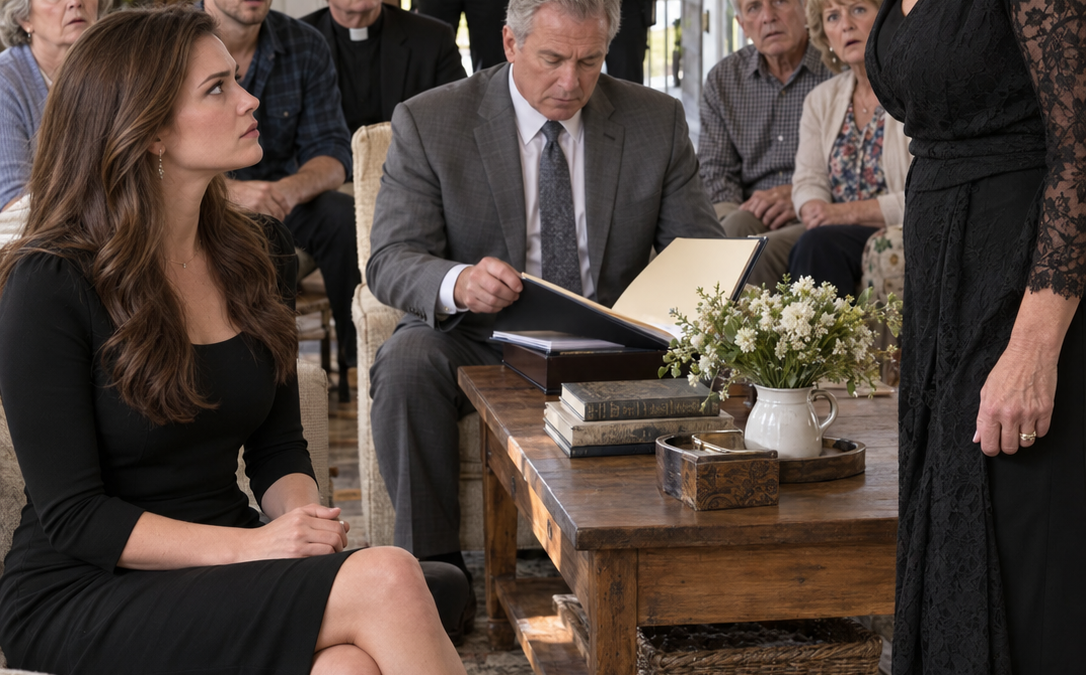
The front room of the farmhouse was set up like a stage, which is to say like my mother.
Folding chairs in rows. The good lamp on. The pastor in the front. Two gray neighbors I half remembered. Ruth in the back with her hands knotted in her lap. Travis against the wall by the window. Roy planted by the door like a guard.
Brenda sat in the center in her black dress with her chin up.
A widow at her coronation.
Tom Beck took the chair at the front with his folder closed.
I sat off to the side where I could see every face.
My mother opened it herself, of course.
She did not wait for the lawyer.
She rose and turned to the pastor and the neighbors and began, in a voice trembling with rehearsed sorrow, to tell them all how hard her marriage had been, how she had stood by Glenn through everything, including the terrible burden of a daughter who lied and stole and had to be sent away for the family’s own safety.
She gestured at me without quite looking at me.
“We did everything we could for that girl,” she told the room. “And she repaid us by breaking her father’s heart. And now she has the gall to come back when there is money on the table.”
The neighbors nodded, soft with sympathy.
The pastor patted her hand.
She was magnificent in the way a wildfire is magnificent, and she had no idea she was standing in her own kerosene.
When she finally sat, satisfied, certain she had set the table the way she always did, she nodded at Tom Beck to get on with handing her the kingdom.
Behind me, the screen door, which had been propped, swung loose in the warm air and creaked.
Detective Puit and her partner stepped quietly into the back of the room.
Nobody but me seemed to notice.
I looked at Tom Beck.
I gave him the smallest nod.
He opened the folder, and I watched my mother’s face because I had waited 20 years for what was about to cross it.
Tom Beck did not raise his voice.
He never does.
He simply read what was recorded.
That on the 4th of March 2019, Glenn Frell executed and recorded a transfer-on-death deed conveying all 400 acres of the Frell farm to his daughter Willa Frell, effective at his death.
That the deed controlled the land regardless of any will or any later transfer.
That a revocable trust held the remaining funds of Nadine Frell, also in Willa’s name.
That the quitclaim deed Brenda had obtained two weeks before Glenn’s death conveyed nothing because by then Glenn owned nothing left to give.
The room did not erupt all at once.
It came in stages, like ice going out on a river.
The neighbors turned to look at me, then at Brenda.
The pastor’s hand went still on hers.
And my mother stood up so fast her chair went over backward, and the performance fell off her face all the way down to the bone.
“This is fraud,” she said, and her voice cracked up into a register I had never heard from her. “He was sick. He didn’t know what he was signing. That girl manipulated a dying man.”
Roy came off the door with his fists working.
And I sat there, hands folded in my lap, and I let her burn.
Because the only person in that room who needed to stay calm was me.
When she finally ran out of air, I spoke once and quietly, and the whole room leaned in to hear it.
“He didn’t send me away,” I said. “He sent me out of reach. There is a difference. And you spent 20 years making sure I never learned it.”
She started to answer, and I kept going, still soft, looking right at her.
“You told me on that porch that he didn’t want me. You told me nobody did. He spent the next 20 years proving you wrong on paper, in a courthouse, with his name pressed so hard into the deed it nearly tore the page.”
Then she changed tactics the way drowning people do.
She came toward me with her hands out and her voice gone sweet and shaking.
“We can work this out,” she said. “Family to family. We’ll split it fair. Just you and me. No lawyers. No police.”
For one second, I saw the frightened poor girl she must have been once.
The one who swore she would never be powerless again.
And I almost felt the pull of it.
Then it passed.
“There’s no deal,” I said. “There’s only what’s recorded.”
That was when Detective Puit stepped forward from the back of the room, and the temperature changed for everyone who had come expecting a quiet country will reading.
She introduced herself and her partner, calm and clear, and said that the matter before the family was not only an estate.
There was an open investigation into the financial exploitation of Nadine Frell, and some present might wish to speak with their own attorneys before saying anything further.
She did not slap cuffs on anybody.
Real life is slower and heavier than television.
But she laid the certified bank statements on the table next to my father’s deed, and she said, looking at no one in particular, that they had recently confirmed a key date with a witness who had been in the house the night the pattern began.
Every head in the room understood whose date that was.
My mother’s mouth opened and shut.
Roy was already halfway out the door, and Puit’s partner went out after him, unhurried.
And Travis, my brother, who had spent his whole life being told who I was, pushed off the wall by the window and stood in the middle of that room.
He said to the neighbors and the pastor and our mother the only words that mattered.
“She told me Willa stole,” he said, his voice unsteady. “My whole life, I never once saw any proof.”
He did not look at me when he said it.
He did not need to.
He was not switching teams or asking for forgiveness, and I did not expect him to.
He was just a man who could not stand in his father’s house and keep holding a lie that heavy.
The pastor was on his feet now.
The neighbors were murmuring.
The whole careful story my mother had spent two decades building was coming apart in front of the only audience she had ever wanted to fool.
Tom Beck closed the folder.
“That concludes the reading,” he said.
And in the silence after, with the alfalfa smell drifting in through the propped screen door and my father’s name sitting on the table in black ink, I understood that I had not won anything back.
You cannot win back 20 years.
But the truth was finally in the room.
And it was not leaving with my mother’s version anymore.
People always want to know how it ended in numbers.
So here is what I can tell you plainly and without dressing it up.
The land was mine, free and clear, and nothing my mother filed afterward changed that.
She did pursue her elective share as a surviving spouse, which the law allowed her, and she got a portion of the rest.
Her lawyer made it slow and expensive the way I was warned it would be.
The county attorney referred Roy’s case forward, and the financial exploitation matter is still grinding through the system as I tell you this, the way those things do, with no guarantees and a great deal of paper.
I did not get a tidy bow.
What I got was the truth on the record and a farm I never expected to want.
I stayed two weeks past the funeral to deal with it all.
And on the last evening, I walked the bottomland by myself in the long gold light.
Four hundred acres of second-cutting alfalfa my father had moved heaven and a courthouse to keep for me.
I had his green-and-black work flannel on over my shirt, the one Ruth pulled out of the box, and it still hung off me too big, the way his things always did.
I sat on the tailgate at the edge of the field and read the last page of his letter one more time, the page he wrote near the end, where the pen shakes.
He had signed it:
Your father, who never once stopped.
The grief did not lift.
I do not think it ever fully will.
But sitting there in his jacket, on his land, with his words in my lap, I was for the first time in 20 years exactly where he had always wanted me to be.
Home and safe.
And finally, knowing it, I saw my mother one last time the morning I left, standing on that same porch where she had branded me at 11.
She started to say something about family. About how I would regret cutting her off. About how I had always been ungrateful.
I did not raise my voice.
“You don’t get to tell the story anymore,” I said. “The records do.”
And then I walked down the steps, and for the first time in my whole life, I reached back and let that screen door close behind me.
The way you close a door on a room you are never going to enter again.
Some people love you out loud, with phone calls and birthdays and their arms around you.
Mine loved me in silence.
In paperwork.
In 20 years of letting me hate him so that I would be far away and breathing.
And I would trade every acre of that farm for one more chance to hear his screen door close gently behind him as he came in from the field.
That’s my story.
One strange message on a beach.
A father who played the villain so I would never have to grow up beside the real one.
If this reminded you that the quiet ones are so often the people quietly protecting you, go call them today, while the only letters left are not the kind a lawyer hands you across a table.
Share this with someone who needs it.
Drop a comment, hit subscribe, and I’ll see you in the next one.








