When i was 18, my younger brother blamed me for something he did, and my parents threw me out without asking questions; i spent the night in a bus station, a month later, at a family barbecue, he joked about it — right as my grandfather walked up behind him holding the security footage.
I was eighteen the first time I realized just how disposable I was to my own parents.
Not in a dramatic teenage way. Not in the slam-the-door, you never listen to me kind of way. No. I mean really, truly disposable—like a cracked mug they didn’t even bother trying to fix before tossing it in the trash.
My name’s Kyle, and if you’d asked anyone in my family back then, they’d probably have told you I was the quiet one. The dependable one. The kid who kept his grades up, worked part-time at the gas station down the street, and still managed to make dinner a few nights a week because both Mom and Dad worked late.
I didn’t mind. I figured if I stayed out of trouble, didn’t make waves, and kept doing the right thing, it would all pay off somehow. Maybe I wasn’t the smartest or the funniest or even the favorite, but I was steady. I was loyal.
And that had to mean something.
My younger brother Dylan was the opposite. Two years younger, fourteen going on forty. He had the charm, the dimples, the ability to twist a story until it came out like spun sugar in your ears. Everybody loved Dylan—teachers, coaches, Grandma, even the neighbor who once caught him sneaking a joint behind the shed. She’d just smiled and said, “Boys will be boys.”
And my parents? They ate it up like gospel.
I don’t think it was malicious at first. Dylan was simply easier. Dylan made them laugh. I made them grocery lists. Dylan got detention for cheating on a quiz, and the response was, He’s just bored with school. I pulled a B-minus in AP Bio, and suddenly it was, What happened to your focus?
Still, I didn’t resent him. Not really. He was my brother. I figured the world would catch up with him one day, and maybe then we’d finally be standing on even ground.
The house we grew up in wasn’t warm, exactly. It wasn’t cold either. It was practical. Rules posted on the refrigerator in laminated sleeves. Chores rotated on a chart. Affection was rare but functional—a pat on the back if you did well, a “Not bad” if you made honor roll.
I wasn’t the kind of kid who needed much.
Just a little fairness.
A little trust.
So when it happened—when the whole damn thing unraveled—I wasn’t even angry at first. I was confused. Stunned, really, like I’d slipped into somebody else’s life and couldn’t find the script.
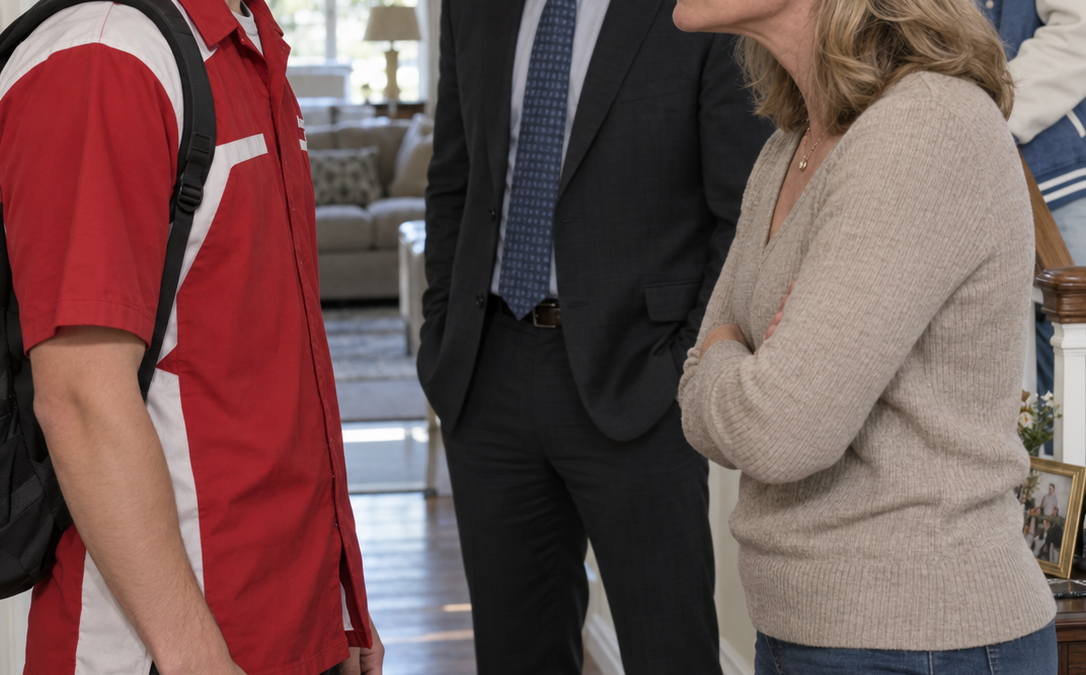
It was a Friday in early spring. I remember because the weather had just started warming up, and I’d taken my hoodie off for the first time while walking home from work. I was still wearing my red-and-white PetroMart uniform, smelling like burnt coffee and stale air freshener.
I’d barely walked through the front door when my mother came charging into the hallway like she’d been waiting for me to cross a tripwire.
“Where is it?” she snapped.
I blinked. “Where’s what?”
“Don’t play dumb. The cash. Dylan said you took it from his room.”
At first, I genuinely thought it was a joke. Maybe he’d misplaced his allowance or something. But Mom’s face was stone, her arms crossed tightly against her chest like she was bracing for impact.
“Mom, I just got off work. I haven’t even been home since this morning.”
“Don’t lie to me, Kyle.”
Her voice cracked—not with doubt, but with anger. Like she was offended I’d even try to defend myself.
“He said he had three hundred dollars saved from Christmas and his birthday. It’s gone. And your backpack was in his room this afternoon.”
I stared at her like she’d grown a second head. “What? Why would I even be in his room?”
“Maybe because you wanted money? You’ve been stressed about your car repairs, haven’t you?”
The thing was, yes, my car had been acting up. The starter was busted. I’d been walking to work all week.
But the idea that I’d go into my brother’s bedroom and steal from him—that I’d wait until he wasn’t home and sneak in like a thief—was so far outside reality that I didn’t even know how to argue against it.
“I didn’t take anything,” I said quietly.
And that was the moment something in her expression hardened.
Like she’d already made up her mind.
Like I was no longer her son but a threat that needed to be neutralized.
Dad came in a few minutes later, still wearing his suit from work. Mom briefed him quickly, and just like that, the jury was in. No questioning Dylan. No checking the rest of the house. No asking me anything beyond that first explosion.
“You need to leave,” Dad said.
I looked at him, waiting for the rest.
Just until we sort this out.
Just for tonight.
Anything.
But he didn’t add a word.
“Are you serious?” My voice cracked worse than I expected. “You’re kicking me out over a lie?”
“You’ve been distant lately. Angry. This kind of behavior doesn’t come from nowhere.”
“Dad, I didn’t do anything.”
He didn’t flinch. “Then maybe spending the night somewhere else will help you think about that.”
I didn’t scream. I didn’t beg. I just walked to my room in a daze, grabbed my backpack and phone, and left.
It wasn’t until I was halfway down the block that I realized I had absolutely no idea where I was going. No close friends nearby. No spare keys to anybody’s place. Just a dead car in the driveway and a crumpled five-dollar bill in my pocket.
So I walked.
For hours.
Eventually, I ended up at the bus station downtown, slumped against a plastic bench with my hoodie pulled tight around me and my stomach growling. I don’t think I slept more than ten minutes at a time. The flicker of the overhead lights, the occasional bark from some guy arguing with a vending machine, the constant shuffle of footsteps—it all blurred into one long, hollow stretch of time.
Every time I closed my eyes, I saw my mother’s face.
My father’s silence.
Dylan’s smug little half-smile as he stood behind them during the whole thing, not saying a word.
I waited two days before going back.
Two full days of silence. No texts. No missed calls. Not even a Where are you? from anyone.
When I finally walked through the front door again, pale and stiff and cracked from the inside out, they barely looked up from the television.
That should have been the end of it.
It wasn’t.
Three weeks later, we had a family barbecue for Grandma’s seventieth birthday. Everybody was there—cousins, aunts, uncles, the works.
And that’s when Dylan, standing in front of half the family, decided to tell the story.
Not with shame.
Not with guilt.
Like it was a punchline.
“You should’ve seen Kyle’s face when Mom kicked him out,” he said, laughing. “All over a fake hundred I printed for a prank. Didn’t think they’d actually believe me.”
I froze midstep with a paper plate of pasta salad in my hand.
My heart started thudding so loudly I could barely hear the rest of the conversation. The blood drained from my face so fast I thought I might pass out.
And Dylan just kept laughing, like this was some harmless childhood memory.
Then I saw Grandpa.
Quiet, stoic Grandpa was standing just behind Dylan, holding something in his hand.
Something black.
Rectangular.
Familiar.
A security-camera DVR.
And suddenly, I wasn’t the one trembling anymore.
Dylan was.
Because he hadn’t known Grandpa had installed cameras at the house when he’d come over to work on the garage two months earlier. He hadn’t known one of those cameras pointed directly toward the hallway outside both of our rooms.
I didn’t say anything. I just stood there, paper plate in hand, heart pounding in my ears, watching Dylan’s face change when he finally noticed Grandpa behind him.
First came confusion—head cocked, eyebrows raised.
Then recognition.
Then something darker.
Fear, maybe. Regret. Maybe even guilt.
But it passed too quickly.
The smirk came back.
“Come on, Grandpa,” Dylan said, his voice wobbling. “Don’t tell me you’re still messing with that garage-camera thing.”
Grandpa didn’t answer. He simply stepped forward, set the DVR on the patio table like it was a loaded weapon, and quietly said, “I think it’s time we watch something.”
The conversation around us died.
Cousins went quiet. Uncle Peter paused midbite. Even Mom, who’d been bragging about Dylan’s Mathlete trophy to Aunt Maria, turned around with a polite, confused smile.
“Dad, what are you doing?”
Grandpa didn’t look at her.
“I was checking the wiring a few months back. Installed a camera to watch the driveway after the neighbor’s car got keyed. Didn’t mean to catch anything else, but it’s all there.”
The silence was suffocating.
My hands had gone cold.
Dylan tried again. “It was a prank. Just a joke. We already moved past it. Kyle’s fine, aren’t you?”
He looked at me like I was supposed to rescue him.
Like I’d laugh along and let him off the hook.
But I couldn’t even meet his eyes.
I was back at that bus station. Two nights on a freezing plastic bench with nothing but vending-machine apple juice and the sound of strangers coughing in the dark. I was reliving every second of standing in that hallway while my parents looked at me like a stranger.
Like a criminal.
Grandpa pressed play.
The footage was grainy and black-and-white, but clear enough.
The camera showed the upstairs hallway. My backpack sat beside the stairs exactly where I’d left it before going to work that day.
Then Dylan appeared.
Shirtless. Hair a mess.
He tiptoed toward his room, glanced around, opened the zipper of my bag, pulled one of his fake bills from a drawer in his room, and dropped it inside.
Then he looked straight down the hallway toward the camera.
And grinned.
He walked back into his room like nothing had happened.
Grandpa didn’t say a word. He just let the silence stretch until the weight of it settled over the entire party.
You could practically hear the collective shift, like everyone’s mental picture of Dylan had tilted sideways and cracked.
Dylan’s voice came out small.
“That’s… that’s not what it looks like.”
But it was exactly what it looked like.
I should have felt vindicated. I should have felt triumphant.
Instead, I felt hollow.
The damage had already been done, and no amount of I told you so was going to fix it.
Mom’s face turned pale.
Dad’s jaw tightened.
But he didn’t say anything.
Not even to me.
Not yet.
The barbecue fizzled out after that. People left early. Grandpa packed up the DVR and drove away without another word. Dylan disappeared into the house, and I stood on the back porch for a long time, trying to decide whether I wanted to scream, cry, or laugh like a lunatic.
But that wasn’t the breaking point.
Not yet.
That came later.
Things didn’t go back to normal. Not really.
There were apologies, but awkward ones. Stiff ones.
Mom said things like, “We didn’t have the full picture,” and, “You should have said something sooner.”
Dad mumbled something about being under stress at work.
None of it landed.
None of it reached that part of me that had gone cold the night they shut the door in my face.
And Dylan didn’t get punished.
Not really.
He was grounded for a week, but that basically meant no Xbox. There was no family meeting. No real consequences. No forced apology.
He didn’t even seem sorry.
In fact, Dylan started acting like he was the victim—as though Grandpa had betrayed him by spying on him.
And my parents wanted the whole thing to disappear. Swept beneath the rug like everything else.
“We need to move forward,” Mom said one night at dinner without looking me in the eye. “As a family.”
But the damage had already carved too deep.
They didn’t notice how quiet I became. They didn’t notice that I stopped coming home right after work, that I spent hours in the library or wandered aimlessly around the mall because almost anywhere felt better than being home.
They didn’t notice when I lost weight.
They didn’t notice when I started missing meals.
They didn’t notice when I stopped making small talk.
They only noticed when I pushed back.
About a month later, Dylan came into my room without knocking. He threw a rolled-up sock at me and smirked like we were buddies again.
“Hey, I need your laptop. Mine’s dead.”
I didn’t look up from my desk. “No.”
He scoffed. “Dude, come on. Just for an hour.”
I slowly turned toward him. “You want the laptop of the guy you framed and got kicked out of the house?”
He rolled his eyes. “We’re still on that?”
That was it.
I stood up.
“Get out.”
He lifted both hands in mock surrender. “Okay, okay. Jeez.”
He backed out of the room, but not before muttering, “Still acting like a martyr, huh?”
That night, I locked my bedroom door for the first time.
The next day, I changed every password I had. I stopped leaving my phone unattended. I started carrying my backpack everywhere, even around the house.
When Mom asked whether I was okay, I smiled and said, “Great.”
If they didn’t care enough to protect me, I’d protect myself.
But things kept getting worse.
A friend from school eventually told me Dylan had started telling people I had mental-health issues. According to him, I was paranoid, obsessed with being the victim, always twisting stories for attention.
He told people I’d made up the story about getting kicked out. That I’d chosen to sleep at the bus station just to guilt-trip our parents.
He even showed people the security footage—but only part of it. Just enough to make the whole thing look like some ridiculous misunderstanding.
According to Dylan, the fake-money setup had been an experiment for a psychology project and I’d overreacted. Grandpa had taken it out of context.
My reputation took a hit.
Teachers started treating me differently. Friends became distant.
One guy actually asked if I’d gone off my meds.
That was when the anger finally caught up with the hurt.
Because they hadn’t just ruined one weekend.
They hadn’t just thrown me out of my own home.
They’d let my name rot in public.
They’d let Dylan spin lie after lie until I didn’t even recognize the person other people thought I was.
But the worst part came one night when I overheard a conversation I wasn’t supposed to hear.
I was walking past the living room when I heard Dad’s voice, low and sharp. I stopped just behind the corner.
“I’m not saying we should ignore it,” he said. “But Dylan’s record matters. He’s got a real chance at a scholarship, and we can’t let one stupid prank ruin that.”
Mom sighed. “I know, but Kyle’s so cold lately. Like he wants us to suffer.”
Dad’s voice turned bitter. “He’s always been dramatic. You remember the science fair in sixth grade? That meltdown over the ribbon? He’s got that black-and-white thinking. It’s always, I’m the victim, with him.”
I stood there in the dark hallway gripping the edge of the wall, feeling like a ghost inside my own house.
That was when I knew.
They didn’t believe me.
Not really.
Not in their bones.
They wanted to believe me because it was convenient now. Because believing me avoided conflict.
But Dylan was still the golden boy.
And me?
I was a stain they were trying to scrub out with polite smiles and forced family dinners.
I didn’t sleep that night.
I didn’t eat the next morning.
I just stared at the ceiling and ran the same thought through my mind over and over.
They won’t protect you.
They never will.
And that’s when the shift happened.
Quiet.
Subtle.
Permanent.
I stopped hoping they’d change.
I stopped expecting justice.
I stopped thinking about what I wanted from them.
Instead, I started thinking about what they had to lose.
But I didn’t do anything.
Not yet.
Because revenge takes patience.
And Dylan?
He wasn’t finished digging his own grave.
Not by a long shot.
The week after overhearing that conversation, I stopped being Kyle the older brother—at least in their eyes.
I was still there technically. Still breathing under their roof. Still paying for my own gas whenever I could scrape enough tips together. Still folding laundry in silence because the washing machine was downstairs and I didn’t feel like getting dragged into another argument over who’d left their socks in the dryer.
But emotionally?
Mentally?
I was gone.
Something inside me had shut off. That last little flicker of faith I’d had in my family—that tiny belief that maybe they’d eventually understand how badly they’d failed me—snapped clean.
After that, it was survival.
Eyes forward. Mouth shut.
Keep your head down.
Keep your hands clean.
For the first time in my life, I stopped trying to prove myself.
I didn’t want their approval anymore. I didn’t want them to like me, believe me, or clap when I did well.
I wanted distance.
Space.
A way out.
And that’s when the fall really started.
It came slowly and quietly, like a leak in the ceiling. You don’t notice it at first. Then one day you look down and realize the whole floor has warped.
It started with school.
My grades slipped, just a little at first. I’d always been a straight-A student, the kind of kid who double-checked homework and showed up early for exams.
Suddenly, I didn’t care.
I couldn’t focus.
I’d sit in class staring at the whiteboard until the letters blurred into static.
Teachers noticed. A few pulled me aside and asked if everything was all right.
I said yes.
They nodded.
Life moved on.
Then came work.
I started showing up late. Missing shifts. Forgetting to stock the coolers or sweep the floor.
My manager, Brian, was an older guy with bad knees and a permanently exhausted voice. He tried to give me chances. He liked me—or at least he used to.
Eventually, even he had to let me go.
“We’re just not getting the same Kyle anymore,” he said, patting my shoulder like he was sorry.
I nodded, set my name tag on the counter, and walked out without saying a word.
I didn’t tell my parents I’d been fired.
I didn’t want to give them another reason to pretend they were disappointed in me.
Not that they asked.
As long as Dylan was doing well—captaining the math team, winning debate tournaments, flashing that charming grin—they didn’t seem to care what shadows I was disappearing into.
I hit rock bottom a few weeks later.
No job.
No money.
No friends left who hadn’t swallowed some version of Dylan’s story.
One afternoon, I found myself sitting in the parking lot of an old strip mall, staring at a half-eaten sandwich I couldn’t really afford, wondering whether this was it.
Whether this was what the rest of my life was going to feel like.
Then something strange happened.
My phone buzzed.
It was a text from Grandpa.
You free this weekend? I could use some help with the cabin.
The cabin.
It was an old, run-down place about an hour outside town, tucked into the woods near a lake. Grandpa used to take me there every summer when I was little.
Fishing trips.
Bonfires.
Stories beneath the stars.
Nobody had mentioned the place in years.
I stared at his message for a long time before typing back a single word.
Sure.
That weekend changed everything.
Not overnight. Not in some dramatic, life-altering movie moment.
But it was the first time in months I felt like someone actually saw me.
Grandpa didn’t ask questions. He didn’t prod. He didn’t pity me.
He handed me a toolbox and pointed toward a broken gutter.
“I need a second pair of hands,” he said. “You still know how to climb a ladder?”
I nodded.
Then I got to work.
We spent the whole weekend fixing things. Cleaning out the crawl space. Sanding the porch. Hauling branches away from the driveway.
At night, we sat beside the fire with mugs of black coffee while crickets filled the silence around us.
Grandpa never asked about Dylan.
He never mentioned the barbecue.
But at one point, while staring into the fire, he said something I’ll never forget.
“You don’t owe anyone forgiveness just because they share your last name.”
I didn’t answer.
I just nodded slowly and stared into the flames.
It was the first time I’d felt like my anger wasn’t some burden I needed to apologize for.
Maybe I wasn’t crazy.
Maybe I had a right to feel betrayed.
That Sunday, just before I left, Grandpa handed me a thick envelope.
“It’s not much,” he said, “but it’s enough to get the wheels turning.”
Inside was five hundred dollars in cash, a list of local job openings he’d circled in the newspaper, and a copy of the cabin key.
“I want you to fix this place up. Use it. Stay here on weekends if you need to. Just build something for yourself away from them.”
I almost cried.
Instead, I said, “Thank you.”
And I meant it more than I’d meant anything in years.
That was the beginning of the rise.
I applied for three jobs that week. Got interviews at two. Eventually took a part-time job at a hardware store where the owner, a gruff woman named May, didn’t care about my GPA or my family drama.
She cared that I showed up.
And that I didn’t break things.
My first paycheck wasn’t much, but it was enough to fill my gas tank and buy myself a new pair of work boots.
I started spending my weekends at the cabin—cleaning, painting, replacing broken windows one at a time.
I bought my own groceries.
Cooked my own meals.
Slept in my own bed.
The place wasn’t fancy.
But it was mine.
I started reading again. Books I actually liked—psychology, philosophy, home-repair manuals.
I even started keeping a journal, something I’d always thought was stupid until I realized how much of my life I’d been bottling up.
That journal became a safe place.
A map of where I’d been.
And where I wanted to go.
Slowly, things began clicking into place.
I applied for a community-college course in construction technology. Something practical. Something I could do with my hands.
I got in.
Started taking evening classes.
Some nights, when the power flickered at the cabin, I studied by candlelight.
Nobody knew.
Not my parents.
Not Dylan.
I didn’t tell them because I didn’t need them to know.
This was mine.
Back at home, things stayed tense.
Mom kept pretending everything was normal. She’d ask how school was going even though she had no idea I wasn’t in the same program anymore.
Dad barely spoke to me.
And Dylan?
Dylan had slipped back into his usual smug rhythm, except now there was an edge to it. A twitch in his confidence, like he knew something had changed but couldn’t quite identify what.
I didn’t argue.
I didn’t push back.
I let him believe I was still broken.
Still bitter.
Still trapped beneath the shadow he thought he cast over me.
But I watched.
I listened.
And what I heard changed everything.
It happened late one night.
I was in the kitchen heating leftovers when I heard Dylan talking on the phone in the den. His voice was low, but the walls in our house weren’t exactly soundproof.
“Yeah, but if I say he threatened me,” Dylan whispered, “they’ll have to take it seriously. He’s already got the reputation. I just need someone to vouch for it.”
A pause.
“No, I’m not lying. I’m just exaggerating.”
Another pause.
“I don’t care if he gets kicked out. Honestly, it’s about time. He’s just dragging everything down.”
I didn’t move.
Didn’t breathe.
I stood there holding a bowl while something icy slid down my spine.
He wasn’t done.
Not by a long shot.
Now he was planning to push me out completely.
That night, I drove to the cabin and sat on the porch until sunrise.
Because I’d finally understood something important.
Dylan didn’t just want attention.
He didn’t just want to be the favorite.
He wanted to erase me.
He wanted me gone—not only from the house, but from the story entirely.
And for the first time in my life, I felt something shift deep inside my chest.
Not fear.
Not sadness.
Focus.
Dylan still thought I was the quiet older brother.
He had no idea who I’d become.
I wasn’t playing defense anymore.
I was building something.
And soon, I was going to show them all what that looked like.
Revenge doesn’t start with rage.
It starts with silence.
With stillness.
With watching the pieces move on their own until you finally decide it’s your turn to move one back.
That night on the porch, watching the sky turn from ink to ash, I started sketching out the first pieces of a plan.
Not some wild scheme involving fireworks and courtroom drama. I wasn’t looking to humiliate Dylan in front of the entire school or burn our house down in some blaze of vengeance.
I didn’t want noise.
I wanted certainty.
I wanted Dylan to dig his own hole, convinced he was winning, until the dirt was piled so high around his neck that even Mom and Dad couldn’t pretend not to see it.
I just had to hand him the shovel.
The first step was proof.
Real evidence.
Undeniable.
Ironclad.
I already knew what Dylan was planning. He wanted to frame me again. But if I confronted him, he’d wriggle his way out of it like he always did.
He’d turn it into a misunderstanding.
Or another joke.
And our parents would nod along because that’s what they always did.
So instead, I played along.
I went quiet again.
Kept my head down.
Started acting distracted.
I left my bedroom door unlocked. Left my bag lying around. Left my phone charging out in the open.
I made it look like I was slipping again.
Dylan started circling within two days.
Little comments.
“You feeling okay, man?”
“You’ve been kind of spaced out lately.”
“You sure everything’s cool?”
I nodded and told him I was tired.
Then one day, I caught him watching me just a little too long in the hallway mirror.
I knew he was lining something up.
So I turned the cabin into my war room.
I bought two small cameras secondhand for cash. Nothing fancy—motion-triggered, Wi-Fi capable, with a recording loop.
I spent a weekend learning how to configure them.
Then I carefully installed one behind the bookshelf in my bedroom, angled perfectly toward the door and desk.
The second one went inside an old portable speaker in the hallway, pointed toward my room.
Both fed back to an old laptop I kept at the cabin.
Nobody knew.
Especially Dylan.
The next step was harder.
I needed to rebuild my reputation.
The lies Dylan had told still lingered. Some teachers continued giving me sideways looks. A few classmates practically flinched when I passed them in the hallway, like I might have a breakdown at any moment.
But I wasn’t trying to win everybody back.
Just a few key people.
So I started arriving early to class again. Quietly helping students who struggled, especially the people Dylan had once charmed and then ghosted when they stopped being useful.
I volunteered after school in the workshop, helping refurbish old furniture with Mr. Henley, the shop teacher.
Mr. Henley had hands like oak roots and a memory like a steel trap.
I didn’t say much.
I never mentioned Dylan.
I just kept showing up.
Reliable.
Consistent.
Useful.
It took a few weeks, but the whispers began to change.
“Hey, Kyle helped me with that trig homework.”
“He’s actually chill.”
“Didn’t know he was doing the shop program. Dude’s smart.”
One evening, even Mr. Henley—who hadn’t said more than three words to me all year—gave me an approving nod.
“Good hands. Steady. You ever think about an apprenticeship?”
I didn’t say it aloud, but that was the moment I knew.
I wasn’t trapped anymore.
I was building a way out.
Now I just needed to give Dylan enough rope to hang himself.
And, as usual, he delivered.
About a month after I’d overheard the hallway conversation, I came home late from the cabin on a Sunday night.
When I entered my bedroom, my phone—normally locked and charging beside my desk—was sitting on my pillow.
The screen was cracked.
The battery was low.
And when I turned it on, half my apps had been rearranged.
Classic mistake.
Amateur mistake.
I didn’t say anything.
I grabbed the portable speaker from the hallway, removed the hidden memory card, and drove straight back to the cabin.
The footage showed exactly what I’d expected.
Dylan creeping into my room.
Checking the hallway first.
Picking up my phone.
Unlocking it.
He’d apparently watched me enter the code.
Then he opened apps, scrolled through messages, took pictures of pages from my journal, pocketed the phone, and disappeared for twenty minutes before bringing it back.
I watched the footage three times.
Then I made a copy.
And another.
One went onto a flash drive I taped behind a drawer at the hardware store.
Another went into cloud storage under a burner Gmail account.
A third copy went onto a hidden partition of Grandpa’s old laptop.
I wasn’t losing this one.
At that point, I was almost ready.
But I needed one final thing.
Someone on the inside.
Someone in the family who saw what was happening and hadn’t gone too far down the rabbit hole to admit it.
That’s when Aunt Melissa came back into the picture.
She was Mom’s younger sister. She’d lived out of state for years but moved back to town after her divorce.
When she started showing up at family dinners again, she seemed a little older, a little rougher around the edges.
But she was sharp.
She’d always had a sixth sense for tension.
One evening during a small dinner at Grandma’s house, Melissa pulled me aside onto the porch while everybody else was inside fawning over Dylan’s Student of the Month plaque.
“You look like you’re planning something,” she said, lighting a cigarette with one hand. “And I don’t think I want to stop you.”
I raised an eyebrow. “That obvious?”
She exhaled a ribbon of smoke.
“I know your brother. Always thought he was a snake in a varsity jacket.”
That was all I needed.
The next day, I handed her a thumb drive.
“If anything happens to me,” I said, “make sure Grandpa sees this.”
She took it without hesitation.
“I’ll do you one better. I’ll keep it in my safe.”
Just like that, I had an ally.
The final piece fell into place at a school fundraiser.
Dylan was scheduled to give a short speech about student leadership and ambition.
My parents were glowing.
Mom had her phone ready to record. Dad had even ironed his shirt.
They invited me to attend like they were offering me a crumb of dignity.
I smiled.
“Sure.”
That night, I sat in the crowd, calm and patient.
I watched Dylan step onto the stage with his polished charm, his practiced smile, his perfect posture.
I even applauded with everybody else.
Then, as he started speaking, I took out my phone and opened the Dropbox link.
There he was on my screen in black-and-white.
Creeping into my bedroom.
Taking my phone.
Smiling like the little king he believed himself to be.
I watched it once more.
Then I sent the link to Mom.
To Dad.
And to every teacher Dylan had mentioned by name in his application essays.
After that, I switched off my phone, leaned back in my seat, and listened to my brother talk about integrity.
It was almost poetic.
And I wasn’t done.
Because that wasn’t the revenge.
That was only the ignition.
The explosion came next.
I left before the fundraiser ended.
Not because I was scared.
Because I’d already won.
I slipped out of the auditorium just as Dylan reached the climax of his speech—some canned metaphor about rising together on a tide of ambition—and stepped into the cold night air.
The cabin key sat in my pocket.
My engine purred to life.
And as I pulled out of the parking lot, I could already feel it beginning.
The shift.
It’s a strange thing, knowing you’ve lit the fuse.
Knowing that any minute, the life someone built on lies is going to start burning down around them.
And knowing you won’t need to raise your voice.
Throw a punch.
Or even be in the room when it happens.
All you have to do is wait.
The first fallout hit the next morning.
I woke at the cabin to birds chirping like they hadn’t just witnessed the beginning of a social nuclear detonation.
I made coffee, showered, and sat on the porch in flannel and work boots while checking my email.
Three messages were from teachers.
One was from Principal Hartley.
Every message carried roughly the same undertone.
We need to talk about what we saw.
Apparently, not long after Dylan finished his speech, Mom’s phone had buzzed during the applause.
She opened the video in full view of the parents seated beside her.
Word spread fast.
At some point during cleanup, somebody—a teacher’s friend, I think—projected the clip onto a whiteboard.
Dylan hadn’t even made it off school grounds before the whispers started.
By morning, the video was everywhere.
Teachers.
Students.
Scholarship committees.
Even the student council Discord server, where somebody posted the video under the caption:
Student of the Month caught acting like a Bond villain.
Dylan didn’t go to school that day.
Or the next.
Or the next.
At home, my parents cracked.
Dad stormed into my bedroom Wednesday night holding his phone like it was coated in acid.
“Did you do this?” he demanded, his voice sharp and bitter.
“I sent a video,” I said calmly. “The rest happened on its own.”
He stared at me. His mouth twitched like he wanted to yell but couldn’t figure out what, exactly, he had the right to yell about.
“You embarrassed this family.”
“No,” I said, standing. “Dylan embarrassed this family. I just told the truth.”
Dad looked away.
He didn’t say anything.
Didn’t apologize.
He simply walked out and softly shut the door behind him, like I was a guest inside my own house.
Mom tried a softer approach the following day.
She knocked gently and started talking about how everybody made mistakes and how he’s your brother.
I asked whether she remembered kicking me out of the house because of a lie.
She left in tears.
I didn’t follow her.
Dylan’s fall was slow, ugly, and public.
His scholarship application was withdrawn.
His student-council position was revoked.
The school board launched an ethics inquiry, which was a fancy way of saying they were looking for a formal reason to distance themselves from the mess.
His friends dropped him.
His social media became a battlefield.
Half the comments said, Leave him alone.
The other half said some version of, Wow. What a manipulative freak.
But the worst moment for Dylan came when Grandpa found out everything.
Aunt Melissa gave Grandpa the original footage.
And the full audio recording of Dylan’s hallway conversation—the one where he’d talked openly about framing me again.
Grandpa didn’t yell.
Didn’t rant.
He simply called a family meeting.
Sunday.
Kitchen.
No excuses.
Everybody showed up.
Mom.
Dad.
Dylan.
Me.
Aunt Melissa sat at the far end of the table sipping coffee with one eyebrow raised like she was watching a live episode of a true-crime show.
Grandpa stood.
“I’m not here to mediate,” he said, his voice low and even. “I’m here to set things right.”
He plugged in the flash drive.
Then he played everything on the living-room television.
The full hallway footage.
The bedroom footage.
The audio of Dylan conspiring to smear me.
All of it.
Nobody spoke.
When it ended, Dylan looked up with bloodshot eyes.
“I didn’t think it would go this far,” he whispered.
Grandpa stared him down.
“You made it go this far.”
Then he turned toward my parents.
“You too.”
Dad flinched.
Grandpa pointed toward me.
“You owe Kyle more than an apology. You owe him your damn respect.”
Mom burst into tears.
“From this point forward,” Grandpa continued, “you don’t get to pretend this didn’t happen. You don’t get to play neutral. You either own what you allowed, or you don’t speak to me again.”
It was the only time I’d ever seen Grandpa truly furious.
And yet he never raised his voice once.
He just stared at them.
For once, they had nothing to say.
That night, I packed my things.
Not in anger.
Not because I’d been exiled.
I was just done.
Grandpa had already offered to let me stay at the cabin full-time. Aunt Melissa had offered her guest room whenever I needed something closer to town.
But I didn’t want pity.
I wanted space.
Before I left, Dad stood awkwardly in my doorway.
“We weren’t trying to hurt you,” he said.
I slung my bag over one shoulder.
“But you did.”
His head dropped.
“What happens now?”
I looked him straight in the eye.
“I live my life. You live yours.”
Then I walked out.
Life became quiet after that.
Peaceful, even.
I got a full-time construction job working for Mr. Henley’s brother. Started saving money. Kept taking night classes.
I learned how to build walls.
Lay brick.
Pour concrete.
Real, solid things.
Things that stayed where you put them.
Things that couldn’t be twisted by somebody else’s lies.
I kept fixing the cabin too.
Installed solar panels.
Painted the deck.
Built a fire pit out back where I’d sit at night and stare at the stars, wondering how long it had been since I’d felt that free.
Grandpa visited every Sunday.
Sometimes we talked.
Sometimes we just sat.
But he always brought coffee and left a twenty-dollar bill on the table for groceries, even when we both knew I had enough.
I never asked him for anything more.
He never asked me to.
Dylan never really recovered.
He switched schools halfway through the year and deleted all of his social-media accounts.
Last I heard, he was doing community service connected to academic dishonesty and personal misconduct.
His friends scattered.
His charm fizzled.
Nobody remembered the math trophies or leadership speeches anymore.
They remembered the smirk on his face when he planted fake evidence in his brother’s bag.
They remembered the footage of him pacing the hallway and whispering about exaggerating things so he could get me kicked out again.
Funny how long a reputation takes to build.
And how quickly it can crumble.
My parents tried contacting me a few times.
Texts.
Voicemails.
Even a birthday card containing a check and a note that read, We’re proud of you.
I mailed the check back.
Didn’t return the call.
Some bridges don’t need to be burned.
They collapse on their own.
It’s been a year now.
I’ve got savings.
A certification in progress.
A steady job.
A truck that doesn’t stall every time it rains.
A home with my name on the mailbox and a lock only I have the key to.
I’m not angry anymore.
Not bitter.
Not broken.
I’m just free.
And I built that freedom with my own hands.
From the ground up.
No help.
No shortcuts.
No family name carrying me.
Just truth.
Just grit.
Just a quiet, steady climb out of the hole they pushed me into.
And now, when I look back on everything, I don’t think about the bus station.
Or the cracked phone.
Or the lies.
I think about the moment Dylan realized the camera was rolling.
The moment the golden boy saw the mirror held up to his face and finally saw what the rest of us had always known.
And I think that was the day I got my life back.
That was the day I stopped surviving and started living.
That was the day I—








