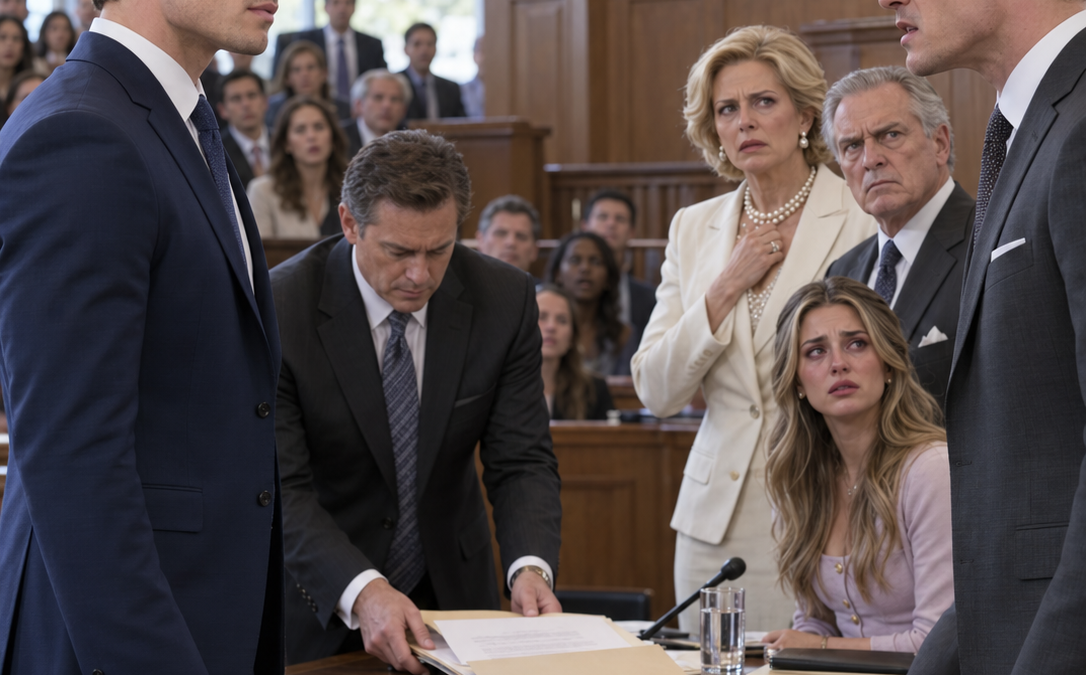
The moment i walked into the courtroom, my mother laughed under her breath and my dad shook his head; the judge went pale, his hand trembled, and he whispered: ‘dear god… is that really him?’; everyone turned to stare—they had no idea who i was until…
“Not now, Lucas.”
Or worse, my dad’s favorite:
“You just wouldn’t understand.”
My own thoughts were background noise in my parents’ perfect narrative.
Even at Christmas, the gifts told the story. Matthew would get a brand-new iPhone, Clare a designer bag, and me a clearance sweater, usually in the wrong size.
My mom once even said, “Well, you never care about this stuff anyway,” as though that somehow justified her neglect.
But here’s the thing.
When you spend years being treated like a shadow, you start learning to observe.
I watched everything. I noticed patterns. I saw the way my brother bragged but never actually followed through. I saw how my sister’s sweetness was more calculated than anyone wanted to admit. And most of all, I saw my parents’ blind spots.
They assumed I was dumb.
That gave me a kind of freedom they didn’t realize.
I had space to think, to plan, to work on my own life without them hovering over me. It hurt too much to be ignored, but in a twisted way, it gave me the quiet I needed to build something they never expected.
The disrespect didn’t stop when I became an adult. If anything, it got worse.
When I was twenty-two, I started my own small business. Nothing flashy at first, just online consulting—a mix of IT troubleshooting and security work that grew out of side gigs I’d done in college.
I poured everything into it. Late nights. Endless research. Cold calls. Rejection after rejection until, finally, it started paying off.
Within three years, I was pulling in six figures.
By twenty-six, I’d scaled enough to hire a team.
And suddenly, I wasn’t just surviving. I was thriving.
But you wouldn’t know it if you asked my family.
They never bothered.
They didn’t even ask how I paid rent.
My mom still referred to me as “between jobs,” and my dad once laughed and said, “Lucas probably fixes printers for a living.”
I didn’t correct him.
Why should I?
Let them think I was nothing.
The first big crack in the facade came two years ago at Thanksgiving.
Everyone was gathered at my parents’ house, like always, and my mom had just toasted Matthew for his “promotion.” I put that in quotation marks because, as I’d later find out, the promotion didn’t exist. He’d been quietly let go, but my parents spun the story so no one would lose their precious golden-boy image.
Anyway, after the toast, Clare piped up about her new internship, and of course my mom swooned.
Then, almost as an afterthought, she glanced at me.
“And Lucas is… well, still figuring things out. Aren’t you, honey?”
The whole table laughed.
Matthew smirked.
I felt my ears burn, but I smiled politely and said, “Something like that.”
What none of them knew was that I’d signed a deal that very week that doubled my company’s revenue.
But why ruin their fun?
I let them laugh.
I let them believe I was stuck in the same place.
That was their first mistake.
Over the next year, the digs got worse.
Clare came to me asking for money, “just until payday,” and when I said no, she called me selfish and told my parents I was hoarding cash.
Matthew once tried to convince me to co-sign a loan for him, claiming it would “help the family.” I turned him down flat, and suddenly I was painted as the villain.
My dad even called me one night.
“You’re abandoning your siblings,” he said. “We’re a family. Family helps family.”
I wanted to laugh at the hypocrisy.
Where was that help when I was struggling?
Where was the support when I was clawing my way up?
But instead of arguing, I kept quiet. I told them I’d think about it.
That was their second mistake.
Mistaking silence for weakness.
The breaking point came this past summer.
My grandmother passed away, and with her death, the family estate became the center of attention—a sprawling house, land worth millions, and, more importantly, the trust she’d left behind.
My grandmother loved me, maybe more than anyone else in the family.
She’d seen the way my parents treated me. And though she never called them out directly, she made it clear in private that she believed in me.
We used to sit for hours drinking tea in her garden while she told me stories about resilience, about building a life when everyone doubted you.
I never forgot those talks.
So when she passed, I wasn’t shocked to learn she’d left me something.
What I didn’t expect was how much.
I’ll never forget the reading of the will.
My parents sat smugly, expecting everything to flow to Matthew and Clare, maybe with some token amount set aside for me.
Then the lawyer announced that the bulk of the estate—both financial assets and property—was being entrusted to me.
You could have heard a pin drop.
My dad’s jaw clenched so hard I thought his teeth might break.
My mom’s face drained of color.
Clare burst into tears.
Matthew outright shouted, “This has to be a mistake.”
The lawyer calmly explained that it wasn’t.
My grandmother had written her wishes clearly.
I was the primary beneficiary.
In that moment, for the first time in my life, I had the upper hand.
And they hated it.
Of course, they didn’t accept it.
Not even close.
The weeks that followed were a storm of phone calls, guilt trips, and outright manipulation.
My mom would leave voicemails crying, “How could you do this to your brother and sister?” as if I’d written the will myself.
My dad accused me of tricking my grandmother in her final days.
Matthew called me in the middle of the night demanding his “fair share.”
Clare even showed up at my apartment unannounced, banging on the door and screaming that I had ruined her life.
I didn’t open it.
I couldn’t.
The entitlement was staggering.
But deep down, I knew it wasn’t over.
They weren’t just going to let it go.
And I was right.
Which brings me back to the courtroom.
Because when a family like mine feels slighted, they don’t just sulk.
They fight.
They contest.
They drag you into the mud with them.
And so there I was, summoned to court, facing my own parents and siblings in a battle over my grandmother’s final wishes.
When I walked into that room, heard my mother’s laugh, and saw my father’s disdain, I felt something I hadn’t felt in years.
Power.
Real power.
Because I knew something they didn’t.
Something that made the judge himself tremble when he recognized me.
And that’s where everything started to shift.
The air in the courtroom was thick with tension, the kind that hums beneath your skin and makes every sound sharper, every movement exaggerated.
When the judge looked at me with that startled expression, my parents didn’t notice at first. They were too busy whispering to Matthew, their voices dripping with confidence, as if this whole thing were nothing more than a formality.
I could hear my mother’s smug little hiss of a laugh, the one she used whenever she thought victory was already in her hands.
I didn’t move.
I didn’t speak.
I simply sat quietly at my table and watched.
Let them think this was going to be easy.
The lawyer representing my family was a slick man in his fifties. Expensive suit. Hair slicked back. The kind of man who thought a smirk could be used as a weapon.
He stood, introduced himself, and immediately launched into a speech about undue influence and unfair manipulation.
Every word was crafted to paint me as the villain.
Me.
The invisible son who had supposedly wormed his way into my grandmother’s trust.
He even suggested that I’d isolated her in her final years, as though I’d kept her locked away from the rest of the family.
My mom dabbed fake tears from her eyes, nodding along with the performance, while Clare sniffled into a tissue like she’d been rehearsing for weeks.
I should have felt angry.
Mostly, I felt detached.
Like I was watching actors in a play.
Maybe that’s what years of being dismissed does to you.
You stop expecting fairness.
Still, every lie they told added fuel to the slow-burning fire in my chest.
They were trying to erase every good thing I’d built with my grandmother. Every quiet afternoon in her garden. Every story she told me about resilience.
Those memories were real.
They mattered.
But here, in this sterile courtroom, my family was trying to rewrite them into something sinister.
Matthew was called to the stand first, and he strutted up there like he was giving a motivational speech.
He looked the judge straight in the eye.
“My grandmother always loved us equally. She never would have singled Lucas out like this unless he pressured her.”
He paused dramatically, as if expecting gasps, then leaned closer.
“He’s always been resentful. Always jealous. This is just his way of finally getting back at us.”
I almost laughed.
Jealous of what?
Of his promotion that didn’t exist?
Of the years he’d coasted on praise while doing nothing meaningful with his life?
But I kept my mouth shut.
Let him dig his own grave.
Then Clare took her turn.
Her voice trembled, delicate and fragile. The perfect performance of a wronged little sister.
“Grandma promised me she’d help me with school. She told me she wanted me to have a good life. And then suddenly… suddenly everything went to Lucas. It doesn’t make sense.”
She sniffled loudly, glanced at my parents for reassurance, and added, “He never even cared about family until there was money involved.”
That one stung.
Not because it was true, but because it was the exact opposite of the truth.
I cared too much.
I had spent years trying to be part of this family, trying to be noticed, included, loved.
They were the ones who shut me out.
They laughed at me.
They minimized everything I did.
And now, in front of strangers, they had the audacity to call me the heartless one.
By the time my mom took the stand, I knew exactly how this show was going to play out.
She sighed dramatically, clutching her tissue.
“Your Honor, Lucas is… he’s always been troubled. He doesn’t like to admit it, but he’s had difficulties since he was young. We tried to help him. We really did. But he pushed us away. And my mother, God rest her soul, she was vulnerable at the end. He must have convinced her. There’s no other explanation.”
My father, when he spoke, didn’t even bother pretending to be sad.
He leaned forward, his voice sharp, every word a blade.
“This is about fairness. Lucas has never carried his weight in this family. He’s never sacrificed. Never supported anyone else. And now he wants to take everything for himself. That isn’t right. That isn’t what my mother-in-law wanted.”
The irony was so heavy it nearly crushed me.
The same man who had never once shown up for me, who had ridiculed me for years, was now lecturing me about sacrifice.
I wanted to stand up and shout. I wanted to lay out every moment of neglect, every time I’d been mocked or dismissed.
But instead, I sat quietly with my hands folded and waited for my turn.
Because I knew something they didn’t.
Something that had made the judge pale when he recognized me.
And I wasn’t going to waste it on an outburst.
As the testimonies continued, I noticed the small things.
The way my mother avoided my eyes, afraid of what she might see there.
The way Matthew’s voice shook slightly when he was pressed about his so-called promotion.
The way Clare clung to my mother’s hand like a child even though she was a grown woman.
Their stories were rehearsed.
Polished.
But brittle.
If you looked closely, the cracks showed.
And I was more than ready to press on those cracks until the whole thing shattered.
Still, the favoritism was undeniable.
Even in court, my parents treated Matthew and Clare like victims, like porcelain dolls who needed protecting.
I was the villain in their story.
The shadowy figure who had corrupted everything.
When recess was called, my father leaned across the aisle and muttered just loudly enough for me to hear.
“You think you’ve won. You’re nothing, Lucas. Always have been. Always will be.”
My mother smirked beside him, whispering something to Clare that made her giggle.
They wanted me to break.
To lash out.
To prove their story right.
I didn’t give them the satisfaction.
I just smiled.
Because I could feel the tide turning, even if they couldn’t.
That night, back at my apartment, I couldn’t sleep.
My mind replayed every word they’d said. Every lie. Every accusation.
I thought about the years of being dismissed, about the countless times I’d walked away from family gatherings with a pit in my stomach, wondering why I wasn’t enough.
I thought about the Christmas when my grandmother had slipped me an envelope with a note inside.
“One day they’ll see who you really are. Be patient.”
I’d tucked that note away in a drawer, unsure whether it would ever come true.
And now, sitting in the middle of this storm, I realized she’d been right.
But patience only lasts so long.
By the second day in court, the games escalated.
My family’s lawyer accused me outright of forging documents.
Matthew swore he’d seen me coaching my grandmother in her last weeks.
Clare cried so hard she had to be escorted out for a break.
And my parents?
They sat there proud of the circus they’d created, convinced everything was going their way.
The judge, though, kept stealing glances at me.
His expression was unreadable, but I caught the flicker of recognition again—the same whisper of unease he’d shown on the first day.
He knew.
He remembered.
And my family had no idea.
At one point during a heated exchange, Matthew turned and sneered at me.
“You don’t belong here, Lucas. You never have. You’re just the spare. The mistake. And soon everyone will see that.”
The words hit harder than I wanted to admit.
But instead of flinching, I leaned back in my chair and smiled again.
Because soon—very soon—it wouldn’t be me on trial anymore.
It would be them.
And when the judge finally cleared his throat, signaling that the next session would begin with my testimony, the whole room seemed to shift.
My parents straightened in their seats, ready to pounce on anything I said.
Matthew smirked.
Clare wiped her eyes dramatically.
They thought they had me cornered.
They thought I was about to crumble under the weight of their lies.
What they didn’t know was that I had spent years preparing for this moment.
Years of silence.
Years of planning.
Years of watching.
And now, with the whole courtroom waiting, I was finally ready to speak.
When the judge called my name, the room hushed.
I could hear the scrape of my chair against the polished floor, the soft rustle of papers being shuffled, even the creak of the bench as the bailiff adjusted his stance.
I walked slowly, deliberately, toward the witness stand, feeling every pair of eyes on me.
My mother’s sharp gaze.
Matthew’s arrogant smirk.
Clare’s teary little performance.
They were all waiting, hungry for me to falter.
The oath was simple.
“Do you swear to tell the truth, the whole truth, and nothing but the truth?”
“I do.”
When I sat down, I let the silence hang for a moment before speaking.
“I loved my grandmother,” I began, my voice steady. “She was the one person in my family who treated me as if I mattered. We spent years together. Afternoons in her garden. Evenings drinking tea. She confided in me. She trusted me. And she made her wishes clear.”
My family’s lawyer interrupted almost immediately.
“Wishes you convinced her of. Isn’t that right?”
“No,” I said firmly, locking eyes with him. “Wishes she had long before any of this. She chose me because she knew I would honor them.”
The back-and-forth began.
Questions designed to trip me up.
Accusations slipped into every inquiry.
Did I visit her alone?
Yes. Often.
Did I ever talk about finances with her?
Once or twice, at her request.
Did I know about the will before she passed?
No.
I found out with everyone else.
My answers were calm and measured, but I could feel the weight of my family’s hatred pressing down on me with every word.
And then it happened.
The betrayal that finally snapped something inside me.
During recess, as the court broke for lunch, my lawyer pulled me aside. His face was unusually grim.
“Lucas,” he said quietly. “They’ve submitted new evidence. You need to see this.”
I frowned, confused, and followed him into a side room where he laid a folder on the table.
Inside were pages of emails.
Hundreds of them.
At first glance, they looked like messages I had supposedly sent to my grandmother—pleading with her, manipulating her, even threatening her.
My chest tightened as I scanned the words, bile rising in my throat.
“I never wrote these,” I whispered.
“I know,” my lawyer replied. “They’re forgeries. But they’re claiming they came from your account. They’ve already submitted testimony from an expert who will swear they’re authentic.”
I felt the floor tilt beneath me.
My own family had fabricated evidence.
Weaponized technology.
Driven a knife into my back without hesitation.
It wasn’t just lies in a courtroom anymore.
It was deliberate sabotage crafted to destroy me completely.
When we returned, my parents sat straighter, smugness radiating from them like heat.
Matthew wouldn’t stop grinning.
Clare leaned against my mother, whispering something that made her smirk.
They were so sure this was the killing blow.
Their lawyer strutted to the center of the room, waving the stack of papers like a trophy.
“Your Honor, we have here documented proof of undue influence. A string of emails written by Lucas to his grandmother in her final months, urging her to disinherit the rest of her family. The language is clear, coercive, and manipulative.”
He handed the documents to the judge, who adjusted his glasses and began to read.
My heart pounded in my chest—not with fear, but with a rising fury I could barely contain.
To watch the same man who had trembled at the sight of me now squint over fabricated lies was unbearable.
The lawyer continued, his voice dripping with satisfaction.
“You’ll see he even goes so far as to threaten withholding care unless she complies. This, ladies and gentlemen, is not love. This is exploitation.”
My mother gasped, pressing a hand to her chest in fake shock.
Clare started crying again.
Matthew folded his arms, smug as ever.
It was a perfectly orchestrated performance.
And for a moment, I saw the spectators in the gallery begin to shift uncomfortably, as if maybe they believed it.
That was the moment the betrayal sank its teeth into me.
Not just because of the lies, but because it confirmed what I had feared deep down for years.
My family didn’t just dislike me.
They didn’t simply undervalue me.
They despised me enough to destroy me.
To smear me.
To twist the truth into something unrecognizable.
Blood meant nothing to them if money was on the line.
When my lawyer rose to object, pointing out inconsistencies, the judge silenced him with a raised hand.
“We will review these documents carefully,” he said.
His voice was neutral, but his eyes flicked toward me again, and I caught the faintest glimmer of unease there.
He knew something.
Remembered something.
But the paper in his hand carried weight, and my family knew it.
As the session dragged on, I sat in silence while they paraded their evidence.
Their expert—a man I’d never seen before—took the stand and rattled off jargon about metadata and server logs.
He spoke confidently, but when pressed, his answers were vague.
Still, it was enough to plant seeds of doubt.
By the end of the day, whispers in the gallery had grown.
Strangers muttering about greed.
About manipulation.
My parents walked out arm in arm, their faces glowing with false victory.
Clare clung to Matthew and whispered, “We’ve got him now.”
I stayed behind, staring at the empty courtroom, my fists clenched until my knuckles ached.
The betrayal cut deeper than any insult they’d ever thrown at me.
This wasn’t about inheritance anymore.
It wasn’t about the will.
This was about erasing me completely.
About painting me as the villain so they could walk away clean.
That night, alone in my apartment, I sat in the dark and thought about every moment that had led me here.
The times they laughed at me.
The gifts that told me I didn’t matter.
The holidays when I was invisible.
And now this.
A deliberate attempt to frame me.
To ruin me.
My grandmother’s note echoed in my mind.
“One day they’ll see who you really are.”
I knew then that the patience she’d urged me to keep was over.
They had crossed the line.
There was no going back.
The next morning in court, as I walked past my family, Matthew leaned close enough that only I could hear.
“It’s over, Lucas. Nobody believes you. You’re finished.”
His grin was wide, cruel, and certain.
I didn’t respond.
I didn’t even look at him.
I just walked to my seat, calm on the outside, while something inside me shifted permanently.
Because I wasn’t finished.
Not even close.
And when the judge announced that the next session would allow me to submit evidence of my own, I finally felt the faintest trace of a smile curve across my lips.
My family thought their betrayal was the end of me.
They had no idea it was just the beginning.
When I got home that night, after the forged emails had been introduced, I didn’t bother turning on the lights.
The apartment felt colder than usual, empty in a way that pressed down on my chest.
I sat on the edge of my bed, still wearing my courtroom clothes, staring at the floor as though it might offer some kind of answer.
My phone buzzed on the nightstand.
Messages piled up from friends who had heard whispers about the trial, from old classmates who’d seen something online, even from a couple of distant relatives fishing for gossip.
I didn’t answer any of them.
What was I supposed to say?
That my own family was trying to bury me alive beneath a mountain of lies?
For the first time in years, I felt small again.
Powerless.
The same way I’d felt sitting at the dinner table while my voice was drowned out by praise for Matthew and Clare.
The courtroom.
The judge’s pale stare.
The whispered gasps when those forged emails were read aloud.
It all replayed in my head like a cruel loop.
I tried to sleep, but every time I closed my eyes, I saw my grandmother’s handwriting.
“One day they’ll see who you really are.”
And all I could think was: What if she was wrong?
What if they succeeded in twisting everything until even strangers believed them?
The following morning, I dragged myself to court with heavy steps.
My suit felt stiff.
My tie felt too tight.
The fluorescent lights overhead only sharpened the pounding in my skull.
My family, by contrast, looked refreshed.
Almost celebratory.
My mother wore pearls and a light smile, the kind she reserved for moments when she thought she’d already won.
Matthew leaned back in his chair, arms crossed, radiating smug confidence.
Clare dabbed at her eyes now and then, but even her grief looked rehearsed.
When the session began, the judge announced that the new evidence would officially be entered into consideration.
My stomach twisted.
Even though my lawyer objected, pointing out inconsistencies in the metadata and a questionable chain of custody, the judge simply nodded.
“We’ll allow it for now.”
The gavel cracked against the wood.
And in that moment, it felt as though my entire case had slipped further from my grasp.
The rest of the day was brutal.
Every argument my lawyer tried to make was countered by their polished narrative.
Every time I thought we’d found a hole in their story, they shifted the focus.
At one point, my father even stood and declared, “This isn’t about money. It’s about principle. My son has betrayed us all.”
Hearing those words in his voice broke something deep inside me.
He didn’t hesitate to call me a traitor.
He didn’t flinch.
By the time court adjourned, I could barely keep my legs steady as I walked out the door.
Outside, reporters swarmed.
Microphones were thrust toward me.
Camera flashes exploded in my eyes.
“Lucas, did you manipulate your grandmother?”
“Lucas, what about the emails?”
“Lucas, how do you respond to claims that you isolated her?”
I said nothing.
I pushed through them like a ghost and made my way home, my mind numb.
That week was the lowest point I can remember.
I stopped answering calls.
Ignored texts.
Let dishes pile up in the sink and laundry go untouched.
My business partners sent emails—first concerned, then frustrated, then panicked.
But I couldn’t bring myself to answer.
I was watching everything I’d built teeter on the edge because of lies I couldn’t yet disprove.
One night, I sat at my desk staring at my company’s balance sheets, the numbers blurring together as I wondered whether I was going to lose everything.
And in the silence of those nights, when the weight of it all pressed hardest, the voices of my family echoed inside my head.
Matthew’s sneer.
“You’re the mistake.”
My mother’s whisper.
“He’s troubled.”
My father’s cold pronouncement.
“He betrayed us all.”
Words that cut deeper than knives because they weren’t just accusations in a courtroom.
They were admissions of how they’d always seen me.
But somewhere in that darkness, something began to stir.
I don’t know if it was anger or survival, or maybe the last spark of my grandmother’s faith in me, but it flickered quietly at first.
A thought.
Small, but steady.
They may have cornered me, but they haven’t won yet.
I started digging through my old files.
At first, it was almost mechanical.
Opening folders.
Scrolling through documents.
Revisiting emails I’d saved from my grandmother over the years.
I didn’t even know exactly what I was looking for.
But slowly, as the hours stretched into days, I realized I wasn’t searching blindly.
I was retracing a path.
Piecing together fragments of truth that might still cut through their lies.
One night, blurry-eyed at three in the morning, I found an old email from my grandmother.
It was short, just a note about a book she wanted me to read, but something about it struck me.
The date.
The timestamp was weeks after the date my family’s forged emails claimed I had already coerced her into rewriting the will.
She hadn’t mentioned any of it.
She was cheerful.
Clear-headed.
Entirely herself.
I stared at that email for a long time, my pulse quickening.
It wasn’t enough to overturn their narrative.
Not by itself.
But it was a thread.
A crack in the wall they’d built.
The next day in court, though, things got worse before they got better.
Matthew took the stand again.
This time, he held nothing back.
He leaned into the microphone.
“Lucas always hated us. He resented every good thing we had. This is his revenge. He’s not honoring Grandma. He’s punishing us.”
My mother nodded along, dabbing at her eyes for effect.
Clare cried again, burying her face against my mother’s shoulder.
I sat motionless, feeling whispers ripple through the gallery.
To them, maybe I did look like the villain.
The quiet son.
The black sheep.
Suddenly inheriting everything while the golden boy and the princess were left behind.
It was a story that almost wrote itself.
And sitting in that courtroom, I realized just how far they’d go to make sure it stuck.
That night, back in the darkness of my apartment, I felt the weight press hardest again.
A thought slipped into my head.
Maybe I should just walk away.
Let them have it.
None of this is worth it.
The money, the estate, the trust—none of it could erase the poison of standing across from my own family and listening to them dismantle me piece by piece.
For a long while, I sat with that thought, wondering whether surrender would simply be easier.
Then I remembered the look in my grandmother’s eyes the last time I saw her.
Clear.
Steady.
Almost defiant.
She had leaned close and whispered, “Don’t let them define you.”
And just like that, the flicker inside me grew stronger.
No.
I wasn’t going to walk away.
Not yet.
So I started quietly planning.
Not loudly.
Not with grand gestures.
Just small, steady steps.
I called an old friend from college who now worked in cybersecurity.
At first, I asked careful, vague questions about how digital forgeries might be unraveled.
I revisited my grandmother’s letters and documents, searching for patterns, details only she and I would know.
I didn’t tell my lawyer everything yet.
I wanted to be sure before I made any promises.
Outwardly, though, I let my family believe they were winning.
I sat silent in court, shoulders heavy, gaze lowered—the image of a man defeated.
And it worked.
I could see their confidence swell.
Between sessions, I heard whispers about dividing up the estate, about what they’d do once I was out of the way.
They thought they’d broken me completely.
And in a way, they had.
But what they didn’t understand was that rock bottom isn’t just the lowest point.
It’s also the foundation.
And from a foundation, you can build.
The day the judge announced that we’d move to closing arguments within the week, my parents smiled.
Matthew nodded in satisfaction.
Clare squeezed my mother’s hand.
To them, the game was already over.
But as I walked out of that courtroom, the late-afternoon sun blinding my eyes, I felt something shift inside me.
The suffering was still heavy.
The betrayal was still raw.
But beneath it all, the quiet beginnings of a plan were taking shape.
They thought they’d buried me.
What they didn’t know was that I was planting roots.
The morning after the judge announced closing arguments were only a week away, I woke with a strange kind of clarity.
The heaviness was still there, yes, but dulled.
Almost background noise.
Something in me had hardened during those sleepless nights of despair.
It wasn’t hope exactly.
It was resolve.
My family wanted to bury me beneath lies.
Fine.
But if they thought I would simply stay buried, then they didn’t understand me at all.
I began with small, deliberate steps.
That old friend from college—the cybersecurity specialist—I finally told him the full story.
I explained the forged emails, the expert testimony, the way my family’s lawyer had paraded them around as if they were ironclad truth.
He listened quietly.
When I finished, he said, “Lucas, I can already tell you this: if those emails were faked, there’ll be holes. Metadata can be forged, yes, but real digital fingerprints are almost impossible to mimic perfectly. Give me access and I’ll dig.”
For the first time in weeks, I felt something almost like relief.
Not victory.
Not yet.
But the first real crack in their wall of lies.
Meanwhile, I forced myself back into the rhythm of my business.
I logged into meetings again.
Fielded questions from my team.
Reassured clients.
At first, it felt mechanical, as if my body were going through the motions while my mind remained trapped inside the courtroom.
But as the days passed, I realized how completely I’d let the trial swallow me.
My company was still thriving.
My partners were still committed.
My employees still believed in me.
The world outside that toxic family bubble hadn’t collapsed.
If anything, it had grown stronger in my absence.
One afternoon, I walked into the office unannounced.
My team looked up in surprise, then broke into smiles.
“Good to see you, boss,” one of them said.
And in that moment, standing in a room filled with people who respected me for my work, I felt the contrast sharply.
Here, I wasn’t invisible.
Here, I wasn’t the mistake.
Here, I mattered.
That realization gave me fuel.
The shame my family had tried to drown me in began to lose its grip.
I wasn’t nothing.
I had built something real.
Something no smear campaign could erase entirely.
Back in court, I noticed subtle changes, too.
The judge, though bound by procedure, kept glancing toward me with that same faint unease.
It wasn’t pity.
It was recognition.
He knew something.
And every time my family’s lawyer grew more arrogant, every time Matthew sneered across the aisle, every time Clare dabbed her eyes with theatrical precision, I sensed the tide beginning to shift.
If only slightly.
One key moment came when my lawyer cross-examined the so-called expert who had authenticated the forged emails.
Calmly, methodically, he asked questions about server logs, timestamps, and supposed IP addresses.
The man gave answers, but they were vague.
Overly rehearsed.
When pressed on whether he had personally verified the email headers, he stammered.
The gallery noticed.
I noticed the judge lean forward slightly, pen hovering over his notepad.
It wasn’t a knockout blow.
But it was the first dent in their armor.
That night, my cybersecurity friend sent me a message.
I found something. Call me.
My heart pounded as I dialed.
He explained that while the emails looked convincing on the surface, the metadata told a very different story.
Formatting errors.
Character encodings.
Inconsistencies in server paths.
Red flags everywhere.
“These weren’t written by you,” he said. “They weren’t even written during the time they claim. Whoever forged these didn’t account for the way your provider stamps outbound mail.”
I closed my eyes and let the words sink in.
Proof.
Real proof.
It wasn’t enough yet.
I knew we’d need a meticulous, airtight presentation.
But it was the foothold I’d been waiting for.
From that point on, the weight on my chest began to lift.
I walked into court the next morning with straighter shoulders.
My family noticed.
My mother’s smile faltered when she saw me.
Matthew’s smirk wavered.
Clare, always the actress, tried harder with her tears, but even they looked strained.
They could feel it, even if they didn’t understand it yet.
My silence was no longer defeat.
It was preparation.
Outside the courtroom, I began reclaiming other parts of my life, too.
I started running in the mornings again, pounding the pavement until sweat burned my eyes.
I cleaned my apartment.
Cleared the dishes.
Folded the laundry.
Small things.
But each one reminded me that I was still in control of my own space, my own choices.
The fog of despair lifted with every step, replaced by sharper focus.
Friends who had reached out earlier finally heard back from me.
I grabbed coffee with an old colleague who told me, “I’ve seen the news, but I know you, Lucas. You don’t need to explain.”
That kind of loyalty, that kind of belief, was something my family had never given me.
And it made me even more determined to fight.
In court, the momentum continued to tilt, slowly but surely.
My lawyer introduced character witnesses.
Old professors.
Business partners.
Even a neighbor from my grandmother’s block.
They painted a picture of me not as some manipulator, but as the quiet, steady presence I had always been.
One neighbor in particular, an elderly woman who had often shared tea with my grandmother, testified that she’d overheard my grandmother praising me repeatedly.
“She said Lucas was the only one who visited without expecting anything,” the woman said. “The only one who listened.”
That testimony hit hard.
I saw it in the faces of the people in the gallery.
I saw it in the way the judge’s pen scratched more notes across the page.
And for the first time, I saw my mother’s mask crack.
She pressed her lips together so tightly they turned white.
By the end of that week, the narrative had shifted.
My family still pushed their lies.
Still clung to their forgeries.
But doubt had been planted.
The certainty they’d carried into the courtroom began to fray around the edges.
And through it all, I stood calmer.
Stronger.
My silence was no longer the silence of defeat, but the silence of someone waiting for exactly the right moment.
Privately, I continued working with my cybersecurity friend, compiling a report that detailed every inconsistency.
Every timestamp error.
Every impossible encoding.
It was meticulous.
Technical.
Airtight.
When I handed the draft to my lawyer, he read through it slowly.
Then he looked up at me with something close to admiration.
“Lucas,” he said, “this could change everything.”
And still, I kept quiet in court.
I let my family believe they were winning.
That I was cornered.
That those forged emails were the nail in my coffin.
I sat through their sneers, their whispers, their smug glances because I knew something they didn’t.
Their entire strategy was about to collapse under its own weight.
But beyond the legal battle, something else was rising in me, too.
A confidence I hadn’t felt in years.
I wasn’t simply surviving anymore.
I was building.
Reclaiming.
Every run I took, every meeting I rejoined, every late-night conversation with allies reminded me that I wasn’t defined by their lies.
I was defined by what I had built.
By the truth my grandmother had always seen.
And as the week drew to a close, with closing arguments looming, I walked out of the courthouse into the sunlight and felt something I hadn’t felt in months.
Power.
Not loud.
Not flashy.
Quiet.
Steady.
Unshakable.
The kind of power my family had never given me.
The kind I’d forged myself.
They thought they had stripped me down to nothing.
Instead, they had revealed what I really was.
And when the time came, I knew I would show them exactly what that meant.
The closer we got to closing arguments, the more the tension in the courtroom turned electric.
You could almost taste it in the air, like the charge before a thunderstorm.
My family carried themselves with the same smug arrogance, but I could see the cracks widening.
Matthew’s jokes during recesses sounded forced now, his laughter a little too loud.
Clare’s tears came more quickly and with less control, as though the performance were slipping.
My mother fussed endlessly with her pearl necklace, her composure fraying around the edges.
And my father, always the stern patriarch, snapped at Matthew once under his breath.
There was a sharpness in his voice I’d never heard directed toward the golden boy before.
They still thought they were ahead.
But their confidence was no longer the unshakable wall it had once been.
It was a mask.
And I had spent a lifetime learning how to see through masks.
Meanwhile, behind the scenes, my quiet plan was taking shape.
My cybersecurity friend—his name was Raj—had worked day and night digging through every byte of those forged emails.
What he uncovered was more than I could have hoped for.
“Lucas,” he said one night over a video call, his voice carrying equal parts excitement and disbelief. “Whoever made these didn’t just forge your words. They were sloppy. I found copy-paste artifacts in the source code.”
He paused.
“And here’s the kicker. The machine they came from left behind an internal identifier. That identifier traces back to a device registered under your brother’s name.”
For a moment, I just sat there stunned, staring at the lines of code he had shared on the screen.
“You’re saying—”
“I’m saying,” Raj interrupted, “that Matthew was either directly involved or reckless enough to let his own machine be used for this. Either way, we can prove the forgery, and we can trace it back to him.”
The words hit me like a tidal wave.
Proof.
Not only that I was innocent, but that my own brother—the golden boy, the pride of my parents—had been complicit in framing me.
My hands tightened around the edge of my desk until my knuckles whitened.
After everything.
The years of mockery.
The dismissal.
The betrayal.
They had finally handed me the very rope I needed to unravel their story.
But I didn’t rush.
I knew better than to reveal my hand too early.
Instead, I told Raj to compile a formal, detailed report.
Line by line.
Timestamp by timestamp.
An airtight case that couldn’t be dismissed as speculation.
At the same time, I reached out to another unlikely ally.
My grandmother’s attorney.
The man who had drafted her will.
I arranged a quiet meeting at his office, away from my family’s eyes.
He greeted me with a solemn nod.
His shelves were lined with thick legal volumes, his desk neat and deliberate.
“Lucas,” he said. “I was wondering when you’d come.”
We spoke at length about my grandmother’s intentions.
He told me stories I hadn’t even known—about how she had defended me in conversations with him, how she’d insisted that I was the only person who visited without asking for something.
“She was very clear, Lucas,” he said firmly. “Her decision was deliberate. Not coerced. If she were here, she would be devastated by what they’re doing.”
When I left his office, I carried more than his words.
I carried copies of documents.
Notes my grandmother had written in her own hand during the estate-planning process.
They weren’t dramatic.
They were simple.
Pragmatic.
But they carried her voice.
Her reasoning.
Her intent.
And intent, in a case like this, was gold.
The more I gathered, the more I realized I wasn’t simply defending myself anymore.
I was building a fortress.
A fortress of truth.
While my family scrambled behind walls of lies.
In court, I let the mask of defeat linger a little longer.
My silence, my stillness—it fed their illusion.
During one recess, I overheard Clare whisper to my mother.
“He looks so beaten down. It’s almost over.”
My mother patted her hand.
“I told you. He was never strong enough.”
I walked past them without a word.
But inside, the fire burned hotter.
They truly believed I was finished even as I sharpened the blade they’d handed me.
The real turning point—the moment I knew the stage was truly set—came three days before closing arguments.
Raj called again.
This time, he was wearing a grin I hadn’t seen since college.
“Lucas, I’ve got the final report ready. It’s bulletproof. Not only can we prove the emails were forged, but the digital trail traces back to an IP address registered at your parents’ house.”
He paused for effect.
“And the timestamps? They line up perfectly with the nights Matthew claimed he was working late.”
My chest tightened.
But not with fear this time.
With exhilaration.
They had built their entire case around those emails.
Strutted into court waving them like banners.
And now I had proof that not only were they fake, but the forgery could be tied directly to them.
I sat back in my chair, the weight of weeks lifting all at once.
For the first time, I allowed myself to picture it.
The moment their expressions would change.
The smugness draining from their faces.
The gallery gasping.
The judge’s pen scribbling furiously.
The silence when they realized the very weapon they’d forged was now the blade at their own throats.
Still, I didn’t let myself gloat.
Not yet.
There was work to do.
My lawyer needed to integrate Raj’s findings into a formal motion.
We had to make certain every detail was airtight.
Every potential challenge accounted for.
And while that work continued, I prepared myself in other ways.
I started dressing sharper in court.
Nothing flashy.
Just precise.
My suits pressed.
My ties chosen carefully.
My posture straighter.
I wanted the visual contrast to be undeniable.
Their arrogance unraveling.
My strength emerging.
Outside the courtroom, I rebuilt my connections with quiet purpose.
I met with my business partners, updated them on the truth behind the headlines, and secured their trust.
I even reached out to a journalist I’d known years earlier, someone who had once covered one of my company’s early projects.
I didn’t give him the full story.
Not yet.
But I gave him enough hints to start digging.
My family wanted to play games in the shadows.
Fine.
But I wasn’t going to stay in the dark anymore.
Each night, I took long walks through the city and thought about my grandmother.
About how she must have known this would happen.
About how she had prepared me in her own quiet way.
“Be patient,” she had told me.
I understood now.
Patience didn’t mean passivity.
It meant waiting until the right moment to act.
And that moment was almost here.
The day before closing arguments, I stood outside the courthouse as the sun dipped low, painting the sky in streaks of gold and crimson.
My parents walked past me arm in arm, Matthew and Clare trailing behind.
They didn’t even glance at me.
To them, I was already defeated.
A shadow of the son they’d dismissed years ago.
I let them pass, my hands folded calmly behind my back.
Because what they didn’t know—what they couldn’t possibly imagine—was that I had everything I needed now.
Proof.
Documents.
Allies.
And a quiet confidence they had never seen in me before.
Tomorrow, the storm would break.
The morning of closing arguments, I woke before dawn.
The city outside was still wrapped in silence, the streets dark except for the occasional flicker of a streetlamp.
I stood at my window, coffee in hand, and for the first time since this nightmare began, I felt still.
Not calm exactly.
There was a thrum of anticipation in my chest.
But I was steady.
Like all the pieces had finally locked into place.
When I walked into the courthouse, my family was already there.
My mother wore a pale suit, her pearls gleaming beneath the fluorescent lights.
My father stood stiffly beside her, jaw set, projecting the kind of authority he’d always wielded like a weapon.
Matthew leaned against the wall with his arms crossed, that same smirk plastered across his face.
Clare clung to my mother’s arm, dabbing at her eyes with a tissue even before proceedings began.
To anyone else, they looked composed.
Unified.
But I’d spent my entire life watching them.
I saw the flicker in Matthew’s eyes.
The faint tremor in Clare’s hand.
The way my father’s mouth tightened when he thought no one was watching.
They were unraveling.
Even if they didn’t know it yet.
The judge entered, his robe flowing behind him, gavel in hand.
The room fell silent.
“We’ll hear closing arguments today,” he said, his voice steady. “The petitioners may proceed.”
My family’s lawyer stood first, as expected.
He launched into a speech dripping with false sincerity, painting my family as victims of manipulation, their grief twisted by my supposed deceit.
He waved the stack of forged emails again, his voice rising with practiced indignation.
“This is not the action of a loving grandson,” he declared. “This is the calculated exploitation of a vulnerable woman. Lucas does not deserve this estate. He deserves our pity, if not our condemnation.”
My mother sniffled loudly.
Clare’s tears flowed.
Matthew leaned back, arms folded smugly.
My father nodded along, every gesture rehearsed.
The lawyer ended with a flourish, his words echoing through the hushed courtroom.
“We ask that the court overturn this will, restore fairness, and protect this family from the destructive greed of one misguided son.”
When he sat down, my family exhaled collectively as though victory were already in their hands.
My mother reached over and squeezed Matthew’s hand.
Clare whispered something into my father’s ear.
Their lawyer leaned back, self-satisfied, certain he had sealed my fate.
Then it was our turn.
My lawyer rose, calm and deliberate.
He didn’t rush.
He didn’t raise his voice.
He began simply.
“Your Honor, we’ve heard a great deal of testimony. Much of it emotional. Much of it rehearsed. But what this case comes down to is one question: What did Lucas’s grandmother want?”
He paused and allowed the silence to settle.
Then he continued.
“She wanted her estate to go to the person who truly cared for her. The person who visited. Who listened. Who asked for nothing. That person was Lucas. And while the petitioners have tried to distract this court with accusations, performances, and manufactured evidence, today we will show the truth.”
He gestured toward me.
I stood slowly, my hands steady, and walked to the front.
My lawyer handed me a folder.
Inside were the documents Raj had prepared.
The technical report tracing the forged emails back to Matthew’s machine and my parents’ house.
I held the folder for a moment before speaking.
“Your Honor,” I said, my voice steady, “my family has accused me of manipulation. They’ve submitted emails they claim I wrote. I want to show you something.”
The judge adjusted his glasses and watched me intently.
I opened the folder and handed the first page to the bailiff, who delivered it to the bench.
“This is a technical analysis conducted by a certified cybersecurity specialist. It examines the metadata of the emails submitted against me. What it shows is simple. These emails were not written by me. They weren’t even written at the time claimed. The timestamps don’t align. The server paths are inconsistent. And most importantly, the device used to create them is traceable.”
I paused.
“Traceable to a machine registered under my brother’s name.”
The room erupted in whispers.
My mother’s hand froze halfway to her face.
Clare’s tissue dropped to the floor.
Matthew’s smirk vanished, his jaw tightening.
My father shifted uncomfortably, his hands gripping the edge of the table.
The judge flipped through the documents, his brow furrowing.
He glanced at Matthew.
Then back at me.
“You’re saying these were forged?”
“I’m not just saying it, Your Honor,” I replied. “We can prove it. And we can prove where they came from.”
My lawyer stepped in then, elaborating on the technical details and methodically walking the court through Raj’s findings.
He explained how formatting errors betrayed copy-and-paste manipulation.
How encoding inconsistencies revealed tampering.
How IP addresses traced directly back to my family’s residence.
Piece by piece, he laid it out.
Each point another brick in the wall we were building.
The gallery murmured more loudly with each revelation.
By the time he finished, the atmosphere in the room had shifted completely.
The smug confidence that had clung to my family all this time was gone.
In its place was something else.
Panic.
But I wasn’t done.
“Your Honor,” I said softly, “these emails were not just lies. They were attempts to erase my relationship with my grandmother. To turn years of love and trust into something ugly. But she left behind her own words. Words that show what she really wanted.”
I handed forward the notes from my grandmother’s attorney.
The documents she’d written in her own hand during the estate-planning process.
Simple words.
But clear.
Lucas visits me often. He listens. He cares. He doesn’t ask for anything.
The judge read them aloud.
My grandmother’s handwriting—her voice carried through ink—filled the courtroom.
And for the first time since this ordeal began, I felt her presence beside me.
Not as a ghost.
As a shield.
The silence that followed was deafening.
My mother’s face had gone pale, her lips pressed tightly together.
Clare stared down at her lap, eyes wide.
My father’s jaw twitched, the mask of control finally slipping.
And Matthew…
Matthew was shaking his head, muttering under his breath, his composure shattered.
The judge finally looked up, his expression grave.
“This evidence is significant. The court will take it under consideration.”
But the damage was already done.
As we recessed, the gallery buzzed with whispers.
Strangers turned their heads toward my family, no longer with sympathy but suspicion.
Reporters scribbled furiously in their notebooks.
I walked past my parents without a word, my steps calm and steady, while they sat frozen, their carefully constructed narrative crumbling around them.
For the first time, they looked small.
That night, as I lay in bed, the weight that had pressed down on me for months finally lifted.
The revenge wasn’t about gloating.
It wasn’t about humiliation.
It was about truth.
About turning their own weapons against them.
They had tried to bury me under lies.
Instead, they had buried themselves.
And yet, I knew this wasn’t the end.
Not yet.
Tomorrow would bring the fallout.
The reckoning.
The moment the world would see them for who they truly were.
But for now, I allowed myself one small, quiet victory.
The image of their faces—stunned and pale—as their empire of lies came crashing down.
The morning of the verdict, the courthouse was more crowded than it had been on any other day.
Word had spread about the forged emails.
About the cracks in my family’s story.
Reporters clustered outside with microphones ready, cameras flashing every time someone walked through the doors.
The case wasn’t just a private matter anymore.
It had become a spectacle.
A story people wanted to see resolved.
When I entered, I kept my head high.
My family was already seated, and their appearance told the story better than any headline could.
My mother’s face was ashen, her pearls clutched tightly in one hand like a lifeline.
My father looked older, deep lines carved into his forehead, his eyes hard but hollow.
Clare sat stiffly, her tissue crumpled in her lap, her gaze darting nervously around the room.
And Matthew?
Matthew looked like a man on the edge of breaking.
His usual swagger was gone.
He tapped one foot uncontrollably, jaw clenched, his fingers fidgeting with a pen that clicked over and over until my mother finally snapped at him to stop.
The judge entered.
The room fell silent.
He cleared his throat, adjusted his glasses, and began.
“This court has reviewed the testimony, the documents, and the new evidence submitted. The petitioners allege undue influence, coercion, and manipulation. However, the evidence provided by the respondent has cast serious doubt on those claims.
“The digital analysis submitted shows clear inconsistencies in the supposed emails, including alterations and metadata linking their origin not to the respondent, but to the petitioners’ own residence.”
A murmur rippled through the gallery.
My family shifted uncomfortably.
The judge continued, his voice firmer now.
“Furthermore, the handwritten notes from the decedent herself support the respondent’s account. Her intent was clear. She chose to entrust her estate to Lucas, not out of coercion, but out of love and confidence.
“Therefore, this court rules that the will shall stand as written. The estate is to remain in Lucas’s possession.”
The gavel struck once.
Sharp.
Final.
For one heartbeat, the room was silent.
Then it erupted.
Reporters scribbled furiously.
Whispers flew through the gallery.
People buzzed with the shock of it.
I didn’t move.
I sat perfectly still, letting the words sink in.
I had won.
Not just legally.
In the only way that mattered.
I had defended my grandmother’s trust.
Preserved her legacy.
Exposed my family’s lies for what they were.
Across the aisle, the fallout began immediately.
My mother’s face twisted, the mask of composure shattering.
“No,” she hissed. “This can’t be. This isn’t fair.”
She clutched my father’s arm, her voice rising until the bailiff approached and warned her to calm down.
My father sat rigid, his lips pressed into a thin, bloodless line.
His eyes bored into me.
But there was no triumph left in them.
Only rage.
Quiet, simmering rage.
The rage of a man who had lost control.
Clare buried her face in her hands, sobbing loudly.
Her tears were no longer a performance.
Not this time.
“What about me?” she cried, her voice breaking. “What am I supposed to do?”
But it was Matthew who fell hardest.
He stood abruptly, knocking his chair backward.
“This is a lie!” he shouted, his voice cracking. “All of it! He manipulated everything. He—he must have hacked something!”
His words stumbled over one another.
Incoherent.
Panicked.
He was unraveling in front of everyone.
The golden boy stripped bare.
The judge slammed the gavel again.
“Order in the court. Sit down, Mr. Hayes, or you will be held in contempt.”
Matthew froze, his chest heaving, before slowly sinking back into his chair.
His face was pale.
His hands trembled.
And me?
I didn’t say a word.
I didn’t need to.
The truth had spoken for me.
As we left the courtroom, reporters swarmed.
Microphones thrust forward.
Questions came from every direction.
“Lucas, how does it feel to win?”
“Lucas, what do you have to say about the forged emails?”
“Do you plan to press charges against your family?”
I didn’t answer.
I simply walked calmly through the crowd, sunlight spilling over me while cameras flashed.
Behind me, I heard the chaos of my family’s exit.
The shouts.
The sobs.
The desperate attempts to cover their disgrace.
But their voices were drowned out by the roar of the crowd.
By the truth that had already taken root.
In the weeks that followed, the consequences came swiftly and mercilessly.
The forged emails weren’t just a courtroom embarrassment.
They were a crime.
Raj’s report was handed over to investigators, and soon Matthew found himself under official scrutiny.
The golden boy’s name appeared in headlines, not for promotions or achievements, but for fraud and forgery.
The whispers about the promotion that never existed resurfaced.
This time, people connected the dots.
His reputation collapsed almost overnight.
My mother and father tried to retreat quietly, but the stain was permanent.
Whispers in their social circles grew louder.
About the lies.
The courtroom theatrics.
The attempt to frame their own son.
Invitations dwindled.
The respect they’d clung to for decades evaporated.
And Clare?
Well, Clare discovered quickly that crocodile tears didn’t pay bills.
She had counted on the estate to fund her plans.
Her lifestyle.
Her safety net.
With nothing coming her way, she was left adrift.
I didn’t gloat.
I didn’t call or write to rub salt in the wound.
I simply moved forward.
I expanded my business.
Invested in the estate.
Opened the old house to the community, just as my grandmother had always dreamed.
Her garden bloomed again.
Vibrant.
Alive.
A living memory of the afternoons we’d spent together.
Sometimes, I’d sit there with a cup of tea, looking out across the flowers and thinking about everything that had happened.
The lies.
The betrayal.
The courtroom battles.
And I’d hear her voice again, as clearly as if she were sitting beside me.
“One day they’ll see who you really are.”
She was right.
The last time I saw my parents, it happened by chance.
I was walking out of a meeting downtown when I spotted them across the street.
They saw me, too.
For a moment, none of us moved.
My mother’s eyes narrowed.
My father’s jaw tightened.
But neither one of them spoke.
They simply turned and walked away, their shoulders hunched, their steps slower than I remembered.
I stood there and watched them disappear into the crowd.
And I felt nothing.
No anger.
No bitterness.
Just release.
Because they had spent their whole lives trying to convince me I was nothing.
And in the end, they had destroyed themselves trying to prove it.
As I walked away, sunlight breaking through the clouds overhead, I whispered the words that had carried me through every moment of darkness.
“Don’t let them define you.”
And I never did.








