“she’s just a clerk,” my sister laughed. i stood in the back row at her husband’s seal graduation… until his 4-star general stepped forward and saluted: “vice admiral, ma’am.” 200 seals stood at attention.“she’s just a clerk,” my sister laughed. i stood in the back row at her husband’s seal graduation… until his 4-star general stepped forward and saluted: “vice admiral, ma’am.” 200 seals stood at attention.
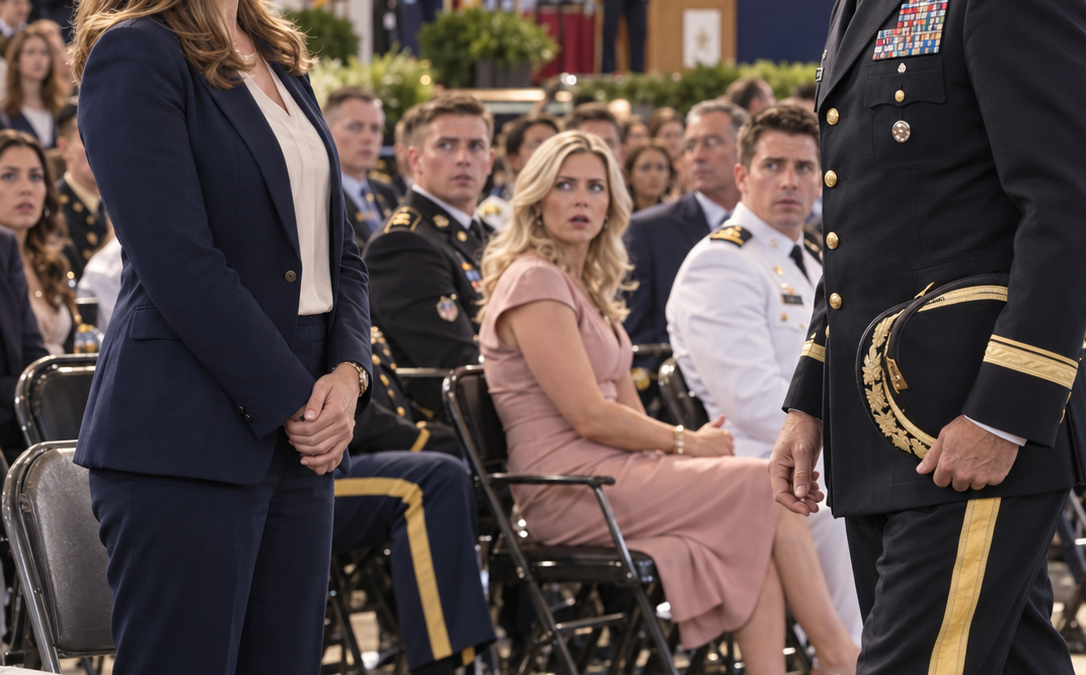
“The shuttle was on time, Cassie,” I replied quietly, keeping my voice low and steady. “It’s good to see you. Congratulations on Travis completing the pipeline.”
Cassandra waved her hand dismissively, as if my congratulations were merely expected homage rather than genuine goodwill. She turned back toward her circle of friends, tilting her head with a practiced, pitying sigh.
“Ladies, this is my older sister, Eleanor. I mentioned her earlier—the one who works behind a desk in Washington. She pushes administrative memos around the Pentagon basement all day.”
A couple of the younger wives offered tight, polite smiles, while a woman named Brenda, clutching a mimosa, gave an amused chuckle.
“Oh, Pentagon staff. That must be quiet work. Lots of paperwork.”
“I imagine quiet is an understatement,” Cassandra chimed in, laughing loudly enough to draw the attention of a nearby waiter. “Eleanor has always preferred safety over ambition. While Travis was breaking his bones in the freezing surf during Hell Week, my sister was perfecting the art of formatting executive spreadsheets and ordering gourmet coffee for the real officers.”
She smiled.
“But hey, somebody has to handle the filing cabinets, right? We can’t all be warriors.”
The words were deliberate needles designed to draw blood in front of an audience. I felt the familiar tightening in my jaw, the instinctive pull of authority that usually made subordinates snap to attention across command rooms. But I held it back.
I had promised myself that this weekend belonged to Travis’s achievement.
I had spent years in the shadows of classified special-access programs, deliberately keeping my military identity separate from my family to shield them from the scrutiny and danger of my rank. Cassandra had weaponized my silence, turning my classified life into a fictional narrative of failure that elevated her own fragile ego.
“Anyway, thank God you’re finally here,” Cassandra said, turning sharply toward a luggage cart parked beside the valet stand. “The bellhop is taking forever, and I need these brought up to Suite 402 immediately. Travis’s dress whites are in the garment bag, and my evening gala gown cannot get wrinkled under any circumstances.”
With a careless flick of her wrist, Cassandra tossed a heavy set of rental-car keys straight at my chest.
I caught them out of reflex, the metal digging into my palm. Before I could speak, she gestured toward four massive designer suitcases stacked precariously on the cart.
“You’ve got arms, Nora. Put that government desk-sitting energy to use and haul these upstairs,” Cassandra ordered, her voice carrying across the terrace with effortless cruelty. “Then take the steam iron to my gown. The welcome dinner starts at six, and I need you downstairs early to hold our table near the stage so the commanding officers can see us when they walk in.”
“I’m a guest here to support Travis, Cassie, not your unpaid staff,” I said, looking her directly in the eyes.
Cassandra’s face hardened, the thin veneer of charm instantly evaporating into pure spite. She took a step closer, lowering her voice just enough for the circle of wives to lean in and catch every venomous word.
“You’re here because I allowed you to come, Eleanor. Dad always said you lacked the grit to make something of yourself in uniform, and you proved him right by hiding behind a computer screen in D.C. You’re forty-five, unmarried, with nothing to show for your life except a government pension and an empty apartment.”
She leaned closer.
“Travis is the hero of this family now. So yes, you will carry the bags, you will steam my dress, and you will stay out of the way when the important people arrive.”
As she emphasized the word important, Cassandra made a dramatic gesture with her right hand, holding a tall glass of freshly squeezed orange juice. Whether through calculated malice or reckless arrogance, her elbow jerked outward, tipping the heavy glass directly toward me.
The cold, sticky liquid splashed across the front of my navy blazer, soaking through the fabric and leaving a dark, dripping stain against my white shirt beneath.
A sharp gasp rippled through the circle of wives, followed quickly by suppressed snickers.
Cassandra didn’t flinch. She simply looked down at the mess on my clothes with a cold, mocking smirk, setting the empty glass onto a nearby marble ledge.
“Look at that. You’re already a mess,” Cassandra said, wiping a single stray drop from her own wrist with a linen napkin. “Go up to the room and clean yourself up. And don’t forget to press Travis’s service jacket while you’re at it. If there’s a single crease on his shoulders tomorrow morning, I’ll make sure everyone in Coronado knows you ruined his big day.”
She turned her back on me, effortlessly reengaging the wives in conversation, as if I had already ceased to exist.
I stood there in the bright California sun, the cold juice soaking against my ribs. I didn’t raise my voice. I didn’t drop the luggage keys.
I simply reached down, took the handle of the heavy cart, and wheeled it past the murmuring crowd toward the hotel elevators.
Inside the quiet sanctuary of the service elevator, I reached into the deep inner pocket of my stained blazer. My fingers brushed past the hard, heavy gold of my officer’s academy ring, tucked securely out of sight.
Just as the elevator began its ascent, the heavy rhythmic vibration of my encrypted satellite device buzzed against my hip, its persistent pulse signaling a flash-priority transmission directly from the Joint Special Operations Command deck.
The service elevator climbed with a slow mechanical groan, the low hum vibrating against the steel walls. I gripped the cool luggage-cart handle, watching the floor numbers tick upward in amber digital light.
My hip pulsed with the steady rhythm of the encrypted device, but protocol dictated that I could not break communication silence in an unvetted public corridor. I took a measured, disciplined breath, letting the familiar tactical focus push down the bitter residue of Cassandra’s public spectacle.
Stepping off onto the fourth floor, the thick carpet muffled my footsteps as I pushed the heavy cart down the quiet hallway to Suite 402.
Unlocking the door, I stepped into the air-conditioned suite, greeted by the sterile scent of commercial citrus cleaner and the soft ocean glare pouring through sheer balcony curtains. I wheeled the four oversized suitcases into the corner, setting Cassandra’s designer garment bags neatly on the luggage rack.
Stripping off my juice-stained navy blazer, I draped it over the back of a desk chair and wiped my wrist with a damp cloth. My eyes fell on the reflection in the vanity mirror.
Sharp gray eyes. High cheekbones. Lines of quiet authority etched around my mouth from years of command in windowless SCIF facilities and on the rolling decks of aircraft carriers.
Looking at my reflection, the ghost of our childhood home in Richmond, Virginia, rose up like a sudden fog.
For more than twenty years, Cassandra had been perfecting the architecture of my supposed failure.
It had begun the summer our mother passed away. I was already a junior officer deployed in the Persian Gulf, tracking hostile patrol boats while my family was gathered back home to settle the estate. Mom had been the anchor, the only person who understood the quiet discipline of service.
But the moment she was gone, Cassandra, barely twelve at the time and aggressively shielded by our father’s doting indulgence, began claiming every inch of space.
When I finally returned on brief emergency leave, my childhood bedroom—the room with the bookshelf holding my Annapolis acceptance letter, my track medals, and the vintage wooden ship models my grandfather had carved—was completely gone.
Cassandra had demanded a walk-in beauty closet and vanity suite, throwing a tantrum until our father complied. Without consulting me, they had packed my entire youth into three cardboard boxes and shoved them into the damp, oil-slicked corner of the garage beside the lawn mower.
Our father, blinded by Cassandra’s theatrics and his own unresolved bitterness over never having served as a commissioned officer himself, had swallowed her version of reality whole.
Whenever neighbors or church friends in Richmond asked where Eleanor was, Cassandra would sigh with performative heartbreak, telling them I had washed out of the naval tactical track, that I couldn’t handle the physical pressure of the fleet, and that I had taken a low-level clerical position pushing paper in the deep basements of D.C. out of sheer shame.
I had never fought the rumor.
In the world of high-level naval intelligence and joint special operations, anonymity was the greatest armor. My real assignments—evaluating strike packages, coordinating Fifth Fleet maritime intercepts, managing special-access programs that required presidential-level clearances—demanded absolute operational security.
I couldn’t explain to a gossiping sister or a resentful father why my name never appeared in local newspapers. I let them believe the lie because the mission demanded it, never anticipating that Cassandra would mistake my professional silence for profound weakness and turn it into her personal weapon.
The heavy suite door clicked open, breaking the silence of the room.
Travis Sterling walked in, shutting the door behind him with a sharp kick of his heel. At thirty-two, Cassandra’s husband was athletic and broad-shouldered, carrying himself with the unmistakable swagger of a man who believed the world revolved around his newly pinned status.
He was in his PT gear, smelling faintly of ocean water and sweat, a gold watch glinting on his wrist. He barely glanced at me as he tossed a crumpled dress-white service jacket onto the glass coffee table right in front of where I stood.
“Hey, Nora,” Travis said, his voice flat, the casual arrogance he shared with his wife evident in every syllable. “Cassie said you’d be up here. Look, the collar on this jacket is stiff, and the left sleeve has a wrinkle from the garment bag. I need it crisp before the command reception tonight. The brass from Group One is going to be evaluating the junior officers during cocktail hour.”
I looked at the white uniform lying bunched on the table, then looked up into Travis’s smug, expectant eyes.
“The hotel provides a professional dry-cleaning service down the hall, Travis. You can have them press it in twenty minutes.”
Travis scoffed, walking over to the mini-fridge and pulling out a bottle of sparkling water.
“Why pay forty bucks for hotel pressing when Cassie said you’re here to help out? Come on, Nora. Don’t be difficult. You’ve spent twenty years behind a desk in D.C. You probably know how to follow basic instructions. Just set the iron to low steam and get it done. It’s a huge night for me and, by extension, for the family.”
He took a long sip of water, wiping his mouth with the back of his hand, completely oblivious to the sheer absurdity of commanding a flag officer to press a junior lieutenant’s tunic.
“Cassie told me about your work at the Pentagon,” Travis continued, leaning against the counter with a smirk that mirrored my sister’s perfectly. “No offense, but it sounds mind-numbing, staring at supply requisitions and routing emails all day. It takes a different breed to be out there on the sharp end of the spear. The teams don’t have time for hesitation. We need people who actually execute, not bureaucrats who hide behind red tape.”
I stepped toward the coffee table, looking down at his uniform.
My fingers lightly brushed the stiff shoulder loops where his lieutenant shoulder boards would sit. On the lapel, tucked beneath the collar flap, was a small embroidered unit patch indicating his upcoming tactical assignment—the maritime interdiction unit scheduled for immediate deployment aboard the USS Baton in the Gulf of Oman.
My heart gave a quiet, cold thud.
Travis didn’t know that two weeks ago his entire deployment package had crossed my desk at the National Military Command Center.
He had failed a critical subsurface-navigation protocol during his final field exercise off San Clemente Island, an infraction that should have led to an immediate administrative review and possible disqualification from the upcoming deployment cycle.
It was my signature on the flag-level waiver document that had granted him a conditional secondary evaluation, keeping his career alive because I had believed in giving a young family member a chance to prove his worth under pressure.
“Make sure the crease down the sleeve is sharp, Nora,” Travis called casually, turning toward the adjoining bedroom to take a shower. “I’m going to get cleaned up. Have it ready on the hanger in forty-five minutes. Don’t embarrass me in front of my team.”
The bathroom door slammed shut, followed by the immediate roar of running water.
I stood alone in the quiet living room, looking down at the white fabric.
I reached into my blazer pocket, pulled out the secure communication device, and entered my twelve-digit biometric authentication code. The screen flashed bright blue, displaying an urgent encrypted transmission—a high-priority tactical alert from Bahrain regarding an escalating situation in the Strait of Hormuz.
The clock on the hotel nightstand glowed a silent 0215 in amber digital numbers.
Outside, the rhythmic crash of Pacific waves rolling against the Coronado shoreline provided a steady, muted baseline to the night. Through the adjoining wall of the suite, the muffled sounds of celebration were finally beginning to die down.
Cassandra and Travis had hosted several junior officers and their spouses for an impromptu late-night toast, filling the suite with the clinking of champagne flutes, loud laughter, and endless boasts about Travis’s upcoming deployment.
Throughout the evening, Cassandra had treated me like a ghost in the background, repeatedly reminding the guests that “Nora was just staying out of the way because big military talk gives her a headache.”
I had left them to their revelry hours ago, retreating into the small guest alcove to review operational telemetry while the suite slept.
Suddenly, the heavy titanium casing of my secure device vibrated violently against the dark mahogany nightstand.
Three sharp, distinct pulses.
A flash-priority override from the National Military Command Center at the Pentagon.
I swung my legs over the edge of the bed and picked up the device, pressing my thumb against the biometric sensor. The screen unlocked instantly, shifting from solid black to an encrypted dark-blue interface displaying high-level operational routing.
Top Secret. No Foreign. Special Access Required.
A crisp, digitally scrambled voice came through the secure earpiece as soon as I engaged the satellite uplink.
“Flag Duty Director, authenticate Echo Seven Sierra Niner.”
“Authenticated. Director Operations Hayes here. Go ahead, Watch Commander.”
My tone dropped into the quiet, razor-sharp cadence of command that had governed my life for two decades.
The tired sister vanished entirely.
The three-star admiral took her post.
“Ma’am, we have an active tactical escalation in the Fifth Fleet area of responsibility,” Colonel Matthews reported from the subterranean command floor in Virginia. “A maritime patrol unit operating forty nautical miles off the coast of Fujairah in the Gulf of Oman has encountered three fast-attack missile craft running dark. They’ve breached the established exclusion corridor and are shadowing a commercial tanker convoy under U.S. naval escort.”
“Status of the escort vessel?” I asked, pulling up the live tactical feed on the small high-density screen.
Red and blue geometric markers shifted in real time across a detailed hydrographic grid of the Strait of Hormuz.
“The escort is the USS Mason, ma’am. They’ve gone to general quarters. Rules of engagement require flag-level authorization to deploy tactical air support from the Abraham Lincoln strike group to establish an active deterrence envelope. The regional combatant commander is currently airborne between Stuttgart and D.C. Authority devolves directly to your console.”
My eyes scanned the satellite overlay, analyzing the speed, heading, and weapon signatures of the fast-attack craft.
A miscalculation here could spark a full-scale international conflict.
Hesitation could cost American sailors their lives.
“Colonel Matthews, authenticate Strike Package Bravo Three,” I commanded calmly, my voice steady and unwavering. “Authorize two F/A-18s from the Lincoln to conduct a low-altitude supersonic pass over the lead hostile vessel. Armed defensive countermeasures. If the hostile vessels lock surface-search radars on our escort or breach within five nautical miles of the convoy’s perimeter, the tactical commander on scene is cleared for kinetic engagement. Maintain active data link to my terminal.”
“Understood. Aye, Admiral. Directives logged and transmitted to Fifth Fleet Tactical Operations Center at 0218 Zulu. Stand by for live telemetry.”
For the next twenty minutes, I sat in the dim light of the Coronado hotel room, listening to the crackle of combat radio chatter over thousands of miles of encrypted fiber-optic cable.
I watched the green vector lines on my screen as two American fighter jets screamed out of the night sky, their sonic booms tearing through the humid air of the Arabian Gulf.
The hostile boats cut their engines, turned hard to starboard, and retreated back toward their territorial waters.
The convoy was secure.
“Target vessels breaking off, ma’am,” Colonel Matthews reported, a note of professional relief in his voice. “Tactical perimeter restored. No casualties. Zero ordnance expended. Excellent call on the deterrence threshold.”
“Good work, Colonel. Maintain increased readiness posture through the morning watch,” I replied. “Send the final post-mission assessment directly to my secure briefing queue.”
“Will do, ma’am. One administrative note before you sign off. The personnel package for the upcoming detachment arriving aboard the Baton next week has cleared secondary screening. Your flag-level waiver from two weeks ago successfully finalized the roster.”
“Acknowledged, Colonel,” I said softly, my eyes drifting to the detailed PDF attachment blinking on the screen.
I scrolled down to the personnel manifest.
There, highlighted in bold black text beneath the official seal of the Department of the Navy, was the name:
STERLING, TRAVIS J., LT, USN.
Beneath his name was the red administrative line from his previous navigation failure during the Hell Week evolution at San Clemente Island—a critical error that should have ended his career before it even started.
Directly below the red line was my own digital signature, an encryption hash dated fourteen days ago.
Approved for advanced selection.
Without that signature, Travis would not be wearing a gold trident today. He would not be standing on a stage in Coronado tomorrow morning receiving the applause of his peers.
He would have been quietly reassigned to a surface support depot, stripped of his operational dreams.
He and Cassandra truly believed that his sheer talent and charm had carried him across the finish line. They had no conception of the silent, invisible hand that had shielded him from his own mistake.
I locked the device, watching the screen fade to pitch black, and stepped out onto the balcony.
The cool Pacific air brushed against my face, carrying the distant rhythmic hum of naval patrol boats cutting through San Diego Bay. Morning fog was beginning to roll in from the ocean, thick and gray, swallowing the lights of the naval amphibious base across the water where hundreds of families would soon gather.
The morning sun beat down relentlessly on the black asphalt of Naval Amphibious Base Coronado, pushing the summer temperature past ninety-five degrees by nine o’clock.
The air was thick with the scent of salt spray, sunblock, and diesel fumes from idling transport shuttles. Dozens of military families dressed in their finest summer linens and suits were streaming toward the main security gate, their chatter echoing off the concrete barriers.
Cassandra strode ahead of me wearing a designer blush-pink sheath dress and oversized sunglasses, clutching a VIP lanyard in one hand and a gold clutch in the other.
Travis had already reported to the assembly area hours earlier, leaving Cassandra in charge of our small party.
As we approached the security line, she stopped abruptly, turned on her stiletto heel, and snatched the white VIP access pass right out of my hand.
“What are you doing, Cassie?” I asked, keeping my voice quiet amid the gathering crowd.
“I’m correcting a mistake,” Cassandra said with a loud, theatrical sigh, making sure the people around us heard every word. “VIP seating is strictly reserved for the immediate sponsors and distinguished guests of the graduating class. It looks ridiculous for a low-level desk clerk from Washington to sit in the front row with the commanding officers’ families.”
She looked me up and down.
“You just look completely out of place, Nora.”
She dug into her handbag and pulled out a plain yellow general-visitor wristband, practically tossing it at my chest.
“Here. You can go through the service gate on the left with the overflow crowd,” she commanded, adjusting her sunglasses with an air of absolute superiority. “And don’t just stand there empty-handed. Take this cooler of electrolyte water and follow behind us. Travis’s team might need extra hydration after the ceremony, and you can at least make yourself useful since you didn’t have to pay for a ticket.”
She shoved a heavy, condensation-covered plastic cooler into my hands.
The freezing water sloshed against the rim, soaking through the sleeves of my light civilian blazer and dripping down my slacks.
A few bystanders turned to look, their eyes darting between Cassandra’s designer outfit and my soaked sleeves.
I gripped the hard plastic handles, feeling the biting cold sink into my fingers.
These were the hands that had signed strategic force-posture agreements and reviewed multibillion-dollar naval appropriations. Now they were hauling ice water under the scorching San Diego sun to satisfy my sister’s insatiable appetite for petty dominance.
I followed several paces behind her as the line converged at the primary security checkpoint.
Two armed master-at-arms sailors in crisp digital camouflage stood at the gate, their tactical vests loaded with gear as they checked identification against the master access roster.
When Cassandra reached the lead sentry, a young Master-at-Arms Second Class named Miller, she presented her military spouse ID and VIP pass with a grand, practiced flourish.
“Mrs. Cassandra Sterling, wife of Lieutenant Travis Sterling,” she announced, beaming proudly. “And that person behind me with the cooler is just our family assistant for the day. She has the yellow wristband. You don’t need to check her for the VIP tent. Just direct her to the open grass area or wherever the general public waits.”
Petty Officer Miller glanced from Cassandra to me.
His eyes swept over my posture—the straight, unyielding spine, the balanced stance, the calm, observant gaze that only decades of naval command could carve into a person.
Then his gaze dropped to the government credential card I held between two fingers.
It was not a standard civilian contractor badge.
It was a high-level Department of Defense common-access credential embedded with the gold holographic emblem reserved for flag and general officers.
The young sailor’s eyes went wide.
His posture stiffened instantly, the color draining from his face as his right hand instinctively twitched toward the brim of his cover to render the mandatory salute to a three-star flag officer.
Before his hand could complete the motion, I gave him a subtle, almost imperceptible shake of my head.
A silent, unambiguous order.
Stand down.
Petty Officer Miller froze mid-motion.
His throat bobbed as he swallowed hard, his eyes darting frantically between my calm, unblinking face and the oblivious woman standing in front of him.
Cassandra noticed the guard’s hesitation and let out a sharp, mocking laugh, misinterpreting his shock entirely.
“See that, Nora?” Cassandra sneered, turning back toward me with a dismissive wave. “Even the armed guards know you don’t belong here. They’re confused why someone who pushes memos in a basement is even allowed on the same base as real warriors. You’re lucky Travis’s status got you through the gate at all.”
She turned back to the sentry, tapping her manicured nails impatiently against the podium.
“Can you hurry it up, Petty Officer? The sun is ruining my makeup, and my husband is waiting in the ready room.”
Petty Officer Miller stood frozen for another second, his breathing noticeably shallow.
He looked at me one more time, his eyes wide with a mixture of fear and profound reverence, before managing a tight, strained nod.
“Pass through, ma’am,” Miller stammered, his voice trembling slightly as he handed Cassandra her pass, carefully avoiding looking her in the eye.
“Thank you,” Cassandra replied smugly, stepping past the barricade without a backward glance. “Come along, Nora. Don’t lag behind. We have a front-row seat to get to, and I don’t want you wandering off with Travis’s drinks.”
I stepped through the turnstile, giving the young sentry a brief, steadying nod of acknowledgment.
He remained rigid at attention until I had cleared the security perimeter, his gaze burning into the back of my blazer as I walked into the crowded courtyard of the base.
The grand auditorium at Naval Amphibious Base Coronado was an impressive hall of naval tradition, echoing with the muffled chatter of more than a thousand guests.
The air was cool and smelled of polished oak, industrial floor wax, and the sharp, clean scent of fresh laundry starch. Massive American flags hung from the ceiling behind the stage, their heavy golden fringe catching the warm amber glow of stage spotlights.
Cassandra moved with an air of absolute entitlement, leading our small family contingent down the center aisle.
She was guided by an usher directly to the front row, the section reserved for the immediate sponsors of the graduating officers. With an exaggerated sweep of her dress, she took her seat beneath the center flag, placing her designer clutch on the plush velvet cushion beside her.
She turned around, scanning the hall until her eyes locked onto me standing in the center walkway, holding the cooler.
Her expression immediately soured into a scowl.
She marched back up the aisle, grabbing my arm with sharp manicured nails and pulling me roughly toward the periphery of the room.
“What do you think you’re doing, Nora?” Cassandra hissed under her breath, her eyes darting nervously to make sure none of the commanding officers’ wives were watching us. “You can’t stand in the main aisle looking like an unwashed vendor with that plastic cooler. You’re ruining the aesthetic of Travis’s entire section.”
“I was waiting to see where the family overflow seating is located, Cassie,” I said evenly.
“There is no family overflow in the front. And you certainly aren’t sitting anywhere near the stage cameras,” she snapped.
She pointed an accusatory finger toward the far back corner of the auditorium.
Near the heavy soundproof emergency-exit doors, tucked behind a massive concrete pillar in the shadows, sat a single row of metal folding chairs coated in a thin layer of dust.
“Sit back there, right next to the exit. Keep your head down. Don’t talk to anyone. And don’t you dare mention that you’re related to Travis. If the media or the commander sees a frumpy desk clerk claiming to be his sister-in-law, it reflects poorly on his professionalism.”
“Understood,” I replied quietly.
“Good. Stay invisible.”
She turned on her heel and strutted back down to her VIP throne in the front row, flipping her hair over her shoulder.
I walked to the back corner and set the blue cooler beneath a metal folding chair.
Leaning my back against the cool, rough concrete of the structural pillar, I adjusted my civilian blazer. From this vantage point, I could see the entire hall—the sea of crisp summer-white uniforms, the gleaming gold buttons, and the proud parents holding small American flags.
For a woman who had spent twenty-three years climbing the absolute summit of the naval chain of command, standing in the forgotten dust of the back row was a surreal irony.
Yet there was a quiet, profound power in the shadows.
I didn’t need a velvet seat to validate my career.
The weight of my service was carried in the safety of the fleet, not in the applause of a social circle.
Suddenly, a shadow fell over me from the side aisle.
I turned my head and saw Captain Evelyn Reed, the senior intelligence director for Naval Special Warfare Command. We had served together during a high-stakes maritime interdiction deployment in the North Arabian Sea seven years ago.
Evelyn was in full dress whites, her chest adorned with ribbons of valor, her silver eagles shining brightly on her collar.
Her sharp eyes landed on me.
For a second, she looked confused. Then her eyes widened in profound shock as she recognized the woman standing alone in civilian clothes beside the exit door.
“Vice Adm—”
Evelyn’s body instantly snapped rigid as her hand started to rise toward her brow to render a full salute.
I caught her gaze immediately, offering a quick, decisive shake of my head and raising a single finger to my lips.
Evelyn stopped mid-motion, her hand dropping back to the seam of her trousers.
She looked around the hall, noting my position in the overflow exile, and then looked back at me, her brow furrowing with deep concern and disbelief.
Before Evelyn could take another step toward me, Cassandra’s voice rang out from the front row as she noticed the senior officer lingering near our corner.
Cassandra rushed halfway up the aisle, flashing an obsequious, overly eager smile at Captain Reed.
“Oh, Captain, please don’t let my sister bother you,” Cassandra chimed in, her voice dripping with fake politeness and condescension. “She’s just staying back here, out of the way. She works a low-level desk job at the Pentagon and doesn’t really understand naval protocol. I apologize if she stood in your path.”
Captain Reed slowly turned her head toward Cassandra.
The intelligence officer’s gaze was like a sheet of Arctic ice, sharp and unblinking.
She looked at Cassandra’s smiling, oblivious face, then glanced back at me standing quietly in the shadows.
A look of sheer, unadulterated astonishment crossed Evelyn’s features.
“Is that so?” Captain Reed replied in a low, dangerous tone that completely flew over Cassandra’s head.
“Yes, ma’am. We’re just here to celebrate my husband, Lieutenant Travis Sterling,” Cassandra boasted proudly, smoothing her dress. “He’s the real hero today.”
Captain Reed didn’t answer.
She simply gave Cassandra a long, chilling look, offered me a subtle, respectful nod of her chin, and walked briskly down the side corridor toward the backstage green room.
“See, Nora?” Cassandra muttered, glaring back at me before heading to her seat. “You almost embarrassed us in front of a full-bird captain. Just keep your mouth shut.”
Moments later, the auditorium doors sealed shut with a heavy thud.
The brass fanfare echoed from the high balcony speakers, signaling the start of the official ceremony.
The master of ceremonies stepped up to the podium, his voice booming through the sound system.
“Ladies and gentlemen, distinguished guests, please rise for the arrival of the official party and the Commander of United States Special Operations Command.”
A collective gasp rippled across the front rows.
A four-star general never attended standard qualification graduations unless an unprecedented strategic announcement was underway.
Cassandra leaned forward in her VIP seat, her face glowing with breathless excitement, convinced that the supreme leader of America’s elite forces had arrived specifically to witness the brilliance of her husband’s class.
The heavy oak double doors at the side of the stage swung open, and the entire auditorium of more than a thousand people snapped to their feet in a single rustling wave of discipline.
Walking onto the illuminated stage was General Marcus Vance, Commander of United States Special Operations Command.
The four-star Army general was an imposing figure—tall, barrel-chested, his operational dress uniform bearing four silver stars on each shoulder and a dense array of combat decorations that told the story of forty years on the front lines of global conflict.
Behind him walked the Naval Special Warfare leadership, their expressions stern and focused.
General Vance stepped up to the center podium. His sharp, hawk-like eyes swept across the vast sea of white uniforms, taking in the rows of graduating SEALs, their proud families, and the distinguished guests.
“Please be seated,” General Vance said, his gravelly baritone carrying effortlessly through the auditorium speakers.
The crowd sat in synchronized unison.
In the front row, Cassandra leaned forward so far she was practically perched on the edge of her velvet cushion. She turned her head slightly to whisper to Travis’s mother sitting beside her, her voice trembling with giddy pride.
“Do you see that? A four-star general came all the way from MacDill Air Force Base. Travis’s class must have broken historic evaluation records for General Vance to preside in person.”
On the stage, General Vance adjusted the microphone, resting his large, calloused hands on the edges of the wooden lectern.
He did not open the standard leather-bound commencement program resting before him.
“Today, we pin the golden trident onto thirty-two exceptional naval officers and enlisted warriors,” General Vance began, his voice commanding absolute silence. “These men have endured the freezing tides of San Clemente, the brutal physical crucible of Hell Week, and specialized tactical warfare. They represent the tip of our nation’s spear.”
A round of enthusiastic applause rippled through the front rows, led aggressively by Cassandra, whose hands clapped high near her face so the cameras could catch her gleaming diamond rings.
“However,” General Vance continued, raising a hand to quiet the room, “a spear is only as lethal as the hand that wields it. Behind every tactical strike, behind every successful maritime insertion, there is a strategic mind operating in the shadows of the Pentagon—someone who analyzes the battlefield, coordinates theater-level assets, and absorbs the crushing weight of classified operational decisions.”
The general paused, his gaze hardening as he looked out across the audience.
“Less than eight hours ago, in the volatile waters of the Gulf of Oman, an allied commercial convoy came under imminent threat from hostile fast-attack missile craft. The junior officers graduating today will soon deploy directly into that theater. But those men would be sailing into an active ambush were it not for the razor-sharp decisiveness of a senior naval commander who authorized a high-risk tactical interception at two o’clock this morning, neutralizing the threat without a single shot fired.”
A low, reverent murmur spread through the rows of naval officers seated in the hall.
They understood the gravity of what the general was describing.
A real-time combat crisis resolved in the dead of night while the rest of the world slept.
Cassandra gasped softly, clutching her husband’s arm.
“Travis, did you hear that?” she whispered loudly enough for the surrounding rows to hear, her eyes sparkling with delusional triumph. “He’s talking about the deployment sector you’re heading to. He’s acknowledging how critical your upcoming mission is. He came here to set the stage for your platoon.”
Travis sat rigidly, but his expression was distinctly uneasy.
His jaw tightened, his brow furrowing as he stared at the stage.
Unlike his wife, Travis was a trained tactical officer. He knew that four-star joint commanders did not fly across the country to praise junior lieutenants for operations they hadn’t even participated in yet.
From my position in the dusty back corner by the emergency exit, I stood motionless, my arms resting loosely at my sides.
My navy blazer was still damp at the cuffs from Cassandra’s cooler, but my mind was completely locked onto the general’s words.
I remembered the red tactical vectors shifting across my screen in the dark hotel room only hours ago.
“Furthermore,” General Vance continued, his voice sharper and more resonant than before, “we must recognize that warrior spirit is nothing without institutional integrity. Two weeks ago, a flag-level officer intervened on an administrative review board to grant a conditional waiver for a promising candidate whose tactical-navigation error would have otherwise ended his career.”
The room went still.
“That commander saw potential where the bureaucracy saw failure. She gave a second chance to someone who did not even realize he was standing on the edge of a professional abyss.”
Travis visibly flinched.
The color drained from his face beneath his tan, his fingers curling tightly around the armrest of his chair.
He turned his head slightly, a flicker of profound confusion and anxiety crossing his eyes as he began to connect the dots of his own close call during the San Clemente evolution.
Cassandra, entirely blind to her husband’s mounting panic, let out a triumphant scoff and turned around in her seat.
She looked all the way to the back row, locking her spiteful eyes onto me standing in the shadows behind the concrete pillar.
She smirked, mouthing the words:
Look at what real leadership looks like.
Onstage, General Vance slowly closed his folder.
He stepped back from the wooden podium, his polished combat boots clicking loudly against the stage floorboards.
The entire auditorium watched in stunned silence as the supreme commander did not call the first graduating SEAL to the stage.
Instead, he stepped down the carpeted stairs on the right side of the platform, his tall frame cutting through the spotlight beams as he entered the main center aisle of the hall.
The rhythmic, heavy thud of General Marcus Vance’s jump boots against the polished wooden floorboards cut through the breathless silence of the auditorium.
It was a measured, unstoppable cadence.
Every head in the hall turned in synchronized disbelief, tracking the four-star commander as he advanced down the wide center aisle.
In the front row, Cassandra’s eyes lit up with radiant, delusional certainty.
She sprang to her feet with a wide, dazzling smile, smoothing down her designer blush-pink dress. She reached down, yanked Travis by his forearm, and pulled him out into the center walkway beside her.
“He’s coming to shake your hand, Travis,” Cassandra whispered excitedly, her voice buzzing with frantic adrenaline. “He’s honoring you personally in front of the entire command.”
As General Vance approached their row, Cassandra extended her right hand with grand, dramatic poise, stepping directly into his line of sight.
“General Vance, sir, it is such an absolute honor to have you here for my husband, Lieutenant—”
General Vance did not break stride.
He didn’t blink.
He didn’t slow down.
He didn’t even shift his gaze.
His broad shoulder brushed past Cassandra’s outstretched arm as if she were made of thin air, parting the space between her and Travis without a single glance.
Cassandra froze, her hand hanging awkwardly in the empty air, her bright smile instantly collapsing into a bewildered, sickly grimace.
The supreme commander continued moving with tidal force straight toward the back of the auditorium.
The silence in the room transformed into a suffocating vacuum.
Hundreds of guests turned in their seats, their eyes following the path of the four silver stars gleaming under the chandeliers.
General Vance did not stop at the rows of decorated officers.
He did not look at the VIP guests.
He walked past the velvet seats, past the family rows, and marched straight into the shadowy, uncarpeted alcove at the very back of the hall.
He stopped exactly three paces in front of my metal folding chair beside the dusty concrete pillar.
In that quiet corner, the Commander of United States Special Operations Command drew his heels together with a sharp, echoing snap, his spine locked into absolute rigidity.
With mathematical precision, his right hand rose to the brim of his cover in a full, unwavering ceremonial salute.
“Vice Admiral Hayes, ma’am,” General Vance’s baritone boomed across the vast auditorium, carrying to every single rafter and corner without the aid of a microphone. “It is a profound honor to see you here today. We certainly did not expect the Pentagon’s Director of Strategic Operations to be standing back here in the shadows of the overflow section.”
Before the echo of his words could even fade, something extraordinary occurred.
Triggered by the supreme commander’s salute, Captain Evelyn Reed and the entire senior command staff on the stage snapped to attention.
In the front three rows, all thirty-two newly qualified Navy SEALs, accompanied by their instructors, stood up in flawless unison.
The violent crack of nearly two hundred boots striking the hardwood floor simultaneously shook the building like an earthquake, rattling the tall glass fixtures along the walls.
“Good morning, Vice Admiral!”
The assembled warriors roared together, their voices fusing into a single thunderous wall of sound that vibrated straight through the floorboards and into the marrow of everyone present.
In the front aisle, Cassandra’s designer gold clutch slipped from her paralyzed fingers, hitting the floor with a hollow, pathetic thud.
The color drained from her face in a matter of seconds, leaving her skin ghostly white.
Her mouth opened. Her lips trembled.
But no sound came out.
She looked at the four-star general saluting her older sister—the woman she had spent eighteen years branding a cowardly desk failure. The woman she had forced to carry baggage and fetch ice water only hours earlier.
Beside her, Travis stood petrified.
His knees wobbled beneath his crisp dress whites, his chest heaving as the horrific realization crashed through his mind.
The all-powerful flag officer who had reviewed his files, who had authorized the tactical air operation last night, and who held his entire military destiny in her hands was the sister-in-law he had treated like an unpaid maid.
General Vance lowered his hand.
His sharp gaze shifted down to the melting blue cooler tucked beneath my chair and then across the hall to the frozen couple standing in the front aisle.
A look of subzero disgust flickered across the general’s rugged face.
“It seems, Vice Admiral,” General Vance said in a voice cold as iron, loud enough for every officer in the room to hear, “that some people in this room have fundamentally forgotten what honor looks like. They mistake humility for weakness and parade around in the reflected glory of others, completely blind to the titan standing right in front of them.”
I stepped out from behind the concrete pillar, leaving the shadows behind.
I didn’t shout.
I didn’t gloat.
I held my head high, my spine straight, the quiet, unshakable authority of a three-star flag officer radiating from every inch of my posture.
The dust of the back row fell away as I met the general’s gaze and returned his salute with crisp, immaculate precision.
“At ease, General,” I replied, my voice steady, clear, and commanding. “Thank you for the courtesies. Let us proceed with honoring the graduating class.”
General Vance stepped aside, clearing the center aisle, and gestured with an open hand for me to lead the way toward the front of the auditorium.
As I began walking down the wide carpeted aisle, the hundreds of guests on both sides parted like the Red Sea, their faces frozen in awe, shame, and reverence.
I walked past the rows of white uniforms, my steady footsteps echoing through the breathless hall, straight toward the front row where my sister stood shivering in the wreckage of her own arrogance.
The remainder of the qualification ceremony unfolded in a state of surreal, high-voltage tension.
I took my rightful place on the stage alongside General Vance and the Naval Special Warfare commodore, observing the formal pinning with the sharp professional eye of a flag officer.
When Travis marched across the platform to receive his trident, he kept his eyes locked strictly forward, his complexion pale beneath the stage lights.
His hand trembled as he rendered a salute that felt heavy with crushing humiliation.
The moment the final command was dismissed, the formal reception in the courtyard shifted into an immediate social trial.
Cassandra lingered near the edge of the stone patio, clinging desperately to Travis’s arm. But the glittering circle of high-ranking wives and influencers who had laughed at her jokes that morning now treated her like radioactive fallout.
Brenda, the woman who had smirked over mimosas at the hotel, turned her back completely as Cassandra approached, smoothly joining a group of senior officers across the lawn.
Every glance directed at Cassandra was saturated with cold, unvarnished disdain.
The Naval Special Warfare community was built entirely on earned respect. To be exposed as someone who had publicly degraded a three-star vice admiral—and one’s own sister—was a social death sentence within those circles.
I walked toward the shaded pavilion near the administrative wing, accompanied by Captain Evelyn Reed and two master-at-arms security escorts.
“Vice Admiral Hayes!”
A frantic, cracking voice cried out from the periphery.
Cassandra broke away from the shrinking crowd, practically stumbling across the grass in her designer heels. Her blush-pink dress was wrinkled from hours of nervous sweat.
Travis trailed several paces behind her, his head down, clutching his certificate folder like a shield.
“Nora, please! Nora, wait!”
Cassandra pleaded, rushing toward the pavilion steps.
Before she could take two strides onto the concrete landing, the two master-at-arms sailors stepped forward in flawless unison, their arms crossing to block her path with the immovable authority of military law.
“Stand back, ma’am,” the lead sentry ordered in a flat, uncompromising tone. “Maintain the designated perimeter around the flag officer.”
“Get out of my way! That’s my sister!” Cassandra shrieked, her voice high and ragged with panic.
Her carefully constructed composure had entirely disintegrated.
“Nora, tell them to let me through. Tell them this is all a huge misunderstanding. You can’t let them treat me like this in front of everyone.”
I stopped, turning slowly to face her.
The silence between us felt heavier than armor plate.
I looked at Cassandra—at her smeared mascara, her trembling hands, and the raw, undiluted terror in her eyes.
For eighteen years, she had fed on the illusion of my failure to inflate her own hollow significance.
Now, stripped of her lies, she was just an insecure woman drowning in the shallows of her own ego.
“Stand down, Petty Officers,” I said softly to the security detail. “Give us a moment.”
The guards stepped aside, though their eyes remained vigilant.
Cassandra rushed forward, reaching out to grab my sleeve, but stopped when she saw the unyielding steel in my expression.
Her hands hovered in the air, trembling.
“Why didn’t you tell me, Nora?” Cassandra sobbed, tears finally cutting tracks through her makeup. “Why did you let me treat you like that? Why did you let me carry on thinking you were just a clerk? You set me up to look like an absolute fool.”
“I never set you up, Cassie,” I replied, my voice dropping to a low, razor-sharp register that cut through her hysterics.
“I took an oath to protect this country, which meant spending two decades in classified operations where self-promotion was forbidden. I never once lied about who I was. You invented the lie because you needed to believe I was small so you could feel big.”
Her face tightened.
“You stole Mom’s legacy. You threw my life into the garage. And you treated me like dirt today because you believed there were no consequences for cruelty.”
Cassandra shook her head frantically, turning to pull Travis forward.
“Travis, tell her. Tell her how hard we worked for this. Nora, you have to talk to General Vance. He looked at Travis like he was dirt on the stage. You have to tell the commodore that Travis is a good officer or his career is over before it even starts.”
Travis stepped forward, but unlike his wife, he did not beg.
He looked up at me, his eyes hollow with a sickening realization.
“It was you, wasn’t it, ma’am?” Travis asked, his voice barely audible, his throat working hard to swallow the bile of his own pride. “The waiver two weeks ago at San Clemente. The administrative review for the subsurface-navigation violation that should have scrubbed me from the roster.”
Cassandra looked between her husband and me, her brow furrowing in confusion.
“What waiver? What are you talking about, Travis?”
“My career was dead, Cassie,” Travis whispered, his voice breaking as a tear escaped his eye. “I failed the evolution. The board recommended immediate dismissal, but a flag-level waiver overruled them and granted me conditional qualification. I thought it was luck. I thought the board recognized my raw talent.”
He looked directly into my eyes, his shoulders collapsing forward under the crushing weight of his debt.
“It wasn’t luck. It was your sister. The woman I told to iron my uniform this morning was the only reason I was allowed to wear it today.”
Cassandra froze, her lips parting as the final pillar of her arrogance crumbled into fine ash.
“You owed your entire future to the woman you shoved into the back row with the dust,” I said to Travis, my voice cold and steady. “I approved that waiver because I believed in evaluating potential over honest mistakes. But rank and talent mean nothing without character, Lieutenant.”
I held his gaze.
“Remember that when you lead men into combat.”
“Thank you, Vice Admiral,” Travis choked out.
He snapped to rigid attention and offered a salute that shook with genuine, soul-crushing remorse.
“I will never forget this, ma’am.”
Cassandra tried to speak, to offer some desperate, clawing excuse to salvage her social standing, but the words withered on her tongue.
She looked around the sunlit courtyard at the dozens of naval officers watching her with quiet judgment.
The isolation was absolute.
She was completely, irrevocably exposed.
I didn’t utter another word.
I turned my back on them and walked toward the official staff transport idling at the curb, leaving my sister standing alone in the blazing California heat, completely consumed by the silence of her own making.
The black government sedan glided smoothly past the high-security perimeter gates of Naval Base San Diego, leaving the sunbaked lawns of Coronado behind.
The heavy, pressurized silence inside the vehicle was a welcome sanctuary after the emotional storm of the auditorium.
Outside the tinted windows, the gray, towering silhouettes of guided-missile destroyers and amphibious-assault ships loomed against the afternoon sky, their massive steel hulls resting in the calm waters of the bay.
I sat in the rear passenger seat looking down at my hands.
The residue of melted ice water was gone, replaced by the clean, crisp feel of high-grade wool.
While Cassandra had been frantically trying to explain away eighteen years of lies to an empty courtyard, my flag aide had retrieved my service dress whites from the secure locker at Fleet Logistics Center.
Stripping away the civilian blazer felt like shedding a phantom skin.
I slipped into the pristine white tunic, feeling the familiar, grounding weight of the fabric settle across my shoulders.
On each shoulder board rested the three gleaming gold stars of a vice admiral, flanked by the gold-fouled-anchor crest of naval command.
On my left chest, rows of campaign ribbons and medals of valor sat in razor-sharp alignment—decorations earned in the Persian Gulf, the Mediterranean, and the classified operations centers of the Pentagon.
The sedan came to a halt along Pier Six, directly beneath the soaring flight deck of the USS Carl Vinson.
“Admiral on deck,” the driver announced into his radio as he opened my door.
I stepped out into the crisp Pacific wind, my officer’s cover firmly in place.
Two sideboys in immaculate dress uniforms rendered sharp, synchronized salutes at the foot of the brow, followed by the high, piercing trill of the boatswain’s pipe echoing across the steel hull.
“Vice Admiral, United States Navy, arriving,” the quarterdeck watch announced over the ship’s 1MC public-address system.
I returned the salute with practiced precision, stepping onto the hangar-bay deck where the smell of JP-5 aviation fuel, sea salt, and hydraulic oil greeted me like an old friend.
This was my world.
This was where the consequences of leadership were real.
Where life and death were decided by character, competence, and steady nerve, not by social clout or performative arrogance.
Captain Evelyn Reed caught up with me as we ascended the narrow ladders toward Flag Bridge. She carried a thick leather binder containing the updated strategic disposition for the Pacific theater.
“The situation in the Gulf of Oman is completely stabilized, ma’am,” Evelyn reported, her voice brisk and professional. “Fifth Fleet confirms all adversary vessels have returned to port. Our convoy cleared the strait without further incident.”
She adjusted the binder beneath her arm.
“Furthermore, the incident report from Coronado has already made its way through the command channels. General Vance made sure the Joint Staff was informed of the situation regarding Lieutenant Sterling’s family.”
I walked over to the reinforced bridge windows, looking out across the vast expanse of open ocean.
The late-afternoon sun was beginning its descent, painting the horizon in violent shades of crimson, copper, and gold.
“How is Travis being handled?” I asked quietly.
“He’s been reassigned to a secondary evaluation team under close supervision, ma’am,” Evelyn replied, closing her binder. “The commodore made it clear that while his operational waiver stands, his personal conduct and the toxic dynamic surrounding his family will be monitored with extreme scrutiny.”
She paused.
“As for his wife, Cassandra tried to contact the public-affairs office to issue a statement claiming it was a playful family misunderstanding. The public-affairs officer shut it down immediately and revoked her base privileges for ninety days due to conduct unbecoming a military dependent.”
I let out a slow, steady breath, watching the white foam churn against the aircraft carrier’s hull.
There was no joy in hearing about my sister’s disgrace.
No victorious thrill.
No petty vindication.
For eighteen years, I had carried the silent burden of her contempt, absorbing her cruelty so that our family could maintain some fragile illusion of peace.
I had let her take Mom’s room. Let her burn my letters. Let her tell the world I was a coward who ran from the heat of battle.
I had thought that enduring her abuse was a form of protective love.
But standing on this bridge, surrounded by the quiet hum of radar consoles and the disciplined focus of hundreds of sailors, I realized that allowing someone to drown in their own arrogance isn’t love.
It is enabling their destruction.
Cassandra had spent her life building a fortress of lies out of the scraps of my dignity, only to discover that when the winds of truth blew, her fortress had no foundation.
The shame that had crushed her in that auditorium wasn’t something I had created.
It was the inevitable harvest of her own cruelty.
“Are you all right, Admiral?” Evelyn asked softly, stepping up beside me.
I reached up and touched the cool metal of the three gold stars on my shoulder board.
The weight was heavy, but it was a weight I had chosen to carry for the men and women who served under my command.
“I am fine, Evelyn,” I said, my voice clear, steady, and filled with an unshakable sense of peace. “Set the watch for international waters. It’s time to get back to work.”
The bridge fell into its rhythmic operational focus.
Ahead of us, the carrier’s massive bow cut through the deep Pacific swell, leaving a wide, gleaming white wake in the open sea.
I stood straight at the center of the command console, completely unburdened, watching the last shadows of the coast disappear into the boundless, gleaming light of the open horizon.
As the carrier pushed farther into the open ocean, the quiet hum of the bridge offered a clarity that only distance and time can bring.
Looking back at the events in Coronado, the journey was never truly about proving Cassandra wrong or claiming a public triumph over my own blood.
It was about an essential truth that so many of us learn the hard way:
Your worth is never up for negotiation, especially with people who benefit from keeping you small.
In life, we often find ourselves trapped in painful family drama where those closest to us project their own insecurities, jealousy, and shortcomings onto our shoulders.
When people lack real substance, their quickest shortcut to feeling superior is tearing down someone whose quiet strength intimidates them.
They mistake humility for weakness, and they confuse silence with surrender.
True integrity doesn’t scream to be noticed.
Real excellence doesn’t need to demean others to prove its power.
The battles that define who you are are rarely fought under bright stage lights.
They are won in the quiet, unglamorous hours when nobody is watching—when you choose discipline over drama, character over vanity, and purpose over pettiness.
If you are currently walking through a season of your life where you feel overlooked, belittled, or trapped in the shadow of someone else’s toxic entitlement, remember that the truth is patient.
You don’t need to stoop to their level or waste your energy fighting small-minded battles.
Focus on building your foundation, mastering your craft, and guarding your peace.
When the storm clears, your work, your character, and your resilience will speak with a thunder no lie can ever drown out.
The most profound victory you can ever achieve over those who try to erase you is simply living a life of authentic greatness and remaining untouchable in your own truth.
Thank you so much for taking this journey with me.
Real-life narratives of quiet courage and family revenge remind us that justice and honor always find their way home in the end.
If Eleanor’s story resonated with your heart and inspired you to stand firm in your own worth, please take a moment to give this video a like and share your thoughts in the comments below. I read every single one.
And if you love powerful, deeply moving military drama and captivating stories of resilience, make sure to hit that subscribe button and turn on the notification bell so you never miss our upcoming journeys.
Stand tall.
Protect your peace.








