On father’s day, dad humiliated me in front of the entire family: “i’m proud of all my children… except the disgrace sitting at this table.” nobody defended me. i smiled, handed him an envelope, wished him a happy father’s day, and left. moments later… he opened it, and started screaming so loudly the neighbors came outside…
I’m a CPA. I built this office from a card table and a secondhand laptop, one tax season at a time, 12 years of it. Nobody handed me a thing. I tell you that not to brag, but so you understand the kind of person my family had decided I was.
Cold. Selfish. The daughter who chose ledgers over love.
I hung up with Earl and looked at the calendar.
Father’s Day.
I had circled it weeks ago and then pretended I hadn’t. Forty minutes to the homestead. Forty minutes back. A whole afternoon of being talked about instead of talked to.
I told myself every year that I wouldn’t go. And every year I went because the woman who raised me would have wanted me there, and because I had unfinished business with that house that none of them knew about.
I picked up my keys.
I told myself this year would be different.
I was right, just not the way I meant.
The drive out to Marrow Creek hasn’t changed in my lifetime. Two-lane road, then gravel, then the white fence my grandfather painted the summer he came home from Korea.
The Frost Place has been in the family three generations: 80 acres, a barn that leans a little to the south, and the farmhouse where my father was born in an upstairs bedroom. There’s a live oak in the side yard my mother planted the year she married in.
She used to say, “A family is like that tree. You can’t see most of what holds it up.”
I came around the last bend and there it was, strung with flags, cars parked in the cut hay, smoke rolling off two grills. To anyone driving past, it looked like the happiest house in the county.
I parked at the far end of the lane, past everybody.
The way you park when some part of you is always ready to leave early.
Muscle memory, I guess.
The body remembers where it isn’t wanted long after the mind makes excuses.
I sat there a minute with the engine ticking. I could hear my brother’s laugh carrying across the yard, big and easy. The laugh of a man who believes the ground under his feet is his.
I checked my purse.
The tin box was still inside where I’d put it that morning without quite letting myself ask why. I had carried that box around for two years. Today, for the first time, I’d brought it back to the place it came from.
I didn’t know yet that by sundown everyone at that table would understand exactly what it meant.
Travis met the guests at the gate like he owned it.
He’s 38, four years older than me, and he has always had a way of standing in a doorway so you have to ask him to move. He shook hands. He clapped backs. He pointed people toward the coolers like a man giving a tour of his estate.
His wife Sandra worked the other end, refilling tea and saying things just loud enough.
“We’re so glad the people who actually show up came today.”
She smiled at me when she said it.
That’s the trick of it. The smile.
Aunt Lorna sat in the shade like a judge, 71 and certain of everything. When she saw me, her mouth went flat the way it does when she finds a stain on a tablecloth.
My father stood by the head of the table, tall and gray and handsome in the way old farmers stay handsome, and he gave me a nod so small it could have been a twitch.
Hello to you, too, Dad.
I carried a deviled egg plate to the table because that’s what you do with your hands when no one offers you a chair.
And I watched.
That’s my profession, really—watching where the numbers don’t add up.
And something at that party didn’t.
Travis leaned down and said something low into my father’s ear, and my father listened. Then he nodded, slow and serious, the way you nod at a thing you’ve already half-decided.
Sandra caught it, too. She glanced at me, then quickly away.
Whatever my brother was selling that afternoon, my father was buying.
I just didn’t know yet what it was.
You don’t become the disgrace overnight.
It takes one bad season and a room full of frightened people.
Five years ago, my mother was dying in the front bedroom and the farm was drowning. I knew that part because I’m the only one in the family who reads a balance sheet without moving my lips.
The mortgage was three payments behind. The equipment loans were worse.
And my brother had a plan.
Travis stood at the foot of Mom’s bed and laid out an investment: a sure thing, a man he knew with a feedlot deal that would clear the debt by spring. All he needed was for Dad to pull equity out of the homestead to get in.
I asked questions.
That’s all I did at first.
I asked who the man was, where the paperwork was, and what happened to the 80 acres if the sure thing wasn’t.
Travis called me heartless.
He said our mother was lying right there and all I cared about was the fine print.
I had brought a folder.
I’d spent two nights building a simple projection. What the deal would cost if it failed. What it would cost the house.
I held it out.
My father took it, looked at it for one second, and set it face down on the dresser without reading a word.
“We don’t need your spreadsheets, Meredith. We need faith.”
And there it was.
The line that drew itself between me and the rest of them, clean as a fence post.
I had brought arithmetic to a deathbed.
To this family, that was the same as bringing nothing at all.
Here is something nobody tells you about being cast out.
You still keep showing up.
Two years ago, on an ordinary Tuesday, I drove out to check on my father because the winter had been hard and he wasn’t answering the phone. He let me in, gruff, and went back to his chair.
I made coffee in the kitchen where I learned to make coffee.
And while the pot ran, I saw it.
A stack of mail shoved under the Sunday paper.
The way you hide something you can’t throw away.
The top envelope had a bank’s name in the corner and a line of red print across the front.
Second notice.
I didn’t touch it.
I’d like to tell you I respected his privacy. The truth is, I already knew what it was.
You don’t spend 12 years reading other people’s panic and miss it on your own father’s kitchen table.
I brought him his coffee and said, as carefully as I could, “Dad, if the place is in trouble, I can look at it. No charge. Just let me see.”
He didn’t even turn his head.
“The place is fine. I handled it. Travis and I handled it.”
The “we” landed where it always landed—on the son who stayed and the daughter who counted.
I left it alone because pushing would only get me sent home faster.
But I sat in my car at the end of that lane for a long time.
A man who has handled it does not hide the second notice under the newspaper.
A man who has handled it does not need to lie to his own daughter about it.
Something was wrong with the farm, and my father would rather lose it than let me help.
Back at the party, I stood at the edge of the patio with my plate and waited for a chair that wasn’t going to come.
There’s a particular kind of loneliness in a crowd of people who share your last name. You’re close enough to touch them and somehow standing outside the glass.
A cousin’s kid asked me who I was.
Not rude. Just honest the way children are.
“I’m your aunt Meredith,” I said, and watched him decide that didn’t mean much.
I looked for my mother out of habit. She’d be at the grills bossing my father, sneaking the first ear of corn.
Five years gone, and the yard still had a shape where she used to be.
I want to be clear about something because it matters for everything that came after.
I did not drive out there that day hoping they’d finally love me.
I was done hoping for that.
I came because I had made my mother a promise, and because there was one thing left to put right, and Father’s Day was the day to do it.
I touched my purse and felt the hard edge of the tin box through the leather.
Some decisions don’t feel like decisions.
They feel like a season finally turning.
The way you know in your bones that the cold is breaking even before the snow goes.
I had carried this family on my back in the dark for two years. I had let them call me whatever they needed to call me.
And today, quietly, that was going to end.
I just had to get through the speeches first.
The neighbors came over around four.
The Pruitts have farmed the next quarter section for as long as the Frosts have farmed ours, and their fence line runs close enough to the patio that you can hand a casserole across it.
Hal Pruitt shook my father’s hand and said the place looked beautiful.
My father lit up the way he only does in front of an audience.
He put his arm around Travis. He swept his free hand toward the house, the barn, the leaning fence, all of it gold in the late sun.
“This land’s been Frost land since my granddad cleared it,” he said. “And it’s going to stay Frost land. Fourth generation right here.”
He squeezed Travis’s shoulder.
“We’ve got it all worked out.”
Travis ducked his head, humble as a deacon, and Sandra beamed, and Aunt Lorna dabbed her eyes like she was watching a wedding.
I stood 10 feet away, holding a plate of food I hadn’t touched.
And I felt the strangest thing.
Not anger.
Something colder and quieter than anger.
Because I knew what that house was worth down to the dollar. I knew who held the note on it.
And it was not the man making the toast.
He was standing in his own front yard promising the neighbors a legacy he no longer owned, and he didn’t even know it.
Hal Pruitt raised his beer.
“To the Frosts,” he said.
Everyone drank.
I lifted my glass, too, because what else do you do?
But my eyes went to the kitchen window where the stack of mail used to hide under the newspaper, and I thought, You have no idea how close you came to losing all of it.
I know that feeling, standing in a room full of people who share your blood and your last name and still feeling like a guest at your own family’s table.
If you’ve ever been the one they talk about instead of to, you already understand why I stayed quiet for so long.
Stay with me.
What comes next is the part nobody in that yard ever saw.
The feedlot deal failed.
Of course.
They always do when there’s no paper behind them.
The man Travis trusted took the money and was gone by the time the ground thawed. My mother died that April before the corn was in, and the family needed someone to blame who wasn’t grief and wasn’t a con man nobody could find.
So they blamed me.
At the funeral, my aunt Lorna told three different women that Meredith cared more about money than her own mother.
Travis stood at the casket with his hand over his heart, the beautiful son, the one who tried to save the farm while his sister sat home with her calculator.
He cried beautifully.
He always could.
And I let them have it, the whole story, because correcting it at my mother’s grave would have made me exactly the cold thing they said I was.
Here is what none of them ever learned.
My mother spent her last six weeks in a hospice bed at home with a nurse three days a week and the good pain medicine that insurance fights you on.
Somebody paid for that.
Not my father, who had nothing left but pride and acreage.
Not Travis, who was busy chasing money he’d already lost.
I paid it quietly. Every invoice. Through a billing address that wasn’t mine, so no one would ask.
I held my mother’s hand the night she died, and she knew, even if no one else did, which of her children had counted and which one had shown up.
“Except the disgrace,” my father would say years later, lifting his glass.
He had no idea he was toasting the woman who’d buried his wife with dignity.
Travis worked the party like a man running for office.
I watched him steer Hal Pruitt and two of the cousins on a slow loop of the property, pointing at the barn, the new section of fence, the back 40 where the soybeans were coming up green.
He talked about all of it with the easy pride of ownership.
“When Dad finally hangs it up,” he said, loud enough to carry, “we’ve got plans. Bring the whole operation into the modern age.”
Sandra walked beside him with her hand looped through his arm, nodding at every word.
There’s a particular rhythm to a man laying groundwork. I’ve sat across the desk from enough of them to know it when I hear it.
You don’t talk that confidently about when Dad hangs it up unless you’ve already started moving the pieces.
I drifted close enough to refill my tea and caught the tail of it.
Travis was telling a cousin that the transfer was almost done.
Just a few signatures left.
Getting everything squared away so there’d be no mess later.
No mess later.
People who plan to inherit a farm honestly don’t talk about avoiding a mess. They talk about the harvest, the weather, the price of diesel.
The word that kept snagging in my mind was almost.
Almost done.
A few signatures left.
My brother was in a hurry about something.
And a man in a hurry to sign papers is a man afraid of what happens if he waits.
I set down my glass for the first time all afternoon.
I stopped thinking about how it felt to be there and started paying attention.
I should explain how a person ends up qualified to quietly take apart her own family’s ruin.
When my mother first got sick, I was three years into my practice, scraping by, doing taxes for hog farmers and the lady who runs the diner.
But farm clients teach you things city accountants never see.
You learn how a place can be worth a million dollars on paper and still go under because the cash isn’t there in March. You learn what a charge-off is when a bank gives up trying to collect and sells the debt for pennies. You learn what a lien is, and a note, and how a deed actually moves from one hand to another in this country.
I learned all of it because my clients lived and died by it, and because somewhere in the back of my mind, I already knew my own family was sitting on the same cliff.
By the time the second notice showed up under my father’s newspaper, I wasn’t a frightened daughter anymore.
I was a professional who understood exactly what that red ink meant and exactly how much time was left before a bank turns a family farm into a line item at an auction.
That knowledge is a heavy thing to carry into a house where no one will let you help.
I’d sit at my desk at night and run the numbers on a place I wasn’t welcome in just to know how bad it was.
Bad.
It was bad.
But the same training that let me see the cliff also showed me the ledge—the narrow, legal, almost invisible ledge that a person with patience and savings could stand on to catch a falling house.
I just had to be willing to do it alone.
The week after I saw that second notice, I went to see Walt Harrove.
Walt’s been doing real estate law in Marrow Creek since before I was born. A heavyset man with reading glasses he never cleans and a memory like a steel trap.
He knew my grandfather.
He drew up the deed when my parents married.
If anyone could tell me what was really happening to the farm, it was Walt.
I sat across his cluttered desk and asked him plain.
He took off the dirty glasses and rubbed his eyes for a long moment.
Then he told me the mortgage had gone past saving.
The bank had already charged off the loan and bundled it for sale, the way they do when they’ve decided a place is a loss. The homestead was weeks from being listed at auction, and my father had told no one.
Not Travis.
Not Lorna.
Not a soul.
He’d rather lose three generations of Frost land in silence than admit out loud that he couldn’t hold it.
I sat with that for a minute.
The clock on Walt’s wall ticked.
Then I asked him the question that changed everything.
“Walt,” I said, “if the bank’s already given up on the note, can a third party buy it? Can someone just step in and purchase the debt?”
He went still.
He put the glasses back on and looked at me over the top of them.
Really looked.
The way a man looks when he’s recalculating who you are.
“Yes,” he said. “Somebody can. It’s legal. It’s quiet. And if it’s done right, the bank doesn’t care who writes the check.”
He paused.
“Meredith, are you asking me what I think you’re asking me?”
I didn’t answer him right away.
I was already doing the math.
I want you to understand what it cost, because nothing about this was a gift that fell out of the sky.
I had spent 12 years building my practice into something worth a little money. I had a retirement account I’d fed since I was 22. I had a small office building paid down to a sliver of what I owed on it.
To buy that note, I borrowed against the office, drained most of the retirement, and emptied the savings I’d kept for the rainy day every farm kid is raised to fear.
I sat in Walt’s office and signed my own security out from under myself to catch a falling house that the people inside it would never know was caught.
We did it clean.
Walt set up a trust to hold the note and the recorded lien on the property, with terms I dictated.
On paper, the trust simply became his lender—the new name the bank’s old loan answered to—and I put the whole thing into forbearance.
No payments demanded.
No collection.
The debt frozen in place.
My father would go on living in that house exactly as he always had.
No rent.
No notice.
No knock at the door.
The bank got its check and walked away.
And the auction that was weeks from destroying my family simply never happened.
As far as the world was concerned, Raymond Frost had handled it.
He even started believing it himself.
And I let him.
I let him because the alternative was to walk into that house and say, “I saved you,” and watch his face curdle.
Because being saved by the disgrace would have been worse to him than losing the land.
So I told no one.
I drove home to Cedar Hollow that night a great deal poorer and carrying a secret heavier than the debt itself.
I did it for a reason I hadn’t said out loud yet.
The reason was in a tin box.
Back in the present, the party noise rose and fell like weather.
Somebody started the ice cream churn. Kids screamed in the sprinkler. My father held court at the head of the table, and Travis kept the cups full, and the whole machine of the afternoon ran on without me, the way it always did.
I slipped away from it.
I walked across the yard to my mother’s live oak, where the noise thinned out and the shade was deep, and I sat down on the old iron bench my father swore he’d repaint every spring and never did.
From there, I could see the whole party at a distance, like a thing happening to someone else.
I took the tin box out of my purse and held it in my lap.
It was an old fruitcake tin, dented, the lid painted with faded poinsettias.
My mother kept buttons in it.
Then, later, when she got sick, she kept other things.
After she died, my father couldn’t bear to go through her dresser. So the job fell to me, the way the hard, quiet jobs always did.
I found this box at the back of her bottom drawer under a folded quilt.
Inside was a letter with my name on the front in her handwriting, the cursive gone shaky at the edges.
I had read it once the night I found it, and then I’d put it away and carried it around for two years without reading it again, because some letters you can only survive so often.
But I’d brought it back to the farm today on purpose.
I needed to read it here, in the shade of her tree, before I did the thing I’d come to do.
So I opened the lid.
The paper had gone soft from being folded so long.
My mother’s voice came up off the page like she was sitting beside me on the bench.
“Mare,” she wrote. “By the time you read this, I’ll be gone, so I’ll say it plain. The way you like things. I know about the farm. I’ve known longer than your father thinks. I’ve watched him hide the notices, and I’ve watched him lean on Travis. And I know how this ends if somebody doesn’t catch it.”
She wrote about how she’d married into this land at 19 and learned to love it the way you love a difficult man for what it asks of you.
Then she wrote the part I’d carried for two years.
“Your father is going to lose this place. And his pride won’t let him take help from the one child strong enough to give it. That’s you, Mare. It was always you.
“You’re the one who can carry a thing in the dark and not need a single soul to clap for it. So I’m asking you to do something hard. Save it if you can. Do it quietly. Let him keep his pride, even when he doesn’t deserve it, because the land isn’t for him. It’s for the ones who come after.
“And somebody has to be the root nobody sees.”
And then she wrote the line.
“He’ll never thank you. Do it anyway. You are always the strong one, Mare. That’s why it has to be you.”
I sat under her tree and read it twice.
And the second time, my eyes stayed dry, which would have surprised her because she always said I cried at the wrong things and never the right ones.
I folded the letter back into the tin.
He’ll never thank you.
Do it anyway.
Two years I’d done it anyway.
And across the yard, the man I’d done it for was about to stand up and call me a disgrace.
I put the tin away and sat a while longer with my hands in my lap.
From the bench, I watched my father work the crowd, and I tried to feel the warmth my mother must have wanted me to feel.
I couldn’t quite.
What I felt was something drier.
There’s a particular bitterness in keeping a man comfortable on a foundation he doesn’t know you poured.
He laughed at someone’s joke. He refilled his own tea and looked for all the world like the happiest man at the party.
And he was.
He just didn’t know he was the happiest man at a party in a house his own daughter had been quietly keeping over his head for two years.
The lien in my name, him never once the wiser.
I almost laughed.
Not a kind laugh.
The kind you let out so it doesn’t turn into something worse.
My mother had asked me to be the root nobody sees, and I had been, and I would have gone on being it probably for as long as he lived.
That was the plan: catch the house, hold it in the dark, hand it down to the next generation when the time came, and never once say a word.
I had made my peace with being the disgrace if it meant the land stayed Frost land.
But peace is a thing that depends on everyone playing their part.
I could be the silent root.
I could carry it forever, gladly, for my mother.
What I would not do, what I could not do, was stand by and watch someone take the very thing I’d bled to protect and try to sell it out from under us.
And that, though I didn’t know it yet sitting under that tree, was exactly what my brother was doing.
I came back toward the party for a piece of pie, and that’s when I saw it.
Travis had drawn my father away from the crowd around the side of the house by the propane tank, where people go to talk without being heard.
I stopped at the corner with a paper plate in my hand.
An ordinary woman getting dessert.
Invisible the way I’d been invisible all day.
Travis had a folder.
He opened it against the side of the house and held out a pen.
“Just here, Dad,” he said. “And here where the tabs are, just so it’s all squared away and nobody can give us grief about it later.”
My father patted his shirt pocket for his reading glasses and didn’t find them.
He squinted at the page.
“It’s a lot of paper, son.”
Travis smiled, smooth as butter.
“It’s nothing. Lawyer stuff. Protects the place. You trust me, don’t you?”
And there it was again.
The question my brother had been asking our father his whole life.
The one that wasn’t really a question.
My father took the pen, but before he signed, the breeze caught the folder’s cover and lifted it.
I saw the logo printed on the corner of the top page.
It wasn’t a bank.
It wasn’t Walt’s firm.
It was a name I knew from my own work.
A real estate outfit two counties over that handles one kind of transaction and one kind only.
They don’t protect places.
They move them.
My father set the pen to the paper, and I heard myself say from across the yard, louder than I meant to, “Dad, wait.”
My father looked up, annoyed at the interruption.
Travis closed the folder fast.
The way you close a door on a room you don’t want seen.
“It’s family business, Meredith,” Travis said. “Nothing that concerns you.”
The old line.
The one that had kept me out of every important room since I was 19.
My father’s jaw set.
“We’ll finish this inside, son.”
He tucked the folder under his arm and steered Travis back toward the crowd.
And the moment was gone.
I stood there with my pie going warm and useless in my hand.
But moments like that leave you awake.
A few minutes later, I was at the drink table, and Sandra was beside Aunt Lorna.
The two of them had their heads together, not as quiet as they thought.
Sandra was glowing.
She didn’t know I was close enough to hear.
“Once it’s all signed over,” she said, “Travis says we’ll finally get what we’re owed after everything we put up with.”
Aunt Lorna patted her hand.
“It’s about time somebody around here was sensible.”
Signed over.
Not inherited.
Not someday.
Signed over now.
With a real estate company’s logo on the paperwork and a husband in a hurry.
I’d spent the whole afternoon collecting pieces, and right there at the drink table, they snapped together into a shape I recognized cold.
My brother wasn’t securing the farm for the fourth generation.
He was getting our father to sign the homestead into his control so he could sell it.
Get what we’re owed.
I set down the pie.
I needed to see those papers.
And I needed to see them before my father’s pen ever touched that page.
I waited for my chance.
It came when the cake was cut and the whole crowd drifted to the long table, even Travis, even my father.
I told a cousin I needed the bathroom and went in through the kitchen door into the cool dim of the house I grew up in.
The folder was on the kitchen table where my father had set it down, next to his glasses and his truck keys.
I’m not proud of what I did.
But I’m not sorry either.
I opened it.
The top page was exactly what I’d feared and worse: a listing agreement drawn up and ready, naming the homestead, the 80 acres, the barn, all of it.
The asking price was printed in bold near the top.
And it was low.
The kind of low you set when you want a fast sale and don’t care what the land is really worth.
But that wasn’t the part that stopped my breath.
The seller’s signature line at the bottom didn’t say Raymond Frost.
It said Travis Frost by power of attorney.
I stood in my mother’s kitchen and understood the whole machine at last.
Travis had already gotten my father to sign a limited power of attorney, probably months ago, dressed up as “lawyer stuff” that “protects the place.”
Now he was using it to list the farm for sale under his own hand.
The signatures he needed today weren’t to protect anything.
They were the last few that let him close.
My father thought he was securing a legacy.
He was signing away the right to ever stop his son from selling his home.
I slid my phone out and photographed every page.
The listing.
The low price.
Travis’s signature on the seller’s line.
Then I closed the folder exactly as I’d found it.
My hands were steady.
They’re always steady.
That’s the thing about me nobody ever gave me credit for.
Here’s the thing about being underestimated for years.
People forget to hide things from you.
They assume you’re not paying attention, that you don’t matter enough to notice.
By the time my brother slid that paperwork across the table, I’d already spent two years learning exactly what our family was worth and exactly who was trying to sell it.
Keep watching.
The envelope is closer than you think.
I didn’t confront anyone at the party.
That’s the mistake the disgrace is supposed to make.
The scene.
The tears.
The accusation nobody believes.
I’m not built that way.
I went back out, ate a polite piece of cake, said my goodbyes were coming soon, and then stepped around the barn where I had a bar of signal and called Walt Harrove at home on a Sunday.
He answered with cake in his own mouth, somebody’s party on his end, too.
I told him what I’d seen.
The folder.
The real estate firm.
The listing agreement signed by Travis under power of attorney.
Walt stopped chewing.
He asked me three sharp questions.
The date on the agreement.
The name of the brokerage.
Whether the price was on it.
I answered all three.
There was a long quiet on the line.
Then Walt said the thing I already knew but needed to hear from someone with a license.
“Meredith, if he’s got a valid POA and he lists it and finds a buyer, your father could lose that farm in 60 days. And there’s not a lot Raymond could do about it once it’s in motion. Especially,” Walt added, “if Raymond doesn’t even understand what he signed.”
I leaned against the barn my grandfather built and looked out at the green back 40 and the leaning fence and the live oak.
Sixty days.
My brother had built a clean, quiet machine to take the homestead, and it was already running.
He’d thought of everything.
Everything except one thing.
He didn’t know the farm could never be sold without first going through me.
I want to slow down here, because this is the hinge the whole afternoon turned on.
My brother had spent months working my father, gathering signatures, lining up a buyer, building a power of attorney into a key that would let him sell the family farm and pocket what he called what we’re owed.
It was, I’ll admit, a good plan.
Patient.
Cruel.
Exactly the kind of thing he’d always been better at than honest work.
But every plan rests on an assumption, and Travis’s plan rested on one that had been false for two years.
He believed the farm could be sold free and clear.
It couldn’t.
When I bought that charged-off note and folded it into the trust, the bank’s claim on the homestead became mine.
The recorded deed of trust, the lien securing the full value of the place, now named my trust.
The one I funded.
The one I controlled.
My father still held title, still owned the land on paper, but that land carried a lien for everything it was worth.
And the lien holder was me.
My father lived there untouched by my arrangement, though he never knew the difference because nothing in his daily life had changed.
So picture it.
My brother standing in the side yard getting our father to sign a power of attorney to sell a house.
And the house was already quietly, legally beyond his power to sell out from under us.
A power of attorney lets you act for the person who granted it.
It does not let you hand a buyer clean title when a lien for the property’s full value is sitting in someone else’s hands.
Travis had built a beautiful key and fitted it carefully into a lock that opened nothing.
He could list the farm.
He could shake hands with a buyer.
And the second anyone ran a title search, the whole thing would collapse, because the claim on that title wasn’t the bank’s anymore and it wasn’t Raymond’s to clear.
It belonged to a trust.
And the trustee was the disgrace.
So I had a choice.
Standing behind that barn with my phone still warm in my hand, I could do nothing loud at all.
I could let Travis run his scheme straight into a title search and watch it die on its own, quietly, the way I did everything.
The buyer would walk.
Travis would have to explain to a real estate company why he’d tried to sell a property he didn’t own.
My father would never even know how close he’d come.
And I could go on being the silent root my mother asked me to be, holding the land in the dark for the fourth generation, letting them call me whatever kept the peace.
That was the safe path.
It was the path I’d walked for two years.
And I was good at it.
But I sat down on an overturned bucket in the barn shade and thought about my mother’s letter.
He’ll never thank you.
Do it anyway.
She’d asked me to protect the land.
She had not asked me to protect the lie.
There’s a difference.
And it took me two years and one Father’s Day to feel it in my chest.
Protecting the land quietly had cost me nothing but money and pride.
But protecting the lie year after year had cost me my name in my own family.
It had let a good son keep being good in everyone’s eyes while he tried to rob the lot of them.
And it had let my father believe every single day that the daughter who saved him was the one who’d failed him.
My mother asked me to keep his pride even when he didn’t deserve it.
But a man who’d sell the legacy he’s bragging about doesn’t deserve the truth kept from the people he’s bragging to.
I made my decision.
Not revenge.
Daylight.
I came back around the barn, meaning to find a quiet way to warn my father one more time, the way I’d warned him about the second notice two years before.
I owed him that, I thought.
I caught him by the dessert table, away from Travis for once, and kept my voice low and even.
“Dad,” I said, “before you sign anything else today, will you let me read it? Just read it. Five minutes, please.”
For a second, something flickered across his face, and I let myself hope.
Then Travis appeared at his elbow like he’d been summoned.
My father’s jaw hardened.
And whatever door had cracked open swung shut.
He looked at me in front of Hal Pruitt, in front of the cousins, in front of his sister, and he said it loud enough for all of them.
“You lost the right to worry about this family the day you let your mother die.”
The words landed like a slap.
Hal Pruitt looked at his shoes.
Sandra smiled into her cup.
And I stood there in the late gold light with five years of being the disgrace pressing down on my shoulders, and I understood that there was no quiet way left.
I had offered him the truth gently.
And he had spat it back in front of witnesses.
He wanted me cast out.
He wanted it public.
Fine.
I have spent my whole life being told I was cold.
So I let myself be exactly as cold as the moment called for, which is to say perfectly, professionally clear.
If he wanted the truth public, he was going to get it public.
I just wasn’t going to raise my voice to do it.
I left the party early, before the speeches, and nobody noticed me go.
Which was fitting.
I drove the 40 minutes back to Cedar Hollow with the windows down and my mother’s letter on the seat beside me.
By the time I reached my office, the sun was low and my mind was clear as a closed book.
I let myself in and turned on one lamp.
Then I printed three documents.
The first was the recorded deed, the public record showing the homestead held in the trust—my trust—dated two years back, stamped by the county.
The second was the payoff letter from the bank, proof that the debt that nearly took the farm had been satisfied in full by me the spring my father told the neighbors he’d handled it.
The third was a copy of the listing agreement, the one I’d photographed in my mother’s kitchen, Travis’s signature at the bottom by power of attorney, the asking price low enough to make a person sick.
Three pieces of paper.
The whole truth of five years in black and white.
The only language this family had never let me speak.
I didn’t add a single word of accusation.
I didn’t write him a letter calling him cruel or my brother a thief.
The papers said all of it without raising their voice, which is the only way I’ve ever known how to win.
I squared the edges and slid them into a plain manila envelope, the kind I use for clients.
And I wrote one line on the front, small, in my steady accountant’s hand.
“Happy Father’s Day.”
Then I turned off the lamp and went home, because Father’s Day wasn’t over yet.
And there was one more place that envelope needed to be.
I almost didn’t go back.
I sat at my own kitchen table that evening with the envelope in front of me and let myself feel the size of what it would do.
Once those papers were out, there was no folding them back up.
My father would know in front of everyone that the disgrace had held his house in her hands for two years.
Travis would be finished in the family and probably out of it.
The clean story they all told themselves would shatter on the patio stones, and they would never, ever be able to glue it back the way it was.
Part of me wanted to protect them from that even then.
That’s the part my mother knew about.
The root that grows in the dark and asks for nothing.
But I read her letter one more time and let the last line settle where it belonged.
He’ll never thank you.
Do it anyway.
She wrote that about saving the land.
But I understood now that doing it anyway meant the hard whole of it, not just the easy quiet part.
It meant letting the truth sit down at the table, even when the truth would cost me the last thread of belonging I had.
I wasn’t going back to humiliate my father.
God knows he’d handled his own humiliation just fine without my help.
I was going back because a lie had worn my name for five years, and I was finally done lending it out.
I checked the time.
The party would be winding down to the family, the neighbors lingering at the fence, the perfect audience for the only kind of revenge I’ve ever believed in.
The kind where you simply stop letting people lie about you and let the paperwork do the rest.
I picked up the envelope and my keys.
It was nearly dusk when I came back up the gravel drive.
The cars had thinned, but the core of it was still there.
The family at the long table.
The Pruitts leaning on the fence with coffee.
The citronella candles just lit against the bugs.
The light had gone that deep summer gold that makes everything look like a memory while it’s still happening.
I parked at the far end of the lane, the way I always did, and walked up through the cut hay with the envelope in my hand.
Conversations dipped as I passed, the way they do when the person people have been discussing arrives.
Travis saw me first, and something tightened in his face.
A flash of the boy who used to check whether I’d seen him take the last of something.
He didn’t know what I knew.
But men like my brother always feel the weather change before they understand why.
At the head of the table, my father was holding court, glass in hand, telling the Pruitts a story about my grandfather.
Travis, recovering, lifted his own glass and called out, warm and false.
“Hey, before everybody heads out, somebody ought to say something for Dad. Father’s Day and all.”
A murmur of agreement.
Cups raised.
My father waved it off the way men do when they want exactly to be pushed.
And then he got slowly to his feet, tall and gray in the candlelight.
The patriarch.
The happiest man at a party in a house he didn’t own.
I stopped a few feet from the table.
I held the envelope down at my side where no one had reason to look at it yet.
And I waited for my father to say what I already knew, in my bones, he was about to say.
My father lifted his glass and looked around the table at all of it.
The family.
The land.
The gold-lit evening.
His whole kingdom.
“I’ve been blessed,” he said, and his voice carried the way it always did when he had an audience. “Three generations on this ground.”
And he started naming them, his blessings going around the table.
He nodded at Travis first and longest.
“My son who stayed, who works this land beside me.”
Sandra got a nod.
The cousins.
Even Aunt Lorna, who pressed her hand to her chest.
He was proud, he said, of all his children.
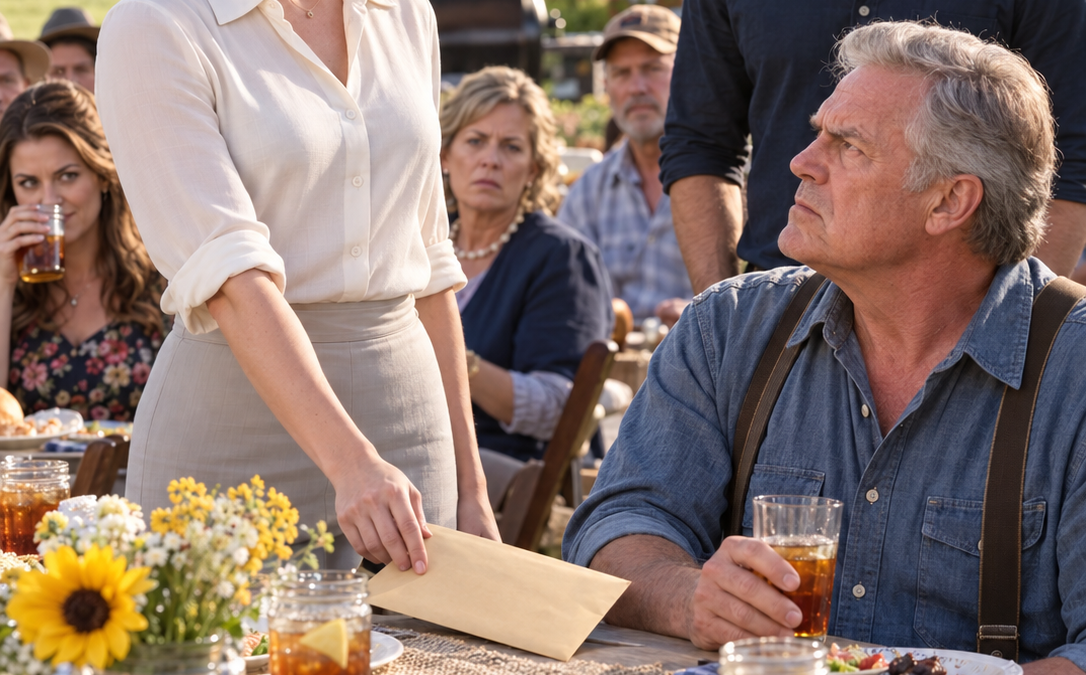
And then his eyes found me standing just off the end of the table in the candlelight.
The warmth drained out of his face like water out of a cracked trough.
The whole table followed his gaze to me.
“Proud of all my children,” he said again, slower now, making sure the neighbors heard it too, “except the disgrace sitting at this table.”
The words went out across the patio and hung there in the bug light.
Somebody’s fork stopped scraping.
Hal Pruitt looked away.
Sandra lifted her cup to hide a smile and didn’t quite manage it.
Aunt Lorna gave one small satisfied nod, a judge agreeing with her own verdict.
And Travis—my brother, the thief in a clean shirt—looked at me with something close to pity because he thought he’d already won.
This was just the part where they put the disgrace in her place one more time before the night ended.
Nobody defended me.
Not one of them.
In five years, not one of them ever had.
I stood very still and let the silence finish.
Then I did the only thing left that was mine to do.
There were no tears from me.
I want you to know that because everyone at that table was braced for them.
They wanted the disgrace to crumble.
To make a scene.
To prove the story true.
I have never in my life given people the version of me they were rooting for.
So I smiled.
A real one.
Almost gentle.
Which I think unsettled my father more than shouting ever could have.
I stepped up to the head of the table, into the candlelight, close enough that he had to look at me, and I set the manila envelope down beside his plate.
Square and quiet.
The way you set down a thing that’s already decided.
His eyes dropped to the line on the front.
“Happy Father’s Day.”
Then they came back up to mine, narrow, suspicious.
A man who could feel the ground shifting and didn’t yet know which way.
“What’s this?” he said.
Not a question, really.
A warning.
I kept my voice low and even.
The voice I use when a client is about to learn something hard and true.
“Happy Father’s Day, Dad,” I said. “Open it when you’re ready.”
That was all.
No accusation.
No speech.
Five years of it, and I spent fewer words on him than he’d just spent on me.
I looked around the table once.
At Travis.
At Sandra.
At Lorna.
At the Pruitts, frozen at the fence.
And I let them all see that I was perfectly, completely calm.
Then I turned and walked back down through the cut hay toward my car.
Behind me, I heard my father pick up the envelope.
I heard the paper.
I didn’t turn around.
Some things you don’t need to watch to know they’ve landed.
The walk to my car felt a mile long.
Behind me, the patio had gone quiet in that particular way a crowd goes quiet when it can’t tell yet whether to be embarrassed or afraid.
I heard Travis’s voice, pitched easy and loud for the benefit of the neighbors, telling everyone not to mind me.
“She’s just being dramatic,” he said. “You know how she gets. Ignore it, Dad. Throw it out.”
But my father didn’t throw it out.
I could feel that without looking.
The way you feel a storm cell change direction.
There’s a kind of silence a man makes when he’s reading something that doesn’t match the story in his head.
And it was pouring off that patio now, thick as the citronella smoke.
“Open it,” somebody murmured.
Maybe Sandra, curious in spite of herself.
Maybe Lorna.
I reached my car and put my hand on the door handle and made myself stop just for a second in the last of the light.
I thought about my mother under her oak tree.
The night she died.
The years of invoices nobody ever saw.
I thought, This is for you.
And I wasn’t sure if I meant her or the girl I used to be—the one who brought a folder to a deathbed and got told the family needed faith instead.
Behind me, I heard the unmistakable sound of an envelope being torn the rest of the way open.
Then the rustle and slide of papers coming out into the candlelight.
I heard my father draw a breath.
And then, across the whole gold evening, I heard that breath catch in his throat as his eyes found the first line of the first page.
I opened my car door.
The screaming was about to start.
My father read the first page.
Then the second.
Then the third.
And the whole party watched the color leave his face one shade at a time.
The first page was the recorded deed of trust filed with the county two years back.
The lien on the homestead and all 80 acres assigned to my trust, with my name as trustee.
The second was the bank’s payoff letter.
The proof that the debt that should have taken the farm had been satisfied in full.
Paid by me.
The very spring he’d told these same neighbors he’d handled it himself.
And the third was the listing agreement.
His son’s signature at the bottom by power of attorney.
The asking price printed low and ugly across the top.
The machine that had been quietly selling the family’s home right out from under the man making the toast.
He understood it all in one terrible rush.
The disgrace had saved the farm.
The son he’d just praised had been trying to sell it.
The legacy he’d promised the neighbors hadn’t been free and clear for two years, and the only thing standing between it and the auctioneer had been her.
My father came up out of his chair so fast it went over backward into the grass.
“Travis,” he said, and his voice cracked clean down the middle. “What is this? What did you do?”
Travis was already on his feet, hands up, the easy charm gone gray.
“Dad, that’s—that’s not— She’s twisting it. That’s—”
But my father wasn’t listening anymore.
He was turning the pages over in his shaking hands and roaring now.
No words, even.
Just a sound.
The sound of a proud man watching every story he’d told about himself come apart at once.
The Pruitts came off the fence.
Down the road, a porch light snapped on.
Then another.
Neighbors stepping out to see what was tearing the evening open.
I was in my car with the window down when my father finally found words again and screamed my name across the yard.
Not the disgrace.
My name.
Meredith.
I started the engine and said the only thing I had left to say, quietly, through the open window into the chaos of the people who’d never once defended me.
“I didn’t come to take anything, Dad. I came to give it back. It was always going to be yours. I just made sure no one could take it from you, including him.”
I didn’t stay to watch it burn.
That’s the difference between me and the people at that table.
The one thing I’d hold on to driving home in the dark.
They needed an audience for everything.
Their pride.
Their grief.
Their cruelty.
I didn’t need one for my justice.
But I saw enough in the rearview to last me.
Travis was backing away from the table with his hands still up, talking fast, and no one was looking at him the way they used to.
Sandra had stepped clear of her husband, an actual foot of evening air between them now.
The first crack in a marriage built on what they were owed.
Aunt Lorna sat with her mouth open and, for once in her 71 years, nothing to say.
And my father—my proud, hard, foolish father—had sat back down in the chair somebody righted for him.
The papers lay loose in his lap.
He stared at the recorded deed with my name on it like it was written in a language he was only now learning to read.
The neighbors stood at their fences in the porch light.
Everyone who’d heard him call me a disgrace was now hearing the rest of it.
And there’s no folder face down on a dresser big enough to hide this.
I turned out of the lane onto the two-lane road and rolled the window up.
The screaming faded behind me.
I drove the 40 minutes home with the radio off and my mother’s letter on the seat beside me.
And somewhere around the county line, I realized my hands were finally, after five years, not steady at all.
They were shaking.
I let them.
I’d earned the right to shake.
The listing came down within the week.
A title search would have killed it anyway, but Walt made one call to the brokerage and it vanished by Tuesday like it had never been.
Travis had a harder week.
The creditors he’d been planning to pay with the sale didn’t disappear just because his scheme did, and without the farm to sell, he had nothing to wave at them.
Sandra took the kids to her mother’s place over in the next county and, last I heard, hadn’t come back.
The fourth-generation Golden Boy turned out to be just a man who owed money and lied about it.
And a small town does not forget that quickly.
Walt and I finished the work I’d started two years before.
This time my father signed willingly.
Eyes open.
And we folded the homestead into a proper family trust, the kind built to outlive all of us.
My father gets to live there the rest of his days, exactly as he always has.
Every acre and every board of it.
But it can never be sold out from under the family again by Travis or anyone, because the terms don’t allow it.
And the trustee won’t sign it.
The trustee is still me.
My father called nine days after Father’s Day.
I almost didn’t answer.
When I did, he didn’t apologize.
Not really.
My father doesn’t have the equipment for it.
But he said my name.
Meredith.
Not the other word.
And he asked, in a voice I’d never heard him use, why I never told him.
I said, “You wouldn’t have let me help if you’d known it was me.”
And he was quiet a long time because we both knew it was true.
Then he asked if I’d come out to the farm again sometime.
And here is where I drew the line my mother never got to draw for herself.
“I’ll keep the roof over your head, Dad,” I said. “For her and for the land and for the people who come after. But I won’t keep standing in a room that calls me a disgrace.
“Those are two different things.
“And you don’t get one without the other anymore.”
He didn’t argue.
For the first time in five years, he didn’t argue.
I’ve thought a lot since that night about what my mother asked of me and about the part of her letter I only understood too late.
I learned that being the strong one doesn’t mean you owe people your silence forever.
And that sometimes the kindest thing and the strongest thing are the same thing—which is to finally let the truth sit down at the table and stay.
That’s where I’ll leave it tonight.
One envelope.
One quiet drive home.
One family that finally knows who held the roof up all along.
The barbecue grease still warm on the plates.
The second notice hidden under the Sunday paper.
“Do it anyway” in my mother’s shaking hand.
If you’ve ever been called the disgrace by people who never once saw what you carried in the dark, tell me about it down in the comments because I read them, and you are not the cold one in your story.
Subscribe to Hidden Family Revenge, where the quiet ones always get the last word.
I’ll see you at the next table.








