My sister’s text read: “don’t come to my wedding-your presence would ruin our photos.” i replied “ok.” that evening, at the governor’s charity gala, he introduced me as “the daughter i never had” to the entire state senate. my phone exploded when the photos went viral…
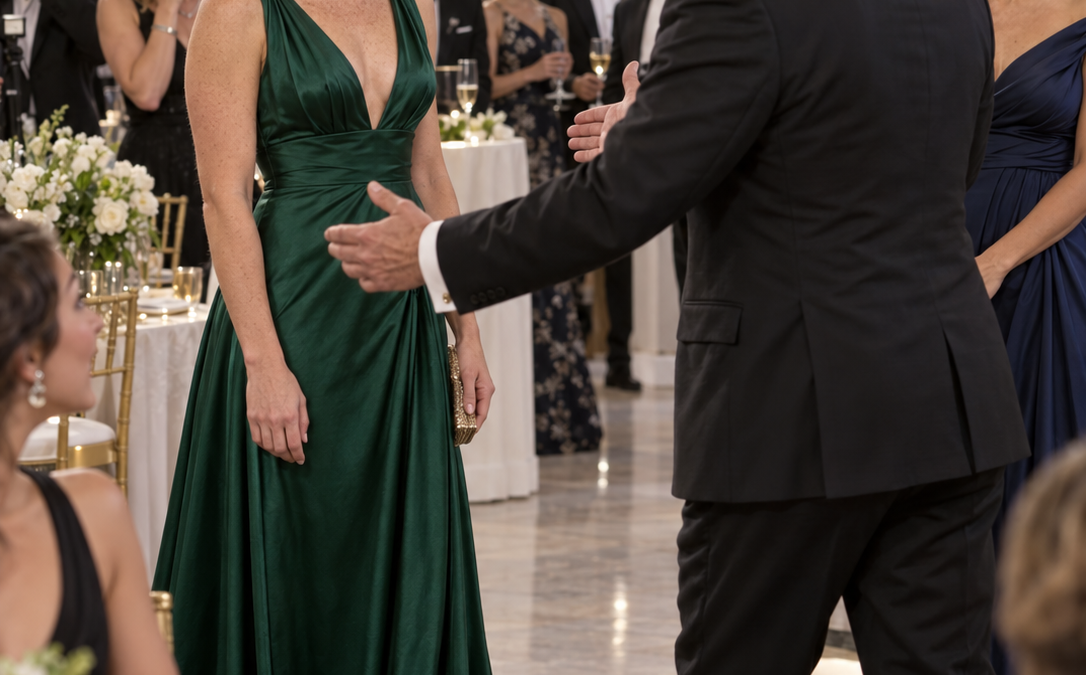
I believed that lie for a long time. Long enough to skip my own college graduation because it fell on the same weekend as Beexley’s spring dance recital. Long enough to lend her $8,000 in 2019 that she never paid back—money I’d been saving to put a down payment on a small condo.
Long enough to fly across the country in 2022 to help her move into her new apartment in Los Angeles, only to be told when I got there that she’d already hired movers and just wanted me around to keep her company while she supervised them.
I want to tell you now, in this first chapter, so you understand what her text really meant: I had never in my life done a single thing to embarrass my sister. I had never shown up to a family event drunk. I had never caused a scene. I had never worn something inappropriate. I had never talked about myself too loudly at a dinner.
The only thing I had ever done wrong, as far as I could tell, was to keep existing in a way that reminded people I was there.
So when her text came in calling me a walking ruin of her wedding photos, it didn’t come out of nowhere. It came out of a lifetime of slowly being pushed toward the door.
What was different this time was that I finally walked through it.
I want to tell you what my life actually looked like on that Tuesday morning because you deserve to know who Renley Ashford really was versus who my family had spent 36 years telling her she was.
I lived in a small but beautiful house in East Sacramento with hardwood floors I had refinished myself. I had a garden in the back with tomatoes and rosemary and a lemon tree that my neighbor, Mr. Howerin, kept trying to steal fruit from through the fence. I had a rescue dog named Biscuit, a shepherd mix with one ear that flopped, who was currently asleep on my feet.
And I had a job that my family, to this day in the spring of 2025, did not really understand.
For the last 11 years, I had been working my way up in a policy research firm that consulted with the state government of California on education reform. I had started as a research assistant making $32,000 a year and I had, through a mix of stubbornness and long nights and a boss who actually saw me, become the senior policy director.
I made $180,000 a year plus bonuses. I had testified before the state assembly seven times. I had co-written a bill that expanded early literacy funding for low-income districts, and it had passed in 2023 with bipartisan support.
My mother, when I told her about the bill passing, had asked me if that meant I would finally have time to help Beexley plan her engagement party.
That’s the part I need you to understand.
My family did not know me.
They had built a version of Renley in their heads when I was seven years old—a quiet, awkward girl who wasn’t as pretty as her sister—and they had refused to update that image for the next 29 years. To them, I was still the girl who wore glasses and read too much and made everyone uncomfortable at Christmas dinner by asking questions no one wanted to answer.
It didn’t matter what I accomplished. It didn’t matter what I earned. It didn’t matter that my apartment in East Sacramento was, by any objective measure, twice as nice as Beexley’s rental in Los Angeles.
Because my mother had spent so long telling everyone that Beexley was the star and I was the shadow. Admitting anything else would have meant admitting she’d been wrong about her own daughters for three decades.
And Colette Ashford would rather set herself on fire than admit she’d been wrong about anything.
Beexley was marrying a man named Preston Vandermir, whose family owned a chain of luxury car dealerships in Southern California. My mother had been telling everyone who would listen that the Vandermirs were practically royalty, which was, to put it politely, not accurate.
They were rich. Yes.
They were not royalty.
But my mother, who had been raised in a trailer park in Modesto, had spent her whole adult life climbing toward what she thought rich people looked like, and marrying her prettier daughter into car dealership money was, for her, the summit of a mountain she’d been climbing since 1979.
The wedding was scheduled for June 21st, 2025, a Saturday. The venue was a vineyard in Napa. That cost, according to the invoice I’d been shown by my mother in a fit of bragging, $95,000 just for the property rental.
The dress had come from a designer in Milan. The flowers were being flown in from Ecuador. There were 280 guests on the list, including a state senator, a former baseball player, and someone my mother kept calling the influencer with the pool videos, whose name I did not know and did not particularly want to.
I was supposed to be a bridesmaid.
I had already paid $1,200 for a dress. I would have to alter myself because Beexley had picked a designer who didn’t stock anything above a size eight, and I was a comfortable 10. I had paid another $800 for a bachelorette weekend in Palm Springs that I hadn’t been allowed to attend because Beexley wanted just her real friends for that part.
And now, on a Tuesday morning in April, two months before the wedding, I was standing in my kitchen holding a mug of hot coffee, staring at a text that told me my presence would ruin the photos.
I picked up my phone again. I read the message a second time and then a third time.
And then I did something I had never done in my whole life.
I laughed.
Not a bitter laugh. Not a sad laugh. A real, actual belly laugh, the kind that surprised even me and made Biscuit lift his floppy ear to check on me.
Because I realized in that moment that I was free.
My sister had just handed me, in seven words, the permission I had been waiting for since I was old enough to understand what favoritism was. She had told me in writing that I did not need to show up, that I did not need to smile through another event where my mother would introduce me as Beexley’s older sister and forget to mention my name, that I did not need to spend a Saturday in June watching my family celebrate a person who had quite literally just called me an embarrassment.
I picked up my phone one more time. I texted my assistant, Margarite, and asked her to confirm my seat at the governor’s charity gala that same evening, June 21st, 2025.
And then I went to work.
To explain how a woman my family thought was a walking embarrassment ended up with a personal invitation to the governor’s charity gala on the exact same night as her sister’s wedding, I have to take you back to the fall of 2019, when I met a man named Harlon Whitfield at a policy roundtable in a hotel conference room that smelled like burnt coffee and industrial carpet cleaner.
At the time, Harlon Whitfield was the lieutenant governor of California. I was a mid-level policy analyst at my firm, and I had been sent to the roundtable because my boss had food poisoning and needed someone to cover a panel on rural education funding.
I was 30 years old, wearing a navy-blue blazer I’d bought at an outlet mall in Vacaville, and I was so nervous I’d forgotten to eat breakfast.
Harlon was 62 at the time, a tall man with silver hair and a face that reminded me, in the strangest way, of my father before he’d left us. Not in features. In something quieter.
The way he listened. The way he tilted his head when someone was talking, like whatever they were saying was the most important thing he’d hear all day.
When my turn came to speak, I stood up on legs that were shaking and I gave a five-minute presentation on a data set showing that children in the Central Valley were three grade levels behind in reading by the time they hit fifth grade.
When I finished, the room was quiet.
And then Harlon Whitfield, the Lieutenant Governor of the state of California, raised his hand and asked me, in front of 40 other people, if I would be willing to come to his office the following week to walk him through my research in more detail.
I nearly threw up in the parking lot afterward out of pure shock.
But I went to his office the next Tuesday, and I brought my binder, and I sat across from him at a big cherrywood desk while he asked me questions for two hours, taking notes on a yellow legal pad with a fountain pen.
At the end, he asked me what I wanted to do with my career.
I told him I wanted to make sure no kid in California ever grew up thinking they were stupid just because no one had taught them to read.
He looked at me for a long moment, and then he asked me if I would be willing to consult on his education task force.
That was the beginning of a professional relationship that changed the entire shape of my life.
Over the next few years, I worked closely with Harlon and his team. I helped draft policy papers. I sat in on strategy sessions. When he ran for governor in 2022, I contributed research to his campaign platform on education, though I stayed carefully behind the scenes because my firm required political neutrality.
He won that November by a comfortable margin.
And when he took office in January 2023, he invited me and my team to a private breakfast at the governor’s mansion to thank us for our contributions.
That was where I met his wife, Marisol.
She was a small, warm woman with dark, curly hair and a laugh that filled a room. She had been a pediatric nurse for 30 years before Harlon’s political career had made her a public figure, and she had none of the coldness that my mother had spent her whole life practicing.
Marisol took one look at me across that breakfast table, listened to me talk for maybe 10 minutes about my work, and then, in front of everyone, she reached across and squeezed my hand and told me she had always wanted a daughter, and I reminded her of the daughter she might have had.
I laughed it off at the time.
But over the next two years, Harlon and Marisol Whitfield became something my own family had never been to me.
They invited me to Sunday dinners at the mansion when they were in town. Marisol called me on my birthday. Harlon sent me a handwritten note when my dog Biscuit had emergency surgery in the fall of 2024. And inside the envelope was a check for the vet bill that I tried to return three times before Marisol finally called me and told me in her firm nurse voice to stop being ridiculous and cash the check.
They were, in every meaningful sense of the word, the parents I had spent my whole life wishing I had.
I never told my family about them.
Not once.
Not because I was ashamed, but because I knew in my bones that the moment my mother found out I had a personal relationship with the governor of California, she would find a way to make it about her.
She would call me constantly asking for favors. She would tell everyone at her boutique that her daughter was close with the governor. She would try to get Beexley invited to state functions. And she would, without even meaning to, poison the one relationship I had built that was actually mine.
So I kept it separate.
I kept it sacred.
When Harlon and Marisol asked me about my family, I gave them the shortest possible version. I said my mother ran a boutique. I said my sister was engaged. I said we weren’t very close.
Marisol had looked at me with her nurse eyes when I said that last part, and she nodded very slowly, and she had never pushed for more.
In early April of 2025, Harlon’s office had reached out with a formal invitation. The annual Governor’s Charity Gala was being held on Saturday, June 21st, at the Crocker Art Museum in downtown Sacramento.
The theme that year was literacy and early childhood education. And Harlon wanted me to be a featured guest—not just an attendee, a guest of honor, seated at the head table, recognized during his remarks for my work on the 2023 literacy bill.
I had said yes immediately.
And then, later that same week, I had realized with a strange twist in my stomach that the gala fell on the exact same night as Beexley’s wedding.
I had planned to skip the gala.
I had already told Margarite to send my regrets, that a family obligation would keep me from attending. I had been prepared to sit at the head table of my sister’s wedding in Napa in a bridesmaid dress that pinched at the ribs, watching my mother cry happy tears for the daughter she actually loved, while 800 m of distance separated me from the people who had shown me what being a daughter was supposed to feel like.
But now, at 9:47 in the morning on that Tuesday in April, my sister had sent me a text that changed everything.
And by 9:49, I had already messaged Margarite to reverse my regrets and confirm my seat at the gala.
Margarite, who had worked with me for four years and who knew more about my life than most of my family did, called me back within three minutes.
“You’re going to the gala,” she confirmed carefully, “instead of the wedding. Are you sure?”
“My sister told me not to come,” I answered. “In writing. I’m not chasing anyone who’s already made up their mind about me.”
There was a long pause on the line.
And then Margarite, who was 58 years old and had raised three daughters of her own, said something to me I have never forgotten.
“Renley,” she began, her voice very quiet. “For 11 years, I’ve watched you break yourself in half for people who wouldn’t cross the street for you. If you’re finally done, I will personally make sure your dress fits like a dream.”
I started crying right there in my kitchen, holding a cup of coffee for the third time that morning.
Biscuit put his big head on my knee.
Outside my kitchen window, my lemon tree was blooming and the whole yard smelled like early California spring. And for the first time in my entire life, I felt like I was allowed to choose myself.
I hung up with Margarite. I sat down at my kitchen table and I started making a list of everything I needed to do before June 21st, 2025, the day my old life was going to end and my new one was going to begin.
Between April and June of 2025, three things happened that shaped everything that came after.
My mother called me 47 times. My sister sent one more text. And I stopped answering the phone.
The first call came on the Wednesday after the text at 7:15 in the morning. I was in the shower and I let it go to voicemail.
When I checked the message an hour later, my mother’s voice was tight and controlled in the way it got when she was trying not to sound angry in front of a witness.
“Renley, it’s your mother. Your sister mentioned there was a little misunderstanding. Please call me back so we can sort it out before it becomes something bigger than it needs to be.”
I didn’t call back.
I forwarded the voicemail to Margarite with a note that said, “For the record.”
The second call came that same afternoon. The third came that evening. By Friday, I had 11 voicemails, all in that same brittle tone, each one a little more insistent than the last.
By the following Monday, my mother had started texting instead.
The texts got progressively worse.
Renley, this silent treatment is childish.
Renley, your sister is under an incredible amount of stress right now.
Renley, do you have any idea how selfish you are being?
Renley, I did not raise you to behave this way.
I saved every single one.
I didn’t reply to any of them.
Meanwhile, my life kept happening.
I went to work. I chaired a meeting on Wednesday about a new pilot program for pre-kindergarten literacy in Fresno County. I took Biscuit to the dog park on Saturday morning and watched him try to steal a tennis ball from a golden retriever twice his size.
I had dinner on Sunday with my best friend, a woman named Odelise Freeman, who I had met in graduate school and who had, over the last decade, become the sister my actual sister had never been.
Odelise was a family attorney in Sacramento, 37 years old, with a shaved head and a laugh you could hear across a restaurant.
When I told her over pasta at our favorite spot in Midtown what Beexley had texted me, Odelise set her fork down very slowly. She took a sip of her wine and then she looked at me and asked in her attorney voice, “Renley, have you considered that your family might be planning something bigger than just excluding you from a wedding?”
I hadn’t.
I told her so.
She nodded, thinking.
“Do you know what your grandmother’s estate looked like when she passed?”
My grandmother, Winifred, had died in February of that same year, 2025. She was 91, and she had been sharp as a needle right up until the end. She had lived alone in a house in Carmichael, a modest three-bedroom she had bought with my grandfather in 1962 and paid off entirely by the time he died in 1998.
My mother had been managing her affairs for the last decade, ever since Grandma Winifred’s hip surgery had made it hard for her to drive.
I told Odelise I hadn’t seen a will, that my mother had told me right after the funeral that Grandma left everything to be split fairly, and that the estate was still being settled.
I hadn’t pushed.
I had been too sad to push.
Grandma Winifred was the one person in my extended family who had actually seen me. She used to slip me $20 bills at Christmas when no one was looking. And she used to call me on my birthday and sing to me in her wobbly old voice.
Odelise took another sip of wine. Then she pulled out her phone and started typing.
“Renley,” she began without looking up, “I want your permission to pull the probate records on your grandmother’s estate. Public information. It won’t take me an hour.”
I gave her permission.
I didn’t think much of it that night. I was still deep in the fog of what my sister had said, and my grandmother’s estate felt like a distant secondary concern.
Two days later, on a Tuesday evening in late April, Odelise called me at 9:30 at night.
She never called that late unless something was wrong.
“Renley,” she began, her voice careful. “Are you sitting down?”
I sat down.
“Your grandmother’s will was filed in probate on March 11th, 2025. Your mother was named executor and, according to the will, which I now have a copy of, your grandmother left her house, her savings, and her retirement account totaling approximately $640,000 to be split equally between her two granddaughters. You and Beexley. $320,000 each.”
I couldn’t speak for a moment.
I had assumed the estate was maybe worth $100,000 total, split three ways with my mother.
“Renley,” Odelise continued, “your mother has not filed any distribution paperwork, and based on the transfer records I can see, the house has already been listed for sale under a private listing, not on the open market. The buyer, according to the paperwork, is a limited liability company. I traced the LLC. It’s registered to Preston Vandermir.”
The room went very quiet.
I could hear my own heartbeat in my ears.
Preston, my sister’s fiancé, was buying my grandmother’s house from my mother in what was clearly not going to be a market-rate transaction, in a deal that had been arranged without any of the money that legally belonged to me being distributed to me.
I sat on my kitchen floor.
Biscuit came over and pressed his warm body against my side. Outside my window, the last of the April sunlight was fading behind my lemon tree.
“Odelise,” I asked very slowly, “what do you think is happening here?”
“I think,” she answered, choosing her words with the careful precision of someone who had seen this exact story a hundred times, “that your mother was planning to distribute your grandmother’s estate in a way that gave the bulk of it effectively to your sister and her new husband. I think she was probably going to tell you that the estate was worth much less than it was, hand you a token check, and pocket or gift the rest.
“I think, Renley, that the reason your sister texted you not to come to the wedding is that they don’t want you in the same room with the Vandermir family when the topic of your grandmother’s estate comes up, because they’ve told the Vandermirs a very specific version of a story, and you being there might complicate that story.”
I sat on the floor for a long time.
Biscuit didn’t move.
My phone buzzed in my hand at some point, and when I looked down it was another text from my mother.
Renley, this is your last chance to apologize to your sister before this becomes irreparable.
I laughed the same belly laugh from the morning of the text, only now it had teeth.
“Odelise,” I asked, “what would you do if you were me?”
She was quiet for a moment.
“Legally, Renley, you have every right to challenge the sale and demand a full accounting of the estate. I can file the paperwork this week. It would freeze the sale. It would trigger a full audit, and it would almost certainly blow up in your family in a way that nothing could put back together.”
I looked at Biscuit, at my kitchen, at the lemon tree.
“Do it,” I told her. “Freeze the sale, file the paperwork, and do it in a way that they don’t find out until after June 21st.”
There was a pause.
And then Odelise, in her attorney voice, said, “Renley Ashford, you have officially stopped being the family doormat. I am so proud of you, I could cry.”
I hung up.
I sat on the kitchen floor a little while longer. And then I got up, made myself a cup of tea, and went to bed with my dog curled at my feet.
For the first time in my entire adult life, I slept for nine straight hours.
The second and final text from my sister came on May 30th, 2025, exactly three weeks before her wedding, and it was the moment I realized that my family had absolutely no idea what was coming.
I had spent the previous month executing what Odelise, in her lawyer voice, called a strategy of patient silence.
I did not respond to my mother. I did not respond to my sister. I did not respond to the four cousins who had been recruited to send me peacemaker messages on my mother’s behalf—cousins I had barely spoken to in years who suddenly wanted to talk about how family is family and how I should reconsider before it’s too late.
I forwarded every message to Odelise. She screenshotted them all.
She built me a file.
Meanwhile, quietly, the legal work was moving.
Odelise had filed a formal request for accounting on my grandmother’s estate in the second week of May. Under California probate law, my mother had 30 days to respond with a full inventory.
Odelise had also filed a preliminary objection to the private sale of the Carmichael house, which had, as she’d predicted, immediately frozen the transaction.
The freeze had been served through the county recorder’s office, meaning my mother would receive an official notice in the mail. Odelise had timed the paperwork so that the notice would arrive at my mother’s boutique address, not her home, and had estimated that with normal county processing, my mother would receive it sometime in late June.
After the wedding.
After the gala.
After I had already walked out of the old story and into the new one.
I was, in short, running out the clock.
And my family, having no idea, was running toward what they thought was going to be the crowning event of my sister’s life.
I went to work every day like nothing was happening.
In mid-May, I flew to Los Angeles for a two-day conference on multilingual education. On the plane home, I sat next to a woman who worked in television production, and we ended up talking for the entire flight.
Her name was Sable Marchetti.
She was in her early 40s, sharp and funny, and she produced a documentary series for a major streaming platform.
When I told her, in the general terms I used for strangers, about my work on the 2023 literacy bill, she got very quiet.
And then she asked me if I would be willing to have coffee with her the following week.
Coffee turned into a three-hour meeting at a cafe in Midtown Sacramento, at which Sable told me that she had been trying for over a year to develop a documentary about the hidden literacy crisis in the American West, and she needed a subject-matter expert to serve as an on-camera consultant.
She wanted to know if I would be interested.
She offered me a fee that was more than I made in a year at my firm.
I told her I would think about it.
I did think about it that whole week, walking Biscuit in the evenings under the long California light.
And then I told her yes.
I signed the contract on May 27th, 2025.
Three days later, on the evening of May 30th, my phone buzzed with a text from my sister.
I was in my kitchen again making dinner: salmon, roasted broccoli, and rice. Biscuit was at his usual spot on the floor. The phone lay face down on the counter. The screen lit up, and I flipped it over.
It was longer than the first one.
It read:
“Renley, Mom told me you’re still pouting about the wedding thing. I don’t know why you’re making this so hard. You’ve always been jealous of me, and you can’t handle that I finally have something good. Preston’s family is important, and I don’t need my weird older sister making them uncomfortable. Don’t come. Don’t send a gift. Don’t call Mom crying afterward. Just stay in your little house with your little dog and your little job, and let me have my day. If you show up, I will have security remove you.”
I read it twice.
I saved it.
I sent it to Odelise. I sent it to Margarite. I sent it to Odelise again with a note that said, “I want this in the file.”
And then, because I am not made of stone, I sat down at my kitchen table and I cried for about 10 minutes.
Not because Beexley’s words hurt.
Beexley’s words had lost their power over me sometime in April.
I cried because I was mourning something.
A version of a sister I had wanted for 36 years and never had. A version of a family I had kept trying to build in my head, no matter how many times the real one knocked it down.
I cried because, on some level, up until that text, I had still been holding on to a small, stupid hope that Beexley might at the last minute knock on my door and apologize and hug me and say she hadn’t meant it.
That we could be sisters. Real sisters. The kind who told each other secrets and drank wine together and cried at each other’s weddings.
That hope was dead now.
I let it die.
I let it go the way you let go of a bird you’ve been holding too tightly.
And when I was done crying, I got up, washed my face, ate my dinner, and called Odelise.
“Add it to the file,” I told her.
“Already done,” she answered.
I did not respond to Beexley’s text.
I let it sit unanswered in my phone for the next three weeks, a small monument to the exact moment I stopped being available to be hurt.
The next thing I did the next morning was something I had been putting off for weeks.
I called my father.
I had not spoken to Redmond Ashford in a real conversation since I was probably 25 years old. He had left when I was 11 and Beexley was nine. And while he had sent birthday cards through my teens and occasional emails through my 20s, we had drifted into the kind of relationship where you exchange holiday texts and nothing else.
He lived in Portland, Oregon. Remarried. No other children.
He had reached out in February when Grandma Winifred died, offering condolences.
I hadn’t responded.
I had been too wrapped in my mother’s version of grief to make room for his.
But now, on the morning of May 31st, 2025, I dialed his number.
He picked up on the third ring.
His voice was older than I remembered.
“Renley?” he asked carefully.
“Dad,” I began, and my voice caught, which surprised me. “Dad, I need to tell you some things, and I need to ask you some questions, and I don’t know if you’ll want to hear them, but I think you’re the only person left in my family who might tell me the truth.”
There was a long pause on the line.
And then my father, in a voice that sounded like he had been waiting 25 years for this call, answered.
“Renley, whatever you need to know, I will tell you. Whatever you need to say, I will listen. I owe you that. I owe you more than that.”
We talked for two hours.
He told me things about my mother I had never known. He told me why he had really left, which was not, as my mother had told the family, because he had fallen for another woman.
He had left because he had discovered in the summer of 2000 that my mother had been quietly siphoning money from a joint savings account—money they had been saving for my college fund—into a private account she was building for Beexley.
When he confronted her, she had told him to leave and never contact the girls again.
Terrified of a custody fight he could not afford, and believing at the time that his absence would be less damaging than a war, he had gone.
He had spent 25 years wishing he had fought harder.
He told me so on that phone call with a rawness that I felt in my chest.
By the time we hung up, I had a father again.
Not fully. Not perfectly.
But a beginning.
And I had one more piece of the truth that my mother had spent my whole life hiding from me.
The morning of June 21st, 2025, I woke up at 5:45 in a hotel suite at the Sutter Club in downtown Sacramento.
And the first thing I noticed was how quiet it was.
No phone buzzing. No dog snoring. No garbage truck outside my kitchen window. Just the soft hum of a hotel air-conditioning system and the pale gray of a summer sunrise filtering through the linen curtains.
I had checked into the hotel the previous evening because Margarite had insisted on it.
She had said that a woman being publicly honored by the governor of California should not be doing her own hair in a bathroom mirror on the morning of.
She had booked me the suite, arranged for a hair and makeup team to arrive at 2:00 in the afternoon, and had my dress delivered on a padded hanger the night before.
Biscuit was at her house for the weekend, being spoiled by her grandchildren.
The dress was hanging in the closet across the room.
It was floor-length, a deep emerald-green silk that had been altered three times by a tailor in East Sacramento named Ms. Pham, who had told me at the final fitting that green was the color of new beginnings in her grandmother’s village in Vietnam, and that I should wear it like armor.
I had cried at that fitting quietly into a tissue Ms. Pham had handed me without a word.
I got up. I made coffee at the little machine on the counter. I stood at the window and watched the city wake up, and I thought about my sister, 800 m south, waking up on her wedding day.
I did not hate her that morning.
That surprised me.
I had expected to.
I had expected to feel a bitter, hot rage as I looked toward Napa, imagining her getting her makeup done, imagining my mother fluttering around her in a mother-of-the-bride dress.
Instead, I felt something quieter.
Something almost like pity.
Because Beexley did not know—would not know for another few days—that the whole architecture of the life she was building was about to collapse.
She did not know that her fiancé’s plan to buy my grandmother’s house at a below-market rate had been frozen. She did not know that her mother’s version of the estate was about to be exposed in a formal audit. She did not know that my father, whom she had not spoken to in 20 years, was now in daily contact with me.
She did not know that I had spent the last two months quietly building a life around me that no member of my family could touch.
She thought today was her day.
And in a way, it was.
It was the day her whole story was going to be rewritten by forces she couldn’t see.
I spent the morning working. I answered emails. I finalized the notes for a briefing I was giving the following Tuesday.
I ordered room service at 11:00, a light lunch of grilled chicken and a spinach salad because I did not want to eat much before the gala.
At noon, my father called.
He had flown down from Portland two days earlier and he was staying at a hotel across town.
He asked if I was all right.
I told him I was.
He asked if I was nervous.
I told him I was not.
“Renley,” he began quietly on the line, “I want you to know something. I am so proud of the woman you have become. And I am so sorry I was not there to watch it happen.”
I did not cry.
I had cried enough in the last two months.
I told him I loved him.
I told him I would see him at the gala, where he was one of my three personal guests, along with Odelise and Margarite.
At two, the hair and makeup team arrived.
Two women, both in their 30s, both extraordinary at their jobs.
They swept my brown hair up into something soft and elegant, with a few pieces framing my face. They did my makeup in warm, neutral tones, letting my freckles show through the base rather than covering them.
When they were done and I looked at myself in the mirror, I did not recognize the woman looking back.
She was beautiful.
Not in the way my sister was beautiful, all sharp angles and corn-silk hair.
She was beautiful in a way that came from underneath.
Her eyes were clear. Her jaw was steady. Her mouth had the soft, ready curve of a woman who had finally stopped apologizing for existing.
I put on the dress at 4:30.
Margarite arrived at 5:00 in a gown of her own, a rich sapphire blue, with her silver hair pinned up.
She looked at me and her eyes filled with tears.
“Renley,” she whispered. “You look like every good thing you have ever done all at once.”
I did not have words to answer.
I just hugged her, careful not to smudge either of our makeup.
The car came at 5:30—a black town car arranged by the governor’s office, with a driver named Cyrus who opened the door for me and told me, without being asked, that it was an honor to be driving me that evening.
I thanked him.
I climbed into the back seat with Margarite, and we drove the short distance to the Crocker Art Museum through streets I had walked a thousand times, past the bookstore where I used to work in college, past a coffee shop where I used to study for exams, past the front of the old boutique building where my mother had run her business until she’d moved locations in 2018.
The whole city looked different from the back seat of a town car on the night of the gala.
Or maybe I just looked different looking at it.
We arrived at the museum at six.
There was a red carpet leading up to the entrance. Not a Hollywood red carpet, but a proper one, with press on either side taking photos of arrivals.
Cyrus opened my door.
I stepped out into the warm June evening in my emerald-green dress, and for a moment I stood very still, letting the noise wash over me.
A photographer to my left called out.
“Ma’am, could I get your name for the caption?”
I turned to him.
I smiled.
“Renley Ashford,” I answered, clear and calm. “I’m one of the guests of honor tonight.”
He nodded, wrote it down, snapped a photo.
Margarite, at my elbow, squeezed my arm gently.
We walked up the carpet together, past more photographers, past reporters, past a few faces I recognized from state government, and a few I didn’t.
At the top of the steps, a young man in a black suit checked my name off a list, and I was handed a small program with the evening’s agenda printed inside.
At the top of the guest-of-honor list, in small, elegant type, was my name.
Renley Ashford, senior policy director, and the title of my research work.
We stepped into the main gallery.
The ceilings were high, the walls were lined with paintings, and the room was already half full of people in evening wear holding champagne flutes and laughing softly.
A string quartet was playing in the corner. Waiters moved among the guests with silver trays.
And across the room, standing near the head table with his wife Marisol at his side, was Governor Harlon Whitfield.
He saw me the moment I walked in.
His whole face lit up.
He set down his glass. He said something quickly to the group of people he had been talking to, and then he crossed the room toward me, his hands out.
“Renley,” he greeted me, warm and loud enough to be heard by the people standing nearby. “There you are. I have been telling everyone I know that they had to meet you tonight.”
He hugged me right there in the middle of the gallery in front of 200 people.
The governor of California hugged me like I was his own daughter.
Marisol was right behind him, and she hugged me too.
And she whispered in my ear, “Sweetheart, you look absolutely radiant.”
I did not know it at that moment, but at the exact same instant that Harlon Whitfield was pulling back from his hug and turning to introduce me to a small circle of state senators, my sister Beexley, in a vineyard in Napa, was walking down the aisle toward Preston Vandermir with 280 guests watching.
Her dress was ivory. Her hair was in a low chignon. My mother, in the front row, was crying happy tears.
Neither of them, at that moment, had any idea that a photograph was being taken 600 miles north that was going to change everything.
The gala unfolded like a slow, beautiful piece of music, and I was, for the first time in my life, one of the instruments instead of the audience.
Harlon led me around the room for the better part of an hour, introducing me to people whose names I had only ever seen in newspapers.
State Senator Whitmore, a formidable woman in her 60s who had chaired the education committee for over a decade, took both my hands and told me that the 2023 literacy bill was one of the proudest things she had voted for.
State Senator Bochamp, a tall, lean man from the Central Valley, admitted to me that he had originally opposed the bill and had been convinced to support it by the very research data I had contributed.
Assembly Member Ortiz wanted to know if I would be willing to consult on a new initiative around adult literacy in the Bay Area.
I met the state superintendent of public instruction. I met the president of the California State Board of Education. I met three university presidents.
I met a country singer, a former secretary of state, and a woman who had donated $4 million to Harlon’s Education Foundation the previous year.
Every single one of them was introduced to me by Harlon, and every single one of them was told the same thing in slightly different words.
“This is Renley Ashford. Her research changed the way we think about early childhood literacy in the state. You need to know her name.”
Odelise arrived at 6:45 in a stunning black gown, her shaved head polished and her earrings glittering.
My father arrived a few minutes later in a charcoal suit that fit him beautifully, looking nervous and proud in equal measure.
Marisol immediately took him under her wing, introducing him around as Renley’s father, who flew in all the way from Portland to be here tonight.
She had a gift for making people feel included that I had never seen anyone else do so effortlessly.
We were seated at the head table at 7:15, Harlon at the center, Marisol at his right, me at his left, Odelise and my father and Margarite at seats nearby.
The other seats at the head table were filled with the lieutenant governor, State Senator Whitmore, and two major donors.
Dinner was served: salad, then a beautifully prepared filet with roasted vegetables.
I ate slowly. I laughed at the right moments. I answered questions about my work when they came.
I felt, in the strangest way, like myself.
Not a performance. Not a version of me shaped to make other people comfortable.
Just Renley at a table where I belonged.
Around 8:15, as dessert was being cleared, Harlon tapped his water glass with a small silver spoon.
The room quieted.
The string quartet stopped midpiece.
A staff member handed him a wireless microphone.
“Friends,” Harlon began, standing at his seat. “Thank you for being here tonight. Thank you for your generosity to a cause that Marisol and I care about more than we can express in words. Every dollar raised in this room tonight goes to expanding early childhood literacy access in communities across California, communities that for too long have been asked to build the future of this state without the basic tools to read the blueprints.”
There was warm applause.
“Before I turn things over to our other speakers,” Harlon continued, “I want to take a moment to recognize someone at this table tonight. Someone whose work has quietly, without fanfare, without seeking any credit, shaped the education policy of this state in ways that will benefit children for generations.
“I met her in 2019 when she was a young analyst nobody had heard of. And I sat in a hotel conference room and watched her stand up and speak with more clarity and more conviction than anyone else in a room full of people twice her age. I have watched her over the last six years become one of the most important voices in education policy on the West Coast.”
He turned.
He looked at me.
The room was very quiet.
“Renley Ashford,” he continued, warm and unhurried, “is a woman I am proud to call a colleague. She is a woman I am proud to call a friend. And I will tell all of you, and I will tell the members of the state senate here in this room tonight, that Marisol and I love her like the daughter we never had.
“Renley, would you please stand up?”
I stood up.
My legs were steady.
My hands were steady.
My father, three seats away, had tears streaming down his face and was not trying to hide them.
Margarite was gripping Odelise’s hand under the table.
The room erupted.
Not just polite applause.
Real applause.
The kind that goes on for a while.
Someone in the back stood up. Then someone else.
And then, within about 10 seconds, the entire ballroom of about 400 people was on their feet, giving me a standing ovation.
Cameras flashed.
I could see, at the edge of the room, a photographer moving carefully to capture the moment. I could see reporters typing on their phones. I could see Marisol next to Harlon beaming at me like I was actually her child.
I stood there in emerald-green silk, freckles showing through my makeup, 36 years of being called an embarrassment falling off me like an old coat I had finally taken off.
And I smiled.
Not big. Not showy.
Just a real, quiet, whole smile of a woman who had finally been seen.
The applause went on for what felt like a full minute.
When it finally died down, Harlon gestured for me to sit, and then he handed me the microphone.
“Would you like to say a few words?” he asked.
I hadn’t planned to speak.
I hadn’t prepared anything.
But I took the microphone.
I stood again.
I looked out at the room.
“Thank you,” I began, and my voice was steadier than I expected. “Thank you, Governor. Thank you, Marisol. Thank you to everyone in this room who has spent an evening caring about children you will probably never meet.”
I paused.
I took a breath.
“When I was seven years old, a teacher named Mrs. Ramirez sat me down after class one day and taught me a word I didn’t know. The word was enough. Not the way you use it when you want more food. The way you use it when someone tells you you are not smart enough, not pretty enough, not good enough.
“She told me that when someone tells you that, you look them in the eye and you say, ‘I am enough.’ And you say it until you believe it.”
The room was completely silent.
“I have thought about Mrs. Ramirez almost every day for the last 29 years. I do the work I do because I want every child in California to have a Mrs. Ramirez. I want every child to be told by somebody that they are enough.
“Because when a child learns to read, they learn that their story matters. And when a person learns that their story matters, there is nothing on this earth that can convince them otherwise. No matter how many times someone tries.”
I looked around the room.
Faces. Kind faces. Faces of strangers who had, in the last 10 minutes, become witnesses.
“Thank you for letting me be part of this work. I will spend the rest of my life trying to be worthy of it.”
I sat down.
The room stood up again.
Marisol reached over and took my hand and squeezed it so hard I thought she might crack a knuckle.
Harlon was smiling at me with what I can only describe as a father’s pride.
My father, three seats away, was openly weeping.
And in the back of the room, unbeknownst to me, a photographer from the Sacramento Bee had just captured a photograph that would, within the next four hours, begin to travel across the state of California with the speed of wildfire.
The photograph showed Governor Harlon Whitfield mid-speech, one hand raised toward me at the head table. My face in three-quarter profile, softly lit by candlelight, wearing an expression that was neither proud nor embarrassed, but simply quietly at peace.
The caption, which would run on the paper’s website by 10:30 that evening, read, “Governor Whitfield honors policy director Renley Ashford, calling her the daughter I never had at Saturday’s charity gala.”
By midnight, that photograph and that caption would be trending on three social media platforms.
By 6:00 in the morning, it would have been shared over 400,000 times.
By noon on Sunday, June 22nd, 2025, it would have been picked up by five major news outlets.
And by 2:00 in the afternoon on Sunday, my phone, which I had turned off at 10 the night before, would have 347 missed calls, most of them from a woman named Colette Ashford, who was at that very moment in a vineyard in Napa, watching her carefully constructed universe start to burn.
I turned my phone off before the gala started and I did not turn it back on until Sunday morning at 9:42, when I was in my hotel suite drinking coffee and watching a fog roll off the American River from my window.
The screen took nearly a full minute to load all the notifications.
When it was done, I sat down on the edge of the bed and just looked at it for a while.
347 missed calls.
211 text messages.
41 voicemails.
Notifications from every social media platform I was on, and emails stacked so high the app couldn’t display them all.
I scrolled slowly through the calls first.
My mother, over and over.
Beexley, four times.
Numbers I didn’t recognize, dozens of them.
My father once.
Odelise twice.
Margarite once.
Harlon Whitfield’s chief of staff once.
I opened the text thread from my mother first because I wanted to know, before I looked at anything else, what a woman who had spent 36 years diminishing me was going to say when the world had finally seen me.
The messages had come in a rolling avalanche starting at around 11 the previous night.
Her first message read:
Renley, please call me immediately.
The second:
Renley, someone at the wedding just showed us a picture. Is this real?
The third:
Renley, why did you not tell us you knew the governor?
The fourth, sent about 90 minutes later, when the photograph had clearly started moving on social media:
Renley, people at the reception are asking us about you. Your sister is very upset. Please call and explain what is happening.
The fifth, at 2:00 in the morning:
Renley, this is very selfish. You knew today was your sister’s day.
The sixth, at 6:00 in the morning:
Renley, we need to talk. This is getting out of hand. Beexley cried through most of the reception. Preston’s family is asking questions. You need to fix this.
The seventh, at eight:
Renley, if you have any love left for this family, you will call me right now.
There were more.
I read them all.
I felt, as I read, an emotion I had not expected.
It was not satisfaction.
It was not triumph.
It was something more like the calm you feel when a long fever finally breaks.
I opened the text thread from my sister next.
Her messages were shorter, angrier, less controlled.
Renley, what did you do?
Renley, how could you?
You’ve ruined my wedding.
Preston’s mother spent the whole reception asking about you.
Everyone is talking about you, not the bride.
This is exactly why I didn’t want you there.
You always have to make everything about you.
I read her texts twice, and then I put the phone down, screen dark, and I went and made a second cup of coffee.
I did not respond to either of them.
Not yet.
I called Odelise instead.
She picked up on the first ring.
“Renley,” she began, and her voice had a laugh in it. “Have you seen it?”
“I’ve seen my texts,” I answered. “I haven’t looked at the photo yet.”
“Well,” she continued, “you should. It is stunning. It’s the top story on the Sacramento Bee. It’s the top result on Google for your name. And a producer from a national morning show called me at seven in the morning asking if you would be willing to do an interview. I told her I would ask.”
I sat down on the couch in the suite.
I pulled up the Sacramento Bee’s homepage on my phone, and there I was.
Emerald-green dress. Candlelight. That soft, quiet expression.
Harlon next to me, his hand raised.
The headline:
Governor Whitfield honors Sacramento policy director, calls her the daughter I never had.
The story below the photograph was warm and detailed.
It described my work. It described the standing ovation. It quoted Harlon. It quoted three of the senators who had been in the room. It ended with a mention of my brief remarks, and it quoted the line about Mrs. Ramirez.
I read the article twice.
And then I did what Odelise had suggested.
I looked at social media.
My name was trending in California.
There were thousands of comments under the article, most of them warm, some of them from teachers who had shared their own Mrs. Ramirez stories.
There were people from my college who had recognized my name, sharing memories.
There was a photograph of me at 18 from my Sacramento State graduation that someone had dug up from a public alumni newsletter and reposted with the words, “Look at this incredible woman.”
I felt, sitting there, an odd doubling.
Because I had spent so much of my life being invisible to my own family.
And yet, in the span of one night, thousands of strangers had decided to see me.
It was as if the universe had been quietly holding a mirror up for me and had finally turned it around so I could look.
I called Odelise back after about 20 minutes.
“What’s happening with the estate?” I asked her.
“Interesting timing,” she answered. “The formal notice of the freeze on the Carmichael sale is scheduled to arrive at your mother’s boutique on Monday or Tuesday. But because the news story is everywhere, and because your mother is presumably going to spend the day today calling everyone she knows about you, I would guess the news of the freeze is going to hit her right in the middle of the PR firestorm she is currently trying to manage.
“It’s not going to go well for her.”
“What about Preston?” I asked. “Does he know his LLC has been named in a legal filing?”
“Not yet,” Odelise answered. “But I expect he will find out this week. And I think, based on my read of his family’s public reputation, that his mother in particular is going to be very unhappy about being publicly connected to what is, in essence, a family estate dispute involving a woman the governor of California just praised on the front page of the Sacramento Bee.”
I let that sit for a moment.
“Odelise,” I asked, “what happens now?”
She was quiet for a moment, and then she answered in her lawyer voice, softened by our friendship.
“Now, Renley, you get to decide. You can respond to your mother. You can respond to your sister. You can accept the interview requests or turn them down. You can pursue the estate case aggressively or you can try to resolve it quietly.
“You are, for the first time in your entire life, holding all the cards. What you do with them is completely up to you.”
I sat on the couch for a long time after we hung up.
Biscuit was still at Margarite’s. My father was probably eating breakfast at his hotel. The city outside my window was going about its Sunday.
And I was, in the strangest way, at peace.
I made a decision.
I would not respond to my sister at all.
She had said in writing that she did not want to hear from me.
I would honor that permanently.
I would not respond to my mother in text either, because texts could be twisted and quoted and rewritten.
I would call her once. I would say what I needed to say. And then I would hang up and not answer again.
I would do one interview—not for morning television, but for the Sacramento Bee, the paper that had published the original photograph—and I would use it to talk about literacy work, not family drama.
I would refuse to comment on anything personal.
I would let Odelise pursue the estate case at full speed.
And I would go home to my dog and my lemon tree and my life.
I picked up the phone.
I called my mother.
She picked up on the first ring in a voice so tight it sounded like it was being squeezed through a straw.
“Renley,” she began. “Thank God. Do you have any idea what you have done to this family?”
“Mom,” I answered, and my voice was very steady. “I need you to listen to me for two minutes without interrupting. Can you do that?”
She was quiet.
Which was, in itself, a small miracle.
“I am not calling to apologize,” I continued. “I have done nothing wrong. I received a text from Beexley telling me not to come to her wedding because my presence would ruin the photos. I received a second text three weeks ago telling me she would have security remove me if I showed up.
“I honored her request.
“I attended a professional event that I had been invited to weeks before her text. I did not know a photograph would be taken. I did not know it would go viral. I did not plan any of what is happening.
“But I will tell you what I do know, Mom.
“I know that Odelise Freeman filed a formal request for accounting on Grandma’s estate on May 14th. I know that she filed an objection to the private sale of the Carmichael house to Preston’s LLC. I know that the freeze notice is going to reach your boutique this week.
“I know everything.
“I have known for two months.”
There was a silence on the other end so heavy it had weight.
“Mom,” I finished, “I am going to hang up now. Do not call me again. If you or Beexley want to communicate with me, you will do so through Odelise. She has been retained. Everything is in her hands now.”
I hung up.
I turned my phone off.
I sat in the quiet of the hotel suite and I felt, for the first time in my whole life, what it was like to close a door and not check three times to see if it was really closed.
My mother did not respect the boundary.
Of course she didn’t.
She had never respected a boundary in her life. Not with my father. Not with me. Not with anyone who had ever tried to draw a line between what she wanted and what she was owed.
But that Sunday afternoon, and for the three days that followed, she tried every angle she could think of to break through the door I had closed.
She called Margarite.
She called Odelise, who politely but firmly told her that all communication had to be in writing and go through the law office.
She called two of my cousins, who had never actually liked her, and had them call me.
I sent every message to Odelise and did not respond to any of them.
She showed up at my house on Monday morning.
At 10:00, I was at work.
Biscuit was inside.
My neighbor, Mr. Howerin, the same one who was always trying to steal my lemons, was out watering his front lawn when a silver sedan pulled up and my mother got out.
He watched her march up my walkway, ring my doorbell for three minutes, then walk around to my back gate and try the latch.
It was locked.
She called out my name.
She called out Biscuit’s name, hoping the dog would recognize her voice.
He didn’t.
She rang the doorbell again.
And eventually, Mr. Howerin, who had known me for six years and knew perfectly well that I would not be home on a Monday morning, walked over and told her in his 82-year-old rasp that she was trespassing and he was going to call the police if she didn’t leave.
She left.
Mr. Howerin called me at work to tell me about it.
I thanked him and sent him a fruit basket that afternoon, minus lemons, which was our long-running joke.
Beexley, meanwhile, was having a different kind of breakdown.
She had gone on her honeymoon to Italy on Monday, but according to Odelise, who was getting updates from a mutual contact, the trip was not going well.
Preston’s mother, the Vandermir matriarch, had spent all of Sunday and Monday quietly extracting information from my mother about what the Sacramento Bee photograph meant, about who I really was, about why my mother had led the Vandermir family to believe for the last year that her older daughter was a difficult person who was estranged from the family by her own choice.
When the Vandermirs had done their own research and discovered that the difficult older daughter was a highly respected policy director who had just been publicly honored by the governor, and when they had also somehow learned through a probate attorney friend that there was a frozen estate sale connecting their son to a family financial dispute, they had become, in Odelise’s tactful phrasing, extremely displeased.
Preston, according to the mutual contact, had spent much of the honeymoon on the phone with his mother, trying to explain a situation he himself did not fully understand.
Beexley, according to the same source, had spent much of the honeymoon crying.
I did not celebrate any of this.
I want you to understand that.
I did not laugh when I heard my sister was crying in Italy.
I did not feel vindicated.
I felt, if anything, a quiet sadness for a woman who had never been taught by our mother how to build a life on anything other than being pretty and being favored.
Because when those two things stopped working, she had nothing else to fall back on.
That was not her fault.
Not entirely.
It was, in a way, the deepest cruelty my mother had inflicted on her, worse in some ways than the cruelty she had inflicted on me.
I had been left to build myself.
Beexley had been built by other people.
And now the scaffolding was falling.
On Tuesday afternoon, the estate freeze notice was formally received at my mother’s boutique.
I know this because a friend of Odelise’s who worked at the county recorder’s office texted her when the delivery confirmation came through.
About two hours after the notice arrived, my mother called Odelise directly in what Odelise later described as the highest-pitched voice I have ever heard on a professional call.
Odelise, in her lawyer voice, walked my mother through the legal reality of the situation.
That the freeze was in effect.
That the sale of the Carmichael house to Preston’s LLC could not proceed.
That a full accounting of the estate was required by California law and had to be produced within the next 15 days.
That any evidence of self-dealing or breach of fiduciary duty by the executor could result in her removal as executor and possible civil liability.
Odelise was, in every word, professional and correct.
She did not threaten.
She did not editorialize.
She simply laid out what the law required, and she made it very clear that my mother had two choices.
She could comply in full immediately, or she could fight it and lose at significant personal cost.
My mother chose to comply.
She agreed on that call to produce a full accounting of the estate within 10 days. She agreed to withdraw the private sale of the house and list it on the open market.
She agreed to distribute my rightful $320,000 once the estate was properly settled.
She also, at the end of the call, tried one last time to get Odelise to convey a message to me.
She said, in the small voice of a woman who had run out of angles, “Please tell Renley I am sorry. Please tell her I want to see her. Please tell her we can start over.”
Odelise, in a moment of professional restraint that I will admire until the day I die, responded, “Miss Ashford, I am not in a position to convey personal messages. If you wish to communicate with my client, you may do so through a written letter, which I will review and pass along at my client’s discretion.”
She sent me a summary of the call by email that afternoon.
I read it in my office at the firm with my door closed.
I stared at the last line, the part about my mother wanting to start over, for a long time.
I picked up my phone.
I called my father in Portland.
“Dad,” I began when he answered. “Mom wants to start over.”
He was quiet for a long moment.
And then, in a voice that had 25 years of hindsight in it, he answered.
“Renley, your mother has been starting over her whole life. She started over when she left Modesto. She started over when I left. She started over every time a lie she told collapsed and she had to build a new one.
“Starting over is what she does instead of changing.
“Do not confuse the two.”
I felt something loosen in my chest.
“What should I do?” I asked.
“You should do exactly what you have been doing,” he answered. “You should live your life. You should let the legal process handle the estate. You should not owe your mother a single conversation you do not want to have.
“And if someday, years from now, she has done real work on herself and she reaches out in a way that shows she has genuinely changed, you can decide then whether you want to open the door a crack.
“But not now.
“Not from this.”
I hung up.
I put my face in my hands for a moment, and then I got back to work.
That evening, when I got home, I let Biscuit out into the backyard, and I sat on my back steps in the warm June air.
My lemon tree was heavy with fruit.
Mr. Howerin waved at me over the fence and reported that no more silver sedans had appeared.
I told him I owed him another fruit basket.
He told me he’d rather have a lemon, which made us both laugh.
I sat there until the light turned lavender and then gray and then blue.
I thought about Beexley in Italy on a honeymoon that was probably not what she had imagined. I thought about my mother sitting alone in the house she had lived in for 25 years, staring at a legal notice she had not been prepared for.
I thought about my father in Portland, who had, in one phone call, given me more wisdom than my mother had given me in a lifetime.
And I thought about a photograph still moving through the world at that very moment, of a woman in an emerald-green dress standing next to a governor who had called her his daughter.
I had spent my life being told I was less.
In one night, without asking for it, I had become more.
Not more than I had ever been.
Just finally visible for what I had actually always been.
And nothing—no phone call, no text, no unwelcome visit, no tearful mother—was going to put me back into the small, dark box I had lived in for 36 years.
I stood up.
I called Biscuit inside.
I locked my back door.
And I made dinner.
The month of July 2025 was the month my life reorganized itself around a truth I had spent decades hiding from.
And the person who taught me the most in the middle of all of it was the one I had least expected.
Preston Vandermir called me on the morning of July 3rd, 2025.
I did not recognize the number.
Under any other circumstance, I would have let it go to voicemail, but something told me to pick up.
“Renley?” a man’s voice asked carefully. “It’s Preston. Preston Vandermir. I know I am probably the last person you want to hear from. If you want to hang up, I understand. I just… I needed to try.”
I sat down at my kitchen table.
“I’m listening,” I answered.
He took a breath.
And then Preston Vandermir, my sister’s new husband, said something that I did not see coming.
“I am so sorry, Renley,” he began. “I am so sorry for every part of this. I want you to know that I did not know about the estate. I did not know about the house.
“My father handled the paperwork on the LLC as a favor to your mother. He told me it was an investment property purchase, a below-market family sale that would help your mother with retirement.
“I did not connect it to your grandmother. I did not connect it to you.
“I did not even honestly understand until last week that your grandmother had passed. Beexley told me your grandmother had died years ago.”
I sat very still.
“I want you to know,” he continued, “that I have called my father and told him to withdraw completely from the transaction. I have signed a document, which I can send to your attorney, formally dissolving my involvement in the LLC.
“I do not want any part of your grandmother’s estate. I do not want any of the inheritance that is legally yours. I want you to have every dollar and every square foot of that property that belongs to you.”
I could not immediately speak.
“There is more, Renley,” Preston went on.
And his voice on the phone had a quality I had never heard from any man in my family, which was the sound of a person telling the truth even when it cost him.
“I need to tell you honestly that in the six weeks since our wedding, I have learned things about my wife and about your mother that I did not know before.
“I have learned that they lied to me about you repeatedly. They told me you were unstable. They told me you had cut off contact with the family. They told me you had a history of causing scenes.
“My mother, who watched that photograph of you and the governor go viral, spent a week asking questions of everyone she could find who knew you. What she learned did not match what your mother had told her.
“My mother is, if I may say so, not a person who takes kindly to being lied to. She is currently, as we speak, deeply reconsidering her family’s relationship with your mother.”
He paused.
“Renley, I am not calling to ask for anything. I am not calling to try to smooth this over. I am not asking you to speak to Beexley or to forgive her.
“I am calling because you deserve to hear directly from me that I did not knowingly participate in what your mother and my father tried to do to you.
“And I am calling because whatever happens with my marriage—and honestly, I am not sure what is going to happen with my marriage—I do not want to be the kind of man who says nothing when he could have said something.”
I sat with that for a long moment.
“Preston,” I answered finally, “thank you. Thank you for calling. I appreciate it more than I can tell you.”
“Renley,” he continued, and his voice broke slightly. “I have to ask, was there ever a version of this where the four of us—you and Beexley, and me and someone you loved—sat around a dinner table and were a family? Was that ever possible?”
I thought about it honestly.
“Preston,” I answered, “I don’t know. I would have wanted it to be. I don’t think Beexley ever did, and I don’t think you can build a family on a foundation only half the people want.”
He was quiet.
“I am going to send the paperwork to your attorney today,” he told me. “I hope whatever comes next, you have a beautiful life. From everything I have learned about you in the last three weeks, you deserve one.”
We hung up.
I sat at my kitchen table for a long time.
The paperwork arrived at Odelise’s office that afternoon.
Preston had, as promised, formally withdrawn his LLC from any interest in my grandmother’s Carmichael house.
The withdrawal, combined with the ongoing estate freeze, meant that the house would now be sold on the open market.
Odelise estimated it would go for around $460,000, considerably more than the private sale price that had been arranged.
My rightful share of the estate had, in effect, just increased by tens of thousands of dollars.
Two weeks later, on July 18th, 2025, the full accounting of the estate was delivered to Odelise’s office.
It confirmed everything we had suspected.
My mother had, over the last three years, quietly transferred approximately $87,000 from my grandmother’s accounts into accounts either held by her or held jointly with Beexley.
She had done it in small amounts disguised as caregiver reimbursements, medical expenses, and household repairs.
It was, Odelise explained to me, a textbook pattern of elder financial abuse.
Odelise asked me what I wanted to do.
I had two choices.
She told me I could pursue full civil action against my mother, which would almost certainly result in her being removed as executor, ordered to repay the misappropriated funds with interest, and potentially referred for criminal charges.
Or I could negotiate a private settlement in which my mother repaid the funds, agreed in writing to certain conditions, and avoided the public and criminal consequences.
I thought about it for three days.
I called my father.
I called Marisol Whitfield, who I had, over the previous month, started confiding in more and more.
I sat on my back steps by my lemon tree.
In the end, I chose the private settlement.
Not because my mother deserved mercy.
She did not.
But because pursuing full criminal action would have consumed the next two years of my life.
And I did not want to spend the next two years of my life on my mother.
I wanted to spend them on my work, on my documentary with Sable Marchetti, on my dog, on my father, on Harlon and Marisol, on Odelise, on the life I had finally built for myself.
The settlement was drafted in the last week of July.
My mother repaid every dollar.
She agreed to permanent removal as executor of the estate, replaced by a neutral third party.
She agreed in writing to have no contact with me, directly or indirectly, for a period of five years.
She agreed that if she violated the no-contact provision, the settlement would be voided and the criminal referral would be reactivated.
She signed it on July 31st, 2025, in Odelise’s office with a lawyer of her own present.
I did not attend.
I was, on that same day, in a studio in Los Angeles filming my first interview segment for Sable’s documentary.
Beexley, according to the mutual contact who kept feeding Odelise updates, was, as of the end of July, living separately from Preston in a rented apartment in Beverly Hills.
Their marriage, six weeks old, was on the rocks.
Preston had reportedly moved back into his parents’ house while things were sorted out.
The Vandermir family had gone completely silent on the topic of my sister, which everyone who knew them read as the polite death knell of the marriage.
I felt, when I heard, exactly what I had felt on that phone call with Preston.
Not triumph.
Not vindication.
Just a quiet, tired sadness for a woman who had made her whole life about being chosen and who was now, for the first time, discovering what it was like to be unchosen.
I did not reach out.
She had made her choice.
I had made mine.
The door was closed.
It was going to stay closed.
I finished July stronger than I had ever been.
My father flew down to visit for a long weekend at the end of the month.
He met Biscuit.
He met Odelise.
He met Harlon and Marisol at a small dinner Marisol hosted at the governor’s mansion, at which she introduced my father to everyone as Renley’s dad, who came all the way from Portland.
My father that night drank one glass of wine and told me in the kitchen, while we were getting dessert, that he had never been prouder of anything in his life than of me.
I told him he could have been proud of me for a long time.
He said, “I know. And I wasn’t there. And I am here now, and I will be here for whatever is left of my life.”
That was enough.
That was more than enough.
I closed the month of July 2025 with a life that looked nothing like the life I had woken up to on that Tuesday in April.
Six months later, in the last week of December 2025, I sat on my back steps in Sacramento with a mug of hot cider in my hand, watching the low winter sun set behind my lemon tree, and I thought about everything that had happened since a text message had cracked my life in half.
The Carmichael house had sold on the open market in September for $472,000.
After the estate was properly settled, my final inheritance came to $341,000, considerably more than the $320,000 I had originally been entitled to because the open-market sale had generated more value than my mother’s private deal ever would have.
I invested most of it.
I set aside a portion for a garden studio in my backyard, a small dedicated workspace where I could write and do research without disturbing the rest of the house.
Construction was scheduled to begin in the spring of 2026.
I had done exactly one interview with the Sacramento Bee in July.
The reporter, a kind woman named Idelia Vega, had honored my request to keep it focused on literacy.
The article ran on the front of the Sunday feature section.
It brought a wave of speaking invitations, which I accepted selectively, and a wave of consulting inquiries, which I forwarded to my firm.
Sable Marchetti’s documentary was in post-production.
I had filmed six segments over the summer and fall.
It was scheduled to release in April of 2026, and the streaming platform was reportedly very excited about it.
Harlon Whitfield had, in November, appointed me to the state’s newly formed commission on early childhood literacy, a five-year appointment with a small stipend but significant policy influence.
I had cried when I got the call.
Marisol had brought me flowers.
My father and I talked on the phone every Sunday evening.
He had come down to visit twice more since the July trip.
He was planning to spend Christmas with me.
Odelise and Margarite and Biscuit and my dad and I were going to have a small dinner on Christmas Eve in my dining room with the good china I had inherited from Grandma Winifred.
I had not spoken to my mother since the July phone call.
I had not spoken to Beexley since her wedding day, which I had not attended, which was the last day of a story I no longer lived in.
The Vandermir marriage had, as everyone had quietly predicted, ended.
Preston and Beexley were formally separated by October and divorcing by December.
Preston had, according to Odelise, moved on quietly.
Beexley, according to the same source, had moved back to Sacramento in November and was reportedly living with our mother in the house I had grown up in.
I did not know if that was true.
I did not particularly want to know.
But I noticed that I could think about it without any sharp feeling.
Just a kind of faraway sadness, like watching a house I used to live in from a passing train.
Mr. Howerin had, in October, given me a jar of homemade lemon marmalade made from lemons he had at long last been formally granted access to from my tree.
We were now, in his phrasing, in a treaty.
Biscuit had, in November, graduated from an intermediate obedience class, which he had needed because he was starting to steal things from other dogs at the park with increasing confidence.
I had, in the months since June, thought a great deal about what I wanted to say when I finally sat down and wrote or spoke about what had happened.
I had turned down every offer to tell my story publicly.
I had turned down two book deals and a podcast interview and a magazine profile because I had, at that point, told my story to exactly the people who needed to hear it, and I did not owe the internet a spectacle.
But sitting on my back steps in late December, with the cold air on my face and Biscuit warm against my leg, I found that there was something I did want to say.
Not for revenge.
Not for closure.
Just because I thought maybe some other woman somewhere might need to hear it.
So I will say it now, at the end of this story, to whoever is watching.
If you are a person who has spent your life being told you are the difficult one, the ugly one, the awkward one, the wrong one, the embarrassing one, the too-much one, the not-enough one, I want you to hear me.
That was not the truth.
It was a story that somebody told about you, probably because they needed you to be small so that somebody else in your family could feel big.
And you believed it because you were a child, and children believe what their families tell them.
You do not have to keep believing it.
You are allowed to walk away from people who have decided who you are and refuse to update the file.
You are allowed to build a life that has nothing to do with them.
You are allowed to succeed loudly.
You are allowed to succeed quietly.
You are allowed to close a door and not check three times to see if it is really closed.
You are allowed to let your mother be sorry from a distance without ever going back to see if she means it.
The most radical thing you can do if you have been the family embarrassment is to become the family memory.
To leave.
To live.
To thrive.
To let your absence be the loudest thing in the room.
To let the people who spent your whole life making you small become the ones who tell strangers quietly, “We don’t really talk to her anymore.”
And to be unable, when the strangers ask why, to give an answer that makes them look like the people they always claim to be.
That is what I did.
Not on purpose.
Not out of strategy.
Just by finally, at 36 years old, saying yes to a life that was mine.
My sister called me a wedding embarrassment.
She said my presence would ruin her photos.
She said it in a text message on a Tuesday morning in April.
And that same evening in June, in a room full of the most powerful people in the state of California, a governor called me the daughter he never had.
And the photograph traveled the world, and my family’s story about me collapsed, and I was finally free.
I am not telling you this because I want you to hope for a governor.
Most of us do not have a governor.
Most of us have co-workers and neighbors and friends and dogs and lemon trees and quieter Mrs. Ramirez moments that never make the newspaper.
That is okay.
The governor is not the point.
The point is that when you stop believing the story your family has told about you, the world will start showing you the story that was actually always true.
You just could not see it because you were too busy trying to be who they wanted.
Stop trying.
Be who you are.
The people who love you, the real ones—the Margarites and the Odelises and the Harlons and the Marisols and the fathers who come home 25 years late and mean it—they are already looking for you.
You just have to be findable.
And you become findable the moment you stop hiding inside a shape somebody else built for you.
That is my story.
Renley Ashford, 36 years old, from Sacramento, California, on the last week of December in 2025.
If any part of what I have told you tonight has meant something to you, if any of it has made you think about your own family, your own story, the door you have been afraid to close, I would love it if you would like this video, subscribe to the channel, and share your own story in the comments.
I read them.
I really do.
And somewhere in the comments, there is going to be another woman who is exactly where you were.
And your story might be the thing that helps her walk through her own door.
Take care of yourselves.
Be kind to the version of you that is still trying to earn love that should have been








