My sister’s baby shower turned into an attack on me; she laughed, “at least my baby will have a father,” guests clapped; mom said, “some women just make bad choices”; then my 7-year-old son stood up and said, “aunt naya, should i tell everyone about uncle mike’s other family?” the room froze…
Nia got the new clothes. Nia got the car when she turned 16. Nia got the college fund that our father had started for both of us. Even though I had watched him open the account with my name written on the first page, when I asked about it during my sophomore year of high school, my mother looked at me over her coffee cup and told me that Nia needed it more because Nia was younger and more delicate.
I remember nodding. I remember not arguing. I remember thinking that if I just worked harder, if I just made myself smaller and more useful, eventually she would see me, too. She never did.
I put myself through community college by working nights at a diner off Route 42. I earned a degree in dental hygiene, which was not glamorous, but it was steady, and steady was all I had ever wanted. By the time I was 26, I had my own little apartment, a used Honda Civic, and a savings account that I had built one $12 tip at a time.
That was the year I met Julian.
Julian Whitmore was a man who could walk into a room and make everyone in it feel like the most important person there. He was a regional manager for a logistics company. And he told me on our third date that he had known within five minutes of meeting me that he wanted to marry me.
I believed him.
I believed him when he moved into my apartment six months later. I believed him when he proposed to me at Christmas in 2016. I believed him when I found out I was pregnant with Elliot in the spring of 2017, and he cried and held my stomach and whispered that we were going to have the family neither of us ever had.
Elliot was born in November of 2017. Julian was there at the hospital, and for six weeks after that, he was the perfect father. He got up for the middle-of-the-night feedings. He learned how to swaddle. He took pictures of Elliot’s tiny feet and sent them to everyone in his phone.
And then, on a Tuesday in January of 2018, when Elliot was two months old, Julian left for work in the morning and never came back.
He did not die. He did not have an accident. He simply drove away and started a new life in Denver with a woman he had apparently been talking to online for over a year. I found out through a mutual friend on Facebook.
Julian did not even have the decency to call me. He sent one text message three days later that just read, “I cannot do this. Please do not try to find me. I will send money when I can.”
He never sent money.
I never tried to find him. I signed the papers when they came in the mail six months later. And I raised my son alone.
My mother’s response when I called her crying that first night was to sigh into the phone and tell me that maybe I had pushed him too hard. Maybe I had not made him feel appreciated. Maybe if I had lost the baby weight faster, he would have stayed.
I hung up on her.
It was the first time in my life I had ever hung up on my mother. And I sat on the floor of my kitchen with Elliot asleep in the bassinet next to me, and I made myself a promise. I promised that my son would never, ever feel like a leftover. Not the way I had.
I kept that promise.
I worked doubles when I had to. I moved us into a smaller apartment so I could put more money into savings. I learned how to cut Elliot’s hair myself. I took him to the library every Saturday morning and read to him until his eyes got heavy.
By the time he was five, he could read chapter books on his own. And by the time he was seven, in the spring of 2025, he was the kind of kid who noticed everything. Teachers told me at every conference that he was unusually observant. One of them called him quietly brilliant.
I did not think much of it at the time. I just thought he was my sweet, quiet boy.
Meanwhile, Nia had done what Nia always did. She had floated through life on the softness my mother built underneath her. She dropped out of two colleges. She worked as a receptionist at a chiropractor’s office in Akron. She dated a string of men who all looked the same and all left the same way. And every time she cried about it, my mother rearranged the whole family to comfort her.
Then, in the summer of 2023, Nia met Mike Dacroa at a bar downtown.
Mike was 38, tall, well-dressed, and drove a black SUV that he washed every weekend. He worked as a sales director for a medical equipment company. He wore a wedding band the first three times Nia went out with him. And when she asked about it, he told her he was separated and just had not gotten around to taking it off.
She believed him, or she pretended to. I could never tell which.
By the fall of 2024, Nia had moved in with Mike and was already showing off a diamond ring that he had promised would become an engagement soon once his divorce finalized. My mother threw a small dinner party to celebrate.
I was not invited.
I heard about it from my aunt Miriam two weeks later. And when I called my mother, she told me it had just been immediate family. I reminded her that I was immediate family.
She told me not to make everything about myself.
In February of 2025, Nia announced she was pregnant. My mother called every relative we had. There were flowers delivered. There was a gender reveal party at a country club in April that I was told about the day before and could not attend because I had already committed to Elliot’s school play.
When I sent a card and a gift anyway, my mother told me over the phone that Nia had barely noticed it because so many other people had sent nicer things.
So, when the baby shower invitation arrived in the mail in the middle of May, printed on thick cream paper with rose-gold lettering, I stared at it for a long time before I opened it.
Elliot found me at the kitchen table with the envelope in my hand. He climbed into the chair across from me and asked me very seriously why I looked sad.
I told him it was nothing.
He did not believe me. He never did.
I did not know it yet, but he had already started noticing things at Uncle Mike’s house that no seven-year-old should have to notice. And he had been keeping them quietly, the way he kept everything, waiting for the moment they would matter.
The invitation said the baby shower would be held on the third Saturday of June at my mother’s house from 1:00 in the afternoon until 5. There was a dress-code request written in italics at the bottom of the card. Guests were asked to wear pastels. Nia was going to be wearing white.
My mother had underlined that part twice with a pen before she mailed it, as if she wanted to make sure I understood not to embarrass anyone by showing up in the wrong color.
I set the invitation on the refrigerator with a magnet shaped like a sunflower. And every morning for the next four weeks, I looked at it while I made Elliot’s breakfast. And every morning, I told myself that this time would be different.
This time, I would go. I would smile. I would hand over the gift I had picked out, and I would leave before anyone could say anything that hurt me.
I had done this dance so many times before.
Christmases, where I sat at the far end of the table and got asked twice if I wanted to help clear the dishes. Thanksgivings, where my mother introduced Nia’s newest boyfriend to relatives while I stood in the hallway holding Elliot’s hand. Birthdays, where the cake said Nia’s name and mine was mentioned as an afterthought.
Elliot asked me one night in early June, while I was tucking him into bed, if we really had to go to the party. His hair was still damp from the bath, and he smelled like the strawberry shampoo he insisted on using.
I sat down on the edge of his mattress and asked him why he did not want to go.
He was quiet for a long time.
Then he pulled his blanket up to his chin and told me that Uncle Mike made him feel weird.
I felt something cold move through my chest. I asked him what he meant.
He shrugged the way seven-year-olds shrug when they know something is important but do not have the words to explain it. He told me that when we went to Grandma’s house the last time, Uncle Mike had been on the phone in the backyard. And when Elliot walked out to get his soccer ball, Uncle Mike had hung up really fast and told him not to tell anyone he had been on the phone.
Then Uncle Mike had given him a $5 bill.
I asked Elliot when this happened. He told me it was in April at the gender reveal party, the one I had not been invited to. Elliot had gone with my mother because Nia had insisted her nephew be there even if his mother could not make it.
I brushed his hair back from his forehead and told him that Uncle Mike was probably just having a boring work call and did not want to be interrupted.
Elliot looked at me with those serious brown eyes he inherited from my father. And he told me that he did not think it was a work call because Uncle Mike had said, “I love you, too,” right before he saw Elliot standing there.
I did not sleep that night.
I lay in bed staring at the ceiling and thought about Mike Dacroa. I thought about the wedding band he had worn on those first dates with Nia. I thought about the way he always stepped outside when his phone rang at family gatherings.
I thought about how he had never once introduced Nia to anyone from his own family. Not his parents, not his siblings, not a single friend. In almost two years of dating, Nia had met exactly zero people from Mike’s life.
Every time she brought it up, according to my aunt Miriam, Mike told her that his family was estranged and it was too painful to talk about.
The next morning, I did something I had never done before.
I opened my laptop while Elliot was watching cartoons in the living room and typed Mike’s full name into a search engine.
Michael Anthony Dacroa. Akron, Ohio. Medical equipment sales.
The first three results were his LinkedIn profile and some articles about a charity fundraiser his company had participated in. Nothing unusual.
But on the fifth page of results, I found a photograph from a community newsletter from a suburb about 40 minutes north of Akron, dated November of 2022. It showed a group of families at a Thanksgiving food drive. The caption listed the volunteers by name.
Third from the left was a man who looked exactly like Mike, standing next to a woman named Karine Dacroa and two children, a boy of about 10 and a girl of about six. The caption identified them as the Dacroa family of Hudson, Ohio.
I stared at the photograph for a very long time.
Then I saved it to my computer.
I did not tell Nia. I did not tell my mother. I did not tell anyone because I already knew what would happen if I did.
I would be the jealous older sister trying to ruin her happiness. I would be the bitter divorced woman who could not stand to see her family thrive. I would be, as my mother had said about me so many times, someone who just could not be happy for other people.
So, I closed the laptop and went back to making pancakes. And I decided that if Mike Dacroa was hiding a wife and two children, that was between him and Nia and whatever version of the truth he chose to tell her.
It was not my job to blow up my sister’s life.
But I kept the photograph.
Two weeks before the shower, I took Elliot shopping for something nice to wear. He picked out a light blue button-down shirt and a pair of khaki pants, and he stood in front of the dressing room mirror and asked me if he looked like a gentleman.
I told him he looked like the finest gentleman in all of Ohio.
And he grinned so hard I thought his face might split.
I bought him a little navy-blue bow tie to go with the outfit. It cost $8, and he wore it around the apartment for the rest of the week.
I picked out my own outfit more carefully than I wanted to admit. A soft pink sundress with cap sleeves from a discount store that I found on the clearance rack for $22. I bought a pair of nude sandals to go with it. I got my hair trimmed for the first time in almost a year.
I even painted my nails a pale coral color the night before the shower, sitting on the couch after Elliot went to bed, watching an old movie with the volume turned low.
I wanted to look nice, not because I wanted attention, but because I wanted, just once, to walk into my mother’s house and not feel like the shabby daughter who had ruined her own life.
The gift I picked out was a hand-embroidered baby quilt. I had spent almost six weeks working on it in the evenings after Elliot went to bed. It had little yellow ducks along the border and the baby’s initials stitched in the corner.
Nia had announced the baby’s name in a social media post in May. She was going to name her son Bo Michael Dacroa.
So, I had stitched a B and an M and a D into the corner in soft gray thread, and I had wrapped the whole thing in white tissue paper with a silver ribbon.
The morning of the shower, Elliot woke me up by climbing onto my bed and telling me it was party day.
He was already wearing his bow tie.
He had put it on crooked, and I fixed it while he sat still and let me. I asked him if he was excited.
He shrugged.
He asked me if Uncle Mike was going to be there.
I told him that Uncle Mike would probably be there. Yes.
He nodded slowly, the way he did when he was thinking about something big. Then he told me that he had one more thing to tell me about Uncle Mike, but he wanted to save it for later.
I asked him what it was.
He told me that he wanted to be sure first.
“Sure of what?” I asked him.
He did not answer. He just slid off the bed and went to brush his teeth.
I should have pushed him. I should have sat him down and made him tell me everything he knew.
But I did not.
I told myself he was seven, that he was making a bigger deal out of nothing. That whatever he had noticed was probably just a misunderstanding.
I finished getting dressed. I put the quilt in a gift bag. I helped Elliot into his shoes, and at 12:45 in the afternoon on the third Saturday of June in 2025, I loaded my son into the back of my Honda Civic and drove to my mother’s house for the party that was going to change everything.
I did not know it yet, but my little boy did.
And he was waiting.
My mother’s house looked like a bridal magazine had exploded inside it. There were fresh flowers on every surface, garlands of eucalyptus and baby’s breath draped over the doorways, and a hand-painted wooden sign propped up on the front porch that said, “Welcome to Baby Bo’s Shower,” in swirling gold letters.
A woman I did not recognize was standing on the lawn taking pictures of the arriving guests with a professional camera.
My mother had hired a photographer for a baby shower.
Elliot held my hand as we walked up the driveway. He was carrying the gift bag with the quilt inside, insisting that he wanted to be the one to give it to Aunt Nia.
I let him.
He was proud of the bow tie and proud of the gift and proud of being seven years old and grown up enough to attend a real party.
I watched him walk ahead of me up the front steps, and I felt my heart squeeze so hard I almost had to stop and breathe for a second.
Inside, the house was full of women. My mother’s friends from her book club. Nia’s co-workers from the chiropractor’s office. Two of our cousins from my mother’s side, both younger than me, both married with children.
My aunt Miriam was there wearing a lavender blouse, and she gave me a small nod from across the room that I could not quite read.
My mother spotted me from the kitchen and made her way over holding a tray of tiny cucumber sandwiches. She was wearing a cream-colored dress and pearls.
She looked beautiful. She always did.
She kissed Elliot on the top of his head and told him he looked handsome. Then she looked at me, and her eyes did that quick scan they always did, top to bottom, evaluating.
She told me the pink was a nice color on me.
It was not quite a compliment, but it was the closest thing I had gotten from her in years.
And I took it.
I smiled and said, “Thank you.”
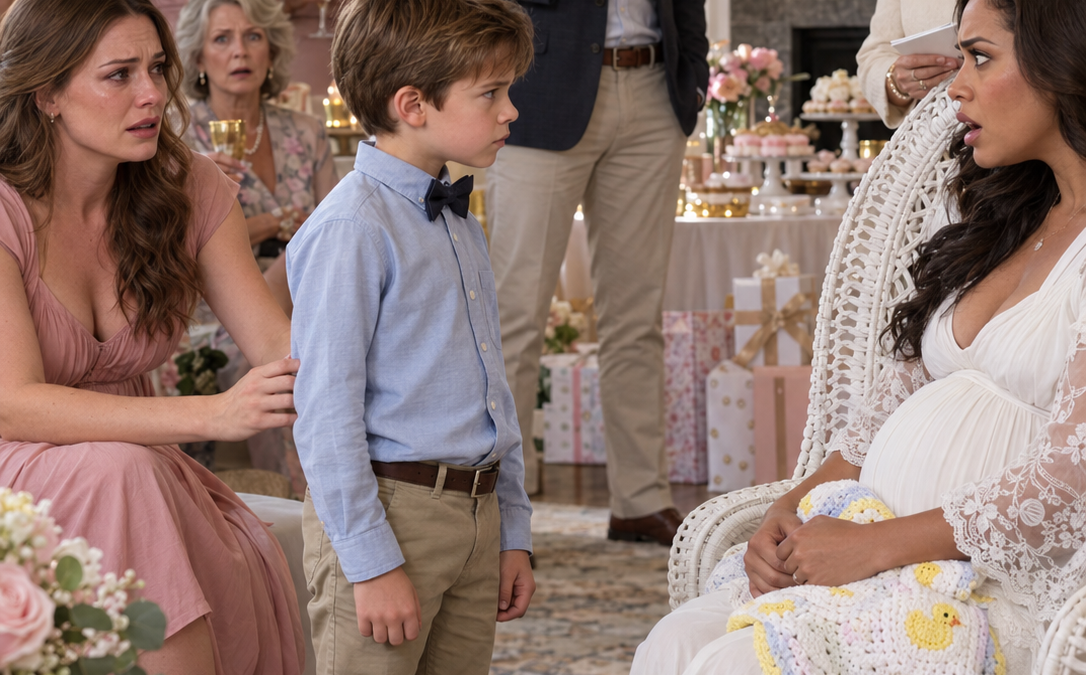
Nia was seated in an oversized white wicker chair in the living room that had been decorated with more flowers and a satin sash across the back that read mother-to-be. She was wearing a long white maternity dress with lace sleeves, and her hair was curled in loose waves that fell over her shoulders.
She looked, I will admit, radiant.
She was seven months pregnant, and she was glowing in the way pregnant women sometimes do. And for a moment, when I first walked in, I felt genuinely happy for her.
She was my little sister. Whatever else was between us, she was about to become a mother. And I remembered what it felt like to be seven months pregnant and full of hope for the person growing inside me.
Elliot walked straight up to her and held out the gift bag.
He said, “Congratulations, Aunt Nia. My mom made this for baby B.”
Nia smiled at him, a real smile, and she took the bag and told him he was the sweetest little gentleman she had ever seen. She set the bag beside her chair with the pile of other gifts and gave Elliot a hug.
He hugged her back.
And then he looked around the room slowly, carefully, like he was taking inventory.
His eyes stopped on Mike, who was standing near the fireplace with a glass of something in his hand, talking to one of my mother’s book club friends.
Elliot’s face went very still.
Mike waved at him.
Elliot did not wave back.
He came and sat down next to me on the love seat by the window, and he pressed his little shoulder against my arm and did not say anything for a long time.
The shower proceeded the way these things do.
There were games. Guess the baby food flavor. Measure the mother’s belly with a piece of ribbon. Write a piece of advice for the parents on a paper card and drop it into a decorated jar.
Mike participated in some of the games, laughing loudly, hamming it up for the guests.
He was charming.
He was the kind of man who knew exactly how to be charming.
And I watched the women in the room fall for it one by one, telling Nia how lucky she was, how devoted he seemed, what a wonderful father he was going to be.
I sat quietly.
I ate a cucumber sandwich. I helped Elliot get a cup of pink lemonade from the drink table. I complimented my mother’s decorating when she came over to check on me.
I did everything right.
I was the version of myself I had promised I would be that morning in the car: polite, small, invisible.
And then it happened.
Nia was seated back in her wicker chair opening gifts. My mother was sitting on a stool beside her with a notepad, writing down who had given what so that thank-you cards could be sent later.
Aunt Miriam was passing out slices of a lemon cake that had been decorated with tiny sugar flowers. The room was warm with laughter, and the golden late-afternoon sunlight was coming through the tall front windows and making everything look softer than it actually was.
Nia reached for the gift bag Elliot had given her.
She pulled out the quilt.
She unfolded it slowly, and for a moment, I thought I saw her face soften. She ran her hand over the little ducks. She traced the initials in the corner.
Then she looked up at the room and laughed, a bright, brittle laugh, and she held the quilt up for everyone to see.
She said, “Oh, look, everyone. My sister made this by hand. Isn’t that so sweet, so old-fashioned?”
A few of the women murmured polite compliments. One of my cousins said it was beautiful. My mother said nothing.
Nia set the quilt on her lap, and she smiled at me across the room.
It was not a warm smile.
It was the smile she had been giving me since we were children—the one that meant she was about to say something that would sound harmless to everyone else but would land like a knife in my ribs.
She tilted her head.
“Thank you, Delaney. It really is so thoughtful, and honestly, it must be so nice to have all that extra time on your hands since you don’t have a husband to take care of you.”
Several people laughed.
A short, uncomfortable ripple of laughter that some of them tried to swallow back into their throats.
My mother’s friend Beverly actually clapped her hands together once, like it was a joke she had been waiting for.
I felt my face go hot.
I opened my mouth to say something. Anything.
But before I could get a word out, Nia kept going.
“I mean, at least my baby is going to have a father, right? So I guess he won’t need a handmade quilt to feel loved.”
The room went a little quieter after that.
Not silent. Just quieter, the way a crowd gets when it senses that a line has been crossed but nobody wants to be the one to point it out.
My mother put her hand on Nia’s arm and gave her a look that was supposed to look disapproving, but her mouth was already curling at the corner.
She said softly, but loud enough for the room to hear, “Oh, honey, don’t tease your sister. Some women just make bad choices, and we have to be gracious about it.”
I felt Elliot stiffen beside me on the love seat.
His whole little body went rigid.
I put my hand on his knee to steady him, to tell him without words that it was okay, that we were fine, that we would leave in a few minutes and go home and forget any of this had happened.
I could feel the tears rising in my throat, but I refused to let them out.
I would not cry in this room.
I would not give them that.
But Elliot was not looking at me.
He was looking at Mike.
Mike was laughing along with the other guests. Actually laughing. Holding his drink and shaking his head and grinning at my humiliation like it was the best entertainment he had seen all week.
That was when my son stood up.
He was small. He barely came up to my shoulder when I was sitting down, but he stood up in his little blue button-down shirt and his crooked bow tie, and he walked into the middle of the living room.
Every single person in that house turned to look at him.
He stopped in the exact center of the room between Nia’s wicker chair and the love seat where I was sitting.
He did not look at me.
He did not look at my mother.
He looked directly at his aunt Nia.
Then he turned his head and looked at Mike.
Then he turned back to Nia.
His voice was small, but it was clear.
“Aunt Nia, should I tell everyone about Uncle Mike’s other family?”
For a second, I thought I had misheard him.
I saw the words in the air before I understood them. I watched them travel across the room like a slow, terrible bird.
I saw them land on Nia’s face.
I saw her mouth open.
I saw the color drain from her cheeks in real time, from pink to gray to something almost green.
The photographer, who had been quietly circling the room, lowered her camera.
Mike laughed.
It was a nervous laugh, a small choked sound that came out too fast.
“Buddy, what are you talking about? Come on now.”
Elliot did not turn to look at him.
He kept his eyes on Nia.
“At the party in April, in the backyard, you were on the phone and you said ‘I love you too’ to somebody, and then you gave me $5 and told me not to tell. And then last time we came to visit, when you took me to get ice cream while Mommy stayed home, you drove to a house that wasn’t yours.
“There was a lady there and two kids. You told me to wait in the car. You said if I told anyone, you would tell my mom I was bad at school.”
The silence in the room became something you could feel on your skin.
Nobody moved.
Nobody breathed.
I stared at my son.
I did not know about any of this.
The ice cream trip. The lady. The two children.
He had never told me.
He had kept it inside his little seven-year-old chest for weeks, months, waiting to be sure of what he had seen.
And now he was sure.
Nia turned her head very slowly toward Mike.
Her hand was still on the quilt in her lap. Her fingers had gone white where they gripped the fabric.
“Michael.”
She did not raise her voice.
She just said his name.
Mike put his glass down on the mantel. His hand was shaking.
He tried to laugh again, but it did not work this time.
“Sweetheart, he is a little kid. He is making up stories. You know how kids are.”
My aunt Miriam stood up from the couch. She was 63 years old, and she had been married for 41 years to my uncle Robert, and she was the kind of woman who did not tolerate nonsense.
She walked to the center of the room and stood next to Elliot. She put her hand on his shoulder and looked at Mike.
“Michael, is this true?”
Mike opened his mouth.
Nothing came out.
One of my cousins, Sabrina, who had been quiet the entire party, pulled out her phone.
I watched her type something very quickly.
Then she looked up at Mike, and her face changed.
She said out loud to the whole room, “Oh my God.”
She turned her phone around and held it up.
On the screen was a Facebook page. The profile picture was Mike standing next to the same woman from the community newsletter photograph I had found, with the same two children.
The account name was Karine Dacroa.
There was a post from just the day before, a photograph of Mike helping the little boy with a science project at a kitchen table with the caption, “My husband, the world’s best dad.”
Nia made a sound I had never heard from another human being.
It was not quite a scream.
It was not quite a cry.
It was something rawer than either of those. Something that came from a place inside her that had never had to make a sound before.
She stood up.
Her white dress had caught on the arm of the wicker chair, and she yanked it free.
I heard the lace tear.
She pointed at Mike.
Her whole hand was shaking.
“You told me she was your ex. You told me the divorce was almost final. You told me those kids were from a previous marriage that ended years ago. You told me.”
Mike started to move toward her.
“Nia, honey, let me explain. This is not what it looks like. We can talk about this in private.”
My mother stood up, too.
She had been sitting so still on the stool that I had almost forgotten she was there. She turned to Mike with the notepad still in her hand, and I watched something happen to her face that I had never seen happen before.
My mother, who had spent my entire life defending the wrong people and blaming me for their choices, looked at Mike Dacroa—the man she had welcomed into her home and served dinner to and bragged about to her book club—and said, “Get out of my house.”
Mike tried to reach for Nia.
He tried to grab her arm.
Aunt Miriam moved between them faster than a woman her age should have been able to move.
She put herself between Mike and my sister.
“One more step and I am calling the police. You understand me?”
Mike stopped.
He looked around the room at all the pastel dresses and the flower garlands and the tray of lemon cake sitting half-eaten on the coffee table.
And he saw what I had already seen.
There was no version of this where he walked out with anything left.
Every woman in that room was looking at him like he was something they had scraped off their shoe.
There were no allies here.
There was no charm that could save him now.
He turned and walked out of the living room.
His footsteps sounded very loud on the hardwood floor.
The front door opened and closed. A car engine started outside.
Then he was gone.
Nia collapsed back into the wicker chair.
My mother went to her and put her arms around her. Nia was sobbing the kind of sobs that shake the whole body, and my mother was rocking her the way she used to rock her when she was a little girl scared of thunder.
The other guests began very quietly to gather their purses. Some of them slipped out the back door. Some of them hugged Aunt Miriam on the way out.
Nobody knew what to say to me or to Elliot, so nobody said anything to us at all.
Elliot came back over to the love seat.
He climbed up next to me and pressed his face into my side.
I could feel him trembling.
He was not crying, but he was trembling the way small animals tremble after a loud noise.
I wrapped my arms around him and held him against me. I whispered into his hair that I was so proud of him, that he had done the right thing, that he was the bravest boy I had ever known.
He whispered back that he was sorry he had not told me sooner.
I told him he did not need to be sorry for anything.
Across the room, Nia lifted her head from my mother’s shoulder. Her mascara had run in dark streaks down her cheeks.
She looked at me for the first time in maybe 15 years.
She looked at me like I was a real person and not a shadow standing at the edge of her life.
“Delaney.”
I did not answer.
I did not know what to say.
I did not know if she wanted comfort or an apology or if she was going to blame me for what had just happened, for bringing my son into her house, for letting him see what he had seen.
But she did not blame me.
She just kept saying my name softer and softer until it dissolved into more crying.
My mother looked up at me.
Her face was wet, too.
She opened her mouth to say something, but she could not seem to find the words.
In the end, all she managed was, “I did not know.”
I nodded.
I gathered Elliot’s things. I picked up his little suit jacket that he had draped over the arm of the love seat.
I stood up, took his hand, and led him toward the front door.
Before we walked out, I turned back once.
I looked at my sister in her torn white dress, my mother kneeling on the floor beside her, the pile of unopened baby gifts, and the quilt with the little ducks and the initials for a baby who would never carry his father’s name in the way he had been promised.
I said quietly, “We will talk when you are ready.”
Then I took my son home.
We did not speak much on the drive back.
Elliot sat in the back seat and stared out the window, and I gripped the steering wheel so hard my knuckles ached.
When we pulled into the parking lot of our apartment building, he unbuckled his seat belt, but he did not get out.
He just sat there.
I turned around in my seat and looked at him.
He asked me in a very small voice if he had done something bad.
I got out of the front seat. I opened his door, knelt down on the pavement, and pulled him into my arms.
I held him so tight I could feel his heartbeat against my chest.
I told him no.
I told him he had done something good.
I told him that sometimes the truth is very heavy, and it takes a very brave person to carry it. And he had carried something heavier than any seven-year-old should have to carry.
And I was more proud of him in that moment than I had ever been of anything in my entire life.
He started to cry then.
He had held it in all through the drive. And now that we were home and it was just the two of us, he let it out.
He cried into my shoulder for a long time.
I sat down right there on the asphalt in my pink sundress and let him cry.
I did not tell him to stop.
I did not tell him to be a big boy.
I did not tell him that everything was going to be fine.
I just held him.
When he was done, we went upstairs.
I made him grilled cheese for dinner because it was his favorite. He ate two whole sandwiches.
Then we sat on the couch and watched a cartoon about a family of penguins. By the time the credits rolled, he was asleep with his head on my lap.
I carried him to bed.
I took off his little bow tie and folded it carefully and set it on his dresser. I changed him into pajamas without really waking him up.
I kissed his forehead.
Then I closed his door quietly, went into the living room, sat on the couch, and stared at the wall for almost an hour.
My phone had been buzzing since we left my mother’s house.
I had turned off the ringer in the car.
Now I picked it up and looked at it.
Fourteen missed calls. Twenty-three text messages.
Most of them were from my mother. A few from Aunt Miriam, two from my cousin Sabrina, and one from a number I did not recognize that just said, “Please call me when you can. It is Nia.”
I did not call anyone.
Not that night.
I read the messages from my mother. Some of them were apologies. Some of them were long explanations about how she had never known Mike was married, how she had been fooled just like everyone else, how she felt sick to her stomach about what had been said at the shower.
One of them near the end said, “Delaney, I know I have not always been the mother you needed. Please forgive me.”
I read that one three times.
Then I set the phone down and went to bed.
The next morning, Elliot woke up and asked me if we could have pancakes.
I made him pancakes.
He asked me if Aunt Nia was going to be okay.
I told him I did not know yet, but that we were going to be okay, and that was the important part.
He seemed satisfied with that answer.
He went to play with his Legos on the living room floor, and I sat at the kitchen table with my coffee and called Aunt Miriam.
She picked up on the first ring.
She said my name like she had been waiting all night to say it.
She told me she had stayed with my mother and Nia until almost midnight. She told me Nia had thrown up twice from crying so hard, and she had made her drink water and lie down.
She told me my mother had spent hours sitting on the edge of Nia’s old bed, holding her hand, apologizing for not seeing what Mike was.
She told me nobody had slept much.
Then she told me the part I had not expected.
After Nia finally fell asleep, my mother had sat down at the kitchen table with her, and my mother had cried harder than she had cried at my father’s funeral in 2008.
My mother had said out loud to Aunt Miriam that she had spent 17 years destroying her older daughter and she did not know if it was too late to fix it.
I put my coffee cup down.
My hand was not steady.
Aunt Miriam said, “Delaney, I am not telling you this to pressure you. I am not telling you to forgive anyone before you are ready. I just want you to know that something broke open in that room yesterday, and I do not think your mother is going to be able to close it back up.”
I thanked her.
I told her I loved her.
I hung up.
I sat there for a long time.
Elliot was in the living room building a spaceship and humming to himself.
The next call I made was to Sabrina.
She was younger than me by five years, one of my cousins from my mother’s side. We had never been close, but there had always been something between us, a mutual understanding that we were both women in a family that did not always see us.
When she answered the phone, she told me she had been thinking about me all night.
She told me she had spent an hour after the shower digging into Mike’s social media, and she had found more than just the Facebook page.
She had found Karine Dacroa’s Instagram, which was public. She had found the school district website that listed Mike as a member of the parent-teacher association at an elementary school in Hudson, Ohio.
She had found a photograph from just three weeks earlier at his son’s ninth birthday party where Mike was standing behind a cake shaped like a race car with his arm around his wife and his two children.
She asked me if I wanted her to send it all to Nia.
I thought about it for a moment.
Then I told her yes.
I told her Nia deserved to see all of it.
I told her to send it to my mother too, so that when Nia was ready to look, my mother could sit with her while she did.
Sabrina told me she was proud of me.
She told me she had watched Elliot stand up in the middle of that living room and it had been the bravest thing she had ever seen a child do.
She told me I had raised a very good boy.
I told her his father had nothing to do with it.
She laughed a little at that.
Then she told me she loved me, and we hung up.
I did not call Nia.
Not that day. Not the next.
I needed time.
I needed to sit with what had happened. I needed to be sure that when I did talk to her, I would say the right things and not the things I had been holding back for 15 years, sharpened and waiting.
She called me twice on Sunday.
She called me three times on Monday.
She sent me a long text message on Tuesday morning that I read once and then set aside.
She was not asking me to fix things immediately. She was asking me to talk to her when I could.
She said she understood if I needed time.
She said she was sorry for what she had said at the shower.
She said she was more sorry than she knew how to say for the years before that.
On Wednesday evening, after Elliot was in bed, I sat down at the kitchen table with a glass of water and called her back.
She picked up on the first ring, just like Aunt Miriam had.
We did not say much at first.
She cried a little.
I let her.
Then, when she could speak, she asked me if I would come over to my mother’s house that weekend, just the three of us.
She said she needed to tell me some things in person. She said she needed to hear some things from me, too.
I told her I would come.
I told her I would come on Saturday afternoon and I would come alone, without Elliot, because whatever was going to happen between the three of us was not something my son needed to witness.
He had witnessed enough.
She agreed.
She thanked me.
Before we hung up, she whispered, “I don’t deserve for you to come, Delaney.”
I told her that was not really the point.
I hung up.
I finished my water. I turned off the kitchen light and went to check on Elliot.
He was sleeping on his side with his stuffed elephant tucked under his arm. His breathing was slow and steady.
I watched him for a long time.
Then I went to bed and tried, for the first time in almost 15 years, to imagine what it might feel like to have a family that actually saw me.
Saturday came slowly.
I dropped Elliot off at his friend Jackson’s house for the afternoon.
Jackson’s mother, a woman named Raina who worked at the same dental office as me, gave me a hug at the door and told me she had heard bits and pieces of what had happened at the shower.
She told me to take as much time as I needed and not to rush back.
I hugged her tighter than I meant to.
Elliot ran into the backyard without looking back.
I drove to my mother’s house with the windows rolled down.
It was a hot afternoon in late June, and the air smelled like cut grass and someone’s charcoal grill.
I turned onto her street and saw her car in the driveway and Nia’s little white sedan parked behind it.
I sat in my Honda for almost five minutes before I could make myself get out.
My mother opened the door before I could knock.
She was wearing jeans and a plain gray T-shirt, and her hair was pulled back in a low ponytail. She was not wearing any makeup.
I had almost never seen her without makeup.
She looked older than I remembered.
She looked tired in a way that seemed to reach all the way down into her bones.
She did not try to hug me.
She just stepped aside and let me in.
Nia was sitting at the kitchen table.
She was wearing a soft pink sweatshirt and leggings. Her hair was in a messy bun, and her eyes were swollen and red-rimmed.
There was a mug of tea in front of her.
There was another mug set out for me, a third for my mother.
I sat down.
My mother sat down.
Nia wrapped her hands around her mug and stared into it like it might tell her what to say.
After a long silence, she started to talk.
She told me that Mike had come to the house the night of the shower, banging on the door, begging to be let in, telling her that Karine meant nothing, that he was going to leave her, that Bo was the only child he really wanted.
Nia had not opened the door.
My mother had called the police.
Mike had left before they arrived, but there was now an official record of the incident, and Nia had spent the following Monday morning at a lawyer’s office filing for a restraining order.
She told me that Karine, Mike’s actual wife, had messaged her on Sunday afternoon.
Karine had known nothing.
Karine had believed her husband was traveling for work every other weekend when he was actually with Nia.
Karine had two children with him, a nine-year-old boy and a six-year-old girl, and she had been married to Mike for 12 years.
She had cried on the phone with Nia for almost an hour.
They were, in a strange and terrible way, both survivors of the same man.
Nia told me that she was going to raise Bo alone.
She had already decided.
She was not going to fight for Mike.
She was not going to try to keep him.
He had asked her in one of his last messages before she blocked his number if they could work something out, some kind of arrangement, and she had told him that her son was not going to be a side family.
She had told him he could see Bo through a lawyer when Bo was old enough to ask questions and not before.
She looked up at me for the first time since I had sat down.
Her eyes were full of tears again, but she did not let them fall.
“Delaney, I owe you more apologies than I have words for.”
I did not say anything.
I let her keep talking.
She told me that she had spent the entire week thinking about the things she had said at the shower, about her handmade-quilt comment, about the “at least my baby has a father” line, about the way she had laughed while people clapped for her cruelty.
She told me that she had said those things because she had wanted, for one afternoon, to feel like she had something I did not have.
She told me that she had grown up watching me be quietly better than her at almost everything, and she had let our mother’s favoritism convince her that it was okay to punch downward, to make me smaller so that she could feel bigger.
She told me that she was ashamed.
She told me that Elliot standing up in that living room had not just exposed Mike.
He had exposed her, too.
He had shown her in one clear sentence that the little boy she had spent seven years mostly ignoring was more perceptive, more courageous, and more loving than she had ever bothered to notice.
She said she had lain in bed on Sunday night and thought about the fact that a seven-year-old had known her fiancé was cheating on her before she had known it herself.
And it was because he had been watching.
He had been watching because he loved his mother, and he did not want his mother to be hurt by anyone else in her family.
She said, “Delaney, your son is more of a man at seven than Mike has been his entire adult life.”
I felt the tears finally come.
I did not try to stop them.
I let them slide down my face while I sat in my mother’s kitchen holding a mug of tea that I had not taken a single sip of.
Then my mother started to talk.
She spoke slowly, like she was choosing each word carefully.
She told me that she had spent the whole week going back through her memory, trying to figure out when she had stopped seeing me.
She thought it had started when my father died.
She had been so afraid in those first months of losing another person.
Nia had been 13, small and clingy and openly grieving, while I had been 17 and quiet and holding myself together in a way that had made my mother believe I did not need her.
She told me that had been a lie she had told herself.
That everyone needs their mother no matter how strong they seem.
That I had been a child too.
That I had lost my father too.
And she had let me disappear into the background of our family because it had been easier than trying to hold both of her daughters at the same time.
She told me about the college fund.
She told me that she had known when she gave it all to Nia that it was wrong. She had known, and she had done it anyway because Nia had cried and I had not, and she had rewarded the crying without thinking about what it taught both of us.
She told me about Julian.
She told me she had known within a month of meeting him that something was off about him, but she had not said anything because she had not wanted to be the mother who ruined her daughter’s happiness.
And then, when he left, she had blamed me because it had been easier than blaming herself for not warning me.
She told me she had been a terrible mother to me.
She used those exact words.
A terrible mother.
She said she did not expect me to forgive her.
She said she was not asking me to forgive her.
She said she was just asking me to let her try, from this point forward, to be something better. Not for her own sake, for mine and for Elliot’s.
I sat there for a long time.
I did not know what to say.
I had spent so many years imagining a version of this conversation, and now that it was actually happening, I found that I did not have a speech prepared.
I did not have a list of grievances I wanted to read out loud.
I just had one question.
I asked my mother why now.
She looked at me.
“Because your seven-year-old was braver than I have ever been.”
I nodded.
I picked up my mug.
I took my first sip of tea.
It had gone cold, but I drank it anyway.
Then I set the mug down and told them both something I had never told either of them before.
I told them that I had raised Elliot to notice things because I had spent my whole childhood not being noticed.
I told them that every book I had read to him, every question I had answered patiently, every hard conversation I had not shied away from had all been an attempt to build a person who would grow up understanding that other people were real and that their feelings mattered.
I told them that I had done that alone.
Without help from either of them.
Without money from Julian.
Without a single evening off in seven years.
And I told them that if they wanted to be part of Elliot’s life going forward, and part of mine, they were going to have to earn it.
I was not going to hand it to them.
I was done handing things to my family and getting nothing back.
Nia nodded.
My mother nodded.
Neither of them tried to argue with me.
We sat in that kitchen for another two hours.
We talked about things I had never talked about with them before.
And when I drove home to pick up Elliot from Jackson’s house, I did not feel healed.
I did not feel like everything was fixed.
But I felt, for the first time in a very long time, like I was seen.
Weeks passed, and then a month, and then another.
Summer turned into the beginning of fall.
Elliot started second grade in August, and I stood on the sidewalk outside his new classroom and watched him walk in with his new backpack.
I did not cry until I got back to the car.
My mother started calling me, not once every few months the way she used to, but twice a week, sometimes more.
At first, the calls were awkward. She would ask about Elliot and about work and about the weather, and she would run out of things to say, and there would be a long silence, and then she would tell me she loved me and hang up.
But slowly, over the weeks, the silences got shorter.
She started asking me real questions.
She asked me about the dental office. She asked me about the community college class I was taking on the weekends to become a dental hygienist supervisor.
She asked me if I needed anything.
The first time she offered to babysit Elliot so I could have an evening to myself, I almost said no out of habit.
Then I stopped myself.
And I said yes.
She came over on a Thursday night in September. She brought a homemade lasagna and a coloring book for Elliot.
She stayed with him for four hours while I went to a movie by myself for the first time in almost eight years.
I sat in the dark theater with a bucket of popcorn on my lap and cried through half the film.
It had nothing to do with the movie.
Nia was a different story.
She was seven months pregnant, and then eight months pregnant, and then approaching her due date, and she was doing it alone.
She had moved out of the apartment she had shared with Mike and moved back into my mother’s house temporarily.
She had found a therapist, a woman named Dr. Iveta Molnar, who specialized in helping women recover from what she called intimate partner deception.
She was going twice a week.
She started reaching out to me too.
Small things at first.
She sent me a picture of an ultrasound in the middle of July.
She texted me a link to an article about single motherhood in August and asked if she could ask me some questions about it.
Sometime in early September, she invited me over for lunch, just the two of us.
I went.
It was uncomfortable in some ways.
She apologized twice more before we even sat down at the table.
But by the end of lunch, we were laughing about something a cashier had said to her that morning at the grocery store, and it felt for a moment like we were sisters instead of strangers.
Bo Michael Dacroa was born on the 14th of September 2025, except he was not named Michael Dacroa anymore.
Nia had legally changed her plan.
He was born Bo Prescott, taking our family name, the name our father had passed down to us before he died.
Nia had made the decision on her own without asking my mother or me.
She told me later that she had wanted to give her son a name that stood for the family that would actually raise him, not the man who had lied about being part of it.
I went to the hospital the day after he was born.
I brought a small bouquet of daisies and a little stuffed rabbit, and Elliot, who had begged me to let him come.
He walked into the hospital room holding my hand, and he saw the little baby wrapped in a blanket in his aunt’s arms, and his whole face lit up in a way I had not seen since he was a much smaller child himself.
Nia looked up at us.
She was exhausted.
Her hair was a mess. There were dark circles under her eyes.
But she smiled at Elliot and held out her free arm.
“Do you want to come meet your cousin?”
Elliot climbed carefully onto the edge of the hospital bed.
Nia moved the baby so that Elliot could see his face.
Bo was tiny.
He had a full head of dark hair and a little pink mouth and one hand that was wrapped around his own tiny thumb.
Elliot stared at him for a long time.
Then he looked up at his aunt.
He asked her if the baby was going to be okay.
Nia’s eyes filled with tears.
She told him that yes, the baby was going to be okay because he had a lot of people who loved him.
She told Elliot that she was going to try to be a really good mother, and she was going to try to be a really good aunt, and she was sorry she had not been a very good one before.
Elliot considered this for a moment.
Then he said, “That’s okay, Aunt Nia. Everybody can learn.”
I stood in the doorway of that hospital room and looked at my son sitting on the bed next to my sister, holding her newborn baby’s tiny hand between his own two fingers.
And I thought about the little boy who had stood up in the middle of our mother’s living room in June and told the truth.
He had not just broken open the lie about Mike.
He had broken open something in all of us.
And now, three months later, we were being rebuilt.
Not fixed.
Rebuilt.
There is a difference.
That fall was strange and beautiful in a way I had never expected.
My mother took Elliot to the pumpkin patch in October.
She had never done that with him before.
She sent me pictures. Elliot was holding a pumpkin almost bigger than his head, and my mother was standing next to him in a red flannel shirt, and both of them were grinning.
Nia asked me if I would consider being Bo’s godmother.
I said yes.
She cried.
I cried a little too.
My mother baked a cake for the little ceremony we did at the house. Aunt Miriam brought her famous potato salad. My cousin Sabrina came with her two toddlers.
And we all sat around my mother’s dining room table for the first time in years and ate together like people who actually wanted to be in each other’s company.
But there was still a shadow.
There was still something we had not talked about.
And by November, I could not put it off any longer.
I asked my mother one evening, while we were sitting on her back porch watching Elliot chase leaves in the yard, about the college fund.
The one my father had started for both of us.
The one she had given entirely to Nia.
She was quiet for a long time.
Then she told me that she had known this conversation was coming.
She had been waiting for it.
She had actually been preparing for it in her own way.
She told me that when my father died, the account had a little over $60,000 in it.
He had been putting money in it since I was born, and he had continued after Nia was born, and by the time he passed away, it was intended to be split evenly between the two of us.
My mother had not split it.
She had given all of it to Nia over the years in small installments for tuition and books and living expenses.
My mother told me that she had been putting money aside in a savings account of her own since June, since the shower.
She had been trying to figure out how to make things right.
And she had realized that no apology was going to mean anything if she did not also try to give back what she had taken.
She told me she had put $22,000 into an account for me.
It was not the full 30 that had been my share.
She was going to keep adding to it, she said, until it reached that number, but she wanted me to have access to it now.
She wanted me to use it for whatever I needed.
For Elliot’s future.
For my own education.
For a down payment on a small house, if that was what I wanted.
I did not know what to say.
I sat there in the porch chair with my hands wrapped around a mug of coffee, and I watched my son jumping in a pile of red and yellow leaves.
I thought about the 17-year-old girl who had watched her mother sign paperwork to move that money out of her name.
And I thought about all the nights I had worked doubles at the diner because there had been no other way.
I told her thank you.
I told her I did not know how I felt about it yet.
I told her I would need to sit with it for a while.
She nodded.
She said she understood.
She said the money would be there whenever I was ready.
Then she put her hand on top of mine, just for a moment.
It was the first time she had touched me in that particular way since I was a child.
And she said, “Delaney, I know I cannot undo what I did, but I am going to spend the rest of my life trying to be your mother in the way you should have had one.”
I did not answer her out loud.
I just turned my hand over under hers and squeezed her fingers, and I let her keep her hand there until the sun went down.
The trouble came at the end of November, and it came from a direction I had not been watching.
Mike Dacroa had been quiet for months.
After the shower, after Nia had blocked him and filed the restraining order, he had disappeared from our lives the way he had once appeared in them—quickly and without warning.
Karine had filed for divorce in July.
We had heard through the grapevine, mostly from Sabrina, who had stayed loosely in touch with a mutual acquaintance, that Mike had been fired from his sales director job in August after the company caught wind of the personal scandal.
He had moved out of the family home in Hudson.
His whereabouts for a while had been a mystery none of us cared to solve.
One Tuesday in late November, Mike showed up at Nia’s lawyer’s office demanding paternity rights.
The lawyer warned him about the restraining order, but he caused a scene before leaving.
Nia was terrified, so I went to my mother’s house after work.
We discussed the legal situation with Aunt Miriam.
The lawyer advised Nia to document everything, noting judges often favor biological fathers.
Aunt Miriam suggested hiring a private investigator named Paragan Vance to look into Mike’s life.
My mother insisted on paying for it, refusing to let Nia spend her savings.
A week later, Paragan revealed Mike was living with a pregnant woman named Simone, who thought he was a widower.
Paragan also found Mike’s hidden criminal record from Michigan, where he committed identity fraud and racked up almost $15,000 in debt.
Nia decided to warn Simone, sending her the proof.
Simone believed her, kicked Mike out, and Nia spent hours comforting her.
Another ex, Karine, joined them, and the three women formed a support group.
Realizing he was out of options, Mike stopped contacting them and eventually disappeared.
Christmas was incredibly warm.
My mother hosted a large, loving gathering.
She gave me a genuine hug, something she rarely did.
During the gift exchange, she handed me an envelope containing a check for $30,000.
It was the full inheritance my father had intended for me.
I unfolded the note.
It was written in my mother’s careful, slanted handwriting.
It said, “Delaney, your father wanted you to have this. I am sorry it took me 17 years to give it to you. I am prouder of the woman you became without it than I have any right to be. Please use it for yourself, not for anyone else. For you.”
I did not cry in front of everyone.
I tucked the check and the note back into the envelope and put it in my purse.
I got up from the couch.
I walked over to my mother, who was sitting in her armchair.
I bent down and kissed her on the cheek.
I whispered, “Thank you.”
She squeezed my hand.
Nia was next to us on the couch.
She was watching.
She was smiling with her whole face, without any bitterness, without any competition, without any of the old poison.
She said out loud, “Dad would be so happy right now.”
My mother said, “Yes, he would be.”
We finished the morning quietly.
Aunt Miriam pulled out a deck of cards and taught Elliot how to play a game that our grandmother had taught her when she was a child.
Uncle Robert fell asleep in the armchair.
Bo went down for a nap in a portable bassinet in the corner of the living room.
I sat on the floor next to my son while he studied his cards with the seriousness of a professional poker player.
At one point, my mother came over and sat on the floor next to us.
She was almost 70 years old, and she sat down on the floor of her own living room in her red apron, and she watched Elliot play cards with her sister.
Then she leaned her head briefly against my shoulder.
Elliot looked up.
He saw the two of us sitting there, his grandmother’s head on my shoulder.
He did not say anything about it.
But he smiled.
A small, private smile, the kind he made when a puzzle piece finally fit.
Later, when everyone had gone home and Elliot was asleep on the guest bed at my mother’s house, my mother and I stood in her kitchen washing dishes together.
It was late.
The house was quiet.
Bo was asleep in Nia’s arms in the living room, and Nia was dozing beside him on the couch.
My mother handed me a wet plate.
I dried it and set it in the drying rack.
She said without looking at me, “Delaney, I want to ask you something, and I want you to say no if you need to.”
I asked her what it was.
She told me she wanted us to have a real conversation once a week from now on, just her and me.
She said she wanted to know me.
She said she had spent 34 years being the mother of someone she had never bothered to get to know, and she did not want to spend another year that way.
She said she did not know how much time she had left in her life, but whatever it was, she wanted to spend a piece of it every week learning about her older daughter.
I stood there with a dish towel in my hand.
I looked at my mother, at the lines around her eyes and the gray in her hair and the way her hands moved carefully in the soapy water.
I said, “Yes.”
I said, “Yes, I would like that.”
She nodded.
She kept washing.
Then she said one more thing.
She said that if I ever wanted to bring a friend to family dinner, or a person I was dating, or anyone at all, she wanted me to know that they would be welcome.
She wanted me to know that she would not judge them and she would not compare them to Julian and she would not make anyone feel small.
I smiled a little.
I told her I was not seeing anyone.
I told her I had not really thought about that in a very long time.
She said, “Well, when you are ready, if you are ever ready.”
I dried the last plate.
I set it in the rack.
I turned off the light in the kitchen and walked with my mother in the dark back to the living room, where my sister was asleep with her baby and where my son was breathing softly in the next room and where my life at 34 years old had finally, quietly, begun to feel like something that belonged to me.
It is now late in 2025, and I am sitting at the kitchen table of a house that belongs to me.
Not to a landlord.
Not to a memory of a man who left.
To me.
I used the money my mother gave me back, combined with the savings I had built one $12 tip at a time and then one dental hygienist paycheck at a time over the past 15 years, and I put a down payment on a small three-bedroom house in a quiet neighborhood about 10 minutes from Elliot’s school.
It has a yellow front door because when we went to look at it, Elliot walked up the front walk and told me that a yellow door meant a happy house.
The realtor laughed.
I did not.
I understood exactly what he meant.
We moved in during the third week of October.
The first night, we slept on mattresses on the floor because the movers had not yet delivered the bed frames.
Elliot lay next to me in the dark and asked me if this was really our house forever.
I told him it was really ours and it was really forever, or at least for as long as we wanted it to be.
He was quiet for a while.
Then he told me that he loved me.
Then he fell asleep.
Elliot is eight years old now.
His birthday was in November, and my whole family came to celebrate.
My mother baked him a cake shaped like a rocket ship.
Nia brought Bo, who is almost four months old and has recently discovered that he has feet.
Aunt Miriam brought her potato salad because Aunt Miriam brings potato salad to everything.
Sabrina brought her toddlers, who chased Elliot around the backyard for two hours until he collapsed on the grass laughing.
I stood on the back porch and watched them all.
My family.
My real family.
The one that had taken 34 years to arrive.
Nia came out and stood next to me.
She had Bo in a little carrier strapped to her chest.
She leaned against the porch railing and took a long breath of the cold November air.
She told me that she still had bad days.
She told me that some mornings she woke up and remembered how she had felt at that shower in June, laughing at me while everyone clapped, and she wanted to disappear into the mattress.
She told me that Dr. Molnar had told her that guilt is only useful if it changes you.
And once it has changed you, you have to let it go, because holding on to it forever is just another form of self-indulgence.
I told her I thought Dr. Molnar sounded very wise.
Nia laughed.
“She is, mostly—except when she asks me how I feel about things and I want to throw my coffee at her.”
We stood there for a while watching Elliot swing Bo’s little bare feet in the air while he made him giggle.
She told me that she was going back to school in January.
She had enrolled at the community college.
She was going to study early childhood education.
She said she wanted to work with children.
She said it was partly because Bo had made her love children in a way she never had before, and partly because Elliot had shown her what it looks like when a child is truly seen, and she wanted to be someone who helped other children feel that way.
I told her I was proud of her.
She looked at me, and her eyes filled with tears the way they had been doing on and off for six months now.
And she told me that no one had ever said that to her before.
Not really.
Not for something she had earned.
I told her I would say it again as many times as she needed to hear it.
My mother is doing well.
She is still calling me twice a week, sometimes three times.
We have started something we call Tuesday tea.
Every Tuesday evening, if Elliot has a school event or a sleepover or is otherwise occupied, my mother comes over to my new little house with the yellow door, and we sit at my kitchen table and drink tea and talk.
We have talked about my father.
We have talked about the days after he died.
We have talked about the years I spent invisible.
We have talked about the years she spent making herself smaller, too, in ways I had not understood when I was younger.
My mother is not a monster.
She was a woman who lost her husband and could not carry both of her daughters at the same time.
And she chose the one who cried louder.
And she has spent the past several months trying to make it right with the one who did not.
I have forgiven her.
Not all at once.
Not because she asked me to.
But slowly, over the weeks, in small doses, the way a body absorbs medicine.
Julian, my ex-husband, is still gone.
I heard from a mutual acquaintance in August that he had gotten divorced again from the woman he had left me for back in 2018 and that he was living somewhere in Arizona now.
I do not know if that is true.
I do not particularly care.
He has never asked to see Elliot.
He never will.
I made peace with that a long time ago.
Elliot asked me one night in late October if he was ever going to meet his dad.
He was sitting on my bed in his pajamas, and I was brushing my hair at the little vanity by the window.
I set the brush down.
I turned around.
I looked at him.
I told him the truth.
I told him that his father had made a choice a long time ago, when Elliot was a tiny baby, not to be part of our lives.
I told him that this choice had been about his father and not about him.
And I told him that if his father ever came back, we would think about it together and we would decide together what we wanted to do.
I told him that in the meantime, he had a family.
He had me.
He had Grandma.
He had Aunt Nia.
He had baby cousin Bo.
He had Aunt Miriam and Uncle Robert and cousin Sabrina and her kids.
He had more people who loved him than most children ever have.
He thought about it for a long time.
Then he nodded.
“Okay. That is enough.”
Then he asked me if he could have another cookie.
I let him have two.
I want to say something now before I end the story because I think this story has been about a lot of things, but there is one thing at the center of it that I want to make sure I say clearly.
For 15 years, I believed that being a good daughter meant being quiet.
I believed that if I just stayed small enough and worked hard enough and never asked for anything, eventually I would earn a place at the table.
I was wrong.
You do not earn a place at your own family’s table.
You already have one.
And if the people at that table refuse to see you, that is not a failure of your smallness.
That is a failure of their sight.
I did not need to shrink myself for the past 15 years.
I did not need to hand over my college fund without a fight.
I did not need to smile through baby shower cruelty.
I did not need to accept being invisible.
But I did need to raise my son with love.
And I did that.
I did need to build a life that could stand on its own.
And I did that, too.
And when the moment came in June of 2025, in the middle of my mother’s living room, I did not need to be the one to speak, because the boy I had raised—the boy who had been listening his whole small life—spoke for me.
And in the process, he freed all of us.
If you are watching this and you are the invisible daughter, or the leftover sister, or the parent doing everything alone, or the person at the family gathering who feels like they do not belong, I want you to hear this.
You are not too much.
You are not too little.
You are not the problem.
You are simply in a room full of people who have not yet learned how to see you.
And you have two choices.
You can wait for them to see you.
Or you can build a life so full and so honest that eventually you stop needing them to.
Sometimes, if you are very lucky, both things happen.
Sometimes the people who did not see you learn how, and they come back and ask in trembling voices if it is too late.
And sometimes you get to say, “No, it is not too late. Come sit down. The tea is still warm.”
And sometimes, if you are luckier still, you get a seven-year-old boy in a crooked bow tie who loves you enough to say the thing no one else in the room has the courage to say.
And you get to spend the rest of your life trying to be worthy of that kind of love.
I am trying every day.
I am trying.
Thank you for listening to my story.
If any part of it resonated with you, please give this video a like and consider subscribing to the channel so you do not miss the next one.
And if you have your own story of family, of being unseen, of finding your voice, or of a child who taught you something you did not know you needed to learn, I would love to hear it in the comments.
This world is full of quiet people carrying heavy truths.
And sometimes the most healing thing we can do is set them down together.
Take care of yourselves.
Hold your children close.








