My sister, who happens to be the bank manager, publicly embarrassed me just because i asked to “withdraw $150.” she smirked and said, “we don’t serve beggars here.” a few minutes later, i made a request for $4.2 billion – and the whole bank came to a standstill…
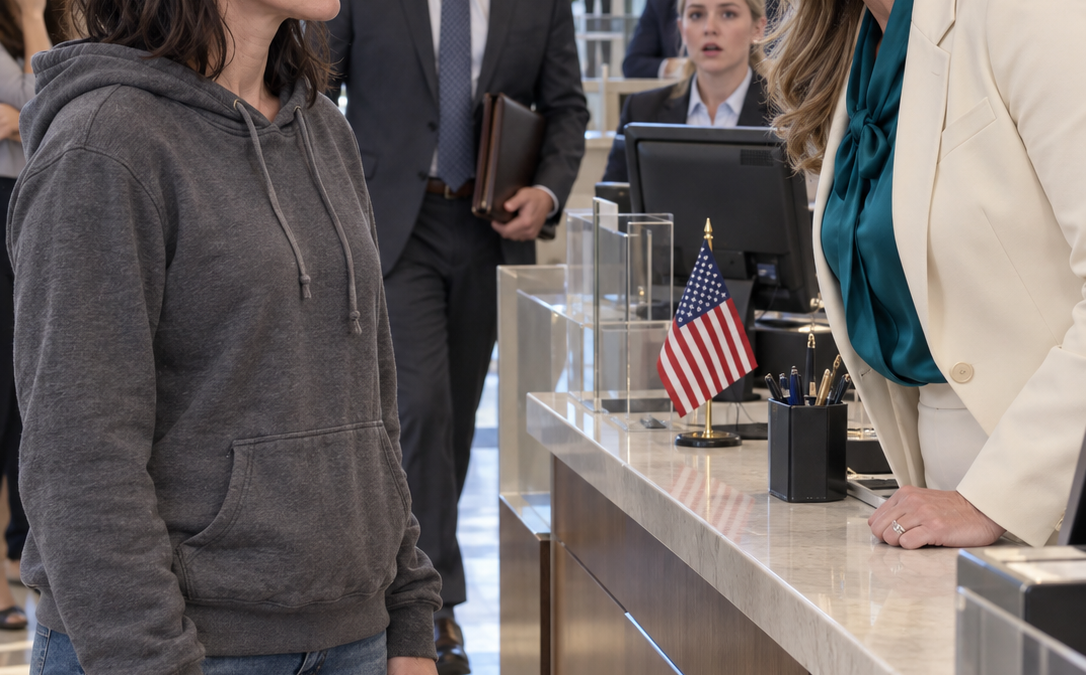
$150 cash from an old savings account I kept at this branch for exactly one reason: it was two blocks from the studio apartment I rented under my birth name.
Everything else in my life ran through different names, different institutions, different cities. But that little account, with its modest balance and its ordinary purpose, was the one my family knew about, the one Delphine could see.
Priya typed something into her computer. Then she paused. Her eyes flicked up past my shoulder, and I felt the air shift behind me before I heard the voice.
“Well, look who finally decided to grace us with her presence.”
Delphine walked out from her glass-walled office at the back of the branch, her heels clicking against the polished floor like a metronome, counting down to something ugly.
She was wearing a cream blazer, pearl earrings, and a smile that did not reach her eyes. She had dyed her hair a shade lighter since I last saw her at Thanksgiving, and it made her look sharper somehow, more corporate, more like someone who had forgotten where she came from.
“Delphine,” I acknowledged quietly. “I just need to make a withdrawal. I’ll be out of your way in a minute.”
She stopped beside Priya and glanced at my slip. Her eyebrows lifted in an exaggerated arc, and then she laughed.
Not a chuckle. A real laugh, loud enough that the man who had been humming turned to look.
“$150,” she announced loudly enough for the entire lobby to hear. “Priya, honey, are you sure this account even has that much in it?”
Priya’s cheeks flushed. She glanced at me, apologetic, then at her screen.
“Ma’am, the account has sufficient funds. I can process this right now.”
“Oh, I bet it barely has sufficient funds,” Delphine cut in, still smiling that terrible smile. “My sister here has a talent for showing up whenever rent is due. Winslow, sweetheart, did Mom finally cut you off? Is that why you’re here begging for scraps?”
The word begging hit me like a slap.
The little girl with the lollipop had gone quiet. The humming man had stopped humming. A woman near the door lowered her phone.
I kept my voice steady. “Delphine, please just let her process the transaction.”
“You know what?” Delphine went on, turning slightly so she was addressing the whole room. “Now, I really do have to draw a line somewhere. This is a professional financial institution. We serve investors. We serve business owners. We serve people who contribute. We do not serve beggars here, Winslow. If you need money, go ask Mom. Or better yet, get a real job.”
There it was, out in the open.
In front of Priya. In front of the humming man. In front of the mother and the little girl and the woman by the door. In front of the security guard who had shifted uncomfortably and was now studying his shoes.
I felt heat crawl up my neck. Not embarrassment exactly. Something colder. Something that had been building for 15 years.
One dismissive comment at a time. One Thanksgiving joke at a time. One whispered aside to relatives at a time.
Every time Delphine had reduced me to a punchline, every time our mother had shaken her head and sighed my name like it was a disappointment she had to carry.
I looked at Delphine, really looked at her, and I thought about the phone call I had scheduled for that afternoon at 2:00 with the acquisitions team from a Swiss holding group.
And I thought about the papers sitting in a locked drawer in my apartment, waiting for signatures.
And I thought about the fact that my sister, the branch manager of a midsized regional bank, had absolutely no idea who was actually standing in front of her.
I could have walked out. I could have walked back to my apartment and let the moment die.
That would have been the mature choice, the evolved choice, the one my therapist would have applauded.
Instead, I smiled. A small, quiet smile that I did not force.
“Priya,” I requested gently, “can you go ahead and process the $150?”
Priya nodded, grateful for the redirection, and her fingers flew across the keyboard.
Delphine rolled her eyes and turned to walk back toward her office, satisfied that she had made her point.
“Actually, Delphine,” I added, just loud enough to stop her. “While I have you here, I do have one more piece of banking business I’d like to discuss. Something a little larger than $150. Do you have a few minutes?”
She turned back, her mouth already curling into another dismissive smirk.
“Winslow, please. I don’t have time to help you open a checking account with $50 or whatever tiny thing you’ve dreamed up. I’m the branch manager. My calendar is full.”
“I understand,” I replied evenly. “It’s just that the transaction I’m considering is somewhat time-sensitive, and I’d really prefer to route it through this branch since it’s where my account is already established. But if you’re not available, I can absolutely take it to your competitor across the street. They advertise a very responsive commercial team.”
Something flickered in her eyes.
Not recognition. Just the manager’s instinct that kicks in whenever someone mentions the competition.
She hesitated.
“How large a transaction are we talking about?” she asked, her tone still condescending but with a thin thread of curiosity underneath.
I picked up the envelope Priya had just slid across the counter containing my $150 in crisp twenties and a ten. I tucked it neatly into the inside pocket of my hoodie.
“4.2 billion,” I answered. “Give or take.”
The lobby went completely silent.
The humming man’s mouth fell open. Priya froze mid-keystroke. The security guard finally looked up from his shoes.
Delphine let out a sharp little laugh, but the laugh cracked in the middle.
“I’m sorry. 4.2 what?”
“Billion,” I repeated. “Dollars. American. I have a wire coming in from Zurich this week, and I need to structure the receiving account, set up the associated trusts, and arrange for a portion to be moved into a new commercial acquisition. I was going to handle it through my private bankers in New York, but since I’m home visiting Mom, I thought I might give my sister the business. Family first, right?”
Delphine’s smile did not just disappear.
It collapsed.
Her lips parted, her jaw slackened, and for the first time in my entire life, I watched my older sister look at me and not know what to say.
I gestured politely toward her glass-walled office at the back of the branch.
“Shall we?”
Delphine did not move for a full five seconds.
I counted them.
Her heels stayed planted on the polished floor, her cream blazer suddenly looking a size too big, her mouth working around words that would not come out.
Behind me, I heard Priya whisper something under her breath that sounded a lot like, “Oh my God.”
I waited.
I had waited 15 years for this moment. Another few seconds would not kill me.
When Delphine finally managed to speak, her voice had lost that sharp edge, replaced by something uncertain and small.
“I think there’s been some kind of misunderstanding. Why don’t you come back to my office and we can, um… we can talk about this properly.”
“Of course,” I responded, keeping my tone light. “Lead the way.”
She turned on those clicking heels and walked back toward her office, and I followed.
The whole lobby watched us go. I could feel their eyes on my back, on my faded hoodie, on the paint stain on my knee.
The humming man was whispering to the woman with the phone. The little girl had forgotten about her lollipop entirely.
Delphine’s office was exactly what you would expect. Glass walls on two sides, a heavy wooden desk, a framed photograph of her and our mother on a cruise ship, and a small crystal award for regional performance sitting on the credenza.
She closed the door behind us and gestured to the chair across from her desk.
I sat down.
She did not.
She stood behind her chair, gripping the back of it with both hands, her knuckles going pale.
“All right,” she started, forcing a smile that looked physically painful. “Let’s start over. Winslow, if you are… um, if you are dealing with some kind of large transaction, obviously the bank would love to help. I just—I mean, you have to understand how it looked, right? You walked in here in that hoodie asking for $150, and I just assumed.”
“You assumed what, exactly?” I asked, tilting my head.
She swallowed.
“I assumed you were, you know, struggling like you always are. Or like I thought you always were.”
“Interesting phrasing,” I noted. “You thought I always was.”
“Winslow, come on. Don’t do this. Just tell me what’s going on. $4.2 billion? Really? Are you—I mean, is this some kind of joke, or are you actually serious?”
I leaned back in the chair and studied her.
My sister, Delphine Rose Marchetti, 41 years old, born in Fresno, California, in 1984.
The pretty one. The smart one. The one who married a dentist named Grayson at 28, bought a four-bedroom house in Roseville at 30, and never let anyone forget any of it.
The one who called me at least twice a year, ostensibly to check in, but really to remind me how far behind I was.
“I’m serious,” I confirmed. “The wire will hit Thursday morning, Zurich time, which puts it in the receiving account here by Thursday afternoon Pacific. I need the receiving structure ready by Wednesday, end of day. Can your branch handle that, or do I need to escalate to your regional commercial office?”
She sat down.
Finally, she sat down slowly, like her legs had decided on their own that standing was no longer possible.
“Winslow, I have to ask. Where did this money come from?”
I smiled again, and this time the smile had a little more edge to it.
“You know, that’s a really good question, Delphine, and I’d love to answer it. But before I do, I’d like to ask you something first. Do you remember what you said to me at Thanksgiving in 2019?”
She blinked.
“What?”
“Thanksgiving 2019. You had just been promoted to assistant manager. You spent the entire dinner talking about your bonus. And when I mentioned that I was working on a project, you laughed and told the whole table that my projects were like New Year’s resolutions. Big talk, no follow-through. Do you remember?”
Color rose in her cheeks.
“Winslow. That was six years ago.”
“It was. And do you remember what you gave me for Christmas that year? You gave me a book called How to Get Your Life Together in front of everyone. Aunt Marisol laughed so hard she snorted wine out her nose.”
“Winslow—”
“And do you remember what you told Mom in that voicemail you left her in August of 2022? The one she accidentally played on speaker at brunch? You told her that if I didn’t have my act together by the time I was 35, she should stop enabling me and let me hit rock bottom. You used the phrase tough love. You said I was a leech.”
Delphine’s mouth opened, closed, opened again.
“I don’t remember saying that,” she whispered.
“I do. I remember all of it. Every single word. Because when you spend 15 years being the family’s designated failure, you develop a very good memory for the exact language people use to describe you.”
I let that sit in the air for a moment.
She looked down at her desk.
“So,” I continued, my voice softening slightly, “when you ask me where the money came from, I want you to understand that I’m going to tell you. But I’m also going to take my time telling you, because you’ve had 15 years to build a certain picture of me in your head. And I think you deserve to have that picture dismantled slowly, piece by piece, so that it actually sticks.”
Her eyes came back up.
There was fear in them now.
Real fear, and something else. Something I had not seen in her since we were kids and I caught her sneaking out of the house through the laundry room window.
Shame.
“Winslow, I’m your sister.”
“You are,” I agreed. “You are absolutely my sister. And that is exactly why this is going to hurt.”
There was a soft knock at the door.
Priya poked her head in apologetically.
“Ms. Marchetti, sorry to interrupt. Um, the customers in the lobby are asking if everything is okay. And there’s a gentleman here who says he has an appointment with a Ms. Winslow Marchetti at 11:00.”
I checked my watch.
10:58.
Right on time.
“Send him in, Priya. Thank you.”
Delphine looked at me sharply.
“You have an appointment here?”
“I do. I scheduled it last week under my own name through the commercial banking portal. I’m honestly surprised no one flagged it for you, given the amount attached. But then again, you don’t really check the commercial pipeline for accounts under $100,000 in daily average balance, do you? And my little savings account here certainly doesn’t meet that threshold.”
The office door opened, and a tall man in his early sixties walked in.
Silver hair. Charcoal suit. A leather portfolio tucked under one arm.
His name was Elias Witcom, and he was the senior vice president of commercial banking for Meridian Trust’s Western Region. He had flown in from Denver that morning specifically for this meeting.
“Ms. Marchetti,” he greeted warmly, extending his hand to me. “Wonderful to finally meet you in person. Your team at Halird Kestrel Holdings speaks very highly of you.”
I shook his hand.
“Thank you for coming out on such short notice, Elias. I know the flight from Denver isn’t exactly convenient.”
“For a client of your caliber, we would fly a lot further.”
Elias turned to Delphine, extending his hand.
“You must be the branch manager. Elias Witcom, senior VP commercial. We spoke briefly on the phone last week about preparing the receiving structure. You must be thrilled that Ms. Marchetti chose to route this through your branch. It’s going to be a very good quarter for you.”
Delphine took his hand automatically.
Her grip was weak.
She looked at me. She looked at Elias. She looked back at me.
“Halbert Kestrel Holdings,” she repeated slowly.
“That’s right,” Elias confirmed cheerfully. “Ms. Marchetti’s holding company. Perhaps you saw the coverage in Forbes last quarter. The piece on female founders in the private acquisition space.”
Delphine had not seen the piece.
I could tell by her face.
She had never once, in all the years I had been quietly building what I built, thought to actually look me up.
Elias sat down in the chair beside mine, opened his leather portfolio, and began arranging documents on Delphine’s desk with the calm efficiency of a man who had done this a thousand times.
Delphine watched him like she was watching a magician pull scarves out of a hat.
Every document that appeared made her flinch a little more.
“So, to recap where we are,” Elias began, sliding a printed summary toward Delphine. “The incoming wire is scheduled for Thursday, March 13th, 2025, originating from Banque Lémanique in Zurich in the amount of 4.2 billion United States dollars. This represents the closing proceeds from the sale of Ms. Marchetti’s majority stake in Argent Fenwick Industries, a European industrial holdings group. The buyer is a Swiss family office we cannot name in this room, but the transaction has already been approved by the relevant regulatory bodies in both jurisdictions.”
Delphine’s eyes moved across the summary like she was trying to translate a foreign language.
“Argent Fenwick,” she echoed faintly.
“Yes,” Elias continued. “Ms. Marchetti acquired her initial position in Argent in 2016, when the company was still privately held and, frankly, in some trouble. She restructured the operations, brought in new leadership, and grew the enterprise value considerably. This is a very impressive exit.”
I let Elias do the talking.
I had told him nothing about my personal history with Delphine. To him, this was just a routine client meeting, and Delphine was just the branch manager who happened to be present.
He had no idea he was slowly, methodically, professionally dismantling my sister’s entire understanding of who I was.
“Now,” Elias went on, “in terms of the receiving structure, we’re going to set up three separate accounts. The main operating account will hold approximately 3.1 billion. A secondary account tied to the Halird Kestrel Charitable Arm will hold 600 million. And a third account, which Ms. Marchetti has designated for a specific acquisition target here in the Sacramento region, will hold 500 million.”
“500 million,” Delphine repeated. “Here in Sacramento?”
“Correct. Ms. Marchetti has been evaluating a local acquisition for some time. I believe the target is in the regional banking sector.”
Delphine’s head snapped up.
I met her eyes calmly.
Elias, oblivious, continued rearranging papers.
“Elias,” I interrupted gently. “Would you mind giving Delphine and me a few minutes alone? There’s a family matter we need to discuss briefly. I promise it won’t delay the paperwork.”
“Of course,” Elias replied, standing. “I’ll step out to the lobby and make a few calls. Take your time.”
He left.
The door clicked shut behind him.
Silence.
Long, thick silence.
Delphine stared at the summary on her desk. Her hand was shaking slightly. She pressed it flat against the paper as if she could stop the shaking by force.
“Regional banking sector,” she whispered. “Winslow, please tell me you’re not—”
“Not what?” I asked.
“Please tell me you’re not buying my bank.”
I let the question hang there for a long moment.
Then I sighed.
“Meridian Trust isn’t for sale, Delphine. Not exactly. But its parent company, Cornerstone Regional Bank Shares, has been in acquisition talks for almost a year. The board has been looking for a buyer. The current CEO wants to retire. The stock has been underperforming. It’s actually a very attractive target if you know where to look. And yes, my group has been in negotiations quietly through intermediaries. I flew out to Denver twice last year to meet with the board chair. He’s a lovely man named Whitfield Osc. Have you ever met him?”
She shook her head slowly.
“I have. Three times. He has no idea I have a sister who works for him. Why would he? I use my birth name only on personal accounts. All my business dealings are under my formal legal name, Winslow Marchetti Halbert. I took my grandmother’s maiden name legally when I started the company in 2012. It felt appropriate. She was the only person in the family who ever believed in me.”
Delphine looked up sharply.
“Grandma Halbird?”
“Yes.”
“But she left you almost nothing when she died. Just that old sewing machine and a savings bond.”
I smiled, and this time the smile was almost tender.
“She left me $47,000, Delphine. In a savings bond that had been maturing for 22 years. Mom and Dad never told anyone the actual amount because they were embarrassed. She left me more than she left you. You got the pearl earrings. I got the seed capital.”
Delphine’s mouth opened. Closed.
She looked at her own pearl earrings reflexively, then jerked her hand away from them.
“$47,000,” she echoed.
“Enough to move to Portland. Enough to rent a small office. Enough to hire one junior analyst and buy my first distressed asset, a little scrap-metal recycling company in Vancouver, Washington, that everyone said was going to fail. I turned it around in 18 months and sold it for $400,000.
“That was in 2013. I used the proceeds to buy two more, and two more, and two more. By 2016, I had enough capital to move into European industrials. By 2019, when you were laughing at me at Thanksgiving, I had a personal net worth of about $90 million.”
Delphine made a small sound.
Not a word. Just a sound.
“By 2022, when you told Mom I was a leech, I had crossed one billion. I didn’t tell anyone. Why would I? None of you had ever asked. Every time I came to Thanksgiving, every time I came to Christmas, every time I sat through a birthday brunch, I listened to you and Mom and Aunt Marisol talk about how sad it was that Winslow couldn’t get her life together.
“And I just… I let you talk, because it was easier than trying to explain something you had already decided was impossible.”
“Why?” Delphine whispered. “Why would you let us keep believing?”
I thought about that for a moment.
It was a good question.
It was honestly the question I had asked myself the most over the years.
“Because for a long time, I thought if I told you the truth, you would suddenly love me. And I didn’t want love that only showed up when I had a billion dollars. I wanted the love that should have been there when I had nothing. And every year, I waited. And every year, it didn’t come.
“I told myself I would wait one more year, just to see. Just to see if any of you would ever ask me a real question. Ask me what I did for work. Ask me if I was happy. Ask me anything at all.”
“But we did ask.”
“No, Delphine. You didn’t. You asked what I was doing to fix myself. You asked when I was going to grow up. You asked if I had thought about going back to school. You never once, in 15 years, asked me what I actually did for a living. Not once. Neither did Mom. Neither did Aunt Marisol. Not one of you.”
Her eyes filled with tears.
I watched them fill and felt nothing.
That surprised me a little.
I had thought I might feel something. Guilt, maybe. Pity.
But there was just a quiet, hollow calm.
“Winslow, I’m so sorry.”
“I know you are. Or I know you’re sorry right now, in this moment, because you’ve just discovered that I’m not who you thought I was. But I need you to understand something, Delphine. I did not walk into this bank today to buy Cornerstone Regional. The Cornerstone deal has been in motion for months. It’s happening regardless of what happened at your teller window this morning.
“I walked into this bank today to withdraw $150 because I wanted to see what would happen. I wanted to see if my sister, who hadn’t seen me in four months, would greet me kindly or humiliate me in front of a lobby full of strangers.”
I paused and let it land.
“You chose humiliation in under 60 seconds, without hesitation. And you did it loudly. And you did it publicly. And you did it with a smile on your face. So now we get to find out what happens next.”
There was another soft knock at the door.
Elias returning.
“Come in,” I called.
Elias stepped back inside, portfolio in hand, professional smile in place.
He had no idea what had just happened in the room.
He sat down and picked up exactly where he had left off, as if the last ten minutes had not just rearranged the entire architecture of my sister’s life.
“All right,” he continued brightly. “Shall we go through the signature pages?”
We spent the next hour going through paperwork.
Signature after signature. Initial here. Date there.
Elias explained each document in his measured, patient way, and Delphine sat across the desk, nominally participating, mostly just staring.
Every so often, she would glance at me, and I could see her cycling through the same three expressions.
Disbelief. Calculation. And something that might have been grief.
When we finished, Elias gathered the signed documents into his portfolio and stood up.
“Ms. Marchetti, this has been a pleasure. Everything will be in place by Wednesday. Ms. Delphine Marchetti, thank you for your hospitality. I’ll be in touch with your team about the operational handoff for the local accounts.”
He shook both our hands and left.
I heard his footsteps cross the lobby and the front door chime as he exited.
Delphine and I were alone again.
“Winslow, can we… can we get lunch?” she asked. Her voice was small. “Please. Just you and me. I want to. I need to.”
I looked at her for a long moment.
“No, Delphine. Not today. I have a 2:00 call. And honestly, I need to think. I’m not going to make any promises about lunch or about anything else in the emotional wake of what just happened. That wouldn’t be fair to either of us.”
“When can I see you?”
“I don’t know. Let me sit with this.”
I stood up, picked up my hoodie, which I had shed at some point during the meeting, and pulled it back on over my head.
As I did, I caught Delphine’s eye.
She was staring at the paint stain on my knee.
“That’s from painting my mother-in-law’s kitchen last weekend,” I informed her. “Aloan wanted a very specific shade of sage green, and I insisted on doing the trim myself. I like painting. It relaxes me.”
“Your mother-in-law?”
“Yes.”
“Winslow, are you married?”
I let out a soft laugh.
“Delphine, I’ve been married for six years. His name is Callum. He’s a pediatric cardiologist at UC Davis. You met him once at Mom’s birthday in 2020. You spent about four minutes talking to him and then wandered off because you assumed he was some guy I brought as a plus-one.”
She closed her eyes.
“Oh my God.”
“I stopped mentioning him because it hurt too much when none of you remembered his name. It was easier to just not bring him to family events. He doesn’t particularly enjoy being invisible.”
“Does he know about the money?”
“Yes. He has always known. He was there from the beginning. He was the one who told me to take Grandma’s savings bond and bet on myself. He worked double shifts at his residency so we could eat while I built the first company. He is the reason any of this exists.”
I walked to the door, my hand on the knob.
I paused and looked back.
“Delphine, one more thing. The Cornerstone acquisition. I haven’t decided yet what I’m going to do with the current management team. It’s standard practice in acquisitions of this size to conduct a full personnel review. That review will include branch managers. It will be conducted by an outside consultancy without my direct involvement.
“I want you to know that I’m not going to fire you personally. I’m not going to save you personally. Whatever happens, happens based on your performance metrics and your team’s reviews of you as a manager, not on our family history.”
She nodded, slow and small, like a child receiving a verdict.
“Thank you,” she whispered.
I left.
I walked through the lobby.
Priya looked up from her window and gave me a tiny private nod.
I nodded back.
The humming man was gone. The woman with the phone was gone. The little girl and her mother were gone.
It was almost noon, and the bank was in its lunchtime lull.
Outside, the March sun was bright, but the air was cool.
I walked the six blocks back to my apartment.
My little studio, the one I kept because I liked having a quiet place in my hometown where nobody knew me.
Callum and I had a house in Portland and another in Zurich and a small pied-à-terre in New York. But the Sacramento studio, with its lumpy futon and its view of a parking lot, was the place I came when I needed to remember who I had been before any of this.
I let myself in, dropped my keys on the counter, and sat down on the futon.
And then, for the first time all day, I let myself feel it.
I cried.
Not loud. Not messy.
Just steady, quiet tears that ran down my face while I stared at the ceiling.
Because I had waited 15 years for a moment like the one that had just happened.
And now that it had happened, I discovered that revenge, when you actually get it, does not feel like victory.
It feels like grief.
Grief for the sister I had never had. Grief for the family I had needed. Grief for the little girl I had been at nine years old, standing in the kitchen while my mother called Delphine her golden child in front of dinner guests and asked me if I could please stop interrupting.
I cried for about ten minutes.
Then I stood up, washed my face, made myself a sandwich, and called.
He picked up on the second ring.
“Hey, love. How did it go?”
“It went. She said what I thought she would say. She humiliated me in front of the whole lobby. Then Elias came in.”
There was a pause.
“And?”
“And she fell apart. Just completely. Cal, I’ve never seen her look at me like that before. Like she was scared of me.”
“Are you okay?”
“I don’t know. I thought I would feel triumphant. I feel sad.”
“Of course you feel sad. You just watched your sister become a stranger. That’s not triumph. That’s loss.”
I loved him for that.
I loved him so much in that moment I could barely breathe.
“Do you want me to fly down tonight?” he asked.
“No. Stay in Portland. I have the 2:00 call, and then I need to sit with this for a day or two. Mom is going to call me, probably tonight. Delphine will tell her everything.”
“You ready for that conversation?”
“I’ve been ready for that conversation since I was nine years old.”
He laughed softly.
“Yes, you have.”
We talked for a few more minutes, and then I let him go.
He had a patient at 1:00, a little boy from Bend who needed a heart valve replacement.
Callum’s day mattered.
My day was, in the grand scheme, just a family dispute.
At exactly 2:00, my phone rang.
It was Yanick, my lead in Zurich, calling to walk me through the final details of the wire. We spoke for 40 minutes. He was efficient, sharp, and always a little too formal, which I liked.
When we hung up, I lay back on the futon and closed my eyes.
I must have dozed off, because when I woke up it was nearly five and my phone was buzzing on the coffee table.
Nine missed calls.
Six from my mother. Two from Delphine. One from Aunt Marisol.
I sat up slowly.
I stared at the screen.
I let it ring one more time from my mother, and then I picked up.
“Winslow Marie Marchetti,” my mother started, her voice tight with a fury I had heard maybe four times in my whole life. “What on earth have you done to your sister?”
I closed my eyes and leaned back against the futon.
“Hello, Mother. It’s nice to hear from you too.”
“Don’t you take that tone with me. Delphine called me sobbing. She said you came into her bank and—and that you’re some kind of tycoon. That you’ve been lying to us for years. What is going on?”
“I haven’t been lying to anyone. I’ve been living my life. You just never asked me about it.”
“Winslow, don’t be dramatic. This isn’t about who asked what. This is about you deliberately humiliating your sister in her place of employment.”
I opened my eyes and stared at the ceiling.
“Mom, sit down. This is going to be a long conversation.”
My mother’s name is Genevie Marchetti.
She is 65 years old.
She raised two daughters, mostly on her own, after my father, Bruno Marchetti, died of a heart attack in 2001 when I was 13 and Delphine was 17.
She worked as a paralegal at a small law firm in Fresno for 32 years. She retired in 2020.
She now lives in a nice condominium in Roseville, about ten minutes from Delphine, in a building that Delphine helped her pick out.
I love my mother.
I want that on the record before I say anything else.
I love her.
She is my mother, and she did the best she could.
But she also spent 37 years telling me—with words and with silence and with the small daily choices only children can measure—that I was the daughter she had not planned on and did not quite know what to do with.
Delphine had come first.
Delphine was the miracle baby born after three years of trying.
Delphine looked like my mother. Delphine had my mother’s smile, her taste in clothes, her ambition.
Delphine was, in every visible way, the daughter my mother had wanted.
Then I came along four years later, and I looked like my father.
I had his stubbornness. His quiet. His tendency to disappear into books and long walks.
My father adored me.
When he died, the person in the house who understood me best went with him.
My mother did not know what to do with the strange, quiet, dark-haired girl left behind.
She loved me, but she loved me the way you love a foreign exchange student.
Politely. Uncertainly. Always a little relieved when I went to my room.
Delphine, sensing the imbalance the way older siblings always do, took full advantage of it.
She became the interpreter between me and my mother.
She became the golden one, always by contrast to me.
She became, over the years, the architect of a family narrative in which she was the successful daughter and I was the disappointing one.
I never fought that narrative.
I couldn’t have won.
So I built my life somewhere else, on my own terms, and I let them keep their story.
But now the story was collapsing, and my mother wanted to know what I had done to her.
“Mom,” I began, “I didn’t do anything to Delphine. I made a business appointment at her branch, and I attended it. She humiliated me before the appointment started. That’s on her, not on me.”
“You could have warned her,” my mother argued. “You could have called her ahead of time and said, ‘Delphine, I’m coming in to discuss a large transaction.’ You didn’t have to just walk in there in a hoodie.”
“I didn’t walk in there in a hoodie to embarrass her. I walked in there in a hoodie because it was Tuesday and I like that hoodie. I didn’t owe her a warning. I don’t owe her advance notice of my life. Mom, do you hear yourself? Your daughter called your other daughter a beggar in front of 30 strangers, and you’re asking me why I didn’t give her a heads-up.”
There was a long silence on the other end of the line.
I could hear the tick of the wall clock in her kitchen.
“Winslow,” she began, her voice softer now. “I didn’t know she said that.”
“She said, ‘We don’t serve beggars here.’ In her manager voice. Loud, so the whole lobby could hear. She was punishing me for existing in her professional space.”
“That doesn’t sound like her.”
“Mom, don’t do that. Don’t do the thing where you decide the version of events that’s easier for you to believe. It sounds exactly like her. She’s been doing it my whole life. This time she just did it in front of witnesses.”
Another silence.
Longer this time.
“Is it true?” my mother asked. “About the money?”
“Yes.”
“How much?”
“Enough. Elias won’t tell you the specific numbers, and neither will I. But enough that Delphine’s bank is being acquired by my holding group—not directly, through a parent company. She works for me now, technically. Or she will by June.”
“Winslow, please tell me you’re not going to fire her.”
I laughed.
I didn’t mean to.
It just came out.
“Mom, your first question upon learning that your other daughter has spent 15 years building a fortune while you all mocked her is to make sure Delphine keeps her job. Do you hear yourself?”
“Winslow, that’s not fair.”
“It’s completely fair. I have been telling you my whole life that you always choose her, and you have always told me I was imagining it. And now, in the first real test of it, you have chosen her again. Within 30 seconds.”
I heard her breathing unevenly.
She was starting to cry.
“Winslow, what do you want me to say?”
“I want you to ask me if I’m okay. That’s what I want you to say. I want you to ask me what my life is like. I want you to ask me the name of my husband. I want you to ask me what I do for a living. I want you to be curious about me the way you’ve been curious about Delphine my whole life. That’s what I want.”
“Your husband,” she echoed faintly. “Callum.”
I felt something loosen in my chest.
She remembered his name.
“Yes. Callum. He’s well. He’s a pediatric cardiologist. We’ve been married since 2019. We have no children. We have a house in Portland. I have a company called Halird Kestrel Holdings. I bought my first business in 2013 with the money Grandma left me. I’ve been building it ever since.
“I am, as of Thursday afternoon, going to be worth somewhere between four and five billion dollars, depending on how the closing shakes out. I run a charitable arm that funds vocational scholarships for women who didn’t finish college. I named it after Dad.”
I heard her sharp intake of breath.
“After Bruno?”
“Yes. The Bruno Marchetti Foundation. It has awarded, as of last year, over $200 million in scholarships and small-business grants. There are 143 women running their own businesses right now because of that foundation.”
She was fully crying now.
I could hear it.
Not the theatrical crying she did at Delphine’s wedding.
Real crying.
Quiet, ragged, the kind that comes from somewhere deep.
“Winslow, why didn’t you tell me?”
“Because you never asked. Because every time I mentioned work, you changed the subject to Delphine’s promotions. Because I got tired of trying. Because Grandma believed in me and you didn’t. And the foundation was for the parent who did.”
She cried for a long time.
I did not say anything.
I just listened.
I let her cry.
Finally, she spoke.
“Winslow… I have been a terrible mother to you.”
I closed my eyes.
I had waited a very long time to hear those words.
Longer than I had waited for the withdrawal moment.
Longer than I had waited for anything.
But hearing them, I discovered, did not undo anything.
They were just words.
They were the beginning of something, not the end.
“You haven’t been terrible, Mom. You’ve been careless. There’s a difference. Terrible is active. Careless is passive. You didn’t hate me. You just didn’t see me. And in some ways, that’s worse, because it took me 30 years to figure out that the problem was not me.”
“Can you forgive me?”
I thought about that.
Really thought about it.
“I don’t know yet, Mom. I want to. But I need you to understand something. Forgiveness is not going to come from you apologizing. Forgiveness is going to come from you actually changing. From you actually calling me and asking how my week was. From you actually remembering Callum’s name without a prompt. From you actually being interested in my life, not just relieved that you no longer have to be embarrassed by it.
“If you can do that over time—real time—then yes, I can forgive you. But if this is just a one-time apology because the money changed the equation, then no. Because that’s not forgiveness I want. That’s just performance.”
She was quiet.
Then, in a very small voice, she said, “I’ll try. Winslow, I’ll try.”
“Okay, Mom. That’s all I’m asking.”
We hung up shortly after that.
I sat on the futon for a long time, holding the phone against my chest.
Then I stood up, opened my laptop, and got back to work.
Because life does not stop, no matter how much your family rearranges itself around you.
I had a wire coming in on Thursday.
I had a board meeting on Friday.
I had a foundation event in Portland the following week.
My life continued.
It always had.
It always would.
The only difference now was that my mother, for the first time, actually knew that it existed.
Delphine called me the next morning at 7:15.
I let it ring.
She called again at 8:00.
I let it ring.
She sent a text at 9:00 that read, “Please, Winslow. I know you’re angry. Just let me talk to you.”
I did not respond.
I made coffee. I did my morning stretches. I read the market summary from my Zurich team.
At 10:00, I called, and we talked for half an hour while he drove to the hospital.
At 11:00, I finally texted Delphine back.
Come to the studio at 2. Do not bring Mom.
She replied within seconds.
I will be there.
At 2:00 exactly, there was a knock at my door.
I opened it.
She stood there in jeans and a plain sweater, no blazer, no pearl earrings, her hair pulled back in a low ponytail.
She looked five years older than she had the day before.
“Come in,” I offered.
She came in and stopped just past the threshold, looking around.
The studio was small.
A futon. A coffee table. A tiny kitchen. A bookshelf. And a desk in the corner.
On the wall above the desk was a framed photograph of me and Callum on our wedding day on a beach in Big Sur.
On the bookshelf were photographs of me with people she did not recognize—board members, foundation recipients, Callum’s parents, my grandmother in her last year of life holding my hand.
“This is where you live?” Delphine remarked quietly.
“When I’m in Sacramento. Yes. I have a house in Portland with Callum. This is just a base.”
“It’s smaller than my walk-in closet.”
“I know.”
She sat down on the edge of the futon, her hands folded in her lap like a child sent to the principal’s office.
“Winslow, I haven’t slept. I’ve been going over every conversation we’ve had for the last 15 years. Every one. And I need to tell you that I’m ashamed of almost all of them. I don’t know how to be your sister anymore. I don’t know how to be a sister to someone I’ve hurt this much.”
I sat down in the desk chair facing her.
“Delphine, before we talk about anything, I need to ask you a question. And I need you to answer it honestly, not defensively. Can you do that?”
“Yes.”
“If I had told you three years ago that I had a net worth of $1 billion, would you have been happy for me, or would you have been jealous?”
She opened her mouth.
Closed it.
Really thought about it.
I appreciated that.
She could have lied.
She almost did.
“I would have been jealous,” she admitted. “I would have been furious. I would have thought, How dare she? How dare she have this and not have earned it the right way? Not gone to business school, not paid her dues, not done it the way I did.”
“Thank you for telling me the truth.”
“Winslow, why am I like this? Why did I need to be the one who succeeded? Why couldn’t I just be happy for you?”
I considered the question.
Not to torture her with the silence, but because it deserved a real answer.
“Because Mom set us up from the time we were tiny. She made you the successful one and me the failure, and we both had to play our parts to keep her comfortable. If I succeeded, your identity fell apart. If I stayed a failure, your identity worked. So you needed me to stay a failure.
“And I let you for a long time because I loved you and because it was easier than fighting. But at some point, I got tired of paying for your identity with mine.”
She was silent for a long time.
Then she asked, “When did you get tired?”
“August of 2022. The voicemail you left Mom. The one she played on speaker. The leech comment. I remember driving home from that brunch and pulling over on the side of the road. I sat in my car for an hour, and I made a decision.
“I decided that I was going to stop performing for you. Both of you. I was going to keep coming to family events because I didn’t want to lose Mom entirely, but I was going to stop trying to earn your respect.
“And I decided that whenever the truth came out, I wasn’t going to soften it. I was going to let it hit the way it needed to hit.
“So, the bank yesterday was not planned. Not the way you think. I didn’t go there to trap you. I really did just need cash for laundry quarters and to pay my building’s front desk guy for accepting a package.
“I went in fully expecting you to be at least civil. I gave you a chance, Delphine. If you had said hello, if you had smiled, if you had made even a token effort to be a decent sister to me in public, I would have processed my withdrawal and left. And Elias would have met me at a coffee shop instead of your office. You never would have known.”
She stared at me.
“You had a coffee-shop backup plan?”
“I always have a backup plan. That’s how I run my life. But you didn’t give me a reason to use the backup. You gave me the excuse to bring Elias to your branch. You did it to yourself, Delphine. Every single word.”
Her eyes filled with tears again, but she did not let them fall.
She sat up straighter.
“What happens now?” she asked. “With us? With the family? With the bank?”
“The bank is separate. Whatever happens there will happen. You’re a good manager from what your metrics say. I looked at them last night. Your branch is in the top 15% of the region. Your customer-satisfaction scores are decent. Your team retention is average.
“There’s no reason on paper that the new ownership would fire you. So probably your job is safe. But I’m not going to intervene either way. Are we clear?”
“We’re clear.”
“With the family, I’m not going to cut anyone off. But I’m going to change how I show up. I’m going to bring Callum to family events. I’m going to talk about my life. If Mom or Aunt Marisol or anyone else tries to steer the conversation back to your latest promotion, I’m going to redirect it.
“I’m going to take up space. And if any of you have a problem with that, you can find your way out of my life. I’m done being small so other people can feel big.”
“Fair,” she whispered. “Completely fair.”
“With you and me specifically, I’m not ready to be sisters again yet. Maybe not for a long time. Maybe not ever. I’m willing to be in touch. I’m willing to be at the same holiday tables. But I’m not going to pretend that 15 years of contempt can be erased by one apology.
“If you want to rebuild something with me, you’re going to have to earn it. Slowly. Over years. With actions, not words. And it might not ever be what you want it to be. Do you understand?”
She nodded, tears finally spilling.
“I understand.”
“There’s one more thing, Delphine.”
“Okay.”
“The Christmas book. How to Get Your Life Together. The one you gave me in front of everyone in 2019.”
“Yes.”
“I still have it. I kept it. It’s in a box in my Portland closet. And I want you to know that on the day my company crossed $1 billion in assets under management, I took that book out of the box and wrote inside the front cover. Do you know what I wrote?”
She shook her head, tears streaming.
“I wrote, ‘Thank you, Delphine. This book helped me remember every single day why I could never afford to fail. Not because I was afraid of failure. Because I was afraid of proving you right.’”
Her face crumpled.
She put her hands over her mouth and made a small, broken sound.
“I’m so sorry,” she wept. “Winslow, I’m so, so sorry.”
I did not go to her.
I did not hug her.
I did not tell her it was okay, because it was not okay.
And pretending it was would have been the same thing my mother had done my whole life, which was to smooth things over so the comfortable people could stay comfortable.
I let her cry.
After a while, when she had cried herself out, I got her a glass of water and walked her to the door.
She turned to me before she left.
“Winslow, whatever it takes—whatever it takes—I’ll do it. I’ll do it to be someone you can eventually respect.”
“Start with respecting yourself,” I advised. “Because a lot of the way you’ve treated me came from the way you were treating yourself. You can’t be kind to me if you’re not kind to you. Figure that out first. The rest will follow.”
She nodded.
And she left.
I closed the door.
I leaned my forehead against it.
And for the second time in 24 hours, I let myself cry.
Thursday came.
The wire hit at 11:47 in the morning, Pacific time.
Yanick called me the second it cleared.
Everything was in place.
The accounts were established. The trusts were structured. The Cornerstone acquisition was one step closer.
I spent Thursday afternoon in a series of calls with my legal team, my tax team, and Elias, working through the final coordination on the local acquisitions.
By six that evening, I was exhausted in the specific way that only long financial days can exhaust you.
I ordered pad thai and ate it standing at my tiny kitchen counter.
At seven, my phone rang.
It was Delphine.
I let it go to voicemail.
She called again.
I let it go.
She sent a text.
Please pick up. It’s about Mom.
I called her back immediately.
“What happened?”
“She’s in the emergency room. Chest pains. She thinks it’s a heart attack. I’m on my way there now. Kaiser Roseville. Winslow, please come.”
My stomach dropped.
My father had died of a heart attack at 52.
My mother was 65.
I had known this call would come someday.
I had not expected it to come this week.
“I’m on my way,” I confirmed. “Fifteen minutes.”
I threw on shoes and grabbed my keys.
My car was still at the shop, so I called a ride-share.
Twenty minutes later, I was walking through the sliding doors of the Kaiser emergency department, and Delphine was waiting for me in the lobby, her face streaked with dried tears.
“How is she?” I asked.
“They think it might be stress cardiomyopathy, not a heart attack. They’re still running tests. She’s stable. She’s asking for you.”
I followed Delphine back through the double doors, down a hallway, past curtained bays, to a small private room where my mother lay on a gurney with wires running to a monitor.
She looked small.
Smaller than I had ever seen her.
Her hair was flat against her head. Her eyes were closed.
When she heard the door, she opened them.
And when she saw me, she started to cry.
“Winslow. You came.”
“Of course I came, Mom.”
I walked to the side of the bed and took her hand.
Delphine stayed by the door, giving us space.
My mother’s hand was cold.
I held it between both of mine.
“The doctor thinks it’s not a heart attack,” she informed me weakly. “He thinks it’s broken-heart syndrome. He said it happens when someone has a big emotional shock.”
“Mom—”
“Winslow, please don’t think I’m blaming you. I’m not. I’m blaming myself. I’ve been sitting with what you told me for three days, and I’ve been thinking about the last 37 years, and I just… I couldn’t carry it. Around noon today, I felt like an elephant sat on my chest. Delphine drove me here. They think I’ll be fine, but I need to say something to you right now, in case—”
“Don’t talk like that.”
“Let me talk, Winslow. When your father died, I fell apart. You know that. And I leaned on Delphine because she was 17 and she was strong and she looked like me and I could see myself in her.
“And I ignored you.”
“I know.”
“I ignored you. I saw your father every time I looked at you, and it hurt. And instead of loving you through the hurt, I let the hurt push me away from you. I told myself you were fine. I told myself you were like your father—self-sufficient, quiet, not needing much.
“But you were 13. You were a child. You needed a mother. And I gave your mother to your sister.”
I could not speak.
I just held her hand.
“And then when you grew up and you didn’t become what I thought you should become, I doubled down on Delphine. Because if I doubled down on her, I didn’t have to feel the guilt of what I had done to you.
“If she was the success and you were the failure, then my choices had been justified. It made a kind of sense. I could tell myself that Delphine turned out right because I raised her right, and you turned out wrong because you were just like your father—stubborn—and there was nothing I could have done.
“That was the story I told myself for 30 years.
“And it was a lie.
“All of it was a lie.”
The monitor beeped steadily.
Delphine had come to stand behind me.
I could feel her hand on my shoulder, tentative.
“Winslow, I’m so proud of you,” my mother said. “I’m so proud. I can’t even say it right. But I don’t have the right to be proud of you because I didn’t raise you into it. You did that yourself. I just want you to know I see it. I see you. Finally. I’m so sorry it took me so long.”
I bent down and kissed her forehead.
Her skin was clammy.
“Rest, Mom. Just rest. We can talk more later. I’m not going anywhere.”
She closed her eyes and drifted off.
Whatever they had given her was working.
Delphine and I stood on either side of the bed, watching her breathe.
After a while, Delphine whispered, “Can we go get coffee?”
I nodded.
We told the nurse we would be back in 20 minutes and walked down the hall to the cafeteria.
It was mostly empty.
We got coffee from the vending machine and sat at a plastic table by the window.
“Winslow, I want to tell you something, and I want you to just listen. You don’t have to respond.”
“Okay.”
“After I left the studio on Wednesday, I drove home and sat in my garage for two hours. And I thought about everything you had said. About Mom setting us up. About me needing you to be a failure so I could be a success. About my identity being built on your smallness.
“And I realized you were right. All of it. Every word.
“And then I realized something else. I realized that I haven’t been happy. I haven’t been happy for years.
“I’ve been performing. I’ve been performing being the successful daughter, the successful wife, the successful manager, the successful everything.
“And underneath all of it, I’m exhausted. I’m so tired of being the golden child. Because being the golden child isn’t actually about being happy. It’s about being a mirror for someone else’s expectations.
“And I don’t even know what I would want if I got to want things for myself.”
I sipped my coffee.
It was terrible.
“I don’t know what to do with that.”
“Delphine, you don’t have to do anything with it.”
“I just wanted you to know I’m going to start therapy. I already called and made an appointment for next Monday. I told Grayson last night, and he said he thought it was a good idea. He said he’s been worried about me for a long time. He said he didn’t know how to bring it up.”
“That’s a start.”
“It is. And, Winslow, there’s one other thing. I want to give back the pearl earrings.”
I looked up sharply.
“What?”
“Grandma’s earrings. The ones she left me. I want to give them to you because you should have gotten something from her that had beauty in it, not just utility. The savings bond was practical. The earrings were personal.
“And she gave the personal one to me because I was the pretty one and you were the smart one, and that was another way the family divided us. I want to give them back.”
I shook my head slowly.
“Delphine, that’s not necessary.”
“I know it’s not necessary. That’s why I want to do it. I don’t want to give you something because I have to. I want to give you something because I want to. It’s a small thing. It’s symbolic. But it matters to me.”
I looked at her.
At my sister.
At the woman who had called me a beggar three days ago and who was now offering me the only thing our grandmother had left her.
“Okay,” I agreed quietly. “Okay. I’ll take them. Thank you.”
She nodded.
And for the first time in as long as I could remember, she smiled at me.
A real smile.
Not the smirk.
Not the polite family smile.
A tired, broken, real smile.
We finished our coffee.
We walked back to Mom’s room.
We sat with her through the night, taking turns dozing in the chairs.
The doctor came in the next morning and confirmed the diagnosis.
Broken-heart syndrome.
Full recovery expected with rest and stress management.
She would be discharged in two days.
I stayed in Sacramento for a week.
Delphine did too.
We took shifts caring for Mom.
And in the quiet hours in her condominium while she slept, we started tentatively to have actual conversations.
Not sister conversations.
Just human conversations.
About her marriage. About my company. About the years we had lost.
It was not healing.
Not yet.
But it was maybe the beginning of one.
The Cornerstone acquisition closed on April 22nd, 2025.
There was a press release, a photograph of the board handshake, a short article in the Sacramento Bee about the local branches and what the change in ownership would mean for customers.
My name appeared in the article, but only as the founder of the acquiring holding group.
My face did not.
I had been very deliberate over the years about staying out of the photographs.
Two days later, the personnel review began.
As I had promised Delphine, I had no direct involvement.
The outside consultancy conducted interviews with every branch manager and their teams.
Metrics were pulled.
Customer surveys were analyzed.
The process took six weeks.
In early June, the results came back.
Delphine’s branch was rated in the top 10% of the acquired portfolio.
Her team’s reviews of her were, to my mild surprise, better than average.
There were, however, three formal complaints on file from customers filed over the previous two years, all citing rude or dismissive treatment.
All three complaints had been quietly buried by the previous regional office.
The consultancy recommended that Delphine keep her position contingent on completing a management coaching program and attending mandatory customer-service training.
She was called into a meeting with the new regional director and told the terms.
She accepted them without argument.
She called me the same night.
“They told me about the complaints. Winslow, one of them was from 2023. A customer said I laughed at her when she asked about a hardship program. I don’t even remember it. Winslow, I don’t remember it. That’s the worst part. I did that to someone, and I don’t even remember.”
I was in Portland by then, sitting in my kitchen with Callum.
He raised an eyebrow at me.
I put the call on speaker so he could hear.
“Delphine, that’s what the coaching is for. To help you remember. To help you see the impact you have on people you don’t know. It’s a good thing. It’s a chance.”
“I know. I’m going to take it seriously. I just… I feel sick. Winslow, I’ve been doing this to people for years. Not just you. People I don’t even remember. Customers. Employees who left and never told me why. I’ve been a certain kind of person for a very long time, and I didn’t know it.”
“You knew it,” Callum interjected gently.
Delphine went quiet.
She had forgotten he was there.
“Sorry to jump in, Delphine. It’s Callum. But you knew it. You just didn’t want to look at it. You finally looked. There’s more dignity in that than saying you didn’t know.”
“You’re right,” Delphine agreed. “I finally looked.”
I took the phone back.
“Keep doing the work, Delphine. You earned this outcome.”
After hanging up, Callum held my hand.
“Watching someone change is strange,” he said. “But people can do it. Your sister might.”
That summer, my mother began genuinely calling me every Sunday.
It felt disorienting, like finally receiving something I had stopped believing existed.
Aunt Marisol also called to apologize theatrically.
I accepted it without expecting much.
Delphine and I met monthly.
Through therapy, she listened more and interrupted less.
In August, she and Grayson hosted a clumsy but earnest dinner for Callum and me.
In September, my foundation held its annual gala.
I invited my mother, but not Delphine, wanting to pace our reconciliation.
My mother met the women I had funded and cried quietly.
Later, she told me she was proud of me.
I simply accepted it.
By October, Delphine finished her coaching program.
We exchanged brief, meaningful texts, finding a new vocabulary.
In November, while visiting the Swiss Mountains, Callum asked if I felt different.
I told him I just felt lighter, like I had finally put down a heavy bag.
For Thanksgiving, Callum and I hosted the whole family at our Portland house, which we had bought for a little under $2 million.
The house filled with chaotic, imperfect family noise.
During dinner, Aunt Marisol gave a rambling speech, calling me the dark horse of the family.
Delphine corrected her.
“Winslow was never a dark horse. She was always the strongest person in our family. She built a life we didn’t deserve to be a part of, and she’s generous enough to let us be a part of it anyway.
“To Winslow, who ran her race without any of us cheering and won it anyway.”
The table fell silent.
Callum squeezed my hand.
I raised my glass and toasted to all of us for finally getting here together.
After dinner, while cleaning up, Delphine handed me a small velvet pouch.
Inside were the pearl earrings from Grandma Halbird.
“I’ve been carrying them for months,” she said. “Tonight felt right.”
“Thank you,” I said, closing my hand around them.
“Thank you for letting me be here,” she replied.
We finished the dishes in comfortable silence and joined the others by the fire.
I sat down beside my mother.
She took my hand.
We watched the fire together.
Nobody spoke for a while.
It was the kind of silence I had never had with my family before.
Not tense.
Not performative.
Just quiet.
“Winslow,” my mother spoke softly after a long while. “Can I ask you something?”
“Of course, Mom.”
“When did you know that you were going to build all of this? Was there a moment?”
I thought about it.
The others had gone quiet, listening.
“There were a lot of moments, Mom. But the biggest one was probably in the spring of 2012. Grandma had died about a month before. I was living in Portland, working as a bookkeeper for a plumbing company. I was making about $32,000 a year.
“Callum was in medical school. We had almost no money. And one night, I was sitting at our kitchen table looking at the check from Grandma’s savings bond.
“$47,000.
“And I remember thinking, I could pay off Callum’s loans with this. Or I could put it in a retirement account. Or I could go back to school.
“Those were the safe choices. That was what everyone would tell me to do.”
I paused.
Nobody moved.
“And then I remembered something Grandma had told me. She told me once, when I was about ten, that the difference between a life you build and a life you inherit is that you can only love the life you build.
“She said, ‘If someone hands you a life, you spend the whole thing trying to please them. But if you build one yourself, you get to decide what it looks like.’
“And I remembered that, sitting at that table with that check.
“And I thought, Grandma left me this money because she wanted me to build something. Not to be safe. To build.
“So I called him at the hospital, and I told him what I wanted to do.
“And he said yes.
“Without hesitation, he said, ‘Do it. Do it. If it fails, we’ll eat rice and beans for a decade and figure out the next thing.’
“And I did it.
“And it didn’t fail.
“And here we are.”
There was a long silence in the room.
The fire crackled.
“Grandma was a wise woman,” my mother acknowledged softly. “I didn’t appreciate her when she was alive. I thought she was difficult. I think, actually, she just saw things I didn’t want to see.”
“She loved you, Mom. She just didn’t know how to reach you.”
“She reached you.”
“She did.”
We sat in the firelight for a long time.
Aunt Marisol eventually went to bed.
Grayson followed.
My mother stayed.
Delphine stayed.
Callum stayed.
The four of us sat in the living room until nearly 1:00 in the morning, talking, saying nothing, being family in a way we had never been before.
When I finally got into bed that night, Callum wrapped his arms around me from behind.
His breath was warm against my neck.
“You did good, Marchetti,” he whispered.
“We did good.”
“You did the hardest part.”
“Yeah,” I said. “I guess I did.”
I fell asleep faster than I had in months.
That was ten months ago.
It is September of 2025 now.
A lot has happened, and not much has.
Life does that.
It moves in seasons, not in dramatic beats.
Delphine is still the branch manager at Meridian Trust, which is now technically Cornerstone Meridian, the subsidiary of a holding company I control.
She has finished her second round of management coaching.
Her customer-satisfaction scores have gone up.
Her team’s reviews of her are now among the top 5% in the region.
Two of her tellers, including Priya, have been promoted to assistant-manager positions at other branches.
Priya sent me a handwritten note when it happened, thanking me.
I framed the note.
It is on my desk.
Delphine and I talk on the phone about once a week now.
She has been in therapy for six months.
She is a different person.
Not entirely.
The old Delphine is still in there sometimes.
Quick to compare. Quick to compete.
But she catches herself now.
She names it out loud.
She apologizes.
It is not perfect, but it is real.
My mother calls every Sunday without fail.
She has visited Portland three times since Thanksgiving.
She has met all of Callum’s family.
She has been to two of my foundation events, and she has learned the names of most of my board members.
She asks about my work.
She asks about my life.
She is trying in the small daily ways that matter.
Sometimes, when we are on the phone, she will fall quiet for a moment.
And I know she is thinking about my father.
About the years she gave to Delphine instead of to both of us.
About the sister I was supposed to be to Delphine and the sister she was supposed to be to me.
She does not always know what to do with those thoughts.
I do not always know what to do with them either.
But we sit with them together on the phone.
And that is more than we ever did before.
Aunt Marisol has calmed down.
She stopped calling every week to apologize, which was a relief.
She sends me a birthday card.
She sends me a Christmas card.
She is who she is, and I have accepted that.
Grayson, Delphine’s husband, called me one night in April.
He wanted to thank me.
He told me that Delphine had been a stranger to him for years and that whatever had happened between us at the bank in March had brought his wife back to him.
He said it awkwardly, the way he does everything, and I appreciated it more than I could tell him.
He is a good man.
He deserved a wife who was actually present.
He has one now.
Callum and I are the same, which is to say, we are wonderful.
We are talking about adopting.
Not a baby.
An older child, maybe seven or eight, from foster care.
Someone who has been waiting a long time.
Someone who has been overlooked.
It feels right, given who we are.
We have started the process.
It will take a year.
Maybe two.
We are patient.
The Bruno Marchetti Foundation had its best year on record.
We funded 37 new businesses.
We awarded 86 scholarships.
We opened a new office in Sacramento near my old studio apartment.
I hired a woman named Marisol to run it.
Not the same Marisol as my aunt.
Just a coincidence.
This Marisol is 26 years old and dropped out of Sacramento State because her mother got sick and she had to work.
She was one of our early grant recipients in 2020.
She built a small catering company from nothing.
She sold it last year and used the proceeds to help her mother move into assisted living.
When I called her about the foundation job, she cried on the phone.
She started three weeks later.
She is going to be excellent.
I kept the Sacramento studio.
I still go there sometimes when I need to think.
I sit on the futon, and I look at the view of the parking lot, and I remember the woman I was on that Tuesday morning in March, walking to the bank in a paint-stained hoodie, wondering if I had the courage to let the truth finally come out.
I did.
And it did.
And here we are.
If you are watching this and you have a family that has made you small your whole life, I want to tell you something.
You do not have to become a billionaire to reclaim yourself.
You just have to stop performing.
You have to stop shrinking so that other people can feel tall.
You have to stop apologizing for existing in the specific shape you exist in.
The money is not what changed my relationship with my family.
What changed it was that I finally, after 15 years, stopped playing the role they had cast me in.
The money just made the confrontation louder.
But even without the money, the confrontation was going to happen.
It had to.
Because the alternative was living a small life inside someone else’s story until I died.
Your confrontation might not happen at a bank.
It might happen at a Thanksgiving dinner.
Or in a phone call.
Or in a quiet moment in your own kitchen when you finally decide you are done.
It might not have the dramatic reveal that mine had.
It probably will not.
Most confrontations do not.
But it will have the same shape.
It will start with you deciding that your dignity is not negotiable.
And it will end with you finding out who in your life is willing to love the real you and who is only willing to love the version they invented.
Some of the people you love will not survive that discovery.
Some of them will fall away, unable or unwilling to see you as you actually are.
That is a real loss.
Do not let anyone tell you it is not.
But the people who stay—the people who look at the real you and choose to love that version—are the family you actually have.
Blood is not the same as family.
Blood is just biology.
Family is who shows up when you finally stop performing.
I want to leave you with one more thing.
My grandmother, Ioni Halbird, born in Missouri in 1928, died in Sacramento in 2012.
She left me $47,000 and a philosophy.
The philosophy was worth more than the money.
She told me once, near the end of her life, that the world will spend your whole existence trying to teach you to be smaller than you are, and your only job is to refuse the lesson.
Just refuse it.
Every day.
In every small moment.
Refuse to be smaller than you are.
Refuse to laugh at jokes that make you the punchline.
Refuse to accept treatment you would not accept for a stranger.
Refuse to apologize for having desires, ambitions, opinions, or feelings.
Refuse.
And eventually, she promised me, the world will get tired of asking, and it will let you be your full size.
And you will find, when that happens, that you are much bigger than anyone ever wanted you to be.
Including yourself.
She was right.
She was right about everything.
I miss her every day.
If this story meant something to you, if any part of it touched a place in your life that has been waiting to be seen, I would love it if you would give this video a like and subscribe to the channel.
And if you have your own story about family, about being underestimated, about finally reclaiming your worth, please share it in the comments.
I read them.
I really do.
There is a whole community of us here, people who have been made small and have decided to stop being small.
And every story shared helps someone else find the courage to write theirs.
Thank you for being here.
Thank you for listening.
And whatever your family has told you about who you are, remember: they are telling you a story about themselves, not about you.
You get to write your own.
You always did.








