My sister threw a party for her new rank, everyone called her “major,” my parents treated me like a nobody, but the general said, “who signed her file this morning?” the room went silent when he looked at me.
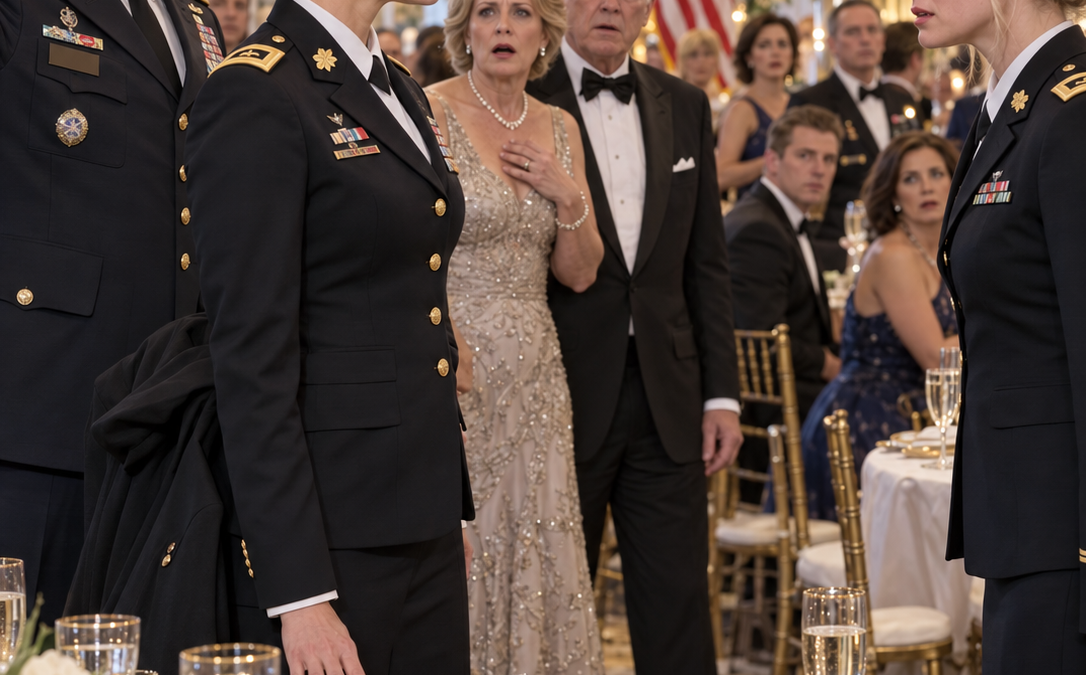
Please stay toward the back corner near the service hallway.” I stared at her. She continued without hesitation. “People don’t understand military office jobs. They assume paperwork means… well…” She glanced over my shoulder as if searching for a polite word. “…clerical.” Then she leaned closer. “I don’t want your low-level desk clerk aesthetic confusing anyone tonight.” For a second, I honestly wondered if she believed it. Not the insult. The fantasy. Because the Army Human Resources Command doesn’t advertise who signs promotion packets. Or who blocks them. Or who ends careers with one signature after months of investigations.
People imagine uniforms winning wars. Very few think about the people responsible for deciding who deserves to wear those uniforms in the first place. I simply nodded. “If that’s what you want.” “It is.” She patted my shoulder. “And please… don’t embarrass your sister.” I almost answered. Instead, I watched her hurry away to greet another donor. Probably a smarter decision. Across the ballroom, Clarissa posed for another photograph. Someone asked whether becoming a Major before thirty had changed her life. She smiled. “It definitely opens doors.” She had no idea how true that sentence really was. Except not in the direction she imagined. Earlier that morning, before anyone inside this ballroom had started getting ready for tonight’s celebration, I had signed a document that would decide whether those gold oak leaves stayed on her shoulders for another day. No one here knew that. Not my parents. Not Clarissa. Not her fiancé. Not even the senators congratulating her.
The certified order was already moving through official military channels. Once it reached its final destination, there would be no family influence, political donation, or expensive attorney capable of stopping what came next. I wasn’t worried about tonight. I was wondering who would still be standing beside Clarissa tomorrow. A man wearing a navy tuxedo approached me. “You must be Clarissa’s sister.” “I am.” “You served too?” “I did.” He smiled politely. “So… are you still in administration?” “Something like that.” He nodded as though he understood. “I hear Clarissa will probably end up advising senior leadership.” Before I could answer, Clarissa called him across the room. He apologized and hurried away. I watched him leave. People rarely lie on purpose. Most simply repeat whatever sounds impressive. Near the stage, my father stood beside a scale model of his newest construction project. He wasn’t talking about buildings. He was talking about Clarissa.
“My daughter earned every bit of this.” He pointed proudly toward her uniform. “Major before thirty. That’s discipline.” Several guests looked genuinely impressed. One investor even joked that he should hire whoever managed our family’s genetics. Dad laughed louder than anyone. I remembered being sixteen years old, cleaning drywall dust from one of his job sites after school because he said hard work built character. Clarissa had spent that afternoon shopping. Dad called her “too pretty for construction.” Some traditions never changed. A string quartet shifted into another song. Servers rolled out trays of filet mignon and lobster tails. The ballroom buzzed with conversations about promotions, influence, contracts, and future opportunities. Everything looked perfect. Which usually meant something underneath was already broken. I checked my phone. No new messages. Not yet. Good. The timing still mattered. I slipped the phone back into my pocket.
Inside my leather portfolio rested one sealed envelope that nobody in this ballroom would have wanted to open. Not because it contained opinions. Because it contained facts. Certified ones. The kind that never cared how expensive the party was. Or who paid for the flowers. Or how loudly people applauded beneath crystal chandeliers. The night everyone celebrated my sister’s biggest achievement had already become something else entirely. They just hadn’t learned its real name yet. I pushed open the glass door before anyone could stop me. The music faded behind me, replaced by the steady rhythm of waves rolling onto the shore beyond the Hilton Head Country Club. The Atlantic looked almost black under the night sky, and the cool air carried the smell of salt instead of expensive perfume. I wrapped both hands around my glass of water and stood still until the noise inside became nothing more than a distant hum.
Four seconds in. Four seconds holding it. Four seconds out. Four seconds holding again. Box breathing. It wasn’t something I learned from a self-help book. It came from instructors who taught us how to make decisions while our brains wanted to panic. Lower the pulse. Slow the vision. Think before you react. By the third cycle, my heartbeat settled. By the fourth, my mother’s words sounded almost funny. “Low-level desk clerk aesthetic.” I’d heard worse. A young Marine once called me “the lady with the scary spreadsheets.” I thanked him. He thought I was joking until six officers failed promotion review because their documentation wasn’t complete. Paperwork isn’t glamorous. Neither is accountability. But both decide careers. I rested my elbows against the wooden railing. The ocean breeze slipped beneath my blazer, and without thinking, my fingertips brushed the raised scar just below my collarbone. Cold. Uneven.
Still easy to find after all these years. Most people assumed scars came with dramatic stories people wanted to tell. The truth is usually the opposite. You stop talking about them because everyone expects the exciting version. Mine came during an evacuation mission outside Helmand Province. Not from charging into a building. Not from some movie-style firefight. Our convoy had already loaded civilians when an improvised explosive device detonated fifty yards behind the last vehicle. A piece of shrapnel punched through the side panel, skipped off a steel frame, and buried itself just below my collarbone. I remember someone yelling for a medic. I remember arguing because another passenger was bleeding worse than I was.
I remember being annoyed that my uniform shirt had to be cut open. Everything else blurred together. The scar stayed. My family never asked where it came from. Not once. The first Thanksgiving after I came home, my mother asked whether I planned on wearing a dress instead of “those serious clothes.” My father wanted to know if military retirement matched private-sector salaries. Clarissa spent twenty minutes explaining why influencers deserved more respect than people realized. Nobody noticed the scar. Or maybe they noticed and simply decided it wasn’t useful to their conversations. Inside the ballroom, laughter exploded near the stage. I glanced through the tall windows. Clarissa had found another audience. She held up her phone while three women crowded around her. They angled themselves toward the chandelier, making sure the gold oak leaves on her shoulders caught the light.
Click. Another picture. Someone adjusted her collar. Another picture. One of the guests actually said, “Turn a little so everyone can see your rank.” Clarissa happily did exactly that. The irony almost deserved applause. People weren’t photographing her. They were photographing a lie stitched onto government-issued fabric. One waiter stepped onto the veranda carrying an empty tray. “You okay, ma’am?” “I’m fine.” He looked toward the ballroom. “Big party.” “Apparently.” He smiled. “They’ve tipped well.” “I’m glad.” He nodded politely and disappeared back inside. Simple conversation. Honest conversation. Somehow it felt better than everything happening in that ballroom. I checked my watch. 8:47 p.m. The administrative system would already be updating records across multiple databases. Those changes weren’t instant everywhere. Secure military systems rarely moved as fast as rumors. Which explained why Clarissa still believed tonight belonged to her.
A gull cried somewhere over the water. The sound pulled me backward almost twenty years. My grandfather never cared about impressive speeches. He believed in cleaning your own boots. Checking your own gear. Showing up five minutes early because being exactly on time meant you were already late. When I graduated from Officer Candidate School, he handed me a worn wooden box. Inside was his old compass. Nothing fancy. The brass had faded. The leather strap had cracked years earlier. He said, “You’ll never need this to find north.” I asked why he was giving it to me. He smiled. “So you remember there’s a difference between knowing where you’re going and remembering who you are.” Years later, before my first deployment, he said something else that stayed with me far longer. “The uniform isn’t a costume, Adeline.” He tapped the oak leaves on my shoulder.
“It’s a second skin, paid for in blood.” Then he looked me straight in the eye. “Never let anyone treat it like a party favor.” At the time, I thought he was talking about respect. Eventually I realized he was talking about responsibility. Respect comes from other people. Responsibility belongs to you whether anyone is watching or not. Through the window, Clarissa accepted another round of applause. Someone handed her another glass of champagne. She raised it high enough for half the ballroom to cheer. My parents stood nearby, absolutely glowing. For one strange second, I wondered what tonight might have looked like if Clarissa had simply earned that rank honestly. I would have been the first person to congratulate her. I would have saluted her without hesitation. Rank itself had never been the problem. The shortcut was. Because shortcuts inside the military don’t stay personal. Someone always pays.
Sometimes it’s another officer who deserved the promotion. Sometimes it’s a soldier who trusts the wrong leader. Sometimes it’s an entire unit. The ocean breeze carried another burst of laughter from inside. I took one last drink of water before setting the empty glass on the railing. Then I straightened my blazer. Whatever happened next wasn’t about revenge. It wasn’t even about family anymore. It was about protecting something my grandfather had spent a lifetime teaching me to honor. And before this night was over, everyone celebrating those borrowed oak leaves was going to learn exactly how much the real ones were worth. I slipped my phone back into my pocket, and the quiet rhythm of the ocean gave way to a memory I hadn’t planned on revisiting. Three weeks earlier, I was sitting inside Building 100 at Army Human Resources Command in Fort Knox, Kentucky, staring at two encrypted monitors that had already been glowing for almost four hours. Routine audits aren’t exciting. Nobody writes headlines about them. Nobody thanks the officer who catches a problem before it reaches someone’s uniform.
That’s exactly why I liked them. Problems don’t care whether you’re looking for them. But they almost always leave fingerprints. My office wasn’t large. Government furniture rarely inspires anyone. One standing desk. Two classified workstations. A locked filing cabinet. A framed Army Values card that had survived three different duty stations. The only personal item was an old brass compass sitting beside my keyboard. My grandfather’s. I started every morning the same way. Coffee. Log into SIPRNet. Log into the personnel management network. Review overnight updates. Cross-reference promotion packets scheduled for final certification. That Tuesday looked no different. At 9:18 a.m., my inbox displayed forty-three pending reviews. Most took less than two minutes. Awards matched service history.
Fitness reports aligned. Command endorsements were authentic. Promotion recommended. Next. Promotion recommended. Next. Administrative correction requested. Next. It was almost relaxing. Until candidate number twenty-seven appeared. STERLING, CLARISSA M. For a second, I assumed there had to be another Clarissa Sterling somewhere in the Army. There wasn’t. Same middle initial. Same date of birth. Same service number. I leaned back without realizing it. “What are the odds?” I muttered. Not impossible. Just inconvenient. I treated it like every other file. No special treatment. No assumptions. Family meant absolutely nothing inside HRC. The system either confirmed facts… or it didn’t. Her packet looked polished. Too polished. Every document had perfect formatting. Every evaluation lined up neatly. Every endorsement appeared exactly where it belonged. Almost perfect. Almost. Years of reviewing personnel files had taught me one thing. Real careers are messy. Someone forgets a signature. Someone uploads the wrong attachment.
Someone dates a memo incorrectly. Perfect files usually deserve another look. I opened the deployment verification. According to the packet, Lieutenant Clarissa Sterling had completed an overseas operational assignment supporting Joint Task Force operations in Djibouti. Long enough to qualify for key promotion consideration. Interesting. I clicked into the deployment database. No match. That wasn’t unusual. Sometimes records updated late. I searched again using her service number instead of her name. Nothing. Now I was interested. I opened another secure database that tracked overseas personnel movement through transportation records. Still nothing. No flight manifests. No arrival records. No theater accountability. No temporary duty authorization. No customs processing. Nothing. Nobody accidentally disappears from every military system at once. I opened her leave history. There it was. Administrative leave. Same dates. Destination listed as Myrtle Beach, South Carolina. I blinked twice. Maybe someone entered the wrong code. It happens.
I requested archived payroll records. Her housing allowance never changed. Her hazardous duty pay never started. Her family separation allowance never activated. Combat-zone tax exclusion? None. Everything pointed toward one conclusion. She had never left the United States. Yet her promotion packet claimed months of overseas operational service. I stopped drinking my coffee. It had gone cold anyway. The next attachment caught my attention. Combat service certification. Signed by a lieutenant general. I knew the name immediately. Not personally. Professionally. He had retired eight months earlier. Odd. I enlarged the digital signature. Something looked off. Not dramatically. Just enough to bother me. The pressure lines were identical across every letter. Natural handwriting doesn’t repeat itself like a computer stamp. I opened archived signature examples from authenticated personnel records. Side by side. The differences became obvious. Spacing. Pen pressure. Terminal strokes. The authentic signature flowed naturally.
The one inside Clarissa’s packet looked like someone had copied a photograph, cleaned it with editing software, and pasted it onto an official form. It wasn’t sophisticated. It was careless. The kind of forgery made by someone who believed nobody would ever examine it closely. Unfortunately for them… Examining things closely happened to be my job. I requested metadata. The document creation history appeared. Modified six times. Converted twice. Original author information removed. Interesting. Very interesting. I followed the digital trail further. The upload itself had originated through an external submission portal before being imported into the promotion review queue. Nothing illegal about that. Thousands of packets entered that way. But every upload carries electronic fingerprints. Time stamps. Device identifiers. Network routing information. Most people never think about them. Personnel investigators do. The system generated a yellow advisory banner across my monitor.
MANUAL REVIEW RECOMMENDED. Not because it knew the documents were fake. Because enough small inconsistencies had accumulated to trigger human review. Computers don’t determine integrity. People do. I rubbed my eyes and looked at the brass compass beside my keyboard. Grandpa used to say that lying becomes expensive because every lie eventually needs another lie to protect it. He was right. One forged deployment created fake evaluations. Fake evaluations required fake endorsements. Fake endorsements demanded fake signatures. Soon an entire career rested on paperwork that couldn’t survive five minutes under real scrutiny. My office phone rang. “Major Sterling.” “Morning,” my colleague Daniel said. “Lunch at noon?” “Probably not.” “Another mountain of promotion packets?” “You could say that.” He laughed.
“Don’t work too hard.” Too late. I ended the call and looked back at the screen. For just a moment… I wasn’t looking at a case file. I was looking at my little sister. The girl who used to beg me to help with homework because math made her cry. The teenager who convinced Dad to buy her first car after pretending she wanted to volunteer more often. The woman now asking the United States Army to reward achievements that had never happened. Family memories didn’t erase evidence. They simply made the evidence hurt more. I took a slow breath. Then I opened a formal investigative review. The moment I entered my authentication code, the system automatically locked the promotion packet from further processing. No edits. No withdrawals. No quiet corrections. An electronic notification appeared across the screen.
CASE STATUS: FRAUD REVIEW INITIATED. The ghost hiding inside the system was no longer invisible. And once the Army starts following a trail of forged records, it doesn’t stop because the last name happens to match yours. I entered my authentication code without taking my eyes off the screen. Within seconds, the promotion packet disappeared from the standard review queue and moved into the restricted fraud investigation system. From that point forward, nobody—not a commander, not a congressman, not even the officer who submitted the packet—could quietly pull it back or replace a document. Every click would be logged. Every change would leave a permanent record. There was no undo button anymore. At 1:40 that afternoon, my secure phone rang. “Major Sterling.” “General Thorne would like to see you in Conference Room Four at 1500.” “I’ll be there.” The call lasted less than ten seconds.
That was enough. I spent the next hour assembling the evidence exactly the way Army investigators expect to see it. Not opinions. Not assumptions. Facts. I organized every exhibit in chronological order. Deployment verification records. Leave records. Military pay history. Transportation logs. Digital signature analysis. Metadata reports. Network activity. Nothing dramatic. Just evidence that could survive a courtroom. By 2:55 p.m., I walked into one of the coldest rooms in Headquarters. Conference Room Four had no decorations, no windows, and no distractions. A long government-issued table stretched across the center of the room. The walls were plain white. Every chair matched. Even the coffee tasted like punishment. Lieutenant General Alistair Thorne was already seated at the far end. He didn’t waste time on small talk. “Have a seat, Major.” “Yes, sir.” Two legal officers sat quietly along one side of the table.
An investigator from the Criminal Investigation Division opened a laptop but said nothing. General Thorne folded his hands. “Walk us through it.” I connected my encrypted tablet to the display screen. The first slide appeared. “Routine promotion audit initiated during scheduled personnel review.” Click. “The candidate submitted documentation claiming qualifying operational service in Djibouti.” Click. “Transportation records show no military travel.” Click. “Defense Finance records show no hostile fire pay, no imminent danger pay, and no combat-zone tax exclusion.” Click. “Official leave records place the candidate on administrative leave inside the continental United States during the same period.” Nobody interrupted. I appreciated that. The evidence deserved silence. I continued. “The recommendation packet contains a digitally altered endorsement bearing the signature of a retired lieutenant general.” The CID investigator leaned forward. “Confidence level?” “Ninety-nine point eight percent.” “Basis?” I enlarged both signatures on the screen.
“The authentic signature demonstrates natural pressure variation and inconsistent stroke spacing. The submitted document repeats identical digital compression artifacts across multiple characters.” He nodded once. “I agree.” General Thorne never looked away from the screen. “What else?” I moved to the next exhibit. “The uploaded documents were stripped of original author metadata before submission.” Another click. “The editing history shows multiple export cycles through commercial graphic software.” Another click. “The upload originated through an external network rather than an approved military workstation.” General Thorne finally spoke. “Can we identify the source?” “Yes, sir.” I opened the final forensic report. Several lines of technical information filled the screen. The CID investigator read them before I said a word. His eyebrows lifted. “Well…” General Thorne looked toward me. “Explain it.” “The upload logs include originating IP information preserved during gateway authentication.” I pointed to one highlighted entry.
“Our Cyber Forensics Division subpoenaed the associated internet service records.” The room remained completely still. I clicked once more. A corporate registration appeared. STERLING CIVIL INFRASTRUCTURE GROUP. Headquarters Address. Executive Office Network. Registered Account Holder: Garrison Sterling. No one said anything for several seconds. The silence wasn’t uncomfortable. It was professional. Evidence speaks more clearly when nobody interrupts it. One of the legal officers finally broke the silence. “So the forged recommendation packet originated from the father’s corporate office?” “Yes.” “Any indication the candidate knew?” I answered honestly. “I can’t prove intent beyond the submitted documents.” General Thorne looked directly at me. “But?” I met his eyes. “But someone with access to that office created or transmitted fraudulent military records on behalf of Lieutenant Clarissa Sterling.” He slowly closed the folder in front of him. “This wasn’t résumé inflation.” “No, sir.” “This wasn’t administrative negligence.” “No, sir.” “This was a deliberate attempt to obtain federal military promotion through falsified service documentation.” “Yes, sir.” The words sounded clinical. They were supposed to. Emotions don’t belong inside legal findings. Facts do. General Thorne leaned back in his chair.
“I’ve read your evaluations for years, Major Sterling.” I waited. “You’ve never brought me a case built on assumptions.” “No, sir.” “And you understand what happens if this proceeds.” “I do.” He studied me for another moment. “She’s your sister.” “She is.” “Would you like to recuse yourself?” That question mattered. Army regulations allow officers to disclose conflicts of interest under certain circumstances. I had considered it the night before. Then I remembered something every investigator learns early. Avoiding responsibility isn’t the same thing as avoiding bias. I answered carefully. “My relationship requires full disclosure, sir.” “It does.” “But the evidence remains independently verifiable through finance records, transportation databases, cyber forensics, and CID analysis.” “It does.” “My signature didn’t create these facts.” General Thorne gave the smallest nod. “No, Major.” He opened the completed legal recommendation. “This office doesn’t punish people for embarrassing their families.” He slid the document toward me.
“It punishes fraud.” He paused just long enough for every person in the room to understand the weight of the next sentence. “This is active-duty promotion fraud, Major. Under applicable Army regulations, it carries mandatory reduction to the substantive grade of Lieutenant, administrative separation proceedings, and referral for further investigation.” The room became perfectly still again. Then he looked directly at me. “Since this action falls within your jurisdiction, you must sign the final order.” For the first time that afternoon, my hand hesitated. Not because I questioned the evidence. Because I remembered teaching Clarissa how to ride a bicycle when she was eight. I remembered her crying after her first driving test. I remembered believing, years ago, that she’d eventually grow into someone better than the version chasing attention. Those memories belonged to my sister.
The documents in front of me belonged to Lieutenant Clarissa Sterling. Those were no longer the same person. I uncapped the government-issued pen. My signature took less than three seconds. Major Adeline Sterling. The ink dried almost immediately. General Thorne collected the order and signed beneath my name. “It becomes effective at 0800 hours on the scheduled processing date.” That date happened to be the same morning my parents planned to celebrate Clarissa’s miraculous promotion. Nobody in that conference room smiled. Justice isn’t satisfying when it lands inside your own family. General Thorne closed the file. “The Army has finished its review.” I stood, gathered my portfolio, and quietly thanked everyone before walking out. The investigation was over. Now all that remained was the moment when the truth would arrive before anyone realized the party had already started too late. I slipped my portfolio under one arm and walked back into the ballroom before anyone noticed how long I’d been outside. The party had somehow become even louder. Champagne glasses clinked every few seconds. A jazz quartet had moved from soft background music to upbeat standards that encouraged conversations instead of interrupting them.
The master of ceremonies announced another toast for Clarissa, and more applause rippled through the room. If someone had walked in at that moment, they would have thought they were witnessing the beginning of a political dynasty. In a way, they were. They just had the wrong ending. A hostess approached me. “Miss Sterling?” “Yes?” “Your parents are inviting a few guests into the private lounge. They asked if you’d join them.” “Did they say why?” She smiled politely. “They just said it’s family business.” I almost laughed. Whenever my father said “family business,” he usually meant someone else was about to carry the risk. The private lounge sat behind carved oak doors away from the ballroom.
It was quieter, decorated with leather chairs, framed golf photographs, and shelves filled with expensive bourbon. Through the open doorway, I recognized the people gathered around the fireplace. Clarissa stood beside her fiancé, Preston Hawthorne. Preston wasn’t military. His family owned Hawthorne Defense Systems, a defense contractor with manufacturing facilities in three states and a long history of bidding on federal logistics contracts. They weren’t celebrities, but inside government procurement circles, the Hawthorne name opened plenty of doors. His father, Malcolm Hawthorne, held a crystal tumbler in one hand while listening to my father explain something with exaggerated confidence. “…that’s why Washington is the natural next step,” Dad said. “A Major with Clarissa’s leadership profile won’t stay where she is for long.” Malcolm nodded. “I imagine she’ll have excellent connections.” “Oh, absolutely.” My mother stepped in before anyone else could speak.
“Our daughter has always been destined for senior leadership.” Clarissa smiled modestly, as if the compliment embarrassed her. It didn’t. She enjoyed every second of it. Genevieve turned toward Preston’s mother. “Once Clarissa moves into a liaison assignment, she’ll naturally build relationships across procurement offices.” Dad picked up the conversation immediately. “And as luck would have it, Sterling Civil Infrastructure is expanding into military construction.” He chuckled. “Funny how family connections work.” Everyone around the room understood exactly what he meant. Nobody said the words influence. Nobody said contracts. Nobody said favoritism. They didn’t have to. Malcolm smiled carefully. “Relationships certainly matter in our industry.” “They matter everywhere,” Dad replied. I stood near the doorway, unnoticed for another minute. Long enough to hear my future brother-in-law say something that made me shake my head.
“I told Clarissa she’ll probably know more generals than I do within a couple of years.” Clarissa laughed. “Oh, don’t exaggerate.” She didn’t correct him. She simply enjoyed hearing it. Eventually my mother spotted me. “There you are.” Her smile disappeared just enough for me to recognize the signal. She wanted something. “Come with your father.” Dad walked toward another corner of the lounge without asking whether I intended to follow. I did. Mostly because I wanted to know what game he was playing. We stopped beside a service door where catering staff moved in and out carrying trays of desserts. The hallway beyond was empty enough to keep conversations private. Dad reached inside a leather portfolio. “I’ve been waiting until things settled down.” He placed a thick document folder on a small cocktail table between us. “I need your signature.” I didn’t touch it.
“What is it?” “Nothing complicated.” That answer guaranteed it was complicated. He opened the folder himself. Pages covered in legal language. Corporate guarantees. Financial disclosures. Liability schedules. Projected revenue. The loan amount sat near the top. $8,450,000.00. I read it twice to make sure I hadn’t added an extra digit in my head. Eight million dollars. Dad tapped one paragraph with his finger. “The bank loves your credit history.” “My what?” “You’ve never missed a payment.” “I know.” “Federal employment.” “Yes.” “Excellent debt-to-income ratio.” I looked up. “You want me to guarantee this loan.” “Co-sign.” “That’s not the same thing.” He shrugged. “Close enough.” I flipped another page. The loan funded one of his company’s proposed expansion projects. If Sterling Civil Infrastructure defaulted… the bank could pursue every guarantor. Including me. “You didn’t mention this before tonight.” “I didn’t want unnecessary discussions.” Translation?
He assumed public pressure would work better than honesty. I closed the folder. “No.” His smile faded. “You haven’t finished reading.” “I’ve read enough.” He folded his arms. “Your sister is entering a completely different world now.” I stayed quiet. “Washington opportunities.” “Political relationships.” “High-level appointments.” He leaned slightly closer. “This family needs to think bigger.” I looked him straight in the eye. “So that’s why you invited me?” “Don’t be dramatic.” “I’m asking.” His voice hardened. “Clarissa is a Major now.” He said it with unmistakable pride. “She’s the future of this family.” Then came the sentence that probably explained my childhood better than years of therapy ever could. “You’re just a paper-pusher.” I almost smiled.
If only he knew. He pushed the folder closer. “Sign this so we can finalize her dowry.” For a moment, I genuinely wondered whether I’d heard him correctly. Dowry. As though his daughter were another business asset moving between families. As though I existed only to improve the balance sheet. I glanced toward the ballroom through the partially opened doors. Clarissa was posing for yet another photograph. Malcolm Hawthorne appeared satisfied. My mother looked happier than I’d seen her in years. Dad mistook my silence for hesitation. “I’ve already spoken with the attorneys.” “I’m sure you have.” “They say this is perfectly safe.” “For you.” “For everyone.” I looked back at the paperwork. He hadn’t even bothered highlighting the section making me jointly responsible for the full amount if his company failed. He honestly believed I wouldn’t notice. Or maybe he believed I would sign anyway.
Family had always been his favorite negotiating tactic. I slid the folder back across the table without opening it again. “I won’t be signing anything tonight.” His jaw tightened. “You don’t understand what’s at stake.” I met his stare without raising my voice. “No, Dad. I understand exactly what’s at stake.” He opened his mouth to argue again. Before either of us could say another word, the ballroom music stopped so suddenly that conversations throughout the club seemed to freeze with it. Every head turned toward the main entrance. Even my father looked up. The sound of polished dress shoes echoed across the marble floor. Someone important had just arrived. What happened here was unbelievable on its own.
But it also reminded me of another family case that unraveled layer by layer until the final truth was even harder to believe. If you’re watching this, keep an eye on the top-right corner of your screen between minutes 45 and 55. That story connects in a way you probably won’t expect. The music died so abruptly that the last piano note seemed to hang in the air. Every conversation stopped in the middle of a sentence. The ballroom doors swung open with quiet precision, not because someone pushed them dramatically, but because the staff had instinctively stepped aside. Lieutenant General Alistair Thorne entered first. He wore full Army dress whites that needed no introduction.
Every ribbon, badge, and insignia sat exactly where Army regulations required. Behind him walked two Military Police officers in formal service uniforms. Neither looked left nor right. They weren’t there to impress anyone. They were there because protocol required witnesses. For one brief moment, nobody moved. Then my mother practically floated across the marble floor. “General!” Her silk gown whispered across the polished surface as she hurried toward him, smiling with the confidence of someone convinced the universe had just rewarded her. Several guests immediately began whispering. “A lieutenant general?” “He came himself?” “Clarissa must really be going places.” Someone even started clapping. A few others joined in. My mother reached General Thorne first. “What an incredible honor!” she said, extending both hands. “I can’t tell you what this means to our family.” General Thorne stopped exactly one step away. His expression never changed.
“I assume you’re here for Clarissa,” my mother continued before he could respond. “She’s been looking forward to meeting senior leadership. We knew someone from Washington would eventually notice her achievements.” She laughed lightly. “Our Major has always exceeded expectations.” General Thorne didn’t take her hand. He didn’t acknowledge her statement. He didn’t even slow down. He simply walked past her. My mother’s smile froze in place. For a second she looked genuinely confused, as though someone had skipped an important page in the script she’d written inside her head. Guests shifted uncomfortably. My father frowned. Clarissa straightened her shoulders and adjusted one of the gold oak leaves on her uniform. She clearly assumed the General intended to congratulate her personally. He kept walking. Every polished step echoed through the silent ballroom. Nobody spoke. Nobody reached for another drink. Even the catering staff stopped moving.
I remained exactly where I was near the service hallway, my portfolio resting against my side. General Thorne never looked away from me. Neither did the two Military Police officers following several paces behind him. As the distance between us disappeared, I noticed something most civilians in the room wouldn’t recognize. The General wasn’t carrying a ceremonial folder. He was carrying an official command case. Dark leather. Government issue. Metal security clasp. The same type used for certified personnel actions. I already knew what was inside. Nobody else did. My mother hurried after him. “General, perhaps you’d like to meet Senator Wallace first.” No response. “Our future son-in-law’s family owns Hawthorne Defense Systems.” Nothing. “We’ve arranged a brief presentation honoring Clarissa’s promotion.” Still nothing. Watching my mother chase a three-star general through a ballroom while he politely ignored every word would have been funny under different circumstances.
Tonight it simply confirmed something I’d learned years earlier. Rank impresses people. Discipline ignores them. General Thorne stopped exactly six feet in front of me. His posture became even straighter. Without hesitation, he raised his right hand in a textbook military salute. Perfect angle. Perfect timing. Perfect form. Instinct took over before conscious thought. I returned the salute immediately. The ballroom remained absolutely silent. Behind me, I heard someone whisper, “Why is he saluting her?” Another voice answered, “Maybe she’s military too.” A third quietly added, “I thought the younger sister was the Major.” The confusion spread through the room like a slow-moving wave. General Thorne lowered his salute. His voice carried effortlessly across the ballroom. “Major Sterling.” No one missed the title. Not one person. Certainly not my parents. My mother blinked twice.
“…Major?” My father stared at me as if I’d suddenly become someone else. Clarissa actually laughed once. A short, nervous laugh. “There must be some misunderstanding.” General Thorne continued as though nobody else had spoken. “The Human Resources Command has finalized the administrative review.” Every word landed with the precision of a judge reading a verdict. Clarissa’s smile weakened. “What review?” No one answered her. General Thorne turned slightly toward the two Military Police officers. One stepped forward carrying the secured command case. The other remained near the entrance, quietly ensuring no one interfered. Several guests exchanged worried looks. Senator Wallace slowly lowered his champagne glass without taking a sip. Malcolm Hawthorne’s expression shifted from curiosity to calculation. People accustomed to government work recognize official procedures long before they understand their purpose. My father finally found his voice. “General… perhaps we should discuss whatever this is privately.” General Thorne looked at him for the first time. “Mr. Sterling.” “My family would appreciate discretion.” “The United States Army has already exercised appropriate discretion.” Dad forced a smile. “I’m sure this can be cleared up.” General Thorne’s face remained unreadable.
“There is nothing to clear up.” The room somehow became even quieter. Clarissa took one cautious step forward. “Sir… if this is about my promotion paperwork, I have copies of everything.” “I know.” “My commanding officer approved—” “I know.” “My recommendations were verified.” “I know.” She looked relieved for half a second. It disappeared when he added, “That’s precisely why we’re here.” Across the ballroom, I noticed several guests discreetly pulling out their phones before thinking better of it. Even they sensed this wasn’t ordinary military protocol. General Thorne accepted the command case from the Military Police officer. He placed it carefully on the nearest banquet table beside a silver champagne bucket and rested one hand on the metal clasp. Nobody moved.
Nobody breathed loudly. The entire evening had shifted. Less than fifteen minutes earlier, my father had called me nothing more than a paper-pusher. Now one of the highest-ranking officers in the United States Army had crossed an entire ballroom without acknowledging anyone else, publicly saluted me, and announced that an official administrative review had reached its conclusion. The celebration was over. Only the truth hadn’t been opened yet. I rested my hand lightly on the edge of my portfolio and waited. Nobody seemed willing to breathe first. One hundred and fifty guests stood frozen beneath the crystal chandeliers. The champagne fountain continued flowing as if nothing had changed, and somewhere in the kitchen a plate shattered, the sound echoing through a ballroom that had suddenly forgotten how to speak. Clarissa finally stepped forward. She forced out a laugh. It landed badly. “General,” she said, glancing around the room as though searching for someone who would laugh with her, “there has to be some mistake.” No one joined in. “My promotion was finalized this morning.” She smiled again. “I received all the paperwork.” General Thorne looked at her with the same expression he had worn throughout the evening. Professional. Measured. Unmoved.
“The Army issued paperwork this morning.” Clarissa nodded eagerly. “Exactly.” He didn’t raise his voice. “Not the paperwork you believe.” The color drained from her face. My mother immediately stepped beside her. “There must be some misunderstanding.” She looked toward the guests with an awkward chuckle. “You know how government offices are.” Several people gave polite smiles. Most didn’t. My father took one confident step forward. “General Thorne, if there has been some administrative confusion, my attorneys can coordinate directly with the appropriate offices.” General Thorne answered without looking at him. “This matter has already been coordinated with every appropriate office.” That sentence landed harder than any shout could have. Across the room, I noticed Malcolm Hawthorne quietly place his drink onto a nearby table. His wife stopped smiling. Preston looked back and forth between Clarissa and the General, trying to understand what he had walked into.
Clarissa shook her head. “No.” She laughed again, softer this time. “This is impossible.” She reached into her purse. “I have emails.” She pulled out her phone. “I have congratulations from people in my command.” Her hands were beginning to shake. “I have photographs from this morning.” General Thorne didn’t move. “None of those determine your rank.” For the first time all evening, Clarissa looked directly at me. There was confusion in her eyes. Not guilt. Not yet. Confusion. She expected me to say something. To rescue her. To explain that the General had confused two officers with the same last name. Instead, I quietly set my portfolio on the nearest banquet table. A waiter standing nearby instinctively stepped forward. “Ma’am?” “Would you hold this for a moment?” I handed him my dark civilian blazer. He accepted it carefully. The movement took only a few seconds.
Yet it felt as though time had slowed for everyone watching. Without the blazer, the room finally saw what it had missed all night. My Army service uniform. Perfectly pressed. Every ribbon placed according to regulation. Every insignia exactly where it belonged. And on both shoulders… Gold oak leaves. Real ones. The ballroom became completely silent. Someone near the back whispered, “Oh my God…” Another guest quietly asked, “She’s the Major?” The answer was already standing in front of them. My mother stared at me as though she had never actually looked at me before. “I…” She couldn’t finish the sentence. My father blinked several times. “When…” He stopped talking. Clarissa’s eyes locked onto my shoulders. Then onto hers. Then back to mine. For years she had enjoyed introducing herself as the accomplished daughter. Tonight, for the first time, she realized she had never even known what rank her own sister actually held. That realization hurt her more than anything General Thorne had said. I smoothed one sleeve without any hurry. “I wasn’t hiding my rank.” Nobody answered.
“I simply never found it necessary to announce it at family dinners.” A nervous laugh escaped from one of the guests. It disappeared almost immediately. General Thorne gave me a slight nod. That was my cue. I opened my leather portfolio. Inside sat a single certified document protected inside a transparent government evidence sleeve. The certification stamp stretched across the bottom corner. Original signatures. Official seal. Chain-of-custody markings. Nothing flashy. Just legally authenticated paperwork. I removed it carefully. No dramatic flourish. No speech. No attempt to embarrass anyone. I laid the document flat on the white tablecloth beside the silver champagne bucket. The contrast was almost absurd. One represented celebration. The other represented accountability. General Thorne spoke clearly enough for every guest to hear. “Certified administrative action.” The nearest guests instinctively leaned closer. I stepped slightly aside so nobody could claim I was blocking their view. Clarissa took one hesitant step toward the table.
“I don’t…” Her voice cracked. “I don’t understand.” “You will.” General Thorne gestured toward the document. “Read it.” She didn’t move. Neither did my parents. Finally Malcolm Hawthorne walked forward first. Not because he was curious. Because businessmen understand documents. He adjusted his reading glasses and looked down. His expression changed almost immediately. His wife saw it happen. “So?” He didn’t answer. Instead, he kept reading. Every line made him quieter. Preston approached beside his father. “What is it?” Malcolm slowly turned the first page so his son could read. I watched Preston’s eyes move across the document. His breathing changed. He reached the section identifying the subject. Lieutenant Clarissa Sterling. He frowned. “Lieutenant?” Then he continued reading. His face lost every trace of confidence. Around the room, whispers began spreading from table to table. “What does it say?” “What’s happening?” “Why is everyone looking at Clarissa?” A retired colonel who had been sitting near the front quietly stood and moved closer. He recognized the formatting immediately. “So that’s an HRC order.” Another retired officer nodded once. “Certified.” “No question.” My mother finally grabbed the edge of the table.
“What kind of document is this?” General Thorne answered her directly. “The official findings of an administrative fraud investigation.” She laughed reflexively. “That can’t possibly involve my daughter.” No one echoed her confidence. Because by then, more and more guests had seen enough of the first page to understand what they were looking at. Not rumors. Not accusations. Not family conflict. An official United States Army determination. I looked across the ballroom at the same people who had applauded Clarissa less than an hour earlier. Their expressions had changed completely. Some looked shocked. Some looked embarrassed. A few quietly stepped away from my parents without saying a word. No one wanted to be standing too close to a scandal that had just become federal. Clarissa reached toward the document with trembling fingers. This time, nobody tried to stop her. Clarissa’s fingers stopped just above the paper.
She looked at the first page. Then the second. Then back to the first again, as if reading it twice might change the words. It didn’t. Her breathing became shallow. “No…” It barely came out as a whisper. “This isn’t…” She couldn’t finish the sentence. Around us, the ballroom filled with uneasy murmurs. Conversations that had once revolved around promotions and wedding plans now revolved around one question. “What exactly happened?” The master of ceremonies, still standing beside the stage with a wireless microphone in his hand, looked completely lost. He glanced toward the country club’s event coordinator for instructions. General Thorne answered before anyone else could. “Use the presentation screen.” The coordinator hesitated. “Sir?” “The certified order.” His tone never changed. “Project it.” Nobody argued. Within moments, a technician connected the certified HRC document to the ballroom’s projection system.
The giant screen that had spent the evening displaying photographs of Clarissa shaking hands, smiling beside flags, and posing with champagne now faded to black. A second later, the first page of the administrative order filled the screen. The Army seal appeared at the top. Below it came the title. ADMINISTRATIVE FRAUD FINDINGS. A wave of whispers swept across the room. Then came the name. Subject: Lieutenant Clarissa Sterling. Not Major. Lieutenant. I watched dozens of people instinctively look from the screen to Clarissa’s shoulders. Then back to the screen. Then back again. The contrast was impossible to ignore. The document continued. It outlined falsified deployment records. Fraudulent combat service certification. Digitally altered endorsements. False promotion qualifications. Every finding referenced supporting evidence and applicable regulations. No dramatic language. Just facts. Federal facts. Malcolm Hawthorne took one slow step backward. His wife followed him without saying a word.
Preston remained frozen for another few seconds before looking directly at Clarissa. “You told me you deployed.” Clarissa swallowed hard. “I…” “You showed me pictures.” “They were…” “You said you earned that promotion.” Her mouth opened. Nothing came out. Preston looked back at the screen. His voice became quieter. “Was any of it true?” Clarissa searched the room desperately. She looked toward our mother. Toward our father. Toward me. No one answered for her. Because nobody could. Malcolm finally spoke. “Preston.” His son turned. “We’re leaving.” Genevieve rushed forward so quickly that one of her high heels nearly slipped on the marble floor. “Please.” She held up both hands. “There has to be some explanation.” Malcolm looked at her with polite distance. “There usually is.” He glanced toward the projected document. “This one happens to be written by the United States Army.” Garrison stepped between them.
“Let’s not overreact.” “Overreact?” Malcolm folded his arms. “You represented your daughter to my family as a newly promoted Major.” “She is—” He stopped himself. For the first time all evening, he realized he could no longer finish that sentence. Malcolm continued. “My attorneys perform due diligence before every government contract.” He looked directly at Garrison. “I appreciate it when other people do the same.” Without another word, the Hawthorne family moved several feet away. They didn’t make a scene. They simply created distance. Sometimes that’s louder than shouting. Around the ballroom, other guests began doing exactly the same thing. The senators quietly excused themselves from conversations with my parents. Business owners drifted toward opposite sides of the room.
People who had been taking selfies with Clarissa thirty minutes earlier suddenly became fascinated by the dessert table. Reputations move quickly. Scandals move faster. Clarissa stared at Preston. “You can’t seriously believe this over me.” He looked exhausted. “I believe what I’m reading.” “You don’t even know how military paperwork works.” “No.” He nodded toward me. “But apparently your sister does.” Clarissa turned so sharply that the medals on her uniform clicked against one another. She pointed at me. “You did this.” My voice stayed calm. “I documented what already existed.” “You ruined my life.” “I reviewed your file.” “You’re my sister.” “I was your reviewing officer.” There wasn’t another answer to give. General Thorne stepped forward. The murmuring stopped almost immediately. His voice carried through the ballroom with the same measured authority I’d heard dozens of times inside briefing rooms. “Lieutenant Clarissa Sterling.” She flinched at the title.
“You are no longer authorized to present yourself as a Major in the United States Army.” She shook her head violently. “No…” “Your promotion was never lawfully established.” He paused only long enough for every guest to absorb the next sentence. “Your rank was officially revoked at 0800 hours this morning.” Several people gasped. My father looked at his watch instinctively, as if checking whether time itself had betrayed him. It had. The celebration had started hours after the decision had already become official. General Thorne continued. “Your current display of Major insignia constitutes unauthorized wear of military rank.” Clarissa instinctively grabbed both shoulders. Almost protectively. Those gold oak leaves had meant everything to her. At least until they became evidence. General Thorne’s expression never softened. “Your uniform is now an offense against the regulations of the United States Army.” The two Military Police officers quietly stepped forward. Not aggressively. Professionally.
One stopped several feet behind Clarissa. The other positioned himself near the ballroom entrance. Neither touched her. Neither needed to. General Thorne delivered the final instruction without raising his voice. “Strip those epaulets off.” Clarissa stood perfectly still. Tears filled her eyes. “I…” “Or my escort will remove you from this venue.” The ballroom became so quiet that I could hear the air conditioning humming above us. Clarissa looked around one last time. At our parents. At Preston. At the guests who had celebrated her. At the photographers who now refused to lift their cameras. Finally… Her trembling hands reached toward the gold oak leaves resting on her shoulders. Her trembling hands finally closed around the gold oak leaves. For several long seconds, Clarissa couldn’t make herself pull. Those insignia had become her entire identity. Not because she had earned them. Because everyone else believed she had.
Then she squeezed her eyes shut. With one sharp motion, she ripped the first oak leaf from her shoulder. The metal pin snapped loose. It struck the marble floor with a tiny metallic click. In the silence, it sounded almost impossibly loud. The second one came off even harder. This time she didn’t bother being careful. She tore it free so violently that one button on her dress coat flew across the ballroom and disappeared beneath a table. The two gold oak leaves landed several feet apart. Nobody rushed to pick them up. Clarissa stared at them for one heartbeat. Then her legs gave out. She collapsed onto her knees. The polished marble reflected the tears running down her face. “I didn’t…” She struggled to breathe. “I never…” Her words dissolved into sobs. Every expensive decoration surrounding her suddenly looked ridiculous. Crystal chandeliers. Fresh orchids. Imported champagne.
A string quartet stood silently with instruments in their hands. None of it could hide the truth lying in plain sight. Across the room, guests quietly stepped farther away. Not because anyone ordered them to. Because scandals create empty space all by themselves. My father refused to accept what everyone else already had. “This is outrageous!” His voice exploded through the ballroom. “I know people in Washington.” No one answered. “I’ve funded campaigns!” Still nothing. He pointed toward General Thorne. “This isn’t over.” General Thorne remained perfectly still. “You have no idea who you’re dealing with.” The General looked at one of the Military Police officers. A single nod. Nothing more. The officer walked calmly toward my father carrying a sealed government envelope. “Dad,” I said quietly. He ignored me. “You people are making a terrible mistake.” The Military Police officer stopped directly in front of him. “Mr. Garrison Sterling?”
“What?” “You are being served.” Dad frowned. “Served with what?” The officer removed a document from the envelope. “A federal subpoena issued by the United States District Court.” Several people gasped. The officer continued reading in a clear, practiced voice. “You are ordered to produce financial records relating to allegations of conspiracy to commit fraud, identity theft, electronic forgery, and the creation of falsified federal military documents.” My father’s face lost every trace of color. “That’s ridiculous.” The officer handed him the paperwork. “Your acknowledgment of receipt is sufficient.” “I don’t accept this.” “You don’t have to.” The officer calmly released the document. It slipped from my father’s fingers onto the floor. “Service has been completed.” Dad looked around the ballroom as though someone would rescue him. The senators avoided eye contact. The business owners suddenly became fascinated by their phones. Even people who had spent years asking him for favors quietly backed away.
Influence disappears faster than money when federal investigators become involved. He bent down to retrieve the subpoena. His hands shook. Not with anger anymore. With fear. Nearby, my mother rushed toward Clarissa and dropped beside her on the marble floor. “Oh, sweetheart.” She wrapped both arms around her. “This isn’t your fault.” Clarissa cried harder. “I just wanted…” “I know.” “I just wanted everyone to…” Genevieve pulled her closer. “We’ll fix this.” There it was again. The family motto. We’ll fix it. They never meant fixing mistakes. They meant hiding consequences. Preston slowly approached one final time. Clarissa looked up hopefully. “Please…” He didn’t kneel. He didn’t touch her. He quietly removed the engagement ring from his jacket pocket.
“I was going to ask you to resize this after the wedding.” He placed it gently on the nearby banquet table. “I don’t know who I was planning to marry.” Clarissa stared at the ring. “Preston…” He shook his head. “I can forgive failure.” His voice remained steady. “I can’t build a life on deception.” Then he turned and walked away to join his parents. None of them looked back. My mother watched him leave. Something inside her finally broke. Not because Clarissa had committed fraud. Not because my father faced federal investigation. Because the audience was leaving. Everything she had spent decades building depended on other people believing the image she created. The image was gone. She slowly stood.
Her mascara had begun to run, but she didn’t seem to notice. Instead, she looked directly at me. Every ounce of grief transformed into rage. “You.” She crossed the ballroom faster than I expected. “You did this.” Her voice cracked. “You’re jealous.” I didn’t answer. “You’ve always been jealous of your sister.” Several guests looked uncomfortable. One elderly woman quietly whispered, “I don’t think that’s what happened.” Genevieve wasn’t listening anymore. She stopped less than a foot away from me. “You destroyed her life!” The accusation echoed across the ballroom. People waited. Some expected me to defend myself. Some expected me to argue. Some probably hoped for one last dramatic scene. Instead, I looked at my mother the same way I had looked at hundreds of personnel files over the years. Without anger. Without satisfaction. Just clarity. “I didn’t destroy this family, Mother.” She stared at me.
“I simply audited your lies.” I glanced briefly toward the scattered oak leaves, the subpoena lying partly unfolded in my father’s hand, and the certified Army order still resting beside the untouched champagne bucket. Then I looked back at her. “And the ledger has finally balanced.” She opened her mouth. Nothing came out. For the first time in my life… she had no story left to tell. Around us, people quietly began collecting their coats. The jazz musicians packed their instruments without playing another note. Waiters carried away untouched champagne. Someone switched off the projector. The ballroom emptied little by little. Not with shouting. Not with panic. Just with the quiet certainty that everyone had witnessed the end of something pretending to be stronger than it ever was. The Sterling family hadn’t fallen because one document appeared.
It had fallen because every lie it stood on had finally reached the same day of reckoning. I slipped my phone into my coat pocket after pressing the final confirmation button. Your number has been successfully changed. That was it. No dramatic farewell. No last argument. No final family group message. Just one permanent change that made sure the next time my parents tried calling, they would reach someone else entirely. I stood at the end of the wooden dock and looked across Norris Lake. The water was almost perfectly still. Thin sheets of ice clung to the shaded shoreline, while the open water reflected a pale winter sky that seemed to stretch forever. The air was cold enough to sting my lungs, but after everything that had happened over the past few weeks, it felt clean. This place had always felt different. My grandfather bought the cottage decades before anyone in the family cared about expensive country clubs or political fundraisers. It wasn’t large. Two bedrooms. A stone fireplace. A screened porch that rattled whenever the wind picked up. He used to joke that the view was worth more than any mansion because nobody could build another lake beside it.
He was right. It also happened to be the only property legally titled in my name alone. The only thing my family had never managed to control. A pair of geese drifted quietly across the water while I balanced a mug of black coffee in one hand. No speeches. No applause. Just silence. For the first time in a very long time, silence didn’t feel lonely. It felt earned. My secure government laptop sat open on the small table behind me. One final notification waited on the screen. Administrative Separation Process: Continuing. Criminal Referral: Active. Financial Investigation: Pending. I reviewed the update one last time, then closed the laptop and locked it inside its security case. Work was finished. Whatever happened next would belong to investigators, military attorneys, and federal prosecutors. Not me. I had done my job.
Nothing more. Nothing less. News travels faster than people expect when reputations collapse. Within four days of the gala, local newspapers stopped calling it a charity celebration. They called it a federal fraud investigation. Sterling Civil Infrastructure lost two government contracts before the week ended. Three banks suspended ongoing financing. Every corporate account connected to the investigation was frozen pending review. The accountants would spend months sorting through records. Maybe longer. Clarissa moved out of the luxury condominium she had proudly shown all over social media. Two moving trucks emptied the place in less than six hours. Designer furniture. Imported wine racks. Custom artwork. Even the white grand piano she’d admitted she never learned to play. Appearances are surprisingly heavy when strangers have to carry them downstairs. Someone later told me she rented a small apartment outside Lexington.
I hoped she found something more valuable than another audience. I hoped she found honesty. Whether she did wasn’t mine to decide. As for my parents… The last update I received came from an attorney handling unrelated personnel matters. They had sold their vacation home. Several investment accounts remained inaccessible. Most of their energy now went toward answering questions they could no longer avoid. For years they believed money solved every problem. Eventually they discovered that evidence doesn’t negotiate. I didn’t celebrate any of it. People often imagine justice feels exciting. It doesn’t. It mostly feels quiet. Sometimes sad. Sometimes necessary. I reached into my coat pocket and pulled out my grandfather’s old brass compass.
The leather strap had finally broken completely. I smiled. He probably would have told me to stop carrying something that old. Then again, he probably would have fixed it himself with whatever happened to be sitting in the garage. I turned the compass over in my hand. The needle settled. North. Steady as always. Funny thing about compasses. They don’t care who you wish you were. They only tell you where you actually stand. That reminded me of something I’d learned after years inside Army Human Resources Command. People think promotions define character. They don’t. Character determines whether someone deserves promotion. The paperwork simply catches up eventually. I thought about the ballroom. About the chandeliers. The applause. The speeches. My mother’s desperate smile. My father’s certainty that influence could purchase another ending. None of those things had collapsed because I exposed them.
They collapsed because they were built on something that couldn’t carry their weight forever. Truth is patient. It doesn’t panic when lies become popular. It simply waits. A cold breeze crossed the lake. I zipped my jacket and looked toward the distant shoreline. For years I wondered why my grandfather never seemed interested in proving himself to anyone. Now I understood. When you know exactly who you are, strangers don’t get to vote on your worth. That lesson took me far longer to learn than any military regulation ever did. If there’s one thing this experience taught me, it’s this: Never confuse recognition with respect. Recognition comes from people who are watching. Respect comes from living in a way that still feels right when nobody is. Never wear a title you haven’t earned. Never borrow honor you didn’t build.
And never sacrifice your integrity just to keep the peace inside a family that profits from dishonesty. Sometimes the bravest decision isn’t exposing someone else’s lie. It’s refusing to participate in it. If you’ve ever been treated as the invisible one because you chose honesty over approval, don’t mistake silence for failure. The people who build their lives on appearances often look unbeatable—right up until reality asks them for proof. Before you leave, take a look at the story waiting for you on your screen. It’s one of the cases our viewers keep recommending to friends because the ending changes everything you think you know. If this story stayed with you, that one probably will too.








