My sister snatched my federal flight pass and tore it to pieces in front of everyone. she had no idea my mission was being tracked by air force command. then my radio came alive, and the whole airport realized who i really was…
But at 4:57 that morning, my phone buzzed with a message I could not ignore. The message came from a secure app that only pings when command needs eyes on me within the hour. I read it twice, felt my stomach drop, and stepped away from the group near the check-in counter.
I called a number I have memorized since 2017.
A calm voice answered.
“Beexley, we are activating your standby. Wheels-up window opens at 9:15 your time. You will be routed through Denver to Hunter Army Airfield. Confirm.”
I confirmed.
I closed my eyes. I felt the shift happen inside me—the one where Aunt Marlo steps to the side and Captain Beexley takes over.
When I opened my eyes, my sister Karine was standing three feet away with her arms crossed, staring at me like I had just stolen her purse.
“Who were you talking to at 5:00 in the morning?” she demanded.
“Work,” I answered.
“Work,” she repeated in that flat, mocking tone she has used on me since I was nine. “Marlo, it is Mom’s birthday trip. Whatever little help-desk emergency you have can wait.”
I did not argue. Arguing with Karine is like arguing with a brick wall that has taken a public-speaking class. Instead, I nodded, mumbled something about a client, and walked back to the group.
My mother, whose name is Delphine, hugged me and told me I looked tired. My father, Warren, patted my shoulder and asked if I remembered to bring the birthday card. My brother-in-law, Preston, barely looked up from his phone.
My niece, Juniper, who is eight, wrapped her little arms around my waist and whispered that she had saved me the window seat.
I hugged her back and felt a small, sharp ache in my chest because I already knew I was not going to be on that plane with them.
We moved toward security.
The line was long. Denver at 6:00 in the morning is a river of tired people and rolling suitcases. Karine was in her element, barking soft orders at Preston, straightening Juniper’s jacket, sighing loudly whenever the line paused.
My mother watched the departure boards with quiet excitement. It had been almost four years since our whole family had traveled together.
I checked my phone.
Another message.
The wheels-up window had moved.
8:40.
I had less than two hours.
I did what I had to do. I reached into my wallet, pulled out my federal flight pass, and stepped out of the line toward the TSA officer standing at the crew and priority entrance.
I did not want anyone to see.
I had already planned to say I was going to the bathroom and meet them at the gate later.
But Karine saw everything.
She has always seen everything.
“Where are you going?” she snapped, loud enough that the family in front of us turned around.
“I need to use a different line,” I answered quietly. “I will meet you at the gate.”
“A different line? What do you mean, a different line?”
I tried to keep my voice low.
“It is a work thing. Please, Karine, just go through with Mom and Dad. I will explain later.”
She stepped out of the line and followed me.
Of course she did.
My mother called after her, confused. Preston and Juniper looked between us with wide, worried eyes.
“Marlo, stop,” Karine hissed, catching my elbow. “You are not doing this. Not today. Not on Mom’s birthday. You always do this. You always have to make yourself the center of attention.”
I turned to face her.
I was tired. I was already halfway into my working brain, calculating fuel loads and weather patterns for a route I had flown twice before. I did not have the energy to fight.
“I am not making myself the center of anything,” I told her. “I have to go to work. I will fly out tonight and meet you all at the hotel.”
“Work?” she scoffed. “You fix computers, Marlo. Nobody’s spreadsheet is on fire at 6:00 in the morning.”
I did not respond. I turned back toward the priority line.
That was when she saw the laminated card in my hand.
She grabbed my wrist. Her fingernails, freshly done in a pale pink she had shown off in the car, dug into my skin.
“What is that?” she demanded.
“Let go of me.”
“What is that in your hand?”
“Karine, let go.”
She yanked my wrist toward her and pulled the card out of my fingers before I could close my fist. She held it up, squinting at it in the overhead light.
It had my photograph, my rank abbreviated in small letters, and a hologram of the Department of Defense seal. To someone who did not know what they were looking at, it looked like a fancy work badge.
“Is this one of those fake priority passes?” she asked, loud enough for the entire security line to hear. “Marlo, are you seriously trying to skip the line in front of Mom on her birthday with a fake card?”
“It is not fake. Give it back.”
“Oh my God.”
She laughed.
It was a sharp, humiliating laugh, the kind she used to use on me at the dinner table when I was 15 and had opinions.
“This is so like you. You cannot stand that this trip is about Mom, so you have to invent some fake emergency and pretend you are important.”
“Karine, I am telling you, give me that card back right now.”
She looked me dead in the eye.
She smiled.
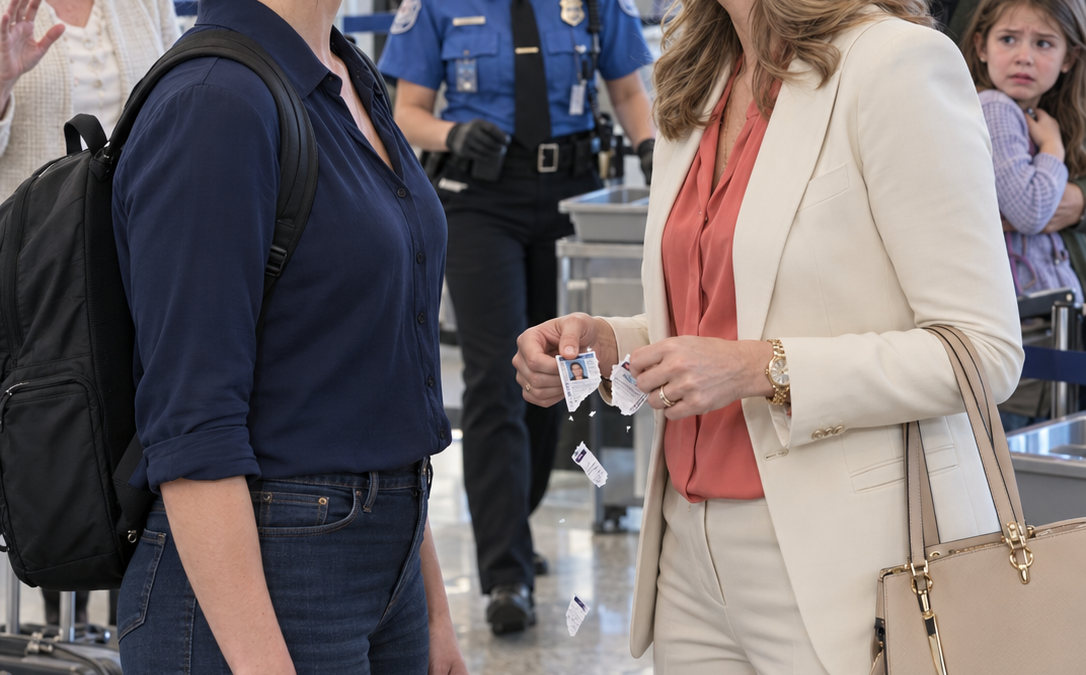
And then, in front of my mother, my father, my brother-in-law, my eight-year-old niece, and about 90 strangers who had all stopped scrolling their phones to watch, my sister took my federal flight pass in both hands and tore it clean in half.
The sound the plastic made was small, but I felt it in my teeth.
She was not finished.
She tore each half again.
Four pieces.
She held them out over the floor and let them fall one by one like she was scattering flower petals at a wedding.
They landed near my boots.
“There,” she announced. “Now you can wait in line with the rest of us like a normal person.”
The whole security area had gone quiet.
My mother’s mouth was open. Juniper was crying softly into Preston’s leg. A TSA officer 20 feet away had already started walking toward us, her hand moving toward the radio on her shoulder.
I looked down at the four pieces of my flight pass on the dirty airport floor.
Then I looked up at my sister’s triumphant, smug face, and I felt my phone vibrate against my hip.
The vibration against my hip was not a text message.
It was a specific pattern.
Three short pulses followed by one long one that only came through when the secure line was calling me directly.
I have felt that pattern maybe 40 times in 11 years. Every single time, it has meant that a person somewhere in a windowless room at the Pentagon or at Air Force Global Strike Command wanted to hear my voice within the next 60 seconds.
I did not answer it.
I could not answer it in front of Karine, in front of my parents, in front of a TSA officer walking toward us with her hand already on her radio.
Instead, I slowly bent down and picked up the four pieces of my federal flight pass off the floor.
My hands were steady.
That surprised me.
Inside, I was somewhere between panic and a strange, cold calm that I only ever feel in the cockpit when something goes wrong at 30,000 feet. Outside, my fingers moved like they were folding a napkin.
Karine was still smiling.
She had that look on her face, the one she wore after every family fight when she thought she had won. She turned to my mother and said, “See, Mom? I told you. She always makes everything about her. Now, can we please just enjoy the trip?”
My mother did not answer.
She was staring at me.
Not at Karine.
At me.
And for the first time in maybe 20 years, I saw something in my mother’s eyes that looked like she was actually seeing me.
The TSA officer reached us. She was maybe 50 years old, short, with gray hair cut close to her scalp and a name tag that read Ramos.
She had that particular kind of calm that people get after 20 years of watching human beings behave badly in airports.
“Ma’am, is there a problem here?” she asked, looking at me.
Before I could answer, Karine jumped in.
“There is no problem, Officer. My sister was trying to skip the line with a fake pass. I took care of it. We are ready to go through the regular way.”
Officer Ramos did not look at Karine.
She kept her eyes on me.
She had seen the pieces of card in my hand.
“Ma’am, can I see what you’re holding?” she asked.
I held out my palm.
The four pieces of laminated plastic sat there. The photograph was split down the middle. The Department of Defense seal was broken into quarters.
Officer Ramos looked at it for exactly two seconds.
Her face changed.
It did not become panicked.
It became professional in a way I recognized instantly.
She was a veteran. I could tell by the way her shoulders squared.
“Ma’am, are you Captain M. Beexley?” she asked quietly.
“Yes.”
“Can I see a secondary identification, please?”
I pulled my military ID out of my wallet and handed it to her.
She looked at it, looked at me, and then very calmly reached up and pressed the button on her shoulder radio.
“This is Ramos at Checkpoint Bravo. I need a supervisor, and I need the duty officer at the tower notified. I have a federal aviator with a compromised credential. Repeat, compromised federal aviation credential. I need a clean escort to Gate C42.”
Karine’s smile started to slip.
Not much. Just a little at the corners.
“What is she talking about?” Karine demanded. “Marlo, what is she talking about?”
I did not answer my sister.
I answered Officer Ramos.
“My phone is ringing on the secure line. I need to take it.”
“Take it, Captain. I will hold your family here.”
I stepped ten feet away, turned my back, and answered my phone.
The voice on the other end was Colonel Adri Hverson, my direct commander at Nellis. He is 58 years old, has flown in three combat zones, and does not raise his voice for anything short of a building on fire.
“Beexley, why are you not answering the first ring?” he asked flatly.
“Sir, I have a situation at Denver International. My federal flight pass has been destroyed by a civilian in the security area. I have TSA assistance now, and I am being escorted to the gate. I will be at Hunter within your window.”
There was a pause.
“Destroyed. How?”
“Torn in half, sir. Four pieces.”
Another pause.
“By whom?”
I closed my eyes.
“By my sister, sir. It is a family matter. It will not affect the mission.”
Colonel Hverson has known me since I was a second lieutenant. He met my parents once at my promotion ceremony in 2019. He has never met Karine.
He was quiet for maybe three seconds, which for him is an eternity.
“Beexley,” he said. “I am going to make some calls. You are going to walk to that gate. You are going to fly your mission, and when you return, we are going to have a conversation about your family situation. Do you copy?”
“Copy, sir.”
“And, Beexley?”
“Sir?”
“That flight pass is federal property. Destruction of federal property is a federal offense. I am not telling you what to do with that information. I am simply making sure you have it.”
He hung up.
I stood there for a moment, breathing.
Then I turned around and walked back to my family.
Officer Ramos had been joined by two other TSA agents and a man in a navy-blue blazer who I assumed was airport operations.
Karine was talking loudly at all of them, her hands moving in the air, her voice rising.
“She lied to us. She lied to our mother. She has been telling us for years she works in computers. This is clearly some elaborate scam. I want to file a complaint. I want her stopped from getting on that plane. This is fraud.”
Officer Ramos looked at me.
Her eyes said, I have been listening to this for four minutes and I need you to make it stop.
I walked up to Karine.
I stood close enough that only she could hear me. My mother was three feet away, watching. My father was holding Juniper’s hand. Preston was pale.
“Karine,” I said in the quietest voice I have ever used with her, “I want you to listen to me very carefully. That card you tore up is federal property. Tearing it up is a federal crime. I am not going to press charges today because it is Mom’s birthday and because Juniper is watching, but you are going to stop talking right now. You are going to stand still. You are going to let these officers do their job. And later, when we are all at the hotel, you and I are going to have a conversation that you have been avoiding for 25 years.”
She stared at me.
Her mouth opened, closed, and opened again.
“You are bluffing,” she whispered.
“Try me.”
The man in the navy blazer stepped forward.
“Captain Beexley, my name is Douglas Merritt. I am the operations manager on shift. We have been notified by the Air Force liaison at the tower. We are prepared to escort you to a private security screening and then directly to your gate. Your family is welcome to complete regular screening and proceed to their own gate.”
“Thank you, Mr. Merritt.”
He turned to my family.
“Ma’am, sir,” he addressed my parents. “Your daughter is going to be traveling separately today. She will meet you at your destination this evening. We will do our best to make your morning as smooth as possible.”
My mother nodded slowly.
She still had not spoken.
My father cleared his throat and asked in a voice I had not heard from him since I was a child, “Marlo, sweetheart, is everything all right?”
“Everything is fine, Dad. I will see you tonight.”
Juniper let go of Preston’s hand and ran to me. She wrapped her arms around my waist for the second time that morning.
She looked up at me with her enormous brown eyes.
“Aunt Marlo, are you in trouble?”
I knelt down. I brushed her hair out of her face.
“No, sweet pea. I am not in trouble. I have a job to do. That is all. I will see you at Grandma’s birthday dinner tonight.”
“Okay.”
“Okay. Save me a piece of cake.”
“I will save you the corner piece.”
I kissed her forehead.
I stood up.
I looked at Karine one last time.
She was pale now. The smug look was completely gone. Something else was moving behind her eyes, and I could not tell yet whether it was fear or the beginning of a new kind of anger.
I turned and followed Douglas Merritt through a side door marked AUTHORIZED PERSONNEL ONLY.
Behind me, I heard my mother finally speak.
She said one word very quietly to my sister.
“Karine.”
That was all.
Just her name.
But the way she said it made me realize that whatever was about to happen in my family, it was not going to be small.
Douglas Merritt walked me down a corridor lined with fluorescent lights and gray industrial carpet, the kind of hallway that exists behind every airport wall, invisible to travelers.
Two TSA agents followed us at a respectful distance. Nobody spoke.
At the end of the corridor, we entered a small room with a metal table, two chairs, and a screening machine that looked newer than the ones on the public floor.
A woman in a dark suit was already waiting inside.
She stood when I entered.
“Captain Beexley, I am Special Agent Ren Kavanaaugh, Homeland Security Investigations, Denver Field Office,” she introduced herself. “Colonel Hverson contacted my supervisor 11 minutes ago. I am here to expedite your screening and generate a replacement credential.”
“Thank you, Agent Kavanaaugh.”
“I need to ask you three questions for the record, and then we will move you to your gate. Are you fit to fly today?”
“Yes.”
“Was the destruction of your credential the result of any threat to your person or to national security?”
“No. It was a personal family dispute.”
“Do you wish to file a federal report on the destruction of your credential?”
I paused.
I thought about Juniper’s face. I thought about my mother’s voice saying my sister’s name in that quiet, disappointed way. I thought about Colonel Hverson’s warning about federal property.
“Not at this time,” I answered. “I reserve the right to file later.”
Agent Kavanaaugh nodded. She made a note on a tablet.
“Understood. That right remains open for 90 days.”
She handed me a temporary credential printed on a stiff piece of card stock with a magnetic strip and a fresh photograph taken from my service file.
It would get me to the gate and onto the aircraft.
A permanent replacement would be issued at Hunter.
Within eight minutes, I was through screening and walking briskly down the concourse toward Gate C42.
The Boeing waiting for me was not the little regional jet my family was boarding. It was a military transport with civilian markings, one of the aircraft the Air Force uses to move personnel discreetly when a full military plane would draw attention.
There were maybe 12 other passengers already on board. All of them were in civilian clothes. All of them carried themselves in that particular way people who have been in uniform carry themselves.
I settled into a window seat near the front.
I opened my flight bag. I pulled out my headset, my kneeboard, and the sealed envelope that contained my mission brief.
I would not open the envelope until we were airborne.
That is protocol.
While I waited for the door to close, I thought about what had just happened.
Not about the flight pass. That could be replaced.
I thought about the look on my mother’s face.
I thought about the way Karine had smiled while she tore up something she did not understand.
And I thought, for the first time in years, about a specific afternoon in the summer of 2003.
I was 14. Karine was 19. She was home from her first year of college.
My parents had thrown her a party in the backyard. Half the neighborhood was there. My father had put up a banner that read, “We are so proud of our girl.”
Above the grill, my mother had strung fairy lights.
That same afternoon, I had received a letter in the mail. It was from a summer aviation program at the Air Force Academy for high school students.
I had applied in secret because I did not think I would get in.
The letter told me I had been accepted.
Full scholarship.
Two weeks in Colorado Springs, learning to fly small propeller aircraft under active-duty instructors.
I ran into the backyard with the letter. I found my mother by the fairy lights.
I held it out to her, breathless.
She read it.
She smiled.
She hugged me.
And then she folded it back up, tucked it into her apron pocket, and said, “Sweetheart, this is wonderful, but not today. Today is Karine’s day. Let us not steal her thunder. We will celebrate you later.”
We never celebrated me later.
I went to the program that summer.
I came back changed.
Nobody asked how it went.
I learned then, at 14, that in my family there were two categories of daughter.
There was Karine.
And there was later.
For 22 years, I had been later.
The aircraft door closed.
The pilot’s voice came over the intercom.
“Good morning, passengers. We are cleared for pushback.”
I closed my eyes.
I felt the plane begin to move.
My phone was still on. I had not put it in airplane mode because this aircraft was equipped for in-flight communication.
I glanced at the screen one last time before slipping it into my flight bag.
There were 17 new messages.
Fourteen were from my mother.
Two were from my father.
One was from Karine.
I did not open any of them.
The flight to Hunter Army Airfield took just under four hours. I slept for two of them.
When I woke, the pilot was announcing our descent into Savannah.
Through the window, I could see the flat green marshes of coastal Georgia and the ribbon of the Savannah River curling toward the ocean.
At Hunter, I was met by a lieutenant who drove me to the flight operations building. There, I received my permanent replacement credential, briefed with my flight crew, and reviewed the mission.
It was a routine transport of sensitive cargo to a naval base in Jacksonville and back.
Nothing dramatic.
Nothing dangerous.
But it was time-sensitive, and it required a pilot with my specific certifications, which is why they had activated me on standby.
We flew out at 1400 hours.
The flight was smooth.
The cargo delivery went perfectly.
We were wheels down back at Hunter by 1900 hours.
I signed my paperwork, changed out of my flight suit and into a simple pair of dark jeans, a navy blouse, and low boots, and caught a rideshare to the boutique hotel in downtown Savannah where Karine had booked our family.
The whole family in one hotel for four nights.
I stood on the sidewalk outside the hotel for almost three full minutes before I walked in.
The Savannah air was warm and heavy. It smelled like magnolia and river water.
I thought about turning around, getting back in the rideshare, and finding my own hotel.
I thought about how easy it would be.
But my mother was 70. My father was 73. Juniper was eight.
And I had promised her I would eat the corner piece of the cake.
I walked in.
The hotel lobby was small and elegant, with dark wood floors and a chandelier made of driftwood and glass.
A young woman at the front desk looked up and smiled.
“Checking in. Beexley. Marlo Beexley.”
She typed.
She frowned.
She typed again.
“I am sorry, Miss Beexley. I do not have a reservation for you. There is a Beexley group reservation, but I only see rooms booked for Warren and Delphine Beexley, Karine and Preston Whitum, and Juniper Witkum.”
Five people.
Three rooms.
I stood there for a long moment.
“There is no room for me?”
“I am not seeing one. Ma’am, would you like me to check availability? We are almost full for the weekend, but let me see.”
I nodded slowly.
She typed.
She made a small, apologetic face.
“We have one room left. It is a suite on the top floor. It is our most expensive room, $480 per night. Would you like to book it?”
I thought about that for a moment.
Karine had planned this trip for six months. She had asked everyone for their preferences twice. She had sent a group text confirming everyone’s names.
My name had been on that text.
I had responded.
“Yes,” I told her. “I will take the suite. Four nights under my card.”
I handed her my personal credit card.
She processed it.
She handed me a key.
“Top floor, Room 801. Enjoy your stay, Captain.”
I looked up at her.
She smiled a little.
“The gentleman who came in earlier for the group check-in mentioned your rank. He asked if we would treat you well.”
“Which gentleman?”
“Your father, ma’am.”
I felt something in my chest go warm and then cold.
“Where is the family right now?”
“They are at dinner. The Grey, two blocks down. Their reservation was at seven.”
It was 7:40.
I could still make it.
I thanked her, took the key, and rolled my small suitcase to the elevator.
I went up to the eighth floor. I put my bag in the suite. I washed my face.
I looked at myself in the mirror.
My hair was pulled back in a low bun. My eyes looked tired but calm.
I did not look like a woman about to walk into a war.
I looked like someone’s aunt.
I took the elevator down.
I walked the two blocks to the restaurant and pushed open the heavy door of The Grey, ready to eat cake, ready to hug my niece, and ready finally to stop being later.
The restaurant was housed in a restored Art Deco Greyhound bus terminal from the 1930s. High ceilings. Terrazzo floors. The original ticket booth still standing in the middle of the room.
It was loud with the soft hum of Saturday-night dinner.
A hostess with a tight ponytail greeted me at the door.
“Beexley party,” I told her.
She smiled and led me toward the back.
I saw them before they saw me.
My family was seated at a long table near the window.
My mother had her hair swept up. She was wearing a coral-colored blouse I had never seen before.
My father was in a linen jacket, laughing softly at something Juniper had said.
Preston was on his phone.
Karine was speaking to the waiter, gesturing at the wine list.
Then my mother looked up.
Her eyes found mine across the room.
Her whole face changed.
She stood up so quickly her chair scraped against the terrazzo floor.
Every head at the table turned.
“Marlo.”
She said my name the way you say the name of someone you thought you might not see again.
She walked around the table and met me halfway.
She hugged me tighter than she had hugged me in 20 years. Her cheek was warm against mine, and I could smell her perfume, the same lily of the valley she had worn since I was a little girl.
“I am so glad you came,” she whispered.
“Happy birthday, Mom.”
She pulled back. She held my face in both her hands.
Her eyes were wet.
“We have a lot to talk about, you and me.”
“Not tonight.”
“Tomorrow.”
“Okay.”
She led me to the table.
My father stood and hugged me, too, and it lasted longer than usual.
Juniper flew out of her chair and wrapped herself around my legs.
Preston nodded at me with an awkward, apologetic smile.
Karine did not stand.
She did not look at me.
She kept her eyes on the wine list.
There was no empty chair for me.
Of course there was not.
The waiter, sensing the situation, quickly pulled up a chair from a nearby table and set a place setting.
I sat between my father and Juniper.
Juniper immediately grabbed my hand under the table and did not let go for the next 45 minutes.
The meal was strange.
My mother asked me about my flight down, and I told her it was smooth.
My father asked me about my work, and I said it had gone well.
Preston asked me about Savannah, and I said it seemed lovely.
Nobody asked me the real question that was hanging over the table.
Nobody said the words federal or Air Force or credential.
Karine barely spoke.
When she did, it was to the waiter or to Preston.
She did not look at me even once.
Not when I sat down.
Not when the appetizers came.
Not when the main courses were cleared.
She was performing being ignored.
And she was doing it very well.
Then the cake arrived.
A three-tier lemon-lavender cake my mother had requested, with 70 tiny candles arranged in a spiral.
The whole restaurant sang.
My mother closed her eyes and made her wish.
She blew out most of the candles in one breath.
Juniper helped with the rest.
The waiter cut the cake and served each of us a piece.
Juniper, true to her word, saved me the corner piece with the most frosting.
I ate it slowly.
My mother watched me eat it.
She was crying a little, quietly dabbing at her eyes with a napkin.
“Mom, what is it?” I asked softly.
“I am just happy,” she answered. “I am just very, very happy.”
Karine finally spoke.
“Are we really going to pretend this morning did not happen?”
The whole table went still.
My father set down his fork.
My mother closed her eyes.
“Karine, not tonight,” my father warned.
“No, Dad. We are going to talk about this. Marlo lied to us for years. She has been lying to Mom for years. She has been lying to me. Apparently, she is some kind of secret agent or military something and none of us knew. Do you know how humiliating that was, Marlo? In front of a whole airport, to find out my own sister has been living a whole other life behind my back.”
I set down my fork.
I looked at her.
“Karine, I did not lie to any of you,” I said calmly. “I told you I worked in a job that required a security clearance. I told you I could not discuss the details. Every single one of you accepted that answer for 11 years. If you assumed I was fixing spreadsheets, that was your assumption, not mine.”
“That is a technicality.”
“That is the truth.”
“Why did you not tell us?”
“Because my job requires me not to tell you. Because I signed documents that legally prevent me from telling you. Because when I joined this program in 2014, I gave up my right to talk about my daily life in exchange for the honor of doing what I do. I told Mom and Dad the general truth in 2015. I told you what I was allowed to tell you. If you did not listen, that is not on me.”
Karine turned to my mother.
“You knew?”
My mother nodded slowly.
“I knew she was in the Air Force. I did not know the details. I knew enough.”
“And you did not tell me?”
“It was not my information to share, sweetheart.”
Karine stood up.
She threw her napkin on the table.
“This is unbelievable. You all kept this from me for a decade.”
“Karine, sit down,” my father ordered.
She did not sit down.
She looked at me, and I saw all of it in her face.
The years of being the oldest.
The years of being the successful one.
The years of being the one my parents pointed to when they wanted to brag.
And now, in one morning at a Denver airport, all of that had been rearranged.
“You did this on purpose,” she hissed at me. “You waited until Mom’s birthday. You waited until we were all together. You wanted to embarrass me.”
“Karine, I did not want any of this,” I answered. “I asked you to let me go. I asked you to let me handle it. You grabbed my wrist. You took my card. You tore it up. Every single thing that happened this morning happened because you would not let me walk away.”
“Because you were being sneaky.”
“Because I was doing my job.”
Preston finally looked up from his phone.
“Karine. Honey, maybe we should—”
“Do not honey me right now, Preston.”
Juniper started to cry.
Small, quiet, confused tears.
I turned to her.
“Sweet pea, you did such a good job saving me this cake. It was the best piece I have ever had. Do you want to go for a little walk with me outside? The river is right there.”
She nodded, wiping her face with the back of her hand.
I looked at my father.
He nodded slightly.
I stood up, took Juniper’s hand, and led her out of the restaurant onto the sidewalk.
The Savannah night was warm and thick. String lights hung between the trees on the square across the street. A carriage horse passed us.
Juniper leaned into my side.
“Aunt Marlo, why is Mom so mad at you?”
I thought about how to answer that.
Juniper was eight. She was smart. She could handle more than most adults gave her credit for, but she did not need to be dragged into a fight that had been building since before she was born.
“You know how sometimes when you and your friend play a game, and your friend has been winning the whole time, and then you win one round, and your friend gets a little mad because they are not used to losing?”
“Yes.”
“It is kind of like that, except with grown-ups. And it is nobody’s fault, really. Sometimes people just have to learn that other people are more than they thought.”
She was quiet for a moment.
“Aunt Marlo, are you a pilot?”
“Yes, sweet pea. I am a pilot.”
“Do you fly planes with guns on them?”
“Sometimes.”
“Cool.”
I laughed.
I could not help it.
She was the only person in my family who had heard the news and immediately thought it was cool.
No jealousy.
No anger.
No 20-year-old grudges rearranging themselves inside her chest.
Just a little girl thinking her aunt was cool.
We walked to the river.
We watched the boats.
I bought her a cup of vanilla ice cream from a stand on the promenade.
When we came back to the restaurant, only my parents were left at the table.
Karine and Preston had gone back to the hotel.
My father paid the check.
My mother took my hand as we walked out.
She did not let go the whole way back to the hotel.
I did not sleep well that night.
The suite was beautiful, the sheets were soft, and the pillow was exactly the right firmness, but my mind kept spinning.
Around 3:00 in the morning, I gave up.
I made a cup of coffee from the little machine on the desk.
I sat by the window and watched the sky over Savannah slowly turn from black to gray to a soft, hopeful pink.
At 6:30, there was a knock on my door.
It was my mother.
She was in a robe over her nightgown, her hair loose around her shoulders.
She looked older than she had at dinner.
She looked like a woman who had also not slept.
“Can I come in, sweetheart?”
I stepped aside.
She sat on the small couch by the window.
I made her a cup of the terrible hotel coffee.
She held it in both hands and did not drink it.
“I owe you an apology,” she began. “A big one. It is about 30 years overdue.”
I sat across from her.
I did not say anything.
I had learned a long time ago that when my mother had something important to say, the best thing I could do was be quiet.
“Your sister was our first,” she continued. “You know how it is with first children. Everything is new. Everything is a milestone. We celebrated everything she did. And then you came along, and you were so easy, sweetheart. You slept through the night at three months. You read on your own at four. You never asked us for anything. You never made a fuss. And I think—I am ashamed to say this—but I think we took that to mean you did not need us.”
“Mom—”
“Let me finish, please. I have been holding this for a long time.”
I nodded.
“When you got into that aviation program in 2003, I told you we would celebrate later. Do you remember?”
“I remember.”
“We never did.”
“I know.”
“We never did. I have thought about that day at least a thousand times. I have thought about the letter in my apron pocket. I have thought about the way your face changed when I said, ‘Not today.’ I have thought about how you never brought us another letter after that. You stopped telling us things, and I let you stop.”
She looked out the window.
“When you joined the Air Force, your father and I were so proud, but we did not know how to be proud of you. We did not have the practice. Karine, we knew how to celebrate. We had been doing it since 1984. But you? We did not have the language. So we said, ‘That is nice, Marlo,’ and we moved on. And you let us because you had learned by then that, with us, moving on was easier than fighting.”
I felt my eyes fill.
I did not want them to.
I had cried maybe four times as an adult.
I hate crying.
But there it was.
“Yesterday morning at that airport,” she said, “when your sister tore up your card, I saw her face. I saw how proud she was of herself. And I finally understood what we did to both of you. We made her think being first meant being better. And we made you think being second meant being invisible.
“Marlo, I am not asking you to forgive me. I am telling you that I see it now. And I am telling you that I want to spend the years I have left doing better. Not making up for it, because I do not think anyone can make up for 30 years, but doing better going forward.”
I stood up.
I sat next to her on the couch.
I took her hand.
“You did not make me invisible, Mom. I made me invisible. It was easier. It was safer. I chose it, too.”
“You should not have had to choose it, sweetheart.”
We sat there for a long time.
The sky outside got brighter.
Somewhere down the street, a church bell rang seven.
“There is something else,” my mother said finally.
“What?”
“Your sister. She has been struggling for about a year now. Preston’s practice has been having problems. They are in some financial difficulty. Karine has not told anyone. Your father found out through Preston’s mother at a party in April. Karine does not know we know.”
“How bad?”
“I do not know exactly. Bad enough that she has been drinking more. Bad enough that she has been snapping at everyone. Bad enough that your father and I have been talking about offering to help. But you know how she is. She would rather die than accept help.”
I thought about this.
I thought about the way Karine had grabbed my wrist yesterday morning.
I thought about the way her hand had been shaking a little when she tore the card.
At the time, I had thought it was rage.
Now, I wondered if it had been something else, too.
“That does not excuse what she did,” I said quietly.
“No, it does not. But it explains it a little.”
My mother squeezed my hand.
She stood up.
She kissed the top of my head the way she used to when I was small.
“I am going to go get dressed,” she told me. “Your father wants to take you to breakfast. Just you. He has been wanting to ask you about your work for a long time. He did not want to push, but he would like the chance now, if you are willing.”
“I am willing.”
She smiled.
She left.
I sat by the window a while longer.
Then I got dressed.
I met my father in the lobby at eight.
He was wearing a blue button-down and jeans.
He looked nervous, which was strange because my father is a retired mechanical engineer, and I have never seen him look nervous about anything.
We walked three blocks to a small breakfast place with green shutters and a hand-painted sign.
We ordered eggs and grits and coffee.
My father cleared his throat about six times before he finally spoke.
“Marlo, I want to ask you something, and I want you to know I do not need details you cannot give me, but I have been curious for a very long time.”
“Ask.”
“What do you fly?”
I smiled.
My father is an engineer.
Of course that was his first question.
“Right now, I fly a variant of the C-37. Before that, I flew the C-17. Before that, I was on the T-38 for training. I have about 4,200 hours in the air.”
His eyes lit up.
Truly lit up.
My father, in that moment, looked like a boy who had just been told his hero was real.
“4,200 hours?”
“Give or take.”
“And you are a captain?”
“I made captain in 2020.”
“Why did you never tell me?”
“You never asked.”
He looked down at his plate.
He was quiet for a while.
“You know,” he said slowly, “when I was young, I wanted to fly. I applied to the Air Force Academy in 1970. I did not get in. My eyes were not good enough. I became an engineer instead. It was a good life. But I never stopped looking up at the planes.”
“I know, Dad.”
“You know?”
“You used to take me to air shows every summer. Just us. Karine never wanted to go. You would put me on your shoulders, and you would tell me the name of every aircraft.”
He blinked.
He had forgotten.
“I remember that.”
“I do, too. Those days were why I applied to that summer program in 2003. I did not think about it consciously at the time, but looking back, that is why.”
My father’s eyes filled.
He put his hand over mine on the table.
“Marlo, I am so proud of you. I have always been proud of you. I did not know how to say it. I do not think I ever said it enough, but I am proud of you. So proud. My daughter, the pilot.”
I could not speak.
We finished breakfast slowly.
He asked me a hundred more questions.
What was the T-38 like?
Was the C-17 as loud as it looked?
Had I ever been scared?
I answered all of them.
He drank in every answer.
When we walked back to the hotel, he had his arm around my shoulders.
Karine was sitting in the lobby.
When we came through the door, she looked up.
She saw us.
She saw my father’s arm around me.
Something in her face broke.
Karine stood up from the leather chair in the lobby. She was dressed carefully in a cream-colored blouse and dark trousers, her hair pulled back.
She looked put together, but her eyes were red.
She had been crying, or she had been drinking, or both.
“Dad, can I talk to Marlo alone, please?”
My father looked at me.
I nodded.
“I will be upstairs, sweetheart,” he told me and squeezed my shoulder.
He walked to the elevator.
Karine gestured toward the little courtyard behind the lobby, a small garden with a fountain and two wrought-iron benches.
I followed her out.
The morning was warm, and the air smelled like jasmine.
We sat down on opposite ends of the same bench.
She did not speak for a long time.
I let her have the silence.
Finally, she started.
“I have been trying to figure out how to say this since 3:00 in the morning. I keep starting sentences in my head, and none of them are right. So I am just going to talk, and it might come out badly.”
“Okay.”
“I did not know,” she began. “Yesterday at the airport, I really did not know. When I tore up that card, I thought I was calling out my little sister for being a showoff. I thought I was doing what I always do—correcting you, managing you, putting you in your place—because I have been putting you in your place since you were three years old and you kept using my crayons without asking.
“That is the story I have been telling myself about us for our whole lives. That I am the responsible one, and I have to keep an eye on you because you are the flighty one who does not think things through.”
She laughed.
It was a bitter, sad laugh.
“Flighty. God, what a word to have used about you.”
I did not say anything.
“When that TSA officer said the words ‘federal aviator,’ my whole world tipped sideways. Marlo, I do not think you understand what that felt like. It was like finding out my sister was a stranger. It was like finding out I had missed a whole person. And underneath that, worse than that, it was like finding out I had been wrong. About you. About me. About everything.”
She turned to look at me.
Her eyes were huge and wet.
“I have always thought I was better than you,” she confessed. “I have always thought I had the better life. Bigger house. Better husband. A child. A career. And you had this quiet little computer job, and no partner, and no kids, and I felt sorry for you.
“That is a horrible thing to admit, but it is true. And yesterday, in maybe 40 seconds, all of that got taken away from me. Not because you took it. Because it had never really been true.”
“Karine—”
“Let me finish, please. I have to say it while I can.”
I nodded.
“Preston’s practice is failing,” she continued. “It has been failing for about 18 months. We are behind on the mortgage. We are behind on Juniper’s school tuition. He has been borrowing money from his mother without telling me. And I found out in March, and I have been furious with him and with the world and with myself.
“And I have not told anyone. Not Mom. Not Dad. Not you. I did not want to lose the story of who I was. And so I have been walking around for the last year pretending everything was fine and taking my anger out on everyone around me, and especially on you, because you have always been the one I could take it out on and you would just take it.”
She wiped her face with the back of her hand.
“Yesterday at the airport, I was already at the edge. I had barely slept the night before. Preston and I had a huge fight in the hotel room the night before we flew out. And then you stepped out of line, and I just—I lost it.
“I made it about you being selfish because it was easier than admitting that I was drowning. And I destroyed your card. I destroyed a piece of federal property. I could have gotten you in serious trouble. I could have gotten you charged with something.
“I did not know. But even if I had known in that moment, I do not know if I would have stopped.”
She looked down at her hands.
“That is the worst part,” she whispered. “Not that I did it, but that I am not sure I would have stopped.”
I was quiet for a long time.
A hummingbird came to the flowers by the fountain, hovered, and left.
Somewhere upstairs, a hotel door closed.
“Karine,” I said finally, “I do not know what to do with this.”
“I know.”
“Part of me wants to hug you. Part of me wants to walk away.”
“I know.”
“You have been unkind to me for as long as I can remember. Not just yesterday. My whole life. You have made me feel small. You have made me feel invisible. You have made me feel like there was something wrong with me for not being you.
“And now you are sitting here in front of me, and you are telling me you are drowning. And part of me wants to help you. And part of me wants to say, ‘Well, now you know how it feels.’”
She nodded.
She did not argue.
“I do not have to decide right now, do I?” I asked.
“No, you do not.”
“I need to think.”
“Okay.”
We sat there for a while.
The fountain trickled.
The jasmine smelled sweet and heavy.
“There is one thing I need you to do,” I told her.
“Anything.”
“I need you to apologize to Juniper. Not to me. To her. She was watching yesterday. She saw everything. She saw her mother tear up something that belonged to her aunt. She saw the police get involved. She saw her aunt fly away. And she saw her mother yelling at dinner.
“She is eight, Karine. She is going to remember all of that. I need you to sit down with her, and I need you to tell her that what you did was wrong, and that adults make mistakes too, and that she never has to be scared to love both of us.”
Karine started to cry then.
Really cry.
Her shoulders shook.
She nodded through the tears.
“I will. Today. I will do it today.”
“Good.”
“Marlo?”
“Yes?”
“Are we going to be okay? You and me? Someday?”
I thought about that.
I thought about it carefully.
I did not want to say something I did not mean, and I did not want to be cruel.
“I do not know,” I answered honestly. “Maybe someday, but I am not going to promise you today. What you did yesterday, and what you have done for years before that, those are things that will take time to work through. I am not going to pretend they will not.
“I am also not going to shut the door forever. But I need space. I need you to earn it back slowly. I need you to stop taking your pain out on me. I need you to get help for you and Preston. Real help. Professional help.
“And I need you to accept that from now on, the story of our family is going to look different. I am not later anymore. I am not the flighty one. I am not the one you correct. I am your sister, and I am a grown woman, and I have a whole life you did not know about.
“And if you want to be in it, you have to treat me like an equal.”
She nodded slowly.
“That is fair.”
“Do you agree to those things?”
“Yes. All of them.”
“Then we can start slowly. One conversation at a time.”
She reached out her hand.
I looked at it for a moment.
Then I took it.
She squeezed my hand once, hard, and let go.
We walked back into the hotel together.
My father was waiting by the elevator.
He watched us come in.
He did not ask what we had talked about.
He just held the elevator door open, and the three of us rode up together in silence.
That afternoon, Karine took Juniper for a walk by the river.
They were gone for two hours.
When they came back, Juniper ran to me and hugged my legs and told me her mom had explained everything, and that grown-ups make mistakes, too, and that she loved both of us the same amount.
I looked over her head at Karine.
Karine nodded once.
It was a start.
The rest of the Savannah trip was strange in a good way.
Not fixed.
Not healed.
But strange in the sense that everyone at the family dinners was suddenly a different person than they had been three days before.
My father asked me questions.
Real questions.
About my work. About my life. About the friends I had made in the Air Force. About whether there was anyone special in my life, which there was not.
But he asked anyway, and it was the first time in 15 years he had asked without sounding disappointed by the answer.
My mother watched me.
That is the only way I can describe it.
She just watched me like she was trying to memorize me, like she was trying to make up for years of not looking closely enough.
Sometimes I would catch her eye, and she would smile and look away, embarrassed to be caught.
Karine was quiet.
Not sullen.
Just quiet.
She let other people speak.
She did not interrupt.
She did not correct.
When she did speak, it was slower. More careful.
Once, at breakfast on our last morning, she asked me what my favorite airplane was to fly.
I told her.
And she listened.
She actually listened.
It was the strangest conversation I had ever had with my sister.
Preston pulled me aside on the third day.
He apologized for staying silent at the restaurant. He told me Karine had told him about her conversation with me.
He said he was going to look for a job at a bigger practice and let the small clinic go.
He looked ashamed and relieved at the same time.
Juniper became my shadow.
She followed me everywhere.
She asked me a thousand questions about airplanes.
On the ferry ride across the river, she asked if she could be a pilot someday.
I told her she could be anything she wanted.
She squeezed my hand and said she wanted to be exactly like me.
I saved that sentence in my chest.
On the last morning, June 13th, 2025, we all had breakfast at the hotel.
My mother made a small speech.
She thanked everyone for coming.
She thanked Karine for planning it.
She thanked my father for driving her crazy for 50 years.
And then she looked at me, and her eyes filled, and she said one sentence.
“To my youngest daughter, Marlo, who I am finally seeing, thank you for coming home.”
Everyone lifted their orange juice glasses.
Karine lifted hers, too.
Our eyes met over the rims.
She nodded very slightly.
We flew back that afternoon.
Different flights.
Different cities.
Different lives.
I flew commercial this time because I was no longer on standby.
Karine, Preston, and Juniper flew to Chicago.
My parents flew back to Phoenix.
I flew back to Las Vegas.
I thought that was the end of it.
I thought the story of the airport had been closed.
I was wrong.
Three weeks later, on July 4th, 2025, I received a phone call from my mother.
Her voice was strange.
Tight.
“Sweetheart, are you sitting down?”
“What is it?”
“Karine received a letter from the Department of Justice. Someone at the airport filed a report about the incident.”
My stomach dropped.
I sat down on my kitchen floor.
My cat wandered over and rubbed against my leg.
“What kind of letter?”
“They are investigating the destruction of federal property. They want to interview her. She is terrified, Marlo. Preston is terrified. They are talking about hiring a lawyer. They do not have money for a lawyer. Preston’s mother has already given them everything she can.”
I closed my eyes.
I thought about what Colonel Hverson had told me on the phone in the terminal.
That destruction of federal property was a federal offense.
I had chosen not to press charges.
But apparently someone else had reported it.
Maybe Officer Ramos.
Maybe Douglas Merritt.
Maybe Agent Kavanaaugh.
It did not matter who.
The report had been filed.
The wheels had started turning without me.
“Marlo, can you do something? Can you talk to someone? Karine is not sleeping. She is barely eating. She has been crying every day since the letter came. She keeps saying she is going to lose everything. She keeps saying she is going to go to jail.
“Please, sweetheart. I know I have no right to ask, but please.”
I sat on the floor for a long moment.
I thought about my sister crying.
I thought about Juniper.
I thought about the promise I had made to Karine in the courtyard.
That I would not shut the door forever.
That we could start slowly.
I thought about the woman I wanted to be.
Not the woman my family had made me.
The woman I had chosen to become.
“Mom, I will make some calls. I cannot promise anything, but I will try.”
She sobbed once and thanked me.
I hung up.
I called Colonel Hverson.
He answered on the second ring.
“Beexley.”
“Sir, I need to talk to you about the report that was filed on my credential incident.”
There was a pause.
“I was wondering when you were going to call.”
“Sir, my sister received a letter from the DOJ. They want to interview her. I want to know if there is a way to unwind this.”
“Beexley, I told you at the time that destruction of federal property was a federal offense. I told you the information was yours to use as you saw fit. You chose not to press charges. But this is not being prosecuted at your request.
“It is being pursued because the report was flagged by an assistant U.S. attorney in Colorado who reviews all Denver airport incident reports. It is her decision, not yours.”
“Is there a way to communicate with her?”
“There is. You can write a victim impact statement. In it, you can state clearly that you do not wish to see charges filed. You can explain the circumstances. You can request that the matter be closed.
“It does not guarantee anything, but assistant U.S. attorneys weigh victim statements heavily in these kinds of cases, especially when the victim is a service member and the offender is a family member with no prior record.”
“How do I file it?”
“I will send you the template. You can write it tonight. Send it back to me. I will pass it through the JAG office and to the assistant U.S. attorney directly.”
“Thank you, sir.”
“Beexley.”
“Sir?”
“You do not owe her this.”
“I know, sir.”
“You have every right to let this run its course.”
“I know.”
“But you are choosing not to.”
“Yes, sir.”
He was quiet for a moment.
Then he said, “You are a good pilot, Beexley, and you are a better person than most. I will send you the template.”
I hung up.
I sat at my kitchen table.
I opened my laptop.
I waited for the email.
It came within ten minutes.
I read the template.
I began to write.
I wrote about Karine.
I wrote about our family.
I wrote about the years of small unkindnesses and the years of favoritism and the years of a family system that had put us on opposite sides of a wall neither of us had built.
I wrote about the airport.
I wrote about my sister’s hand shaking as she tore the card.
I wrote about the conversation in the Savannah courtyard.
I wrote about her promise to get help.
I wrote about her daughter, my niece, who was eight years old and had learned in one morning that adults make mistakes and can apologize for them.
I wrote that pursuing federal charges against Karine would not repair what she had done.
It would only deepen the wound.
It would traumatize my niece.
It would destabilize a family that was, for the first time in decades, beginning to heal.
I wrote that Karine had accepted full responsibility, that she had apologized, that she had begun therapy, which I had insisted on as a condition of our reconciliation.
I did not lie.
I did not soften what she had done.
I simply asked the assistant U.S. attorney to consider that the goal of the justice system was not only punishment but repair, and that in this case, repair was already happening.
I finished at 2:00 in the morning.
I sent it to Colonel Hverson.
He forwarded it within the hour.
I did not sleep.
I sat on my balcony and watched the sun come up over the desert.
Four days later, on July 8th, 2025, Karine received a second letter.
This one was short.
It informed her that, after review of the incident report and consideration of the victim impact statement provided by the affected federal employee, the assistant U.S. attorney had elected not to pursue formal charges.
The matter would be closed with a warning letter on file.
Karine called me.
She was crying so hard I could barely understand her at first.
“Marlo. Marlo, you did this. You did this for me.”
“I did it for Juniper and for Mom.”
“You did it for me, too.”
“A little.”
“Yes.”
“I do not deserve this.”
“Probably not. But you got it anyway.”
“How do I thank you?”
I thought for a moment.
“Keep going to therapy. Keep working on things with Preston. Do not stop just because the letter is gone. That is how you thank me. By being someone I can actually be a sister to.”
“I promise I will. I already have an appointment tomorrow.”
We talked for a while longer.
She told me Preston had found a new position at a larger practice.
It paid less than his own clinic had when it was healthy, but it was steady and it came with benefits.
They were going to sell the big house and move into something smaller.
Juniper was going to change schools in the fall.
Everything was changing.
“It is scary,” she admitted, “but it is also good. It feels good. I feel lighter.”
“That is what putting down a story you have carried too long feels like.”
“Where did you learn to say things like that? Therapy?”
I laughed.
“I have been in it since 2018.”
“You never told me.”
“You never asked.”
She laughed too.
It was a small, tired laugh.
But it was real.
Over the next few months, things shifted.
Not all at once.
Slowly.
Karine and I started talking on the phone once a week.
At first, the conversations were awkward.
She kept apologizing for things.
I kept telling her she did not need to keep apologizing.
She just needed to keep changing.
After a while, the conversations became easier.
She told me about her therapy.
I told her about my flying in the vague terms I was allowed.
She listened.
Really listened.
Sometimes she cried a little.
Juniper started calling me on video chat every Sunday afternoon.
She would show me her drawings, most of them of airplanes.
She had decided she wanted to be a pilot when she grew up.
I sent her a small model of a C-17 and a book about the history of women in aviation.
She read the whole book in a week and called me to tell me about Bessie Coleman.
In September, I flew to Chicago on leave.
I stayed with Karine and Preston for four days.
It was the first time I had ever stayed in their house.
Karine had always found a reason to book me a hotel before.
This time, they had a guest room ready.
Fresh flowers on the nightstand.
A note from Juniper on the pillow that read, “Welcome home, Aunt Marlo.”
Preston cooked dinner every night.
He was quieter than I remembered him.
Less anxious about performing.
We talked about his new practice.
He seemed relieved not to be running his own place anymore.
He said he had not realized how much the responsibility had been crushing him until it was gone.
Karine took me to lunch on Saturday, just the two of us.
We went to a small Italian place on a corner.
She ordered a salad and iced tea.
She had stopped drinking.
She told me it had not been a formal decision. She had just noticed that every time she drank, she felt worse the next day, and she had decided she did not want to feel worse anymore.
“I want to tell you something,” she said halfway through the meal. “It is going to sound strange.”
“Okay.”
Over lunch, Karine confessed she had been telling everyone about my Air Force pilot career.
For the first time, she expressed genuine pride without making it about herself.
I felt something break open inside me.
Later, my niece Juniper gave me a drawing of us in matching flight suits.
I taped it to my refrigerator.
In October, my parents visited my Las Vegas apartment.
My mother wept over a framed photo of me in my uniform, realizing she had never asked to see it before.
My father toured the base exterior with me, holding my hand like I was a child, and jokingly asked me to fly over his grave someday.
In November, I learned I was being considered for a promotion to major.
During a family video call, everyone cheered for me.
Seeing my whole family united and proud made me realize the emotional wall between us was finally coming down.
In December, Karine flew to Las Vegas alone just to spend time with me.
She toured my apartment, met my base friends, and laughed at their stories.
For the first time, her childhood anecdotes felt like love instead of criticism.
Before leaving, she gave me a scrapbook about my aviation milestones.
It contained photos from my childhood to the present, gathered by my parents and captioned by Karine.
The final page featured our recent family dinner with a note about the night she finally started to see me.
I rested my head on her shoulder, speechless.
At the airport, Karine thanked me for not giving up on her.
After she left, I sat in my car at the exact curb where my life had fallen apart six months prior.
The airport itself had not changed.
But we had.
That place had ultimately given us a beautiful gift wrapped in terrible packaging.
I drove home that night.
Colonel Hverson called me.
He rarely calls at night unless something is happening.
“Beexley, are you sitting down?”
“Sir, that is the second time this year someone has asked me that. It never goes well.”
He laughed.
Colonel Hverson almost never laughs.
“This one goes well. Your promotion board met early. Some kind of scheduling change. You made major, Beexley. It will be official in January.”
I did not respond for a moment.
“Sir?”
“You heard me.”
“Sir, thank you.”
“Do not thank me. You did the work. You have done the work for 11 years. I only signed a piece of paper.”
“Yes, sir.”
“Beexley.”
“Sir?”
“Go call your family.”
I hung up.
I sat on my couch.
Bowfort jumped up next to me and settled on the scrapbook Karine had given me the day before.
I looked at my phone.
I thought about who to call first.
I called my father.
He answered on the first ring because that is what my father does now.
He answers on the first ring.
“Sweetheart?”
“Dad, I made major.”
He was quiet for a second.
Then he made a sound I had never heard from him before.
It was not a word.
It was just a sound.
Joy and pride and grief and love all mashed together into one small human noise.
“My daughter,” he whispered. “My daughter, the major.”
I cried on the phone with him for a long time.
Then I called my mother.
Then Karine.
Then Juniper, who answered on her mother’s phone and shrieked so loud that Karine had to take the phone back to save my hearing.
I saved the last call for the family group chat.
I typed one sentence.
“Board came back early. I made major. Official in January.”
Within 90 seconds, everyone had responded.
My mother sent a string of hearts.
My father sent, “We love you so much.”
Karine sent, “Major Marlo Beexley.”
Preston sent, “Congratulations, sister.”
He had never called me sister before.
Juniper sent one line, all in capital letters, that I will remember for the rest of my life.
“MY AUNT MARLO IS A MAJOR AND SHE FLIES PLANES AND SHE IS THE BEST AUNT IN THE WHOLE UNIVERSE. AND WHEN I GROW UP, I AM GOING TO BE JUST LIKE HER.”
I read it three times.
Then I closed my phone.
I sat on my balcony.
I looked at the desert.
And I let myself, for the first time in a very long time, feel proud of me.
It has been almost seven months since Karine tore up my federal flight pass in Denver International Airport.
If you had told me on the morning of June 9th, 2025, standing in that security line with four pieces of laminated plastic in my hand, that by December I would be sitting on my couch holding a scrapbook made by my niece and my sister, celebrating a promotion to major with my whole family cheering on a group chat, I would not have believed you.
I would not even have believed the smaller version of that story.
I would not have believed that Karine and I would be talking on the phone every week.
I would not have believed that my father would call me first thing every morning just to say, “Good morning, sweetheart.”
I would not have believed that my mother would tell me every single time we spoke that she loved me and that she was sorry for the years she had missed.
I have been thinking a lot about that morning.
About the specific sound the plastic made when it split.
About the look on my mother’s face.
About my sister’s smile at the moment she thought she had won.
Here is what I have learned.
The people who tear things up in front of you, in front of everyone, are usually the ones who are most afraid of what those things mean.
Karine did not tear my flight pass because she was cruel.
She tore it because, for one instant in a crowded airport, she had felt the ground move under her feet.
She had felt the story of who she was and who I was start to shift.
And she did what people do when a story they have depended on starts to change.
She tried to tear the change up before it could touch her.
It did not work.
Change had already touched her.
It had already touched all of us.
The other thing I have learned is that being invisible is a choice.
Even when it does not feel like one.
I let my family not see me for 25 years.
I let them assume things about my work.
I let them assume things about my life.
I told myself I was being humble, or protecting my clearance, or keeping the peace.
But underneath all of that, I was also protecting myself from the risk of showing them who I really was and having them still not care.
At the airport, I stopped having a choice.
My sister ripped that choice out of my hands the moment she tore the card.
And in doing so, without meaning to, she gave me back to my family.
Not the version of me they had settled for.
The real one.
The pilot.
The captain.
The person who had built a whole life while nobody was looking.
I would not recommend that path to anyone.
It is not the way anybody should have to become visible to their own family.
But it is the path I got, and I am grateful, in a strange, complicated way, that I got it.
Karine calls me every Sunday now.
Preston is doing better.
His new practice is stable.
They sold the big house in November and moved into a smaller one in a good school district.
Juniper is thriving at her new school.
Her drawings have gotten more detailed.
Last month, she sent me a picture of a C-37 with the caption, “The plane my aunt flies.”
It is on my refrigerator next to the older one.
My parents are planning to move to Las Vegas next year.
My father wants to be closer to me.
My mother wants to be closer to warm weather.
They found a small house about 15 minutes from my apartment.
When my father toured it, the first thing he did was walk out into the backyard, look up at the sky, and say, “You can see the planes from here.”
I visit Chicago once a month.
Karine and I have started a tradition of Saturday lunches, just the two of us.
Sometimes we talk about old fights.
Sometimes we cry.
Sometimes we just eat and talk about nothing at all.
That last kind of lunch—the nothing kind—is the one I love the most.
Because that is the kind of lunch that sisters who are just sisters have.
I got a letter last week from the assistant U.S. attorney in Colorado.
Her name is Bethany Doer.
She had reviewed my victim impact statement, she wrote, and she wanted me to know that it was one of the most thoughtful pieces of writing she had received from a service member in her career.
She said she had shared portions of it, with my name redacted, with a training class of new prosecutors.
She said she hoped I would forgive her for that.
She said she thought it might help some young lawyer somewhere remember that justice is not always the same thing as punishment.
I wrote her back.
I told her that I forgave her.
I told her I hoped the lawyers she trained would carry that lesson with them for the rest of their careers.
The promotion is official on January 15th, 2026.
My whole family is flying to Las Vegas for the ceremony.
My father will be in a new suit he bought for the occasion.
My mother has a dress picked out.
Karine is bringing Juniper, who has been practicing how to salute in the mirror for two weeks.
Preston is bringing his mother, who wanted to meet the sister-in-law she had heard so much about.
Colonel Hverson will be there.
Yuki and Dela will be there.
My whole life will be in one room.
It will be the first ceremony of mine that my whole family has attended.
The first one my mother has seen.
The first one Karine has come to.
The first one Juniper will remember for the rest of her life.
I have thought a lot about what I will feel when they pin the leaves on my uniform.
I do not know yet.
I imagine I will feel proud.
I imagine I will feel grateful.
I imagine I will feel, somewhere underneath it all, the ghost of a 14-year-old girl in a backyard in the summer of 2003, holding an acceptance letter from an aviation program, waiting for her mother to say congratulations, being told, “Not today.”
I imagine that 14-year-old girl will finally get her today.
If you are watching this and you are the invisible one in your family, I want you to hear something.
You do not have to wait for someone to tear something up in front of an airport for your family to see you.
You can start smaller than that.
You can send them the photograph you have never sent them.
You can tell them about the job they never asked about.
You can hang the framed picture on your wall and invite them over.
You can stop performing the smallness they got used to.
Some of them will see you.
Some of them will not.
Some of them will surprise you.
Some of them will disappoint you.
That is not the part you can control.
The part you can control is whether you keep hiding.
And if you are the sister who has been the corrector, the one who has been keeping score, the one who has been the loud one, the responsible one, the one who has been managing everyone else, I want you to hear something, too.
You can put that down.
You do not have to carry the story of who you have been.
You can set it down and pick up a new one.
You can call your sister.
You can ask her about her life.
You can listen to the answer.
Family is not the group of people you were born to.
Family is the group of people who choose to keep seeing each other over and over, even after the tearing.
Especially after the tearing.
My name is Marlo Beexley.
I am a soon-to-be major in the United States Air Force.
I have 4,216 hours in the air.
I have a niece who wants to be exactly like me.
I have a sister who is finally becoming my sister.
I have parents who see me now, all of me, for the first time.
And I have a scrapbook on my coffee table with a photograph of a 14-year-old girl on the first page, smiling at a letter, not knowing that 22 years later, her whole family would finally be smiling back.
If this story meant something to you, please give it a like, subscribe to the channel so you do not miss the next one, and share your own story in the comments.
Tell me about the moment your family finally saw you.
Tell me about the sister you are still working things out with.
Tell me about the letter you never showed anyone.
I read every comment.
I want to hear from you.
Thank you for watching.
And whoever you are, wherever you are,








