My sister mocked: “you’re wearing that ragged outfit to the wedding?” but i walked in wearing blue. 4 stars on my shoulder. 500 marines stood up and said: “general on deck!” my family’s jaws dropped…
She was sitting in front of a lit-up mirror, her hair in rollers, her face fresh from a facial. Our mother, Karine, stood behind her with a curling iron. Aunt Peggy was on the couch. Three of the bridesmaids were painting each other’s toes.
Delaney looked me up and down in the mirror and let out a laugh that started small and grew.
“Oh my God,” she gasped, turning around. “Marlo, please tell me that is not what you are wearing.”
“It’s not,” I answered, walking to the coffee cart. “Just came to say hi.”
“You look homeless, honey.” Aunt Peggy chimed in, giggling behind her hand. “Where did you sleep? A bus stop?”
Karine shook her head slowly, the way she had been shaking her head at me since I was in the fifth grade.
“Marlo, we start pictures at one. You cannot come down looking like this.”
I poured coffee into a paper cup and did not turn around. I had learned a long time ago that turning around invited more.
“I brought a dress. It’s in my room.”
“What dress?” Delaney demanded. “Please do not tell me it’s that ragged thing you wore to Wesley’s parents’ anniversary party. That was two years ago, and it looked like a costume then.”
“Different dress.”
“Show us.”
“After I shower.”
“Show us now.”
I finally turned around.
Delaney had that look on her face, the one I remembered from every childhood Christmas when she wanted to open my presents before I did. Her eyes were bright and hungry, and she was smiling with her teeth.
Behind her, our mother had the same expression, only tighter around the mouth.
They wanted a preview so they could pick it apart before I could feel proud of it.
“You will see it when I walk in,” I told her, sipping the coffee. “Same as everybody else.”
Delaney rolled her eyes so hard I thought she might sprain something.
“This is my wedding, Marlo. Not one of your little army things. If you embarrass me in front of Wesley’s family, I swear to God I will never forgive you.”
“Marine Corps,” I corrected quietly.
“Whatever.”
“They are not the same, Delaney.”
“Nobody cares.”
Our mother touched Delaney’s shoulder like she was calming a horse.
“Sweetheart, deep breath. Marlo is not going to embarrass you. Are you, Marlo?”
I finished my coffee, dropped the cup in the trash, and walked to the door.
Right before I stepped out, I stopped, one hand on the frame, and looked back at the three of them. My mother with her curling iron. My sister with her champagne. My aunt with her giggles still fading in the corner of her mouth.
“I promise you,” I said, and I meant it. “No one will remember what I am wearing five minutes after I walk into that ballroom.”
Delaney let out a small, triumphant snort.
“Finally, some self-awareness.”
I closed the door gently behind me.
In the elevator, I did not smile. I did not frown. I stood with my hands loose at my sides, the way I stood when I was waiting to be piped aboard a ship, and I watched the numbers climb toward the 14th floor.
There was a young couple beside me holding hands. The girl smiled at me shyly.
She had no idea.
Nobody at this hotel had any idea.
My name was not on the wedding program in any special way. Delaney had insisted on that. She wanted me listed simply as “sister of the bride.”
No titles. No ranks. No fuss.
She had actually used the word fuss.
“I do not want your Marine stuff overshadowing my day,” she had told me on a phone call back in March. “You get that, right? This is my moment.”
I had told her yes. I had told her whatever she needed because, for 20 years, whatever Delaney needed had been the operating principle of the Prescott family.
And I had built a life outside of that house, outside of that town, outside of that dynamic so completely that it did not cost me anything anymore to nod and agree.
Or so I thought.
Back in my room, I locked the door and stood in front of the garment bag for a long moment.
My reflection in the mirror across the room looked tired. There were dark circles under my eyes from the redeye flight. My hair, dark brown with two thin streaks of gray at the temples that I refused to dye, was tied in a messy bun.
My hands, when I lifted them to unzip the bag, were steady.
They were always steady.
Inside the bag hung the dress-blue uniform of a United States Marine Corps four-star general.
Mine.
Tailored, pressed, every ribbon, every medal, every service star arranged in exactly the order regulations required. The blood stripe on the trousers so sharp it looked painted on. The white cover with the eagle, globe, and anchor sitting on the shelf above in its own protective box.
I had been promoted to the rank of general nine months earlier, in September of 2024, in a ceremony at the Pentagon that my family had not attended.
My mother had a hair appointment that day.
Delaney was in Cabo for her bachelorette.
My father—well, my father had not spoken to me since 2019.
The Commandant of the Marine Corps had personally pinned the fourth star on my shoulder. The Secretary of Defense had shaken my hand.
My sister had posted a photo of a margarita.
I was one of only a handful of women who had ever worn four stars in the Marine Corps.
I commanded Marine Forces Command, which meant that on any given day, close to 200,000 Marines around the world answered, one way or another, up a chain that ended at my desk.
Today, 500 of them were downstairs in the ballroom of the Coral Bay Resort.
Not because Delaney had invited them. She did not know a single one of them by name.
They were there because Wesley, my sister’s fiancé, was a former Marine captain, and his commanding officer from his active-duty days—a colonel I had known for 15 years—had quietly reached out to me three months ago and asked if I would be willing to have my unit provide a color guard and a full honor detail for the ceremony as a gift to Wesley.
I had said yes on one condition.
Nobody tell Delaney.
Nobody tell my mother.
Nobody tell anyone.
I wanted to walk into that ballroom exactly like my sister expected me to.
Plain.
Overlooked.
Underestimated.
And then I wanted them to see who I actually was.
I laid the uniform out on the bed with the careful hands of a woman who had folded a flag over more coffins than she could count.
Every crease had a meaning. Every ribbon had a story.
The Bronze Star with Combat V from Falia in 2004. The Legion of Merit from a joint operation I still could not talk about. The Defense Distinguished Service Medal from my time at Central Command. The wings from jump school. The scuba bubble. The parachutist badge my daughter had once tried to pull off my chest, thinking it was a toy.
My phone buzzed on the nightstand.
It was a text from my aide, Master Sergeant Jorge Dacres, who had flown in with the honor detail the night before and was already downstairs coordinating.
“500 present and accounted for, ma’am. Formation set. Awaiting your entrance. Ballroom doors at 1400 hours.”
I typed back one word.
“Copy.”
Then I sat down on the edge of the bed in my stained sweatshirt, in front of my uniform, and I thought about the last 20 years.
And I let myself, for just a minute, feel something close to what a normal person might call anger.
The Prescott family had a hierarchy, and I had lived at the bottom of it my whole life.
Delaney was the sun.
My mother was the moon.
My father was the sky that held them both up.
And I was the ground underneath, useful for holding weight, invisible when everyone looked up.
I was born in Bowfort, South Carolina, in the summer of 1986.
Delaney came along four years later, in 1990, and from the moment she opened her eyes, she was the family project.
She was blonde where I was brown-haired. She was small and delicate where I was tall and square-shouldered. She cried in a way that made adults come running.
I cried in a way that made adults tell me to be quiet.
My father, Denton Prescott, was a lawyer who ran a small firm in town that mostly handled real estate closings and the occasional messy divorce.
My mother, Karine, had taught kindergarten for a few years before quitting to raise Delaney full-time.
She never quit to raise me.
She had been working when I was born, and she kept working until Delaney arrived, and then she stayed home.
The difference between the two of us was written into our earliest photographs.
Baby Marlo at daycare.
Baby Delaney on a picnic blanket in the backyard with a professional photographer.
I do not tell you this to complain. I tell you this because you need to understand the shape of the pond before you can understand the fish.
Delaney had ballet and gymnastics and horseback riding and pageants.
I had chores.
I do not remember signing up to have chores instead of activities. I just remember being seven and being handed a laundry basket, and being nine and being taught how to make dinner on Wednesdays because my mother took Delaney to dance on Wednesdays and my father worked late.
By the time I was 12, I could roast a chicken, iron my father’s work shirts, and change the oil in the family station wagon.
Delaney, at eight, could name every princess in every Disney movie and had a small closet in the guest room dedicated to her costumes.
Our house was 2,000 square feet.
Delaney had a walk-in closet.
I had a wardrobe from IKEA.
The moment that shaped me most was in the spring of 1999, when I was 13.
I had made straight A’s every semester since fourth grade. Delaney, at nine, had brought home a report card with three B’s and a C.
My parents took Delaney to the Olive Garden to celebrate her hard work.
They forgot to pick me up from the library, where I had been studying for a science test.
I walked home in the rain, three miles in a windbreaker that was too small.
When I got there, soaking wet, my father was carrying leftovers into the kitchen.
He looked up, surprised.
“Oh, Marlo. Were you supposed to be somewhere?”
I did not answer him.
I went upstairs, changed clothes, and sat on my bed.
My mother came up an hour later with a slice of tiramisu on a paper plate.
“We saved you dessert,” she offered gently. “Delaney was so excited. She really needed a win, you know.”
I ate the tiramisu.
I did not thank her.
She did not notice.
That night, I decided, in the very specific way that 13-year-old girls decide things, that I was going to become someone my family could not overlook.
I did not know yet that the way I would do that would take me 20 years and cost me every ounce of softness I had ever had.
But I knew, sitting on my bed with a paper plate on my knees, that I was done waiting for them to see me.
High school made it worse.
I was a good student, but Delaney was a good performer.
She sang at the church Christmas pageant. She was the youngest-ever runner-up at the Miss Bowfort Junior Pre-Teen contest in the fall of 2001. She got her picture in the local paper twice before she turned 12.
Meanwhile, I made the honor roll and captained the debate team and won the state civics competition my junior year.
My parents forgot to come to the ceremony because Delaney had a recital that same weekend.
Aunt Peggy came instead.
She sat in the third row of the auditorium and clapped so loud I could hear her over the microphone.
When I stepped down from the stage with my trophy, she hugged me and whispered, “Your parents are fools, Marlo. Do not become one, too.”
Aunt Peggy was my father’s older sister. She had never married. She had worked as a nurse at the Naval Hospital in Charleston for 30 years, and she was the one who first put the idea of the military in my head.
Not as a suggestion. Just as a possibility.
She said when I was 16, sitting on her porch drinking sweet tea, “You know, the Marines will pay for your college if you sign up right. And they will not care what your sister is doing while you are doing it.”
I looked at her.
She smiled.
“Just something to think about.”
I thought about it for two years.
When I was 18, in the spring of 2004, I graduated third in my class at Bowfort High.
I had already been accepted to the University of South Carolina on a partial scholarship. My parents had not offered to help pay the rest because Delaney, at 14, was starting to look at private high schools, and they were saving for that.
Delaney had cried at the dinner table about how public school was full of gross people.
That summer, I told my parents I was joining the Marine Corps.
My mother stared at me across the kitchen table like I had told her I was joining the circus.
“You cannot be serious.”
“I signed the papers yesterday.”
“Marlo, that is a job for men and poor people.”
“I am poor, Mom. You have not saved a dollar for my college.”
“Do not speak to me like that.”
My father cleared his throat.
“Marlo, this is impulsive. You have a scholarship.”
“A partial one. I would have to take out $60,000 in loans.”
“Then take them out. That is what young people do.”
Delaney, who was 14 and eating pasta, looked up from her plate.
“The Marines? Like camouflage and everything? Oh my God, Marlo, you’re going to look so ugly with a buzz cut.”
My mother did not correct her.
My father did not correct her.
Aunt Peggy, who had come over for dinner, put her fork down and said quietly, “Delaney, hush.”
Delaney looked stunned.
Aunt Peggy had never told her to hush before.
Nobody had.
I left for boot camp at Paris Island on a Tuesday morning in August of 2004.
My mother did not come to the sendoff. She had a headache.
My father dropped me at the recruiter’s office at six in the morning, shook my hand like I was a client, and told me to make good choices.
Aunt Peggy drove separately and met me there with a small bag containing three pairs of white socks, a Bible, and a note that I did not read until my first night in the barracks.
The note said:
“You are worth 10 of them, and someday they will know it. Do not come home until you believe it about yourself first.”
I still have that note.
It is in a frame on my desk at Quantico.
Boot camp did to me what no one at home had ever bothered to do.
It looked at me.
It measured me.
It found that I had steady hands and a level head and legs that could run for miles without complaint.
My drill instructors did not care that I was a girl. They did not care that my sister had won a beauty pageant.
They cared whether I could do the job.
I could do the job.
I finished boot camp as the honor graduate of my platoon. I received a meritorious promotion. I was selected for an accelerated leadership track.
When I finally came home on leave that Christmas of 2004 in my dress blues, my mother took one look at me at the airport and said, “Oh, honey. You have gained weight in your shoulders.”
Delaney, then 14, laughed.
“You look like a boy.”
My father hugged me stiffly and asked how much longer I was going to do this Marine thing.
I did not answer him.
I got in the car.
I let them drive me home.
And that night, in my old bedroom, which had been converted into a craft room for my mother while I was gone, I sat on a folding cot and read Aunt Peggy’s note again.
And I promised myself I would not come home permanently until I had become someone even they could not shrink.
Twenty-one years later, in a hotel room in Charleston in June of 2025, with a four-star general’s uniform laid out on the bed in front of me, I realized I had kept that promise.
Now, I just had to walk downstairs and let them see.
The years between 2004 and 2025 did not pass in a straight line.
They passed in deployments and promotions, in weddings I missed and funerals I attended in uniform, in phone calls that got shorter and shorter until they stopped almost completely.
I did my first tour in Iraq in 2006 at 20 years old, as a young enlisted Marine attached to a supply and logistics unit outside Ramadi.
My convoy was hit by an improvised explosive device in October of that year.
The Marine sitting next to me, a Lance Corporal named Bo Ellerie from Tulsa, Oklahoma, died in my arms while I held pressure on a wound in his thigh that we could not close.
He was 19.
He had a girlfriend named Sarah and a dog named Duke, and he wanted to open a barbecue place when he got out.
I remember all of that because he told me while he was dying.
He was afraid to stop talking, so I kept him talking.
When I came home from that tour in the spring of 2007, my mother asked me if I had bought any of those cute Iraqi rugs for her.
I stared at her.
She did not know Bo Ellerie had died.
She did not know I had a scar on my left calf from shrapnel.
She did not know I could not sleep with the lights off anymore.
I did not tell her.
I applied to a commissioning program that year and got accepted.
The Marine Corps sent me to finish my bachelor’s degree at the University of Virginia while remaining on active duty, and I graduated in 2010 with a degree in political science and a commission as a second lieutenant.
My family did not come to the graduation.
Delaney was starting her senior year of high school and had a college tour scheduled that weekend at Vanderbilt.
Aunt Peggy came.
She stood in the audience in a blue church dress and cried when they pinned my bars on.
Afterward, she took me to a diner off Route 29 and bought me a cheeseburger and told me my father had asked her not to tell me that he had been sober for 18 months.
That was the first I had heard that my father had ever had a drinking problem.
“He hid it well,” Aunt Peggy said, salting her fries. “He hid a lot of things well. He is trying, Marlo. He is not there yet, but he is trying.”
I did not know what to do with that information.
I filed it away.
My father and I did not speak that year, or the next, or the one after that.
He did not reach out.
I did not reach out.
We simply existed in the same country, three states apart, and let the silence grow around us like ivy.
By 2014, I was a captain.
By 2017, I was a major deployed to Afghanistan, running a joint operation cell.
I met my husband there, an Air Force officer named Rowan Whitaker, who had a dry sense of humor and could quote entire scenes from The Big Laboski, and who did not flinch when I told him I could not sleep with the lights off.
We got married in 2018 at a small courthouse ceremony in Alexandria, Virginia.
My family did not come.
Delaney was studying abroad in Barcelona.
My mother said the flight was too expensive.
My father sent a card with a check for $50 inside.
Rowan and I had a daughter in 2020, right in the middle of the pandemic, at a hospital in Northern Virginia where he was not allowed to be in the delivery room because of the restrictions.
He watched on FaceTime from the parking lot.
Our daughter, Iris, came into the world small and screaming and perfect.
And the first person who held her besides me and the nurses was Aunt Peggy, who had driven up from South Carolina and quarantined for two weeks in our guest room to make sure she could be there.
My mother met Iris when Iris was 14 months old.
Delaney met Iris on FaceTime when Iris was two, for about 90 seconds before Delaney had to hop off for a spin class.
I was promoted to colonel in 2019, brigadier general in 2021, major general in 2022, lieutenant general in 2023, and in September of 2024, the President of the United States nominated me for my fourth star.
The Senate confirmed me two weeks later.
I stood in a room at the Pentagon in front of the Commandant of the Marine Corps, and he pinned the fourth star on each of my shoulders while my husband held my daughter and my Aunt Peggy stood in the second row and openly wept.
My mother sent a text that night.
It said, “Congratulations, sweetie. So proud. Delaney is having a rough week. Please call her.”
I did not call Delaney.
Instead, I got in my car and drove to a small cemetery outside Fredericksburg, where three Marines from my command who had died in a training accident the year before were buried.
And I stood in front of their headstones in my new stars.
And I told them out loud what rank I had reached because that is what you do when you get promoted.
You honor the people who did not make it.
That is where Rowan found me two hours later.
He brought a thermos of coffee and a blanket. He sat down beside me on the frozen grass and did not say anything for a long time.
Finally, he asked, “Did you call your mom back?”
“No.”
“Are you going to?”
“No.”
He nodded.
He knew better than to push.
Rowan and I had a rule, one that we made in year two of our marriage.
No forcing each other to be at peace with people who had never once tried to be at peace with us.
He had his own family issues, though nothing like mine. He kept his distance from a brother who had stolen money from their mother.
I kept my distance from an entire family who had stolen 20 years of my sense of self.
The Marine Corps had given it back.
By early 2025, I was in command of Marine Forces Command in Norfick, Virginia, which meant I oversaw the operational readiness of nearly 200,000 Marines.
I had a staff of over 100 officers and enlisted Marines who reported directly through my chain.
My schedule was a color-coded nightmare that my aide, Master Sergeant Dacres, ran with the precision of a symphony conductor.
I traveled constantly.
I briefed Congress.
I spoke at the Naval War College.
I visited grieving families of fallen Marines because I insisted on it.
I read every casualty report personally, and I signed every letter of condolence with my own hand, not a machine.
My family did not know what any of this meant.
In March of 2025, three months before the wedding, Wesley’s old commanding officer, a colonel named Trroo Rasmusen, called me on my personal cell.
Trude and I had served together in Falluja when I was still enlisted. He had gone on to command a battalion. He had retired the year before and was working in defense consulting.
“Marlo,” he began, and I could hear him choosing his words carefully. “I need to ask you something a little unusual.”
“Go ahead, Tru.”
“Wesley Cade is marrying your sister in June.”
“I am aware.”
“Wesley was one of mine. Good officer. Combat tour in Helmond. Silver Star. He does not talk about it much. His wife—well, your sister—she does not seem to know what any of that means.”
“She would not,” I acknowledged.
Tru paused.
“I would like to give Wesley the wedding gift of a full Marine honor guard. Color detail. Sword arch. The works. Five hundred of us have volunteered. Active duty and retired. It would be a surprise for him. He deserves it, Marlo.”
“He deserves to be seen for who he actually is on his wedding day, not just for the guy your sister is turning him into.”
I sat with that for a long moment.
“Delaney will hate it,” I finally answered.
“Delaney will not know until she walks in.”
“You are asking me to keep this from my own sister.”
“I am asking you to give a Marine the recognition his own future wife will never give him.”
I closed my eyes.
I thought about Bo Ellerie dying in my arms in 2006. I thought about the three Marines in the cemetery outside Fredericksburg. I thought about my sister, who had once told me on a phone call in 2015 that soldiers were kind of tacky at weddings.
“Do not you think?”
“Yes,” I whispered into the phone. “Let’s do it. But, Tru, one more thing.”
“Name it.”
“I will be there in uniform. Full dress. No one in my family knows.”
He was quiet for a beat.
Then, softly, “Understood, General. It will be an honor.”
That was how the plan was born.
The wedding day itself began the way it always would in a family like mine—with me being asked to fix things I had not broken.
At 11:30 in the morning, my mother called my hotel room in a panic because the florist had delivered the wrong shade of white peonies and Delaney was, quote, “having a breakdown.”
Could I please come down and talk to the florist because I was, quote, “good at being firm with people.”
I was standing in my hotel bathroom, hair half-done, my uniform hanging behind me on a padded hanger.
I looked at myself in the mirror.
I looked at the phone.
I set the phone down on the counter without answering and finished pinning my hair into the tight, low bun regulations required.
At 11:45, my mother called again.
This time, she left a voicemail.
It got progressively more shrill.
It ended with, “Marlo, honestly, when your sister needs you the one time in her life, you cannot even pick up the phone. This is exactly the kind of thing Aunt Peggy warned us about.”
I paused, my hairbrush in my hand.
Aunt Peggy had warned them about something.
Interesting.
At 12:15, there was a knock at my door.
I opened it a crack, keeping my body behind the door, still in my hotel robe.
Aunt Peggy stood in the hallway in a lavender dress and pearls, her white hair in soft waves.
“Are you alone?” she asked.
I opened the door wider.
She stepped in and shut it behind her.
She looked at the uniform on the hanger.
She looked at me.
Her eyes filled up, and she pressed her fingers to her mouth for a moment.
“Oh, honey,” she whispered. “You are actually going to do it.”
“I am.”
“Your father is downstairs. He is sober. He has been sober for six years now. He does not know either, does he?”
“No one knows except Trude and me. And now you.”
She sat down on the end of the bed.
Her hands were trembling a little.
“Marlo, listen to me. Your father—he is a different man. Not fixed, not free, but different. He asked me last week if I thought you might ever speak to him again. He knew he could not ask you himself.”
I did not answer her.
“I told him that was between you and God. But I want you to know, in case it matters when you see him downstairs, that he did not come today to walk Delaney down the aisle. Wesley’s father is walking her down the aisle. Denton is just—well, he is just here, sitting in the pews. He asked to be seated in the back.”
I sat down beside her.
My robe was too warm.
My hands were cold.
“Why is Wesley’s father walking her?”
“Because your father asked Delaney six months ago if she wanted him to. And she said—and I quote—’Dad, no offense, but I want somebody who looks better in the pictures.'”
I let out a small sound.
It was not a laugh.
It was something more like a wince pretending to be a laugh.
Aunt Peggy took my hand.
“Sweetheart, whatever you are about to do in that ballroom, I want you to remember one thing. You are not doing it to punish them. You are doing it to introduce them to the person you have already become. What they do with that introduction is up to them. Understand?”
“I understand.”
She squeezed my hand and stood up.
At the door, she turned back.
“Your daughter is downstairs with Rowan. She is wearing the little navy dress with the anchor buttons. She has been telling everyone she meets that her mommy is a general. Nobody is listening, which I find hilarious.”
I smiled for the first time that day.
“Iris is four. She calls everyone in a uniform a general. Last week, she called the UPS driver a general.”
“Well,” Aunt Peggy replied, opening the door, “today, she is going to be right.”
She closed it softly behind her.
At 12:45, my phone buzzed again.
Master Sergeant Delacres.
“Formation staged in the service corridor. Ma’am, Wesley in place with his groomsmen. No idea. Colonel Rasmuson has eyes on the bride’s suite. She has not left. Guest seating now. Doors close at 13:45. General on deck call at 1400 exactly.”
“Copy,” I typed back.
I dressed slowly.
There is a ritual to putting on a dress-blue uniform for a Marine general, and I did not rush it.
Each piece went on with intention.
The white shirt.
The trousers with the scarlet blood stripe.
The blue coat with its high collar and its rows of ribbons in perfect order.
The gold buttons, 13 of them, each polished the night before.
The belt with its buckles centered exactly at the gig line.
The white gloves.
The Sam Browne belt.
The Mamaluke sword, the officer sword of the Marine Corps, in its scabbard.
And on each shoulder, the four silver stars.
I looked at myself in the mirror for a long time.
The woman looking back at me did not look tired anymore.
She looked steady.
She looked like someone who had spent 21 years earning the right to walk into a room without asking permission.
I put on the white cover.
I picked up the sword.
I checked my watch.
13:58.
I walked out into the hallway.
A young Marine corporal was waiting for me by the elevator in his own dress blues, standing at parade rest.
When he saw me, he snapped to attention, his eyes forward, his back straight.
“Ma’am.”
“Corporal, take me down, please.”
“Aye, ma’am.”
We rode the elevator in silence.
He did not look at me.
He did not need to.
His posture told me everything about how seriously he was taking his part in what was about to happen.
The elevator doors opened on the ground floor.
The service corridor was dim and cool, lined with rolling carts of dinner plates for the reception.
At the far end of the corridor, in the shadow of the ballroom’s back entrance, I could see them.
Five hundred Marines standing in silent formation.
Row upon row.
Dress blues.
White covers.
Boots polished.
Some young, some old, some in wheelchairs at the front, some standing so straight they looked carved from wood.
Trroo Rasmusen was at the head of the formation in his own uniform, retired, but every bit as sharp as I remembered him.
When he saw me, he did not smile.
He did not need to.
His right hand came up in a salute so crisp it was almost audible.
I returned it.
He turned to the formation.
“General on deck,” he called, softly enough not to carry into the ballroom.
Five hundred pairs of boots snapped together.
I walked down the length of the formation slowly, my eyes moving over each face.
I recognized some of them.
A staff sergeant from my old unit in Iraq.
A gunnery sergeant who had served under me at Camp Pendleton.
A retired sergeant major with a chest full of ribbons who had to be in his 80s, standing with the help of a cane, his eyes wet.
At the end of the formation, I turned back and faced them.
“Marines,” I began, keeping my voice low. “You know why we are here?”
There is a Marine on the other side of those doors in a tuxedo, marrying a woman who does not yet understand what he gave for this country.
There is also a family on the other side of those doors who does not yet understand what one of their own has given.
“Today we correct both of those oversights quietly, with dignity, and without embarrassing anyone. This is not about revenge. This is about recognition. When the moment comes, we do it clean. We do it sharp. And then we take our seats. Am I clear?”
“Aye, ma’am.”
They answered as one voice, kept low, but I felt the vibration of it in the floor.
Tru stepped up beside me.
He handed me a folded piece of paper.
“The seating chart. Ma’am, your family is in the third row on the bride’s side. Your daughter and your husband are in the fifth row, per your instruction. Your aunt is in the second row. And Delaney—the bride—is being queued to enter the ballroom in eight minutes. She will be walking down the aisle first, before you. Wesley’s father is with her.”
“Perfect.”
I took a slow breath.
I could hear the string quartet on the other side of the doors playing something soft and pretty.
I could hear the murmur of 250 wedding guests settling into their seats.
I could not hear my mother, but I knew she was in there, probably fussing over the flowers, probably telling everyone in a 15-foot radius that Delaney was the most beautiful bride she had ever seen.
She was about to be introduced to the older daughter she had spent 38 years forgetting.
The ballroom doors of the Coral Bay Resort were tall, white, and gold-trimmed.
On the other side of them, my sister was about to walk down an aisle lined with 250 guests, six bridesmaids, $10,000 worth of imported peonies, and a string quartet from the Charleston Symphony that Delaney had bragged about on Instagram for three straight months.
I stood in the service corridor, out of sight, and waited.
At exactly 2:00 in the afternoon, the quartet shifted into the bridal march.
I heard the ballroom doors open.
I heard the collective intake of breath from 250 guests.
I heard my mother, unmistakable, let out a small theatrical sob from the third row.
I heard the soft clicking of a photographer moving down the aisle.
Delaney was walking.
I gave her the walk.
Every second of it.
She had waited for this her whole life, and I did not want to take it from her.
I wanted her to have her moment, her full and undisturbed moment, so that when what came next came next, she could never accuse me of stealing anything from her.
I heard Wesley’s father hand her off.
I heard the officiant welcome everyone.
I heard him invite the guests to be seated.
I heard him begin the opening remarks, the traditional dearly beloveds, the reflections on love and partnership.
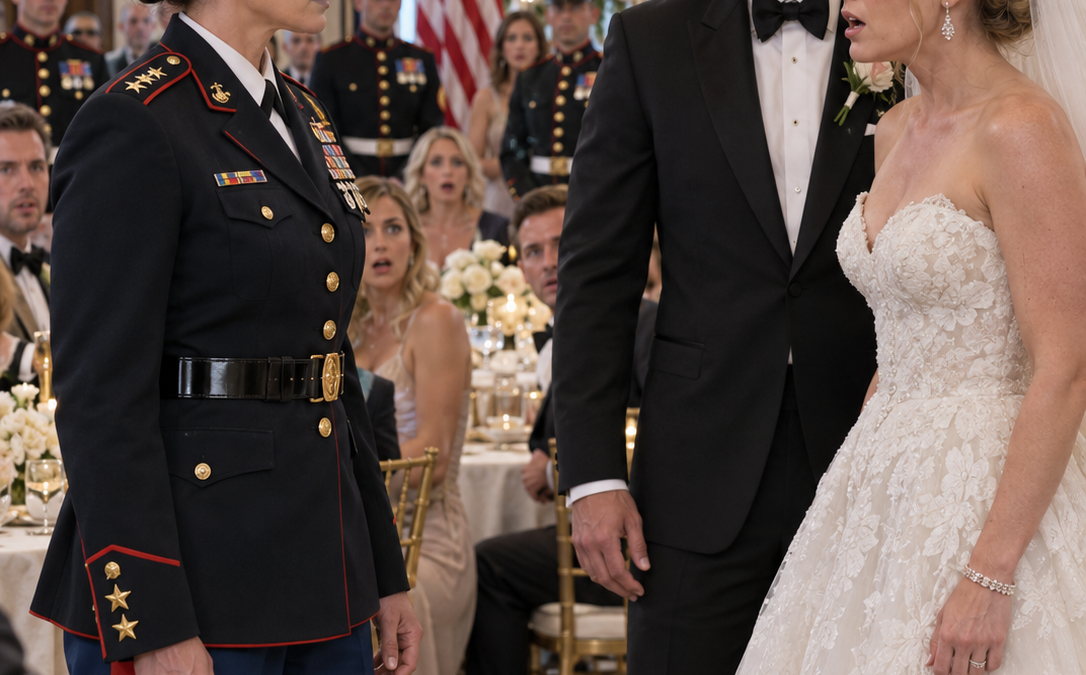
And then, exactly as we had arranged, at the moment when the officiant paused to say, “Before we proceed with the vows, we have one final guest joining us today,” I stepped away from the wall.
Trroo Rasmusen was already in position at the doors with two Marine corporals.
He gave me a single nod.
I nodded back.
The doors swung open.
I began to walk.
I want you to picture this the way I felt it, because it is a memory I will carry with me until the day I die.
Two hundred and fifty guests seated in white chairs.
A vaulted ceiling with crystal chandeliers.
A long white aisle runner leading to an altar where Wesley Cade stood in his tuxedo, his back to me, holding my sister’s hands.
My sister in her $10,000 dress.
Her veil.
Her hair swept up.
Her face already turning toward the sound of the opening doors, her expression preparing itself for whatever late guest was about to be embarrassed by their tardiness.
And then Delaney saw me.
She did not recognize me at first.
That is the honest truth.
I saw her eyes land on my uniform, and I saw her brain refuse the input for about half a second.
She saw the blue.
She saw the white cover.
She saw the gold.
And her brain said: This must be some kind of surprise entertainer, some kind of hired performer, because her sister Marlo—her plain, boring sister Marlo—could not possibly be walking into her wedding in a full dress uniform.
Then her eyes climbed to my face.
Her mouth opened.
Nothing came out.
Behind me, Trroo Rasmusen stepped through the doors, followed by two rows of Marines, and then two more, and then two more, until 500 Marines had filed silently into the back and sides of the ballroom in perfect formation.
There were audible gasps from the guests.
Someone toward the back said, “Oh my God, is she in the military?”
Someone else whispered, “That is a lot of medals.”
Wesley Cade turned around.
The look on his face is the second memory I will carry forever because Wesley, unlike Delaney, knew exactly what he was looking at.
His eyes moved to my collar.
To my shoulder boards.
To the four stars.
His face went slack.
Then his back straightened.
Then his right hand came up to his forehead in a salute so pure and instinctive that his tuxedo sleeve pulled tight.
I stopped in the center of the aisle.
I returned his salute.
Then Trroo Rasmusen’s voice rang out loud and clear, the way it had rung out in Fallah in 2006, the way it had rung out on parade grounds for 30 years.
“General on deck.”
Five hundred Marines snapped to attention.
The sound of 500 pairs of boots hitting the floor at exactly the same instant filled that ballroom like a thunderclap.
Guests jumped in their seats.
My mother in the third row actually screamed.
And then one voice, 500 strong, all of them together:
“Good afternoon, ma’am.”
I let it settle.
I stood there in the center of the aisle, in the middle of my sister’s wedding, and I let the reality of what was happening wash over that room like a wave.
Delaney was staring at me.
Her mouth was still open.
The bouquet in her hands had drooped.
Her veil was slightly crooked from turning her head too fast.
Behind her, our mother was on her feet in the third row, her hand pressed to her chest, her eyes wide and confused, and for the first time in my adult life, looking at me.
Really looking at me.
Not through me.
Not past me.
At me.
My father was in the last row on the bride’s side.
I could see him now at the edge of my vision, standing up slowly, his hand on the pew in front of him.
His face was doing something I had never seen it do before.
He was crying silently without moving, just standing there with tears running down into his shirt collar.
Aunt Peggy was in the second row.
She was smiling so hard I thought her face would split.
And in the fifth row, my four-year-old daughter, Iris, was standing up on the pew, her navy dress with the anchor buttons riding up on her tights, and she was pointing at me with one small finger.
I could hear her voice, high and clear, cutting through the silence of the ballroom.
“Mommy! Mommy, that’s you! You’re the general! You’re the biggest general!”
Rowan, my husband, was trying gently to sit her down.
He was also smiling in a way I had only seen him smile twice before.
Once at our wedding.
Once when Iris was born.
I gave Tru a small nod.
He called out, quieter now, “At ease. Marines, take your seats.”
Five hundred Marines relaxed into parade rest and then, in an orderly, practiced flow, took their positions along the walls and the reserved back rows that Tru had coordinated in advance with the resort staff.
They did it in near silence.
No shuffling.
No talking.
Just the soft, coordinated movement of 500 trained people who knew exactly what their job was.
I turned my attention back to the front of the ballroom.
To my sister.
To Wesley.
To the officiant, who was standing at the altar with his mouth also slightly open.
I began to walk again, slowly, down the aisle, my sword at my side, my white gloves tucked into my belt now that the entrance was complete.
When I reached the front of the ballroom, I stopped in front of Wesley.
He was still standing at attention.
His jaw was tight.
His eyes were shining.
“Captain Cade,” I greeted him quietly.
“General,” he replied, his voice cracking just slightly.
“At ease, Marine. This is your wedding day, not a parade.”
He allowed himself a small breath.
His shoulders came down about a quarter of an inch.
His eyes flicked involuntarily toward the medals on my chest.
He knew what each one was.
He knew what each one meant.
I turned to my sister.
Delaney was looking at me like she had never seen me before.
Which, in a way, she never had.
Not really.
Not this version.
Not the one that had been standing in front of her the whole time, disguised as the sister she had built her whole identity on being better than.
“Delaney,” I offered gently.
“Marlo, I—”
She began.
Then she stopped.
Then she started again.
And she stopped again.
I did not enjoy this.
I want that to be clear.
If you are watching this and you think I was standing there gloating, you have misunderstood me.
I was tired.
I was steady.
And I felt, more than anything, sad.
Because it should not have taken 500 Marines and a four-star salute for my sister to see me.
Aunt Peggy should have been enough.
My promotion in 2024 should have been enough.
My daughter being born should have been enough.
But it had not been enough.
And so here we were.
I turned to the officiant.
“Sir, I apologize for the interruption. This is my sister’s wedding day, and I have no intention of taking any more of her time than necessary. I would like to take a seat with my family, if that is all right, and let you continue.”
The officiant, who was a Methodist minister in his 60s, cleared his throat and adjusted his glasses.
“Of course, General. Please.”
I saluted Wesley once more.
I nodded to my sister.
Then I walked alone to the third row on the bride’s side, where my mother was still standing, her hand pressed to her chest, staring at me as if I were a stranger who had just walked into her house.
I sat down in the empty seat that had been left for me.
My mother, after a long moment, sat down too.
She did not look at me.
She looked at her lap.
Her hands were shaking.
The officiant, to his credit, resumed the ceremony as if a general had not just walked in with 500 Marines.
He proceeded to the vows.
Wesley’s voice was steadier than Delaney’s, which trembled through the whole thing.
Rings were exchanged.
A kiss was shared, briefer than Delaney had probably planned.
And then, 42 minutes after the ceremony began, they were pronounced husband and wife.
Delaney walked back down the aisle on Wesley’s arm.
Past me.
Past our mother.
Past our father.
Past 500 Marines standing along the walls in silent respect.
She did not look at any of us.
The reception was held in the same ballroom after a 30-minute cocktail hour, during which the resort staff transformed the space with what I can only describe as military precision, which felt fitting.
Round tables.
Ten seats each.
Gold chargers.
A live band.
A dance floor.
A three-tier cake.
I was not seated at the family table.
Delaney had made that decision months ago.
The family table sat six: my parents, Delaney, Wesley, Wesley’s parents.
There was no room for me and even less room for Rowan or Iris.
Delaney had told my mother back in April that she wanted the family table to look clean in photographs.
I was seated with Aunt Peggy at what Delaney’s wedding planner had called the “extended family table,” along with Rowan, Iris, two of Wesley’s college friends, and a woman I did not know who turned out to be the wife of one of Wesley’s Marine buddies.
I was fine with the seating.
I preferred it.
I did not want to sit at the family table.
I wanted to sit with my daughter, who was currently chewing on a bread roll and telling everyone at the table that she had recently learned to write her whole name.
Aunt Peggy, on my right, patted my hand under the table.
“You did that beautifully,” she whispered.
“Thank you.”
“Your father wants to speak to you. He is at the bar. He has been drinking club soda for two hours. He is terrified.”
“I know.”
“When you are ready.”
“After the toasts.”
She nodded and returned to her salad.
The toasts began around 4:30.
The maid of honor, one of Delaney’s blonde bridesmaids, gave a rambling speech about how Delaney was the best friend anyone could ever have and how she had once let her borrow a dress in college that changed her life.
There was polite laughter.
Wesley’s best man gave a shorter, more genuine speech about how Wesley had saved his life during a training exercise in 2016.
There was more genuine laughter and a moment of respectful applause.
Then Wesley took the microphone.
He stood up.
He was still in his tuxedo.
But somewhere between the ceremony and the reception, something in him had shifted.
He held himself differently.
Straighter.
More present.
Like the salute I had received from him earlier had realigned something inside him that had been slightly off for years.
“I want to thank everyone for being here today,” he began, his voice carrying easily across the room. “Especially the 500 Marines who came to honor a moment I did not know I needed honored. Semper Fi, brothers and sisters. I love you.”
The Marines around the room, seated and standing, answered in one low voice.
“Oorah.”
Delaney, at the head table, was smiling in a way that did not reach her eyes.
Wesley continued.
“I also want to thank someone I only met formally for the first time about 90 minutes ago, though I have heard her name in Marine Corps circles for years. My new sister-in-law, General Marlo Prescott.”
The room turned to look at me.
I did not stand.
I nodded once.
“Ma’am,” Wesley added, looking directly at me, “I served under officers who wore your name on their reports. I read one of your after-action briefings when I was a lieutenant in Helmond in 2017. It saved lives, mine included. I did not know when I fell in love with your sister that I was marrying into your family. If I had, I would have written to you a lot sooner.”
“Thank you for being here. Thank you for bringing them. Thank you for reminding me who I am on the day I was starting to forget.”
He raised his glass.
“To General Prescott. And to my wife, Delaney, who I promise I will spend the rest of my life loving.”
The room raised its glasses.
To the general.
To Delaney.
Delaney’s smile was gone now.
She was looking at Wesley like she had never seen him before either.
She reached for the microphone.
“I want to say something,” she announced, her voice a little sharper than the microphone required.
Feedback squealed for a moment.
She adjusted.
“I want to say thank you all for coming. This has been the most surprising day of my life in more ways than one.”
She let out a small laugh that was almost a laugh.
“I did not know my sister was such a big deal. She never told us. She kept it—well, I guess she kept it to herself, which is very Marlo of her.”
There was a beat of uncertain silence.
“I mean, of course, I am proud of her,” Delaney continued. “We are all proud of her. But I do wish she had shared this with the family so that today did not have to be, you know, quite so much about her.”
The silence got sharper.
Aunt Peggy went very still beside me.
Delaney kept going.
She could not stop herself.
I had seen her do this at Thanksgivings my whole life.
Once she started digging, she could not stop.
“Anyway, thank you, Marlo, for the show. Very impressive. Wesley loved it. We all loved it. And now, back to my wedding.”
She sat down.
There was a smattering of confused applause.
I did not move.
I did not react.
My face was as still as it had been in the aisle.
I felt Rowan’s hand on my knee under the table.
He squeezed once.
It was our signal.
It meant: I am here. Whatever you decide to do, I am here.
I did not decide to do anything yet.
Iris, on my other side, tugged at my sleeve.
“Mommy, why did Aunt Delaney say you took her wedding?”
“She did not mean it that way, baby.”
“But she did say it.”
“Yes, she did.”
“That’s not nice.”
“No, it is not.”
“Are you going to tell her?”
I looked down at my daughter’s small, serious face.
Four years old.
In her navy dress with a smear of butter on her cheek from the bread roll.
She was watching me the way I had watched my own mother 30 years ago, waiting to see what a woman does when someone says something not nice.
“Yes, sweetheart,” I told her. “Mommy is going to tell her. But not in front of everyone. That would not be fair to Delaney. Do you understand?”
“Because it’s her wedding.”
“Because it is her wedding.”
Iris nodded solemnly and returned to her bread roll.
Rowan, on my other side, leaned in and whispered, “You are a better woman than I am, Marlo Whitaker.”
“Prescott,” I corrected softly.
It was the name I still used professionally.
Rowan had never minded.
“Prescott, then. Still true.”
The band began to play.
Delaney and Wesley took the floor for their first dance.
I watched them, and I saw what I had suspected for months.
Wesley was in love.
Delaney was performing.
Halfway through the dance, my mother approached our table.
She stood beside my chair for a long moment, her hands folded in front of her.
Her wedding-day makeup smudged slightly at the corner of her left eye, where she had wiped away a tear or two she had not planned on.
“Marlo, can I speak with you outside?”
I looked at Rowan.
He nodded.
I stood up.
“Of course, Mother.”
We walked out of the ballroom and into the hallway, past two Marine corporals who came to attention as I passed.
My mother flinched at the sight of them.
She did not know what to do with her body around men who saluted her daughter.
We stepped onto the outdoor terrace overlooking the marsh.
The June air was thick and warm.
Somewhere, a boat horn sounded low and far away.
My mother did not look at me.
She looked at the water.
“I did not know,” she began.
“You did know. I told you in September. I sent you the invitation to the ceremony.”
“I did not know it was that big.”
“Every rank is that big, Mother. You did not want to know.”
She was quiet.
The marsh smelled of salt and old wood.
My mother stood at the terrace railing in her mother-of-the-bride dress, mauve chiffon with beaded shoulders, and for the first time in my adult memory, she looked small to me.
“Marlo,” she offered finally, “I do not know what to say.”
“You do not have to say anything, Mother. This is Delaney’s day. Let’s leave it at that and go back inside.”
“No.”
She turned to face me.
Her eyes were wet.
“No, Marlo, please. I have to say something. If I do not say it now, I never will, and I know that about myself.”
I waited.
She took a shaky breath.
“When you told me in 2004 that you were joining the Marines, I told your father that night that I thought you were doing it to punish us. To embarrass us. To make us feel bad for spending more on Delaney.”
“That is what I believed for years. And I built my whole story of you around that belief.”
“Every promotion you told us about, I heard as, ‘Look what I did without you.’ Every uniform photo, I heard as, ‘Look who I became despite you.’ And I could not bear it, so I stopped listening.”
I did not answer her.
I let her keep going.
She had earned the right to keep going, if only because she was finally speaking.
“Then Aunt Peggy called me last week. She told me that you had been promoted to four-star general nine months ago. Nine months, Marlo, and I did not know.”
“She told me you were commanding 200,000 Marines. She told me you were one of only a handful of women in history to reach this rank.”
“And I sat in my kitchen and I cried for three hours because I realized I had missed it. All of it. Every step.”
“And it was not because you had kept it from me. It was because I had refused to receive it.”
The moon was starting to rise over the marsh.
It was still faint, a pale silver disc against the not-quite-dark sky.
“I am not asking you to forgive me,” my mother continued. “I am not even asking you to like me. I know I do not deserve either of those things.”
“I am telling you out loud, once, that I saw you today. I saw you walk down that aisle, and I understood for the first time in 38 years that I had a daughter who was—who is—extraordinary.”
“And I chose to look away from her because it was easier to look at the daughter who reflected me back.”
I turned to the railing beside her.
I set my white gloves on the wood.
I did not know what to do with my hands.
“Delaney is not who you think she is either,” I stated quietly.
“I know.”
“Do you?”
“She has spent 35 years being loved for being pretty. She has never had to earn anything. She married a Marine officer today because he looks good in a tux and because his family has money.”
“She did not marry him because she loves what he is. She married him because she loves what he presents.”
“And someday, when he stops presenting well, when he has a hard year, when he is depressed or drinking or grieving, she will not know what to do with him because you did not teach her how to love hard things.”
My mother nodded slowly.
Her hand came up to her mouth.
“I did not know how to teach her that. I did not know how myself.”
“I know.”
We stood there for a long time.
The band from the ballroom drifted out onto the terrace, muted through the glass.
A slow song.
Wesley and Delaney were probably still on the dance floor.
“Your father,” my mother spoke gently, “is inside. He wanted to be out here. I told him no, that I needed to speak with you first. I hope that was all right.”
“It was.”
“He has changed, Marlo.”
“So Aunt Peggy tells me.”
“He drinks club soda now. He goes to meetings twice a week. He has a sponsor named Bud who calls him every Sunday.”
“He asked me last night if he could bring Iris a present today. I told him he had to ask you first.”
“He was too afraid.”
“He is still afraid.”
I closed my eyes for a moment.
The Denton Prescott of my childhood had never been afraid of anything.
He had been a lawyer who won cases through intimidation.
He had been a father who used silence as a weapon.
He had been a man who once told me, when I was 15, that I was too plain to expect much from life.
Now he was afraid to give a present to my daughter.
“Tell him he can bring the present to the table,” I finally answered. “And that he can sit with us for a minute if he wants.”
My mother’s eyes filled again.
“Thank you, Marlo.”
“Do not thank me. Thank him. He is the one who did the work.”
She nodded and stepped away from the railing.
Before she went back inside, she stopped and turned back to me.
“There is one more thing, Marlo.”
“Yes?”
“Your grandmother Ruth—my mother—she left a house to me in her will when she died in 2018. A little beach cottage on Adisto Island.”
“I have been renting it out ever since. I never told you about it because Delaney was upset that Grandmother only left the house to me and not to her too.”
I did not know where this was going.
I waited.
“Grandmother, before she died, told me that if she had lived long enough, she would have left the house to you directly, not to me.”
“She said she felt she had failed you as a grandmother because she had let me set the tone.”
“She said—and I remember this exactly—’Karine, Marlo is the one who will need a home she can retreat to. Delaney will always land somewhere soft. Marlo will need a place of her own.'”
“Grandmother said that?”
“She said that. And I ignored it because I was angry that she saw you clearly when I did not.”
She reached into her small evening bag and pulled out a folded piece of paper.
She held it out to me.
“I had my lawyer draw this up last week. It transfers the deed to the Adisto cottage to you, free and clear. You do not owe me anything for it.”
“I know it does not undo anything. I know a house is not 38 years. But I want you to have it. Grandmother would have wanted you to have it. And I finally want what Grandmother wanted.”
I did not take the paper.
Not right away.
“Mother, that house has to be worth what? $500,000?”
“$650,000. It has appreciated, and it is paid off. There is no mortgage.”
“Delaney will lose her mind.”
“Delaney can lose her mind. It is not her house. It never was. It was Grandmother Ruth’s decision delayed by 37 years.”
I took the paper.
I did not open it.
I folded it once and slid it into the inside pocket of my dress coat, next to a small folded photograph of Bo Ellery I had carried in that pocket since 2007.
“Thank you,” I whispered.
My mother nodded once sharply and turned to walk back inside.
At the door, she paused.
“Marlo, may I meet Iris properly?”
“She is at our table, Mother. She has been there all evening.”
“May I meet her as her grandmother, not as the woman who has only seen her twice?”
I looked at her for a long time.
“Yes,” I finally answered. “But do not perform. She is four. She sees through performances.”
“I understand.”
She went inside.
I stayed on the terrace for another minute, alone.
The moon was clearer now.
I thought about Grandmother Ruth.
I had loved her deeply as a child.
She had been the only relative besides Aunt Peggy who had ever treated me as a person in my own right, not as a shadow of my sister.
She had died when I was 32, in the fall of 2018, while I was deployed.
I had not been able to attend the funeral.
Delaney had told me at the time on the phone that Grandmother had asked for me on her deathbed.
I had never known whether that was true or a manipulation.
I had chosen to believe it was true because it was easier to grieve a grandmother who had wanted me at the end than one who had not.
Now I knew it was true.
I went back inside.
My father was standing near our table.
He was holding a small wrapped package in his hands.
It was clumsily wrapped in blue paper with a slightly bent bow.
He was 67 years old now.
His hair was completely white.
He had lost weight since I had last seen him at Christmas of 2018.
He looked up when he saw me approaching.
He did not smile.
He did not know if he was allowed to.
“Marlo.”
“Dad.”
The word came out before I could stop it.
I had not called him Dad since 2019.
I had called him Denton or my father or that man, depending on my mood.
But when he stood there holding a poorly wrapped present for a granddaughter he barely knew, the word came out on its own.
His eyes filled.
“May I?” he asked, gesturing to Iris.
“Yes.”
He knelt down beside her chair with some difficulty.
His knees were not what they had been.
Iris looked at him curiously, still chewing on a piece of fruit.
“Hello, Iris.”
“Hi. Who are you?”
“I am your grandfather. My name is Denton. I brought you a present. Is it all right if I give it to you?”
Iris looked up at me.
I nodded.
“Yes, please,” Iris responded politely, in the voice she used with strangers at church.
He handed her the package.
She opened it slowly.
It was a small stuffed dog, brown with floppy ears.
Not fancy.
Not expensive.
Just soft and clearly chosen with care.
“His name is Duke,” my father told her. “If you want to keep the name. Or you can pick another name.”
I felt something crack open in my chest.
Duke.
Bo Ellery’s dog’s name.
He had remembered from a phone call in 2007 when he had been drunk and I had told him, sobbing, about the Marine who had died in my arms and his dog, Duke.
He had remembered.
Iris hugged the dog.
“I like Duke. Thank you, Grandpa Denton.”
He stood up slowly.
His eyes met mine over her head.
“I have 20 years of things to say to you, Marlo,” he offered quietly. “I do not expect to say them today, or maybe ever. But I wanted you to know that I have been listening even when you thought I was not.”
“I know that now.”
“May I sit just for a minute, please?”
My father sat at our table for exactly seven minutes.
He did not apologize or make excuses.
He simply sat beside Iris and told her about his orange cat named Winston, who liked to sit in the dry bathtub.
Iris laughed.
He laughed too, carefully, like a man who had not used the muscle in a long time.
Then he returned to the family table.
Delaney watched him go, her face tight.
I knew a scene was coming.
Delaney had been decentered twice already.
Once when I walked in.
Once when Wesley thanked me in his toast.
I gave her 90 minutes.
At 8:00, she found me by the bar.
Her veil was gone.
Her hair was falling.
Her martini nearly empty.
She asked to speak alone.
Rowan kissed my head and walked away.
In a small anteroom off the hallway, Delaney spun around, flushed and shaking.
“You waited 38 years to humiliate me, and you did it on my wedding day,” she snapped. “Five hundred Marines, Marlo. Everyone is talking about you. Not me. On my wedding day.”
I told her to sit down.
Not as a general.
As her sister.
Something in my voice made her comply.
I stood before her and spoke plainly.
I explained that Wesley’s old commanding officer had asked me to help honor him, and I said yes because that is what I do.
I told her I never shared my life because no one asked.
Aunt Peggy asked every phone call for 21 years.
Delaney never once did.
I told her I had deployed four times, held a dying 19-year-old in Iraq, written letters to 211 grieving families, and been promoted to general in September of 2024.
It was in every major paper.
She did not know because she did not look.
Then I told her the harder truths.
She had called Wesley’s brotherhood tacky.
She had refused to let our father walk her down the aisle because he did not photograph well.
She had asked Aunt Peggy if Wesley’s parents were rich enough.
She had married a man with a Silver Star and did not even know what a Silver Star was.
She was sobbing openly now.
“I am telling you this because Wesley will have a bad year eventually,” I said quietly. “And when he does, you will need to decide whether you love him or what he presents.”
“I want you to remember you have a sister who can help you understand him if you ever decide to actually meet her.”
She said she had been a terrible sister.
I told her she had been the sister she was taught to be, raised to be a spotlight while I was the shadow.
That was not her fault.
But it was her responsibility now.
We agreed to start over slowly.
One question a month.
Building a relationship one honest answer at a time.
I told her to send Wesley to me, or any of the 500 Marines in that ballroom, whenever he needed someone.
She promised she would.
Before we left the room, she told me I looked beautiful walking down the aisle.
She apologized about the sweatshirt incident that morning.
I laughed for the first time all day and told her she was not wrong about a Fruit of the Loom sweatshirt from 2009.
She also told me she would not fight me for Grandma Ruth’s house.
She said Grandma loved me the most and always had.
I thanked her.
We walked back into the ballroom together, and the energy had shifted.
Wesley danced with Iris.
Rowan laughed with Tru.
My father sat with retired Marines.
Aunt Peggy danced with a sergeant major 20 years her junior.
The 500 Marines had woven themselves into the room like family.
Delaney walked to Wesley, said something I could not hear, and he kissed her deeply in the middle of the dance floor.
Not for the camera.
For her.
The reception ran until 11.
Delaney hugged me briefly on her way out.
A short, fierce, uncertain hug.
The Marines saluted me one by one as they left.
Tru was the last, asking if the night had been what I needed.
I told him it was more than that.
Aunt Peggy found me by the coat check, flushed from dancing, telling me a sergeant major had asked for her email.
She reminded me of the things she had told me over the years.
That my parents were fools.
That the Marines would pay for my college.
That I should believe in myself.
She said she was proud I had come home believing it.
And now they all knew it too.
My parents approached together, arm in arm, walking slowly like a couple relearning the rhythm.
My mother invited us to the house whenever we were ready.
My father nodded silently.
I said I would call next week.
My mother touched my cheek for the first time in perhaps 20 years.
I stood alone in the emptying ballroom for a moment.
The band was packing up.
The peonies, $10,000 worth of them, were being gathered for a local nursing home.
Rowan came up behind me with Iris asleep on his shoulder.
“Ready to go home, General?”
“Ready.”
We walked out into the warm June night.
Charleston smelled of magnolia.
Somewhere in the distance, an ambulance siren wailed, and life continued for people who had no idea what had happened in that ballroom.
In our rental car on the way back to the hotel, Iris stirred sleepily in her car seat.
“Mommy.”
“Yes, baby.”
“Aunt Delaney said I could come visit her sometime. She said she wants to know me.”
“Do you want to visit her?”
“I think so. She looked pretty when she was crying. Like she was sad, but okay.”
“Yes. She was sad but okay.”
“Are you sad but okay?”
I looked at Rowan in the driver’s seat.
He was smiling at the road.
“Yes, sweetheart. I am sad but okay too. Sometimes those two things go together.”
“Okay.”
She fell back asleep.
At the hotel, after Rowan carried Iris to bed, I stood in front of the mirror and began to undress slowly, in reverse of how I had put the uniform on.
The sword.
The Sam Browne belt.
The coat.
The gloves.
The trousers.
Each piece back in the garment bag.
Each piece hung with care.
Underneath, in a soft T-shirt and my old leggings, I looked like Marlo again.
Not General Prescott.
Just Marlo.
I sat down on the edge of the bed and pulled out the folded deed from the coat pocket.
I opened it for the first time.
The Adisto Cottage.
Two bedrooms.
One bath.
On the water.
Grandmother Ruth’s house.
I began to cry.
Not sadness.
Not anger.
Not relief.
Just the sound of a very long day finally releasing itself from my chest.
Rowan sat down beside me on the bed and put his arm around me and did not say a word.
He knew.
He always knew.
Outside in the hallway, I could hear the faint sounds of the last guests returning to their rooms.
Laughter.
Doors closing.
Someone humming a song from the band.
Somewhere in the building, my sister was on her wedding night.
Somewhere else, my parents were probably lying awake, talking about the day.
And somewhere inside me, for the first time in 38 years, a small, quiet room opened up where my family used to live.
I did not know yet what I would put in it.
But I knew now that it was mine to fill.
The summer moved slowly after the wedding.
That was the surprise of it.
I had expected some kind of dramatic aftermath.
A flood of texts.
A hundred phone calls.
A demand that everything be resolved immediately, the way our family had always tried to resolve things in one loud weekend followed by another 20 years of silence.
Instead, there was a slow, careful correspondence.
My mother sent me a card the following Wednesday.
It said simply, “Thinking of you. Iris was lovely. Would love to see her again soon. Love, Mom.”
I wrote back.
I did not send an email.
I wrote it by hand.
I said, “Iris asks about you. We will drive down in July if that works.”
We drove down in July.
It was awkward for the first two hours.
My mother had made too much food.
My father hovered in the doorway.
Iris broke the tension by climbing into my father’s lap and asking him if Winston the cat was there.
He took her to the sunroom to meet Winston.
When she came back, she was carrying the cat like a baby.
And my father was laughing.
Actually laughing.
My mother caught my eye across the kitchen and mouthed, “Thank you.”
Delaney called me in August.
She asked me one question, as promised.
She asked what a Silver Star was.
I told her.
I told her the whole thing.
What it was.
What it meant.
What her husband had done to earn one.
She listened.
She did not interrupt.
When I was finished, she was quiet for a long time.
“Marlo, I do not know how to be a good wife to him.”
“You are going to have to ask him what he needs, Delaney. And then you are going to have to actually listen to the answer. That is all it is. It is not complicated. It is just hard.”
“Okay.”
“And when you cannot listen, when it is too heavy, you call me, or Tru, or any of the people you met at the wedding.”
“Okay.”
She has called me twice since then.
Once in September.
Once at the beginning of October.
She asked about my work the first time.
She asked about Iris the second time.
Small steps.
Careful ones.
I do not yet trust that they will continue.
I hope they will.
Hope is a thing I have learned to carry lightly.
Like an egg in my hand.
I took possession of the Adisto cottage in late July.
Rowan and Iris and I spent a long weekend there in August.
I painted the front porch a soft blue.
Iris helped.
Most of the paint ended up on Iris.
That is fine.
It is her house too now.
Grandmother Ruth would have liked that.
My father sent me a letter in September.
A handwritten letter.
Eight pages.
It was not an apology exactly.
It was more like a report.
He told me the whole story of his drinking, from when it started in 1988, right after I was born, when he was 27 and terrified of being a father.
He said he had drunk to manage the fear, and the drinking had eaten his ability to be present, and the absence had eaten his ability to love me the way I deserved.
He said he did not expect the letter to fix anything.
He wanted me to know the shape of it so that if I ever wanted to speak about it, we would both be starting from the same map.
I wrote back three pages.
I told him I forgave him.
I told him forgiveness was not the same as trust, and that trust would come slower, and that I was willing to walk toward it if he was.
He wrote back within a week and told me he was.
Aunt Peggy is dating the sergeant major.
His name is Wallace.
He is 53.
She is 71.
They go to Waffle House together twice a week.
She calls me every Sunday with updates and giggles like a schoolgirl.
I tell her to enjoy every minute.
Wesley wrote to me in October.
A short note.
He said he wanted me to know that he had started attending a support group for combat veterans, that Delaney had gone with him once, that it had been hard for both of them, and that it had been worth it.
He signed the letter:
“With respect and gratitude, Wesley.”
And a small P.S.
“Delaney is teaching me how to argue like a Prescott. She says it is a family trait. I am learning.”
I laughed for a long time at that.
The 500 Marines have gone back to their lives.
Some of them have written to me.
Some of them have added me on the professional networks I keep.
One of them, the young corporal who had recorded Iris doing the floss, sent me a photograph he had taken that day.
It was of me standing at the front of the aisle, looking at Wesley right before I turned to Delaney.
My face is in profile.
I look in the picture like a woman who has just come home from a very long journey and is discovering that home is a different shape than she remembered.
It sits on my desk now, next to Aunt Peggy’s 2004 note.
At work, life has continued.
I still command Marine Forces Command.
I still fly to briefings.
I still sign letters of condolence with my own hand.
In November, we lost a Marine in a training accident in California.
His name was Lance Corporal Amari Boon.
He was 20 years old.
He was from Detroit.
He had a girlfriend named Kayla.
I called his mother personally.
I flew to Detroit for the funeral.
I sat in the front row in my dress blues.
And after the service, I walked with his mother back to her car, and she held my hand the entire way.
And she did not know that I had once been the young Marine who held Bo Ellery in her arms in Ramatti in 2006.
But I knew.
And Bo knew.
And that was enough.
That is the work.
That is the whole work.
Holding people through the worst days of their lives and helping them find a way to keep walking.
Sometimes I think about that morning in the bridal suite.
My sister laughing at my sweatshirt.
My mother warning me not to embarrass Delaney.
Aunt Peggy silent in the corner, knowing what was coming.
That version of me is still inside me.
The girl in the wet windbreaker walking three miles home from the library in 1999.
The 18-year-old boarding a bus to Paris Island with three pairs of white socks and a Bible and a note in her pocket.
The young sergeant in Ramatti holding a dying friend and promising him she would remember his dog’s name.
All of them are still inside me.
None of them ever go away.
But now, next to them, there is also a woman who walked down an aisle in June of 2025 in a general’s uniform and let her family see her.
Not to punish them.
To introduce them to the person she had already become.
If there is one thing I want you to take away from this story, it is this:
You do not have to shrink yourself to fit into the family you were born into.
You do not have to explain yourself over and over to people who have already decided who you are.
You do not have to prove anything by force or by scene or by revenge.
You just have to become.
Fully.
Slowly.
Steadily.
Over years.
And one day, when the moment is right, you will walk into a room and the people who overlooked you will finally look up.
And you will not owe them a big speech.
You will not owe them a takedown.
You will owe them, at most, an introduction.
And then you will owe yourself the peace of walking away or walking toward them on your own terms.
My name is Marlo Prescott.
I am 38 years old.
I am a general in the United States Marine Corps.
I am a wife.
I am a mother.
I am a niece who was raised, in the ways that mattered most, by a woman named Peggy who saw me when no one else did.
And once, my sister laughed at my outfit at her wedding, and then 500 Marines rose and saluted me.
And then, slowly, over the months that followed, my family began to become a family.
That is the whole story.
If it moved you, if any part of it reminded you of your own family, your own quiet years, your own moment of finally being seen, I would love to hear about it.
Leave a comment and tell me about a time you were underestimated, and how you found your way through it.
Give this video a like if it meant something to you, and subscribe so you can hear more stories like this one.
Your story matters.
Your quiet years mattered.
And whoever you are becoming, whoever the world does not see yet, keep








