My sister laughed when security asked me to step out of line at the white house. “this is embarrassing,” she whispered. i simply handed over my qr code. the woman scanned it twice. her face changed. then she turned to the navy admiral standing nearby and said, “sir… she’s here.”
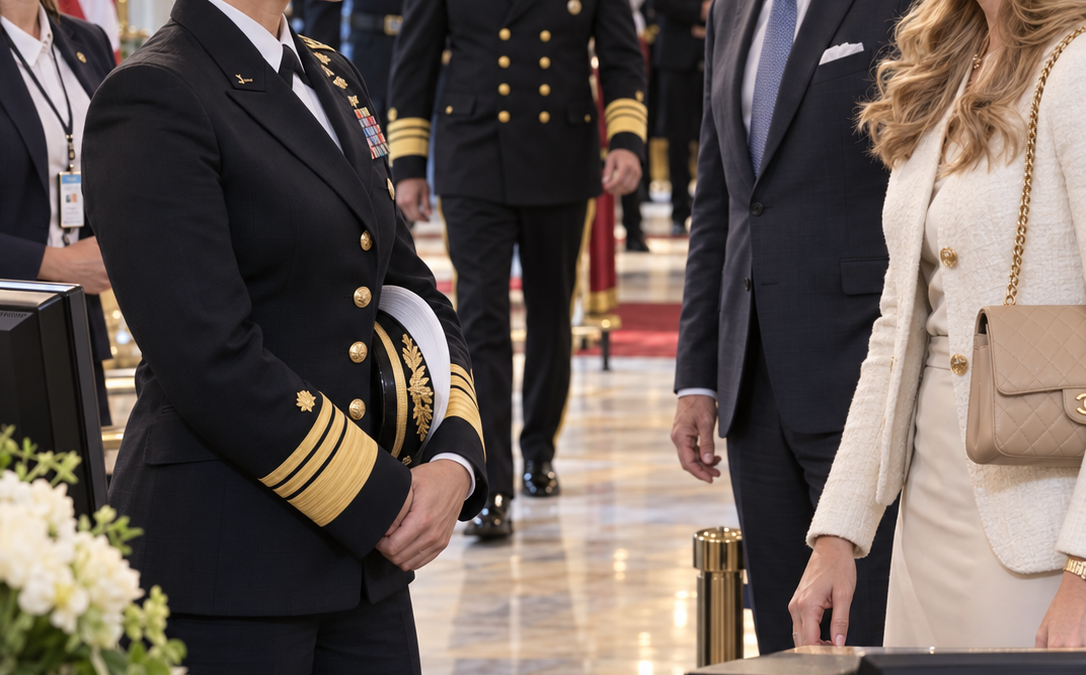
Ava’s eyebrows lifted immediately. There it was. That look. The same look she had been giving me since we were kids. Not concern. Not curiosity. Satisfaction.
“I knew there had to be some mistake,” she said.
Her voice wasn’t loud. It didn’t need to be. The people closest to us heard every word.
I kept my expression neutral.
“What kind of mistake?” my father asked.
Ava shrugged. “I don’t know. Maybe paperwork. Maybe the wrong registration.”
She glanced toward me.
“I told her to double-check everything before we left Virginia.”
I hadn’t told her that I had already confirmed the information twice. I also didn’t remind her that the invitation had come directly from Washington. There wasn’t much point.
My father turned toward me.
“Brooke, are you sure you’re using the right confirmation?”
I nodded. “Yes.”
The woman at the desk continued typing. A few seconds passed, then a few more. The line behind us kept moving.
People checked in. People walked through. People entered the ceremony area.
We stayed exactly where we were.
Ava folded her arms.
“This is kind of embarrassing.”
I almost laughed. Not because it was funny, but because she sounded exactly like herself. When something went wrong for her, it was a problem. When something went wrong for someone else, it was entertainment.
A group of guests walked past us. One man recognized Ava from a legal event in Richmond. They exchanged greetings. Within 30 seconds, she was smiling and chatting as if nothing unusual was happening.
Meanwhile, I stood beside a potted plant near the wall like misplaced luggage.
That felt familiar, too.
My father checked his watch. Then he checked it again. He hated waiting, especially when he thought somebody else had caused it.
The woman at the desk suddenly paused. She leaned closer to the screen. Her expression changed—not dramatically, just enough for me to notice. She clicked something, then clicked something else.
A few moments later, she stood up.
“One second, please.”
She walked toward another employee. The two of them spoke quietly. The second employee came over and looked at the monitor.
Now both of them were focused on the screen.
Ava noticed it, too. For the first time, she stopped talking.
My father shifted his weight.
“What’s going on?”
Nobody answered.
A minute later, a man wearing an official White House event credential approached the desk. He appeared older than the others, more senior. The two employees immediately stepped aside and let him take their place.
He studied the screen for several seconds.
Then he looked directly at me.
Not at my father.
Not at Ava.
Me.
“Commander Sullivan?”
“Yes, sir.”
He nodded once. His expression remained professional, but I could tell something had changed. He entered a few commands into the system. The screen refreshed.
Then he looked back up.
“Would you mind waiting here for just a moment?”
“Of course.”
My father looked increasingly confused. Ava looked increasingly uncomfortable. I wasn’t sure what I felt. Mostly curious.
The official walked several feet away and pulled out his phone. He made a call. The conversation lasted less than 30 seconds. When he finished, he returned to the desk.
Then he made another call.
This one lasted even less time.
Ava finally broke the silence.
“What exactly is happening?”
The man gave a polite smile.
“We’re just confirming a few details.”
That answer didn’t satisfy her. I could tell it didn’t satisfy my father either.
The waiting area suddenly felt much quieter than before. People continued moving through security. Staff members continued checking credentials, but my attention stayed fixed on the man behind the desk.
He wasn’t looking at the screen anymore.
He was watching the entrance like he was expecting someone.
A few seconds later, another event official appeared. The two exchanged a few words. Then both of them turned and looked directly at me.
Ava noticed.
So did my father.
Neither of them said anything.
Whatever they were waiting for had apparently arrived, and judging by the sudden change in the room, it wasn’t someone ordinary.
The second official glanced toward the main entrance corridor and immediately straightened his posture. I had seen that look before—not at White House events, obviously, but mostly on military bases.
People stand differently when someone important is approaching. Their backs get straighter. Their conversations get shorter. Their eyes shift toward the same spot.
Whatever was happening, it wasn’t normal.
My father noticed it, too.
“What is going on?” he asked quietly.
Nobody answered him.
For once, that made two of us.
Ava looked from the officials to me and back again. She still seemed convinced there was some simple explanation—a paperwork issue, a scheduling mistake, a misunderstanding that would eventually make me look foolish.
That theory fit her version of the world.
The problem was that Ava had been building that version for almost 40 years.
When we were kids, everybody knew who Ava Sullivan was. I was just Ava’s younger sister.
That’s not me being dramatic. That’s literally how people introduced me.
“Oh, you’re Ava’s sister.”
I heard it at church. I heard it at school. I heard it at family reunions.
After a while, people stopped saying your name, and you stopped expecting them to.
Ava was four years older than me and good at everything adults noticed. She spoke confidently. She smiled at the right moments. She remembered names. She could walk into a room and somehow leave with three new friends and an invitation to somebody’s barbecue.
People loved her.
Honestly, I loved her, too, when we were younger. She wasn’t mean back then. At least, not openly.
The problem wasn’t Ava.
The problem was what happened when everyone decided she was special.
My father helped build that idea.
Every report card became a family event. Every award became a celebration. Every accomplishment became a story he told for years.
I can still remember one particular Saturday afternoon. I was probably 10. Ava had won some academic competition at school. My father invited relatives over. My aunt brought a cake.
Pictures were taken. People made speeches.
You would have thought Ava had just negotiated world peace.
Meanwhile, I had spent that same week helping my mom repaint our back fence. Nobody mentioned it.
Not because repainting a fence deserved a party, but because nobody noticed I had done it at all.
That became a pattern.
Ava received attention.
I received responsibility.
Looking back, neither one of us asked for those roles, but we both learned them.
My mother noticed long before anyone else.
Mom had a way of watching people when they thought nobody was paying attention.
One night, she found me sitting alone in the backyard. I had just come home from school. I wasn’t crying. I wasn’t even upset.
I was mostly confused.
A teacher had congratulated Ava for something during an assembly. The entire auditorium applauded.
Meanwhile, I had received the highest grade in my class on a science project. Nobody knew, not even the teacher who handed me the ribbon.
Mom sat beside me. We listened to crickets for a few minutes.
Then she asked what was wrong.
I told her the truth.
“I think people forget I’m here.”
She looked at me for several seconds.
Then she smiled.
Not a fake smile.
A real one.
“The people who matter won’t forget.”
At 10 years old, that sounded nice.
At 10 years old, I also wasn’t sure it was true.
The next morning, she hung my science ribbon on the refrigerator. It stayed there for months. Nobody else in the house cared much.
Mom cared enough for everybody.
That was her gift. She made people feel seen, especially the people who weren’t.
As the years passed, Ava became even more impressive. Student government, honor society, debate team, scholarships, newspaper interviews.
She earned every one of those accomplishments. I want to be fair about that.
Ava worked hard.
The issue wasn’t that she succeeded.
The issue was that everyone acted as if she was the only one who did.
By high school, I had stopped competing for attention. That race was over.
I focused on things I could control.
Grades. Work ethic. Discipline.
The funny thing is that military life ended up fitting me perfectly years later because I had already spent my childhood learning how to do things without applause.
My father never understood that. He believed confidence came from being praised.
Mom understood something different.
She believed confidence came from surviving without it.
One afternoon during my senior year, I came home with a letter—a big one.
I had been awarded a major scholarship.
Not a small local scholarship. A serious one. The kind that could change someone’s future.
I was excited, not because of the money, but because I wanted my father to be proud.
I walked into the kitchen and handed him the letter. He read it, nodded, and told me congratulations.
Then he set it on the counter.
Ten minutes later, he left to attend an event honoring Ava.
That scholarship letter remained on the kitchen counter all weekend.
Nobody framed it.
Nobody showed relatives.
Nobody brought cake.
Monday morning arrived.
The letter was still there.
Eventually, Mom picked it up and put it in a folder.
I remember standing in the living room later that week. Across from me hung a framed newspaper article about Ava. One wall over sat photographs of Ava receiving awards.
The scholarship letter was nowhere in sight.
I stared at those frames longer than I should have.
Then I looked toward my mother.
She was watching me from the doorway.
She already knew exactly what I was thinking, and judging by the look on her face, she wasn’t nearly as surprised by it as I was.
She already knew exactly what I was thinking.
Mom pushed herself away from the doorway and walked into the living room. She didn’t look at the newspaper article hanging on the wall.
She didn’t look at the scholarship letter either.
She looked at me.
That was different.
Most people looked at accomplishments.
Mom looked at people.
“I know,” she said quietly.
I hadn’t spoken.
Apparently, I didn’t need to.
She sat down on the couch and patted the cushion beside her. I joined her, and for a few moments, neither of us said anything.
The television was on in the next room. My father was watching a college football game. Ava was talking on the phone with a friend.
Life in our house continued exactly as normal.
Except it didn’t feel normal to me.
“It doesn’t bother me,” I lied.
Mom laughed. Not a mean laugh. Not even a skeptical one. Just the laugh of somebody who had known me my entire life.
“Brooke, you’ve always been a terrible liar.”
That made me smile a little.
“I just thought he’d be excited.”
“He should have been.”
That answer surprised me. Mom rarely criticized my father, even when she disagreed with him, especially in front of me.
“He loves you,” she added.
“I know.”
“But love and attention aren’t always the same thing.”
That sentence stayed with me for years.
At the time, I didn’t fully understand it.
Later, I understood it too well.
Mom reached over and squeezed my hand.
“Your father sees what people celebrate.”
I frowned.
“What does that mean?”
“It means he’s impressed by things everyone can see. The newspaper articles, the speeches, the public recognition, the awards hanging on walls.”
Those things made sense to him.
The quieter stuff didn’t.
The discipline, the consistency, the sacrifices nobody noticed.
Those things mattered to Mom, and eventually they would matter to me.
Over the next several years, Mom became my safe place, not because she fixed problems, but because she listened.
There is a difference.
A lot of people want to solve your life.
Very few people actually want to hear it.
Mom was one of those people.
When I doubted myself, she listened.
When I got frustrated, she listened.
When I felt invisible, she listened.
Then she would usually say something annoyingly wise, the kind of advice you don’t appreciate until years later.
Ava and Mom had a different relationship.
They loved each other. There was never any question about that.
But Mom worried about Ava, not because Ava was failing, but because Ava was succeeding.
Too much attention can change people, especially when they start believing they deserve all of it.
By the time Ava finished law school, she had become the unofficial celebrity of our extended family. She was interviewed by local newspapers. She spoke at community events. She joined nonprofit boards.
Every holiday gathering somehow turned into a discussion about Ava’s latest achievement.
Sometimes even Ava seemed uncomfortable with it.
Most of the time, she didn’t.
Mom noticed.
One Thanksgiving, after everyone left, she stood at the kitchen sink washing dishes. I was drying them.
She looked out the window and sighed.
“What?” I asked.
She shook her head.
“Nothing.”
“Mom.”
She smiled.
“I just wish your father realized he has two daughters.”
That hit harder than she intended.
We both knew it.
Neither of us said anything else.
A few years later, everything changed.
Mom started getting tired.
At first, she blamed stress.
Then she blamed work.
Then she blamed age.
She was wrong.
The diagnosis came in February.
Cancer.
I remember the exact day because I was stationed in Florida at the time. My phone rang during lunch.
When I heard her voice, I knew something wasn’t right.
Parents have a way of sounding different when they’re trying to protect their children from bad news.
The treatment started almost immediately.
So did the pretending.
Everybody pretended.
Mom pretended she felt stronger than she did.
Dad pretended everything would be okay.
Ava pretended optimism could solve medical problems.
I pretended distance wasn’t killing me.
Military leave helped when I could get it, but I couldn’t be there every day. That bothered me more than I can explain.
Every time I flew home, Mom looked a little smaller, a little weaker, a little more tired.
Yet somehow, she spent those visits worrying about me.
Typical Mom.
One afternoon, I was helping her organize paperwork in the dining room. The house was quiet.
Dad was at work.
Ava was in court.
Mom handed me a folder, then another, then another. Halfway through the stack, she stopped and looked at me.
“You know something?”
“What?”
“I never worry about you.”
I laughed.
“That might be the first time you’ve ever said that.”
She nodded.
“It’s true.”
“Why?”
“Because when things get hard, you get stronger.”
Nobody had ever said that to me before.
Not a teacher.
Not a boss.
Not my father.
Nobody.
I looked away because I suddenly felt emotional.
Mom noticed.
Of course she noticed.
She always did.
A few weeks later, she started recording voice memos. The explanation sounded practical. She said she wanted to leave messages for everyone in case she forgot things during treatment.
That wasn’t really why she did it.
I think she knew before any of us did.
The recording continued for months.
Some were funny.
Some contained family stories.
Some were instructions about recipes nobody else knew how to make.
Mom took her macaroni and cheese very seriously.
Frankly, she should have.
It was excellent.
The disease kept progressing.
The treatments kept getting harder.
The hospital visits became more frequent.
Nobody talked much about the future anymore.
The future had become uncomfortable.
One evening, I sat beside her hospital bed while rain tapped against the window. She looked exhausted, but her eyes were still sharp.
Still Mom.
She reached over and touched my hand.
“Promise me something.”
I nodded.
“Okay.”
“Never let being overlooked convince you that you’re ordinary.”
The room felt very quiet after that.
I tried to answer.
Nothing came out.
She squeezed my hand, then smiled.
The same smile she had given me beside that refrigerator years earlier. The same smile she used whenever she was absolutely certain about something.
And she was absolutely certain about me.
I wish I could tell you that certainty made losing her easier.
It didn’t.
Mom passed away eight months later.
The funeral was held on a gray Saturday morning in Virginia. Friends, relatives, neighbors, and former coworkers filled the church.
People shared stories about her kindness. They talked about meals she delivered during hard times and the way she remembered birthdays nobody else remembered.
That all sounded like Mom.
The problem was going home afterward.
Funerals end.
Grief doesn’t.
The house felt different the moment we walked through the front door.
Her chair was still there.
Her reading glasses were still on the side table.
Her favorite coffee mug sat beside the sink.
Everything looked normal.
Nothing was normal.
For a while, we all tried to adjust.
Dad threw himself into work.
Ava threw herself into family responsibilities.
I threw myself into figuring out what came next.
The strange thing about losing someone like my mother is that you don’t just lose the person.
You lose the balance they created.
Mom had spent years quietly smoothing rough edges.
Without her, those edges became obvious.
Dad leaned on Ava more and more.
At first, it made sense.
She lived nearby.
I didn’t.
She could stop by after work.
I couldn’t.
She could attend appointments.
I couldn’t.
Nobody blamed her for that.
I certainly didn’t.
The problem was what happened afterward.
Gradually, every family decision started running through Ava.
Holiday plans.
Repairs around the house.
Family gatherings.
Medical paperwork.
Everything.
Dad treated her like a partner.
I became someone he updated afterward.
One evening, about six months after Mom passed away, I drove over for dinner.
Ava was already there.
Of course she was.
She had reorganized Dad’s kitchen. She had reorganized his filing cabinet. She had reorganized half his life.
Honestly, some of it probably helped.
Ava was good at organizing things.
People included.
Dinner started normally.
Then Dad asked me a question.
“So, what are you planning to do after graduation?”
I had recently finished another semester and was exploring options.
I’d been thinking about military service for years.
That wasn’t new.
What was new was finally saying it out loud.
“I’m considering the Navy.”
The room went quiet.
Not shocked quiet.
Disappointed quiet.
Dad put down his fork.
“The Navy?”
“Yeah.”
“What?”
It wasn’t an angry question.
It was worse.
It was a confused one, like I had just announced plans to become a circus performer.
I explained what attracted me to it.
The structure.
The leadership opportunities.
The chance to serve.
The chance to build something meaningful.
Dad listened.
Then he shook his head.
“I don’t understand it.”
Ava jumped in immediately.
“Neither do I.”
I should have expected that.
“You have options, Brooke.”
“I know.”
“So why would you choose something like that?”
Something like that.
I still remember those words, as if military service was something people settled for when real plans failed.
I looked at Ava.
“You know thousands of highly educated people serve, right?”
She shrugged.
“That’s not what I meant.”
But it was exactly what she meant.
Dad sighed.
“I just think you could do more.”
That one hurt.
Not because he intended it to.
Because he genuinely believed it.
To him, joining the Navy looked like lowering my ambitions.
To me, it looked like finding them.
The conversation went nowhere after that.
By dessert, everyone had moved on.
I hadn’t.
A few weeks later, I submitted my application.
I didn’t tell many people, mostly because I was tired of defending the decision.
The process took months.
Medical screenings.
Interviews.
Paperwork.
Background checks.
The military loves paperwork almost as much as lawyers do.
Maybe that’s why Ava never enlisted.
Too much competition.
That joke still makes me smile.
Eventually, everything came together.
I received my acceptance package.
The day it arrived, I sat in my apartment staring at it for nearly an hour.
Not because I was scared.
Because I knew my life was about to change.
I called Dad that evening.
His reaction wasn’t terrible.
It wasn’t good either.
“Well,” he said, “if that’s what you want.”
Not exactly the speech from a proud father you see in recruiting commercials.
Still, it was better than nothing.
Ava’s reaction was more direct.
We were having lunch when I told her.
She stared at me across the table.
Then she laughed.
Not cruelly.
Not loudly.
Just enough.
“Nobody joins the Navy because they have a better option.”
There it was.
Classic Ava.
Every compliment disguised criticism.
Every criticism disguised concern.
I took a sip of my coffee.
“Good to see you’re supportive.”
“I’m being realistic.”
“No. You’re being Ava.”
That ended the conversation.
A few months later, I stood inside a federal building preparing to take the oath.
The room wasn’t large.
A handful of recruits stood nearby. Some had family members with them.
Parents.
Spouses.
Brothers.
Sisters.
People taking photos.
People crying.
People smiling.
I kept looking toward the entrance.
Nobody walked through it.
Dad had work.
Ava had court.
Life was busy.
I understood that.
At least, I told myself I did.
The officer conducting the ceremony called us forward.
We raised our right hands.
I repeated every word of the oath loudly, clearly, proudly.
When it was over, people hugged their families.
Pictures were taken.
Phones came out.
Laughter filled the room.
I gathered my paperwork and started toward the exit.
“Brooke.”
I turned around.
An older woman stood near the back of the room.
For a second, I didn’t recognize her.
Then I did.
She had been one of Mom’s closest friends.
Mrs. Reynolds.
She walked over and handed me a small envelope.
“Your mother asked me to give you this if I ever got the chance.”
My chest tightened.
I looked down at the handwriting on the front.
It was Mom’s.
Without realizing it, I smiled.
For the first time that day, I didn’t feel alone.
I carefully slipped the envelope into my jacket pocket and walked outside into the afternoon sunlight, my hand resting against it the entire way to the parking lot.
I didn’t open it right away.
Part of me wanted to.
Part of me was afraid to.
The drive home took almost 40 minutes.
The envelope sat in the passenger seat the entire time.
Every stoplight made me look at it again.
Eventually, curiosity won.
Mom had a strong record against my self-control.
I pulled into a grocery store parking lot and opened it.
Inside was a single folded note.
The handwriting was unmistakable.
“Brooke, you have spent your whole life waiting for someone to notice you. Stop waiting. The people who matter most won’t always be the people who understand you best. Build your life anyway. Love, Mom.”
That was it.
No dramatic speech.
No life-changing secret.
Just Mom.
Direct and honest.
I folded the note and put it back in the envelope.
Then I drove home.
Over the next several years, that note traveled everywhere with me.
Different apartments.
Different duty stations.
Different states.
The Navy turned out to be exactly what I needed.
Not because it was easy.
Because it wasn’t.
The first few years were some of the hardest of my life.
Early mornings.
Late nights.
Training exercises.
Evaluations.
New responsibilities.
New mistakes.
The military has a way of exposing every weakness you have, then politely asking you to fix it immediately.
I learned quickly, mostly because I didn’t have a choice.
The first time I supervised sailors older than me, I thought I was prepared.
I wasn’t.
One of them had children in high school.
Another had served longer than I’d been an adult.
They looked at me and saw a young officer trying very hard not to look nervous.
Unfortunately, I was nervous.
Very nervous.
The good news is that leadership isn’t about pretending to know everything.
The bad news is that I learned that lesson while making several embarrassing mistakes.
One afternoon, a senior chief pulled me aside after a rough meeting.
He shut the office door behind us.
I immediately assumed I was about to get destroyed.
Instead, he handed me a cup of coffee.
“Relax, ma’am.”
That was his entire opening statement.
Then he spent 20 minutes explaining things nobody had taught me.
How to listen.
How to earn trust.
How to admit mistakes.
How to stop trying so hard to prove myself.
That conversation helped shape the officer I eventually became.
I still remember it.
Back home, life continued without me.
That became normal.
Military families understand this.
Everyone else usually doesn’t.
While I was changing duty stations, my family kept living in the same town.
While I was learning new jobs, they kept attending the same community events.
While I was deploying, they kept posting holiday pictures.
Sometimes I’d see those photos online.
Dad smiling.
Ava smiling.
Friends gathered around the table.
Meanwhile, I was halfway across the country eating Thanksgiving dinner on base.
Not every sacrifice is dramatic.
Most of them are small.
That’s what makes them difficult.
Nobody applauds missing a birthday.
Nobody hands out medals for eating Christmas dinner three weeks late.
You simply do it.
Then you move on.
Ava’s life looked completely different.
She kept building her career. The local newspapers seemed to interview her every few months.
Community leadership awards.
Professional recognition.
Charity events.
Fundraisers.
Panel discussions.
She was becoming exactly the person everyone always expected her to become.
Dad loved it.
Every phone call included an update.
“Ava gave a speech yesterday.”
“Ava got another client.”
“Ava was featured in the paper.”
I started treating those updates like weather reports.
Interesting.
Predictable.
Impossible to stop.
To be fair, Ava really was successful.
She worked hard.
She earned opportunities.
The issue wasn’t her success.
The issue was the comparison.
No matter what happened in my career, it never seemed to register the same way.
A few years into my service, I received my first major promotion.
I was proud of it.
Not because of the rank itself, but because of everything it represented.
The long hours.
The evaluations.
The responsibility.
The growth.
I called Dad that evening.
For once, I thought maybe this would be different.
“That’s great, Brooke.”
I smiled.
Then came the pause.
A long one.
The kind that creates hope.
Then he spoke again.
“Speaking of good news, Ava just got selected to lead a new legal committee.”
There it was.
The weather report.
I sat in silence while he spent the next 15 minutes talking about her new position.
At one point, I actually pulled the phone away from my ear and laughed.
Not because it was funny.
Because it was so unbelievably consistent.
Dad eventually stopped talking.
“You still there?”
“Yep.”
“What?”
“Nothing.”
I wasn’t angry anymore.
That’s the strange thing.
Disappointment eventually gets tired.
After enough years, it starts showing up less often.
Acceptance takes its place.
The Navy gave me something my family never could.
A clear standard.
The mission either got completed or it didn’t.
The team either trusted you or they didn’t.
Results mattered.
Excuses didn’t.
That simplicity helped.
As the years passed, more responsibility followed.
Larger teams.
More complex assignments.
Longer deployments.
Higher expectations.
I learned how to make decisions under pressure, how to stay calm when things went wrong, how to solve problems while everyone else panicked.
Those skills turned out to be useful later.
Very useful.
One assignment led to another.
One successful evaluation led to another.
Gradually, I built a reputation.
Not a public one.
The military version.
The kind that spreads through recommendations, performance reviews, and quiet conversations between senior leaders.
Those reputations matter.
Nobody outside the system sees them.
Inside the system, they can change everything.
Around that time, I received orders connected to a series of emergency response operations along the Gulf Coast.
At first, it looked like another assignment.
Another location.
Another job.
Then weather forecasts started appearing across every major network.
Meteorologists grew increasingly concerned.
Emergency management agencies began preparing resources.
Military planners started holding meetings.
The projected path kept getting worse.
By the end of the week, everyone was watching the same storm map, and nobody liked what they were seeing.
By the end of the week, everyone was watching the same storm map, and nobody liked what they were seeing.
The hurricane started as a cluster of weather reports on conference room screens.
Then it became emergency briefings.
Then it became phone calls at odd hours.
Then it became the only thing anyone talked about.
That happens before major disasters.
You don’t notice one giant change.
You notice a thousand small ones.
Stores run out of water.
News anchors stop smiling.
Emergency managers cancel vacations.
People start using words like catastrophic.
The storm eventually made landfall along the Gulf Coast.
The forecast had been bad.
Reality was worse.
Entire neighborhoods flooded.
Roads disappeared underwater.
Power grids failed.
Communication systems became unreliable.
Thousands of families suddenly needed help.
The Navy was activated to support response efforts alongside FEMA, state agencies, local governments, and first responders.
That was where I came in.
At the time, I was serving in a logistics role that focused on coordination between multiple organizations.
On paper, it sounded simple.
It wasn’t.
Nothing involving five agencies, three command structures, and a natural disaster is ever simple.
Within 48 hours, I found myself working inside a temporary operations center filled with maps, laptops, radios, and people who hadn’t slept enough.
Everyone looked exhausted.
Everyone was busy.
Everyone wanted answers, preferably immediately.
One county needed emergency generators.
Another needed medical supplies.
A third needed evacuation transportation.
A fourth needed fuel.
At one point, three different agencies called asking for the same helicopters.
Unfortunately, we did not have three different sets of helicopters.
That created some interesting conversations.
The first week was controlled chaos.
The second week was just chaos.
I stopped counting the hours.
Most of us did.
When people ask what disaster response looks like, they usually imagine dramatic rescues.
Boats.
Helicopters.
People being carried through floodwaters.
That absolutely happens.
But logistics looks different.
Logistics is making sure the helicopter has fuel.
Making sure supplies arrive.
Making sure the right resources reach the right place before somebody runs out of time.
When logistics fails, everything fails.
That reality kept me awake more than once.
One morning, I arrived before sunrise and found several team members sleeping at their desks.
Nobody bothered waking them.
They had earned it.
A few hours later, I learned that one of our primary transportation routes had become unusable.
Flooding had cut off access.
Several communities were now at risk of losing incoming supplies.
Not ideal.
Military language often uses phrases like not ideal.
It sounds better than saying, “We’re in trouble.”
The situation needed a solution quickly.
Multiple agencies began proposing alternatives.
Most were too slow.
Some were unrealistic.
A few were impossible.
Eventually, our team developed a new distribution plan using a combination of military transportation assets, state resources, and temporary staging locations.
It wasn’t perfect.
It worked.
Sometimes that’s enough.
For the next several days, we operated almost nonstop.
Meetings blurred together.
Coffee became a food group.
I stopped caring what day of the week it was.
One evening, a FEMA official looked at me and asked, “How long have you been awake?”
I honestly didn’t know.
That probably answered his question.
The pressure kept increasing.
Every decision affected real people.
Families waiting for food.
Patients waiting for medication.
Communities waiting for help.
Failure wasn’t theoretical.
Failure had consequences.
That responsibility changes how you think.
You stop worrying about personal recognition.
You stop worrying about promotions.
You stop worrying about impressing people.
You focus on solving the next problem.
Then the next one.
Then the next one.
At some point during those weeks, a senior Navy officer began attending several coordination meetings.
I knew who he was immediately.
Most people in uniform would.
Admiral James Whitmore.
Experienced.
Respected.
The kind of leader whose reputation reaches people long before he does.
The first time he entered the operations center, conversations got noticeably quieter.
Not because people were afraid.
Because people paid attention.
Good leaders have that effect.
He didn’t spend much time making speeches.
I appreciated that.
Disasters don’t need speeches.
They need solutions.
Instead, he asked questions.
A lot of questions.
Some simple.
Some difficult.
All relevant.
I interacted with him several times over the following weeks.
Nothing dramatic happened.
No movie moments.
No inspirational speeches.
Mostly briefings, updates, recommendations, problem-solving.
Exactly what you’d expect.
One afternoon, a transportation issue threatened to delay critical deliveries to multiple communities.
Several options were discussed.
None looked particularly good.
I presented an alternative.
The room debated it.
The admiral listened.
Then he asked a few follow-up questions.
I answered them.
A few minutes later, he nodded.
“Let’s do it.”
The plan worked.
Not perfectly.
No disaster plan ever does.
But it worked well enough.
People received supplies.
Operations continued.
The mission moved forward.
Later that evening, I ran into the admiral near a temporary planning area.
He stopped me.
That surprised me.
Senior leaders usually have somewhere else to be.
“Commander Sullivan.”
“Sir.”
“You handled that well today.”
It wasn’t a long conversation.
Maybe 30 seconds.
Maybe less.
Then he moved on.
I moved on, too.
At least, I thought I did.
The mission eventually stabilized.
Recovery efforts continued.
Resources began flowing more consistently.
Communities slowly started rebuilding.
People returned home.
Some homes were damaged.
Some were gone entirely.
Natural disasters leave marks that last a long time.
The military eventually began reducing its direct involvement.
As local recovery operations improved, personnel rotated out.
Teams returned to their normal assignments.
Life started looking normal again, or as normal as life ever gets in the Navy.
Before leaving the region, I attended one final coordination meeting involving representatives from several agencies.
Most of the discussion focused on lessons learned.
What worked.
What didn’t.
What needed improvement next time.
After the meeting ended, I gathered my notes and headed toward the exit.
Across the room, Admiral Whitmore was speaking with several senior officials.
For a brief moment, his eyes shifted in my direction.
Then he said something quietly to one of the people standing beside him.
The official looked over at me, then nodded.
I didn’t think much about it.
At the time, I was mostly thinking about sleep and the fact that, for the first time in weeks, I might actually get some.
At the time, I was mostly thinking about sleep and the fact that, for the first time in weeks, I might actually get some.
The hurricane mission eventually became another chapter in my service record.
Reports were written.
Evaluations were completed.
Personnel moved on.
That’s usually how military work goes.
You spend months solving problems that feel enormous.
Then everybody packs up and goes back to work.
The mission becomes paperwork.
The paperwork becomes a file.
The file disappears into a cabinet somewhere.
Life moves forward.
A few months later, I had almost stopped thinking about the hurricane response altogether.
Then an email arrived.
It came through official channels.
The subject line looked ordinary.
The contents were not.
I read it once.
Then again.
Then a third time, just to make sure I wasn’t misunderstanding anything.
I wasn’t.
I had been selected for a national recognition program honoring military leaders who had demonstrated exceptional service during humanitarian operations.
The ceremony would take place in Washington, inside the White House complex.
For several seconds, I just stared at the screen.
Twenty years in the Navy teaches you not to get overly excited about things.
This was difficult.
I printed the email, read it again, then called my commanding officer.
His response was immediate.
“Congratulations, Commander.”
That felt good.
Simple.
Professional.
Sincere.
The next phone call was harder.
Dad answered on the third ring.
“Hey, Brooke.”
“Got a minute?”
“Sure.”
I explained what had happened.
There was a pause.
Then another.
Finally, he spoke.
“At the White House?”
“Yeah.”
“No kidding.”
For the first time in a long while, I heard genuine surprise in his voice.
Not doubt.
Not distraction.
Surprise.
He asked questions.
Several of them.
More questions than he’d asked about my career in years.
I tried not to notice.
I noticed anyway.
By the end of the conversation, he was excited.
Very excited.
That should have made me happy.
Part of me was happy.
Another part couldn’t ignore the fact that the White House seemed to impress him more than the work that got me there.
Still, progress is progress.
I took it.
Ava called the following evening.
Dad had apparently informed her before I could.
That felt about right.
“Well, this is unexpected.”
“Nice to hear from you, too.”
She laughed.
“I mean it. Congratulations.”
The compliment sounded genuine, at least initially.
Then came the follow-up questions.
Who else would be there?
Would media be present?
Could family attend?
Would there be photographs?
Would there be receptions?
The conversation slowly shifted away from me and toward the event itself.
Also very Ava.
A few days later, she started posting online.
At first, it was harmless.
Photos of Washington landmarks.
Articles about White House history.
Comments about family travel plans.
Then things started getting weird.
One evening, a friend texted me.
“Saw Ava’s post. Congratulations.”
I opened Facebook.
There it was.
A professionally written post, several photos, a long caption.
“Proud to represent the Sullivan family during an upcoming White House leadership event in Washington.”
I read it twice.
Not once did it mention me.
Not once.
People immediately started commenting.
“Congratulations, Ava.”
“We’re proud of you.”
“What an honor.”
“Amazing accomplishment.”
I kept scrolling.
Nobody seemed to realize she wasn’t the person being recognized.
What surprised me most wasn’t the misunderstanding.
It was the fact that Ava never corrected it.
Not once.
The comments kept coming.
The assumptions kept growing.
The truth stayed absent.
I called her.
“Hey.”
“Hey.”
“Did you read the comments on your post?”
“Some of them.”
“You realize people think you’re receiving the award.”
A brief pause followed.
Then came her answer.
“I didn’t tell them that.”
Technically true.
The best kind of misleading statement.
The kind that survives fact-checking.
I rubbed my forehead.
“Ava.”
“What?”
“You know exactly what they’re assuming.”
Another pause.
This one longer.
Finally, she sighed.
“Honestly, Brooke, does it matter?”
There it was.
The real answer.
To her, attention wasn’t something you rejected.
It was something you accepted whenever it appeared.
Even if it belonged to someone else.
I let the subject drop.
Arguing wouldn’t change anything.
It never did.
Over the following weeks, the posts continued.
Family countdowns.
Travel updates.
Washington photos from previous trips.
One picture even showed Dad smiling beside a suitcase.
The caption read, “Big week for the Sullivan family.”
Again, no mention of me.
Friends started reaching out directly.
Some asked if Ava was receiving an award.
Others congratulated her.
A few assumed she had been invited to advise government leaders.
Apparently, social media can transform anyone into an expert if given enough time.
Meanwhile, I was still going to work every day.
Meetings.
Personnel issues.
Administrative reviews.
Normal life.
The contrast became almost funny.
Online, Ava looked like the star of the trip.
Offline, she wasn’t even on the invitation.
One afternoon, I mentioned the situation to a fellow officer.
He listened quietly, then laughed.
“Your sister missed her calling.”
“What calling?”
“Campaign manager.”
I laughed, too, because he wasn’t entirely wrong.
As the trip approached, Dad became increasingly enthusiastic.
He bought a new suit.
Then another tie.
Then new shoes.
I hadn’t seen him this excited in years.
Part of me enjoyed watching it.
Part of me remained cautious.
Excitement and understanding are not the same thing.
The week before departure, we all met for dinner.
Dad seemed happier than he had in a long time.
Ava controlled most of the conversation.
Also normal.
At one point, she began discussing plans for Washington.
Restaurants.
Photos.
Tourist sites.
Networking opportunities.
Networking opportunities.
At a White House recognition event for somebody else.
That phrase stayed with me.
After dinner, I stepped outside to get some air.
The evening was cool, quiet.
For a few minutes, I stood alone near the parking lot.
Then I heard Ava’s voice.
She was around the corner talking to someone on the phone.
I wasn’t trying to listen.
Her volume made that impossible.
“This is probably the biggest moment our family has ever had.”
She laughed.
A short, confident laugh.
The kind she always used when she thought people agreed with her.
“Honestly, I’ve spent years helping hold this family together. It’s nice to finally see that recognized.”
I stood very still.
She kept talking.
And with every sentence, it became harder to tell whether she actually believed the story she was telling or had simply repeated it long enough to make it feel true.
She kept talking.
And with every sentence, it became harder to tell whether she actually believed the story she was telling or had simply repeated it long enough to make it feel true.
I walked away before she finished the conversation.
Not because I was angry.
Because I was tired.
Tired people don’t make good decisions.
The Navy taught me that.
The following week passed quickly.
Flights were booked.
Schedules were confirmed.
Uniforms were inspected.
Travel plans changed three separate times because apparently no trip involving government facilities can happen without at least one unnecessary complication.
Some traditions are sacred.
Washington greeted us with cool weather and unusually clear skies.
Dad loved it immediately.
Ava loved it even more.
By lunchtime on the first day, she had already posted enough photos to convince strangers she was running the federal government.
Meanwhile, I spent most of my time reviewing schedules and instructions.
Military habits die hard.
The morning of the ceremony arrived sooner than expected.
I woke before my alarm, not because I was nervous, but because I always wake up early before important events.
I checked my uniform one last time.
Everything looked correct.
Dad wore the new suit he had purchased for the trip.
Ava looked like she was attending an awards show.
We left the hotel together.
The drive was quiet for once.
Even Ava seemed focused.
As we approached the security checkpoint area, the atmosphere changed.
People moved with purpose.
Staff members directed guests.
Military personnel stood at designated locations.
Everything operated efficiently, the way large events are supposed to work.
We joined the check-in line.
Dad looked around like a tourist.
Ava checked her phone.
I reviewed my confirmation information one final time.
Then we reached the front.
The rest had already happened.
The scan.
The missing name.
The request to step aside.
Ava’s comments.
Dad’s growing confusion.
The officials.
The phone calls.
Now everyone stood waiting.
The senior event official continued watching the main entrance corridor.
Several other staff members had quietly gathered nearby.
That detail caught my attention.
People rarely gather around routine problems.
Dad finally broke the silence.
“Brooke, did someone explain what’s happening?”
“No. I have no idea.”
That answer seemed to bother him.
It bothered me, too.
Ava crossed her arms.
“I still think it’s a registration issue.”
Nobody responded.
The first official checked his watch, then immediately straightened.
Someone was approaching.
The reaction spread through the room almost instantly.
A few conversations stopped.
Several staff members adjusted their posture.
A military officer appeared first.
Navy captain.
Senior.
Professional.
He moved directly toward our group.
Behind him came two additional personnel.
Then another figure appeared.
This one I recognized immediately.
So did almost every military member nearby.
Admiral James Whitmore.
My brain needed a second to process what I was seeing.
Not because I didn’t know him.
Because I had absolutely no reason to expect him there.
The admiral wasn’t looking at the officials.
He wasn’t looking at the crowd.
He was looking directly at me.
That felt strange.
Very strange.
The senior event official stepped forward.
“Sir.”
The admiral nodded briefly, then continued walking straight toward me.
Out of the corner of my eye, I noticed Ava shift her position.
For the first time all morning, she looked uncertain.
Dad looked completely lost.
Honestly, I wasn’t far behind.
The admiral stopped a few feet away, then smiled.
Not a polite public smile.
A genuine one.
The kind people use when they recognize someone they expected to see.
“Commander Sullivan.”
“Sir.”
I still wasn’t entirely sure what was happening.
The admiral extended his hand.
I shook it.
Then he delivered the sentence that changed the entire room.
“We’ve been waiting for her.”
Silence followed.
Not complete silence.
The kind of silence created when 20 people suddenly stopped thinking the same thing.
The event officials relaxed immediately.
The tension disappeared.
One of them actually laughed softly, like a problem had finally been solved.
Dad stared at me, then at the admiral, then back at me.
His expression was almost impossible to describe.
Confusion.
Shock.
Pride.
Embarrassment.
All mixed together.
Ava looked like someone had just handed her the wrong script.
The admiral turned toward the officials.
“Everything good?”
“Yes, sir,” the senior official said. “We located her record.”
Located her record.
That made me smile.
Apparently, I had spent the last 20 minutes accidentally becoming the most complicated check-in of the day.
The admiral looked back at me.
“I apologize for the delay.”
“No apology necessary, sir.”
“Still, we were expecting you.”
There was that phrase again.
Expecting you.
Not allowing you in.
Not verifying your invitation.
Expecting you.
The distinction mattered.
The admiral gestured toward the interior entrance.
“We should get you inside.”
Dad finally found his voice.
“Excuse me.”
Everyone turned toward him.
“My daughter is being recognized today?”
The question sounded almost painful.
The admiral studied him for a second, then smiled.
“Yes, sir.”
A brief pause followed.
“A great deal of work went into making sure that happened.”
Nobody said anything after that.
Nobody needed to.
The admiral began walking.
I followed.
A few steps later, he slowed slightly.
“How have you been since Gulf Coast operations?”
The question caught me off guard.
Not because of what he asked.
Because he remembered.
We spoke briefly as we moved through the building.
Nothing dramatic.
Just professionals discussing work.
Yet every few feet, another person greeted him.
Another senior leader nodded.
Another official stopped to speak.
Several of them were introduced to me.
One represented FEMA.
Another worked with emergency management leadership.
Another served in a senior military position.
Every introduction followed the same pattern.
They already knew who I was.
Not personally.
Professionally.
That realization felt surreal.
Behind us, Dad and Ava followed quietly.
Very quietly.
For years, Ava had been the person everybody recognized first.
The person people wanted to meet.
The person people wanted to talk to.
Now the roles had reversed.
Not because I had demanded attention.
Not because I had corrected anyone.
Because the work itself had arrived before I did.
The hallway opened into a larger gathering area filled with guests, officials, and military personnel.
The admiral stopped beside a small group already engaged in conversation.
One of them looked up, then smiled.
“There she is.”
The others turned, and suddenly every eye in that circle landed on me.
And suddenly every eye in that circle landed on me.
For a second, I felt like I had walked into the wrong room.
Not because anyone looked unfriendly.
Because everyone seemed to know something I didn’t.
The group included senior military leaders, FEMA officials, emergency management representatives, and several people whose job titles sounded important enough that I stopped trying to remember them.
The introductions continued.
Handshakes.
Names.
Conversations.
Every person seemed interested in the same thing.
The hurricane response.
Not the White House.
Not the ceremony.
The work.
One FEMA official shook my hand and smiled.
“We heard good things about your logistics team.”
I immediately corrected him.
“It wasn’t just my team.”
He laughed.
“That’s exactly what they said you would say.”
Apparently, I had developed a reputation.
I wasn’t sure how I felt about that.
The gathering gradually moved toward the main event area.
Dad and Ava stayed close behind us.
I could feel it.
Not physically.
Emotionally.
The entire morning had flipped upside down.
Nobody knew how to act.
Least of all us.
We eventually entered the ceremony room.
It wasn’t enormous.
It wasn’t designed to impress people with size.
It impressed people with significance.
Every person there had a reason for being present.
Military members.
Civilian leaders.
Families.
Public servants.
People whose work rarely made headlines.
People who had spent years solving problems most Americans would never hear about.
For the first time all day, I felt completely comfortable.
This made sense to me.
Work made sense.
Recognition never had.
I took my assigned seat.
That created another moment.
Dad looked at the seating chart.
Then looked at me.
Then looked at the seating chart again.
Apparently, my seat location had answered a question he hadn’t known how to ask.
The front section.
Not the audience.
The honorees.
Ava noticed, too.
Neither of them said anything.
The ceremony began.
Speakers welcomed guests.
Several leaders discussed public service.
Others spoke about teamwork during emergencies.
The message remained consistent.
No one succeeds alone.
No one responds alone.
No one serves alone.
That part mattered because it was true.
Then the recognition started.
One by one, names were called.
Stories were shared.
Accomplishments were highlighted.
Families applauded.
Colleagues applauded.
The room felt warm.
Genuine.
Nobody seemed interested in competing.
People were simply proud of one another.
Eventually, my name appeared on the screen.
Commander Brooke Sullivan, United States Navy.
I heard Dad inhale sharply.
Then the narrator began reading.
The summary covered the hurricane mission, the logistics operations, the interagency coordination, the transportation networks we rebuilt, the emergency supply routes, the support provided to isolated communities.
It sounded strange hearing my career compressed into a few paragraphs.
Even stranger hearing it read aloud.
The audience listened carefully.
Several people nodded.
A few smiled.
Then something happened I wasn’t expecting.
The narrator mentioned leadership development programs I had helped build for younger sailors.
I had completely forgotten those were included.
The room applauded.
The recognition wasn’t for a single operation anymore.
It was for years of work.
Years I rarely talked about.
Years my family rarely asked about.
I glanced toward Dad.
His eyes never left the stage.
Not once.
The narrator continued.
Deployments.
Assignments.
Humanitarian missions.
Community service.
Mentorship.
At some point, I realized something.
This was the first time my father had ever heard the full story.
Not pieces of it.
Not fragments.
The whole thing.
Nobody had ever presented it to him before, and I had never been the type to present it myself.
The applause grew louder.
As the recognition concluded, people stood.
Not everyone.
Enough.
More than enough.
I felt embarrassed, grateful, proud, uncomfortable—all at the same time.
Military people understand that feeling.
Most of us are better at doing the work than talking about it.
After the ceremony, guests gathered for conversations and photographs.
The atmosphere relaxed immediately.
Groups formed throughout the room.
Leaders spoke with families.
Colleagues reunited.
Stories were exchanged.
Several people approached me.
Some had participated in the hurricane response.
Others had worked in related operations.
A few simply wanted to say congratulations.
Dad remained unusually quiet.
That worried me more than if he had been talking.
Ava wasn’t quiet, but she wasn’t herself either.
For the first time in my memory, she seemed uncertain where she belonged.
A few people recognized her from social media posts.
That led to some awkward conversations.
One woman smiled politely and asked, “So, which recognition were you receiving today?”
Ava hesitated just briefly, then answered, “I’m actually here supporting my sister.”
The woman nodded.
“Oh, Brooke.”
There was no insult in it.
No hostility.
Just clarity.
For years, Ava had occupied the center of every family story.
Now she was standing inside a room where nobody cared about family status.
Only service.
Only results.
Only contribution.
That reality hit differently.
A little later, I found Dad standing alone near a display area.
He was staring at one of the event programs.
I walked over.
“You okay?”
He looked up slowly.
“How long?”
“What?”
“How long have you been doing all of this?”
I almost laughed.
Not because the question was funny.
Because it was impossible to answer.
“Most of my adult life.”
He looked back at the program.
“I didn’t know.”
That sentence carried more weight than any apology could have.
Because it was true.
He didn’t know.
Not because I hid it.
Because nobody had been paying attention.
For several seconds, neither of us spoke.
Then he said something that surprised me.
“Your mother would have loved this.”
The emotion hit immediately.
Hard.
I looked away.
He did, too.
Neither of us trusted our voices.
The room continued moving around us.
Conversations.
Laughter.
Photos.
Handshakes.
Life.
Dad stared down at the program again, then shook his head slightly, almost like he was reviewing decades of memories and finding mistakes he hadn’t noticed before.
For the first time in a very long time, he wasn’t looking at Ava.
He wasn’t looking at the crowd.
He wasn’t looking at the event.
He was looking directly at me.
And it felt like he was seeing me clearly for the first time in his life.
Many people spend years chasing validation while neglecting the work that creates real value.
They become focused on being seen instead of becoming someone worth seeing.
Social media has made this problem even worse.
We live in a world where people can broadcast every accomplishment, every vacation, every promotion, and every milestone.
Sometimes it creates the illusion that attention and achievement are the same thing.
They are not.
One of the most interesting parts of this story is that Ava was not a failure.
She was successful.
She worked hard.
She built a career.
She earned respect in many areas of her life.
Her mistake was believing that attention automatically meant importance.
That mistake is more common than most people realize.
Many people become addicted to being the center of the story.
They begin measuring their value by how often they are noticed.
Eventually, they stop asking whether they are contributing something meaningful.
They only ask whether people are paying attention.
That can happen in families.
It can happen at work.
It can happen in friendships.
It can happen online.
The lesson is not that ambition is bad.
The lesson is that attention is a poor substitute for purpose.
I also think this story offers an important warning about family favoritism.
Many parents never intend to create unequal relationships between their children.
Most do not wake up in the morning planning to hurt one child while helping another.
Yet it happens every day.
Sometimes one child is easier to understand.
Sometimes one child is more outgoing.
Sometimes one child follows a path the parents recognize while another chooses a completely different direction.
Over time, those small differences can become deep wounds.
The hardest part is that many parents do not even realize they are doing it.
Robert Sullivan did not hate his daughter.
He loved her.
The problem was that he paid attention to what the world celebrated.
He noticed awards, public praise, and visible success.
He missed quieter forms of achievement because they required more effort to see.
That is a mistake many people make.
If you are a parent watching this video, take a moment to think about your own family.
Ask yourself whether there is a child whose strengths receive less attention because they are less obvious.
Ask yourself whether you celebrate results more than character.
Ask yourself whether one child has become so independent that you assume they no longer need encouragement.
Sometimes the strongest child is the one who needs to hear kind words the most.
Another lesson from this story is about resilience.
Many people hear that word and immediately think it means being tough.
But real resilience is not pretending that disappointment does not hurt.
Real resilience is continuing to move forward even when it does.
Brooke felt ignored.
She felt overlooked.
She felt disappointed.
Those feelings were real.
What made the difference was that she did not allow those feelings to become her identity.
That is an important life skill.
Pain can teach us lessons.
It should not become our personality.
Some people spend decades trying to prove their critics wrong.
They become trapped in a cycle where every decision is driven by old wounds.
They never build the life they actually want because they are too busy fighting battles from the past.
Brooke avoided that trap.
She built a meaningful career.
She served others.
She focused on her responsibilities.
She continued growing even when recognition was absent.
Ironically, that is exactly what eventually brought recognition.
That is why I believe the best form of success is not revenge.
It is growth.
Many revenge stories end when someone finally gets even.
Real life is usually more complicated.
The most satisfying family stories are often the ones where people gain clarity rather than victory.
The most memorable family drama is not always about punishment.
Sometimes it is about truth finally becoming impossible to ignore.
That is what happened here.
The truth did not arrive through an argument.
It did not arrive through a speech.
It arrived through years of consistent effort.
And that lesson applies far beyond this story.
If you are working hard and feel unseen, keep building.
If you feel overlooked, keep growing.
If people underestimate you, let your work speak before your emotions do.
You cannot control when others finally recognize your value.
You can control whether you continue creating it.
Thank you for spending this time with me and for being part of this community.
If you enjoy stories about perseverance, family relationships, personal growth, revenge stories, family stories, and family drama with meaningful life lessons, please take a moment to subscribe to the channel.
Your support helps us continue sharing stories that inspire thoughtful conversations and remind us that character matters far more than recognition.
This story is a work of fiction created for entertainment purposes.
Any resemblance to actual persons, events, organizations, or situations is purely coincidental.








