My sister decided to “expose” me. she secretly sent my daughter’s hair for a dna test, convinced she could prove my husband wasn’t her father. at family dinner, she handed him the envelope with a smile: “you deserve the truth.” but when he read the results, his smile disappeared. he looked at my sister and said one sentence. she begged him not to say another word.
“You think I cheated, Karen?”
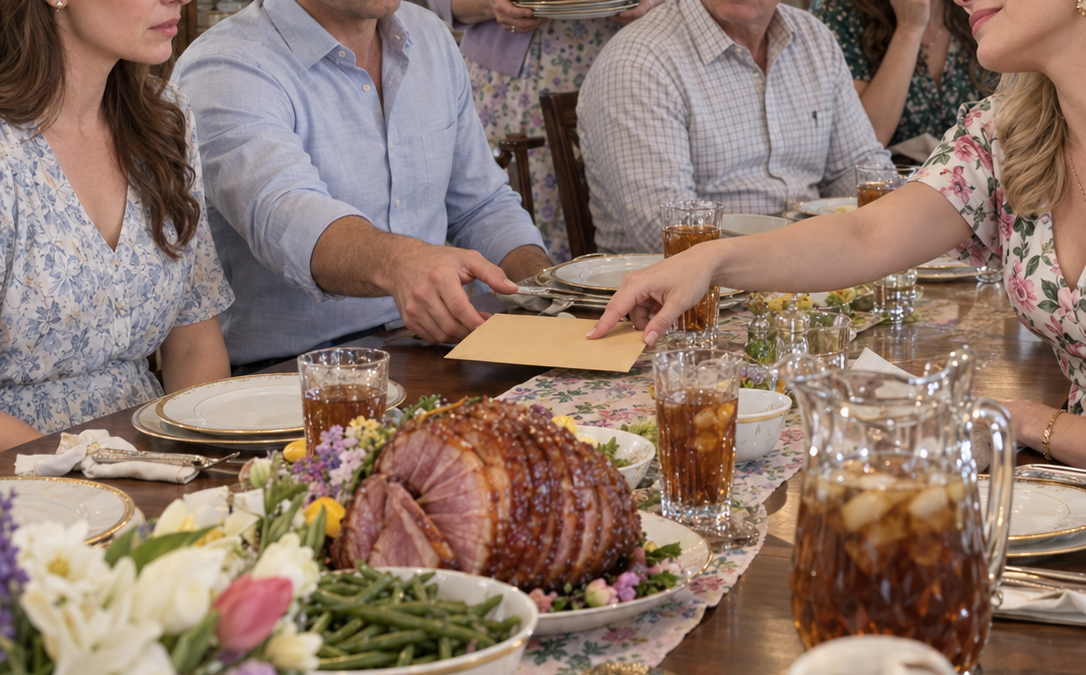
I didn’t even get to answer before my sister slid the DNA envelope across the Easter Sunday dinner table toward my husband, smiling like she’d waited three years for this moment.
“Not think, Molly. I know. Lark’s blonde hair doesn’t match Nolan at all. You’ve been lying to him for six years. Today, everyone finally sees what kind of woman you really are.”
My sister—the one who had always called herself the real Boyd daughter—smirked like she had just destroyed my life.
She had no idea the bomb she brought wasn’t meant for me.
It was meant for her.
And when my husband reached page four, the truth she had spent thirty-eight years hiding would finally explode in her face.
My name is Molly Martin, and I’m thirty-five years old. If you’ve ever been humiliated by your own blood and want to witness justice served cold, hit like, subscribe, and comment “witnessed” with your city below. I want to know who’s listening.
To understand how my sister ended up holding that envelope, I have to take you back three months, to a Nixa I still believed in.
Nixa, Missouri, isn’t the kind of town people move to. It’s the kind of town people come back to when they’ve run out of other places. Twenty-four thousand souls tucked between Springfield and the Ozarks. A couple of stoplights, three Baptist churches, one QuickTrip on Highway 160 where every trucker between St. Louis and Tulsa stops for coffee at some point in his life.
My father was one of those truckers for thirty-one years. My mother worked the breakfast shift at Nixa Family Diner from 1985 until her knees gave out in 2018.
Everyone in this town knows everyone in this town, which meant everyone would eventually know what happened in my parents’ dining room on Easter Sunday.
But in January of 2026, I still thought the story we were living was the one we had chosen.
I finished my night shift at Mercy Hospital in Springfield at six in the morning on a Tuesday, drove twelve miles back through the still-dark Ozark hills, and pulled into our driveway just as the light started coming up over the tree line.
Our workshop light was already on.
Nolan had been out there since four.
There was a cow at a farm off Highway CC that was calving hard, and he’d told the owner he’d be there by seven.
My husband is a large-animal vet. He operates on a schedule the rest of the world stopped keeping around 1962. He also operates on a rule I’ve come to trust more than most things in my life.
He doesn’t explain twice.
I stepped into the mudroom, kicked off my shoes, and heard him from the workshop.
“Coffee is still hot. Lark’s lunch is on the counter. She wanted the pink thermos.”
That was the entire conversation.
That was more than a lot of mornings.
Lark is six years old. She was born in January of 2020, just before the world stopped, and she came into it with pale blonde hair so fine it looked almost silver under the delivery-room lights.
Nolan’s hair is dark brown. Mine is chestnut. Nolan’s family runs to red-cheeked Irish stock and mine to sturdy German farmers, and neither of us had any reason to expect a blonde.
Except for one.
My great-grandfather, Elmer Boyd, came off a boat from Kaiserslautern in 1923 and stayed blonde until he was fifty. A recessive gene skipped my grandfather, skipped my father, waited three generations, and landed on my daughter.
Her pediatrician told me that in her second week of life.
Dr. Iverson looked at Lark, looked at the chart, looked back at me, and said, “Any blondes on either side?”
I told her about Elmer.
She nodded once, wrote something down, and moved on.
That was the last time I thought about my daughter’s hair color for four years.
The reason I thought about it again started at Christmas of 2025.
We spent Christmas Eve at my parents’ house, five minutes from ours by the back roads. Nixa has good back roads. You can get almost anywhere without touching a highway.
My mother had made the same casserole she’d made every Christmas Eve since I was old enough to remember. My father sat in his recliner watching a bowl game. My older sister, Karen, came in with a tote bag full of wrapped gifts and a bottle of Cabernet she’d bought at the Walmart on Sunshine Street.
She kissed our mother on the cheek.
She did not look at me.
She looked at Lark.
“Come on, sweetheart,” she said, taking Lark’s little hand. “Let’s get you looking pretty for Grandma’s picture.”
She led my daughter upstairs to the guest bathroom that used to be Karen’s bedroom.
I stayed in the kitchen because my mother had asked me to whisk the eggs for the noodle dish.
I did not follow.
I did not think to follow.
Karen had been helping with Lark’s hair at every family gathering for two years now. It was the one gesture she offered, and I had made the mistake of accepting it as kindness.
She came back down five minutes later. Lark’s hair was tied with a red ribbon. Karen set the hairbrush—a small pink Elsa brush, one Lark loved—back on the counter.
She wiped her hands on a dish towel like she’d just finished a difficult job.
Then she smiled at me for the first time all evening.
“There. Now she looks like Christmas.”
I said, “Thank you.”
That was the last kind sentence I said to my sister for the rest of my life.
Three months later, some of the hair from the back of that Elsa hairbrush would be sitting in a laboratory in Salt Lake City, and a manila envelope would be printing.
But before we get to Easter, you have to understand what thirty-five years in that family had made me.
Because if you don’t understand that, you’ll think I was slow to react.
I wasn’t slow.
I was trained.
I was born in September of 1990, twenty-one months after Karen. From the day I came home from Cox South, my role was already assigned.
She was the one who had already been christened, photographed, cataloged. She was the one Uncle Wayne had picked out a stuffed rabbit for.
I was the surplus daughter.
Loved. Tolerated. But never the story.
My father was on the road twenty days out of every thirty in the years I could remember, hauling long-haul runs to Chicago and back. And when he came home, he came home to Karen—to her drawings on the fridge, to her fishing trips to Table Rock Lake with Wayne, who had all the time in the world for her and none for me.
I asked once, when I was six, if I could go fishing too.
My mother said, “You wouldn’t like it, honey.”
Karen came home with a bass and a picture with Wayne’s arm around her shoulder.
I got a coloring book that afternoon.
That picture is still on the wall in my parents’ living room.
Karen, age eight, freckled and grinning, holding a two-pound bass. Wayne Keller, forty-five years old, one arm around her, the other around a stringer.
I didn’t understand until Easter of 2026 why that picture never made me as angry as it should have.
I think my body knew before my head did.
There are two baptism photos framed on my mother’s piano. Karen in 1989, with Wayne standing behind her as sponsor. Me in 1991, with Pastor Bradford’s wife—a woman I’d met exactly twice—standing in the same spot.
My mother had never explained to me why Wayne was Karen’s godfather but not mine.
I asked once when I was ten.
She said, “Wayne’s been through a lot, honey. He needs a break from all this.”
I was ten.
I accepted the answer.
Ten-year-olds accept the stories the adults hand them.
My father toasted my sister at her thirtieth birthday party in 2018. He raised his glass at a LongHorn Steakhouse in Springfield and said to Karen, “My boy girl. The one who stayed.”
I was sitting three feet away next to Nolan.
My father did not include me in the toast.
He did not correct himself.
Nolan squeezed my hand under the table and said nothing.
He knew what my father had not said.
I was the one who married the Martin boy.
Karen was the one who kept the name.
If you’ve ever been the second-favorite child in a house that only had two children, comment “second” below. I want to see how many of us are out here.
I did not become an angry person.
I became a watchful one.
I became an emergency-room nurse because a room full of dying people is easier to read than a family. Patients don’t lie with their bodies.
My family had been lying with theirs for thirty-five years, and I had never once stopped to look.
Karen got engaged at twenty-nine to a man named Jared Whitmore. Called it off six months later.
She got engaged again at thirty-four to a paramedic named Colin Redfield. Called that one off eighteen months later.
My mother told everyone it was Karen’s high standards.
What it actually was, I learned later, was that both men had figured out something about her the family hadn’t let themselves see.
She couldn’t sit next to someone else’s happiness without wanting to redistribute it.
My happiness became her project in 2023.
It started at Thanksgiving.
She was three months out from calling off Colin. Her eyes were the kind of bright that isn’t happiness.
Lark had just turned three, was toddling around the living room in a pair of denim overalls, and Karen watched her for a long moment.
Then, in front of the whole family, she said it.
“Nolan, you ever think Lark looks more like Molly’s side—or someone else’s side?”
The room stopped moving.
My father kept eating. My mother stared at the pumpkin pie she was cutting.
Nolan set his fork down.
He looked at my sister for a slow eight seconds without answering.
Then he reached for another slice of pie and took it.
That was his answer.
I thought that was the end of it.
It was the beginning.
Through 2024, Karen started calling Nolan directly.
Not me.
Him.
Under the pretext of asking veterinary questions about her neighbor’s dog.
Every conversation eventually turned to Lark. Every conversation ended with a phrase along the lines of, “Has she ever asked about why she looks so different?”
Nolan never told me about those calls.
He kept the screenshots in a folder on his phone labeled CB.
I found out about that folder in May of 2026.
He had fifty-two files. Every message. Every casual text. Every group-chat comment where she’d tagged a family cousin and written “our beautiful mystery” under a photo of my daughter.
He was not building a case.
He was building a witness.
He didn’t know yet that he’d need one. He just knew, the way he knew when a cow was going to breech, that something was coming.
In February of 2026, Karen texted him directly.
Not through the group chat. Not through a call.
A single message.
I’m going to say this once. If you want to know the truth about Lark, I can help you. Just say the word.
Nolan didn’t reply.
I saw the notification pop up on the family iPad we keep on the kitchen counter, the one he’d set up so we could both see our shared calendar.
He didn’t know I saw it.
I didn’t know he’d received it until Easter was over.
That night was the first night I stopped sleeping through the night.
Whatever was coming, it was close enough that my nervous system had heard it.
I just hadn’t decided yet what to do.
I made a list in my head in the break room at Mercy on a Tuesday in early March.
The hairbrush at Christmas.
The iPad notification.
The group chat.
“Our beautiful mystery.”
Karen’s refusal to let Nolan repair Wayne’s old cabin in 2020, back when he’d offered.
The forty acres in Ozark that Wayne had left her—and only her—when he died in April of 2019.
The wording in the will that I had read exactly once when it was still fresh:
For my dear friend’s daughter.
Singular.
Not daughters.
Just Karen.
I had noticed the singular in 2019 and filed it under Wayne being Wayne.
In April of 2026, I would take it out of that file and read it in a different color.
I turned to my coworker, Beth Corbin, who was stirring a packet of instant coffee at the counter next to me.
Beth is fifty-three years old and has been an ER nurse since Reagan was president. She has read more people faster than most detectives read cases.
“Something is coming, Beth. I don’t know what.”
She looked at me.
“Molly, you read patients in twenty seconds. Read your own family.”
I drove home that night thinking about how right she was and how wrong I had been for thirty-five years.
Three weeks before Easter, I stopped by my mother’s house on a whim.
She was sitting at her kitchen table with a cup of chamomile tea gone cold in front of her.
I sat down across from her.
I made small talk about Lark’s school.
Then I mentioned Wayne’s cabin.
“Mom,” I said, careful and casual. “Why did Uncle Wayne leave the land to Karen and not to both of us?”
My mother went quiet.
Not for one second.
For six.
I have watched people die faster than my mother went quiet.
Then she said something she had never said in her life.
“Some things don’t have a reason, honey. Some things just are.”
My mother had a reason for everything.
She had a reason for which drawer the good silver went in. She had a reason for why the towels were folded in thirds and not halves.
She had never, in thirty-five years, told me that something just was.
I drove home.
I told Nolan what she’d said.
He stared at his coffee for a long moment.
Then he said one sentence.
“Molly, don’t ask her again until Easter is over.”
He knew.
He didn’t know what he knew, but he knew something.
The Wednesday before Easter, we were sitting on the porch after Lark had gone to bed.
Nolan was drinking coffee out of a walnut mug he had turned on his own lathe two years earlier.
He set the mug down.
He looked at me and said the second full sentence he had spoken on the subject of my sister in three years.
“Whatever happens Sunday, I want you to trust that I saw it coming. And I want you to trust that our daughter is safe. That’s it. That’s all I’m going to say.”
I nodded.
I didn’t ask him what he saw coming.
In our marriage, when Nolan says he saw it, I don’t need to see it too.
I just need to be ready to understand what he saw.
And what my mother had spent thirty-eight years unable to see out loud.
You have to go back to the winter of 1988.
Wayne Keller was thirty-seven years old that January. He had been married to Loretta since 1972.
They had wanted children the way some people want to breathe.
Three pregnancies.
Three losses.
The last one was in December of 1987, and it had put Loretta in a rest facility in Springfield for six weeks.
Wayne came home alone every night to a house he could not bear to sit inside of.
He drank at first.
Then he stopped drinking because he was afraid of it, and he started driving.
He drove the Nixa back roads at midnight.
He drove past my parents’ house.
He drove past the diner where my mother worked.
Nixa Family Diner closed at nine every night. My mother stayed until ten most nights to prep pies for the morning.
My father was on the road hauling long-haul routes between Springfield and Chicago on a three-week rotation.
My mother had been married to him for five years. She had lost two pregnancies of her own.
She was twenty-seven years old and alone in a town where everyone knew her name and no one saw her.
Wayne walked into the diner on the night of January 28, 1988, at 10:52 in the evening.
My mother wrote the entry in her order book.
She was still using it as a work log.
Everything else in that book was written in ballpoint pen.
That entry was written in pencil.
It said:
Closed early. Headache.
I found that order book in her garage in May of 2026, in a plastic tub labeled DINER 1985–1989 in her handwriting.
I stood in that garage for twenty minutes with a single pencil entry in my hand, and I understood what my mother had done and what she had spent the next thirty-eight years trying not to remember.
She locked the door.
She poured him a cup of coffee.
He talked about Loretta.
She listened.
Somewhere between eleven at night and one in the morning, they stopped talking.
I do not need the details.
Neither do you.
What matters is what she did afterward.
She washed the two coffee cups.
She wiped down the counter.
She turned off the lights.
She drove home.
She got into a cold bed and cried once.
And did not cry again.
My father came home from his run on February 3, 1988.
He was home for five days.
He looked at her and said, “You look tired, honey. You feeling okay?”
She said she was fine.
She had made a decision by then.
The decision was that whatever had happened at the diner had not happened.
And if a child came out of it, that child would be my father’s because my father was the man she was married to.
And my father deserved the child she was going to give him.
She wasn’t lying.
She was hoping.
Karen was born on December 3, 1988.
My father held her at the hospital in Springfield with his eyes wet in a way I had never seen before or since.
Wayne came to visit two days later with a bouquet of roses.
Loretta came with him.
She had come home from the rest facility in March.
She could not have children.
She wanted to hold the baby.
She held Karen for fourteen minutes.
There is a photograph of that visit that sat on my grandmother’s mantel for thirty years.
Wayne is standing behind Loretta, one hand on the back of her chair, watching his wife hold a baby that was his own.
He is not looking at Loretta’s face.
He is looking at the floor.
I looked at that photograph a hundred times in my life.
I never once wondered why he was standing there like that.
In April of 2026, I would understand that he was standing there because he could not sit down.
Loretta died of pancreatic cancer in the spring of 2010.
She died believing her husband had been faithful to her for thirty-eight years.
Wayne died of a heart attack in April of 2019, a year after he had, for reasons no one at the time understood, submitted his DNA to a small Ozark historical genealogy project run out of a library in Branson.
He opted in to relative matching.
He probably did it because the librarian talked him into it.
He probably did not know he was leaving a confession.
Or maybe he did.
Some men leave doors open at the end because they cannot bear to shut them.
What Karen did next was a small, deliberate act by a woman with no idea what she was picking up.
She sat at her fourth-grade classroom desk at Nixa Elementary on a Wednesday afternoon in February of 2026, after the last student had gone home.
She opened her laptop.
She Googled consumer DNA testing without alleged mother.
She read three articles.
She landed on a service called Meridian Genetics that offered a combined relationship and ancestry test for $149.
Twenty-three-day turnaround.
Results delivered by email as a PDF.
Under “Alleged Relationship” on the order form, she selected:
Aunt and niece. Alleged mother sample not provided.
She did not submit our mother’s DNA.
She did not think she needed to.
That was the door she opened without knowing it.
She placed the order on March 8, 2026.
She paid with her Visa.
She mailed the kit—her own cheek swab and the hair she had taken from the back of Lark’s Elsa hairbrush on Christmas Eve—to a lab-partner processing center in Salt Lake City.
Then she waited.
While she waited, she went to Sunday dinner at my parents’ house three weeks in a row.
And every single Sunday, she said something about Lark.
About how blonde she was.
About how the truth always comes out.
My mother stopped replying.
My father stopped chewing when she spoke.
Nolan kept a small Moleskine notebook in his workshop where he was noting every one of her comments by date.
His entry for March 22 said:
Karen: “The truth will come out one day.”
She said it three times in a single meal.
She thinks she is warning me.
She is announcing herself.
My sister was foreshadowing her own life.
She did not know.
She got the email on March 31, 2026, at 3:03 in the afternoon.
She was parked in the faculty lot at Nixa Elementary.
She opened the PDF on her phone in the dim front seat of her Nissan.
She read the top-line summary.
It said:
Genetic relationship consistent with half-aunt to niece, or alleged aunt is not a full sibling of child’s parent. Follow-up sibship testing recommended.
She stopped reading at half-aunt.
She interpreted the sentence the way a woman who has already decided the story interprets a sentence.
She read:
Molly cheated.
Lark is not a full Boyd.
My sister laughed out loud in the empty parking lot.
The next morning, she drove to the FedEx Office on Sunshine Street and printed the entire four-page report.
She did not read pages two, three, or four.
She put the pages in a manila envelope.
She sealed the metal clasp.
She hid the envelope in her navy-blue tote bag, at the bottom under a scarf and a paperback novel.
Then she waited five days for Easter Sunday.
Easter Sunday 2026 was warm for early April.
Sixty-eight degrees, with a light wind through the redbuds.
Nolan drove.
I sat in the passenger seat with a pie balanced on my lap.
Lark sang the entire soundtrack of a movie I did not recognize from her booster seat behind me.
Nolan reached across the center console at the four-way stop by the Baptist church on McCracken and put his hand over mine.
“Whatever happens,” he said quietly, “we take our daughter home tonight. Same as we came.”
I nodded.
I could not speak.
My hands were already knowing what my head hadn’t decided.
My mother had set the dining room for eight: herself, my father, Karen, Nolan, me, Lark, and my cousin Hollis Boyd and her husband, Grady Whitmore, from Springfield.
Hollis is my cousin on my father’s side, thirty-eight years old, with two little ones of her own. She and Grady were the only extended family my mother had felt strong enough to invite.
The rest of the Boyds were aging, scattered, and had made their apologies about travel.
My mother was performing an Easter that would not survive dessert.
She did not know it yet.
The dining-room walls are painted a soft yellow my mother chose in 2003. The good china is white with a thin gold band.
My father was watching KY3 for the afternoon forecast when we walked in.
He turned the television off when he saw Lark and lifted her into his arms without saying my name.
He never said my name when he saw us.
He always said hers.
Karen was helping in the kitchen.
She was wearing a floral dress she had bought new.
Her hair was straightened.
She smiled at me for the first time in months.
It was a smile that had been rehearsed.
“There you are, Molly. Come in. Sit down. I’ve been waiting.”
She had been waiting for six days.
I did not know that yet either.
My father said grace.
He said the same grace he has said every holiday of my life.
“Lord, we thank You for this family, for the sacrifice of Your Son, and for the truth that sets us free. Amen.”
My sister opened her eyes before the rest of us.
I saw her do it.
She was looking at Nolan across the table.
She was smiling.
The first course was ham and mac and cheese and green beans and deviled eggs. My mother had made pie. There was sweet tea in the good pitcher.
Hollis asked Nolan about calving season.
Grady asked my father about the Ford dealership out on Kearney.
Karen inserted a sentence into the conversation the way a person inserts a knife into a coat.
“I’ve been thinking a lot about family lately,” she said, cutting a deviled egg in half with her fork. “About what makes people family.”
Nolan did not look up.
My mother reached for the pitcher of tea.
Her hand was steady in a way that told me it wasn’t.
After the first course, my mother stood to clear the plates.
I stood to help her.
I had been standing to help her clear plates for thirty-five years.
It was a reflex older than my memory.
My sister stopped me.
“Sit down, Molly. I’ve got something for Nolan. Better said with everyone here.”
My mother did not put the plates down.
She stood at the head of the table holding a stack of gold-rimmed china in both hands, and she did not move.
She felt what was about to enter the room before it entered.
My sister reached into the navy tote bag under her chair.
She pulled out the manila envelope.
She placed it on the table between herself and Nolan.
Then she slid it toward him with two fingers.
The way a dealer slides a card.
I saw the envelope.
My chest went cold.
My voice was calmer than my chest.
“You think I cheated, Karen?”
She looked at me.
She did not answer me.
She answered Nolan.
“Not think, Molly. I know. Lark’s blonde hair doesn’t match Nolan at all. You’ve been lying to him for six years. Today, everyone finally sees what kind of woman you really are.”
I did not answer.
There was nothing to answer.
My husband set his fork down.
He set it down slowly, the way he sets down a scalpel after a surgery.
Then he reached for the envelope.
Before he opened it, he did something I had not expected.
He looked at Karen across the table and gave her one chance.
“Karen, before I open this, you just told a room full of family that my wife has been unfaithful for six years. Are you sure that’s the story you want to be locked into?”
She smiled.
She was so sure.
She had been sure for six days.
“Read it.”
Nolan opened the metal clasp.
He pulled out four pages stapled at the corner.
He read the first page without moving his face.
Then he looked up.
“Karen, this doesn’t say what you think it says. Did you read page four?”
Her smile did not fall.
Not yet.
She thought he was buying time.
“It says exactly what it says.”
He read section two aloud in the same even voice he uses with clients when he explains a large-animal diagnosis they don’t want to hear.
“Shared DNA between subject sample Karen Boyd and secondary sample, alleged niece: 12.5 percent.”
He looked up.
He looked at my sister.
“Karen, you’re a fourth-grade teacher. What does a full aunt share with a niece?”
Her mouth opened.
She had planned for every question except that one.
Her fork was still in her hand.
She set it down.
Nolan did not wait for her to answer.
“A full aunt and a full niece share approximately twenty-five percent. A half-aunt shares approximately twelve and a half.”
He paused.
“This report is telling you, Karen, that you and my wife are not full sisters. You share one parent. Not both.”
My mother sat down.
She had been standing at the head of the table with the plates the whole time.
She sat down carefully, still holding them, and set them on the tablecloth so gently they made no sound.
Karen’s face did not fall yet.
She was still moving through the sentence in her head.
She was still telling herself he had read it wrong.
She reached her hand across the table.
“Give it to me.”
He didn’t.
He turned the page.
“Section three. Ancestry markers. Subject sample: sixty-two percent Irish, Munster region. Eighteen percent Scots-Irish. Fourteen percent English. Six percent German.”
The room had not been silent yet.
Not really.
It went silent.
Then Nolan turned the paper toward my father.
He slid it across the table with the same two-finger motion my sister had used ten minutes earlier.
“Curtis, look at the ancestry breakdown on your daughter. The daughter you’ve been calling the real Boyd for thirty-seven years. Six percent German.”
My father did not move.
Nolan continued.
“Elmer Boyd was full German. He came over from Kaiserslautern, with all four grandparents from the same country. A full Boyd granddaughter would test far higher for German ancestry.”
My father did not pick up the paper.
He looked at it.
He looked at my mother.
He looked at the paper again.
Then he said one sentence.
“Wayne was Irish.”
A beat.
“Keller. Munster.”
My mother’s tears started then.
She did not sob.
She did not cover her face.
She sat at the head of her own Easter table with a pile of plates in front of her and cried the way a woman cries who has been ready for this day for thirty-eight years.
The kind of crying that has no sound because it has been rehearsed in silence for so long.
My father did not raise his voice.
My father, who raised his voice at me for slamming a screen door in 2004, did not raise his voice at his wife of forty-three years, who had just admitted to a thirty-eight-year silence.
He was too tired to raise it.
He had been carrying the possibility longer than he had let himself know.
He said her name once.
“Adele.”
Then:
“Was it Wayne?”
She did not look up.
She nodded once.
Nolan turned to page four.
He read it out loud, and his voice did not shake.
“Cross-reference indicates the subject’s Irish Munster markers are consistent with the Keller line profile submitted for genealogy comparison in 2018 by Wayne Keller of Springfield, Missouri, now deceased. Confidence: parental.”
The word parental landed on the table like a plate dropped from height.
It did not break anything.
It just sat there.
Karen understood.
Then her whole face went slack.
She reached across the table and yanked the paper out of Nolan’s hand.
She read page four for the first time.
Her hands began to shake so hard I could hear the paper in them.
She looked at Nolan.
Then she said the sentence I did not know she was capable of saying.
“Nolan, please. Please don’t say another word.”
He did not say another word.
He did not need to.
My father stood up.
He put both hands flat on the table for a moment to steady himself.
He was sixty-seven years old, and I watched him age five more years in the eight seconds it took him to stand.
Then he did something he had not done in twenty years.
He walked around the table.
He did not walk toward my mother.
He did not walk toward Karen.
He walked to my chair.
He put his hand on my shoulder.
It was heavy.
It was shaking, but only a little.
“Molly, take your daughter home. Take your husband. I need—I need to sit with my wife.”
For thirty-five years, I had been the second name in every sentence in that house.
In one sentence at his Easter table, my father made me the only name.
He did not follow my name with anyone else’s.
He did not soften it with anyone else’s.
He said my name, and he asked me to protect what he now understood was mine.
I stood up.
I did not look at my sister.
I did not look at my mother.
My cousin Hollis was crying silently at her end of the table.
Grady had already put his arm around her.
I walked into the family room, where Lark was building a tower of Duplo blocks with Hollis’s four-year-old.
“Sweetheart, we’re going home a little early. Grandma isn’t feeling well.”
Lark looked up.
She has the kind of eyes that go straight to the truth and hold it there.
“Is Grandma sad, Mommy?”
I told her yes.
I told her Grandma was very sad.
I did not tell her why.
She will ask again in ten years.
I will tell her then.
Or I won’t.
I got her coat.
I lifted her onto my hip even though she is six and too big to be carried.
She wrapped her arms around my neck and did not ask again.
Nolan was standing at the front door with our pie carrier in his hand.
Karen was still sitting in her chair in the dining room.
She had the four pages spread out in front of her.
She was reading page four for the third time.
She was not crying.
She was still.
My father sat next to my mother.
He did not touch her.
He did not turn his chair away from her.
He sat exactly where he had always sat, and he faced the wall.
We walked out.
The screen door closed behind us the way screen doors close in Missouri in April.
Slowly, with a small squeak and then a quiet thump.
Nolan drove.
Lark fell asleep against her booster seat in four minutes.
Small children feel tension in a room and dispose of it by sleeping.
I stared out at the redbuds coming into bloom along Highway CC.
The light was long and gold.
I said the only thing I could say.
“You knew.”
He kept his eyes on the road.
“I knew something. Not what.”
He drove another half mile.
Then he said the second sentence he was ever going to say about it in the car.
“I’ve known for two years that whatever was coming would come through her. I didn’t know what shape it would take. I built a folder just in case. Fifty-two files. It’s on my desk in the workshop. You can read it tonight, or you can never read it. Either way, it’s yours.”
We got home at 1:05 in the afternoon.
Nolan carried Lark upstairs and read her three books and put her to bed.
I sat at the kitchen table with a mug of coffee I did not drink.
When he came back down, he set a manila folder—kraft brown, unlabeled—in front of me.
He kissed the top of my head.
He sat across from me.
He did not open it.
He waited.
I opened it.
I read for an hour.
I read every screenshot.
I read the group-chat post where Karen had captioned a photo of my daughter:
Our beautiful mystery.
I read the February text where she had offered Nolan “the truth” like a favor.
I read his own handwritten notes on his observations of my mother.
How her hands stopped when Karen mentioned Lark.
How she had not once in three years defended me from a single one of Karen’s comments.
I closed the folder.
I did not cry.
I said one sentence.
“You’ve been protecting me from a truth about my mother while she was refusing to protect me from a lie about my daughter.”
He nodded.
“I didn’t know it was about your mother, Molly. I only knew she was the door.”
I put my hand over his.
If you’ve stayed with me this far, please stop for a second and comment “witnessed” and your state below.
I want to know how many people are out there sitting on their own version of this envelope.
I’m not asking for likes.
I’m asking for company.
Small towns don’t need lawyers.
They have Walmart bakeries.
What happens there is public record within seventy-two hours.
By the following Sunday, four different women I did not know had come up to me at Price Chopper to ask if my mother was all right.
I said she was fine.
I did not elaborate.
Nixa understands the pause between a sentence and its meaning.
Nixa does not need the meaning.
Karen stopped coming to First Baptist Nixa the Sunday after Easter.
My mother stopped going the following week.
My father went alone.
He sat in the back pew, which he had never done in his life.
He nodded at the pastor.
He did not stay for coffee.
He drove home.
He and my mother lived in the same house through those two weeks and slept in the same bed and drank coffee at the same table and spoke maybe eight sentences a day to each other.
He did not leave her.
He did not forgive her.
He was doing what a Missouri man does when a marriage of forty-three years has been sitting on top of a January night in 1988 for as long as anyone can remember.
He was giving the truth a chair.
He was letting it sit down.
He was not making dinner conversation with it yet.
Karen submitted her resignation to Nixa Elementary on April 14.
She cited a personal family matter.
Principal Redfield did not ask.
She had already gotten one phone call from a member of her congregation about it.
She accepted the resignation the same day.
Karen finished out the week teaching fourth-grade math with her hands shaking.
Then she packed a small U-Haul trailer, five feet by eight, on April 17 and drove 165 miles up I-44 and US-71 to Kansas City.
She had a friend from college there who let her sleep on a couch.
She did not tell my parents where she was going.
She did not tell me.
I found out through Hollis’s husband, Grady, who works at the bank branch in Springfield where Karen had closed her checking account.
She kept the key to Wayne’s cabin.
Forty acres in Ozark, appraised at just over $200,000.
My sister could have sold that cabin.
That is more money than a fourth-grade teacher makes in three years.
She did not sell it.
She did not visit it.
She kept the key on her ring the way a person keeps a scar because taking it off means admitting how you got it.
I drove to Springfield Memorial Cemetery on the second Saturday after Easter.
I stood in front of Loretta Keller’s grave for twenty minutes.
She had been dead since 2010.
Her stone was small and clean.
Someone had put a bunch of daffodils in the little metal vase.
I found out later it had been my father.
He had been coming to her grave once a month for six years without telling anyone.
I did not say much.
I said the only thing I had left to say.
“He didn’t know. She didn’t know. I’m sorry.”
There were three women whose lives had been shaped around the same lie.
Two of them were dead.
One of them was my mother.
I was the only one who could stand at that grave and apologize on their behalf.
I was not related to Loretta by blood.
I was not required to.
But someone had to.
And no one else was going to.
That is what standing in a family means in the end.
Sometimes you stand in for the people who cannot stand for themselves anymore.
On April 19 in the evening, my father told my mother he was going to drive to my house the next day.
He told her he did not know when he would be back.
He told her it was not because he was leaving her.
It was because he owed me a long time.
She nodded.
She did not argue.
She had used up her arguments in a diner in January of 1988.
On April 20 at 3:15 in the afternoon, my father pulled into my driveway in his Ford Ranger.
He did not get out of the truck for twelve minutes.
I watched him from the living-room window.
Lark was at kindergarten.
Nolan was at the clinic.
It was just me and a pot of coffee and my father in a truck in my driveway.
I did not go out to him.
He had to come to me.
I owed myself that.
He came up the porch steps at 3:27.
I opened the door.
I did not hug him.
I gestured to the rocking chair Nolan had built for the porch in 2018.
He sat down.
I sat next to him.
I poured him a cup of coffee.
He held it in both hands and looked at the maple in the front yard for four full minutes.
Then he said it.
“Molly, I owed you thirty-five years of knowing you were mine. I know that doesn’t undo it. Let me start now.”
I did not answer right away.
I let the coffee get cold between us the way I let almost everything get cold between us my whole life.
Then I did what I had never done.
I answered him honestly.
“You cannot make up thirty-five years, Dad. You can only stop them from being thirty-six.”
He nodded once.
He drank his cold coffee anyway.
He asked me about my work.
He asked me about Lark.
He did not ask me to forgive him.
He did not ask me to talk to my sister.
He did not ask me to talk to my mother.
He asked me if he could come back next Monday.
I said he could.
He came back the next Monday.
He has come back every Monday since.
He is teaching Lark to bait a hook on our back porch.
My daughter is six years old and has never met Wayne Keller.
And my father is teaching her to fish the way Wayne once taught the daughter my father thought was his.
There is a symmetry there I do not have the strength to describe.
I only have the strength to let it happen.
My mother writes me a letter every two weeks.
She does not call.
She does not come to the house.
She writes on yellow legal-pad paper in the handwriting I have known my whole life.
Her letters are short.
Two paragraphs.
She does not ask for forgiveness.
She tells me what she has done that week.
Went to counseling on Thursday. Baked bread on Friday. Sat on the porch with your father on Sunday. We did not say much, but we sat.
I read every letter.
I have not answered one yet.
I will when I can.
I am not in a hurry.
Karen has not contacted me.
She has not contacted my parents.
My cousin Hollis got a birthday card from her in mid-May, with no return address and no city on the postmark that Hollis could make out.
The card said, in Karen’s careful teacher’s handwriting:
I don’t know how to be anyone yet. I’ll find out. Don’t tell them where I am.
Hollis showed me the card.
She asked me what she should do.
I told her to keep the card.
And to keep the promise.
My sister is going to have to build herself from nothing.
That is not a mercy I can give her.
That is a mercy she owes herself.
I found the diner order book in my mother’s garage in the second week of May.
I had gone over to help my father move a chest freezer.
She had left the garage light on and the plastic tub open on the workbench like she knew I would find it.
She never said a word about it to me.
She just left it where I could see it.
That was the closest thing to a confession she had left in her.
I sat on my parents’ garage floor for twenty minutes with a book of receipts in my lap and a single pencil entry under my thumb.
Closed early. Headache.
January 28, 1988.
10:52 in the evening.
I put the book back.
I closed the tub.
I turned off the light.
I walked out.
Some truths do not need to be spoken again.
Some truths only need to be seen once by the right person.
Nolan and I sat on the porch that night after Lark went to sleep.
He had refilled his walnut mug.
I had my knees pulled up under a blanket.
The redbuds were done.
The dogwoods were blooming.
The clinic phone had not rung all day.
The workshop light was off for the first time in a week.
He looked at me the way he had looked at me the day I told him I was pregnant.
He said the sentence he had earned.
“You okay, Moll?”
I answered him the way I had earned.
“I will be. I already am.”
He nodded once.
He drank his coffee.
We did not talk again for an hour.
We watched the light go out of a sky that had held it a long time.
If you have stayed with me this far, you didn’t stay because of my sister.
You stayed because somewhere in your own family there is a Karen or a Curtis or a mother who has been carrying a January night in her chest for thirty-eight years without setting it down.
I don’t have advice for you.
I have witness.
Which is what I asked you for at the beginning, and what you’re giving me now—in a car, or a kitchen, or a bed at two in the morning.
Thank you for staying.
Some truths only stop being lonely when someone else hears them.
My sister paid $149 to prove that I was not who my family thought I was.
She was right about the wrong person.
The daughter who left the Boyd name is the one who was ever a Boyd at all.
The daughter who kept it never was.
I do not say this with victory.
I say this because for thirty-five years, I lived believing I owed my family an answer for being who I am.
It turns out I owed them nothing.
It turns out my father, when he finally understood, drove five minutes and sat in his truck for twelve.
It turns out my husband had built me a witness so that if the moment ever came, I would not have to be the only one carrying it.
It turns out the only name worth keeping is the one your husband and your daughter and your father, standing on your porch on a Monday afternoon, already call you.
My name is Molly Martin.
I am thirty-five years old.
I am somebody’s real daughter now.
And I am done apologizing for not being someone else’s.








