My parents sold my grandfather’s house behind my back for $620,000; they split it with my brother; they didn’t know grandpa left me 1 thing they couldn’t sell: it was worth $4.7 million.
Walter Meyers spent 35 years working underground. He started at 22 in the copper mines outside Asheville and worked his way up to senior geological consultant by the time he retired at 57.
He was a quiet man. Never raised his voice once in my entire life.
When I was seven, he gave me a chunk of quartz he had pulled out of a vein 200 feet below the surface.
“Hold on to that,” he said. “That rock is older than anything you will ever touch.”
I still keep it on my desk at work. Twenty-five years later, it sits next to my coffee mug and my engineering calculations.
Every summer, my parents would ship me off to Grandpa Walt’s farm. Three months of creek water and sawdust. He taught me to read the grain in oak. He taught me how soil changes color when the mineral content shifts. He taught me that the most valuable things are the ones people walk right over.
My mother thought those summers were free babysitting.
My brother Craig never went. He said the farm was boring. No internet, no friends, no pool. My father drove me there, dropped me off, and picked me up in August without ever staying the night.
But I stayed every summer until I was 18.
And when I left for NC State to study civil engineering, Grandpa shook my hand at the workshop door and said, “You are the only one who ever listened, Holly girl.”
That was the last thing he said to me before I moved away.
I got the call on a Tuesday morning at 6:47.
My mother’s voice was flat.
“Your grandfather passed last night. Heart attack. They found him in the workshop.”
The funeral was small. Fourteen people in a white chapel outside Hickory.
My mother ran it like a production. She chose the flowers. She chose the readings. She chose who sat where. When I walked in, she pointed to the third row without looking up from her phone.
Craig showed up 12 minutes late, still in a polo shirt from his restaurant franchise. He shook hands with people he did not know and checked his email twice before the service started.
My father stood by the casket and said nothing. He had that expression he always wears around my mother—careful, measured, trying not to take up too much space.
I wanted to say something.
I had written two paragraphs the night before about Grandpa’s workshop, about how he carved a set of bookshelves for my first apartment, about the way his hands smelled like cedar and motor oil.
I stood up.
My mother turned around.
“Keep it short, Holly. People have places to be.”
I said four sentences.
Then I sat down.
Afterward, in the parking lot, I asked about the farm. The 40 acres. The workshop.
My mother’s answer came fast. Too fast. Like she had rehearsed it.
“Grandpa didn’t leave a will.”
Five words.
She did not blink. She did not pause.
I noticed something else.
On the edge of the casket, someone had placed Grandpa’s reading glasses—the wire-rimmed ones he wore every evening in the workshop, perched on the end of his nose while he read geology journals.
My mother had put them there like a prop.
I drove home that night with a knot in my stomach I could not name.
Something about that answer.
Five words. No blink.
It sat wrong in my chest.
Two weeks passed.
I called my mother and asked about the farm.
“Your father and I are handling it. Craig is helping, too.”
“Can I come up this weekend? Maybe help sort through Grandpa’s things?”
“You live three hours away, Holly. Let us deal with it.”
That was the end of the conversation.
She hung up the way she always does, mid-sentence, as if the call were already over before I started talking.
I drove to the farm anyway.
Saturday morning. Seven o’clock.
The fields were still damp from overnight rain. I pulled up the gravel drive and went straight to the front door.
The lock had been changed.
A new brass deadbolt, still wearing the sticker from the hardware store.
I tried the side door.
Changed, too.
I walked around to the back and checked the mudroom.
Same thing.
I stood in my grandfather’s yard, locked out of his house, holding a key that no longer fit anything.
I called Craig.
“Yeah, Mom changed the locks. Security thing, you know. The house is going to be empty for a while.”
“Nobody told me.”
“Mom thinks it is better this way. Less people in and out.”
Less people.
Meaning me.
I sat in my car for 20 minutes.
The workshop was still visible from the driveway. Gray wood, tin roof, the door crooked the way it had been since 1994.
Nobody had touched it.
That Monday, I got an email from a man I had never met.
The subject line read: Inquiry Regarding the Meyers Property Listing.
I did not know what listing he was talking about.
I opened the email and saw a Zillow link.
My grandfather’s farm.
Forty acres. Four bedrooms.
Listed for $620,000.
I clicked that link seven times. Refreshed the page. Scrolled through the photos.
My grandfather’s kitchen.
His living room.
The view from the back porch where we used to sit and watch the hawks circle.
Status: Pending.
I called my mother.
My hands were shaking, but my voice was not.
“You are selling Grandpa’s house.”
A pause.
Then that tone. The one she uses when she wants you to feel small.
“It is not Grandpa’s house anymore, Holly. It is a family asset. And since there was no will, your father and I, as next of kin, decided what is best.”
“I am next of kin, too.”
“You did not need the money, Holly. You have your career. Craig’s restaurant is struggling. We are helping him.”
There it was.
Craig needed the money.
That was the entire calculation.
That was the math my mother did in her head while she stood at my grandfather’s casket and told me he left nothing behind.
“How much?”
“$620,000. The offer came in fast. Good market.”
“And who gets it?”
“Your father and I are splitting it with Craig. He is in a rough spot.”
“And me?”
Silence.
Then:
“Grandpa didn’t leave a will. We checked. There is nothing to divide beyond the property.”
That line again.
Five words plus two, said with the same rehearsed calm.
I learned later that Craig had already received a deposit. $80,000 wired before the sale even closed. My mother arranged it. My father signed the paperwork.
Nobody called me.
Nobody texted.
Nobody thought the quiet daughter three hours south might have a question about her dead grandfather’s property.
They were wrong.
Thanksgiving.
I drove to my parents’ house because I thought maybe face-to-face would be different. Maybe if I sat across from my mother and asked calmly, she would explain.
I was wrong about that, too.
The table was set for 12. Extended family. Aunt Linda, Uncle Martin, cousin Jake. Everyone eating my mother’s pot roast and pretending nothing had changed.
I waited until dessert. Waited until the conversation slowed.
“I want to talk about Grandpa’s property.”
My mother’s fork stopped halfway to her mouth.
“Not here, Holly.”
“Then where? You do not return my calls.”
Craig leaned back in his chair.
“Holly, if you needed money, you should have said something. Dad and I would have helped you out.”
I looked at him.
He was wearing a new watch.
$43,000 had already passed through his hands from the sale, and he was offering to help me out.
“I do not need money, Craig. I need someone to explain why I was not told.”
My mother set her fork down.
“Because there was nothing to tell you. Your father and I made a decision as a family.”
“A family that did not include me.”
Nobody spoke.
Uncle Martin studied his pie.
Aunt Linda looked at the ceiling.
My father stared at his plate.
I stood up, thanked my aunt for dessert, and drove home in silence.
Three hours on Interstate 40 with nothing but headlights and my own breathing.
And somewhere past Statesville, I remembered something.
A conversation with Grandpa two years before he died.
We were standing in his workshop, and he said it casually, the way he said most important things.
“Holly girl, when I am gone, go to my workshop. Bottom shelf behind the router. There is a cedar box.”
I had forgotten that conversation.
For two months, I had forgotten it.
Saturday morning. December.
The air tasted like iron and wet leaves.
I drove to the farm before sunrise. The house had a new mailbox now. The buyer’s name was already on it.
But the workshop sat untouched.
Same gray wood.
Same tin roof.
Same crooked door.
The house key did not work anymore.
But the workshop key—the one Grandpa gave me when I was 14—still fit.
The lock turned like it had been waiting.
Inside, there was sawdust on every surface.
The smell hit me first.
Cedar and machine oil and something older. Something that lives in wood that has not been disturbed.
Grandpa’s bench saw. His clamps. His collection of hand planes lined up along the pegboard like a museum exhibit.
His reading glasses sat on the edge of the workbench.
Wire-rimmed.
One lens had a smudge.
I picked them up and held them.
I did not put them on.
Bottom shelf behind the router.
I knelt down.
Nothing visible. Just scrap wood and dust.
But the floorboard beneath the shelf was loose. One corner lifted when I pushed.
I pulled it up.
Underneath, wrapped in a shop rag, was a cedar box. Small, maybe eight inches by 12.
The wood was hand-planed, smooth as glass.
On the lid, carved in Grandpa’s steady letters:
HM.
Holly Meyers.
I sat on the workshop floor and held it in my lap.
The weight of it told me there was paper inside.
Something stiff.
Something official.
I lifted the lid.
Three items.
A manila envelope thick with documents.
A smaller white envelope with my name in Grandpa’s handwriting.
And a chunk of granite, dark and speckled with silver-white flecks that caught the weak morning light through the workshop window.
I opened the smaller envelope first.
Grandpa’s handwriting was steady, slanted slightly left, the way it always looked on the notes he left me in the workshop.
The letter was dated three years before his death.
It was short. Direct.
The way he always was.
He wrote that he knew what would happen to the farm.
He had watched Diane—he never called her “your mother” in writing, always Diane—plan and maneuver for years.
He wrote that Craig would need money and Diane would use the property to provide it.
He wrote that he did not blame them.
But he did not trust them either.
So he made arrangements.
Three years ago, he drove to the office of an attorney named Elaine Marsh in the next county.
He signed a mineral rights deed.
The deed separated all subsurface mineral rights on the 40-acre parcel from the surface estate, and he transferred those mineral rights to one person.
Holly Marie Meyers.
The deed was notarized, filed with the county recorder’s office, and made public record.
Then he wrote the line I have carried in my head every day since I read it.
“They can sell the house, Holly girl. They can sell every blade of grass. But they cannot sell what is underneath. That belongs to you.”
I set the letter down and picked up the granite chunk from the cedar box.
I turned it over.
The silver-white flecks caught the light again.
I did not know what mineral it was.
Not yet.
But I knew my grandfather.
A man who spent 35 years underground did not put a random rock in a box with a legal deed.
I opened the manila envelope.
Inside was a copy of the mineral rights deed and a geological survey report.
I read the deed three times.
Then I drove home.
And I did not call my mother.
I spread everything across my kitchen table that night.
The mineral rights deed on the left.
The geological survey on the right.
Grandpa’s letter in the center.
The granite chunk holding down the corner of the deed like a paperweight.
The deed was clean legal language. Notarized signatures. A county filing stamp with a date from three years ago.
It transferred all subsurface mineral rights—oil, gas, metals, minerals, everything beneath the surface of the 40-acre parcel—from Walter P. Meyers to Holly Marie Meyers.
I am a civil engineer.
I design bridges and drainage systems.
I understand legal documents.
And what I understood reading this deed was simple.
The surface of that land—the house, the grass, the driveway—could be sold by whoever inherited it.
But the subsurface was already mine.
It had been mine for three years before Grandpa died.
Before the funeral.
Before the sale.
My parents had sold a house sitting on top of my property.
The geological survey was harder to read.
Technical language. Core sample data. Mineral composition analysis.
But one section was highlighted in yellow.
Grandpa’s yellow highlighter. The one he kept in his shirt pocket.
Significant lithium-bearing pegmatite deposit identified across southwest quadrant. Preliminary assessment suggests commercially viable concentrations.
Lithium.
I knew enough to know that lithium in 2024 was not a curiosity.
It was a currency.
But I needed someone who could tell me exactly what I was holding.
The deed named the attorney.
Grandpa’s letter named the attorney.
Elaine Marsh.
Mineral rights and estate law.
Offices in the next county.
I picked up the granite chunk and rolled it in my palm.
The silver-white flecks.
I was starting to suspect what they were.
I called Elaine Marsh the next morning at eight sharp.
She picked up on the second ring.
“Marsh Law Office.”
“My name is Holly Meyers. I think my grandfather left some documents with you.”
A pause.
Then warmth.
“I was wondering when you would call. Your grandfather told me about you.”
We met that afternoon.
Her office was small, two rooms above a hardware store in Marion.
Elaine Marsh was about 45, direct, no-nonsense. She wore reading glasses on a chain and had a map of county mineral claims pinned to her wall.
She examined the deed, then pulled her own copy from a locked filing cabinet.
“Your grandfather came to me four years ago. He wanted the mineral rights separated from the surface estate. Clean severance. We filed the deed with the county recorder three years ago this March.”
She set both copies side by side on her desk.
“This deed is valid. Properly executed. Properly recorded. It predates your grandfather’s death by three years. That means the mineral rights were already yours when he passed. They are not part of his estate. They are not subject to intestate succession.”
I needed to hear the next part.
“Your parents sold the surface. They had the right to do that. Through intestate succession, the surface estate passed to your father and mother as next of kin. But they never owned the minerals. Those have been yours for three years.”
“What about the geological survey?”
Elaine nodded.
“Your grandfather commissioned that five years ago. Smart man. But the survey is dated. Current lithium prices are different. What we need is an updated valuation. Then we file a petition to formally enforce your mineral rights, and we notify every party involved that the subsurface does not belong to them.”
She picked up the phone.
“I know a geologist. He can do a site visit next week.”
Dr. James Avery drove a truck older than my grandfather’s workshop.
He was 61, retired from the state geological survey, and he charged $400 a day plus mileage.
Elaine trusted him because he had testified in 11 mineral rights cases and never been wrong.
We met at the property on a Wednesday morning.
The new owner, a developer named Harris, was not home, but his contractor was laying gravel in the side yard.
Elaine introduced herself and explained that Holly Meyers held the mineral rights and had legal access for assessment purposes.
The contractor shrugged and went back to work.
Dr. Avery walked the property with a bag of tools.
Core sampler.
Portable XRF analyzer.
GPS unit.
He took samples from three locations: the southwest corner near the old fence line, the ridge behind the workshop, and the low field by the creek.
He worked slowly, methodically, the way my grandfather used to work.
At the second sample site, he crouched over a freshly pulled core, ran the XRF scanner across it, and looked at the readout for a long time.
“Miss Meyers, come look at this.”
I knelt beside him.
The readout showed elevated lithium concentrations.
“This is consistent with the Kings Mountain pegmatite belt. The vein runs northeast to southwest across your property.”
I pulled the granite chunk from my jacket pocket, the one from the cedar box.
He took it, turned it over, and held the XRF scanner to it.
“Same mineral composition. Your grandfather kept this as a type specimen.”
He looked at me.
“Whoever had this land surveyed before knew exactly what they were looking for. This is not accidental.”
I looked at the ridge behind the workshop.
Forty acres of rolling Carolina hills.
And somewhere underneath all of it, lithium.
One week later, Dr. Avery’s formal report arrived at Elaine’s office.
Twenty-two pages.
Core sample analysis. Mineral concentration maps. Extraction feasibility assessment.
And on page 14, in a section titled Preliminary Valuation, one number:
$4.7 million.
I read it sitting in the chair across from Elaine’s desk.
She watched me the way you watch someone open a door they did not know existed.
“Based on current lithium carbonate market prices and the estimated deposit volume across the 40-acre parcel, the mineral estate is valued at approximately $4.7 million.”
I set the report down.
Then I picked up the granite chunk from my jacket pocket and placed it on Elaine’s desk next to the deed.
“$620,000,” I said. “That is what my parents sold the house for. Split three ways. My mother, my father, Craig. About $27,000 each.”
“And $4.7 million,” Elaine said, “is what is underneath.”
I sat with that math for a long time.
My grandfather was a mining engineer for 35 years.
He knew what lithium was worth before most people could spell it.
He commissioned that geological survey.
He separated the mineral rights.
He filed the deed.
He carved a cedar box, put a rock inside, and hid it under a floorboard in his workshop.
He did all of that because he knew my mother would sell the surface the moment he was gone.
And he was right.
“Your grandfather once told me something,” Elaine said. “He said, ‘People look at the surface and think that is all there is.’”
I looked at the granite on her desk.
The silver-white flecks caught the overhead light.
“Do you want to notify your family first?” Elaine asked. “Or do you want to file?”
“File.”
I was sitting in Elaine’s office with a geological report that said the dirt under my grandfather’s sold house was worth $4.7 million.
My mother told me Grandpa left nothing.
My brother had already spent his share.
And I had not said a word to any of them yet.
If you have ever been the quiet one in your family, the one they forgot to include, stay with me. Like and subscribe, because this is where it turns.
Before Elaine filed anything, I needed to see it for myself.
I drove to the county recorder’s office on a Thursday afternoon.
Small brick building. Two clerks behind the counter. A row of filing cabinets that looked older than the building itself.
“I need a chain-of-title search on a 40-acre parcel.”
I gave them the address.
My grandfather’s address.
The clerk typed, pulled out a printout, and ran her finger down the page.
“Surface rights transferred via intestate succession to Raymond and Diane Meyers. Subsequently sold to Harris Development LLC. Recorded six weeks ago.”
“Is there anything else filed on that parcel?”
She scrolled.
Stopped.
Looked at the screen for a moment.
“Yes. Separate filing. Mineral rights deed. Grantor: Walter P. Meyers. Grantee: Holly Marie Meyers. Recorded three years ago. Book 47, page 312.”
There it was.
My name in the county records.
Filed three years before my grandfather died.
Public record.
Anyone who had done a thorough title search would have found it.
“Can I get a certified copy?”
She printed it, stamped it, and handed it to me.
I held a piece of paper that said the ground under my grandfather’s sold house belonged to me.
Had belonged to me for three years.
My grandfather drove to this building, stood at this counter, signed these papers, and walked out knowing that no matter what happened to the house above, the earth below belonged to his granddaughter.
I photographed the certified copy and sent it to Elaine.
She replied four minutes later.
We file Monday.
I walked out of the building into gray December light and nearly ran into a man in a wool coat standing by a silver truck in the parking lot.
“Miss Meyers?”
It was Harris, the buyer.
He looked uncomfortable, hands in his coat pockets, keys jangling.
“My attorney told me someone filed a mineral rights claim on my property.”
I kept my voice level.
“It is not a claim, Mr. Harris. It is a deed that has been on file for three years. I own the mineral rights.”
He blinked.
Then his jaw tightened.
But not at me.
I could see the math happening behind his eyes.
The same math I had done.
The same realization.
“The sellers never disclosed this. My title company should have caught it.”
“You should talk to your attorney about that.”
He looked at me for a long moment.
Then he nodded slowly, like a man absorbing the cost of a mistake that was not his.
“I paid $620,000 for that property.”
“For the surface, yes.”
“And underneath?”
“Underneath is mine.”
He pulled out his phone and started dialing before he reached his truck.
I heard him say, “Get me the title insurance file,” before the door closed.
I sat in my car and called Elaine.
“Harris just confronted me in the parking lot. He knows.”
“Good. I already got a call from his attorney 20 minutes ago. They are very interested in cooperating with us.”
“Cooperating how?”
“Harris is angry, but not at you. He bought a property with a severed mineral estate that the sellers failed to disclose. That is a legal problem for your parents, not for you.”
I had not expected this.
I came to the county recorder’s office to confirm what I already knew and walked out with an ally I did not plan for.
The pressure on my parents was now coming from two directions.
Mine.
And Harris’s.
Monday was going to be a very different kind of day.
Elaine filed the enforcement petition on Monday morning.
Two documents.
A petition with probate court to formally recognize and enforce Holly Meyers’s mineral rights deed, and a legal notice to Harris Development LLC confirming that mineral rights were excluded from the surface sale.
By Monday afternoon, my phone started buzzing.
Unknown numbers.
I did not answer.
That evening, Craig called.
First time in weeks.
“Holly.”
His voice was tight.
“I just got a call from some attorney. What is going on?”
“You should ask Mom.”
“Holly, come on. What did you do?”
“I did not do anything, Craig. I found out what Grandpa did.”
Silence on the line.
I could hear kitchen noise in the background.
His restaurant was still open.
Still bleeding money.
“What are you talking about?”
“Grandpa left me the mineral rights to the property. He filed a deed three years ago. It is public record.”
More silence.
Then:
“What mineral rights?”
“The rights to everything under the ground. The house you and Mom and Dad sold sits on top of a lithium deposit, Craig. And the lithium belongs to me.”
I could hear him breathing fast.
Shallow.
“How much?”
“That is between me and my attorney.”
“Holly.”
“Grandpa didn’t leave a will. Is that not what Mom said?”
He hung up.
I set the phone on the counter and looked at the granite chunk sitting on the windowsill.
Three years it had been hiding under a floorboard.
Three years my name had been in the county records.
And nobody in my family had thought to look.
Twenty minutes later, my mother called.
I watched her name on the screen.
Watched it ring four times.
Five.
Six.
I let it go to voicemail.
I listened to the voicemail the next morning, standing at my kitchen counter with coffee that had already gone cold.
My mother’s voice went through three stages.
I have heard this progression my entire life.
Sweet.
Sharp.
Threatening.
In that exact order.
Sweet:
“Honey, Craig told me something upsetting last night. I am sure it is a misunderstanding. Call me back when you get a chance.”
Sharp:
“Whatever you think you found, your grandfather’s affairs were handled properly. I do not know what this attorney told you, but she does not know our family.”
Threatening:
“You need to stop this before you embarrass yourself and tear this family apart. I will not say it again.”
I played it twice.
Not because I needed to hear it again.
Because I was listening for one specific thing.
She never asked what I found.
Not once.
She did not say, “What mineral rights?”
Or, “What deed?”
She went straight to damage control.
She already knew.
I called Elaine.
“She knows about the mineral rights. She has always known.”
Elaine was quiet for a moment.
“That is helpful. Actually, if she knew about the severed mineral estate and concealed it during the property sale, that strengthens any nondisclosure claim Harris might bring.”
“She knew, and she sold the house anyway.”
“She sold the surface, which she technically could. But she had a legal obligation to disclose to the buyer that the mineral rights had been severed, and she did not.”
I picked up the granite chunk from my desk and rolled it between my palm and fingers.
Cool.
Heavy.
Full of silver-white flecks that I now knew were lithium-bearing mica.
“Elaine, is there any way to find out if my mother accessed Grandpa’s files before the funeral?”
“Leave that to me.”
My father called on a Wednesday night.
Late.
After 10.
His voice was different from my mother’s.
Tired.
Not angry.
The voice of a man who has been standing in someone else’s storm for 30 years and finally feels the rain.
“Holly, your mother is beside herself.”
“I know.”
“She says you are trying to take something that belongs to the family.”
“I am not taking anything, Dad. Grandpa gave it to me three years ago. Legally.”
“The mineral rights.”
“Yes.”
A long pause.
I could hear the television in the background. Some game show.
My mother was probably in the other room.
“Your grandfather mentioned something once, years ago, about the land being special. About what was underneath.”
“And you sold it anyway.”
Another pause.
Longer this time.
“Your mother handled the sale. I signed where she pointed.”
I wanted to feel sorry for him.
Part of me did.
My father is not a cruel man.
He is a weak one.
He loves my mother more than he loves being right.
And he has spent his life choosing peace over principle.
“I should have talked to you first,” he said. “I know that now.”
“Yes.”
Then it came.
The request I knew was coming.
“Can you just drop this for the family?”
“The family did not include me when they sold Grandpa’s house. Dad, I will not drop it.”
He sighed.
Long and low.
Like air leaving a tire.
“Your mother will not let this go quietly.”
“Neither will I.”
He said good night.
I said good night.
We hung up like strangers.
The next morning, I got a text from a cousin I had not talked to in two years.
Heard you are suing your parents. Your mom is telling everyone.
The gossip machine was already running.
Within 48 hours, my mother had called everyone.
Aunt Linda sent a text.
Your mother is heartbroken. Please think about what you are doing.
Cousin Jake called and left a voicemail.
“Holly, I love you, but suing your own parents? Come on.”
Uncle Martin, who I had seen maybe five times in the past decade, emailed a three-paragraph lecture about family loyalty.
Not one of them mentioned the mineral rights.
Not one of them asked what Grandpa had actually done.
They had Diane’s version.
Holly is greedy.
Holly is ungrateful.
Holly is tearing the family apart.
And that was enough.
I did not argue with any of them.
I sent each person the same text message, word for word.
I am not suing anyone. I am enforcing a legal document Grandpa filed three years ago. Ask Mom about the mineral rights deed.
Most did not respond.
Two came back confused.
What mineral rights?
That was the crack in my mother’s story.
She could tell people I was suing.
She could tell them I was greedy.
But eventually, someone would ask the question she did not want to answer.
What exactly did Holly find?
I sat at my desk that evening, the granite chunk pinning down a stack of geological reports.
I was mapping the situation the way I map an engineering project.
Pressure points.
Structural weaknesses.
Load-bearing elements.
My phone rang.
Unknown number.
But a local area code.
“Holly, this is your Uncle Paul. Walt’s brother.”
I had not talked to Uncle Paul in three years.
He lived two towns over from the farm.
Quiet man.
Like Grandpa.
“Holly, I know about the deed. Your grandfather told me the day he filed it.”
I sat down.
“He said—and I am quoting him—‘I just made sure Holly gets what matters.’”
Uncle Paul was 74.
He had the same voice as Grandpa.
Low.
Careful.
Each word placed like a brick.
“Your grandfather called me from the parking lot of the recorder’s office. He was proud of himself. First time in years I had heard him sound like that.”
“Did he tell you about the geological survey?”
“He showed it to me. Drove over that same week with a folder full of maps and charts. Said there was lithium under that property. Said the deposit ran northeast to southwest, right under the ridge behind the workshop.”
“And he told you why he separated the mineral rights?”
“He told me Diane would sell the place the minute he stopped breathing. His words, not mine. He said she would split the money with Craig and Holly would get nothing.”
He was right.
“He knew that woman for 30 years, Holly. He was always right about her.”
Paul offered to testify at the probate hearing.
Signed affidavit.
In-person testimony.
Whatever Elaine needed.
“Your grandfather was the sharpest man I ever knew. Seventy-five years old and still reading geology journals every night in that workshop. If anyone tries to say he was not competent, I will set them straight.”
Then Paul told me one more thing.
“Holly, your grandfather left a second letter with his attorney. Sealed envelope. He told me about it the last time I saw him. Said it was only to be opened if there was a dispute.”
I called Elaine before Paul had even hung up.
“Do you have a sealed letter from my grandfather?”
A beat of silence.
Then:
“I do. I have been waiting for the right time.”
“Is it time?”
“Yes.”
“Come to my office tomorrow.”
The envelope was manila.
Sealed with wax.
Actual sealing wax.
The kind Grandpa used on his woodworking projects.
His initials were pressed into the dark red circle.
WM.
Elaine cut it open carefully and handed me the letter.
His handwriting again.
Steadier than the first letter.
He must have written this one earlier, when his hands were still sure.
He addressed it to Elaine with instructions to share it with me if a dispute arose.
And then he laid out everything.
He knew Diane would sell.
He had watched her calculate the value of the property at family dinners for years.
He wrote that she once asked him over Christmas ham what the farm was worth on the current market.
He was still alive.
Still eating at his own table.
And she was already pricing the property.
He separated the mineral rights because, in his words:
“My daughter-in-law has always valued what she can count. She never valued what she could not see.”
He commissioned the geological survey because he suspected lithium.
Thirty-five years as a mining engineer.
He recognized the pegmatite formations on his own land the way a carpenter recognizes oak grain.
He did not tell the family because they would have fought over it while I was still breathing.
He left the surface to intestate succession on purpose.
Let them have the house.
Let them sell it.
Let them think they won.
But the ground beneath it is Holly’s.
She earned it by being the only one who ever asked me about my work, not my money.
Elaine set the letter down.
“This is admissible as evidence of intent. Combined with the recorded deed, the geological survey, and Paul’s testimony, your case is airtight.”
The probate hearing was scheduled for January 14.
Three weeks away.
My grandfather saw all of this coming.
Three years before he died, he filed a deed.
Five years before that, he ordered a geological survey.
He watched Diane favor Craig for decades and never said a word.
He just prepared quietly.
The way he taught me.
The probate hearing is in three weeks. If you think Holly should walk in there with everything Grandpa left her, tell me in the comments and hit subscribe.
Craig showed up at my apartment on a Tuesday evening.
I did not invite him.
He just appeared in the hallway, still wearing his restaurant management polo, smelling like fryer oil and anxiety.
“Can we talk?”
I let him in.
He sat on the edge of my couch and rubbed his hands together like he was trying to start a fire between his palms.
“Look, Holly, I know things got messy. Mom overreacted. Dad should have called you. I should have called you.”
I waited.
“But we are siblings. I will back you up at the hearing. One hundred percent. I will testify that you have the right to those minerals.”
“In exchange for what?”
He looked at his hands.
“Split the mineral rights with me. Fifty-fifty. You still get $2.3 million. I get enough to save the restaurant.”
“You want half of something Grandpa specifically left to me.”
“He would have wanted us to share.”
“He had the chance to share. He chose to give it to me. Just me.”
Craig’s face changed.
The nice-brother mask came off the way a coat comes off.
Fast.
Thrown aside.
“You always thought you were better than us. You and Grandpa in that workshop, looking down on the rest of us.”
“I was not looking down, Craig. I was paying attention.”
He stood up.
The granite chunk was sitting on my coffee table, catching the lamplight the way it always does.
He looked at it like he had never seen a rock before.
“You are going to regret this.”
“Maybe. But I am going to keep my promise.”
He walked out.
The door did not slam.
It clicked shut.
Which was somehow worse.
That night, I got an email from Harris’s attorney.
Harris was filing a separate civil claim against my parents for nondisclosure of the severed mineral estate.
The night before the hearing, I sat at my kitchen table and laid everything out.
The mineral rights deed.
Original and county-recorded certified copy.
The geological survey.
Original and updated.
Dr. Avery’s formal valuation.
$4.7 million.
Signed and stamped.
Grandpa’s sealed letter to Elaine explaining everything.
Uncle Paul’s signed affidavit, notarized that morning.
Five documents.
Each one a brick in a wall my grandfather had started building years before I knew it existed.
Elaine called at nine.
Final prep.
“Their attorney will argue undue influence. That Walter was not mentally competent when he filed the deed. Paul’s testimony destroys that. The three-year gap between the filing and Walter’s death destroys it further. Competent people do not execute legal documents and then live three more years without anyone questioning their faculties.”
“What about the sealed letter?”
“Cherry on top. A man who knew his family well enough to predict exactly what they would do. That is not incompetence. That is clarity.”
I packed the cedar box.
I was bringing it to court.
Not as evidence.
As a reminder for me.
I reached inside and picked up Grandpa’s reading glasses.
Wire-rimmed.
One lens still had that smudge from the last time he wore them.
I folded them carefully and slipped them into my blazer pocket.
“Holly,” Elaine said. “Are you ready?”
“I have been ready since I opened that box.”
I went to bed at 11.
Set my alarm for 5:30.
Laid my blazer on the chair with the glasses in the pocket and the granite chunk next to it.
Morning came gray and cold.
January in North Carolina.
I drove to the courthouse with the cedar box on the passenger seat, right where it had been when I drove it home from the workshop.
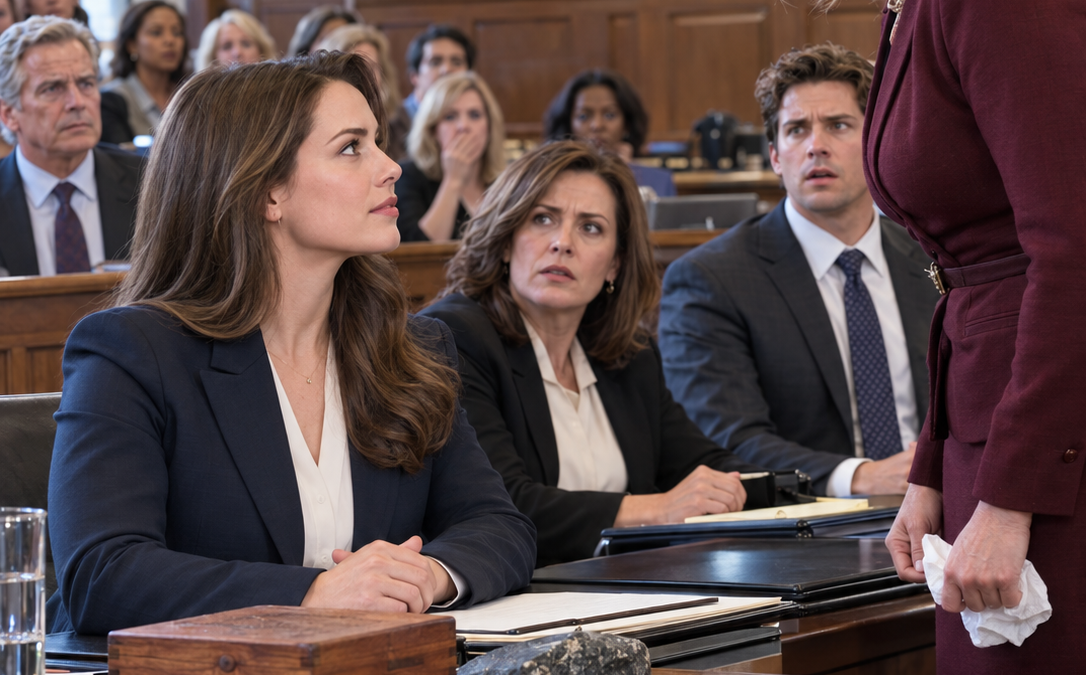
The probate courtroom in Caldwell County is smaller than you would expect.
Wood paneling.
Fluorescent lights.
An American flag behind the judge’s bench that had been there so long the stripes had faded to pink and gray.
I arrived at 8:30 with Elaine and Uncle Paul.
I set the cedar box on the table in front of me.
Paul sat in the first row of the gallery, hands folded, looking like an older version of my grandfather.
My mother arrived at 8:45.
Full performance.
Black dress.
Tissue in hand.
Dabbing her eyes before she even sat down.
Craig was behind her, wearing a suit I had never seen, looking everywhere except at me.
Their attorney, a man from Charlotte named Brewer, carried a leather briefcase and the confidence of someone who had been told a simple version of this story.
My father came in last.
He sat in the second row behind my mother, staring at the floor.
Harris was in the gallery, too.
Gray wool coat.
Legal pad on his knee.
He caught my eye and gave a single nod.
The judge called the case.
“Matter of the mineral rights deed of Walter P. Meyers, deceased.”
Brewer went first.
He argued the deed was executed without the family’s knowledge.
He suggested Walter may have been unduly influenced by an outside party.
He used the word elderly three times.
Elaine stood.
“Your Honor. The deed in question was executed by a licensed attorney, notarized by a county official, and recorded with the county recorder’s office, all three years before Mr. Meyers’s death, during which time he continued to live independently, manage his own affairs, and drive himself to medical appointments. If that constitutes undue influence, it is the most well-documented case this county has ever seen.”
A murmur moved through the gallery.
The judge raised one hand.
Elaine presented five exhibits, one by one.
Exhibit A.
The original mineral rights deed signed by Walter P. Meyers, notarized, dated three years before his death.
Exhibit B.
The county recorder’s certified copy, filed in Book 47, Page 312.
Public record.
Exhibit C.
The updated geological survey and formal valuation by Dr. James Avery.
Lithium-bearing pegmatite deposit across the southwest quadrant of the 40-acre parcel.
Estimated value at current market prices:
$4.7 million.
When Elaine said that number aloud, the courtroom shifted.
My mother’s hand tightened around her tissue.
Craig leaned over and whispered something to Brewer.
Exhibit D.
Walter’s sealed letter to Elaine explaining his intent.
Elaine read key passages aloud.
“My daughter-in-law has always valued what she can count. She never valued what she could not see.”
And:
“She earned it by being the only one who ever asked me about my work, not my money.”
Exhibit E.
Uncle Paul’s affidavit and testimony.
Paul stood, walked to the witness box, and sat down the way my grandfather used to sit.
Straight-backed.
Hands on the armrests.
Looking directly at whoever spoke.
“My brother was a mining engineer for 35 years. He knew what was under that land. He chose to protect it for the one grandchild who cared about his work, not his money.”
Brewer tried on cross-examination.
“Is it not possible Walter was confused? He was 75 when he filed this deed.”
Paul looked at Brewer the way you look at someone who has said something they should not have.
“He drove himself to the attorney’s office, drove himself to the recorder’s office, came to my house afterward, and we drank coffee while he told me exactly what he did and why. That man was sharper at 75 than most people are at 40.”
The judge thanked Paul.
Paul nodded and returned to his seat.
In my blazer pocket, I could feel the weight of Grandpa’s reading glasses against my chest.
Next to them, in my other pocket, the granite chunk.
I had not touched either one.
Not yet.
The judge turned to Brewer.
“Does the respondent wish to present evidence?”
Brewer shuffled papers.
He had nothing.
A deed filed three years ago.
A county record.
A geological survey.
A sealed letter from a dead man who predicted everything.
An independent witness who had known the mining engineer for seven decades.
There was nothing to argue against.
Brewer asked for a continuance.
The judge denied it.
“You have had three weeks, counselor.”
That was when my mother stood up.
Brewer reached for her arm.
She pulled away.
“That land was supposed to take care of this family.”
Her voice was loud enough to fill the room.
“My father-in-law had no right to give it away to one grandchild.”
“Ma’am, please sit down.”
“She did not need it.”
Diane pointed at me.
Her finger shook.
“She has her career. Craig needed that money. We all needed it.”
I sat perfectly still.
Hands folded on the table.
I did not look at her.
I did not react.
“You are tearing this family apart over dirt!”
She was almost shouting now.
Craig buried his face in his hands.
Brewer tried to guide her back to the chair.
And then, from the second row, my father spoke quietly.
But in that courtroom, quiet carried.
“Diane. Sit down.”
The gallery went still.
My mother turned.
She looked at my father like she had never heard his voice before.
Then she sat down.
The judge asked if I wished to respond.
I stood slowly and smoothed my blazer.
“Your Honor, my grandfather worked underground for 35 years. He taught me that the most valuable things are the ones people walk right over.”
I paused.
Looked at the cedar box on the table.
“You can sell a house. You cannot sell what is underneath.”
I sat down.
The courtroom was silent.
The judge reviewed the exhibits for 12 minutes.
I know because I watched the clock above the courtroom door.
Then she spoke.
“The mineral rights deed executed by Walter P. Meyers and recorded with the county recorder’s office is valid, properly executed, and properly recorded. The deed predates the decedent’s death by three years and was executed during a period when Mr. Meyers was demonstrably competent.”
She looked at me.
“Holly Marie Meyers is the sole owner of all subsurface mineral rights on the 40-acre parcel in question.”
I exhaled.
I did not know I had been holding my breath.
“The surface sale to Harris Development LLC is valid, but does not and never did include mineral rights. Those rights were severed by the grantor three years prior and transferred to the petitioner.”
She turned to the respondents’ table.
“The court notes that the respondents sold the surface property claiming no will or other estate documents existed while a separately recorded deed transferring mineral rights was on file with this very county. The court recommends that the buyer’s legal counsel review potential claims for nondisclosure.”
My mother sat frozen.
Her tissue crumpled in her fist.
She did not move.
Craig stood without a word and walked out of the courtroom.
Did not look at me.
Did not look at anyone.
My father stayed, seated in the second row.
He looked at me.
Then he nodded once.
Small.
The nod of a man who knew what the right thing was and never had the courage to do it.
I picked up the cedar box from the table.
Opened the lid.
Placed Grandpa’s reading glasses inside next to the granite chunk.
Closed it.
Elaine put her hand on my shoulder.
“It is done.”
Outside, the January afternoon was bright.
The kind of cold that makes everything sharper.
Edges.
Colors.
Sounds.
Elaine, Paul, and I stood on the courthouse steps.
The granite of the building was the same pale gray as the chunk in my pocket.
“Congratulations,” Elaine said. “You now own a $4.7 million mineral estate.”
“My grandfather owns it. I am just the one he trusted to take care of it.”
Paul hugged me.
His arms felt like Grandpa’s.
Same height.
Same grip.
Same cedar-and-coffee smell.
“He would be proud, sweetheart.”
Harris came out a few minutes later.
His handshake was firm and brief.
“No hard feelings, Miss Meyers. I am going after your parents’ attorney for the title failure. Not you.”
“I understand.”
“For what it is worth, your grandfather sounds like he was a hell of an engineer.”
I nodded.
Harris walked to his truck.
I was heading to my car when I saw my father standing by his pickup across the lot.
Alone.
My mother was already gone.
Craig must have driven her.
My father was just standing there, keys in his hand, looking at the sky.
He saw me.
Raised his hand.
Half wave.
Half surrender.
I waved back.
I did not walk over.
He did not walk over.
We stood 40 yards apart in a county parking lot, and that was the closest we had been in months.
I put the cedar box on the passenger seat.
Same spot as every drive.
Engine on.
Heat up.
Highway south.
Three hours home with Grandpa riding shotgun.
Six months later, I signed a development lease with a mining company out of Charlotte.
The terms were straightforward.
They handle extraction.
I receive royalties based on production volume.
The first quarterly payment arrived in April.
The second appraisal confirmed Dr. Avery’s estimate.
$4.7 million in lithium reserves, give or take market fluctuations.
I set up a trust in Grandpa’s name.
The Walter P. Meyers Engineering Scholarship Fund.
Half of the first year’s royalties go to first-generation engineering students at the community college in Caldwell County.
The same county where Grandpa spent 35 years underground and never once complained about the dark.
Craig’s restaurant franchise closed in March.
He declared personal bankruptcy two months later.
His share of the $620,000, about $27,000 after taxes and my mother’s cut, was gone before the lease was even signed.
My mother blames me.
Craig has not called since the hearing.
Harris filed a civil suit against my parents for failure to disclose the severed mineral estate during the property sale.
Their attorney costs are mounting.
Diane fired Brewer and hired someone cheaper.
My father sent me a letter.
Handwritten.
Short.
No excuses.
No explanations.
I should have been braver. I hope you know that.
I read it twice.
Then I opened the cedar box, placed the letter inside next to the mineral rights deed and Grandpa’s reading glasses and the granite chunk, and closed the lid.
The box sits on my bookshelf now, between a framed photo of Grandpa in his mining gear and my NC State engineering diploma.
Three objects that tell the story of two people who believed the most valuable things are the ones you cannot see.
I did not reconcile with my mother.
I did not slam the door either.
I sent her one text.
Final.
Clear.
If you ever want to have an honest conversation—not about money, not about Craig, not about blame—you know my number.
She never replied.
I visit the property once a quarter.
Walk the land.
Check on the mining operation.
The drill pads are on the southwest corner near the old fence line where Dr. Avery pulled his first core sample.
The rest of the 40 acres looks the same.
Rolling hills.
Creek.
Hawks circling.
The workshop is still standing.
Harris agreed to preserve it as part of our surface-use agreement.
The mining company routes its equipment road around it.
I go inside sometimes.
Sit at Grandpa’s bench.
Run my hand along the wood he planed smooth 40 years ago.
His tools are still on the pegboard.
His reading glasses are in the cedar box at home, but the smudge on the left lens is still there.
I have not cleaned it.
The workshop smells the same.
Cedar and machine oil and something deeper.
Something permanent.
Like the earth remembering who walked here.
My grandfather spent 35 years underground.
He knew what mattered is not always what you can see.
He taught me that patience is not weakness.
Silence is not surrender.
And the people who walk over you will never think to look down.
That is my story.
A cedar box.
A granite rock.
And a deed filed three years before goodbye.
If this story reminded you to check what is really yours, share it with someone who needs to hear it. Drop a comment, hit subscribe, and I will see you in the next one.








