My parents skipped my wedding to fly to dubai with my brother; i asked my husband’s father to walk me down the aisle instead; the documentary crew filmed everything; it went viral with 14m views; few days later, 93 missed calls.
“Your father and I have talked it over, and we need to be in Dubai for Derek’s store opening. It falls on the same weekend.”
I stood there with tulle pinned to my head and said nothing.
“You know how important this is for him,” she continued. “He has been working on this for 2 years. The investors are flying in. He needs family support there.”
Four seconds of silence. I counted them.
“What about my wedding?” I asked.
“Oh, Tori, you have Liam’s family. You will be surrounded by people who love you, and we will celebrate when we get back. We can do a nice dinner, the whole family.”
She said it the way you cancel a hair appointment. Light. Quick. Already moving on to the next thing on her list.
I said, “Okay,” and hung up.
Janet was still holding the camera. She looked at my face and set it down. She did not ask what happened. She crossed the room, put both hands on my shoulders, and held me there until I remembered how to breathe.
This was not the first time. Not the fifth. Not the 10th.
When I graduated from college, my parents arrived 2 hours late. Derek had an audition for a modeling agency that morning, and my mother drove him across town first. By the time they walked into the auditorium, I had already crossed the stage.
My father shrugged. “We saw the livestream.”
When I got promoted to lead engineer at 27, I planned a dinner at the Italian place my mother loves. She canceled three hours before. Derek needed a ride to the airport. He was flying to Miami for a friend’s birthday.
She said she would make it up to me.
She never did.
When I had surgery on my shoulder the following year, my mother sent a text.
“Sending prayers, sweetheart. Keep us updated.”
She did not come. She did not call. Derek was visiting from Los Angeles, and she said she did not want to miss the time with him since he was only in town for a few days.
I stopped counting after 26.
Twenty-six times they chose Derek over showing up for me.
My aunt Ruth told me once, sitting in her kitchen with coffee going cold between us, “Your mother sees you as the strong one, Tori. She thinks strong means you don’t need her.”
I remember the taste of that coffee.
Bitter.
Just like the words, Tori will understand.
That was the phrase. My mother used it like a skeleton key, unlocking her way out of every obligation to me. She said it to my aunt. She said it to my uncle. She said it to my father whenever he hesitated.
And the worst part was, for 31 years, she was right.
I did understand.
I understood that I came second.
I still have the pen. I used a blue felt-tip, the kind that bleeds a little at the edges if you press too hard. I sat at the kitchen table the night after I mailed the formal invitations and wrote a separate note on cream-colored cardstock.
I tucked it inside my parents’ envelope before sealing it.
Mom, Dad,
This is the most important day of my life. I need you there, not for photos, not for tradition. I need you there because I still believe we can be a family. Please do not miss this one.
Love, Tori.
I asked my aunt Ruth to handle it. She drove 40 minutes to my parents’ house on a Tuesday afternoon. She told me later that my mother took the envelope, glanced at it, and set it on the kitchen counter next to a stack of catalogs.
“Did she open it?” I asked.
Ruth paused.
“Not while I was there.”
I told myself she would read it that evening. I told myself the words would reach her. That this time, the handwritten truth of her daughter’s heart would be enough to keep her from booking a flight to the other side of the world.
Two weeks later, Ruth stopped by my parents’ house to pick up a casserole dish. She saw the invitation on the counter.
Same spot.
Same angle.
Still sealed.
My mother never opened it.
She left my heart on that kitchen counter, still sealed, tucked between a Pottery Barn catalog and a stack of coupons she would never use.
And she booked the flights to Dubai the same week Ruth delivered it. I know because I saw the confirmation email Derek forwarded to the family group chat.
Business class. Two seats.
I met Liam Callaway at a friend’s barbecue 5 years ago. He was 33 now, an environmental engineer who spent his weekdays testing soil samples and his weekends building raised garden beds he never quite finished.
He was quiet, steady, the kind of man who listened with his whole body.
But the person who changed my life was not Liam.
It was his father.
Warren Callaway was 62, a retired high school principal with a voice like warm gravel and hands that had fixed everything from leaky faucets to broken hearts.
The first time Liam brought me home for Sunday dinner, I stood in the doorway holding a bottle of wine like it was a shield. Warren walked straight up to me, took the bottle, and said, “You don’t need to earn a seat at our table, Tori. You’ve had one since the first dinner.”
I almost cried.
I think he knew.
Over the next 5 years, Warren became the father I had always needed. He called me every Sunday, not to check in, but because he wanted to hear about my week. He taught me how to change my brake pads. He remembered my birthday every single year without being reminded.
He showed up to my work presentation when I mentioned it once in passing. He sat in the back row of a conference room full of engineers and gave me a thumbs-up when I looked nervous.
My own father forgot my birthday three years in a row. He never learned what I did for a living.
The last time I explained my job to him, he nodded and said, “So, you fix computers?”
Warren never confused my career with anything. He read an article about fintech once just so he could ask me a better question at dinner.
My father called 4 days after my mother did. I think she made him. His voice had that particular strain it gets when he has been coached on what to say.
“Sweetheart, I know this is not what you wanted to hear.”
“Then why are you saying it?”
“We can only be in one place.”
He paused.
“Derek’s investors are flying in from Singapore. This is his big break. If we’re not there, it sends the wrong message.”
“And what message does missing my wedding send?”
He did not answer that.
Instead, he said, “You have Liam’s family. You’ll be fine.”
I sat with that sentence for a long time after he hung up.
You’ll be fine.
Not, I wish I could be there.
Not, I’m sorry.
Just the assumption that someone else would pick up where they left off. That Tori would understand.
Liam found me sitting on the back porch that evening. The sun was going down behind the oak trees, and I was staring at my phone on the railing like it had betrayed me.
“What did he say?” Liam asked.
“He said I’ll be fine.”
Liam sat down next to me. He did not touch me right away. He just sat there until the sky turned dark orange, and then he said, “You will be. But not because of them.”
I turned my phone face down.
“I’m done hoping,” I said.
That night, Derek sent me a text.
“Hey, sis. Sorry about the timing. I’ll make it up to you.”
No specific offer. No plan. No follow-up question about the wedding. Just six words tossed into the void like a coin into a fountain, making a wish that cost him nothing.
I did not reply.
I drove to Warren’s house on a Thursday evening. Janet was on a night shift. The porch light was on, and I could see him through the screen door, reading a book with his glasses halfway down his nose.
He looked up when I knocked.
“Tori, come in. Coffee’s still warm.”
We sat on the porch with our mugs. The crickets were loud that night. I held the coffee with both hands and stared at the steam curling off the surface, trying to find the words I had rehearsed the whole drive over.
“My father chose Dubai,” I said.
Warren set his mug down on the railing.
“Would you walk me down the aisle?”
He did not say anything for 10 seconds.
He did not need to.
His face said every word his mouth could not. His eyes reddened at the edges, his jaw tightened, and he pressed his lips together the way men of his generation do when they are trying very hard not to cry.
Then he cleared his throat.
“I would be honored, Tori. More than you know.”
I heard a soft sound behind the screen door. Janet had come home early. She was standing just inside the kitchen with a dish towel pressed against her mouth, tears running down her cheeks.
Warren reached across the space between our chairs and squeezed my hand once. Firm. Steady.
“We’re going to make it a good day,” he said.
I believed him.
Not because he promised it, but because Warren Callaway had never once in 5 years told me something he did not mean.
My father never bought a new tie for me in his life.
Warren bought one the same afternoon I asked him.
Navy blue.
He told me later it was the most important purchase he had ever made.
Marcus Chen was Liam’s college roommate. They shared a dorm with cinder-block walls and a mini fridge that hummed so loudly neither of them could sleep the first semester.
Marcus went on to become a documentary filmmaker. Not the Netflix kind. The indie kind. He had a YouTube channel with 48,000 subscribers and a specialty in short documentaries about modern milestones: first-generation college students, immigrant small-business owners, couples who eloped during the pandemic.
Six months before our wedding, Marcus pitched Liam an idea. He wanted to film a miniseries called Modern Ceremonies.
Real weddings. Real people. No scripting.
Liam liked the concept and brought it to me.
I said yes.
Marcus was respectful. He never pushed. He asked permission before every shot, and he had a rule: if anyone at the event asked him to stop filming, the camera went down immediately.
What Marcus did not know when he packed his two cameras and his tripod into the rental van was that our wedding was about to become something he never planned for.
“I just want to capture what’s real,” he told us over dinner the week before. “Real is what people connect with.”
Liam nodded.
I sipped my water.
I did not tell Marcus about my parents. There was no reason to. The documentary was about the wedding, not the absence. About the love in the room, not the chairs left empty by the people who should have filled them.
But real has a way of including the parts you did not script.
And when Marcus pointed his camera at two white chairs in the front row with paper signs that read Reserved, with no one sitting in them, he captured the one thing I never asked him to film.
The truth.
If you have ever had someone choose convenience over your most important day, you know exactly what I was feeling standing there. And if this story is already hitting close to home, go ahead and hit that subscribe button, because what happened at my wedding and what 14 million people saw after is something I still think about every single day.
Janet took me dress shopping. So did my best friend Nora and my cousin by marriage, Sarah. Four women in a bridal boutique in Hartford on a Saturday morning, armed with opinions and tissues.
The consultant brought out five dresses.
I tried on three.
The third one was the one.
A-line. Lace sleeves. A neckline that sat just right.
When I stepped out of the fitting room and looked in the mirror, I felt something shift in my chest. I turned to the left to find my mother’s face.
Her chair was empty.
It was a cream-colored settee near the window with a throw pillow that said, Here comes the bride.
No one was sitting in it.
Nora was on the opposite couch. Sarah was by the mirror. Janet was behind me, already reaching for the veil.
Janet saw me looking. She stepped forward, adjusted the lace at my shoulder, and said, “You look like everything good in this world, Tori.”
I blinked twice and looked back at the mirror.
That evening, I made the mistake of opening Instagram.
Pamela had posted a photo of herself and Derek at the Dubai Mall. Floor-to-ceiling glass, palm trees in the background, Derek in a linen shirt, grinning. Pamela next to him with a shopping bag and a caption that read, “So proud of my boy. Family supporting family.”
I stared at those four words.
Family supporting family.
I set my phone face down on the nightstand and turned off the lamp.
Liam rolled over.
“You okay?”
“I will be,” I said.
I was not sure if I was lying yet, but I was getting closer to the truth.
The venue was a vineyard estate 20 minutes outside of Stamford. Stone walls, white chairs on a manicured lawn, a wooden arch draped in wisteria.
We did the setup the day before, and I walked the rows myself to check the spacing.
Front row. Bride’s side.
Two chairs on the left end.
White paper signs held down with small stones.
Reserved.
Nora came up beside me.
“Do we remove the signs?”
I stood there and looked at those two chairs for a long time. They were identical to every other chair on the lawn, but they felt heavier, like the weight of 31 years of skipped birthdays and halfhearted phone calls had settled into the wood.
“Leave them,” I said.
Nora waited.
“They made their choice. The chairs should reflect that.”
Marcus was filming behind us.
I did not know he had caught the moment until weeks later, when the documentary was already live and 14 million people had seen me standing in front of two empty chairs, arms crossed, deciding what to do with the space my parents left behind.
Two white chairs. Two paper signs.
Reserved for the two people who should have been there more than anyone else on Earth.
I turned and walked back toward the reception tent. Liam was adjusting speakers. Warren was helping string lights along the canopy. Janet was arranging place cards with the kind of precision only a pediatric nurse could manage.
Ruth had arrived that morning, pulling into the driveway with a car full of homemade pastries and a hug that lasted a full minute.
My family was all there.
Just not the one I was born into.
The phone calls started 3 days before the wedding.
Uncle Pete, my mother’s older brother, called first.
“Tori, sweetheart, your mother is beside herself about this whole situation. Can’t you just move the date? Even a week would help.”
“The date was set eight months ago, Uncle Pete.”
“I know, but family is family. You only get one mother.”
I closed my eyes.
“She only gets one daughter’s wedding, too.”
He did not call again.
Aunt Linda, my father’s sister, sent a long text. She wrote about tradition, about how a daughter should honor her parents regardless of circumstances, about how weddings come and go but the bond between parent and child is eternal.
She ended with, “I hope you’ll reconsider and show some grace.”
I read it twice and did not respond.
But then Ruth called.
Ruth, who had driven 40 minutes to deliver my invitation. Ruth, who saw it still sealed on the counter. Ruth, who was the only person in my mother’s family who ever said my mother was wrong to my face.
“I’m flying in Thursday,” she said. “I’ll be there for the rehearsal. I’ll be there for the ceremony. And I will be sitting in the front row on your side.”
“Ruth, you don’t have to.”
“Tori, listen to me. Your mother is wrong. I told her so last Tuesday, and I’ll tell her again on Sunday. You deserve to have family there, and I am your family.”
She paused.
“I should tell you something. That invitation you wrote? It’s still on the counter, sealed. She never opened it, Tori.”
I already knew.
But hearing it from Ruth, hearing the confirmation that my mother never even read the words I wrote her, made the decision I had been circling for weeks feel inevitable.
The rehearsal dinner was at Warren’s house. Forty people in his backyard under string lights that Liam and his brother had spent the afternoon hanging. Folding tables covered in checkered cloths. Janet’s famous pot roast. Ruth’s lemon pastries.
Nora brought three bottles of wine and a playlist she had spent two weeks curating.
It felt like family.
Real family.
The kind that shows up and stays.
Warren stood up at the end of the meal with a glass of iced tea. He never drank alcohol. He cleared his throat, and the yard went quiet.
“I want to say something about family,” he began. “Family isn’t always the people who share your blood. Sometimes it’s the people who choose to show up. Who drive 40 minutes to deliver an invitation. Who fly across the country because they said they would. Who string lights in a backyard because that’s what you do for the people you love.”
He looked at me.
“I didn’t get a daughter when Liam was born. I got one 5 years ago, when Tori walked through my front door holding a bottle of wine like she was afraid we’d send her back.”
He paused.
“We never will.”
I cried.
First time in two weeks.
Not the tears I had been fighting. Not the ones that came from grief and anger.
These were different.
These came from somewhere warm.
Marcus was filming from the corner near the rose bushes. I noticed him capturing close-ups: Warren’s hands around the glass, Ruth wiping her eyes, Liam watching me from across the table.
I wondered what story he was building.
I did not know yet that the story had already written itself.
And I did not know that the whole world was about to read it.
The night before my wedding, I could not sleep. I lay in bed staring at the ceiling fan, counting the revolutions, trying to empty my head.
It did not work.
So I picked up my phone.
I should not have opened Instagram.
I know that now.
Pamela had posted again.
A rooftop restaurant with the Dubai skyline behind her. Gold-rimmed plates. Derek across the table in a blazer, raising a glass.
The caption read, “Celebrating our boy’s dream coming true. Family first always.”
Family first always.
I read those three words until they stopped looking like English.
Glenn had not posted anything. He never did. Social media was Pamela’s territory, but he was in the background of Derek’s post. A selfie with both parents.
#DubaiDreams #Family #Blessed.
My father looked the way he always looked in photos.
Present in body, absent in everything else.
Derek had posted a separate story, a boomerang of champagne glasses clinking. He tagged my mother.
He did not tag me.
He did not mention that his sister was getting married tomorrow in a vineyard in Connecticut with two empty chairs in the front row.
He did send me a direct message, though.
“Wish you could be here, sis. This place is insane.”
No mention of my wedding.
Not one word.
I took a screenshot.
Not for revenge.
Not for evidence.
I took it because I needed something tangible. A reminder.
I opened my Notes app and typed six words underneath the image.
This is who they chose to be.
Then I set the phone down, turned off the light, and stared at the ceiling fan until the sun came up.
Tomorrow, I was getting married.
And for the first time, I did not wish my parents were coming.
The morning of my wedding, Ruth found me in the bridal suite, lacing up my shoes. She closed the door behind her and sat down on the edge of the bed.
She was holding her phone.
“I wasn’t going to show you this,” she said, “but you deserve to know.”
She turned the screen toward me.
It was a group text.
Three weeks old.
Pamela, Glenn, Derek, Ruth, and Uncle Pete.
Pamela had sent the first message at 9:47 on a Thursday morning.
“Derek’s store opening is confirmed for June 14th. We need to be there. Tori will understand. She always does. Derek needs us there. This is his moment.”
Glenn replied 12 minutes later.
“She’ll be fine. Liam’s family will take care of it.”
Derek responded with a thumbs-up emoji.
Nothing else.
Not a question. Not a hesitation.
Just a thumb pointing upward like my wedding was a restaurant recommendation.
He was acknowledging.
Uncle Pete wrote, “Are you sure about this, Pam?”
Pamela replied, “Pete, don’t start. Tori is the strong one. She doesn’t need us hovering. Derek does.”
I read the thread twice.
Then a third time.
I zoomed in on the timestamps. I looked at who read what, when they read it, how long they waited before responding.
They did not forget my wedding.
They discussed it, weighed it against a store opening in Dubai, and decided I was not worth the flight.
It was not a scheduling conflict.
It was a choice documented in black and white.
And the sentence I had heard my entire life, the one that followed me from childhood through college, through every surgery and promotion and milestone they missed, was right there on the screen, typed out by my mother’s own hand.
Tori will understand.
She always does.
Ruth took my hand.
“Now dry your eyes. You’ve got a wedding to get to.”
I handed her phone back.
I looked in the mirror. I picked up a tissue, pressed it under each eye, and set my jaw.
She was right about one thing.
I did understand.
Janet fastened the last button on the back of my dress. Nora was on her knees, adjusting the hem. Ruth pinned the veil into place with steady hands. Sarah held up the mirror.
Marcus filmed from the corner of the room, so quiet I forgot he was there.
I looked at my reflection.
The dress was everything I wanted. Lace sleeves, A-line skirt, a neckline that framed my collarbones without trying too hard. My hair was pinned into a low twist with a few loose strands near my temples.
My makeup was light.
I wanted to look like myself, not a version of myself designed to impress people who were not coming.
The girl who used to cry in her car after Thanksgiving dinners was gone.
The woman in the mirror had already made her peace.
She was not pretending to be strong.
She was not performing resilience for an audience.
She was simply done reaching for people who had already let go.
I put my phone on silent and set it face down on the vanity.
“Ready?” Nora asked.
I straightened my shoulders.
“Yes.”
Janet squeezed my arm.
“You look beautiful, Tori.”
Ruth leaned in and whispered, “Your mother is a fool.”
I almost laughed.
Almost.
There was a knock at the door.
Liam’s voice came from the other side.
“Dad’s outside. He said he’s been ready since sunrise.”
I picked up my bouquet, white peonies tied with a ribbon Nora had sewn herself, and walked to the door.
The last time I walked through a doorway before becoming someone’s wife, I did not look back at my phone.
I did not check for a last-minute text from Pamela.
I did not wait for Glenn to call with a change of heart.
I walked forward.
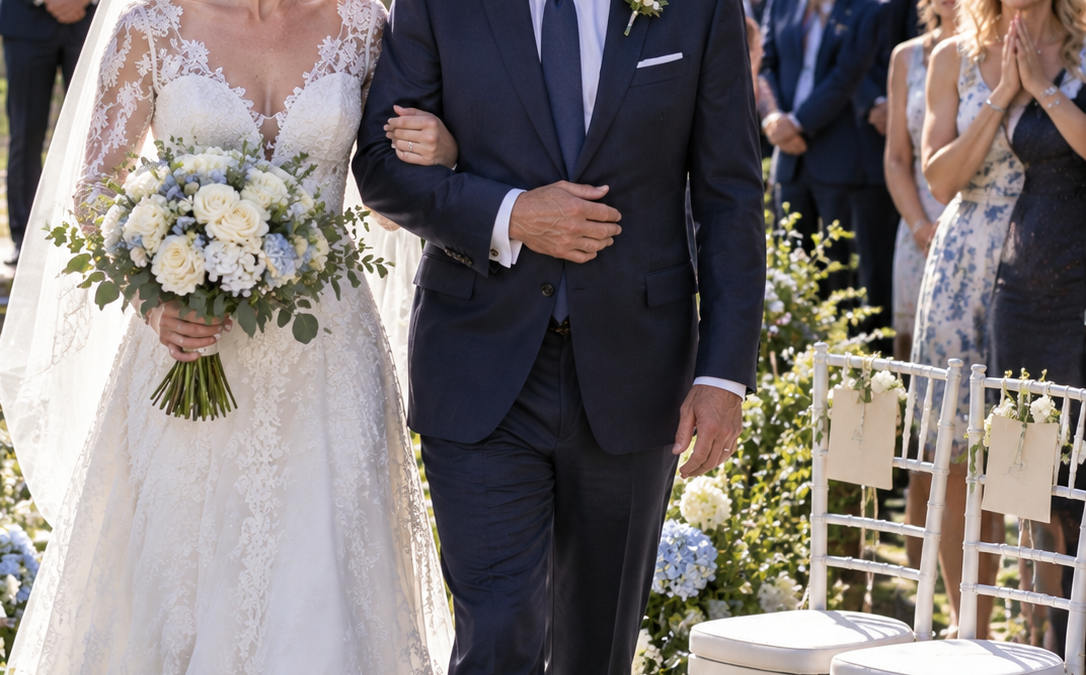
Warren was standing at the end of the hallway.
Navy suit. New tie.
His shoes were polished so well I could see the overhead lights reflected in the leather. He was holding his hands together in front of him the way he probably did at every school assembly for 30 years.
Composed. Upright. Waiting for his cue.
But his hands were shaking.
Liam had checked on him 20 minutes earlier.
“You okay, Dad?”
Warren had straightened his tie and said, “I’ve waited 62 years to walk a daughter down the aisle. I think I can manage a few more minutes.”
When I came through the door, Warren’s breath caught.
I watched his face go through three expressions in the span of two seconds.
Surprise.
Then pride.
Then something deeper and harder to name.
The kind of emotion that lives in the chest of a man who spent his career teaching other people’s children and who loved his son’s wife as if she had always been his.
“You are the most beautiful bride I have ever seen,” he said.
His voice cracked on the last word. He cleared his throat and straightened his jacket.
“Thank you,” I said. “For everything. Not just today.”
He offered his arm.
I took it.
And for the first time that day, I felt the weight of the morning—the group text, the sealed invitation, the Dubai posts—lift from my shoulders and settle somewhere behind me where it belonged.
Warren’s arm was steady.
His step was measured.
He had practiced the walk three times in his living room the night before. Janet told me later she watched him from the kitchen, counting his paces, making sure his timing was right.
He wanted it to be perfect.
And it was.
The string quartet played something soft as the doors opened. I do not remember the name of the piece.
I only remember the sunlight.
It poured across the vineyard lawn in long gold sheets, catching the tops of the white chairs and the petals scattered along the aisle.
One hundred twenty people stood and turned.
I heard the rustle of fabric, the quiet gasps, and the sound of someone already crying in the third row.
Warren and I stepped forward together.
His pace was steady.
Mine matched his.
I held my bouquet with my left hand and gripped his arm with my right. He placed his free hand over mine and kept it there the whole walk.
I looked at the faces.
Nora, already wiping her eyes.
Sarah, grinning.
Janet, standing in the front row with her hand over her heart.
Liam at the altar, jaw tight, eyes bright.
And then I looked at the two chairs.
Front row.
Bride’s side.
White paper signs.
Reserved.
Empty.
The seats were perfectly placed, perfectly still, perfectly vacant.
Two rectangles of absence in a sea of people who chose to show up.
Marcus’s camera caught the moment.
A slow pan from my face to the chairs and back again.
Five seconds.
No narration.
No music sting.
Just the image of a bride walking past the place her parents should have been, arm in arm with the man who chose to be there instead.
One hundred twenty people watched.
Some of them knew the story. Some did not.
But everyone who looked at those chairs understood.
Ruth sat alone on the bride’s family side, three seats from the empty ones.
Tears streamed down her face.
She did not wipe them.
At the altar, Warren released my arm. He took my hand, placed it into Liam’s, and leaned in close enough that only we could hear.
“She’s the best thing that ever happened to our family,” he said.
Liam nodded.
“I know.”
Liam wrote his own vows.
So did I.
His were shorter, but they landed harder.
“Tori,” he said, holding both my hands, “I cannot promise you a perfect life. I cannot promise we will never fight about whose turn it is to unload the dishwasher. But I promise you this: I will always be in the one place that matters. I will always show up. And I will never, for as long as I live, make you wonder whether you are enough.”
I did not trust my voice after that.
I read mine from a folded piece of paper because I knew I would forget everything the moment I looked at him.
The ceremony ended with a kiss and a cheer that echoed off the stone walls.
We walked back up the aisle together, past the empty chairs, past Ruth’s tear-streaked face, past 120 people who would go home and tell someone about the wedding with the two empty chairs in the front row.
At the reception, Warren gave the toast.
He stood with his glass of iced tea and told the room a story I had never heard before.
“The first time Tori came to our house for dinner, she stood in the doorway for 30 seconds before Liam finally nudged her inside. She was holding a bottle of Pinot Noir like it was a life vest. And I thought to myself, this woman has been waiting her whole life for someone to tell her she belongs somewhere.”
He raised his glass.
“Tori, you belong here. You always have.”
Marcus captured every reaction. The laughter. The tears. The clinking glasses. The band starting up.
He told me later that night, as the crew packed up, that he had never filmed anything like it.
The camera stopped rolling at 11 that night.
But the story was just getting started.
If you have ever wondered what happens when the truth gets out, not through confrontation but through a camera lens, stay with me, because the next part is the reason this story reached 14 million people.
And if this is speaking to something in your own life, share it with someone who needs to hear it.
Two weeks after the wedding, Marcus sent me an email with a link to the rough cut.
Twenty-two minutes.
He titled it Modern Ceremonies: Tori and Liam.
I watched it alone the first time.
Liam was at work.
The house was quiet.
It was beautiful.
Marcus had woven together the rehearsal dinner, the ceremony, the speeches, the first dance, the sparkler exit. He used natural audio—the string quartet, the clink of glasses, the laughter during Warren’s toast.
No voice-over.
No dramatic music.
Just the sounds of a real wedding with real people.
But then came the chairs.
Marcus did not add narration.
He did not explain.
He held the shot for 5 seconds.
A slow, steady frame on two white chairs in the front row. Paper signs. Reserved. Empty. Sunlight falling across the seats.
You could see a shadow moving in the background where the other guests were standing, but the chairs themselves were still.
It was the quietest 5 seconds of the entire film.
And it said everything.
I called Marcus that evening.
“You can publish it,” I said.
He paused.
“Are you sure? Once it’s out there, you can’t take it back.”
“It’s the truth, Marcus. The chairs were empty. The camera saw it. I’m not ashamed of being the person who showed up to her own wedding.”
“You don’t want me to cut that part?”
“No.”
He exhaled.
“Okay. I’ll have it up by Friday.”
I hung up and sat with the silence.
Liam came home an hour later, set his bag down, and found me staring at the ceiling.
“You good?”
“I told Marcus to post it.”
“All of it?”
“All of it.”
He sat down beside me.
“Then whatever happens, we handle it together.”
Marcus uploaded the documentary on a Friday morning.
The title was simple.
Modern Ceremonies: Tori and Liam.
The thumbnail was a still frame from the ceremony. Warren and me walking down the aisle, the two empty chairs visible just behind us in the front row.
No text overlay.
No clickbait.
Just the image.
The first 24 hours were normal by Marcus’s standards.
12,000 views.
His subscribers liked it.
The comments were warm.
“Beautiful wedding.”
“Warren is amazing.”
“That vineyard is gorgeous.”
And then someone asked the question.
“Wait, are those two chairs in the front row empty? Who are they reserved for?”
Another comment appeared underneath.
“I think those are the bride’s parents’ seats.”
And another.
“Where are the bride’s parents?”
Marcus’s regulars started responding. Some speculated. Some asked directly.
Marcus did not reply to any of them.
He never did.
He let his films speak for themselves.
By hour 36, a wedding planner in New Jersey shared the video in a private Facebook group with 22,000 members.
Her caption read, “This is the most powerful wedding film I have ever seen. Watch it to the end.”
The views jumped.
12,000 became 40,000.
Then 90,000.
Then 180,000 in 48 hours.
The comments changed.
They became longer.
More personal.
“My mother skipped my wedding for my sister’s baby shower. I have never told anyone.”
“I cried when I saw those empty chairs.”
“That was me 20 years ago.”
“The father-in-law walking her down the aisle destroyed me.”
“That’s what real family looks like.”
I read every comment that night.
Hundreds of them.
Strangers sharing their own stories underneath mine.
I did not reply to any of them.
I just read.
And for the first time, I did not feel alone in my own story.
Day five: 1.2 million views.
A parenting blogger in California wrote a piece titled The Empty Chairs That Broke the Internet. She embedded the video. Her article was shared 11,000 times in two days.
Day six.
A Reddit thread appeared.
The title: This bride’s parents flew to Dubai for her brother’s store opening instead of her wedding.
It reached the front page within hours.
12,000 upvotes.
3,000 comments.
Day 8: 4.7 million views.
A regional news outlet in Connecticut ran a segment. They used the still frame of the empty chairs.
They did not name us. Marcus had not used last names in the documentary.
Day 10.
7 million.
Interview requests poured in.
A morning show producer. Two podcast hosts. A magazine editor.
Marcus forwarded them all to me.
I declined everyone.
“You don’t owe anyone your story,” Liam said.
“The video already told it,” I replied.
My phone vibrated constantly. Friend requests, direct messages, emails from strangers who wanted to thank me for making them feel seen.
I read some.
I did not respond.
I was not ready to be a public figure.
I had only wanted to get married.
Nora called me that week.
“Tori, the video is everywhere. Are you okay?”
“I think so.”
“Are your parents watching this?”
I had not thought about that.
Or rather, I had been trying not to.
Somewhere across the ocean, in a Dubai hotel room or on a return flight or in the house where my sealed invitation still sat on the counter, my parents were about to discover what 14 million strangers already knew.
And there was nothing I could do to control what happened next.
Derek found out first.
One of his business partners sent him a link on a Tuesday afternoon. A text with no context, just the URL and a question mark.
“Is this your sister?”
Derek watched the video in his office above the new store in Dubai. The store that had opened to modest foot traffic and a lease payment that was already straining his cash flow.
He watched the ceremony.
He watched Warren walk me down the aisle.
He watched the camera hold on two empty chairs.
He called my mother.
Pamela was at home in Connecticut by then. They had returned from Dubai 4 days after my wedding.
She answered Derek’s call on the first ring.
She always did.
“Mom, there’s a video.”
He sent her the link.
She watched it on the couch in the living room with the curtains drawn.
I know this because Ruth told me later.
Ruth, who had been invited over for lunch that day. Ruth, who sat at the kitchen table and listened to Pamela watch 22 minutes of a wedding she chose to miss.
Pamela saw the empty chairs.
She saw Warren’s hand over mine.
She saw 120 guests witnessing the space she and my father had left behind.
She saw the comments, thousands of them, from strangers who called her selfish, heartless, unforgivable.
Glenn watched on his phone in the upstairs bedroom.
He did not come down for an hour.
Derek’s Instagram direct messages were already filling up. People who recognized his face from the Dubai posts had connected the dots.
“Isn’t this your sister’s wedding?”
“Why weren’t you there?”
“Your parents picked your store opening over her wedding.”
“You should be ashamed.”
Derek turned off his notifications.
But the comments did not stop.
The first voicemail arrived at 2:14 in the afternoon.
“Tori, this is your mother. I don’t know what that filmmaker was trying to do, but this is not the full story. You know we wanted to be there. You know that. Call me back immediately.”
The second came 40 minutes later.
“This is humiliating, Tori. Everyone at church has seen it. Carol from my prayer group sent it to me. You need to have that video taken down. This is a family matter, not entertainment for strangers.”
The third came just before midnight.
“I’m your mother, Tori. I carried you. I raised you. And you let a camera crew embarrass us in front of the entire internet. Call me, please.”
I listened to all three.
The next morning, I sat on the kitchen floor with my back against the cabinet and played them one after another.
The way you watch a storm move across a field, knowing it cannot reach you but feeling the pressure change in your chest.
Three voicemails.
Not a single apology.
Just three different ways of saying, How dare you let people see what we did?
Not, I’m sorry I wasn’t there.
Not, I made a terrible mistake.
Not, Can we talk about what happened?
Just damage control.
Just reputation management.
Just the same instinct that had governed her parenting for 31 years.
Protect the image.
Ignore the wound.
I set the phone on the counter and made breakfast.
Eggs. Toast. Coffee.
I ate slowly.
Liam sat across from me, reading the news on his tablet, not asking questions he already knew the answers to.
“Are you going to call her back?” he finally asked.
“No,” I said.
He nodded and went back to his coffee.
By day 14, the video had 7.2 million views.
The comment section had become something I never anticipated.
It was not just people reacting to my story.
It was people telling their own.
Thousands of them.
A woman in Texas whose mother skipped her graduation for her brother’s baseball game.
A man in Ohio whose parents funded his sister’s wedding but told him his was too informal to attend.
A grandmother who drove 14 hours to be at her granddaughter’s recital because she wrote, “Someone in that little girl’s life needs to show up.”
Strangers were healing underneath my wedding video, and I did not know how to feel about that.
Derek’s Dubai store started receiving negative reviews online. One-star ratings from people who had never set foot in the country.
“Owned by the guy whose parents skipped his sister’s wedding.”
“Family values.”
“Check the YouTube video.”
I posted publicly on my personal page the first and only thing I said:
“Please do not leave negative reviews on my brother’s business. This is a family matter. I do not want anyone harmed because of this video. Thank you.”
Some people listened.
Some did not.
But I had said my piece.
Uncle Pete stopped calling.
Aunt Linda deleted her Facebook account.
Two of my mother’s church friends unfollowed her on Instagram.
Small things.
But in a small town, small things are the ones that cut.
Ruth texted me.
“Your mother hasn’t left the house in three days. She’s watching the video comments on a loop. Glenn took the router password away.”
I read that message three times.
I did not feel satisfaction.
I did not feel revenge.
I felt the quiet, hollow ache of watching people realize too late that their choices have witnesses.
Day 21.
14 million views.
Marcus’s channel went from 48,000 subscribers to 320,000 in 3 weeks.
He did not monetize the video.
He told me later he turned down two sponsorship offers.
A comment with 47,000 likes sat at the top of the page.
It read, “Those two empty chairs said more than any speech ever could.”
I saved that comment.
I do not know why.
Maybe because a stranger on the internet articulated in one sentence what I had spent 31 years trying to explain to my parents.
Absence is not neutral.
Absence is a message.
I turned my phone off that evening and sat on the porch with Liam.
The fireflies were out.
The neighbor’s dog was barking at something in the trees.
It was quiet in the way that only summer evenings in Connecticut can be quiet.
Thick. Warm. Alive.
“I didn’t plan this,” I said.
“I know,” Liam said. “That’s why it’s real.”
Marcus called the next day and asked if I wanted to film a follow-up documentary.
An update.
Where are they now?
I said, “No. This is not a franchise, Marcus. It’s my family.”
He understood.
I did not want fame.
I did not want a platform.
I did not want to become the woman known for having parents who did not show up.
I wanted what I had always wanted: to be loved by the people who were supposed to love me first.
And when that did not happen, I wanted the freedom to stop pretending it was okay.
Fourteen million people watched my wedding.
But only the people in that vineyard knew what it felt like to stand there.
And that was enough.
The letter arrived on a Monday.
Plain white envelope.
No return address.
But I recognized the handwriting.
My father wrote in block capitals the way men who grew up in small-town New England were taught. Every letter the same height. No flourishes. No wasted ink.
I opened it at the kitchen table with a glass of water I never drank.
Tori,
I watched the video. I saw those chairs.
I have no excuse.
I was a coward. I chose the easy path every time your mother asked me to, and I told myself it was keeping the peace. But I was keeping the peace for me, not for you.
I know this letter changes nothing. I know a piece of paper doesn’t fix 31 years of letting you down.
But I want you to know the moment Warren took your arm and walked you down that aisle, I felt something break inside me that I don’t think will ever heal.
He did what I should have done, and he did it better than I ever could have.
I’m sorry, Tori.
Not sorry for Dubai.
Sorry for every time before Dubai that made Dubai possible.
Dad.
I read it twice.
Folded it along the creases.
Slid it back into the envelope.
Liam came home and found the letter on the table. He read it without asking because I left it there for him to see.
“What are you going to do?” he asked.
“Nothing. Not yet.”
“Is that okay?”
“It has to be.”
I did not reply to my father’s letter.
Not because I was punishing him.
Because I was not sure a letter, even a good one, earned a response after three decades of silence.
Sometimes the kindest thing you can do for yourself is let someone’s apology sit without an answer.
Pamela showed up on a Saturday morning in August.
I was in the front garden pulling weeds from the bed along the walkway. Dirt under my nails, hair tied back, no makeup.
Not expecting visitors.
A silver car pulled into the driveway.
My mother stepped out.
She had lost weight. Her eyes were red in a way that was not from crying that morning, but from weeks of it.
She was wearing a blouse I had never seen before, which meant she had bought it for this visit.
She had dressed up to come apologize.
“We need to talk,” she said.
I stood up, brushed the dirt off my knees, and did not invite her inside.
“That video destroyed us, Tori.”
Her voice cracked on my name.
“My friends, my church group, your father’s colleagues. Everyone has seen it. Carol won’t even look at me.”
“You’re upset that people saw what you did,” I said. “Not that you did it.”
She flinched.
“That is not fair.”
“Neither was Dubai.”
She pressed her hand to her chest.
“I am sorry. I am. But you have to understand, Derek needed—”
“Derek always needed,” I said, keeping my voice even. “And I always understood. That was our arrangement.”
Her face shifted.
The controlled composure she had practiced in the car began to crack.
“You’re punishing me. You are punishing your own mother.”
“I’m not punishing you, Mom. I’m just not pretending anymore.”
She stood there on my walkway, shaking.
I did not raise my voice.
I did not need to.
“You told Aunt Ruth, ‘Tori will understand. She always does.’ You wrote it in the group text. You’ve been saying it my entire life. Every birthday you missed. Every dinner you canceled. Every time you chose Derek because he was louder and I was easier to ignore.”
I paused.
“You were right about one thing. I do understand now. I understand that I deserved better.”
She opened her mouth.
Closed it.
Opened it again.
No words came.
She was crying now, standing on my walkway with mascara running and her new blouse wrinkled where she had been gripping the fabric.
“What do you want from me?” she asked. “Tell me and I’ll do it.”
“Nothing,” I said. “That’s the point. I don’t need anything from you anymore.”
The words landed between us like a door closing.
Not a slam.
A click.
I told her that if she wanted a relationship—a real one, not the performance she had been running for three decades—she would need to start therapy.
Not for me.
For herself.
Not as a gesture.
As a commitment.
“You lost your sister when you were 19,” I said. “I know that broke something in you. I’ve watched it shape every choice you’ve made. But you don’t get to break me to fill that gap.”
She looked at me like I had spoken a language she did not recognize.
“You attached yourself to Derek because he reminded you of her. The energy, the attention, the need to be close. I get it. But that is not my burden to carry. And it was never my job to compete with a ghost.”
She put her hand over her mouth.
“Go home, Mom. Find a therapist. Do the work. And if you come back, come back because you’ve changed, not because you need me to forgive you so you can feel better about yourself.”
I turned toward the door.
Stopped.
Looked over my shoulder.
“Warren was in the one place that mattered. Mom, you were in Dubai.”
I walked inside and closed the door.
Through the window, I watched her stand there for two full minutes.
Then she walked to her car, sat behind the wheel for another three, and drove away.
I did not raise my voice.
I did not need to.
Thirty-one years of silence is louder than any scream.
I turned my phone back on that evening.
The screen lit up with a number I had to count twice.
93 missed calls.
Pamela: 31.
Glenn: 17.
Derek: 8.
Uncle Pete: 12.
Aunt Linda: 9.
Numbers I did not recognize: 16.
Neighbors, maybe.
Church members.
People who had gotten my number from someone who got it from someone else.
Ninety-three attempts to reach a woman who had spent 31 years reaching for them.
I held the phone up for Liam to see.
“93,” I said.
He looked at the screen.
Looked at me.
“How many are you going to return?”
“Zero.”
He nodded.
Not because he agreed.
Because he trusted me.
I did not block anyone.
I did not change my number.
I simply did not call back.
There is a difference between shutting a door and locking it.
I left the door unlocked.
But I stopped standing on the other side waiting for someone to walk through it.
That same week, Derek’s Dubai store hit its first serious cash-flow problem.
The foot-traffic projections had been optimistic.
The lease was expensive.
Two of his investors pulled back after a supply-chain delay.
These were business fundamentals.
Nothing to do with the video.
Nothing to do with me.
Glenn had put $80,000 of his savings into Derek’s store.
Retirement money.
The kind of investment you make when your son tells you it is a sure thing and your wife tells you family comes first.
$80,000 sitting in a storefront in a Dubai shopping district where the rent was due and the customers were not.
I did not feel satisfaction.
I felt the familiar weight of watching people make choices and then wonder why the floor gave out beneath them.
3 months later, Derek’s store closed.
Four months of operation.
Underfunded from the start.
The location was wrong.
Tucked behind a food court in a mall that catered to tourists who came for photographs, not purchases.
The investors pulled their remaining capital in September.
Derek signed the lease termination on a Tuesday and flew home on a Wednesday.
Glenn lost most of the $80,000.
Not all of it.
The liquidation recovered some inventory value, but enough was gone that the retirement plan he and Pamela had mapped out was no longer accurate.
Pamela started therapy in late August.
Glenn told Ruth, who told me.
Twice a week.
Tuesdays and Thursdays.
With a therapist in Fairfield who specialized in family systems.
I did not ask what they discussed.
It was not my business anymore.
Her church friends remained polite but distant. Conversations that used to last 20 minutes after service now lasted three.
People remembered the video.
They did not bring it up.
They did not need to.
Derek moved back to Connecticut and took a job at a retail store in Stamford.
He texted me in October.
Three sentences.
“Tori, I’m sorry I took them from you. I didn’t think about what it cost you. I should have.”
First genuine apology from any of them.
Not about the video.
Not about embarrassment.
About the fact that he had consumed every resource in our family—financial, emotional, physical—and never once looked across the table to see if I was still there.
I read it.
Saved it.
Did not reply yet.
6 months after the wedding, this is what my life looked like.
Sunday dinners at Warren and Janet’s house.
The table seats eight, but there are always 10 because someone always brings someone.
Liam carves whatever Janet has roasted.
Warren quizzes everyone on trivia from the newspaper.
Ruth drives down from Hartford once a month and brings her lemon pastries, which are never as good as she thinks they are, and nobody tells her.
Nora and I go running on Saturday mornings, three miles along the reservoir.
She talks about her kids.
I talk about the garden bed I am trying to coax tomatoes out of.
We do not talk about the video anymore.
It has become a thing that happened.
Not a thing that is happening.
Pamela and I have had two phone calls.
Both short.
Surface-level.
“How is work?”
“How is the weather?”
She does not bring up the video.
She does not bring up Dubai.
She asks about Liam, and I can hear in her voice that she is trying.
Trying looks different than I thought it would.
Smaller.
Quieter.
Less dramatic.
Glenn sent me a birthday card in September.
The first one in 9 years.
I did not open it for a week.
When I finally did, it said five words in his block capitals.
I’m proud of you.
I should have said it sooner.
I cried.
Not because I needed his approval.
Because I realized I no longer did.
The tears were not about gaining something.
They were about releasing the last piece of something I had been carrying since I was a girl.
The belief that if I just tried hard enough, he would notice.
He noticed.
It took 14 million strangers and two empty chairs.
But he noticed.
In November, a package arrived.
Small padded envelope.
My mother’s handwriting.
Inside was the wedding invitation.
The one Ruth had delivered.
The one that sat sealed on the counter.
The one she never opened.
It was open now.
And tucked inside was a Post-it note in Pamela’s handwriting.
Eight words.
I finally read it. I’m sorry it took 14 million strangers to make me pick it up.
I put the invitation in a drawer.
Maybe someday I would frame it.
Maybe someday it would mean something different.
But not yet.
I thought about my mother’s old refrain.
Tori will understand.
She always does.
She was right about one thing.
I do understand now.
I understand that I deserve better.
Family is not a title you inherit.
It is a promise you keep.
And if the people who gave you life cannot keep that promise, you are allowed to build a table where people actually sit down.
Warren taught me that not with words, but with a navy tie and a steady arm and 62 years of showing up for every person who walked through his door.
That is what family looks like.
Quiet.
Steady.
Present.
That is my story.
Two empty chairs.
One documentary.
And a father-in-law who never once had to be asked twice.
If this reminded you to call someone who actually shows up for you, do it today.
Drop a comment, hit subscribe, and I will see you in the next one.








