My parents received $2,000 a month from me so they could “live comfortably”; but on my wedding day, they didn’t show up at all; when i called, mom snapped, “don’t bother us”; i hung up, shaking, and immediately closed every account in my name; 30 minutes later, they called me frantically.
My father, Jean, nodded from his recliner. He always nodded when Patrice spoke. Thirty years of marriage, and I never once saw him disagree with her in front of us.
I did not resent Jolene. Not then. I just thought that was how families worked. The strong one carries the weak one.
I did not realize I was being trained.
In June 2021, my father, Jean, lost his job at Portland Precision Manufacturing. He had worked there for 30 years as a floor supervisor. The company downsized and eliminated his department.
He was 57 years old, with no college degree and a retirement fund that covered about 14 months. I was 28, in my first year of emergency medicine residency at Maine Medical Center. My salary was $62,000 a year before taxes. Take-home after deductions, insurance, and loan payments was roughly $3,800 a month.
My mother called on a Tuesday. She was crying.
“We can’t make the mortgage, Morgan. Your father is devastated. He won’t even get out of bed.”
I did the math on a napkin in the hospital break room at two in the morning. $2,000 a month. That left me $1,800 for rent, food, gas, and everything else.
It was tight.
It was possible.
I set up an automatic transfer that night, from my checking account to the Meyers Joint Savings. My phone dinged when the first one processed.
$2,000 transferred to Meyers Joint Savings account ending in 4471.
I ate a granola bar and went back to the ER.
That weekend, I opened a spreadsheet on my laptop. One green row: month one, $2,000. Running total at the bottom: $2,000.
I told myself this was temporary. Dad would find something. Six months, maybe a year. The transfers would stop, and I would catch up on my student loans.
$280,000 from medical school, accruing interest at 6.8%, while I ate cafeteria food at midnight.
Temporary.
That word lived in my head for four years.
Four years and $96,000.
The months passed. The transfers kept going. I worked 80-hour weeks in the emergency room. I lived in a 400-square-foot studio apartment with a mattress on the floor and a microwave I had bought at Goodwill. Most of my meals came from the hospital cafeteria: $4 salads, day-old sandwiches, whatever was left on the warming trays after the night shift started.
My parents did not eat like that.
I visited Scarboro for Christmas 2021. The house had new hardwood floors in the living room, new kitchen appliances, a French-door refrigerator, a convection oven. The bathroom had been retiled.
My mother gave me a tour like she was on a home renovation show.
“We found a contractor through the neighborhood Facebook group. Such a good deal.”
I asked about the cost.
She waved her hand. “Your father handled it.”
My father. The one who had not worked in six months. The one who turned down a warehouse job because it was, in his words, beneath a man with 30 years of supervisory experience. The one who declined a position at Home Depot because he did not want to wear an apron.
Nobody asked me about residency. Nobody asked about my apartment. Nobody asked if I was eating enough or sleeping enough or surviving at all.
Nobody said thank you.
At Christmas dinner, Jolene pulled up in a new Honda CR-V. Sage green. Still had the dealer plates.
My mother beamed. “Doesn’t she look gorgeous in that car?”
I looked at the car, then at my mother.
“Who paid for it?”
Nobody answered.
Patrice changed the subject to Jolene’s plans for a spring vacation with Brett. I drove home in my 2014 Civic with 211,000 miles on the odometer.
The second year was worse. Not the work. The work I could handle. The ER was predictable in its chaos. Heart attacks at dawn, broken bones at noon, overdoses at midnight.
I knew what to do with a body in crisis. I had been trained for that.
What I had not been trained for was watching my family celebrate someone else with my money and pretend I did not exist.
In spring 2022, Jolene had a pregnancy scare. False alarm. My mother drove two hours to Jolene’s apartment to sit with her. She brought soup, flowers, and a stuffed bear she picked up at the gift shop.
That same week, I was hospitalized for dehydration after a 14-hour shift. I called my mother from the IV chair. She answered between bites of something.
“Oh, honey, drink some water. I can’t come up. Jolene needs me this week.”
Jolene, whose scare was already over. Whose tests had come back negative three days ago.
That September, Jolene had her actual wedding. Small ceremony at a restaurant on the waterfront. My parents paid for her dress, the flowers, and a honeymoon contribution to a resort in Cancun.
I did not ask how much.
The answer was somewhere in my spreadsheet. Green rows, one after another, running total climbing past $36,000.
I attended. I gave a toast. I smiled in the photos.
Afterward, I drove to the parking lot and sat in my car with the engine off. Eighteen months of transfers. $36,000.
And my mother had just told the photographer, “Let’s get the family photo, just the four of us.”
I was standing six feet away.
The four of them smiled.
The camera flashed.
I was not in the frame.
In spring 2023, year two of transfers, I sat down one evening and looked at my student loan balance.
$274,000.
Interest was accruing faster than I could pay the minimums. At this rate, I would be in debt until I was 42.
I decided to have the conversation. Reduce the transfers from $2,000 to $1,500. Still generous. Still more than most adult children send their parents. Still 30% of my net income.
I called my mother on a Saturday morning.
“Mom, I need to talk about the monthly transfers. My student loans—”
She cut me off before I could finish.
“After everything we sacrificed for you.”
There it was. Her weapon. She kept it loaded at all times.
“We fed you. We clothed you. We drove you to every science fair and college visit. And now you want to put a price on gratitude?”
I backed down.
I kept the amount at $2,000.
At work the next week, my attending physician, Dr. Lena Kovatch, cornered me in the break room. Lena was 38, direct, and the only person at the hospital who noticed when I picked up extra shifts.
“You look like you haven’t slept in a year. That’s not dedication. That’s something else.”
I told her I was fine.
She did not believe me.
She also did not push. Lena was smart like that.
Three days after the guilt-trip phone call, I opened Instagram. My mother had posted a photo from a weekend trip to Cape Cod. Lobster dinner. Ocean view.
Caption: Blessed Life. Grateful Heart.
Blessed.
With my $2,000 funding the lobster.
I closed the app and went back to the ER.
Garrett Holt walked into the hospital in July 2023 carrying a toolbox and wearing steel-toed boots. His contracting company had won the bid to rewire the third-floor electrical system. Four-person crew. Six-week project.
Licensed master electrician. Thirty-three years old, from Lewon. He drove a 2016 Ford F-150 with a dent in the tailgate and a bumper sticker that read Local 567.
We met in the cafeteria. He had brought his own lunch: a roast beef sandwich, an apple, and a thermos of coffee. He sat down across from me while I ate the same wilted Caesar salad I had been eating for two years.
“You work here?” he asked.
“Resident. Emergency medicine.”
“And you eat that every day?”
“Most days.”
He pushed half his sandwich across the table.
“My mom made extra.”
That was how it started.
Coffee in the parking lot after my shifts. Texts between his rewiring jobs and my traumas. He was steady in a way I had forgotten people could be.
No performance. No agenda. Just a man who showed up and said what he meant.
It took me three months to tell him about the $2,000.
We were sitting in his truck in the hospital parking lot. October. The heater running. I said it fast, like pulling off a bandage.
“I send my parents $2,000 a month. They depend on it. My dad lost his job two years ago, and they can’t make ends meet.”
Garrett was quiet for a long time. He did the math the same way I had done it, on his fingers, in his head, the way people do when the number is too large to process casually.
“Morgan, that’s 30% of your salary.”
“They need it.”
“Do they?”
Nobody had ever said those two words to me.
And I felt the ground shift under everything I had built my silence on.
Thanksgiving 2023, I brought Garrett home to Scarboro for the first time. My mother opened the door and looked him up and down the way a jeweler examines a stone she already knows is fake.
“So, Garrett, what exactly is it that you do?”
“I’m a licensed electrician. I own a small contracting company in the Portland area.”
Patrice smiled. The kind of smile that has teeth but no warmth.
“An electrician. Well, that’s good, honest work.”
My father, Jean, shook his hand without standing up from the couch.
“Does the business do well?”
“We stay busy.”
Jolene, seven months pregnant by then, leaned against the kitchen counter.
“Does he have benefits? Health insurance?”
This from a woman who had never in her life held a job with employer-provided insurance.
Garrett handled all of it with a patience I envied. He talked about his crew, his certifications, his plans to expand into solar panel installation. He answered every question without flinching, without performing, without trying to impress anyone who had already decided not to be impressed.
After dinner, I went to the kitchen to get water. The hallway was dark, and my parents did not know I was there.
I heard Patrice’s voice.
“An electrician. Our daughter, the doctor, is marrying an electrician. At least Jolene married a sales manager.”
And then Jean, my father, the man whose mortgage I paid every month, said something I will never forget.
“As long as the checks keep coming, who cares who she marries?”
I stood in that hallway for a long time, my hand on the glass, my feet on the hardwood floor I had paid for.
As long as the checks keep coming.
Like I was a subscription service.
Like love had a billing cycle.
In February 2024, Garrett proposed on the hospital rooftop after my Saturday overnight shift. No ring box. He had the ring loose in his jacket pocket because he said he did not want me to see a box and figure it out before he could ask.
The sun was coming up over Portland. I was still in scrubs. My hands smelled like hand sanitizer.
I said yes before he finished the question.
I called my parents that afternoon. Patrice answered.
“Hello?”
“Mom. I’m engaged. Garrett proposed this morning.”
Silence.
Then: “Oh. Well, I hope you’ve thought this through.”
No congratulations. No excitement. No “tell me everything.”
Just the sound of someone deciding how much disapproval she could get away with.
An hour later, Jean called back. He was alone. I could tell because he spoke in a lower register, the voice he used when Patrice was not in the room.
“Morgan, I need to talk to you about something. This wedding—it better not affect our arrangement. You know what I mean?”
“Dad, I’m getting married. I’m planning a wedding. Things might need to adjust.”
“Adjust?”
His voice dropped. Not angry yet. Something before angry. The sound of a man calculating how much he stood to lose.
“We depend on you, Morgan. You owe us this. Don’t pull the rug out.”
There it was. The second weapon.
After everything we sacrificed.
You owe us this.
Two sentences. Two chains. One for guilt, one for obligation.
I hung up and sat on the couch with Garrett. I told him what Jean said, every word.
Garrett looked at me.
“Morgan, you don’t owe them your life.”
I knew he was right.
I also knew that knowing and doing are two completely different things.
Right now, I am sitting in my apartment, engaged to the man I love, and my father just told me I owe him my paycheck. If you have ever been in a position where your family treated your generosity like a bill, like something they were owed, then you understand why my hands were shaking.
Stay with me, because what I found out next changed everything.
From March through May 2024, Garrett and I planned a modest wedding. We found a barn venue in Kennebunkport. White clapboard, string lights, a view of the river through hundred-year-old windows.
Capacity for 85 guests. October 19th, a Saturday. Total budget: $28,000.
Garrett’s savings and my tax refund.
No family money.
No parental contribution.
Every dollar earned and accounted for.
I invited my mother to help me choose a dress. She had one answer for everything that spring.
“I’m busy.”
Jolene’s nursery needed painting. Jolene’s registry. Jolene’s prenatal appointments. My sister had become a full-time occupation for my mother, one that conveniently left no hours available for my wedding.
I sent save-the-date cards to everyone. My parents received theirs in mid-April.
No response for two weeks.
Then a text from Patrice.
October is difficult. Jolene is due in November. I need to be available.
October.
Five months before November.
But somehow October was difficult.
My phone dinged that same evening.
$2,000 transferred to Meyers Joint Savings. Account ending in 4471.
Month 36.
Running total on my spreadsheet: $72,000.
I stared at the notification on my phone the way you stare at a receipt for something you no longer want but cannot return.
$72,000.
My mother could not find one weekend in five months for my wedding. But she had time for Jolene’s nursery, Jolene’s doctor visits, Jolene’s everything.
I put my phone down and picked up the guest list. Eighty-five names. I started addressing envelopes at the kitchen table while Garrett heated up leftover pasta.
This was my wedding.
Mine and Garrett’s.
And the people who wanted to be there would be there.
In July 2024 came Jolene’s baby shower. My mother organized it the way generals organized campaigns. Rented venue at a hotel in South Portland. Catered for 40 guests. Pink balloon arch. A three-tier cake with “Baby Girl Tate” written in fondant script.
I drove two hours to attend.
I brought a gift, a baby blanket I had crocheted between overnight shifts. Seafoam green. It took me three weeks of stolen minutes in the break room, hooking yarn under fluorescent lights while monitors beeped behind me.
At the shower, my mother stood in front of the room and gave a speech. She was radiant, voice steady, eyes shining. The performance of a lifetime.
“Jolene, you are the light of this family. Becoming a mother is the most important thing a woman can do.”
I sat in the corner.
Nobody mentioned my upcoming wedding.
Nobody asked about the venue, the dress, the date.
I was 31 years old, an emergency medicine physician, and I was invisible.
Jolene opened gifts. She got to mine, held up the blanket, turned it over once.
“Oh, cute. Did you make this?”
She set it on the pile and reached for the next box.
After the party, I helped clean up, stacking chairs, folding tablecloths, collecting paper plates.
My mother pulled me aside near the dessert table.
“Morgan, the $2,000. Can you do $2,500 this month? The shower cost more than we expected.”
“I’m paying for my own wedding, Mom. I can’t increase it.”
She tilted her head.
That look.
The one she gave me when I was failing to meet her expectations, and she wanted me to know it without saying it directly.
“You always find a way. You’re the strong one.”
The strong one.
She called me that only when she needed more money.
In August 2024, I received a letter from the bank. The joint savings account, the one I transferred $2,000 into every month, required updated signature cards.
Routine paperwork.
But it meant logging in.
And logging in meant looking at the numbers.
I opened the account on my laptop at two in the morning.
The balance should have been substantial. Thirty-eight months of deposits. Even with the mortgage payments coming out, there should have been a cushion.
The balance was $340.
I read it twice.
Then three times.
Then I scrolled.
Transaction history.
Withdrawals.
Regular. Large. Relentless.
$1,500 to Jolene Tate.
$2,000 to Brett Tate Auto Group.
$800 to Jolene Tate.
$3,200 to Brett Tate Auto Group.
$1,000 to Cape Cod Resort and Spa.
$1,200 to a furniture store in South Portland.
$700 to a salon.
$500 to a nail studio.
The money was not keeping my parents afloat.
It was not paying the mortgage. Or at least not most of it.
It was funding Jolene’s lifestyle, Brett’s failing car dealership investment, and my mother’s vacations.
I screenshotted every transaction.
Every single one.
Saved them to a folder on my laptop named Transfers.
Then I opened my spreadsheet.
Green rows.
Thirty-eight of them.
Running total: $76,000.
I added a new column. I cross-referenced each withdrawal to Jolene or Jolene-adjacent expenses.
The math took me 40 minutes.
Forty-three percent of everything I sent went directly to my sister or her husband.
Twenty-two percent went to vacations, renovations, and personal spending.
Thirty-one percent went to the mortgage.
The actual stated reason for the transfers.
I closed the laptop.
My hands were shaking.
Not from anger.
From the specific nausea of discovering you have been lied to by people you trusted with your survival.
I did not tell Garrett immediately. I sat with it for three days.
During those three days, I went back through my text messages with my mother. Two years of conversations.
I was looking for a pattern.
And I found one.
Every guilt-trip text—
I am so stressed about bills.
Your father can’t sleep.
We just don’t know how we’ll manage.
—arrived within 48 hours of a large withdrawal from the joint account.
Mom texting “We’re barely making it” on a Monday.
$1,500 transferred to Jolene Tate on Wednesday.
The correlation was not emotional.
It was operational.
My mother texted me distress signals to keep the money flowing, then redirected the money to my sister before the ink dried.
I added another column to my spreadsheet.
Blue.
Matched guilt-trip texts to withdrawal dates.
The pattern was mathematical.
Provable.
Undeniable.
At work that Thursday, I dropped a cafeteria tray. Salad on the floor. Dressing on my shoes.
I sat down right there on the linoleum.
Dr. Kovatch found me.
She crouched beside me, white coat touching the floor.
“Talk to me.”
“I’ve been paying my parents $2,000 a month for three years. They’ve been giving it to my sister.”
Lena did not flinch.
Did not gasp.
Did not say she was sorry.
She sat down next to me, back against the vending machine.
“What are you going to do?”
“I don’t know yet.”
“Yes, you do. You just haven’t said it out loud.”
We sat there for a while. The cafeteria hummed around us. Trays clanging. Conversations drifting.
Normal sounds for normal people on a normal Thursday.
I was not normal anymore.
I had the numbers.
And numbers do not lie.
Even when mothers do.
I showed Garrett the bank statements on a Saturday morning. We were at his kitchen table, coffee going cold.
He scrolled through the screenshots slowly, his jaw tightening. He did not yell. Did not curse. Just breathed through his nose the way he did when he was processing something too large for words.
“Forty-three percent to Jolene,” he said.
“Yes.”
“And they told you it was for the mortgage.”
“Yes.”
“And you’re still sending $2,000 a month.”
“I stopped.”
He looked at me.
“When?”
“Tuesday. After my shift. I sat in the parking lot, opened the banking app, and pressed cancel.”
For the first time in 38 months, my phone did not ding with a transfer notification on the first of the month.
October would arrive, and $2,000 would stay in my account.
Mine.
The silence where that notification used to be felt louder than any sound I had ever heard.
Garrett reached across the table and put his hand over mine.
“Are you going to confront them?”
“Not yet. Not before the wedding. I need to get through October 19th first.”
He nodded.
“Then we get through October 19th.”
He did not tell me what to do. He did not strategize or plan or map out consequences.
He simply aligned himself next to me and said we.
That was enough.
I closed the laptop.
The spreadsheet saved automatically.
Green rows.
Red column.
Blue column.
Running total at the bottom in bold:
$76,000.
A fortune for a resident.
A fraction of what my mother believed I owed her.
Two weeks later, the first of October arrived.
No transfer.
No ding.
No $2,000 leaving my account.
The silence was extraordinary.
Jean noticed first.
October 3rd, a text:
Morgan, the transfer didn’t go through. Can you check?
I replied:
I’ll look into it.
I did not look into it.
Two days later, Patrice sent an email.
Not a text.
An email.
My mother used email for what she considered serious matters, the way some people use certified mail.
Subject line: Transfer Issue — Urgent.
Morgan, I noticed the October payment is missing. I assume this is a bank error. Please fix it immediately. Your father and I have bills.
Also, I need to talk to you about the wedding. I’ve been thinking, and I don’t think October 19th works for us. Jolene’s due date is getting closer and I need to be ready.
You understand, right?
After everything we sacrificed for you.
After everything we sacrificed for you.
Third time.
Same sentence.
Same weight on the same pressure point.
She called the $2,000 a payment.
Not a gift.
Not help.
A payment.
Like I owed a debt that would never reach zero.
I did not reply to the email.
I took a screenshot and added it to the folder. Same folder as the bank statements, the withdrawal records, the guilt-trip text correlations.
Then I put my phone down and picked up the stack of wedding invitations.
Eighty-five envelopes waiting to be addressed.
I started with Grandma Ruth’s.
Ruth lived in Bangor. My mother’s mother. Seventy-nine years old. Sharp as surgical steel. Independent as a cat.
She had always been kind to me in a way that felt different from the rest of the family. Quieter. More specific.
I wrote her address in blue ink, sealed the envelope, pressed the stamp down hard.
Some people you invite because you have to.
Some people you invite because they actually show up.
October 3rd, I sent the invitations.
My parents received theirs two days later.
Patrice called that evening.
“Morgan, we need to discuss this. The venue is a barn.”
“It’s in Kennebunkport. It’s beautiful.”
“We’re not barn people.”
“You’re invited. That’s all I’m asking.”
“Jolene had her wedding at a restaurant. A proper restaurant.”
I let that sit for a moment.
A proper restaurant.
Paid for with my money.
I did not say that.
Not yet.
Jean spoke from somewhere in the background.
“Tell her about the money.”
Patrice lowered her voice.
“Morgan, the October transfer, and now a wedding we didn’t approve of. What’s happening?”
“You’re invited to my wedding. That’s what’s happening.”
She hung up without responding.
No RSVP came back.
Not that week.
Not the next.
I called Grandma Ruth.
She had already RSVPed yes, with a handwritten note tucked inside the card.
Wouldn’t miss it for the world, sweetheart.
Garrett’s mother, Doris, a retired cafeteria worker from Lewon who had raised Garrett alone after his father left when Garrett was six, RSVPed the same day she received the invitation.
She called to ask if she could bring her apple pie and whether the barn had a kitchen she could use.
Eighty-five invitations.
Within two weeks, 63 had RSVPed yes.
My hospital colleagues.
Garrett’s crew.
Friends from medical school.
Cousins on my mother’s side who liked me more than they liked Patrice.
My parents?
Nothing.
Fourteen days before the wedding, and the two people who had received $96,000 of my money could not check a box on a card and put it in the mail.
I stopped waiting.
October 8th.
Eleven days before my wedding.
I was scrolling through Instagram during a break when I saw it.
A cousin’s story repost.
A pink-and-gold invitation graphic with cursive lettering.
Join us for Jolene and Brett’s gender reveal.
Saturday, October 19th.
5:00 p.m.
The Tate residence, Scarboro.
October 19th.
My wedding day.
I checked the original post on Jolene’s account.
She had uploaded it three weeks earlier.
My mother had liked it.
My mother had commented, “Cannot wait,” with a pink heart.
Three weeks ago.
While I was still waiting for their RSVP.
I called Jolene.
She answered on the second ring, voice bright and unbothered.
“Your gender reveal is on my wedding day.”
“Oh, is it? I didn’t realize.”
“The venue—”
“Well, it’s at our house, but October 19th was the only day that worked for everyone.”
“Everyone. Including Mom and Dad.”
“Morgan, I’m pregnant. This is about my baby. Not everything is about you.”
I held the phone away from my face for a moment.
Breathed.
Put it back.
“Mom RSVPed to your party three weeks ago. She hasn’t RSVPed to my wedding.”
Jolene was quiet for exactly two seconds.
Then:
“Well, maybe you should have picked a different date.”
I hung up.
I did not call my parents.
I did not change my wedding date.
I opened the spreadsheet on my laptop one more time.
Red column.
$43,000 to Jolene over 38 months.
And now Jolene had scheduled her gender reveal on my wedding day.
My sister did not accidentally choose October 19th.
She chose it because she knew our parents would come to hers.
She chose it because she could.
October 12th, one week before the wedding, I drove to Scarboro alone.
I sat at my parents’ kitchen table. The table I had eaten a thousand meals at growing up. The table where I had done homework, argued about curfew, opened birthday cards with $10 bills inside.
Patrice sat across from me.
Jean stood by the counter, arms crossed.
“My wedding is in seven days. I need to know if you’re coming.”
Patrice folded her hands.
“Morgan. Jolene needs us. She’s eight months pregnant and having her gender reveal the same day. We can’t be in two places.”
“You could come to the ceremony. It’s at two. Jolene’s party is at five.”
“We need to help set up. Jolene can’t do it alone.”
“Brett has family. Friends. She’s not alone.”
“She is our daughter.”
I let that sentence land.
She is our daughter.
Said to me, also her daughter, as if I were a neighbor requesting a favor.
Jean shifted his weight.
“And about the money?”
“This isn’t about the money right now. This is about my wedding.”
Jean’s jaw tightened.
“It’s always about the money, Morgan. You stopped paying. We noticed.”
I stood up.
My chair scraped the new hardwood.
“I’m asking you one more time. Will you be at my wedding?”
Patrice looked at Jean.
Jean looked at the floor.
Patrice looked back at me with something that was not quite apology and not quite defiance.
Something in between.
Something practiced.
“We’ll try.”
I drove 40 minutes to hear those three syllables.
We’ll try.
And I knew exactly what they meant.
They meant no.
They meant Jolene.
They meant the money mattered more than the ceremony.
I did not cry in the car.
I was past that.
The last week before the wedding moved at two speeds.
Fast at the hospital.
Slow at home.
Garrett’s mother, Doris, arrived from Lewon on Wednesday. She brought the apple pie, three casseroles, a garment bag with her church dress, and a hug that lasted eleven seconds.
I counted because I had forgotten what it felt like to be held by a mother figure without conditions attached.
“My son chose well,” she said. “I’m proud of you both.”
Grandma Ruth called every evening.
“I’m bringing my rolls and a surprise. You’ll love it.”
My parents?
Nothing.
No call.
No text.
No RSVP card arriving in a last-minute rush of conscience.
My college friend Sadie came down from Boston for the dress fitting. She stood behind me in the mirror as I adjusted the straps.
Ivory satin. Simple cut. No train.
“Where’s your mom?” Sadie asked.
“Busy.”
Sadie knew me well enough not to push.
The night before the wedding, I sat alone in my apartment. Garrett was at his mother’s hotel, keeping with the tradition of not seeing the bride before the ceremony.
The apartment was quiet in a way I was not used to.
No hospital sounds.
No beeping monitors.
No overhead pages.
I opened the banking app on my phone.
The old automatic transfer schedule was still visible in the history.
$2,000 — Canceled.
The word sat there in gray letters.
Final.
Clean.
I closed the app and looked at my wedding dress hanging on the back of the bedroom door.
Tomorrow, I would put that dress on.
I would stand in front of people who actually chose to be there.
And for the first time in four years, I would not be the person who funded someone else’s comfort while starving her own.
October 19th.
Seven in the morning.
The barn in Kennebunkport.
I woke in the bridal suite, a small room above the reception area with whitewashed walls and a window facing the river. The light was gray and gold, the way Maine mornings look in autumn when the fog has not yet burned off.
Garrett had texted at midnight.
Tomorrow you become my family officially.
Sadie helped with my hair.
Doris brought breakfast.
Scrambled eggs.
Toast.
Orange juice.
A cloth napkin she had ironed at the hotel.
She set the plate on the vanity and kissed my forehead.
“Eat. You have a big day.”
I checked my phone.
Zero messages from my parents.
Zero missed calls.
The screen was clean and empty where their names should have been.
Grandma Ruth arrived at eleven.
She walked into the bridal suite in a navy-blue dress with pearl buttons, her white hair pinned back with a clip I remembered from childhood.
She saw me in my wedding dress and stopped in the doorway.
Her chin trembled.
“Your mother should be here.”
“She isn’t coming, Grandma.”
“I know, baby. I know.”
Ruth reached into her purse, a leather bag the color of walnut that she had carried for 30 years.
She pulled out a small brooch, blue enamel set in tarnished silver, a forget-me-not.
“This belonged to my mother. Something old, something blue, something better than what they deserve to see.”
I pinned the brooch to the inside of my dress near my heart, where nobody could see it, but I would feel it all day.
First tear of the day.
Ruth wiped it with her thumb.
“That’s the only one you get before the ceremony,” she said. “Save the rest for the dancing.”
At two in the afternoon, the ceremony began.
Seventy-eight of 85 guests were present.
My side of the aisle: Grandma Ruth in the front row, three cousins, eight colleagues from the hospital, Sadie, and a handful of friends from medical school.
Garrett’s side: Doris, his crew of three electricians in sport coats they clearly did not wear often, and two dozen family members from Lewon who had driven 90 minutes without complaining.
I walked myself down the aisle.
Garrett was already crying before I reached him. His crew pretended not to notice.
Doris held a tissue to her mouth.
Ruth sat straight-backed and still, the way women of her generation hold themselves when they are trying very hard not to fall apart.
We exchanged vows.
Garrett spoke first.
“I choose you not because it’s easy, but because you’re worth choosing.”
I said mine.
I do not remember all of them.
I remember meaning every word.
The officiant pronounced us married.
The barn erupted.
Seventy-eight people clapping.
Some standing.
Doris openly weeping.
Ruth nodding.
One of Garrett’s electricians whistling.
At 3:30 in the afternoon, between the ceremony and the reception, guests were moving to the cocktail area.
I stepped outside to the parking lot alone.
I called my mother.
Four rings.
She answered.
“What?”
“I just got married, Mom.”
“We’re at Jolene’s. The reveal was beautiful. Pink. It’s a girl.”
“I just got married.”
Pause.
Then three words.
“Don’t bother us.”
The line went dead.
I stood in the October air holding my phone.
The brooch pressed against my chest through the satin.
Somewhere inside the barn, my husband was pouring champagne for 78 people who chose to be here.
My mother chose a balloon pop in Scarboro.
I stood in the parking lot for four minutes. I know because the phone screen had the time on it and I watched it change twice.
I was not crying.
Something harder than crying.
Something quieter.
The kind of stillness that comes when a decision has already been made and your body is just waiting for your hands to catch up.
I opened the banking app.
Joint savings account with parents.
Balance: $340.
I submitted a request to remove myself as co-owner.
The confirmation screen said processing would take 24 hours.
I went to my personal checking account.
Changed my direct deposit details.
Removed the secondary routing to Jean’s personal account.
$200 a month I had set up for his gas and groceries.
Canceled.
I scrolled to transaction history.
Found the old automatic transfer.
$2,000 to Meyers Joint Savings.
Canceled since September.
Good.
Still canceled permanently.
Total financial severance completed in four minutes and twelve seconds.
Standing in a gravel parking lot in Kennebunkport, Maine, in my wedding dress, with my grandmother’s brooch against my heart.
I put the phone in my clutch and walked back inside.
The barn was warm and loud with music and conversation and the clinking of glasses.
Garrett saw my face.
He crossed the room.
“What happened?”
“I’ll tell you tonight. Right now, I need to dance at my wedding.”
He took my hand and we walked to the floor.
The band played something slow.
I put my head on his shoulder.
He held me like I was something worth holding.
Somewhere in Scarboro, my father’s phone buzzed.
Bank notification.
Alert: Co-owner removed from account ending in 4471.
He would see it soon.
But not yet.
First, I was going to dance.
It took Jean 30 minutes.
He was at Jolene’s gender reveal party when his phone buzzed in his pocket. He had been holding a paper plate with a slice of pink cake when he looked at the screen.
First notification: co-owner removed from joint savings.
Second notification: secondary transfer canceled.
He excused himself from the living room, walked to the driveway, and dialed my number.
Straight to voicemail.
My phone was in my clutch on silent, on a table inside the barn, where 78 people were eating dinner and toasting my marriage.
He called seven times.
Each call went to the same place.
Then the texts started.
Call me now.
Morgan, what did you do?
This is not funny.
You cannot just cut us off.
He drove to the nearest ATM and tried to withdraw from the savings account.
His card still worked.
Balance: $340.
He stared at the screen, then drove back to Jolene’s house.
He walked inside.
My mother was refilling a punch bowl.
She saw his face.
“What is wrong?”
Jean’s voice was loud enough for the room to hear.
“She shut everything down. Your daughter shut everything down.”
Patrice set the ladle down.
“Keep your voice down.”
“We have $300, Patrice. $300.”
Jolene stood near the dessert table, a pink balloon still tied to her wrist.
“What are you talking about?”
Silence.
Nobody explained.
Because explaining would mean admitting where the money had been coming from.
Admitting that their daughter, the doctor, had been funding their life for four years.
Admitting that they chose Jolene’s balloon pop over Morgan’s wedding.
They could not explain it without condemning themselves.
So they stood there in a room full of pink and said nothing.
Our wedding night.
A bed-and-breakfast in Kennebunkport, three miles from the barn. White sheets. Fireplace. A window overlooking a garden going dormant for winter.
I checked my phone after Garrett fell asleep.
Fourteen missed calls.
Nine voicemails.
Jean, voicemail one:
“Morgan, call me back. There’s been a mistake.”
Jean, voicemail three:
“This is not acceptable. We had an agreement.”
Jean, voicemail four:
“You owe us this. You can’t just stop.”
His voice cracked on the word stop.
Jean, voicemail seven.
Late.
Slurred.
Something rattling in the background.
“You’ll come crawling back. You always do.”
Patrice texted at eleven at night:
Morgan, I don’t know what has gotten into you. I hope you’re happy ruining your father’s health.
Patrice texted at 11:47:
Fine. Don’t respond. But when you need us—and you will—remember this night.
I read them all.
Every word.
I did not play them on speaker.
I held the phone close to my face in the dark room while my husband breathed beside me.
I screenshotted every message.
Added them to the folder on my phone.
The same folder as the bank statements.
The withdrawal records.
The guilt-trip text correlations.
The email about the transfer issue.
Then I typed one text to both of them.
I got married yesterday.
You were not there.
The money stopped.
These are related.
I hit send.
Put the phone in the nightstand drawer.
Closed it.
Garrett shifted in his sleep.
The fireplace crackled.
Outside, the ocean made the sound it always makes.
Steady.
Indifferent.
Ongoing.
I lay back and listened.
For the first time in four years, there was nothing I owed anyone.
I have just read 14 missed calls and nine voicemails from parents who could not be bothered to attend my wedding, but who noticed the missing money within 30 minutes.
If you have ever been loved only for what you provide, you know exactly how this feels.
Stay with me, because Thanksgiving is coming.
And so are the bank statements.
November came in cold and gray, the way it always does in Maine.
I went back to work.
Year four.
Chief resident.
For the first time in 38 months, my paycheck arrived and $2,000 stayed where it was.
I redirected that money to my student loan.
The first extra payment hit the balance like a stone dropped into still water.
$2,000 of principal gone.
The math felt different now.
Lighter.
At this rate, the debt would be paid by 37 instead of 42.
Jolene had her baby the second week of November.
A girl named Lily.
I sent a gift through Amazon. A set of organic cotton onesies.
I did not visit.
Patrice left a voicemail. Her voice had the quality of someone rehearsing outrage.
“Your niece was born and you can’t even visit. What kind of person are you?”
I saved the voicemail.
Did not return the call.
Jean, meanwhile, had started selling things on Facebook Marketplace.
A cousin sent me a screenshot.
The new kitchen appliances.
The patio furniture.
The convection oven.
Items my money had paid for, now listed at garage-sale prices.
Grandma Ruth called the Sunday before Thanksgiving.
“Are you coming? I’m hosting the whole family.”
“I’ll be there, Grandma.”
“Good, because I have some questions about why your mother has been telling everyone you abandoned the family.”
I paused.
“What exactly has she been saying?”
“That you stopped helping them. That you chose your husband over your parents. That you’re selfish and ungrateful.”
Ruth’s voice was level.
But underneath the level, there was something sharp.
The sound of a woman who has been lied to and knows it.
“I’ll be there, Grandma. And I’ll bring the receipts.”
I meant it literally.
I printed the bank statements.
Four years.
Forty-eight pages.
November 28th.
Grandma Ruth’s house in Bangor.
A white Cape Cod with green shutters and a front porch that sagged slightly on the left side. Ruth had lived there since 1967.
The house smelled like roasted turkey, bread rolls, and the lavender sachets she kept in every closet.
Garrett and I arrived at noon.
The manila envelope was in my bag.
Forty-eight pages.
Four years.
Every transaction highlighted in yellow.
Patrice was already there.
She saw me in the doorway and did not hug me.
She turned to Aunt Linda with a performance smile and said, “Oh, look. The prodigal daughter decided to show up.”
Jean sat in Ruth’s armchair by the window.
He would not make eye contact with me.
He looked thinner than he had in October.
Older.
The kind of aging that happens when comfort disappears and reality shows up in its place.
Jolene was on the couch with baby Lily on her lap.
Brett stood behind her, hands in his pockets.
They both gave me a nod.
Cold.
Practiced.
Coordinated.
Nineteen people in that house.
Aunt Linda and Uncle Paul.
Cousins Marcus, Diane, and Rachel.
Ruth’s neighbor Helen, who had been coming to Thanksgiving for 20 years.
Two more cousins from Lewon.
Some of them had heard Patrice’s version of events.
Morgan abandoned us.
Morgan stopped supporting us.
Morgan married beneath her and turned her back on family.
Marcus pulled me aside in the hallway.
“Is it true? Your mom says you cut them off.”
“After dinner. I’ll explain everything after dinner.”
From the kitchen, Ruth was watching.
She had been watching Patrice perform all morning.
The sighs.
The whispered asides to Aunt Linda.
The dabbing of dry eyes with a tissue.
Ruth said nothing.
But she was counting.
Dinner ended.
Plates were cleared.
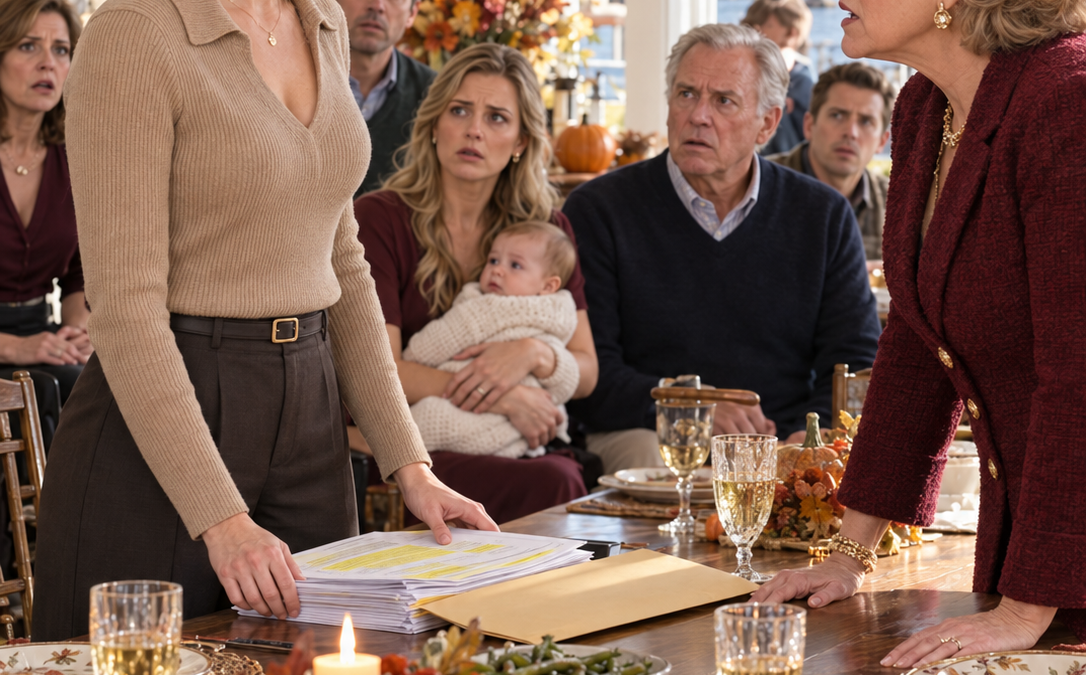
The table was a landscape of crumbs and water rings and half-empty glasses of cider.
Ruth stood at the head of the table.
She placed both hands flat on the surface.
“Before dessert, I think we need to address what has been going on in this family.”
Patrice was ready.
She had been rehearsing this performance for weeks. I could see it in the way she straightened her back and found her voice.
“Mom, if this is about Morgan, I don’t want to make a scene. But yes, my own daughter has abandoned us after everything we sacrificed.”
“Mom, stop.”
The room went still.
Nineteen people stopped moving.
A fork clinked against a plate somewhere.
And then even that stopped.
I opened the manila envelope.
Pulled out the bank statements.
Set the stack on the table.
Forty-eight pages printed on white paper, highlighted in yellow.
“For three years and two months, I sent you $2,000 every month. That’s $76,000 from the joint savings account, plus $12,000 through the secondary transfer to Dad’s personal account. $88,000 total.”
I opened the spreadsheet printout.
Green column: payments.
Red column: withdrawals.
“Forty-three percent of the money I sent went directly to Jolene or to Brett’s car dealership. Another 22% went to vacations, renovations, a Cape Cod spa trip, and personal spending.”
I pointed to a row highlighted in orange.
“The mortgage—the reason I started sending money in the first place—accounted for 31%.”
Nineteen people at the table.
Nobody spoke.
Uncle Paul put on his reading glasses and pulled a page toward him.
Aunt Linda leaned over his shoulder.
Patrice’s voice came out sharp and thin.
“Those are private family finances. You have no right.”
“They’re my bank statements. My name was on the account. My money.”
Jean stood up from his chair.
“You ungrateful—”
Ruth did not raise her voice.
“Jean. Sit down.”
Jean sat.
Ruth was 79 years old and 4 feet 11 inches tall.
And Jean sat down without finishing his sentence.
I looked at my mother.
My voice did not change pitch.
Did not waver.
“On October 19th, my wedding day, I called you. Mom, you said three words: ‘Don’t bother us.’ You were at Jolene’s gender reveal party, the one she scheduled on the same day as my wedding.”
I looked around the table.
“I’m not asking for the money back. I’m not suing anyone. I’m telling this family the truth because you’ve spent the last month telling everyone I abandoned you.”
I looked back at my mother.
“I didn’t abandon you. I stopped paying for the privilege of being ignored.”
The room was silent.
The kind of silence that has weight.
Aunt Linda spoke first.
Her voice was careful, the way people sound when they are trying very hard to be fair.
“Patrice, is this true? $88,000?”
My mother’s eyes moved around the room, searching for an ally. A soft face. Someone who would take her side.
She found none.
“It’s complicated. Morgan doesn’t understand—”
Ruth cut her off.
“What doesn’t she understand? I’m looking at the numbers. They add up.”
Cousin Marcus had the bank statements.
Now he was passing pages to Uncle Paul.
They circled the table like evidence in a trial nobody had called for.
Jolene was pale, holding Lily closer to her chest.
“I didn’t know it was Morgan’s money. Mom said it was from Dad’s retirement.”
Brett pushed his chair back.
He had invested $3,200 of my money into his car dealership.
He said he did not know.
His face said something different.
Jean tried once more.
“This is none of your business. She’s our daughter. That money is family money.”
Uncle Paul looked up from the statements.
“Jean, family money doesn’t get laundered through one person’s salary.”
Patrice started crying.
Performance tears.
The same ones she used when she wanted sympathy.
The same mechanism she had used on me for four years to keep the transfers flowing.
“You’re all turning against me. My own mother. My own family.”
Ruth looked at her daughter.
“Patrice, I asked you two weeks ago if Morgan was really helping you with money. You said a little. $88,000 is not a little.”
Patrice opened her mouth.
Closed it.
For five seconds, I counted.
She had nothing.
Her chin trembled.
Her eyes dropped to the table.
For one brief moment, she looked like someone who knew she had gone too far.
Then it passed.
She hardened.
The performance resumed.
“Morgan has always been dramatic. She’s doing this for attention.”
I stood up.
“I’m done.”
“Garrett, let’s go.”
We reached the front door.
Coats on.
Keys in hand.
Ruth followed us into the hallway.
She moved slowly but with purpose, the way she did everything.
She took my arm.
Her hand was small and warm and steady.
“I didn’t know. I swear I didn’t know.”
“I know, Grandma.”
“$88,000.”
She said it quietly, like she was still trying to make the number real.
“My granddaughter was eating hospital food to send her parents $88,000, and they couldn’t come to her wedding.”
She reached for her left hand.
Pulled off her wedding ring.
A thin gold band worn smooth by 57 years of wear.
Her husband had worked three jobs to buy it.
She pressed it into my palm.
Her fingers closed over mine.
“The people who choose you don’t need to be paid.”
I held the ring.
Garrett put his hand on my shoulder.
Through the closed door, I could hear the aftermath.
Patrice crying.
Jean arguing with Paul.
Jolene on the phone, probably calling Brett, who had left the house five minutes earlier.
Grandma Ruth looked at me for a long time.
Then she patted my hand and stepped back.
“Go home. Eat leftovers. Hold your husband. That’s what Thanksgiving is for.”
I put the ring in my coat pocket.
Garrett opened the door.
November air rushed in.
Cold.
Clean.
Unforgiving.
We walked to the truck.
I did not look back.
Three months later, in January 2025, Jean found a job.
Warehouse work at a distribution center in Westbrook.
$17.50 an hour.
Five days a week.
Six in the morning to 2:30 in the afternoon.
The kind of job he had called beneath him for four years.
Patrice got a part-time position at a floral shop in Scarboro.
Her first job in 14 years.
She arranged flowers and worked the register three days a week.
She did not post about it on social media.
The Blessed Life, Grateful Heart captions disappeared.
Jolene and Brett sold the Honda CR-V.
Replaced it with a used Corolla.
Six years old.
90,000 miles.
Brett’s dealership investment collapsed the same month.
Turns out $3,200 was not enough to prop up a failing franchise.
The investor group pulled out.
Brett went back to selling cars for someone else.
Extended family?
Eleven of the 19 people at Thanksgiving reached out to me.
Texts.
Calls.
A few handwritten cards.
Most said some version of the same thing:
We didn’t know.
We should have asked.
Aunt Linda sent flowers to the hospital with a note.
Your mother told us you were ungrateful. She was wrong.
Cousin Marcus set up a group text with me, Rachel, and Diane.
He named it Family That Actually Talks.
We texted every few days.
Recipes.
News articles.
Photos of nothing important.
The small currency of people who stay in touch because they want to.
Grandma Ruth called every Sunday afternoon.
She had started telling me stories about her own mother, a woman who raised five children in a farmhouse outside Bangor.
“Another woman who gave too much to people who didn’t deserve it,” Ruth said. “I didn’t realize I was watching the pattern repeat.”
When people ask me if I have forgiven my parents, I say the same thing every time.
When they’re ready to have a conversation—a real conversation, not a performance—I will listen.
The door is not locked.
It is closed.
And the difference matters.
Patrice has not called since Thanksgiving.
Not once.
Ruth says she is still telling a version of the story where she is the victim and I am the ungrateful daughter who turned her back on family.
But the audience has thinned.
Fewer people believe it now.
Jean called once in early December.
His voice was different.
Smaller.
Stripped of the authority he used to borrow from Patrice.
He said four words.
“I got a job.”
I said one word.
“Good.”
That was the whole conversation.
Eleven seconds.
The shortest call we have ever had.
But something in it was different.
Not an apology.
Not a request.
Just a fact delivered to the one person who would understand what it meant.
Jolene sent a photo of baby Lily in late January.
A text with no caption.
Just the image.
Round cheeks.
Dark hair.
Wrapped in a blanket I did not recognize.
Not the one I had crocheted.
Underneath, she wrote:
She has your eyes.
I saved the photo.
I did not respond.
My spreadsheet is closed now.
Green rows.
Red column.
Blue column.
Final total at the bottom:
$88,000.
I filed it in a folder on my laptop and have not opened it since November.
What I open now is my student loan balance.
Down $6,000 since October.
At this rate, $2,000 extra per month, I will be debt-free by 37 instead of 42.
Garrett and I eat dinner at our kitchen table most nights.
Real food.
Meals we cook together.
No cafeteria tray.
No midnight granola bars.
Ruth’s gold ring sits in a small wooden box on my nightstand.
I do not wear it.
But I see it every morning when I reach for my phone.
I spent four years trying to buy my way into my own family.
$88,000.
And the answer was always the same.
Not enough.
The people who love you do not keep a running tab.
And the people who keep a running tab were never loving you.
They were billing you.
My phone does not ding on the first of the month anymore.
The silence is the most expensive thing I have ever earned.
That is my story.
$88,000.
Three words on a wedding day.
And a grandmother’s gold ring that taught me what family actually costs.
If you know someone who needs to hear this, share this video.
Thank you for being here.
Drop a comment, hit subscribe, and I will see you in the next.








