My parents had me arrested at grandma’s funeral in front of 80 relatives. mom pointed at me. “she stole from a dying woman.” dad said, “handcuff her.” my sister livestreamed it. “say goodbye to your career.” at the station, the detective opened grandma’s file then froze. “your family doesn’t know you have this, do they?”
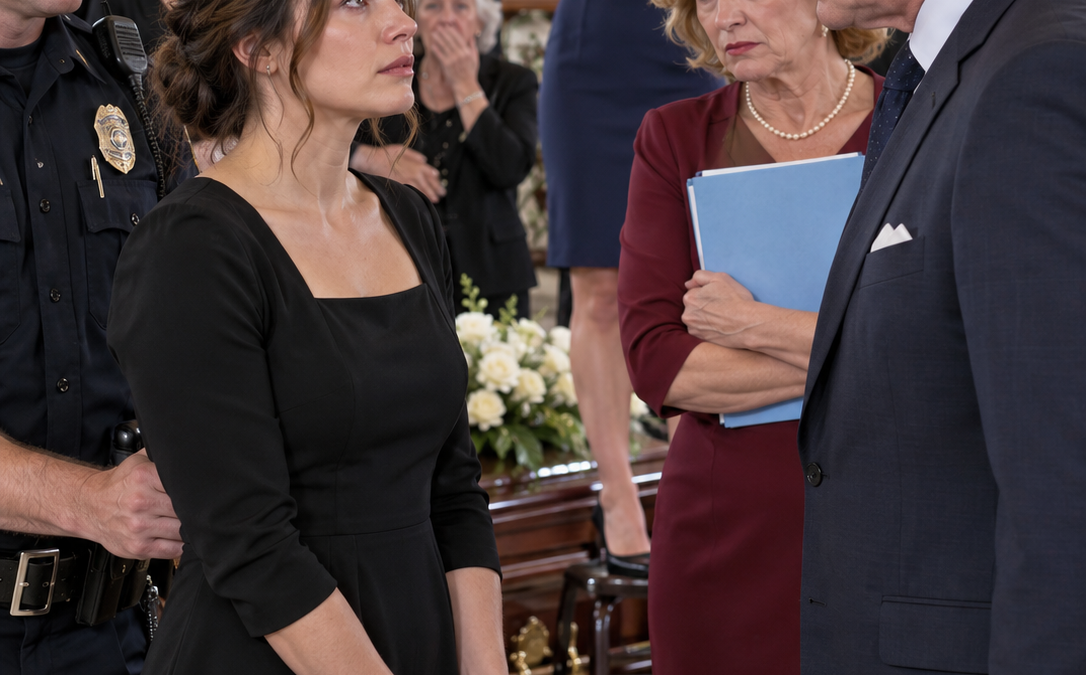
My name is Joyce Peterson. I am 38. I am a registered nurse. I washed my grandmother’s hair the morning she died.
Six days later, at her funeral, my mother pointed at me in front of 80 relatives.
“She stole from a dying woman. She’s a nurse. She knew exactly what she was doing. She took the wedding ring off her hand.”
My father turned to two officers he had called the day before.
“Handcuff her. Walk her past the casket. I want everyone to see.”
They did.
My sister climbed onto a chair, put my face in front of 12,000 people, and said, “Say goodbye to your career, Joyce. Grandma died ashamed of you.”
I didn’t argue. Silence was the only thing in that room they could not edit.
Three hours later, a detective opened a file with Grandma’s name on it, stopped on the second page, and looked at me like the room had changed sides.
“Your family doesn’t know you have this, do they?”
They thought that funeral was the ending. It was the first door Grandma left. They never saw it shut behind them.
Before I continue, if you find this story worth hearing, please take a moment to like and subscribe, but only if you genuinely connect with what I’m sharing. Drop a comment telling me where you’re watching from and what time it is there. I’d love to know.
I’m Joyce. To understand what was in that file, you need to see a kitchen table in Kettering, Ohio, and the woman who graded my homework at it.
My grandmother, Eleanor Peterson, taught math at Fairmont High School for 34 years. She retired the year I turned seven, which meant that by the time I was 14 and fighting with my parents about everything, she had all the time in the world to sit me down at her kitchen table on Ridgeway Road and hand me a pencil.
I’d give her the right answer. She’d give me half credit.
“Anybody can guess, Joyce. Show me how you got there.”
Next to my worksheet, she kept a green cloth notebook. She’d had it since 1960. Every dollar that came into or went out of that house went into that book in her teacher’s handwriting. $12.40 for groceries. A stamp. A furnace filter.
I thought it was the most boring object on earth.
At my parents’ house, I was the difficult one. My sister, Brittany, was three years older, prettier, easier, and she never once made my father repeat himself. I asked why. That was my crime.
By 14, I had a label, and labels in my family did not come off.
When Brittany got married in the summer of 2008, my parents paid for the wedding. $38,000. I was 20, working nights and taking nursing classes at Wright State, and I remember my mother telling me, not unkindly, that they’d done their part for me by letting me live at home through high school.
The next spring, my last year of tuition came up short. I told Grandma over coffee that I might have to sit out a semester. Two days later, the balance was paid.
She wouldn’t discuss it.
All she said was, “Don’t tell your father. He’ll make it about him.”
The summer I turned 16, she taught me to balance a checkbook at that same table. Not on a computer. In the book, with a pencil. She made me carry the ones out loud.
“Money doesn’t lie, Joyce,” she said. “People just stop reading it.”
I thought it was one more thing a retired teacher says. I wrote it down anyway because she was watching.
I graduated in 2010. Six years on a hospital floor, then Brightwater Home Health in 2016, where I became a certified geriatric care manager.
My job is the unglamorous side of aging: medications, appointments, the daughter in Arizona who wants updates, the son who doesn’t call. I handle 14 patients and their families, and most of them trust me with the parts of their lives they can’t hold anymore.
Which is why what happened later landed where it did.
In October 2023, Grandma was diagnosed with congestive heart failure. She was 87. My grandfather Walter had been gone 12 years, and she lived alone in the Ridgeway Road house with her book and her opinions.
When my grandfather died in 2011, my father had handled the funeral, the bank, the insurance, all of it, without being asked. I remember him at the kitchen table with Grandma’s checkbook open, saying, “This is what sons do, Mom.”
She’d let him.
A year later, she’d given him a card on her account for emergencies. I didn’t think about either of those things again until the numbers made me.
I started going three days a week. I set up her pill organizer. I drove her to cardiology. My parents lived 15 minutes away and came on Sundays, then every other Sunday, then when they could.
In February 2025, she asked me to sit down at the kitchen table. Same chair.
“I want someone who actually reads statements handling my bills,” she said. “That’s you. Norah Whitfield is drawing up the papers.”
I’d never heard the name. Norah was an elder-law attorney in Dayton.
On the 18th, in Norah’s office, Grandma signed a durable power of attorney naming me as her agent. I signed the acceptance. She opened a new account at Heartland Savings Bank for her care expenses and moved her savings into it.
At the bank, a woman named Gail slid a signature card across the desk for a safe-deposit box.
“For later,” Grandma said. “There’s nothing in it you need yet.”
I signed. I didn’t think about it again for over a year.
What I did think about, briefly, was that she’d asked her sister Lorraine to drive her to a few appointments that month instead of me. Lorraine was 83 and lived on a farm out in Xenia. I saw her beige Buick in Grandma’s driveway three times in February.
“Lorraine’s driving me Tuesday,” Grandma said when I offered. “You’ve got patients, and some things a sister should do.”
I assumed doctors.
I was wrong about one of them.
In March, my father called me for the first time in months. He didn’t say hello.
“Her card got declined at the pharmacy. Joyce, what did you do?”
“What card?”
He hung up.
After that, my mother started telling people I was “managing Grandma.” That was the word she used with the cousins at church, in the family group chat.
I wasn’t in “managing.”
As if I’d built a wall around an old woman and locked the gate.
Around the same time, I noticed Grandma wasn’t wearing her wedding ring. Sixty years on that hand. When I asked, she flexed her fingers and said they’d been swelling.
It was true.
It was also not the whole answer.
At Christmas, my mother stood in Grandma’s kitchen holding a business card she’d pulled from under a refrigerator magnet.
“Norah Whitfield, Elder Law. Who is this?”
“Grandma’s attorney,” I said. “Ask Grandma.”
She didn’t.
She wrote the name on the back of a Christmas card. I watched her do it and thought nothing of it.
By February 2026, Grandma was in hospice at home. A hospice aide named Renee Dubois came in the afternoons. I came every morning before work and every evening after.
On March 14th, my mother sat at the bedside for the first time in weeks. I was in the doorway.
“Mom,” she said, “when the time comes, the ring should stay in the family. Brittany has the girls.”
Grandma opened her eyes.
“It’s where it belongs.”
That was all.
Renee, at the foot of the bed, wrote something in her chart and didn’t look up.
On the 22nd, Grandma asked me to bring her the green notebook from the drawer. She held it on her lap for a while. Then she handed it to me.
“Keep this. It’s just my numbers.”
A week later, on a Sunday morning, I washed her hair in a basin of warm water. She closed her eyes when I rinsed it.
She died before noon.
Six days after that, my mother would tell two police officers what Grandma had said about that ring.
She would only change one word.
Grace Lutheran Church in Kettering seats about 200, and on Saturday, April 4th, it was nearly full. Grandma had been one of six Voss children, and the Voss family does not do small funerals. Add three decades of former students and you get 80 relatives at the luncheon alone.
My mother, who ran the church’s funeral committee, had set out the 80 folding chairs herself.
The service was at 11:00. The luncheon was in the fellowship hall at a quarter to 12. The casket stayed in the sanctuary because the family was doing a private burial at 3:00.
I’d brought a box of Grandma’s photo albums for the memory table. Her picture sat on an easel by the coffee urns.
Lorraine found me in the front pew before the service and gripped my hand.
“Ellie would have hated the lilies. Sit by me.”
My parents did not speak to me that morning. Not once.
My father shook hands at the door like a man greeting customers. My mother wept in the right places. Brittany stood near the hall entrance with her phone already out, and I remember thinking she was checking on her kids.
Two Kettering Police cruisers were already parked at the far end of the lot. I assumed they were there for the procession.
Around one, the pastor asked if the memory table could be cleared so the church ladies could set up dessert. I picked up the box of albums, put my tote bag on my shoulder, and started for the side door.
My father walked past me toward the parking lot.
He came back with the two officers.
He pointed.
“That’s her. There’s a sworn complaint on file since yesterday, and she’s carrying my mother’s property out right now.”
I stopped.
Eighty people stopped with me.
My mother stood up from the family table. She had a folder, light blue with a tab on the side. The tab said JOYCE in her handwriting.
She handed it to the older officer, whose name tag read Kesler.
Then she turned to the room, because the room was the point.
“She stole from a dying woman. She’s a nurse. She knew exactly what she was doing. She took the wedding ring off her hand.”
I set the box down.
I said the only true sentence I could fit into one breath.
“I hold her power of attorney.”
My father didn’t let it land.
“Forged. She’s a nurse. She knows how to handle a confused old woman. She was alone with my mother every day. Every single day. Nobody else was allowed.”
That last part was my mother’s line.
Actually, he’d borrowed it.
Officer Kesler opened the folder. I could see bank statements with yellow highlighter, a page with a notary stamp. He read for a moment, then looked at me and then at the 80 people watching him decide.
“Ma’am, I’m going to need you to come with us.”
“Handcuff her,” my father said. “Walk her past the casket. I want everyone to see.”
Kesler didn’t answer him.
He did take out the cuffs, because that’s the procedure.
And the walk to the cruiser went through the sanctuary because my father had told them where to park.
The metal was cold on wrists that still smelled like the shampoo I’d used on her a week before.
That’s when Brittany climbed onto a folding chair.
She held her phone up high, the way she does for open houses, and I heard her voice go bright and public.
“For everyone asking, yes, this is my sister. Yes, she’s a nurse. Not for long.”
She read a comment out loud. Then another. Then she pointed the phone straight down at my face.
“Say goodbye to your career, Joyce. Grandma died ashamed of you.”
Around the room, people did what people do.
Two of Grandma’s brothers turned toward the wall. A cousin covered her mouth. Most of them looked at the floor because the floor doesn’t ask you to choose.
One person didn’t.
My cousin Meredith, who runs scheduling at a hospital and has never once believed a story on its first telling, stood by the pillar near the door. Her phone was up, too.
It was not pointed at me.
It was pointed at Brittany.
I didn’t understand why until three weeks later.
As Kesler steered me toward the sanctuary doors, my father leaned close to him and said something quiet.
Quiet for him.
I heard it.
So did the microphone on a phone held high by a woman standing on a chair 10 feet away.
“Cuff her before she gets to that lawyer of hers.”
Then we were in the sanctuary, and it was cool and dim, and my grandmother was there.
The casket was open. Her hands were folded.
No ring.
I’d known that for a year, and it still hit me in the ribs because now 80 people had seen a bare hand and one story to explain it.
Lorraine followed us all the way to the front steps. Eighty-four years old, in her good navy coat.
“I’m her great-aunt,” she said to the officers. “Where are you taking her?”
Then, to me, lower: “Joyce, don’t say anything until you’ve slept.”
The cruiser door shut.
Through the window, I could see the church steps, Brittany still filming, my mother holding a cousin who was holding her, and my father back inside already, shaking the pastor’s hand like a man who had just finished a job.
The Kettering Police Station is a low brick building that smells like floor wax. They put me in a room with a table bolted to the floor and gave me a paper cup of water I didn’t drink.
Someone took my information.
Nobody said the word charged.
Nobody said the word released either.
They took my fingerprints on a glass scanner and photographed me against a height chart. A young officer named Loots asked if I had any medical conditions they should know about.
I told her I was a nurse.
She wrote that down without looking up.
The way you’d note an allergy.
I was still in the black dress.
Officer Kesler came back once, stood in the doorway, and didn’t quite meet my eyes.
“For what it’s worth, I don’t like doing that at a church. Detective from the Elder Crimes Unit is on her way in. It’s her case now.”
I thought about Lorraine on the church steps.
Don’t say anything until you’ve slept.
So I sat, and I didn’t.
The detective’s name was Carol Hensley. Mid-50s, reading glasses pushed up into gray hair, the kind of tired that comes from 11 years of listening to families lie about money.
She carried a laptop under one arm and a thin folder in her other hand.
The folder was not my mother’s.
The tab was yellow, not blue, and the paper looked older.
She sat down, opened the laptop, and typed.
I watched her stop.
She read something on the screen, then opened the paper folder and turned to the second page, and her whole posture changed.
Not dramatic. Just a woman settling into a chair she hadn’t expected to be comfortable.
“You’re the agent on Eleanor Peterson’s power of attorney.”
“Yes.”
“Notarized February of last year. The 18th.”
“Yes.”
“Who drafted it?”
“Norah Whitfield.”
She closed the folder halfway, the way you close a door when you don’t want anyone in the hall to see through it.
“Your family doesn’t know you have this, do they?”
“Have what?”
“A power of attorney that’s already on file with this department,” she said. “Attached to something your grandmother filed herself 14 months ago.”
I asked what my grandmother had filed.
She shook her head before I finished the question.
“I can’t show you what’s in here. I can tell you the transfers your mother reported were made by someone your grandmother authorized in writing, in front of a notary, with a physician’s evaluation attached. That’s not theft. That’s paperwork.”
I don’t remember what my face did.
I remember the water cup, and that my hands were finally steady enough to want it.
“Then why am I here?”
“Because there’s a sworn statement about a ring, and because I don’t have your grandmother’s full bank records yet. And because a complaint doesn’t close itself.”
She stood up.
“You’re being released pending investigation. No charges are being filed today. Don’t leave the county. Don’t contact the complainants. And if I were you, I’d start with whoever drove your grandmother to her appointments last February.”
She was out the door before I could ask how she knew there was a whoever.
They let me go a little after seven.
My car was still at the church. I stood in the station lot and called a ride, and while I waited, I turned my phone back on.
Sixty-three messages.
Four missed calls from Denise Albright, my director of nursing.
Nothing from my parents.
Nothing from Brittany.
Denise’s last text was two lines.
Call me tonight. Not tomorrow. Tonight.
I opened Instagram instead.
Brittany’s live video was already sitting on her profile as a replay. Twenty-two minutes. The view count had a comma in it.
I didn’t call Denise that night.
I watched the video all 22 minutes.
And at minute 19, my father said something I had not heard clearly in the room.
I played it three times.
“Cuff her before she gets to that lawyer of hers.”
Grandma’s lawyer.
Norah.
The name my mother had written on a Christmas card four months earlier and then apparently kept.
I didn’t know yet what that sentence would come to mean.
I only knew it was strange.
He’d said it like a man who knew the clock was running.
By Sunday morning, the video didn’t matter anymore because it had children.
Someone had clipped 40 seconds, just the handcuffs and Brittany’s voice, and posted it to a Facebook group called Kettering Community Watch.
Nine thousand members.
The caption said: Local nurse arrested at funeral for stealing from grandmother.
The comments did the rest.
She works for Brightwater.
I’ve seen her at my mom’s.
They should pull her license.
Poor family.
Brittany deleted the original at eight that night.
By then, it was in six other places.
And by then, though I wouldn’t learn it for weeks, someone who had stood in that fellowship hall had already saved a copy she didn’t know about.
Monday morning, Denise met me in the Brightwater lobby before I could reach my desk.
She walked me into her office and closed the door.
Denise has been a nurse for 30 years. She’s not a hugger. She sat on the edge of her desk instead of behind it.
“Five families called over the weekend. Five. I’ve got a corporate compliance officer asking me why our care manager is trending in a crime group.”
“It’s not—”
“I know it’s not.”
She held up a hand.
“I’ve read your charting for 10 years, Joyce. I’m not building a case against you. I’m building a file for you. But I have to put you on administrative leave. Paid. Until there’s something on paper from the police. That’s not my call. It’s the company’s.”
I put my badge on her desk.
She didn’t pick it up.
Then her phone buzzed on speaker because she’d forgotten to take it off, and I heard Kevin Brennan’s voice.
His mother, Ida, is 91. I’ve managed her care for four years. I know which pharmacy she likes and that she won’t take her evening pills unless the TV is off.
I’m sure she’s fine.
Kevin was saying, “I just can’t have my mother’s name next to that video.”
Denise reassigned my 14 patients that afternoon.
She did it herself, one at a time, and she called me afterward to tell me who had each one because she knew I’d want to know.
On Tuesday, I drove to Ridgeway Road.
Grandma’s mail had been piling up since the hospice weeks, and I had the key I’d used every morning for two years.
The key didn’t turn.
The deadbolt was new. Brass, still shiny, with the hardware-store sticker not quite scraped off.
Taped inside the storm door was an index card in my father’s block capitals.
PROPERTY OF THE ESTATE OF ELEANOR PETERSON.
NO ENTRY WITHOUT AUTHORIZATION.
D. PETERSON.
I stood on the porch where I’d stood a thousand times with a pill organizer in my hand, and I looked through the front window at her chair.
And I understood something about the folder my mother had handed Officer Kesler.
The bank statements in it had been highlighted in yellow.
Grandma’s old account statements still came to this house by mail because she never trusted the online ones.
My mother had been in here.
She’d gone through the pile.
She’d found the February transfers, and she’d built a story out of the pages that showed money leaving and left out the page that showed where it went.
I didn’t try the back door.
I got in my car, took a photo of the index card, and sent it to Norah with one line.
They’ve changed the locks.
Her reply came back in four minutes.
Don’t go back. Document everything. He can’t do that. But let’s win it on paper, not on the porch.
I drove home.
I didn’t get to sit in her chair.
That was a small loss, and I put it with the others.
Ten days later, a letter arrived from the Ohio Board of Nursing.
Someone had filed a complaint.
The complainant’s name was withheld.
The wording was my mother’s.
The family, meanwhile, had a group chat. Forty-some people, mostly Voss cousins and aunts.
I wasn’t in it.
Lorraine was.
And she’d started forwarding me screenshots without comment.
My mother’s message was long. I’ll give you the middle of it.
We did not want to do this at Mom’s funeral, but Joyce left us no choice. Mom was confused at the end. Joyce knew that. That’s the part I can’t forgive. Please pray for her.
Thirty-one hearts under it by the time Lorraine sent it to me.
I read it at my kitchen table with the green notebook sitting closed beside my coffee.
I hadn’t opened it.
I’d carried it home from the station in my tote bag and set it down and left it there because it was the last thing she’d handed me, and I wasn’t ready for it to be an ordinary object.
Lorraine called that evening.
“Have you read her numbers yet?”
“Not yet.”
She asked it like a woman who already knew the answer to the problem and was waiting for me to show my work.
On Friday, April 10th, an envelope came from Whitfield Elder Law.
Inside was a short letter and a court filing.
Norah had filed Grandma’s will with Montgomery County Probate Court.
The will was dated February 18th, 2025.
The same day as the power of attorney.
The same day as the safe-deposit-box card.
The named executor was Joyce A. Peterson.
The letter said Grandma had asked that it be sent only after her death and that I should call Norah’s office before discussing the estate with any family member.
There would be an informational meeting for the family on April 24th.
The same notice had gone to my parents and to Brittany.
I sat with that for a while, and the funeral rearranged itself in my head.
They hadn’t needed me arrested because of the money.
They’d needed me under investigation before anyone read this.
A named executor with an open criminal complaint is an executor you can argue about.
My phone buzzed.
My father.
First message since the church.
Whatever you got her to sign, it won’t hold. We’ve been to a lawyer, too.
I put the letter down beside the notebook.
Two things my grandmother had left me.
I had opened neither.
That night, I opened the one she had handed me herself.
If you’ve ever had a family decide who you were before you got to say a single word, I’d genuinely like to hear about it in the comments. Not the whole story. If you don’t want to share it, just the moment you realized the verdict was already in.
The first page said 1960.
Rent, $22.
Milk.
Gas.
A church envelope.
Her handwriting was the same on page one as it was on the pill schedule she’d corrected in my hand last year.
Sixty-six years of a woman keeping track of what she owed and what she was owed, in blue ink, then black, then blue again.
I turned pages for an hour.
I wasn’t looking for anything.
I was looking for her.
I found her on a page from May 2009.
J — tuition, $6,200. Don’t tell Dale.
I hadn’t cried at the funeral.
I hadn’t cried in the cruiser, or the station, or Denise’s office.
I cried at that.
Not the amount.
The margin note.
She’d written me into the book the same way she wrote furnace filters, and she’d underlined the part about my father.
Then I reached January 2022.
The handwriting didn’t change.
The entries did.
D card — $2,000.
February.
D card — $2,500.
March.
D card — $2,900.
D card every month.
I counted them twice.
Thirty-six lines in three years, most of them between $1,200 and $2,400, in the same neat column where she’d once recorded a stamp.
She never wrote a word beside them.
No complaint.
No question mark.
Just the fact, month after month, in the hand of a woman who had graded 34 years of teenagers and knew exactly what a pattern looked like.
In November 2024, one line broke the rhythm.
Statements J printed — doesn’t match.
I remembered that Thanksgiving weekend.
She’d asked me to print six months of bank statements from her online account because the print was too small on the screen.
I’d printed them.
I’d handed them over.
She’d said, “I’ll do my own math.”
And I’d thought it was a joke.
She hadn’t been joking.
The last D card was January 2025.
Below it, in a slightly heavier hand, she’d added the whole column.
$61,000.
Enough.
She’d underlined enough once.
I sat with the pen mark for a long time.
My father’s phone call.
Her card got declined at the pharmacy. What did you do?
He’d had a card on her account.
He’d been using it for three years.
She’d caught him.
She’d added it up.
She’d closed the door.
And she’d never once said his name out loud to me.
She’d said his name here.
Three pages later, February 2025 had three lines in a row.
Feb. 4 — NW — $350.
Norah Whitfield. The attorney.
Feb. 11 — Dr. H — $40 copay.
I didn’t know a Dr. H.
And then one I could not explain at all.
Feb. 12 — L drove — $0.
Nothing bought.
Nothing paid.
Lorraine had driven her somewhere, and Grandma had thought it worth writing down that the trip had cost nothing.
I closed the book to think.
That’s when I noticed the back cover.
It was thicker than the front.
Something under the cloth.
I’d carried this notebook for two weeks and never pressed on it.
I peeled the lining back with a butter knife.
Taped to the board was a small flat key, the number 218 stamped into it, and a folded scrap of paper in her hand.
Heartland. You’re on the box. E for later.
She’d said, “There’s nothing in it you need yet.”
I didn’t go to the bank on Monday.
On Monday, Detective Hensley called me in again.
And this time she wanted the notebook.
I brought Norah with me.
She isn’t a criminal attorney and said so twice, but I wanted a witness who’d known Grandma, and she’d agreed the moment I told her about the key.
We met in the station lot beforehand.
Norah is 60, wears her hair in a gray braid, and talks the way Grandma did, in complete sentences with the verbs in the right place.
“She never told me what was in that box,” Norah said. “She told me there was one and that you were on it, and that I was not to mention it to you unless you asked. I’ve had clients hide things from their children before. I’ve never had one hide something from the child she was protecting.”
“Why would she do that?”
“Because you’d have opened it while she was alive.”
Norah looked at the notebook under my arm.
“And then you’d have had to look at her knowing.”
Hensley read the photocopies at the steel table.
She stopped at the page that said enough and stayed there.
“Your grandmother tallied this herself.”
“That’s her hand.”
“People who are confused don’t add columns.”
She turned the page.
“I’ve subpoenaed the full account history. Card transactions, transfer authorizations, all of it. Until it comes back, the complaint stays open on paper. I want you to understand that’s a formality, not a suspicion.”
Norah made a note in pencil.
I asked the question I’d carried in.
“The thing she filed. What is it?”
“I can’t tell you that.”
Hensley set the copy down and looked at me over her glasses.
“But I can ask you something. Who drove your grandmother to her appointments last February?”
“My great-aunt Lorraine.”
She nodded slowly, like she’d been waiting 11 days to hear that name.
“Then she’s the one you should be talking to. Not me.”
Xenia is 18 miles east of Kettering. Thirty minutes if you don’t hit the light at the bypass.
I drove out on Saturday morning with the notebook on the passenger seat.
Lorraine’s farm is 120 acres. Her late husband’s family worked it for three generations, and now her son runs it while she runs him.
She was on the porch when I pulled in.
Eighty-four years old.
Same navy coat from the funeral.
Arms folded.
“You took your time.”
“You told me to sleep first. I did.”
She held the door.
“Coffee’s on.”
Her kitchen is where Grandma’s would have gone if it had been out in the country.
The same yellow light.
The same wall calendar by the phone, except hers was last year’s and she’d left it up.
She put a mug in front of me, then set the calendar down beside it and folded it open to February 2025.
Three dates were circled in red pen.
The 4th.
The 11th.
The 12th.
“Your grandmother made me promise to wait until you asked,” she said. “She was very specific. If Joyce comes asking, tell her. If she doesn’t, she doesn’t need it.”
Lorraine sat down across from me.
“You came.”
I put the notebook on the table and opened it to the three lines.
She read them without her glasses.
She’d known they were there.
“The first one was the lawyer,” she said. “The second was the doctor. The third one, honey, is the one your parents are going to hate.”
She told it in order because that’s how the Voss sisters told everything.
February 4th. A Tuesday.
She’d picked Ellie up at nine with a manila envelope on her lap.
The bank statements I’d printed at Thanksgiving.
The green notebook.
Norah Whitfield had spent an hour with her.
And when Grandma came out, she’d said one thing in the car.
“She says I’m not crazy, and she says I should get that in writing from someone with a medical degree.”
February 11th.
Dr. Susan Halverson, a geriatrician in Centerville.
A full cognitive evaluation.
“Ellie said if she was going to be called senile, she wanted it on paper that she wasn’t before anyone got the chance.”
I thought about my mother’s message in the group chat.
Mom was confused at the end.
Grandma had beaten her to it by a year.
“And the 12th?”
Lorraine turned her mug a quarter turn on the table.
“Montgomery County Job and Family Services. The building on Edwin C. Moses. Adult Protective Services is on the second floor. She sat in a plastic chair for two hours with a number in her hand. And when they called her, she filed a report on Dale.”
I didn’t say anything.
There wasn’t a version of that sentence I’d been ready for.
“She wrote it herself. Name, dates, the card, the amounts. She brought the copies from your book. The woman at the counter asked if she wanted an investigation opened, and Ellie said…”
Lorraine stopped.
For the first time, her voice was not steady.
“She said, ‘I don’t want him arrested. He’s my son. I want it written down that I knew, so nobody can ever say my granddaughter did it.’”
She wore her blue church suit, Lorraine said. The one from Walter’s funeral.
“She said if she was going to accuse her own son of something, she’d do it dressed.”
Lorraine had asked her in the car afterward if she felt better.
Grandma had said no.
She said she felt finished.
The trip had cost nothing.
So she’d written zero.
And she’d written it down because a day like that belonged in the book.
I asked the only question I had left.
“Why didn’t she tell me?”
Lorraine put her cup down.
“Because she knew what you’d do with it.”
I waited.
“You’d have gone to your father. You’d have asked him to explain it because that’s what you do. You ask why. And he’d have told the whole family you were turning his mother against him. And Ellie would have been 88 with a bad heart, trying to stand between you and them.”
Lorraine shook her head.
“She didn’t want you to carry it while she was alive. She wanted it to carry you after.”
The coffee had gone cold.
Neither of us touched it.
“She wasn’t a fortune teller, Joyce. She thought a report in a drawer was enough. She thought they’d try it at a lawyer’s office or at the reading, and somebody official would open a file and that would be that.”
Lorraine looked out the window.
“She planned for a lie. She didn’t plan for a show.”
That was the part that undid me.
Not that Grandma had known.
That she’d built a wall exactly one lie high, and my parents had brought a crowd.
I didn’t fall apart.
I sat in a farmhouse kitchen and held a green notebook and understood that the last competent act of my grandmother’s life had been on my behalf, and that it had a hole in it I was going to have to fill myself.
Lorraine let the silence sit as long as it needed to.
Then she reached over and tapped the calendar.
The current one on the wall.
“Memorial Day weekend. The reunion’s here this year. Same crowd as the funeral. Same 80, give or take a baby.”
“I wasn’t planning to come.”
“Dale already asked me for the microphone.”
She said it flat.
“Bring whatever she left you. All of it. They were all there last time.”
Heartland Savings Bank has a branch on Dorothy Lane with a safe-deposit room the size of a walk-in closet.
I went on a Wednesday afternoon with the key in my pocket and my driver’s license in my hand.
Gail remembered me.
She’d been the one who slid the card across the desk 14 months earlier.
“Your grandmother said you’d come eventually,” she said, pulling the file. “She said not to rush you.”
She confirmed I was on the box as co-renter from February 18th, 2025.
Then she printed the access log because I asked and because I had learned in three weeks to ask for paper.
One line.
One visit.
Eleanor Peterson — February 18th, 2025.
Nobody since.
“She came in alone that day,” Gail said. “Wouldn’t let me carry the bag.”
The box was 218.
Bottom row.
Gail turned her key.
I turned mine.
Then she left me in the small room with the door open.
Inside was a dark blue velvet box, a thick envelope, and a folder clipped shut.
I opened the velvet box first because I was afraid to.
The ring was there.
Thin gold, worn flat on one side from 60 years of a hand that graded papers.
It had been sitting in a steel drawer since the winter before last.
My mother had sworn to the police it left Grandma’s hand in March.
The folder held copies: the power of attorney, the will, a two-page letter on a doctor’s stationery I didn’t read yet.
The envelope had my name on it.
Two pages.
Lined paper.
The teacher’s hand.
Dated February 18th, 2025.
I’ll give you what she wrote, and I’ll give it to you the way she wrote it, which is to say without decoration.
She said she knew her son had been taking from her account for three years, and that she’d added it up, and that she could not bring herself to have him charged.
She said she’d filed a report with the county instead, so that the fact of it existed somewhere she didn’t control.
She said she’d done that for me because she’d watched my parents decide who I was since I was 14, and she would not have them decide it with money after she was gone.
They will say you took it, she wrote.
I have made sure that a stranger with a badge can say you didn’t.
She said the ring was mine, not because it was worth anything, but because it should stay on a hand that had held hers.
And then she wrote this:
You can burn the notebook. You can hand it to the police. You can give the ring to your sister if that buys you peace. You can do nothing at all. I trust the girl who showed her work. Being loved by me never required you to be quiet. Don’t let it require that from anyone else.
I didn’t cry in the bank.
I’d cried at the tuition line, and I think she’d have said that was the right place for it.
I put the ring on.
It fit.
I took it off and put it in my pocket because I was not going to let anyone film it on my hand before they had heard the rest.
Then I sat in my car in the Heartland lot and made three calls.
Norah first.
“I’m ready to read the will now.”
Denise second.
“I have something for the file.”
And a text to Lorraine.
I’m coming to the reunion. Save me a chair by you.
Norah called back before I’d started the car.
“Joyce, there’s a line in the will about your father. You should hear it before he does.”
The reading was on Friday the 24th in Norah’s conference room, the one with the glass wall.
Twelve people.
My parents.
Brittany and her husband, Tyler.
Lorraine.
Two of Grandma’s brothers.
Me.
And a man in a gray suit named Curtis Blanchard, whom my father introduced as “our attorney” in a voice meant for a bigger room.
Blanchard had already filed an objection to my appointment as executor four days earlier.
Grounds: a pending criminal investigation.
He had attached the Community Watch clip as an exhibit.
Norah read the will the way Grandma had written it.
Plainly.
The house on Ridgeway Road was to be sold.
Half the proceeds to me.
A quarter to Brittany.
A quarter to establish a scholarship at Fairmont High School for a graduating senior going into teaching, to be called the Show Your Work Scholarship.
Whatever remained in the care account would go into the estate.
Then Norah turned the page and read a sentence I’d heard once already over the phone.
“I acknowledge that my son, Dale Peterson, has received from me during my lifetime the sum of $61,000, which I intend as his full share of my estate.”
Nobody moved.
My father’s face did something I’d seen at the church.
It went still.
Then it went looking for someone to blame.
“Sixty-one thousand what? What is that supposed to mean?”
“I believe your mother expected you to know,” Norah said.
My mother found her voice first.
“She was confused. Everybody knows she was confused at the end.”
Norah didn’t argue.
She slid a two-page document across the table.
Letterhead from a geriatric practice in Centerville.
Dr. Susan Halverson.
A full cognitive evaluation dated February 11th, 2025, one week before the will.
Every score in the normal range.
A signed opinion that Eleanor Peterson understood the nature and extent of her property and the natural objects of her bounty.
“Your mother anticipated that concern,” Norah said.
Blanchard asked for a 10-minute break.
My father was gone before it ended.
My mother stayed long enough to lean across the table, close enough that I could smell her church perfume.
“This isn’t over. The police still have a file on her.”
She was right about the file.
She was wrong about whose name was in it.
What followed was three weeks of a family fighting on two fronts at once, and I was only visible on one of them.
On the visible front, my mother organized a prayer chain at Grace Lutheran.
For me.
My name went out on the Wednesday email to 400 households under FAMILY IN CRISIS.
Brittany posted a story with a photo of Grandma’s house and the caption: Some people would sue their own parents over a dead woman’s house.
Blanchard’s objection sat in the probate file with a Facebook clip stapled to it.
I didn’t answer any of it.
I did three things instead.
I sent Detective Hensley a copy of Grandma’s letter and the bank’s access log for box 218, along with Gail’s name.
I sent Denise the will, the power of attorney, and Dr. Halverson’s evaluation for the file she was building.
And I texted Meredith, my cousin, the one by the pillar.
Her reply came in under a minute.
I have all 22 minutes. I screen-recorded her replay Saturday night before she pulled it. I also have my own video. I was recording Brittany, not you. I wanted her face when she said it.
Then a second text.
Do you want me to post it?
I looked at that question for a long time.
No, I wrote back.
Not yet.
Not online.
I wanted the same 80 people.
Same room, or close enough.
Renee Dubois, the hospice aide, called me on the last day of April.
Norah had reached out to her.
Renee had been at the foot of Grandma’s bed on March 14th and had written a note in her chart that afternoon, the way good aides do when a family member says something that might matter later.
She’d signed a statement for Norah.
One paragraph.
What my mother had asked.
What Grandma had answered.
Four words.
It’s where it belongs.
Not Joyce has it.
Not Joyce took it.
Renee had been standing four feet away.
Four words.
And a woman I’d worked beside for six weeks had put her name under them.
I thanked her.
She said, “I write down what people say, Joyce. That’s the whole job.”
It was the second time in a month someone outside my family had described my grandmother without meaning to.
On Friday, May 8th, Detective Hensley called.
The subpoena had come back.
Every transfer in February 2025 had been executed under the durable power of attorney on file, into an account titled in Grandma’s name with mine as agent.
Thirty-six debit-card transactions between January 2022 and January 2025, all on a supplemental card issued to Dale Peterson.
The safe-deposit access log matched what I’d sent her.
“The theft complaint is closed. Unfounded. No charges.”
She paused.
“I’ve notified the complainant, as I’m required to.”
“My mother.”
“The complainant.”
Another pause.
“I can’t discuss whether anyone else is being looked at. That’s not your problem to carry.”
Norah requested a copy of the incident report through public records on Monday.
It arrived Wednesday.
The disposition line, in the flat language of a police form, read:
UNFOUNDED. TRANSFERS EXECUTED UNDER VALID DURABLE POA ON FILE. NO CHARGES.
She sent a copy to the Board of Nursing the same day with the power of attorney and Dr. Halverson’s evaluation attached.
On Thursday, May 14th, Denise called me into the same office and slid my badge back across the desk.
“Corporate reviewed the report. You’re reinstated. Monday.”
She let herself smile, which for Denise is a whole event.
“Kevin Brennan called this morning. His mother’s been asking for you by name for a month. He wants to know if you’ll take her back.”
I said yes.
Then I opened the family group chat, which Lorraine had finally added me to, and read what my father had posted an hour earlier.
Family meeting at Lorraine’s Saturday. Everyone. We’re settling this.
He didn’t know Lorraine had already saved me a chair.
He didn’t know the complaint was closed because the only person Hensley had called was my mother, and my mother had not told him.
I worked that out later.
Not then.
At the time, I only saw a man choosing the same room twice.
Uncle Ray called me that evening.
Grandma’s brother.
Eighty-seven.
A retired pipe fitter.
A man who’d been at the church and had turned toward the wall when the cuffs came out.
“Your father’s got everyone thinking there’s a vote Saturday,” he said. “About the house. About you.”
“I know.”
“Is it true what he’s saying?”
I could have told him everything.
I had it all in a bag by the door.
Instead, I said the thing Grandma would have said.
“Come Saturday, Uncle Ray. Sit close. I’ll show you the work.”
He was quiet for a second.
Then he laughed.
One short bark.
“That’s Ellie talking.”
“It’s the only way I know how to do it.”
Here is what he did not know on the Thursday before Memorial Day weekend.
There was a box and a letter and an access log.
There was a signed statement from a hospice aide.
There was a police report with the word unfounded on it.
And there were 22 minutes of video he thought had been deleted.
He’d picked the room again.
Eighty people.
Same faces.
This time he did not know who else had been invited to speak.
Before Saturday plays out, I want to know what you think. Of the three of them—my father, my mother, my sister—which one cracks first? Put it in the comments before you keep listening. I’ll tell you if you were right.
The Voss family reunion has been held on the Saturday before Memorial Day for as long as anyone can remember.
And this year it was Lorraine’s turn to host.
That meant the long field behind her farmhouse, three rows of picnic tables end to end under the walnut trees, and a folding table for the potluck that ran the length of the barn wall.
I got there at noon.
I’d counted on the drive the way I count everything now.
Eighty-two people if the babies were included.
The same faces as the fellowship hall, minus the flowers, plus potato salad.
Some of them looked at me and then quickly at something else.
A few nodded.
One of Grandma’s brothers, Uncle Ray, who is 87 and has never lowered his voice for anyone, walked over and shook my hand in front of everybody and said nothing at all.
And that was its own kind of sentence.
Lorraine had saved me the chair at the head of the first table, right beside hers.
I put my tote bag on the bench between us.
Inside it, in the order I’d need them: the police report, the access log, Renee’s statement, the velvet box, and the green notebook.
Meredith sat two seats down with her laptop bag at her feet.
My parents arrived at 12:30.
My mother carried a stack of photocopies against her chest.
Light blue folders.
She’d made 20 of them.
Brittany came behind her with Tyler and the girls, phone in her hand, not yet raised.
My father went straight to Lorraine’s son and asked for the wireless microphone they used for the blessing.
He got it.
He said a few words about his mother first.
I’ll give him that.
He said she’d been the smartest person he’d ever known and that he’d never once won an argument with her.
People laughed because it was true.
Then he turned toward my end of the table.
“Before we eat, this family needs to settle something. Most of you were at the church. You saw what happened. What you didn’t see is that there’s an open police investigation into Joyce, and my mother’s estate is tied up in it. And I’m asking every one of you to stand with us.”
My mother started handing out the folders.
Bank statements.
The same yellow highlighter.
Her sworn statement about the ring, photocopied with her signature at the bottom.
She didn’t say a word while she did it.
I noticed that later.
At the time, I only noticed that my father was the one talking.
And my father sounded very sure.
“The police have her file,” he said. “Ask her why she hasn’t been cleared.”
So I stood up and answered him.
And I did it with one sheet of paper.
I took the incident report out of my bag, unfolded it, and set it on the picnic table in front of Uncle Ray.
Then I read the one line that mattered in the flat voice you use for a chart.
“Disposition: unfounded. Transfers executed under valid durable POA on file. No charges.”
I handed it to Uncle Ray.
He put on his glasses and read it out loud, slower than I had, so the far tables could hear.
“Kettering Police Department. Closed May 8th.”
My father turned his head.
Not toward me.
Toward my mother.
“You said they were still investigating.”
She didn’t answer him.
She was holding the last two folders against her chest, and she kept holding them.
It was a small thing.
A husband asking a wife a question in front of 80 people and getting nothing back.
I don’t think most of the field caught it.
I did.
It was the first time in my life I’d seen the two of them not on the same page, and it had taken a police form to do it.
My mother recovered fast.
She always has.
“That report says nothing about the ring.”
Her voice went up to reach the back tables the way it had reached them at the church.
“Whatever they decided about the money, she took the ring. I was there. Mom told me.”
I reached into the bag and took out the velvet box.
I opened it and set the ring on the picnic table beside the report.
Thin gold.
Worn flat on one side.
It caught the light through the walnut leaves, and about 30 people leaned forward at once.
Beside it, I laid the access log from Heartland Savings Bank.
“Box 218,” I said. “One entry. Eleanor Peterson, February 18th, 2025. Nobody opened it again until I did last month. The bank keeps the log. It’s not mine.”
Lorraine stood up then and unfolded a single sheet and put on her reading glasses.
“This is a signed statement from Renee Dubois, Ellie’s hospice aide. She was in the room on March 14th when Carolyn asked about the ring.”
Lorraine read it word for word because that’s how you read a thing that matters.
“Mrs. Peterson opened her eyes and said, ‘It’s where it belongs.’ She did not say Joyce had it. She did not say Joyce took it. I was standing at the foot of the bed.”
Lorraine lowered the paper.
“Carolyn, you told the police Ellie said Joyce took it. Renee says she didn’t. Which of you was closer to the bed?”
My mother did not look at the ring.
She didn’t look at Lorraine either.
She looked at my father.
That was when I opened the notebook.
I didn’t explain it.
I’d decided that on the drive.
Explaining is what you do when you need to be believed.
And I wasn’t there to be believed.
I was there to read.
“January 2022,” I said. “D card, $1,200.”
I turned the page.
“March 2022. D card, $2,100. August 2022. D card, $1,500.”
I read six of them, one at a time, and the field got quiet in the particular way a crowd does when it starts doing arithmetic on its own.
Then I turned to the last one.
“January 2025. D card, $1,500.”
I put my finger under the total.
“$61,000.”
And then one word in her hand, underlined once.
Enough.
I passed the book to Lorraine, open to February.
She held it up so the near tables could see the handwriting, and she read the three lines.
The lawyer.
The doctor.
And the one that had cost nothing.
“February 12th. L drove. $0.”
She closed the book on her finger.
“I drove her to Job and Family Services on Edwin C. Moses. She sat two hours in a plastic chair at Adult Protective Services to write your name down, Dale. Not to have you arrested. She wouldn’t do that to you. To make sure they never could arrest her.”
She nodded at me.
“That report was in the police computer 14 months before you walked two officers into a church luncheon. The detective found it the same afternoon.”
Nobody at any of the three tables touched a plate.
My father found his voice.
And it was the one from the kitchen when I was 14.
“She was confused when she wrote that. My mother was 88 years old and she was confused, and Joyce was in that house every day feeding her—”
Meredith opened her laptop.
She’d queued it up before she sat down.
She turned the screen toward the tables, turned the volume all the way up, and pressed play.
It was the church fellowship hall.
The coffee urns.
My mother’s voice, clear as glass.
“She stole from a dying woman.”
Then Brittany’s, brighter and closer because it was her phone.
“Say goodbye to your career, Joyce.”
And then, at 19 minutes and four seconds, my father.
Lower.
Meant for Officer Kesler and no one else.
“Cuff her before she gets to that lawyer of hers.”
Meredith paused it there.
My father’s face on the screen turned toward the officer.
Sixty-odd people looking at the same frozen frame.
Across the second table, a cousin I’d babysat in 2003 said, “Oh,” very quietly.
The way you do when a math problem finally comes out.
Somebody’s chair scraped.
Nobody stood.
I asked him one question.
It was the only thing I said to him all day, and I said it the way you’d ask a patient’s son when the last dose was given.
Level.
Curious.
“How did you know I had a lawyer, Dad?”
He opened his mouth.
My mother answered for him.
That was the thing about my mother.
She had never once in her life let a silence stand if she thought she could fill it with a better story.
“Because your grandmother threatened us with her. She said if we touched one more dollar, she’d—”
She stopped.
She heard it.
Everyone heard it.
If we touched one more dollar.
Brittany, two seats down from her, turned her phone face down on the table.
It’s the only time I’ve ever seen her do it.
And my father, who had been told by his mother a year before that there was a lawyer and a line and a file, and who had chosen a funeral anyway, did what he’d always done when the ground moved.
He explained why he was right.
“That money was mine.”
He wasn’t yelling.
It came out flat and reasonable.
Which was worse.
“I’m her son. $61,000 over three years from a woman with $200,000 in the bank and a paid-off house. I was owed. You want to talk about what people took? Ask Joyce what she was doing there every day.”
Nobody answered him.
Eighty people had heard him say handcuff her in a church.
Now the same 80 had heard I was owed in a field.
And there was no version of the story left that had a thief in it who wasn’t him.
Uncle Ray took the microphone out of his hand.
He didn’t grab it.
He just held out his palm.
My father put it there.
“Dale, sit down.”
My father sat.
Around the tables, people began to do the things people do.
A cousin who’d put a heart under my mother’s message got up, walked the length of the first table, and sat down across from me without a word.
Then another.
Not a stampede.
Six, maybe seven.
Two of Grandma’s brothers stayed exactly where they were, looking at their hands.
My aunt Bev, my mother’s closest friend in the family, stood up and went to stand behind my mother’s chair and put a hand on her shoulder.
And I understood that, too.
Some people choose the person, not the truth.
That’s allowed.
I picked up the ring.
I’d carried it in my pocket for a month.
I put it on my finger there at the picnic table with everybody watching because the last time everybody had watched me, they’d watched my hands go behind my back.
“I’m not asking anyone to pick a side,” I said. “Grandma already wrote hers down.”
That was the whole speech.
Eighteen words.
She’d have given me full credit.
Lorraine took the microphone from Uncle Ray.
She didn’t raise her voice.
She didn’t have to.
“Ellie showed her work. Now you’ve seen it. Eat something.”
My father stayed in his chair.
My mother did not sit.
She was still holding the last two blue folders against her chest, and she looked, for the first time in my life, like a woman who had run out of pages.
The practical things happened the way practical things do.
Quietly.
On paper.
Without anyone standing on a chair.
That same night, Meredith posted in the Voss family group.
One hundred twenty members, most of the 80 among them.
She didn’t editorialize.
She uploaded the full 22 minutes, then a photo of the police report with the disposition line circled, and wrote one caption:
Some of you saw the first 40 seconds. Here are the other 21 minutes. And here is what the police report actually says.
It didn’t go viral.
It wasn’t supposed to.
It went exactly where the first 40 seconds had gone.
To the same people.
And then it stopped.
On Tuesday, Curtis Blanchard withdrew the objection to my appointment as executor.
One paragraph.
No explanation.
The undue-influence suit he’d promised never got filed.
The probate court issued my letters of authority the following week, and the house on Ridgeway Road went on the market with a realtor who was not my sister.
Brittany’s brokerage got two complaints that month from clients who happened to be cousins and happened to have been at the reunion.
I didn’t make those calls.
I didn’t need to.
Hartwell Realty took her name off the featured-agents page for a while, which in her world is a very loud thing.
The Board of Nursing closed the complaint against me at the preliminary-review stage on the 28th.
Norah forwarded me the email with no comment except a period.
Whether the county ever did anything about a sworn statement that turned out to be false or a supplemental debit card that had drawn $61,000, I don’t know.
I didn’t ask Detective Hensley.
She told me it wasn’t mine to carry, and she’d been right about everything else.
The scholarship paperwork went to Fairmont High School the same week.
The Show Your Work Scholarship, for a senior going into teaching.
The counselor who took the call had been in Grandma’s algebra class in 1991.
Two days after the reunion, my sister sent me the first message since the funeral.
Eleven words.
I didn’t know about the card. I’m sorry about the video.
I read it several times.
I believed the first sentence.
I think she believed the second.
I didn’t answer.
I didn’t block her.
And I’ve left it exactly there, where it can sit until it means something or doesn’t.
My mother sent an email.
Four paragraphs.
The subject line was MOVING FORWARD AS A FAMILY, with every word capitalized like a church bulletin.
It said we’d all been under terrible stress.
It said Grandma wouldn’t have wanted this.
It said the girls miss their aunt.
I answered once.
Three lines.
Say to them what you said to the officers, and say which parts were untrue. To the same people, in the same group. Then we can talk about family.
I gave her three weeks.
My father hasn’t written.
I don’t expect him to.
Men who are owed don’t apologize.
It would upset the ledger.
I blocked both of their numbers on a Wednesday afternoon between patients, and I gave Norah’s office as the only address for anything to do with the estate.
It took less than a minute.
I’d expected it to feel like something.
It felt like closing a chart.
If you’ve had to choose your own version of the truth over your family’s, I’d like to hear how you’re doing now. Not the fight. The after. That’s the part nobody films.
Lorraine mailed me something the week after the reunion.
No note.
Just the February 2025 page torn from her kitchen calendar.
Three dates circled in red.
Folded in half.
I put it inside the back cover of the green notebook where the key had been.
It seemed like the right drawer for it.
I went back to work on a Monday.
Ida Brennan was in her chair with the television off, which meant she’d been waiting to take her evening pills with me.
She’s 91 and doesn’t miss much.
She looked at my hand while I was counting out her tablets.
“That’s new.”
“It was my grandmother’s.”
“Hmm.”
She took the pills.
“Nice that you’ve got it.”
“It’s where it belongs,” I said.
And heard whose voice it was as I said it.
I wear it on a chain now under my scrubs because gloves and rings don’t get along, and because I like knowing it’s there without anyone needing to see it.
The green notebook lives on the shelf in my kitchen next to the cookbooks, where I can reach it.
I don’t open it often.
Sixty-six years of a woman keeping track of what she owed and what she was owed.
And at the end of it, one word underlined.
For a while, I thought she’d left me an answer.
She hadn’t.
She left me the method.
Write it down.
Date it.
Keep the receipts.
Show the work.
So that when someone stands up in a room and tells 80 people who you are, there’s a book somewhere that already says otherwise.
On the last Friday in May, I took the notebook down and opened it to the page after enough.
There was room.
She’d left room.
I picked up a pen and wrote in my own hand under hers.
May 2026. J. Ring. $0. Show your work.
I closed the book and put it back on the shelf.
My parents told 80 people who I was.
My grandmother wrote it down first.
I’m the one who gets to keep writing.








