My parents got $2,000 a month from me, but on my wedding day they didn’t show up, when i called mom snapped, “don’t bother us,” i closed every account in my name, 30 minutes later they called frantically.
My name is Dr. Talia Brooks. I am 32 years old. And for four years, I sent my parents $2,000 on the first of every month.
Four years. $2,000 each time.
$88,000 by the time I finally stopped counting mercy as a family duty.
I counted it on my wedding day.
Not during some quiet night with a spreadsheet and a mug of tea. Not after a calm conversation where everyone admitted what had been happening. I counted it in the gravel parking lot outside a river barn in Wells, Maine, wearing my wedding dress, holding my phone in one hand and the edge of my veil in the other so the wind would not drag it through the dirt.
My parents had not come.
No text, no card, no last-minute apology. Nothing.
I called my mother from that parking lot because some stubborn, hungry part of me still believed the woman who taught me how to braid my hair tight for church might hear the word married and remember I was her daughter.
She answered on the fourth ring. In the background, people were cheering.
“Mom, I just got married.”
She said three words.
“Don’t bother us.”
Then she hung up.
Thirty minutes later, my father checked his banking app at my sister’s gender reveal party and realized the money was gone. Not stolen. Not hidden. Gone from his reach because I had finally closed every account, transfer, and little back door I had left open in my name.
That was when the calls started.
Fourteen missed calls before midnight. Nine voicemails. Texts that went from confused to furious to desperate so fast you could see the math happening in real time.
My parents missed my wedding without blinking, but they noticed the missing money in thirty minutes.
Welcome back to Hidden Family Revenge, where sometimes the receipt is the only family photo that tells the truth.
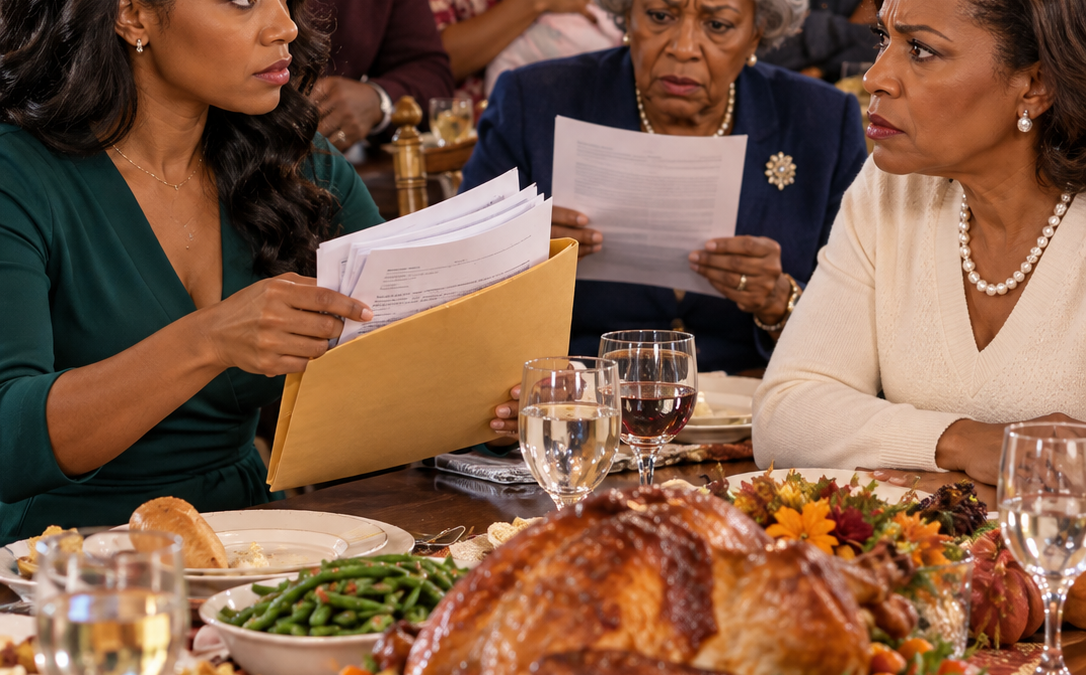
If you have ever been treated like the responsible one until responsibility became a bill nobody else planned to pay, leave a comment with where you are listening from and subscribe. This story starts with a monthly transfer, but it ends at Thanksgiving with forty-eight pages of bank statements spread across my grandmother’s table.
Let me take you back to the summer of 2021, before I knew I was not helping my family survive.
I thought I was saving them.
I grew up in Harbor Falls, Maine, in a neighborhood where every yard had trimmed hedges, every porch had a flag, and every Black family on the block understood that being respectable was treated like rent.
My mother, Denise Brooks, believed in polished shoes, thank-you notes, church dresses that did not wrinkle, and never letting anybody see you sweat unless the sweat came from charity work.
She used to say, “People are already looking for a reason, Talia. Do not hand them one.”
At ten, that meant do not run through the grocery store. At sixteen, it meant do not talk too loudly when white mothers from school were in the room. At twenty-eight, it somehow meant send your parents $2,000 every month and ask no questions.
There were two daughters in our house, me and Kiara. Kiara was four years younger, softer where I was sharp, dramatic where I was controlled, and talented in the exact way that made adults rush to protect her from consequences.
If Kiara cried, the whole house moved. If I cried, my mother handed me a tissue and said, “You know better than to fall apart.”
I was the straight-A daughter. Science fairs, debate team, scholarship applications filled out in blue ink at the kitchen table. Howard waitlist, University of Maine acceptance, medical school.
After that, I worked through every stage of it because I learned early that my ambitions were impressive only if they did not inconvenience anyone.
Nobody paid my rent after I turned eighteen. Nobody paid my tuition. Nobody asked whether a Black girl from a small Maine town felt lonely walking into lecture halls where people assumed I was there for a diversity brochure before they learned I could ruin the curve.
I did not complain.
I studied. I worked. I became useful.
Kiara went to community college twice and left twice. My parents called it finding her path. They paid $8,000 for a yoga certification weekend because she said teaching breath work had healed her spirit. They paid her first apartment deposit because she said living at home restricted her energy.
They paid for her wedding dress when she married Darius Lane, a car salesman with perfect teeth, a leased sedan, and the confidence of a man who knew somebody else’s money would always arrive before his own ran out.
Their wedding was at a seafood restaurant on the Portland waterfront. My mother paid for flowers, dress alterations, a photographer, and part of the honeymoon. My father, Calvin, stood during the toast and called Kiara the heart of the family.
I clapped with everyone else.
I was twenty-four then, in my first year of medical school, eating rice and canned beans three nights a week while studying anatomy until my eyes burned.
I remember asking my mother later, gently, why Kiara got help for everything and I got told to be proud of independence.
Denise looked at me like I had asked why water was wet.
“Kiara needs us more.”
My father nodded from his recliner.
That was his role.
Calvin Brooks had opinions in private and silence in public. In our house, my mother made the weather and my father carried the umbrella.
Back then, I did not resent my sister. Not in any clean way. I believed what I had been taught.
Strong women carry. Strong women understand. Strong women do not count.
The trouble is, when people learn you will not count, they start counting on you.
In June of 2021, my father lost his job at Northline Precision Manufacturing. He had worked there thirty years as a floor supervisor. He knew every machine, every shift schedule, every man who had ever tried to hide a mistake under the word calibration.
Then the company downsized and folded his department into another facility. At fifty-seven, with no degree and a retirement account that had been raided more than anyone admitted, Calvin came home at eleven in the morning with a cardboard box and sat in his chair like somebody had removed the walls around him.
I was twenty-eight, in emergency medicine residency at Casco Bay Medical Center. My salary before taxes was a little over $62,000 a year. After deductions, insurance, rent, student-loan minimums, and everything else, I brought home about $3,800 a month.
I lived in a studio apartment with a radiator that clanged all winter and a kitchen so small I could open the fridge and touch the sink at the same time.
My medical school debt sat at $280,000 and grew while I slept.
My mother called me on a Tuesday at 2:13 in the morning.
I remember the time because I was in the hospital break room, shoes off, one foot blistered from a twelve-hour shift that had become fourteen.
She was crying.
“Talia, we cannot make the mortgage.”
That sentence did what she designed it to do. It cut past logic and went straight into the part of me that still heard her saying, People are looking for a reason. Do not hand them one.
“Your father is devastated,” she said. “He will not get out of bed. I do not know what we are going to do.”
I asked how much they needed.
She hesitated just long enough to make the number feel reluctant.
“Two thousand would keep us steady. Just until he finds something.”
Two thousand.
I wrote it on a napkin beside a vending-machine coffee and did the math with a pen I had stolen from the nurses’ station.
Rent. Loans. Gas. Groceries. Phone. Scrubs. Board-exam fees.
Taking $2,000 out meant I would have about $1,800 left for everything else.
Impossible.
Then I made it possible, because that is what trained daughters do.
That night, I set up the transfer. $2,000 from my checking account to Brooks Joint Savings, ending in 4471, on the first of every month. Automatic.
When the confirmation came through, I stared at the screen until the numbers blurred. Then I ate half a granola bar and went back to the emergency department because Room 9 had chest pain and Room 14 was vomiting blood.
That weekend, I opened a spreadsheet.
Column A: date.
Column B: amount.
Column C: running total.
The first row was green.
$2,000.
I told myself it was temporary.
Temporary became six months. Six months became a year.
A year became four.
During those four years, my father did not find work. Not because work did not exist. Because every job that existed insulted the man he still believed he was.
Warehouse supervisor? Too far.
Home-improvement store? He was not wearing an apron at his age.
Security desk at a corporate building? He had spent thirty years managing men, not checking badges.
My mother called it pride. I called it something else in my head and did not say it out loud because I was still sending the money.
The first Christmas after the transfers started, I drove to Harbor Falls after a night shift. I had slept three hours. My eyes felt gritty. I brought a grocery-store poinsettia and a gift card I could not afford.
The living room had new hardwood floors.
The kitchen had a new French-door refrigerator.
The bathroom tile was new, too. White with gray veins, the kind of tile my mother would have called too showy if someone else bought it.
She gave me a tour like we were on television.
“We found a contractor through the neighborhood group,” she said. “Such a blessing.”
I looked at the refrigerator, then at my father in his chair.
“I thought things were tight.”
Denise smiled too quickly.
“Your father handled it.”
My father did not look up from the game.
At dinner, Kiara arrived in a sage-green Honda CR-V with dealer plates still on it. My mother clapped her hands like Kiara had given birth to the thing.
“Doesn’t she look beautiful in that car?”
I asked who paid for it.
Nobody answered.
Kiara tossed her curls over one shoulder and said Darius knew a guy at the dealership. My mother changed the subject to their spring trip plans.
I drove back to Portland in my 2014 Civic with a cracked side mirror and more than 200,000 miles on the odometer.
Halfway home, my phone dinged with an email from my student-loan servicer reminding me interest was accruing.
I laughed so hard I had to pull over.
Not because it was funny. Because if I did not laugh, I was going to scream on the side of Route One in my good coat.
The second year was worse.
Not at work. Work made sense to me.
Emergency medicine is chaos, but it is honest chaos. A heart attack does not pretend to be a migraine to manipulate you. A broken arm does not ask whether you are grateful enough before it lets you set the bone.
Families are not like bodies.
Families can bleed you and call it love.
In March of 2022, Kiara thought she might be pregnant.
She was not.
The test was negative. The blood work was negative. The entire scare lasted three days.
My mother drove two hours to her apartment with soup, flowers, and a stuffed bear from a hospital gift shop.
That same week, I ended up in the emergency department as a patient after a fourteen-hour shift turned into seventeen, and I got dehydrated enough that one of the nurses ordered me into a chair and started an IV before I could argue.
I called my mother from the IV bay.
She answered between bites of something crunchy.
“Oh, honey, drink some water.”
“I am getting fluids now.”
“Good. I cannot come up this week. Kiara still needs me.”
Kiara had already posted a selfie at brunch.
I said, “Okay.”
That September, Kiara had what she called her real wedding celebration because the restaurant ceremony had been too small. My parents paid for a second dress, more flowers, and another photographer.
I attended in a navy dress I had bought off a clearance rack. I gave a toast about sisterhood that made my mother dab her eyes.
Then the photographer said, “Family picture.”
My mother waved me aside.
“Let’s get the four of us first.”
The four of them.
Denise. Calvin. Kiara. Darius.
I stood six feet away while the camera flashed.
Eighteen months of transfers by then.
$36,000.
I was not in the frame.
In the spring of 2023, I tried to reduce the payments.
Not stop them. Reduce them.
My student-loan balance was $274,000. Interest was growing faster than my minimum payments could touch. I sat at my kitchen table after a night shift and calculated what would happen if I kept sending my parents $2,000 every month.
At that rate, I would be paying for medical school into my forties.
I called my mother on a Saturday morning.
“Mom, I need to talk about the transfers. I can still help, but I need to bring it down to fifteen hundred.”
She went quiet.
That kind of quiet from Denise Brooks was never empty. It was the inhale before a performance.
“After everything we sacrificed for you.”
There it was.
She kept that sentence loaded.
“We drove you to school events. We fed you. We kept a roof over your head. We made sure you had opportunities. Now that we need you, you want to put a limit on gratitude.”
Gratitude.
I was twenty-nine years old, in debt up to my throat, working eighty hours a week, and my mother had turned my childhood meals into invoices.
I backed down.
The transfer stayed at $2,000.
At work the next week, Dr. Anukica Rivers found me in the break room staring at a vending machine like it owed me answers.
Anukica was thirty-eight, brilliant, blunt, and one of the few attendings who could correct you without making you feel small. She was also a Black woman who had survived medicine long enough to know when another Black woman was disappearing behind competence.
“You look like you haven’t slept since residency started,” she said.
“That is because residency started.”
“No. This is something else.”
I told her I was fine.
She looked at the untouched salad in my lap and said, “Fine is a word people use when they don’t want witnesses.”
Then she left me alone, because good doctors know when pressure will make a patient lie.
Three days later, I opened Instagram between patients and saw my mother’s post from Cape Cod.
Lobster dinner. Ocean view. My father wearing linen like a retired executive. My mother in a wide-brimmed hat with the caption, “Blessed life, grateful heart.”
Blessed with my $2,000 funding the butter.
I closed the app and went to treat a man who had cut his hand open cleaning a fish.
Marcus Reed came into my life carrying a toolbox and half a sandwich.
It was July 2023. His electrical company had won a six-week hospital contract to rewire part of the third floor.
He was thirty-three, a licensed master electrician from Lewiston with calloused hands, steel-toed boots, and a Ford pickup that had a dent in the tailgate shaped like a bad decision.
We met in the cafeteria because he sat across from me while I was eating another wilted Caesar salad.
“You work here?” he asked.
“Emergency medicine resident.”
He looked at my tray.
“And they feed you like that?”
“They offer better food. I make bad choices.”
He unwrapped a roast-beef sandwich, cut clean in half, and pushed one side toward me.
“My aunt made extra.”
I should have said no.
Instead, I ate half a stranger’s sandwich because it had real bread and horseradish, and because he did not make a show of offering it.
That was Marcus.
Steady. Quiet. No performance.
We drank coffee in the parking lot after my shifts. He texted me pictures of wiring panels he was proud of, and I pretended to understand them. I sent him photos of vending-machine dinners, and he started bringing extra food without announcing it as rescue.
It took three months to tell him about the $2,000.
We were sitting in his truck with the heater running, October rain tapping the windshield. I said it fast because shame moves better at speed.
“I send my parents $2,000 a month. My dad lost his job. They need it for the mortgage.”
Marcus did not react right away.
He did the math silently. I watched his fingers move once against the steering wheel.
“That is almost a third of what you take home.”
“They need it.”
He looked at me then.
Not angry. Not pitying.
“Do they?”
Nobody had asked me that.
Not do you love them.
Not can you afford it.
Do they?
The question sat in the truck between us like a tool I had never been taught to use.
Thanksgiving 2023, I brought Marcus home.
My mother opened the door and inspected him from boots to haircut. She had a gift for making evaluation look like welcome.
“So, Marcus, what exactly do you do?”
“Electrical contractor, ma’am. I own a small company in the Portland area.”
“An electrician.”
She said it politely.
In our family, polite was where judgment went to put on perfume.
“Yes, ma’am.”
My father shook his hand without standing from the couch.
“Business good?”
“Steady.”
Kiara, seven months pregnant by then, leaned in from the kitchen and asked, “Do you have benefits?”
This from a woman whose husband had once called commission-based car sales entrepreneurship and whose own work history could fit on a sticky note.
Marcus answered every question calmly. He talked about his crew, his licenses, his plans to expand into solar installation.
He did not puff himself up.
He did not shrink.
I loved him a little for that before I admitted I loved him at all.
After dinner, I went to the kitchen for water and stopped in the dark hallway when I heard my mother’s voice.
“An electrician. Our daughter, the doctor, is dating an electrician.”
My father made a low sound.
Denise said, “At least Kiara married someone with polish.”
Then Calvin Brooks, the man whose mortgage I believed I was paying, said the sentence that should have ended everything right there.
“As long as the checks keep coming, who cares who she dates?”
I stood barefoot on hardwood I had paid for, holding an empty glass.
As long as the checks keep coming.
Not as long as she is happy.
Not as long as he treats her well.
As long as the checks keep coming.
Like I was a payroll department with a pulse.
I did not confront them that night.
That is hard to admit, but it is true.
Some humiliations do not make you brave right away.
Some just show you the cage.
In February 2024, Marcus proposed on the hospital rooftop after my Saturday overnight shift.
No audience. No violin. No ring box, because he said I would see the box and solve the mystery before he got the question out.
The sun was coming up over Portland, turning the windows pink. I was still in scrubs. My hair was pinned badly under a scrub-cap line. My hands smelled like sanitizer.
He said, “I know your life is loud. I want to be the place where it does not have to be.”
I said yes before he finished kneeling.
That afternoon, I called my parents.
My mother answered.
“Hello?”
“Mom, I am engaged. Marcus proposed this morning.”
Silence.
Then, “Oh. Well, I hope you have thought this through.”
No congratulations.
No tell me everything.
No let me see the ring.
Just the sound of my mother moving disappointment around in her mouth until it found the shape of concern.
An hour later, my father called. He was alone. I knew because his voice was lower, smaller, the one he used when Denise was not within earshot.
“Talia, this wedding, it is not going to affect our arrangement, is it?”
Arrangement.
“Dad, I am planning a wedding. Things may need to change.”
“Change how?”
“I don’t know yet.”
“We depend on you.”
“I know.”
“Do not pull the rug out from under us.”
Then quieter, more dangerous because it sounded almost sad:
“You owe us this. After everything we sacrificed.”
You owe us this.
Two chains.
One from my mother. One from my father.
I hung up and sat beside Marcus on the couch. He did not tell me what to do. He never did. He just listened while I repeated every word.
When I finished, he said, “Talia, you do not owe them your life.”
I knew he was right.
Knowing is the first door.
Walking through it is another thing entirely.
If you have ever had family turn your generosity into a bill, then you understand why I sat there shaking even after the call ended.
Stay with me, because what I found in the bank records turned that fear into something I could finally hold in my hands.
March through May, Marcus and I planned a modest wedding. A river barn in Wells. White clapboard.
At the shower, Kiara opened my gift, held the blanket up, and said, “Cute. Did you make this?”
Then she set it down and reached for a box with a stroller label.
After the shower, I helped stack chairs. My mother found me near the dessert table.
“Talia, the two thousand. Can you make it twenty-five hundred this month? The shower cost more than expected.”
I looked at her.
“I am paying for my wedding.”
She tilted her head in that familiar way, the way she had looked at me when I brought home a 96 instead of a 100.
“You always find a way.”
“Not this time.”
Her face tightened.
“You are the strong one.”
The strong one.
She only called me that when she needed me to bleed quietly.
In August, a letter came from the bank. Brooks Joint Savings needed updated signature cards because my name was still attached to the account.
Routine paperwork, the kind you open with one hand while eating cereal over the sink.
But updating a signature meant logging in.
Logging in meant seeing the account.
I had avoided looking for years because I thought avoiding was trust.
The balance should have been solid. Thirty-eight deposits by then. Even with mortgage payments, there should have been a cushion.
The balance was $340.
I stared at it until my vision tunneled.
Then I opened the transaction history.
The truth was not hidden.
It was itemized.
$500 to Kiara Lane.
$2,000 to Darius Lane Auto Group.
$800 to Kiara Lane.
$3,200 to Darius Lane Auto Group.
$1,000 to a Cape Cod resort.
$1,200 to a furniture store.
$700 to a salon.
$500 to a nail studio.
Renovation payments. Vacation charges. Transfers to my sister. Transfers to her husband.
Some mortgage payments, yes.
But not enough to make the story true.
I downloaded everything.
Screenshots. PDFs. Every statement. Every withdrawal. Every date.
Then I opened my spreadsheet.
Green column: every deposit I sent.
Red column: where the money went.
Blue column: messages from my mother that matched the timing.
Then I pronounced an elderly woman dead while her daughter sobbed into her sweater.
Afterward, I dropped a cafeteria tray.
Salad everywhere. Dressing on my shoes. A plastic fork sliding under a vending machine.
I sat down on the linoleum because my legs forgot the job.
Anukica found me.
She crouched beside me, her white coat brushing the floor.
“Talk to me.”
“I have been sending my parents $2,000 a month. They told me it was for the mortgage. And almost half went to my sister.”
Anukica did not gasp. She did not call my family names.
She sat beside me against the vending machine like this was a consult and the patient was my life.
“What are you going to do?”
“I don’t know.”
“Yes, you do. You just haven’t said it out loud.”
So I said it.
“I am going to stop paying.”
The words did not feel powerful.
They felt like stepping off a ledge and trusting the ground to appear because you were tired of hanging from a rope someone else kept cutting.
I invited friends from medical school. Cousins on my mother’s side who had always liked me more quietly than they dared to say at family gatherings.
Grandma Odessa.
Odessa was my mother’s mother, seventy-nine years old, four feet eleven inches tall, sharp as a scalpel, and impossible to bully. She lived in Bangor in a white Cape Cod with green shutters and a porch that leaned left because she said perfect porches made people arrogant.
She RSVP’d with a handwritten note.
Would not miss it for the world, baby.
Marcus’s mother, Mrs. Darlene Reed, called the day she got the invitation to ask whether the barn had a kitchen and whether she could bring apple pie.
My parents did not respond.
Neither did Kiara.
Fourteen days before the wedding, I learned why.
I was on break at the hospital, scrolling Instagram while eating soup from a paper cup, when I saw a cousin’s story repost.
Pink-and-gold invitation graphic.
Join us for Kiara and Darius’s gender reveal.
Saturday, October 19th, 5:00 p.m.
The L—
Then she said, “Maybe you should have picked a different date.”
I hung up.
I did not call my mother.
I opened the spreadsheet.
Red column.
$43,000 to Kiara and Darius over thirty-eight months.
My sister had scheduled her gender reveal on my wedding day because she knew they would choose her.
She knew because they always had.
One week before the wedding, I drove to Harbor Falls.
I sat at my parents’ kitchen table, the same table where I had done homework, opened birthday cards with ten-dollar bills inside, and learned that the oldest daughter in a Black family with respectable ambitions was expected to become both proof and pillar.
Denise sat across from me with her hands folded. Calvin stood by the counter, arms crossed.
“My wedding is in seven days. I need to know if you are coming.”
My mother sighed, already tired of the inconvenience of my feelings.
“Talia, Kiara needs us. The ceremony is at two. Her party is at five. We need to help set up.”
“Darius has family. Friends. She has help.”
“She is our daughter.”
There it was.
Said to me.
Also her daughter.
As if I were a neighbor asking for a ride.
My father shifted.
“And the money.”
“This is not about money.”
“It is always about money when people stop paying.”
People.
Not my daughter.
People.
I stood. The chair scraped the hardwood I had helped buy.
“Will you be at my wedding?”
Denise looked at Calvin.
Calvin looked at the floor.
Denise looked back at me with a face that pretended regret and practiced refusal at the same time.
“We will try.”
I drove forty minutes for those three words.
We will try.
It meant no.
It meant Kiara.
It meant the money had stopped, and so had the performance.
The week before the wedding moved like weather. Fast at the hospital, slow at home.
Darlene arrived from Lewiston on Wednesday with apple pies, three casseroles, a garment bag, and a hug so long I counted eleven seconds because I had forgotten what it felt like to be held by a mother figure who did not make contact conditional.
“My son chose well,” she said. “And so did you.”
Grandma Odessa called every night.
“You eating?”
“Yes.”
“Do not lie to old women. We invented it.”
“I ate.”
“Good. I am bringing something blue.”
My parents said nothing.
No call. No RSVP. No last-minute burst of conscience.
October 19th arrived gray and gold.
The bridal suite above the barn had whitewashed walls, a little mirror, and a window facing the river. Morning fog hung low over the water.
My dress was ivory satin, simple, no train, because I needed to be able to move like myself.
Sadi, my college friend, helped with my hair.
Darlene brought breakfast on a real plate with a cloth napkin she had ironed at the hotel.
“Eat,” she said. “A bride who faints scares everybody and ruins pictures.”
At eleven, Grandma Odessa arrived in a navy dress with pearl buttons. Her silver hair was pinned back with a comb I recognized from childhood.
When she saw me, she stopped in the doorway.
“Your mother should be here.”
“She is not coming.”
“I know.”
She came forward and opened her palm.
In it was a small blue enamel brooch. Forget-me-nots set in tarnished silver.
“My mother’s,” she said. “Something old, something blue, something better than foolish people deserve to see.”
I pinned it inside my dress near my heart, where nobody else could see it.
Odessa wiped one tear from my cheek with her thumb.
“That is the only one you get before the ceremony. Save the rest for dancing.”
At two, I walked myself down the aisle.
Seventy-eight people stood.
Not eighty-five.
Seventy-eight.
Enough.
My side held Grandma Odessa, three cousins, eight hospital colleagues, Sadi, and a handful of people who had seen me tired and loved me anyway.
Marcus’s side held Darlene, his three-man crew in sport coats they clearly wore once a year at most, and two dozen relatives who had driven from Lewiston without making the trip sound like a favor.
Marcus cried before I reached him.
His crew pretended not to notice badly.
Darlene pressed a tissue to her mouth.
Grandma Odessa sat straight-backed in the front row, hands folded over her purse like she was holding the whole room in place by will.
Marcus said his vows first.
“I choose you not because you are useful, not because you are strong. I choose you because you are Talia, and that would be enough on your weakest day.”
I nearly lost the one-tear rule.
I do not remember every word I said back.
I remember meaning all of them.
The officiant pronounced us married.
The barn erupted.
At 3:30, between the ceremony and reception, guests moved toward cocktail hour.
I stepped outside alone.
The parking-lot gravel clicked under my heels. The air smelled like river water and fallen leaves.
Inside, people were laughing.
My husband was somewhere pouring champagne for people who had chosen to come.
I called my mother.
Four rings.
“What?”
“Mom, I just got married.”
There was noise behind her. A cheer. A woman saying, “It’s a girl.”
Someone laughed.
“We are at Kiara’s,” my mother said. “The reveal was beautiful. Pink. It is a girl.”
“I just got married.”
A pause.
Then:
“Don’t bother us.”
The line went dead.
I stood there in my wedding dress with my grandmother’s brooch pressing against my chest.
I did not cry.
Something inside me went quieter than crying.
The kind of quiet that means the decision is no longer an argument.
It is a door.
I opened my banking app.
Brooks Joint Savings, ending in 4471.
Balance: $340.
Remove self as co-owner.
The app told me processing could take twenty-four hours.
I submitted the request anyway.
Then I opened my personal checking account.
Secondary transfer to Calvin Brooks. $200 monthly for gas and groceries.
Cancel.
Old automatic transfer to Brooks Joint Savings.
Already canceled.
I checked it again.
Canceled permanently.
Four minutes and twelve seconds.
That is how long it took to financially leave a family that had been emotionally gone for years.
I put the phone in my clutch and walked back into my wedding.
Marcus saw my face and crossed the room.
“What happened?”
“I will tell you tonight.”
“Are you okay?”
“No. But I want to dance.”
So we danced.
The band played something slow. I put my head on his shoulder.
He held me like I had never been a payment. Like I was not a transfer, not a problem, not the strong one, not the doctor daughter who could be trusted to survive neglect.
Just his wife.
Somewhere in Harbor Falls, my father’s phone buzzed.
He did not notice immediately.
He was at Kiara’s gender reveal, holding a paper plate with pink cake and pretending the daughter missing from the room had chosen absence instead of being pushed into it.
Then the second alert came.
Co-owner removed from account ending in 4471.
Secondary transfer canceled.
Calvin Brooks stepped onto Kiara’s driveway and opened the banking app.
$340.
He called me.
Voicemail.
He called again.
Voicemail.
Seven times in twenty minutes.
My phone was in my clutch on silent, sitting on a table inside a warm barn while seventy-eight people ate dinner and toasted my marriage.
Then the texts started.
Call me now.
Talia, what did you do?
This is not funny.
You cannot just cut us off.
My mother texted at 11:02 that night.
I do not know what has gotten into you. I hope you are happy ruining your father’s health.
At 11:47:
Fine. Do not respond. But when you need us, and you will, remember this night.
I read everything after Marcus fell asleep at the bed-and-breakfast.
Fourteen missed calls.
Nine voicemails.
My father’s voice moving from command to panic to rage.
My mother’s texts arranged like little knives.
I screenshotted all of it.
Same folder as the bank statements.
Same folder as the withdrawal history.
Same folder as the email that called my help a payment.
Then I sent one message to both of them.
I got married yesterday. You were not there. The money stopped. These are related.
I put the phone in the nightstand drawer and closed it.
The room had white sheets, a small fireplace, and a window overlooking a garden going dormant for winter.
Marcus breathed beside me.
Outside, the ocean made its steady sound, indifferent and ongoing.
For the first time in four years, there was nothing scheduled to leave my account for people who could not schedule one afternoon for me.
November came cold.
I went back to work as chief resident and sent the first extra $2,000 to my student loan.
Principal.
Not interest.
Not family.
Principal.
I watched the balance drop and felt something in my chest drop with it.
Kiara gave birth to a girl the second week of November.
Baby Amara.
I sent cotton onesies through Amazon.
I did not visit.
My mother left a voicemail.
“Your niece was born and you cannot even come. What kind of person are you?”
The kind who had been at work the night before, saving someone else’s mother.
The kind whose own mother skipped her wedding.
The kind who did not call back.
My father started selling things on Facebook Marketplace. A cousin sent screenshots.
Patio furniture.
The convection oven.
The French-door refrigerator.
Items my money had helped buy, now listed at prices low enough to hurt.
Grandma Odessa called the Sunday before Thanksgiving.
“Are you coming?”
“If you want me there.”
“Do not start that. I asked if you are coming.”
“Yes.”
“Good. Because your mother has been telling people you abandoned the family, and I have questions.”
I sat up.
“What has she been saying?”
“That you cut them off. That you chose your husband over your parents. That you got too good for the people who raised you.”
Odessa’s voice was level.
Too level.
“Bring what you need to bring,” she said.
So I did.
Forty-eight pages.
Bank statements. Transfer records. My spreadsheet.
Green column for my deposits.
Red column for withdrawals to Kiara, Darius, vacations, renovations.
Blue column for guilt messages timed within forty-eight hours.
I printed all of it at the hospital because the printer there had already seen worse.
Thanksgiving was at Grandma Odessa’s house in Bangor.
White Cape Cod. Green shutters. Porch leaning left.
The house smelled like turkey, yeast rolls, nutmeg, and the lavender sachets she kept in every closet.
The dining-room table had been extended with two folding tables and covered in mismatched cloths because Odessa believed matching was for people who did not cook enough.
Nineteen people came.
Denise was already there when Marcus and I arrived.
She did not hug me.
She turned to Aunt Marlene and smiled with all her teeth.
“Look. The prodigal doctor decided to grace us.”
Calvin sat in Odessa’s armchair by the window, smaller than I remembered, eyes on the floor.
Kiara sat on the couch with baby Amara tucked against her chest.
Darius stood behind her, checking his phone.
Cousin Devon pulled me aside near the hall.
“Your mom says you stopped helping them.”
“After dinner,” I said. “I will explain after dinner.”
Odessa heard me from the kitchen.
“No. Before dessert.”
Denise’s head turned.
My grandmother kept carving turkey like she had not just set the fuse.
Dinner moved strangely.
People talked around the thing everyone could feel but nobody had touched yet.
Denise dabbed at dry eyes twice.
Calvin ate little.
Kiara kept her face angled toward the baby.
Darius drank too much cider and looked at the door.
After the plates were cleared and before pie, Grandma Odessa stood at the head of the table.
She placed both hands flat on the wood.
“Before dessert, we are going to address what has been said in this family.”
My mother straightened.
She had been waiting.
I could see the performance rising into her face.
“Mama, if this is about Talia, I do not want to make a scene. But yes, my own daughter has abandoned us after everything we sacrificed.”
“Stop.”
I said it not loudly, but the room went still.
I opened the manila envelope and pulled out the bank statements.
Forty-eight pages.
White paper. Yellow highlights. Orange highlights. Blue notes.
The whole ugly math of four years.
“For three years and two months,” I said, “I sent $2,000 every month into the joint savings account. That was $76,000. I also sent $12,000 through a secondary transfer to Dad’s personal account for gas and groceries. $88,000 total.”
Uncle Curtis put on his reading glasses.
Aunt Marlene leaned forward.
My mother’s voice sharpened.
“Those are private family finances.”
“They are my bank statements. My name was on the account. My money funded them.”
Calvin stood.
“You ungrateful little—”
Grandma Odessa did not raise her voice.
“Calvin. Sit down.”
He sat.
Seventy-nine years old, four feet eleven, and he sat like a schoolboy.
I placed the spreadsheet on the table.
“Green column is every payment I made. Red column is withdrawals. Forty-three percent went directly to Kiara or Darius’s dealership. Twenty-two percent went to renovations, vacations, salon visits, and personal spending. Thirty-one percent went to the mortgage, which was the reason I was told the money was needed.”
Nobody spoke.
The numbers moved around the table without asking permission.
Uncle Curtis pulled one page closer.
Cousin Devon passed another to Simone.
Aunt Marlene whispered, “Eighty-eight thousand.”
I looked at my mother.
“On October 19th, I called you from my wedding. You said, ‘Don’t bother us.’ You were at Kiara’s gender reveal, the one she scheduled for my wedding day. You missed the ceremony. You missed the vows. You missed the dinner. But Dad noticed the missing money in thirty minutes.”
Kiara’s face went pale under her makeup.
“I did not know it was your money,” she said.
I looked at her.
“You never asked.”
“Mom said it was Dad’s retirement.”
Darius shifted behind her.
He had received $3,200 for his failing dealership.
He said nothing.
His face said enough.
My father tried again.
“That money was family money.”
Uncle Curtis looked up from the statements.
“Calvin, family money does not get laundered through one daughter’s paycheck.”
The word laundered changed the room.
Not legally.
Not officially.
Morally.
Denise started crying.
Performance tears.
Beautifully timed.
Chin trembling. Hand to chest.
The same tears she had used to keep the transfers coming.
“You are all turning against me. My own family. My own mother.”
Grandma Odessa looked at her daughter with an expression I had never seen before.
Not anger.
Disappointment after the last excuse has died.
“Denise, I asked you two weeks ago whether Talia was helping with money. You said a little.”
My mother said nothing.
“Eighty-eight thousand dollars is not a little.”
For five seconds, Denise had no performance ready.
I counted.
One.
Two.
Three.
Four.
Five.
Her eyes dropped to the table.
For one breath, she looked like a woman who knew she had gone too far.
Then she hardened.
“Talia has always been dramatic. She is doing this for attention.”
That was when I stood.
“I am done.”
Marcus stood with me immediately.
I gathered nothing.
I left the copies on the table.
Let them read.
Let them pass.
Let the numbers do what numbers do when people are tired of being lied to.
We reached the front door with our coats on when Grandma Odessa followed us into the hall.
She moved slowly, but every step had purpose.
She took my arm.
“I did not know,” she said. “I swear to you, baby. I did not know.”
“I know.”
“Eighty-eight thousand dollars.”
She said it like she was still trying to make the number fit inside a grandmother’s mouth.
“My granddaughter was eating hospital food to send her parents $88,000, and they could not come to her wedding.”
Then she reached for her left hand.
She pulled off her wedding ring, a thin gold band worn smooth by fifty-seven years.
Her husband had bought it in 1967 after working three jobs through one summer and skipping lunch for two months.
I knew the story.
Everyone knew the story.
Odessa told it whenever someone complained about old love being simple.
She pressed the ring into my palm and closed my fingers around it.
“The people who choose you do not need to be paid.”
I could hear the dining room behind us.
Denise crying.
Calvin arguing with Curtis.
Kiara’s voice low and panicked.
Darius making excuses to nobody in particular.
Grandma Odessa patted my hand.
“Go home. Eat leftovers. Hold your husband. That is what Thanksgiving is for.”
Marcus opened the door.
November air rushed in, cold and clean.
I did not look back.
The aftermath did not arrive with lightning.
It arrived with job applications.
In January, Calvin found work at a distribution center in Westbrook.
$17.50 an hour.
Six in the morning to 2:30 in the afternoon.
The kind of job he had called beneath him for four years.
My mother got a part-time position at a floral shop in Harbor Falls. Three days a week, register and arrangements.
She did not post about it online.
The blessed-life captions disappeared.
Kiara and Darius sold the Honda and bought a used Corolla with 90,000 miles on it.
Darius’s dealership investment collapsed the same month.
Apparently, $3,200 from my paycheck had not been enough to hold up a business built mostly on posture.
Eleven of the nineteen people at Thanksgiving reached out to me.
Texts. Calls. Two handwritten cards.
Most said some version of, “We did not know. We should have asked.”
Aunt Marlene sent flowers to the hospital with a note that said, I believed your mother too quickly.
Cousin Devon started a group text with me, Simone, and Tasha.
He named it Family That Actually Talks.
We texted about recipes, weather, work, and the tiny ordinary things people send when they are trying to build a bridge without making speeches about bridges.
Grandma Odessa called every Sunday.
She told me stories about her own mother, a woman who raised five children outside Bangor and gave too much to people who mistook sacrifice for permission.
“I did not realize I was watching the pattern repeat,” Odessa said once. “You stopped it.”
“No, baby. You did.”
Denise has not called since Thanksgiving.
Not once.
Odessa says she still tells a version where she is the wounded mother and I am the ungrateful daughter who married away from family and got too proud.
But the audience is smaller now.
That is what truth does sometimes.
It does not silence a liar.
It thins the room.
Calvin called once in December.
His voice was different. Smaller. Stripped of the authority he used to borrow from my mother’s certainty.
He said four words.
“I got a job.”
I said one.
“Good.”
The call lasted eleven seconds.
It was not an apology.
It was not repair.
But it was the first fact he had offered me without asking for money on the other side of it.
Kiara sent a photo of baby Amara in late January.
No caption at first.
Just the baby wrapped in a blanket I did not recognize. Round cheeks. Dark curls. Eyes open like she was suspicious of the whole world already.
Then one text under it.
She has your eyes.
I saved the photo.
I did not respond.
Maybe one day I will.
Maybe I will not.
A niece is innocent.
A sister is not.
Both things can be true at the same time.
And I am done forcing myself to make complicated things simple so everyone else feels comfortable.
The spreadsheet is closed now.
Green column.
Red column.
Blue column.
Final total: $88,000.
I keep it in a folder on my laptop and have not opened it since November.
What I open now is my student-loan balance.
Down $6,000 since October.
At this pace, with $2,000 extra going where it should have gone all along, I will be debt-free by thirty-seven instead of forty-two.
Marcus and I eat dinner at our kitchen table most nights.
Real food.
Food we cook together.
No cafeteria tray unless I am on shift. No midnight granola bar because I sent my grocery money to people who were booking spa weekends.
Grandma Odessa’s ring sits in a small wooden box on my nightstand.
I do not wear it.
It is hers.
And someday I may give it back if she asks.
But I see it every morning when I reach for my phone.
And it reminds me of the sentence she put in my hand with the gold.
The people who choose you do not need to be paid.
I spent four years trying to buy my way into my own family.
$88,000.
The answer was always the same.
Not enough.
Because people who love you do not keep a running tab.
And people who keep a running tab were never loving you.
They were billing you.
My phone does not ding on the first of the month anymore.
That silence is the most expensive thing I have ever earned.
That is my story.
$2,000 a month.
Three words on a wedding day.
And a grandmother’s gold ring that taught me what family actually costs.
If someone in your life needs to hear that love is not a subscription service, share this with them.
Drop a comment, hit subscribe, and I will see you in the next one.








