My parents gifted my sister a $13,000 cruise and me a $2 lottery ticket, i ended up winning $100 million, when they finally found out, my phone was already showing 79 missed calls from them.
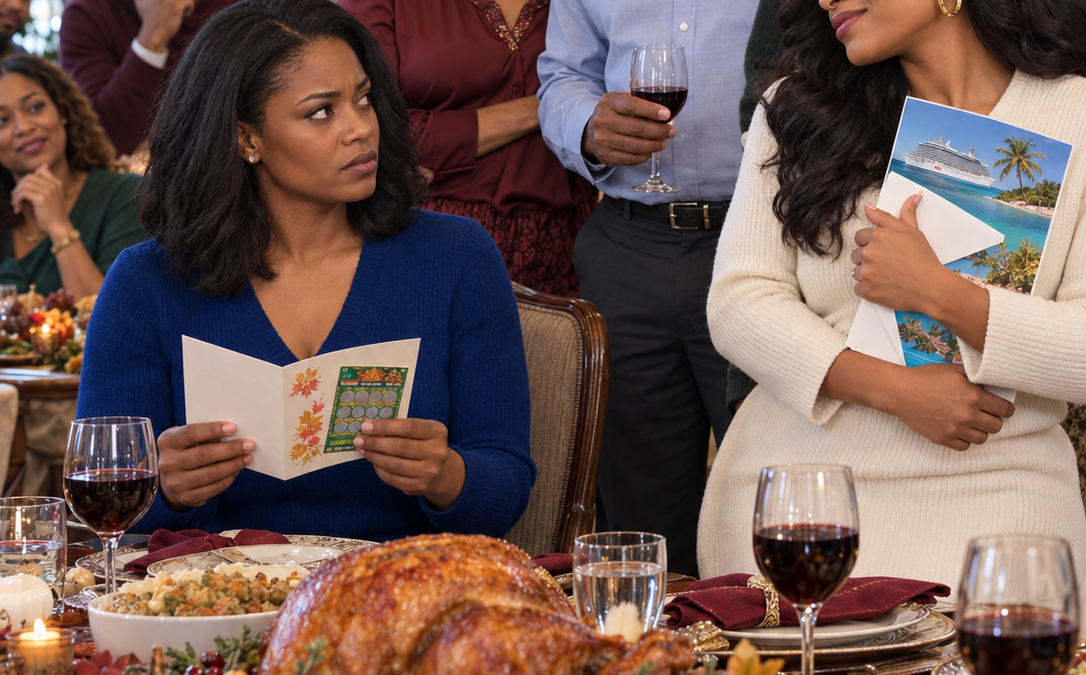
On Thanksgiving, my parents handed my sister an envelope with a $13,000 cruise inside. Mariah screamed so loud the dog started barking.
Then my father handed me a card.
Inside was a $2 scratch-off lottery ticket and a note in his blocky handwriting:
“Don’t spend it all in one place.”
The whole table laughed.
My sister wiped happy tears from her eyes with the cruise brochure still in her hand. Her husband slapped my father on the back. My mother looked at me with that little smile she used when she wanted me to prove I was easy to love by not making things awkward.
So I smiled.
I slipped the card into my coat pocket, helped clear the dessert plates, and drove home alone.
Three weeks later, that $2 ticket was worth $100 million.
And by the time my family found out, my phone was already showing 79 missed calls.
My name is Simone Ellis. I was 34 years old, a Black pediatric nurse, and I had spent my whole life being the daughter who did not need anything. At least, that was the story my family preferred, because if Simone did not need anything, nobody had to feel guilty for giving everything to Mariah.
If you have ever been the strong one, the low-maintenance one, the daughter they stopped checking on because you always made it work, stay with me. Tell me in the comments where you are listening from, because this story is about a cheap card on a refrigerator, a winning ticket nobody respected, and the moment I learned that being overlooked can become cover while you build a life nobody gets to touch.
And if someone in your life needs to hear that strength should not make love optional, send this to them.
Let me show you Thanksgiving before the money. That matters.
People hear $100 million and suddenly every story sounds like it begins there.
It does not.
Mine began in a kitchen in Fairmont Ridge, forty minutes from my apartment in Mill Creek, with my sleeves rolled up and my hands in dishwater while everyone fussed over my sister’s new highlights.
My parents’ house was the kind of place that looked warmer from the outside than it felt when you knew where to stand. Brick ranch, white trim, two maple trees in the yard, a porch. My mother decorated for every season with wreaths, lanterns, pumpkins, flags, plastic snowmen—whatever proved to the neighbors that the Ellis family was cheerful and intact.
Inside, things arranged themselves around Mariah.
Always had.
I arrived early because I always arrived early. Someone had to peel potatoes. Someone had to check whether the green beans were actually washed. Someone had to notice Pop Ellis needed a cushion behind his back before he asked.
That someone was never going to be Mariah.
I am good in a crisis. That is what pediatric nursing teaches you.
Children cry with their whole bodies. Parents panic in layers. Machines beep. Doctors ask for numbers. You learn to keep your voice steady when a small hand is squeezing yours so hard your fingers ache.
That steadiness followed me into my family until they mistook it for proof that I had no needs.
At Thanksgiving, I carved. I refilled. I moved hot dishes before anyone burned themselves. I caught my mother’s eye and nodded when she forgot whether the rolls were still in the oven.
Nobody thanked me.
No one was cruel about it.
That almost made it worse.
It was not cruelty. It was assumption.
Simone handles things.
Simone is fine.
Simone does not mind.
Mariah arrived an hour late with her husband, Brandon Porter, and a bottle of wine she never opened. She floated into the house wearing cream wool, gold hoops, and perfume that announced itself before she did.
My mother, Loretta Ellis, lit up like someone had opened the curtains.
“There she is,” Mama said, wiping her hands on a towel and rushing from the kitchen.
My father, Vernon, stood from his recliner.
“My baby girl.”
Mariah was thirty-two.
Still baby girl.
I stood at the sink with sweet potato on my wrist and watched the house make room for her.
Brandon shook my father’s hand and started talking about some project at work. My mother touched Mariah’s hair and asked whether she had gone to that salon in Buckhead again.
Mariah laughed.
“It costs too much. But, you know, self-care.”
Self-care in my family meant Mariah got a salon appointment and I got a compliment for looking tired but strong.
I told myself not to care.
That was one of my practiced talents.
I had a life. A good one.
I had a small apartment with plants that had survived my night shifts, a savings account I built myself, a job that mattered, and a circle of people who called me without needing a favor. I had no debt besides my car. I paid my own way through nursing school with scholarships, overnight work, and enough caffeine to concern a cardiologist.
I did not need my parents to fuss over me.
That is what I believed, because needing something from people who do not offer it is exhausting.
The pattern started early.
When I was seventeen, I got a scholarship to nursing school. My parents said they were proud. Then, almost overnight, proud became relieved.
“Simone has it handled,” my father would say.
He meant it as praise.
Or maybe he meant it as release.
The first time I noticed the difference clearly, I was eighteen and home for winter break. Mariah had backed Mama’s sedan into a mailbox and cried so hard at the kitchen table that my father called the insurance company before he finished his coffee.
By dinner, he had promised to cover the deductible because young people make mistakes.
That same week, my nursing textbooks cost more than I expected. I mentioned it once, not even asking directly, just saying I would pick up another overnight shift at the pharmacy.
My mother said, “At least you’re responsible enough to figure it out.”
Responsible.
That word looked like a compliment and worked like a locked door.
At twenty-one, I came home after a clinical rotation so tired I fell asleep sitting upright in the den. Mariah came in twenty minutes later, upset because a bridesmaid dress did not fit right for someone else’s wedding.
My mother spent an hour on the phone helping her find a tailor.
My father drove across town to pick up the dress.
I woke up under no blanket.
No one had noticed I was cold.
These were not headline cruelties.
That is why they lasted so long.
No one slapped me. No one said they did not love me. They simply built a family where my sister’s discomfort became an emergency and mine became evidence that I was dependable.
By the time you are good enough at being okay, people stop asking whether okay is costing you anything.
Mariah needed help with her car payment.
Mariah needed help with rent after dropping two classes.
Mariah needed a wedding because she deserved one beautiful day.
Mariah needed a down payment because Brandon’s credit had taken a hit after a business idea collapsed.
Mariah needed a vacation because stress was affecting her marriage.
Every need came wrapped in emotion, and my parents treated emotion like an invoice due immediately.
I did not cry enough.
I did not collapse beautifully.
I sent spreadsheets.
I adjusted.
I handled.
So the family ledger wrote me in the cheap column.
I got practical gifts. Kitchen towels. Gas cards with eight dollars left because my father said he forgot to load the rest. A scarf my mother admitted was originally for a church raffle.
One Christmas, Mariah got a new laptop after saying hers was slow.
I got a mug that said WORLD’S OKAYEST NURSE because my father thought it was hilarious.
I laughed, too.
That is the part I have had to forgive myself for.
I laughed because calling it funny was easier than admitting it hurt.
Thanksgiving that year should have been ordinary.
That is why it cut so deep.
There was turkey, ham, dressing, greens, macaroni, sweet potatoes, cranberry sauce, pecan pie. Nana Bernice sat near the window with a blanket over her knees. Pop Ellis had his cane hooked over the chair beside him. Cousins drifted in and out of the kitchen.
Football murmured from the den.
I moved through the rooms like I always did, useful and mostly unseen.
After pie, Mama clapped her hands.
“Before everyone leaves, your father and I have a little early Christmas surprise.”
My stomach tightened before I knew why.
My mother loved presentations. She went to the sideboard and picked up a cream-colored envelope thick enough to mean money. She handed it to Mariah with both hands.
“For you and Brandon,” Mama said, already emotional.
Mariah opened it.
Her face froze.
Then she shrieked.
“Oh my God. Mom. Daddy. No way.”
Inside was a glossy brochure and a printed confirmation for a Caribbean cruise. Balcony suite. Seven nights. Excursions included. Champagne package. Spa credit.
$13,000.
I know because Mariah shouted the number before she remembered to pretend she was humble.
“This is too much.”
It was not too much.
Not for Mariah.
For Mariah, too much was just a dramatic pause before thank you.
Brandon pumped my father’s hand.
“Sir, this is incredible.”
My father puffed up.
“You two work hard. You deserve something nice.”
Mariah cried.
My mother cried because Mariah cried.
People hugged. Cousins admired the brochure. Someone joked about hiding in their luggage.
I stood near the end of the table holding a stack of dessert plates and felt the old familiar lesson settle over me.
Then my mother turned.
“And Simone,” she said.
Her tone changed.
Not cruel.
Light.
Careless.
My father reached into his shirt pocket and pulled out a drugstore card. The envelope had a cartoon reindeer wearing sunglasses.
“For our practical girl,” he said.
The room chuckled before I even opened it.
Inside was a $2 scratch-off ticket taped to the card. Under it, in my father’s handwriting:
“Don’t spend it all in one place.”
For a second, I heard nothing.
Then Mariah leaned over.
“It’s the thought that counts.”
Brandon laughed.
My father laughed.
My mother smiled like I should play along because family teasing meant love, and I had always been so good at understanding that.
I looked down at the ticket.
Two dollars.
My sister held $13,000 in cruise paper.
I held a punchline.
I could have said something.
I could have asked right there why one daughter got a balcony over the Caribbean and the other got a joke bought at the gas station.
But years of training do not disappear because your chest hurts.
I smiled.
“Thanks, Daddy.”
“See?” he said. “Simone gets me.”
No.
I understood him.
That was not the same.
I put the card in my coat pocket and helped clear the table because that is what I had been taught to do with pain.
Wrap it in usefulness.
Make yourself busy enough that nobody has to notice what they did.
When I drove home that night, the card sat on the passenger seat.
At a stoplight outside Fairmont Ridge, I picked it up and read the note again.
Don’t spend it all in one place.
For the first time, I did not excuse it.
I did not soften it.
I did not translate it into humor so my parents could remain innocent in my head.
I let it mean what it meant.
At home, I changed out of my sweater, washed my face, and taped the card to my refrigerator.
Not the ticket.
The whole card.
The reindeer. The tape. My father’s handwriting.
I stood in my kitchen looking at it for a long time.
It was evidence.
That word may sound dramatic for a holiday card, but some of you know exactly what I mean.
Maybe your evidence is a birthday they forgot. Maybe it is a group photo where you are always on the edge. Maybe it is the expensive gift given across the table while your own envelope feels like an afterthought. Maybe it is years of being told you are imagining the pattern because nobody wants to admit who benefits from it.
If you have a card like mine, even if it is not paper, you are allowed to look at it.
You are allowed to stop calling proof bitterness.
That night, I went to bed as a thirty-four-year-old woman who had finally admitted something I had avoided for years.
My parents loved my sister with resources.
They loved me with assumptions.
I had no idea the cheapest gift they ever gave me was about to become the most valuable thing I owned.
The ticket sat on my refrigerator for six days.
I did not scratch it.
Part of me forgot.
Part of me did not want the joke to be finished.
As long as it remained unscratched, the card stayed evidence. Once I scratched it and lost, it would become just another small humiliation on top of a hundred others.
Then Thursday happened.
I came home from one of those shifts that leaves your soul standing in the hallway behind you.
We had a child come in with breathing trouble that turned ugly fast.
Not lost, thank God, but close enough that every nurse on the unit moved with that sharp quiet people mistake for calm.
By the time I clocked out, my scrubs felt too heavy on my body.
I drove home in silence.
I poured a glass of cheap red wine.
Then I saw the card on the refrigerator.
“Fine,” I said to the empty kitchen. “Let’s spend the two dollars.”
I took a quarter from the jar by the door and scratched the ticket at the counter.
I expected nothing.
Maybe a free ticket.
Maybe two dollars, which would have been too poetic to bear.
The first number matched.
I frowned.
The second matched.
My hands stopped.
I leaned closer and scratched the rest carefully.
Slower now.
The way I check medication dosages when the decimal point matters.
The numbers kept matching.
In the ER, your body often understands emergency before your emotions do. The monitor changes rhythm and your hands are already reaching while your mind is still forming the words.
That happened at my kitchen counter.
My hands knew before I did.
I set the quarter down.
I read the instructions on the back.
Then again.
Then I pulled up the lottery website on my phone and checked the game rules.
Then I read the ticket a fourth time.
My mouth went dry.
The prize tier did not fit inside my normal life.
CLAIM AT LOTTERY HEADQUARTERS.
I sat down on the floor because my knees had become theoretical.
The card was still taped to the refrigerator above me.
Don’t spend it all in one place.
“Daddy,” I whispered.
Then I started laughing.
Not joy.
Not yet.
Shock.
The kind of laugh that comes out when the universe tells a joke so sharp you cannot tell if you are bleeding.
I did not sleep.
I put the ticket in a sandwich bag because nurse brain said protect the evidence. Then I put the bag in a hard plastic container. Then I put that container in my locked file box.
Then I took it back out because I needed to see it again.
At three in the morning, I made coffee I did not drink.
At six, I called in a personal day, something I almost never did.
At eight-thirty, I drove to a regional lottery office with the ticket in my purse and my hands at ten and two on the steering wheel like a teenager taking a driving test.
I will not bore you with the fluorescent lights, the security window, the forms, the careful voices people use when money changes the air.
What matters is that they verified it.
$100 million.
From a $2 scratch-off my father bought as a joke.
Here is what surprised me.
I did not feel rich.
I felt afraid.
I have watched sudden change break people.
Illness.
Death.
Money.
Good news can still rip the roof off your life if you do not reinforce the walls first.
So I did not call my mother.
I did not call Mariah.
I did not call a friend from work and scream into the phone.
I drove home and made a list.
Step one: lawyer.
Not car.
Not house.
Not revenge.
Lawyer.
People always ask why I did not call my family.
The honest answer is that I almost did.
There is a reflex in you, even when you have been hurt, to run toward the people who made you when something impossible happens.
I sat at my kitchen table with my phone in my hand and my mother’s contact open.
Then I looked up.
The card was still on the refrigerator.
Don’t spend it all in one place.
It’s the thought that counts.
I put the phone down because I knew my family.
My mother would cry first and calculate second.
My father would start talking about family legacy.
Mariah would need.
Brandon would advise.
Every person who had laughed at the $2 ticket would suddenly remember they loved the hand holding it.
I needed silence before noise.
By noon, I had the name of a lawyer from a doctor I trusted at the hospital whose cousin had handled estate work after a settlement.
By four, I was sitting in the office of Nadine Price, a woman with silver locks, rimless glasses, and the calmest face I had ever seen outside an operating room.
She did not gush.
She did not gasp.
She listened.
She asked where the ticket was.
She told me not to sign the back until we discussed the claiming structure, state rules, tax implications, and whether a trust could protect my name from becoming a public target.
“Do not talk to family yet,” she said.
I almost laughed.
“That was my instinct.”
“Good instinct.”
Nadine helped me create a trust. There were limits to privacy because lottery rules are what they are, but there are ways to keep a person from becoming a headline if you move carefully and early.
She brought in a financial adviser she trusted, not a salesman with teeth. She talked me through lump sum versus annuity, taxes, security, charitable giving, and the strange social danger of everyone suddenly believing your life is community property.
“The next two weeks matter,” she told me. “Most mistakes happen before the winner understands they are not just lucky. They are vulnerable.”
That sentence sobered me more than the number.
Vulnerable.
I had spent my whole life being called strong.
It turns out $100 million can make you vulnerable in a brand-new way.
Nadine made me do boring things before beautiful things.
That may be why I trusted her.
She told me to change passwords. She told me to freeze my credit. She told me not to answer unknown numbers. She told me to make a list of people who would be told eventually and another list of people who should never be told directly because they would treat information like a party favor.
“Your family?” she asked.
I looked at the ticket in its protective sleeve on her desk.
“Second list.”
She did not blink.
“Good. Honesty about risk is not disloyalty.”
I needed that sentence more than I wanted to admit.
For thirty-four years, any boundary around my family had felt like betrayal. Not because they said that every time, though sometimes they did, but because I had absorbed the idea that love meant immediate access.
If Mama called, I answered.
If Daddy needed help, I drove.
If Mariah cried, everyone turned toward her, and I was expected to turn, too.
Nadine’s office was the first place anyone said, in a practical voice, that access could be managed.
We put the original ticket in secure storage after the claim process moved forward. We documented every step. We created email accounts only for legal and financial communication. We discussed security at my apartment.
She even made me practice one sentence.
“I am not discussing money.”
I laughed the first time.
She looked over her glasses.
“Again.”
“I am not discussing money.”
Again.
By the tenth time, it sounded less like a line and more like a door I could close.
So I disappeared into ordinary life.
I claimed quietly through the trust where the rules allowed.
There was no giant-check photo.
No press conference.
No local news interview with me crying in a blazer.
Just papers, signatures, tax planning, and a number with more zeros than I had ever held in my mind moving into accounts I had to learn to respect.
Then I went back to work.
Same scrubs.
Same badge.
Same vending-machine coffee.
Same small hands in mine.
Not one person on St. Anne’s Children’s Unit knew the tired nurse adjusting IV tubing had just become wealthier than the hospital donors whose names were on the plaques downstairs.
I liked that.
For two weeks, the secret studied me.
It reminded me that before the number and after the number, I was still Simone.
I still knew how to calm a terrified child before a procedure. I still knew which vending machine stole quarters. I still knew Mrs. Harlon in housekeeping kept peppermint candies in her pocket for nurses having bad nights.
The money was enormous.
But it was not identity unless I handed it that power.
My family had no idea.
To them, I was still practical Simone, the daughter with a sensible haircut, reliable car, and no drama.
The daughter you could give two dollars and a joke.
I let them keep believing it.
Every day they did not know was another day the decision stayed mine.
The story broke locally without my name.
Single winning ticket worth $100 million sold in the region.
Trust claims major prize.
Rosedale Market receives seller bonus.
Fairmont Ridge lost its mind.
It is not a big place.
A number like that becomes weather.
People talk about it at church, the barbershop, the grocery store, the pharmacy line. Everyone knows someone who might be the winner. Everyone invents signs after the fact.
My family talked about it constantly.
Not once did they suspect me.
Mariah texted:
Did you hear about the lottery winner near Dad’s store? Crazy. Imagine.
Imagine indeed.
My mother apparently thought it was the man who owned the hardware store. My father said it was probably someone from his old union. Brandon had theories about a contractor who had suddenly paid cash for a boat.
They went through half the county and never considered the daughter who had been handed an actual ticket at their own table three weeks earlier.
That should have hurt.
Instead, standing in the hospital break room reading Mariah’s text, I felt something new.
Power.
Not loud power.
Quiet power.
The power of holding the answer while everyone who underestimated you asks the wrong question.
Being invisible had never felt delicious before.
It did then.
While the town guessed, I asked myself a question I had never had the luxury to ask in any serious way.
What do I want?
Not what will make my parents proud.
Not what will prove I am not bitter.
Not what will finally make Mariah see me.
What do I want this money to do in the world?
Mariah posted cruise countdown photos online. Sundresses. Sandals. A caption that said, “Blessed,” with three palm-tree emojis.
Three weeks earlier, that cruise had been proof of my cheapness.
Now it looked small.
That surprised me.
The money had not healed the wound.
Exactly.
But it had removed my parents’ resources from the altar.
Their ability to give or withhold no longer had teeth.
Thirteen thousand dollars was no longer power.
It was just a receipt.
So I made another list.
Not purchases.
People who loved me before I had anything they could use.
The first name was Aunt Josephine.
Josephine was my mother’s younger sister and the only adult in my childhood who noticed quiet children without needing them to perform.
She came to my school plays when my parents were at Mariah’s dance recital. She mailed me twenty dollars in college with notes that said:
Buy something fun, not something sensible.
She sat in the back row at my nursing pinning ceremony and cried harder than my mother.
Aunt Josephine had medical debt.
Serious debt.
Cancer treatment, follow-up care, insurance gaps, interest that grew like mold.
She never complained directly, but I knew enough.
She had mentioned once that she might sell her house if things did not settle.
Her house was small, yellow, and stubborn.
Same as her.
When I was little, she kept a shoebox in the hall closet full of things she said were too special to throw away and too ordinary for anybody else to understand.
Ticket stubs from my school choir concert.
A photograph of me in a crooked paper nurse hat from career day.
A birthday card I made her with glitter glue that shed blue sparkles for a decade.
“Proof,” she told me once when I found the box.
“Proof of what?”
“That I was there.”
I thought that was strange as a child.
I understand it now.
Aunt Josephine showed up in small ways that did not announce themselves.
She mailed soup when I had the flu in college. She called after hard shifts before I told anyone they were hard because she could hear something in my voice.
She sent five-dollar coffee cards and wrote, NOT PRACTICAL. DO NOT ARGUE, on the envelope.
She never had much money.
She had attention.
And attention—real attention—is expensive in families where everyone is busy pretending not to see the imbalance.
Nadine and I arranged to pay every cent anonymously.
Hospital balances.
Collection agencies.
Follow-up bills.
All gone.
No strings.
No announcement.
No dinner where she had to thank me in front of people.
Just relief arriving quietly, the way real love often does.
The second thing I did was at work.
St. Anne’s children’s unit had needed portable monitoring equipment for two years, the kind that lets medically fragile kids stay close instead of being transferred to the city. We also had a family support fund that was always empty by spring because illness is expensive in ways healthy people do not understand.
I donated enough through the trust to buy the equipment outright and fund the family program for years.
Anonymous.
The email went out on a Monday morning.
Incredibly generous gift.
Transformational support.
Pediatric care.
Families in crisis.
My coworkers cried.
I cried, too, standing at the nurses’ station with my badge clipped crooked and my coffee getting cold.
Nobody knew the donor was right there.
That felt better than any sports car could have.
I am telling you about Aunt Josephine and the children’s unit before I tell you about the 79 missed calls because this is the center of the story.
By the time my family found out, I had already chosen who I wanted to be with money.
I did not choose revenge first.
I chose repair.
Not repair with them.
Repair where love had already existed.
That distinction saved me.
The leak came from a stupidly ordinary place.
Rosedale Market got a seller bonus for the winning ticket. People congratulated the clerk. Someone remembered my father buying several scratch-off tickets around Thanksgiving as gag gifts for cards.
Someone mentioned a gift ticket.
Someone else mentioned an Ellis family dinner.
Then a cousin named Denise, who had been at Thanksgiving and had a memory sharper than family peace required, started doing math.
She texted me on a Tuesday.
Simone, that lottery ticket your dad gave you at Thanksgiving—did you ever scratch it?
I stared at the message in the break room.
There it was.
The weather changing.
I did not answer.
I put my phone in my locker and finished my shift.
Calm hands.
Steady voice.
One more night of being exactly who I was before the ringing started.
Before the storm fully reached me, Aunt Josephine called.
She was crying so hard I thought someone had died.
“Auntie, breathe. What happened?”
“Simone,” she said, her voice breaking. “The hospital called. My bills. All of them. Somebody paid them.”
I sat down.
“All of them?”
“Every one. They said anonymous. They wouldn’t tell me who.”
She started crying harder.
“Who does that, baby? Who does that for an old woman?”
She sobbed then.
Not delicate tears.
Relief coming out of the body after holding fear too long.
I closed my eyes.
“Someone who loves you,” I said.
“I keep thinking maybe God finally opened a window.”
“Maybe He did.”
She cried harder.
I wanted to tell her.
Of all the people in the world, Aunt Josephine was the one I almost told.
But I did not want her relief turning into obligation. I did not want her looking at me differently. I did not want money walking into the room between us wearing my face.
So I said, “Let yourself breathe, Auntie.”
“I can keep my house,” she whispered.
That was worth more than Mariah’s cruise.
When I clocked out that night, my phone came alive halfway to the parking garage.
My mother.
My father.
Mariah.
Brandon.
Unknown number.
My mother again.
Mariah again.
Calls stacked so fast the screen felt hot in my hand.
I pulled into my apartment lot and sat in the car, watching my family discover me in real time.
Seventy-nine missed calls by midnight.
Seventy-nine.
I had gone years without that many calls from them unless someone needed a form notarized or a ride home from a procedure.
Now love had found my number.
I made tea.
I sat at my kitchen table.
I put my phone faceup beside the card still taped to the refrigerator.
Then I read the texts.
My mother:
Sweetheart, call Mom right away. We are so happy for you. We love you so, so much, sweetheart.
She had not called me sweetheart since I was small enough to believe it came without conditions.
Mariah:
OMG, Simone. I am literally crying. You deserve this so much. We have to celebrate. Family sticks together.
Brandon:
Huge congrats. When you get a sec, I have some smart ideas for protecting and growing that kind of money. We should sit down before people start trying to take advantage. Family keeps family safe.
Family keeps family safe.
This from a man who laughed at my $2 card with a $13,000 cruise brochure on the table.
My father:
Call me. Important.
That was it.
Vernon Ellis never wasted punctuation on tenderness.
There were messages from cousins, too.
Those fascinated me.
People who had watched the Thanksgiving scene and laughed along now wrote careful little notes as if they were approaching a stray animal.
Cousin Denise:
Girl, is it true? Either way, I always said you were the smart one.
She had never said that to me.
Uncle Lionel:
Your parents must be so proud. Call your folks. Family first.
Family first is one of those phrases people use when they want the person with the wound to move faster than the people holding the knife.
A church friend of my mother’s sent a message with seven praying-hands emojis and one sentence:
Blessings are meant to flow through a family.
I wondered whether she had texted Mariah the same thing about the cruise.
Probably not.
The strangest message came from Pop Ellis’s old neighbor, Mrs. Cora, who simply wrote:
If it was you, keep your curtains closed for a while.
That one I appreciated.
It was the only message that treated me like a person in danger instead of a wallet in hiding.
I read every message.
Not one said, I’m sorry.
Not one said, We treated you badly.
Not one said, That card was cruel.
They were not ashamed of the joke.
They were alarmed that the joke had turned into money.
The next morning, I listened to the voicemails like chart notes.
Brandon’s was four minutes long. He spent maybe fifteen seconds congratulating me and the rest outlining his thoughts on wealth protection, investment strategy, real-estate opportunities, and why I needed someone I could trust before professional outsiders took advantage.
Professional outsiders.
He meant Nadine, though he did not know she existed.
“This kind of blessing has to be managed inside the family,” he said.
Inside the family meant inside his reach.
Mariah’s voicemail was softer and somehow worse.
She cried.
She said she was sorry if Thanksgiving made me feel bad.
If.
She said she had always looked up to me, which was such an aggressive rewrite of history that I had to pause the message and walk around my kitchen.
Then, in the same breath, she mentioned that she and Brandon had been looking at a bigger house.
And wouldn’t it be beautiful if everybody could finally be comfortable?
There it was.
Apology braided to an ask.
So tight you could miss the seam if you wanted to.
I did not want to.
My mother’s voicemail I saved for last.
“Simone, my baby girl,” she began.
I flinched.
My baby girl.
Not practical girl.
Not Simone has it handled.
My baby girl.
She said she was proud. She said she had always known I was special. She said this family had always been there for each other through thick and thin.
She got weepy talking about how much she loved both her daughters equally and how money did not matter.
Not really.
Because what mattered was family.
Money did not matter.
From the woman who had handed Mariah a cruise and me a punchline three weeks earlier.
I looked at the card on my refrigerator while her voice filled my apartment with love that had apparently been waiting for a prize claim.
I decided then that I would speak once.
Not by text.
Not in private, where they could twist the room after I left.
Not on the phone, where my mother could cry and my father could bark and Mariah could act wounded until I comforted her.
I would go to Christmas.
I texted my mother one sentence.
I’ll come by Christmas afternoon.
She responded in under ten seconds.
Oh, thank God. We love you. We are all so excited to see you.
Excited.
That was one word for it.
Before Christmas, Aunt Josephine called again.
This time she was calmer.
“I heard something,” she said.
“I figured.”
“Is it true?”
I was quiet.
“Baby, you don’t have to tell me.”
That made me want to tell her more.
“Yes,” I said. “It’s true.”
She inhaled softly.
Then she did something no one else in my family had done.
She did not ask for a number.
She did not ask what I would buy.
She did not ask whether I would help anyone.
She said, “Are you safe?”
I closed my eyes.
“I’m working on it.”
“Good. Keep working on it.”
I laughed a little.
“Auntie, everyone is calling.”
“Of course they are. Some folks only hear your name when it sounds like a cash register.”
“I’m going to Christmas.”
“I know.”
“You think that’s a mistake?”
“Depends why you’re going.”
“To tell the truth where people can hear it.”
“Then wear comfortable shoes.”
I smiled for the first time all week.
She told me about the twenty-dollar bills she used to mail me in college.
“I never had much,” she said, “but I wanted you to have something nobody could call practical.”
“I spent one on earrings once.”
“Good.”
“Mama told me I should have saved it.”
“Your mother has always confused usefulness with virtue.”
That sentence sat with me.
Useful had been my family name for me.
Christmas afternoon, I put the original card in my purse.
Not the winning ticket.
That was secured and legally handled.
The card.
The joke.
The thought.
My parents’ house looked different at Christmas.
Lights wrapped around the porch railing. A wreath hung on the door. Through the front window, I could see the tree glowing blue and gold.
Cars lined the curb.
More family than usual.
Of course.
The millionaire daughter was coming.
When I walked in, the room turned toward me like sunflowers toward the sun.
“There she is!” my mother cried.
She rushed me before I had my coat off, arms open, perfume and hairspray and sudden affection wrapping around me.
My father stood so fast the recliner footrest slammed down.
“Simone.”
Mariah was there with Brandon, both dressed like they were attending a tasteful interview.
Nana Bernice sat near the tree.
Pop Ellis watched from his chair.
Aunts.
Uncles.
Cousins.
Everyone smiling too hard.
There were presents under the tree with my name on them.
Big ones.
My name in my mother’s handwriting on shiny paper.
I almost admired the speed.
Three weeks earlier, my worth fit inside a drugstore card.
Now it required wrapping paper and bows.
Mariah had postponed the cruise.
She told me within five minutes as if I should be touched.
“We just felt family was more important right now.”
Translation: the Caribbean could wait once $100 million entered the room.
My mother led me to the good chair, the one near the tree, the one Mariah usually occupied while everyone brought things to her.
Someone handed me wine.
Brandon hovered near my shoulder.
Cousins congratulated me.
My father said, “We always knew our Simone would do something big.”
That was such a complete lie that I almost respected its ambition.
I let them perform.
For ten minutes, I let the room become everything I had once wanted from it.
Warm.
Focused.
Proud.
Attentive.
My mother touched my shoulder every time she passed, as if proving ownership.
Mariah kept looking at me with wet eyes.
Brandon asked whether I had thought about strategic privacy, which was rich considering the man had told half the family I was coming.
I watched it all.
The love.
The timing.
The choreography.
When the performance crested, when everyone had settled into the belief that their sudden affection had softened me, I set my untouched wine on the coffee table.
“Can I say something?”
The room went quiet instantly.
That detail mattered to me.
Three weeks earlier, I could have stood on the Thanksgiving table and struggled to get half those people to stop talking over me.
Now a sentence from me turned the room silent.
I stood.
Not dramatically.
Just enough to see every face.
“First, thank you for the welcome,” I said. “It is quite a change.”
A few people chuckled uncertainly.
My mother smiled harder.
I reached into my purse.
“Three weeks ago, most of you were here for Thanksgiving.”
My father’s expression shifted.
“At that table, my parents gave Mariah and Brandon a Caribbean cruise worth $13,000.”
Mariah’s cheeks reddened.
“Simone,” my mother said softly.
I looked at her.
She stopped.
“Then they gave me this.”
I held up the card.
The reindeer with sunglasses looked even uglier under Christmas lights.
“A two-dollar scratch-off ticket taped inside a card with a note from my father.”
I opened it.
“Would you like me to read it?”
Nobody answered.
So I read it anyway.
“Don’t spend it all in one place.”
Silence.
The kind that has weight.
“Everybody laughed,” I said. “Mariah told me, ‘It’s the thought that counts.’ And she was right.”
Mariah looked down.
“The thought did count. The thought was that she was worth a cruise and I was worth a punchline.”
My mother’s eyes filled immediately.
Not because she was sorry.
Because consequences had arrived in public.
“I kept the card,” I said. “I put it on my refrigerator. Not because I thought the ticket would win. I kept it because, for the first time in my life, the pattern was too clear for me to explain away.”
I looked around the room.
“My whole life, Mariah needed things, and need got rewarded. Cars. Wedding help. Down payments. Business losses. Vacations. Comfort. Attention. I handled my life, so I was treated like I did not require care.”
My father shifted.
“That’s not fair.”
“It is accurate.”
Aunt Josephine, sitting near the far wall, said nothing, but her eyes were on me.
Steady.
Proud.
“Then I scratched the ticket,” I continued, “and it was worth $100 million.”
Even though they knew, the number still moved through the room like electricity.
Brandon leaned forward.
My mother’s hand went to her mouth.
“I verified it. I hired a lawyer. I claimed through a trust as privately as the rules allowed. I built a team before any of you knew because I knew exactly what would happen when you found out.”
My father said, “You should have told us.”
“Why?”
He blinked.
“Because we’re your family.”
“You were my family at Thanksgiving, too.”
No one breathed.
“Before any of you called me, I paid off Aunt Josephine’s medical debt anonymously.”
Aunt Josephine covered her mouth.
Her eyes filled.
I had not planned to say it, but seeing her there, knowing everyone else was about to make money ugly, I wanted one clean thing in the room.
“I also funded equipment and a family support program at the children’s unit where I work. Because when I thought about what to do with this money, I thought about the people who showed me love before there was anything to gain.”
My mother whispered, “Simone.”
“Not once in the 79 missed calls did any of you apologize for Thanksgiving.”
I took out my phone and held it up.
“Seventy-nine calls. Texts about love, family, celebration, advice, bigger houses, staying together. Not one apology. Not one message saying that card was cruel. Not one person saying, ‘We made you feel small, and we are ashamed.’”
Mariah started crying.
I did not stop for her tears.
“The money did not change me. It changed what you thought I was worth.”
My father stood.
“Now hold on.”
There he was.
The voice that expected rooms to rearrange.
“We made a joke,” he said. “A family joke. You made a ledger. We raised you.”
“Aunt Josephine showed up for more of my life than you did.”
The room cracked around that sentence.
My mother’s face collapsed.
“How can you say that to us?”
“Because it is true.”
“We gave you that ticket,” my father snapped.
“Yes.”
“So if you want to talk about thoughts counting, maybe remember who bought it.”
There it was.
The turn.
I had wondered how long it would take.
Not long.
“You bought a joke,” I said. “The lottery made it valuable. Not your love.”
Brandon stood then, red creeping up his neck.
“This is insane. That’s family money.”
Several people looked at him.
He was too worked up to notice.
“A hundred million dollars should help the family. Your parents are getting older. Mariah and I have been talking about moving. There are smart ways to structure this so everyone is secure.”
“It is not family money,” I said. “It is mine.”
“You can’t just sit on that kind of money while your own family has needs.”
“Watch me.”
Nana Bernice made a small sound that might have been a laugh.
Brandon glared.
Mariah wiped her face.
“Simone, it’s the thought that—”
She stopped.
She heard herself.
She heard Thanksgiving coming out of her own mouth and understood, maybe for the first time, how ugly it sounded.
Her face changed.
Not enough.
But real.
“I’m sorry,” she whispered.
My mother turned toward her sharply, as if Mariah had broken formation.
I looked at my sister.
“For what?”
She swallowed.
“For laughing.”
That was not everything.
But it was something.
“Thank you,” I said.
Then I turned back to the room.
“I am not here to punish anyone. I am here to make something clear one time. I will not be buying love from people who found it after the local paper did. I will not be managed by Brandon. I will not be guilted by my parents. I will not be told that family means everyone gets access to what one person protected.”
My father scoffed.
“Money has made you hard.”
“No,” I said. “Being treated cheaply made me honest.”
That landed.
Not kindly.
But truth rarely lands like a feather.
My mother was crying openly now.
“I just want my family together for Christmas.”
“Then you should have treated all your family like family before Christmas.”
I picked up my coat.
The room watched me.
“I love some of you,” I said. “But I will not be buying any of you.”
I placed the card on the coffee table.
“You can keep that. I have what it taught me.”
Then I walked to the door.
My father called my name once.
Not softly.
Not sorry.
Like a command.
I did not turn around.
“Merry Christmas,” I said.
Outside, the cold air hit my face so cleanly I almost cried from relief.
I drove home without music.
No tears.
No shaking.
Just quiet.
The kind of quiet that comes after a monitor stops alarming because the rhythm finally stabilized.
The fallout was exactly what you think.
My mother told people I had changed.
My father said money revealed my character.
Brandon posted something vague online about greed and family values, then deleted it when three cousins commented about the $2 card.
Mariah did not go on the cruise, at least not that winter.
Some relatives believed my parents less than they expected because they had been in the room.
It is hard to unsee a man demand credit for a joke gift once the joke becomes $100 million.
I kept the money in the trust.
Carefully managed.
Slowly moved.
Nadine stayed exactly as calm as ever, which I appreciated because everyone else seemed to think a large number required large behavior.
I did not buy a mansion.
I did buy a safer car.
I moved into a slightly larger place with better locks, better light, and a real guest room.
Aunt Josephine stayed there first.
She arrived with a pound cake and a suspicious number of grocery bags, looked around, and said, “This feels like peace.”
“That was the goal.”
“Good. Rich is fine. Peace is better.”
I kept working.
Not as many shifts.
Enough.
People argue with that part sometimes.
Why work if you do not have to?
Because children still get sick.
Because competence is grounding.
Because I spent too long being valued only for usefulness to abandon service entirely just because I can afford not to.
The difference is that now I choose it.
Choice changes the taste of everything.
The scholarship came next.
I funded a nursing scholarship for students going into pediatric care and named it after Aunt Josephine.
Though officially it honored a caregiver who believed in showing up before being asked, she pretended not to know it was about her.
“Josephine is a common name,” she said.
“Not in that exact sentence, Auntie.”
“Let an old woman have mystery.”
So I did.
Mariah texted me a month after Christmas.
No emojis.
No house mention.
Just:
I am sorry for Thanksgiving and for a lot of years. You did not deserve any of it.
I stared at it for a long time.
Then I screenshotted it.
Not to mock her.
To save the first apology that did not arrive attached to a request.
I did not answer that day.
Two days later, I wrote back.
Thank you for saying that. I am not ready for more.
She replied:
I understand.
Maybe she did.
Maybe she did not.
But she did not ask for money.
That was the first decent gift she had given me in years.
My parents took longer.
My father never apologized.
He sent one message through my mother asking whether I planned to help with retirement security after all they sacrificed raising me.
I asked Nadine to refer me to a therapist who specialized in family estrangement because I wanted to stop hearing my father’s voice in my nervous system.
That was one of the best purchases I made.
My mother called twice.
I let both go to voicemail.
The first was tears.
The second was quieter.
“I’ve been thinking about the card,” she said. “I don’t know why I let your father do that.”
Let.
Not did.
Not chose.
Still orbiting accountability, but closer.
I saved it.
Not because it fixed anything.
Because evidence goes both ways.
If I kept proof of harm, I could also keep proof of movement.
Small movement.
Incomplete movement.
But movement.
I do not keep the card on my refrigerator anymore.
For a while, I thought I would frame it.
Then I realized I did not want humiliation turned into decor.
I had already used it.
It had done its job.
The card showed me the truth.
The ticket opened a door.
I walked through.
I still have the original note stored with my legal papers in a folder Nadine labeled PERSONAL HISTORY because lawyers have a gift for making emotional devastation sound organized.
Sometimes I think about the version of myself who drove home from Thanksgiving with that card on the passenger seat.
I want to reach back and put a hand on her shoulder.
I want to tell her:
You are not cheap.
You are not imagining it.
You are not ungrateful for noticing the difference between a cruise and a punchline.
But I also know she had to tape that card to the refrigerator.
She had to look at it.
She had to stop lying for people who never asked what their jokes cost.
That is the part I hope you hear.
The lottery win was rare.
The card was not.
Lots of families hand out cards like that.
Sometimes they are literal.
Sometimes they are silence, old patterns, uneven help, affection with a receipt, praise that only arrives when you do not need anything.
You may never scratch your way into $100 million.
Most people will not.
But you can still stop accepting the price someone else wrote on you.
You can still decide that the people who loved you before advantage deserve your best.
You can still leave the card on the table and walk into the cold, breathing cleaner air than you did inside.
That is my story.
My parents gave my sister a $13,000 cruise and gave me a $2 lottery ticket as a joke.
The joke won $100 million.
Seventy-nine missed calls later, I learned that money does not create family greed.
It reveals where greed had been sitting all along.
If someone in your life keeps handing you the cheap gift and expecting gratitude, believe the pattern.
Share this with the person who has been told they are too strong to need care.
Drop a comment if you have ever had to stop proving you were worth more.
And subscribe if you believe the people who price you low are only revealing their own value, not yours.








