My parents gave the suv grandma gifted me to my sister, my grandma asked, confused: “why are you arriving in an uber? what happened to the suv we bought you for your 24th birthday?”, before i opened my mouth, my mom smiled: “her sister needed it more,” everyone froze, grandma opened her binder and did something none of us expected.
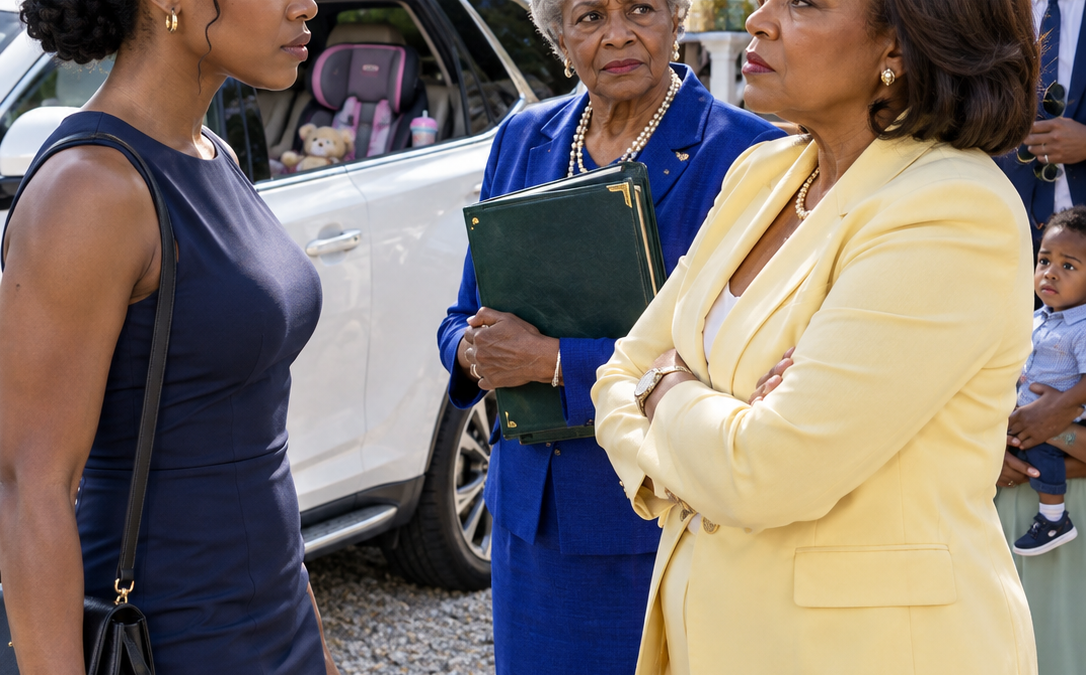
Three weeks ago, I stepped out of an Uber in my grandmother’s driveway while forty relatives watched from the porch. The white Lexus RX 350 my grandparents bought me for my twenty-fourth birthday was parked right there in the front circle.
My sister was driving it.
Her daughter’s booster seat was in the back. Her son’s toy truck was wedged under the passenger seat. And before I could even shut the Uber door behind me, my grandmother looked over her glasses and asked one calm question.
“Nadia, baby, why are you arriving in a rideshare? What happened to the SUV Walter and I gave you?”
The whole driveway went quiet.
My mother answered before I could open my mouth.
“Mama, Nadia let Mo’Nique use it. You know Nadia. She’s independent. Mo’Nique needed it more.”
My grandmother had a green leather binder tucked under her arm. Nobody on that porch knew she had spent the morning at the Maryland Motor Vehicle Administration with an attorney, two certified copies, and an affidavit with my name on it. Nobody knew she had already called Uncle Elijah and told him to bring his flatbed around at six sharp.
And nobody knew that the little silver keychain hanging from my sister’s purse still had my initials engraved into it.
N.B.
My name is Nadia Brooks. I am the daughter my family called selfish for keeping records, asking questions, and refusing to smile while they turned my inheritance into my sister’s convenience.
If you have ever been called independent by people who really meant available, stay with me. Tell me in the comments what your family always expected you to give up, because this one started with a car, but it was never only about a car.
I am twenty-nine years old. I live in Baltimore in a brick condo with radiators that hiss all winter and a kitchen window that looks out over an alley full of murals, trash cans, and one very judgmental orange cat.
I work in cybersecurity for a payments company near the harbor. Most days, I write threat models, review logs, and argue gently with product managers about why “we will fix it after launch” is not a security plan. I am good at my job because I do not trust convenient explanations.
That is funny now.
For years, I trusted every convenient explanation my family handed me.
We are a Black family from Prince George’s County, Maryland. My grandmother, Lillian Brooks, still lives in the white farmhouse in Upper Marlboro that my grandfather bought in 1984, back when he was running Brooks Electrical and my grandmother was teaching second grade.
The house has black shutters, a red front door, and a magnolia tree out front that drops leaves like it is trying to prove a point.
My grandfather Walter died two years ago. After the funeral, everyone expected Grandma Lillian to sell the house and move into a smaller place near my parents.
She did not.
She said she had spent forty years teaching children how to read and thirty-eight years married to a man who labeled every spare screw in the garage. If the house had survived the mortgage, the storms, and three generations of cousins, it could survive her being seventy-six.
That was Grandma Lillian. She did not announce strength. She made tea, put on lipstick, and did what needed doing.
My mother, Denise Brooks, is a realtor in Bowie. She wears cream blazers and soft perfume and speaks in the warm voice of a woman who can turn a cracked foundation into a “character opportunity.” She has spent my entire life managing appearances: church photos, family holiday cards, open-house smiles, the right table at the right brunch.
My father, Calvin, is an accountant. He is quiet in the way men get when they have been married to a louder person for too long. He does not lie easily, but he avoids truth with the discipline of someone doing taxes in April.
My older sister, Mo’Nique, is thirty-one. She is beautiful in the way people immediately organize themselves around. Pretty skin, perfect silk press, tiny waist after two babies, camera-ready laugh.
My mother understands Mo’Nique.
Mo’Nique wanted the things my mother understood. A house in a good school district. A husband with a job people could explain quickly. A baby shower with balloon arches. A Christmas card where everyone wore ivory.
Mo’Nique married Darius Carter six years ago. Darius works as a finance manager at Crown Ridge Motors in Laurel. He is smooth, polite, and has the kind of smile that makes people sign add-ons they did not walk in wanting.
They have two children, Jada and Malik.
I love those children. I want that clear before anyone twists the shape of this story.
Jada is five and asks questions like she is cross-examining the universe. Malik is three and believes every machine is either a truck or trying to become one.
They are not the villains here.
Children never are.
But in my family, children were often used as a receipt.
Mo’Nique has the kids. Mo’Nique needs the space. Mo’Nique cannot be expected to make things harder.
Nadia, you are single.
Nadia, you work from home sometimes.
Nadia, you do not understand what it is like.
Nadia, be flexible.
That word followed me around like a hand on the back of my neck.
Flexible meant I drove home after Thanksgiving, even when I was exhausted, because Mo’Nique’s kids needed to sleep in the guest room. Flexible meant I gave up the necklace Grandma Lillian had promised me for graduation because Mo’Nique cried that she had nothing sentimental to wear at her wedding rehearsal.
Flexible meant that when my company gave me a bonus, my mother asked whether I could help Mo’Nique cover Jada’s private preschool deposit “just this once.”
It was never once.
It was a family subscription plan with my name on the credit card.
The Lexus was different.
That was why it hurt the way it did.
On my twenty-fourth birthday, Grandma Lillian took me to dinner at the Copper Lantern, an old restaurant near Annapolis where she and Grandpa Walter used to go on their anniversary.
My grandfather was still alive then, but he had started walking slower. He came with us that night wearing his brown fedora and the navy cardigan Grandma hated because one cuff had a tiny burn mark from a soldering iron.
We ordered crab cakes and green beans and the sweet potato biscuits my grandmother claimed were too sweet, then ate two of them.
After dinner, Grandpa Walter cleared his throat. He had a way of clearing his throat before saying anything important, like he was asking the room for permission to be quiet.
“Walk with me outside, Nadia.”
In the parking lot, under a sodium light buzzing with bugs, sat a white Lexus RX 350 with a red bow on the hood.
I laughed first because it looked staged.
Then my grandmother handed me a small velvet pouch. Inside was a silver keychain engraved with my initials.
N.B.
My grandfather said, “You earned reliable.”
That broke me. Not the car. The sentence.
I had been driving a 2008 Civic with a driver’s-side window that sometimes needed encouragement and a trunk that collected rainwater if the car faced downhill. I was two years out of college, commuting to an entry-level security analyst job, still paying off loans, still proving I was fine because being fine made everybody comfortable.
Grandpa Walter put the key in my hand.
“Title is clean,” he said. “Your grandmother and I handled it. No loan, no strings. Keep maintenance records. Don’t let anybody talk you out of what’s yours.”
Grandma Lillian gave him a look.
“Walter.”
“What? I’m saying it plain.”
He said everything plain.
My mother did not.
A week after my birthday, we had Sunday dinner at my parents’ house. Mo’Nique and Darius came with baby Jada, who was teething and furious about it.
My mother made salmon, couscous, roasted asparagus, and a lemon cake she bought from a bakery but placed on her own cake stand.
The Lexus was parked out front. Everyone admired it.
Mo’Nique walked around it twice, hand on the hood, smiling in a way that did not reach her eyes.
“Must be nice,” she said.
Darius nodded. “Clean vehicle. Low mileage, too.”
My mother laughed lightly. “Your grandparents always did have a soft spot for Nadia.”
The sentence floated over the table later like steam.
After dinner, while Mo’Nique was changing Jada in the guest room, my mother touched my arm in the hallway.
“Sweetheart, let me put the original title in our safe.”
“Why?”
“Insurance. Estate paperwork. If there’s ever an accident, it is just cleaner if all the family documents are together.”
“Grandpa said I should keep it.”
Her mouth softened.
“Your grandfather worries. I am not taking anything from you. You will have a copy. The original will simply be protected.”
I was twenty-four.
I had spent my life being told I was mature.
Mature daughters do not make scenes over paper.
So I gave it to her.
She handed me a copy two days later in a manila envelope. I did not inspect it. I put it in my desk drawer at home with my tax forms and apartment lease.
For five years, that photocopy sat there like a harmless thing.
It was not harmless.
It was the cover story.
The trouble started in March.
My Lexus went in for what my mother called “routine service coordination.”
I know that sounds ridiculous now. At the time, it sounded like my mother being my mother.
She called me on a Tuesday morning while I was reviewing a suspicious login pattern from a vendor account.
“Darius says Crown Ridge can take a look at your SUV. There’s a software recall, something with the infotainment system, and he’ll get you a loaner.”
“I haven’t seen a recall notice.”
“He checked by VIN.”
“Why does Darius have my VIN?”
“Nadia, don’t interrogate. Help. I gave it to him from the insurance file.”
I should have stopped there.
Instead, I said, “Fine. When?”
The loaner turned into a rental sedan after two days. Then the rental became “just another week” because a part was delayed. Then my mother said the service department had found an electrical issue and it made sense to be patient because Darius was saving me money.
I work from home three days a week. My office is near the harbor. Parking is annoying. Rideshares are not impossible.
My mother knew all of that.
She built the lie around my convenience.
For almost ten weeks, I took rideshares, borrowed my father’s old Camry once, and paid for weekend rentals when I had to drive farther than the grocery store.
Every time I asked about the Lexus, my mother said Darius was handling it.
Darius never called me directly.
That should have told me something, but family trained me to think direct questions were rude if the answer might embarrass someone.
Three weeks before Grandma Lillian’s seventy-sixth birthday luncheon, I drove to Mo’Nique’s house in Bowie because Jada had a kindergarten readiness program and I had promised her a pink backpack with stars on it.
I rented a gray Nissan for the day, parked at the curb, and walked up the driveway with the backpack in one hand and a book for Malik in the other.
The garage door was open.
The white Lexus sat inside.
My white Lexus.
License plate ending 318.
The same tiny scratch near the rear bumper from the time I backed too close to the pole in my condo garage.
A purple booster seat was strapped behind the passenger seat. Malik’s toy excavator sat in the cup holder. A pack of wipes was wedged into the door pocket.
There was a glittery charm hanging from the rearview mirror that said, BLESSED MAMA.
For a second, my body did not move.
Mo’Nique came out carrying a basket of laundry.
She saw me.
She saw where I was looking.
Her face changed only a little, but sisters know little.
“Oh,” she said. “Mom didn’t tell you we switched.”
“Switched what?”
“Cars.”
“Mo’Nique, that’s my SUV.”
She shifted the laundry basket to her hip.
“I know. For now. Darius said the paperwork was clean. Mom said you were okay with it because you barely use it in the city.”
“Paperwork?”
“Nadia, please don’t start. Jada has pickup in twenty minutes.”
That was the moment I understood I was not walking into a misunderstanding.
I was walking into a decision already made without me.
I set the backpack on her porch.
“Here. For Jada.”
“You don’t want coffee?”
“No.”
“Nadia—”
I walked back down the driveway before I said something in front of her neighbors that could not be folded back into my mouth.
My hands shook so hard in the rental that I had to sit there with the engine off until Mo’Nique closed the garage door.
The sound of it rolling down felt like a curtain being dropped over a stage.
I drove back to Baltimore in silence.
No music. No podcasts. Not even anger yet.
Just the windshield, the road, and the feeling of my own body taking inventory.
That night, I called my mother.
She answered on the third ring.
“Hi, sweetheart.”
Not her home voice.
Her showing-a-house voice.
“Why is Mo’Nique driving my Lexus?”
There was the smallest pause.
Not long enough for a stranger to notice.
Long enough for a daughter.
“Oh. She told you.”
“Why is Mo’Nique driving my Lexus?”
“Nadia, lower your voice.”
“I am alone in my apartment.”
“Your tone is still aggressive.”
I laughed once.
It came out ugly.
“My tone is aggressive because my sister has my car.”
“Your sister needed it more.”
There it was.
The family hymn.
“She has two children,” my mother continued. “Her Pilot has been unreliable. Darius drives for work. You live in the city. You have rideshare. You work at a technology company. You told me yourself you barely drive during the week.”
“That does not make my car community property.”
“Do not talk like that. Nobody stole anything.”
“What paperwork did Darius process?”
“The transfer was handled properly.”
My throat went dry.
“Transferred temporarily? That is not how titles work.”
“Since when are you a vehicle-law expert?”
“Since my name was on the title.”
My mother sighed.
Not a worried sigh.
An annoyed one.
“Nadia, we discussed this. You agreed it made sense for Mo’Nique to have the SUV for the kids.”
“We never discussed that.”
“You forget things when work gets busy.”
I stood in my kitchen staring at the refrigerator. There was a magnet on it from the Copper Lantern. Grandma Lillian had bought it for me the night they gave me the car.
“Mom, what did you sign my name on?”
The silence changed.
That was answer enough.
Then she said, “You will not embarrass this family at your grandmother’s luncheon.”
Not, You will not accuse me.
Not, How dare you.
You will not embarrass this family.
“Her birthday is in three weeks,” she said. “She is seventy-six. She does not need stress because you are upset over transportation.”
“Transportation?”
She had reduced my grandfather’s gift to a ride.
“I want my car back.”
“We will talk after the luncheon.”
“No. We talk now.”
“Good night, Nadia.”
She hung up.
I did not sleep.
At two in the morning, I pulled the manila envelope from my desk drawer and looked at the title copy my mother had given me five years earlier.
It was not a certified copy.
It was a black-and-white scan on regular printer paper. The seal was muddy. The bottom corner was cut off. My address had one digit missing from the apartment number.
I sat there at my desk with the paper under my lamp and felt five years of trust rearrange itself into something colder.
The next morning, I called my father.
He picked up from his office. I could hear a calculator printing in the background, that little fast chatter like teeth.
“Dad, did Mom transfer my Lexus to Mo’Nique?”
He did not answer.
“Dad?”
He breathed in.
“Your mother said you understood.”
“Did you see me sign anything?”
“No.”
“Did you ask?”
“Nadia—”
“Did you ask?”
His chair creaked.
“You know how your mother is when she decides something.”
I closed my eyes.
That sentence had raised me.
It excused everything by making her personality weather.
“Dad, that car was in my name.”
“I know.”
“Grandpa bought it for me.”
“I know.”
“Then why are you speaking like this is a scheduling conflict?”
He did not answer for a long time.
When he did, his voice was lower.
“Your grandmother has been asking questions.”
My eyes opened.
“About what?”
“The Lexus. The title. Who has the original. She asked me last week whether I had ever seen your signature on a transfer form.”
“What did Mom say?”
“That you signed it.”
“And?”
“And your grandmother got quiet.”
Everybody in our family knew Grandma Lillian’s quiet.
My mother performed silence when she wanted people to chase her.
Grandma Lillian went quiet when she was building a file.
“Dad, did Grandma say anything else?”
“She asked if I still had the email you sent me from that security conference in Atlanta. The one about whether travel could be deducted because you were speaking.”
I remembered it.
April in Atlanta. Three-day conference. I had spoken on a panel about payment fraud and token theft.
I wore a cobalt blazer because Kesha from work said I looked like a person who should scare hackers politely.
“Why would she ask about that?”
My father exhaled.
“Because the transfer form is dated April eleventh.”
I sat down slowly.
April eleventh.
I had been in Atlanta on April eleventh.
“Dad, I have the hotel receipt.”
“Your flight confirmation, too. You forwarded them to me because you wanted me to check the reimbursement categories.”
“Send them to me.”
“Nadia, if I send them, your mother will know.”
“Only if you tell her.”
Another long silence.
Then my father said the bravest sentence I had ever heard from him.
“I will send them tonight.”
He did.
At 9:42 p.m., three emails landed in my inbox.
Southwest itinerary: Baltimore to Atlanta, April ninth. Return April twelfth.
Hotel folio from the downtown conference hotel.
Conference agenda showing my panel on April eleventh from 2:00 to 3:15 p.m.
There was even a photo from the company LinkedIn page. Me in that cobalt blazer, microphone in hand, name tag visible, standing under a screen that said, SECURING PAYMENT RAILS IN REAL TIME.
On the day I supposedly signed a vehicle transfer in Laurel, Maryland, I was standing on a stage in Georgia talking about fraud detection.
The irony was not subtle.
The next day at work, Kesha Morgan found me in the break room staring into a cup of coffee I had not drunk.
Kesha is a senior engineer on my team. She used to be a paralegal before switching careers, which means she reads contracts the way other people read menus.
She has short locs, red glasses, and the calm of a woman who has seen too many people confuse confidence with legality.
“You have looked at that coffee for nine minutes,” she said.
“I think my mother forged my name on a car title.”
Kesha did not blink.
She pulled out the chair across from me.
“Start at the beginning.”
I told her the short version.
Grandparents bought me the Lexus. Mom kept the title. SUV went in for service. Sister has it. Mother says I agreed. Transfer dated while I was at a conference.
Kesha listened without interrupting.
When I finished, she tapped one red fingernail on the table.
“You work in security.”
“I know.”
“If someone claimed you approved access to a production database on a day you were presenting in another state, what would you check first?”
“Access logs.”
“Exactly. Treat your family like a system that has already shown suspicious activity.”
That sentence did something for me.
Not because it was cold.
Because it was fair.
Systems do not get a pass because you love the admin.
That afternoon, I paid for a Maryland MVA online title record search. I entered the VIN from my insurance card, verified my identity, and waited while the portal loaded.
The record came back clean and cruel.
Vehicle: 2021 Lexus RX 350.
Current titled owner: Mo’Nique Brooks Carter.
Effective transfer date: April 11.
Transaction source: Crown Ridge Motors, Laurel.
Transfer type: immediate family transfer.
I stared at the page.
Immediate family.
As if that explained the theft.
I downloaded the report, printed it, saved a PDF, and put copies in three places: work laptop encrypted folder, personal cloud drive, external drive I use for tax records.
Old Nadia would have called my mother immediately.
New Nadia made a folder.
The next morning, I went to the MVA branch in Glen Burnie before work.
The waiting area smelled like wet coats and floor cleaner. A toddler cried near the vending machines. A man in a Ravens jacket kept arguing with a number on a screen as if the screen might apologize.
At window nine, a clerk named Mrs. Alvarez listened while I explained that I needed certified copies of two records: the original title history and the transfer form from April eleventh.
She asked for my ID.
I handed it over.
She typed for a long time.
Then she looked at me over the top of her glasses.
“You are saying you did not sign the transfer?”
“I am saying I was in Atlanta that day.”
“Do you have proof?”
“Yes.”
I showed her the itinerary and conference agenda.
She nodded once, the way women in government offices nod when they have decided to help you without making a performance of it.
“I can print certified copies. I can also give you the fraud affidavit form. I cannot give legal advice.”
“I understand.”
The printer behind her hummed.
When she slid the transfer form through the slot, I saw the signature before I read anything else.
Nadia B. Brooks.
It was close enough to be insulting.
My real signature has a sharp N because Grandpa Walter taught me cursive at his kitchen table with a pencil he sharpened using a pocketknife. He hated bubbly letters.
He said, “Your name should not look like it was trying to charm anybody.”
The signature on the form had a looped N. The B was wrong, too. Mine is narrow. This one looked inflated.
Then I saw the driver’s license number.
Two digits were transposed.
The address used was my old apartment from before I bought the condo.
The form listed in-person identity verification by Crown Ridge Motors.
Verified by employee code DC147.
Darius Carter.
For a moment, the room got quieter around me.
Not actually.
The toddler still cried. The number screen still beeped. Someone still argued about tags.
But inside my body, every sound moved far away.
Mrs. Alvarez slid over the affidavit.
“If you fill this out, sign in front of a notary. You can file here or through an attorney.”
“Thank you.”
She held my eyes for a second.
“Make copies.”
“I already do.”
For the first time that morning, she smiled.
I took the papers to my bank during lunch and had the affidavit notarized by a woman named Patrice, who stamped it with the kind of force that suggested she had opinions about fraud.
I did not file it yet.
Kesha told me not to.
“Once you file, formal notices start moving,” she said when I called her from the parking garage. “Your mother gets a chance to spin, panic, destroy messages, or prepare everyone. Right now, the record is clean because they think you are still being polite.”
“So I wait.”
“You wait until you decide what outcome you want.”
“I want my car back.”
“That is the small outcome.”
I sat with that.
“What is the big one?”
“You stop being the account everybody withdraws from.”
The following week, my mother acted like nothing had happened.
She texted me about Grandma Lillian’s birthday luncheon.
Remember, the dress code is Sunday best, but spring colors preferred.
Please come early to help with table cards.
Can you pick up the mini crab cakes from the caterer in Silver Spring?
Also, don’t bring up the Lexus. Your grandmother worries.
That last line almost made me laugh.
My grandmother did not worry.
She documented.
Mo’Nique texted, too.
Nadia, please don’t make Saturday weird. Mom said you’re still upset. The Lexus situation is temporary. You don’t have kids, so you really don’t understand how hard it is juggling everything.
I wrote back one sentence.
When will you return my vehicle?
She responded six minutes later.
We can talk after Grandma’s birthday. Please don’t be selfish this weekend.
Selfish.
The word landed differently now that I had certified paper in a folder.
Before, selfish had been a hook in my ribs.
Now it was a label printed by people who needed me easier to spend.
On Wednesday, Grandma Lillian called me at exactly 7:00 p.m.
She does not text. She says texting is where punctuation goes to lose its manners.
“Nadia.”
“Hi, Grandma.”
“Are you driving up Saturday?”
I looked at the folder on my desk.
“I am not sure.”
“Why not?”
There it was.
The opening.
I could have told her everything I wanted to, but my grandmother had a way of asking questions that made you answer only the part she needed.
“The Lexus is with Mo’Nique.”
Silence.
One second.
Two.
Paper moved on her end.
“Did you sign it over?”
“No.”
“Do you have papers?”
“Yes.”
“Bring nothing. Saturday.”
I blinked.
“Grandma—”
“You heard me. Bring nothing. No folder, no copies, no angry speech. Come as my granddaughter.”
“What are you doing?”
“Old woman work.”
“That is not an answer.”
“It is exactly an answer.”
I heard her pen scratch.
“Nadia, there are two kinds of people who keep records. People who are afraid of being lied about, and people who have decided nobody will lie about them twice. Your grandfather was the second kind. I learned late, but I learned.”
My throat tightened.
“Oh, Grandma. I have a notarized affidavit.”
“Good.”
“I have proof I was in Atlanta.”
“Better.”
“Should I file?”
“Not before Saturday.”
“Why?”
“Because your mother has spent years correcting you in rooms after you leave them. I would like her to try it while you are still standing there.”
That was the closest my grandmother came to sounding angry.
“Trust me,” she said.
So I did.
Saturday morning at 8:18, my door buzzer rang.
I checked the camera and saw Grandma Lillian standing in my building lobby wearing gardening sneakers, a beige trench coat, and a silk scarf tied neatly at her throat.
She held the green leather binder against her hip like a school principal about to end recess.
I buzzed her up.
She stepped into my condo, looked around, and said, “You need a plant in here.”
“Good morning to you, too.”
“Plants remind a house somebody intends to stay.”
She placed the binder on my kitchen table.
I stared at it.
I had seen that binder before.
Grandpa Walter used to keep it in the bottom drawer of his desk.
Green leather. Brass corners. Tabs labeled in his square handwriting.
Insurance.
House.
Business.
Vehicles.
Gifts.
Grandchildren.
After he died, Grandma Lillian started carrying it whenever family money came up.
My mother joked about it once.
“Mama and that old binder. Like the IRS in church shoes.”
Grandma had smiled.
“Better shoes than prison slippers.”
Nobody laughed, but nobody tested her that day either.
Now the binder sat on my table.
Grandma opened it to a tab marked NADIA.
Inside were copies of the original purchase receipt, the title application, the dealership invoice from the Lexus dealer, a handwritten note in Grandpa Walter’s block letters, and a photograph of me crying in the parking lot at twenty-four with the key in my hand.
I had never seen that photo.
Grandma touched it with one finger.
“Your grandfather took this. Blurry as sin. He was proud anyway.”
I swallowed.
“Grandma.”
“Answer one question.”
“Okay.”
“Did you give your mother permission to transfer that car to Mo’Nique?”
“No.”
“Did you sign any title paper?”
“No.”
“Did you tell Mo’Nique she could keep it?”
“No.”
Grandma closed the binder.
“Good. Put on something blue.”
“What?”
“You look steady in blue.”
I almost smiled.
“Is that part of the legal strategy?”
“It is part of the grandmother strategy.”
She drank coffee at my kitchen table. Cream, no sugar.
While she did, I got dressed: navy sheath dress, low heels, small gold hoops, hair twisted back.
I put on the pearl bracelet she had given me when I bought my condo.
At the door, she stopped me.
“Order a rideshare.”
“You drove here.”
“I know.”
“I can ride with you.”
“No.”
She tucked the binder under her arm.
“I need you to arrive in a way nobody can explain away.”
“Grandma, are you about to start something at your own birthday party?”
She looked at me for a long second.
“No, baby. Your mother started it. I am going to finish the paperwork.”
She left first.
I stood in my condo for ten minutes after she was gone, listening to the radiator tick even though it was too warm for heat, trying to decide if I was afraid or relieved.
At 3:42, I ordered an Uber.
The driver was a man named Felix in a black Camry. He asked if I was going to a wedding because of the dress.
I told him a birthday party.
“Big family?”
“Bigger than I feel ready for.”
He laughed.
“That is every family party.”
On the ride out of Baltimore, I watched row houses turn into highways, highways into shopping centers, shopping centers into roads lined with trees and churches and brick subdivisions.
Maryland in late spring is green enough to look generous.
That day, it felt like the whole state was holding its breath.
My phone buzzed twice.
Mom: Where are you? I need you to help Aunt Vivien with the seating cards.
Mo’Nique: Are you almost here? Please be normal today.
I did not answer either one.
The Uber turned into Grandma Lillian’s long gravel driveway at 5:11 p.m.
There were cars everywhere. Sedans along the magnolia trees. SUVs parked in grass. A catering van near the side gate. My uncle Marcus’s truck by the shed. Folding chairs under a white tent in the backyard. Gold balloons tied to the porch railings, bobbing in the breeze like cheerful little witnesses.
And at the front of the circle, parked where everyone arriving had to see it, sat my white Lexus.
Clean.
Detailed.
BLESSED MAMA charm hanging from the mirror.
My stomach went tight.
Felix stopped behind a blue minivan.
“You good?”
“Yes.”
It was not entirely true, but it was close enough for a stranger.
I tipped him through the app.
He pulled away slowly over the gravel.
My cousin Tia saw me first.
“Nadia, where’s your car?”
I heard two conversations pause.
My mother was on the porch in a pale yellow suit, greeting people like she owned the day.
Mo’Nique stood near the front door in a mint-green dress, holding Malik on one hip.
Darius leaned against the railing, sunglasses in his hand, talking to a cousin about interest rates.
My father stood behind my mother with a glass of iced tea and the posture of a man hoping weather would pass.
Grandma Lillian stepped out of the front door.
She wore a royal-blue dress and low black heels. Her silver hair was pinned back.
The green binder was tucked under her left arm.
She looked at the Uber disappearing down the road.
Then she looked at me.
“Nadia, baby,” she said clearly. “Why are you arriving in a rideshare? What happened to the SUV Walter and I gave you?”
No one moved.
Even the balloons seemed to stop shifting.
My mother laughed lightly.
“Mama, don’t make a thing of it.”
Grandma did not look at her.
She looked at me.
“I asked Nadia.”
That was the first crack.
Small.
Sharp.
My mother stepped closer anyway.
“Nadia let Mo’Nique use it. We handled it months ago. Mo’Nique needed something safe for the kids, and Nadia is so independent. You know how she is.”
Every word had been polished before it left her mouth.
My grandmother’s face did not change.
“Is that true, Nadia?”
My voice came out steadier than I felt.
“No, Grandma.”
Mo’Nique shifted Malik on her hip.
“Nadia—”
I kept looking at Grandma Lillian.
“I did not give Mo’Nique my SUV.”
My mother turned her smile toward the porch, trying to gather the room back into her version of normal.
“Sweetheart, you are confused. We discussed this in April.”
“No.”
“You signed the transfer.”
“No.”
“Darius handled the paperwork through Crown Ridge. Everything was proper.”
Grandma Lillian turned her head slowly toward Darius.
“Darius?”
He straightened.
“Yes, ma’am?”
“You processed the transfer?”
His smile flickered on.
“The dealership processed it. Standard immediate-family transfer. Nothing unusual.”
“Did Nadia appear in person?”
The porch air changed.
Darius glanced at Mo’Nique.
Mo’Nique looked at our mother.
My mother looked at Grandma’s binder.
“Mrs. Brooks,” Darius said, “with respect, this seems like something we could discuss privately.”
“With respect,” Grandma said, “my driveway is private property, and the car is parked on it.”
Aunt Vivien, my grandmother’s younger sister, appeared beside the porch column with a glass of lemonade in her hand.
She did not say anything.
She just stood close enough that Grandma did not look alone.
Grandma held out her hand.
“Keys, please.”
Mo’Nique’s eyes widened.
“Grandma—”
“Keys.”
Darius reached into his pocket slowly and pulled out the key fob.
The silver N.B. keychain caught the sunlight.
I heard someone behind me inhale.
Grandma took the keys from him and slipped them into the pocket of her dress.
“Thank you.”
My mother’s voice sharpened under the sugar.
“Mama, this is your birthday. People are here to celebrate you.”
“They are.”
“Then please do not do this.”
“Denise, you used my birthday to display a lie. I am using my birthday to correct it.”
That sentence landed across the porch like a hand on a table.
My father lowered his eyes.
Mo’Nique’s mouth parted, but no words came out.
Grandma walked to the small table beside the front door where someone had placed a vase of hydrangeas and a stack of birthday cards.
She set the green binder down, opened the clasp, and turned to the tab marked NADIA.
My mother whispered, “Mama.”
Grandma did not stop.
“When Walter bought Nadia that Lexus,” she said, “he paid cash from our vehicle account. Not from Denise. Not from Calvin. Not from family general funds. From the account your grandfather and I used for gifts we intended to belong to the person receiving them.”
She lifted one page.
“Purchase invoice. June eighteenth, five years ago. Buyer: Walter and Lillian Brooks. Gift recipient: Nadia Brooks. Vehicle identification number ending 7729.”
She lifted another page.
“Original title record. Titled to Nadia Brooks.”
My mother folded her arms.
“No one disputes that.”
Grandma looked at her.
“Then we can move quickly.”
A small sound came from Aunt Vivien.
Almost a laugh, but drier.
Grandma pulled out a third page.
“April eleventh of this year. Transfer processed through Crown Ridge Motors. New titled owner: Mo’Nique Brooks Carter. Transfer submitted as immediate-family transaction. Identity verified by employee code DC147.”
Darius’s face lost its salesman shine.
Grandma turned to him.
“That is you, correct?”
He swallowed.
“That is my employee code.”
“Did Nadia stand in front of you on April eleventh?”
“I don’t remember every transaction.”
“Try.”
My mother stepped forward.
“Mama, stop interrogating him. He was helping family.”
“Family is not a legal category that permits forgery.”
The word forgery changed everything.
Someone in the yard stopped laughing.
A cousin near the steps set down her plate.
Malik put his head on Mo’Nique’s shoulder, confused by the adults going too still.
I finally spoke.
“I was in Atlanta on April eleventh.”
My mother turned to me.
“Nadia, do not.”
I did anyway.
“My flight left Baltimore on April ninth. I returned April twelfth. On April eleventh, from two to three-fifteen p.m., I was speaking at a security conference. There are flight records, a hotel folio, a conference agenda, and photos.”
My mother tried to smile.
“You travel so much, sweetheart. Dates blur.”
“Not this one.”
“You signed before you left.”
Grandma looked down at the transfer form.
“The form says in-person verification on April eleventh.”
My mother looked at Darius.
Darius looked at the driveway.
Mo’Nique whispered, “Darius?”
He said nothing.
Grandma lifted two pages side by side.
“This is Nadia’s signature from the original title application. This is the signature on the April eleventh transfer. Look at the N.”
My mother did not look.
Grandma’s voice stayed gentle.
“Denise. Look at the N.”
My mother’s face hardened.
“Mama, I did what I had to do because Mo’Nique needed a safe car.”
The confession was not clean, but it was enough to make the porch shift.
My father closed his eyes.
Mo’Nique made a small, wounded sound.
“Mom.”
My mother turned toward her.
“Do not act surprised. You knew Nadia would make this about herself.”
I felt heat move up my neck.
Grandma placed the pages back into the binder.
“Nadia did not make this about herself. The title had her name on it.”
“She has a good job,” my mother said. “She has no children. She can afford rentals. Mo’Nique is drowning.”
I looked at my sister.
Her eyes were wet.
For one second, I saw the little girl who used to crawl into my bed during thunderstorms, not the woman who had driven my car for ten weeks while asking me to be normal.
“Mo’Nique,” I said. “Did you know I never signed?”
She looked at Darius.
He did not rescue her.
“Mom said you agreed.”
“After you saw me arrive in rentals?”
She pressed her lips together.
“I thought you were being dramatic.”
That hurt more than I expected.
Not because it was the worst thing said that day.
Because it was probably true.
My pain had been background noise to her for so long that she only heard it when it threatened convenience.
Grandma turned another page.
“This morning at 9:05, my attorney, Mrs. Pauline Mercer, met me at the Largo MVA office. Nadia’s notarized affidavit was filed with supporting proof of travel, proof of conference attendance, certified title history, and the transfer form.”
My mother stared at her.
“Nadia filed against me?”
“Nadia signed an affidavit stating the truth.”
“Against her family.”
Grandma closed the binder halfway, then opened it again as if deciding the lesson needed all its pages.
“Denise, you keep using that word as if family is a locked room. It is not. Family is not the place you get to commit wrong and demand privacy afterward.”
Behind my mother, Aunt Vivien nodded once.
Grandma continued.
“The MVA placed an administrative hold on the title record pending fraud review. Because the vehicle was originally purchased by Walter and me as a documented gift, and because the transfer was challenged with evidence, temporary title control has been moved into my name through my attorney’s office until the review closes. The Lexus will not be driven by Mo’Nique, Darius, you, Calvin, or anyone else.”
Darius took one step off the porch.
Grandma turned toward him without raising her voice.
“Do not walk away while I’m still speaking to you.”
He stopped.
That was the moment I realized every man on that porch had underestimated my grandmother because she carried peppermints in her purse and wore gardening shoes.
Grandma pulled out one final sheet.
“At 10:12 this morning, Mrs. Mercer sent a notice to Crown Ridge Motors Compliance Office and to the Maryland MVA Business Licensing and Consumer Services Division. It includes your employee code, Darius, the date of the transaction, and the identity-verification issue.”
Darius’s jaw opened slightly.
“Mrs. Brooks, I could lose my job.”
“Yes.”
“I have kids.”
“So does the woman whose car you helped take from her.”
He looked at me for the first time that day.
Not with apology.
With fear.
That was not the same thing.
Mo’Nique whispered, “Darius, what did you do?”
He rubbed his forehead.
“Your mom brought the title and Nadia’s ID copy. She said Nadia was fine with it. I thought it was family.”
“You verified her in person,” Grandma said.
He looked down.
“I checked a box.”
“You checked a box that had a person behind it.”
That sentence sat in the warm air with the smell of crab cakes drifting from the backyard tent.
My mother was crying now.
Not the soft open-house tears she used when a seller picked another realtor.
These were angry tears.
Cornered tears.
Tears that came because the room had stopped obeying.
“I have done everything for this family,” she said.
Grandma looked at her daughter with a sadness I had never seen before.
“No. You have managed this family like a listing. You staged what looked good and hid the damage.”
My father made a small sound.
Grandma turned to him.
“Calvin.”
He looked up.
“Did you send Nadia the travel records?”
My mother’s head snapped toward him.
“Calvin.”
My father held her gaze for one second, then looked at Grandma.
“Yes.”
The porch went quiet again.
Grandma nodded.
“Thank you.”
It was two words, but they changed something in my father.
His shoulders dropped like he had been carrying a bag he hated but could not put down.
My mother stared at him.
“You betrayed me.”
He spoke very quietly.
“I stopped helping you betray her.”
I had never loved him more than I did in that exact second, and I had never been angrier that it had taken him twenty-nine years to find it.
Both things can be true.
Grandma turned a page to a tab labeled FAMILY ACCOUNTS.
My mother saw the label and went still.
“Mama.”
“I am not finished.”
Grandma addressed the porch now, not like she wanted an audience, but like the audience had been forced into the lie and deserved the correction.
“After Walter died, I gave Denise limited authority to help manage birthday gifts, education contributions, and family reimbursements because I was grieving and did not want to learn every online portal alone.”
My mother wiped her cheeks.
“Mama, please.”
“That authority ended this morning.”
The words were quiet.
They hit hard.
“From today forward,” Grandma said, “all family distributions, gifts, advances, reimbursements, and trust-related matters go through Mrs. Mercer. Denise will not hold titles, checks, copies of identification, passwords, or original documents for any adult child or grandchild in this family.”
Aunt Vivien said softly, “Amen.”
Grandma looked at Mo’Nique.
“Mo’Nique, you are my granddaughter. I love you. I will not punish your children for adult dishonesty. I will still see Jada and Malik. I will still buy birthday books. I will still come to school programs when invited.”
Mo’Nique cried silently.
“But you will return every spare key, insurance card, toll pass, and document connected to Nadia’s Lexus. You and Darius will reimburse Nadia for every rental and rideshare connected to the ten weeks you drove her vehicle. Mrs. Mercer will send an itemized request.”
Mo’Nique covered her mouth.
“Grandma, we can’t afford that.”
“Then you should have chosen a smaller theft.”
The sentence was so calm that for half a second, I thought I misheard it.
Aunt Vivien did not.
She turned her face toward the magnolia tree and pressed her lips together like laughter would be disrespectful but tempting.
My mother stepped toward Grandma.
“You are humiliating us.”
Grandma’s eyes sharpened.
“No, Denise. Humiliation is when your daughter has to pay for rides while her sister installs car seats in the vehicle your father bought her. This is accountability.”
I had not cried yet.
That sentence came close.
Not because it was dramatic.
Because someone had finally named the shape of what happened without asking me to soften the edges first.
From the road came the low rumble of a diesel engine.
Grandma closed the binder.
“Right on time.”
Everyone turned.
Uncle Elijah’s flatbed truck rolled slowly into the driveway.
Uncle Elijah is not technically my uncle by blood. He was Grandpa Walter’s best friend, Grandma Lillian’s neighbor for thirty years, and the man who fixed every bicycle in our family without once accepting money.
In Black families like ours, uncle is sometimes a title earned by showing up more than a certificate.
He parked behind the Lexus, stepped down from the cab, and put on work gloves.
My mother whispered, “You called a tow truck?”
“I called Elijah,” Grandma said.
“Mama, people are eating.”
“They can chew and learn.”
Uncle Elijah walked up the driveway, nodded to me, nodded to Grandma, and did not ask a single question.
That is how I knew Grandma had told him enough.
Darius finally moved.
“Mrs. Brooks, I need to get the booster seat and Malik’s things.”
“You may remove the children’s belongings,” Grandma said. “Aunt Vivien will stand with you while you do.”
Aunt Vivien set down her lemonade gladly.
Mo’Nique followed Darius to the Lexus.
She moved like a person walking underwater.
Jada came running from the backyard with frosting on her chin.
“Mommy, why is Mr. Elijah taking our car?”
Mo’Nique froze.
My chest tightened.
I walked over before anybody else could make a child’s question carry adult shame.
“Hey, Jada Bug.”
She looked up at me.
“Aunt Nadia, is it your car?”
Children hear everything.
“Yes, sweetheart.”
“But we used it.”
“I know.”
“Are you mad at me?”
That almost broke me.
I crouched in my navy dress on Grandma’s gravel driveway and took her sticky little hand.
“No. I am not mad at you. Grown-ups made grown-up choices, and grown-ups are fixing them.”
She thought about that.
“Can I still ride with you one day?”
“Yes. With permission and a booster seat.”
That made her smile.
Behind her, Mo’Nique started crying harder.
I stood and let her have that moment without comforting her.
Some tears belong to the person who caused them.
Uncle Elijah loaded the Lexus onto the flatbed while half my family pretended not to watch and the other half stopped pretending entirely.
The rear wheels rolled up the ramp.
The BLESSED MAMA charm swung from the mirror until Aunt Vivien opened the door and removed it along with the booster seat, toy excavator, wipes, two snack cups, a library book, a cardigan that was not mine, and a toll transponder registered to Darius.
Then she handed me the silver keychain.
N.B.
It was warmer than I expected from sitting in the sun.
I closed my fingers around it.
For a second, I was twenty-four again in that Annapolis parking lot.
Grandpa Walter saying, “You earned reliable.”
I wished he had been there.
Then I looked at Grandma Lillian standing small and straight beside the porch with that green binder under her arm and realized part of him was.
Grandma addressed the guests.
“Thank you all for coming to celebrate my seventy-sixth birthday. I apologize that business interrupted the party. The food is paid for, the cake is coconut, and the tent has fans. Please stay if you are comfortable. If you are not, drive safely.”
Nobody moved for a few seconds.
Then Aunt Vivien clapped once.
“I came for coconut cake.”
That released the room.
People began making small sounds again. Plates moved. Someone guided the children back toward the yard.
A cousin I barely knew touched my elbow as she passed and whispered, “Check everything they kept for you.”
I nodded.
My mother stayed on the porch.
My father stood beside her but not in front of her.
That difference mattered.
Grandma turned to me.
“Nadia, will you help me inside?”
“Yes.”
We walked into the foyer together.
The house smelled like lemon polish, fried crab, and hydrangeas.
Family photos covered the wall.
There was Mo’Nique in cap and gown. Mo’Nique at her bridal shower. Jada as a newborn. Malik in a pumpkin costume.
There were photos of me, too, but fewer.
Me at high school graduation.
Me with Grandma and Grandpa at the Copper Lantern.
Me in the cobalt blazer from the conference, printed and framed in a small silver frame I had not noticed before.
Grandma saw me looking.
“Your father sent that.”
I swallowed.
“When?”
“Yesterday.”
From the porch, I heard my mother say his name.
“Calvin.”
Not angry this time.
Scared.
Grandma touched my wrist.
“Do not go out there to rescue either one of them.”
“I wasn’t.”
She lifted one eyebrow.
“You were thinking about it.”
I laughed despite myself.
“Maybe.”
“That habit is older than your hurt. It will take time.”
We went into her study.
Grandpa Walter’s desk still faced the window.
The green binder went back on it like a judge returning to the bench.
Grandma opened the bottom drawer and took out a sealed envelope.
“This is for you to take home after the review closes. Copies of everything, not originals. Originals stay with Mrs. Mercer until your clean title is issued.”
“Grandma, how did you know?”
She sat down slowly in Grandpa’s chair.
“Your mother asked me two months ago whether Walter and I had ever intended the Lexus to be considered a family asset.”
My stomach turned.
“What did you say?”
“I said no.”
“And she argued.”
“Of course she did.”
Grandma looked toward the window where Uncle Elijah was securing the last strap on the flatbed.
“Then Mo’Nique mentioned at Sunday dinner that her Pilot was unsafe. Darius made a joke about being able to fix paperwork faster than engines.”
“Everyone laughed?”
“Everyone except your grandfather’s sister, Vivien.”
“Aunt Vivien heard?”
“Aunt Vivien hears everything. She called me Monday morning.”
I sat in the chair across from the desk.
“Why didn’t you tell me?”
“Because I needed to know whether they had convinced you to call a theft generosity.”
That one hurt.
Not because it was unfair.
Because it was possible.
“I might have,” I admitted.
Grandma’s face softened.
“I know.”
We sat quietly while the party continued outside without us.
The sound of relatives trying to recover normal drifted through the window in pieces.
Who wants cake?
Where are the napkins?
Don’t let Malik near the punch bowl.
Life keeps moving even while a family myth collapses.
Two days later, Crown Ridge Motors called me.
Not Darius.
A compliance manager named Mr. Patel.
He spoke carefully, like every word had a legal pad underneath it.
He confirmed that the dealership had opened an internal review of the April eleventh transfer. He asked whether I would be willing to provide my travel proof and a statement.
I told him all communication could go through Mrs. Mercer.
That felt good.
Not powerful in a movie way.
Powerful in a boring adult way, which is often the only kind that lasts.
On Wednesday, Darius was suspended pending review.
By Friday, he was no longer at Crown Ridge.
Mo’Nique texted me that I had destroyed her family.
I stared at the message for a long time.
Then I wrote back:
Darius risked his job when he falsified identity verification. Mom risked your comfort when she asked him to. You risked our relationship when you kept driving my car after I asked for it back. I did not create those choices by naming them.
She did not reply.
My mother called me thirty-one times in the first week.
I did not pick up.
She left four voicemails.
The first was furious.
“Nadia, you have humiliated me beyond belief. You let your grandmother make a spectacle of this family over a vehicle.”
The second was wounded.
“Sweetheart, I have always tried to help both my daughters. You do not know what it is like to be a mother watching one child struggle while the other seems fine.”
The third was practical.
“Please call me. I need to know what documents your grandmother has and whether Mrs. Mercer is planning to contact anyone else.”
The fourth came late Sunday night.
No performance.
Just my mother’s tired voice.
“I did sign it. I told myself it was temporary. I told myself you would understand. I do not know why I keep doing that to you.”
I saved the voicemail.
I did not return it.
An apology that notices itself is not always ready to become repair.
My father emailed me on day nine.
Subject line: I AM SORRY.
The email was short.
Nadia,
I should have asked questions the first time your mother said the title had been handled. I should have sent the records before you had to ask. I am proud of how you stood there. I am sorry I made you stand alone for so many years.
When you are ready, I would like to take you to breakfast. No excuses.
Dad
I read it three times.
Then I printed it and put it in my own folder.
Not because paper fixes things.
Because sometimes you need evidence of the first true sentence.
The MVA review closed faster than I expected.
Mrs. Mercer called me eleven days after the party.
“Clean title has been approved,” she said.
I was at my desk, headset around my neck, a dashboard open with a suspicious login spike from a vendor integration.
“In my name?”
“Only your name.”
“No family insurance?”
“No.”
“No lien?”
“No.”
“No duplicate floating around?”
“Not one that matters.”
I leaned back in my chair and looked at the ceiling tiles.
My coworker Jamal rolled past in his chair.
“Good news or bad news?”
“My car is legally mine again.”
He gave me two thumbs up and rolled away without asking a single follow-up question.
That is why coworkers can sometimes be healthier than family.
They do not always think access comes with explanation rights.
That Saturday, I went to Grandma Lillian’s house.
The Lexus was parked in her garage, clean and quiet, like it had been holding its breath, too.
Uncle Elijah had detailed it after removing the car seats because, as he told Grandma, “That baby deserves to come home smelling like herself.”
The BLESSED MAMA charm was gone.
The glove compartment had a new registration card and a copy of the clean-title receipt.
The insurance card listed only my policy.
Grandma sat at the kitchen table with the green binder, a pot of tea, and a plate of shortbread cookies.
She had added a new page under my tab.
At the top, in her careful handwriting, she had written:
RESOLVED.
I touched the word.
“Grandma.”
“Walter liked clean endings.”
“This does not feel clean.”
“No. It feels true. Clean comes later.”
We drank tea.
Outside, two robins fought over the birdbath like tiny, angry politicians.
Grandma watched them for a while, then said something I will never forget.
“I owe you an apology older than this car.”
I looked at her.
“For what?”
“For knowing your mother measured you against Mo’Nique and telling myself it was not my house to correct.”
I shook my head.
“Grandma, you did not do this.”
“No. But I saw pieces.”
Her hands rested around her teacup.
“When you were nine, you won that science fair with the water filter made of sand and charcoal. Your mother left early because Mo’Nique had dance photos. Walter and I stayed. You pretended not to mind.”
I remembered the trifold board.
Blue ribbon.
Grandma taking me for ice cream afterward.
“When you were seventeen and got into that summer coding program,” she continued, “your mother said it was too expensive and then paid for Mo’Nique’s senior beach week. Walter wanted to fight her. I told him parents make their own choices.”
She looked at me with wet eyes.
“We were wrong.”
“Oh, Grandma.”
“Grown people should not watch a child become the family cushion and call it peace.”
I had no answer.
Sometimes an apology reaches a place you thought had scarred over and proves it was only numb.
Grandma slid the keychain across the table.
N.B.
“Take your car home.”
I closed my hand around it.
“Thank you.”
“You are welcome.”
“I am not going to Mom’s for Thanksgiving.”
Grandma nodded as if I had told her the mail came.
“You can come here.”
“Mo’Nique?”
“If Mo’Nique comes, she will behave. If she cannot behave, she can eat somewhere else.”
I laughed.
Grandma smiled a little.
“What?”
“You make boundaries sound like seating charts.”
“They are. Some people do not get placed near the silver.”
I drove the Lexus back to Baltimore that afternoon.
It felt familiar and strange at the same time.
The seat was mine, but adjusted wrong.
The mirrors were mine, but aimed for someone else’s eyes.
There were faint cracker crumbs in the seam where Malik’s seat had been.
I vacuumed them out at a gas station off Route 50.
Not because crumbs mattered.
Because I needed my hands to participate in taking my life back.
When I pulled into my condo garage, the orange alley cat was sitting near my parking space like an inspector.
“I know,” I told him. “About time.”
He blinked once, unimpressed.
That night, I changed three things.
First, I moved every important document into a fireproof lockbox in my own condo.
Passport. Birth certificate. Social Security card. Car title receipt. Insurance. Condo deed. Tax records.
No family safe.
No copies floating through my mother’s folders.
Second, I removed my mother from my emergency contact list at work and replaced her with Grandma Lillian and Kesha.
Third, I wrote a text to my mother.
I am not discussing the Lexus by phone. If you want a relationship with me, you will start with a written apology that names what you did. You signed my name without permission, transferred my vehicle, lied about my consent, and pressured me to stay quiet.
Do not ask me for money, documents, rides, or help managing Mo’Nique’s needs.
I will contact you when I am ready.
I sent it before I could soften it.
She responded the next morning.
That is very cold.
I did not answer.
Cold is what people call your boundary when they are used to warming their hands over your life.
Mo’Nique and I have spoken once.
She called from her car.
Not the Lexus.
I could hear traffic and Malik singing in the back seat.
“I am sorry,” she said.
I waited.
“I should have asked you directly.”
“Yes.”
“I told myself Mom knew what she was doing.”
“You always do.”
She was quiet.
“That is fair.”
I looked out my condo window at the mural across the alley. A huge painted woman with sunflowers in her hair.
“I love Jada and Malik,” I said. “That has not changed.”
“I know.”
“But I am not going to be the solution to your household emergencies anymore.”
“I know.”
“Do you?”
She cried then, softly.
“I am trying to.”
That was not enough for immediate repair.
But it was more than denial.
So I said, “Send me Jada’s dance recital date.”
She exhaled like she had been holding her breath all week.
“Okay.”
“I will come if Mom is not sitting beside me.”
“Okay.”
That is where we are.
Not healed.
Not destroyed.
Somewhere honest.
Which is new ground for us.
Darius sent one email through Mrs. Mercer.
It was short and legal-sounding.
He accepted responsibility for failing to verify identity, agreed to reimburse rental costs through a payment plan, and asked that I not pursue a separate civil claim while the administrative review concluded.
Mrs. Mercer asked what I wanted.
I thought about it for two days.
Then I said I wanted reimbursement, a written admission, and every document copy destroyed or returned.
I did not want a dramatic court fight if the title was clean and the record was corrected.
I wanted my life back more than I wanted to become the full-time manager of their consequences.
That is another thing nobody tells you.
Winning can still cost time.
So I chose the part of winning that gave me time back.
Grandma Lillian approved.
“Walter used to say, ‘Every fight sends you a bill,’” she told me. “Read it before you agree to keep fighting.”
The bill was too high.
I had paid enough already.
Last Sunday, I visited Grandma again.
She was in the garden wearing a straw hat and purple gloves, arguing with a tomato plant.
“It is leaning,” she said.
“Maybe it is independent.”
She looked at me over the rim of her glasses.
“Do not start.”
I helped her tie the plant to a stake.
Then we sat on the porch with lemonade while my Lexus sat in the driveway where everyone could see it.
No booster seat.
No charm.
No story attached to it except the true one.
Grandma reached into the pocket of her gardening apron and pulled out a new keyring tag.
Not silver.
Brass.
Plain rectangle.
On one side, it said:
N.B.
On the other, in small engraved letters:
NOT AVAILABLE.
I laughed so hard I had to put my lemonade down.
“Grandma. Too much.”
“No good?”
“Elijah made it.”
“Of course he did.”
I put it on the keyring beside the original silver one.
That is how I carry the lesson now.
One keychain for the gift.
One keychain for the boundary.
The SUV is just a vehicle.
Leather seats. White paint. A few miles added by people who had no right to add them.
But what happened around it showed me the whole family system in one clean diagram.
My mother thought my adulthood was still under her signature.
My sister thought need was ownership.
My brother-in-law thought a checked box was harmless if everybody at the dinner table benefited.
My father thought silence would keep peace.
My grandmother knew peace built on theft is only quiet damage.
And me?
I learned that being dependable does not mean being divisible.
I learned that a good job does not cancel loneliness, that being single does not make your belongings communal, that not having children does not make you less family, and that Black women are too often praised for strength by the same people handing them more weight.
I also learned to check every document, every title, every account, every copy someone else says they are keeping for safety.
Especially when the person says, “Trust me.”
I still have the photocopy my mother gave me five years ago.
I keep it in my lockbox now, not because it has legal value, but because it has educational value.
On the back, I wrote one sentence:
Never let someone protect a thing by removing it from you.
Grandma Lillian saw it and nodded.
“Walter would like that.”
“Would he be mad?”
“Maybe Walter would have shown up with Elijah and a bigger truck.”
I believe that.
I think about the driveway a lot.
The Uber pulling away.
My mother’s smile freezing.
Mo’Nique’s hand on Malik’s back.
Darius holding my keys like they were suddenly hot.
Grandma Lillian setting the green binder on that little porch table and making the whole family look at the paper trail.
They thought I was too busy, too polite, too independent to follow.
My favorite part is not the flatbed.
It is not Darius losing his job.
It is not even the clean title.
My favorite part is the question:
“Is that true, Nadia?”
Because my grandmother did something no one in my family had done for years.
She asked me in front of everyone.
Then she believed my answer.
That was the gift bigger than the Lexus.
That is my story.
One gifted SUV.
One forged signature.
One green binder.
One grandmother who knew the difference between keeping peace and keeping records.
If this reminded you of a document someone else is holding “for safety,” check it this week.
If you have ever been told someone needed your life more than you did, tell me what you took back.
Share this with the dependable person in your family, and subscribe if you want more stories about quiet receipts, loud consequences, and women who finally stop being available for theft.
I will see you in the next one.








