My parents chose my sister’s birthday party over my wedding, all 40 relatives went to her party, i married alone in a courthouse, 3 weeks later, my husband’s company went public, $50 million, mom called: “we need to talk about the family.”
My name is Belle Carter Powell, and I was 32 years old when I got married in a courthouse wearing a white dress that cost $89. No flowers from my mother, no aunties crying in the first row, no cousins taking pictures on the steps, no father walking me anywhere—not because we couldn’t afford a wedding.
My husband’s company was six weeks away from being valued at $50 million.
I got married that way because, on that same Saturday, 40 people from my family were across town at my sister Mariah’s 30th birthday party. My mother chose the birthday party. My father chose not to get involved. My grandmother went where my mother told her to go. My aunts, uncles, and cousins all showed up for Mariah in heels and suits while I stood in front of a judge with one friend holding grocery-store flowers.
Three weeks later, my husband’s company went public.
Six weeks after my wedding, my mother called me five times in one afternoon. When I finally answered, she said, “Belle, we need to sit down and talk about the family.”
But what she didn’t know was this: the morning after my wedding, while the family group chat was still full of cake pictures from Mariah’s party, I had opened my laptop and started preparing for that exact phone call.
The Carter family had always had a seating chart, even when nobody admitted it.
My mother, Deanna Carter, sat at the head of it. She wasn’t loud every minute. She didn’t have to be. Deanna could move a whole room with one look over the top of her glasses.
Mariah, my older sister, sat on her right hand. Mariah was pretty, bright, dramatic, and used to being watched. If she came into a room late, people acted like the room had been waiting on her.
My younger brother, Troy, sat on my mother’s left. Troy was the baby. Even at 28, he could fail a class, wreck a car, quit a job, or borrow money without a plan, and somebody would say he was just under pressure.
And me?
I was the daughter who refilled the serving dishes. The one who cleaned the kitchen after Sunday dinner. The one who remembered who was allergic to what, who needed a ride, who had a doctor’s appointment, who hadn’t paid their light bill yet.
Nobody called it using me. They called it depending on me.
There is a difference, but I didn’t learn that difference until much later.
My parents split when I was 11. My father, Clayton Carter, moved out first into an apartment, then into another state with a woman named Pette. For about two years, he sent birthday cards with $20 tucked inside. Then even that stopped.
My mother never said, “Your father leaving was your fault.” She was smarter than that.
She said, “You have his face.”
She said, “You get quiet just like him.”
She said, “That stubborn streak came straight from Clayton.”
After a while, I understood the translation. When she missed him, she resented seeing him in me.
Mariah didn’t carry his face. She carried my mother’s presence. Troy carried my mother’s worry.
I carried the silence.
By 13, I knew how to read a room before I entered it. By 15, I had a part-time job at a pharmacy and was using my own paycheck to cover little things my mother called “helping around the house.” By 16, I understood that if I needed something, I had better earn it or go without.
My mother forgot my 16th birthday.
She remembered three days later because Mariah asked if we still had paper plates left from her dance-team banquet. I was standing in the hallway when my mother looked at the calendar and made a small sound.
“Oh, Belle,” she said. “Baby, I have been so busy.”
She hugged me with one arm because she had a laundry basket on her hip.
I told her it was fine.
That was my first real talent: making other people comfortable with how little they gave me.
I left home at 18 with a scholarship, two duffel bags, and a plastic storage bin full of towels. Nobody drove me to campus. My mother said Troy had a summer-league game and Mariah needed help moving into her new apartment.
I carried my own bags up three flights of stairs.
That first semester, I worked in the tutoring center three nights a week and at a grocery store on Sundays. I majored in computer science because numbers made sense to me. Code made sense to me. If something broke, there was a reason. If you traced the reason carefully enough, you could fix it.
Families weren’t like that.
I graduated with a 3.9 GPA and no debt. My mother came to the ceremony because Mariah had posted about it online and made it look like the family had always supported me. Troy came late and asked if there would be food.
My father sent a text two days later that said, “Proud of you, kid.”
That was the whole message.
I saved it anyway.
After college, I moved into a small apartment with another woman from my program and took a job as a junior developer at a company that sold logistics software. I wasn’t flashy. I wasn’t a talker in meetings. I was the person who stayed late and found the bug nobody else could find.
That was how I met Ellis Powell.
It was 2019 at a technology conference in Atlanta. He was onstage explaining a platform his startup had built for small freight companies. I was sitting in the back with my laptop open because a client issue had followed me to the conference.
After his presentation, he walked by my table and asked, “Was it that boring?”
I looked up and said, “Your presentation was fine. Your database design is the part that made me nervous.”
He stared at me for one second.
Then he laughed so hard he had to sit down.
Ellis was quiet in a way that didn’t feel empty. He listened. He asked good questions. He didn’t confuse calm with weakness. He had grown up in a steady house in Virginia with two parents who loved each other and a grandmother who kept everybody honest.
He was the first man I dated who didn’t tell me to forgive my family before he even understood what they had done.
On our fifth date, I told him more than I meant to. The missed birthday. The way Mariah’s life had background music and mine had errands. The way Troy could empty my mother’s savings and still be called a sweet boy. The way my father existed like weather far away.
Ellis listened until I finished.
Then he said, “You know, you don’t have to keep auditioning for people who already assigned you the wrong part.”
I remember that because he didn’t say it like a slogan. He said it while wiping a drop of coffee off the table with his napkin, like it was just practical.
I loved him for that.
He proposed the next October on a walking trail beside the river. No crowd, no photographer hiding in bushes. Just him, me, and a ring he had designed with a small oval stone because he knew I didn’t like anything that caught on sweaters.
We set the wedding date for March 15th.
That date mattered because Ellis and his co-founder, Malcolm, were deep in paperwork for something they wouldn’t talk about publicly yet. The spring was going to be chaos. March 15th was the one clean weekend.
I called my mother the same night we chose it.
“Mom, Ellis and I are getting married.”
“Well, look at that,” she said. “Congratulations, baby.”
I waited for warmth to reach her voice.
It never did.
“March 15th,” I said.
There was a little pause.
Then she said, “March? Mariah has been looking at that weekend for her birthday dinner.”
“Her birthday is in March.”
“I know when I had her, Belle.”
I closed my eyes.
“This is my wedding, Mom.”
“And I said congratulations. But your sister is turning 30. That only happens once.”
I remember sitting on the edge of my bed with the phone pressed to my ear, looking at Ellis’s ring on my finger and feeling something cold move through me.
“A wedding only happens once, too,” I said.
My mother sighed like I was making an appointment difficult.
“You have always been more flexible than Mariah. Don’t start acting brand-new now.”
There it was.
Flexible.
That word had been wrapped around my neck since childhood.
Flexible meant I could move my graduation dinner because Mariah had rehearsal. Flexible meant I could skip my school play because Troy needed watching. Flexible meant I could give up my room for relatives because I was the one who wouldn’t complain.
Flexible meant nobody had to ask what I wanted.
I made 42 save-the-date cards by hand anyway. Cream cardstock, black ink, a small pressed-flower design in the corner. I wrote every address myself.
Aunt Loretta. Uncle Frederick. Cousin Haven. Grandma Josephine. Cousins I barely saw except at funerals and barbecues.
Every person who shared my history, even if they hadn’t shared much of my life.
I mailed them on a Tuesday morning before work.
Two weeks later, Mariah posted her official birthday invitation.
March 15th.
The Meridian Ballroom.
Three hundred guests.
The theme was Mariah’s Gold Season.
I stared at the post in the break room at work while the microwave behind me beeped three times. I didn’t move. I didn’t even blink at first.
Then I called my mother.
“She knew my date.”
“Belle, the deposit is paid.”
“I sent the cards before she booked that room.”
“Your sister has friends flying in. She can’t rearrange everybody because you and Ellis decided to do something small.”
“A wedding is not something small.”
“Well, you made it small.”
That sentence hurt more than I expected.
Maybe because it was the first honest thing she had said.
In her mind, if I didn’t turn my life into a performance, then my life didn’t need a crowd.
The RSVPs started coming back the next week.
No.
No.
No.
Forty-two cream envelopes went out.
Forty-two answers came back.
Not one yes from my family.
I sat at my kitchen table opening them one by one while Ellis stood behind me with his hand on the back of my chair.
Aunt Loretta wrote, “So sorry, sweetheart. Your mama said the date changed.”
Uncle Frederick wrote, “We’ll catch the next one.”
The next one?
Like I was rescheduling a dentist appointment.
Cousin Haven texted me instead of mailing the card back.
“Are you doing the wedding in April now? Auntie Deanna said March got canceled.”
I read that message three times.
Canceled.
I hadn’t canceled anything.
I called Aunt Loretta first because she was the one person in the family who still sometimes told the truth by accident.
“Auntie, who told you my wedding moved?”
There was a long silence.
Then she said, “Your mother called me, baby. She said you and Ellis had paperwork trouble and the ceremony was pushed back.”
“Did she tell everyone?”
“I don’t know everyone, but she told me, and she told your grandmother while I was on the phone.”
I hung up and sat there with the cards spread over the table.
My mother hadn’t simply chosen Mariah’s party.
She had cleared the road for it.
She had taken my wedding off the family calendar without asking me.
Before I go on, tell me where you’re listening from tonight. I want to know where this story is reaching. Because that night at my kitchen table, I felt like my whole life had been reduced to 42 little envelopes, and not one person in my family could hear me.
Ellis came home late that night from another meeting with Malcolm. He found the envelopes in piles on the table.
Accepted.
Declined.
Returned.
Questions.
The accepted pile had one card in it.
Nia Brooks, my best friend from college.
Nia hadn’t even waited for the card. She called the day I told her and said, “Tell me the time and where to stand.”
Ellis picked up Aunt Loretta’s card, read it, and put it down gently.
“What do you want to do?” he asked.
Not, “Do you want me to call them?”
Not, “Let’s just move the date.”
Not, “Maybe your mother misunderstood.”
Just the only question that gave the day back to me.
“I want to marry you on March 15th,” I said. “Even if it’s just us and Nia.”
Ellis nodded once.
“Then that’s what we’re doing.”
His phone rang around ten. Malcolm’s name lit the screen. Ellis stepped into the bedroom, but the apartment was small, and I heard pieces through the door.
“Filed.”
“Six weeks.”
“Lockup.”
“Quiet until legal clears it.”
When he came back out, he looked tired and lit from the inside at the same time.
“Everything okay?”
“It will be,” he said. “I can’t talk about it yet, but soon.”
I didn’t push. Ellis had always been careful with confidential things. That was one of the reasons I trusted him.
In my family, words were used to move people around.
With Ellis, words were used when they were true.
I gathered the RSVP cards and put them in a shoebox. The last one, number 42, I slipped into my wallet.
I don’t know why.
Maybe because it had my own handwriting on it.
Maybe because I needed one piece of proof close to me.
March 15th came on a clear Saturday morning.
At 7:40, I stood in front of the bathroom mirror in my $89 dress. It was simple, knee-length, and a little loose at the waist. I had steamed it twice because one crease near the hem refused to quit.
Ellis wore a navy suit he usually saved for investor meetings. He looked nervous in the sweetest way, like he was about to sign something more important than any company paperwork.
Nia arrived with a bouquet from a grocery-store floral case. White daisies, yellow centers, one bent stem she kept trying to hide.
“Stop fussing with it,” I told her.
“I refuse to let a crooked daisy ruin your wedding pictures.”
“Nia, we’re going to a courthouse.”
“A courthouse can still respect a bouquet.”
She made me laugh, and that laugh saved me from crying.
The judge’s office smelled like coffee, printer ink, and lemon cleaner. There were plastic chairs against one wall and a bulletin board with jury-service notices pinned crooked.
The ceremony lasted nine minutes.
At 8:06 in the morning, I became Belle Powell.
Nia cried hard enough that the judge handed her a tissue box.
I didn’t cry.
I thought I would, but I didn’t.
I felt clear.
Sad, yes.
But clear.
Afterward, we stood on the courthouse steps. Nia took pictures until a woman walking by offered to take one of all three of us.
In the photo, Ellis is smiling at me. Nia is wiping her cheek. I’m holding the daisies like they’re worth more than diamonds.
By 8:30, we were eating breakfast tacos in Ellis’s car because it had started to drizzle.
It was still one of the happiest mornings of my life.
That night, I opened Instagram.
Mariah’s party looked like a movie premiere.
Gold balloons. A champagne wall. A three-tier cake. A DJ. My cousins in cocktail dresses. My grandmother sitting at a table with a gold sash that said QUEEN OF THE FAMILY.
Then my mother appeared in a video holding a microphone.
“To my beautiful firstborn,” she said, “the girl who has always brought light into this family.”
I watched five seconds.
Then I closed the app.
I didn’t post my wedding pictures. Not that night.
Not because I was ashamed.
Because I was tired of presenting proof of my life to people who had already decided it didn’t count.
The next morning, I woke at 6:12. Ellis was already at the office for what he called a pre-market legal review. I made coffee and checked my phone.
No calls from my mother.
No text from Mariah.
No congratulations from Troy.
No awkward message from my father.
The family group chat had 19 new messages.
All of them were about Mariah’s party.
Cake pictures. A short video of Troy dancing.
My mother wrote, “What a night. My baby girl deserved every second.”
My baby girl.
I sat at the kitchen table with coffee cooling beside me and the shoebox of RSVP cards still on the chair.
That was when I opened my laptop.
I typed a title at the top of a blank document.
Declaration of Financial Independence.
I didn’t know if those were the right legal words.
I only knew I wanted one piece of paper that said what I had never been able to say at Sunday dinner.
I am not your emergency fund.
I am not your backup plan.
I am not the daughter you ignore until a bill comes due.
At 9:15, I called Nia.
“I need a lawyer,” I said.
“For Ellis?”
“No. For me. Something about family money, boundaries, a document they can’t twist.”
She didn’t ask me to explain twice.
By lunch, she sent me the name of Desmond Pierce, a civil attorney she had used when her aunt tried to put her name on a loan without permission.
That same night, at 2:04 in the morning, Troy texted me.
“Congrats or whatever. You still know people at banks, right? Need you to look over something for me quick.”
I stared at that message in the dark.
My brother hadn’t come to my wedding.
He hadn’t written my husband’s name.
He hadn’t used the word married.
But he wanted me to look at his finances before sunrise.
I didn’t answer.
Three weeks went by.
My family said nothing.
No card. No apology. No “We heard there was confusion.” No “Your mother told us wrong.”
Nothing.
Silence can be cruel when it’s used as punishment. But this silence was worse because I don’t think they were punishing me.
I think they had simply moved on.
I used those weeks.
Desmond Pierce met me in a small office above a dental clinic. He was a narrow man with silver glasses and a voice that made people stop interrupting themselves.
I told him I didn’t want to sue anybody. I didn’t want a restraining order. I didn’t want drama.
“I want a clear record,” I said. “If my family comes asking for money, I want my answer written before they arrive.”
He leaned back and tapped his pen once against a yellow pad.
“Then we write a declaration. Not magic. Not a court order. But clear, signed, notarized, harder to bully than a conversation.”
The first draft was one page.
It stated that I, Belle Carter Powell, would not co-sign loans, credit cards, leases, bail bonds, business debts, mortgages, or refinancing documents for any member of the Carter family.
It stated that I would not provide gifts over $100 per calendar year.
It stated that I would not be used as collateral, reference, guarantor, emergency contact for financial obligations, or promise of future payment.
It stated that any request for money had to be made in writing and would be considered declined unless I replied otherwise in writing.
Desmond looked at me over his glasses.
“This won’t make them respect you.”
“I know.”
“It’ll make your answer harder to confuse.”
“That’s enough.”
He notarized the final version on a Wednesday.
I watched the seal press into the paper and felt a strange calm come over me.
Some women keep wedding bouquets.
I kept a notarized boundary.
On April 5th, Ellis’s company went public.
The startup he had built with Malcolm had spent three years in a cramped office above a print shop, then another two years in a co-working space with broken air conditioning.
I had joined as employee number seven 18 months before the IPO.
I wrote code for the product.
I sat in meetings.
I missed dinners.
I carried my laptop to Thanksgiving because the system had failed in three states at once.
The opening share price was $14.
By the end of the day, the company closed at $19.
The valuation landed around $50 million.
Ellis held close to 8%. On paper, his stake was worth a little over $4 million before taxes, restrictions, and all the careful rules people forget when they see a headline.
I had my own equity, too.
Not Ellis’s amount, but enough to make me sit very still at my desk while everyone around me cheered.
At the office, people hugged. Malcolm opened champagne in paper cups. Somebody put the stock ticker on the break-room television. A junior engineer cried because her options had become real money.
Ellis found me near the coffee machine.
“It’s real,” he said.
His eyes looked almost scared.
“It is.”
“What do you want to do tonight?”
“Go home. Order Thai. Turn off both phones.”
He smiled like that was exactly why he married me.
That night, we ate noodles from cardboard containers on the secondhand couch we had owned since our first apartment. The financial news was on mute.
We watched our company name crawl across the bottom of the screen and said almost nothing.
“We should start looking at houses,” Ellis said.
“I have a spreadsheet.”
He laughed into his container.
“Of course you do.”
Nobody in my family knew yet.
I didn’t tell them.
I wasn’t hiding my life.
I was protecting the first quiet thing I had ever built without asking for their blessing.
Four days later, a local business site published an article.
The Atlanta Startup That Just Crossed $50 Million.
Ellis’s photo was in it. Malcolm’s, too. My name showed up halfway down as an early engineer.
The article mentioned our IPO, our client contracts, the valuation, and the fact that several early employees now held meaningful equity.
Somebody from my old job shared it on LinkedIn.
Somebody else tagged Ellis on Facebook.
By lunch the next day, Mariah had dropped the article into the family group chat.
“Wait, is this Belle’s husband?”
Aunt Loretta wrote, “The one she married?”
Uncle Frederick wrote, “I thought they moved the wedding.”
Troy sent three money-bag emojis.
My mother wrote, “Call me, Belle.”
That was the whole message.
Then my phone rang.
Mom.
I let it ring.
She called again.
Then again.
By the fifth call, I answered.
“Hi, Mom.”
“Belle, honey, how are you? How is married life?”
Honey.
She hadn’t called me honey since she needed me to watch Troy on school nights.
“Married life is fine.”
“I’ve been meaning to call you. Things got so busy after Mariah’s party, and then your father had some travel issues, and you know how family can get.”
I waited.
She didn’t say wedding.
She didn’t say courthouse.
She didn’t say I’m sorry.
“Why are you calling?” I asked.
She took a breath that sounded rehearsed.
“We need to sit down and talk about the family.”
There it was.
The same word they had forgotten on March 15th had suddenly become heavy in her mouth.
“What about the family?”
“Troy is going through a difficult time. Some financial things have gotten ahead of him. We’ve all been trying to help, but now that things are changing for you and Ellis, I thought maybe we could talk like adults.”
“Changing how?”
“Belle.”
She said my name in the tone she used when I was supposed to stop making her say the ugly part.
“The article?” I asked.
“It’s wonderful news. We’re all so proud.”
That was a new lie.
I almost admired how fast she built it.
“When?”
“This Saturday.”
“Your place?”
“Maybe. We’re moving.”
That silence was quick and sharp.
“Moving where?”
“I’ll send you the address.”
“Is Ellis going to be there?”
“It’s my family, Mom. You’re talking to me.”
She didn’t like that. I could hear it in the tiny pause before she said, “All right, baby. Saturday.”
We closed on the house 11 days after the IPO.
$3.8 million.
Five bedrooms. Two acres. Tall windows in the living room that made the afternoon light fall in long white strips across the floor.
We didn’t buy it to impress anybody.
We had saved hard for years. Ellis had sold a small portion of pre-IPO shares in a planned secondary sale months earlier. I had my own salary and equity. We had financial advisers, tax counsel, and more spreadsheets than any newly married couple probably needed.
Still, the first day I walked through that empty house, I had to stand in the foyer and breathe.
For years, I had lived like stability was something I had to borrow for a few minutes at a time.
Now I was standing under a ceiling so high my footsteps echoed back at me.
The first thing I hung on the wall wasn’t art.
It was our marriage certificate.
The courthouse seal in the lower corner.
My name.
Ellis’s name.
March 15th.
The certified copy cost $27.
The frame cost $12.
It hung just inside the entryway where any person walking into that house would see it before they saw the staircase or the kitchen or the view.
That wasn’t an accident.
I wanted my mother to walk into a $3.8 million house and face the $27 piece of paper she had treated like nothing.
Two days before the meeting, Nia sent me a text.
“Call me when you can. This is ugly.”
I called from the floor of the new living room because our furniture hadn’t arrived yet.
“I found Troy,” she said.
“What does that mean?”
“Online gambling boards. Sports-betting threads. He used the same handle from his old gaming account. I know I shouldn’t have gone digging, but after that 2:00 a.m. bank text, I got a bad feeling.”
Nia was a data analyst.
She could find a pattern in a junk drawer.
She sent me screenshots.
I read them sitting cross-legged on hardwood with my back against the wall.
The posts weren’t all under his real name, but the pieces fit. Same username he had used for years. Same birthday. Same city. Same references to our mother, our sister, and one post about my “tech brother-in-law.”
The debt was worse than I expected.
Online poker.
Sports betting.
A private loan from someone he called D.
$45,000 from my mother’s retirement account.
$20,000 from Mariah.
$15,000 from Grandma Josephine.
Smaller amounts from friends who had stopped answering him.
Total: $180,000.
Then I found the post that made my hands go cold.
It was dated March 15th.
My wedding day.
Troy had written:
“My sister just married a tech dude. Once that money clears, I am straight.”
I read it once.
Then again.
Then a third time, because sometimes pain makes you check the words like maybe they’ll become different.
While I was holding daisies on courthouse steps, my brother was telling strangers online that my marriage would fix his debt.
I saved every screenshot in a folder.
I printed the March 15th post.
I printed the debt totals.
I printed the family group chat where nobody had mentioned my wedding until money entered the room.
Then I called Desmond.
“If I show them these papers, am I doing anything illegal?”
“If the posts are publicly accessible and you aren’t using private account access, you can show them,” he said. “But don’t threaten. Don’t demand. Don’t promise treatment or payment. Make your boundary, keep your voice calm, and if anybody gets aggressive, end the meeting.”
“That sounds simple.”
“Simple isn’t the same as easy.”
He was right.
Thursday night, I printed four copies of the declaration.
One for my mother.
One for Mariah.
One for Troy.
One for my father, because my mother had informed me he was coming too.
I hadn’t seen Clayton Carter in four years.
He lived in Washington by then. He had missed my high school graduation, my college graduation, and my wedding, but apparently he could travel when Troy’s debt needed a fatherly voice in the room.
Each copy went into a white envelope.
I wrote their names in black ink.
Deanna.
Mariah.
Troy.
Clayton.
Ellis came into the kitchen while I was lining them up on the island.
“Do you want me downstairs Saturday?”
“No,” I said. “Stay close, but let me do it.”
He nodded.
“If you need me, call.”
“I will.”
That was all.
No speech.
No trying to be the hero.
He understood that the money had brought them to our door, but the wound was older than money.
Friday night, I slept on a mattress on the bedroom floor because the furniture delivery was scheduled for Saturday morning.
I woke around 2:00 and couldn’t go back to sleep.
I opened my phone and ended up in old photos.
There was one from when I was 11, holding a science-fair certificate.
Second place.
I was smiling so hard my cheeks looked sore.
Behind me was a school gym wall and a table with paper cups.
No mother.
No father.
No siblings.
That was the week my father left. My mother had meetings with lawyers. Mariah had a sleepover. Troy was with a neighbor.
I walked home with the certificate bent in my backpack.
I kept scrolling.
Every picture had the same shape.
Me holding something I had earned.
Nobody beside me.
Mariah’s dance photos filled albums. Troy’s football pictures lived on my mother’s living-room wall.
My wins lived in old phone storage, waiting for me to remember them by accident.
I almost called my mother.
I really did.
My thumb hovered over her name while I sat on that mattress in a house she hadn’t seen yet.
For one tired second, I wanted to give her one more chance to say, “Belle, I know. I heard you.”
Then my screen lit with a family group-chat notification.
Troy: “Does the new house have a pool?”
Mariah: “Ask about the guest rooms, too.”
Mom: “Everybody stay focused. Saturday, we’re going for Troy.”
Not one word about my wedding.
I put the phone facedown and went back to sleep.
Saturday morning, the movers arrived at 8:10.
I had planned it that way.
The meeting was at one. By then, the house wouldn’t look like a stage set.
It would look like mine.
The crew brought in the dining table first. Dark wood. Ten seats.
Then the sectional, bookshelves, lamps, rugs, a bed frame, boxes of dishes.
The whole house seemed to fill itself in a few hours.
At 10:45, I showered and put on a navy blazer, a white blouse, and dark pants.
Not expensive.
Not showy.
Just serious.
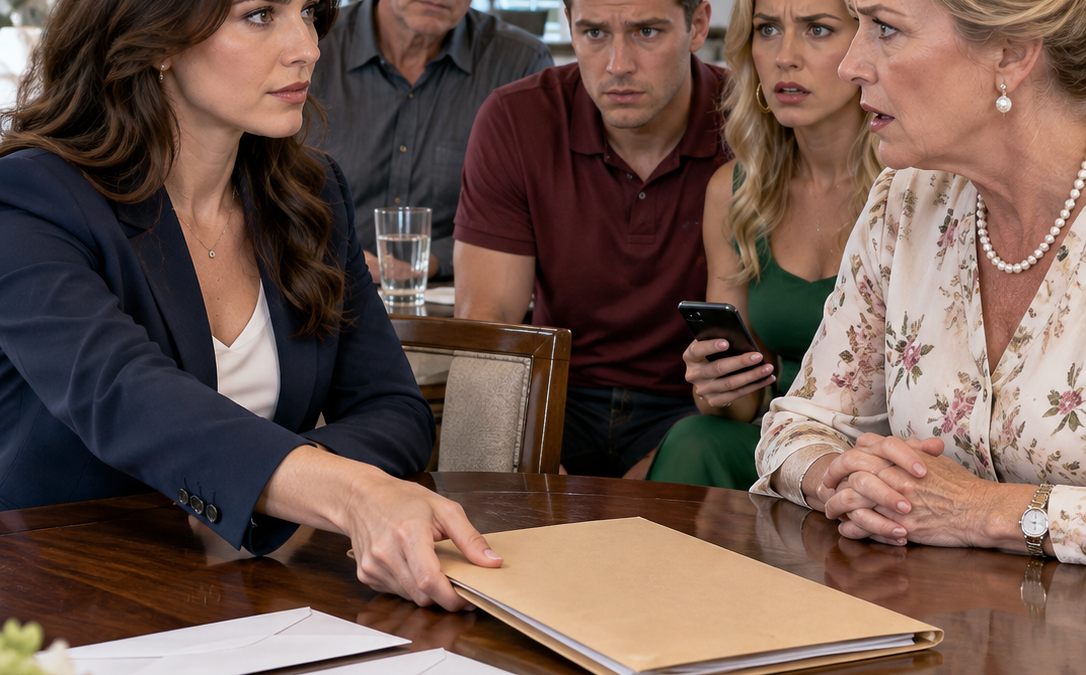
At 11:15, I placed the four envelopes on the dining table.
At 11:20, I placed the folder of screenshots beside my chair.
At 11:30, I checked that the marriage certificate was straight in its frame.
At noon, Ellis came downstairs and looked at the table.
“You ate?”
“Not much.”
He made me toast and eggs anyway.
I ate half because he stood there waiting until I did.
At 12:55, I poured one glass of water and set it at my place.
At 1:07, the doorbell rang.
Seven minutes late.
That was my family.
I opened the door.
My mother stood first in a cream floral blouse and pearl earrings.
Deanna always dressed soft when she intended to be hard.
Mariah stood behind her in a fitted green dress, her phone already in one hand.
Troy wore a wrinkled polo shirt and the restless look of a man who hadn’t slept.
My father stood at the back with his hands in his pockets, eyes on the porch boards.
For one second, nobody moved.
Then my mother smiled too wide.
“Belle,” she said. “Look at you.”
“Come in.”
They stepped across the threshold.
I watched the house hit them.
My mother saw the tall ceiling first, then the stone floor, then the living room.
Mariah’s eyes moved over the light fixtures, the staircase, the windows—the kind of fast inventory she did when she was measuring herself against another woman.
Troy looked around like a man pricing objects.
My father looked at the marriage certificate.
His eyes stopped on the date.
March 15th.
He looked away first.
My mother saw it next.
Her smile flickered.
Just a little.
“This is beautiful,” she said. “When did you all even find time?”
“Sit down,” I said. “We can talk at the table.”
I offered water.
Nobody accepted except my father.
They sat.
I took the head of the table.
The white envelopes lay in front of them, unopened.
My mother folded her hands.
“I want to start by saying we’re proud of you.”
“No.”
Her eyebrows lifted.
“No. Start with why you came.”
Mariah shifted in her chair.
Troy stared at the envelope with his name on it.
My father’s ice clinked in his glass.
My mother inhaled through her nose.
“Fine. Troy has had a hard year.”
Troy rubbed his hands over his face.
“Some investments went bad,” she continued. “Some obligations piled up. We’ve all helped where we could.”
“What kind of investments?”
“Belle, don’t do that.”
“Do what?”
“Make this into an interrogation.”
“You came to my house to ask for money. I get to ask what the money is for.”
Mariah leaned in then, using the soft voice she used when she wanted credit for being reasonable.
“Belle, nobody is saying you don’t, but this is family. Troy is in real trouble.”
“How much?”
My mother answered.
“$180,000.”
The number sat on the table like something alive.
I picked up my pen and wrote it on the legal pad.
$180,000.
“Owed to whom?”
“Various people,” my mother said. “Banks. Some credit cards. Some bookmakers.”
Troy’s head snapped up.
My mother’s lips pressed together.
“That word is unnecessary.”
“It’s the correct word.”
Mariah looked at me with irritation now. Her old impatience had come back.
“You know, the way you’re acting is exactly why people say money changes people.”
I looked at her.
“What people?”
“Everybody can see this house. Belle, you married into money, and now you want to sit above us with a legal pad.”
For a moment, the whole room went still.
Even my mother glanced at Mariah like she had gone too far too soon.
I set the pen down.
“I worked two jobs through college. I graduated without debt. I was employee number seven at Ellis’s company. I wrote code for the platform that went public. I have equity in my own name. Don’t reduce my life to who I married because that story is easier for you.”
Mariah blinked.
She had expected me to defend Ellis.
She hadn’t expected me to defend myself.
I opened the folder.
The sound of paper changed the room.
Troy sat up straight.
“Before we talk about what you think I owe,” I said, “we’re going to talk about what you planned.”
I placed the first printout on the table.
“This is a public post from a gambling forum. The date is March 15th. My wedding day.”
Troy stared at it.
His face changed in pieces.
Confusion.
Recognition.
Fear.
I read the line out loud.
“My sister just married a tech dude. Once that money clears, I am straight.”
No one moved.
The house was so quiet I could hear the refrigerator kick on behind me.
My mother reached for the paper.
I let her take it.
“That could mean anything,” she said.
“It means Troy was counting on my marriage paying his debt before anybody in this room bothered to congratulate me.”
“You don’t understand what I was going through,” Troy said.
His voice was rough, but not loud yet.
“Then explain it.”
He looked at my mother.
That told me enough.
She took over.
“He made mistakes. Gambling can become an illness. You think I don’t know that? You think I’ve slept well? I pulled $45,000 from my retirement, Belle. Mariah gave twenty. Your grandmother gave fifteen. We’ve all been drowning.”
“And nobody called me until the article came out.”
“Because we didn’t want to burden you.”
I almost laughed.
Not because it was funny.
Because the lie was so tired it could barely stand.
“Troy texted me at 2:04 the morning after my wedding asking about banks.”
Troy looked down.
My father spoke for the first time.
“Maybe we need to lower the temperature.”
I turned to him.
“Clayton, you came here to lower a temperature you helped create by being absent for 20 years.”
He flinched.
I didn’t enjoy it.
That surprised me.
Some part of me had imagined that truth would feel like release.
Mostly, it felt like placing a heavy box exactly where it belonged.
“You didn’t come to my high school graduation. You didn’t come to my college graduation. You didn’t come to my wedding. But you got on a plane when Troy needed $180,000.”
He looked at the table.
“Your mother said it was serious.”
“It was serious when I got married, too.”
He nodded once.
Small and ashamed.
My mother saw the shame and stepped over it.
“This is not about your wedding.”
“It is about my wedding because you erased it and then came here saying family.”
Her face hardened.
“I didn’t erase anything.”
I reached into the folder and took out the next pages.
“Aunt Loretta told me you called her and said the ceremony moved. Cousin Haven texted me asking if April was the new date. Two other relatives wrote the same thing on their RSVP cards. I called the Meridian Ballroom. They had open dates all through March. Mariah booked March 15th after my save-the-dates went out.”
Mariah’s mouth parted.
“You called the venue?”
“Yes.”
That one word seemed to bother her more than any speech could have.
People who lie to quiet women often count on quiet meaning unprepared.
I was done being useful in silence.
I put the venue notes beside the forum post.
“Here’s the order,” I said. “I announced my wedding date. Mariah booked her birthday party on that date. Mom called relatives and told them my ceremony was postponed. Forty people went to the party. Nobody checked with me. Then, when Ellis’s company went public, this family found my phone number again.”
Troy pushed back from the table.
“So what? You want an apology before you help? Fine. I’m sorry. Everybody’s sorry. Can we handle the real problem now?”
“No.”
The word came out calm.
He stared at me.
“No?”
“No.”
My mother leaned forward.
“Belle, listen to me. Troy could lose everything. This private lender, this man, whoever he is, he is not patient. I’m scared. I’m telling you that honestly. I’m scared for my son.”
For the first time that day, her voice cracked in a way I believed.
I did believe she was scared.
I believed she had lain awake counting numbers she couldn’t fix. I believed she had taken money from retirement because watching Troy panic had broken something in her.
I believed she loved him.
That was the hard part.
People can love one child and still use another one to pay the bill.
“If Troy is in danger,” I said, “then he needs to go to the police or to an attorney. If he has a gambling addiction, he needs treatment. If he owes illegal lenders, he needs professional help. A check from me will not make him safe. It will only teach everybody at this table that my marriage is a cash drawer.”
My mother wiped under one eye.
“You sound so cold.”
“I sound clear.”
“I did the best I could with you.”
That line landed because I knew there was some truth in it.
My mother had worked hard. She had packed lunches, paid rent, kept lights on, and stretched grocery money. She had raised three children with more fear than help.
But hard work doesn’t erase harm.
“You worked,” I said. “I know that. I’m not denying it. But you also taught me that my needs were always easier to move than everybody else’s. You taught me to be grateful for crumbs because other people needed the plate.”
Her tears came then.
Real tears.
Quiet at first, then harder.
“I should have come,” she said.
The room changed.
Mariah looked down.
My father closed his eyes.
Troy stopped rubbing his hands.
“I should have come to the courthouse,” my mother said. “I know that. I knew it that morning. I was standing at Mariah’s venue watching them set out gold napkins, and I knew I should have been somewhere else.”
For one dangerous second, I felt hope.
Not forgiveness.
Hope.
Then she looked up at me and said, “So help me now. Don’t punish me for one mistake by letting your brother drown.”
There it was.
The turn.
An apology used as a bridge back to my wallet.
I stood.
My chair scraped against the wood floor.
I walked to the kitchen island, picked up the four envelopes, and returned to the table.
“Open them.”
Mariah did first.
Then my father.
Then my mother.
Troy waited until everyone else had torn the flap before he opened his.
They unfolded the single sheet.
My mother read slowly.
Mariah skimmed, went back, and read again.
My father held the page with both hands.
Troy said, “What is this?”
“My answer.”
“Declaration of Financial Independence,” Mariah read.
“Yes.”
My mother looked at me over the page.
“You had this drawn up the week after my wedding?”
“After my wedding.”
“Against your own family?”
“For myself.”
She swallowed.
I read the main lines aloud so there would be no pretending later.
“I will not co-sign any loan, debt, mortgage, lease, bail bond, refinancing, credit card, or financial obligation for any member of the Carter family. I will not provide monetary gifts over $100 per calendar year. I will not act as guarantor, collateral contact, emergency financial reference, or promised source of future payment. Any request for money must be made in writing and is considered declined unless I answer in writing.”
The notary seal sat at the bottom.
My signature was in black ink.
The room had no music.
No cheering.
No gold balloons.
Just four people reading a boundary they couldn’t interrupt.
Troy threw his copy down.
“You can’t be serious.”
“I am.”
“You live in this house now and you’re talking about $100?”
“Yes.”
“You owe us more than that.”
“For what?”
“For being family.”
“You were family on March 15th, too.”
His jaw tightened.
“You always do this. You keep score. Perfect little Belle with her grades and her receipts and her little lawyer papers.”
“I learned to keep records because people in this family rewrite stories.”
He stood so fast his chair rocked backward.
My father reached out but didn’t touch him.
“You think you’re better than me?”
“No.”
“Yes, you do.”
“I think I’m not responsible for your gambling debt.”
He stepped toward my side of the table.
Upstairs, a floorboard creaked.
Ellis appeared at the top of the stairs.
He didn’t come down.
He didn’t puff his chest.
He simply stood there with one hand on the railing, watching.
Troy looked up at him, then back at me.
The math arrived in his face.
He was in my house, asking for my money, raising his voice at my table, while the man he had called “a tech dude” stood close enough to hear every word.
Troy sat down.
My mother whispered, “Troy.”
He shoved the envelope away, but stayed quiet.
Mariah was the next to speak.
“You know what bothers me?” she said. “You act like we all sat in a room and plotted against you.”
“Did you?”
Her eyes flashed.
“No.”
“Then why March 15th?”
“Because it was available.”
“It was available because you booked it after my cards were mailed.”
“It was my birthday.”
“Your birthday was March 2nd.”
“It was my 30th.”
“And it became more important than my wedding because everybody already knew how this family worked.”
She looked toward our mother, waiting for help.
My mother didn’t speak.
That was the first time all day Mariah looked uncertain.
I took one more paper from the folder.
“The venue coordinator wrote the available March dates down for me. So you had March 8th, March 15th, March 22nd, and March 29th as options. When you paid your deposit, you chose the one date I had already mailed out.”
Mariah’s face went still.
“That woman had no right to give you that.”
“She didn’t give me your contract. She confirmed dates.”
“That was enough.”
“You embarrassed me by calling.”
I almost snorted.
“You embarrassed yourself by making the call necessary.”
My father covered his mouth with one hand.
He wasn’t hiding a smile.
He was hiding shame.
Mariah folded her arms.
“Fine. I was angry.”
The words were small, but they were the first real ones she had offered.
“About what?”
“About you getting married first.”
My mother closed her eyes.
There it was.
Not all of it.
But a layer.
Mariah stared at the table as she spoke.
“I was with Kevin for six years, and he still hadn’t set a date. You meet Ellis, and suddenly there’s a ring and a date and a man who looks at you like you’re the only person in the room. Everybody was going to ask me questions at your wedding. I knew they would.”
Her voice cracked at the last sentence.
For a second, I saw my sister without the spotlight she usually carried.
I saw a woman terrified of being pitied beside my happiness.
It didn’t excuse her.
But it made the shape of the damage clearer.
“So you took the room,” I said.
She wiped at the corner of her eye with one finger.
“I didn’t think everyone would skip yours.”
“You knew Mom told them it moved.”
She didn’t answer.
That was an answer.
My mother sat straighter.
“Enough. We’re not dragging Mariah through this. She made a mistake. I made mistakes. We can talk about all that later. Right now, Troy needs help.”
“No, Mom. Right now, Troy needs consequences.”
Troy laughed once.
Ugly and short.
“Consequences. Easy to say from a mansion.”
“This house didn’t erase what you did.”
“You got lucky.”
I looked at him until he looked away.
“I got tired.”
That was the closest I came to a speech.
My mother picked up the declaration again, her hands trembling.
“If you refuse to help, I may lose my house.”
“Then you need a financial counselor.”
“I used my retirement for him.”
“That was your choice.”
“I’m your mother.”
“And I’m your daughter.”
That stopped her.
For a long moment, she looked at me like she had forgotten that second sentence could stand on its own.
“When I was 12,” I said, “you made me miss my school play because Troy had a fever and Mariah had rehearsal. You told me I was mature enough to understand. When I was 18, you didn’t drive me to college because Mariah needed furniture picked up. When I got married, you told people it was postponed because Mariah needed a full room. Now Troy needs $180,000, and you’re calling it family again.”
She whispered, “I was trying to survive.”
“So was I.”
The quiet after that was different from the quiet before.
Before, they had been waiting for the next opening.
Now there was nowhere easy to go.
My father finally put his copy of the declaration down.
“Belle,” he said, “I’m sorry.”
My mother shot him a look.
He ignored it.
“I should have been there for more than the wedding.”
I wanted his apology to feel bigger.
I wanted it to repair something.
But it arrived small and late, wearing a wrinkled shirt and sitting beside a glass of water he had barely touched.
“Thank you,” I said.
That was all I could give him.
My mother turned on him.
“Clayton, now is not the time.”
“It’s exactly the time,” he said quietly. “We’re sitting in her house asking her to save all of us from choices we made without her.”
My mother looked betrayed.
Maybe she was.
People who are used to directing the story don’t handle it well when a supporting character speaks.
Troy stood again, slower this time.
“I need air.”
“Take your envelope with you,” I said.
He glared at me.
“Keep it,” I said. “You’ll need to remember my answer.”
He shoved it into his pocket and walked to the front door.
In the entryway, he stopped under the marriage certificate.
For one second, he looked at it.
Then he said without turning around, “I didn’t know Mom told everybody it moved.”
I believed him.
Mostly.
Troy could be selfish and still not know every lie told for him.
“Now you do,” I said.
He left.
The door closed hard, but not a slam.
Mariah stood next.
She picked up her purse, then put it down again.
“I saw one of your wedding pictures,” she said.
I waited.
“Nia posted it in her private story. You were standing on the courthouse steps.”
“I didn’t know she posted it.”
“Just close friends. I saw it because we still follow each other from college.”
Her mouth pressed into a thin line.
“Your dress looked pretty.”
The room seemed to hold its breath.
It wasn’t an apology.
It wasn’t enough.
But it was the first time my sister had looked at something of mine without trying to shrink it.
“Thank you,” I said.
She nodded, picked up her purse, and left with her envelope folded in half.
My father stood after her.
He walked to the entryway, then turned back.
“I don’t know how to fix 20 years.”
“You probably can’t.”
He nodded like he deserved that.
“Can I send you a birthday card this year?”
The question was so small it almost hurt worse.
“You can send it,” I said. “I’m not promising anything else.”
“Fair.”
He left.
Then it was just my mother and me at the table.
Ellis had gone back into the office upstairs. I heard the door close softly.
My mother sat with her envelope in front of her.
Her mascara had smudged under one eye.
The floral blouse looked less like armor now.
“I did call Loretta,” she said.
I looked at her.
“And your grandmother. And Frederick.”
“Why?”
She stared at the certificate in the entryway even though she was too far away to read it.
“Because if they all went to your wedding, Mariah would have been humiliated.”
“And if they all went to Mariah’s party?”
She didn’t answer.
“Then I would be humiliated quietly,” I said.
Her face trembled once.
“You always seemed like you could handle things.”
“I could handle them because nobody came.”
She put one hand over her mouth.
For once, I didn’t comfort her.
That was new.
She stood slowly.
“I don’t know who you are right now.”
“I do.”
She looked at me for a long time, as if she were deciding whether to bless me or punish me.
“If you send us away with nothing, I may never be able to forgive you.”
There it was.
The oldest weapon in our house.
Her absence.
For most of my life, the threat of losing my mother would have made me fold. It would have made me apologize for having needs. It would have made me search my pockets for money, time, labor—anything that could buy the room back.
But something had changed on March 15th.
She had already been absent on the day I needed her.
I looked at her and said, “Then that will be your boundary.”
She blinked.
“Mine is on the paper.”
Her eyes filled again, but the tears didn’t fall.
She walked to the entryway, stopped under the marriage certificate, and reached toward the frame.
For a second, I thought she might touch it.
She didn’t.
She let her hand drop, opened the door, and left.
The house became still.
Four chairs sat crooked around the dining table.
Four water glasses.
Only one used.
The folder was open to Troy’s March 15th post.
The legal pad still had $180,000 written on it in my handwriting.
I sat at the head of the table and drank the water I had poured before they arrived.
It had gone warm.
Ellis came down a few minutes later.
He didn’t ask if I had won.
That wasn’t what had happened.
He sat beside me in the chair nobody had used and took my hand.
“Are you safe?” he asked.
“Yes.”
“Are you okay?”
“Not yet.”
“Okay.”
We sat like that until the light moved across the floor.
After a while, I reached into my wallet and pulled out the last save-the-date card.
Number 42.
Cream cardstock, bent at one corner.
My own handwriting softened from being carried around for weeks.
Belle Carter and Ellis Powell.
March 15th.
I opened the fifth envelope, the copy of the declaration I had kept for myself, and slid the card inside.
Not to make a symbol out of it.
Just to keep the facts in the same place.
The invitation they rejected.
The boundary they couldn’t move.
Six months later, Troy entered a gambling treatment program after a lender took him to court over a smaller loan he had ignored.
The program wasn’t fancy.
It was state-funded, crowded, and strict.
My money was never used.
My mother sold her house in September and moved into a one-bedroom condo about 40 minutes from our old neighborhood. She told some relatives I had abandoned the family in a crisis.
Some believed her.
Some didn’t.
Aunt Loretta called me one evening while I was folding towels.
“Baby, I should have checked with you,” she said. “I’m sorry.”
I thanked her.
I didn’t pretend it erased anything.
Cousin Haven sent a message, too.
“If I had known the wedding was real, I would have come.”
That one made me cry because I believed her.
Mariah texted me in October.
“I should not have booked that date.”
Six words.
No apology with my name in it.
No mention of the phone calls or the lies.
But still, six words closer to truth than she had been before.
I didn’t answer right away.
I waited three days and wrote, “No, you should not have.”
She sent back, “I know.”
That was where we left it.
My father sent me a birthday card in November.
No money inside.
No long letter.
Just a card with a lighthouse on it and his handwriting.
“Happy birthday, Belle. I hope you are well. Dad.”
It was the first birthday card he had sent in almost 20 years.
I kept it in a drawer.
Not because it fixed anything.
Because sometimes a small, honest thing is still worth keeping.
Ellis and I settled into the house slowly.
Nia came over on Fridays and complained that our kitchen was too nice for people who still ate tacos over the sink.
We adopted a terrier mix named Biscuit, who chewed the corner of a rug that cost more than my wedding dress, which felt almost funny.
My lockup period ended in October. I worked with a financial adviser to diversify my equity.
The adviser wasn’t a cousin.
Not a family friend.
Not somebody my mother recommended.
And that alone felt like peace.
The family group chat stayed muted.
I didn’t delete it.
I just stopped letting it call me into rooms where I was only useful when somebody needed something.
The marriage certificate still hangs in the entryway.
Most mornings, I walk past it without stopping.
That’s how I know healing is real.
Not because the paper stopped mattering, but because I no longer need to stare at it to prove the day happened.
Sometimes I still think about that $89 dress.
It hangs in a garment bag in the back of my closet.
The hem is still a little wrinkled.
One tiny coffee spot sits near the side seam from the breakfast tacos after the ceremony.
I used to think that stain was sad.
Now I love it.
It reminds me that the best part of my wedding wasn’t who missed it.
It was who stayed.
Forty-two cards went out.
Forty-two answers came back.
Four envelopes sat on my table.
And one $27 certificate still hangs on my wall in a house built by two people who understood the value of showing up.
My family wanted to talk about family only after money made my number worth dialing.
I finally answered with a paper they couldn’t bend.
If this story made you think of someone who keeps being called selfish for setting a boundary, share it with them. Subscribe, and tell me in the comments if you believe family should still have access to your wallet after they refuse to show up for your life.








