My older sister made my life hell while my parents defended her. i left at 18 with one bag. five years later, mom called crying: “your sister needs you.” then i heard why and started laughing.
My name is Patricia Vega. I’m 23 years old.
When I was 18, my parents emptied the $7,800 I had worked three years to save for nursing school and handed every dollar to my older sister. Then my mother looked me in the eye and said, “She’s your sister. You can spare it. Stop being so selfish.”
When I refused to smile and thank them, they told me I was the problem in this family and ordered me to leave.
I walked out that night with one bag.
Five years later, my mother called me near midnight, sobbing.
“Your sister needs you.”
I laughed because the girl they threw away with one bag was no longer the one who said yes. And the reason they needed me now was the last thing any of them expected.
Before I tell you what made me laugh, if you enjoy stories about justice and family boundaries, take a second to like and subscribe—but only if this already hits you. Where are you watching from right now, and what time is it there? Drop a comment and let me know.
Now, let me take you back to the house I grew up in, because you can’t understand the laugh until you understand the rule.
There was one rule in our house, and everyone lived by it without ever saying it out loud.
Megan came first.
Megan always came first.
She was five years older than me, and by the time I was old enough to notice anything, the pattern was already set like concrete. If Megan wanted the last of something, she got it. If Megan broke something, I had somehow provoked her. If Megan and I both wanted the same thing, the “fair” solution was always that I gave it up.
My mother had a sentence for those moments, and she used it so often that it stopped sounding like words.
“She’s your sister. You can spare it.”
I heard that sentence over a bicycle when I was seven. I heard it over a spot on a school trip when I was ten. I heard it over my own bedroom when I was twelve and Megan decided she wanted the bigger room.
My father carried my mattress down the hall while I stood there holding a lamp, waiting for someone to ask if I minded.
Nobody asked.
Nobody ever asked.
My father, Steve, had a different way of not helping. He didn’t argue with my mother. He just found something to do with his hands—a drawer that needed fixing, a gutter that needed clearing. He would drift out of the room the second a conflict started, and by the time he drifted back, it was already settled.
And settled meant I had lost.
I used to think he disagreed with her privately. It took me a long time to understand that silence in a house like ours is not neutral.
Silence is a vote.
I want to be honest about Megan, because it would be easy to make her a cartoon, and she wasn’t one. She was charming when she wanted to be. She could make my mother laugh until she cried. She remembered people’s birthdays and sent long, warm messages that made everyone feel chosen.
That was the thing about her.
She could give you the exact feeling you were starving for, right up until the moment she needed something. Then the warmth turned off like a switch, and you realized it had always been a transaction.
When I was nine, Megan took a bracelet our grandmother had given me before she passed. It wasn’t expensive. It was a thin silver chain, and it was the only thing I had that felt like it was only mine.
Megan wanted it. She wore it to a party and lost it.
When I cried, my mother sat me down and explained that I was making my sister feel terrible. Didn’t I love her? Wasn’t a bracelet a small price to pay for peace in the family?
I was nine.
I said I was sorry.
I apologized to the person who lost my grandmother’s bracelet.
That’s how deep the training went.
There was a phrase they started using around that time, and it followed me for the next decade.
“You’ve always been the strong one.”
My mother said it like a medal she was pinning on me.
“Patricia is the strong one. Patricia can handle it. Megan is sensitive. Megan needs more. But Patricia? Patricia will be fine.”
I believed it because when you’re a child, the story your parents tell about you becomes the story you tell about yourself. I thought being the strong one meant I was loved for something real.
It took me years to understand.
It wasn’t a compliment.
It was a job description.
Being the strong one meant I was the one who gave. It meant my needs were the ones that could always be postponed. It was the reason they could keep taking, dressed up as praise so I’d say thank you while they did it.
There’s one afternoon I think about more than the others.
I was fourteen, and I’d won a small award at school for a science project. Nothing huge. A ribbon and my name read out at an assembly.
I came home lit up, holding it, and found my mother on the phone in the kitchen, upset. Megan had gotten into an argument that had blown up into a crisis by our family’s standards.
My mother covered the phone with her hand, looked at the ribbon, and said, “Not now, Patricia. Your sister’s having a hard time.”
I put the ribbon in a drawer.
Nobody ever asked to see it again.
I learned that day that good news from me was an interruption and bad news from Megan was an event. I filed it away with everything else, and I got very good at not needing anyone to look at my ribbons.
What I didn’t understand at fourteen was that a house runs on whatever it rewards.
Ours rewarded Megan’s chaos with attention and my steadiness with more to carry. So Megan learned to make chaos, and I learned to carry.
We were both just doing what got us love.
Only one of us was getting any.
The first time I watched the whole machine run at full speed, I was fifteen.
Megan, twenty, got into trouble. Money she owed. A situation my parents whispered about in the kitchen after I went to bed.
I remember my father saying, “We handle family problems inside this family.”
I remember my mother’s voice, calm and final. And I remember that whatever it cost to fix Megan’s problem, the household got tighter afterward.
The thing that got cut was the thing that had my name on it.
I didn’t understand yet that there was a pattern with a shape.
Megan falls. The family scrambles. And somehow, when the dust settles, I’m the one who paid.
I would learn that shape by heart.
I just didn’t know at fifteen that it would come for the one thing I was building to save myself.
I started saving when I was fifteen. I want you to understand what that means because it matters later.
I got a job at a diner off the highway the month I turned fifteen. I worked weekends, then weeknights when I could get them, bussing tables and eventually waiting tables. I opened a savings account so I could put the money somewhere it wouldn’t get spent on groceries or gas or Megan.
Because I was a minor, the bank needed an adult on the account. So my mother’s name went on it next to mine.
A joint account.
I didn’t think twice about it.
I was fifteen. You don’t imagine your own mother as a risk.
For three years, I put almost everything I made into that account. I skipped things other kids didn’t skip. I told myself it was worth it because that money was a door.
It was community college.
It was the nursing program I’d already looked up, the prerequisites I’d already mapped.
By the fall I turned eighteen, I had $7,800 in that account. I used to check the balance just to feel it.
$7,800.
Every shift for three years, one tip at a time.
It was the most solid thing in my life.
That same fall, Megan fell again.
She lost her job. She lost her apartment. She was pregnant near the end of it. And she came home the way she always came home—as an emergency that reorganized the entire house around her.
I felt for her. I did.
Whatever else was true, she was scared. There was a baby coming. I wasn’t cold to that.
But I also felt the air change, the way you feel the pressure drop before a storm. And I knew, the way you know a thing in your body before your mind admits it, that a bill was about to come due.
It was going to have my name on it.
My mother sat me down in December.
She didn’t ask.
That’s the part people don’t believe when I tell it.
She informed me.
She said Megan needed a fresh start for the baby’s sake, that family takes care of family, and that they had already moved my savings to help her get set up.
Already moved.
Past tense.
$7,800 gone before the conversation started.
Because her name was on the account, she didn’t need my permission.
I asked how she could do that. I asked what I was supposed to do about school.
My mother looked at me with something close to disappointment, like I was the one behaving badly.
Then she said the sentence.
“She’s your sister. You can spare it. Stop being so selfish.”
I didn’t yell.
I want you to know that.
I’ve replayed that night a thousand times, and I didn’t yell.
I just stopped.
I stopped nodding. Stopped softening my face. Stopped performing the gratitude that was the price of staying.
I said quietly that it wasn’t fair.
That was all.
That it wasn’t fair.
My mother’s face closed like a door.
She said that if I couldn’t be grateful, if I was going to bring this kind of attitude into the house at a time like this, then maybe I was the real problem in this family.
And then she said the thing I never thought she’d say.
She told me to go.
I looked at my father.
He was standing in the hallway, half in shadow, and for one second his mouth opened.
I waited.
I gave him that second.
He closed it and looked at the floor.
Megan was on the couch, one hand on her belly. As I passed her with my bag, she said something I’ve never forgotten.
Not “sorry.”
Not “stay.”
She said, “You’ll be back. You always come back.”
I packed one bag, a canvas duffel, the kind you throw in a car trunk. I put in clothes, my documents, a phone charger, and the empty feeling where $7,800 used to be.
I walked out into a January night in Ohio with that bag on my shoulder.
I heard the door shut behind me, and the sound of it was so ordinary it frightened me.
She was right that I’d be needed again.
She was wrong about everything else.
I slept on a school friend’s couch for three nights. Her mother was kind in the careful way of someone who has troubles of her own, and I could feel that I couldn’t stay.
So I did the math the way I’d learned to do the math.
Cold and clear.
And I made a decision.
I wasn’t going to rebuild my life in the same town where the door had closed.
I looked at a map.
Grand Rapids, Michigan, was about 175 miles north. Far enough that no one would drop by. Cheap enough to survive. Big enough to disappear into. And there was a community college with the nursing pipeline I needed.
I bought a bus ticket with money I could not afford to spend.
And I went.
Those first months, I won’t pretend they were anything but hard.
I got a job at a coffee place, then a better one at a care facility as an aide, wiping counters and learning that I didn’t flinch at things that made other people flinch. I rented a room I could barely pay for.
There were nights I sat on the floor with a calculator and felt the whole thing tilting.
I thought about the number I used to check on my phone, the $7,800 that would have made all of this so much easier.
And I let myself be furious for exactly as long as it took to fall asleep.
Then I got up and went to work.
The person who changed it was Bridget.
Bridget was a few years older, a coworker at the care facility, blunt and funny and impossible to lie to. She noticed I was rationing meals before I told anyone I was rationing meals.
One night, she just said, “You’re staying with me until you’re on your feet. The couch is yours.”
I started to do the thing I’d been trained to do—to figure out what I’d owe her, what the catch was, how I’d pay it back.
She saw it on my face and cut me off.
“You don’t owe me anything. That’s how this works.”
I didn’t know it worked like that.
Nobody had ever shown me that it did.
I sat on Bridget’s couch that first night, and I cried the way you cry when someone is kind to you and you don’t have a category for it.
I got my CNA certification that year and worked while I chipped away at prerequisites.
Then I got into the two-year associate degree nursing program, and I worked through that too.
There was a semester I almost quit. A clinical rotation went badly. An instructor was hard on me, and I sat in my car in a parking lot and seriously considered walking away because some part of me still believed the old story—that I wasn’t the smart one.
I was just the strong one.
And strong wasn’t enough for this.
I called Bridget.
She let me talk, and then she said, “You’re tired. Tired isn’t the same as wrong.”
I went back inside.
Somewhere in those years, I said no to Megan for the first time in my life.
I remember it because of how sick it made me.
She texted me at two in the morning. She needed money, a few hundred dollars right away. No explanation beyond the usual promise to pay it back.
I was a student living on a care aide’s wages, and I did not have a few hundred dollars to give.
The old me would have found it anyway.
Borrowed it. Skipped something. Made myself smaller so Megan could stay comfortable.
I sat there with my thumb over the keyboard and typed the shortest, hardest sentence I’d ever sent her.
“I can’t. I don’t have it.”
Three seconds later, my phone rang.
Not Megan.
My mother.
Awake at two in the morning to tell me I was being selfish. That family helps family. That Megan was going through so much.
And I realized the two of them were still one operation, still working me from both directions, from 175 miles away.
I let it go to voicemail.
I lay awake the rest of the night feeling like I’d done something monstrous.
I hadn’t.
I had just declined to set myself on fire to keep someone else warm.
It only felt monstrous because I’d never been allowed to do it before.
That was the real education of those five years.
Not the license.
The license I earned in classrooms.
The harder thing—learning that no is a complete sentence, and that the guilt that comes after it is just an old alarm going off in an empty house—that I earned one sleepless night at a time.
I passed my licensing exam and became a registered nurse.
I took a job on a pediatric floor, which is not an easy place to land as a new graduate. But I’d learned that I was steady when other people came apart, and steadiness is worth more in that work than almost anything.
I learned to be good at it.
Not rich.
Never rich.
I want to be clear about that, because this isn’t a story where I came back a millionaire.
I just became a person with a license, a paycheck that covered rent, and a skill no one could take out of a joint account.
Competence turned out to be a kind of safety that lives in your hands.
The one person I couldn’t fully close the door on was Lily.
Megan had never really left my life because Megan surfaced whenever she needed something. Over those years, she’d text me out of nowhere.
Never an apology. Never a question about how I was.
Always a request.
“Can you take Lily this weekend? You’re better at this anyway.”
She used me as free childcare when it suited her, and I let her because saying yes to Megan was the only way to see Lily.
So I’d drive down, or Lily would come up, and for a weekend I was somebody’s safe person.
Lily was small and watchful in the way kids get when the adults around them are unpredictable.
She started asking for me between visits.
She kept a little stuffed rabbit I’d given her for her third birthday and named it after me, which everyone thought was funny.
I didn’t think it was funny.
I thought it was the saddest and most important thing I’d ever heard.
And I didn’t fully understand why until much later.
By the start of this year, I was almost free.
I had my own apartment, a job I was proud of, a chosen family in Bridget and in Ruth, the charge nurse who’d taken me under her wing.
For the first time, my life was mine.
Then, one night at the end of winter, my phone lit up near midnight with a word I hadn’t seen on that screen in five years.
Mom.
I let it ring twice.
I want you to know I considered not answering.
Then I thought of Lily, and I picked up.
My mother was crying before I said anything.
Not the delicate crying I remembered from arguments she intended to win.
This was ragged. Out of control.
The crying of someone who had run out of other options.
“Patricia,” she said. “Please don’t hang up.”
I didn’t hang up.
I also didn’t fill the silence for her, which was new for me. The old me would have rushed in to make her comfortable.
I just waited.
“Your sister needs you,” she said. “Only you can fix this. Only you.”
And that’s when I laughed.
I need to explain the laugh because it’s the center of this whole thing, and if you take one wrong thing from it, you’ll take everything wrong.
I did not laugh because anyone was hurt.
There was a child in this story, and I did not yet know how deep the trouble went. Nothing about it was funny.
I laughed because of the sentence.
Your sister needs you.
The exact words. The same three-word spell they’d used on me my whole life, the one that had emptied my savings and my childhood and, finally, my place in that house.
Five years of silence, and the first thing out of her mouth was the sentence.
They had thrown me away to save Megan.
And now they were calling me back to save Megan.
And they truly could not hear how absurd it was.
To them, I was still the strong one.
Still the family’s designated repair kit.
The laugh came up out of me before I could stop it.
It wasn’t cruelty.
It was the sound of something breaking loose after a very long time.
My mother heard it and got it completely wrong. She thought I was gloating.
Her voice sharpened for a second.
“This isn’t funny, Patricia.”
And there was the woman I remembered, the one who could turn on you mid-sob.
I stopped.
I asked her what was going on.
She dodged the way she dodges, talking around the shape of it. Megan was going through a hard time. Things were complicated. Family needed to pull together.
And then she said a name that took the laugh out of my chest completely.
“It’s about Lily.”
Everything in me went still and cold and focused.
I asked the only question that mattered.
“Where is Lily right now? Mom, answer that first.”
There was a silence on the line that lasted too long.
A simple question.
Where is the five-year-old?
And my mother, who could talk her way through anything, didn’t have an answer ready.
“She’s with us,” she finally said. “For now. It’s… it’s been hard on her. That’s why we need you.”
For now.
Two words that opened a door I couldn’t close.
I told her I’d call her back.
I sat in my dark apartment with the phone in my hand, and I understood that whatever was really happening in that house, they had been sitting on it long enough that “for now” had become a way of life.
Why would a five-year-old be living with her grandparents “for now”?
And why, if this was so urgent, had it taken them until near midnight to make a call they clearly should have made a long time ago?
I didn’t sleep.
In the morning, I called Ruth, my charge nurse, and asked her a careful hypothetical question, the kind you ask when you don’t want to say too much.
Ruth listened, and then she said something I already knew and had been avoiding.
“A child’s safety is never a private family matter, Patricia. You know that. Whatever your family thinks it is, that’s not what it is.”
I took two days off and drove the 175 miles back to Toledo, back down the road I had left with one bag.
I told myself I wasn’t going for them.
I was going for a five-year-old who kept a stuffed rabbit named after me.
That’s the only reason I got in the car.
I did not go to Megan’s place.
Megan didn’t really have a place anymore.
That was the first thing I pieced together.
I went to my parents’ house, the house I’d been ordered out of, and Lily answered the door holding the rabbit.
She looked up at me and her whole face changed.
“Aunt Patty, are you staying this time?”
Are you staying this time?
Five years old, and she’d already learned to ask whether the safe person was going to disappear.
I won’t describe everything I saw in that house because it isn’t mine to put on display, and because a child deserves privacy even in a story.
But I’ll tell you what I noticed, because I noticed it the way a pediatric nurse notices, which is not the same as the way a family member notices.
I noticed that Lily was too quiet.
I noticed the state of things that a child had clearly been living in for a while.
I noticed that my mother kept steering me away from certain rooms and certain questions, that my father wouldn’t meet my eyes, and that Megan was not there.
No one wanted to say exactly where she was or what was wrong with her.
They gave me the version they’d rehearsed.
Megan was unwell.
Megan couldn’t cope right now.
They were helping out with Lily, but it was too much for them at their age.
And then came the ask.
The real reason I’d been summoned across two states.
My mother said it gently, like she was offering me a gift.
“You take her quietly. No lawyers, no drama. You’ve always been so good with her. That’s what family does.”
No lawyers, no drama.
I heard those words, and something clicked into place.
This wasn’t a plea for help.
This was a handoff.
They didn’t want me to help Lily. They wanted me to take Lily quietly, off the books, so that whatever was wrong could stay inside the family where no one would ever have to answer for it.
They weren’t asking me to save a child.
They were asking me to absorb a problem the way I’d absorbed every problem my whole life, so they wouldn’t have to.
Then I saw the notice on the refrigerator, half hidden under a magnet, and my whole understanding of the situation changed.
It was from Lily’s preschool.
And the words at the top were:
Third Notice.
Before I tell you what that notice unraveled, let me ask you something.
Based on everything you’ve heard so far, why do you think they really called me after five years of silence?
Hold that guess in your mind.
Because when I found the answer, it was worse and colder than anything I’d imagined.
Drop your theory in the comments. I read them.
Third Notice.
I stood in front of that refrigerator and read it twice.
The preschool was asking my parents to please make contact regarding Lily’s attendance and well-being.
Third notice.
Which meant there had been a first and a second, and someone in this house had received them and done nothing.
I did the thing I do at work when a story doesn’t add up.
I stopped reacting and started counting.
My mother had told me on the phone that this was recent. A crisis. Sudden.
But a third notice isn’t sudden.
A five-year-old living with her grandparents “for now” isn’t sudden.
I asked my mother, keeping my voice level, how long Lily had been staying there.
She gave me a number that was too small.
“A few weeks,” she said. “Maybe a month.”
That afternoon, a neighbor came by.
Her name was Joan, an older woman from my mother’s church, the kind who brings a dish when there’s trouble. She didn’t know she was walking into anything. She just saw me, a face she half remembered, reached out, squeezed my arm, and said the thing that broke the whole story open.
“Oh, thank goodness. We’ve all been so worried about that little girl for months now. I’m just so glad somebody finally came.”
Months.
Not a few weeks.
Months.
And we’ve all been worried.
A whole street had seen it. A whole congregation had murmured about it.
And no one inside the house had picked up a phone to the one relative who was a pediatric nurse until the situation had gotten bad enough that outside forces were about to get involved.
My mother’s smile didn’t move, but her hand did.
She reached out, touched Joan’s shoulder, and steered her toward the kitchen, toward coffee, away from me.
And I stood there and let the arithmetic finish itself.
They hadn’t called me when it started.
They’d called me when it looked bad.
When the preschool sent a third notice.
When the neighbors had been talking for months.
When “no lawyers, no drama” was the only thing standing between this family and a set of consequences they very much did not want to face.
The urgency in my mother’s midnight voice hadn’t been about Lily at all.
It had been about exposure.
I went and found Lily because I needed to be near her more than I needed to be right.
She was sitting on the floor of the back bedroom, lining up the same four toys over and over.
The careful, repetitive play of a kid who was managing something too big for her.
I sat down next to her.
She leaned into my side without looking up, the way she used to when she was two.
Then she said, matter-of-factly, the way children deliver the things that stop your heart, “Mommy went away again. Grandma said, ‘Don’t tell. Don’t tell.’”
Somewhere in this house, a five-year-old had been handed a secret to keep.
And she’d been keeping it because that was what the adults she loved had asked of her.
I recognized it instantly because I’d been that child.
The one taught that the family’s comfort depends on your silence.
The pattern didn’t just repeat.
It had already reached down a generation and put its hand on Lily.
And no one in that house had even noticed they were doing to her exactly what they had done to me.
That was the moment my last hesitation died.
Whatever it cost, this was not going to run one more lap through one more child.
I asked to see Lily’s things. I said I wanted to know what to pack if I was going to take her.
My mother, eager to seal the handoff, let me into the room where Megan’s boxes were stacked.
I wasn’t looking for evidence.
I want to be clear about that because I know how it sounds.
I wasn’t building a case.
I was a woman looking through her sister’s boxes for a child’s clothes.
But I found something anyway.
The way the truth surfaces when you’ve stopped forcing it.
An old bank statement.
Not mine.
Megan’s.
It was from years back, mixed into a folder of papers no one had bothered to sort.
There was a deposit on it dated the same cold week I’d walked out of this house at eighteen.
$7,800.
I sat down on the floor of that room with the statement in my hands.
For five years, I had told myself a story about the $7,800.
The story was that my parents took it for “the family.”
Some vague emergency. A sacrifice they demanded and dressed up in the word family.
I’d made a kind of peace with the vagueness because the vagueness let me believe it had gone somewhere necessary.
It hadn’t gone somewhere vague.
It had gone to Megan.
That exact number—$7,800—deposited into Megan’s account the same week they emptied mine and put me out the door.
My future hadn’t disappeared into a family emergency.
It had been transferred, dollar for dollar, into my sister’s life so she’d have a cushion while I had a bus ticket.
The money they took to save Megan the first time was the same money.
And I was the one who paid for the landing she was now falling out of a second time.
The pattern I’d felt my whole life without being able to name finally had a paper trail.
Megan falls.
The family scrambles.
Patricia pays.
It had a receipt now.
It had a date.
I kept looking more carefully, and I found the other thing.
A recent letter, already opened, from a lender.
My parents’ names were on it as co-signers on a debt of Megan’s.
As co-signers, the letter reminded them, they remained responsible for the outstanding balance.
My parents had co-signed for Megan again.
Put their own names on the line for her again.
And now that line was tightening.
There it was.
The real reason for the midnight call, in black and white.
They weren’t drowning in worry for Lily.
They were exposed.
If this situation went the official route, if the preschool’s report turned into a caseworker at the door, if Lily’s living situation became a matter of record, then everything else could surface too.
Their names on Megan’s debt.
The months of neglect they’d known about and hidden.
The picture of a family that had let a child slide while they protected an adult.
“No lawyers, no drama” wasn’t about protecting Lily.
It was about protecting themselves.
I called Ruth again from the driveway.
I told her more this time.
She was quiet for a moment, and then she asked me the question that reorganized everything.
“Patricia, who’s the stable one here? Who has the job, the home, the record, the training? When the county looks at this family and asks, ‘Who can safely take that little girl?’ who do you think they’re going to be looking at?”
I hadn’t let myself think of it in those terms.
But she was right.
And once she said it, I couldn’t unsee it.
My mother thought she was asking me for a favor.
My father thought they were dumping a burden on the strong one one more time.
Neither of them understood what they had actually done.
In any honest look at this family, I was the only stable, employed, documented, trained adult in the picture.
Which meant I wasn’t the one begging to be let in.
I was the one who held the door.
For the first time in my life, my silence had weight.
And I understood that I wasn’t going to spend it the way they expected.
I drove back to Grand Rapids to think because I didn’t trust myself to make this decision inside that house, breathing that air.
I sat with Bridget at her kitchen table and laid it out.
Bridget, who has never once let me lie to myself, asked the only question that mattered.
“Okay, so you can take Lily. The question is, why? Are you doing this for her? Or are you doing it to finally be the one they need? To finally be seen?”
She held my eyes.
“Because only one of those keeps you sane.”
It landed hard because part of me—a real part—wanted them to watch me be the hero of their emergency.
Wanted my mother to see, finally, what she’d thrown out.
That part of me was still hungry for the recognition I’d been chasing since I was nine years old with a lost bracelet.
And I knew, sitting at that table, that if I acted from that hunger, I’d end up right back inside the pattern, just wearing a different costume.
The strong one riding in to fix Megan’s mess.
So grateful to be needed that I’d take it all on my own shoulders again.
Quietly.
No lawyers.
No drama.
I wasn’t going to do it quietly.
I decided I would protect Lily, but I would do it in the open, through the proper channels, so it could never be undone on someone’s whim the way everything in that family got undone.
Not a quiet handoff.
A real legal kinship guardianship, with the county’s knowledge, with a caseworker involved, with a record.
It was the difference between taking a child in the dark and standing up for her in the light.
The dark was what they wanted because the dark protected them.
The light protected Lily.
I made a short list of conditions.
Not out of cruelty, but because conditions were the only thing that had ever stopped this family from running the same play again.
Full transparency about Megan’s situation.
My parents accountable for what was theirs to be accountable for.
And Megan.
If Megan ever wanted a place in Lily’s life again, it would come after she did the real work.
Not before.
Not because she cried on the phone.
Help was going to come with terms this time.
That’s not the same as revenge.
That’s the end of a pattern.
I called Ruth once more before I went back.
I told her I was afraid.
Afraid that the second I walked into that house, the old gravity would pull me back into being the girl who apologized to the person who lost her bracelet.
Ruth said, “Listen to me. You did not break this. Don’t walk in there carrying it like you did. You’re not fixing your failure. You’re stopping theirs.”
I got in the car and drove the 175 miles south again.
And this time, I brought something I’d never packed before.
Not a bag.
A limit.
By the time I got back, it wasn’t just a family conversation anymore.
The preschool’s report had done what reports do.
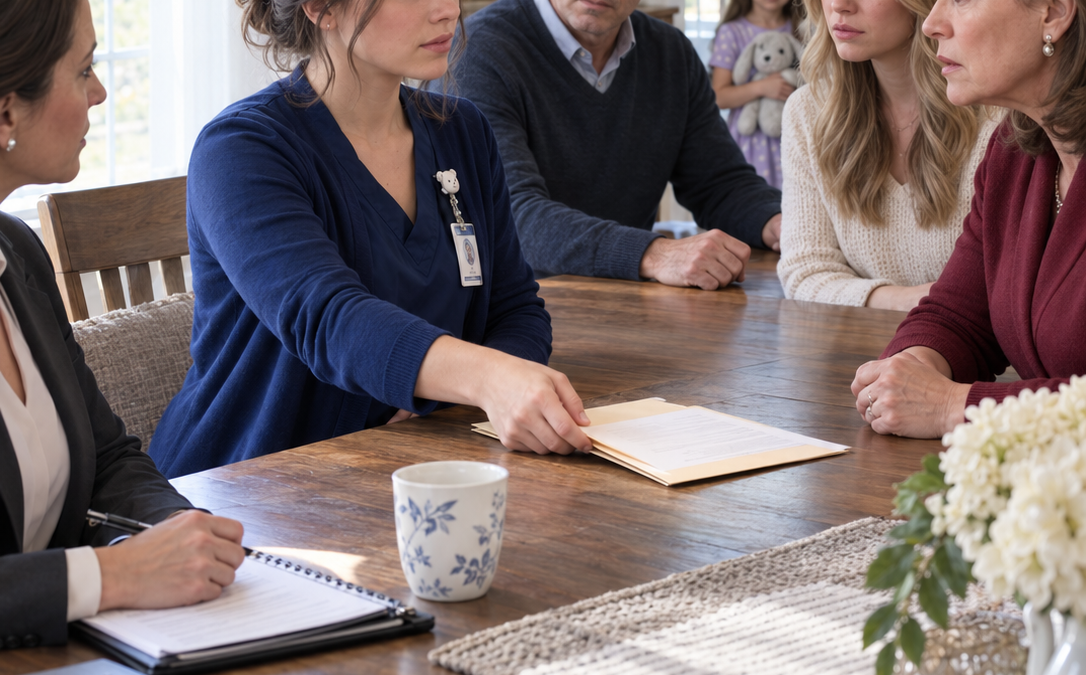
A woman named Angela, a caseworker from the county, had scheduled a meeting to assess Lily’s situation and talk through where she should be.
That was why everyone was in one room that afternoon.
Me.
My mother.
My father.
Megan.
And Angela, with a folder and a calm, neutral face.
Even Joan drifted in and out with a coffee pot, a witness who didn’t know she was one.
Megan walked in like she’d already won.
She’d pulled herself together for the occasion, and she was warm and rueful and utterly in control of the narrative.
“I just need a little help getting back on my feet,” she told the room, mostly to Angela. “It’s temporary. Every family goes through rough patches. We handle things ourselves. We always have.”
My mother nodded along, steering, the conductor of an orchestra she’d led my whole life.
For a few minutes, it worked.
The story they were telling was smooth and reasonable, and I could see it settling over the room.
Patricia takes Lily quietly.
Megan gets back on her feet.
The family keeps it in the family.
My mother actually said it out loud, warm as anything.
“So, it’s settled. Patricia takes Lily, and we keep all this in the family.”
She smiled at me like we were finally on the same team.
That’s when I put the preschool notice on the table.
I didn’t raise my voice.
I just slid it into the middle of the table where everyone could see the words at the top.
“Third notice,” I said. “Joan mentioned it’s been months. So somebody in this room has known about this for a long time.”
The room changed temperature.
My mother’s smile stayed, but it stopped meaning anything.
Angela leaned forward and read the notice without touching it.
My mother recovered fast.
She always did.
She switched tracks so smoothly it would have impressed me if it weren’t aimed at me.
“We did everything we could,” she said, her voice thickening with practiced hurt. “You weren’t here, Patricia. You left. You don’t get to come back after five years and judge us.”
You weren’t here.
The oldest move in her book.
Turn the person telling the truth into the person who abandoned them.
A year ago, it might have worked on me.
I let it sit for a second.
And I didn’t defend myself because defending myself was the trap.
“I wasn’t here,” I agreed calmly. “Let’s talk about why.”
I didn’t raise the bank statement.
I didn’t need to wave it around like a weapon.
I just said the shape of it out loud, plainly, for the room.
“Five years ago, you took the money I’d saved for school and you gave it to Megan. You told me I was selfish for minding, and you told me to leave. So, no, I wasn’t here. You made sure of that.”
My mother started to speak, and I kept going.
Still quiet.
“I’m not bringing that up to relitigate it. I’m bringing it up because it’s the same thing happening right now, with a different person to pay for it. Last time, it was my future. This time, it’s a five-year-old.”
Megan felt the room tilting and did what she always did when she was losing.
She got warmer.
More wounded.
More reasonable sounding.
“You’re twisting everything,” she said.
Then she turned to Angela with the practiced softness that had gotten her out of trouble her whole life.
“She’s angry at our parents, and she’s using my daughter to get back at them. That’s what this is.”
It was a good move.
Almost a smart move.
It reframed the only stable adult in the room as the unstable one.
But Angela had already read a third notice that said months. She’d heard a neighbor say months. She’d watched a grandmother try to steer a witness toward the coffee.
She didn’t take the bait.
She just asked Megan, evenly, to walk her through the last thirty days.
Where had Lily slept each week?
Who had taken her to school?
Who had signed the notices?
And I watched my sister try to build a month out of air.
The dates didn’t connect.
The names kept changing.
Every sentence she offered to save herself became one more brick in the wall closing behind her.
Then Angela asked the question that ended the performance.
She looked around the table, unhurried, and said, “Let me ask it plainly. Who here can provide a stable, documented, safe home for Lily right now, today?”
Silence.
My mother opened her mouth and closed it because the honest answer to that question was sitting in the room.
And it wasn’t her.
It wasn’t my father, who couldn’t hold a job or his own troubles together.
It wasn’t Megan.
It was the daughter they’d thrown out at eighteen for refusing to smile while they robbed her.
Every eye in that room moved to me.
The one who wasn’t here.
The one who was, in fact, the only one who could.
I let the quiet do the work.
Then I said the thing I’d driven 350 miles round trip to be able to say.
“You didn’t call me to help,” I said to my mother evenly. “You called me because I’m the only one who can. And those aren’t the same thing.”
My mother’s whole posture shifted.
In the space of a breath, she went from a woman issuing terms to a woman negotiating for them.
“Patricia,” she said, softer now, reaching. “We’re family. Let’s just… let’s talk about this like family.”
Megan felt the ground moving and lunged to get in front of it.
“She’s my daughter,” she said. “I decide where she goes. And I say she stays with Mom and Dad where I can see her.”
She was trying to keep Lily inside the closed circle where the family’s image stayed intact and no one had to answer to anyone.
But she had just said it in front of the one person whose whole job was to ask the next question.
Angela asked it gently and with a pen in her hand.
Where had Lily actually been sleeping?
Who had actually been getting her to school—or not?
What did the third notice mean?
Megan’s answers got thinner with every question.
And the more she talked, the more she locked the door she was trying to hold open.
She wasn’t being defeated by me.
She was being undone by the plain daylight of her own account.
I didn’t gloat.
I want you to know that.
There was a child two rooms away with a rabbit, and none of this was a victory in any way that felt like winning.
I looked at Megan, then at my mother, and said quietly, “Lily is not a way to save this family’s image. She’s a five-year-old, and I’m the person she trusts.”
Angela closed her folder.
She said, in the careful language people in her job use, that based on what she was seeing, I appeared to be the appropriate placement for Lily and that she would support moving in that direction through the proper process.
The room went quiet in a different way than before.
And then my father, who had not said a single word the entire meeting, who had spent my entire childhood finding a drawer to fix whenever the truth walked into a room, stood up.
If you’ve made it this far and you’re wondering whether you would have set the same conditions I did, or whether you would have just taken the child and swallowed the rest, tell me.
I genuinely want to know how you would have played it.
Because what my father said when he stood up changed the shape of everything that came before it.
My father stood there with his hand shaking.
He looked at me, not at the floor for once, and said, “There’s something you should know about the money.”
My mother said his name like a warning.
He kept going anyway.
It was the bravest thing I ever saw him do.
Which tells you everything about how low the bar had been.
“The $7,800,” he said. “When we took it, we told you it was for the family. We let you think it was some… some emergency we all shared.”
He swallowed.
“It wasn’t. It was for her. It was only ever for her. We took your future and we handed it to your sister so she’d have a soft place to land. And we told you that you were selfish for minding.”
He looked at me, and his eyes were wet.
“You’ve been paying for her landings your whole life. We made sure of it. And I stood in that hallway five years ago and I let it happen.”
I already knew because I’d found the statement.
But hearing him say it out loud in that room, in front of everyone, was different.
Knowing a thing and having it confessed are not the same.
Something I’d been holding for five years finally set itself down.
And in that quiet, the last piece turned over.
That phrase they’d pinned on me since I was a child.
You’ve always been the strong one.
I finally understood what it had always meant.
It was never praise.
It was the permission slip.
It was the sentence that let them take.
Because if I was strong, then I could spare it.
And if I could spare it, then taking it wasn’t stealing.
It was just family.
Strong was the word they used so I’d carry what they didn’t want to.
I thought that realization would flatten me.
It did the opposite.
It set me free.
Because if the strength was real—and it was; I’d built it with my own two hands over five years—then it was mine.
It had never belonged to them.
And I got to decide what to do with it.
Megan was watching me, and for the first time, the confidence was gone from her face.
She wasn’t cruel in that moment.
She was just scared and small.
And I felt the old pull to soften it for her, to make her comfortable, to fix her feelings the way I’d been trained.
I didn’t.
But I didn’t twist the knife either.
“I’m not here to end you, Megan,” I said. “I’m here to stop covering for you. Those are different, too.”
She asked me one question.
It was the only question that showed me she might someday be able to change.
She didn’t ask what would happen to her.
She asked, “Is Lily going to be okay?”
“Yes,” I said. “I’m going to make sure of it.”
And then Lily herself settled the last thing that needed settling, the way children do without knowing the weight of it.
She’d wandered to the doorway with the rabbit.
She came and stood next to me, close, the way you stand next to the person you’ve already chosen.
She tugged my sleeve and asked in a small voice, “Can we go to your house? I like it when it’s quiet.”
I like it when it’s quiet.
Five years of sporadic weekends.
A stuffed rabbit with my name on it.
A child who’d been keeping a running tally of which adult was safe.
She’d chosen me a long time ago.
I just hadn’t understood that the visits Megan used me for, the free babysitting I resented and showed up for anyway, had been building the one bond in this whole story that no one could take out of a joint account or write out of a will.
Family, it turns out, isn’t who shares your blood.
It’s who a scared kid walks toward when the room gets loud.
I made my choice.
And I said it plainly enough that no one could rewrite it later.
“I’ll take responsibility for Lily,” I said. “I won’t take responsibility for all of you. Not anymore.”
That truth didn’t break me.
It let me go.
None of this wrapped up cleanly the next morning, because real life doesn’t.
But it moved.
With Angela’s support, Lily came home with me under an emergency kinship arrangement while the formal guardianship worked its way through the proper process.
Paperwork in motion.
Not a gavel in a courtroom.
Just the slow, official machinery that makes a thing real and hard to undo.
I drove the 175 miles north again.
And this time, the bag I’d once carried out alone came back holding a five-year-old’s clothes and a rabbit.
There were two of us in the car.
The consequences my parents had been so desperate to avoid arrived on their own without any help from me.
The debt they’d co-signed didn’t disappear because I’d shown up.
The bill for a lifetime of covering Megan finally came due, and it wasn’t mine to pay.
There was a strange, quiet justice in watching it land where it had always actually belonged.
I didn’t cause it.
I just stopped standing in front of it.
Megan came at me once more before it was over, the way she knew how.
She called, and she was furious first.
When furious didn’t move me, she switched to devastated.
Then she said the sentence that had run our whole lives.
“We’re family, Patricia. How can you do this to family?”
I noticed I wasn’t afraid of it anymore.
It used to land like a verdict.
Now it just sounded like a lock trying keys that no longer fit.
“I’m not doing anything to you,” I told her. “I stopped doing your consequences for you. That’s not the same thing. And I think somewhere you know it.”
She hung up on me.
But she called back two days later, quieter.
And she didn’t ask for anything.
That quiet was the first honest sound I’d heard from her in years.
The hardest part wasn’t the anger.
It was the guilt that came for me anyway, uninvited, at odd hours.
The old reflex insisting that a good person would fix this, that a good sister would find a way.
I’d sit with it and remind myself what Ruth had told me in the driveway.
I did not break this.
I’m not fixing my failure.
I’m refusing to keep paying for theirs.
Some nights I believed it easily.
Some nights I had to say it out loud.
But it got truer every time I said it.
My mother tried, near the end, to do the thing that had always worked.
She called me, and she cried, and she said, “We all made mistakes, Patricia. All of us. Let’s just move forward. We all made mistakes.”
Notice what that sentence does.
It spreads the guilt into a fog where no one is responsible for anything specific.
And it invites me to be the bigger person one last time, to absolve the whole house with a nod.
A year ago, I’d have taken it.
Grateful just to be spoken to kindly.
“Name yours,” I said. “Name the specific thing you did. Then we can talk.”
There was a silence on the line.
My mother, who had a sentence ready for every occasion of my life, did not have one for that.
For the first time, she had nothing to say.
And I understood that her apology had never been an apology.
It had been a key she used to open me back up.
My father was different.
A week later, he wrote me a letter.
Actual handwriting, which he’d never done.
He didn’t spread the guilt around.
He wrote, “I stayed quiet for twenty years. That was my choice, and it was wrong. I let them take from you because it was easier than standing in a hallway and saying no.”
He didn’t ask for anything.
He didn’t ask to be forgiven or let back in.
He just named the specific thing he did.
Which is the only apology that has ever meant anything.
I didn’t tear up my boundaries because of that letter.
Forgiveness and access are not the same thing.
And I’d finally learned the difference.
But I wrote him back.
Not the whole family.
Just him.
One narrow door left open a crack for the one person who’d finally chosen to stop finding a drawer to fix.
It’s May now.
A few weeks have passed since that room, and I want to show you what a few weeks can build when it’s built on the truth instead of on a lie everyone agreed to keep.
Lily is enrolled in a preschool here in Grand Rapids.
She goes every day.
And no one is receiving notices about her.
That ordinary fact is the thing I’m proudest of in my whole life.
She sleeps through the night now.
Mostly.
She has a small chair at Bridget’s kitchen table because Bridget adopted the two of us the way she adopts everyone worth adopting.
And Ruth checks in like the aunt Lily deserves.
The guardianship is still working through its steps the way real things do.
I’m not pretending it’s all finished.
But it’s real.
It’s in the light.
And it can’t be undone on someone’s whim.
Ruth came by last week and watched Lily color at that little chair, humming to herself, relaxed in the way kids get when they finally believe the ground will stay under them.
Ruth said quietly, “Look at her. That’s what safe looks like.”
I had to leave the room for a minute.
Megan called me, and for once it was different.
She wasn’t asking me to fix anything or take anything.
She’d started getting some real help.
Small steps.
The beginning of the work.
I told her the truth, which was gentler than she expected and firmer than she wanted.
“You can be in her life when you’ve done the work. Not before, and not because you had a hard week. When it’s real.”
She didn’t argue.
That was new.
For the first time in twenty-eight years, my sister heard a boundary and didn’t try to talk her way around it.
I don’t know if it will hold.
But it was a start.
And I’ve decided to let a start be a start without needing it to be a promise.
People ask me if I’ve forgiven my family, and I’ve stopped answering it as one question because it isn’t one.
I’ve forgiven myself for believing the story they told about me.
For apologizing for things that weren’t mine.
For thinking love was something I had to earn by disappearing.
That forgiveness was the one that mattered.
The rest—reconciliation, trust, access—those aren’t gifts you hand out because someone cried.
They are things that get rebuilt slowly, in the light, by the person who did the breaking.
Or they don’t get rebuilt at all.
And either way, I’m okay.
For years, I kept that canvas bag by the door of every place I lived.
I never fully unpacked the part of me that was always ready to leave, always braced for the moment I’d be told I was the problem and shown the door.
Last week, I took the bag, folded it, and put it on the top shelf of a closet.
I don’t need it by the door anymore.
I’m not bracing for the sentence.
There’s no one here who’s going to say it.
That night, after I put Lily to bed, she came down the hall half asleep, the way kids do when they’re just checking that the world is still where they left it.
“Aunt Patty?”
“I’m here,” I said.
She looked at me.
“Is this home?”
“Yes,” I told her. “This is home.”
So was I.
Finally.
That’s why I laughed five years after they threw me out with one bag, when my mother called near midnight and told me my sister needed me.
Not because anyone was hurting.
Because I finally understood the sentence.
It had never been about my sister needing me.
It had been about them needing me to disappear into a role again.
And the girl who used to say yes to that sentence wasn’t in the house anymore.
She’d packed one bag, driven 175 miles, and built a life where the strong one finally got to decide what her strength was for.
It was for the little girl asleep down the hall, calling out to make sure the safe person hadn’t left.
I hadn’t.








