My nephew smashed my gender-reveal cake for views while my sister laughed: “relax, it’s content!” i took his phone to delete the video and froze at what it had captured behind the gift table. i sent it to my husband. ten seconds later, he called. “do not let her leave.”
My name is Madison Butler, and I’m 32 years old.
At my gender reveal party, my sister sneered, “Smash it, Sawyer. Make it go viral.”
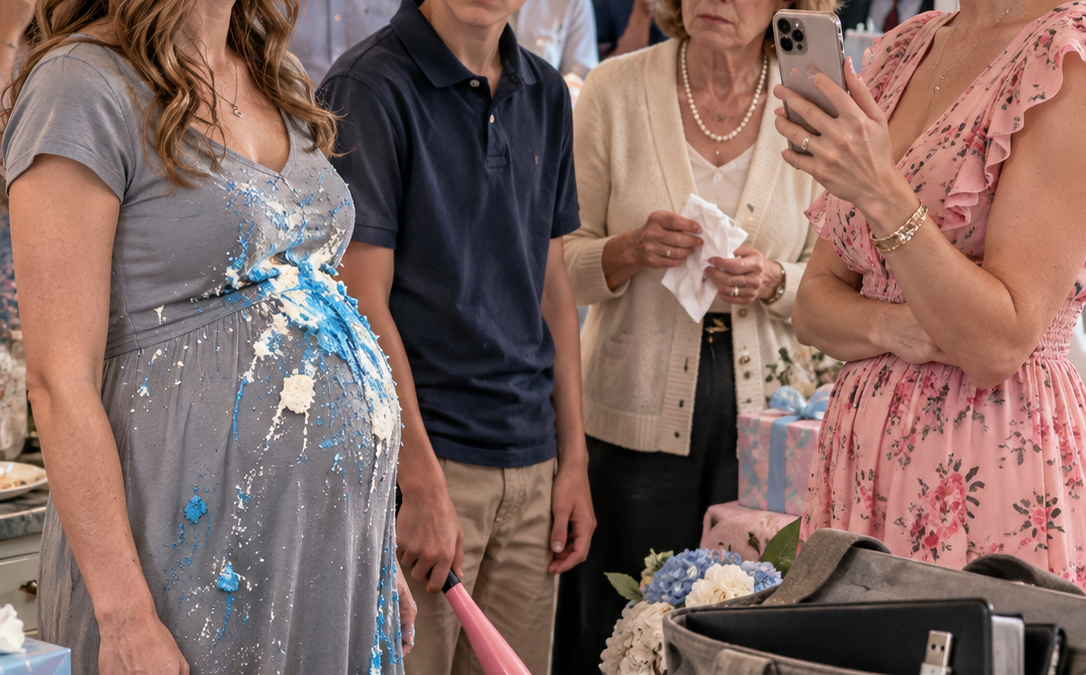
My fourteen-year-old nephew swung the bat and destroyed the cake. Blue frosting splattered across my belly and dress.
My sister laughed loudly.
“Relax. It’s content.”
My mother rolled her eyes. “Don’t be dramatic, Madison. You always ruin everything.”
My father looked away.
I didn’t cry. I grabbed the phone to delete the video.
That was when I saw it.
A thick binder sticking out of the tote bag behind the gift table. The label was clear as day.
BUTLER, M.
CASE FILE — VOLUME 4.
I sent the screenshot to my husband.
Ten seconds later, he called, his voice ice-cold.
“Madison, do not let her leave. Take her keys. Do not let her touch that bag.”
They thought they had been watching me for six years.
They had no idea the camera had finally turned the other way.
If you’ve ever been betrayed by the people who were supposed to love you most, drop a comment. Like if you want to see what happened next, and subscribe for the full story.
The morning of the party, Cormac made toast the way he always did, one slice sliding into the other like paperwork. He had a mug in one hand and a pen in the other because his brain did not turn off.
I was writing case notes at the kitchen table because mine didn’t either.
I am a licensed clinical social worker. I sit across from children who draw their fathers as shadows, and I write down what the shadow means.
That morning, I was writing about a nine-year-old boy who had drawn his stepfather without a mouth.
I had been working at Morrison Child and Family Services for sixteen months. Before that, I had spent three and a half years earning my clinical hours at a domestic violence intake center on Southeast Powell.
I know what a trauma pattern looks like.
I know how a family builds one.
Cormac read over my shoulder without asking. He does that.
“You’re doing that thing again,” he said. “Writing case notes on a Saturday.”
“He drew his father as a shadow this week. I want to be ready Monday.”
He kissed the top of my head.
Twenty-five weeks pregnant, and he still kissed the top of my head as though he had never seen anything better.
That was the last small moment before the day cracked open.
My phone lit up on the counter.
A text from Rowan, my sister.
Wait until you see the party favors. I remembered you love white peonies from your bridal shower.
I read it twice.
My bridal shower was in 2019. I had mentioned peonies once to a florist in a room where Rowan had not been present.
Cormac saw the message over my shoulder.
He paused for three seconds, then kept spreading butter.
“She has a memory palace for you.”
“She’s just being sweet.”
“That’s one word.”
Then he did something quieter than asking a question.
“How many things does Rowan remember about you that even I don’t?”
I didn’t answer.
I stood up and walked to the bathroom because the baby was pressing on my bladder and because I did not want to think about it.
On the way back, I opened the refrigerator for water and saw the card Rowan had mailed the week before.
Can’t wait to meet my little niece or nephew. Six weeks left of just us, sis.
She had underlined the words just us with a blue teacher’s pen.
My mother had used that kind of pen my whole childhood.
I threw the card into the paper recycling.
I did not think about it again.
Not yet.
Cormac has a habit of walking around a house before he speaks. He walked around our kitchen once, circled back, and stood in front of me with one hand on the back of a chair, deciding what to say.
“If anything feels off, one word. Just text me one word, and I come.”
“You’re being dramatic.”
“I’ve been dramatic about your family for four years.”
He set my phone on the charger next to my keys, then set his own phone beside it.
“Full battery on both. Just in case.”
I laced up the flats that fit around my swollen feet. I chose a soft gray cotton dress because my belly liked soft things now.
I put on the small gold necklace Rowan had given me at my college graduation, the one with the tiny letters R and M.
I had always thought they stood for Rowan and Madison.
I would remember it later in a different way.
Before we left, Cormac slid his notebook and a portable audio recorder into his messenger bag. He did that for every family dinner.
He had never used them.
He always brought them.
We drove out to West Linn with a cake box in the back seat.
My mother lives on Aspen Lane in a house where I know every corner. I know which floorboard groans and which door sticks. I know which vase I broke when I was twelve because my mother has reminded me at every Christmas for twenty years.
You always ruin things, Madison.
Try not to today.
We arrived at 1:15.
My mother opened the door with a smile that had been rehearsed the way only teachers of small children can rehearse.
My father stood behind her with both hands in his pockets.
He nodded once.
“Look at you,” my mother said. “You’re glowing now. Rowan is finalizing everything. You go sit and don’t lift a finger.”
Rowan stepped out of the kitchen wearing a gray canvas coat over her party dress.
On her shoulder was a tote bag I had never seen before.
It was heavy.
It did not match the party.
“I know exactly where everyone should stand for photos,” she said. “Trust me on this.”
She placed the tote in the small gap between the gift table and the kitchen counter, in a corner where no guest would naturally stand.
The corner of a binder pushed against the canvas.
Half an inch of spine.
Sawyer walked past me and knelt to tie his shoe. He looked up once.
I thought he was tired.
If you have ever watched a child in your family try to reach for the only safe adult in the room and get shut down for it, you already know how this story ends.
Take a second to like this video so more people who have lived it can find their way here. In the comments, tell me the age you first realized which adult in your family was actually safe.
I read every one of those.
Let me tell you who my sister looked like before the party.
This matters to the extended family.
Rowan was the one who remembered every birthday. She wrote condolence cards on the anniversary of Aunt Marian’s husband’s death. She organized the Easter potluck when my mother’s hip acted up. She showed up with white peonies and homemade lasagna.
She had 4,800 Instagram followers who were almost all cousins.
She had a Google Calendar shared with my mother that mapped birthdays, anniversaries, and doctor visits across our whole extended family.
Cousin Everly once told me, “Rowan wrote me a card on my divorce anniversary. Who does that?”
I told her it was thoughtful.
I thought so at the time.
I used to think she was the good sister.
That is what she wanted me to think.
I remember Rowan differently now.
When I was seventeen and had a bad night with a Tylenol bottle I had taken by accident, Rowan drove me home from the ER.
She never mentioned it again.
Neither did my mother, except my mother was the one who had left two Tylenol bottles on the counter that looked identical and told me to just handle it.
I only figured that out later.
Much later.
Rowan and Grady Marston married in 2015.
Four rounds of IVF between 2015 and 2018 did not take.
In June of 2018, they started fostering. They took in a small, quiet six-year-old named Sawyer through Multnomah County.
They finalized his adoption in November 2019.
One month later, Grady left.
He did not slam a door.
He just did not come home from a work trip.
My mother told the neighbors Grady couldn’t handle the responsibility Rowan gave him.
Rowan did not correct her.
When I asked what had happened, Rowan said he wasn’t ready to be a father.
She did not say she had signed the adoption papers alone.
Between 2020 and 2022, Rowan tried IUI with a sperm donor at Oregon Reproductive Medicine.
Three rounds.
None of them took.
In 2022, a doctor told her she would not carry a pregnancy of her own.
She told my mother.
She did not tell me for another year.
When she finally did, she said it quietly in the kitchen on Thanksgiving while I was slicing pie.
I hugged her.
She stiffened.
She and Grady finalized their divorce in March 2024.
She kept the last name Marston because she had built a freelance graphic design brand on it.
The last name was the last thing she had of him.
That was what she said.
That was what I believed.
At every family dinner after 2022, my mother would find a way to say, “Rowan gave that boy a home when no one else would. That’s the kind of woman she is. Madison doesn’t understand that. She’s never had to think about anyone but herself.”
I always thought it was a comment about pregnancy.
Now I think it was preparation.
There was one Thanksgiving I keep coming back to.
November 2022.
Aunt Marian, my father’s older sister, asked Rowan across the table why Sawyer had not been signed up for any sport.
Marian had been a middle-school counselor for thirty years.
She noticed things.
“He’s sensitive,” Rowan said. “He needs unstructured time.”
“He’s ten,” Marian said. “He should be on a team.”
My mother changed the subject to pumpkin pie.
Marian was not invited to Christmas that year.
She was not invited to Easter, or the next Thanksgiving, or any dinner after that.
Nobody explained it.
When I asked my mother once in the driveway after a birthday party, she said, “Marian doesn’t understand what a real mother looks like. She never had one of her own.”
I dropped it.
I used to think Aunt Marian had gotten weird.
I should have asked.
There is a memory I did not know how to hold until this past May.
It was Thanksgiving 2024.
Sawyer was twelve.
He stood next to me for two hours in my mother’s living room without a reason. He did not eat. He did not talk.
He held a folded square of notebook paper in his fist for so long the paper turned soft.
Right before Rowan called him to the car, he pushed the paper into my hand.
“Aunt Maddie, do you think Mom is sad?”
“Why do you ask?”
“She writes a lot at night.”
I put the paper in my coat pocket.
I forgot about it for eighteen months.
The coat had hung in the hall closet all winter and into spring. I had switched to a lighter jacket the week we told my parents I was pregnant, and I had not put the coat back on since.
At the party this year, before the cake, before anything else, my nephew came up to my mother.
“Can I come stay at Aunt Maddie’s this summer?”
My mother did not look at me.
“Sawyer, can’t you see your aunt is busy?”
Rowan laughed.
“I’ll find another way for you two to have time.”
I heard it that day as kindness.
I hear it differently now.
We got to the house at 1:15. The party was set to start at two.
Between those moments, my mother arranged thirty-two folding chairs in the backyard with the seriousness of a woman setting up a chapel.
Rowan draped blue and pink linens over the gift table. She centered the guest book with a pen my mother had lent her.
Behind the gift table was a small dead corner where the kitchen counter met the wall.
That was where the tote went.
Cormac took the cake box straight to the kitchen and set it on the counter.
Then he walked once around the ground floor.
He said hello to my father, who was fussing with a set of speakers he did not know how to operate. He asked my mother where she wanted people to put their coats.
He noticed the tote.
I saw him notice it.
He did not say anything.
At 1:30, the first guests arrived.
My cousin Dileia from Vancouver came in with her husband and their toddler. My father’s former coworker came with a bottle of sparkling cider because I could not drink.
My mother worked the door with the same handshake she had used at parent conferences.
Callie arrived at 1:50.
Callie Winslow was my best friend from Reed College. She is a doula now, though she was not my doula.
She held me longer than usual at the door.
Earlier, at 1:45, my mother had handed Sawyer his role.
“You’re on camera today, honey. Everyone will want to see this.”
Rowan positioned Sawyer near the sliding door.
“Sawyer, honey, stay where I put you.”
“The light is better over here, Mom.”
He moved three steps to the left.
From that angle, his phone caught both the gift table and the dead corner behind it.
Rowan waved a hand at him and turned back to greeting guests.
She did not check his frame.
At 1:52, I walked into the kitchen to get a glass of water and heard my mother and my sister in the middle of a sentence.
“Three hours,” Rowan said.
My mother nodded.
Then Rowan saw me.
“Three hours until Grandma Ellsworth is out of surgery. I wanted Mom to know.”
My grandmother was ninety and did not have surgery scheduled that week.
I would find that out later.
Cormac heard the exchange from the back patio through the screen door. He was on a call with Bram, his editor.
He watched me.
He always saw things I couldn’t.
At 2:02, my mother clapped her hands.
The guests gathered in the kitchen and dining room.
The cake sat on the table, whole and waiting.
It was the size and shape of a nine-inch layer cake with pale gray buttercream. Callie had told me the baker at Baker & Spice had added the blue interior right before delivery so even I would not know until it was cut.
I was surprised twice that day.
Once when I saw the cake, at how beautiful it was.
Once when it was broken, at how quickly beauty can be turned into something else.
My mother started counting down from ten.
Callie kept one hand on my shoulder.
At three, Rowan handed Sawyer a small pink plastic bat. She had held it behind her back until that moment.
At two, Rowan spoke loudly enough for every guest to hear.
“Sawyer, honey, this is your moment.”
At one, she said, “Smash it, Sawyer. Make it go viral.”
Sawyer looked at me for one second before he lifted the bat.
His face was the apology I did not understand yet.
He hit the cake.
Not hard.
Not weak.
Just enough.
The cake broke.
Blue frosting bloomed from the middle. A wave of it flew forward and landed across my belly and my gray dress, exactly where I placed my hand when the baby moved.
Rowan raised her phone.
“It’s a boy, and now it’s viral.”
The guests laughed once.
Then they stopped laughing.
A few of them looked at the floor.
Dileia’s toddler started crying, and Dileia carried her out into the yard.
My father, without looking at anyone in particular, said, “Boys will be boys. Both of them.”
Callie stood up.
She started to speak.
My mother was faster.
She crossed the kitchen, took a paper napkin off the table, and dabbed at the front of my dress the way you would dab at a child who had made a mess.
“Don’t be dramatic, Madison. You always ruin everything.”
She had said that sentence when I was twelve and broke the vase.
She had said it when I was seventeen and we came home from the ER.
She had said it when I was twenty-two, on the morning of my wedding to Cormac, when I asked whether my flowers had arrived.
Twenty years of the same three words.
You ruin everything.
Rowan lifted her phone higher.
“Relax, Mads. It’s content.”
I looked at her calmly.
“Whose content, Rowan?”
Callie stood again and said too brightly, “Sawyer, would you help me get some paper towels?”
She was trying to give him a way out.
She had not seen that he had already moved.
Sawyer had stepped toward me.
He held his phone out with both hands.
Rowan was posting a story and wasn’t looking.
He kept his voice below a breath.
“Aunt Maddie. Two minutes, thirty-eight seconds. Watch it before Mom sees. And I’m sorry about the cake. I couldn’t say no in time.”
I took his phone.
Right then, I understood that he had not been swinging a bat.
He had been aiming a camera.
“I’ll be right back,” I said aloud to my mother. “Bathroom.”
I walked past Cormac at the patio door.
He was still on his call.
He did not know yet.
I did not go to the bathroom.
I went upstairs to my old bedroom and closed the door behind me.
I sat on the edge of the bed.
At the foot of the bed was the quilt my mother had knitted for me when I was eight.
Folded neatly.
Perfect corners.
She had made me while she made herself.
My hands were steady.
That was the strange part.
I opened Sawyer’s video and scrubbed the timeline to two minutes and thirty-eight seconds.
The frame caught the gift table and, behind it, the dead corner where the tote sat.
Rowan was crouched there, halfway hidden by the table.
In one hand, she held a three-inch black binder she had pulled from the tote. Her thumb flicked through dividers.
The overhead kitchen light caught the plastic cover.
I could read the spine.
BUTLER, M.
CASE FILE — VOLUME 4.
At the bottom of the cover, in a smaller line:
KENSINGTON & RIDGEWAY INVESTIGATIVE SERVICES
CONFIDENTIAL.
I read files like this at work.
I know what a case file looks like.
I dragged the scrubber forward.
At 3:14, Rowan set the open binder on the kitchen counter.
A stack of four-by-six photographs slid out.
Sawyer’s camera drifted in a way that would look accidental to anyone but me.
The top photograph was me.
I was sitting in a waiting-room chair at OHSU Center for Women’s Health, seen through the front window at an angle.
The corner of the print had a timestamp.
10:34 a.m.
February 27, 2026.
Three days after my anatomy scan.
She had not been at my anatomy scan.
I scrolled through the next few photos.
There was one of me watering a pot of basil in our backyard, shot from a neighbor’s yard.
One of Cormac walking to his car in front of our house.
One of me on the porch at Callie’s condo.
One of me at the Sellwood Farmers Market, holding a paper bag of tomatoes, with a small child in the background whose face had been circled in red pen.
It was the toddler from the family whose case notes I had been writing that morning.
I turned the phone off for a second, then turned it back on because my brain needed a beat to keep working.
At 3:52, Rowan flipped to a list of names.
I read down the column.
Dr. Grantham.
Megan Fielding.
Callie Winslow.
Two of my colleagues from Morrison.
My next-door neighbor.
The chair of our neighborhood association.
Beside each name was a small handwritten note.
Approached. No response.
Approached. Sympathetic.
Not yet.
At the top of the page, circled in red, were two words.
WEEK 30: MOVE IN.
The video’s audio picked up my mother stepping toward the counter.
Sawyer had moved one step closer to the wall, and his phone caught a small conversation that had not been meant for it.
Rowan’s voice, low.
“After the reveal, I’ll bring up week thirty. Volume five opens then.”
My mother, even quieter.
“Don’t bring it up. Just come.”
I stopped breathing.
I opened my texts.
I dragged three screenshots into a message to Cormac.
I sent them.
If your gut just tightened the way mine did, you already know something is wrong.
Comment, “I know that logo,” if you have ever recognized a folder that was not supposed to be about you.
The next ten seconds changed everything.
Don’t skip.
This is why Cormac called back so fast.
Nine seconds after I sent the screenshots, my phone lit up.
Cormac’s voice was so flat it was almost gentle.
“Madison, where are you right now?”
“Upstairs. Old bedroom.”
“Come down, but do not rush. I know that logo. I spent nine weeks on that firm last October. Kensington & Ridgeway sells ‘family peace of mind’ packages. That is code for custody prep. That is a surveillance binder. That is not a scrapbook.”
“How do you want me to do that without a fight?”
“You are the calmest person in that house. Ask her for sunscreen. Take her tote and her keys in one move. That folder can be destroyed in ten seconds. A snapped USB, a wiped SD card, a magnet in a pocket. Do not let her touch that bag. Do not let her leave. I’m walking to the front door now.”
“Cormac, there’s a lease in there. She rented a place. There’s a note that says move in.”
“Then we’re already late. Two moves. Sunscreen. Keys.”
I stood up.
The quilt did not shift.
I walked down the stairs the way my body wanted to move, which was slowly.
In the entry hall, my mother was refilling a pitcher of water.
I could see Rowan in the kitchen with her back to the sliding door.
Sawyer was in the yard with two younger cousins.
Cormac stayed on the earbud.
“Talk about sunscreen. Two moves. Do not narrate.”
I have never been good at lying.
Well, that day I found out I could.
I walked into the kitchen.
“Ro, do you have sunscreen? Cormac is freaking out about UV. The little cousins are out there.”
Rowan hesitated for half a second.
“Uh, yeah. In my bag. Let me get it.”
“I’ll grab it. You keep hosting.”
I crossed the kitchen in three steps.
I lifted the tote off the floor.
It was lighter than I expected.
The binder was heavy.
I opened the zipper at the top.
Inside were a bottle of Coppertone, a canvas pencil case, and, in a small interior pocket, a silver USB drive on a key ring.
I slipped the keys to Rowan’s RAV4 into the front pocket of my dress.
I took the sunscreen out and held it in my other hand.
Then I walked out of the kitchen without breaking stride.
I did not go to the yard.
I met Callie in the dining room.
I passed her the tote.
“Guard this with your life,” I whispered. “Cormac’s coming in a minute. Set the binder open on the dining-room table before he gets to the door.”
Callie did not ask a single question.
“Got it.”
Rowan turned from the sink.
She saw me holding the sunscreen.
She did not see the tote.
She did not see her keys.
She looked at me for three seconds.
She patted her hip pocket once.
Then she smiled.
I smiled back.
I went outside and gave the sunscreen to Dileia so it would look normal from the kitchen window.
Dileia asked if I was all right.
I told her I was going to lie down for a few minutes.
She rubbed my shoulder and pointed toward the little cousins in the grass.
Cormac came in through the side door and greeted my mother in the entry hall.
He said her name gently, as though he had all the time in the world.
Then he walked past her into the dining room without stopping.
The binder was open on the table.
Callie stood one step to the side with her arms crossed.
Cormac ran his index finger down the tab index at the front.
His mouth moved once.
He looked up at me.
“Lo, this is volume four. That means there are three before it.”
No one else spoke.
He opened the small interior pocket of the tote and lifted out the USB.
He plugged it into his laptop on the sideboard.
Then he turned the screen so I could see.
The root folder held three subfolders.
BUTLER.
LARKIN.
HOLSTEAD.
Under BUTLER were four more folders.
Volume One: 2020–2021.
Volume Two: 2021–2022.
Volume Three: 2023–2024.
Volume Four: 2024–Present.
Cormac looked at me.
“Six years. She started when you and I got married.”
I called my cousin Everly first.
She lives in Boise, seven hours away by car.
She picked up on the second ring.
“Hi, honey.”
“Everly, I found a binder in Rowan’s tote. It says Larkin, Volume One.”
Everly went silent for three seconds.
Then she cried.
She cried the way people cry when they have been waiting to.
“Oh my God, Maddie. I saw that binder in her guest room in 2020. Labeled clear as day. I flipped through it and saw medical records I never showed her. I saw screenshots of texts I sent Tanner. I saw the dates I had seen a therapist. I asked her what it was. She said it was a memory book.
“I stopped trusting her that day. I burned the few pages I copied, but I never opened Volume Two.”
“What’s in Volume Two?”
“Piper. My daughter. She’s eight. Rowan has been building something about her since Piper was two. Since Tanner started asking for custody. Rowan met with him twice in 2021. He mentioned it once. I made him stop talking. He wouldn’t tell me what they discussed. He didn’t want to see me hurt. He was still my husband then.”
Everly took a breath.
“When we finalized the divorce, Tanner asked for joint physical custody. I fought it because his lawyer knew things about my depression history that only three people knew. One of them was Rowan.
“I lost joint custody by an inch. Piper still has to see him every other weekend.
“That was Rowan. That was her.”
“Did you tell my mother?”
“I told your mother. She told me I was projecting. She told me Rowan had lost too much already to hear something like that.”
Everly took a long breath.
“Maddie, don’t ever let Piper stay overnight with Rowan again. Don’t ever let your child—”
Her voice broke.
“I have been silent for four years because I didn’t have anyone who believed me.”
“I believe you.”
I called Joss next.
She lives in Eugene and teaches at the University of Oregon.
She picked up on the first ring.
“You found it.”
“You know?”
“She came between me and my mom for eight months. April to December 2023. She kept telling me Mom was confused about me. Mom stopped talking to me at Advent.
“It took me until June 2024 to call my mother and ask what Rowan had said. My mother cried for an hour. She had been told that I said things I never said. She had been told I was ashamed of her. She had been told I did not want her at my thirtieth birthday.
“Rowan had a hand in every single lie.”
“Did you tell Adelaide?”
“Easter 2025. She told me not to make things worse. She said I was projecting. She said Rowan had lost too much already.”
Joss paused.
“Maddie, don’t let her near your baby. Not ever. And check what Adelaide has been writing in the margins. Mine was in her handwriting.”
Callie tapped my elbow.
She held up her phone.
She had already opened a FaceTime call to Aunt Marian.
My aunt picked up in two rings.
Her hair was wrapped in a scarf.
She had already been crying.
Before we could explain, Marian said, “I’ve been keeping notes since Thanksgiving 2022. A Google Doc. I called it the Butler Ledger.
“Adelaide had a binder in the top of her hall closet. I saw the corner of a page with Everly’s OB information on it. I asked her about it. She said, ‘Family looks after family.’
“That was the last Christmas I was invited.”
Cormac leaned closer.
“How current is the ledger?”
“Last entry, two months ago. Madison, your name is in it now. I added the date of your anatomy scan after Everly told me Rowan had been outside OHSU.
“She was in the parking lot in a rental sedan. Everly saw it because she happened to be visiting Portland that day for a work training. Everly didn’t tell me until a week later because she thought she was being paranoid.”
Marian kept going.
“Thirty-eight entries. Four years. Get me on this call when you confront her. I have been waiting.”
“Aunt Marian, why did you keep the ledger?”
“Because someone had to remember. I was a middle-school counselor for thirty years, Madison. I have watched grown women rewrite reality in front of children. I could not stop your mother alone, but I could write it down.”
Sawyer walked into the dining room carrying a glass of water.
He set it on the sideboard.
Then he reached into the small side pocket of his backpack and pulled out a silver USB drive on a narrow strap.
He also pulled out a square of paper, soft with age.
“I copied it every time she left the file open,” he said. “Six years. She never checked because she never thought I could.”
He held out the paper.
“You gave this back to me at Thanksgiving 2024. I redrew it every time she moved things.”
Three arrows.
“That was the closet where she kept the binder. That was the drawer where she kept the USB. That was the tote she brought today.”
I unfolded the paper.
Three arrows.
A rectangle.
A smaller rectangle.
A third small mark.
I had thought it was a house.
“You’ve been trying to tell me for two years.”
“Yeah.”
The label on his USB was written in ballpoint pen.
FOR SOMEONE WHO BELIEVES ME.
Cormac plugged Sawyer’s USB into a second port on his laptop.
He opened the first folder.
Then he closed the laptop.
“We call Bram after dinner. Not before.”
“I saved everything on Google Drive too,” Sawyer said. “School account. Portland Public Schools gives us one. Mom doesn’t have the password.”
My mother walked past the dining-room doorway holding a stack of small plates.
She saw the USB.
She saw the open binder.
She saw all of us standing around it.
She did not say a word.
She took the bottle of sunscreen from my hand.
Then she turned and walked back into the kitchen.
Silence was her confession.
She never asked what we were doing because she already knew.
Cormac turned the binder to the tab marked MENTAL HEALTH.
Inside was a photocopy of my psychological evaluation from the Reed College Health and Counseling Center, dated 2013.
Clipped to the front was a HIPAA release form.
My signature.
August 15, 2011.
The week before I moved into my freshman dorm.
Written in the margin, in blue ballpoint, in my mother’s neat teacher’s handwriting:
Useful for future proceedings. Keep updated.
Date of last update:
January 12, 2026.
Cormac stared at the page.
“This is not Rowan’s handwriting.”
“I know. I signed a HIPAA release the week I moved into Reed. I forgot to revoke it. She’s been using it for fifteen years.”
I turned the next page.
A letter from Reed Health and Counseling addressed to Adelaide Butler.
Per your medical release, we have enclosed the requested evaluation records for your daughter.
I turned to the next tab.
SOCIAL CIRCLE.
There was a page with twelve names.
Every important person in my life.
Beside Callie’s name, in blue ballpoint:
Loyal to M. Contact only if she doubts.
Beside Megan Fielding, my doula:
Reached out April 2. Sympathetic. Might help.
I turned another tab.
FINANCIAL.
Rowan had a printout of the closing statement on our Sellwood house.
She had our mortgage lender.
She had circled the line for our first payment.
Beside it:
Second-income risk assessment. Cormac freelance exposure Q3.
Another tab.
WORKPLACE.
She had the names of my two supervisors at Morrison.
She had a note about my performance-review cycle.
She had a screenshot of a private LinkedIn post I had made about burnout after a hard case.
My phone buzzed in my hand.
It was Megan.
I answered.
“Madison, I’ve been meaning to call you. A woman named Rowan reached out a few weeks ago. She said she was your sister trying to prepare for a postpartum crisis.
“She had a lot of specific questions about my after-hours availability. Something about it felt wrong. I didn’t want to be alarmist.”
“Thank you. That was your gut. Trust it.”
I hung up.
My father was standing in the kitchen doorway.
He had one hand on the frame, in the exact place he had stood the day I broke the vase when I was twelve.
“You girls need to stop making a fuss.”
“Dad, look at what is in this.”
He looked down.
His face did not become sorry.
It became disappointed.
Disappointed with me.
“We only wanted to help your sister. She couldn’t have children of her own. What were we supposed to do?”
“You could have loved her the way she was.”
He looked past me at Cormac.
He tried to make it a man-to-man moment.
“Cormac, come on. You’re a reasonable person.”
Cormac did not look up from the binder.
“Charles, I am the most reasonable person in this house. That is why I am not talking to you right now.”
My father’s face closed.
He turned and walked back into the kitchen.
I heard the click of a beer being opened.
I stood up straight.
I held out the printed list of twelve names.
“You wrote in this binder, Dad, or Mom wrote it for you. Either way, it is in your house.”
That was the moment I stopped waiting for him to be my father.
Three denials came out of my sister’s mouth in the next four minutes.
Watch for the exact moment she lies to my mother’s face.
Subscribe if you’re still with me.
Portland got quiet.
Rowan came out of the kitchen into the front hall with her purse in one hand and her keys not in the other.
She patted her hip pocket, then her jacket pocket, then her purse.
“Sawyer, honey, do you have my keys?”
“No, Mom.”
Her voice climbed a little.
“Adelaide?”
My mother answered from the living room.
“They must be in your bag, sweetheart.”
Rowan walked into the dining room.
She saw the binder open on the table.
Her eyes moved for a fraction of a second.
Then she smiled.
“That’s not what it looks like.”
Cormac lifted the tab marked MENTAL HEALTH and turned the binder to face her.
He did not say a word.
“I’ve been collecting things for months for the baby shower,” Rowan said. “I was going to bind them into a little book. A gift for the two of us.”
Cormac tapped the letter from Reed Health.
“Explain this.”
Rowan looked at my mother.
My mother stepped into the doorway and set her water pitcher down on a runner.
She did not answer.
Rowan tried again.
She turned her body toward me and softened her mouth.
“Madison, you had a breakdown at seventeen. Mom told me you almost—”
“Mom told you what didn’t happen. And she wrote it down for you.”
Rowan looked back at my mother.
“Mom. Tell them.”
“Rowan, dear, sit down.”
Rowan did not sit down.
“This was protection. If something happens after the baby comes, I needed to know how to help. That is what sisters do.”
From the corner of the room, Callie raised her phone.
Aunt Marian was on the screen.
Marian tilted the camera toward her face.
“I have kept a Butler Ledger for four years, Rowan. Thirty-eight entries.
“I have your handwriting on nine of Adelaide’s Christmas cards.
“I have your handwriting on Everly’s OB information.
“I have your handwriting on a list of my own medications after my hip surgery.
“I have three of your birthday cards where you asked how Bill’s blood pressure was three years after he died.
“You did not remember he was dead.
“You did remember the medication he took.”
Rowan’s mouth opened.
Everly’s voice came through the speaker of the other phone Callie was holding.
“Rowan, you destroyed my marriage. You had a binder on my daughter. She is eight.”
Joss’s voice came through my phone on the sideboard.
“You took eight months of my relationship with my mother, and you called it care.”
There were three screens live in the dining room.
Marian above.
Everly and Joss below.
My mother in the doorway, hands empty.
Rowan tried her third denial.
“Every family has secrets. Every family keeps notes. I just organized mine.”
I put my hand on top of the binder.
“Ro, a scrapbook doesn’t have an investigative firm on the cover. A scrapbook doesn’t have a HIPAA release. A scrapbook doesn’t have a lease in it.”
She flinched at the word lease.
Cormac reached into the back tab of the binder.
He pulled out a folded copy of a residential rental agreement signed March 12.
The address was 3812 Southeast Bybee Boulevard, 1.8 miles from our house.
He held it up.
“Move-in was scheduled for the day I would have left for a work trip. You were going to come to my wife’s house while I was gone. You were going to move a suitcase in and offer to stay one night. Then two. Then a week.
“Then you were going to sit with the baby while Madison slept, and you were going to make her feel like she needed the help.
“That is what week thirty meant.”
Rowan looked at the floor.
Cormac continued.
“I write about people like Kensington & Ridgeway for a living. I have interviewed twenty-two women whose sisters and mothers used those packages to build fake concern into a soft custody transfer.
“I know how the script goes.
“I know the first move is a lease within two miles.
“I know the second move is becoming a hospital-approved emergency contact.
“I know the third move is getting a note into the pediatrician’s file.
“I know the fourth move is a call to child welfare after a mother sleeps for eight hours.
“You are on move one.”
Rowan slowly sat in the dining-room chair closest to the wall.
Sawyer walked around the table and stood behind her.
He did not touch her.
He did not speak.
He simply stood there.
“I just wanted to be loved the way she is,” Rowan said quietly.
“Loved the way who is?”
She did not answer.
I stood in the flat shoes that fit around my swollen feet.
I placed one hand on my belly.
I asked her again.
She still did not answer.
There was one more thing beneath that whole binder.
I could feel it in the air.
I went upstairs.
I walked into my mother’s bedroom.
Then I opened the door of the wall closet she had kept locked since I was six.
It was not locked today.
It had been locked for so many years that I had stopped trying it by the time I reached high school.
On the top shelf were three binders.
Silver-gray.
Neat labels in a printed hand.
MARSTON, R. — 1999–2002.
MARSTON, R. — 2003–2005.
MARSTON, R. — 2006–2008.
I lifted the first one down.
The label was in my mother’s handwriting.
I opened it.
The first page was a chart of Rowan’s weight beginning at age twelve.
Beside the chart, in blue ballpoint:
Add 200 calories on Sundays to cover evidence.
The second page was a list of the friends Rowan had made in seventh grade, with an assessment of each one.
Emily Franks — unstable family, likely to be needy. Steer away.
Grace Weaver — too pretty, may compete.
I sat down on the edge of my mother’s bed.
I turned pages.
Every boy Rowan had dated.
Every visit to a school counselor.
Every letter Rowan had written to a friend.
Photocopied.
Filed.
Annotated.
In the 2003 binder, there was a photograph of Rowan at sixteen at a summer-camp dance.
The picture had been taken from behind a tree.
I opened the third binder.
I turned to the last page.
It was dated August 2008.
Rowan was twenty-one and living in her first apartment with a boy named Peter, who lasted six months.
At the bottom of the page, in my mother’s neat blue ballpoint handwriting, were the words:
Rowan will keep records like this for her own children someday.
I closed the binder.
My sister had been raised by a woman who trained her to be an object of study.
She had grown up and thought that was love.
I carried all three binders downstairs.
I set them on the dining-room table in front of Rowan.
My mother came in behind me.
She saw them.
She stood straighter.
“Madison, that is not—”
“Sit down, Mom.”
My mother sat down.
I turned to Rowan.
“This is yours. Not mine.”
She did not look at me.
Her fingers touched the top binder.
Her hands were shaking.
“She did to you what you did to me. That does not undo what you did to Everly, or Piper, or Joss, or me. But you should know why you became this.
“And Mom should know we know.”
Rowan opened the first binder.
She stopped at the chart of her weight.
Her eyes moved down to the note in the margin.
Her breath caught.
I looked at my mother.
“You always ruin your daughters. You did it to Rowan. You would have done it to my son.”
My mother did not answer.
She did not deny it.
She just sat there.
Rowan nodded once.
She did not open the other two binders.
She stood.
She walked toward the front door.
Cormac did not stop her.
Sawyer did not follow her.
My mother said her name three times.
Rowan did not turn around.
I set her car keys on the console table beside the door.
She took them.
She left.
The door closed softly.
Callie sat down at the table and put both hands flat against it.
Aunt Marian, still on FaceTime, said, “I love you, Madison. I love you, Sawyer.”
Then she hung up.
Cormac quietly closed the binder.
He picked up the tote.
Sawyer spoke to the room, to no one in particular.
“Can I ride home with you guys?”
“Yes.”
We drove home in Cormac’s car with Sawyer in the back seat, holding his backpack in his lap the entire way.
He did not speak.
He did not need to.
When we reached our house in Sellwood, he sat on the front step for a minute before coming inside, the way you sit down after walking a very long way when you are not yet sure the ground is solid.
The next twenty-one days were the quietest I have known.
On Monday morning, I called Dr. Grantham’s office and asked for a new emergency contact on file.
I gave them Callie.
I asked them to note that Rowan Marston was not authorized to receive information about my care under any circumstance.
The intake nurse said, “Thank you for telling us. We’ll flag it.”
She did not ask why.
She had heard that sentence before.
On Tuesday, I called Morrison and moved my maternity leave up by two weeks.
My supervisor supported it without asking a question.
I told her a family situation had changed.
“Take care of yourself and take care of the baby. The cases will be here.”
On Wednesday, three days after the party, Cormac sat at his desk and opened his Substack, the one he calls Sightlines.
He had been thinking about the essay for four years.
He drafted it in one sitting.
He named it “The Family Business of Watching.”
He did not use our names.
He did not use Rowan’s name.
He did not use the name of the firm printed on the binder.
He described a pattern.
He described one lease signed one week too early.
He described a note written in a mother’s handwriting about a daughter’s future.
He sent it to me before he posted it.
I read it twice.
“Publish it.”
He posted it on May 21.
In the first forty-eight hours, it had 380,000 views.
Cormac closed the comments.
He did not need the noise.
On May 22, my mother lost her Bible-study leadership at Portland Presbyterian.
She had held it for eleven years.
The elder who called her did not mention the essay.
He did not need to.
Portland Presbyterian is small.
The families were the same families who had received Rowan’s Christmas cards.
On May 23, Aunt Marian drove up from Salem and sat in our living room for two hours without saying much.
She held Sawyer’s hand while he watched a nature documentary about salt marshes.
She told him she was proud of him.
She did not ask what he had seen.
On May 24, I wrote my parents a letter by hand.
Two pages.
I did not use my professional voice.
I told them contact would end.
I told them that if they wanted to know their grandson someday, that would be a conversation my son could have as an adult.
I would not be the bridge.
I sealed the envelope.
Cormac drove it to the post office because I did not want to see the mailbox on the corner of our street.
My mother called twelve times that night.
I did not answer.
On the thirteenth call, Cormac picked up on speaker.
He used the same careful voice he had used in the entry hall.
“Adelaide, Madison is done. Do not call this number again.”
He hung up.
He unplugged the landline.
Then he kissed my forehead.
“It is quiet now. That is allowed.”
On May 26, Everly called me from Boise.
She said Piper had asked why Aunt Rowan had not sent a birthday card that year.
Everly had told her the truth in words an eight-year-old could hold.
Piper had drawn a picture of a house with a door that could be closed.
Everly took a photograph of it and sent it to me.
I put it on our refrigerator.
On May 27, Rowan moved out of Portland.
She broke the lease on Southeast Bybee and took her deposit as a loss.
She rented a small studio in Eugene near where Joss lived, which struck me as either brave or cruel.
I could not tell which.
She sent Sawyer a text saying she was sorry and hoped he was well.
She did not send one to me.
On May 28, Rowan drove back to Portland to a notary in a strip-mall office in Milwaukie.
She signed a temporary custody arrangement without a lawyer, giving Cormac and me physical care of Sawyer for six months, renewable.
She did not ask for anything.
She did not make eye contact with the notary.
Cormac had told her, through a mutual family friend, that a second essay was sitting on his hard drive.
He had not written a second essay.
He would not have needed to.
Sawyer walked into our house that evening with one backpack, a duffel bag, and a plastic bin of the mementos Rowan had given him over seven years.
He set the bin down on our front step.
“I don’t want this stuff. Can we throw it out?”
Cormac looked at him.
“Let’s put it in the garage tonight and decide next week. That’s okay too.”
If you are the safe adult in someone’s life—the aunt, the uncle, the older cousin, the coach who noticed something in the middle of practice—someone in your family knows you are the one they can reach.
Tell them today.
Share this with the person who needs to hear that a door can be left open on purpose.
Subscribe so the next family who is watching finds this too.
Sawyer chose the pullout couch in the living room for his first night.
He said it was closer to the door.
Cormac and I left our bedroom door open.
We did not say anything about it.
We simply left it open.
Around eleven, I walked past the living room to get a glass of water.
Sawyer’s voice came out of the dark.
“Aunt Maddie?”
“Yeah, bud?”
“Thanks for looking at frame 238.”
“Thanks for showing me.”
He was quiet for a second.
“Can we leave the porch light on?”
“Yes.”
I turned it on.
Then I went back to bed.
I did not tell Cormac what Sawyer had said until the next morning.
He put down his coffee and turned toward the window.
He did not say anything for a while.
Then he said, “We’ll leave that porch light on for a long time.”
Over the following days, Sawyer began trying out small things.
He asked what time we usually ate dinner.
He asked whether he could keep his toothbrush in the guest bathroom or whether we would rather he use the hall one.
He asked if he had to close his bedroom door at night.
Cormac answered every question the same way.
“You choose. Then you tell us. Then we go from there.”
Sawyer chose the guest bathroom.
Sawyer chose to leave his door open.
Sawyer chose to eat dinner with us, then take a plate to the couch afterward because the couch was where he had slept the first night and the couch was where he still felt safe.
We let him.
He did not need to be tested.
He needed to be believed.
On the second Sunday, he asked if he could enroll in a summer soccer program.
He had never played on a team.
“Yes.”
I called Sellwood Community Recreation on Monday morning and paid for the summer session.
When I hung up, I sat at the kitchen table and cried for the first time since the party.
Because Aunt Marian had asked the right question at Thanksgiving 2022.
And no one had answered her.
The last Sunday of May, we finished the nursery.
Cormac assembled the crib on the rug.
Sawyer painted a small cloud on the wall above the changing table.
Callie brought dinner.
Megan Fielding came by to drop off a book about the fourth trimester and stayed for tea.
I put a photo frame on the shelf near the window.
Inside were seven faces.
Sawyer at Thanksgiving 2024, before we knew what we knew.
Aunt Marian in her scarf.
Callie at Reed graduation.
Everly with Piper.
Joss with her mother, photographed on the Oregon coast the previous summer.
Cormac at his laptop, laughing at something off-camera.
Me.
There were no photographs in that room of the people who had watched me.
There were only photographs of the people who had seen me.
I stood at the window with one hand on my belly.
The window was open.
There was no one on the sidewalk.
There was no one at the neighbor’s fence.
The camera had turned the other way.
I spoke quietly into the room.
“No one gets to watch you. Only love you.”
The baby moved.








