My mom looked at me and said, “you should’ve brought food from home”, meanwhile, my sister was enjoying a $120 surf & turf, i just smiled and said, “alright”, then i stood up and said loudly, “excuse me, i’ll be paying — for my meal only”, mom’s face went pale, “what are you doing?”, and as for that bill…
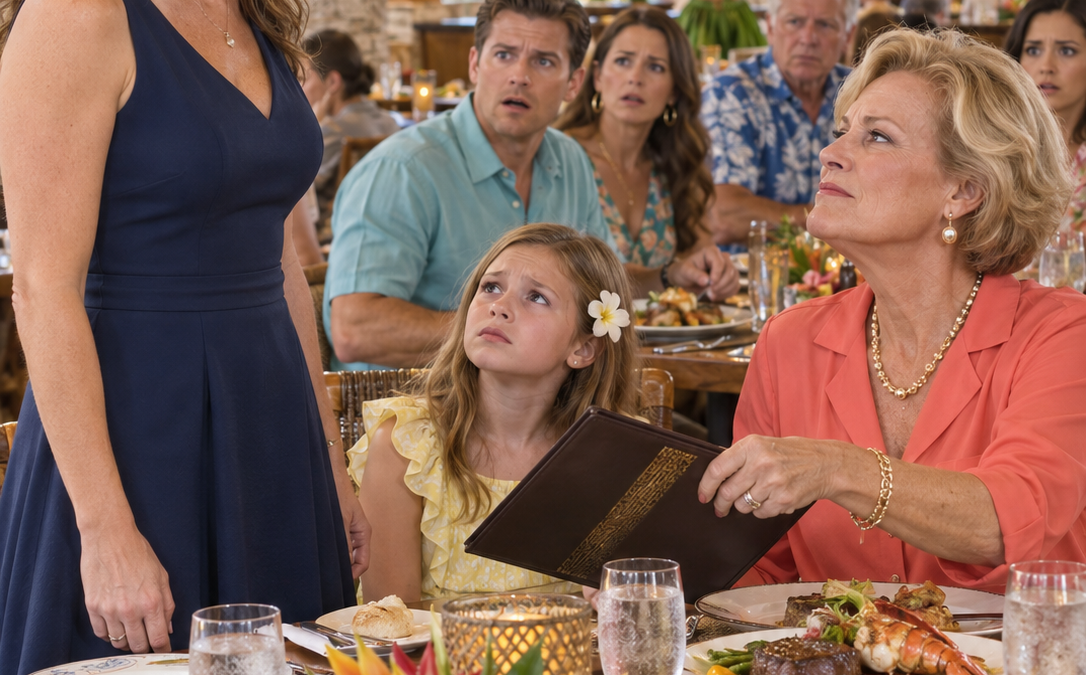
I was five minutes early to my dad’s 70th birthday dinner at the Hawaiian luau spot in Honolulu, still hoping this time would be different. My daughter clutched my hand, whispering to ask if she could get something special.
Then I saw them—my mom sliding the menu away, my brother and his family devouring $120 surf and turf.
She didn’t smile. She just said, “You should have brought food from home.”
My dad said nothing.
For a moment, I froze. Then years of swallowing my pride and covering their bills cracked something inside me. When the waiter came, I stood, looked at my family, and said, “I’ll be paying for my meal only.”
Mom’s face went pale.
“What are you doing?” she snapped.
I kept my smile steady. “And please move everything else to my mom’s bill. It’s Dad’s birthday, after all.”
A hush fell over the table. My brother froze mid-bite.
“My daughter will have the Kalúa pig with pineapple salsa,” I told the waiter. “Make it quick.”
Her eyes widened. Then she smiled for the first time that night.
No one spoke for thirty seconds. Mom leaned back, a sharp laugh escaping her.
“Overreact much?”
“Exactly,” I replied. “A dinner that requires humiliating my child first.”
My brother’s wife cleared her throat, visibly uncomfortable. “Let’s not make a scene.”
I cut her off.
“A scene? That’s your word for consequences?”
Silence hit the table again. When the waiter brought my daughter’s plate, she set it down gently and gave me a small nod.
“Thank you,” my daughter whispered.
Mom immediately started fussing over my brother’s kids again. When the check came, the waiter handed it to her. I watched the color rise in Mom’s face as she saw the total.
“You think this is necessary?” she asked through clenched teeth.
I met her stare.
She shoved her chair back. “You’ve embarrassed us.”
“Funny,” I said as I stood. “That’s what you said when I succeeded instead of failing like my brother.”
I took my daughter’s hand and walked out.
Outside, she squeezed my fingers.
“Mom, are we in trouble?”
“No, sweetheart. We’re free.”
Behind us, through the window, Mom glared while my brother whispered. Let them eat in silence. I’d had enough of swallowing mine.
If you’ve ever dealt with toxic family favoritism like this, smash that subscribe button. The real consequences unfold next.
The waiter handed Mom the $1,200 check. She stared at it, her face draining of color as the total sank in.
I watched from my seat, steady now after my earlier stand. Ethan shifted uncomfortably, his fork paused over the remains of his surf and turf. Natasha avoided eye contact, focusing instead on her kids, who were whining about their cold sides.
Dad sat silently, his expression neutral. But when our eyes met, he gave me a subtle nod, as though he understood without needing to say a word.
I calmly pulled out my wallet.
“Here,” I said to the waiter, handing over $180 in cash. “This covers my daughter’s Kalúa pig and my salad. Keep the change.”
The table went still.
Mom’s hand tightened around the bill.
“You’re not serious.”
I met her gaze without flinching. “Dead serious. The rest is on you. After all, it’s Dad’s birthday celebration you organized.”
Ethan leaned forward, his voice low but sharp. “This is ridiculous. We all came here as family.”
“Family?” I echoed, keeping my tone even. “The kind where you let my child go hungry while yours feast? No thanks.”
Natasha cleared her throat again and glanced at Ethan for support. He only shrugged, mumbling something about me overreacting.
Mom turned to Dad, expecting backup.
“Anthony, say something.”
He adjusted his napkin slowly.
“It’s her choice, Cynthia.”
His words hung in the air. He wasn’t defending me outright, but for once, he was refusing to side against me.
I felt a small surge of validation. Dad had always been the quiet observer, rarely stepping into our messes. Until now.
Pushing back my chair, I stood.
“And while we’re talking about choices, Ethan, consider this your notice. The $800 a month I’ve been covering for your rent is done. No more wiring money whenever your job hits a rough patch.”
His eyes widened. “You can’t just cut us off like that. We agreed you’d help.”
“Agreed?” I countered. “I offered because I thought it was temporary. But it’s been over a year of me paying your bills and watching your kids on weekends while you and Natasha vacation. All while Mom praises you as the responsible one.”
Natasha’s face flushed, but she stayed quiet, fiddling with her napkin. Even the kids sensed the tension and fell silent for once.
Dad nodded again, almost imperceptibly, his way of signaling that he wouldn’t interfere.
Mom slammed the check down.
“This is ungrateful after everything we’ve done for you.”
“Everything?” I replied softly. “Like ignoring my promotions so you could celebrate Ethan’s latest scheme? Or expecting me to fix every crisis while you enable him?”
Ethan pushed his plate away.
“You’re twisting things. I work hard. It’s not my fault the market’s tough.”
“Tough enough to afford that new car last month?” I asked, pulling out my phone to show a screenshot of his social media post. “While I skip vacations to bail you out?”
The waiter returned with the receipt for my portion, breaking the standoff. I signed it quickly.
Brian texted me then. He had been waiting in the car after dropping us off earlier.
Everything okay? Need me to come in?
I replied quickly.
We’re leaving soon. Stay put.
Turning back to the table, I gathered Felicia’s things.
“We’re done here. Enjoy the luau lights without us.”
Mom’s voice rose behind me. “You’ll regret this—walking out on family.”
I paused at the door.
“Family doesn’t mean endless sacrifice. It means mutual respect. Something I’ve given plenty of and received none.”
As Felicia and I stepped into the humid Honolulu night, the sounds of hula music faded behind us.
She looked up at me.
“Why did Grandma say that, Mom?”
I knelt to her level.
“Sometimes people forget what’s fair, sweetheart. But we won’t anymore.”
Back home later that evening, Brian listened while I recounted everything.
“You did the right thing,” he said, hugging me. “No more enabling their chaos.”
I nodded, already planning to block their numbers temporarily.
For years, I’d been the fixer—the one paying Ethan’s overdue utilities, the one Mom called for advice but never thanked.
No longer.
That bill wasn’t just for dinner. It was the beginning of closing the account on their entitlement.
The next morning, my phone buzzed with messages.
Ethan: We need to talk about the rent.
Mom: How dare you embarrass us on your father’s birthday?
I ignored both and poured my coffee.
Brian suggested documenting everything, from past Venmo transfers to the restaurant receipt.
“Build your case if they push back.”
Aunt Dana called too, having heard whispers from a cousin.
“Good for you for standing up. They’ve taken advantage for too long.”
Her words reinforced my resolve.
By afternoon, I had emailed my bank asking for transaction records tracing the thousands I’d sent Ethan over time. Each entry reminded me how unbalanced the scales had become—me working overtime while he coasted.
As evening fell, I sat with Felicia and helped her with homework. She smiled more freely now, unburdened by the awkwardness of the night before. Brian joined us, turning the evening into a family game night.
For the first time in months, peace felt tangible instead of fragile.
Mom’s favoritism had poisoned family gatherings for years, but that night marked a shift. No more silent complicity from Dad, either. His subtle nods hinted that something in him might finally be changing.
Ethan would have to face reality without my safety net.
And me? I finally breathed without the weight of their expectations pressing down on my shoulders.
Two days later, my doorbell rang at 7:00 p.m.
I glanced through the peephole and saw Mom standing there with Ethan, their faces set in grim determination. There was no courtesy knock, only the sharp chime demanding entry.
I opened the door, keeping my expression neutral.
They pushed past me without a hello, Mom clutching a folder as though it were ammunition.
Ethan scanned the living room as if he were assessing what I owed them. Mom dropped the folder onto the kitchen island with a thud.
“That’s the lease agreement for Ethan’s place. Since you’ve decided to play games with money, you’ll cover the full back rent you promised.”
I crossed my arms, unmoved.
“I never promised. I helped out of goodwill, not obligation.”
Ethan jumped in, his tone defensive.
“My job’s been unstable. Layoffs everywhere. You know that. We counted on your support.”
Mom nodded vigorously, placing a hand on his shoulder.
“He’s trying his best. As a mother, I see how hard he works. You, on the other hand, always make things difficult.”
I reached into my purse and pulled out four crisp $100 bills.
“Here. Four hundred dollars as petty cash. Consider it my final gesture. But the babysitting for your kids is over. No more free weekends while you two escape.”
Ethan’s jaw dropped.
“You can’t do that. The boys love staying here.”
“Love it enough to thank me? Or do they just expect it like everything else?” I shot back.
Mom’s eyes narrowed.
“This is spiteful. Family helps family, especially when one succeeds like you have.”
Brian walked in from the hallway, having heard the raised voices. He stood beside me, solid and calm.
“She’s right. We’ve covered enough. It’s time for balance.”
Ethan turned toward him.
“Stay out of this. It’s between siblings.”
Brian shook his head.
“Not when it affects our home.”
I pulled up the Venmo screenshots on my phone.
“See these? Thousands transferred over months for rent and utilities. Even that gym membership you said you needed for stress, while I cut back on our groceries.”
Mom waved a dismissive hand.
“You’re exaggerating, as usual. Ethan deserves help. He’s building a future.”
“A future on my dime,” I pressed. “Last month alone, I wired $800 while you posted about your spa day.”
Ethan flushed.
“That was a gift from Natasha. My career is in flux. The tech industry is brutal.”
“Brutal enough that you couldn’t repay me even once?”
Brian added quietly, “We’ve documented it all. Push this any further and it becomes formal.”
Mom scoffed.
“Threats now? From the perfect daughter who thinks she’s above us?”
The argument circled endlessly—Ethan repeating his job woes, Mom defending him as the victim. I stayed firm, listing more evidence: emails begging for loans, ignored IOUs, transfers that had never been repaid.
Felicia peeked out from her room, but I motioned gently for her to go back inside.
Finally, Mom snatched up the folder.
“You’ll pay what’s due, or you’ll face the fallout.”
Ethan nodded in agreement, though the unease in his eyes betrayed him.
They stormed out and slammed the door behind them.
I locked it immediately.
The click echoed with a sense of finality.
My phone rang only minutes later.
Dad.
I answered, expecting more pressure.
“Brandy,” he said softly. “I heard what happened.”
There was no accusation in his voice.
“Maybe you’re right. Things have been uneven for too long.”
I paused, genuinely surprised.
“You think so?”
“I’ve seen it, but I stayed out of it to keep the peace. Not anymore.”
We talked briefly. He admitted that Mom’s bias toward Ethan came from patterns that had existed for years, but he wouldn’t enable them any longer.
“Do what protects your family,” he concluded.
When I hung up, I felt a rare alliance beginning to form.
Brian hugged me from behind.
“That took guts.”
We sat down together and reviewed the screenshots.
Aunt Dana texted soon afterward.
Rumors flying. Stand strong.
I replied with the details, knowing her perspective might help.
Over the next hour, more messages flooded in—cousins sharing similar stories about Ethan’s unpaid favors. Piece by piece, the family’s polished facade began to crack.
Felicia emerged from her room and asked if everything was okay.
“Yes, honey. We’re just setting boundaries.”
She nodded, sensing the shift even if she didn’t fully understand it.
That confrontation hadn’t only been about money. It exposed the rot underneath everything. Mom’s protectiveness had shielded Ethan from growing up, leaving me as the perpetual giver.
No longer.
Brian suggested updating our will next, making sure Felicia’s future remained secure. I agreed and pulled up legal sites to take notes.
As the night deepened, I organized a digital folder: transfers, texts, timelines.
Evidence wasn’t revenge.
It was armor.
For the first time, Dad’s quiet support felt like a genuine turning point. Ethan might scramble, but without my crutch, reality would hit him. Mom could rage, but her favoritism would no longer dictate my life.
Monday morning, the school called.
The administrator’s voice was professional but cautious.
“Mrs. Young, we received an anonymous report concerning Felicia’s well-being. It’s standard procedure for us to follow up.”
My stomach tightened instantly.
“A report about what?”
“Concerns about neglect and emotional withdrawal. The counselor may speak with her today.”
I hung up and began piecing it together.
An anonymous report, right after the confrontation.
Ethan or Mom had pushed the boundaries even further.
Instead of panicking, I focused.
First, I saved screenshots from Ethan’s texts bragging about his surf-and-turf dinner, timestamped the night of Dad’s birthday.
Living large, he had written beneath a photo of the plate.
It contrasted sharply with all their claims of financial hardship.
Next, I walked through the house methodically. The refrigerator was stocked with fresh fruit, yogurt, and meals prepared for the week. Felicia’s room was organized, with books on the shelves, toys in bins, and folded laundry put away.
Everything was spotless enough to withstand any scrutiny.
Brian came home early from work.
“I got your text. What’s the plan?”
We sat at the table, and he pulled up our shared drive.
“Document everything,” he said. “Add those screenshots to the folder. If this escalates, we’re ready.”
Anger simmered beneath the surface, but it wasn’t explosive. It was calculated.
I made no rash calls to Mom or Ethan. Instead, I wrote strategy notes about Felicia’s routine, her straight A’s, and her extracurricular activities.
This wasn’t emotion.
It was preparation.
Aunt Dana called that afternoon.
“I heard through the grapevine about the school involvement. Keep every receipt, digital or otherwise. They’ve crossed a line.”
Her advice sharpened my focus.
“Thanks, Aunt Dana. I’m building it now.”
The follow-up visit came after lunch. Two women in plain clothes arrived with badges.
“Child Services follow-up,” one explained.
I invited them inside politely.
They toured the kitchen, noting the full pantry. In Felicia’s room, they asked about her hobbies. She chatted easily about art class and soccer.
No red flags emerged.
They interviewed me separately, asking questions about our routine and support system. I answered steadily, mentioning Brian’s stable job and our community ties.
As they wrapped up, one of them hesitated.
“Everything checks out. This seems unfounded.”
Relief washed through me, but my resolve hardened.
The visit ended without an issue. No findings. Case closed.
Still, the intrusion lingered like a warning.
Once I was alone again, I knew it was time for counteraction.
This wasn’t only defense anymore.
It was about turning the tide.
Brian returned with takeout, immediately sensing my mood.
“We beat this round.”
We ate together, Felicia oblivious and happy.
Later, I expanded the folder to include school records, doctor visits, and even photographs from family outings.
Aunt Dana emailed more suggestions.
Scan old checks, too.
Her network of relatives had stories about Ethan using similar tactics with others. It fueled my plan.
By evening, frustration had given way to clarity.
Their move had been designed to intimidate me, but it had backfired by exposing their desperation.
No tearful breakdowns. No frantic phone calls.
Just methodical steps.
Brian reviewed the additions.
“Solid. If they try again, this shuts it down.”
Felicia hugged me before bed.
“School was fun today, Mom.”
Her innocence reinforced my determination.
That night, I researched local resources and support groups for family estrangement. Notes piled up—timelines of their demands, records of my concessions.
The anonymous report wasn’t an isolated event.
It fit their pattern of control.
But now, armed with proof, I felt stronger. The clean report validated the life we had built: stable, nurturing, and secure.
Their ploy had failed.
And it ignited my next phase.
Carla’s office smelled like coffee and victory.
She leaned back in her chair, reviewing the stack of printouts I had brought.
“This is gold,” she said, tapping the rent receipts. “We’ll base the no-contact letters on patterns of dependency and manipulation.”
I nodded and handed over the latest social media posts from Ethan and Mom, along with the Child Services clearance.
She drafted quickly, outlining the demands: cease all contact, repay outstanding debts, or face escalation.
Evidence wove through every paragraph—rent transfers, ignored repayments, even public smears hinting at our fallout.
“This isn’t aggression,” Carla explained. “It’s enforcement of boundaries.”
By midday, three letters were ready.
One for Mom. One for Ethan. One copied to Natasha so she was fully aware.
We sent them by certified mail that afternoon. The clerk stamped each envelope, sealing the step.
Back home, I waited for the ripples.
Two days of silence followed.
No calls.
No texts.
Then my phone buzzed with a Venmo notification.
$3,000 from Natasha.
The note read:
Half what we owe. I’m out.
I stared at the screen, piecing together what she meant.
A follow-up message arrived.
Filing for divorce. Can’t keep covering his messes.
It was the first unmistakable sign that the cracks were widening and Ethan’s world was beginning to unravel without everyone else holding it together.
Aunt Dana called that evening.
“I’ve kept quiet too long,” she began. “Your mom favored Ethan from the start. Extra lessons for him, excuses for his failures, while you bootstrapped everything.”
The revelation stung, but it also clarified things.
“She babied him after his first job loss, convinced he’d turn it around. Meanwhile, you graduated at the top of your class without fanfare.”
I absorbed her words and added notes to my records.
“Thanks for telling me. It fits the puzzle.”
Dad called separately the next morning.
“Got wind of the letters,” he said. “I support you. I’m not signing anything against that.”
His tone carried weight—a shift from neutrality to alliance.
“Your mom’s upset, but this needed addressing. I’m proud of how you’re handling it.”
We talked briefly about the imbalance he had witnessed over the years and his reluctance to intervene until now.
“Protect Felicia first,” he advised before hanging up.
Brian reviewed Natasha’s Venmo transfer with me.
“This changes things. Natasha’s switching sides.”
We updated the Young family receipts folder, adding the payment as a partial acknowledgment of the debt.
Scans of old bank statements joined the collection, detailing loans that had never been returned.
Carla emailed to confirm that the certified letters had been delivered and signed for.
The silence stretched through another day, building tension.
There was no backlash yet, but anticipation grew.
I scheduled a brief virtual session with a therapist to discuss managing family estrangement. The notes from that conversation became another part of my preparation—emotional toll, coping strategies, and ways to maintain no contact.
Felicia remained shielded from all of it. Her days stayed normal, filled with school and playdates.
Cousins reached out through a group chat and shared their own stories: Ethan borrowing money without repaying it, Mom dismissing complaints whenever anyone challenged him.
It strengthened my position and revealed just how wide the web had become.
Brian suggested printing hard copies as a backup.
We organized everything chronologically, from the earliest help I’d given to the most recent denials.
As the second day came to an end, Carla followed up.
“No replies means they’re either processing or plotting. Stay vigilant.”
Her words matched my mindset.
Proactive, not reactive.
The letters weren’t endpoints.
They were barriers.
Natasha’s move signaled that divorce was looming from the financial strain. Aunt Dana’s stories showed that Mom’s bias was habitual, not something I had imagined. Dad’s backing gave me unexpected strength.
That night, I sat with the folder open, cross-referencing every detail.
Each piece fortified our position.
Felicia sat nearby drawing, oblivious but content. Brian joined me, offering quiet company.
The silence no longer felt ominous.
It felt like space reclaimed.
Whatever their next move was, it would meet resistance.
For now, the letters stood as my declaration:
Enough.
A certified letter arrived on Friday.
The envelope bore a law firm’s return address, heavy with legal significance. I opened it carefully.
Inside was a petition from Mom and Ethan demanding grandparent visitation rights to Felicia. The grounds cited estrangement without cause and the best interests of the child.
My pulse quickened, but I stayed composed.
I scanned the document and sent it to Carla immediately.
She called back within the hour.
“Classic overreach,” she said. “In U.S. law, grandparents need proof involving things like unfitness, abuse, neglect, or addiction. You have none of that. You have a clean Child Services report, a stable home, and involved parents.”
She paused.
“This fails before filing.”
She outlined our response: an affirmative defense, our evidence bundle, and a motion to dismiss.
We prepared the response folder that weekend.
Every document went in—rent ledgers, repayment denials, social media posts contradicting their claims of hardship, Natasha’s partial restitution—all organized with tabs.
Brian notarized an affidavit detailing the support we had consistently provided.
Carla added legal precedents, including cases where financial family disputes had not been enough to justify visitation.
“Courts prioritize parental rights,” she noted.
On Monday, Dad asked to meet privately at a neutral café.
He arrived early, coffee already in hand.
“I saw the petition draft,” he admitted. “I don’t want this.”
His eyes met mine directly.
“I refused to sign. Your mom pushed, but Ethan’s name alone weakens it.”
His allegiance was open now.
“You’ve built a good life. I won’t undermine that.”
Relief mixed with gratitude.
We hugged briefly, a rare gesture between us.
Back home, I updated the school’s restricted pickup list.
Only Brian or me.
No exceptions for relatives.
We changed all the exterior locks, made two new keys for ourselves, and gave one spare to Aunt Dana.
Simple precautions against surprise visits.
Felicia noticed the shiny new deadbolt.
“For safety, kiddo,” I explained.
She accepted it without question.
Carla filed our counterpetition Tuesday morning. It included the full Young family receipts compilation, along with Dad’s sworn statement declining involvement.
This buries them, she emailed.
The clerk stamped the filing, and Mom and Ethan were officially served by a process server that same day.
Their reaction came quickly.
Voicemails from Mom pleaded for family unity.
Texts from Ethan accused me of betrayal.
I forwarded everything to Carla without replying.
Brian monitored our security camera. No one approached the house.
Aunt Dana offered to testify if necessary, giving her long view of Mom’s favoritism as character evidence.
By Wednesday, an associate from the other firm contacted Carla and requested permission to withdraw the original filing.
“Clients are reconsidering,” he said vaguely.
Carla pushed for dismissal with prejudice, preventing them from simply refiling the same claim.
The judge granted it Thursday, citing insufficient grounds.
The legal battle crested and collapsed.
Mom left one final message.
“This tears us apart.”
I deleted it without listening again.
Ethan went radio silent, likely because Natasha’s departure was accelerating.
Dad sent a short text expressing support.
Our home felt fortified now—doors locked, pickup lists updated, papers sealed and organized.
Felicia thrived amid the calm, finishing a school project about family trees.
Hers had become simpler.
Us three.
Brian and I reviewed the dismissal order together, a tangible victory.
Carla billed minimally, almost in the spirit of pro bono work, because the case had been so clear.
The drama reached its peak through court filings and resolved without a hearing.
Their attempt had exposed their desperation.
Our response ended it decisively.
Six months later, Ethan’s marriage crumbled.
Natasha finalized the divorce papers in a quiet courthouse session, citing irreconcilable differences rooted in financial irresponsibility.
She moved into a modest apartment nearby with the kids, starting fresh without his chaos.
Ethan was left scrambling.
He lost his job soon afterward.
Word spread among mutual colleagues—stories about unreliable payments and family disputes eventually reaching HR through anonymous tips.
The company cited performance issues, but everyone knew what people believed had triggered the scrutiny.
Mom faced her own isolation.
Her bridge-club invitations disappeared after whispers circulated at community events. Old friends distanced themselves, uncomfortable with the exposed favoritism and legal battles.
She attended fewer gatherings.
Her social circle shrank to echoes.
Attempts to rally sympathy went nowhere.
Details of the failed visitation suit circulated through public court records, painting her in other people’s eyes as overbearing.
I learned about the fallout piecemeal.
A cousin forwarded Ethan’s desperate job-search posts asking for leads.
Aunt Dana shared Mom’s complaints from a rare phone call, noting her loneliness without passing judgment.
Dad visited once and confirmed the rest.
“Ethan’s couch-surfing now,” he said plainly. “Your mom rarely leaves home.”
He expressed no regret about his decision to support me, only quiet acceptance.
Brian and I decided to take a family camping trip to a lakeside site upstate.
We packed the SUV with tents, sleeping bags, and supplies for s’mores. Felicia bounced with excitement during the drive, singing along with the playlists.
At the campsite, we set up beside the water, with pine trees framing a serene view.
Brian built the fire expertly while Felicia collected sticks for roasting marshmallows.
That evening, as the stars emerged, I pulled an old framed photograph from my bag.
The last family portrait with everyone in it.
Faded smiles from better days.
“Time to let go,” I told Brian.
He nodded, understanding.
Felicia watched curiously as we walked toward the dock.
I held the frame over the dark water.
“This represents what was,” I explained to her. “But we’re creating new memories.”
With a gentle toss, the frame splashed into the lake and sank beneath the surface.
The ripples faded quickly.
Felicia clapped, delighted by the drama.
“Bye-bye, old picture.”
We laughed together, the sound carrying across the lake.
Back beside the fire, she roasted marshmallows until they were perfectly golden, chocolate melting between graham crackers.
Brian shared stories from his own childhood camping trips, drawing parallels to our fresh start.
The night air cooled, but the warmth from the flames and from our closeness surrounded us.
Before bed, I drafted one final letter on my laptop, addressed jointly to Mom and Ethan.
This concludes all ties.
It read:
“No further contact desired or required. Wishing you resolution in your paths.”
I attached no evidence and made no accusations.
Just closure.
I sent it by email with a read receipt, then permanently blocked their addresses.
No response was expected.
None came.
Over the following months, our routine solidified without interference.
Felicia excelled at school and joined a swim team that strengthened her confidence.
Brian advanced at work, earning a promotion that eased any lingering financial strain.
I pursued an online certification on the side, expanding my career options.
Dad maintained occasional contact through coffee meetups centered on neutral topics. He respected the boundaries.
Ethan’s unemployment dragged on. Applications were rejected, with references apparently hinting at instability.
He eventually sold the fancy car to cover basic expenses.
A stark downgrade.
Mom began volunteering at a local charity, searching for purpose amid the emptiness.
When she became pushy with Dad, her calls went unanswered.
The consequences unfolded naturally.
No orchestration.
Just the weight of reality.
At the campsite the next morning, Felicia chased butterflies along the shore.
Brian fished from the dock, catching a small bass that we released.
I journaled beside the tent, reflecting on the journey.
Peace settled deeply.
Unforced.
The absence of that old photograph symbolized release. Old obligations had dissolved like the frame beneath the water.
Around midday, we hiked a trail with Felicia leading the way using a map she had drawn herself.
Below us, the lake glittered beneath the open sky. Nature’s vastness made the old conflicts seem smaller.
Lunch was simple—sandwiches shared between bursts of laughter over silly jokes.
Brian took pictures of us.
New portraits for new frames.
As sunset painted the sky, we reluctantly packed everything into the SUV.
Felicia begged us to stay one more night, but school was waiting.
On the drive home, she dozed against my shoulder.
Brian reached for my hand.
“We’re good,” he whispered.
I silently agreed.
Through everything, the lesson had crystallized.
Family isn’t obligation.
It’s reciprocity.
Giving without return erodes you.
Balance restores you.
We had permanently cut ties and embraced freedom within the circle we chose.
No regrets lingered.
Only forward momentum.
Ethan and Mom were left to navigate their own fallout and their own hard-earned lessons.
Our path felt clear, vibrant with possibility.
Dad sent a text during the trip.
Glad you’re happy.
Brief.
Affirming.
Aunt Dana planned a visit soon, bringing positivity without baggage.
Felicia’s world expanded through friends, activities, and stability.
Brian and I invested more deliberately in us—date nights, shared goals, time together without family emergencies interrupting everything.
The camping trip marked a rebirth.
Throwing the photograph into the lake hadn’t been dramatic flair.
It was deliberate severance.
The ripples disappeared.
The surface became calm again.
We arrived home refreshed and unpacked without hurry.
New routines waited for us, free of shadows from the past.
Ethan eventually found gig work and scraped by.
Mom cautiously reconnected with distant relatives.
Their circles contracted.
Ours grew selectively.
The cutoff remained permanent. Attempts to reach us went unanswered. The boundaries held.
Felicia asked about her grandparents once.
“They chose differently,” I told her gently.
She accepted the answer and returned to her drawings.
Brian supported me through every step, and our partnership grew stronger because of it.
Freedom tasted sweet—self-defined and unburdened.
Years of enabling disappeared into the depths of that lake.
Reciprocity became our guide.
Relationships became mutual and respectful.
And we lived freely, fully separated from the toxicity, rooted instead in what truly mattered.








