My father slapped me at my own reception after i refused to hand my sister my wedding checks; mom said: “she needs them more, stop being greedy”; my sister smiled; the room went dead silent; my husband stepped in front of me: “you just made this very simple”; dad scoffed until he saw who was coming toward him.
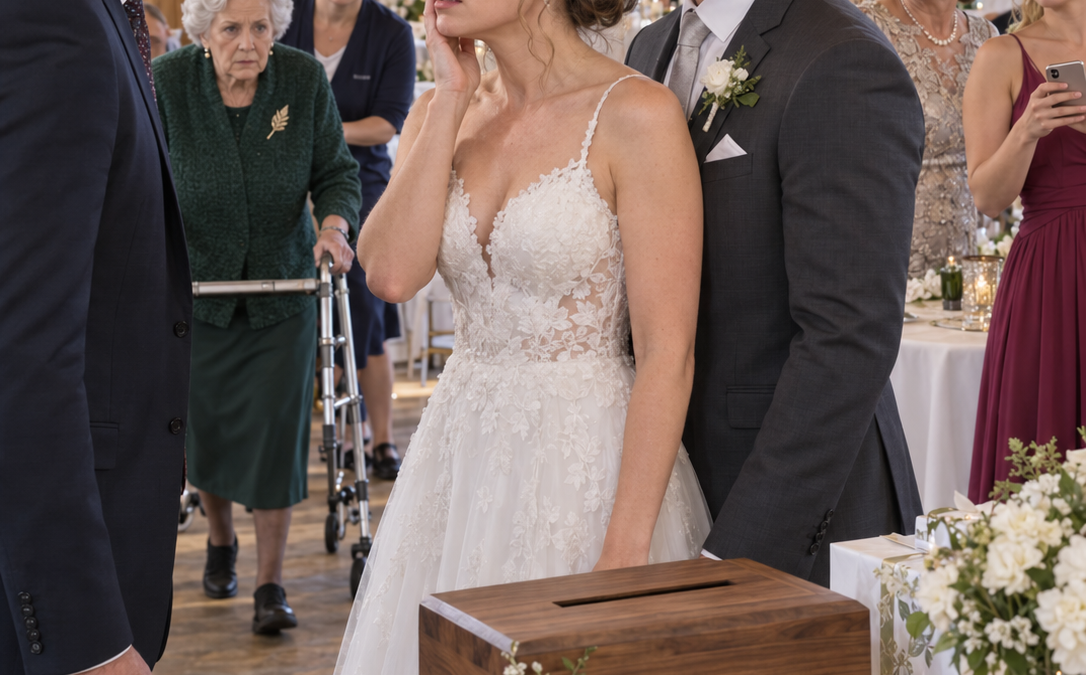
“Give me the box.”
“No.”
He said it again. I said no again. The third time, my father slapped me across the face at my own wedding reception. 90 minutes in, in front of 118 people because the checks on that gift table were not going to my sister. My mother didn’t stop him. She looked at me like I was a child at dinner.
“She needs them more. Stop being greedy.”
My sister smiled. She had known since Thursday. The room went so quiet I heard a chair leg move. My husband stepped in front of me and said, “You just made this very simple.” My father laughed at him. He was still laughing when someone in that room stood up. Someone my parents had spent years keeping away from me with the kindest excuses they had.
What happened after he saw who was crossing the floor is why I never handed my family another envelope. And what I learned about the years before that night is why their version of love did not survive the reception.
My name is Esther Stark. I’m 31 years old. If this story lands in your chest, like and subscribe. Only if it does. Drop your location and local time in the comments. I want to know where you’re hearing this.
I want to start somewhere that has nothing to do with my family because I don’t think the rest of it makes sense until you know what I do for a living. I’m the practice manager at a four-chair dental office on the west side of Grand Rapids.
I started there at 22 at the front desk, answering phones and learning what a denied claim looks like. I took classes at night for 4 years, finished my associate degree at 26, and became the manager at 27.
In the spring of 2023, my boss, Dr. Karen Ashby, called me into her office and closed the door, which she never did. The manager before me had left in a hurry, and nobody had looked closely at what she left behind. There was $68,400 in insurance claims that had never been submitted. Some were over a year old, past the filing window—money the practice had already spent on chairs and gloves and payroll sitting in a drawer.
It took me 5 months. I did it after we locked the doors. One claim at a time. Appealing the ones that had aged out. Calling adjusters. Rebuilding chart notes from scratch.
I got most of it back. Not all. Enough that she didn’t have to sell. When it was done, she handed me a set of keys to the building and said, “I’ve had two managers before you. Neither of them ever asked me what I was afraid of.”
That’s what I’m good at. I’m good at other people’s messes. I’m good at sitting down with a stack of paper held together by rubber bands and not getting up until the numbers agree with each other.
I want you to hold on to that because, in my family, that skill was never once described as a skill. In my family, I was stubborn. I was independent. I was the one who didn’t need anybody. I filed my parents’ taxes for free every March for 9 years.
I got my mother’s physical therapy approved on the second appeal after her insurance denied it. Nobody thanked me for any of it because it wasn’t help. It was just what I did. The way weather is just what happens.
My mother had a phrase she used any time I mentioned something that was hard.
“You’ll figure it out. You always do.”
And then, without a pause: “Your sister’s the one I worry about.”
I heard that sentence for 20 years before I understood it wasn’t a compliment.
I met Ellis Brennan in October of 2022 on a Habitat for Humanity build day in Kentwood. He teaches high school English and builds furniture on the weekends, and he asked me three questions that day and listened to the answers to all three, which was novel enough that I noticed.
He proposed in October of 2024. We paid for our own wedding, $21,800 over 14 months out of two normal paychecks.
We got married in the middle of March because a lakeside lodge in Michigan in March costs about half what it costs in July. And neither of us cared about the temperature enough to pay double for it. We booked Harrow Lake Lodge in Rockford, and we put 118 names on the list, and we paid every deposit ourselves.
In February, we started looking at a house, a three-bedroom on a corner lot, 6 minutes from my parents’ front door. I wanted it. I told Ellis it made sense, that my dad’s knees were getting worse, that it would be easier to help.
Ellis stood in that kitchen with his hands in his jacket pockets and said, “6 minutes. That’s close enough that they’ll never call it a visit. They’ll just call it Tuesday.”
He carried the listing sheet folded in quarters in his coat for weeks. The creases went soft from him opening it and folding it back up. The offer deadline was the Monday after our wedding. It was the only argument in our entire relationship we never finished.
My grandmother taught me how to beat an egg. Marin Stark, my father’s mother. She read two newspapers every morning and did both crosswords in pen, and she was the only adult in my childhood who ever asked me what I wanted instead of telling me what I should want.
She called me Essie. Nobody else did.
She had a ceramic mixing bowl with a crack running around the underside of it. And she refused to throw it out. And when I told her at 15 that I was bad at math and my father was disappointed, she said, “Your father counts. I cook. Neither one of us is any good at the other thing, Essie. Don’t let anybody tell you that’s a character flaw.”
My grandfather Sanford died in August of 2016. He’d worked 31 years at a furniture plant and left her a small pension and a paid-off house. She stayed in that house alone for 4 years and she was fine.
In February of 2020, she broke her hip. That was the last time I was alone in a room with her for 6 years.
Here’s the part you need because otherwise you’ll spend this whole story wondering why I didn’t just get in my car. The wall around my grandmother did not start with a lie. It started with something completely reasonable.
She came out of rehab that spring and she could not go home. Her house sold in May for $184,000. After the realtor and the repairs and the closing, $171,000 went into an account for her care.
She moved into Bellweather Grove in Hastings in June, 40 minutes southeast of Grand Rapids during the exact stretch of months when nobody in this country was allowed inside a place like that. For almost a year, no one saw her. Not me, not my sister, not my mother.
There was a printed sign taped inside the glass door of the lobby with the visitor rules on it. And the sun bleached it and curled the corners. And that sign stayed up so long it stopped being news.
My father handled everything. Her mail, her bank, her Social Security. He’s an only child. There was nobody else to do it and nobody else to check it.
“I’ve got it handled,” he told my mother and me that July. “You two just keep your lives running. That’s what she’d want.”
When the doors opened again, the reason didn’t open with them.
In the fall of 2021, my mother told me the care team had recommended limiting visitors. Grandma got agitated when there were too many people. She got confused afterward and didn’t sleep. The staff had asked the family to keep it to her regular people.
Her regular people became my mother and my sister.
I didn’t fight it. I’d been told my whole life that I was the one who didn’t need things. And somewhere under that, I’d absorbed the idea that pushing would make me the difficult one.
So, I did what I knew how to do. I sent things.
Starting in March of 2021, after my mother mentioned on the phone that grandma’s left hearing aid had quit, and nobody had gotten around to it, I sent $200 a month. Every month, I transferred it to my mother’s phone with the same note every time: for grandma.
I never asked for a receipt. Not once in 5 years.
I want to say that plainly instead of letting you wonder about it. It didn’t occur to me to audit my mother. That’s not naivety, exactly. It’s just that there is a category of person you don’t think to check. And until March of last year, she was in it.
I sent other things, too. A blanket the first Christmas. A leaf-shaped brooch in 2023 that I found in a shop downtown and thought looked exactly like her. A pair of over-the-counter hearing aids in 2024 that cost $290.
In four years, not one of those things was ever mentioned back to me.
The last time I saw my grandmother before my wedding was Christmas of 2025, 11 weeks before, 20 minutes in the common room with my mother sitting on the arm of the couch the entire time.
She was polite to me. That’s the word, polite. She called me dear. She didn’t call me Essie.
“You must be so busy, dear,” she said. “Your mother says you’re always busy.”
And then, looking at the window and nodding at me, she said, “Bridget’s been so good to me.”
I sat in the parking lot for 10 minutes before I started the car. I decided, sitting there, that my grandmother had chosen and that I had lost, and that some things you just carry.
I have a memory box in the closet of my old apartment. In it, there’s a thank-you card from January of 2022 written in handwriting that shakes a little, thanking me for a Christmas package.
At the bottom, it says, “Tell Bridgie thank you for the blanket.”
I always thought she’d mixed up our names.
She hadn’t, but it took me three more months to find that out.
At Thanksgiving in 2025, at the table with my aunt and my sister and Nell and Ellis’s parents all sitting there, my father announced that he was covering the bar at the wedding. $3,100.
He said it the way a man says a thing he wants repeated later.
“The bar is on me. A man pays for the bar at his daughter’s wedding. That’s just how it’s done.”
By the second week of March, the vendor had sent the final invoice three times, and my father had stopped answering texts. Ellis paid it two days before the wedding and printed the receipt and left it face down on the counter so I wouldn’t have to look at it.
What bothered me wasn’t the money. It was that I hadn’t been surprised. Not for one second.
Somewhere along the line, I had started building my life around what my father would fail to do. The way you plan around a road that floods.
He was strange those last two weeks. I noticed it at the time and filed it under wedding stress, which is what you file everything under in the two weeks before a wedding.
He called me twice about the gift table. Not the flowers, not the seating, not the toast—the gift table.
“Big crowd like that. People still bring checks?” he asked the second time, too casually. “Or is it all that phone stuff now?”
I told him it was mostly checks with our parents’ generation.
He said, “Huh?” And changed the subject.
I rode with him to pick up the rental linens that week, and there was a white business envelope on the passenger seat with a clear window in it. I moved it to the dash and sat down and didn’t read it.
3 weeks later, I would know the postmark date on that envelope, and it would change the meaning of everything he did that month.
Here’s what I didn’t know at the time and what Ellis didn’t tell me.
On Saturday, February 21st, my husband drove 40 minutes to Hastings by himself. He’d been building the seating chart on graph paper in pencil because he’s who he is. And he noticed that my grandmother’s name wasn’t on the guest list, and it wasn’t on the list of regrets either.
It wasn’t anywhere.
He had asked me about it in January, and I’d told him what I’d been told.
“She can’t sit in a car that long. She panics in crowds. She wouldn’t know where she was.”
My mother’s exact words had been, “You’d be doing it for you, not for her.”
I had drawn a seat for her at table 12 and then crossed it out with a pen. And Ellis had looked at that crossed-out square for longer than a person normally looks at a piece of paper and said nothing.
So he drove down.
She was in a chair by the window with a newspaper folded in quarters on her lap and the crossword already circled in ballpoint. She asked him what grade he taught. He said 10th mostly. She asked what they were reading and he told her, and she corrected him on a line he’d misattributed.
And she was right.
Her left hearing aid wasn’t working.
And about 20 minutes in, she asked him a question that he told me later he had to look at the floor to get through.
“Is Esther angry with me? She used to write. I’d like to know what I did, if somebody would just tell me.”
He drove 40 minutes home and didn’t say a word about it.
Because in January at the kitchen table, exhausted and half crying over a seating chart, I had made him promise me something.
“Just let me handle them,” I’d said. “I’ve handled them my whole life. One more day won’t kill me.”
He’d looked at me for a while, then.
“Okay. Until it does.”
He kept that promise.
What he did instead was send Bellweather Grove a two-line message that afternoon confirming a non-emergency medical transport van and a private-duty shift for one of their aides. He paid the $180 on his own card and told nobody.
He kept his promise until 9:40 the night of March 14th and not one second longer.
The lodge sits on a small lake, and in the middle of March, the lake still had a rim of ice around the edges, and the fireplace at the north end of the room ran all night. People kept their coats on for the first half hour. It smelled like wood smoke and floor wax.
118 chairs.
The gift table went against the window with a card box on it that Ellis had built out of leftover walnut. Sliding lid. The date burned into the underside where nobody would ever see it.
That lid made a specific sound when it closed. A soft wooden knock.
I heard it three times that night, and I can still tell you what each one meant.
Our coordinator was a woman named Trish Donnelly, who had done 400 of these, and she gave me a rule in the bridal suite before anyone arrived, unprompted.
“Anything valuable goes with me at the end of the night, not with a relative. That’s my rule, not the venue’s.”
I remember thinking it was a slightly strange thing to lead with.
6 hours later, it was the only reason this story has the ending it has.
I saw my grandmother in the receiving line. She was in a wheelchair with a woman in a navy cardigan standing behind her, and she was wearing a green sweater and a brooch.
And my brain simply refused the information for about two full seconds.
I looked at my father.
His face went flat and pale for half a second, and then he smiled and put his hand on somebody’s shoulder and laughed at something.
Grandma took my hand and said, “Don’t you look nice, dear? Then your young man came all the way out to see me. That was very good of him. Nobody’s done that in a while.”
And I looked down and saw what she was wearing on her sweater.
It was the leaf brooch.
The one I’d sent in 2023. The one I’d assumed had gotten lost in a package somewhere because she never mentioned it. And I was too proud to ask.
I opened my mouth to ask about it, and my mother appeared at her shoulder and wheeled her toward the tables, talking the whole way.
Before dinner, Trish came over and handed me an envelope. It had fallen off the table, and it had never been sealed. Older relatives don’t seal them. They just tuck the flap.
Inside was a check for $250 from my great aunt Loretta Fisk, my grandmother’s younger sister, 79 years old and sharp as attack.
The pay line said Vaughn Stark.
The memo line in her careful cursive said, “For Esther and Ellis.”
I stood next to that gift table holding it for longer than made sense. Two names in the right place underneath one name in the wrong place.
I found Loretta near the coffee and asked her about it quietly, keeping my face pleasant because I was a bride and there were people watching me the way people watch a bride.
“Your dad said it was easier that way,” she said. “Said he’d handle getting it to you kids.”
She looked at me.
“Was that not right?”
I told her it was fine.
Then I went back and looked at the table. There were at least three more envelopes in the same category. That specific slanted handwriting older people use for names on the outside.
I found my mother by the cake table and asked lightly whether Dad had said something to people about the checks.
She answered fast, too fast and too long, which is a thing I know from 9 years of talking to insurance companies. When someone gives you four sentences for a yes-or-no question, the answer is in the extra three.
“Oh, that’s just your father being your father. He likes to feel useful. Don’t make it into something.”
And that’s when I looked across at the family table and saw my sister.
The lights were down by then. Bridget’s face was lit up blue from her phone. She was reading something and she was smiling to herself. The private kind of smile you do when a thing you’ve been waiting on finally lands.
She put the phone away.
She looked straight at me, and she kept smiling.
If you’ve ever caught something small at a family event and told yourself you were imagining it, stay with me because the next 15 minutes are the reason I’m telling this at all.
And tell me in the comments whether you would have said something right then or waited like I did.
The toasts were done. The cake was cut. People were on their second round and the little kids were under the tables.
My father came up to the gift table and put his hand flat on the sliding lid of the box before he said anything.
“Give me the box, sweetheart. You’ve got a hotel to get to. I’ll sort it Monday.”
He said it the way you’d offer to carry somebody’s groceries.
That’s the part I want you to understand because it’s the part that made it hard. He wasn’t demanding. He was helping. He had been helping in exactly this tone my entire life.
“No,” I said.
And I heard my own voice say it, and I thought distinctly in the middle of my wedding: I have never said that word to him.
He laughed a little, like I’d made a joke he’d have to explain later. He said something about the bank being closed Monday if he didn’t get there early. He said something about how I had enough to think about.
I asked him quietly why Aunt Loretta’s check had his name on it.
He didn’t answer that.
He went up a step instead.
“It’s family money, Esther. It always has been.”
Somewhere behind me, a fork went down on a plate, and it was louder than a fork should be because more of the room was listening than had been 30 seconds earlier.
At the far end, someone lifted their head. I didn’t see who.
He kept going.
He said Bridget was drowning. He said I was sitting there planning a honeymoon while my sister couldn’t cover a security deposit.
And then he said a thing that meant nothing to me that night and everything to me 19 days later.
“This has to be handled by the end of the month.”
Nobody had asked him about the end of the month.
I said no a second time.
Then my mother came around the table.
She didn’t come to stop him. She came to close it.
“She needs them more,” she said. “Stop being greedy.”
She used the voice you’d use with a seven-year-old reaching across somebody’s plate. Level. Slightly tired.
That was worse than yelling.
Yelling would have been an event.
This was a correction.
Bridget didn’t say anything for the room. She leaned in as she passed and said, just to me, “Don’t make this weird, Est.”
My father reached for the box.
I pulled it back, and it went out of my hands and hit the edge of the table, and the sliding lid jumped open about an inch.
And he slapped me.
118 people stopped talking at the same time.
I’ve read that people scream in those moments. Nobody screamed.
What I remember is a glass being set down very carefully somewhere behind me and the fireplace and my mother-in-law’s hand going onto her husband’s shoulder and my own ear ringing on one side and being irritated about the ringing more than anything else.
Ellis put his drink down.
He took one step and stood between us.
He didn’t touch my father. He didn’t raise his voice. His hands stayed in his pockets.
And I don’t know why that’s the detail I kept, but it is.
“You just made this very simple,” he said.
My father snorted.
“Big words from a guy who teaches sophomores.”
Nobody called anyone. I know that’s the first question, and I’m not going to defend it.
It was my wedding, my father, and a room full of people who had known him for 30 years. And every single one of us did the thing families do, which is nothing, for about 11 seconds.
Then at the far end of the room, a chair pushed back.
My grandmother stood up.
It took her a while.
Ivy Kesler—that was the aide’s name, the woman in the navy cardigan—brought the walker around and set the brake and then let go of it and just walked beside her.
It’s less than 25 ft from table 12 to where my father was standing. It took almost 2 minutes.
Nobody in that room said a word for the whole 2 minutes.
The only sound was four rubber feet coming down on a wood floor over and over, unhurried.
My father moved to help her.
She lifted one hand, and he stopped where he was.
And then he did something that gave him away before anybody had asked him a single question.
He wasn’t surprised that his mother could stand. He wasn’t surprised she’d made it 40 minutes in a van. He wasn’t confused about any of the things he’d been telling me for 6 years.
He panicked because she was there.
“Ma, you’re tired,” he said.
And he said it loud for the room.
“Let’s get you out to the van. It’s late. You’ve got your medication.”
“She’s not on anything that makes her tired, sir,” Ivy said, flat and professional. No edge on it at all.
He put his hand on his mother’s elbow.
She took her arm back.
Then she spoke to the room, and the first thing she said had nothing to do with my wedding.
“I didn’t come here to ruin my granddaughter’s night,” she said. “I came because I’ve just heard my son say three words to her that he’s been saying to me for 6 years.”
She turned to him.
“Family money. That’s what you say to me. I sold my house, Vaughn.”
Her voice didn’t shake.
“I get $2,240 a month from Social Security and $610 from your father’s pension. And I have not seen a bank statement since 2020. I’d like to know what a person has to do to see her own bank statement.”
She wasn’t holding any paperwork. She had a small clutch purse under her arm and a leaf brooch on her sweater, and that was the entire arsenal.
At table 6, my great aunt Loretta stood up.
“Vaughn.”
She had her reading glasses in her hand, and she pointed them at him.
“You called me 3 weeks ago and told me to leave the name blank or write yours.”
He said something about how that was to make it easier.
“Easier for who?”
A woman two seats down from her nodded.
Then a man at another table said out loud that he’d been told the same thing.
Then a third.
11 envelopes, $2,900, though I didn’t have that number until Tuesday.
Trish Donnelly walked over to the gift table and stood next to the walnut box.
She didn’t touch it. She didn’t say anything. She just stood there.
And I understood that she’d decided about 10 minutes ago that she was going to be a wall if anybody needed one.
And that’s when I realized this was getting away from me.
Not away from my father. Away from me.
It was about to become a roomwide argument about 11 checks. And everybody in it was going to leave with a story about the Starks. And none of it would answer the thing I had actually started to feel behind my ribs since the receiving line.
So, I did the opposite of everything I’d ever been taught.
I picked up the box.
I carried it 8 ft to Trish and put it in her hands.
And I said it loud enough that the back tables heard me.
“Nobody opens this tonight. Not him. Not me. You said that was your rule. I’m holding you to it.”
She slid the lid shut.
Second time that night.
Then I turned around, and I didn’t ask my father anything, and I didn’t ask my mother anything.
I walked over to my grandmother and I said, “Grandma, when was the last time you got money from me?”
I want to tell you what that question did to the room, which is nothing.
Nobody understood it.
118 people had just watched a man hit his daughter over a box of envelopes, and I had apparently changed the subject.
Three people in that room understood the question.
All three of them were standing within about 10 ft of each other.
My grandmother tipped her head.
She was genuinely puzzled.
That’s what got me.
There was no defensiveness in it at all.
“From you, dear?”
“From me, sweetheart?”
She said, “You haven’t sent me anything.”
I said, “For how long?”
And she thought about it. Honestly, the way you think about a real question.
And she said, “I don’t believe you ever have.”
I didn’t argue with her.
I want you to know that because it’s the only thing I did right that whole night.
I didn’t raise my voice and I didn’t cry and I didn’t say, “How could you?”
I took my phone out of the little pocket sewn into the side of my dress and I opened my transfers and I scrolled.
It just kept going.
The same note over and over down past the edge of the screen.
For grandma.
For grandma.
For grandma.
I turned the screen around and held it in front of my mother.
“$200,” I said. “Every month, 60 times.”
I didn’t read the dates out loud.
I didn’t have to.
“Mom, say the number out loud.”
She didn’t say the number.
She looked at Bridget.
And my grandmother, who had been watching my face, not the phone, reached up and put two fingers on the brooch on her sweater and said slowly, “Bridget gave me this.”
Nobody spoke.
“Bridget brought me the blanket.”
She was going through it in her head now, out loud, item by item, and it was awful to listen to.
“Bridget brought me the hearing aids in the fall in a little box.”
Bridget—
She stopped.
Then she asked it herself, which is the part I will hear for the rest of my life because I did not ask it and Ellis did not ask it and nobody made her ask it.
“Bridget, did you buy me anything?”
My sister looked at the table.
She didn’t deny it.
She didn’t say yes.
She looked at the tablecloth like there was something written on it.
It was my mother who answered.
“She had nothing, Esther.”
She said it fast, and she said it like she was explaining something obvious to someone slow.
“You had everything. You had the job and the degree and the— You had all of it. She had nothing. I just wanted her to be somebody’s favorite for once.”
And there it is in one sentence.
The whole machine and the reason she built it.
I want to take you back to the common room 11 weeks earlier.
Christmas.
An old woman in a chair by a window being polite to a granddaughter she believes stopped writing, saying warmly about the person who has been bringing her everything.
“Bridget’s been so good to me.”
She was thanking me out loud to my face under somebody else’s name.
My father took money from me for 6 years.
My mother took my place.
My grandmother turned to look at her son and asked him a question, and his answer is the thing 118 people are still repeating at other people’s weddings.
She asked him where her money went.
And my father, who had been in control of every room he’d ever walked into, who managed a building supply warehouse and 40 guys and knew exactly what he was worth, did the worst possible thing.
He started giving numbers.
He told the room what assisted living costs, what her Social Security is, co-pays, haircuts, the podiatrist.
He listed things out loud at a wedding in front of 118 people, one of whom was a professional caregiver from the actual facility.
Ivy Kesler didn’t contradict him. She just frowned slightly at two of the numbers.
“You have any idea what that place costs?” he said. “6 years. 6 years I’ve carried that woman.”
Carried.
I didn’t say anything about that word.
I’ve thought since that it was the smartest thing I did all night, saying nothing about that word.
My grandmother heard it, too.
She repeated it back to him.
Just the one word as a question.
“Carried?”
“That’s what I said.”
“And what am I in your books? What line am I on?”
“You’re an expense, Ma.”
He threw his hands out.
“That’s what it is. That’s what it’s been since 2020. You want it in fancier language. It’s an expense.”
Somebody’s chair scraped.
Then he turned to me, and this is the sentence that finished him in this family, and he handed it over for free.
“I fed you for 18 years. 18. And you’re going to stand here and count envelopes at me?”
He had just told a room full of relatives that his daughter was an investment that had come due.
The first person to move wasn’t me.
My mother-in-law, Colleen Brennan, put her napkin on the table and stood up. She didn’t say anything to anyone. She just stood and stayed standing and looked at him.
And that was somehow the loudest thing that happened all night.
Loretta Fisk went and got her coat.
Deb Hollis, my mother’s cousin, a woman I’ve maybe spoken to nine times in my life, came around the tables and put her hand on my arm and said quietly, “I wrote mine to you. I want you to know I wrote mine to you.”
Then she went and got her coat, too.
Ellis’s father, Gordon, slipped out to the parking lot to rearrange rides for two older guests who suddenly wanted to leave and didn’t have a car.
About 20 people left in 20 minutes.
Nobody made a speech on the way out.
They put their coats on and shook our hands and said congratulations to me and nothing at all to my parents.
And that was the entire punishment.
And it was enormous.
And I still hadn’t said the thing I needed to say.
So, I said it, and I kept it short because I’d learned by then that short is what people remember.
“I’m not giving you the box.”
My father started to talk and I kept going.
“Starting next week, I’ll be talking to Bellweather Grove myself, and I’m not sending anything through you again. Not money, not gifts, not cards, nothing.”
I looked at both of them.
“I’m not asking you to leave either. You can stay. You just can’t have anything.”
Then I sat down in my chair and drank an entire glass of water, which was the most ordinary thing anyone did that night.
My grandmother put her hand over mine on the tablecloth and said she’d like to go home.
And then she said she’d like me to be the one to take her.
I want to ask you something honestly before we go any further.
Has anybody in your family ever taken credit for something you paid for?
Put it in the comments. I read them, and I’ve got a feeling I’m not the only one.
I drove my husband’s car to Hastings that night in my wedding dress. My grandmother in the passenger seat, Ivy in the back, Ellis following us in my car.
Nobody turned the radio on.
The road still had salt on the shoulders from the last storm, and the whole way down there was that particular March darkness where the fields are half snow and half mud.
“You’re going to ruin that dress,” she said.
“It’s already been a long night for it.”
I had the skirt shoved down between the seats so it wouldn’t get caught in the door.
About 10 minutes in, she started asking questions.
“Tell me about the last 5 years,” she said. “Start anywhere.”
So, I did.
And within about 90 seconds, I understood what I was actually dealing with.
She didn’t know I’d become the practice manager.
She didn’t know I’d finished the degree.
She didn’t know I’d been engaged since October of 2024.
She had learned my husband’s name three weeks earlier from him in a chair by a window.
For 6 years, everything she’d been told about me came from two people, and it came out of one sentence.
“Esther’s busy.”
I talked for 40 minutes.
She kept stopping me.
“Slow down. Start again at the part where you fixed the insurance. I want to hear that part properly.”
She held my hand through a curve on the county road and didn’t let go until we were in the parking lot.
When we got her back to her room, she pointed at the bottom drawer of her dresser and said there was a shoe box in there with every piece of paper anyone had ever handed her.
Ellis and I got back to my apartment at 2:00 in the morning and sat on the kitchen floor with our backs against the cabinets because neither of us could face a chair.
He told me about February 21st, about the seating chart and the crossed-out square and the drive and what she’d asked him.
“I broke the promise,” he said.
“You broke the wrong promise on the right night.”
The listing sheet for the house 6 minutes from my parents was on the counter, soft-creased, folded in quarters.
We looked at it for maybe 2 minutes total.
Then he put it in the trash under the sink and we went to bed.
And on Monday, the offer deadline came and went, and neither of us mentioned it.
I drove back down that Sunday and again on Tuesday and again the Thursday after that.
The first thing that happened wasn’t the shoe box.
It was a phone call.
And I want to be specific about it because people assume you can just call a nursing home and start asking questions about your grandmother’s account.
And you absolutely cannot.
They will not tell you the weather.
My grandmother called the business office herself on speaker, sitting on the edge of her bed with the phone on the nightstand.
“This is Marin Stark. Room 14. I’m the one you’ve been mailing.”
A pause.
“I’d like my granddaughter added to this account, and I’d like to know why nobody’s been talking to me.”
They emailed a release form.
She read it, all of it, and signed it and handed me the pen back.
Then we did the shoe box.
It was a shoe box with two rubber bands crossed over the lid.
Inside, paper bank statements she’d asked for years ago and kept even after she couldn’t read the small print. Facility invoices. Medicare summaries. A birthday card from 2019.
And one white business envelope still sealed, addressed to my father, care of her room number.
That’s how they’d sent it to the responsible party at the resident’s address.
It had gotten put in her mail slot, and she’d never opened it because it wasn’t hers.
It was a 30-day notice of discharge for non-payment.
Dated Friday, March 6th.
8 days before my wedding.
I sat on the floor of that room and turned that envelope over and looked at the postmark, and the entire month of March reassembled itself in front of me.
The two phone calls about the gift table.
The white envelope on the passenger seat.
“By the end of the month.”
His hand flat on the sliding lid before he even said hello to me.
I called the business office.
A woman named Wendy Proser handled it, and she was kind about it in the specific way people are kind when they have had this conversation before.
“Three months,” she said. “January, February, March. We mailed the notice to the responsible party on the 6th. He signed for it.”
I asked when the discharge date was.
April 5th.
My grandmother had 17 days to be somewhere else.
Then I did what I do, which is sit down with a stack of paper and not get up until the numbers agree.
$171,000 went into that account in May of 2020.
Her income is $2,850 a month.
Bellweather Grove is $3,650.
The gap—the actual, honest gap between what she has and what it costs—is $800 a month.
She’d been there 70 months.
$800 × 70 is $56,000, which means that account should have had about $115,000 in it.
The balance on the March statement was $2,300.
$112,700 is not an accounting error.
It’s not fees.
It’s not inflation.
And the money didn’t run out in March.
It ran out in December.
I sat with that for a while because December was doing something to a different part of my brain that I couldn’t articulate yet.
Then I went through it line by line, and here is the part that I did not expect and that I’m still not entirely over.
I had seen almost all of it.
$14,600, 2023.
That’s the used SUV my sister pulled into my parents’ driveway that June and honked and made everybody come out and look at.
I told her it was a nice color.
$19,300, also 2023.
That’s my parents’ kitchen. New cabinets, quartz counter, an island.
I ate Thanksgiving in that kitchen and told my mother it turned out beautifully.
$16,800, 2022 to 2025.
That’s the private preschool.
Nell went to the one with the garden.
$30,400 in monthly pieces of $950 from May of 2023 to December of 2025.
That’s a subsidy on my sister’s rent that nobody ever said out loud in front of me.
And $31,600 in credit card payments and what the statements called household.
I had eaten Thanksgiving in a kitchen paid for with my grandmother’s nursing home money and complimented the backsplash.
I made a list of the 11 people whose checks had the wrong name on them on the back of a vendor invoice, and I called all 11 of them over two evenings.
I didn’t ask them to rewrite the checks to me.
“Don’t rewrite it to me,” I told Aunt Loretta. “If you still want to give it, write it to the care home and put her name on the memo line. That’s all I’m asking.”
Nine of them did.
$2,900 left my wedding and went where it should have been going for 6 years, and I never touched a dollar of it, and I’d do it again.
The ninth person I called asked me a question about Bridget that I wasn’t ready to answer.
3 hours later, Bridget texted me.
She picked a diner with a playground, and she brought Nell.
And I clocked that decision the second I pulled in.
I went anyway.
Nell went straight to the swings.
Bridget held a paper coffee cup with both hands, even though it was the end of March and not that cold, and she started before I’d finished sitting down.
“You think I sat there and planned this?”
She wasn’t crying.
She was furious, which surprised me.
“I drove down there twice a month for 6 years. Twice a month, 40 minutes each way. I cut her toenails. I changed the battery in her watch. Where were you?”
I let her finish.
Then I asked, “Who told you I wasn’t allowed to come?”
She opened her mouth and closed it.
And here’s the part I’m not going to make easier than it was.
The driving was real.
6 years, two Saturdays a month in a room that smells like disinfectant and floor cleaner. Sometimes with a 4-year-old in the car.
Nobody made her.
I said so out loud because it was true.
“I’m not taking the driving away from you,” I told her. “I’m taking the blanket.”
Her phone had been face down on the table the whole time.
She hadn’t turned it over once.
I noticed that, and it took me a minute to understand why it bothered me.
Because a person who’s been lying to you checks their phone.
A person who’s been lied to doesn’t have anything to check.
I asked her about Thursday.
She turned the phone over.
She read it out loud.
“Dad, March 12th, 2 days before the wedding. I’m handling the gift table Saturday. Most of it’s coming to you. Don’t say anything to your sister. She’ll make it a thing.”
Most of it.
So, I told her about the notice dated March 6th.
I told her that $7,300 of what was in that box had been spoken for 8 days before he sent her that message, and that there was never a version of Saturday night where that money reached her.
She read the text again.
Then she said to the phone, “Not to me. He wrote most of it.”
And then she told me the other half, the part I hadn’t put together yet.
In January, with no explanation, the $950 a month my parents had been quietly putting toward her rent had stopped.
“Just stopped?” she’d asked.
My mother had said things were tight.
She’d assumed it was her fault somehow. Somehow for not finding something full-time.
She’d been going under for 2 months and had no idea why.
I had to be the one to tell my sister whose money had been paying her rent for 3 years.
She put the cup down and put her hand over her mouth and sat like that for a while.
When she could talk again, she told me about Christmas of 2021.
My mother handed my grandmother the blanket, the one I’d shipped from the same store I always used, and said, “That’s from Bridget.”
And my grandmother pulled Bridget down and hugged her.
“She hugged me,” Bridget said. “Nobody in this family had hugged me in about 2 years, and I just let her.”
Two seconds, she said.
Then 10.
Then the rest of the evening.
Then the next time.
And the time after that.
It wasn’t a decision.
It was 4 years of not making one.
And then she said the thing that turned me around completely.
For 6 years, my mother had been telling her a version of me. That I was busy. That I’d done well and moved on. That I’d asked about grandma once or twice out of obligation.
That I wasn’t going to come.
So there was no point waiting on me.
Two walls.
One builder.
Nell came running back and stopped at the end of the table out of breath and asked me a question with total seriousness.
“Are you still my aunt? Mom said, ‘Maybe not.'”
“I’m still your aunt,” I said. “That part isn’t up to your mom. It isn’t up to me either. It’s just true.”
She said okay and ran back to the swings, and the swing kept moving after she was gone.
I drove home and realized I’d spent 10 days aiming at the wrong person.
My grandmother is the one who brought up moving, not me.
I want to be clear about that because I’ve read enough about people getting shuffled around in their 80s by relatives who’ve decided what’s best.
She asked me on the Sunday.
She said Hastings had been fine and the people were kind and she’d like, if it wasn’t a nuisance, to be closer to Grand Rapids before she died.
And she said the last part completely matter-of-factly, the way she says everything.
I found a place called Alder Court.
Smaller building, 22 residents, 12 minutes from where Ellis and I were about to put an offer in.
$3,200 a month.
They require a nurse assessment before anyone moves in. That’s standard everywhere.
And if a place tells you otherwise, you should leave.
We did it Friday the 27th.
She passed it so thoroughly the nurse asked her twice whether she was sure she needed assisted living at all.
Her income covers $3,250 of it.
I told her in front of the admissions director that I would cover the $350 difference every month.
And then I told her the other part.
“$350 a month from me, and you’ll see every statement paper-mailed here to you with your name on it. If I ever stop, you’ll know before anybody else does.”
She called Social Security herself the following week and had the representative pay changed back to her own name.
It’s a form.
That’s all it is.
6 years of a wall, and undoing the money part of it took one phone call and two pieces of paper.
The mail started coming to her that same month.
First time since 2020.
And that’s the week my father showed up at Bellweather Grove with a borrowed truck.
He didn’t come to yell.
I almost wish he had.
He came to help move furniture.
That’s the whole playbook in my family.
And I recognized it in about 3 seconds.
In the Stark house, usefulness is how you get back in the room.
You make yourself necessary.
Necessary becomes owed.
Owed becomes control.
And nobody ever has to apologize for anything.
“You’ll need somebody who knows how to load a truck,” he said.
“Then load it,” I said. “That’s all this is.”
He loaded it, and he was good at it because he manages a warehouse and he is genuinely good at it.
He got her dresser and her chair and four boxes of books down a hallway with a bad turn in it.
And I didn’t take that away from him.
He didn’t get a key.
He didn’t get put on a single form.
And when the admissions director asked in front of him who the contacts were, I said my name and Ellis’s name.
And stopped.
At one point, he picked up the ceramic mixing bowl with the crack in it and started to wrap it in a towel.
I told him to hand it to her and let her carry it.
In 4 hours, he did not apologize to his mother once.
He talked about the truck’s clutch and the traffic on M37 and how the elevator at Alder Court was too slow.
And he did not say one word to the woman he’d called an expense in front of 118 people.
She moved in on Saturday, April 4th.
One day before the discharge date.
The new room is smaller than the old one.
It faces east.
She stood in the middle of it with her purse still on her arm and looked around and said, “It’s smaller.”
And then, after a moment: “It’s closer.”
Ellis put up a shelf for her that afternoon, before we’d even signed on our own house.
Ivy Kesler drove up from Hastings on her day off to say goodbye and brought her a plant.
My grandmother put the shoe box on top of the dresser where anyone could see it and took the rubber bands off.
The $11,400 owed to Bellweather Grove did not move with her.
It stayed there on an account that had been managed for 6 years by her son.
Nobody did anything to my parents.
I want to be precise about that because I know how these stories usually go.
There’s no courtroom in this one.
No lawyer.
Nobody called the police.
Nobody filed anything.
What happened is that people stopped calling.
Aunt Loretta hasn’t spoken to my father since March.
Three households skipped my grandfather’s memorial lunch in April, which had been on the same weekend for 9 years.
My mother, at 61, took a part-time job doing intake scheduling for a home care agency.
My sister picked up full-time hours at the grocery store.
Deb Hollis called me in April and said something I’ve thought about a lot.
“Nobody’s punishing them, honey. People just stopped calling. That happens on its own.”
I went by my parents’ house once in the middle of April to pick up two boxes of my things out of the basement.
There was a white envelope on the kitchen counter with PAST DUE stamped across it at an angle.
I didn’t touch it.
I got my boxes and I left.
And then, on a Thursday afternoon at the end of April, my mother’s car was parked in front of my building by itself.
She had a cardboard box. Not a grocery bag. A proper moving box, the kind you buy, with the flaps folded over each other.
I let her in.
I’d been to see my grandmother that morning.
Thursdays had already started to mean something by then, and I was still in the clothes I wear to work.
She put the box on my kitchen table and started taking things out of it and setting them on the table one at a time.
Report cards.
A fourth-grade class photo.
A ceramic thing I made in Girl Scouts that has no identifiable purpose.
My high school diploma in its folder.
And a cotton dress folded on top, yellow at the collar, that she made for me the summer I was nine.
“I sewed that in one weekend,” she said. “You wore it until the hem came out twice.”
She didn’t ask me for anything for the first half hour.
If I told you I sat there unmoved, I’d be lying and you’d hear it.
It worked.
I’m 31 years old.
I knew exactly what was happening, and it worked anyway.
That’s the strongest thing she has, and she brought all of it.
And then she apologized.
A real one.
The first one I’ve ever gotten from her in my life.
She said she was the one who started it.
Christmas of 2021.
The blanket.
She said she hadn’t planned it, that it came out of her mouth, and then it was out there, and then it was easier the second time.
She said she’d been the one driving down to Hastings every week in 2020 when nobody could go inside, standing in the parking lot waving at a window, and that nobody had thanked her for that either.
She said she’d looked at Bridget after the divorce and seen somebody with nothing, and she’d wanted her to be somebody’s favorite one time before she died.
She cried.
It was not performance.
I’ve watched my mother perform my entire life, and I know the difference.
And in the whole apology, 30 minutes of it, with real tears, she never once said my grandmother’s name.
She was sorry about what she’d done to me.
“I’m sorry I did that to you,” she said.
I sat there for a second.
“To me,” I said.
She didn’t hear it.
That’s the thing.
She genuinely did not hear it.
40 minutes in, she told me why she’d come.
“There’s $11,400 sitting on your grandmother’s account at Bellweather Grove.”
I said I knew.
“It’s in her name, Esther. Not your father’s. Hers. They send it to collections. It’s her name on it. At 84.”
And then she said it, and I’ll give her this.
It was the best-built sentence anybody used on me in all of 2026.
“You’d be doing it for her, not for us. You can hate me and still do it for her.”
I got up.
I filled a glass of water at the sink and I drank some of it and I did not sit back down.
That’s the only thing that happened physically.
I want you to know how small the moment was.
There was no speech.
It was a woman standing at her own kitchen counter with a glass of water deciding not to sit down again because she wasn’t wrong about the bill.
The bill is real.
The name on it is real.
And the person it lands on is the person I love most in the world.
And my mother knew that when she put that dress on top of the box.
31 years of training came up my throat all at once.
And it sounded exactly like it always has.
It sounded like, “It’s only money, and you’ve got it. And you’re the one who can handle it, and she’s 84, and what kind of person are you?”
I put the glass down.
“I already send it, Mom.”
She looked up.
“$350 a month to Alder Court. It comes out on the 1st. It’s got my name on it. And they mail her a statement, and she reads it.”
She started to say something and I finished.
“I’ve been doing exactly what you’re asking me to do this whole time. The only thing that’s changed is she knows my name on it now.”
My mother was quiet for longer than that entire wedding reception was quiet.
Then I did something I’ve gone back and forth about, and I’ve landed on being okay with it.
I got a sticky note and wrote down Wendy Proser’s name and the direct number for the Bellweather Grove business office.
And underneath it, I wrote: hardship plan.
“Ask for it by name because they have one and almost nobody asks.”
I put it on top of the box.
“That’s real,” I said. “They’ll set it up over the phone in 20 minutes, but somebody there has to make the call, and it isn’t going to be me.”
She picked up her purse.
She left the box.
At the door, she stopped and she asked me one more question.
And it’s the reason I know that nothing I said that afternoon actually landed anywhere.
“So, what am I supposed to tell your father?”
I didn’t answer that one.
We closed on a house on Friday, May 22nd.
A 1958 ranch with a bad driveway and good bones and a maple in the front yard that somebody planted the year it was built.
It’s 12 minutes from Alder Court.
I don’t have anything profound to say about the difference between 6 minutes and 12 minutes except that I picked one of them and somebody else picked the other and I know which one I’d choose again.
Ellis was measuring a door frame the first week and said without looking up, “12 minutes. Close enough that it’s Thursday.”
My office is closed Thursday mornings.
It used to be when I did payroll.
Now I pick her up at 9:00 and we drive two blocks to a diner with vinyl booths and a window, and she orders the same thing every single week, and we take up a table for an hour and a half.
We don’t talk about my parents.
That was never a rule.
Neither of us wanted to spend the good hour on them.
We talk about the crossword, about Ellis’s sophomores, who she has opinions about, about the new chair in the Alder Court common room, which she despises and describes in detail every week like a woman filing a complaint with a government agency.
Somewhere around the third week, she stopped calling me dear.
“Seven letters,” she said over the top of the paper. “To take without asking. I’ve been sitting on that one all week.”
“You’re not funny, Grandma.”
“I’m a little funny.”
In the sixth week, May 14th, she pushed something across the table at me.
Alder Court gives residents $60 a month for personal spending. Toothpaste, a magazine, the vending machine.
It was an envelope with $18 in it.
What she’d managed to save out of 60 after buying her own coffee every Thursday because she insists on buying her own coffee every Thursday.
I pushed it back.
I said something about how that was ridiculous.
She put her hand flat on top of it and didn’t move it.
“I have spent six years being somebody’s expense,” she said. “Take the $18, Essie.”
There was a piece of paper folded in with the bills.
Her handwriting, which shakes now:
“For gas. Thursdays. Grandma.”
I took it.
Here’s where I’ll leave you.
I never finished our thank-you cards.
There were 118 people at that wedding, and about 70 of them gave us something.
And after March, I could not make myself sit down with that stack.
Two weeks ago, on a Thursday, I brought the whole box to the diner.
She addressed the envelopes.
Her handwriting is bad now, and she knows it, and she doesn’t care.
And honestly, at 84, an unsteady hand on an envelope is its own kind of message.
I wrote the insides.
We got 11 of them done before the coffee went cold.
“Who’s next?” she said, holding the pen.
“Aunt Loretta.”
“Good.”
She started writing.
“She’ll like that.”
The $18 envelope is not put away somewhere safe.
It’s on the table, propped against the sugar caddy where I can see it.
I spent most of my life thinking an envelope was something you handed over.
My father put his hand on a box before he said hello to me.
And my mother told a room full of people I was greedy for not opening it.
And for about 11 seconds, I wondered if she was right.
Now, an envelope is a thing I sit at a window and fill out on a Thursday with a woman who spent six years being told I’d forgotten her.
Here’s the question I’d leave you with.
And I’d really like an answer because I’m still working on mine.
When your family tells you that you don’t need it, who taught them that?
Put it below.
And if you want to hear what happened the first time my father called me after all of this and what I said, that one’s on this channel.








