My family humiliated me at thanksgiving, calling me a “disgraceful single mom.” my dad screamed “get out!” in front of everyone. i calmly said “okay” and left without a word. what they didn’t realize? they’d been living off my $87 million fortune the entire time. by morning, i froze every account and flew to my beachfront estate in honolulu…
While Preston was busy being adored and Camille was busy being adorable, I was learning. I read everything I could get my hands on. I stayed after school to help the math teacher grade papers just so I could learn faster. I saved every dollar I earned from babysitting and shoveling driveways.
By 15, I had a small trading account under my father’s name that he never checked because he assumed I was just playing pretend. By 17, I had turned $400 of babysitting money into $11,000.
And my father cashed it out to help pay for Preston’s college application fees.
He didn’t ask. He just took it.
When I cried about it, my mother told me I was being selfish because family helps family. That was the first real lesson I ever learned about the Prescotts. Family, in their vocabulary, was a one-way street, and I was always the one being asked to give.
I left for college at 18 with a scholarship, a duffel bag, and a promise to myself that I would never again let anyone touch my money without permission. I studied finance at a state university nobody in my family bothered to visit.
Preston went to a private school where my parents drained their savings for tuition. Camille eventually went to a fashion program in New York that they took out a second mortgage to pay for. When my scholarship covered everything and I graduated with honors, my father’s only comment at the ceremony was that the campus looked cheap.
By 23, I was working at a small investment firm in Boston, making a decent living, but nothing extraordinary.
Then I met Adrien.
He was a client older than me by 9 years, brilliant, kind, quiet in the way that patient men are quiet. He had built a modest software company from nothing, and he trusted me to help him manage his growing portfolio. We fell in love slowly, the way real things happen.
We married when I was 26. My family came to the wedding, criticized the venue, complained about the food, and left before the cake was cut. Adrienne squeezed my hand and told me he understood now why I never talked about them.
Two years into our marriage, Adrienne’s company was acquired by a larger firm for a number I still can’t say out loud without my throat tightening. We suddenly had more money than either of us had ever imagined.
Adrien, being Adrienne, wanted to give it away. We set up foundations. We funded scholarships. We bought a small house, not a mansion, in a town where nobody knew our names.
Then Adrienne got sick.
Pancreatic cancer, stage 4 by the time they found it. He fought for 14 months. Our daughter Ren was just barely 2 years old when he died. I was 29.
I sat in the hospital hallway holding her tiny hand and understood for the first time in my life what it meant to be completely alone with the weight of everything.
I did not tell my family how much money Adrienne had left me. I did not tell them about the estate, the accounts, the ongoing royalties from the software patents. I told them Adrienne had left me enough to get by.
I said this deliberately. I said this because I already knew what would happen if they found out.
And I was right to say it because, within a month of the funeral, my mother called to tell me she assumed I would be moving back home so they could help raise Ren. And, by the way, could I contribute to the household since I would be living there rentree.
I did not move back home.
I bought a modest condo in a Boston suburb and let them believe I was struggling. For the next several years, I built quietly, methodically, with the same discipline I had learned at 15. I invested. I studied markets. I made careful, patient bets.
Adrienne’s inheritance grew and grew and grew.
By the time Ren was 7, my net worth had crossed $40 million. By the time she was 9, it was 60. By this past summer, in July of 2025, it had crossed $87 million.
And I was still living in the same modest condo, still wearing the same black cashmere sweater, still letting my family believe I was one bad month away from asking them for help.
Why did I let them think that?
Because 6 years ago, I made a decision that I have questioned every single day since. I decided to secretly help them—not because they deserved it, because Ren deserved a family.
And I thought maybe if I quietly made their lives easier, they would be softer, kinder, more welcoming to the little girl who had already lost her father.
I paid off my parents’ mortgage through a shell company that made it look like a bank refinance error in their favor. I paid Preston’s car lease every month through an anonymous corporate benefit. His employer never questioned because I was routing it through a legitimate consulting arrangement.
I paid Camille’s twin daughter’s private school tuition through a fake scholarship fund I created and administered myself. I paid my father’s country club dues. I paid my mother’s cosmetic procedures. I paid for the kitchen renovation they bragged about for 2 years. I paid for Preston’s second honeymoon.
I paid for the family cruise they took without inviting me and Ren.
None of them knew.
That was the whole point.
I wanted to see who they would be when they thought no one was watching. I wanted to see if the softness would come. I wanted to see if, freed from financial stress, they would finally have room in their hearts for the daughter they had spent decades treating like an afterthought.
They did not have room.
They had more space than ever, and they filled every inch of it with contempt for me.
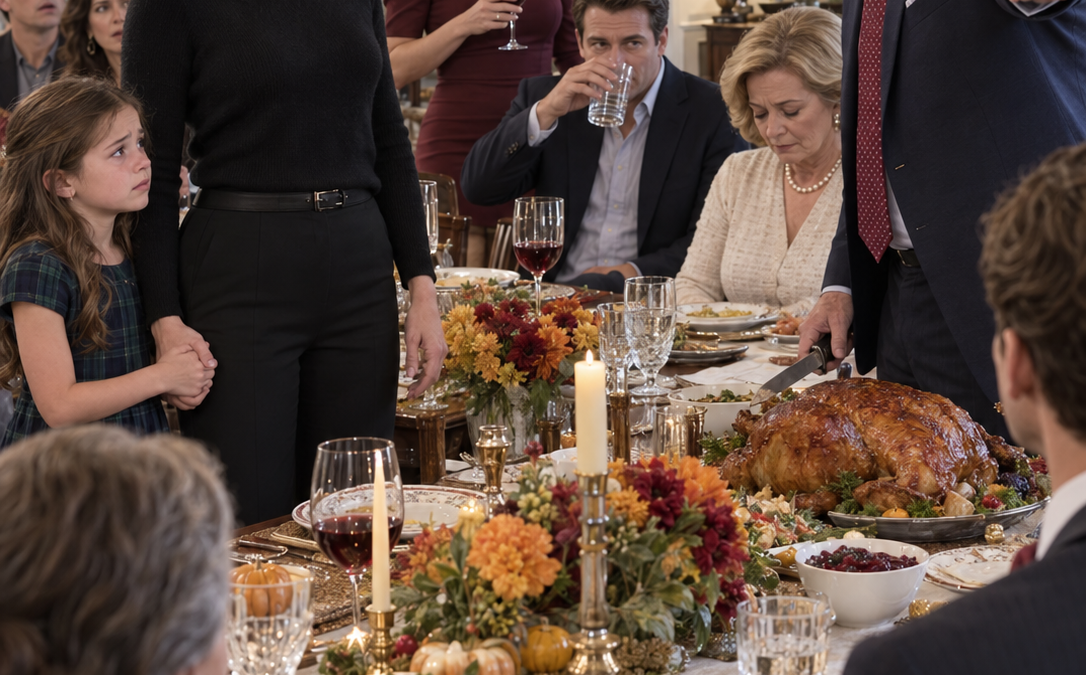
Which brings us back to Thanksgiving. To the turkey steaming on the platter. To my father’s finger pointing at the door. To 23 relatives who watched him call me a disgraceful single mother, an embarrassment, a burden, and worse.
To my daughter Ren, standing frozen in the hallway with her small hand over her mouth. To the moment I looked around that dining room at every face that had eaten off my money for 6 years and understood that I was finally, finally done.
I said one word.
“Okay.”
And I walked out.
By sunrise the next morning, every account was frozen. By noon, Ren and I were on a private plane. By sunset, we were standing barefoot on the sand of a beachfront estate in Honolulu that none of them knew existed.
And that was only the beginning.
To understand what happened in that dining room, you have to understand what happened in the 20 minutes before it. Because my father did not just wake up that morning and decide to throw me out.
He was set off deliberately by my sister Camille, who had been building toward that moment for weeks without realizing that I had already been building toward something much bigger.
Ren and I arrived at my parents house in Greenwich at exactly 2:00 in the afternoon on Thanksgiving Day. I had spent 3 hours on the drive down from Boston, coaching myself into the right frame of mind.
Be pleasant. Be brief. Eat quickly, leave before the wine kicks in, and someone says something they cannot take back.
That was always my strategy at family gatherings, and it had worked more or less for over a decade.
Ren was 10 years old and already smarter than most adults I knew. She sat in the passenger seat with her seat belt pulled tight and her sketchbook on her lap, drawing the same seagull she had been perfecting for a month.
She had her father’s palm. She had his hands, too, long-fingered and careful. Every time I looked at her, I saw Adrienne. And every time I saw Adrienne in her face, I understood a little more clearly why I had spent six years trying to force my family to be worthy of her.
“Mom,” she asked as we pulled into the driveway. “Do we have to stay for dessert?”
“We’ll see how it goes, sweetheart.”
“Grandma always makes me try the pumpkin thing.”
“I hate the pumpkin thing.”
“I’ll eat yours if she isn’t looking.”
She smiled a small smile and closed her sketchbook. I remember that smile with a kind of aching precision now because it was the last one she would give inside that house.
My mother opened the door before I could knock. She looked me up and down, her eyes stopping briefly on the same black cashmere sweater I had been wearing to every holiday since 2019, and she gave me the same small pursed-lip nod she always gave.
“You could have blown out your hair, Marlo. It’s a holiday.”
“Happy Thanksgiving to you, too, Mom.”
She hugged Ren tightly, told her she looked like a proper little lady, and swept us inside.
The house smelled like sage and butter and the specific perfume my mother had been wearing since I was in elementary school. Preston was in the living room with his second wife, Bianca, and their two small boys.
Camille was in the kitchen with her husband, Grant, and their twin daughters, Ivy and Iris, who were both 12 and already talking to each other like they were 40.
My father was in his armchair reading the newspaper, pretending not to have heard the doorbell.
“Dad.”
He grunted without looking up.
That was our greeting. It had been our greeting for years. I stopped taking it personally sometime around my 30th birthday when he forgot to call me and then blamed me for not calling him first.
The first hour passed the way these hours always did.
Preston bragged about a promotion he had gotten at his consulting firm. A promotion I happened to know had come with a raise of $12,000 because I had also happened to see the pay stubs when I was verifying that his mysterious corporate benefit was still routing correctly.
Bianca showed off a diamond bracelet Preston had surprised her with, which he had actually charged to a card that I quietly cleared every month through the same shell arrangement.
Camille talked about the twins new tutor, a tutor who was being paid out of the fake scholarship fund. Grant nodded along at everything Camille said the way he always did, a man who had long ago traded his opinions for a peaceful marriage.
And then Camille found her opening.
“Marlo,” she called from the kitchen in that syrupy voice she used when she wanted to hurt me in front of an audience. “Did you ever hear back from that job you were applying for?”
I hadn’t been applying for any job. I had mentioned 6 weeks ago that I was thinking about consulting on the side to fill the hours while Ren was in school. It was a lie. I had said it to give her something to latch on to so she would stop asking about my finances.
“Still figuring it out,” I answered lightly.
“Oh, that’s such a shame. You know, Grant has a friend who runs a call center in Hartford. I could probably get you an interview if you’re desperate.”
The room got a little quieter. Preston looked up from his phone with a small smile. Bianca leaned forward, sensing entertainment.
“I’m not desperate, Camille. Thanks, though.”
“Are you sure? Because Mom mentioned you were having a hard time keeping up with Ren’s school activities. Poor thing. It must be so stressful being on your own.”
“Ren is doing great in school.”
“Well, of course you’d say that.”
She laughed the little musical laugh she had perfected as a child.
“But you know, sometimes kids need more than their moms can give them. Especially single moms. Especially—well, you know.”
I took a slow breath.
I looked at Ren, who had gone very still on the sofa next to me, her sketchbook clutched to her chest. She was watching her aunt with an expression I recognized. She was cataloging. She was learning.
“Camille, let’s not do this today.”
“Do what? I’m just being honest. Someone should be. You’ve been coasting for years and, honestly, it’s a little embarrassing at this point. Adrienne would be so disappointed.”
The mention of Adrienne was the line.
She knew it. She said it anyway.
My mother, from her armchair by the fireplace, did not correct her. My father, from his armchair by the window, did not correct her. Preston laughed under his breath.
I felt something click inside my chest. Not a break, a click. Like a door closing gently in a room I had been trying to keep warm.
“Camille,” I answered, still calm. “Please don’t say his name.”
“Oh, I’m sorry. Am I not allowed to talk about your dead husband now? Is that another rule?”
Ren’s hand slipped into mine. Her fingers were cold.
That was when my father finally looked up.
He had been waiting, I realized later. He had been waiting for a moment to insert himself, and Camille had handed him one.
“Marlo,” he barked, folding his newspaper. “Your sister is trying to help you. The least you can do is be gracious.”
“She isn’t trying to help me.”
“Don’t you dare talk back to me in my house.”
“I’m not talking back. I’m telling the truth.”
My mother stood up.
“Let’s just have dinner. Everyone to the table. Come on now.”
We moved to the dining room the way people move to their assigned seats on a plane that is about to hit turbulence. I sat Ren next to me. My father took the head of the table, my mother the foot, and the 23 of us—aunts and uncles and cousins, who had been invited to pat out the room—arranged ourselves in the pattern we had followed for years.
The turkey was placed at the center of the table. The steam was still rising off it.
My father lifted his knife and began to carve, and Camille, who could not let a wound close before reopening it, lifted her wine glass and cleared her throat.
“Before we eat,” she announced, “I just like to say a quick thank you to Mom and Dad for everything they do for all of us. Not everyone in this family pulls their weight, but you two carry us all.”
She looked directly at me when she said it.
“Camille.”
“What? I’m giving a toast.”
“You’re being cruel.”
“I’m being honest. There’s a difference, but I wouldn’t expect you to understand it.”
That was when my father set down the carving knife. He set it down slowly, deliberately, and turned toward me with the specific expression I had seen on his face maybe four times in my whole life.
It was the expression he wore right before he took something away.
“Marlo, stand up.”
“Dad—”
“Stand up.”
I did not stand up. I sat very still, holding Ren’s hand under the table, and I looked at him.
“You have been a disappointment to this family for as long as I can remember,” he began, his voice rising with every word. “You come into this house wearing the same tired sweater, dragging your daughter around like some kind of prop, refusing every offer of help, and then sitting at my table with that ungrateful look on your face. You are a disgraceful single mother. You are an embarrassment. You are a burden. And I am tired of pretending otherwise in front of my own family.”
The room was silent.
Twenty-three faces, and not one of them intervened.
He lifted his hand. He pointed at the front door.
“Get out. Get out of my house and do not come back.”
I looked around the table at my mother, whose eyes were on her plate. At Preston, who was hiding a smile behind his water glass. At Camille, who looked positively radiant with victory. At the aunts and uncles and cousins who had eaten Thanksgiving dinner in this house for years, courtesy of a mortgage I had quietly paid off two years ago.
I looked at Ren.
She was crying without sound, the way children cry when they are trying not to be noticed.
I stood up.
I did not shake. I did not raise my voice. I looked my father in the eye and I said the one word that had been building in my throat for 37 years.
“Okay.”
I took Ren’s hand. I picked up my coat, and I walked out of the house without another word.
The car door closed behind us with a soft click, and for a full minute Ren and I just sat there in the driveway, staring at the closed front door of a house that I had, in every practical sense, been paying for.
My hands were steady on the steering wheel. My heart was not racing. If anything, I felt lighter than I had felt in years, like someone had finally taken a coat off my shoulders that I had forgotten I was wearing.
Ren wiped her cheeks with the sleeve of her cardigan.
She did not ask why we were leaving. She did not ask if we were coming back. She only asked one question in the small, careful voice she used when she was trying to be brave.
“Mom, are we okay?”
I turned toward her. I brushed a strand of hair away from her forehead, the way Adrienne used to, and I answered her with the most honest sentence I had spoken all day.
“Ren, we are more than okay. We are finally free.”
She studied my face for a long moment. Ten-year-olds are better lie detectors than most adults, and my daughter was better than most 10-year-olds. Whatever she saw in my expression must have convinced her because she nodded slowly and reached for her sketchbook.
I pulled out of the driveway.
In the rearview mirror, I saw the curtain in the front window move. Someone had been watching. Someone always was.
I did not drive back to Boston. I drove instead to a hotel about 40 minutes away, a quiet place near the water that I had booked earlier in the week as a contingency.
I had known on some level that this Thanksgiving might end badly. I had not known it would end this badly, but I had prepared because that is what I do. I prepare for the worst version of every situation because I learned very young that the worst version is usually the one that arrives.
We checked in under a name that was not Prescott. The clerk at the front desk did not blink. I had used the same name for hotel reservations for years, and Ren knew to answer to it without being reminded.
She had grown up understanding without ever being told directly that our lives had a public version and a private version, and that the private one was where we actually lived.
In the room, I ordered her a grilled cheese and a chocolate milkshake from room service. I ran her a bath. I sat on the edge of the tub while she soaked, and I let her talk about anything she wanted to talk about, which turned out to be a documentary she had watched last week about octopuses.
She told me octopuses have three hearts and blue blood. She told me they can taste with their arms. She told me they are so smart that some scientists think they might be conscious in a way we do not understand yet.
I listened. I nodded. I let her fill the room with facts about creatures who lived underwater and did not have to sit at Thanksgiving tables.
When she finally fell asleep, curled up in the middle of the king-size bed with her sketchbook still open on the pillow, I stepped out onto the small balcony with my laptop and a glass of water.
It was just past 10 at night. The temperature was dropping. My breath came out in soft white clouds.
I opened the laptop.
I logged into the first account.
Here is what most people do not understand about wealth at the level I had built. It is not a checking account with a large number in it. It is a spider web.
There are trusts. There are holding companies. There are shell corporations that own other shell corporations. There are foundations and investment vehicles and offshore structures that exist purely to keep the whole thing organized and protected.
Managing it is a full-time job, which is why most people at this level of net worth hire someone to do it for them.
I did not hire anyone.
I did everything myself.
Adrien had taught me in the last months of his life that the only person you can fully trust with your money is you. Which meant that on that November night, sitting on a hotel balcony 40 minutes from my parents house, I was the only person in the world with the ability to shut off every faucet at once.
I started with the mortgage.
The shell company that had refinanced my parents’ loan two years ago was, in reality, holding the note directly. I had structured it so that they were paying no interest and a token principal amount each month. An amount so small it would take them roughly 400 years to pay off house.
That was going to change.
I opened the servicing portal and adjusted the terms to reflect the actual market value of the property, the actual current interest rate, and the actual monthly payment they would owe going forward.
The new number was just over $9,000 a month.
Their next statement would arrive in 11 days.
Then Preston’s car lease.
I logged into the consulting arrangement that had been quietly covering his monthly payment for 6 years and terminated the contract effective immediately. The termination clause was airtight. I had written it myself.
His employer would receive a notice on Monday morning that the corporate benefit had been discontinued due to a change in the sponsoring firm’s policies. He would find out when the next automatic payment failed and the leasing company started calling.
Then Camille’s twins.
The scholarship fund I had created was a real, legally registered nonprofit. It had one donor, me, and it had one beneficiary, them.
I logged into the administrative portal and updated the beneficiary criteria to exclude any student whose parent had a documented history of—and I actually wrote this into the paperwork—verbal cruelty toward extended family.
It was a joke.
Obviously, nobody would ever read it, but I liked knowing it was there.
Then I revoked their current award effective at the end of the semester in December. The school would send Camille and Grant a very polite letter explaining that the scholarship had unfortunately been discontinued and that the remaining tuition, roughly $46,000 for the spring semester across both girls, would need to be paid directly.
Then my father’s country club dues: cancelled.
Then my mother’s monthly spa membership at the place she had been going to for years and telling everyone she found a great deal on: cancelled.
Then the credit card that Preston did not know I had been paying off in the background for the last 3 years, the one his second wife Bianca used for her jewelry and her weekend trips.
I could not cancel his card, but I could stop paying the balance.
The next statement would show an outstanding amount of just under $31,000 plus interest. And the minimum payment alone would be more than he made in a week.
I worked through the list methodically.
I did not feel angry. I did not feel triumphant. I felt, more than anything, like a woman doing bookkeeping. Like a woman closing accounts on a business that had been operating at a loss for far too long.
When I was done with the family, I opened a different set of accounts.
My own.
I moved a significant portion of my liquid assets from the Boston-based bank I had been using into three separate institutions I had never touched before in three different states.
I authorized a wire transfer to the property manager of the Honolulu estate to prepare the house for immediate occupancy. I contacted the private aviation company I used maybe once a year and booked a flight for early the next morning.
I texted Ren’s school and let them know she would be finishing the semester remotely. I texted the small handful of people I actually trusted—my attorney, my financial adviser from years ago who now consulted with me on strategy, and one friend—and I told them I was going dark for a while.
Then I closed the laptop.
The stars were out. The parking lot below was mostly empty. Somewhere back in Greenwich, 23 people were probably still sitting around a dining table, laughing at me or forgetting me or feeling briefly uncomfortable and then reaching for another glass of wine.
None of them knew that their entire financial reality had just quietly ended.
I went back inside. I climbed into bed next to Ren. She stirred in her sleep and mumbled something about the seagull in her sketchbook.
I kissed the top of her head and, for the first time in 6 years, I slept without dreaming.
The plane lifted off at 6:40 in the morning. Ren pressed her forehead against the small oval window and watched the runway shrink beneath us.
She had never been on a private flight before. As far as she knew, we did not have that kind of money. As far as she knew, we were the kind of family who booked economy tickets 3 months in advance and packed our own sandwiches.
“Mom.”
She turned toward me with wide eyes.
“Whose plane is this?”
“Ours for today.”
“But, like, who owns it?”
“A company we’re renting it from. Sweetheart, I need to tell you some things. Are you ready to hear some grown-up things?”
She sat up straight in her leather seat and folded her hands in her lap the way she used to when Adrienne would read her a bedtime story.
She nodded once.
“You know how Daddy started a company a long time ago before you were born?”
“The one with the computers.”
“The one with the computers. When Daddy died, he left us money. A lot of money. More than I ever told anyone, including you. I kept it quiet because I wanted us to have a normal life. I wanted you to grow up knowing what things cost and how to work hard, not knowing that we could buy anything we wanted.”
She thought about this for a moment.
“Are we rich?”
“Yes, honey. We are very rich.”
“How rich?”
I hesitated, but I had promised myself on the balcony the night before that I would stop lying to the one person in my life who had never deserved to be lied to.
“87 million rich.”
Her eyes widened slowly the way her fathers used to when he was trying to solve a difficult problem in his head.
She did not squeal. She did not gasp. She simply took in the number, turned it over, and set it down.
“That’s a lot of an E.”
“It is.”
“Is that why Grandpa was so mean to you? Because he wants some of it?”
“No, honey. Grandpa doesn’t know about the money. Nobody in the family does. Grandpa was mean to me because he has always been mean to me. The money isn’t the reason. The money is just what he’s about to find out.”
She frowned.
“What do you mean?”
I explained as gently as I could that for 6 years I had been secretly helping the family. That I had paid off Grandpa and Grandma’s house, that I had paid for Uncle Preston’s car and Aunt Camille’s daughter’s school, that I had covered dozens of little things they thought they were affording on their own, and that last night, after we left the dinner, I had turned all of it off.
She listened without interrupting.
When I finished, she was quiet for a long time.
Then she asked a question I was not prepared for.
“Mom, why did you help them if they were mean to you?”
I did not have a clean answer.
I gave her the honest one instead.
“Because I wanted them to be different. I wanted them to be the family you deserved. I thought if I made their lives easier, they would have room in their hearts to love you the way your dad would have loved you. And I was wrong. It didn’t work. It never was going to work. And I’m sorry I made you spend so many Thanksgivings with people who didn’t deserve you.”
She reached across the armrest and took my hand.
“It’s okay, Mom. You were trying.”
I have received a lot of forgiveness in my life. Adrienne forgave me things I had not even done yet, just in case. My best friend from college forgave me for disappearing after Adrienne died. Strangers on customer service lines have forgiven me for my occasional impatience.
But no forgiveness has ever hit me like the forgiveness of my 10-year-old daughter, offered without hesitation on a private plane 35,000 ft above Nevada.
I cried quietly for a few minutes.
She patted my hand like I was the child.
Then she went back to her sketchbook and asked me if octopuses lived in Hawaii because, if they did, she wanted to see one in real life.
We landed in Honolulu just after noon local time.
The property manager, a soft-spoken woman named Kayia, who had been maintaining the estate for me for 7 years, met us at a private terminal with a car. She had been keeping the house ready for a visit that had never happened.
Adrienne and I had bought the property in the second year of our marriage. We had planned to spend our summers there.
He never got to see it.
I had continued to pay for its upkeep because letting it go felt like letting go of a promise we had made together, and I was not ready to break any more promises to him.
The drive from the airport was maybe 25 minutes. Ren stared out the window the entire time. The ocean appeared and disappeared behind rows of palm trees. The air coming through the cracked window smelled like salt and plumeriia.
By the time we turned onto the private road leading to the house, she was sitting on the edge of her seat.
The estate sat on a bluff overlooking the water. It was not the largest house I could have bought. It was not even close.
Adrienne had insisted on something modest by our new standards, something with more garden than square footage, more windows than walls. Six bedrooms, an open kitchen that flowed onto a covered lenai, a swimming pool that was really more of a reflecting pond, and a wooden staircase that led directly down to a small private beach.
Ren got out of the car and just stood there.
She did not run. She did not squeal.
She looked at the house, then at the ocean, then at me, and she said very softly, “Daddy would have loved this.”
“He picked it out, sweetheart. He picked it out for us.”
She walked up to the front door and touched the wooden frame with her fingertips. The way you touch something that belongs to someone you miss.
Inside, Kayia had prepared everything.
The refrigerator was stocked, fresh flowers on every table. Ren’s bedroom, which I had furnished years ago in the hope that we would use it, was ready.
She had a canopy bed, a small desk with a view of the water, shelves that I had filled slowly over the years with books I thought she would love when she got old enough to read them.
She stood in the doorway and asked very carefully, “Is this my room?”
“It has been for a long time. I just never brought you to see it.”
She crossed to the bed. She sat down on it. She pressed her palms flat against the quilt.
“Mom?”
“Yes, sweetheart?”
“I like it here.”
“Me, too.”
That first afternoon, we did not do much.
We walked barefoot on the beach. We ate mangoes over the sink. Ren found a small crab in a tide pool and named him Bartholomew. And then, an hour later, forgot which tide pool she had found him in and cried until we located him again.
I sat on the lai and watched her the way I used to watch Adrien from a small distance, with my whole heart in my throat.
My phone had been off since the flight. I turned it on around 6:00 in the evening, more out of habit than curiosity.
It was, as expected, on fire.
63 missed calls. Over 200 text messages. Voicemails from numbers I had not heard from in years. My father’s brother, my mother’s sister, cousins I barely remembered.
Somewhere in the middle of the day, the family had figured out that something was wrong. Somewhere in the middle of the day, the phone calls to me had begun.
I did not listen to a single voicemail. I did not read a single text.
I scrolled to the top of the list, took a screenshot for my attorney, and turned the phone off again.
Then I went back to my daughter, and I helped her build a sand castle in the last hour of daylight.
The first message I actually read came in on Saturday morning, roughly 48 hours after I walked out of my father’s house.
It was from my mother.
It was the only one out of hundreds that I even glanced at. And I only glanced at it because Kayia had walked out onto the lai with a fresh pot of coffee and mentioned offh hand that my mother had somehow gotten hold of the estate’s landline and left a message on it.
I do not know how she found the number. I had never used it. I had never given it out.
But my mother was a resourceful woman when she felt she had been wronged. And by Saturday morning, she clearly felt she had been wronged in a spectacular way.
The message on the landline was 7 minutes long. I only listened to the first 30 seconds.
“Marlo, this is your mother. Something is very wrong. The bank is telling us the mortgage is going up to $9,000 a month. That has to be a mistake. And your father’s country club canled his membership this morning, and Camille just called crying because the twins scholarship was revoked. We need you to call us back immediately. Whatever your father said the other night, he did not mean it. We are your family. You cannot punish us like this. This is not funny anymore. Call us back.”
I deleted the message.
The text from her on my cell phone was shorter and more revealing.
Marlo, please. Whatever you are doing, please stop. We will talk about the other night. Your father is not himself. Call me.
Your father is not himself.
That was the line that stayed with me.
Because, of course, he was himself.
He had been himself for 37 years. He had been exactly, precisely, undeniably himself at that Thanksgiving table.
What my mother meant was that he was not the version of himself that was convenient for her right now. She wanted the version that was profitable, the version that was pleasant to be around, the version I had spent 6 years subsidizing.
I did not respond.
Instead, I made coffee. I sat with Ren on the lai while she ate a bowl of fresh papaya. I watched a small fishing boat make its way across the horizon, and I opened my laptop to check on the first wave of consequences.
The mortgage serer had already sent out the updated statement that was in motion. Preston’s car company had already flagged the first missed payment attempt, which meant the leasing agent would be calling him by Monday afternoon.
Camille’s daughter’s school had already received the scholarship revocation notice, which was why she was crying to my mother. The country club had already sent my father a very polite letter explaining that his account was now delinquent and his family’s use of the facilities would be suspended pending payment.
Small dominoes, all falling on schedule.
The bigger domino was still to come, and I wanted to be careful about how I placed it.
Here is what my family did not know.
Six years ago, when I first started quietly funneling money to them, I had also, on the advice of my attorney, documented every single dollar. Every transfer. Every refinance. Every scholarship. Every corporate benefit.
I had kept meticulous records, not because I ever intended to collect on the debts, but because my attorney had insisted.
“If you’re going to help them,” he had told me, “help them in a way that leaves you a paper trail. Because someday, Marlo—and I am telling you this as a friend—someday you are going to want to know exactly what they cost you.”
He had been right.
I did want to know.
And now I did know.
The total over 6 years came to just under $2.4 million.
$2.4 million of my money had flowed into their lives.
And on Thanksgiving, in front of 23 witnesses, they had called me a disgraceful single mother. They had called me a burden. My father had pointed at the door and thrown me out of a house that I owned in every way that mattered except the legal one.
By Saturday afternoon, I had a decision to make.
I could let the whole thing unwind quietly. Let them figure out on their own that the money had stopped. Let them think it was bad luck or a bank error or the economy or anything else they wanted to believe.
That would be the merciful path.
That would be the invisible path.
Or I could tell them.
I did not want to tell them out of cruelty. I had spent enough of my life around cruel people to know that being cruel to them in return would not make me feel better. It would just make me look like them.
But I did think, and I still think, that they deserve to know the truth.
Not for my benefit. For theirs.
Because a person who does not know what they have done can never grow past it. And even after everything, some small, foolish part of me still hoped that maybe, faced with the full picture, one of them—any of them—might actually understand.
I decided to send one letter.
Not to all of them. To my mother.
I sat down at the small desk in the corner of the lai, and I wrote it by hand because I wanted her to know I had written it and not typed it. I wanted her to know I had thought about every word.
Mom,
By the time you read this, you will already know that certain accounts have changed. I want to explain what happened and I want to do it once, in writing, so that there is no confusion later.
For the last 6 years, I have been quietly paying for many things in this family. The mortgage on the house, Dad’s country club, your spa, Preston’s car and one of his credit cards, Camille’s daughter’s school tuition, the kitchen renovation, the cruise.
There is a full accounting attached to this letter. The total is just over $2.4 million.
I never told any of you because I did not want thanks. I wanted a family. I wanted a family for Ren because she lost her father, and I hoped that if I made your lives easier, you might have more room in your hearts for her.
I was wrong to think that. That was my mistake and I own it.
On Thursday, Dad threw me out of a house I have been paying for. He called me a disgrace in front of 23 people. Camille mocked Adrienne’s memory. Preston laughed. And you, Mom, sat with your eyes on your plate.
I am not writing to ask for an apology. I have stopped waiting for those.
I am writing to tell you that the version of me who tried to buy your love is gone. She was tired, and she has finally been allowed to rest.
Do not call me. Do not come looking for me.
Ren and I are safe and we are happy and we are far away.
If you ever, any of you, want to know us again, it will not be through money. It will be through humility.
Love,
Marlo.
I attached a printed spreadsheet of every transaction. 247 line items, 6 years of receipts.
I addressed the envelope to my mother’s name at the Greenwich House. I gave it to Kayia to overnight on Monday morning.
Then I closed my laptop, put on a swimsuit, and walked down the wooden staircase to the beach.
Ren was already there, up to her knees in the surf, holding a small plastic bucket and looking for shells. She turned when she heard me coming and waved with both arms over her head.
“Mom, come look. There’s a whole family of crabs.”
I waited out to her. The water was warm. The sun was bright.
Somewhere across the ocean, on the other side of a continent, my family was discovering, one bill at a time, that they had spent six years standing on a floor I had built.
Somewhere across the ocean, my father was probably still in his armchair, waiting for someone to come along and put things back the way they were.
Nobody was going to.
I sat down in the wet sand next to my daughter. I helped her count crabs, and I understood in that moment that leaving them had not been an act of revenge.
It had been an act of return.
I was returning myself to the life I had been meant to have all along.
The letter arrived on Tuesday. I know because my attorney Jonas had it tracked, and he texted me the delivery confirmation at 11:42 in the morning Hawaii time.
By 1:00 in the afternoon, my mother had called myself phone 18 times. By 2, she had called Jonas’s office, though how she had gotten his direct line, I still cannot say.
By 3, my father was on his way to the airport.
Jonas called me at 3:15.
“Marlo, he booked a flight to Honolulu.”
“He does not know you are in Honolulu. He booked a flight to Boston. He is going to your condo.”
I laughed.
I could not help it.
My father, who had barely visited my condo three times in the whole time I had lived there, was flying to Boston to confront a daughter who was not there.
It was so perfectly, exactly him. The dramatic gesture without the follow through. The performance of concern without the actual concern.
“Let him go,” I answered. “The condo is empty. He can knock on the door as long as he wants.”
“He might try to break in.”
“Then let him. It’s furnished, but there’s nothing personal in it. Everything that matters is here.”
Jonas was quiet for a moment.
Then he asked me the question he had been waiting to ask.
“Marlo, are you sure you don’t want to press charges for any of it? The verbal abuse in front of your daughter is documented. We have witnesses. Some of them would testify quietly if you asked. And there’s the small matter of 2.4 $4 million in undocumented gifts that could, if we wanted to be creative, be reclassified as loans.”
I thought about it.
I actually thought about it.
I sat on the lai with the phone against my ear and watched Ren chase a small green gecko across the wooden deck. And I let myself imagine for a full minute what it would feel like to sue my father, to take the house, to send the family a legal notice demanding repayment, to grind their lives into paperwork the way they had ground mine into small, silent humiliations for 37 years.
The imagining felt good for about 90 seconds.
Then it felt hollow.
Then it felt heavy.
Then it felt like a coat I did not want to put on.
“No, Jonas. I don’t want to press charges. I don’t want the house. I don’t want the money back. I just want them out of my life.”
“Understood.”
“But if any of them—any of them—tries to come near Ren, I want you to move fast.”
“That is already in place. We have restraining order paperwork drafted and ready to file the moment any of them makes contact with her. School has been briefed. Your new address here is protected under a trust that does not appear in any public database. You are, in every meaningful sense, invisible.”
“Thank you.”
“Marlo. One more thing.”
“Yes?”
“Your brother called.”
I had been expecting this.
Preston was the one I was most curious about. My father was going to bluster. My mother was going to guilt trip. Camille was going to cry.
But Preston was the one who might, if he was capable of it, actually think.
He had always been the smartest of the three of us. He had just chosen to use his intelligence for smaller things.
“What did he say?”
“He was calm, which surprised me. He asked if I represented you. I confirmed that I do. He asked if there was a way to speak with you. I said no. He asked me to relay a message.”
“What message?”
“He said, ‘Tell her I understand and I do not blame her and I am sorry.’ End quote.”
I closed my eyes.
Of all the reactions I had expected, that one was the last.
Preston the golden boy. Preston the one who had laughed behind his water glass. Preston whose car I had been paying for and whose wife’s jewelry I had been quietly funding.
Preston was the one who said he understood.
“Do you believe him?” I asked Jonas.
“I don’t know your brother well enough to say, but he did not raise his voice. He did not ask for money. He did not ask you to call anyone back. He just asked me to pass along that one sentence.”
“Okay.”
“How do you want to respond?”
“I don’t. Not yet. Let him sit with it.”
I hung up.
I set the phone down on the small wicker table next to my chair. Ren had caught the gecko and was showing him to Kayia, who was pretending to be impressed. The gecko, for his part, looked deeply unhappy.
That night, after Ren was asleep, I did something I had not done in almost a year.
I opened the small wooden box that sat on the top shelf of the closet in the master bedroom.
Adrienne’s box.
Inside were the things I had kept when he died. His wedding ring. A pressed flower from our first anniversary. A letter he had written me during his last hospital stay, sealed in an envelope that read for when you need it.
I had opened the letter twice before. Once in the first month after he died, when I could barely function. Once on Ren’s fth birthday, when the grief had ambushed me in the grocery store.
I opened it a third time.
Now Adrienne’s handwriting was neat and slanted and easy to read. He had been a careful writer in life as in code.
My Marlo,
If you are reading this, it means you have hit a hard place, and I am not there to sit with you through it. I am so sorry. You deserve someone who stays.
What I want to say is this. You are the strongest person I have ever known, and you do not know it yet because you have spent your whole life around people who needed you to be small.
When I first met you, I could see the size of you from across the room. I have never stopped seeing it.
Please, Marlo, whatever the hard place is. Whatever they have said or done, please remember you do not owe anyone your smallness. Not your fathers, not your mother, not Preston, not Camille, not anyone.
Take up the whole room. Take up the whole life. Take Ren and go somewhere warm and be enormous.
I love you,
Adrien.
I read the letter twice.
Then I put it back in the envelope and back in the box.
I sat on the edge of the bed for a long time.
He had known, sitting in that hospital bed 7 years before this Thanksgiving. He had known exactly what was going to happen. He had known who my family was. He had known what they were capable of.
He had known that one day I would sit in a warm room on the far side of an ocean with our daughter asleep down the hall.
And I would need him to tell me it was okay to have left.
I did not sleep much that night, but when I did sleep, I dreamed of him for the first time in a long time.
He was standing on a beach. He was waving me in from the water.
He was smiling.
The next morning, I called Preston.
I do not know exactly why I decided to. Maybe it was the letter. Maybe it was the dream. Maybe it was the fact that Preston was the only one who, when confronted with the truth, had not fought back.
He rang for a long time.
When he finally picked up, his voice was tired.
“Marlo.”
“Preston.”
Neither of us spoke for a good 10 seconds.
“I got your letter,” he began. “Well, Mom’s letter. She let me read it and the spreadsheet. Marlo—”
“Don’t. Not yet. Just listen.”
He listened.
“I am not calling to reconcile. I am not calling to renegotiate. I am not calling to explain myself further. I already said what I needed to say in the letter. I am calling because when I told Jonas to pass along that message, he said your response was different from everyone else’s. He said you did not ask for money. You did not ask me to call anyone back. You just said you understood. So I’m calling to ask you one question. Did you mean it?”
A long silence.
“Yes.”
“Why?”
“Because I have known for a long time, Marlo. I have known Dad is a bully. I have known Mom lets him be one. I have known Camille is cruel, and I have known that I have laughed along at things I should not have laughed at. I have known that you have been carrying something none of us understood. I did not know about the money. I promise you I did not know about the money, but I knew about the rest and I did nothing. And I am sorry.”
I was quiet for a long time.
“Preston, I am not going to be back in your life the way I was. I want you to understand that.”
“I understand.”
“But if you ever want to know Ren—actually know her, not use her as an excuse to get to me—that door is not permanently closed. It is closed for now. It may be closed for a long time, but it is not sealed.”
He made a small sound on the other end of the line.
It might have been a laugh. It might have been a sob. It might have been both.
“Okay, Marlo.”
“Okay.”
I hung up.
I do not know if he will ever walk through that door. I do not know if I will ever let him.
But I said the sentence out loud.
And having said it, I felt for the first time since Thursday that I was not simply cutting away.
I was pruning.
And pruning, if you do it right, is what allows the rest of the tree to grow.
The rest of the family did not take Preston’s approach.
By the end of that first week in Honolulu, my father had returned from his fruitless trip to Boston, discovered that my condo had been quietly listed for sale through a broker who would not confirm or deny the seller’s identity, and, according to Jonas, launched himself into what my mother described as the worst temper of his adult life.
The country club had sent a second, less polite letter. The bank had begun the standard foreclosure warning process on the house, which would kick in 90 days after the first missed payment.
My father, who had convinced himself over the years that the house was fully paid off through some clever refinancing he did not fully understand, was learning in real time that the ground beneath him was not what he thought it was.
Camille went another direction.
She got a lawyer, a cheap one according to Jonas, who was quietly monitoring the situation through professional channels.
The lawyer sent a letter to Jonas’s office demanding—and this is a direct quote—an accounting of all funds withheld from Camille Prescott Whitaker, her husband Grant Whitaker, and their minor children, along with a written assurance that such support will be reinstated within 30 days, failing, which we will pursue any and all legal remedies available.
Jonas laughed for a full 3 minutes when he read it to me over the phone.
“Marlo, she’s trying to sue you for the right to receive gifts you are not legally obligated to give.”
“What is your response going to be?”
“I already sent it. One line. Quote, ‘There is no legal obligation, statutory or contractual, requiring Miss Prescott to provide any financial support of any kind to your client, and any suggestion otherwise is not only frivolous but sanctionable. Please cease and desist.’ End quote.”
“Thank you, Jonas.”
“You are paying me very well to enjoy this.”
“And I am, Marlo. I am enjoying this.”
My mother’s approach was the hardest to ignore.
She did not send lawyers. She did not fly across the country.
She sent letters.
Long handwritten letters, one every few days, all forwarded to Jonas’s office and scanned to me.
She wrote about my childhood, about things she remembered that I did not. She wrote about the day I was born and how she had held me and thought I would be the easy one.
She wrote about the guilt she had carried quietly over the years for the ways she had let my father favor Preston and Camille. She wrote about her own mother, who had done the same to her, and how she had promised herself she would break the pattern and instead had passed it on.
The letters were the most honest thing my mother had ever written to me.
They were also, I understood immediately, a strategy.
Her strategy.
Because underneath the honesty in every single letter was the same small hopeful sentence at the very end.
Some version of:
Please, Marlo, come home.
Please, Marlo, do not do this to us.
Please, Marlo, let us fix.
They did not want to fix us.
They wanted to fix the accounts.
I did not respond to any of the letters, but I kept them.
I put them in a folder marked Mom and I set them aside for a later version of myself who might someday be able to read them without hearing the small hopeful sentence at the end.
Meanwhile, on the island, Ren and I built a life.
I enrolled her in a small private school where the head of admissions did not know my last name and did not care.
She started in the middle of the second week. She was nervous the first morning. She wore a blue sundress and clean white sneakers. And she held my hand the whole way to the front gate.
And she asked me in a small voice if she was going to make any friends.
By the time I picked her up that afternoon, she had made three.
By the end of the month, she had a birthday party invitation and a group project partner and a favorite teacher named Miss Kanani who wore hibiscus flowers in her hair and taught the class how to write haikus.
I started working again quietly, not because I needed the money, because I needed the work.
I had missed it.
For years, I had managed my portfolio in the small pockets of time between Ren’s school pickups and grocery runs, always half distracted, always half hidden.
Now I could sit in my study with the ocean visible through the tall windows and think for hours at a time without interruption.
I began advising two small nonprofits, both of which worked with widows and their children. I did not put my name on anything.
I did not want publicity.
I wanted purpose.
There is a difference.
I also, for the first time in years, made a friend.
Her name was Nolani. She was 42, a marine biologist, and the mother of one of the girls in Ren’s class.
She invited me for coffee on the second week of school, and I said yes almost before she finished asking.
It had been so long since anyone had invited me for coffee for no reason. Not to ask for something, not to sell me something, not to have a hidden agenda. Just to sit across a table and be a person.
Over the next few weeks, coffee turned into walks on the beach. Walks on the beach turned into dinners with our daughters.
Dinners with our daughters turned into me, one Sunday afternoon, telling her the whole story about Adrien, about the money, about my family, about Thanksgiving.
She listened without interrupting.
When I was done, she was quiet for a long time.
“Marlo.”
“Yes.”
“You know, you did the right thing.”
“I know.”
“I mean, you know it in your bones, not just in your head, right?”
I thought about it.
“I am getting there.”
She reached across the table and squeezed my hand.
“Take your time,” she offered. “Some things need to be known slowly.”
I have thought about that sentence a hundred times since.
Some things need to be known slowly.
I had spent my whole life trying to know things fast, trying to figure them out before they could hurt me, trying to be three steps ahead of every hurt that was coming.
And here was a woman on an island in the middle of the Pacific telling me it was okay to let the truth settle at its own pace.
By the middle of December, I was sleeping through the night.
By the end of December, Ren had lost her front tooth on a mango and left it under her pillow, and I had been the one to slip the small folded bill under it in the middle of the night.
And I had cried in the hallway afterward because Adrienne was not there to do it with me.
But it had been a soft kind of crying, the kind that comes from a wound that is finally starting to close.
We spent Christmas on the beach, just the two of us.
Ren wore a Santa hat with sand in the fur. We ate lobster tails and drank sparkling cider out of champagne fluts.
Kayia had strung small white lights along the lai. And after dinner, we sat under them and watched [clears throat] the stars come out one by one.
“Mom.”
“Yes, sweetheart.”
“Do you miss them?”
I did not have to ask who she meant.
“Sometimes. Not the way you might think. I miss the version of them I used to hope they might be. I don’t miss the version of them they actually were.”
She nodded like she understood, and I think she did.
“I don’t miss them,” she admitted. “Is that bad?”
“No, honey, that is not bad. You are allowed to miss the people who were kind to you. You are not required to miss the people who were not.”
She leaned her head against my arm.
“Grandpa was mean,” she stated matterof factly. “And Aunt Camille said things about Daddy that made you sad. I don’t want to see them.”
“You don’t have to ever if you don’t want to. And if you change your mind someday when you are older, we can talk about it then, but you don’t have to.”
She was quiet for a while.
Then she looked up at me with her father’s serious brown eyes.
“Mom.”
“Yes?”
“I love you.”
“I love you too, Ren. So much.”
We fell asleep on the lai that night, wrapped in a single big blanket with the sound of the ocean 400 ft below us.
I did not dream.
I did not need to.
The life I had been dreaming of quietly for years was already the life I was living.
January of 2025 arrived in Honolulu the way January always arrives in Honolulu, which is to say quietly and without much fanfare.
Ren went back to school after the winter break. I resumed my work with the two nonprofits. Nolani and I started swimming laps together three mornings a week at a small pool near her house.
Life had a rhythm now, a gentle one.
Then the article came out.
I had not been expecting it. My attorney had not been expecting it. Nobody in my careful little circle had been expecting it.
But somebody somewhere had connected some dots that were, in retrospect, not that hard to connect.
A journalist at a midsized business publication had been researching a piece on quiet wealth, specifically on widows of tech founders who had disappeared from public view after their husband’s deaths.
And she had done the kind of thorough digging that good journalists do.
She had traced Adrienne’s company acquisition. She had traced the estate. She had traced the trust that owned the Honolulu property, though not to its final beneficiary.
And working backward, she had found me.
She did not print my exact net worth.
She did not need to.
The headline was enough.
The quiet widow of the Adrien Prescott sale. How Marlo Prescott built an $87 million fortune in the shadows.
The article itself was honestly mostly flattering. The journalist had done her homework.
She portrayed me as a careful, private, deliberate woman who had turned an inheritance into something much larger through disciplined investing. She noted that I had not sought publicity and that I had, when contacted, declined to comment.
She did not know about my family. She did not know about the Thanksgiving dinner. She did not know about the 6 years of secret funding.
But my family, of course, subscribed to the internet.
Jonas called me at 7 in the morning Hawaii time. His voice was calm but focused.
“Marlo, the article dropped. It is going to be everywhere by lunch.”
“Are we exposed?”
“Not in any way that matters. Your address is not in it. Ren is not mentioned by name. The estate is described only as being in Hawaii, but the number is out there now.”
“The number is going to be the story.”
“Your family,” he confirmed. “I would expect a response within the hour.”
The response came in 42 minutes.
Not from my father. Not from my mother.
From Camille.
She posted a video on her own social media.
2 minutes and 11 seconds long.
Crying, makeup smudged, though not so smudged that you could not tell she had put it on carefully before filming.
She talked through tears about her estranged sister who had abandoned the family at Thanksgiving and who, it turned out, had been hiding a massive fortune from her own parents while they struggled to make ends meet.
She talked about how she and her husband were now facing enormous financial hardship because of my sister’s cruelty.
She asked for prayers.
She asked for support.
She asked for shares.
By noon Hawaii time, the video had over 400,000 views. By 2:00 in the afternoon, it had 1.3 million.
By dinner, it had crossed 3 million, and the comment section had been flooded with strangers demanding that I help my family and calling me a greedy monster.
Jonas called again.
“Do you want to respond?”
“No.”
“Marlo—”
“No, Jonas. I am not getting into a public fight with my sister. That is exactly what she wants.”
“Understood. But you should know that a few reporters are already digging into the discrepancy between her story and reality. Two of them have reached out to me for comment. I have said nothing on the record. If you would like me to say something on background, I can.”
“Not yet.”
I hung up.
I put the phone face down on the counter. I looked out the window at the water.
Ren was at school. Kayia was in the garden. The house was quiet.
I called Nolani, upset about a viral video where my sister Camille called me greedy. I did not want to be public, but I needed the truth on record for my daughter Ren.
Nolani suggested giving my financial receipts to a careful reporter.
I sent journalist Priya $2,400,000 worth of documents proving I had quietly supported my aranged family.
She published a factual article.
Camille deleted her video and the public turned against her.
Soon after, my mother mailed me an apology. She admitted she had no idea how much I had paid for them and how badly they had treated me.
Two months later, she left my father and moved to a guest house in Vermont.
My father was furious.
My mother asked to speak with me.
After a few days, I called.
She explained she finally realized she had spent her life enabling my father and had lost me decades ago. She had her own savings and refused my money.
We talked briefly about Ren, and she asked to keep writing to me.
I told Ren about the separation. She was understanding, noting that sometimes people need to face sadness to change.
By the summer of 2025, Ren won a statewide art award.
Sitting in the audience, I realized the true point of my wealth was simply providing a safe space for her to thrive.
My mother continued writing to me and filed for divorce. My father eventually signed the papers, sold our family home at a loss, and moved into a small apartment.
Camille did not help him.
I was not sure if I would fully let my mother back into my life, but I knew she had finally changed.
Camille and I have not spoken.
Her lawyer sent one more letter in February, which Jonas answered in one line, and after that, nothing.
I hear about her occasionally through Preston, who has become, to my genuine surprise, a person I speak with once a month.
She’s still married to Grant. The twins are in public school now, which they had refused to consider before and which, according to Preston, they actually seem to like.
Camille is angry still.
Camille may always be angry.
I have made my peace with the idea that she may never be a sister to me in any meaningful way.
It is a strange piece, not a happy one, but real.
Preston and I have built something small.
We talk on the phone.
He has not met Ren yet. That door remains closed for now, though not sealed. And Preston, to his credit, has not pushed.
He asks about her. He listens when I tell him.
He does not use her as leverage.
Once in April, he told me that he had spent his whole life being the son our father wanted him to be and that it had cost him more than he had realized until he lost it.
He was not looking for pity.
He was just telling me.
I appreciated that.
My father I do not speak to.
I do not expect to.
Preston tells me he is quieter now. That the anger has drained out of him and left something smaller behind.
That he sits in his new apartment with the television on. And sometimes, according to Preston, he mentions my name, but only in the past tense, the way you mention someone who has died.
In some ways, I have died to him.
The daughter he thought I was. The disappointing one. The disgraceful one. The one he could throw out of a house at Thanksgiving with no consequences.
That daughter does not exist anymore.
Maybe she never did.
What is left in her place is a woman he does not know how to be a father to.
I do not think he ever will learn.
And I have stopped needing him to.
In July, Ren and I flew to Boston for a week.
I sold the condo. I closed the small storage unit where I had kept the boxes of Adrienne’s things I had not been able to face when he died.
I brought some of those things back to Honolulu with us. His college sweatshirt. A stack of his notebooks. A framed photograph of the two of us on our wedding day, which I hung in the hallway between Ren’s room and mine, so that she would walk past her father every morning and every night on her way to and from sleep.
In August, on what would have been our 15th wedding anniversary, Ren and I released a small paper boat off the end of the beach in front of the estate.
Inside the boat was a note.
I did not tell Ren what I had written.
She wrote her own note, folded it small, and slid it in next to mine.
We watched the boat drift out on the tide until we could not see it anymore.
Neither of us cried.
It was not that kind of moment.
It was the kind of moment where you feel someone you love very much standing behind you with his hand on your shoulder, telling you that you have done well.
In September, I set up two more foundations.
One in Adrienne’s name, focused on funding research into pancreatic cancer. One in my own name, focused on providing housing and financial planning support to widows with young children.
I put $10 million into each.
I hired a small team. I stayed off the board of both quietly and let the professionals run them.
My name does not appear on any of the public materials.
My daughter’s name does not appear anywhere.
But the work happens.
Somewhere in the country right now, a widow I will never meet is sitting in a rental apartment with her children, opening a letter that tells her she has been approved for a grant.
Somewhere in a laboratory, a researcher is running an experiment on a compound that might someday save someone like Adrien.
This is what the $87 million is for.
Not for the beach house. Not for the private plane. Not for the moment of freezing my father’s accounts.
Those were incidents.
This is the point.
I turned 38 this fall.
Ren turned 11.
We had a small birthday party for her on the beach with Nolani and her daughter and Kalia and three of Ren’s school friends.
There was cake with too much frosting.
There was a piñata shaped like an octopus, which Ren had specifically requested and which I had specifically ordered from a woman on Etsy who took 3 weeks longer than she promised to deliver it.
There was a moment at the end of the night when Ren stood at the W’s edge with a sparkler in each hand and turned in a slow circle, laughing, and I understood that I had, without meaning to, become the mother I had always wanted my own mother to be.
I have thought a lot this year about what happened at that Thanksgiving table.
I have thought about my father’s finger pointing at the door. I have thought about my mother’s eyes on her plate. I have thought about Camille’s toast and Preston’s water glass and the 23 faces that did not intervene.
I have thought about my one-word answer, and I have thought about the walk out to the car with Ren’s cold hand in mine.
Here is what I have come to understand.
Family is not the people who share your last name.
Family is not the people you were born to.
Family is the people who make room for you, who see the size of you, who do not need you to be small in order to feel big themselves, who, when they hurt you, come back and try to do better, and who, when they cannot come back, at least let you go with kindness.
Some of the people in that dining room were my blood.
None of them, in that moment, were my family.
And it took me 37 years to understand that the difference between those two things is the most important difference there is.
If you have people in your life who require you to be smaller than you are in order to remain in relationship with them, I want to tell you something that took me a long time to learn.
You do not owe them your smallalness.
You do not owe them your silence.
You do not owe them the version of yourself that fits comfortably inside their assumptions about who you are supposed to be.
You are allowed to walk out of the dining room.
You are allowed to freeze the accounts.
You are allowed to fly across an ocean and start again.
You are allowed to be enormous.
The money is not what saved me.
The money was just the tool that made the leaving possible.
What saved me was the moment I decided that my daughter would not grow up watching her mother be humiliated at a table she had built.
What saved me was the decision made quietly in a driveway, with a 10-year-old’s cold hand in mine, that we deserved better.
And that better was on the other side of a single word.
Okay.
That is the whole story.
That is what happened to me and to Ren and to a family that could not hold us.
If any part of it sounded familiar, if any part of it reminded you of a table you have sat at or a finger that has been pointed at you or a room that required you to be smaller than you are, I hope you will remember that walking out is a complete sentence.
You do not have to explain.
You do not have to justify.
You do not have to stay.
Thank you for spending this time with me. If this story meant something to you, please like this video and subscribe to the channel so more stories like this can find the people who need them.
And if you have a story of your own—a Thanksgiving, a boundary, a moment when you finally said okay and walked out—I would love to read about it in the comments.
We are all, in the end, just people learning how to take up the right amount of room.
I am so glad you are here taking up yours.








