My dad secretly called every architecture firm in town and told them i was a thief; for over 3 years, no one would hire me; he sneered, “you’ll end up coming back to serve the family”; from a top architecture student, i was forced to wait tables; last week, i finally got an interview; the ceo walked in, studied me for a long moment… then pulled out something that made the entire room go silent…
That diner became my whole life. I worked doubles. I picked up weekend shifts. I smiled at drunk truckers and screaming toddlers and old couples who tipped in quarters. And every night, when I got home to my tiny studio apartment above a laundromat, I opened my laptop and applied to more firms.
I kept my portfolio updated. I kept sketching in a notebook I carried in my apron pocket, drawing floor plans on the back of receipts during slow hours.
My father, Corbin Ashb, owned a chain of three funeral homes across the Hudson Valley. Ashb and Sons, established in 1974 by my grandfather, passed down to my dad in 1998. My older brother, Denton, worked there. My younger sister, Priya, married a man who worked there. The whole family orbited around those funeral homes like planets around a very cold, very controlling sun.
I was supposed to be the fourth planet.
That had always been the plan, at least in my father’s mind. He had a specific vision for his three children. Denton would run the business side. Priya would handle the front of house, the families, the grief work. And I, Marlo, the artistic one, the one who used to sketch cathedrals as a child, was supposed to design new locations, renovate the old ones, build the Ashb Empire into something visible from the sky.
I ruined that plan when I was 18.
I told him I wanted to study architecture, but not to build funeral homes. I wanted to design libraries, schools, community centers—places where living people gathered.
He did not shout. My father almost never shouted. He just went very still, set down his fork at the dinner table, and told me that I was free to make my choices, but that my choices had consequences.
I did not understand what he meant. Not then.
I thought he was just being dramatic. He paid for undergrad grudgingly because my grandmother had left a small trust for education that he could not touch without her signature. And she signed it over to me the moment I got my acceptance letter to Syracuse in 2011.
When it came time for grad school, though, that trust was gone and he refused to help. So I took loans. Big ones. I worked three jobs. I graduated Cornell in 2021 with about $92,000 in student debt.
But I graduated. I was proud. And I thought the hard part was over.
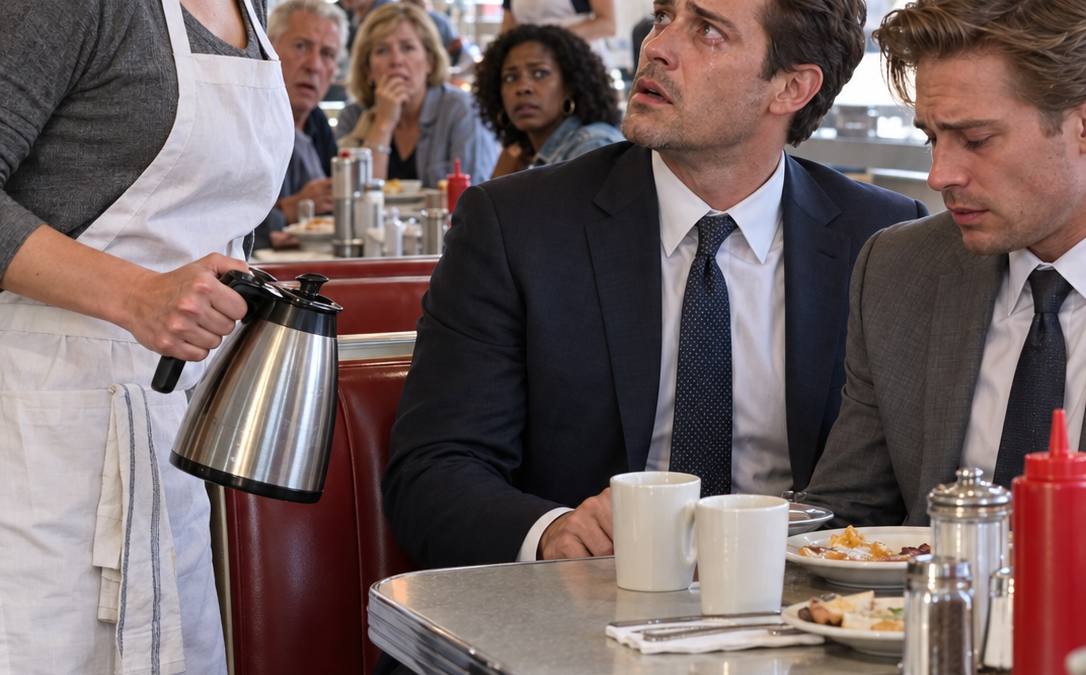
The Tuesday I learned the truth, I was refilling those ketchup bottles at the back counter, half listening to two men in suits eating a late lunch in booth 4.
They were architects. I knew because I had seen their firm logo on my rejection folder. Bramwell and Voss, based in Kingston. They had turned me down in September of 2022 without even letting me finish the interview.
One of them was saying something about a new hire. The other laughed and said, “Well, at least this one is not that Ashby girl.”
I froze.
My hand stopped moving. The plastic bottle in my hand made a small, embarrassed squeak.
The first man dropped his voice. “Oh God, do you remember that? Her father called us before her interview even started. Said she had stolen from him, told us not to touch her with a 10-foot pole. Poor kid walked in with a killer portfolio, and we already had our minds made up.”
The second man shook his head. “That was messed up, but you know how it is. Small industry. You do not hire someone whose own dad is calling you to warn you off.”
They kept eating. They kept talking about golf, about a client in Reinbeck, about a new sushi place.
And I stood there with a bottle of ketchup in my hand, feeling like the floor of the diner had just tilted 45 degrees.
My father.
My father had called them.
I do not remember walking to the booth. I do not remember what my face looked like. I only remember standing next to their table with the coffee pot in my hand and one of them looking up at me and slowly, slowly realizing.
“You are her,” he whispered. “Aren’t you?”
I nodded. I could not make my mouth work.
He looked at his colleague. His colleague looked at his plate.
I set the coffee pot down on their table so I would not drop it. Then I asked, in a voice that did not sound like mine, “How many other firms did he call?”
The man rubbed his face.
“Marlo, I am so sorry. I assumed you knew. When we got the call, we thought, well, family stuff, none of our business, but we cannot risk our reputation on a hire whose own father is warning us. I figured you must have burned that bridge on purpose.”
“I never stole anything from him,” I whispered. “I have never stolen anything in my life.”
“I know,” the man muttered. “I could see it in your work. I could see it in your face at the interview. But it was already too late. And I heard from Kellerman over at Sinclair Group that he got the same call. And I think Peter at Hollowell Design did too. It was… look, it was a whole thing. I am so sorry.”
I do not remember taking off my apron. I do not remember telling Ria I had to leave.
I only remember standing in the parking lot of Sully’s Corner, staring at my beat-up Honda Civic, and understanding for the first time in 3 years that I was not cursed.
I was not unlucky.
I was not talentless.
I had been hunted by my own father, systematically and deliberately, for 3 years.
And the last thing that man in booth 4 had told me before I walked out was the thing that changed everything.
He had leaned forward and whispered, “Marlo, if you ever want to know why he did it, you should look into what your grandmother left behind. That trust of hers. There is more to that story than anyone in your family ever told you.”
I sat in that parking lot for almost 2 hours. The sun moved across my windshield. My phone buzzed with messages from Ria asking if I was okay, from a customer wondering where his check was, from a distant cousin sending me a birthday reminder for my niece.
I did not answer any of them.
I kept hearing my father’s voice in my head. That thing he had said to me at Thanksgiving in 2022, right after I had turned down a job offer at the funeral home for the third time.
He had been carving the turkey and, without looking up, he had smiled that thin, tight smile of his and told me, “You will end up coming back to serve the family, Marlo. You always do. That is what our name means. Ashb children serve Ashb.”
I had laughed it off. I had told him I was fine, that I had interviews lined up, that everything would work out.
He had just kept carving the turkey.
Now, sitting in that parking lot, I understood that he had not been making a prediction.
He had been making a promise.
He had already picked up the phone. He had already made the calls. He was carving the turkey and watching me squirm, knowing he had already boxed me into a corner I could not see.
My grandmother—her name was Ils Ashby—had passed away in 2019 when I was in my last year of undergrad. She had been the softest person in my entire family and the sharpest.
She used to sit with me on her porch in Reinbeck and tell me stories about how she and my grandfather had built the first funeral home from a converted farmhouse with their own hands. She used to draw floor plans on napkins to show me how they had done it.
I think, honestly, she was the reason I fell in love with architecture in the first place.
When she died, my father handled everything. The will, the estate, the distribution of assets. Denton was old enough to help. Priya was still in college. I was in Ithaca, buried under studio projects, and my father assured me over the phone that Grandma had left everything in a way that was fair and simple and did not require me to fly home.
I had trusted him.
I drove home that night with my hands shaking on the wheel. My studio apartment felt smaller than it ever had. I sat at my kitchen table, opened my laptop, and started pulling up every piece of paper I had ever received about my grandmother’s estate, which was almost nothing.
A single letter from my father’s lawyer in 2019 stated that Grandma had left me a keepsake box of personal items and that everything else had been distributed according to her wishes.
I remembered that box.
It had arrived at my dorm 3 months after her funeral. Inside were her reading glasses, a silver locket, a stack of her old sketchbooks, and a birthday card she had already written out for my 22nd birthday, even though she died in April.
I had cried for 2 days.
I had never once questioned why the box was all I got.
Now I opened the box again. It had been sitting on the top shelf of my closet, wrapped in a scarf, untouched for years.
The locket was still there. The glasses. The card. The sketchbooks.
I flipped through them one by one, the way I had done a dozen times before, tracing her pencil lines with my fingertip.
The last sketchbook was one I had barely opened. It was smaller than the others, bound in dark green leather with the initials I pressed into the corner.
I opened it slowly.
The first page was a floor plan. Not a house. Not a funeral home.
A studio.
My grandmother had drawn a small, beautiful architectural studio complete with north-facing windows, a drafting table, and a little green door.
In her careful handwriting at the top of the page, she had written: For Marlo when she is ready.
My hands started shaking again.
I flipped to the next page and the next—page after page of ideas, building sketches, notes about materials, a tiny business plan written in her looping cursive.
And on the very last page, tucked into a paper sleeve, was a folded document, a photocopy of a page from a legal document with a yellow sticky note attached to it.
The sticky note read in her handwriting, “Marlo, if you are reading this, your father did not tell you. Ask a lawyer. I love you, Grandma.”
The photocopy was of a page from her will.
Section 4, subsection B.
It stated in clear legal language that Ils Margarite Ashb was leaving to her granddaughter, Marlo Jun Ashb, the sum of $240,000 to be released on Marlo’s 25th birthday, along with the deed to a small property in Reinbeck, New York, previously used as a florist shop, which Marlo may use at her sole discretion, including but not limited to the establishment of an architectural practice.
I read that page eight times.
I turned 25 in June of 2018. I was in Ithaca. I had been eating ramen for a week because I had run out of grocery money.
My grandmother had died the following April, in 2019, which meant she had written this will while she was still very much alive and healthy, and she had known exactly what she was doing.
The property in Reinbeck. The former florist shop.
I knew that building.
It was on Market Street, half a block from the town square, a red-brick two-story with tall windows and a green door. It had been sitting empty since I was in high school, or so I thought.
Every time I drove past it, I felt a little pang because I always thought it would make the most beautiful studio.
Now I understood why my grandmother had made me feel that way.
Because she had planned it that way.
She had walked me past that building on purpose more than once, telling me what a shame it was that no one was using it, planting the seed.
I sat on my kitchen floor and cried until I could not breathe.
Then I got up, splashed water on my face, and started making a list.
I needed a lawyer. I needed the full copy of the will. I needed bank records. I needed to know exactly what my father had done, when he had done it, and how far it went.
I needed to know if the property was still in the family name, or if he had sold it. I needed to know what had happened to $240,000.
And I needed to keep applying for jobs because if my father found out I was on to him, he might do something worse than sabotage interviews. He might destroy the paper trail entirely.
I did not sleep that night.
I made a spreadsheet of every architecture firm I had applied to since 2022. I listed 47 firms with dates, contact people, and outcomes.
Next to each one, I wrote a question mark.
I would need to find a way to confirm which of them my father had called.
Around 3:00 in the morning, I sent an email to a woman named Odessa Bramwell. She was one of the two men’s colleagues, the founding partner of Bramwell and Voss, someone whose name I recognized from industry magazines.
I did not know her, but her firm had rejected me in 2022, and one of her employees had just told me why.
I wrote her a short, calm email. I introduced myself. I explained what I had learned. I asked if she would be willing to speak with me, either in person or on the phone, to confirm what had happened.
I did not expect a response.
At 7:15 in the morning, my phone rang.
It was Odessa Bramwell.
She had a low, steady voice. She told me she remembered my portfolio very clearly. She told me that, yes, she had received a call from a man identifying himself as my father in the fall of 2022, warning her firm not to hire me because I had, quote, stolen a significant amount of money from the family and could not be trusted around client funds.
She told me she had believed him because why would a father lie about his own daughter? And she had been sorry about it ever since because my work had been excellent.
Then she paused, and she asked me a question that changed my life.
“Marlo,” she asked, “have you heard of a firm called Sarnoff Klein Architects, based out of Manhattan?”
Of course I had.
Every architect on the East Coast knew Sarnoff Klein. They were one of the most prestigious firms in the country. They had designed museums, university campuses, entire neighborhoods in Brooklyn and Queens.
Odessa took a breath.
“Their CEO, Beexley Sarnoff, is a personal friend of mine. She is looking for a lead designer for a new library project in the Hudson Valley. I am going to send her your portfolio myself this morning, along with a note explaining what happened to you. If she agrees to interview you, I want you to promise me one thing.”
I gripped the phone.
“Anything.”
“Do not tell your father,” she whispered. “Do not give him the chance to make one more phone call. This interview, if it happens, has to be a ghost. Understood?”
“Understood,” I breathed.
Four days later, I received an email from an assistant at Sarnoff Klein Architects. Miss Sarnoff would like to meet with me the following Wednesday at 2 in the afternoon at their Manhattan office. Please confirm availability and dietary restrictions in case the meeting extends into an early dinner.
I read that email in the walk-in freezer of Sully’s Corner because it was the only place where the customers could not see me shaking.
I confirmed.
Of course I confirmed.
Then I walked back out to my section, took an order for a patty melt, and tried very hard not to burst into tears while I did it.
I told Ria that afternoon. I told her everything, actually—from the ketchup bottles to the sketchbook to the email.
She sat across from me in a corner booth, drinking her third coffee of the day. And when I finished, she reached across the table and squeezed my hand.
“Marlo,” she muttered, “I have watched you carry that apron like it was a lead vest for 2 years. Go get your life back. And if you need to take a whole week off, take it. Your section will still be here.”
I hugged her so hard she laughed and told me to breathe.
That weekend, I drove down to Reinbeck. I did not tell anyone in my family I was in town. I parked two blocks from Market Street and walked to the red-brick building with the tall windows and the green door.
It was still empty. The windows were dusty. There was a faded For Rent sign in the front window along with a phone number I did not recognize.
I wrote the number down.
Then I stood on the sidewalk across the street and stared at that building until the light started to fade.
I imagined the drafting tables inside. I imagined a receptionist. I imagined my name in gold lettering on the door. I imagined my grandmother standing next to me, sipping tea, telling me she had always known.
Then I drove home.
Monday morning, I called the number on the sign. A woman named Howerin Property Management answered. I asked about the building on Market Street.
She told me it had been on the market for about 6 months, listed for sale by the current owner.
I asked who the current owner was.
She hesitated, then told me the owner’s name was Corbin Ashby and that he had inherited the property in 2019 and had been trying to offload it since 2023.
I thanked her very calmly and hung up.
My father had inherited the property.
My property.
He had put it up for rent, then for sale. He had been trying to sell my inheritance, and I had never known it existed.
I called a lawyer that afternoon. Her name was Yolanda Per, and she came highly recommended by a friend from grad school whose father was in real estate.
I explained the situation over the phone. She listened without interrupting. Then she told me she would need to see the sketchbook, the photocopy, and any other documentation I had.
She told me she could file for a copy of my grandmother’s full will from the probate court since it was a matter of public record. She told me that if what I was describing was accurate, my father may have committed a serious act of estate fraud and that we would need to move carefully.
She asked me one question at the end.
“Marlo, do you want to see your father, or do you want to reclaim what is yours, or both?”
I thought about it for a long time.
“I want what is mine,” I answered finally. “I want the truth to come out in a way that nobody can bury again. I want him to know that I know. And I want him to never be able to touch my career or my name again.”
“That is a good answer,” Yolanda replied. “We can work with that.”
On Wednesday morning, I put on the only nice outfit I still owned: a charcoal-gray blazer I had bought for my Cornell graduation, a white blouse I had ironed three times, black slacks, and low heels.
My portfolio was in a leather case I had gotten as a gift from my thesis adviser in 2021. I had polished the case with a wet cloth.
I had also brought my grandmother’s green leather sketchbook in a padded envelope in case I needed it. I did not know why I brought it. It just felt wrong to leave it behind.
I took the train from Pikipsy to Grand Central. I bought a coffee I did not drink. I looked at my reflection in the train window and tried to remember what confidence used to feel like.
The Sarnoff Klein office was on the 22nd floor of a building on Madison Avenue. The lobby had marble floors and a huge model of a museum sitting on a pedestal near the elevators.
I recognized the museum. It had won awards. I had studied it in a class in 2019.
The receptionist smiled when I gave her my name.
“Miss Sarnoff is expecting you,” she chirped. “Please have a seat.”
I sat. I put my portfolio on my lap. I tried to stop my knee from bouncing.
A few minutes later, a young man in a beautifully tailored suit came out and introduced himself as Miss Sarnoff’s assistant, Priest Vandermir.
He led me down a long hallway lined with framed drawings and photographs of buildings the firm had designed. My heart was beating so hard I could hear it in my ears.
He opened a door at the end of the hallway and gestured for me to go in.
“Please make yourself comfortable,” he told me. “Miss Sarnoff will be with you shortly.”
The room was a conference room with a long walnut table and floor-to-ceiling windows looking out over the city. I sat at the middle of the table facing the door. I put my portfolio in front of me. I laid my hands flat on the table so they would stop trembling.
I waited 5 minutes, then 10, then almost 15.
Finally, the door opened and a woman walked in.
She was in her early 60s, with silver hair cut short, an elegant black turtleneck, and tortoiseshell glasses hanging from a delicate chain around her neck.
She carried a leather folio in one hand and a small paper cup of tea in the other. She set the tea down carefully. She set the folio down even more carefully.
Then, before she sat, she looked at me.
She studied me for a long moment, longer than any interviewer had ever studied me before. Long enough that I started to panic, wondering if I had food on my face, if my blazer was crooked, if she had already decided I was not right for the job before she even sat down.
Then, without saying a word, she reached into her folio and pulled something out.
It was not a resume.
It was not my portfolio.
It was a photograph.
She placed it on the table between us and slid it toward me with two fingers.
The entire room went silent, even though there was no one else in it. Even the traffic sounds from the street below seemed to disappear.
I looked down at the photograph.
It was an old photo, probably from the late 1970s, judging by the colors and the clothes. Two young women stood in front of a red-brick building with tall windows and a green door. They were both wearing paint-spattered overalls. One of them was holding a rolled-up blueprint. The other one was laughing.
The building was the florist shop on Market Street in Reinbeck.
My building.
The woman with the blueprint was my grandmother, Ils Ashb.
I recognized her instantly. That laugh. That jawline. That hair.
The woman next to her was younger, but I could still see it clearly.
The same silver-haired woman now sitting across from me.
Beexsley Sarnoff.
I could not speak.
Beexsley finally sat down. She folded her hands on the table. Her voice, when she spoke, was very soft.
“Marlo,” she almost whispered, “your grandmother was my closest friend for over 50 years. That building on Market Street was supposed to be our studio. In 1978, we were going to open it together. Then she got married and moved back to Reinbeck, and I moved to New York, and life happened. But every year until she passed away, we spoke on my birthday. And every year for the last 10 years of her life, she told me about you. About her granddaughter who was going to become the architect she never got to be.”
She paused. She took a sip of her tea. Her hands were not shaking, but her eyes were bright.
“I have been waiting for your resume to cross my desk for 4 years, Marlo. And when Odessa called me last week and told me why it never did, I had to sit down. I had to sit down and take a very deep breath.”
I felt tears sliding down my cheeks, and I did not even try to wipe them away.
Beexley leaned forward.
“Tell me everything from the beginning, and do not leave out a single detail, because I promise you, by the time you walk out of this room, we are going to fix this.”
I told her everything.
From the Thanksgiving turkey to the ketchup bottles. From the sketchbook to the photocopy. From the phone call with Odessa to the lawyer named Yolanda.
I talked for almost an hour.
Beexley did not interrupt me once. She just listened, occasionally taking small sips of her tea, occasionally making a note in her folio.
When I finished, she was quiet for a long time.
Then she stood up, walked to the window, and looked out at the city.
“Your grandmother,” she began, without turning around, “was one of the most gifted designers I have ever known. She had a mind that could see how a room would feel before it was even built. She could have had any career she wanted, but she chose your grandfather, and she chose Reinbeck, and she chose to build a family. She never regretted it. But she did tell me more than once that she hoped one of her grandchildren would carry the fire she had banked.”
Beexsley turned around. Her eyes were sharp.
“She picked you, Marlo, long before you picked yourself. And your father knew it. He always knew it. That is why he tried to bury this. Because he did not just want you working at his funeral homes. He wanted the trust money. He wanted the property. And he wanted to make sure you never realized what she had planned for you.”
I nodded slowly.
I had already come to the same conclusion, but hearing someone else say it out loud made it feel real.
Beexley walked back to the table and sat down.
“Here is what is going to happen. First, we are going to talk about the library project in Kingston because, regardless of your family situation, I still need to know that you can do this work. Your portfolio is excellent, but I need to see how you think in real time under pressure.”
For the next 2 hours, we talked about architecture.
She showed me sketches of the proposed library site, an old lot on the edge of the historic district. She asked me how I would approach the challenge of blending a modern public building into a neighborhood of 19th-century row houses.
She asked me about materials, about light, about circulation, about how children would use the space differently from adults.
She asked me hard questions, and she asked me soft questions, and she watched me sketch on the back of one of her folder pages until my hand cramped.
At the end of the 2 hours, she took my sketches, laid them out in a row, and studied them.
Then she looked up at me and smiled for the first time since I had walked into the room.
“Congratulations, Marlo,” she stated calmly. “You are hired. Starting salary is $95,000 per year with a signing bonus of $15,000. You will be a project designer on the library, reporting directly to me. You will start on the first Monday of April. Priest will send you the paperwork tomorrow. Any questions?”
I opened my mouth. I closed it. I opened it again.
“I have too many questions to even pick one,” I admitted.
She laughed. A real laugh, warm and full.
“Then let me pick one for you. You are wondering about your grandmother’s inheritance. About the property. About the money.”
“Yes,” I whispered. “Yes.”
She leaned back in her chair.
“I am not a lawyer, Marlo, but I have been through enough estate battles in my life to know how these things work. Your lawyer, Yolanda, sounds sharp. Trust her. But there is something I can do that she cannot. I can make sure your father knows very publicly that his daughter is now a project designer at Sarnoff Klein Architects.”
She paused.
“Because within 24 hours of you signing your contract, we are going to send out a press release announcing the new library project and its lead designer. That press release will be picked up by every architectural publication on the East Coast, including the ones his clients read, including the ones his colleagues read.”
I stared at her.
“You are going to make him watch?” I muttered.
“I am going to make him watch,” she agreed. “And more importantly, I am going to make him realize that the campaign he ran against you failed. That you are not coming back to serve the family. That you have been chosen by someone whose name carries a great deal more weight than his does. He will feel it publicly.”
She continued.
“And then, when your lawyer files whatever she needs to file about the estate, he will already be off balance. He will already be scrambling.”
She paused.
“There is one more thing about the property.”
I held my breath.
“I would like to buy it from him,” Beexley continued. “Through a shell company. Anonymously. He will not know it is me. I will pay him fair market value, which I know is somewhere around $310,000 for a building of that size in that town. He will jump at the sale. Then, once the sale closes and the deed is in my possession, I will transfer the property to you. It will be a gift in your grandmother’s name. It will not undo the fraud. It will not replace the trust money, but it will put that building back in your hands where it belongs, and it will do so in a way he cannot stop.”
I stared at her, unable to breathe.
“Beexley,” I finally managed. “That is over $300,000.”
She waved her hand as if I had mentioned the price of a coffee.
“Your grandmother lent me $8,000 in 1976 when I could not pay my rent in Manhattan. She never let me pay her back. She told me that one day I would understand why. I understand why now. Let me do this for her and for you.”
I could not speak.
I just nodded over and over, tears rolling down my face.
Beexley slid a box of tissues across the table without commenting on my tears. Then she stood up and offered me her hand.
“Welcome to Sarnoff Klein,” she stated warmly. “Now go home. Sleep for 2 days. Give notice at the diner if you have not already, and on Monday, come back and meet the team.”
I shook her hand. My grip was probably too tight, but she did not flinch.
I walked out of that building in a daze.
Manhattan looked different somehow. The buildings looked taller. The sky looked whiter. I walked 11 blocks before I realized I had gone the wrong direction.
And then I laughed out loud on a street corner, and a man selling roasted nuts looked at me like I was crazy, and I did not care.
On the train ride home, I called Yolanda from the quiet car, quietly. I told her everything.
She listened.
Then she told me she had already filed for a copy of my grandmother’s full will from probate, that it should arrive within the week, and that once we had it, we would know exactly what my father had done.
She also told me that if the property sold through a legitimate transaction to a third party in the meantime, that was actually helpful because it would establish a clear market value and force my father to declare the sale on tax records, which we could then use to prove he had been the sole beneficiary of assets that were legally supposed to be mine.
She asked me one more time if I was sure I wanted to go through with all of this.
I looked out the train window at the Hudson River, dark and wide and steady in the late-afternoon light.
“I am sure,” I whispered.
I went home.
I called Ria and told her I was giving 2 weeks’ notice. She said she had already told the cooks I was leaving because she had known the moment I walked out of the diner that Wednesday morning that I was not coming back the same person.
Then I sat down on the floor of my studio apartment, opened my grandmother’s green leather sketchbook to the last page, and pressed my forehead against the sticky note in her handwriting.
“I found it, Grandma,” I whispered. “I finally found it.”
The next 2 weeks were the strangest of my entire life.
I was still working shifts at the diner. I was still putting on my apron and refilling coffee and smiling at regulars. But I was also, in my off hours, signing employment paperwork, being fitted for professional clothes at a small boutique in Reinbeck, reviewing draft press releases with Priest over email, and taking two calls a day with Yolanda about the estate.
Yolanda got the full copy of my grandmother’s will on a Friday morning in late March.
She called me at 10:12 in the morning while I was on my break in the diner parking lot.
“Marlo,” she started without any greeting. “Are you sitting down?”
I sat down on the curb next to my Honda.
“I am now.”
“Your grandmother left you significantly more than what was in the photocopy. That page you found was one section of a much longer document. In total, your inheritance was $240,000 in cash, the Reinbeck property, and a 40% share in a small investment portfolio she had held with a wealth manager in Albany. That portfolio, as of her death in 2019, was worth approximately $600,000 total. Your 40% share would have been $240,000 additionally.”
I did the math in my head.
Then I did it again because it did not seem real.
“Almost half a million,” I whispered.
Yolanda confirmed it.
“$480,000 in cash and assets, plus the property, which is worth another 300-plus. Your grandmother essentially left you three quarters of everything liquid she owned, plus the studio building. The remaining assets were distributed among your father, your brother, and your sister, with your father inheriting the family home and the largest share of the funeral home business.”
“Why so much to me?” I muttered, mostly to myself.
Yolanda paused.
“Because according to a handwritten letter attached to the will, which I now have in my possession, she believed you were the only one of her descendants who would use the money to build something new. She wrote, and I quote, ‘My son Corbin has enough. Denton and Priya will be provided for by him. Marlo is the one who will need capital to start because she is the one who is starting from nothing.'”
I put my head between my knees and breathed slowly.
“There is more,” Yolanda continued gently. “Your father, as executor of the estate, was legally obligated to notify all beneficiaries of their inheritance and to distribute the assets according to the will’s instructions. He did not. He did not notify you. He did not distribute the cash. He liquidated the investment portfolio in October of 2019 and transferred the funds to his personal accounts. He kept the property in the family trust, but under his own name as sole trustee. He forged your signature on a document acknowledging receipt of a keepsake box in full satisfaction of your inheritance, which is why you got that box in the mail.”
I did not respond.
I could not.
“Marlo,” Yolanda pressed on softly, “this is estate fraud. It is a felony. In New York, the statute of limitations is 6 years from the date of discovery, not the date of the fraud. You discovered this in March of 2025. So you have until March of 2031 to bring criminal charges, and you can file a civil suit at any time to recover the assets.”
I finally spoke.
“I do not want him to go to prison,” I whispered.
Yolanda was quiet for a moment.
“Are you sure?”
I was quiet longer.
Then I answered.
“I want my money. I want my property. I want him to sign a statement admitting what he did in a form that I can hold over his head for the rest of his life. I want him to understand that if he ever contacts a single employer of mine again, or if he ever tries to slander me in any way, that statement goes public. That is what I want. Prison would break my mother, and whatever else he is, he is still my siblings’ father.”
Yolanda exhaled slowly.
“That is a very mature answer,” she agreed. “I can work with that. It is called a settlement agreement with a confidentiality and non-disparagement clause. And if he signs it, we can recover the assets without ever setting foot in a courtroom. But you should know, if we do this, he keeps his freedom. He keeps his business. He gets to keep pretending to the outside world that he is a good man.”
“I know,” I whispered.
“Okay,” she replied. “Then we prepare the paperwork. And when Miss Sarnoff’s press release goes out, and when the property sale closes, we send him our letter. He will be surrounded on three sides. He will have very little choice.”
I hung up and sat on the curb for another 10 minutes.
My hands did not shake anymore.
They were still.
The press release went out on the 2nd of April. It was a Wednesday, 4 days after I officially started at Sarnoff Klein.
I spent that morning in a design meeting for the Kingston Library, seated at a long white table with six other architects, three of whom had graduated from the same programs I had graduated from, none of whom knew my story.
Beexley introduced me warmly and moved on.
Nobody looked at me strangely. Nobody asked why I had a 3-year gap in my resume. Nobody cared.
They just wanted to know what I thought about the entrance sequence.
At noon, Priest slid into the room and quietly placed a printed copy of the press release in front of me.
The headline read, “Sarnoff Klein Architects Announces Marlo Ashby as Lead Designer for Kingston Public Library Expansion.”
Underneath was a paragraph about my background, my Cornell degree, my student awards, and a quote from Beexley calling me one of the most promising young designers of my generation.
There was a color photograph of me, taken by a friend of Beexley’s on my second day at the firm, standing in front of a rendering of the library site.
I stared at that press release for a long time.
Then I folded it carefully and put it in my portfolio.
That evening, my mother called me.
My mother, Adeline Ashby, 61 years old, quiet, thoughtful, always overshadowed by my father. She had not called me in almost 4 months.
“Marlo,” she stammered. “Honey, I just saw a press release. Denton got it forwarded to him from a client. Your father is in his office and he has not come out for 2 hours. Are you okay? What is going on?”
I closed my eyes.
“Mom,” I answered gently. “I am fine. I am better than fine. I have a new job. It is a very good job. I would love to tell you about it, but first I need to ask you something.”
“Anything,” she breathed.
“Did you know Grandma left me almost half a million dollars in her will?”
The silence on the other end of the line was the longest silence I have ever heard.
Then my mother whispered, “Oh God.”
My mother agreed to meet me the following day at a small cafe in Kingston, halfway between her house and my new office.
She drove down from Reinbeck in her old blue Subaru, and I met her at the door.
She looked older than I remembered. Thinner. Her hair had more gray in it.
We ordered tea and sat by the window.
“Marlo,” she began before I could even open my mouth, “I did not know the amount. I want you to understand that first. I did not know Ils had left you anywhere near that much money. Your father told me she had left you a keepsake box and a small share of an investment account. He said the share came to about $8,000 and that he was reinvesting it on your behalf until you finished graduate school. He said you had agreed to this over the phone.”
“I never agreed to anything,” I stated quietly. “He never called me about it.”
“I know,” she whispered. “I know that now.”
She looked out the window, her hands wrapped around her teacup for warmth.
“When did you know?” I asked. “Not the whole thing, but some of it. When did you start to suspect?”
She took a long time to answer.
“At Christmas of 2022,” she finally admitted. “You had just been rejected from your fourth or fifth interview. You came home for dinner and you were so quiet at the table. Not sad, just hollow. And your father was making little comments the whole night. About how the market for architects had gotten so tough. About how it was so hard to break into a boutique field. About how, thankfully, our family always had a place for our children.”
She swallowed.
“And I watched him, Marlo. I watched his face. And I saw something I had never seen before. I saw satisfaction. I saw a man who was enjoying watching his daughter struggle. And I could not eat the rest of the meal.”
She wiped her eyes.
“I asked him about it that night when we got home. I asked him why he seemed so pleased. He told me I was imagining things. He told me he was grateful you would be joining the family business soon. He said it as if it were inevitable. And that was the moment I realized he had done something.”
“Why did you not say anything?” I whispered.
“Because I am a coward,” she answered plainly. “Because I have been married to him for 35 years and I have never won a single argument. Because your brother and sister depend on that business. Because I do not have my own money. Because I told myself it would sort itself out. Because I kept hoping you would get a job somewhere far away and be safe from him. I told myself so many lies, Marlo, and I am so sorry.”
I reached across the table and took her hand.
“I am not going to pretend I am not angry,” I stated softly. “But I am not angry at you. I am angry that he put you in a position where speaking up felt impossible. That is on him, not you.”
She cried quietly for a minute.
I let her.
Then I told her the plan.
All of it.
Beexsley. The property. Yolanda. The settlement letter. The non-disparagement clause.
My mother listened without interrupting.
When I finished, she straightened her shoulders in a way I had rarely seen her do.
“I want to help,” she declared.
“How?” I asked.
She reached into her purse and pulled out a small brown envelope. She set it on the table.
“Your father keeps a filing cabinet in his home office. In the bottom drawer, he keeps documents he thinks I would never look at. Boring documents. Tax paperwork. Estate paperwork. Property records. I have never once opened that drawer in 35 years. Until last night, after we hung up the phone.”
She slid the envelope toward me.
“That is a copy of the deed to the Reinbeck property, the liquidation statement for your grandmother’s investment portfolio from October of 2019, and the document he told me you had signed. The one where you supposedly accepted the keepsake box in full satisfaction of your inheritance. Marlo, I know your handwriting. That is not your signature. It is not even close.”
I opened the envelope with trembling fingers.
There it was.
A cheap forgery of my name in an unfamiliar, loopy handwriting on a legal document dated November 2019, when I had been in Ithaca sleeping on a mattress on the floor of my studio apartment, worrying about whether I could afford a new winter coat.
I looked at my mother across the table.
“Are you sure you want to give me this?” I whispered. “This is enough to end his career, his reputation, everything.”
“I know,” she replied. “I have been thinking about it all night. And here is what I decided. I do not want to end him either. But I do want him to face what he did. I want him to sign whatever your lawyer puts in front of him. I want him to give back what he took. And I want him to know for the rest of his life that I was the one who handed you these papers, because I need him to understand that I am not the woman he thought he married. Not anymore.”
I stared at her.
I had never in my entire life seen her look like that.
“I am proud of you,” I whispered.
She squeezed my hand.
“Go finish this, honey. And then come home for dinner. Not to his house. To mine. Because I am going to be filing for a legal separation next month. And I am going to need my daughter with me.”
I hugged her for a long time before we left the cafe.
Longer than I had hugged her at my grandmother’s funeral. Longer than I had hugged her at my graduation.
Longer than I had hugged her ever.
That evening, I met Yolanda at her office in Pikipsy. I laid the documents from the envelope on her desk.
She looked at each of them, her expression getting sharper and sharper with every page.
“Marlo,” she muttered at the end. “This is a case that would take about 90 minutes in front of a judge. He is finished if we want him to be.”
“He does not need to be finished,” I replied. “He needs to sign.”
She nodded slowly.
Then she opened her laptop and started typing.
Two days later, on a rainy Thursday in early April, a courier delivered a thick manila envelope to my father’s home office in Reinbeck.
My mother was not there when it arrived. She was at a hotel in Kingston on my dime with a small suitcase and her three favorite books.
She had told him that morning that she was taking a few days for herself. She had not told him what was in the envelope, only that he would want to open it alone.
Inside the envelope was Yolanda’s letter.
It was seven pages long.
It laid out, in cold and precise legal language, every single thing my father had done.
The forged signature. The liquidated portfolio. The undisclosed property. The phone calls to architecture firms, listed by name, with dates and quotes provided by three of the partners who had already agreed to sign affidavits, including Odessa Bramwell.
Beexley had spent one afternoon on the phone with her contacts, and by the end of that afternoon, we had five architecture firm partners on record confirming that Corbin Ashb had called them personally to accuse me of theft.
The letter offered him a choice.
Sign the enclosed settlement agreement, return all assets and their appreciation to me within 60 days, pay a punitive amount of $80,000 for the wages I had lost during 3 years of blocked employment, and sign a lifetime non-disparagement and no-contact clause regarding my career.
Or refuse and face criminal charges for estate fraud, forgery, and tortious interference with business relations, along with a civil suit that would, based on the evidence already collected, almost certainly result in a judgment of well over $1 million plus legal fees.
He had 14 days to respond.
He did not respond for 11 days.
During those 11 days, I moved into a small one-bedroom apartment in Kingston, closer to my new office.
I bought a couch that was not from a curb. I bought a real coffee maker. I painted my bedroom pale green because it reminded me of the leather sketchbook and of my grandmother’s porch.
On my second day in the new apartment, Beexley sent me a housewarming gift: a large framed print of a floor plan drawn by hand by my grandmother in 1978, from a set of drawings Beexley had kept in a portfolio in her Manhattan office for almost 50 years.
The floor plan was for a two-story architectural studio with north-facing windows, a drafting table, and a little green door.
I hung it in my living room and cried for an hour.
At the office, I was starting to find my rhythm.
My team on the library project consisted of two junior designers, a senior technical architect named Hston Vance, and Beexley herself as principal in charge.
Halston was 51, quiet, with a dry sense of humor and a way of pointing out flaws in your design that made you love him instead of resent him.
Within a week, he told me my instinct for how children moved through a space was one of the best he had seen in a young designer.
Coming from him, that was equivalent to being knighted.
I sketched. I met with the city planning department in Kingston. I toured the site with a construction consultant.
I stood in an empty lot on a windy afternoon and imagined what it would feel like to walk through the front doors of a library that I had helped build.
And for the first time in 3 years, I felt like a person again.
On the 11th day, my father called Yolanda.
She called me right after.
I was in the office, sitting at my desk reviewing elevation drawings.
“Marlo,” she started, “he wants to meet in person. He says he will sign, but he needs to see you first. He says he needs to say some things to you that cannot be put in writing.”
I put down my pen.
“Where does he want to meet?”
“His office at the main funeral home in Reinbeck. This Saturday at 4 in the afternoon.”
“Absolutely not,” I answered without thinking. “I am not walking into his territory. If he wants to meet, he can come to your office in Pikipsy.”
“He refuses to meet in a lawyer’s office,” Yanda replied. “He says it is either the funeral home or nothing.”
I thought about it for a long moment.
Then I told her, “Tell him I will meet him, but not at the funeral home. At my grandmother’s grave at Reinbeck Rural Cemetery. Saturday at 4. He can come alone or with a lawyer. I do not care. But I want the papers in his hand and a pen in his pocket. And I want my mother there. And I want you there.”
Yanda was quiet.
Then she chuckled softly.
“Marlo, that is beautifully theatrical of you.”
“It is not theatrical,” I replied. “It is where this started, and it is where he is going to sign.”
She called my father back.
He agreed.
Saturday came slowly.
I did not sleep well the night before.
I put on a black dress, a simple wool coat, and my grandmother’s silver locket. I drove to Reinbeck alone.
The trees along the highway were just starting to bud, small pale-green tips against the gray sky.
The cemetery was quiet. Old headstones leaned at gentle angles, moss softening their edges.
My grandmother’s grave was on the east side under a young maple tree. Her marker was simple, a rectangle of pale-gray stone with her name, her dates, and a single line she had chosen herself before she died.
It read, “She built her life with her own hands.”
Yolanda was already there when I arrived, in a dark coat, holding a leather binder.
My mother arrived a few minutes later in her blue Subaru. She got out, walked to me, and took my hand without a word.
My father arrived at 4:03.
He came alone.
He was wearing his good black coat, the one he wore to services. His hair had gone almost entirely white since I had last seen him at Thanksgiving of 2024, 5 months earlier.
He looked older. Smaller.
But his eyes were still the same. Cold. Calculating. Always searching for the angle.
He stopped a few feet away from my grandmother’s marker.
He looked at my mother first.
She did not look away.
“You brought her,” he muttered, meaning me.
“She brought herself,” my mother answered evenly. “I am here for both of us.”
He looked at Yolanda. He nodded once, curtly.
Then he looked at me.
“Marlo,” he began in that low, controlled voice he had used on me my whole life, “I want to explain some things.”
“No,” I answered.
He blinked.
“No,” I repeated. “You do not get to explain. You do not get to give me a speech about how you did it for the family or for me or for my own good. You do not get to reframe this into a lesson. You called every architecture firm in this valley and you told them your own daughter was a thief. You stole from her. You forged her signature. You watched her wait tables for 3 years while sitting on her inheritance. And you did it because you wanted her to break and come home and work for you.”
He was very still.
“That is what you did. That is the only story here. And I do not care what you want to explain.”
I continued.
“I do not want a conversation. I want three things from you today. One, I want you to look at Grandma’s grave and understand that she saw all of this coming and that she still trusted me to figure it out. Two, I want you to sign the papers Yolanda is holding without argument, without editing, without further negotiation. Three, I want you to leave and not contact me for one year. After that year, if you want to write me a letter, you may. I will decide whether to read it, and that is the only contact you will have with me until I decide otherwise.”
He opened his mouth.
He closed it.
He looked at my grandmother’s grave for a long moment.
Whatever he saw there, whatever he remembered, whatever ghost of his mother rose up in that quiet cemetery, I will never know.
But something in his face broke just a little.
Just a small crack.
He turned to Yolanda.
She stepped forward and opened her binder on the flat top of a neighboring headstone. She laid out the pages one by one.
She handed him a pen.
He signed.
He signed every page. He initialed every clause.
He did not read a single word because he had already read them all during the 11 days of silence.
When he was done, he handed the pen back to Yolanda.
She checked each signature.
She nodded to me.
He looked at my mother one more time.
“Adeline,” he stated softly.
She shook her head.
“Corbin, I will be filing for separation next week. My attorney will contact yours. Please do not come back to the house. I have already changed the locks.”
His face did not move.
But his eyes did something I had never seen them do before.
They went wet, just for a second.
Then they went hard again.
He turned and walked to his car.
He drove away without looking back.
My mother let out a long breath.
Yanda closed her binder.
I looked at my grandmother’s headstone. I crouched down and pressed my palm flat against the pale-gray stone.
It was cold under my hand.
“I did it, Grandma,” I whispered. “I finally did it.”
The wind moved through the maple tree above us.
Somewhere down the hill, a bird sang three clear notes and stopped.
I got up.
I took my mother’s hand.
We walked back to our cars together.
The next 60 days moved fast.
My father transferred $480,000 into an escrow account managed by Yalanda’s office by the second week of May.
He signed the deed for the Reinbeck property over to a shell company owned by Beexley Sarnoff on the 1st of June, after Beexley made him a formal offer of $315,000, which he accepted within 48 hours, unaware of who was actually buying.
On the 10th of June, Beexley transferred the deed to me as a gift, filed properly with the county clerk in my grandmother’s name.
The transfer document listed the purpose of the gift as: In fulfillment of a promise made to Ils Margarite Ashby, 1978.
I received the keys to the red-brick building on Market Street on a Thursday afternoon in mid-June of 2025.
I drove there straight from the office.
I parked across the street and sat in my car for a while, just looking at the green door.
Then I got out.
I walked across the street.
I unlocked the door for the first time in my life.
The inside smelled like dust and old wood and a faint memory of flowers.
The florist shop had been gone for over a decade, but somehow the ghost of it lingered. The floors were dark wood, worn in patterns from a hundred years of feet. The tin ceiling was intact, painted a pale cream. The tall windows let in an afternoon light that made every dust particle glow like it had been waiting.
I walked from the front to the back. I climbed the stairs to the second floor. I opened every closet and every cabinet.
I stood in the empty space where my drafting table would go, and I closed my eyes, and I heard my grandmother’s laugh.
I sat down on the floor in the middle of the main room.
I opened the green leather sketchbook.
I turned to a blank page.
And I started to draw.
I drew for 2 hours.
I drew the layout of the studio the way I wanted it. I drew the reception desk in the front. I drew the meeting room on the second floor where clients would sit at a big table with samples of stone and wood in front of them.
I drew a small kitchen with a window over the sink that faced west. I drew the tiny office in the back corner where I would put a plaque with my grandmother’s name.
When the sun started to set, I closed the sketchbook, locked the green door, and drove home to Kingston.
I was going to work at Sarnoff Klein for as long as they would have me, learning from Beexley and Hston and everyone else.
That was not a compromise.
That was a gift.
But someday, in 5 years or 10 years or 15 years, when I was ready, I was going to come back to that red-brick building and open my own studio.
And on the door, I was going to put my grandmother’s initials next to mine.
That was the plan.
It had been her plan for me since I was a little girl on her porch.
It was my plan now.
The library project moved forward through the summer.
In July, we broke ground on the site. I stood next to Beexley in a hard hat, holding a ceremonial shovel while local reporters took photos.
My mother came to the groundbreaking.
She wore a bright yellow dress. She stood at the back of the small crowd, and she cried quietly the whole time.
After the ceremony, she came up to me and hugged me and told me that she had gotten a part-time job at a bookstore in Reinbeck, that she was learning to like being alone, and that the separation papers had gone through cleanly because my father had not fought her on any point.
He had signed everything.
He had given her half of the family home and half of his personal savings, and he had not said a word.
The separation would become a divorce in October of 2025, finalized quietly in a county court with no drama and no press.
My mother would take back her maiden name, Adeline Torvvic. She would move into a small apartment above the bookstore.
She would host me for dinner every other Sunday, and slowly, over the course of that summer and fall, I would watch her become a person I had never known.
My siblings were another story.
Denton called me in early July.
He was furious.
He accused me of destroying the family.
He said our father had told him everything from his side, of course, which was that I had gotten some crazy idea in my head about Grandma’s will and had extorted him with a lawyer.
He said I had ruined the business because word had gotten around the Hudson Valley about the scandal and clients were starting to look elsewhere for funeral services.
I listened to him for about 6 minutes.
Then I asked him one question.
“Denton,” I asked calmly, “do you know that Dad forged my signature on a legal document?”
He was quiet.
“Do you know,” I continued, “that he called 47 architecture firms and told them I was a thief?”
He did not answer.
“Do you know that he liquidated an investment portfolio Grandma left me and put the money in his personal account?”
Silence.
“That is what he did, Denton,” I stated. “I have the documents. I have the affidavits. I have a signed confession in the form of a settlement agreement. If you want to see them, I will send them to you. If you do not want to see them, that is your choice. But do not call me and tell me I ruined the family. Dad did that. All I did was refuse to be quiet about it.”
I hung up.
He did not call back for 3 weeks.
When he did, he was calmer. He asked if I would send him the documents.
I did.
He read them.
He called me again a week after that.
He apologized.
It was not a perfect apology. It was awkward and defensive, and it had too many caveats, but it was a beginning.
Priya took longer.
My little sister had always been my father’s favorite, the one he softened around, the one who could get him to laugh at the dinner table.
She refused to speak to me for almost 4 months.
Then, in October, on my grandmother’s birthday, I received a text message from her.
It read only: “I saw the plaque in the papers. Grandma would have been proud of you. I am not ready to talk yet, but I am not not ready either.”
I texted back a heart.
That was enough for now.
The plaque she was referring to was a small brass sign I had installed on the door of the Reinbeck building in September.
It read Torvvic Ashb Design, and underneath, in smaller letters: In memory of Ils Margarite Torvvic Ashb, who taught me to draw with my own hands.
Torvik was my grandmother’s maiden name and now my mother’s again.
Ashb was mine, for better and worse.
The studio was not open yet. It might not open for years, but the sign was there.
And every time I drove past it on my way to or from the office in Manhattan, I felt something in my chest settle a little more into place.
There is a moment I want to describe carefully because it is the moment that made me understand what all of this had really been about.
It happened in late September of 2025, on a Friday evening, at an event Sarnoff Klene hosted at their offices for a group of visiting architecture students from Syracuse University, my old undergraduate school.
Beexley had asked me to give the opening remarks. It was a small thing, about 15 minutes on my career, on the library project, on advice I would give my younger self.
Nothing fancy.
But it terrified me.
I stood in front of 40 students in a large open studio space on the 22nd floor. They were seated on folding chairs. Behind them, through the tall windows, the Manhattan skyline was starting to light up in the dusk.
Beexsley introduced me.
She used the phrase, “One of the finest young architects I have ever hired.”
I could feel my face burning.
I stepped up to the small podium and looked out at the students.
Most of them were between 19 and 23 years old. Their faces were bright and hopeful and a little bit tired, the way architecture students always look.
I set aside the notes I had prepared.
Instead, I told them the truth.
I told them that I had graduated from their program in 2015 and from Cornell in 2021, and that between 2022 and 2025 I had waited tables at a diner in Pikipsy while applying to 47 firms and being rejected by every single one.
I told them that I had been so ashamed I had almost given up.
I told them that for 3 years I believed I was untalented, unlucky, and unwanted, and that I had cried in the walk-in freezer of a diner more times than I could count.
Then I told them why.
I told them about the phone calls.
I told them about my father.
I told them about my grandmother’s sketchbook.
I told them about the CEO who had known my grandmother in 1976 and had waited 4 years for my resume to cross her desk.
I told them about the red-brick building with the green door.
I did not go into every legal detail, but I told them enough.
I told them honestly that sometimes the reason you cannot get a job in your field is not because you are not good enough. It is because someone with more power than you is holding a door shut and you cannot see them from where you are standing.
I told them, if this ever happens to you, do not spend 3 years assuming you are broken.
Look at the door.
Look at the hinges.
Look at who is standing behind it.
And if you find someone there, do not go quiet. Do not just try harder. Go around them. Go under them. Go through them.
But do not disappear.
I told them that boundaries with family were not just about what you allowed people to say to you at dinner. Sometimes boundaries were about what you allowed them to do to your life while you were not looking.
I told them that self-worth was not something you argued yourself into. It was something you built, brick by brick, by refusing to let other people write your resume for you.
I told them that I had been very close to giving up.
That the difference between me standing at that podium and me still refilling ketchup bottles was one overheard conversation in a booth at Sully’s Corner.
One accident.
One tiny piece of luck.
I told them luck is not a plan, but being ready for luck is.
So keep your portfolio updated. Keep drawing. Keep sending resumes. Keep believing you are good even when nobody is calling you back.
Because the day someone finally does, you have to walk in already prepared.
When I finished, there was a moment of complete silence.
Then the audience gave a loud standing ovation.
Some even cried.
A young woman in the back looked at me like I had saved her.
I stepped down shaking.
Beexley squeezed my elbow.
“That was the best speech I have heard in 10 years,” she whispered.
I laughed nervously.
“I just told the truth.”
“The truth is the best speech,” she replied.
Later, Beexley handed me a glass of white wine by the window.
“Your grandmother would be proud,” she said softly. “You got your money, property, career, and mother back. But most importantly, you got your voice back. That is what fathers like yours steal, and you reclaimed it.”
I thought about how lucky I was.
If I had not been at that diner that day, I would never have overheard the conversation.
I worried about all the other overlooked workers who never get that same chance.
“When you open your studio,” Beexley instructed, “hire those overlooked people. Give them the chance that changed your life.”
“I will,” I promised, feeling a solid resolve as we watched the Manhattan lights.
7 months later, in October, I drove to Reinbeck.
I stood outside the red-brick building that would be my studio, admiring the green door, but did not go inside.
Instead, I walked to the bookstore where my mother worked.
We closed up together, went to her apartment above the shop, and cooked pasta.
Sitting by the window with wine, we chatted happily.
She asked if I had spoken to my father.
I said no.
It had been 6 months since the cemetery, and he respected our agreement.
My brother Denton told me our father had cut his work hours, lost weight, and was reading about grief. He remained single, sitting alone in his large house, lost in thought.
I did not feel triumph about that.
Not exactly.
But I did not feel guilty either.
I felt something quieter.
Something like acceptance.
He had made his choices.
I had made mine.
We were living with the consequences of both.
Priya had called me the week before for the first time.
It had been a short call.
She had asked how the library project was going. I had told her.
She had told me she was pregnant, due in April of 2026, and she wanted me to be an aunt her child actually knew, unlike the aunt she had never really known herself.
I had cried on the phone.
She had cried, too.
We had not talked about our father.
We might someday.
But not that day.
My mother refilled my wine glass, and I refilled hers.
And we ate pasta and talked about the color she wanted to paint her kitchen.
Somewhere between the second and third glass, she reached across the table and covered my hand with hers.
“Marlo,” she stated quietly, “I want you to know something. I read a book last month about resilience, and there was a line in it that has stayed with me. The author wrote, ‘The daughter who leaves is not the daughter who broke the family. The daughter who leaves is the one who noticed it was already broken.’ I have been thinking about that line every day since I read it.”
I could not answer.
My throat was too tight.
She squeezed my hand.
“Thank you,” she whispered, “for noticing. Thank you for refusing to pretend. Thank you for pulling us all into the light, even though it hurt.”
I nodded.
I did not have any words.
Later that night, after I hugged her at the door and drove back down the Hudson to my apartment in Kingston, I sat on my green-painted bedroom floor and opened my grandmother’s sketchbook to the very back page, to the sticky note.
I peeled the sticky note off the page carefully.
I placed it inside the silver locket.
I closed the locket.
I put the locket around my neck.
Then I turned to a fresh page in the sketchbook.
And I began to draw the first sketch of what I hoped would someday become my grandmother’s studio, alive again with people inside it, with drawings on the walls, with a little brass plaque on a green door.
If you’re watching this and you feel like your life is stuck in a way you cannot explain, I want you to hear me.
Not every dead end is your fault.
Not every door that shuts on you was shut by fate.
Sometimes there is a person standing on the other side of that door, holding it closed on purpose.
Sometimes that person shares your name.
Sometimes that person raised you.
Sometimes that person taught you how to tie your shoes.
If that is you, if that is your story, I want you to know two things.
The first is that finding out will be the worst day of your life.
Truly, there is no way to sugarcoat it.
Learning that someone who is supposed to love you has been sabotaging you is a kind of grief that does not fit into any of the normal shapes of grief.
It will not be quick.
And it will not be clean.
The second is that finding out is also the beginning of everything else.
Everything you have been trying to build.
Everything you have been failing at.
Everything you thought was impossible.
The moment you see the hand on the door, you can finally pry it off.
You can finally walk through.
And on the other side, there are people you do not know yet waiting for you.
People like Ria, who will let you cry in a walk-in freezer.
People like Odessa, who will pick up the phone at 7:15 in the morning.
People like Beexley, who will pull out a photograph and change your entire life in a single silent moment.
People like your mother, who will find her courage 40 years late but still in time.
Your worth was never up for negotiation.
It was never something your father or your mother or your boss or your community got to vote on.
It was yours from the day you were born.
And no phone call, no forged signature, no cold Thanksgiving dinner can take it away.
It can only be hidden from you.
And hidden things can be found again.
I am 32 years old.
I work at one of the best architecture firms in the country.
I own a red-brick building with a green door in the town where my grandmother taught me to draw.
I have a mother who is finding herself.
I have a brother who is learning to apologize.
I have a sister who is going to have a baby I get to love.
I have a plaque on a door with two women’s names on it.
Mine and my grandmother’s.
And someday, I am going to add more names to that door.
I do not have a father anymore.
Not really.
That is a loss I am still learning how to carry.
But it is a loss I chose over a life he was choosing for me.
And that trade, however painful, was the right one.
If this story touched you, if any part of it reminded you of your own life or your own family or your own quiet 3 years of thinking you were the problem, please give this video a like and consider subscribing to the channel so more stories like this one can find the people who need them.
And if you feel like sharing, I would love to hear your story in the comments.
About a boundary you set.
About a door you finally pried open.
About a grandmother who saw you before anyone else did.
About a moment in a diner or an office or a cemetery that changed everything.
Thank you for listening.
Thank you for staying with me all the way to the end.
And whatever door is in front of you tonight, I hope you find the courage to check the hinges.








