My dad said christmas was cancelled, we’re broke this year; i ate leftovers alone that night; my sister went live: champagne, a dj, a house full of people; everyone was there except me; i didn’t say anything until my dad texted, “can you send $2,000 for the rent?” i replied, “delete my number, i don’t fund liars.”
Then I sat on my bed for a long time, listening to the radiator clank and the neighbors upstairs argue about somebody named Rick. I thought about driving to Pittsburgh anyway, just to keep him company, to bring him the pie and sit with him at his kitchen table, but he had been clear. He wanted to be alone. He said the shame of not being able to provide a real Christmas was too heavy for him to bear with company in the house.
So I unpacked my suitcase. I put the fishing rod in the closet. I set the scarf on the top shelf next to a box of old photographs. And I microwaved the leftovers from my Tuesday dinner, which was a container of mashed potatoes, a chicken thigh, and some green beans that had gone slightly rubbery.
That was my Christmas Eve dinner.
That was the meal I was eating when my phone buzzed at 7:42 in the evening. It was a notification from an app I rarely opened. Payton had gone live on social media.
My sister, Payton Hatcher, 31 years old, a pharmaceutical sales rep who lived in a rented townhouse in the Shadowside neighborhood of Pittsburgh, was streaming live to her 20,000 followers. I don’t know why I tapped the notification. Maybe curiosity, maybe habit, maybe some quiet part of me already knew what I was about to see.
The screen loaded, and there she was holding a champagne flute, her hair curled into loose waves, wearing a sequined red dress that caught the light like a disco ball. Behind her, I could see people. Lots of people.
A crowded living room decorated with a massive Christmas tree, gold ribbons wrapped around the banister, a table piled with catered food, and a DJ set up in the corner spinning music loud enough to shake the camera.
It looked like a wedding reception.
It looked like a movie set.
It looked like the fanciest party I had ever seen in my life.
And then the camera turned, and I saw my father.
He was standing near the fireplace laughing with a man I didn’t recognize, holding a glass of scotch, wearing a red velvet blazer I had never seen before. He looked good. He looked healthy. He looked rich. He looked like a man who was not, under any circumstances, too broke to host Christmas.
I set my fork down on the plate. The clink of metal against ceramic sounded impossibly loud in my quiet apartment.
I turned up the volume on my phone.
Payton was giggling, waving at the camera, saying something about the caterer being late but the champagne being early. She panned across the room, and I recognized faces.
Aunt Susette. Uncle Bernard. My cousin Marcus. My father’s old fishing buddy Hank. Payton’s boyfriend Trevor. Even Mrs. Delaney from three doors down, the woman who used to bring us cookies when we were kids.
Everyone was there.
Every single person I loved and had grown up with was in that room drinking, laughing, dancing.
Everyone except me.
I didn’t cry. That’s the part I still can’t explain. Even now, months later, I didn’t scream or throw the phone or curse at the ceiling. I just sat there on my little brown couch in my little quiet apartment, watching the live stream with my leftover mashed potatoes going cold in my lap.
And I felt something inside of me shift.
It wasn’t grief. It wasn’t anger. It was something quieter than both. Something with more patience.
It was the sound of a door closing very gently in a very long hallway.
Payton eventually turned the camera toward my father and shouted something about him being the best dad in the world. He grinned into the lens, raised his scotch, and said, “To family, to the ones who matter.”
I watched his face. I watched his mouth form those words.
I watched the man who, less than 5 hours earlier, had told me over the phone that he couldn’t afford to have anyone in his house this Christmas because the heating bill was too high.
The stream went on for another 20 minutes. Payton showed off the gifts under the tree, most of which appeared to be from my father.
There was a Louis Vuitton handbag for her. There was a set of car keys for Trevor. There was a rose gold watch for Aunt Susette.
My father was handing out presents like a man auditioning for a Hallmark movie. He looked so proud. He looked so alive.
I clicked off the stream when Payton started slow dancing with Trevor to a Frank Sinatra song. I set my phone face down on the coffee table. I finished my leftovers. I washed the plate in the sink. I dried it with a checkered dish towel and put it back in the cabinet.
And then I sat down at the little wooden table by the window and stared out at the snow falling under the streetlight.
I did not send my father a text.
I did not call Payton.
I did not confront anyone that night.
I simply sat with what I had seen, and I let it settle inside me like sediment sinking to the bottom of a glass of water.
When you know something for sure, you don’t need to react right away. You can let it become a fact first, hard and clear, before you decide what to do with it.
Around 11, I made myself a cup of chamomile tea. I opened my laptop and pulled up my banking records. I scrolled through 6 years of transactions, 6 years of transfers to my father’s account, 6 years of me telling myself that family was worth the sacrifice.
The total, when I added it all up on a calculator, was $54,200.
$54,200.
That was the number I fell asleep looking at.
And I promise you, by the time the sun came up on Christmas morning, I knew exactly what I was going to do.
Christmas morning arrived gray and heavy, the kind of sky that presses down on rooftops and turns snow into slush before noon. I made coffee, sat at my little table, and opened my laptop again.
That $54,200 number was still glowing on the screen from the night before, but I had a different feeling about it now.
Overnight, something in me had hardened into a plan.
I did not want revenge. I want to be clear about that. Revenge is loud and messy, and it doesn’t leave you with anything except a bigger mess to clean up afterward.
What I wanted was clarity.
I wanted to understand exactly what had happened, exactly how long it had been happening, and exactly who else was in on it. Because a party like the one I had watched last night does not appear out of nowhere. That kind of catering, those kinds of gifts, that DJ, that rented sound equipment—none of it was cheap.
Someone had planned it.
Someone had paid for it.
And someone had made the decision, at some specific moment, to leave me off the guest list.
I made a list. I’ve always been a list person. My mother used to say I was born with a pencil in my hand.
On a fresh sheet of yellow legal paper, I wrote down every question I needed answered.
Where was my father actually getting his money?
How long had he been lying to me?
Was Payton in on it, or was she just clueless?
Who else in the family knew?
And most importantly, what was the $2,000 rent request going to look like when it finally came?
Because I knew it was coming.
My father requested rent money from me every January, right after the holidays, when he claimed his savings were depleted from Christmas expenses. It was a tradition at this point. He would text me sometime in the first week of the new year, apologize for asking, explain that things were tight, and request between $1,500 and $2,500 to cover his rent and utilities for the month.
I had never once questioned it.
I had never once said no.
This year, I would say no, but I would say it in a way he would never forget.
Around noon, my phone lit up with a text from Aunt Susette.
“Merry Christmas, sweetheart. I hope you’re having a wonderful day with friends. Thinking of you.”
I stared at that message for a long time.
Aunt Susette had been at the party. She knew I wasn’t there. She was sending me a warm Christmas text while wearing the rose gold watch my father had gifted her the night before, and she was writing to me as if I were some distant niece she barely saw.
The lie of it made my stomach turn.
I did not respond to Aunt Susette. Not yet.
Instead, I called my best friend, Tabitha, who lived across town and who had known me since our first day of dental hygiene school back in 2013.
Tabitha answered on the second ring, her mouth full of what sounded like cinnamon roll. When I told her what had happened, she went completely silent for about 15 seconds.
Then she said one word.
“No.”
“Yes.”
“Marlo, no. Your dad? Your actual father? On Christmas Eve?”
“On Christmas Eve,” I confirmed.
Tabitha exhaled so loudly it sounded like wind through a screen door.
She told me to come over. She told me to bring the pecan pie and the fishing rod and the cashmere scarf. She told me we were going to spend Christmas Day together, and we were going to make a real plan.
And I was not going to sit alone in my apartment stewing in poison.
I loved her for that. I still love her for that.
I drove to Tabitha’s little bungalow on the west side of Akran. Her husband, Desmond, was watching a football game on the couch, and their 9-year-old son, Cory, was building something elaborate out of Lego.
Tabitha met me at the door and hugged me so hard my ribs cracked a little. She took the pie and the gifts, and she led me into the kitchen where she had already poured two enormous glasses of red wine.
We sat at her kitchen table for 4 hours.
I told her everything.
I told her about the six years of transfers. I told her about how my father had cried on the phone in April of 2019 after Mom’s funeral, asking me if I could help him with the mortgage because his grief was making it impossible to work.
I told her how I had said yes without hesitation.
I told her how the requests had grown over the years, how they had become monthly, then twice monthly, then whatever amount he needed whenever he needed it.
Tabitha listened without interrupting.
When I was done, she got up, went to a drawer in her kitchen, pulled out a spiral notebook, and set it in front of me.
“Write it all down,” she instructed. “Every dollar, every date, every story he told you about why he needed it. We’re going to build a file.”
That was Tabitha. Always a file.
She was the kind of woman who kept receipts in labeled envelopes and photographed her odometer every time she got her oil changed. She was exactly the kind of friend I needed at that moment.
While Cory watched a Christmas movie in the living room and Desmond dozed on the couch, Tabitha and I built the file.
I opened my banking app on my phone and read out every single transfer, and she wrote them down in the notebook, one line per transaction.
April of 2019, $400, help with mortgage after Mom’s death.
May of 2019, $300, groceries and gas.
June of 2019, $500, car repair.
July of 2019, $800, property tax installment.
On and on it went.
Six years of my life written out in three-inch columns of a spiral notebook.
When we finished, the number matched.
$54,200.
Tabitha closed the notebook and put her hand flat on the cover. She looked at me over the rim of her wine glass and asked the question I had been asking myself all night.
Where did that money actually go?
Because now that we had it all laid out, the pattern didn’t make sense.
My father worked as a retired postal worker with a decent pension. He had Social Security. He had no medical debts I knew of. His house was a two-bedroom rental in a middle-class Pittsburgh neighborhood.
He didn’t have any expensive hobbies, or at least none I had ever been told about.
So where had my $54,000 gone?
I didn’t know, but I was going to find out.
Tabitha and I made a rough plan that afternoon.
I would not confront my father directly. I would not tip him off. I would let him send the January rent text like he always did, and I would respond in a way that would draw out every truth I needed.
In the meantime, I would quietly gather information.
I would talk to family members without them realizing they were being talked to. I would look at public records. I would study Payton’s social media, which she updated obsessively, for clues about what had really been going on.
By the time I left Tabitha’s house at 10:00 in the evening, I felt something I hadn’t felt in a long time.
Not happiness. Not peace.
Something more useful than either of those things.
Focus.
I drove home through the empty streets of Akran with Christmas lights blinking in every yard. I passed families gathered in warm windows, children in pajamas, dogs racing across snowy lawns, and I did not feel sorry for myself.
I did not feel left out anymore.
I felt like a woman who had spent 6 years asleep and was finally, finally waking up.
When I got home, I opened my laptop one more time.
I typed my father’s name into a public record search.
His full legal name: Cornelius Reginald Hatcher, born in 1955.
The search returned dozens of results.
Court filings. Property records. Business licenses.
I stared at the screen.
I clicked.
And what I saw next made me pour myself another glass of wine because I realized that the Christmas Eve party I had watched from my couch was only the smallest, thinnest tip of a much larger iceberg.
My father had been keeping secrets from me for far longer than 6 years, and he had been building something behind my back that I had never once suspected.
My father owned a business.
Two businesses, actually.
Both registered in the state of Pennsylvania.
The first was a small equipment rental company called Hatcher Family Rentals, incorporated in the spring of 2016. The second was a real estate holding company called CR Properties LLC, incorporated in the fall of 2018.
Both were listed under his full legal name.
Both were active.
Both had current filings.
I did not sleep much that night.
I sat at my kitchen table until 3:00 in the morning, clicking through public records, court filings, property records, and anything else I could find.
And what I pieced together was this.
My father was not a broke retired postal worker living paycheck to paycheck in a rented house.
My father was a small-time real estate investor who owned three properties in the greater Pittsburgh area, rented all of them out for a combined income of roughly $6,200 a month, and ran a modest equipment rental business on the side that generated another $2,000 or so in monthly revenue.
His pension and Social Security were on top of that.
By my rough math, his monthly income was somewhere in the neighborhood of $10,000 a month and had been for years.
The house he lived in, the one he had told me was rented, was actually owned outright by CR Properties LLC.
He had bought it in cash in 2019, 3 months after my mother died, using what appeared to be a chunk of her life insurance payout.
I found the deed.
I found the closing statement.
I found the tax records.
All of it was public. All of it had been sitting there on the internet for anyone to see.
I had just never thought to look because I trusted him.
Because he was my father.
Because when a parent tells you they are broke and grieving and struggling, you don’t demand to see their tax returns.
You send money.
You do what family does.
Payton, on the other hand, I was less certain about.
I spent the next week, from Christmas through New Year’s Eve, quietly gathering information. I did not post anything on social media. I did not respond to Aunt Susette’s text.
I did not call my father back after his brief Christmas Day voicemail, which said only, “Hope you had a nice quiet one, honey. Love you.”
I let the silence sit.
Silence is a powerful thing when you have information and other people don’t know that you have it.
I went back to work at the dental office on the 27th. My co-workers asked me how my Christmas had been, and I said it had been peaceful, which was technically true.
I cleaned teeth. I made small talk with patients. I did my job.
And in the evenings, I built my file.
I studied Payton’s social media for hours. She had been posting videos and photos for years, and once I started looking at them with new eyes, the pattern became obvious.
Vacations to Miami and Cancun. Weekend trips to New York. A new car in the summer of 2023, a fully loaded Lexus SUV that I remembered her telling me she had leased through her company car program at work.
Except pharmaceutical sales reps who worked for the mid-tier company she worked for did not get fully loaded Lexus SUVs as company cars.
I knew that because I had looked it up.
She was posing on Aunt Susette’s boat in the summer of 2022. She was drinking champagne at what looked like a country club with her father in the spring of 2023.
She was showing off a diamond tennis bracelet in November of 2024.
A gift from Dad.
She captioned it, “Isn’t he the sweetest?”
I zoomed in on that bracelet. I did a reverse image search.
I found a similar model at a jeweler in downtown Pittsburgh that retailed for $8,400.
$8,400.
Two months before my father would call me on Christmas Eve to say he couldn’t afford to host dinner.
I called Tabitha that Sunday afternoon and read her the list of everything I had found.
She listened, and when I finished, she asked me a very simple question.
“Do you want the truth, Marlo?”
“I already have the truth,” I answered. “I have all the truth I need.”
“No, I mean, do you want him to say it out loud? Do you want him to sit across from you and admit what he did?”
I thought about that for a long time.
Did I want a confrontation?
Did I want to sit at my father’s kitchen table and watch his face crumple as I laid out the evidence?
Part of me did.
Part of me wanted him to see his own reflection in what he had done.
But another part of me knew that confrontations with liars rarely produce truth.
Liars, when cornered, don’t confess. They deflect. They cry. They flip the blame back onto you. They tell you that you’re being dramatic, that you never understood them, that you’re just like your mother.
Whatever they think will hurt you enough to make you drop the subject.
I told her I did not want a confrontation.
Not yet.
I wanted something better than a confrontation.
I wanted a mirror.
I wanted to hold up a mirror to my father and let him see himself.
And I wanted to do it in a way that made it impossible for him to look away.
That was when the idea came to me, sitting on Tabitha’s kitchen counter with a mug of green tea in my hands and the January sun slanting through the window.
The idea was so simple and so quiet that I almost missed it.
But once I saw it, I could not unsee it.
I would wait for his January rent text.
I would let him ask for the money, and then I would respond with one sentence, one perfect sentence, and I would send him a receipt for what I knew.
Not a legal threat. Not a rant.
Just a single, clean, undeniable receipt of the truth.
And then I would delete his number.
But before I did that, I needed one more thing.
I needed to talk to Payton.
Not to accuse her. Not to fight with her.
Just to figure out, once and for all, whether my sister was a co-conspirator or a bystander.
Because how I handled her would depend on which one she was.
I texted Payton on New Year’s Day.
Just a casual message.
“Happy New Year. Hope you had a great Christmas. Want to grab lunch this weekend?”
She responded within an hour.
She said yes. She would love to. She had missed me. She was sorry we hadn’t talked in a while.
She suggested a restaurant in downtown Pittsburgh called Tavola. She said she would pay.
We set the lunch for the following Saturday, the 4th of January.
Between New Year’s and that lunch, I did one more thing.
I called Uncle Bernard, my father’s younger brother, and I asked him if he would be willing to meet me for coffee.
Bernard had always been the softer one, the one who used to slip me extra allowance money when I was a kid, the one who cried openly at my mother’s funeral.
He agreed to meet me at a coffee shop in Cranberry Township on Friday afternoon, the day before my lunch with Payton.
I drove to Pittsburgh on that Friday morning, checked into a modest hotel by the airport, and drove out to the coffee shop to meet Bernard.
He was already there when I arrived, sitting by the window with a cup of black coffee, wearing the same brown wool coat he had worn for as long as I could remember.
He hugged me. He told me I looked thin. He asked how work was going.
And then, after about 20 minutes of small talk, I set my phone down on the table between us, opened the notes app, and told him I needed to ask him some questions about my father.
I told him I already knew about the businesses.
I told him I already knew about the house.
I told him I already knew about the $6,200 a month in rental income.
I asked him if he would tell me the rest.
Bernard looked at me for a long moment.
His eyes were wet.
He picked up his coffee, took a long, slow sip, and set the cup back down.
“How much have you been sending him, Marlo?” he asked quietly.
“$54,200,” I answered. “Over 6 years.”
Bernard closed his eyes.
When he opened them, he looked older than I had ever seen him look.
“Oh, sweetheart,” he whispered.
“Oh, honey, I am so sorry.”
And then he told me everything.
Bernard talked for 2 hours. He drank three cups of coffee. He held my hand across the table at one point, and I let him because he was crying and I didn’t know how else to comfort him without crying myself.
Here is what my uncle told me that Friday afternoon in that little coffee shop in Cranberry Township.
My father had been planning his so-called retirement empire since before my mother died.
In 2017 and 2018, while Mom was still alive, he had begun quietly buying properties using savings from a joint account that Mom didn’t monitor closely because she trusted him.
He had told Bernard about the plan, sworn him to secrecy, and explained that he wanted to build something for his golden years without Mom worrying about the risk.
Bernard, being a good younger brother, had kept the secret.
When Mom died in April of 2019 from a stroke that came out of nowhere, my father received a life insurance payout of $250,000.
He used $160,000 of that money to buy the house on Warrington Avenue outright, the same house he had told me for 6 years was a rental.
He put another $60,000 into renovating and stocking his equipment rental business.
The remaining $30,000 went into a savings account.
At the funeral, he had cried convincingly.
Bernard remembered it clearly.
My father wailing at the graveside, clutching Bernard’s sleeve, saying he didn’t know how he was going to survive without her, saying he was going to lose the house, saying he was going to have to move in with one of his kids or figure out something drastic.
That was the same week he called me for the first mortgage help.
The mortgage that did not exist on a house he had just bought in cash.
Payton, Bernard told me, had figured it out around 2021.
She had come to visit our father one weekend and had accidentally opened a piece of mail that turned out to be a bank statement for one of the rental properties.
She had confronted him, and instead of being angry with her, my father had recruited her.
He had told her that he was building generational wealth.
He had told her that he wanted to leave her set up for life.
He had told her that Marlo—meaning me—did not need to know because Marlo already made good money as a hygienist and would only complicate things by demanding transparency or wanting to invest.
He had begun giving Payton gifts and money and access to the businesses.
The Lexus SUV in 2023 had been a gift from him, not a lease.
The Miami vacations were paid for out of the rental income accounts.
The diamond bracelet in November had been a bonus he gave her for helping him manage some property maintenance issues over the summer.
She was, in effect, a junior partner in the empire.
And the empire was thriving.
Bernard told me that at Thanksgiving of 2024, my father had gathered him, Payton, Aunt Susette, and a few other family members to discuss what he called the succession plan.
He was going to transfer partial ownership of CR Properties to Payton over the next few years.
He was going to leave her the primary residence in his will.
He had, according to Bernard, referred to me only once during the conversation, saying that I would receive “a token amount” because I had my own career and didn’t need the family assets.
A token amount.
That was the phrase Bernard used.
And I could tell he was quoting my father directly.
I sat with all of that for a while.
Bernard let me sit.
He didn’t try to fill the silence.
When I finally spoke, my voice was steady and quiet, and I asked him a single question.
“Why are you telling me this now, Uncle Bernie?”
He looked out the window at the parking lot for a long moment. His breath fogged the glass.
Then he turned back to me and answered.
“Because I sat in that living room on Christmas Eve, and I watched your father toast the family. And I watched Payton wave that phone around like she was queen of the world. And I thought about you alone in Akran because your father had told us all that you couldn’t make it because of a work conflict.
“And I realized that I had been an accessory to something I never should have been part of. And I could not go into another year carrying that on my conscience.”
I nodded.
I thanked him.
I asked him if he would be willing to say what he had told me in front of other family members if it came to that.
He said he would.
He said he would put it in writing if I needed him to.
I did not need him to put it in writing.
Not yet.
What I needed him to do was keep quiet, keep going about his normal business, and let me handle the next steps in my own way and on my own timeline.
He agreed.
We hugged goodbye in the parking lot.
I watched him drive away in his old gray sedan, and I stood there in the cold January air for a full minute before I got into my own car.
That night, back at the airport hotel, I lay on the stiff bed staring at the ceiling.
I thought about every phone call I had ever had with my father where he had cried about money.
Every text message where he had apologized for needing help.
Every time he had told me I was his favorite because I was the responsible one, the reliable one, the one who never let him down.
Favorite?
That word sat in my chest like a stone.
Payton was the favorite.
That was clear now.
Payton had always been the favorite.
What he had told me for years—that I was the responsible one and she was the flighty one—had been a con.
He had used my sense of responsibility as a leash.
He had trained me to say yes to every request because saying yes made me feel like the good daughter, the trustworthy one, the one Dad could count on.
And every time I said yes, he was quietly funneling my money into the empire that he was building for Payton.
I did not cry that night.
I was past crying.
I had crossed some invisible line somewhere between the coffee shop and the hotel room.
And on the other side of that line, there was only cold, clear work to be done.
The next morning, I drove into downtown Pittsburgh to meet Payton at Tavola.
I arrived 10 minutes early. I sat at the reserved table by the window, ordered a sparkling water, and waited.
Payton walked in at 12:15, wearing a camel-colored coat and knee-high boots, her hair pulled back into a low ponytail, sunglasses pushed up on her head even though it was cloudy outside.
She hugged me.
She smelled expensive, some kind of floral perfume I didn’t recognize.
She sat down across from me and immediately started talking about her New Year’s resolutions and how she was thinking about moving out of her townhouse into something bigger.
I let her talk.
I ordered a salad.
I listened.
I nodded at appropriate moments.
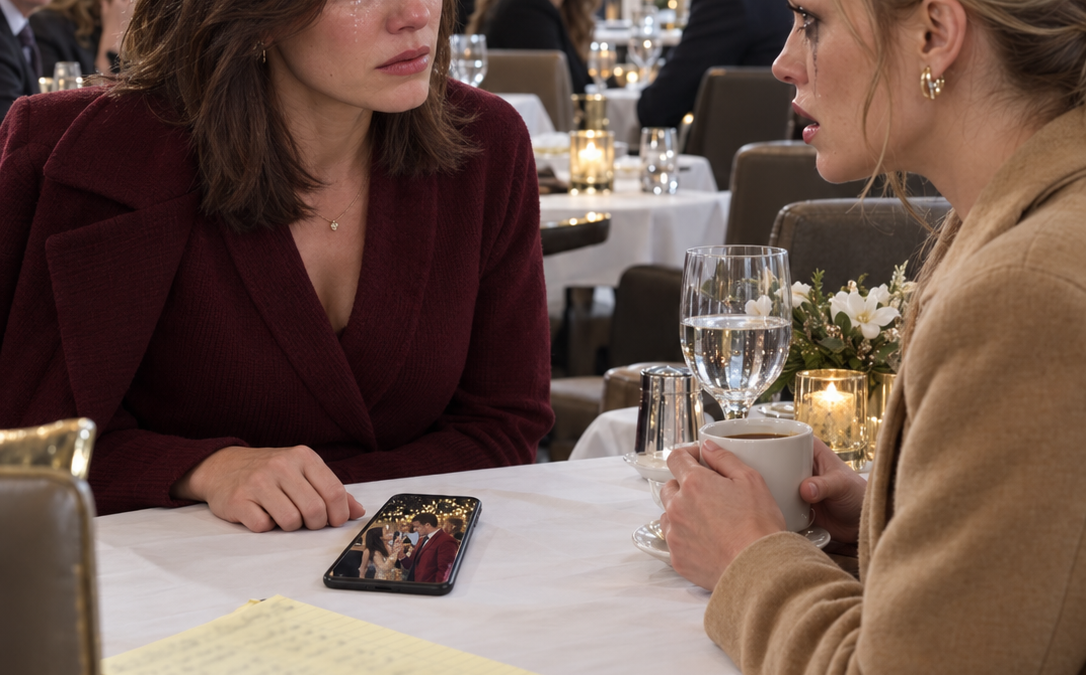
And when the waiter cleared our plates and brought us coffee, I set my phone on the table, pulled up the screenshot I had prepared, and slid it across the tablecloth to her.
It was a screenshot of her Christmas Eve live stream.
Frozen: my father in his red velvet blazer, the DJ in the background, the catered food, the champagne flute in her hand.
Payton looked at the screenshot.
Her face did not change for maybe 3 seconds.
And then it changed all at once, like a curtain falling.
“Marlo,” she began.
“I can explain.”
I did not let her explain.
Not yet.
I turned my phone off, slipped it back into my purse, and told her I was not there to hear an explanation.
I was there to give her a chance.
One chance.
One conversation.
She could either tell me the truth, the entire truth, without lies and without minimizing, or she could keep whatever version of the story she had prepared, and we could pay the check and go our separate ways forever.
Payton stared at me.
She had not expected this.
I could see it in the way her fingers gripped the coffee cup, in the way her shoulders drew up toward her ears.
She had walked into Tavola expecting the same Marlo she had known for 31 years.
The Marlo who let things slide.
The Marlo who took the high road because the high road was easier than confrontation.
The Marlo who could always, always be counted on to smooth things over.
That Marlo was not sitting at the table anymore.
“Which do you want to do?” I asked her calmly.
She looked down at her coffee.
She looked at the window.
She looked at the ceiling.
And then, slowly, she began to talk.
She told me almost the same story Uncle Bernard had told me the day before, but from her perspective.
She had discovered the truth about our father’s finances by accident in the spring of 2021.
She had confronted him.
He had told her about the empire.
He had convinced her that she was smart, that she was the one who could help him grow it, that Marlo wasn’t cut out for business because Marlo was too straight-arrow, too by the book, too much like Mom.
“He said Mom would have shut it all down if she had known,” Payton admitted. “He said she never trusted his business instincts. He said she would have made him sell the properties and split the money and blow it all on frivolous things. He said the only way to build something real was to keep it in a small circle.”
“And you agreed to that circle?”
“I said I agreed,” she confirmed.
Her voice was very small.
I asked her about the money I had been sending, whether she had known, whether he had told her.
She hesitated.
She took a sip of coffee that was probably cold by now.
She set the cup down very carefully.
And then she nodded.
“I knew,” she whispered. “I knew he asked you for money. He told me it was a couple hundred here and there. He said you offered. He said you insisted on helping. He said you would be offended if he refused.”
“How much did he tell you I was sending?”
“He said maybe $5,000 or $6,000 a year.”
“Total?”
“Total ever.”
I laughed.
It was not a happy laugh.
It was the laugh of a person who has just watched the last piece of a puzzle click into place.
I opened my purse, pulled out the folded piece of yellow legal paper I had brought with me, and slid it across the table to Payton.
It was the summary I had prepared.
$54,200 over 72 months.
An average of just under $8,000 per year.
Payton read the paper.
She read it twice.
She put her hand over her mouth.
“Marlo,” she began.
“I need you to just listen for a minute,” I interrupted, “because I want to be really clear about something. I’m not here to yell at you. I’m not going to make a scene in this restaurant. I’m not going to post anything on social media, and I’m not going to blast you to the family.
“But I also need you to understand that I am done.
“I am done sending money.
“I am done pretending.
“And I am done being the daughter who gets left out of everything and then thanked for being understanding.”
She nodded.
Tears were running down her cheeks now, ruining her mascara, dripping onto the paper on the table.
“Dad is going to text me in the next week or two,” I continued. “He’s going to ask for $2,000 for rent. He does this every January.
“He’s going to text me because he does not know that I know, and he still believes I will send whatever he asks for.
“I am going to respond to that text in a specific way, and I need to know before I respond whether you are on his side or on mine.”
Payton looked up.
Her eye makeup was streaked halfway down her face.
She looked younger than 31 right then.
She looked like the kid sister who used to crawl into my bed during thunderstorms when we were little.
“I don’t want to be on his side,” she whispered.
“That’s not what I asked. I asked whether you are.”
She was silent for a long time.
She wiped her face with a napkin.
She took a breath.
And then she said something I had not expected.
“He’s not who I thought he was, Marlo. He’s not who I let myself believe he was.
“On Christmas Eve, after everyone left, I was cleaning up in the kitchen and I heard him on the phone in his office. He was talking to someone about a property he’s trying to buy in Florida, a vacation home. He was laughing about how he was going to fund the down payment.
“And he said—and I heard this clearly—’Marlo will cover January and February rent like she always does. That’s the down payment right there.’
“I stood there in the kitchen holding a champagne glass, and I realized what I had been part of. I realized what he had turned me into. And I have been sick about it for 11 days.”
I felt something cold move through my chest.
He said that.
He said that word for word.
I looked at her.
I studied her face for a long time.
I have known my sister for her entire life. I know when she is lying because she gets a little tell in her left eyebrow, a slight lift, almost imperceptible.
Her eyebrow was flat and still.
She was telling me the truth.
“Okay,” I finally responded. “Then here is what we are going to do.”
We sat in that restaurant for another hour.
I laid out my plan, and Payton listened.
I told her that I was going to respond to Dad’s rent text with a single specific sentence, and then I was going to block his number.
I told her that after that I would begin sending certified letters to reclaim what I could from him legally, though I was not naive about how much of the $54,000 I would actually be able to recover.
I told her that I did not want her involved in any of the legal parts of what I was doing, but that I did want her to make a choice.
She could keep the relationship with Dad, keep the gifts and the car and the diamond bracelet and the future ownership of the properties, and stay quiet about all of this.
In that case, she and I would part ways, and I would not consider her family anymore.
Or she could stand with me, walk away from the empire, and rebuild an actual relationship with her actual sister from scratch.
Not a perfect one.
Not an easy one.
Just an honest one.
I did not ask her to decide at the table.
I told her to take a week.
I told her to think about it seriously, without any pressure from me, without any promises.
I told her that whatever she chose, I would respect it, but there would be no second choice later.
We hugged in the parking lot outside Tavola.
She was still crying a little.
I drove back to Akran that afternoon with the radio off, the sky heavy with snow, and my hands steady on the steering wheel.
I was ready.
All I needed now was the text from my father.
It arrived 4 days later, on the 8th of January at 7:12 in the evening.
The text came in exactly as I expected.
Word for word, almost.
My father wrote, “Hey, sweetheart. Sorry to ask so soon after Christmas, but can you send $2,000 for the rent? Landlord is threatening to move things along. I hate asking, you know that. Love you.”
I was standing in my kitchen when the message came through.
I had just finished making a bowl of tomato soup and a grilled cheese sandwich, and I was about to sit down at the table by the window and eat.
The phone buzzed on the counter.
I saw the preview on the lock screen.
And I felt my whole body still.
Landlord.
Rent.
$2,000.
The lie was so bold now that I knew the truth.
He owned the house.
There was no landlord.
There was no rent.
The only thing there was was my father sitting in his living room with his feet up on the coffee table, texting his older daughter for money to help fund a vacation property in Florida.
I put down my sandwich.
I sat at the table.
I opened the text thread.
I stared at the message for a long time.
Then I opened my notes app and typed out my response very slowly and very carefully.
I had been drafting versions of it for 2 weeks.
I had written and rewritten it.
I had shown drafts to Tabitha.
I had asked her to strike out anything that sounded angry or petty or self-righteous.
What I wanted was a response that would land like a stone in still water.
Not a splash.
Just a single heavy drop.
I copied the final version and pasted it into the text thread.
My finger hovered over the send button.
I thought about my mother.
I thought about her funeral in April of 2019.
My father sobbing over her casket, telling anyone who would listen that he didn’t know how he was going to survive without her.
I thought about the $250,000 life insurance payout.
I thought about how she had trusted him with everything and how he had used that trust to build a small empire that he was now planning to leave to only one of her daughters.
I hit send.
The response read:
“Delete my number. I don’t fund liars.
“I know about the house on Warrington. I know about CR Properties. I know about the equipment rental company. I know about the $6,200 a month in rental income, the life insurance payout, the Florida property you’re planning to buy, and the fact that you told the family I couldn’t make it to Christmas because of a work conflict.
“I have known for 2 weeks.
“I am done.
“Do not call. Do not text. Do not send anyone to speak on your behalf.
“This is the last message you will receive from me.
“Goodbye, Cornelius.”
I used his first name.
I did not call him Dad.
That was intentional.
Dad was a person I no longer had.
Cornelius was a stranger who had taken my mother’s money and lied to me for 6 years.
I pressed send.
I watched the little status change from delivered to read.
I saw the three dots appear, indicating he was typing.
I did not wait to see what he would write back.
I opened the settings on my phone, and I blocked his number.
Then I blocked his email.
Then I blocked him on the two social media platforms where we were connected.
Then I sat down and ate my tomato soup and my grilled cheese sandwich, and I watched the snow fall outside my window.
And I felt, for the first time in 6 years, like I could actually taste my food.
The next two days were quiet in a strange, almost holy way.
I went to work.
I cleaned teeth.
I made small talk.
I came home in the evenings, and I did not check my phone constantly the way I had for years.
I read a book.
I called Tabitha.
I texted Payton once to let her know I had sent the message and that she should decide what she was going to do without pressure from me.
She responded with a simple, “I already decided. I chose you.”
That was the first text between my sister and me that felt real in probably 10 years.
On the third day, the 11th of January, the flood began.
It started with Aunt Susette.
She called me from a number I had not blocked because I hadn’t seen the need.
I let it go to voicemail.
She left a message that started warm and got progressively less warm as it went on.
She said she had heard from my father that there had been some kind of misunderstanding. She said families need to talk things through, not throw around accusations.
She said I owed my father a conversation at the very least, out of respect for everything he had done for me.
I listened to the voicemail once.
Then I deleted it.
Then I blocked her number.
Next came Uncle Bernard.
But Bernard I answered because Bernard had been the one who told me the truth.
He was calling to warn me.
He said that my father was making phone calls to everyone in the family.
He said that my father was crying, saying that I had lost my mind, that I had gone crazy, that I had accused him of horrible things without any basis.
He said that my father was telling people that I was mentally unwell and needed help.
He said that my father was, in effect, running a smear campaign.
“I figured you should know,” Bernard finished, “so you’re not blindsided.”
I thanked him.
I told him I appreciated the heads-up.
I asked him if he was still willing to stand by what he had told me in the coffee shop if it came to that.
He said he was.
He said he had already told his wife, Aunt Marlene, everything.
And Marlene was on my side.
“You have more allies than you think, Marlo,” he added quietly. “Just because he’s loud doesn’t mean he’s convincing.”
That afternoon, my cousin Marcus called.
Then my father’s fishing buddy Hank, who I hadn’t spoken to in 5 years.
Then Mrs. Delaney from three doors down, who wanted me to know that she was very concerned about my father’s mental state and thought I should reach out.
I did not answer any of them.
I let the calls go to voicemail.
I deleted the voicemails without listening.
I blocked the numbers.
By that evening, my phone was quieter.
I sat down with a cup of tea and called Payton.
She picked up on the first ring.
She had been fielding calls all day, too, she told me.
Everyone wanted to know what was going on.
Dad was telling people that I had accused him of stealing from me, that I was making up outrageous stories, that I had been showing signs of instability for months.
Payton had told everyone who called that Dad was lying, and that she was standing with me.
Half the family, she said, had promptly hung up on her.
The other half had gone very, very quiet.
“He’s going to lose people over this,” she predicted. “He’s already losing people.”
“How is he?” I asked.
It was a strange question to ask.
I did not want to care.
But some tiny part of me still did, and I hated that.
“He’s frantic,” she answered. “He’s calling everyone. He drove past my townhouse this afternoon and sat in the driveway for 20 minutes. I didn’t open the door. He left.”
“Payton, are you safe?”
“I’m safe. He’s not violent. He’s just—he’s spinning. He can’t believe this is happening. He genuinely thought he could keep this going forever.”
I thought about that.
I thought about the arrogance of a man who could look at his daughter, take $54,000 from her over 6 years, cut her out of the family Christmas, and still believe that when he asked for $2,000 more, she would send it without question.
He had believed it because I had let him believe it.
Every yes I had ever given him had built the belief brick by brick into an impenetrable wall.
The wall had fallen in one text message.
And now the man who had built it was standing in the rubble, calling relatives, trying to convince them that the wall had fallen because of something wrong with me instead of something wrong with him.
I told Payton I loved her.
She told me she loved me too.
We agreed to have dinner the following weekend at a diner halfway between Akran and Pittsburgh.
She said she was going to start packing up the things Dad had given her over the years, and she was going to figure out what to return and what to sell.
“I don’t want any of it,” she added. “It all feels dirty now.”
I told her to take her time.
I told her not to make any decisions in the middle of a storm.
I told her that whatever she decided about the gifts and the car and the future ownership of the empire, I would support her.
She could keep it all and use it to build her own life, or she could give it all up and start over.
Either choice was hers to make.
We hung up.
I finished my tea.
I went to bed, and I slept for nine straight hours, the deepest sleep I had had in years.
By the middle of January, the family had split cleanly down the middle.
Half of them believed my father.
Half of them believed me.
Bernard and Marlene stood with me.
Payton stood with me.
My cousin Marcus, after hearing both sides, called me one evening and told me he was on my side too, that he had always suspected something was off about the way our father talked about money.
My mother’s younger sister, Aunt Clarissa, who lived in Cleveland and had not been at the Christmas party, called me after hearing the news through the family grapevine and told me she had never trusted Cornelius and that she was proud of me for standing up.
On the other side were Aunt Susette, Hank, Mrs. Delaney, and a handful of other extended family members who had been beneficiaries of my father’s largesse in one way or another over the years.
Aunt Susette in particular had received not only the rose gold watch at Christmas but also, according to Payton, monthly checks of $500 from Dad going back to 2020.
He had been paying her essentially to keep quiet about the state of his finances.
Though I doubt Susette would have used those words.
I did not try to convince the people on the other side.
I did not send them evidence.
I did not launch a countercampaign.
I simply let them believe what they wanted to believe, and I focused on the people who had chosen truth over convenience.
That was one of the hardest lessons of that whole period.
When you tell the truth about a family member, some of the people you love will not believe you.
Not because they are stupid.
Not even because they are cruel.
But because believing you would require them to re-examine their own history, their own choices, their own comfortable arrangements.
And most people, when faced with that choice, will choose their comfort over your truth.
I decided early on that I was not going to grieve those people.
If they came around eventually, I would welcome them back with grace.
If they did not, that was information about them, not about me.
Around the third week of January, I received a certified letter in the mail from a lawyer in downtown Pittsburgh.
It was from my father, or rather from an attorney he had hired.
The letter accused me of, among other things, defamation, harassment, and “making false accusations against a family member with intent to damage his reputation.”
It demanded that I cease and desist from any further communication about him with any third parties.
It demanded a written retraction of my accusations.
It threatened legal action.
I read the letter three times.
Then I laughed out loud.
I was standing in my apartment alone, and I laughed until my ribs hurt.
The letter was a bluff.
I knew it was a bluff because everything I had told Payton was verifiable.
The property records were public.
The business filings were public.
The tax records for the LLC were public.
My father could not sue me for defamation without opening himself up to discovery.
And discovery would put every single one of those records into evidence in a public courtroom.
He didn’t want that.
He couldn’t afford that.
Not financially and not reputationally.
The letter was a scare tactic.
He was hoping I would panic.
He was hoping I would apologize, retract, come crawling back with an olive branch and a check for $2,000.
I did none of those things.
Instead, I did something better.
I called my own lawyer.
I had never had a lawyer before in my life.
But Tabitha’s cousin, a woman named Solange, was an estate and family law attorney in Cleveland who took my case at a reduced rate as a favor to Tabitha.
Solange was in her late 50s, wore small round glasses, and had the calmest voice I had ever heard on a professional call.
She listened to my whole story over the phone one Sunday afternoon, took extensive notes, and then told me exactly what she thought I should do.
“You have two paths,” she began.
“Path one, you do nothing. You let this die. You have already accomplished the most important thing, which is that you have separated yourself from a person who was exploiting you.
“The money is likely unrecoverable, both because the transfers were characterized as gifts and because pursuing it would cost you more in legal fees and emotional bandwidth than you would likely recover.”
“And path two?” I asked.
“Path two, we send him a response letter. A very specific response letter.
“We do not threaten litigation. We do not demand money. We simply lay out in plain factual language every single thing you know.
“We attach exhibits. Property records. Business filings. Tax records.
“We send it certified, and we CC his own attorney.”
“What does that accomplish?”
“It accomplishes two things. First, it puts his attorney on notice that any defamation claim against you would be a losing case because everything you have said is provably true.
“Second, it puts your father on notice that you have documented everything and that if he ever attempts to harm you legally or financially or reputationally again, you have a fully prepared file ready to defend yourself with.
“It is not a threat.
“It is a declaration.”
I thought about it for a full day.
Then I called Solange back and told her to send the letter.
She drafted it.
I reviewed it.
It was six pages long, single-spaced, with 23 pages of attached exhibits.
It laid out my father’s business empire in exquisite detail.
It cited every property he owned.
It cited the source of the down payment on the primary residence, my mother’s life insurance payout.
It cited the average monthly rental income.
It cited the equipment rental company revenues.
It cited the exact amount I had sent him over 6 years and the false stories he had told me to induce those payments.
It concluded with a simple statement that I had no interest in litigation, that I would not be seeking to recover the funds, but that any attempt by him or his representatives to defame me, harass me, or interfere with my personal or professional life would be met with an immediate and public legal response using the attached materials.
Solange sent the letter on the 27th of January.
I never received a response from my father’s attorney.
Not that week.
Not the next month.
Not ever.
The cease-and-desist campaign stopped cold.
The phone calls to relatives slowed.
My father, according to Payton, went quiet.
Payton said he had entered a strange, sullen phase.
He was not throwing parties anymore.
He was not making trips to Florida.
He was sitting in his house on Warrington Avenue, watching cable news, drinking too much scotch in the evenings, and complaining to anyone who would listen that his daughters had turned on him.
“He genuinely believes he is the victim here,” Payton told me over the phone one night in early February.
“He genuinely cannot see what he did.”
“He never will,” I answered. “That’s the part I’ve had to accept. He is not going to have a moment of clarity where he realizes he was wrong.
“He is going to die thinking he was wronged.”
Payton was quiet for a long moment.
Then she asked me something that I had not expected her to ask.
“Do you forgive him?”
I thought about it.
I thought about it for a long time.
And I gave her the most honest answer I could.
“No. But I’m not carrying him around with me either.
“Forgiveness and freedom aren’t the same thing.
“I don’t need to forgive him to be free of him.”
She said she understood.
She said she was working on the same thing herself in her own way.
She said she had signed a new lease on a smaller apartment, sold the Lexus, and was giving the down payment on a cheaper used car back to Dad in a certified check with a note attached.
The note, she told me, read simply:
“I don’t want anything you didn’t earn.”
Honestly, I told her I was proud of her.
She started to cry a little.
We hung up.
I sat at my kitchen table for a long time after that call.
Snow was falling again outside.
The radiator was clanking.
The neighbors upstairs were, for the first time in months, quiet.
I felt something rise in me that was hard to name.
It was not happiness.
It was not sadness.
It was closer to a kind of settled weight, like the way a room feels after you have finally finished cleaning it and every object is exactly where it should be.
I was going to be okay.
Payton was going to be okay.
My father was going to keep being whoever he had always been.
The world was still turning.
And I had my life back.
February passed quietly.
March brought the first thaw.
By the beginning of April, the 6-year anniversary of my mother’s death, I was a different person than I had been on Christmas Eve.
I took the 12th of April off work that year.
It was the anniversary of the day my mother died.
In previous years, I had spent that day either driving to Pittsburgh to visit her grave with my father or, if he was too busy or too tired to come, sitting at home crying alone.
This year, I called Payton.
I asked her if she wanted to visit Mom’s grave with me.
Just the two of us.
She said yes immediately.
We met at the cemetery in Pittsburgh at 10:00 in the morning.
It was a bright, cold spring day, the kind where the sun is out but you can still see your breath in the shade.
Payton was wearing a plain black coat.
No jewelry.
No makeup.
She looked, I realized, more like herself than she had in years.
Whatever costume she had been wearing during the empire years had been slowly stripped away over the past 3 months.
We stood together at Mom’s headstone for a long time.
Neither of us spoke.
There was frost on the grass around the stone, and someone had left a small bunch of daffodils tucked at the base of the marker.
We assumed it was from one of Mom’s old church friends.
Neither of us knew for certain.
After a while, Payton pulled a folded piece of paper from her coat pocket and unfolded it.
She had written a letter to Mom.
She read it out loud, her voice shaking.
She apologized for the things she had let happen.
She apologized for not seeing me clearly.
She apologized for being seduced by a lie that she should have known was a lie.
She told Mom she was going to be a better sister.
She told Mom she was going to try to become a better daughter to her memory, if not to the man who was left.
When she finished, she folded the letter and pressed it into the frozen dirt at the base of the headstone.
She stood, wiped her eyes, and looked at me.
“Do you want to say anything?” she asked.
I thought about it, and I said the only thing I could say honestly.
“Mom, I’m okay. I’m going to be okay, and I’m sorry it took me this long to notice.”
We drove back into the city and had lunch at a diner near the cemetery.
Payton told me she had gotten a promotion at work. She was moving into a management role, which came with a raise but also required her to travel less.
She was thinking about buying a small condo instead of continuing to rent.
She was seeing a therapist, a woman named Dr. Brennan, who was helping her work through the family stuff.
I told her about my life, too.
I had started running in the mornings.
I had signed up for a pottery class on Wednesday evenings.
I had gone on two dates with a man named Ronaldo, a math teacher I had met at Tabitha’s birthday party.
And while I wasn’t sure if there was a future there, I had enjoyed both dates, and I was open to a third.
I had joined a book club through the library.
I had, for the first time in years, been putting the money I would have sent to my father into a savings account, and the balance was growing every month.
We split a piece of cherry pie for dessert.
When the check came, Payton grabbed it before I could.
She paid in cash.
She left a big tip.
Then we hugged in the parking lot for a long time before we drove our separate ways.
I did not see my father that trip.
I did not drive past his house.
I did not check to see if his car was in the driveway.
He was, as far as my life was concerned, no longer a person who existed.
Payton kept me updated in general terms.
He was still living in the house on Warrington.
He had sold the Florida property plan.
Aunt Susette was still coming around, though less often.
Bernard had stopped visiting him entirely.
Life was going on.
In May, an unexpected letter arrived in my mailbox.
It was a card, actually, a plain white card with a small drawing of a robin on the front.
Inside, in handwriting I did not recognize, was a message.
“Dear Marlo,
“You do not know me. My name is Odette Vance, and I was your mother’s friend from her book club in the late 1990s. I have been out of touch with the family for many years.
“I recently learned about the difficulties between you and your father from an old mutual friend, and I felt moved to write to you.
“I want you to know that your mother spoke often of you when we were younger. She said you were the most careful, thoughtful child she had ever met. She said you had a strong sense of right and wrong and that you would grow into a woman she would be proud of.
“I wanted you to know that.
“I think she would be very proud of the woman you have become.
“With warmth,
Odette.”
I read the card three times.
I cried a little, but it was a good cry, the kind that comes from a place of being seen rather than a place of being wounded.
I wrote Odette back that same evening.
I told her thank you.
I told her I would love to meet her someday if she was ever in Akran.
I told her that hearing her words about my mother had meant more than she could know.
Odette wrote back the following week.
She lived in Youngstone, only an hour from Akran.
We made plans to have lunch in June.
Life kept moving.
May turned into June.
The pottery class turned into a small collection of lopsided but proud mugs and bowls that I gave away to friends.
The dates with Ronaldo turned into a real relationship, slow and cautious and honest.
Payton and I began having weekly phone calls, then twice weekly, then almost daily by the end of the summer.
We were not the sisters we had been as children.
We were becoming a new kind of sisters.
Adults who chose each other on purpose, without the tangled loyalties of the past.
Bernard and Marlene invited me to their 40th wedding anniversary dinner in August.
It was held at a small restaurant in Cranberry Township.
Payton was there.
Aunt Clarissa flew in from Cleveland.
Marcus came with his wife.
Several other family members who had chosen truth over convenience were there.
My father was not invited.
Bernard gave a toast that evening that I will remember for the rest of my life.
He raised his glass, looked around the room at everyone gathered, and said something like this:
“Family is not the people you share blood with. Family is the people you share truth with.
“We have all had a hard year, some of us harder than others. But I look around this table, and I see the people who chose truth, who chose each other, who chose to see clearly instead of comfortably.
“And that is what family is.
“To Marlene. To all of us. To the years ahead.”
We raised our glasses.
We drank.
I looked across the table at Payton, and she was crying a little.
But so was I.
So was Marlene.
So was everyone.
It was the good kind of crying, the kind that means something has been repaired that seemed broken beyond repair.
I drove home to Akran that night with the windows down and the summer wind in my hair.
And I thought about my mother.
And I thought about the $54,200 that I would never see again.
And I thought about the fact that some prices are worth paying because of what they buy you on the other side.
I had paid a very expensive tuition for a very valuable lesson.
And I did not regret the payment.
In September, something happened that I had not expected.
Payton called me on a Tuesday evening.
Her voice was strange.
Tight.
Almost breathless.
She said Dad had had a heart scare.
Not a heart attack, but something serious enough that he had been hospitalized overnight for observation.
He was home now, resting.
He had asked her, through a phone call he made from the hospital bed, if she would tell me.
I sat with that for a moment.
I asked Payton what she thought I should do.
She said she couldn’t tell me what to do.
She said she loved me either way.
She said that she had visited him in the hospital because she couldn’t not visit him, but she also wanted me to know that seeing him there had not changed her mind about anything.
He had not apologized.
He had not acknowledged anything.
He had spent the visit complaining about the hospital food and asking her to pick up his mail.
“He hasn’t changed, Marlo,” she added. “In case you were wondering, he hasn’t changed a bit.”
I thanked her.
I told her I would think about it.
I thought about it for 3 days.
I called Tabitha.
I called Solange, who is now more of a friend than a lawyer.
I called Ronaldo, who listened patiently as I laid out every angle of the situation.
Here is what I decided.
I decided that a heart scare does not undo six years of lies.
I decided that my father was 70 years old and he was going to have more heart scares in his life.
And if I began responding to each one, I would be pulled back into a relationship with him piece by piece, on his timeline, on his terms.
I decided that if he wanted to see me before he died, he could pick up the phone and issue an actual apology.
An actual admission.
An actual acknowledgment of what he had done.
Anything less than that was not a real request for reconciliation.
It was a request for me to abandon my boundaries and come running.
I would not come running.
I called Payton back on Friday evening.
I told her my decision.
She said she understood.
She said she would tell him if he asked.
She said she was proud of me for making the choice consciously rather than reactively.
He did not ask.
She did not tell him.
Life went on.
In late September, I turned 35.
Payton drove out to Akran for the weekend.
She stayed at my apartment.
We baked a cake together.
Ronaldo came over for dinner on Saturday night, and he brought flowers, and he shook Payton’s hand.
And I watched my sister and my boyfriend get to know each other over a pot of chicken and dumplings.
I felt something in my chest that I could only describe as full.
The next morning, Payton and I sat at my kitchen table drinking coffee.
She had something to tell me.
She said she had been thinking about it for months and she was ready to talk about it.
She wanted to give me half of everything.
I put down my coffee cup.
“Payton, no.”
“Payton, yes. Listen. Dad still has me as the sole beneficiary in his will. I know that. I’ve seen the paperwork.
“When he dies, the house on Warrington, the two other rental properties, the equipment business—all of it comes to me.
“And I have decided that when that happens, I am going to split everything down the middle.
“50/50.
“I already had my lawyer draft the paperwork. It is a private agreement between us. It goes into effect the moment I inherit.”
“I don’t want it,” I answered. “I don’t want anything he touched.”
“I know,” she replied. “And I love you for that, but it’s not really his money.
“It was Mom’s life insurance, and Mom would have wanted us to split it equally. She would have hated the way Dad divided us.
“So I’m going to undo his division after he’s gone.
“I want you to know that, and I want you to accept it.
“Not because you’re going to spend the money on yourself, but because I want you to know that when the empire he built to divide us finally passes down, it’s going to be reunited.
“It’s going to be equal.
“It’s going to belong to both his daughters, the way it should have from the beginning.”
I stared at my sister.
I felt tears in my eyes, but I did not let them fall.
I finally nodded.
“Okay,” I whispered.
“Okay. Thank you.”
She reached across the table and squeezed my hand.
Then she said something that broke me a little.
“He didn’t deserve either of us.”
We didn’t talk about it again for the rest of the weekend.
We watched movies.
We ate leftover cake.
She drove back to Pittsburgh on Sunday evening, and I stood in the parking lot of my apartment building and waved as her taillights disappeared.
In October, Ronaldo asked me if I wanted to meet his family.
He was from a big Puerto Rican family in Cleveland, and they were having a birthday party for his grandmother.
I said yes.
I drove out with him on a Saturday and spent the afternoon eating rice and beans and pernil at a long table crowded with children and aunts and cousins.
His grandmother, whose name was Esparanza, hugged me for a full minute when we were introduced.
She patted my cheek and told me I had kind eyes.
I drove home that night thinking about the word family and how it can mean so many different things.
How the people who share your blood are not always the people who share your table.
And how sometimes the tables you find in your 30s are more real than the ones you grew up at.
In November, I got a letter from my father.
It was handwritten.
It arrived in a plain white envelope with a Pittsburgh postmark.
I recognized the handwriting immediately.
I sat with the envelope on my kitchen table for two full days before I opened it.
Tabitha came over and sat with me the night I finally decided to read it.
She was there in case I needed her.
The letter was three pages long, front and back.
I will not reproduce all of it here because much of it was self-pitying, and much of it was blame-shifting, and much of it was the same manipulative language he had used on me for years.
But there was one paragraph buried on the second page that made me stop reading.
I had to put the letter down and take a breath before I could keep going.
The paragraph read:
“I know I did wrong.
“I know I lied.
“I know I took advantage of your kindness.
“I know I built something and left you out of it.
“And I told myself I had reasons, but the reasons were not real. The reasons were just what I told myself so I could keep doing what I was doing.
“I am not writing to ask you for anything.
“I am not writing to ask you to come back.
“I am writing because I owed you these words for 6 years and I never gave them to you, and I do not want to die without you having read them.”
I read that paragraph three times.
Then I read the rest of the letter, which slid back into self-pity and complaints about Payton and various rambling grievances against life.
But that one paragraph stood alone.
That one paragraph was, as far as I could tell, the first honest thing my father had said to me in 6 years.
I did not respond to the letter.
I did not call him.
I did not lift the block on his number.
But I did something I had not done in almost a year.
I sat down at my kitchen table and opened the file I had kept in my desk drawer, the file with all the bank records and public documents in Solange’s letter.
And I took out the paragraph I had cut from his letter.
I taped it to the front of the folder.
I closed the folder.
And I put it back in the drawer.
I did not know yet what I was going to do with what he had written.
Maybe someday I would write him back.
Maybe I would not.
But for the first time, I could see a door in the wall.
I did not have to walk through it.
I did not have to leave it open.
But the door was there.
And that was more than I had had before.
The last chapter of my story is not really an ending.
It is more like a landing.
A place where I can look back at everything and see it clearly and set it down for a moment before walking forward into whatever comes next.
It is now December of 2025.
Almost exactly a year has passed since the Christmas Eve when I ate leftovers alone in my apartment and watched my sister’s live stream and saw my father in his red velvet blazer laughing by the fireplace.
I am sitting at my kitchen table as I write this.
It is snowing outside.
The same soft, slow snow as last year.
But my table is different now.
There are two placemats on it because Ronaldo is coming over for dinner.
There is a small Christmas tree in the corner of my living room decorated with ornaments Payton and I made together over Thanksgiving weekend when she visited.
There is a card on my mantel from Odette Vance, who has become a real friend and who came to visit me in October.
There are three cards from patients at the dental office who have become close to me over the years.
There is a card from Bernard and Marlene.
There is one from Aunt Clarissa.
There is one from Ronaldo’s grandmother, Esparanza, who insisted on sending me one even though she has only met me twice.
There is no card from my father.
And I am okay with that.
I am spending Christmas Eve this year at Payton’s new condo in Pittsburgh.
She moved into it in September.
It is small and simple and clean, and she picked out every piece of furniture herself with money she earned herself.
Bernard and Marlene are coming.
Aunt Clarissa is flying in.
Ronaldo is coming with me.
His grandmother wanted to come too, but her hip has been bothering her, so we are visiting her the day after Christmas instead.
We are going to have a real Christmas.
A small one.
An honest one.
10 people around a table that Payton set with our mother’s old china, which she had kept in a box in her closet for years and which she pulled out and washed by hand last week for this dinner.
Our father will be alone in his house on Warrington Avenue this Christmas Eve.
Payton told me she offered to bring him a plate of food on the 26th, but she did not invite him to the dinner itself.
She said he cried on the phone when she told him.
She said she did not change her mind.
She said she loves him, and she is not ready to see him.
And both of those things can be true at the same time.
I am proud of her.
I am proud of myself.
I have thought a lot this year about what happened, about what made me capable of sending that final text, of blocking his number, of walking away from a man I had built my entire adult life around trying to please.
And I think the answer is simpler than I once believed.
It was not strength.
It was not courage.
It was clarity.
When you finally see something clearly, when you finally have the evidence in front of you and you stop looking away, walking away becomes almost easy.
It is the seeing that is hard, not the leaving.
For 6 years, I had refused to see.
I had been given hints and clues and warning signs by dozens of small moments, and I had explained each one away because seeing clearly would have required me to change my life.
It was easier to keep sending the money.
It was easier to keep believing the story he told me about myself.
That I was the good daughter.
The responsible one.
The one he could count on.
That story was the leash.
And I did not realize it was a leash until I was standing in my kitchen on Christmas Eve, holding a plate of cold leftovers, watching a live stream of a family I thought I had.
If I could go back and tell myself something on that night, before I opened Payton’s stream, before I saw my father in the red velvet blazer, I would tell myself this.
The people who love you do not require you to prove your love by ignoring your instincts.
The people who love you do not build a life on your back and forget to invite you to sit at the table.
The people who love you tell you the truth.
Even when the truth is inconvenient.
Even when the truth costs them something.
If you find yourself right now sitting in a quiet apartment somewhere in the world, watching a live stream of a family you thought you had, please hear me.
You are not crazy.
You are not being dramatic.
You are not overreacting.
The pattern you are noticing is real.
The absence you are feeling is real.
And you are allowed to say something about it.
You are allowed to walk away from it.
You are allowed to build a new table in a new room and invite different people to sit at it with you.
I lost $54,200 over 6 years.
I am not going to get that money back.
I made peace with that a long time ago.
But here is what I gained.
I gained a sister who is more of a sister to me now than she has been since we were children.
I gained an uncle and an aunt who chose the truth even when the truth was hard.
I gained a therapist I started seeing in the spring, a woman named Dr. Nai who has helped me understand the difference between love and obligation.
I gained a boyfriend who has never once asked me for money, who cooks me dinner on Wednesday nights, who reads books next to me on the couch on Sunday afternoons.
I gained a friendship with a woman named Odette who knew my mother when they were both young and who has told me stories about my mother that I had never heard before.
I gained a savings account that has, as of the writing of this chapter, over $12,000 in it.
Not because I am rich, but because I am no longer draining myself into someone else’s empire.
I gained an understanding of who I am when I am not being used.
I gained the ability to eat a meal without checking my phone every 10 minutes to see if someone needs something from me.
I gained the ability to say no.
That was maybe the biggest gain of all because I had spent my whole life saying yes.
And I had not known until I finally said no that saying no was even an option.
The people who love you will not punish you for saying no.
That is how you know they love you.
That is the whole test.
My father is a man who taught me to ride a bike on a cracked sidewalk on Manchester Road when I was 5 years old.
He is also a man who took $54,000 from me and left me off the Christmas guest list.
Both of those things are true.
I do not have to choose one truth over the other.
I can hold them both.
And I can decide, based on both of them, that I am not going to be in a relationship with him anymore.
That decision is mine.
It has always been mine.
I just did not know it until last Christmas Eve.
To anyone watching this, I want to leave you with something small.
If someone in your life is telling you they are broke while their behavior suggests otherwise, believe your eyes.
If someone is cutting you out while telling you it is not personal, believe your gut.
If a family member is asking you for money over and over while giving gifts to everyone else, believe the pattern.
The story someone tells you about themselves is not the same as the truth of who they are.
Watch the pattern.
Trust the pattern.
The pattern will not lie to you even when the person does.
I am going to close this now because Ronaldo is going to be here in about 20 minutes, and I need to preheat the oven and put on a nice sweater.
Tonight we are having roast chicken and mashed potatoes.
And yes, I am aware of the symbolism.
And yes, I am doing it on purpose.
Last year, I ate cold mashed potatoes alone while my family threw a party without me.
This year, I am eating warm mashed potatoes with the man I love.
And tomorrow, I am driving to my sister’s house to celebrate Christmas with the people who chose me.
If this story meant anything to you, if any part of it reminded you of your own life or someone you know, please give it a like and subscribe to the channel.
And if you have your own story about family, about boundaries, about the moment you finally saw someone clearly, share it in the comments below.
There are so many of us out here who have sat at a table alone on Christmas Eve.
We should not have to sit there in silence.
Thank you for listening.








