My dad ordered me to show up at my sister’s wedding or lose my college money, they never expected i had already graduated #1 in my class—and was earning more than both of them, on that wedding day…
When his name lit up my phone that afternoon, I almost let it ring out. I wish I could tell you I had a good reason for picking up. The truth is, I picked up the way you touch a bruise to see if it still hurts.
To know why I went quiet, you’d have to go back to a kitchen in Dabney, Indiana, when I was nine and Khloe was seven. That was the year Khloe’s heart stopped being something we took for granted.
Rheumatic fever. A damaged valve. A cardiologist two hours away in Indianapolis.
For one whole summer, the house held its breath around her. My mother slept in a chair by Khloe’s bed. My father took a second shift at the plant to cover the bills. And when he came home, he went straight to her room.
The rest of us learned to be quiet so she could rest.
Khloe got better. She grew up healthy, ran track, married well by my parents’ count. But the house never exhaled. The habit of putting Khloe in the center had set like concrete, and nobody noticed it was still there.
I became the other kind of child. The one who didn’t need anything. The one who cleaned up after the parties.
I remember my mother’s lemon sheet cake at every birthday, every graduation, every holiday. That bright yellow rectangle in the middle of the table. I remember being the one who scraped the plates and washed the pan while everyone else sat with Khloe in the living room.
I didn’t resent the cake. I learned to like the kitchen.
It was quiet there, and quiet was the one thing I could always have.
I’m telling you this so you understand something. I was never the bitter sister waiting in the wings. I left because staying meant disappearing, and I was not willing to disappear.
That is a very different story than the one my father tells at the diner.
So, on the call, he didn’t say hello. He never does. He said the wedding was the 14th, that the whole town was coming, and that I would be there in something nice and not embarrass him.
I said I’d check my schedule.
That was apparently the wrong answer.
I heard him set his coffee down hard. He told me Khloe had asked for me, which I doubted, and that my mother was already worried sick I’d find an excuse.
Then he said the thing he’d been holding back.
“Be at your sister’s wedding, or don’t expect another dime.”
There it was.
The college money. The fund he’d promised me at 18 and quietly spent on Khloe’s car, Khloe’s wedding, Khloe’s everything, while telling himself it was still mine to lose.
He thought he was holding a leash.
He had no idea the collar came off years ago.
I could have laughed. I could have told him I’d billed more in one quarter than he’d earned in two years at the plant. Instead, I went still, the way I do when a client lies to my face and I decide to let them keep talking.
“What time should I be there?” I said, flat.
No fight.
He paused, thrown, because a fight was what he’d called for. He recovered, barked out the details, and hung up.
I sat with the phone in my hand and the city humming below me. He thought he’d won something.
What he’d actually done was hand me a reason to drive down to Dabney with my eyes open, because there was one detail in that call I couldn’t put down.
He’d mentioned the groom helping with money.
And nobody helps my father with money for free.
I grew up in a white two-story off County Road 9. The kind of house with a wraparound porch and an aluminum screen door that banged shut behind you no matter how gently you tried to close it.
That bang was the soundtrack of my childhood. You always knew who was coming and going by the rhythm of it.
My father bought that house the year I was born and paid the last note on it the year I left for college. I remember the day the mortgage was gone. He took my mother to dinner and came home and stood in the front yard like a man surveying a kingdom.
“Nobody can take this from us now,” he said.
He said it more than once over the years. At Thanksgivings. At Christmases. Every time the talk turned to money.
The house was free and clear.
The house was proof he’d done it right.
For a man who measured himself by what the neighbors could see, that deed was the whole scoreboard.
I want you to hold on to that, the way I held on to it, because everything that happened later turns on it.
A house with no debt on it is a safe thing.
It’s also a tempting thing if you’re the kind of man who knows how to put debt back on it without the owner quite understanding what he signed.
I didn’t know that yet, driving south on the interstate two days early with a thermos of bad coffee and a feeling I couldn’t name.
I just knew the screen door would bang when I walked in, and my father would be proud of a house, and somewhere in that house there was a man named Cole Mercer who’d made himself useful.
Useful men make me nervous.
The drive from Chicago to Dabney runs a little under five hours if the trucks cooperate. It gives you time to think, which is not always a gift.
I thought about the last real fight my father and I had, six years back, at a dinner that was supposed to celebrate my master’s.
He had spent the meal asking Khloe about her new boyfriend. When my mother finally mentioned my degree, my father nodded once and said the thing that still lives rent-free in my head.
“Khloe’s the one who stayed.”
Like staying was a virtue and leaving was a betrayal. Like the daughter who built a life out of state had committed some quiet crime against the family by not needing them.
I didn’t argue.
I’d learned that arguing with my father was like arguing with weather. You just get wet.
But I drove home that night and signed the lease on my own place and decided that the version of me that begged for a seat at that table was officially retired.
People think walking away is weakness.
They’ve never tried to do it without slamming a single door.
I wasn’t angry at Khloe. For the record, you can’t be angry at someone for being protected.
I felt something closer to grief when I looked at her, because she’d been wrapped in so much fear as a child that she never learned to stand on her own legs. She married the first man who told her she was special.
That should have scared my parents.
Instead, it thrilled them.
By the time I crossed into Indiana, the sun was going low and orange over the corn, and I told myself I was just going to a wedding.
I almost believed it.
Then my phone buzzed with a text from my mother, and the believing got harder.
The text was four cheerful lines about Cole.
Cole had fixed the gutters.
Cole had found Dad a better return on his savings.
Cole knew a guy who could refinance the truck.
Cole. Cole. Cole.
All with the breathless gratitude of a woman who’d found a son she could brag about.
My mother has a good heart and a short memory for warning signs.
I read it twice in a gas station parking lot off Route 9.
Here is what 12 years of forensic work does to you. The word “return” stops sounding like good news. A stranger who suddenly knows a guy for everything stops sounding like a blessing.
Helpful is the most expensive thing in the world when it comes from someone who wants something.
I texted back something neutral and pleasant, the kind of thing a normal daughter sends.
Then I sat in that parking lot, opened my laptop on the passenger seat, and typed his name into the first of three databases I pay for.
Cole Mercer.
Entrepreneur, my mother had called him.
I have learned to be suspicious of men who introduce themselves with adjectives.
The connection was slow on gas-station data, and the little wheel spun while I told myself I was being paranoid. That some men really are just good with gutters.
The first record loaded a business entity registered eight months ago in Cole’s name, here in Indiana.
New. Clean on the surface.
The address listed wasn’t an office.
I knew that address.
It was one of those mailbox storefronts in a strip mall, the kind that rents you a suite number and a place to hide.
A real company has a real door.
I closed the laptop.
I had a wedding to get to, and now I had a question to carry into it.
I want to be clear about something because it matters for everything that comes next.
I did not drive to Indiana to play detective.
I drove because a leash was rattled at me, because a stranger was suddenly handling my father’s money, and because I am physically incapable of leaving a number that doesn’t add up alone.
My mother raised a girl who scrapes the plates.
The world made her into a woman who reconciles the accounts.
That night, I pulled into the gravel drive a little after nine.
The screen door banged.
My father looked up from his recliner, surprised I’d come early, and for half a second, something almost like pleasure crossed his face before he remembered to be gruff.
My mother hugged me too hard.
And there, on the couch in a sweater that cost more than the couch, sat Cole Mercer.
He stood when I came in. He shook my hand with both of his, looked me in the eye, and told me how much he’d heard about me.
Warm. Polished. Practiced.
A man who’d shaken a lot of hands he intended to empty.
“Khloe’s lucky to have a big sister like you,” he said.
I smiled and said the right things.
Inside, every alarm I own was going off quietly, the way a smoke detector chirps in another room.
He was too smooth.
He held eye contact a beat too long.
And when my father bragged about the house being paid off, Cole said, “A property like this is an asset you should be making work for you, Rey.”
Making it work.
I’d heard that phrase before in depositions from men who were no longer free.
I went to bed in my childhood room that night and lay awake doing math.
By morning, I’d stopped wondering whether to look.
I was only wondering how deep it went.
The next morning, I told my family I had work calls and shut the door to the spare room. That part was even true.
I set up my laptop on the old desk where I used to do homework nobody asked about, and I started a folder.
A plain green folder, the kind I buy a hundred at a time.
I write on the tab in pencil so I can reuse them.
On this one, I wrote a single name.
Mercer.
Then I went to work the way I’d work any engagement, because the people I love deserve at least the rigor I give strangers.
First, the entity. That brand-new company with the mailbox address.
I pulled the filing.
Cole was listed as the sole officer, registered agent also at the same fake suite. Eight months old, and already, according to my mother, managing investments for my father.
A real investment firm has licenses. It has a registration with the state securities division.
I checked.
There was nothing.
Not suspended. Not pending.
Nothing.
A man cannot legally manage other people’s money for return without registering. And Cole had not registered anything but a mailbox.
That alone wasn’t proof of a crime. People cut corners.
But it was a red flag.
The first of what I suspected would be a row of them.
And red flags are my entire profession.
I made a note in the folder in my small, square handwriting.
Then I did the thing I always do next. The thing that separates a hunch from a finding.
I started looking for what came before.
Because men like Cole are rarely first-time builders. They’re repeat performers. They dissolve one stage and walk onto the next.
I just had to find the stage before this one.
It took me most of the morning.
What I found made me close the folder and sit very still.
Before I tell you what I found, I have to tell you about the kitchen.
I came down for coffee around noon and caught the tail end of a conversation that stopped when I walked in.
My mother had her checkbook out.
My father was signing something Cole slid across the table, and Cole was already gathering it up before I could see the letterhead.
“Just some paperwork for the refinance,” Cole said easily, tucking it into a leather folio. “Saving your folks a fortune in interest, Shelby.”
My father beamed.
My mother beamed.
I poured my coffee and watched a con man pour charm.
I asked, as lightly as I could manage, what they were refinancing since the house was paid off.
The temperature dropped two degrees.
My father’s jaw set.
“Grown-up business,” he said, a phrase that told me he didn’t fully understand it either.
I let it go in the room.
I did not let it go in my head.
That afternoon, I asked my mother, just the two of us, how the savings were doing.
She got vague.
There had been some moving around. Money shifted into Cole’s fund to get it growing. A withdrawal here. A transfer there.
Larger amounts than this careful woman would ever normally touch.
Shifting balances. Sudden movement in accounts that had sat steady for 30 years.
In my world, that pattern has a name.
And the name is not “good return.”
I didn’t lecture her.
Lecturing a woman who’s decided to be happy only makes her defend the thing making her unhappy.
I just filed it.
The green folder was getting thicker.
And the picture forming inside it was not a clumsy son-in-law making rookie mistakes.
It was a sequence.
A practiced, patient sequence run by someone who knew exactly which buttons in a proud family to press.
I had to be careful now.
Because he was watching me too.
That evening, I tried the soft version first.
I didn’t bring documents. I didn’t accuse.
I just sat with my father on the porch while the crickets started up and said gently that I’d noticed Cole’s company wasn’t registered with the state, and that maybe before they moved any more money, they should have someone independent look it over.
I offered to do it myself.
For free.
Quietly.
I watched my father’s face close like a store at night.
“You’ve been here one day,” he said, “and you’re already trying to ruin it.”
He told me Cole had done more for this family in six months than I’d done in six years.
He told me I was jealous.
Jealous of Khloe.
Jealous of her happiness.
Jealous that someone had finally brought money into the family instead of just keeping it to themselves up in Chicago.
That last part landed.
I won’t pretend it didn’t.
I’d kept my life to myself, and now my silence was being read as selfishness.
My mother stood in the doorway, the screen door propped on her hip, and I looked at her and waited for her to say something true.
She’d known me 33 years.
She’d watched me scrape every plate.
And she looked at the porch boards and said, “Let’s just have a nice wedding, Shelby.”
Even her.
Especially her.
I didn’t raise my voice.
I’ve learned that raising your voice with people who’ve decided you’re the problem just proves their point.
I said, “Okay.”
I said, “I hope it all works out.”
And I went upstairs to the spare room, opened the green folder, and got back to the only language that had ever told me the truth.
Numbers don’t get embarrassed.
Numbers don’t choose the favorite.
Numbers just sit there and wait for someone willing to read them.
I caught Khloe alone the next morning at the kitchen table, addressing the last of the place cards in her careful loops.
For a moment, she was just my little sister again, tongue between her teeth, working hard at something small.
I sat down.
I didn’t lead with Cole’s company.
I asked her if she was happy.
She lit up and said she’d never been happier, that Cole understood her, that he made her feel chosen for the first time in her life.
That word stopped me.
Chosen.
The girl the whole family had revolved around had grown up feeling not chosen.
And a stranger had figured out exactly how to fill that hole.
They always do.
They listen for the empty room in you.
And then they move in and pay no rent.
I tried carefully to ask whether she knew much about Cole’s business, his past, where he’d lived before.
Her face changed.
The shutters came down, and behind them I heard Cole’s voice in her words.
“He told me you’d do this,” she said. “He said you couldn’t stand to see me have something for once.”
So he’d inoculated her against me before I’d even arrived.
He’d predicted the big sister who notices things and turned my noticing into proof of my jealousy.
It was good work.
Genuinely, I’ve watched professionals do worse.
I reached across the table, squeezed her hand, and told her I loved her and that I’d always be in her corner no matter what.
She let me hold her hand for exactly as long as it took to feel guilty, then pulled it back to finish the cards.
I left the kitchen knowing two things.
Khloe was not my enemy.
And Khloe was not going to be any help.
Whatever I did, I’d be doing it alone.
Which, by then, was nothing new.
It was my mother who almost broke.
Late that night, I came down for water and found her alone at the counter, hands flat on the cold tile, staring at nothing.
She didn’t hear me at first.
When she did, she didn’t put on the bright face.
She looked tired in a way I hadn’t let myself see.
“Shelby,” she said quietly. “You know, I always knew.”
I stood very still.
“Knew what, Mom?”
She turned her wedding ring around and around her finger.
“That it wasn’t fair, the way it went. After Khloe got sick, I was so scared all the time. And you were so easy. And I just…”
She stopped.
Her mouth worked.
For one second, the wall came down, and I saw the whole 30 years in her face.
Every plate I scraped.
Every birthday spent in the kitchen.
All of it known and never said.
I didn’t move.
I wanted that sentence finished more than I’d wanted anything in years.
Then the floorboard creaked in the hall, and my father’s voice came asking what she was doing up.
My mother’s face closed.
She patted my arm.
“Go on to bed, honey. Big day coming.”
And the moment folded itself away like a letter put back in a drawer.
She chose peace.
She chose it the way she’d chosen it my whole life, because peace was the thing she knew how to make and fairness was not.
I’m not going to tell you I forgave her right there.
I didn’t.
But I understood her, which is a colder and more useful thing.
Some people enable harm out of cruelty.
My mother did it out of fear and a tired hope that if nobody named the wound, it might heal on its own.
It never does.
I went back upstairs.
The folder was waiting.
This is the part I keep coming back to.
The page that turned a bad feeling into a hard fact.
I’d spent two days chasing Cole Mercer backward through public records.
And Cole Mercer kept dead-ending because Cole Mercer was only eight months old.
A person with no history before last spring isn’t humble.
He’s hiding.
So I stopped searching the name and started searching the patterns around it.
The registered-agent addresses. The phone number on the mailbox filing. The same strip-mall suite.
And the suite gave him to me.
Two years before Cole Mercer existed, that exact address had hosted another entity one state line over, dissolved and gone.
The officer on that dead company was not Cole Mercer.
He was Cole D. Halverson.
Same first name.
Same middle initial.
Same date of birth listed on a filing he probably never imagined a stranger’s daughter would dig up.
Halverson Capital Group.
Dissolved.
Behind it, when I pulled the thread, were two complaints and a trail of people who’d handed over savings for a better return and gotten a story instead.
I printed the page.
The old printer in the spare room wheezed it out one warm sheet at a time, and I held it under the desk lamp and read it three times.
A name is not a crime.
People change names for a hundred honest reasons.
But a man who changes his name, crosses a state line, rents a hiding place for an address, and starts managing a retired couple’s money without a license?
That man is not running from a bad marriage.
That man is running a route he’s run before.
I slid the page into the green folder, on top, where I’d see it first every time I opened it.
That single sheet was the spine of everything now.
Everything I did from that night forward, I did with that name underneath it.
Halverson.
The wedding was in four days.
A name like Halverson tells you what a man was.
The next records told me what he was doing right now, here, to us.
I went to the county property records the next morning. The ones anyone can pull if they know to look.
My father’s house.
The deed I’d grown up believing was bulletproof.
Free and clear.
Nobody can take this from us now.
There was a new lien on it.
Recent.
A home-equity line of credit drawn against the equity my father had spent 30 years building.
The lender named on the paperwork was a company I didn’t recognize.
So I ran its name through the state corporate filings and the databases I pay for, the same ones I’d already run on Cole, and watched it resolve through a single shell company back to his unregistered fund.
That was the refinance.
That was the “saving your folks a fortune” Cole had slid across the kitchen table while my father beamed and signed.
He hadn’t lowered their payments.
He’d mortgaged the one thing my father swore could never be taken and routed the line into his own structure.
And the only thing standing between Cole and the money was a few more signatures and a wedding that would tie him into the family for good.
I sat in the car outside the county office and felt the whole shape of it click into place.
The wedding wasn’t the point.
The wedding was the lock.
Marry the favorite daughter, become a son, and a proud father stops asking a son-in-law hard questions.
I drove back toward the house.
And yes, I mean drove, because I was an hour from Dabney, pulling records the family didn’t know existed.
On the way, I made one stop.
I went to the county recorder and requested certified copies.
Not stamped.
Sealed.
Official copies.
The kind that carry weight. The kind I could lay on a table and no one could wave away as my jealousy.
If I was going to be called a liar, I’d come with the seals.
The screen door banged behind me when I got back, the same way it had banged my whole life, except now I knew what was hanging over the house it guarded.
That sound used to mean home.
Now it meant a countdown.
My father was on the porch with Cole.
The two of them were laughing about something, my father’s hand on Cole’s shoulder like the son he’d always wanted had finally arrived.
I had certified records of a secret lien in my bag and a dissolved company under a different name in my folder.
And I had to walk past that picture and smile.
I did.
I’m good at the long game.
I’ve sat across conference tables from men who knew I was building the case that would end them, and I learned to keep my face the way you keep a still pond.
Cole watched me come up the steps.
Something behind his eyes had shifted since I arrived.
He’d noticed I asked the wrong kind of questions.
He noticed I didn’t melt for him the way everyone else did.
“Get your work calls done?” he asked, friendly, fishing.
“Always more numbers,” I said.
Friendly back.
Giving him nothing.
That night, I organized the folder the way I’d organize an exhibit for counsel.
The registration page with the Halverson name.
The certified lien.
The state securities search showing no registration.
The mailbox address.
Each one clean.
Each one sourced.
Each one impossible to call a lie because every single sheet carried an official stamp that had nothing to do with me.
I wasn’t going to argue with my father.
I was done arguing with my father.
I was going to do the only thing I’d ever been good at in that family.
I was going to set the truth on the table where everyone could see it and let them decide what kind of people they wanted to be.
I gave them the chance first.
I owe you that detail because it matters.
The night before the rehearsal, I asked my parents to sit with me at the kitchen table, just the three of us.
And I opened the folder.
I was gentle.
I didn’t say “con man.”
I said I’d found some things they needed to see before any more money moved.
I laid out the lien on their house.
Certified.
Sealed.
I showed them the company with no license.
And I turned over the page with the name Halverson on it and explained carefully that the man marrying their daughter had used another name two years ago on a company that collapsed and left people short.
My father didn’t read a single page.
He looked at the stack like it was something I’d dragged in on my shoe.
“So, this is what you drove down here for,” he said.
Not the money.
Not the lien on his sacred house.
The fact that I’d looked.
“You couldn’t let her have one good thing.”
My mother picked up the Halverson page and held it.
For one breath, I thought she’d see it.
I thought the sentence she’d left unfinished at that kitchen counter might finally finish itself.
Then she set it face down.
“People change their names, Shelby,” she said. “I changed mine when I married your father.”
And that was that.
They were the owners of the house.
They were the holders of the accounts.
Every legal door that could have stopped this ran through their signatures, not mine.
And they had decided with their whole hearts to keep signing.
I could not close an account that wasn’t mine.
I could not unwind a lien on a house I didn’t own.
The law that protected their autonomy was the same law that left them exposed.
I closed the folder.
“Okay,” I said.
And I meant a different thing by it than they heard.
Here is where a lot of people would have done something I didn’t do.
They’d have called the police that night, or screamed it across the rehearsal dinner, or grabbed Khloe and shaken her until the truth rattled loose.
I understand the urge.
But I’ve watched what happens when you swing too early in a case like this.
The money’s already gone.
The marks defend their con man harder than ever.
And you become the villain who ruined the wedding on a hunch.
Proof you throw at people who aren’t ready is just confetti.
So I did the colder, smarter thing.
I stopped trying to save people who told me clearly that they did not want saving.
I turned my attention to the one set of choices I actually controlled.
Mine.
I called a lawyer I trust back in Chicago late and walked her through what I had.
I asked her the careful questions.
What’s documentation versus accusation?
What can a forensic accountant say, and what can only a court decide?
Where is the line between protecting my family and exposing myself to a man who clearly knew how to weaponize a signature?
She told me to stay in the lane of facts.
“Don’t allege fraud,” she said. “You’re not the jury. Just lay down what’s verifiable and let the documents speak.”
That was a language I already knew.
I’d built my whole career on the difference between “this is a crime” and “these are the facts, and they raise questions a reasonable person would want answered.”
I went to bed that night calmer than I’d been all week.
Not because anything was solved.
Because I’d stopped fighting the current and started reading it.
The wedding would happen.
The money was poised to move on the wedding day itself.
My father’s pen at the ready.
So I knew, finally, exactly when to set the truth down.
Not before.
Then the pre-wedding dinner was the first time my family got a glimpse of who I’d become.
And they looked right past it.
It happened by accident.
We were at a long table at the only nice restaurant in the county, and my phone rang during the salad course.
I stepped away to take it because it was a managing partner at a firm I consult for, calling about a settlement that hinged on my testimony.
Nine figures of other people’s money.
And they needed my read before Monday.
I took the call in the parking lot, quiet and precise, the way I am at work.
When I came back, my aunt asked who it was.
“Just work,” I said.
My father snorted.
“Bean counting,” he said, to laughs.
Cole, watching, didn’t laugh.
Cole had started to do math of his own about me.
But the rest of them filed it away as Shelby and her little numbers, the daughter with the small life up north, and went back to toasting the groom.
I let them.
There’s a particular freedom in being underestimated by people who refuse to look.
They build their whole picture of you out of a child you stopped being 20 years ago, and they never update the file.
I sat back down next to an empty chair because no one had thought to seat me near the family, and I ate my dinner and watched Cole work the table like a man closing a sale.
He raised his glass to my parents.
He called my father “Dad” for the first time, and my father’s eyes went wet with it.
This stranger handing him the warmth his own daughter supposedly withheld.
I felt the trap close one more inch, and I did the math on timing quietly behind my still-pond face.
Two days.
The folder was ready.
So was I.
The rehearsal was at the church, and afterward everyone came back to the house for cake.
My mother had made her lemon sheet cake.
Of course.
The same bright yellow rectangle from every milestone of my life, set in the center of the dining table like a small sun.
People gathered around it.
Khloe cut the first piece, laughing, Cole’s arm around her waist.
My father made a little speech about family and about how this was just the beginning.
And I stood at the edge of the room by the kitchen doorway, in the spot I’ve stood in my entire life.
The spot with the best view of the dishes that would need washing.
Nobody handed me a plate.
Nobody thought to.
I wasn’t hurt by it anymore, exactly.
It was more like watching a rerun of a show you’ve memorized.
But then Cole found me by the doorway, drifting over with a glass of wine and that easy smile.
He leaned in close enough that only I could hear.
“You’re the smart one,” he said. “You do taxes, asset structuring, all that.”
He swirled his wine.
“Hypothetically, if a guy wanted to move some property out of a couple’s name, keep it clean, gift it to the kids before the wedding for tax reasons… what’s the smartest way?”
He was fishing.
He wanted to know exactly how much I understood.
Whether I was a threat or just a sour sister.
I looked at him over the lemon cake my mother made, and I felt something go very calm and very cold inside me.
“Oh, I’m not really a tax person,” I said, light as air. “I mostly just find things.”
He held my eyes a second too long.
Then he smiled wider and walked back to his bride.
He knew.
And now I knew he knew.
After everyone went to bed, I sat in the dark spare room and put the last piece in place.
Cole’s question at the cake had told me more than he meant to.
Gift it to the kids before the wedding.
He wasn’t done.
The lien was drawn.
The money was moving.
But he wanted the house itself, or as much of it as a few signatures could carry, transferred while my father was glowing and grateful and least likely to read the fine print.
And there was only one moment perfect for that.
The wedding day.
A man like Cole understands occasions.
On the wedding day, my father would be soft, proud, full of champagne and the joy of finally having the family picture he wanted.
Slide a gift deed or a transfer in front of him between the ceremony and the cake.
Call it a tax-smart wedding present to the young couple.
And he’d sign his own house away thinking he was being generous.
The reception.
That was the moment.
I confirmed what I could.
I traced the Halverson trail one state further and found the same move there.
The same pattern.
A property pulled from an older couple “for the kids” 18 months before that company dissolved.
And Cole Halverson vanished.
He wasn’t improvising.
He was running a script he’d run at least twice.
Which meant I didn’t have to guess his next line.
I knew it.
And knowing a man’s next move is the only real power there is.
I laid the green folder out one final time on the desk.
The Halverson page.
The certified lien.
The empty securities registration.
The matching pattern from another state.
Clean.
Sealed.
Sourced.
Undeniable.
I closed it and set it by the dress I’d hung on the closet door.
Tomorrow I’d carry both to the wedding.
One of them was going to do a lot more than the other.
I slept four hours and woke up steady.
That surprised me.
I thought I’d be a wreck the morning I planned to lay my family open in front of 200 people.
But I’ve done versions of this before in rooms with stenographers.
And the body learns the difference between fear and focus.
This was focus.
I dressed early.
Navy.
Simple.
Nothing that asked for attention.
I did the thing I always do before I walk into a room that matters.
I rehearsed the facts.
Only the facts.
Out loud, quietly, until they were smooth.
The company isn’t registered.
Here’s the search.
There’s a lien on the house.
Here’s the certified copy.
He used another name two years ago.
Here’s the filing.
Each sentence was true on its own.
Provable on its own.
Impossible to dismiss as one bitter woman’s story.
My lawyer’s voice was in my head.
Don’t allege.
Don’t perform.
Lay it down and let it sit there.
I knew the temptation would come when my father said something cruel.
To fire back.
To finally, finally say the thing I’d swallowed for 33 years.
I promised myself I wouldn’t.
Power.
Real power is not the loudest voice in the room.
It’s the calmest one holding the only thing that’s true.
I tucked the green folder into a flat leather portfolio so it wouldn’t look like an ambush.
Just a woman with some papers.
I checked that the certified seals were on top.
Then I caught myself in the mirror.
Navy dress.
Steady hands.
And I thought about the girl who scraped the plates while the family laughed in the next room.
I wasn’t doing this to win her a seat at the table.
She’d stopped wanting the seat years ago.
I was doing it because the house she grew up in was about to be stolen.
And I was the only one in the family who could read the theft.
I’ve sat across the table from people who lied for a living.
And I’ll tell you, the hardest part was never the numbers.
The numbers are easy.
The numbers always confess.
The hardest part was watching the people I loved choose the lie over and over because the truth cost more than they were willing to pay.
If your family ever made you the villain just for noticing what was true, you already know exactly how that feels.
Stay with me.
The toast is next.
There was one more thing before the wedding, and I almost forgot to tell you because it was so perfectly him.
The morning of the wedding, my father caught me in the hallway, dressed in his rented suit, looking like a man about to receive an award.
He stopped me with a hand on my arm.
He told me he was glad I’d finally shown some sense and come home.
He told me to keep my opinions about Cole to myself today, that this was Khloe’s day and not the Shelby show.
And then, because he couldn’t help himself, he reminded me one more time.
“And remember what I said. Behave today, or that college fund is gone for good.”
The college fund.
Still.
After everything, the man had a secret lien on his house and a stranger’s hand in his savings.
And the leverage he reached for was a pot of money he’d spent years ago on someone else, threatening a daughter who outearned him before breakfast.
I almost laughed.
Instead, I just looked at him.
This proud, frightened man in a rented suit.
And I nodded.
“I’ll behave,” I said.
And I meant it in my way.
I had no intention of making a scene.
Scenes are for people without evidence.
I was going to be the calmest person in that room.
He took my nod for surrender, the way he always had.
He patted my arm and went off to find his good cufflinks, satisfied that he’d handled me.
He thought silence meant I’d folded.
It meant I was finished arguing.
There’s a difference.
And he’d never learned it because in 33 years, he’d never once stayed quiet long enough to hear it.
I watched him go.
Then I picked up my portfolio, checked the seals one last time, and went to a wedding.
The reception was at Lynen Hall, a banquet room my parents could not afford, with a chandelier my father kept glancing up at like it might fall.
Two hundred guests.
The whole county.
The people whose opinions had run my father’s life.
White tablecloths.
A band.
The lemon cake nowhere in sight because this was the catered kind now.
Three tiers.
Cole’s taste.
Cole’s bill.
Or so everyone assumed.
I sat at a back table with the cousins, exactly where they’d placed me.
And I watched.
I watched Cole move through the room like a man at his own coronation, shaking hands, calling my father “Dad,” already half owner of everything in the building by the look on his face.
And then, between dinner and the dancing, it began exactly as I’d known it would.
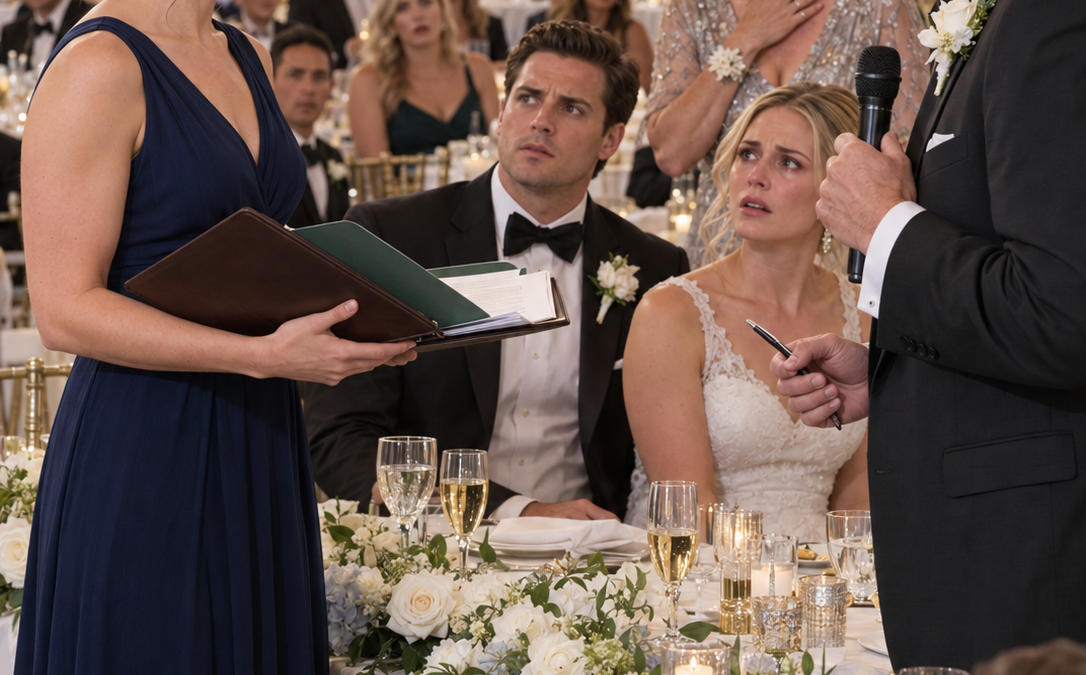
Cole stood and tapped his glass and made a charming little speech about family and new beginnings.
He said he had a surprise.
A gift for the people who’d welcomed him as a son.
He produced a leather folio.
He called my father up to the head table in front of everyone and said he wanted to do something special right now, while everyone could witness it.
“A gift to the next generation,” he said. “Smart. Clean. A way to protect the family’s legacy.”
He had papers.
A deed drawn up in advance and ready for signing.
The kind of document that needs only an owner’s signature and a notary stamp to start a paid-off house sliding out of one family’s name and into a structure they’d never see.
He had a pen.
He had my father glowing, reaching for it in front of 200 witnesses who would later swear they saw a generous man and a grateful father.
The band had stopped.
The room was watching.
Charmed.
My father took the pen.
And I stood up from the back table with my portfolio in my hand.
I walked toward the head table at an unhurried pace.
The way you walk when you have all the time in the world because you are the only one who knows what’s about to happen.
My father saw me coming, and his face curdled.
He didn’t know what I was holding.
But he knew I was not supposed to be walking.
He covered it the way he covers everything.
By performing for the crowd.
“Well, look who decided to join the family,” he said into the microphone.
The room laughed, warm and oblivious.
He gestured at me with the pen.
“My older girl lives up in Chicago, too busy with her little numbers to call her mother, but she made it to the wedding, so I suppose we should be grateful.”
More laughter.
He was rolling now, loose with champagne and the joy of his big day.
And he reached for the oldest weapon he had.
“I had to practically threaten to cut her off to get her here. Be at your sister’s wedding, I told her, or don’t expect another dime.”
The room chuckled at the gruff old father.
He thought he was being charming.
He was reciting in front of 200 people the exact leverage he’d used, and he had no idea he was handing me the room.
I stopped a few feet from the head table.
I did not raise my voice.
I have never needed to raise my voice.
“You’re right that you threatened me,” I said.
The microphone caught it because I’d stepped close enough on purpose.
“But you got one part wrong, Dad. I never needed the dime.”
The laughter thinned.
Something in my tone, flat and certain, told them this wasn’t part of the show.
Cole’s smile stiffened.
My mother’s hand went to her throat.
And my father, sensing the ground shift under him without understanding why, did the thing proud men do when they’re scared.
He doubled down.
“Oh, here we go,” he said. “Go on, then. Ruin it. You always do.”
So I did the opposite of ruin it.
I opened the portfolio.
I set the green folder on the white tablecloth beside the pen my father was still holding, and I opened it so the head table could see.
I didn’t snatch the microphone.
I just spoke clear and even, and the silent room carried my voice to the back.
“Before anyone signs anything tonight,” I said, “I think the family should see a few documents. Not opinions. Public records. Anyone can pull these. I just got there first.”
I laid down the first page.
“This is a search from the state division. The fund that’s been managing Mom and Dad’s savings isn’t registered. There’s no license on file. None.”
I laid down the second.
“This is a certified copy from the county recorder. There’s a home-equity line drawn against this house. The house Dad always said was paid off, free and clear. It was taken out a few months ago. The money runs back to that same unregistered fund.”
A murmur started low, moving through the tables like wind through wheat.
I laid down the third page.
The spine of the whole thing.
And I turned it so Khloe could see it too.
“And this is a business filing from two years ago. One state over. Same date of birth. Same middle initial. Different last name. The man you all know as Cole Mercer registered a company under the name Cole Halverson. That company dissolved. The people who’d given it money to manage did not get it back.”
I looked up.
And I did not look at my father.
I did not look at Cole.
I looked at Khloe.
“I’m not telling you he’s a criminal. I’m not the one who decides that. I’m telling you these are the facts, with the seals on them, and a reasonable person would want them answered before anyone signs a deed tonight.”
The pen was still in my father’s hand.
He was staring at the certified lien with his name on it.
The secret debt on his sacred house.
And I watched the scoreboard he’d lived his whole life by go dark in his eyes.
The room had gone completely still.
Then Cole made his mistake.
Cole laughed first.
The practiced laugh.
And reached for the room.
“She’s jealous,” he said, smooth as ever. “Her sister’s happy and she can’t stand it. These papers are nothing. Anyone can print anything.”
But I hadn’t printed them.
I’d had the county and the state print them.
And the seals were right there on the cloth, catching the chandelier light, where 200 people could see them.
So when his charm didn’t land, Cole did what cornered men always do.
He let the mask slip.
“You think you’re so smart,” he said.
The smoothness cracked.
His voice climbed.
He took a step toward me, finger out, and the easy son-in-law was gone.
Something uglier stood in the rented tux.
“You couldn’t stand to let her have one good thing, so you cooked up a—”
“I didn’t cook up the seals, Cole,” I said.
Quiet.
Still.
The calmer I got, the louder he got.
And the louder he got, the more the room saw it.
He turned on my father for backup and found my father staring at the lien.
He turned on Khloe and found Khloe looking at the Halverson page, her place-card handwriting frozen on her face.
“Khloe is the one who stayed,” my father said suddenly to no one.
The old line falling out of him like a reflex.
And it landed in that silent room as the saddest thing a man ever said.
Because we all understood now what staying had cost.
Staying had put his favorite daughter directly in this man’s hands.
Cole saw the room turning.
He saw 200 witnesses, a table full of seals, and a father who’d stopped defending him.
And the practiced grifter made the only practiced move he had left.
He set down his pen very carefully, said something about needing air, and walked out of Lynen Hall through the side door by the kitchen.
He did not come back for the cake.
He did not come back at all.
For a moment, nobody moved.
Then it all came apart at once, the way these things do.
My mother crying.
Khloe running after Cole and coming back alone with her veil crooked.
My father sitting down heavily in a chair that wasn’t his, holding the certified lien like he was reading it for the first time.
Which he was.
And then they all turned to me.
Of course they did.
The daughter who was too busy with her little numbers was suddenly the only one in the room who understood the numbers.
My father looked up at me.
And for the first time in my life, I saw him ask me for something.
“Shelby,” he said, his voice gone small. “What do we do? The house…”
And here was the moment I’d been bracing for harder than the confrontation.
Because the old me, the plate scraper, would have dropped everything to fix it.
Would have spent herself down to nothing buying back a place at a table that never had a chair for her.
I felt the pull of it.
Thirty-three years of pull.
I knelt down so I was level with him, and I kept my voice gentle because this part I didn’t want to be cruel.
“I’ll help you,” I said. “But hear me. I’ll help you on paper. Nowhere else.”
He blinked.
“On paper?”
“I’ll bring in the right people. I’ll structure it so you don’t lose the house. Every dollar in writing. Every term clear. My name protected.”
I stood back up.
“I’m not the family bank. I’m not the family fixer. I’m your daughter, and I’ll act like one on paper, in writing, with boundaries. That’s the help that’s real.”
It wasn’t the warm forgiveness he wanted.
It was something better.
The only kind of help that doesn’t quietly destroy the person giving it.
And for once in his life, my father just nodded.
Cole was gone within three days.
And so was a chunk of what he’d already pulled.
The way these men are always gone with whatever moved before the music stopped.
The police took my certified copies and my green folder and told my parents what I’d told them, only with badges.
Which is the only way my father has ever heard anything.
The house had a real debt on it now, a soured investment, and a wedding bill for a marriage that lasted one reception.
I did exactly what I said.
I brought in a lawyer and a colleague I trust, and we built a plan in writing that let my parents keep the house and work the debt down on terms that protected them and, just as importantly, protected me.
No open-ended personal guarantee.
No bottomless account they could draw on whenever fear got loud.
Every dollar documented.
Every obligation defined.
I drove down one more time to walk them through it.
The screen door banged when I came up the steps.
Same as always.
I stood on the porch a second before I went in.
My whole life, that door had marked me coming home to a place that didn’t quite have room for me.
This time, I stood there and understood that I was the one who got to decide whether to walk through it and on what terms.
So I opened it.
I went in.
And I put the papers on the table.
On the table next to the papers was a lemon sheet cake.
My mother had made it for me.
It sat there uncut while we worked through the terms.
That bright yellow rectangle from every milestone I’d ever spent in the kitchen.
Only this time, it was in front of my seat.
When we finished, she walked me out to the car.
And on the porch, in the dark, she finished the sentence she’d started in that kitchen a lifetime too late.
“It wasn’t fair,” she said. “What we did. How we saw you. I knew, and I let it happen because it was easier. And I’m sorry.”
She didn’t ask me to say it was okay.
That’s how I knew she meant it.
It wasn’t a wound healed.
It was a wound finally named out loud by the person who made it.
And that is a different thing.
A truer thing.
I told her I heard her.
I told her I’d see her at Christmas.
I didn’t promise more than that.
And she didn’t ask me to.
Here’s what I know now.
The thing it took me 33 years and one ruined wedding to learn.
Helping your family isn’t about finally proving you’re good enough for them.
It’s about deciding, on your own terms, exactly how much of yourself you’re willing to spend.
And mine has a number now.
And it’s written down.
That’s my story.
One folder.
One quiet sentence.
And a family that finally learned my name belonged on the deed of my own life.
If anyone ever made you the villain just for seeing clearly, take this as your sign to write your boundary down today before you need it.
Share this with someone who needs to hear it.
Drop a comment, hit subscribe, and I’ll see you in the next one.








