My dad mocked my military necklace as “cheap tin” in front of his rich friends, then my brother stole it during dinner, and dad defended him; what they didn’t know was that it was a classified pentagon access key, less than 24 hours later, black federal suvs filled the driveway…
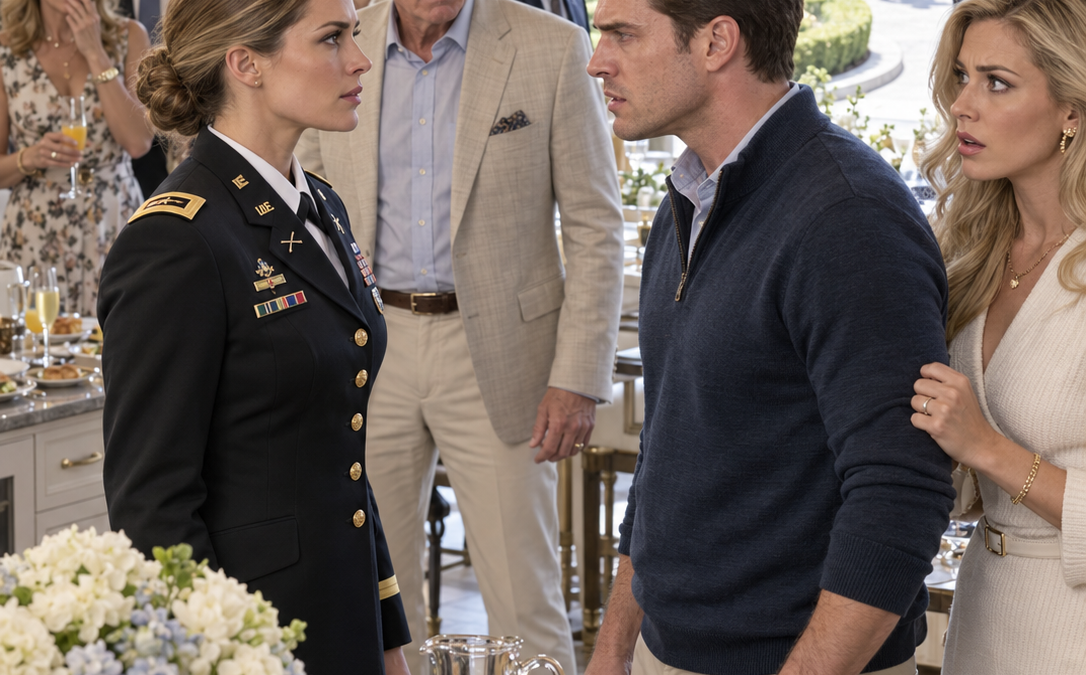
A couple of guests laughed into their wine glasses.
Julian smiled without showing teeth. “Still got jokes.”
His wife walked over carrying a charcuterie board like she was presenting evidence at trial. Blonde extensions. Diamond bracelet. Permanent expression of someone offended by retail workers.
“Oh my God,” she said, staring at my uniform. “You actually wore that.”
I looked down at myself. “Usually how uniforms work.”
She blinked once, deciding whether I was stupid or insulting her. It was always fun watching her process basic human interaction.
Dinner started ten minutes later. My father sat at the head of the table like a king who’d conquered suburban banking. He loved an audience more than oxygen. Every story got louder after the second refill.
Julian was the main attraction tonight.
Richard kept bragging about his company between bites of rosemary chicken.
“Disruptive technology,” he told the Coltons. “That’s where the money is now.”
Julian nodded seriously like he was discussing national security instead of an app that helped rich people rent private golf simulators by the hour.
“Investors are circling,” he said.
I nearly choked on my water.
The last thing I’d heard about his company involved unpaid contractors and a landlord threatening legal action over $38,000 in missed lease payments. But confidence was basically the Hayes family religion. Reality was optional.
I stayed quiet through most of dinner. Years in military intelligence teach you something useful about silence. People reveal themselves when they think you aren’t competing for air.
At 7:58 p.m., my father leaned back in his chair and lifted his wine glass.
“I’ll say one thing,” he announced. “Julian understands presentation.”
Here we go.
Richard’s eyes drifted toward me.
“Success has a look to it.”
The table went quiet enough for silverware to stop moving. His wine glass tilted toward my chest, and then he scoffed.
“Then there’s whatever the hell that thing is.”
I glanced down at the titanium necklace resting against my uniform collar.
Chloe laughed immediately.
“Oh my God, thank you,” she said. “I thought I was the only one.”
Richard shook his head dramatically.
“You walk into a beautiful dinner wearing military ribbons and a damn dog collar.” He looked around the table for support. “I mean, honestly, Eleanor, couldn’t you wear normal jewelry for one night?”
A few uncomfortable smiles appeared around the room.
I took a sip of water. “It’s important,” I said calmly.
Richard stared at it. “A welder?”
More laughter.
Julian smirked into his wine.
My father pointed again. “You know what it looks like? Cheap tin from a truck stop. Ruins the whole aesthetic.”
There it was.
That familiar little sting people pretend doesn’t exist after childhood. Not pain exactly. More like hearing an old song you stopped liking years ago.
I set my fork down carefully.
“I didn’t realize my neck was affecting the property value.”
One of the neighbors snorted into his drink.
Richard rolled his eyes. “Everything with you becomes a joke.”
“No,” I said. “Usually just family dinners.”
Julian looked down to hide a smile. Chloe didn’t bother hiding hers. She reached for her wine glass while still watching me.
And then suddenly—
“Oh my God!”
Cabernet splashed directly across my uniform collar in a dark red wave. A full glass.
The room gasped.
Chloe grabbed napkins dramatically.
“I am so, so sorry. That totally slipped.”
It didn’t.
I’d spent enough years around liars to recognize rehearsal.
Red wine dripped slowly down the front seam of my jacket. My father sighed like I was somehow responsible for gravity.
“For God’s sake,” he muttered.
I stood up slowly.
Nobody moved. Nobody apologized except the woman who caused it, and even she was smiling around the edges. I unbuttoned the top of my jacket calmly.
“Excuse me,” I said.
The powder room sat halfway down the hall beside the staircase. Marble counters, gold fixtures, towels nobody was allowed to actually use.
I locked the door halfway behind me and looked at my reflection.
The wine stain spread across my collar like fresh paint.
I reached up and unclasped the titanium necklace carefully. The heavy chain settled into my palm with a solid metallic weight. Then I placed it on the edge of the marble sink beside the faucet, just for a minute.
Water rushed from the tap as I grabbed a hand towel and started blotting the stain.
From the hallway outside, I could still hear my father talking, still hear laughing, still hear Julian charming investors who didn’t know his company was bleeding money behind the scenes.
I left the powder room door cracked open while I cleaned the uniform.
That was their fatal mistake, not mine.
Have you ever sat quietly at a table while your own family treated you like the least valuable person in the room just because you didn’t fit their version of success?
Tell me in the comments. And if you’ve ever learned that real power usually looks boring until the moment it matters, subscribe to the channel.
The sound of running water faded behind me as I pulled the powder room door open, my sleeve still damp from scrubbing wine out of government-issued fabric.
And the first thing I noticed was silence.
Not house silence.
The wrong kind.
The marble sink edge was empty.
For half a second, my brain tried to reject what my eyes already understood. The spot beside the faucet where I’d placed the titanium necklace sat completely bare except for two tiny drops of water sliding toward the drain.
I looked at the floor first, then behind the soap tray, then automatically checked my own hands like maybe exhaustion had turned me stupid.
Nothing.
The necklace was gone.
I stepped into the hallway slowly.
Voices drifted from the dining room again. Glasses clinked. Somebody laughed at one of Richard’s stories. The entire house still smelled like garlic butter and expensive wine, but now there was something else underneath it.
Panic.
Not emotional panic.
Procedural panic.
Years of military conditioning kicked in immediately. My heartbeat didn’t speed up. My breathing didn’t change. Everything simply became very clear.
Who had access?
Who had motive?
Who moved fastest when money entered the room?
I walked back toward the dining room.
Julian was already standing beside the front entryway, pulling on his charcoal wool coat. Fast movements. Forced casualness. His car keys dangled from one finger while Chloe hovered beside him, pretending not to stare at me.
“There she is,” Julian said quickly. “Hey, I gotta run downtown for a last-minute investor thing.”
I stopped about six feet away from him.
“At 8:30 on a Saturday night?”
He shrugged. “Tech world never sleeps.”
“Neither do casinos,” I said.
One of the neighbors coughed into his napkin, trying not to laugh.
Julian smirked thinly. “Still doing the bitter military sister routine, huh?”
I ignored him and looked directly at my father.
“My necklace is gone.”
Richard didn’t even look up from cutting his steak.
“What?”
“The titanium chain I was wearing.” My voice stayed level. “I left it in the powder room while cleaning the wine off my uniform. It’s gone now.”
That finally got his attention.
Not concern.
Annoyance.
Richard leaned back in his chair with the exhausted expression of a man burdened by everybody else’s incompetence.
“Oh, Jesus Christ.”
Chloe folded her arms immediately. “You’re not implying somebody here stole it, are you?”
I looked at her.
“You tell me.”
Her mouth tightened.
Julian slid one arm into his coat sleeve. “Maybe it fell somewhere.”
“It didn’t.”
“Well, then maybe one of the catering staff grabbed it.”
“We didn’t hire catering staff,” I said.
Another little silence hit the table.
The neighbors suddenly became very interested in their mashed potatoes.
Richard sighed loudly enough for the whole room to hear.
“Eleanor, this is exactly what I’m talking about with you.”
I blinked once. “What does that mean?”
“You turn every situation into some kind of operation.” He tossed his napkin onto the table. “It’s a piece of metal.”
“It’s important.”
“There you go again.” He pointed his fork at me. “Everything with you has to sound classified.”
Julian grabbed his car keys off the counter.
“I really need to go.”
I watched him carefully.
His left hand kept flexing against his coat pocket. Tiny movement. Most people would miss it.
Military interrogators wouldn’t.
“You seem nervous,” I said.
He laughed too quickly. “You seem paranoid.”
Chloe jumped in immediately. “Oh my God, Eleanor. Not everybody is plotting against you just because you work for the government.”
I looked down at the faint wine stain still visible near my collar.
“No,” I said calmly. “Usually people plotting against me are smarter than this.”
Julian’s jaw tightened for maybe half a second.
Then it disappeared.
That was the thing about my brother. He’d spent thirty-four years surviving on charm and momentum. Even when he was lying, he still believed he could outrun consequences if he smiled hard enough.
Richard stood up from the table, finally looking irritated instead of drunk.
“Can we not ruin one dinner?” he snapped. “For once?”
“My property disappeared from your house.”
“Your cheap little Army necklace disappeared,” he corrected. “Let’s not act like Fort Knox got breached.”
A couple of guests shifted uncomfortably.
Nobody defended me.
That part didn’t hurt anymore. I’d learned years ago that wealthy people confuse politeness with morality.
Richard crossed his arms.
“If you lost your little Army toy, buy another one.”
There it was.
The line that settled everything.
Not because of the insult. Because of how casually he said it. Like my work was a hobby. Like service was embarrassing. Like the only meaningful thing in the room was Julian’s fake success and Chloe’s diamond bracelet financed through debt.
Julian checked his watch dramatically.
“I seriously have to move.”
I stepped slightly to the side, blocking the front door without making it obvious.
“What investor meeting?” I asked.
He smiled. “Confidential.”
“That’s new for you.”
Richard threw his hands into the air.
“For God’s sake, Eleanor, stop interrogating your brother.”
“I asked a question, and he answered it.”
“No,” I said. “He performed an answer.”
Julian laughed again, but this time it sounded thinner.
“Listen, Captain Conspiracy, some of us actually make money on weekends.”
I stared at him for another second.
Then I moved away from the door.
“Drive safe.”
His eyes narrowed just slightly, like he was trying to figure out why I suddenly stopped pushing.
That’s the funny thing about guilty people.
Silence scares them more than accusations.
Julian opened the front door fast enough to let cold night air sweep through the foyer. Chloe hurried after him, talking about valet parking downtown, even though there was no valet downtown anymore because the restaurant had closed eight months ago.
Another lie.
Tiny. Sloppy. Automatic.
The front door shut.
Three seconds later, headlights flashed across the front windows.
Then came the sound of his Porsche engine tearing down the driveway like he was late escaping a crime scene.
Nobody spoke.
Richard picked up his wine glass again with a disgusted shake of his head.
“You always do this,” he muttered.
“Do what?”
“Bring tension into a room.”
I looked through the dining room windows toward the empty driveway where Julian’s taillights had already disappeared beyond the gate.
And something inside me went completely cold.
Not angry.
Not emotional.
Certain.
Because my brother hadn’t stolen jewelry.
He’d stolen something he didn’t understand.
And if I was right about what he’d just taken out of this house, the worst night of Julian Hayes’s life had already started.
The sound of Julian’s Porsche faded into the distance while I grabbed my keys from the entry table without saying another word to anybody inside the house.
Nobody stopped me.
My father had already gone back to pouring wine for the neighbors, like the entire conversation had been a minor inconvenience between appetizers and dessert.
That told me everything I needed to know.
Cold air hit my face the second I stepped outside.
Davidson Ridge looked quiet and expensive under the streetlights. Perfect lawns, perfect stone walkways, perfect fake lives packed into oversized homes with six bathrooms and marriages hanging together by golf memberships.
I walked down the driveway toward my car.
Not a luxury SUV. Not a German sports car. Just a dark gray 2017 Honda Accord with 42,000 miles and one dent near the rear bumper from a drunk guy in Norfolk who tried backing out of a seafood restaurant too fast in 2021.
Julian used to mock that car constantly.
“Captain, you know they pay officers actual money, right?”
I never bothered explaining the difference between wealth and financial stupidity.
I unlocked the sedan and slid into the driver’s seat. Then I closed the door and let the silence settle.
No tears.
No shaking hands.
No emotional collapse.
People think military training turns you cold. That’s not really true. It just teaches you that panic wastes time you might not get back.
I reached across the passenger seat and pulled my laptop case closer.
The device inside looked boring on purpose. Matte black shell, no logo, no visible manufacturer markings. The kind of laptop accountants used at airports.
That was intentional.
The dangerous systems never looked dangerous.
I opened it carefully.
The screen lit immediately.
Outside my windshield, I could still see my father’s dining room windows glowing warm yellow through the trees. Tiny silhouettes moved around, laughing over retirement cake, while federal crimes quietly developed less than fifty yards away.
I typed my first password, then inserted a biometric authentication card from my wallet.
Second password.
The operating system loaded into a restricted defense interface most civilians would mistake for a software update screen.
What nobody inside that house understood was that the necklace wasn’t jewelry.
The titanium chain itself was worthless.
Cheap metal, technically speaking.
Richard accidentally got one thing right tonight.
The real value sat hidden inside the clasp housing: a Level Five encrypted PHTO access key embedded within a military-grade RFID capsule tied to secure logistics authorization systems.
Portable. Hardened. Impossible to duplicate without destroying the internal encryption lattice.
At least, impossible for smart criminals.
Julian wasn’t smart.
He was desperate.
There’s a difference.
I clicked into the recovery interface.
The system prompted an asset sync request.
I entered the sixteen-character override passcode from memory.
T7X44 AQ19 VK2P.
For one second, nothing happened.
Then a city map illuminated across the display.
Charlotte spread across the screen in glowing grids and traffic lines. Blue markers, security overlays, encrypted coordinate tags.
And right there, near the southern warehouse district, a pulsing red dot.
Active.
Tracked.
Moving.
I stared at it quietly.
Julian wasn’t downtown.
And Julian wasn’t meeting investors.
Julian was parked outside a warehouse on Remington Street near the old freight rail district.
My stomach tightened slightly.
Not from fear.
Recognition.
Because I knew exactly what operated out of that neighborhood.
Six months earlier, Army Cyber Command circulated an intelligence memo involving underground hardware brokers moving stolen processors and restricted encryption components through shell companies in the Carolinas.
Most people pictured black-market dealers like movie hackers surrounded by neon lights and hoodies.
Real ones looked boring.
Loading docks. Storage units. Paperwork. Men with LLCs and expensive watches pretending they sold salvaged electronics.
I zoomed in closer.
The red dot stayed fixed outside Warehouse 18B.
And suddenly everything clicked together so cleanly it almost annoyed me.
Julian must have felt the abnormal weight inside the necklace. He probably opened the clasp out of curiosity the second he got in the car. Then he found the embedded chip.
And because Julian measured human value entirely through money, his brain skipped directly to resale.
Not sentiment.
Not danger.
Profit.
I leaned back slowly in my seat.
The worst part wasn’t that he stole from me.
Honestly, I could have survived that.
The worst part was realizing my own brother saw unidentified military hardware and thought, I can monetize this.
That takes a special kind of arrogance or financial desperation.
Probably both.
I opened another secured folder and pulled up financial exposure reports connected to Julian’s startup.
Most people assumed military intelligence worked like spy movies.
It mostly worked like depressing accounting.
And there it was.
Late vendor payments. Emergency bridge loans. Three maxed-out corporate credit lines. Payroll delays hidden through shell transfers. One civil suit filed nine days ago by a software contractor demanding $27,000.
Julian’s company wasn’t struggling.
It was dying.
Which meant tonight wasn’t random.
He didn’t steal the necklace because Chloe wanted drama.
He stole it because he needed money fast enough to outrun collapse.
Outside, wind rattled lightly through the trees.
Inside the laptop screen, the red dot moved again.
Warehouse entrance.
Then stationary.
Meeting somebody.
I zoomed farther.
A black SUV had arrived beside him twelve seconds earlier based on traffic capture timestamps.
No plates visible.
Professional.
My jaw tightened slightly.
Because this stopped being family stupidity the second outside buyers entered the equation.
This wasn’t petty theft anymore.
This wasn’t a rich idiot stealing from his sister during dinner.
Julian Hayes was currently attempting to broker classified military hardware through an underground tech channel to save his bankrupt company.
Which meant my brother had just crossed a line most civilians never even see.
Federal theft.
National security breach.
Potential espionage exposure.
Treason, if prosecutors felt aggressive.
I looked back toward my father’s glowing dining room windows one last time.
They were probably eating cheesecake by now.
Richard was probably still telling neighbors how proud he was of his son’s business instincts.
I almost laughed.
Then the red dot blinked again on the map.
Steady.
Waiting.
And deep down, beneath all the training and discipline and protocol, I felt something colder than anger settle permanently into place.
Julian thought he stole a necklace.
What he actually stole was the part of my world where consequences arrive quietly first, then all at once.
The pulsing red dot on my laptop screen reflected faintly across the windshield until it started looking almost identical to the blinking red recording light beside the secure satellite phone mounted inside my center console.
I stared at it for a few seconds.
Then I picked up the handset.
Most civilians think local police handle every theft automatically.
That’s because most civilians never deal with classified federal infrastructure.
The second Julian opened that necklace and attempted to move its contents through an unauthorized channel, this situation left the jurisdiction of normal people entirely.
I entered my authentication sequence manually.
Agency code.
Officer identification.
Rotating encryption phrase.
The line clicked twice before routing through secure relay systems somewhere outside Virginia.
By the time the connection stabilized, it was 3:02 a.m. Eastern.
I knew exactly who would answer.
General Marcus Thorne slept less than any human being I’d ever met. The man treated exhaustion like a personality flaw.
The phone rang once.
“Thorne.”
No greeting.
No confusion.
Just that deep, controlled voice that always sounded like somebody had already been held accountable before the conversation even started.
I straightened automatically in my seat.
“Sir, Captain Eleanor Hayes.”
A short pause.
Then, quieter: “Why are you calling this line at three in the morning, Captain?”
I looked back at the glowing warehouse marker on my screen.
And right there, somewhere beneath all the years of family history and childhood memories and holiday dinners, something shut off cleanly inside me.
Not emotionally.
Operationally.
Because if I used words like brother or family now, hesitation could enter the process.
And hesitation gets people killed.
“My apologies for the hour, sir,” I said evenly. “I have a Code Red compromised asset.”
Silence.
Not empty silence.
Pressure.
“The target is an unauthorized civilian attempting to broker classified hardware through a third-party tech intermediary.”
Another pause.
The kind that physically changes the air around you.
General Thorne didn’t gasp. Didn’t curse. Didn’t ask if I was certain.
Men at that level stop reacting emotionally to disasters because emotional people don’t survive long enough to reach that level.
“What asset?”
“Level Five encrypted PHTO authorization key embedded in titanium transport casing.”
His breathing changed slightly.
That was it.
That tiny shift told me exactly how serious this had just become.
“Compromise level?” he asked.
“Unknown. Civilian target appears aware internal hardware has value, but likely lacks decryption capability.”
“Location.”
I transmitted the coordinates directly from my laptop.
“Warehouse 18B, Remington Freight District, Charlotte.”
General Thorne went silent again.
Longer this time.
In the background, I could hear faint movement on his end. A chair sliding. He was probably already walking toward an operations room while we spoke.
Finally, he said one sentence.
“Who is the civilian?”
I watched the red dot remain motionless beside the warehouse entrance.
Then I answered exactly the way protocol required.
“Male, thirty-four, no military clearance. Civilian technology entrepreneur with significant financial distress indicators.”
I didn’t say brother.
Not once.
Because the moment this entered official systems, personal relationships stopped mattering.
The general understood that too.
“You believe transfer is imminent?” he asked.
“Yes, sir. Probability high.”
A quiet exhale crossed the line.
Then came the part that made my stomach tighten for the first time all night.
“Has the target interacted with foreign nationals before?”
I pulled up the incoming vehicle registration trace from the warehouse cameras.
Shell company.
Delaware registration.
Fake transport documentation.
Classic laundering structure.
“Yes, sir,” I said. “Indirectly through tech brokerage channels. No confirmed intelligence affiliations yet.”
Yet.
That word sat heavy between us.
Because if Julian transferred restricted hardware to the wrong buyer tonight, federal prosecutors would stop caring whether he understood what he was doing.
Intent matters less once national security enters the conversation.
Outside my windshield, the neighborhood remained perfectly peaceful.
Sprinklers clicked softly across somebody’s lawn down the street. A dog barked once in the distance.
Inside my car, an entire machine was quietly waking up.
General Thorne spoke again.
“Any civilian law enforcement involved?”
“No, sir.”
“Good.”
Short sentence.
Huge meaning.
Local police would only complicate containment. This had already escalated far beyond stolen property.
I rubbed my thumb once against the edge of the phone receiver, and for maybe half a second, something human slipped through the cracks.
Because I suddenly remembered Julian teaching me how to drive when I was sixteen.
I remembered him sneaking me concert tickets after Dad grounded me senior year.
I remembered him carrying me inside after I fell asleep in the back seat during a thunderstorm once.
Memory is ugly like that.
It shows up right when you need clarity most.
Then General Thorne’s voice cut through it cleanly.
“Captain.”
“Yes, sir.”
“Are you emotionally compromised?”
Direct.
No softness.
That’s why I respected him.
I answered honestly.
“No, sir.”
Another silence.
Evaluating.
Measuring.
Then, finally, understood.
A keyboard clattered somewhere on his end.
Doors opened.
Voices moved in the background.
Now the machine was officially awake.
“Stand down, Captain,” General Thorne said.
His tone changed completely.
Cold.
Absolute.
The voice of federal authority after decisions are already made.
“The military police and federal agents will take it from here.”
I stared at the blinking warehouse marker while he continued.
“Do not approach the target. Do not attempt recovery independently. Maintain distance and await contact.”
“Yes, sir.”
“Your chain of command will be notified within the hour.”
“Yes, sir.”
Then came the final sentence.
The one that made this real.
“If the hardware has already exchanged hands,” Thorne said quietly, “this becomes a counterintelligence operation.”
Not family anymore.
Not theft anymore.
Counterintelligence.
I closed my eyes briefly.
Julian had spent his whole life believing consequences were negotiable if you smiled confidently enough.
Tonight, he accidentally wandered into the one system in America that does not negotiate.
“Understood, sir,” I said.
The general paused one final time, then softer, almost human again.
“You did the correct thing, Captain.”
The line disconnected just like that.
No dramatic ending.
No speech.
Because real power never wastes words.
I lowered the secure handset slowly back into its dock.
Then I closed the laptop.
Outside, the world still looked normal.
Inside invisible federal systems, however, warrants were already moving. Notifications were already spreading. Vehicles were probably already being dispatched.
And somewhere across Charlotte, my brother still believed he was about to save his company with stolen military hardware.
He had no idea the United States government was already on its way to meet him.
I slept for exactly ninety-two minutes.
Not because I was nervous, but because once federal systems activate around a compromised asset, your phone starts vibrating every twenty minutes with encrypted updates nobody else in the world is allowed to see.
At 5:14 a.m., I received confirmation that surveillance teams had visual contact on Warehouse 18B.
At 5:47, another message confirmed an attempted transaction involving encrypted hardware components.
At 6:03, warrants were approved through emergency channels.
By 7:01, somebody from counterintelligence flagged possible foreign buyer involvement.
That one sat with me for a while.
Because there’s a difference between your brother being greedy and your brother accidentally stumbling into international espionage.
Only one of those still leaves room for sympathy.
By 9:26 Sunday morning, I was sitting at my father’s kitchen table drinking black coffee while classical piano music drifted softly through hidden speakers like the house itself was trying to pretend nothing ugly existed inside it.
The kitchen looked ridiculous.
Fresh fruit trays. Imported pastries. An omelet station hired from a local catering company because apparently retirement brunch now required a live chef making custom eggs beside a six-burner Viking stove.
Richard stood near the windows wearing cream-colored slacks and the satisfied expression of a man who thought wealth automatically made him wise.
Neighbors floated around holding mimosas.
Chloe wore white linen and oversized sunglasses indoors for absolutely no reason except being Chloe.
And Julian—
Julian leaned against the marble kitchen island, sipping espresso like a man who believed he’d beaten the universe itself.
I watched him quietly over the rim of my coffee mug.
Most people looked at my brother and saw confidence.
I saw damage control.
His smile arrived half a second too late every time somebody spoke to him.
His left hand kept tightening around the espresso cup between sentences.
Tiny tremor near the thumb.
Adrenaline.
Sleep deprivation.
Fear trying to hide inside arrogance.
The federal surveillance teams were probably still watching him right now from somewhere outside the neighborhood.
He had no idea.
That was the strange part.
Even after stealing classified hardware and trying to sell it through criminal brokers, Julian still believed he was the smartest man in every room.
My father clapped him on the shoulder proudly.
“Tell them the good news.”
Julian smirked modestly like he hated attention, even though attention was basically oxygen to him.
“Well,” he said casually, “looks like the company’s alive after all.”
A few guests turned immediately.
Richard grinned.
“My son secured new funding overnight.”
“Dad, no—”
“Let me brag.”
Richard lifted his mimosa dramatically.
“This is what real business instincts look like.”
There it was again.
That little sideways glance toward me.
The one he’d perfected over thirty years.
Look at your brother.
Look what success looks like.
Look what happens when people matter.
Julian took another sip of espresso.
“Anonymous backer,” he said. “Massive influx of capital.”
“How massive?” one of the neighbors asked.
Julian shrugged carefully. “Enough to solve every problem we had.”
That almost made me laugh out loud.
Every problem.
Meanwhile, three federal agencies were currently building a case file around him thick enough to stop a door.
Chloe slid beside him proudly.
“I told him investors would come around eventually,” she announced. “People recognize vision.”
Vision.
Interesting word for attempted federal trafficking.
Richard pointed his champagne flute toward me without fully looking over.
“You could learn something from your brother, Eleanor.”
I took another slow sip of coffee.
“Oh?”
“He knows how to build something valuable.”
The kitchen got quieter.
Not fully silent.
Just enough.
Everybody sensed the tension now.
Wealthy people pretend to hate drama while quietly organizing their entire social lives around proximity to it.
I set my mug down gently.
“What exactly did the investor buy into?” I asked.
Julian answered too quickly.
“Software expansion.”
“What kind?”
“Enterprise integration.”
“That doesn’t mean anything.”
He smiled thinly. “It means you wouldn’t understand it.”
Three long beats.
Then the short one.
“I understand debt.”
A couple of people coughed into their drinks again.
Richard rolled his eyes immediately.
“Why are you always like this?”
“Like what?”
“Combative.”
I glanced toward Julian.
His fingers were shaking harder now.
Not enough for civilians to notice.
Enough for me.
Years around intelligence officers teach you something useful.
People under pressure always leak information through their hands first.
Especially liars.
I leaned back slightly in my chair.
“Did the capital clear the bank yet, Julian?”
The question landed differently than the others.
His expression shifted before he caught it.
Tiny pause.
Tiny calculation.
Then the smirk returned.
“Wire transfers take time.”
“How much time?”
“Twenty-four hours, usually.”
There it was.
Confirmation.
No completed transfer.
No secured protection.
No finalized deal.
Which meant federal agents likely allowed the transaction attempt to continue overnight purely to identify everybody involved before moving in.
Standard procedure.
Julian still thought he was negotiating a future.
He was actually sitting inside evidence collection.
He lifted the espresso cup again, trying to recover momentum.
“You know how real business works, right? Deals don’t happen instantly.”
I watched the slight tremor in the porcelain cup.
Then I looked directly into his eyes for the first time all morning.
And suddenly I realized something almost sad.
He genuinely thought he still had options.
That’s what arrogance does to people.
It convinces them consequences are still part of some negotiation process long after the negotiation already ended.
I set my coffee mug onto the marble countertop.
Clink.
Solid.
Sharp enough to cut through the room.
Julian looked at me automatically.
“So the money isn’t in your account yet,” I said softly.
His jaw tightened.
“It’ll clear tomorrow.”
I nodded once.
Then I gave him the first honest thing I’d said to him since childhood.
“That’s unfortunate.”
The room held still.
Richard frowned.
“What’s that supposed to mean?”
I never looked away from Julian.
“Because you don’t have twenty-four hours.”
And right then, somewhere outside beyond the front windows, heavy tires rolled slowly across gravel.
The sound swallowed the kitchen whole before anybody had time to respond to what I’d just said.
Julian turned toward the front windows first.
Then froze.
Three black SUVs moved through the circular driveway in perfect formation like they’d rehearsed it a hundred times before.
No government markings.
No flashing lights.
Just dark glass, heavy frames, and the kind of controlled movement that instantly changes the oxygen level in a room.
One SUV blocked the entrance gate.
Another sealed the lower driveway exit.
The third stopped directly in front of the house.
Nobody spoke.
The brunch guests stared through the windows, holding champagne glasses halfway to their mouths like mannequins waiting for instructions.
Richard frowned hard.
“What the hell is this?”
Outside, doors opened almost simultaneously.
Military police stepped out first.
Body armor.
Tactical rifles.
Communication headsets.
No wasted movement anywhere.
Then federal agents followed behind them in dark jackets, carrying hard cases and sealed evidence bags.
Silent.
Fast.
Terrifyingly calm.
That silence always unsettled civilians the most.
Movies teach people that dangerous operations involve screaming and chaos.
Real professionals barely speak at all.
Chloe grabbed Julian’s arm immediately.
“Oh my God.”
Julian’s face lost color so quickly it almost looked physical.
His espresso cup slipped slightly in his hand.
Coffee splashed onto the marble floor.
Richard straightened up instantly, switching into his favorite mode.
Wealthy suburban authority figure.
“This is ridiculous,” he snapped.
He stormed toward the foyer while guests awkwardly shuffled out of his way.
I stayed exactly where I was.
Coffee mug still beside my hand.
Pulse steady.
Because once federal recovery teams arrive, there’s no point pretending events can still be controlled socially.
Richard yanked the front door open aggressively.
“Excuse me!” he barked across the lawn. “This is private property.”
Nobody answered him.
The agents kept moving.
Two secured the perimeter near the driveway gate.
Another walked calmly toward the side yard.
One military police officer spoke quietly into his shoulder mic while scanning windows.
Richard puffed out his chest harder.
“I asked you people a question.”
Still nothing.
Watching wealthy men realize their status means absolutely nothing to federal operators is always fascinating.
It breaks something deep inside them.
Richard stepped farther onto the porch.
“I know judges in this county,” he announced loudly. “You cannot storm onto my property without identification.”
One of the agents finally glanced at him.
Not intimidated.
Not angry.
Just mildly inconvenienced.
“Please step aside, sir.”
That somehow made Richard even more offended.
“Do you have any idea whose house this is?”
Honestly, that almost made me smile.
Because federal recovery teams absolutely did know whose house it was.
That was the entire reason they were here.
Behind me, one of the brunch guests whispered, “Richard, maybe call a lawyer.”
Another quietly picked up her purse.
People always start preparing exits once reality enters the room.
Julian still hadn’t moved.
That caught my attention.
Most guilty people start talking too much once pressure hits. They deny everything before accusations even happen.
Julian didn’t.
He just stared through the windows at the vehicles like his brain still couldn’t process the scale of what he’d touched.
Then the final SUV door opened.
And suddenly the atmosphere changed completely.
Even the agents shifted.
Straighter posture.
Sharper attention.
General Marcus Thorne stepped onto the driveway wearing full service uniform beneath a dark overcoat.
No dramatic rush.
No visible emotion.
Just controlled movement from a man completely accustomed to walking into disasters other people created.
Fifty-eight years old.
Silver hair cut perfectly short.
Calm eyes that somehow made everyone around him feel guilty automatically.
I’d seen senators fold under less pressure than that man generated by simply entering a room.
Richard marched directly toward him.
Finally, someone important enough for him to recognize.
“Sir,” Richard said sharply, “I demand an explanation for this harassment immediately.”
General Thorne didn’t slow down.
Didn’t acknowledge the question.
Didn’t even look at him.
He walked straight past my father like Richard Hayes physically did not exist.
And I swear that hurt Richard more than any insult ever could.
“Excuse me!” Richard snapped louder. “I’m talking to you.”
Still nothing.
The general climbed the front steps calmly while agents continued securing the perimeter around the property.
Chloe whispered frantically beside Julian.
“What’s happening?”
Julian didn’t answer.
His breathing had changed now.
Shorter.
Uneven.
Fear finally breaking through.
The general entered the foyer.
For one second, the entire house went dead quiet except for the soft hiss of the espresso machine still running near the stove.
Then Marcus Thorne looked directly at me.
Not my father.
Not Julian.
Me.
And he gave one sharp professional nod.
“Asset secured, Captain.”
The words hit the room like a car accident.
Every face changed at once.
Richard blinked hard.
Captain.
One of the brunch guests slowly lowered her champagne glass.
Chloe looked back and forth between me and the general like her brain couldn’t organize the information fast enough.
But Julian—
Julian understood immediately.
That was the moment he finally realized this was never about family drama.
Never about jewelry.
Never about social embarrassment.
His knees actually shifted slightly, like his body forgot how to balance.
General Thorne removed a pair of black leather gloves carefully.
Then he looked toward Julian with the cold professionalism of a man examining hazardous waste.
“Julian Hayes,” he said evenly.
Nobody had raised their voice once.
That somehow made everything worse.
Richard stepped forward immediately.
“Now hold on just one damn minute.”
Two federal agents moved instantly between them.
Not aggressive.
Efficient.
“Sir,” one agent said calmly. “You need to remain where you are.”
Richard stared in disbelief.
“You cannot be serious.”
“Oh, we’re very serious,” the agent replied.
That line landed hard enough to silence the entire kitchen.
Julian finally found his voice.
“This is insane,” he said weakly. “I didn’t do anything.”
General Thorne looked at him for a long moment.
Then toward me again.
And right there, standing in my father’s luxury kitchen, surrounded by terrified millionaires and half-eaten pastries, I watched the exact second my family understood they had completely misunderstood my life.
Because all those years they thought I was the embarrassing daughter with the ugly military necklace.
They never realized I belonged to a world powerful enough to arrive without warning and shut their entire reality down before brunch was finished.
The entire kitchen stayed frozen for about three full seconds after General Thorne said my rank out loud.
Then Julian broke first.
“No,” he said suddenly.
Not loud.
Not dramatic.
Just one small word from a man whose brain finally caught up to reality.
He backed away from the kitchen island so fast his espresso cup tipped over completely.
Dark coffee spread across the marble counter and dripped onto the floor beside untouched pastries.
Nobody would ever finish eating now.
Richard looked between us wildly.
“Eleanor,” he snapped. “What the hell is this?”
I didn’t answer him.
Because the operation had already moved past explanations.
Julian’s breathing turned ragged.
Fast inhales.
Too shallow.
His eyes darted toward the foyer, toward the windows, toward the back hallway leading to the patio doors.
Looking for exits.
That’s the thing about rich people who spend their entire lives escaping consequences.
The moment real consequences finally arrive, they think movement alone can save them.
Julian took another step backward.
“This is insane,” he said again. “There’s been some misunderstanding.”
General Thorne remained perfectly still.
“No,” he replied calmly. “There hasn’t.”
Julian’s chest started rising harder now.
Chloe grabbed his arm.
“Baby, just tell them whatever they need to hear.”
He yanked away from her immediately.
“Don’t touch me.”
That shocked her more than the federal agent standing ten feet away.
Julian never stopped performing confidence around people.
Even during arguments.
But fear strips personality down fast.
One of the brunch guests quietly whispered, “Oh my God.”
Another already had her phone halfway out before a federal agent spoke without even turning around.
“Phones stay off.”
The woman nearly dropped it.
Richard marched directly toward me now, face flushed red with anger and embarrassment.
“You brought this into my house?”
I looked at him calmly.
“No,” I said. “Julian did.”
That hit harder than yelling would have.
Richard pointed aggressively toward General Thorne.
“You need to tell your boss this situation is out of control.”
My boss.
The phrase almost sounded funny standing there beside a four-star general coordinating a federal containment operation.
“Richard,” General Thorne said evenly.
My father immediately turned.
Finally.
Recognition.
Authority.
Someone he thought he could negotiate with.
“Yes,” Richard snapped. “Thank God. Now explain why armed men are terrorizing my family over some stupid necklace.”
General Thorne looked at him with the same expression surgeons probably use before informing people the damage is irreversible.
Then Julian moved fast.
He suddenly bolted toward the back hallway leading to the patio doors.
Chloe screamed instantly.
“Julian!”
He barely made it three steps.
Two federal agents intercepted him so quickly it looked mechanical.
One grabbed his arm while the other drove him face-first against the wall beside the wine cabinet hard enough to rattle crystal glasses inside.
“Federal agents!” one barked sharply. “Stop resisting!”
“I didn’t do anything!” Julian shouted.
But panic ruined the performance now.
His voice cracked halfway through the sentence.
One agent twisted his arms behind his back while the other secured heavy steel handcuffs around his wrists with a solid metallic snap.
That sound changed the room permanently.
Not metaphorically.
Actually.
Because handcuffs sound different in real life than they do in movies.
Heavier.
Colder.
More final.
Chloe started screaming hysterically.
“Oh my God! You’re hurting him!”
Richard lunged forward immediately.
“Get your hands off my son!”
Three agents shifted positions instantly between them.
Not violent.
Not emotional.
Just immovable.
Julian struggled once more before realizing resistance was pointless.
His breathing collapsed into ugly, desperate gasps.
Hyperventilating now.
Sweat covered the side of his face.
His expensive sweater had twisted halfway off one shoulder during the takedown.
The golden-boy image finally cracked open enough for everybody to see what sat underneath it.
Fear.
Raw and pathetic.
Richard looked back at me in complete disbelief.
“Eleanor, say something.”
I stayed still.
“You know this is ridiculous. For God’s sake, tell your boss to release him.”
That word again.
Boss.
Like this was still some office misunderstanding solvable through connections and favors.
Richard pointed wildly toward Julian.
“He took a damn necklace.”
And finally—finally—I stepped forward.
The kitchen went dead silent again.
Even Chloe stopped screaming long enough to listen.
I looked directly at my father, and I spoke in the calmest voice I’d used all weekend.
“It wasn’t a necklace, Richard.”
Nobody moved.
The federal agents held Julian upright while his breathing turned rough and uneven behind them.
I continued.
“It was a Level Five encrypted Department of Defense access key.”
The words landed slowly because half the people in that room didn’t even understand what they meant yet.
Richard blinked hard.
“What?”
“Julian didn’t steal jewelry from his sister.”
I looked toward my brother now.
“He attempted to sell classified government assets to a foreign broker.”
One woman near the dining room actually gasped out loud.
Richard stared at me like I’d started speaking another language.
“That’s impossible.”
“No,” General Thorne said quietly. “Unfortunately, it isn’t.”
Julian suddenly shook his head violently.
“I didn’t know what it was.”
One of the agents tightened his grip slightly.
“That’s not going to help you as much as you think,” the agent muttered.
“I swear to God,” Julian said desperately, looking directly at me now. “I didn’t know.”
And there it was.
Not remorse for stealing from me.
Not guilt over betraying family.
Just terror over consequences.
I studied him for a long second.
Then realized something sad.
He truly believed ignorance erased damage.
That’s how privileged people think.
They assume intent matters more than impact because most of them never suffer the impact personally.
General Thorne stepped closer.
And for the first time all morning, actual disgust crossed his face.
“You’re not going to a local precinct, son,” he said coldly.
Julian stopped breathing for half a second.
“You’re going to federal detention.”
That broke him completely.
His knees buckled so suddenly the agents had to catch him before he slammed into the floor.
A horrible choking sound escaped his throat while the last scraps of arrogance drained out of him right there beside my father’s imported wine cabinet.
No confidence left.
No charm.
No polished entrepreneur act.
Just a terrified man in handcuffs realizing his entire life had collapsed between Saturday dinner and Sunday brunch.
And around him, every wealthy neighbor who once envied Richard Hayes’s perfect family stood there watching the ruins in absolute silence.
The metallic rattle of Julian’s handcuffs echoed through the kitchen as federal agents pulled him back onto his feet.
Or tried to.
His legs barely worked anymore.
The same man who spent years strutting through country clubs talking about disruptive innovation now looked like somebody who’d been hit by a truck in slow motion.
“Please,” he choked out. “Please, Eleanor.”
I didn’t answer.
Two agents guided him toward the foyer while he stumbled against furniture hard enough to knock one of Chloe’s decorative ceramic bowls onto the floor.
It shattered instantly.
Funny enough, that sound finally made Chloe completely lose control.
She collapsed beside the kitchen island, sobbing into both hands, mascara streaking down her face while one heel twisted sideways under her.
“This can’t be happening,” she cried. “Julian, say something.”
He tried.
Nothing useful came out.
Fear had stripped all the polish off him now.
No expensive vocabulary.
No startup confidence.
No practiced charisma.
Just panic.
Raw and ugly.
One federal agent paused long enough to read him formal charges while walking.
“Unlawful possession of restricted federal hardware. Attempted transfer of classified government property. Pending counterintelligence investigation.”
Every word hit the house like another crack spreading through glass.
The brunch guests stood motionless near the dining room entrance, pretending not to stare while absolutely staring.
Nobody touched their food anymore.
Mimosas sat abandoned on countertops.
The omelet chef had quietly disappeared twenty minutes ago without telling anyone.
Honestly, smart man.
Richard still hadn’t fully moved.
That surprised me most.
My father always had something to say.
Opinions were basically his favorite hobby.
But now he just stood there in the middle of his luxury kitchen looking like somebody had removed gravity from the room.
His reputation was collapsing in real time.
And he knew it.
Davidson Ridge ran entirely on gossip disguised as concern.
By tonight, every country-club wife within thirty miles would know federal agents stormed Richard Hayes’s retirement brunch and dragged his son away in handcuffs over national security charges.
You can recover from bankruptcy in those neighborhoods.
You cannot recover from humiliation.
Julian twisted once more while agents moved him toward the front door.
“Dad.”
Richard flinched hard at the sound.
“Dad, do something.”
But there wasn’t anything left to do.
That’s the terrifying part about systems larger than money.
Influence stops working eventually.
And my father had spent his whole life assuming influence was permanent.
One of the agents opened the front door.
Cold morning air swept inside immediately.
Outside, the black SUVs still waited across the driveway like patient predators.
Julian looked back toward me one final time.
Not angry anymore.
Desperate.
“I didn’t know,” he whispered again.
I believed him.
That was the tragedy.
He really didn’t understand what he stole.
But ignorance only matters before consequences start.
Not after.
The agents guided him down the front steps while neighbors across the street openly stared through their windows, pretending to water plants and adjust curtains.
Chloe started crying harder.
“Oh my God. Oh my God.”
Richard finally looked at me then.
Really looked at me.
Not like the embarrassing daughter.
Not like the difficult military kid ruining dinner aesthetics.
For the first time in my life, my father looked at me like he genuinely had no idea who I was.
And underneath that confusion sat something even worse.
Need.
His eyes begged before his mouth did.
“Eleanor,” he said quietly.
I stayed still.
“You can fix this.”
There it was.
The final insult hidden inside the request.
Because after thirty years of mocking my career, dismissing my service, and treating my life like a second-place failure compared to Julian’s fake success, my father suddenly wanted access to the power behind it.
Not respect.
Access.
“I know you can stop this,” he said quickly. “Talk to your general. Explain this whole thing was a misunderstanding.”
Behind him, one of the neighbors slowly backed toward the dining room like she wanted to escape without being noticed.
Richard kept going.
“Julian made a mistake.”
“Yes,” I said calmly. “He did.”
“He didn’t understand what he was doing.”
“Neither did you.”
That stopped him.
The house went quiet again except for Chloe crying softly near the kitchen island.
I looked around slowly.
Imported countertops.
Custom wine cabinets.
Designer furniture.
Everything my father spent decades collecting so people would think he mattered.
And now none of it could protect him from the consequences standing in his driveway.
Funny how fast status turns into decoration.
Richard stepped closer carefully.
Almost nervous now.
“I’m asking you as your father.”
That line might have worked years ago.
Before the jokes.
Before the humiliation.
Before watching him defend Julian for stealing from me less than twenty-four hours earlier because he thought the thing around my neck looked cheap.
I finally walked toward the foyer slowly.
Not angry.
Not triumphant.
Just finished.
General Thorne stood outside near the lead SUV, speaking quietly with another federal officer while agents loaded evidence containers into the rear vehicle.
Julian was already secured inside the second SUV.
Head lowered.
Gone.
I stopped at the doorway and turned back one last time.
Richard stood alone in the center of the kitchen now.
Not physically alone.
But spiritually, absolutely.
The guests kept their distance from him already.
Nobody wanted contamination from scandal.
And suddenly he looked older than sixty-four.
Smaller too.
Like all the arrogance holding him upright had finally collapsed under its own weight.
I studied the man who spent my entire life trying to convince me I was less valuable because my success didn’t look elegant enough for his friends.
Then I spoke quietly.
“You always told me I didn’t understand the value of things, Dad.”
His face tightened.
I glanced once toward the driveway where Julian sat handcuffed inside a federal vehicle.
“But you just traded your son’s freedom for a piece of cheap tin.”
The words settled into the house heavier than yelling ever could.
Richard opened his mouth.
Nothing came out.
Because deep down he knew I was right.
If he had listened.
If he had cared.
If he had treated me like a daughter instead of a social embarrassment.
None of this would have happened.
I stepped outside before he could try speaking again.
Cold air filled my lungs cleanly.
General Thorne opened the rear SUV door for me with one sharp professional nod.
No speeches.
No sympathy.
Just respect.
The kind my own family never figured out how to give me.
I slid into the black leather seat.
Then the heavy door closed behind me with a clean, final thud.
And for the first time all weekend—maybe the first time in years—I felt completely at peace.
Not because my brother got arrested.
Not because my father got humiliated.
But because I finally stopped shrinking myself for people who only respected appearances.
The SUVs rolled slowly down the driveway, leaving behind the mansion, the brunch, the gossip, the arrogance, and the ruins they built with it.
And I never looked back.
The highway outside Charlotte was almost empty by the time the convoy dropped me back at Fort Liberty.
I remember sitting alone afterward in my office parking lot at 2:17 in the morning with a paper cup of bad vending-machine coffee getting cold in my hand.
And for the first time all weekend, everything finally went quiet.
Not outside.
Inside.
No tension sitting in my shoulders.
No mental preparation for the next insult.
No exhausting little calculations about how to keep peace around people determined to misunderstand me anyway.
Just silence.
Peace feels strange when you grow up around people who treat disrespect like normal family communication.
That’s something I didn’t understand until much later in life.
A lot of people watching this story probably think the hardest part was watching federal agents drag my brother out of the house.
It wasn’t.
The hardest part happened years before that.
It was sitting through dinners where your accomplishments became jokes because they didn’t match somebody else’s idea of success.
It was learning that some families only celebrate you when your life improves their image.
And it was realizing that no matter how disciplined, loyal, or responsible you become, some people already decided your role in the family before you even became an adult.
There’s usually a golden child in families like mine.
And then there’s the person expected to absorb dismissal quietly so everybody else can stay comfortable.
My father never sat me down and said, “You matter less.”
People like Richard don’t talk that directly.
They communicate it through comparisons.
Through embarrassment.
Through selective pride.
Julian got admiration for potential.
I got criticism for presentation.
That does something to a person after enough years.
You start overexplaining yourself.
You start minimizing your accomplishments because people act uncomfortable every time you succeed differently than expected.
You start trying to earn respect from people emotionally committed to withholding it.
And honestly, that’s exhausting.
One thing the military taught me very early is that respect and approval are not the same thing.
Approval depends on preference.
Respect depends on conduct.
Somebody might dislike your personality, your politics, your career, your style, your sense of humor.
But if you consistently show discipline, confidence, honesty, and responsibility, mature people still respect you.
Immature people only respect what impresses their friends.
That was my father’s real problem.
He cared more about appearance than substance.
The expensive neighborhood mattered.
The right social circles mattered.
The son with startup buzzwords mattered.
Meanwhile, the daughter serving in military intelligence embarrassed him because it didn’t look glamorous enough during cocktail conversations.
A lot of parents do this without realizing the damage.
They accidentally train their children to believe love must be earned through performance instead of character.
And those kids usually grow into adults who tolerate terrible treatment because they think acceptance always requires self-erasure.
If you take anything from my story, let it be this.
Stop shrinking yourself to make insecure people comfortable.
Seriously.
Stop explaining your value to relatives who only acknowledge you once your position, income, or influence becomes useful to them.
And stop chasing emotional validation from people who benefit from keeping you uncertain about your worth.
That lesson took me years to learn because I confused patience with loyalty.
They are not the same thing.
Patience is healthy.
Loyalty is honorable.
But self-abandonment disguised as family peace will destroy your confidence slowly over time.
And the scary part is that it happens quietly.
You laugh off insults.
You ignore favoritism.
You excuse disrespect because that’s just how they are.
Then one day you realize you built your entire personality around avoiding conflict with people who never protected your feelings in the first place.
That realization changes you.
For me, it changed the moment my father defended Julian after the theft.
Not because of the necklace itself.
Because of what it revealed.
Richard didn’t care that something important to me disappeared.
He cared that I was disrupting the atmosphere by reacting to it.
Some families prioritize comfort over truth for so long that accountability itself starts feeling offensive to them.
And eventually, reality collects the debt.
That’s what happened to my brother.
Not overnight.
Over years.
Every excuse became another brick.
Every rescue became permission.
Every avoided consequence became training.
People think arrogance appears suddenly.
Usually, it’s built carefully by environments that reward image while excusing behavior.
Julian didn’t become reckless because he was successful.
He became reckless because nobody meaningful ever forced him to sit still inside failure long enough to grow from it.
And my father helped build that version of him while mocking the version of me that learned discipline instead.
That’s the irony.
The child he considered weak survived pressure.
The child he considered impressive collapsed the second pressure became real.
I don’t say that with satisfaction.
Honestly, that’s the saddest part of the entire story.
Because deep down, I don’t think my father hated me.
I think he spent so many years worshiping appearance that he genuinely lost the ability to recognize value unless other wealthy people approved of it first.
That happens more often than people admit.
Some adults never emotionally mature past high-school status systems.
Bigger houses.
More expensive watches.
More impressive children.
Different packaging.
Same insecurity.
But here’s the truth I finally learned sitting in that parking lot holding terrible coffee at two in the morning.
Dignity gets quieter as you grow older.
You stop needing applause.
You stop needing revenge speeches.
You stop trying to win rooms full of people committed to misunderstanding you.
And eventually you realize peace begins the moment you stop auditioning for respect from emotionally unavailable people.
That was the real ending of my story.
Not the arrest.
Not the federal charges.
The peace afterward.
I thought about Julian a lot during the weeks after the arrest.
Not constantly.
Not emotionally.
Just in those quiet moments where your mind starts replaying old memories differently because now you finally understand how the story actually ended.
And the strange thing is this.
Julian was not born a bad person.
I know that probably disappoints people looking for simple villains, but life usually doesn’t work that way.
When we were kids, my brother could be funny as hell.
He once convinced an entire neighborhood that our father bought a peacock during a midlife crisis just because he got bored one summer afternoon.
People believed him too.
That was Julian’s gift.
He knew how to make people feel good around him.
The problem was that eventually he learned charm could replace accountability if you used it often enough.
And honestly, a lot of society rewards that behavior for a very long time.
Good-looking people get second chances faster.
Confident people get trusted faster.
People who speak smoothly often receive opportunities more competent people never even hear about.
That’s reality whether we like it or not.
Julian figured that out early.
Every time he missed a deadline, somebody extended it.
Every time one of his business ideas failed, another investor gave him another shot because he sounded convincing explaining the previous disaster.
Every time he overspent, somebody helped him recover before consequences fully landed.
And my father reinforced all of it.
That’s important because entitlement rarely grows alone.
Somebody usually waters it.
Richard treated Julian like a future success story.
No matter what happened, failure became temporary.
Debt became entrepreneurial risk.
Recklessness became vision.
Meanwhile, responsibility looked boring by comparison.
That’s another dangerous thing modern culture does.
We romanticize chaos when attractive people create it.
Especially in business.
Somebody loses millions wearing a hoodie and suddenly people call him disruptive instead of irresponsible.
Somebody works quietly, pays bills on time, builds stable relationships, and stays disciplined for twenty years.
Nobody makes documentaries about that person.
But you know who sleeps better at night?
The boring person.
Every single time.
That’s one lesson I wish more young people understood before social media convinces them their life is failing because it looks normal.
Normal is underrated.
Reliable income is underrated.
Living beneath your means is underrated.
Having integrity when nobody’s watching is extremely underrated.
Julian spent years building the appearance of success instead of the structure required to survive pressure.
That catches up eventually.
Always.
And here’s the scary part.
Most catastrophic decisions don’t feel catastrophic while you’re making them.
They feel temporary.
That’s how people talk themselves into crossing ethical lines.
I’ll fix it later.
I just need one break.
This isn’t technically hurting anybody.
I’m smarter than the system.
That last one destroys people constantly.
Especially intelligent people.
Because intelligence without discipline becomes arrogance surprisingly fast.
Julian genuinely believed he could control situations larger than himself because most of his life trained him to expect escape routes.
Until suddenly there weren’t any.
I remember something General Thorne once told a room full of junior officers during a cybersecurity briefing back in 2021.
He said, “The first bad decision rarely destroys careers. The second one usually does.”
At the time, we were discussing classified network protocols.
But honestly, it applies to life in general.
Most people don’t wake up planning to become criminals, addicts, liars, or disasters.
They normalize smaller compromises first.
Then eventually their moral boundaries become flexible enough to justify almost anything under pressure.
That’s what happened to Julian.
His company started collapsing financially.
His lifestyle became impossible to maintain.
Investors stopped believing the performance.
And instead of shrinking his ego to fit reality, he tried forcing reality to fit his ego.
That path never ends well.
I want to say something directly to anybody watching this who feels financial pressure right now.
Slow down before desperation starts negotiating with your ethics.
Seriously.
A lot of people destroy their lives trying to preserve appearances for people who barely think about them anyway.
The expensive apartment.
The luxury car.
The fake online image.
The pressure to look successful twenty-four hours a day.
None of that matters once your integrity collapses.
And once trust disappears, rebuilding it takes years longer than building wealth ever did.
One thing military life taught me is that competence means nothing without character.
You can be brilliant and still dangerous.
You can be ambitious and still weak.
You can know exactly how systems work and still destroy your own life because emotionally you never learned restraint.
That’s why discipline matters more than motivation.
Motivation changes daily.
Discipline survives ugly seasons.
Julian had confidence.
But confidence without accountability eventually mutates into entitlement.
And entitlement creates people who believe consequences are something that only happens to other families.
Until one morning, federal agents walk through the front door during brunch.
Honestly, the saddest realization for me wasn’t that my brother committed a federal crime.
It was realizing he’d spent years slowly becoming somebody none of us actually knew anymore while everybody around him kept applauding him for it.
That happens outside criminal situations too.
People hide behind performance constantly.
Sometimes the charismatic guy at the party is drowning in debt.
Sometimes the successful-looking couple secretly hates each other.
Sometimes the loudest person in the room is one unpaid bill away from panic.
That’s why I tell younger soldiers something simple now whenever they ask me about success.
Build a life that stays stable when nobody’s impressed.
Because eventually applause fades.
And when it does, your habits, character, and integrity are the only things left carrying your weight.
The strange thing about cutting toxic people out of your life is that the silence afterward feels suspicious at first.
Not peaceful.
Suspicious.
Like your nervous system keeps waiting for the next insult.
The next passive-aggressive comment.
The next moment where somebody reminds you that your existence makes them uncomfortable unless you’re useful.
That feeling stayed with me for a while after everything happened.
A few weeks after Julian’s arrest, I caught myself sitting alone in my apartment on a Thursday night eating grocery-store sushi over the sink because I was too tired to find a plate.
And out of nowhere, I realized something.
Nobody had criticized me in days.
No jokes about my clothes.
No comments about my career.
No subtle reminders that I wasn’t glamorous enough.
No emotional negotiations.
Just quiet.
Honestly, it almost felt unnatural.
That’s when I understood how normalized dysfunction had become inside my family.
A lot of people grow up believing tension is simply part of love.
They think walking on eggshells is maturity.
They think tolerating disrespect makes them loyal.
It doesn’t.
It makes them exhausted.
One lesson I wish somebody taught more adults is this:
Peace and silence are not the same thing.
Some people live in quiet homes filled with resentment, criticism, and emotional manipulation.
Other people live alone in tiny apartments eating bad sushi and feel safer than they ever did surrounded by family.
Emotional safety matters more than appearances.
That realization changes how you look at relationships.
Especially family relationships.
Because society pushes this idea that blood automatically deserves unlimited access to your life no matter how people treat you.
I don’t believe that anymore.
Family matters.
Loyalty matters.
Forgiveness matters too, sometimes.
But respect still matters first.
Always.
And if somebody consistently humiliates you, dismisses you, manipulates you, or treats your value like a debate topic, you are allowed to create distance from them.
That doesn’t make you cruel.
It makes you healthy.
I know some people watching this probably grew up hearing things like, “That’s just how your father is.”
“She doesn’t mean it that way.”
“Keep the peace.”
“Be the bigger person.”
You know what usually happens to the person constantly forced to be the bigger person?
They slowly disappear.
Piece by piece, they become quieter, smaller, more careful, more apologetic for taking up space.
And eventually, they wake up one day realizing they built their personality around avoiding conflict with emotionally immature people.
That’s not peace.
That’s survival mode wearing nice clothes.
Real peace feels different.
Real peace lets you breathe normally.
Real peace doesn’t require performance.
Real peace allows you to exist without constantly calculating other people’s reactions.
I didn’t fully understand boundaries until after my family collapsed publicly.
Before that, I thought boundaries were dramatic ultimatums people posted online next to inspirational quotes.
Turns out boundaries are much simpler than that.
Boundaries are instructions.
That’s it.
They teach people how they’re allowed to treat you if they want continued access to your life.
And the important part is this:
Healthy people adjust when boundaries appear.
Manipulative people get angry because boundaries remove control.
That distinction matters.
After Julian’s arrest, a few extended relatives actually contacted me asking why I went so far.
That question fascinated me.
Nobody asked why stealing classified military hardware and attempting to sell it went too far.
Nobody asked why mocking somebody repeatedly over their career went too far.
Nobody asked why disrespect became normal for years.
But the second consequences arrived, suddenly everyone became deeply concerned about family unity.
That happens constantly in toxic systems.
People tolerate bad behavior forever until accountability embarrasses them publicly.
Then accountability becomes the problem instead of the behavior that caused it.
I stopped participating in that kind of thinking.
Life got better afterward.
Quieter too.
And honestly, quieter is underrated.
You don’t need constant chaos to prove your life has meaning.
You don’t need luxury everything.
You don’t need to impress people who secretly enjoy watching you feel insecure.
Most people would be happier with stable finances, a few trustworthy friends, decent sleep, honest relationships, and enough self-respect to leave rooms where they are consistently diminished.
That’s not a boring life.
That’s a peaceful one.
I think a lot about dignity now.
Not pride.
Not ego.
Dignity.
There’s a difference.
Pride needs witnesses.
Dignity survives privately.
Pride screams.
Dignity stays calm.
Pride tries to win every argument.
Dignity understands that some people are committed to misunderstanding you because it protects the story they tell themselves about their own lives.
And eventually you stop fighting for approval from those people.
That was the real victory in my story.
Not watching Julian get arrested.
Not watching my father lose social status.
Honestly, none of that brought me happiness.
Relief, maybe.
Clarity, definitely.
But not happiness.
What actually changed my life was realizing I no longer needed their permission to believe I had value.
That’s freedom.
Real freedom.
And if you’ve listened to this entire story, I want you to remember something the next time somebody tries to make you feel small for being different, quieter, less flashy, or harder to categorize.
A peaceful life built on integrity will always outlast a performative life built on appearances.
Always.
If this story meant something to you, subscribe to the channel.
Not for drama.
For stories that remind people their dignity still matters in a world obsessed with appearances.
And if you’ve ever had to choose between keeping the peace and protecting your self-respect, tell me your story in the comments.
I read more of them than you…








