In the morning, my mother texted: “plans changed – you and the twins aren’t coming. your sister wants only real family on the cruise.” that same day i canceled the payments, sold the house they all lived in, and left town with my boys. when they flew back, the house… 49 missed calls…
I had put it on my card in February. I had the confirmation email pinned to the top of my inbox. I had the boarding documents printed and clipped together in a folder on the kitchen island, one folder for each of us, color-coded because Reese likes blue and Rowan likes green, and I like anything that keeps my life organized.
The folder on top said “Reese.”
I picked it up. I opened it. I looked at the little printed name tag I had made for his backpack. And I thought about the way he had asked me the night before if there would be a slide on the ship and if Grandma Colette would sit next to him at the dinner where they let kids order dessert first. I had told him yes. I had told him she would love that.
I had lied to my own child, and I hadn’t even known I was lying.
I sat down on the bar stool. I did not cry. I want you to understand that because for most of my life I would have cried. I would have called my mother and asked what I did wrong, and I would have offered to pay for something extra to fix it, and I would have shown up at the port anyway pretending everything was fine because that is what I was trained to do.
Marlo holds it together. Marlo writes the checks. Marlo smiles.
Instead, I picked up my phone and typed one word back.
“Understood.”
Then I turned it face down.
The house was quiet in that specific early-morning way. The kind of quiet where the refrigerator hums and the coffee maker clicks and the ceiling fan in the living room wobbles because I had been meaning to have it fixed for eight months.
The house was mine. I want to be very specific about that because it matters for everything that comes next.
The deed was in my name, only my name. I had bought it in the spring of 2019 for $412,000. I put down $82,000 in cash and closed on a Tuesday while my mother was in Sedona with Wallace. She had never contributed a single dollar to the mortgage, the taxes, the insurance, the roof I replaced in 2022, or the HVAC I replaced last summer.
She had, however, invited herself to move in when her second marriage ended, brought Delaney with her when Delaney’s boyfriend kicked her out, and eventually convinced Wallace to move back in too when they got remarried in a courthouse ceremony I found out about through a Facebook post. Four adults and my two boys under one roof, and I was the only one paying for any of it.
The utilities were in my name. The internet was in my name. The lawn service, the pool service, the pest control, the security system. My mother’s SUV payment came out of my account on the 15th of every month, $468. Delaney’s phone was on my plan. Wallace’s dental work last year, $3,200, went on my CareCredit.
And the cruise—the cruise I had paid for so my boys could finally, finally feel like they had a grandmother the way other kids do.
“Real family.”
I said the words out loud to the empty kitchen just to hear how they sounded.
“Real family.”
I laughed once, and it came out sounding like a cough.
Upstairs, I heard the soft thump of small feet hitting the floor. Reese always woke up first. A minute later, there would be a second thump, and Rowan would come padding down the hall, rubbing his eyes. I had approximately three minutes before two 9-year-old boys came bounding down the stairs in their pajamas, asking if it was cruise day yet.
I stood up. I walked to the folder on the counter, the one that said Colette on the tab, and I opened it.
Inside was her booking confirmation, her passport photocopy, her excursion list. She had booked a private beach cabana in Cozumel. She had booked a couple’s spa day with Wallace. She had booked a specialty steakhouse dinner for four, which meant she had booked it for herself, Wallace, Delaney, and Delaney’s new boyfriend, Trevor, who I had met exactly one time at a barbecue where he asked me if I could Venmo him $40 for gas.
She had not booked anything for me.
She had not booked anything for the boys.
I had assumed I would book those on the ship. I had assumed we would all figure it out together the way families do.
I closed the folder. I picked up all four folders, walked them to the recycling bin in the garage, and dropped them in.
Then I came back inside and opened my laptop.
The first thing I did was log into the cruise line’s website. The reservation was under my name, my card, my account. I clicked cancel. A window popped up warning me that cancellation within 48 hours of sailing meant I would forfeit the full amount.
I clicked confirm anyway.
$22,400 gone.
I did not feel it. I felt something else, something lighter, something that had been sitting on my chest for so long I had forgotten it was there.
Then I opened my banking app. I canceled the autopay on my mother’s SUV. I removed Delaney from my phone plan. I called the utility companies and scheduled service transfers.
And then, because I am my mother’s daughter after all, and I inherited at least one useful thing from her, which is the ability to make a decision and never look back, I opened a new tab and typed in the name of the realtor who had sent me a Christmas card every year since 2019 asking if I ever wanted to sell.
I heard the second thump upstairs. Rowan was up.
I closed the laptop, wiped my face even though it was dry, and put on the smile I had spent my whole life perfecting.
Cruise day was canceled, but something much bigger had just begun.
Reese came down the stairs first, his hair sticking straight up on one side, wearing the shark pajamas that were already too short at the ankles because he had grown two inches since Christmas. He stopped on the bottom step and squinted at me like he was checking to make sure I was really there.
Rowan came down behind him a moment later, dragging the stuffed shark by its tail, still half asleep.
I had exactly one job in that moment, and it was to protect them from a truth they were too young to carry. So I crouched down at the bottom of the stairs, opened my arms, and pulled them both into a hug that lasted a little longer than usual.
“Change of plans, my loves,” I told them, keeping my voice light. “The cruise got canceled. Something with the ship.”
Reese pulled back first, his face falling.
“We’re not going?”
“We are going somewhere,” I promised him. “Just not on the boat. Somewhere better. Somewhere just us.”
Rowan blinked at me.
“Is Grandma still going?”
I did not miss a beat.
“Grandma had to change her plans, too. But you know what I was thinking? How would you two feel about a road trip? Like a real one, just Mom and the boys.”
Reese’s face did the thing it does when he is trying to decide whether to be disappointed or excited. That little pinch between his eyebrows.
Then Rowan, always the one who follows his brother’s lead, tilted his head and asked, “Can we go to that place with the big red rocks like in the movie?”
He meant Sedona. He had seen a documentary about it on a Sunday afternoon three weeks earlier and had not stopped talking about it.
And here was the thing, the beautiful poetic thing.
Sedona was exactly where my mother had been the week I closed on this house. Sedona was where she had gone with Wallace after her second wedding. Sedona had always been her place, her sacred spot, the one destination she talked about like it belonged to her.
“Yes,” I told my son. “We can absolutely go to the big red rocks.”
They cheered. They actually cheered. Both of them jumping up and down in their too-small pajamas. Reese ran back up the stairs to get his shark backpack, and Rowan chased after him.
For a moment, I stood alone in the foyer of my own house and let myself breathe.
Then I got to work.
By 9:00 in the morning, I had called the realtor, a woman named Ivette Bramwell, who had sent me those Christmas cards for six years running. She picked up on the second ring. And when I told her I wanted to list the house immediately, she did not ask me why. She only asked me when.
“Today,” I told her. “I want it on the market today. Cash buyers only. I already know the number.”
I told her the number.
She whistled softly. “Marlo, you could probably get more if you gave me a week.”
“I don’t have a week, and I don’t need more. I need it fast, and I need it clean.”
She promised to have three cash buyers walking through by five that evening. I hung up and moved on to the next thing.
The next thing was the storage unit.
I drove ten minutes to a facility off the highway that I had noticed a hundred times without ever paying attention to, and I rented the largest climate-controlled unit they had. I paid for six months in advance in cash.
Then I drove home, and while the boys were upstairs shoving swim trunks and cruise clothes back into their little suitcases and giggling about red rocks, I started packing.
I packed only what belonged to me and the boys. Every photograph I was in. Every piece of jewelry my late father had left me before he passed in 2011. The kitchen mixer I had bought myself for my 30th birthday. The good pots. The good knives. The linen tablecloth my grandmother Aldine had embroidered by hand before I was born.
The boys’ baby books. Their kindergarten art. The Christmas ornaments with their names on them. Their bikes. Their scooters. The framed picture of the three of us at the pumpkin patch last October, the one where Rowan was missing his front tooth.
Everything else I left.
Every piece of furniture my mother had picked out. Every throw pillow Delaney had ordered off my Amazon account. Wallace’s recliner, which he had somehow convinced me to buy for him at Christmas two years ago because his back hurt. The wine fridge my mother had insisted we needed. The bar cart. The gallery wall of family photos that only included her side of the family.
All of it stayed.
By 11:00, I had a moving company on the way, a small crew, two guys, and a truck. Cash only, no questions.
They arrived at 11:45, and I pointed at the piles I had made and told them exactly where each one was going. They worked fast. The boys watched from the top of the stairs, eating cereal out of paper cups because I had already packed the bowls.
At 12:30, Ivette pulled into the driveway with a photographer.
At 1:15, the first cash buyer walked through. A developer named Orin Hedid, who owned half a dozen rentals in the neighborhood and had been circling this street for two years.
At 2:40, he offered me $485,000, all cash, close in seven days, as is, contents included except for whatever I removed by the end of the week.
I told him to make it $495,000, close in five days, and I wanted the earnest money wired that afternoon.
He agreed on the spot.
I stood in my own driveway and shook a man’s hand and sold the house my mother lived in without ever telling her the house was on the market because legally, morally, and every other way that counted, I did not owe her that conversation.
The house was mine. Her name was on nothing.
She was not a tenant because tenants pay rent. She was a guest who had forgotten she was a guest.
By 3:30, the earnest money hit my account.
$50,000 non-refundable.
Ivette hugged me in the driveway and asked quietly if I was okay. I told her I had never been more okay in my entire life, and I meant it.
Then I drove the boys to the mall.
I bought them new sneakers because Rowan’s had a hole in the toe and I had been putting off replacing them for a month. I bought them each a small hard-shell suitcase, one blue and one green, because their cruise suitcases were the ones my mother had bought them for a trip to San Antonio two years ago, and I did not want anything of hers coming with us.
I bought them each a new hoodie, a new water bottle, a set of travel headphones, and a book about desert animals for the road.
At the checkout counter, Reese tugged on my sleeve.
“Mom,” he whispered. “Are we in trouble?”
I looked down at him. His eyes were huge and worried, the way they get when he thinks he has done something wrong.
And I realized in that moment that my 9-year-old had picked up on more than I thought. He had heard the phone buzz that morning. He had seen my face at the bottom of the stairs. He had watched the movers all afternoon, and he had not asked a single question until now.
I knelt down in the middle of the shoe department, put my hands on his shoulders, and looked him straight in the eye.
“No, baby. You and your brother have never been in trouble a day in your lives. You are the best thing that ever happened to me. This is about grown-up stuff, and Mom is handling it. Okay?”
He nodded slowly.
Rowan came over and leaned against my side.
“Are we still going to see the red rocks?” Rowan asked.
“We are absolutely still going to see the red rocks.”
We drove home with the windows down and the radio up. And when we pulled into the driveway, the moving truck was gone, and the house looked emptier already, like it had exhaled.
I made the boys grilled cheese for dinner, packed the last of our clothes into the new suitcases, and tucked them into bed one last time in the bunk beds they had grown up in.
Reese was asleep in 90 seconds.
Rowan held on a little longer.
“Mom?”
“Yeah, buddy?”
“Grandma didn’t want us to go, did she?”
I froze in the doorway. The hall light was behind me, and he could not see my face, which was good because I do not know what my face was doing.
“What makes you say that, sweetheart?”
He shrugged one small shoulder against his pillow.
“She told Aunt Delaney on the phone yesterday. She said we were too loud and that Trevor didn’t want to be around kids.”
I walked back to his bed, sat down on the edge of it, and kissed his forehead.
“You are exactly the right amount of loud,” I whispered, “and anyone who doesn’t want to be around you is missing out on the best part of the world. Go to sleep, my love.”
He was out before I got to the door.
I stood in the hallway for a long time, my hand on the frame, and I made a promise to both of my boys silently in the dark.
They would never again spend one more second being told they were not real family.
Not by her.
Not by anyone.
Downstairs, my phone buzzed. It was my mother from Galveston calling for the first time that day.
I let it ring.
I let it go to voicemail.
I did not listen to the message.
We were leaving in the morning.
I did not sleep much that night, but I did not need to. There is a specific kind of energy that comes from finally, after decades, doing the thing you should have done a long time ago. It felt like standing on a beach at low tide, watching the water pull back further than it should, knowing something big was coming and being ready for it.
At 4:30 in the morning, I loaded the last two suitcases into the back of my SUV. Not the SUV I had leased for my mother, the newer one, but my own, the one I had bought outright in 2020 with a work bonus and paid off within 18 months.
I had never let her drive it.
A small thing.
But at 4:30 that morning, standing in my driveway under a sky that was still more black than blue, I was grateful for every small thing I had held on to that was just mine.
I woke the boys at five. They were groggy but excited. Reese asked if we could get breakfast at the drive-thru with the round hash browns, and I told him we could get any breakfast he wanted anywhere he wanted for the entire day.
Rowan wore his new hoodie inside out because he was so sleepy, and I did not correct him.
I locked the front door of the house at 5:22.
I stood on the porch for a moment, looked back through the sidelight window at the empty foyer, and felt absolutely nothing except relief.
Then I turned around, and I did not look back again.
I had arranged everything with Ivette the night before. She had a key. She had the codes. She had power of attorney to finalize the sale in my absence, drawn up and notarized by an attorney friend of hers who owed her a favor and stayed late to do it.
Orin was closing in four days. The wire would hit my new account on the fifth day. She would forward my mail to a PO box in Flagstaff.
My mother’s flight home from Galveston was booked for the 29th of the month, a Sunday, six days away. She would land at 10:40 in the morning, take a Lyft home because her SUV was in my garage where I had left it, and walk into a house that was no longer mine, no longer hers, and not even ours anymore.
I drove west on the interstate as the sun came up behind us. By seven, the boys were fast asleep in the back seat, both of them clutching their stuffed sharks, and I was doing 80 on an empty highway with a large iced coffee and a playlist my late father used to love.
And I was crying, but not the sad kind.
The other kind.
The kind where your body finally understands that the danger is behind you.
We drove for three days, not straight through, because I was not going to torture my children.
We stopped in Fort Stockton the first night, a little chain hotel with a pool, and the boys swam until they were pruney while I sat on a lounge chair and answered emails from Ivette and the closing attorney.
We stopped in Las Cruces the second night.
On the third day, we drove into Sedona at golden hour, and the light on the red rocks was so orange it looked fake.
Rowan pressed his forehead against the car window and whispered, “It looks like Mars.”
I had booked us a little rental casita on the edge of town, two bedrooms, a small kitchen, a stone patio that faced west. I paid for a month up front.
The owner, a retired flight attendant named Karine Ashby, met us at the door with lemonade and homemade cookies, took one look at my two boys and their travel-weary faces, and said, “Honey, whatever it is, you’re safe here.”
I did not ask her how she knew.
Women like Karine always know.
The next morning, I did something I had not done in 26 years.
I woke up and I did not check my phone first thing.
I made pancakes.
I let the boys eat them on the patio in their pajamas. I drank coffee out of a mug that had a picture of a cactus on it, and I watched the sun come up over rocks that were older than every problem in my entire life.
At nine, I finally looked at my phone.
17 missed calls.
41 text messages.
Six voicemails.
The first missed call was from my mother, timestamped 4:11 yesterday afternoon, when they must have realized the excursion they had booked required my card on file and my card had been canceled.
The messages escalated in tone through the evening, from confused to annoyed to furious.
My sister Delaney had sent a string of texts that started with concern and ended with all caps demanding to know where I was.
Wallace had sent one text at 11:30 last night that just said, “Call your mother.”
I did not call my mother.
I made a list instead.
On a yellow legal pad I had bought at a gas station in New Mexico, I wrote down every single thing my family had ever taken from me and never given back.
Not to be dramatic.
Not to wallow.
But because I wanted to see it in one place.
When I finished, the list was two pages front and back. Two full pages of financial extractions, canceled plans, missed birthdays, backhanded compliments, moments where I had shown up and they had not.
At the bottom of the second page, I wrote in capital letters:
“DONE.”
Then I closed the notebook and took my sons to see the red rocks.
We spent the next three days playing tourist. We rode the trolley. We ate at a diner where the boys ordered pancakes shaped like bears. We took a Jeep tour with a guide named Fletcher who told the boys stories about coyotes and let them wear his cowboy hat for photos.
We hiked slowly because Rowan gets tired, and we sat on a big flat rock at Cathedral Trail eating string cheese and drinking water out of our new bottles.
At one point, Reese turned to me with red dust on his cheeks and asked, “Mom, are we on a vacation or are we moving?”
Kids know.
They always know.
I put down my water bottle and looked at both of them. Rowan had climbed onto the rock behind me and was hanging off my shoulder like a little monkey.
“I don’t know yet, guys,” I told them honestly. “Right now, we are on a vacation. Later, we might do something different. But wherever we go, we are going together, and it is going to be really good. I promise.”
Reese nodded, considering that.
Rowan said, “Can we get a dog?”
“You can get two dogs.”
Rowan fell backward onto the rock, arms out, and yelled at the sky, “Best day of my life!”
Reese laughed the way he only laughs when his brother is being ridiculous.
And I sat there on Cathedral Rock in Sedona, Arizona, on a Wednesday morning in the middle of my life, and I understood finally what real family actually felt like.
That night, back at the casita after the boys were asleep, I sat on the stone patio with a glass of wine and watched the stars come out.
Karine had left me a note on the kitchen counter that afternoon, folded in half.
“If you need a recommendation for a good school out here, my daughter is the principal. No pressure, just an option.”
I put the note in my wallet.
At 10:47, my phone lit up on the little iron table next to me.
My mother calling for the 29th time.
I watched the screen glow, then dim.
I did not pick up.
She left another voicemail.
I did not listen.
The cruise was ending in three days. She would fly home in four.
I picked up my wine, tipped the glass toward the stars, and quietly, to nobody, said the words I had been swallowing my entire life.
“You should have picked us, Mom.”
Then I went inside and slept.
Actually slept.
For the first time in ten years.
The house closed on a Friday, the 27th of the month. I was sitting on the patio of a coffee shop in Uptown Sedona when the email came in from the title company.
“Wire confirmed. Funds available.”
$482,316 after closing costs and the small commission I insisted Ivette take even though she tried to refuse.
I stared at the number on my phone for a long time.
Not because I could not believe it, but because I was letting myself feel it.
That number was six years of mortgage payments I had made alone. That number was a roof I had replaced while my mother complained the workers were too loud. That number was every Christmas Eve I had hosted, every Thanksgiving I had cooked, every holiday dinner where Delaney had shown up late and left early and never once brought a dish or a bottle of wine.
That number was mine.
I transferred half of it to a new high-yield savings account I had opened online while sitting in bed at the casita two nights before. I moved the other half into a brokerage account.
Then I called Karine, told her I would like to extend my stay for another two months, and asked if she knew of any long-term rentals in the area that might be available in the fall.
She had three she could show me by Sunday.
I hung up and looked across the coffee shop patio at my boys, who were sharing a giant chocolate chip cookie and arguing about which one of them got to hold the dog they did not yet have.
Reese thought Rowan was too rough.
Rowan thought Reese was too bossy.
They were both correct.
My mother’s plane landed the day after tomorrow.
I want to tell you what I did in those 48 hours before she landed because it matters.
I did not gloat. I did not send warning texts. I did not post anything on social media. I did not call Delaney to rub anything in her face.
I made a very deliberate choice to say absolutely nothing because I had learned at 37 years old that silence lands harder than any speech ever could.
Instead, I did the following.
I called my attorney, a woman named Sabine Ostrander, who had drawn up my will three years earlier, and I gave her the full picture: the house sale, the canceled autopays, the removal of my mother, sister, and stepfather from my phone plan, my streaming accounts, my CareCredit as authorized users, my Costco membership, my Amazon Prime, and every other digital tendril I had let them wrap around my life over the years.
Sabine listened without interrupting.
When I was done, she asked one question.
“Marlo, is your mother on any joint accounts with you?”
“No. Never was.”
“Any credit cards where she is an authorized user?”
“Two. I canceled them Tuesday morning.”
“Any life insurance policies where she is a beneficiary?”
I paused.
“Yes. My term policy. She is the primary. The boys are secondary through a trust.”
“Change it.”
I changed it.
That afternoon, my boys became the primary beneficiaries through a trust with Sabine as trustee if anything happened to me before they turned 25.
I removed my mother’s name from every document she had ever been listed on. My emergency contact at work changed to Karine, who did not know it yet but agreed later with a laugh.
My medical proxy changed to my best friend from college, a woman named Amara Caldwell, who lived in Denver and who I had been meaning to call for two years.
When I finally did call her that Friday afternoon from the patio in Sedona, I told her the whole story from the top.
She was quiet for a long time.
Then she said, “Marlo, I have been waiting for this phone call for 15 years.”
I laughed and cried at the same time, which I had been doing a lot of that week.
The other thing I did in those 48 hours was write my mother a letter.
Not to send.
Not yet.
Just to write.
Sabine had suggested it, actually, because she said sometimes people who have been silenced their whole lives need to put the words somewhere before they can decide what to do with them.
So I sat at the little kitchen table in the casita on Saturday morning while the boys watched cartoons in the living room, and I wrote.
I wrote about being 8 years old and coming home with a perfect report card and being told by my mother that Delaney had cried because I got more A’s than she did, so could I please not bring it up at dinner?
I wrote about being 12 and being told to give Delaney my new bike because Delaney was younger and it wasn’t fair.
I wrote about being 16 and paying for my own prom dress out of babysitting money because my mother said Delaney needed new shoes.
I wrote about being 22 and graduating college and my mother not showing up because Delaney had a modeling audition in Dallas that turned out to be a scam.
I wrote about being 29 and pregnant and being told by my mother that having twins was showing off.
I wrote about my late father and how he had been the only one in that house who had ever seen me clearly, and how when he died of pancreatic cancer in the fall of 2011, my mother had married Wallace 14 months later and moved him into the house my father had built.
I wrote about my ex-husband, Terrence, who had left when the boys were 2 years old, and how my mother had told everyone at the family Christmas that year that I had probably driven him away by being too controlling, and how I had smiled and passed the mashed potatoes because that was what I had been trained to do.
I wrote for three hours.
When I finished, the letter was 19 pages long.
I put it in a manila envelope, sealed it, wrote her name on the front, and put it in the drawer of the little writing desk in my bedroom.
I did not know if I would ever give it to her, but it was out of me now, and that mattered.
On Sunday morning, the 29th, I made blueberry pancakes for the boys and we ate them on the patio, and I did not check my phone once until noon.
When I finally did, I saw that my mother’s plane had landed at 10:43 in Houston.
There was a text from her at 10:47.
“I’m on the way home. We need to talk.”
At 11:22, she had sent, “Where are you? The garage code isn’t working.”
At 11:41, she had sent, “Marlo, answer your phone now.”
At 11:58, she had sent, “There are strangers in the house. What is going on?”
I put my phone face down on the patio table and finished my coffee.
The phone rang three minutes later.
Then again a minute after that.
Then again and again.
The boys were inside the casita playing a card game Karine had brought them, and I sat on the patio in the Arizona sun and watched my phone light up over and over, letting each call go straight to voicemail.
Somewhere in Texas, my mother was standing in the driveway of a house that no longer belonged to any of us.
And Orin Hedid, who had already begun renovations, was probably explaining to her very calmly that she needed to leave the property.
Somewhere in Texas, Delaney was probably screaming into her phone.
Somewhere in Texas, Wallace was probably calling his brother to figure out where they could stay tonight.
Not my problem.
Not anymore.
At 2:17 that afternoon, the calls stopped.
I looked at the screen.
49 missed calls.
22 voicemails.
A river of text messages I had not opened.
Then, at 2:21, one new text came in that was different from the rest.
It was from a number I did not recognize.
“This is Wallace. Please call your mother. She is having a breakdown in the driveway. There is nowhere for us to go.”
I read it twice.
Then I set the phone down, picked up my coffee, walked inside, and asked my sons if they wanted to go on the sunset Jeep tour Fletcher had told us about.
They did.
We did.
I did not respond to Wallace that day.
I did not respond the next day.
I let the silence do its work.
The silence lasted 48 hours before somebody tracked me down another way.
On Tuesday afternoon, Amara called me from Denver, and I could tell from her tone before she even said hello that something had happened.
“Your mother found me on Facebook,” she started. “She sent me a message. Multiple messages. She wants me to tell you to call her.”
I sighed and sat down on the patio steps.
“What did she say exactly?”
Amara read the messages out loud.
My mother had introduced herself as if Amara did not remember her, which was funny because Amara had spent every Thanksgiving at our house from freshman through senior year of college.
Then she had launched into a monologue about how I had abandoned her. How I had thrown her out on the street. How Wallace’s blood pressure was through the roof. How Delaney was staying at Trevor’s mother’s house and was humiliated.
She had used the word ungrateful four separate times.
She had used the phrase after everything I did for her twice.
She had asked Amara to please pass along that she was willing to forgive me if I called her by the end of the week.
“Forgive me.”
Amara paused after she read that part, and I could hear her breathing on the other end.
“Marlo, I need you to hear this. She used the word forgive.”
“I heard it.”
“After everything you paid for, after she cut your kids from a cruise you booked, she wants to forgive you.”
“I know.”
I was quiet for a long moment.
Then she asked, “What are you going to do?”
I thought about it.
The truth was, in the two days since the missed calls stopped, I had been thinking about very little else. Not because I was tempted to call, but because I was trying to figure out what I actually wanted the shape of the rest of my life to look like.
I could stay silent forever.
I could send Sabine’s cease-and-desist letter, which she had already drafted.
I could give my mother the 19-page letter I had written on Saturday.
I could do nothing.
But I had two boys who were going to grow up someday, and they were going to ask questions. And I owed them an answer that was not just silence.
I owed them a mother who had used her voice.
And more than that, I owed myself one conversation—not to give my mother closure, but to close the door myself from my side with my hand on the knob.
“I’m going to talk to her,” I told Amara. “Once. On my terms, in a place I choose, at a time I choose. And when I’m done, I’m done.”
Amara let out a slow breath.
“Do you want me to fly out? I can be there tomorrow.”
“Not for this, but soon. Come see us in a few weeks. Come meet the boys again. They only remember you from photos.”
She promised she would.
I hung up and walked into the casita. I told Karine I was going to need to fly to Houston for one night and asked if she could stay with the boys.
She said of course before I even finished the question.
I booked a flight for the following Monday, one week away.
I picked a hotel near the airport, neutral ground.
Then I sat down and sent my mother one text, the first communication I had initiated in ten days.
“I will meet you on Monday at 2:00 in the afternoon at the lobby cafe of the Hyatt near IAH. You will come alone. This is not a negotiation. If you bring anyone or arrive with any other agenda, I will leave.”
She responded in under a minute.
“I’ll be there.”
No apology.
No question.
No acknowledgment.
Just I’ll be there, as if I had summoned her for lunch.
That was fine.
I did not need her to grovel.
I only needed her to sit still long enough to hear me.
The week between that text and the meeting was one of the strangest weeks of my life because, on the surface, it was one of the happiest.
The boys started remote school with a small online program Karine’s daughter had recommended because we were not going back to Texas anytime soon, and I did not want them missing weeks of school over adult drama.
They took to it immediately.
Reese turned out to be shockingly good at math when he was not in a class of 25 other kids.
Rowan started drawing pictures of desert animals during his art hour and pinning them to the wall of the casita’s little living room.
I took long walks in the morning.
I drank coffee outside every single day.
I called Sabine three times to finalize the paperwork on the trust for the boys.
I opened an LLC because I was starting to think about what I wanted to do with the rest of my working life, and being self-employed in some capacity felt right.
I had been a senior operations manager at a logistics firm for 11 years, and I had already emailed my regional director to let him know I was moving out of state and would be resigning at the end of the month unless there was a fully remote role available.
He came back with an offer within 48 hours.
Fully remote.
$10,000 raise.
Keep my seniority.
I accepted.
Everything—and I mean everything—that I had spent my adult life believing was contingent on staying close to my mother turned out not to be.
My job.
My income.
My identity.
My competence.
My worth.
None of it had ever needed her permission.
On Sunday night, I kissed the boys goodbye and told them I would be back the next evening.
Reese asked where I was going.
I told him the truth in the simplest words I could find.
“I need to talk to Grandma one more time to say some grown-up things that I should have said a long time ago.”
He nodded slowly.
Then he asked, “Are you going to yell?”
“Probably not.”
“Are you going to cry?”
“Maybe a little.”
He considered that.
Then he said, “Tell her Rowan and I are okay. She might want to know.”
I nearly broke right there in the kitchen of the casita because my 9-year-old was already a kinder person than my mother had been in her entire life.
I hugged him for a long time and told him I would tell her.
I flew out of Flagstaff at 6:00 on Monday morning. I landed in Houston at 10:40. I checked into the hotel, changed clothes, and walked down to the lobby cafe at 1:50.
I ordered a black coffee and sat at a table near the window with my back to the wall so I could see the entrance.
She walked in at 2:04.
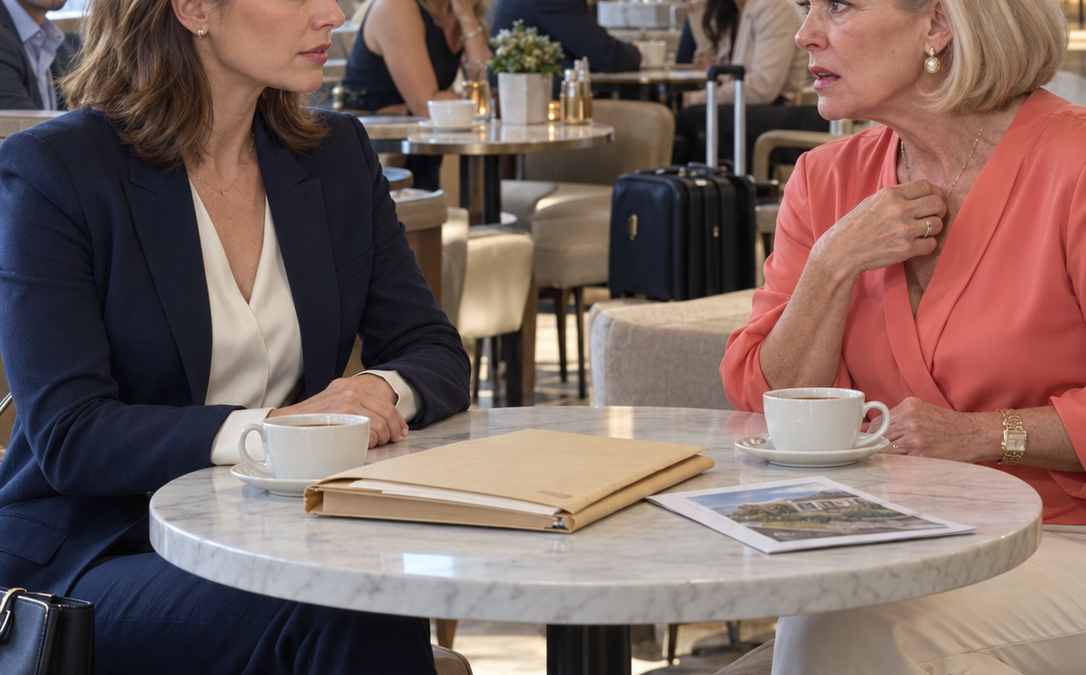
She looked older than I remembered, which was strange because I had seen her three weeks ago. She was wearing the linen pants she saved for what she considered important occasions and a blouse I had bought her for Mother’s Day last year.
Her hair was freshly dyed.
Her nails were done.
She had, I realized with a sinking feeling in my stomach, treated this meeting like a performance she was about to give.
She spotted me.
She walked over.
She did not smile.
She sat down across from me and folded her hands on the table like she was about to conduct an interview.
“Marlo,” she began. “I have been rehearsing what I want to say to you for a week.”
I set down my coffee cup.
“That’s your first problem,” I told her quietly. “You rehearsed. I’m not here for a performance. I’m here for the truth.”
Her mouth tightened.
I saw her gather herself, and then she leaned forward and started to speak.
“You embarrassed me,” was the first thing my mother said to me. “In front of Wallace, in front of Delaney, in front of Trevor and his family. You made me look like a fool at that port when you didn’t show up.”
I let her finish.
I did not interrupt.
Sabine had told me to let her get through her entire prepared statement, no matter how long it took, because people like my mother tell you everything you need to know about them in the first ten minutes if you just let them talk.
So I let her talk.
She talked for 18 minutes straight.
I timed it on the clock behind her head.
In those 18 minutes, she told me that I had ruined her cruise. That Delaney had cried the entire first day at sea because she felt guilty. That Wallace had spent the whole trip on the phone with the credit card company trying to figure out why our cards were being declined for the excursions.
And that she personally had been humiliated at the specialty steakhouse dinner when the maître d’ informed her the reservation had been canceled.
She told me that when she landed in Houston and found strangers in the house, she had, in her words, nearly had a heart attack.
She told me that Orin Hedid had been rude to her.
She told me that they had spent the last week and a half staying with Wallace’s brother, sleeping on a pullout couch, and that Delaney had been reduced to living with Trevor’s mother, which was apparently the greatest indignity of all.
She told me I had acted rashly.
She told me I had overreacted.
She told me the cruise text had been a misunderstanding, that Delaney had said the words in the heat of the moment because Trevor had been pressuring her about not wanting to spend the trip around the twins, and that she, my mother, had only been passing along the message because Delaney had been too upset to send it herself.
She told me she was willing to forgive me if I sat down with her and Delaney and Wallace and helped them figure out a plan to get back on their feet because that was what a real daughter would do.
Then she folded her hands again and waited.
I looked at her for a long moment.
I looked at her hair and her blouse and her manicure, and I thought about the woman who had raised me. I thought about all the times I had sat across from her at some restaurant somewhere being scolded, being lectured, being reminded of my duties.
And sitting across from her at that hotel cafe on a Monday afternoon in Houston, I felt something I had never felt in her presence before.
Nothing.
I felt nothing.
I picked up my coffee, took a sip, set it down carefully, and began to speak.
“Mom, I am going to say some things now, and you are not going to interrupt me. If you interrupt me, I will get up and walk out, and you will not see me again for the rest of your life. Do you understand?”
Her mouth opened.
She closed it.
She nodded once.
“Number one,” I began. “You did not misunderstand the text. Neither did I. You wrote what you wrote and you sent what you sent, and every word of it was chosen carefully. My sons are my real family. Delaney is not if she said what you claim she said, and you are not if you passed it along without pushback. I do not care whose idea it was. I care that you delivered it.”
She started to say something.
I raised one hand.
“Number two. I did not ruin your cruise. You ruined it. You ruined it in February when you let me pay for a trip you were already planning to exclude us from. You ruined it in June when you booked excursions for four people knowing you had a party of six on the reservation. You ruined it the morning of when you sent that text. I did not overreact. I responded exactly proportionally to what you did.”
“Marlo, please.”
“Number three. The house was mine. It was never yours. It was never ours. I let you live there because I loved you and because I felt sorry for you after your second marriage ended. That was my choice. Selling it was also my choice. You are not entitled to a bedroom in my house for the rest of your life because you gave birth to me. Motherhood is not a lien on real estate.”
She flinched at that.
I kept going.
“Number four. I have paid, by my rough calculation, somewhere north of $250,000 supporting you, Delaney, and Wallace over the last six years. That is not counting the cruise. That is not counting the SUV. That is not counting Delaney’s phone, Wallace’s teeth, or the two vacations I took you on before this one. I do not want that money back. I am telling you the number because I want you to hear it out loud one time so you understand what you spent and what you had and what you threw away over a seven-day trip to the Caribbean.”
Her eyes were shiny now.
I did not stop.
“Number five. My sons are 9 years old. They are kind and they are funny and they are curious and they are the two best people I have ever known. Reese asked me last night to tell you that he and Rowan are okay. He wanted you to know. That is the kind of child he is. That is the kind of child you decided was not real family.”
Her face crumpled at that.
I did not soften.
“Number six. You had a chance, Mom. You had 37 years of chances. You had every birthday and every holiday and every graduation and every heartbreak. You had my father’s funeral, where I held you up in the front pew. And you had my wedding, where you got drunk at the reception and told my mother-in-law I was too emotional to be a good wife. You had my divorce, where you told our family it was probably my fault. You had my C-section, where you complained the waiting room was cold. You had the boys’ first birthday, where you spent the whole party comparing them to Delaney’s imaginary future children. You had all of it. And you spent every single one of those moments choosing her or yourself. Never me. Never my kids.”
The cafe was quiet.
A waiter walked by carrying a tray, glanced at us, and kept moving.
“Number seven,” I said more quietly. “Now, I am not angry anymore. That’s the part I want you to hear. I was angry for a long time, longer than I even realized. But I’m not angry now. I am done. There is a difference. Angry people come back. Done people don’t.”
She reached across the table and tried to take my hand.
I moved it into my lap.
“Marlo,” she whispered. “I’m your mother.”
“You were,” I told her. “You could have been. You chose not to be. I am not going to spend the second half of my life trying to teach you how.”
She started to cry.
Real tears, not performance tears.
And for a second, one honest second, I saw the woman she might have been if she had ever chosen differently.
But that woman was a ghost.
That woman had never existed.
And I was not going to raise her from the dead.
“What do you want from me?” she asked, her voice small.
“Nothing,” I told her. “That is the whole point. I don’t want anything from you. Not money, not apologies, not explanations. I came here to tell you that in person because you raised me to believe you were owed a face-to-face. So here it is. Face-to-face. I am closing the door. Mom, you are not invited into the rest of my life. Not into my boys’ lives. Not into their birthdays, their graduations, their weddings. Nothing.”
“You can’t do that.”
“I already have.”
She stared at me, and I watched something shift behind her eyes.
The way a lock turns in a door when someone finally gives up on the handle.
Then she straightened her back, wiped her face with a paper napkin, and reached for her purse.
“Then I hope you’re happy,” she muttered.
“I am,” I told her honestly. “For the first time in my life, I am.”
She stood up.
She paused for a moment, looking down at me like she was trying to memorize my face.
Maybe she was.
Then she turned and walked out of the cafe.
I watched her cross the hotel lobby and disappear through the sliding glass doors, and I sat there for a very long time after she was gone, just breathing.
I flew back to Flagstaff that night.
Karine picked me up at the airport because she had insisted on it.
And when I got in her car, she took one look at my face and did not ask a single question.
She just drove me home, put on the kettle when we got to the casita, made me a cup of tea I did not ask for, and sat with me on the patio in the dark until I was ready to talk.
I told her everything about the cafe, about the 18-minute monologue, about the seven points I had made and how each one had landed.
Karine listened without interrupting, the way Amara had, the way my late father used to.
When I finished, she looked at me and said, “You did something today that most people never do in their entire lives, honey. You told the truth to the person who taught you not to.”
I sat with that for a long time.
The boys were asleep when I got in, but Reese woke up when I kissed his forehead. He looked at me with sleepy eyes.
“Did you tell her?”
“I told her everything.”
“Was she nice?”
“She was herself, buddy, which is not the same thing as nice.”
He nodded like he understood, which he probably did more than any 9-year-old should.
The next morning at breakfast, I told the boys the plan.
We were not going back to Texas to live.
We were going to stay in Sedona for a few months until we found the right place. I was going to work remotely from the casita and eventually from a house we would rent. They were going to keep doing the online school program, and in a few weeks we would drive up to visit Aunt Amara in Denver and then maybe out to California to see the ocean because Rowan had never seen the Pacific.
They took it well.
Better than well.
Reese asked if we could get the dogs before school started up again for the real fall semester, and I told him yes, we could pick out a rescue at the shelter that weekend.
Rowan asked if we would ever see Grandma again.
I sat with that question for a moment before I answered it.
“I don’t think so, sweetheart. Grandma made a choice a while ago that she didn’t want to be part of our family the right way. And I made a choice this month that our family gets to be with people who love us the right way. It’s okay to feel sad about it. You can miss her and still know that this is the right thing.”
He thought about that while chewing his pancakes.
Then he said, “I don’t really miss her. Is that bad?”
“No, honey. It just means you’re paying attention.”
He nodded and went back to his breakfast.
We got the dogs that Saturday.
Two brothers from a litter that had been surrendered to the local shelter. Both mutts, both under a year old, one mostly black with white paws and one mostly white with a black patch over his eye.
Reese named his Cinder.
Rowan named his Bandit.
They both cried in the car on the way home, both dogs and both boys, which was one of the more emotionally intense car rides of my life.
For the next three weeks, we settled into a rhythm.
School in the mornings.
Walks with the dogs in the afternoons.
Dinner on the patio.
I worked from a little corner of the living room, headphones in, running my logistics team from 1,200 miles away and doing, if I am being honest, the best work of my career because I was finally not running on fumes.
I did not hear from my mother again after the cafe.
Not one text.
Not one call.
Not one email.
Delaney sent me a message on Instagram two weeks in, a long paragraph that started with I hope you’re happy and ended with you will regret this someday.
I blocked her without responding.
Wallace sent nothing.
But the family drama was not entirely over because on a Thursday afternoon in the middle of the third week, Sabine called me.
“Marlo, your mother has retained an attorney. He has sent me a letter.”
My stomach dropped.
“For what?”
“She is claiming that she had a verbal agreement with you that gave her a life estate in the property you sold. She is claiming that she contributed to the household in ways that should be recognized financially. She is asking for $150,000 as, and I quote, restitution for her displacement.”
I laughed.
It came out sharper than I meant it to.
“Sabine, she never paid a dime toward that house. There is no agreement. There is nothing.”
“I know,” Sabine said calmly. “That’s why this will not go anywhere. But she is going to try to make you tired. She is going to try to make you settle just to get her to stop. I need you to understand that this is her strategy. And I need you to promise me that you will not respond to her directly under any circumstance.”
I promised.
Sabine drafted her response that afternoon.
It was a masterpiece.
It laid out in seven pages every fact of the last six years.
The deed of the property held solely in my name since 2019.
The mortgage payments all made from an account she was never on.
The utility bills, the insurance, the maintenance records, the property tax filings.
She attached bank statements.
She attached the text messages between me and my mother where my mother had explicitly acknowledged at least four times that the house was mine and that she was so grateful I let her stay.
Sabine had subpoenaed nothing yet, but the letter made clear that if this went further, she would.
She ended the letter by noting that if my mother wished to pursue the claim, we would be filing a counterclaim for the fair-market rental value of the property for the six years she had lived there rent-free, plus the value of the SUV lease payments, plus the phone plan, plus the CareCredit charges, plus every other financial contribution I had made to her lifestyle.
The total, Sabine estimated, would exceed $312,000.
My mother’s attorney sent back a one-line response the following Monday.
His client would not be pursuing the matter further.
I read that email three times on my patio with Bandit asleep on my foot and Cinder chewing on a stick beside me, and I felt the last thread break.
Not a snap.
A soft, quiet unraveling.
The kind of thread you did not know you were still tied to until it let go.
That night, I sat down at the little writing desk in the bedroom of the casita and took the 19-page letter out of the drawer.
I read it start to finish.
Then I walked out onto the patio, where I had built a small fire in the little iron pit Karine kept out there for cool nights, and I fed the letter to the fire one page at a time.
I watched every page burn.
I did not need those words anymore.
They had already done their work.
When the last page was ash, I sat back in my chair, looked up at the stars, and whispered to nobody in particular, “It’s done.”
Bandit lifted his head, looked at me, and thumped his tail once against the stone patio like he understood.
Two days later, I put in an offer on a small ranch-style house on three acres just outside town, five minutes from Karine, ten minutes from the school Karine’s daughter ran.
$435,000 cash.
The seller accepted the same day.
I called the boys in from the yard, sat them down at the kitchen table, and told them we had a house.
A real house.
Their house.
With a yard the dogs could run in and a room for each of them and a big kitchen where we could make pancakes every Saturday for the rest of our lives.
Rowan cried.
He actually cried.
My tough little Rowan.
Reese hugged him, and then hugged me.
And the three of us stood there in the kitchen of the casita for a long time, not saying anything, just holding on to each other.
Real family, I thought.
This.
This is what she meant, and she never even knew.
We closed on the ranch house in the middle of October.
The escrow moved fast because it was a cash sale, and the previous owners, an older couple named Wilhelm and Betina CR, had already moved into an assisted living facility in Prescott.
They left me the riding mower in the barn, three cords of firewood stacked by the back fence, and a handwritten note taped to the inside of the pantry door.
“Please take good care of her. She has been very good to us.”
She had been.
And she was very good to us, too.
The boys picked their rooms the first day.
Reese took the one with the window that faced the mesa because he liked to watch storms roll in over the rocks.
Rowan took the one with the window seat because he had never had a window seat before and had decided he needed one.
I took the primary bedroom, painted the walls a soft desert green, and hung one photograph over the bed.
A picture of my father holding me on his shoulders when I was 4 years old at the county fair.
It had been in a box in a closet in the Texas house for years.
Now it hung where I could see it every morning when I woke up.
We spent October and November settling in.
The dogs adjusted to having three acres to run on.
The boys made friends at their new school, which was small and warm and had a class size of 15.
Reese joined a chess club.
Rowan joined an art class.
I set up a proper home office in the room Wilhelm had used as his study, put a big desk against the window, and worked with the mesa in my line of sight all day.
I took the boys to a therapist named Dr. Marisol Etchgoyan once a week for the first two months.
Not because they were falling apart, but because I did not want them to fall apart later without anyone noticing.
Dr. Etchgoyan was in her 60s, had gentle eyes, and after our third session together, she pulled me aside and said quietly, “Marlo, your children are extraordinary. Whatever you did, you did it right.”
I cried in her parking lot for 20 minutes after that.
Amara came to visit at the end of October, exactly like she had promised.
She stayed for a week.
She brought the boys books and a chess set for Reese and a set of professional colored pencils for Rowan.
And she and I sat on my new back porch every night after the boys went to bed, drinking wine, catching up on 15 years of a friendship I had let go quiet because my mother had always disapproved of Amara for reasons I now understood had nothing to do with Amara and everything to do with my mother not wanting me to have anyone in my life who saw me clearly.
On her last night, Amara asked me the question I had been avoiding asking myself.
“Do you think she’ll ever try again?”
“Who, my mother?”
“Yeah.”
I thought about it.
“Maybe someday, when Wallace dies or when Delaney finally exhausts her. When she is old and alone and it occurs to her that she has grandchildren she has not seen in ten years.”
I looked out at the mesa. The sun was setting behind it, and the whole rock face was glowing that specific orange that had made Rowan think of Mars.
“Then I will listen,” I told Amara. “Once. Because I owe it to the version of me that hoped for 37 years that she might one day become the mother I needed. But listening is not the same as opening the door. She would have to earn that. And I do not think she is capable of what it would take.”
Amara nodded slowly.
“That’s the healthiest answer I’ve ever heard you give about her.”
“Yeah,” I said. “Turns out 450 miles and one honest conversation will do that.”
Amara laughed, and we clinked glasses, and the sun went down.
The winter came quietly.
We had our first snow the second week of December, just a dusting, and Reese and Rowan ran outside in their pajamas at 6:00 in the morning to see it.
The dogs bounded around them like idiots, and I stood at the kitchen window in my robe with a cup of coffee and watched my boys shriek and laugh in the yard.
And I thought, We made it.
We hosted our first Thanksgiving in the ranch house that year.
Just the four of us, if you counted the dogs.
I cooked a small turkey, made my grandmother Aldine’s stuffing recipe from memory, and let the boys each pick one dish to help make.
Reese picked mashed potatoes because he liked using the ricer.
Rowan picked green bean casserole because he liked the fried onions on top.
We ate at the big kitchen table Wilhelm and Betina had left behind, with candles in the middle and Bandit under the table hoping for scraps.
Before we ate, I asked each of us to say one thing we were grateful for.
Reese said he was grateful for our new house and for Cinder.
Rowan said he was grateful for pancakes and for the red rocks.
I looked at both of my sons across the table in the candlelight, in the house that was ours and only ours.
“I am grateful that we are exactly where we are supposed to be. And I am grateful that I got the best two boys in the entire world and that I finally figured out that we were already the whole family. We didn’t need anyone else.”
Reese tilted his head.
“Was that always true, Mom?”
“Yes, baby. I just took a long time to see it.”
He nodded like that made perfect sense.
Then he asked if we could eat now because he was starving.
Rowan agreed.
And we ate.
When we were done, we did the dishes together, all three of us.
Then we watched a movie in the living room with the dogs on the couch.
I fell asleep sitting up with Rowan’s head on my shoulder.
Reese came over and put a blanket on both of us before he went to bed.
And I did not know I was capable of being that happy until I was.
Christmas came, and I did something I had never done before.
I did not host anyone.
I did not fly anywhere.
I did not answer any messages from Texas.
I did not check to see if my mother had sent a card because I had, on Sabine’s advice, opened a PO box specifically for filtering anything that came from her side of the family.
I had asked Sabine to check it once a month and only tell me if anything was legally significant.
It was not.
It never has been.
The boys woke up on Christmas morning to a small pile of presents under a tree we had cut down ourselves at a lot outside of town.
Reese got a telescope.
Rowan got an easel.
They both got new pajamas and new books and a jar full of coins each that they were allowed to spend on absolutely anything they wanted in the new year.
We ate cinnamon rolls in our pajamas.
We took the dogs for a long walk in the snow.
Karine came over for dinner because her daughter was visiting her son-in-law’s family that year.
And she brought a pecan pie that made Rowan declare her the best cook in Arizona.
That night, after Karine had left and the boys were asleep, I sat on the couch in front of the fire with a glass of wine and opened my laptop.
I did one small thing I had been thinking about all month.
I logged into my old email account, the one I had used for the cruise booking, and typed out an email to myself, just to have a record, just to mark the year.
I titled it:
The Year I Chose Us.
In the body, I wrote three lines.
Sold the house.
Kept the boys.
Found the life we should have been living all along.
I saved it as a draft.
I did not send it, but it was there, and it would be there next year and the year after that and the year after that as a small, quiet monument to the morning of a certain text and everything that came after.
I closed the laptop and went to bed.
The new year started with a phone call I did not expect.
In the middle of January, Sabine called me on a Tuesday morning while I was making coffee and told me that Wallace had died of a heart attack at his brother’s house in his sleep.
He was 67 years old.
I sat down at the kitchen table.
Bandit padded over and put his head on my knee.
“How did you find out?” I asked her.
“Your mother’s attorney called. Apparently, she wanted to make sure you were informed. There is a service on Saturday.”
“Am I named in anything?”
“You are not. Wallace had almost no estate to speak of, but your mother wanted you to know. That was the message verbatim. She wanted you to know.”
I thanked Sabine and hung up.
I sat at the kitchen table for a long time, holding my coffee, staring out at the mesa.
The boys were in the living room doing school, headphones on, laptops open.
I had complicated feelings about Wallace.
He had never been cruel to me exactly, but he had never been kind either.
He had married my mother 14 months after my father died. And he had moved into a house my father built, and he had sat in my father’s chair at Thanksgiving for the next 13 years without ever once acknowledging what he had walked into.
He was not a bad man.
He was just a man who had never chosen me, which in a family like mine added up to the same thing.
I thought about the service.
I thought about my mother at 62 years old, now standing at the front of a funeral home for the second time in her life, without Wallace, without a house of her own, with a daughter who had cut her off completely.
I thought about Delaney, who I imagined would be there in something inappropriate, crying at the wrong volume.
I thought about the town I had left and everyone who would be at that service asking where I was, and the story my mother would tell them about her ungrateful oldest daughter who ran off to Arizona and abandoned her family.
I did not go.
I sent flowers to the funeral home.
A simple arrangement.
White lilies.
No card.
I did that not for my mother and not for Wallace, but for the small piece of myself that had grown up in his house and eaten at his table and watched him watch football on Sunday afternoons without ever once asking me how school was going.
That small piece deserved the closure of white lilies.
Everything else I released.
The following week, I told the boys.
I sat them both down at the kitchen table on a Saturday morning after pancakes.
I told them that their grandfather Wallace, who they had known but not really known, had passed away.
I told my sons we would skip their grandfather’s funeral since we were no longer part of that family, but we would light a candle for him.
Reese remembered a nice whistle he received, and Rowan remembered him laughing at a bad coffee face.
I told them both the good and bad memories were valid.
Life continued beautifully.
Spring arrived, and the boys thrived.
Reese learned that effort matters more than perfection.
In April, an old friend of my mother called to say my mother had early-stage breast cancer.
I asked my therapist if I should visit.
After sitting with my feelings, I realized I felt nothing but a quiet need for a boundary.
I decided not to go.
I texted the friend to say I would not be reaching out and asked her not to call again.
My mother recovered without contacting me.
My sister sent a guilt message, which I blocked.
I sometimes felt the old urge to fix things and seek my mother’s approval, but I resisted.
I realized that leaving a toxic family is not just one big decision, but a series of small, quiet choices to protect your peace.
By the time I turned 38, my life was very good.
One Saturday morning, while making pancakes with my son Rowan, he asked if I was happy.
I told him I was very happy.
He noted that I laughed a lot more now.
I hugged him and realized I had finally learned I was allowed to be happy.
That moment was the entire point of my journey.
I sat on my porch later, thinking about the cruel text from a year ago that had started it all.
I do not know where she is today.
I know she survived her cancer because Sabine mentioned it in passing three months ago.
I know she is still living with Wallace’s brother, or she was as of last winter.
I know Delaney has moved four times in 12 months and is no longer with Trevor.
I know none of them have ever apologized.
I know they never will.
And I am, more than anything, at peace with that.
Because here is what I finally understood, sitting on my back porch that Saturday morning with my coffee going cold.
The people who told me I was not real family were the ones who had never learned what family meant.
They thought family was a scoreboard.
They thought family was a currency.
They thought family was something you could give and withhold to control the people who loved you.
They were wrong.
Family is not the people you were born to.
Family is the people who choose you back every single day without keeping score.
My boys chose me back that morning in the kitchen.
My father, gone now for 14 years, chose me back every time I looked at the photograph over my bed.
Amara chose me back over and over from Denver.
Karine chose me back with tomatoes and Sunday dinners and a school she had connected me to.
Sabine chose me back with seven-page letters that ended lawsuits before they started.
Dr. Etchgoyan chose me back with a parking-lot cry and a gentle question about what my body knew.
That was my family.
That is my family.
And the woman who wrote that text, and the sister who let her write it, and the stepfather who never once said anything to stop it, and the boyfriend who did not want my sons around at a specialty steakhouse dinner?
They were people I used to know.
They are not anymore.
If you are watching this and you are somewhere in the middle of your own version of this story, I want to say one thing to you and only one thing because I do not have all the answers, and I am not a therapist, and I am not qualified to tell you what to do with your own family.
You are allowed to leave.
You are allowed to leave the people who taught you that love was something you had to earn by paying for it.
You are allowed to leave the mother who cut your children out of a family cruise while smiling at your credit card.
You are allowed to leave the sister who called you controlling because you were the only responsible one in the house.
You are allowed to leave the stepfather who sat in your father’s chair and never once asked you how you were.
You are allowed to leave, and you are allowed to leave without a fight.
And you are allowed to leave without explaining yourself for the hundredth time.
And you are allowed to leave in one morning with two suitcases and two boys and a plan you make up as you go.
You will not lose everything.
You will lose the thing you were most afraid of losing, which is their approval.
And you will find on the other side of that loss that you did not need it.
You never did.
You never should have.
I made a promise to my sons at the bottom of the stairs on the morning of a canceled cruise.
I told them they were the best thing that ever happened to me.
I told them anyone who did not want to be around them was missing out on the best part of the world.
I told them Mom was handling it.
I kept every one of those promises.
And in keeping them, I found the version of my life I did not know I was allowed to have.
Rowan just came around the corner of the house with a handful of wildflowers he picked from the edge of the yard.
Reese is right behind him holding one of the tomatoes Karine brought over, arguing that they should get to eat one raw with salt because his friend at school told him that is how his grandmother does it.
Bandit is muddy.
Cinder has a stick.
The mesa is glowing in the late-morning light behind them, and the sky is that specific shade of blue you only get in the desert.
This is the ending.
This is what happened after the 49 missed calls.
This is what happened after the woman who wrote the text landed in Texas and found strangers in her house.
She had to figure out her life, and I have figured out mine, and the two lives no longer touch.
And that is exactly how it should have been all along.
If this story meant something to you, if it reminded you of someone you love or someone you left or someone you are still deciding whether to leave, I would love it if you would like this video, subscribe to the channel, and share your own story in the comments below.
Every one of you who has ever been told you were not real family by the people who were supposed to love you most—I see you.
I was you.
And I promise there is a kitchen somewhere on a Saturday morning with pancakes and flour on a small cheek and a dog with a stick and a mesa glowing outside a window, waiting for you to walk into it and finally, finally be home.
Thank you for listening.
Take care of yourselves.
And when the text comes, whatever your text looks like, remember that you get to write what happens.








