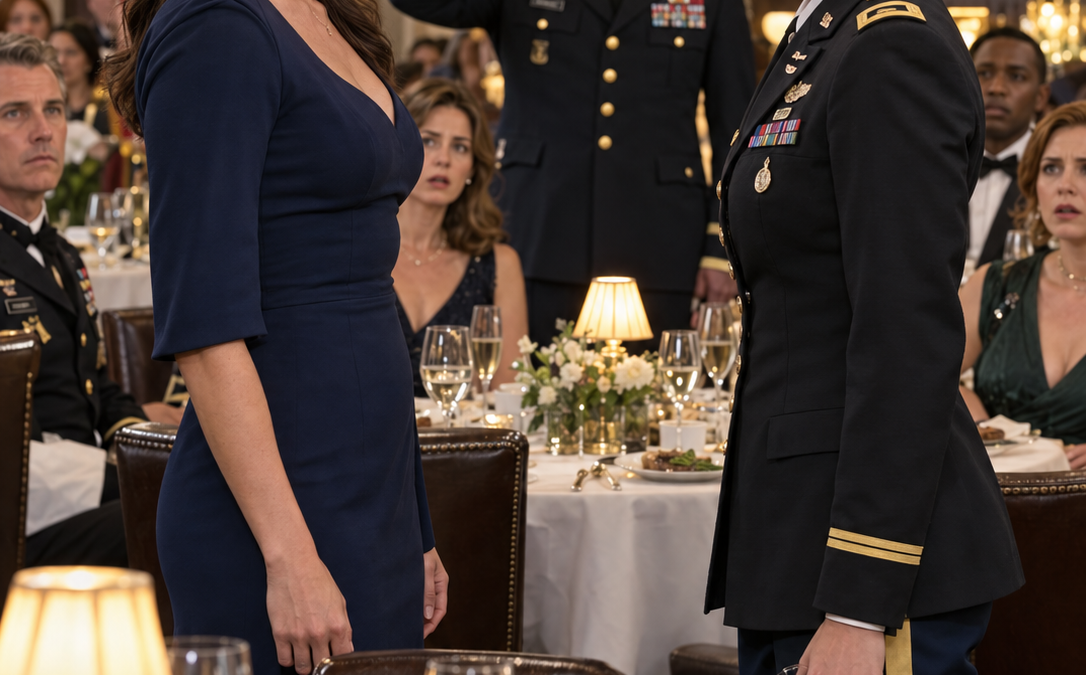
I went to my sister’s promotion party. she bragged about finishing top of her sniper course. then she laughed, “even black viper never scared me.” i stayed quiet… because black viper was my callsign. before i could speak, an officer behind her snapped to attention and said…
But my mother called me three weeks before the party, and she used the voice she only uses when she wants something very badly. She asked me to please, please come because Marley had been talking about it for months, and it would break her heart if I was not there.
So I drove eight hours down Interstate 85, checked into a Hampton Inn, put on a navy blue dress that I had bought specifically for the occasion, and arrived at the steakhouse at 6:30 in the evening carrying a wrapped gift and a card that said, “Congratulations. I am so proud of you.”
Marley hugged me when I walked in.
It was a real hug, the kind she used to give me when she was small and I was her whole world. For a moment, I thought maybe this trip would be different. Maybe the distance between us, which had grown wider every year since I enlisted, was finally starting to close.
She looked beautiful in her Class A uniform, her dark hair pinned back in a tight bun, her new rank gleaming on her collar. She introduced me around as her big sister, the one who works in security up in Raleigh.
Nobody asked follow-up questions. Nobody ever does when you say the word security. It sounds boring. That is why I use it.
The dinner itself was fine. I sat at the end of the long table next to a cousin I had not seen since a wedding in 2019, and we talked about her kids and her new job at a bank in Savannah.
Grover made a toast about how proud he was of Marley, and he mentioned, as he always does, that Marley was the first person in our family to make a real career out of the military. My mother nodded along.
I kept my face neutral.
My 12 years of service, which had started in 2007 and ended quietly in 2019, had never been treated as a real career by anyone in my family because I never talked about it. And because I came home with a limp and a security clearance that meant I could not talk about it.
So the family had decided, without ever saying it out loud, that whatever I had done had not really counted.
That was fine. I had made peace with it, or I thought I had.
After dinner, people started drifting around the room with drinks in their hands. And that was when Marley climbed onto a chair, tapped her champagne flute with a butter knife, and asked for everyone’s attention.
She was laughing already, a little tipsy, her cheeks pink. She thanked our mother. She thanked Grover. She thanked her instructors at Benning.
And then she started telling the story of her final week at sniper school, the story I had already heard three times over Thanksgiving about how she had made a 900-yard shot in wind conditions that had washed out half her class.
That was when she said it.
“I mean, look,” she laughed, gesturing with her glass. “They try to psych you out down there. They tell you all these legends, ghost stories about operators. They told us about this one shooter, call sign Black Viper, supposedly some myth from the sandbox days. And I just want to say for the record, Black Viper never scared me. Not once.”
She grinned.
“Because you know what? Half of those legends are just guys who got lucky and then retired before anyone could ask questions.”
The room laughed. It was a warm, appreciative laugh.
Marley was charming when she was tipsy, and everyone loved her, and it was her night.
I did not laugh.
I did not move.
I was holding that plate of shrimp, and I was staring at the small candle in the center of the nearest table. And I was aware, very distantly, that my hands had gone cold.
Because Black Viper was not a myth.
Black Viper was not a ghost story.
Black Viper was the call sign that had been assigned to me by a joint task force commander in 2013, in a briefing room in Bagram. And it had followed me through six years of work that I could not and would not ever describe to my sister at a steakhouse in Columbus, Georgia.
I felt someone watching me.
I looked up.
The tall man in dress blues was standing at the bar with a glass of bourbon in his hand, and his mouth had come slightly open. He was maybe 50, silver at the temples, and he wore the rank of colonel.
I did not recognize him immediately.
Then I did.
His name was Elias.
In 2014, he had been a major, and he had been the officer who signed off on the after-action report for an operation in a village whose name I am still not allowed to say out loud.
He had shaken my hand once in a hallway and told me that what I had done that night had saved 11 American lives and that he would never forget my face.
He had not forgotten my face.
He set his bourbon down on the bar very slowly. He straightened his shoulders, and then, in front of 40 people in the middle of my sister’s promotion party, Colonel Elias Doran walked three steps forward, came to a full and formal position of attention, and rendered a slow, deliberate salute in my direction.
The room did not notice at first.
Marley was still talking. She was making another joke, something about how the real snipers were the ones who could hit a target and still make it home for dinner. A few people chuckled.
Then the woman standing next to Colonel Doran, a lieutenant colonel I did not know, followed his gaze.
She saw me.
She saw him saluting.
Her face changed.
She set her own drink down, and she came to attention, too.
Marley kept talking. She did not see it yet, but other people were starting to.
A captain near the door turned. A major by the window turned.
One by one, the officers in that room were following the line of Colonel Doran’s salute. And one by one, they were finding me at the back of the room in my navy blue dress, holding a plate of shrimp, and their faces were doing the same thing his had done.
Marley finally noticed the silence.
She stopped mid-sentence.
She looked around, confused, still smiling.
“What?” she laughed. “What is everyone looking at?”
Colonel Doran did not lower his salute.
He spoke, and his voice carried across that entire dining room like a bell being struck in a cathedral.
“Staff Sergeant Rhodess,” he said.
He was looking directly at Marley now, though his hand was still raised toward me.
“With respect, ma’am, I think you owe your sister an introduction she has never received.”
Marley’s smile faltered.
She turned. She looked at me.
And for the first time in her life, I watched my little sister realize she had no idea who I actually was.
The silence in that dining room lasted maybe four seconds.
It felt like four minutes.
Marley stood on her chair with her champagne flute still raised, her mouth slightly parted, and she looked back and forth between Colonel Doran and me like she was trying to solve a math problem in a language she did not speak.
Our mother, who had been sitting at the head of the table, set down her wine glass with a small clink that seemed unnaturally loud. Grover leaned forward in his seat.
The jazz trio in the corner, sensing something they did not understand, quietly stopped playing.
I did not move.
I did not lift my hand to return the salute because I was in a civilian dress at a family party, and returning a salute in that context would have been improper.
But I did the one thing I could do.
I set the plate of shrimp down on the table beside me. I straightened my spine. I met Colonel Doran’s eyes across the room, and I gave him the smallest, most respectful nod I could manage.
He held the salute for another full second.
Then he lowered his hand crisply, the way officers do when they have finished paying respect to someone they consider deserving of it.
The lieutenant colonel beside him lowered her hand a heartbeat later. The captain by the door did the same.
It was like watching a slow wave crest and then settle.
Marley stepped down from her chair. She did it carefully, holding the back of it for balance, and she did not take her eyes off me.
Her cheeks, which had been pink from champagne a moment before, had gone a strange shade of pale.
“Sutton?” she asked.
Her voice was small.
“What is he talking about?”
Before I could answer, our mother stood up.
My mother is a woman named Delphine. She is 63 years old, and she has spent most of her life managing situations she does not fully understand by pretending they are not happening.
She smoothed the front of her dress. She smiled a bright, brittle smile at the room.
“Well,” she announced, “I think everyone could use another drink. Let us get the dessert out, shall we?”
Nobody moved.
Nobody was looking at her.
They were all looking at me.
Colonel Doran cleared his throat. He picked up his bourbon glass again, but he did not drink from it. Instead, he addressed the room in the calm, measured tone of a man who had spent 30 years learning how to control a briefing.
“Ladies and gentlemen,” he began, “I apologize for interrupting Staff Sergeant Rhodess’s celebration. It was not my intention to derail the evening, but I saw something a moment ago that I could not, in good conscience, allow to pass without correction.”
He paused.
He looked at Marley.
His voice softened.
“Staff Sergeant, I do not think you meant any harm by what you said. Legends get passed around at every school in the Army, and most of the time they are exactly what you called them. Ghost stories. But occasionally, and only very occasionally, one of those legends turns out to be a real person.
“And when that person happens to be standing in the same room as you at your own promotion dinner, and she happens to be your older sister, well, the situation calls for a small adjustment of the record.”
Marley turned to look at me again.
Her hand had come up to her collar near her new rank. She was gripping it without seeming to know she was doing it.
“You,” she whispered.
I nodded once.
The lieutenant colonel beside Doran spoke up then. She was a tall woman with dark red hair pulled into a low bun, and her name tape read Whitfield.
“Colonel,” she inquired quietly, “if I may, are you telling us that this is the Black Viper, the one from the 2015 briefings?”
Doran did not take his eyes off me.
“I am not telling you anything, Colonel Whitfield. I am not authorized to tell you anything. I am simply standing at attention because that is what I choose to do in the presence of certain people. What you conclude from that is your own business.”
It was, I thought, a very elegant way to say yes without saying yes.
I could feel Grover staring at me from the table.
Grover is my stepfather. He married my mother in 2003, when I was 15 and Marley was 11, and he had never quite figured out what to do with me.
He had thrown himself into raising Marley, who was young enough to accept him, and he had left me mostly alone, which I had appreciated at the time and resented later, and now felt a complicated kind of nothing about.
He was staring at me now with an expression I had never seen on his face before.
It was not affection.
It was not pride.
It was closer to embarrassment, as if he had just realized he had spent 22 years underestimating someone at his own dinner table.
I took a slow breath.
I walked forward past two tables, past a startled waiter holding a tray of coffee cups, and I stopped in front of my sister.
She looked up at me.
Marley is 5’4″. I am 5’9″.
I had not stood this close to her in maybe three years.
“Marley,” I began softly. “Let us go outside for a minute. Just you and me.”
She nodded.
She did not seem capable of doing anything else.
I looked over her shoulder at Colonel Doran. I gave him another small nod, this one thanking him.
He returned it.
Then I put my hand very lightly on Marley’s elbow, and I guided her through the dining room, past the silent guests, past our mother, whose brittle smile had finally cracked, past Grover, whose mouth was still slightly open, and out through the side door into the parking lot.
The Georgia air hit us like a warm, wet blanket.
It was past 8:00, but the humidity had not broken. Cicadas were screaming in the oak trees along the edge of the lot. The parking lot lights buzzed overhead.
Somewhere on the other side of the building, a car alarm went off briefly and then stopped.
Marley walked with me until we reached the far corner of the lot, near a low brick wall that separated the restaurant from a small landscaped garden.
She sat down on the wall. She put her hands flat on her knees.
She looked up at me, and for the first time all night, I saw not my adult sister, the staff sergeant, the sniper, but the 11-year-old girl who used to crawl into my bed during thunderstorms because she was scared of the noise.
“I do not understand,” she whispered.
I sat down beside her.
I did not answer right away. I wanted to give her a moment.
“Sutton,” she pressed. “What did he mean? What did that colonel mean? That story I told—that was, I mean, that was just something my instructor told us during the last week of sniper school. He said there used to be an operator called Black Viper who worked out of a joint task force in the mid-2010s and that she made shots that nobody could explain and that after some incident in 2016 she just… she just disappeared.
“He said nobody even knew her real name. He said she was probably not even real.”
I looked out across the parking lot.
A family was walking toward the restaurant with two small children laughing about something. The children were carrying balloons.
“He was mostly right,” I answered quietly. “The part about disappearing—that part was accurate.”
Marley stared at me.
“Sutton, please tell me the truth.”
I turned to face her.
I chose my words carefully because there were still things I could not say. Not to her, not to anyone, not for another 11 years, when the operational records would finally come under review for declassification.
“Marley,” I began, “when I enlisted in 2007, I did not go the same route you did. I tested into a program that I was not allowed to tell our family about. By 2011, I was attached to a unit that did not officially exist. By 2013, I had a call sign.
“I kept that call sign until 2019, when I was medically separated after an operation that went badly. There are things I did during those years that I cannot tell you. There are things I am proud of, and there are things I will carry for the rest of my life.
“But yes. Black Viper was me.
“It was always me.”
Her eyes filled with tears.
She did not blink them away.
“Why?” she whispered. “Why did you never tell me?”
“Because I could not,” I explained. “And because by the time some of it could have been shared in general terms, you had already decided who I was. And I did not want to take that from you.”
She was quiet for a long moment.
Then she looked at me with something that was not quite anger, but was not quite sorrow either.
It was closer to shame.
“Sutton,” she whispered, “what have I been doing to you?”
I did not have an answer for that.
Not yet.
But I would.
We sat on that brick wall for maybe 20 minutes. The cicadas kept screaming. A busboy came out with a bag of trash, saw us, and went back inside without saying anything.
Marley wiped her eyes twice with the back of her wrist, careful not to smudge her makeup, and I watched her do it. I thought about how many small habits she had picked up over the years that I had never been around to see form.
“I was 10,” she began quietly, “when you left for basic.”
“I know.”
“I did not really understand what basic was. I thought you were going away for a summer, like camp.”
“I remember.”
“And then when you came home, you were different. You were quieter. You were—you were harder, and Mom told me not to ask you about it because she said you had things on your mind, so I never asked.”
I did not answer.
There was nothing useful to say.
“And then you kept leaving,” she continued. “You would come home for a week or two, and then you would leave again for months, and nobody would tell me where you were.
“And I started to think—I started to think that maybe you did not want to be around us. That maybe you thought you were better than us.
“And then when you got hurt in 2019 and moved to North Carolina and did not come home for holidays, I thought, well, she made her choice. She picked her career over her family, and I resented you for it.
“Sutton, I have resented you for years.”
I nodded.
I had known that.
I had felt it in every clipped phone call, every Christmas card that had arrived without a personal note, every time our mother had mentioned Marley’s accomplishments and then paused, waiting for me to add to the conversation.
And I had said nothing because I had nothing I was allowed to add.
“I picked the Army partly because of you,” Marley admitted.
Her voice cracked.
“Did you know that? I picked it because I wanted you to look at me the way you never looked at anyone. I wanted you to see me as a real person, not just your little sister.
“And when I got into sniper school, I thought, finally. Finally, she is going to be proud of me.
“And then tonight—tonight, I got up on that chair and I made a joke about a legend. And it turned out the legend was you, and everyone in that room knows it now.
“And I have made myself into a fool in front of my entire chain of command.”
She put her face in her hands.
“Marley,” I offered gently. “Look at me.”
She did not.
“Marley, look at me.”
She lifted her face.
“You are not a fool,” I told her. “You are a staff sergeant. You finished top of your sniper course. You did that with your own skill, your own discipline, your own work. Nothing that happened in that dining room tonight takes any of that away from you. Do you understand me?”
She shook her head.
“But everyone heard me,” she whispered. “Everyone heard me brag about not being scared of a name that turned out to be my own sister.
“Colonel Doran. He—he is on the promotion board for E7. He is going to remember this. He is going to remember me as the girl who mouthed off about a legend at her own party.”
“He is going to remember you,” I corrected quietly, “as a young NCO who had the grace to walk outside and talk to her sister honestly. That is what he is going to remember, because that is what I am going to tell him if it ever comes up.”
She started to cry then.
Really cry.
Not the polite tears from a minute before. Big, ugly, shoulder-shaking sobs, the kind she used to cry as a little girl when she scraped her knees badly.
I put my arm around her.
She let me.
She had not let me put my arm around her since maybe 2011.
We sat like that for a while.
Eventually, she caught her breath.
“Sutton,” she asked, “can I ask you something?”
“Yes.”
“That night in 2019, the night you got hurt, was it bad?”
I thought about how to answer.
There is a version of that night I have told to exactly three people: my commanding officer, a therapist at Walter Reed, and a woman I dated briefly in 2021, who I trusted for approximately six weeks before I decided I did not, in fact, trust her and ended things.
I have never told my mother.
I have never told Grover.
I certainly have never told Marley.
But something had cracked open tonight.
And I understood, sitting on that brick wall in the Georgia humidity, that I had a choice to make.
I could keep the wall up. I could say yes, it was bad, and leave it there and let my sister go back inside and drink her champagne and try to salvage her evening.
Or I could give her something.
Not everything. Not the classified parts.
But something.
“It was bad,” I said. “It was in a valley in the northeast of the country I was working in. We were extracting a group of civilians, mostly women and children, out of a village that had been taken over by a group I am not going to name.
“My job was to provide overwatch from a ridge about 1,100 yards away while my team went in on foot.
“Something went wrong on the ground. I do not know what. I still do not know what.
“My radio started giving me contradictory information from two different sources, and I had a very small window to make a very large decision.
“I made the decision.
“It was the right one in that it saved the civilians and most of my team.
“It was the wrong one in that one of my teammates did not come home, and on the way out, my extraction point was hit, and I took shrapnel through my left leg and hip.
“That is why I limp.
“That is why I was medically separated.
“And that is why, Marley, I do not talk about it. Because there is a family in Nebraska that lost a son that night, and I do not have the right to tell his story in a way that centers me.”
Marley was silent.
She was staring at me with her mouth slightly open, and her eyes were wet, and she did not seem to know what to do with her face.
“Sutton,” she whispered, “I am so sorry.”
“You do not need to be sorry. You did not know.”
“But I should have known. I should have. Mom should have told me something. Grover should have. Somebody should have.”
“Mom did not know either,” I explained. “Not the details. She knew I was hurt. She knew I had been overseas.
“She did not know anything more than that because I could not tell her. And because, honestly, I did not want to. I did not want her to spend the rest of her life picturing that ridge every time she looked at me.
“It was easier to let everyone think I did something boring and came home with a bum leg.”
Marley laughed.
It was a wet, cracked laugh, but it was a laugh.
“You are not boring, Sut. I do not think anyone has ever accurately described you as boring.”
I smiled a little.
“Give it time. In 10 years, I plan to be very boring.”
She wiped her face with both hands. She took a long, shaky breath.
Then she looked at me with an expression I had not seen on her since she was small.
“Can we go back inside?” she asked. “Together?”
“Yes.”
“And can you—can you meet my friends as my sister? Not as Black Viper. Just as Sutton.”
Something in my chest, something that had been closed for a very long time, opened a little.
“Yes,” I answered. “I would like that.”
We stood up.
She smoothed her uniform.
I smoothed my dress.
She linked her arm through mine the way she used to when she was seven and I was 11, and we walked to the bus stop together every morning.
And we went back into the restaurant.
What I did not know, walking through that side door, was that Colonel Doran had used those 20 minutes to have a very quiet conversation with our mother.
And that conversation was going to change everything about how the rest of the night, and the rest of the summer, and the rest of my relationship with my family was going to go.
The dining room had not returned to normal in our absence.
That was the first thing I noticed.
The jazz trio was playing again softly, but the volume of conversation was wrong. Too quiet in some corners, too loud in others. People were standing in small clusters instead of sitting at the tables.
Colonel Doran was near the bar again, this time in conversation with Colonel Whitfield and a major I did not know.
My mother was sitting alone at the head table, her hands folded in her lap, staring at a spot on the tablecloth.
Grover was not visible.
Marley squeezed my arm as we walked in.
A few heads turned.
The looks I got now were different from the looks I had been getting all evening. Earlier, when I had first arrived, people had glanced at me with polite disinterest.
Now they were looking at me the way you look at a painting you had walked past a hundred times before realizing it was famous.
I did not enjoy it.
I did not want it.
But I understood it.
And I decided in the space between the door and the table that I was going to handle it with grace because my sister had asked me to.
Colonel Doran saw us coming.
He set down his drink and stepped away from his group.
He met us halfway across the room.
“Staff Sergeant,” he greeted Marley. “Ms. Rhodess.”
He gave me the civilian address rather than my former rank, which I appreciated.
“I hope I did not cause too much disruption.”
“Sir,” Marley replied, and her voice was steadier than I would have expected, “you did not cause the disruption. I did. And I owe you an apology, and I owe my sister a much bigger one.”
Doran smiled slightly.
It was a kind smile.
“Staff Sergeant, in my experience, people who can say what you just said tend to do very well in this Army. Do not lose that habit.”
Marley nodded.
She did not seem to trust her voice.
Doran turned to me.
“Ms. Rhodess, if you have a moment before you leave tonight, I would appreciate a word. Nothing formal. Just a moment.”
“Of course, sir.”
“You do not need to call me sir. You have not needed to call me sir for six years.”
“Old habits, Colonel.”
He smiled again, gave a small nod, and moved off to give us space.
Marley led me toward our mother.
Delphine looked up as we approached.
Her face was a careful mask.
I have seen that mask my whole life. It is the mask she puts on when she has been told something she does not want to process and she is trying to decide how to file it away so she does not have to look at it.
“Marley,” she began. “Honey, are you all right?”
“I am fine, Mom.”
“And Sutton, I…”
Delphine trailed off.
She did not seem to know what to do with me.
She never had.
“Colonel Doran spoke with me while you two were outside.”
“Did he?” I responded, keeping my voice neutral.
“He said some things about your service. About what you did. About what you have not told us.”
“Mom,” I offered gently, “he was not supposed to tell you anything specific. And I doubt that he did.”
“No,” she admitted. “He did not. He was very, very careful. But he said enough.
“Sutton, honey, why did you never—”
She stopped.
She started again.
“Why did you never let me know anything at all?”
I looked at her.
My mother at 63 was smaller than I remembered.
When did she get smaller?
She had been a large presence in my childhood. A woman who filled a room with her opinions and her decisions and her particular kind of anxious love.
Somewhere along the way, she had gotten small, and I had not been paying attention.
And now she was sitting at a table in a rented steakhouse, looking at me like she had never seen me before.
“Mom,” I answered quietly, “I did not tell you because I was not allowed to. And I did not tell you later because I did not think it would change anything.”
“Why would it not change anything?”
I hesitated.
I did not want to hurt her, but she had asked.
“Because,” I explained, “for as long as I can remember, you and Grover made room in this family for one soldier, and that soldier was going to be Marley.
“She was the one who got the interest. She was the one who got the pride. She was the one who got the phone calls and the questions and the framed photographs on the mantle.
“When I enlisted in 2007, you told me I was making a mistake, and you told everyone at church that I was going through a phase.
“When Marley enlisted in 2014, you threw her a party.
“It was not fair. It was never fair. But it was what it was.
“And if I had told you what I actually did, it would have felt like I was competing with her.
“And I did not want to compete with her. I love her too much for that.”
My mother’s face did something complicated.
Marley’s grip on my arm tightened.
“I did not,” Delphine whispered. “I did not mean to do that.”
“I know you did not.”
“I was scared for you. That is why I was hard on you when you enlisted. I was so scared, Sutton. I could not sleep for weeks.
“And I thought if I made it seem small, if I made it seem like a phase, then maybe it would be smaller. Maybe you would be safer.
“And by the time Marley enlisted, I was tired. Honey, I was so tired of being scared.
“And I decided—I decided to be proud instead, because the fear had not worked. It had not kept you home.”
I stared at her.
In 37 years, my mother had never told me that.
I sat down beside her.
Marley sat on her other side.
For a moment, the three of us just sat there at the head table of a promotion party in a restaurant in Georgia and did not speak.
“Where is Grover?” Marley inquired eventually.
“He stepped outside,” Delphine answered. “He needed some air, he said.”
I looked toward the side door.
I could see Grover through the glass, standing on the sidewalk under a streetlight, smoking a cigarette, which was strange because he had officially quit in 2016.
“I will go talk to him,” I offered.
“Sutton,” my mother argued, “you do not have to do that.”
“I know I do not have to, but I want to.”
I stood up.
Marley looked at me questioningly.
I gave her a small nod.
I walked across the dining room, past Colonel Doran, who caught my eye and inclined his head slightly, and out the side door for the second time that night.
Grover looked up when he heard the door open.
He was standing under the streetlight with his cigarette held low by his hip like he was trying to hide it.
He looked at me, and he opened his mouth, and then he closed it again.
“Grover,” I greeted him.
“Sutton.”
Neither of us spoke for a long moment.
A truck went by on the main road, its headlights sweeping across the parking lot.
“I did not know,” he finally admitted. “You have to understand that, Suts. I did not know.”
“I know you did not.”
“I would have… I would have treated you differently if I had known.”
I looked at him.
Grover is 67 years old. He was a mechanic for most of his life, and he ran his own shop in Columbus for 32 years before he sold it in 2022.
He had never served.
He had grown up in a family where nobody served.
His whole understanding of the military came from war movies and from what Marley had told him.
“Grover,” I responded, “I do not want you to treat me differently because of what I did in the Army.
“I want you to treat me differently because I am Delphine’s daughter and I have been in your life since I was 15 years old.
“Those are two very different things.
“And if you cannot tell the difference between them, then it does not really matter what I did or did not do overseas.”
He stared at me.
His cigarette burned down toward his fingers.
He did not seem to notice.
“You are right,” he acknowledged eventually. “You are absolutely right.”
It was the first time in 22 years that Grover had told me I was right about anything.
It was, I realized, not a small moment.
I stayed out there with him for a few more minutes.
We did not say much else.
But when we finally walked back inside together, something between us had shifted.
Not fixed.
Not repaired.
Just shifted.
And sometimes that is where these things start.
I stayed at the party until it ended at 10:30. I talked to Marley’s friends. I met a sergeant named Oit, who had gone through basic with her, and a corporal named Blaine, who was clearly a little in love with her and clearly had no idea Marley knew.
I made small talk with Colonel Whitfield about her time at Fort Bragg, and she did not ask me a single question about my service, which I appreciated more than I could say.
I ate a small piece of the chocolate cake my mother had ordered.
I hugged three cousins goodbye.
And at 10:20, when the room was mostly cleared out and the servers were starting to fold napkins at the empty tables, Colonel Doran came over to me and asked if I still had that moment for him.
We stepped out to the front sidewalk.
The humidity had finally started to break. There was a small breeze coming from the west.
“Ms. Rhodess,” he began, “I want to be very clear. I did not plan any of what happened tonight. I walked into this restaurant expecting to have dinner and congratulate a young NCO on her promotion.
“I did not expect to see you, and when I did, I acted on instinct because it seemed to me at that moment that a wrong needed to be righted immediately.
“I hope I did not overstep.”
“You did not overstep, sir. It needed to happen.”
He nodded slowly.
“There is one more thing,” he continued. “And I would not say this if I did not think it mattered.
“There has been a piece of business regarding you that has been sitting on a desk at the Pentagon since 2019. A recognition that was recommended and approved through several levels and then, for reasons I cannot go into, was quietly shelved because certain elements of the operation you were involved in were still active at that time.
“Those elements are no longer active. They have not been for some time.
“And it has come to my attention in the last several months that the paperwork is being reconsidered.”
I did not answer.
I did not know what to say.
“I am not telling you this to raise your hopes,” he added. “I am telling you because I believe you deserve to know that people have not forgotten what you did.
“Whatever comes of the paperwork, whether it results in anything formal or nothing at all, you should know that.”
“Thank you, sir.”
“And one more thing, if I may. Your sister is going to have a difficult few weeks. She is going to spiral about what she said tonight. She is going to try to overcorrect. She may push you away because she is embarrassed.
“Do not let her.
“You two need each other. I have watched enough siblings in this Army to know when I am looking at two people who need each other.”
I looked at him.
He was maybe 53, silver at the temples, and his eyes were very tired in a way that suggested he had seen many things over many years and had decided at some point to be kind about most of them.
“I will not let her push me away, sir.”
“Good.”
He shook my hand.
He turned and walked to his car.
I watched him drive out of the parking lot, and then I walked back inside to help my mother pay the last of the bill and gather up the leftover cake to take home.
Marley rode with me back to our mother’s house.
She lived in her own apartment closer to Fort Benning, but she had planned to stay at Mom’s for the night because of the drinking.
In the car, she was quiet for a long time.
I did not push.
I let her sit with her thoughts.
The radio was playing an old country song at low volume, and outside the window, the streets of Columbus rolled by dark and mostly empty.
“Sutton,” she began eventually, “can I ask you something else?”
“Yes.”
“That thing you said out there on the wall about the family in Nebraska. Do they know? Do they know what happened?”
“They know their son died in an operation. They know he died a hero. They do not know the specifics.”
“Have you ever—have you ever contacted them?”
I did not answer for a moment.
The traffic light ahead of us turned yellow, and I slowed down and stopped.
“No,” I admitted. “I have not.”
“Why not?”
“Because I did not know how. And because I was afraid that if they knew who I was, they would blame me.
“And because I did not know if I could handle it if they did.”
Marley was quiet.
“Sutton,” she inquired, “have you ever considered that they might not blame you? That they might actually want to hear from you?”
The light turned green.
I drove forward.
“I have considered it,” I confessed. “I have considered it for six years.”
“But you have not done anything about it.”
“No.”
“Sutton,” she offered gently, “I do not know very much about what you did, and I probably will never know most of it. But I know a little bit about carrying weight.
“And I think if I were them, I would want to hear from you. Not because I would want to blame you, but because I would want to know something real about the last night of my son’s life.
“And you are the only person alive who was there.”
I gripped the steering wheel a little tighter.
“I will think about it,” I answered.
“Okay.”
We drove the rest of the way in silence.
When we pulled into my mother’s driveway, Marley did not get out of the car right away.
She sat there with her hand on the door handle.
“Sutton,” she began, “I am going to ask Mom if I can stay with you tomorrow in your hotel room before you drive back to Raleigh. If that is okay.”
“That is more than okay.”
“Good.”
She got out.
We went inside.
My mother was already there, having ridden home with Grover, and she had put on a pot of coffee even though it was almost 11:00.
We sat at her kitchen table, the three of us plus Grover, and we drank coffee that none of us really wanted.
And we talked.
Not about the classified parts. Not about the operation in 2019, or the call sign, or the ridge, or the family in Nebraska.
We talked about smaller things.
About Marley’s plans for the next year. About my mother’s garden. About Grover’s fishing trip he was planning for October with a buddy from his old shop.
It was, in its own strange way, the first real conversation the four of us had ever had.
At around midnight, I drove back to my hotel.
I did not go to sleep right away.
I sat on the edge of the bed in the Hampton Inn, still in my navy blue dress, and I opened my phone and scrolled to a contact I had saved in 2019 and had never once called.
His name was David Merrick.
He was the father of the teammate who did not come home.
He had written to me through official channels two years after his son died, and he had asked if I would ever consider talking to him.
I had never answered.
But I had saved his number.
Six years I had carried that number in my phone and never once dialed it.
I did not dial it that night either.
But I looked at it for a long time.
I thought about what Marley had said, and I thought about what Colonel Doran had said, and I thought about the way my mother had looked at me across the table in that steakhouse.
I thought about a lot of things.
Then I closed my phone.
I brushed my teeth.
I got into bed.
And for the first time in a very long time, I fell asleep without the ridge behind my eyes.
Marley showed up at my hotel room the next morning at 10:15 in jeans and a Fort Benning T-shirt, holding two coffees from a place down the road that she said made the best latte in Columbus.
She still had a small hangover, but her eyes were clear, and her hair was down for the first time all weekend.
She looked, for a moment, like the version of herself I remembered from before the uniform.
She sat on the small chair by the window.
I sat cross-legged on the bed.
We drank our coffee.
Outside, the parking lot was already baking under a Georgia sun that promised 100 degrees by noon.
“I did not sleep much,” she confessed.
“I did not think you would.”
“I kept—I kept thinking about all the things I have said about you over the years. To Mom. To Grover. To my friends.
“I said things, Sutton.
“I said things about how you thought you were better than us, about how you looked down on us, about how you were probably making up half the stuff you would not talk about because you wanted to seem interesting.
“I said things.”
I looked at her over the top of my cup.
“Marley,” I responded, “I probably said things about you, too. In my head, if not out loud.
“That is what siblings do when they have been separated for too long. They fill in the gaps with the worst possible interpretation.
“It is not a moral failing. It is just what happens when you stop knowing someone.”
“But I want to unsay them.”
“You cannot unsay them. You can only decide what to say now.”
She nodded slowly.
“Then here is what I want to say now,” she declared.
“I want to say that I am proud of you.
“I want to say that I do not need to know the details to be proud of you.
“I want to say that whatever you did over there, whatever it cost you, you did not deserve to come home to a family that made you invisible.
“And I am sorry that I was part of that.”
I did not answer right away.
I set my coffee cup down on the nightstand.
I could feel my throat getting tight.
“Marley,” I whispered. “Thank you.”
“Do not thank me. I should have said it a long time ago.”
“You could not have said it a long time ago. You did not know.”
“I could have asked. I never asked.”
I could not argue with that.
She had never asked.
But then, I had never invited her to.
We were quiet for a while.
Then she leaned forward.
“Sutton,” she inquired, “what do you want to do today before you drive back?”
“I do not know. I have not thought about it.”
“Do you want to go somewhere, just you and me?”
“Where?”
She hesitated.
“There is a place,” she offered. “On post. Not a restricted place, just a memorial. They put it up in 2022.
“It is for the operators, the ones from the joint task forces, the ones whose names could not be listed publicly.
“It is just a wall out by the range complex. It has a set of coded designations on it.
“I think—I think if you wanted to see it, we could go together. I have my ID. I can sign you on.”
I stared at her.
“Marley, have you been there before?”
“Once during sniper school. Our instructor took us out there, and he told us it was for the ones nobody could talk about.
“He said we should remember them even if we could not name them.
“I stood there, and I looked at those designations, and I did not know that one of them was yours.
“I did not know, Sutton.”
I felt something in my chest turn over.
“Okay,” I answered. “Yes. Let us go.”
We drove out to the post in her car.
She showed her ID at the gate. The MP looked at the uniform sticker on her windshield, glanced at me, and waved us through.
We drove past the parade grounds, past the housing areas, past the PX.
The road narrowed.
The trees got taller.
We came to a small paved parking area near the edge of a training range, and Marley pulled in and turned off the engine.
The memorial was small.
It was maybe 12 feet long and six feet high, gray granite.
There was a plaque at the top that read simply, “For Those Whose Names We Could Not Say.”
Below that were rows of engraved designations.
Not names.
Not dates.
Just three-letter and three-digit codes arranged in columns.
I walked up to it slowly.
Marley stayed a few steps behind me, giving me space.
I found my call designation in the fourth column from the left, about halfway down.
It was there.
Not with a memorial star beside it, because I was still alive, but simply engraved as an acknowledgment that a person had existed at that code and that the person had done things that mattered.
Next to my designation was another one.
I knew that one, too.
That one had a memorial star.
That one was the teammate who had not come home.
I stood there.
I did not cry.
I had not cried for him in a long time. I had cried enough in 2019 and 2020 to last me a lifetime.
But I put my hand flat against the granite over his designation, and I stood there for a long moment, and I made him a small promise.
I told him I would call his father.
I told him it had been six years, and it was time.
Marley came up beside me.
She did not speak.
She just stood there with me.
After a while, she reached over and put her hand on my back.
“Sutton,” she asked, “who was he?”
“His name was Bennett Merrick,” I answered. “He was 26. He was from a small town in Nebraska called Ord. His father raises cattle. His mother teaches piano.
“He had a younger brother who was in high school when he died, who is probably in his mid-20s now.”
“Tell me one thing about him.”
I thought.
“He carried a small wooden bird in his pocket everywhere. It was carved from a piece of driftwood he had found on a lake in Nebraska when he was a boy.
“He said his grandfather had helped him carve it.
“He said it was for luck.
“He was carrying it the night he died.”
Marley’s eyes filled.
“Do you know what happened to it?”
“I have it. It was in his personal effects, and it—it made its way to me through channels.
“His family did not know.
“I did not know how to give it back to them.
“I have kept it in a box in my closet for six years.”
She looked at me for a long moment.
“Sutton,” she suggested, “when you get home, will you send it to them with a letter?”
“I will,” I promised. “I will.”
We stood there for a while longer.
Eventually, the sun got too high and too hot, and we walked back to the car.
Marley drove us off the post and back into town, and we went to a small diner that she liked.
We ordered pancakes.
And we talked about nothing important for an hour.
It was the best hour I had spent with my sister since 2011.
At 2:00, she drove me back to my hotel.
I checked out.
I loaded my suitcase into my car.
She stood in the parking lot in her Fort Benning T-shirt, squinting against the sun.
And she hugged me for a long time.
“Sutton,” she requested, “call me. Not on holidays. Just call me whenever.”
“I will.”
“And come back. Come back for Thanksgiving. Come back for Christmas. Come back for no reason at all.
“Just come back.”
“I will.”
She let me go.
I got in my car.
I started the engine.
Before I pulled out, I rolled down the window.
“Marley.”
“Yes?”
“Congratulations.”
“Really?”
“On the promotion. On the school. On all of it.
“I am proud of you.”
She smiled.
It was a real smile.
Not the party smile from the night before.
A real one.
“I am proud of you, too, Sutton.”
I drove out of that parking lot with my sister waving in the rearview mirror.
And I drove eight hours back to North Carolina.
Somewhere around the state line, I realized I was singing along to the radio for the first time in years.
I got back to Raleigh at 11 that night.
My apartment was quiet the way it always was, a small one-bedroom on the third floor of a building near the Greenway, with a bookshelf full of history books and a couch that was too nice for how little I used it.
I dropped my suitcase by the door.
I stood in the kitchen for a moment looking at the tile floor.
Then I walked to the closet in the bedroom, pulled down a box from the top shelf, and set it on the bed.
The box was small.
It was made of cedar.
I had bought it in 2019 at a craft fair in Fayetteville specifically because I needed something to put Bennett’s things in, and I did not want the things to sit in a cardboard box for the rest of my life.
Inside were three items.
A small wooden bird about two inches long, carved from driftwood worn smooth from years of being carried in a pocket.
A folded piece of paper with a phone number on it, which was the number I had already saved in my phone.
And a photograph of Bennett that had been taken during a training exercise in 2017, in which he was laughing at something off camera, his helmet slightly askew, his eyes crinkled at the corners.
I looked at all three items.
I closed the box.
I put it on the kitchen table.
Then I went to bed.
The next morning, I woke up at 6:00, made coffee, and sat down at my kitchen table with a piece of stationery and a pen.
I do not have a lot of stationery. I had bought a small pack in 2020 for a thank-you note I had needed to write for someone, and the rest had been sitting in a drawer since then.
The paper was cream-colored with a small pressed-flower design at the top corner.
It was probably too feminine for the occasion.
It was what I had.
I wrote the letter by hand.
I did not draft it.
I did not want to draft it because I knew if I drafted it, I would rewrite it 15 times and never send it.
So I just wrote.
“Dear Mr. Merrick,
“My name is Sutton Rhodess. I served with your son, Bennett, in a unit whose designation I am not permitted to share. I was there on the night he died.
“I have wanted to write to you for six years, and I have been afraid, and I am sorry that my fear has kept me silent for so long.”
I wrote for maybe 40 minutes.
I told him about Bennett in the ways I was allowed to.
I told him that Bennett had been one of the finest people I had ever worked with.
I told him that Bennett had died protecting civilians and that his actions that night had saved at least 11 lives.
I told him that I had been carrying a small wooden bird in a cedar box in my closet for six years and that I understood now that the bird did not belong to me, and that I was sending it back where it belonged.
I told him that I would understand if he did not want to hear from me again, but that if he ever did want to talk, I was available.
And I gave him my phone number.
I did not sign it Black Viper.
I signed it “S.”
I folded the letter.
I put it in an envelope.
I put the wooden bird in a small padded envelope inside a slightly larger padded envelope, and I put the letter in with them.
I addressed the outside to David Merrick at the address I had also saved in 2019.
I drove to the post office.
I mailed it.
I paid the extra to have it tracked.
I drove home.
I sat on my couch.
I stared at the wall for maybe an hour.
Then my phone rang.
It was Marley.
She was calling from the parking lot of the commissary. She said she just wanted to check in. She did not want anything.
She just wanted to say hi.
I told her about the letter.
I told her I had sent it that morning.
She was quiet for a second.
“Sutton,” she offered gently, “I am so proud of you.”
“Do not be. It was six years too late.”
“It was not too late. It was exactly on time because you did it. That is what matters.”
I did not know what to do with that.
So I changed the subject.
I asked her how Mom was.
She told me Mom was fine but had been quiet since the party and had been going through old photo albums. She had pulled out one that had a picture of me in my basic training uniform from 2007 and had put it on the mantle next to Marley’s promotion photo.
I did not know Mom still had that picture.
I did not know what to say.
We talked for maybe 20 minutes.
Then she had to go.
Before she hung up, she asked if I would consider coming down for the Fourth of July, just for the long weekend.
She was going to grill on her small apartment patio, and it would be just her and me and Mom and Grover, and it would be casual, and please, please, would I consider it?
I told her yes.
I told her I would come.
The tracking on the letter showed that it was delivered to David Merrick in Ord, Nebraska, three days later, on a Wednesday at 11:12 in the morning.
He called me at seven that evening.
I was in my kitchen cutting up peppers for a stir-fry when my phone rang and the screen showed an unknown number from Nebraska.
I set the knife down.
I wiped my hands on a towel.
I looked at the phone for maybe three rings.
Then I picked it up.
“Hello?”
“Is this Sutton?”
The voice was deep and slow and a little hoarse, an older man’s voice, a man who had spent his life outside.
“Yes, sir.”
“This is David Merrick. Bennett’s father.”
I sat down at the kitchen table.
My hand was shaking a little.
“Mr. Merrick,” I responded. “Thank you for calling.”
“I got your letter today. And the bird. I have the bird right here in my hand.”
I did not know what to say.
I did not say anything.
“Sutton,” he continued, and his voice cracked a little, “my wife and I have been waiting for this letter for six years.
“We did not know if it would ever come. We did not know if there was anyone alive who could tell us anything real about that night.
“We are so—We are so grateful you wrote.”
I felt my face get hot.
I put my other hand over my eyes.
“Mr. Merrick, I am so sorry it took me this long.”
“Do not apologize, Sutton. Do not apologize. You wrote it. That is what matters.
“And I want you to know something.
“I want you to know that when I read your letter, my wife and I sat at our kitchen table and we cried.
“And it was the first time in six years that we cried and it did not feel like drowning.
“It felt like something else.
“It felt like a hand reaching down.”
I could not answer.
“Sutton,” he pressed, “can I ask you something?”
“Yes.”
“Would you come and visit us sometime, when you can? My wife wants to meet you. I want to meet you.
“My other son, Everett—he is 25 now. He wants to meet you.
“We do not want anything from you. We do not want details you cannot share.
“We just want to put a face to the person who was with him at the end.”
I closed my eyes.
“Mr. Merrick,” I answered, “I will come. I promise you I will come whenever you can.”
“Whenever you are ready.”
“Thank you, sir.”
“No, Sutton. Thank you.”
We talked for maybe another 10 minutes.
He told me a little bit about Bennett as a boy, about the lake where he had found the driftwood, about his laugh, about the way he used to leave the barn door open no matter how many times he was told because he liked to look out at the cows in the morning while he did his chores.
When we hung up, I sat at the kitchen table for a long time.
My stir-fry never got made.
I ordered a pizza.
I sat by the window and ate it.
And I watched the sun set over the Greenway.
I thought about how one letter, one small letter written on cream-colored stationery, had opened a door that I had been standing outside of for six years.
The Fourth of July weekend came fast.
I drove down to Georgia on the second, arriving at Marley’s apartment in the late afternoon.
She met me in the parking lot with a big grin and a can of sparkling water, which she said was going to be my drink of choice all weekend because she was, quote, tired of drinking alone.
I laughed.
I hugged her.
I carried my bag up two flights of stairs to her apartment, which was small and full of light and had a small patio with a metal grill and two folding chairs.
We spent the evening cooking together.
Marley had bought too much food, as she always does when she is nervous, and we ended up making enough burgers for maybe 10 people.
My mother arrived at 7:00 with a peach cobbler she had made from scratch, and Grover arrived at 7:15 with a case of soda and a bag of ice.
We ate on the patio.
We watched fireworks over the trees from a distance.
Small bursts of color against the dark sky.
At some point during the evening, my mother reached over and put her hand on my hand.
She did not say anything.
She just held it there for a moment.
And I realized that in 37 years, she had never quite done that before.
Not exactly like that.
Not without a purpose.
Just a hand on my hand because I was her daughter and she wanted to feel that I was there.
I let her hold it.
I did not pull away.
On the fifth of July, before I drove back to Raleigh, Marley and I sat on her patio drinking coffee, and she told me she had been thinking a lot about what she wanted to do with the next stage of her career.
She had originally planned to try for a slot as an instructor at sniper school in a few years, but since the party, she said she had been reconsidering.
She was thinking about applying to a program that would put her on a track toward the Special Forces support side of things.
She was not sure.
She wanted my opinion.
I did not give her advice.
I told her I would support whatever she chose.
I told her I trusted her judgment.
I told her she should make the decision based on what she wanted, not based on what she thought would impress me or Mom or Grover or anyone else.
She nodded.
She sipped her coffee.
She looked out over the parking lot for a while.
Then she asked me if I had heard anything else from Colonel Doran.
I had not, I told her.
But he had said what he said about the paperwork, and I had chosen to file it in the back of my mind.
Whatever was going to happen with it would happen.
I had lived without formal recognition for six years.
I could keep living without it.
And if something came of it, I would deal with it then.
She nodded.
She did not push.
I drove back to Raleigh that afternoon.
Two weeks later, on a Tuesday morning in the middle of July, I got a phone call from a number I did not recognize.
This time, it was not from Nebraska.
It was from Virginia.
I answered.
The man on the other end identified himself as a colonel from the Office of the Secretary of the Army.
He said he was calling on behalf of a review board that had concluded its work regarding a matter that involved me.
He said he was not able to discuss the details over the phone.
He said a formal letter would arrive at my home address within the next several business days, but he wanted to give me a courtesy call.
I sat down at my kitchen table for the second time in two weeks with a phone pressed to my ear and my hand shaking.
“Sir,” I inquired, “can you tell me anything about the nature of the letter?”
“Ma’am,” he responded, “I can tell you that the board has voted to authorize a decoration that had been recommended in 2019 and then held.
“I can tell you that the ceremony is being planned for a date in September, at a location that will be communicated to you formally.
“I can tell you that the decoration is significant and that it will be conducted in a manner appropriate to the classification of the operation involved, meaning that certain elements of the citation will be redacted, but the recognition itself will be public within permissible limits.”
I did not know what to say.
“Sir, thank you.”
“Ma’am, thank you.”
He hung up.
I sat at the table for a long time.
Then I called Marley.
She picked up on the second ring.
“Marley,” I began, and my voice was shaking a little. “I just got a call.”
I told her.
She was quiet for a long moment.
Then she started to cry.
Not sad crying.
The other kind.
“Sutton,” she whispered. “Oh my God. Sutton.”
“I know.”
“When is the ceremony?”
“September. They will send more details.”
“Sutton, I am going to be there. I do not care if I have to take leave or trade shifts or drive across the country. I am going to be there.”
“I would like that.”
“And Mom and Grover. All of us.”
“Marley, I would like that, too.”
The formal letter arrived four days later.
The ceremony was scheduled for a date in the middle of September at a location in Virginia.
The citation, when I read it, made me sit down on the floor of my living room in a way that I did not entirely mean to.
It described actions on a specific night in 2019 in language that had been carefully redacted, but that still made clear what had happened and what my role had been.
It named Bennett Merrick by name, and it credited him with actions that had also earned him a posthumous decoration that had been awarded to his family in 2021.
I had not known about that decoration.
I had not been told.
I called David Merrick that afternoon.
I told him about the ceremony.
I asked him if he and his wife and their son would consider coming.
There was a long pause on the other end.
“Sutton,” he answered, and his voice was thick. “We will be there. We will absolutely be there.”
The ceremony took place on a Wednesday morning in the middle of September in a small auditorium at a facility in Virginia that I am not permitted to name.
There were maybe 60 people in attendance.
My mother was there.
Grover was there in a dark suit that I had never seen before, which he had clearly bought specifically for the occasion.
Marley was there in her Class A uniform, standing at parade rest in the second row.
Colonel Doran was there in dress blues, sitting in the row behind her.
Colonel Whitfield was there.
Several people I had served with, whose names I still cannot say, were there in civilian clothes, seated toward the back.
And David and Eugenia Merrick were there, along with their younger son, Everett, sitting in the front row on my left.
Eugenia was a small woman with white hair pulled back in a soft bun, and she was holding a handkerchief in her lap.
And when I walked into the room, she looked up at me, and her face did something that I will remember for the rest of my life.
The ceremony itself was short.
The citation was read with the redacted portions omitted.
The decoration was pinned to my jacket by a two-star general who I had never met before, but who shook my hand with both of his and told me quietly, before he stepped back, that the Army was sorry it had taken six years.
I stood at attention.
I saluted.
I felt Marley watching me from the second row.
After the ceremony, we had a small reception with coffee and snacks.
My mother hugged me silently for a long time.
Then Marley, still in uniform, saluted me in front of the generals and colonels.
I returned the salute, grinning through tears.
She whispered that we were even.
And I hugged her.
My mother invited the Merrick family to dinner.
She sounded rehearsed when explaining why, which made me love her more.
At dinner, Bennett’s mother, Eugenia, shared childhood stories of him.
I told her quietly that Bennett was the bravest person I knew, that he died saving lives, and that he was a good man.
She held my hand under the table.
Meanwhile, my mother and Bennett’s father, David, bonded over gardening.
Grover and Everett talked about cars and exchanged numbers.
Marley sat quietly beside me, occasionally touching my arm.
David stood to give a toast.
He thanked me for writing their family a letter six years after Bennett died.
He said my letter proved their son was not forgotten and helped them share the burden.
We all raised our glasses in tearful silence and ate cobbler.
Late that night, in the empty hotel lobby, Marley asked if I would have stayed silent at a party months ago if a colonel had not forced the issue.
I admitted I probably would have, out of stubborn anger.
She said she was glad things happened as they did.
Then she told me she was applying for Special Forces intelligence support to help keep operators safe.
I told her I was proud.
We sat together in the quiet lobby, enjoying the peaceful moment.
The next morning, we said our goodbyes.
Eugenia hugged me.
David shook my hand.
Everett promised to visit me at Christmas.
They drove off in their rental car toward the airport.
I stood in the parking lot for a long time.
Then I went home.
The rest of that autumn was quiet in the best possible way.
Marley and I talked on the phone at least twice a week, sometimes about big things, sometimes about nothing.
She would call me while she was at the commissary and read me the labels on strange snacks she was thinking about buying.
I would call her while I was on the Greenway and describe the heron standing in the creek.
Neither of us was performing for the other anymore.
It was just us, two sisters who had finally decided to stop being strangers.
My mother called every Sunday.
Now, it became a pattern.
She would call around 3:00 in the afternoon Eastern time from her kitchen in Columbus, and we would talk for maybe 30 minutes.
She asked me questions.
Real questions.
Not the polite, surface-level questions she had been asking me for years.
She asked me what I was reading.
She asked me about my work in the general terms I could share.
She asked me if I had eaten.
She asked me if I was sleeping.
She asked me things a mother asks her daughter, and I answered them.
And I did not feel like I was translating myself into a different language to be understood.
Grover called, too, occasionally.
Never on a schedule.
Just when he thought of me.
He called me once to ask my advice about a truck he was thinking about buying.
I do not know a great deal about trucks, but I did the best I could, and I told him what I thought.
He thanked me.
He took my advice.
And he called me a week later to tell me the truck was working out great.
It was the smallest possible thing.
It was also, in the context of 22 years of near silence, an enormous thing.
I flew to Nebraska in early October.
I spent a long weekend at the Merrick farm outside Ord.
David showed me the barn where Bennett had done his chores as a boy.
Eugenia showed me the piano where she had taught him to play a simple version of Amazing Grace when he was seven.
Everett showed me the lake where Bennett had found the driftwood for the bird.
It was a small lake ringed with cottonwood trees, and the water was gray-green under an October sky.
I stood at the edge of it for a long time.
I did not say anything.
Neither did they.
There was nothing to say that had not already been said.
Before I left, Eugenia gave me a small envelope.
Inside was a photograph of Bennett as a boy, maybe eight years old, standing on the porch of the farmhouse with the wooden bird held up in front of his face, laughing.
She told me she wanted me to have it.
She told me she had extra copies.
She told me she wanted me to have something of him that was not from the last night of his life.
I put it in my wallet.
It is still there.
I look at it sometimes when I am at a stoplight or waiting in line at the grocery store, and it reminds me that Bennett was a boy before he was a soldier.
And that he was loved.
And that he is loved still.
In November, Marley’s application for the Special Forces support track was accepted for the next assessment cycle.
She called me from her car in the parking lot at Fort Benning, and she cried, and she laughed, and she cried some more.
And she made me promise to be there when she pinned her next rank.
Whenever that was.
Wherever it was.
I promised.
I meant it.
For Thanksgiving, we all gathered at my mother’s house in Columbus.
Marley and I cooked together.
Grover carved the turkey.
My mother, who had for years insisted on doing every single dish herself, sat at the kitchen table and let us take care of her.
She told me, as I was cleaning the sweet potatoes, that she was proud of me.
She said it just like that.
Just those words.
She did not qualify them.
She did not explain them.
She just put them down between us on the counter and left them there.
I did not know what to do with them.
So I hugged her, because it seemed like the right thing.
At dinner, we set an empty chair.
Marley had suggested it.
It was for Bennett.
It was not a morbid thing.
It was a quiet thing.
We did not talk about him during the meal.
We did not need to.
He was just there in the empty chair, being remembered.
Christmas came.
Everett flew out to Georgia, and Grover took him around his old shop.
And then Everett drove up to Raleigh and stayed with me for two nights.
He is a good kid.
Quiet like his brother.
He asked me a few careful questions about Bennett, and I answered what I could, and he did not push for what I could not.
We ate pizza and watched a football game.
He told me his mother wanted me to come back to Nebraska in the spring.
I told him I would.
Colonel Doran wrote to me in late December.
It was a short letter on Army stationery, and it wished me a peaceful New Year, and it told me that he had recently retired from active duty and was going to be spending the next chapter of his life teaching a class on ethics at a small college in Virginia.
He said he hoped our paths would cross again.
He said he had been proud to know me.
I wrote him back the same day and told him the feeling was mutual.
I do not know what the rest of my life is going to look like.
I do not know if I will ever fully stop carrying that ridge behind my eyes on the hard nights.
I do not know if my mother and I will ever fully close the gap that opened between us during the years I was gone.
I do not know if Marley will get the assignment she wants or if she will find her own version of Bennett Merrick along the way.
Nobody knows any of that.
Nobody gets to know.
But I know some things.
I know that on a Saturday evening in June of 2025, at a promotion party in a rented steakhouse in Columbus, Georgia, my sister stood on a chair and made a joke about a legend.
And the legend turned out to be me.
And instead of that being the end of something, it turned out to be the beginning.
I know that the officer who stood at attention behind her that night did not do it to shame her.
He did it because he understood something my family had not yet figured out, which is that the people around you are not just the shapes you have decided they are.
They are whole human beings with entire histories you do not know about.
And it costs you nothing to stay curious about them.
And it costs you everything if you do not.
I know that I spent years believing that keeping quiet about who I was and what I had done was the price of being safe, and the price of being loved, and the price of not making my family uncomfortable.
It turned out that the price was actually being invisible in my own life.
And that price was too high.
And I had been paying it for too long.
I know that the moment I stopped paying it was the moment things started to change.
I know that if you have a sibling you have grown distant from, it is probably not too late.
I know that if you have a parent who never quite saw you, it is probably not too late.
I know that if you have been carrying something for six years, or 10 years, or 20 years, and you have not yet been able to put it down, that is okay.
And that you are not weak.
And that when the moment comes, you will know it, and you will put it down.
And it will not fix everything.
But it will fix something.
And something is enough to start with.
I know that Bennett Merrick’s wooden bird is on his father’s mantle in Ord, Nebraska, where it belongs.
I know that my basic training photograph is on my mother’s mantle in Columbus, Georgia, next to my sister’s promotion photograph, where it also belongs.
I know that both of those things are because I finally, after a very long time, let myself be seen.
If this story reached you, if any part of it sat down inside your chest and stayed there, please take a minute to like this video and subscribe to the channel so more stories like this can find you.
And if you are willing, tell me in the comments about a moment in your own life when someone finally saw you for who you really were, or a moment when you finally let yourself be seen.
I read them.
I read all of them.
Your story matters, and so do you.
Take care of the people in your life who love you.
Ask them the questions you have been afraid to ask.
Answer the questions you have been afraid to answer.








