I just introduced myself to the ceo’s parents—his mother coldly cut me off: “you’re trash, not important enough to talk to me”, the room fell silent, i said nothing, just smiled and pulled out my phone: “cancel her business contract now”, her smile immediately vanished…
I’m Natalie Quinn. I’m 39 years old. I’ve been building a kind of quiet power most people never notice. It doesn’t come with an expensive watch or a tailored suit. It doesn’t need to announce itself.
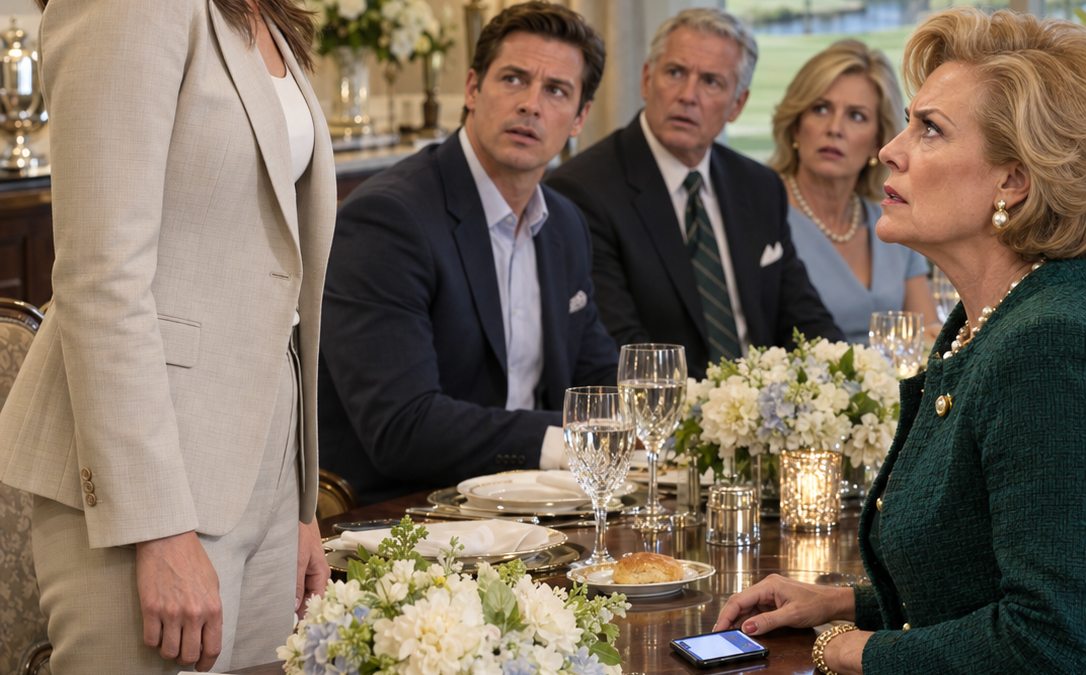
That night, I wore a simple blazer and walked beside my fiancé to meet his parents. They were expecting someone ordinary, someone easy to overlook. I held out my hand and introduced myself like any other guest.
His mother looked me up and down from my shoes to my face and didn’t take my hand.
“You’re trash,” she said as casually as if she were commenting on the weather. “You’re not important enough for me to talk to.”
I didn’t flinch. I didn’t argue. The room went completely still. Even the sound of a fork moving across a plate seemed to disappear. My fiancé started to speak, then stopped himself. His father kept his eyes on the tablecloth, pretending the insult had nothing to do with him.
I smiled. Then I took out my phone and dialed a number I hadn’t called in a very long time.
“Cancel her business contract immediately.”
I ended the call while she was still wearing that satisfied smile. Then her phone lit up on the table. I watched the color drain from her face before dessert was even served.
She had absolutely no idea who she had just insulted or what that one sentence had cost her. By the time she found out, there was nothing she could do to undo it.
Have you ever watched someone judge you before they even knew your name? Tell me in the comments what you would have done in my place. And if you believe respect should never depend on someone’s title, wealth, or family name, subscribe and stay with me, because the moment her phone lit up was only the beginning.
And what she discovered next changed everything.
My mother was buried on a wet Tuesday outside Charlotte, and I went back to work the same week. Helen Quinn was 58. There was no large policy waiting in a drawer and no paid-off house to lean on. The funeral home wanted a check. The landlord still wanted rent.
I was 27, and the only thing I owned that could keep the lights on was a young supply company that barely had a letterhead. People told me to sell it. A competitor offered a number that would have cleared the burial and left a little cash.
I said no. I needed the work more than I needed a clean exit.
What I changed was the face of the thing. On job sites and in receiving offices, I was the woman who coordinated purchase orders, tracked pallets, and argued about delivery windows. Behind that, the signing authority sat under a name I kept off the van doors and off the cheap website: Northridge Supply Partners.
I did not do it to feel mysterious. I did it because after Helen died, I learned how fast a room changes when it decides you have something it wants. Vendors got friendlier when they smelled a sale. A man I dated for three months asked about my little company. In the same breath, he asked whether I had help with the mortgage I did not have.
I ended that and went home to a rented two-bedroom in a ZIP code nobody put on an invitation.
The years after that were not cinematic. I learned the freight elevator in two buildings by heart. I signed leases for warehouse space and parks you drive past without looking. I hired a controller who did not need me in the photo. I took a salary that looked like a coordinator’s salary and left the rest in the business.
I drove the same sedan until the paint dulled and parked it under the oak in the side lot. I bought grocery-store flowers on the anniversary of the funeral and put them in a jar on the counter. Friends assumed I was careful with money because I had to be.
That was only half true.
I was careful because I wanted one test left in my life. If someone stayed, I wanted it to be for the woman who showed up in work clothes, not for a holding name.
By the time I turned 36, the orders were larger, and the outside story was still small. I lived in a brick house on a quiet street in South Charlotte, paid extra on the principal, and kept the blinds practical. No magazine asked for a profile. I would have said no if one had.
Helen used to pack lunch in reused containers and wave at the neighbors from the porch. I kept that scale on purpose.
I met Connor Langford at a supplier breakfast in a hotel conference room near the airport, the kind with metal carafes and name stickers that peel off your blouse. He was 41 and introduced himself as the chief executive of a commercial equipment firm without making the title into a speech.
He asked about lead times on gaskets. He did not ask what my house was worth.
When the session broke, he carried two paper cups and handed me one without commentary. We started with coffee in places that printed calories on the board. He talked about his first warehouse job and a father who measured a week by invoices. I talked about purchase orders, late trucks, and a mother who kept a notebook of what everything cost.
I did not say Northridge owned more of the chain than my badge suggested. He did not push.
That was new enough to notice.
Six months of that looked like ordinary American dating. He came to my kitchen and ate standing up. I went to his condo and watched him rinse the sink before we left. On a Thursday in January, we sat through a high school basketball game because his neighbor’s kid was on the bench and Connor had promised to show up.
He took me to a hardware store on a Saturday because a hinge had failed, not because he wanted to be seen. He met two of my friends at a taco place with plastic trays. He still had not walked me into the club lunches and donor dinners that sat on his family calendar.
He said his people liked a certain room in a certain hour, and he was not in a hurry to put me through it. I liked him for that delay more than I liked the title. He texted when he was late. He remembered Helen’s name after I said it once.
He argued with a waiter who tried to take my plate while I was mid-sentence, then looked embarrassed that he had made a scene. He was not a project. He was a man who had grown up around money and had not yet used it as a first question on me.
In March, he stood in my driveway after rain and asked if I would come to Sunday lunch at his parents’ house. He said it like a weather report. Simple. No speech about what the house meant.
I said I would think about the time. He nodded and did not sell the invitation harder.
That night, I sat at my table with the notebook Helen used to keep, and I did the math I had been postponing. I was 39. I had built Northridge far enough that one honest sentence about it would have changed the air in any dining room in this city.
I did not owe that sentence to a man who had been kind for half a year. I owed myself a cleaner test than money. I wanted to know what he did with ordinary me in a room that belonged to his family, not what he did with a contract and a letterhead.
I closed the notebook. I left Northridge where it was on paper, behind the coordinator story. And I set my alarm for a workday that started before traffic.
Sunday could wait until morning. The company would still be there.
So, with the choice to keep my name small on purpose, the first Sunday lunch at the Langford house lasted longer than the food.
The driveway could hold six cars without anyone parking on the grass. Inside, the napkins had a monogram, and the serving pieces still wore tiny stickers from a store Connor never shopped at.
I set a store bouquet on the sideboard and watched Beverly Langford move it two inches left, as if the arrangement had failed a test I had not been given.
“Natalie,” she said once we were seated. “Connor tells me you coordinate orders. That’s a sweet thing to do for fun.”
Clare Langford sat to her mother’s right and smiled with her teeth. She was 36 and already sounding like the house.
“Which part of town are you in?” she asked.
“South, I think,” Connor said.
“Is that still near the old rail line?”
I named the street. Clare repeated the ZIP code to herself and reached for the sparkling water.
Gordon Langford carved the roast and spoke to the table.
“Not to me. When Connor marries, it will be a Langford wedding. It should look like one.”
Nobody asked what I thought a wedding should look like. Connor rested his hand on the back of my chair and let the sentence stand.
Two weeks after that lunch, he asked in my kitchen. No restaurant, no photographer. I said yes.
The ring was simple, and I liked it. I also liked the barn I had booked on a farm west of the city. String lights and long tables and a parking lot that did not need a valet.
I sent Beverly the link. She called the next afternoon.
“A bit rustic for us. Don’t you think the club has a ballroom that photographs clean? Gordon can put the deposit on the account.”
I started to explain the barn. She had already emailed the club coordinator. By Friday, the farm date was released and my name was a plus-one on a club contract I had not signed.
The guest list came next.
I had 62 people: co-workers and neighbors and two cousins from Ohio. Beverly returned a spreadsheet with 40 extra rows. Country-club regulars. A council contact. Clients of Langford Occasion Group. Her events company listed by firm instead of by friendship.
“These are people who will expect to be in the room,” she said. “It would look odd if they read about it secondhand.”
I deleted three names I did not recognize, and she put them back.
Clare texted a folder of gowns on a Tuesday while I was counting cases at a loading dock.
Ivory. Bateau neck. A house in town I could not pronounce.
“Mother’s stylist can get you in Thursday,” she wrote. “You want it to read correctly in pictures.”
I had already paid a deposit on a dress from a shop on Central Avenue. Nothing famous, a neckline I could lift a box in if I had to. I stood in that shop two evenings later and heard myself tell the owner I might need to pause.
I kept my tone even. I said I would think about Thursday.
Beverly wanted a couple portrait for the Occasion Group spring book. Soft light. The club columns. A line of copy about family and celebration running under our faces.
“It humanizes the brand,” she told Connor on speaker while I was in the room. “Shareholders like a story.”
Connor muted the phone.
“Mom is particular,” he said. “Give her time. She comes around.”
I said, “Whatever you think is best.”
The words surprised me more than they surprised him.
I used to argue for a pallet jack. I used to hold a delivery window like it was a spine. Around the Langfords, I was learning a shorter sentence.
Cake tasting moved to a bakery Beverly preferred. Three tiers. A sugar flower she photographed before anyone cut a slice. The band became a quartet from the club roster. My neighbor who does flowers got a polite email from Clare saying the tables needed a tighter look.
Seating went from mixed tables to a head table that faced the room like a dais. I stopped offering dates. I started nodding.
Connor squeezed my shoulder in parking lots and promised we would pull it back after the season, after the announcement, after his mother decided I was not a problem in the photos.
I was trying to stay inside a family that kept moving the walls.
On a Thursday, I heard myself tell the club coordinator, “I did not have a strong feeling about charger plates. I used to have strong feelings about freight. Charger plates should not have taken anything from me, and they did.”
In April, we walked the club ballroom on a weekday morning. Beverly pointed at the columns the way a foreman points at a load-bearing wall. Gordon timed how long a toast should last. Clare held her phone sideways and took a test shot of the empty head table.
I asked about a corner for my aunt’s chair. Beverly said the layout was already tight.
Late in April, I sat through a planning call where Beverly referred to me as “the bride” and to the reception as “our Saturday.” Gordon asked whether my side would need a shuttle, which was a kind way of asking whether my people could find the club.
Clare took notes on a tablet and did not look up when I said my aunt walks with a cane.
After I hung up, I stood in my own kitchen with the refrigerator humming and the farm confirmation still in a drawer, avoided.
The club packet on the counter still had a logo in the footer I recognized from Beverly’s email signature. Langford Occasion Group. Event. Brand. Photograph.
I understood then what the months had been for.
I was not joining a table. I was being placed in a picture that already had a caption.
The barn was gone. The list was theirs. The dress was becoming an assignment. My yes in this kitchen had turned into inventory.
I ran water over a plate and let it sit. The house was still mine. The woman standing at the sink had started answering like a guest in it, and I could hear it even with the tap on.
Beverly asked me to come alone on a Wednesday afternoon.
The building sat off Randolph, glass and pale brick, with a directory in the lobby that listed three firms and a notary. I took the elevator to four and found a conference room already lit.
A man in a gray suit stood when I came in and gave his name as Jeffrey Hulcom. He said he handled family matters for the Langfords. The table held one water pitcher, four glasses, and a cream folder with a clip.
Gordon was already in a chair by the window. Clare came in two minutes later with a tote and said she was only stopping through. She sat anyway and opened a notebook.
Beverly did not waste the greeting.
“We thought it would be simpler to put a few understandings on paper before the invitations go out. After the wedding, you will be with our family. It helps everyone if the edges are clear.”
Jeffrey slid the folder toward me.
I opened it.
Page one: limited holidays.
Thanksgiving and Christmas would be at the Langford house unless Beverly agreed otherwise in writing. My cousins in Ohio were welcome on a Saturday in January, not on the days that photographed. If I wanted a night with my own people in December, I was to request it by the first of the month.
Page two covered images.
Formal pictures belonged to the couple and to the family hosting. Captions on any public post needed to match language the firm had used before. No jokes about the club. No shots of the loading dock, the sedan, or the brick house if guests from Occasion Group might see them.
If a photographer I hired took something off-list, I would delete it when asked.
Page three was the work clause.
I would not discuss purchase orders, warehouses, or the kind of job that reads as temporary in front of Langford guests. If someone asked what I did, the answer was that I helped with scheduling.
The paragraph used the word modest twice and put it next to a line about tone.
I read it again, slower.
At 39, I have signed leases and vendor packets and a death certificate. I know the difference between a calendar and a fence.
This was not timing. This was a map of where I would be allowed to stand.
“I’m not signing this,” I said.
I closed the clip and set the folder in the middle of the table.
Beverly’s mouth tightened.
“Don’t make this difficult. People like you should know when to step aside.”
Gordon turned his wrist and checked the time. He did not look at the pages. Clare wrote a line in her notebook, neat and bored.
“Where is Connor?” I asked.
“This is women’s business,” Beverly said. “He has a board call. He doesn’t need to sit through stationery.”
Stationery was a generous word for a document that told me how often I could see the only blood I had left.
Jeffrey cleared his throat and offered a revision.
“We could soften the holiday language,” he said. “We could add a review after the first year.”
He spoke as if I had come to bargain. I had come because Beverly asked me to come alone, and I had assumed alone meant a conversation, not a signing.
“I didn’t drive here to edit a muzzle,” I said.
Clare underlined something.
Gordon stood, then sat again as if standing had been a mistake. Beverly kept her hands folded on the folder I had returned.
“You should understand the position you are walking into,” she said. “Connor has a name in this city. Occasion Group has clients who sit in those chairs. If your side of the aisle looks like a warehouse picnic, it reflects on all of us. We are trying to spare you embarrassment.”
I thought of the cousins who would have driven down from Ohio with foil pans and did not list them. I kept my hands on my own purse.
The room smelled like printer toner and lemon oil.
“If he wants a wife who signs this, he can say that to my face,” I said. “Not through a lawyer on a Wednesday.”
Beverly smiled without warmth.
“He wants a smooth year. I am making the year smooth.”
Jeffrey asked whether I wanted a copy to review with my own counsel. I said I would take the copy and I would not be returning a marked version.
He slid a second stapled set across the grain of the table. Clare reached for the original as if it were inventory going back on a shelf.
The volume never rose.
That was the part that stayed with me in the hallway.
Gordon held the door and looked past my shoulder. Clare said she had a vendor call at four. Beverly told me to think it over as if a contract like that could be slept on and improved.
I rode the elevator with a woman carrying dry cleaning and did not speak.
In the lot, my sedan sat between a white SUV and another with a dealer badge still in the window. I unlocked it and sat with the copy on the passenger seat, the engine off and the lot camera blinking over the exit lane.
Their quiet had not been manners.
It had been the sound of people who expected the paper to do the talking.
I had spent months yielding small points in their rooms. In that lot, I understood the bill for that habit.
They had written down what they already believed: that my people were a scheduling problem, that my work was a stain to manage, and that after a ceremony, my name would be useful only if it stayed out of the caption.
A paragraph near the back asked for initials beside a line about grandchildren I did not have.
Visit frequency. Supervision of gifts.
The arrogance of it was almost dull, which made it worse.
I started the car. I did not call Connor from the asphalt.
A man who is sent out of the room does not get the first hearing of the room.
I put the packet in the glove box because I did not want it on the seat where I could see the clip while I drove. Traffic on Independence was thick and ordinary. I took it anyway.
The copy rode with me like a passenger who had already decided I should sit in the back.
Marcus called before sunrise and told me to open the file he had just sent.
Marcus Ellison runs the day-to-day at Northridge Supply Partners. He does not call at five in the morning to chat.
I sat up in the dark, put the phone on speaker, and opened the laptop on the quilt.
“Start with the master service agreement,” he said. “Then the last appendix. Then the bank note I flagged in red.”
The agreement covered three years of banquet work and hospitality service for a cluster of hotels and private clubs in the Carolinas. Linens, plated dinners, bar packages, staffed receptions, and weekend turnovers the hotels could not cover with in-house crews.
Langford Occasion Group was named as vendor. Northridge held final vendor approval.
Without that signature, the hotels would not let the first truck onto a dock.
The number sat in a clean box on the page: $46,400,000.
The last appendix was a signature block and a start date. No initials. No date.
The deal was a sentence short of live.
Marcus walked me through the layers the way he walks a receiving clerk through a shortage claim, slow and without drama.
Occasion Group had already issued offer letters for seasonal captains and bartenders. A revolving line at a regional bank listed the unsigned hospitality contract as the reason the limit should stay open through peak months.
Beverly had told the relationship manager the paperwork was days from done. She had said it in writing.
I scrolled the email.
Her tone on that thread was the tone of a woman confirming a weather report.
Signing soon. Crew hired. Do not squeeze the line.
Under that thread, Marcus had dropped a second folder.
Internal notes from an Occasion Group publicist. A spring launch for a family celebration package. Sample captions. A mood board. Two photographs of Connor and me from a Saturday I had thought was only lunch, cropped tight enough that my cheap watch did not show.
The copy under the mock layout read like a brochure that had borrowed a couple to look warmer than a rate sheet.
I enlarged the image.
I remembered the lunch. I had not remembered a campaign.
“How long have they had this?” I asked.
“The vendor packet has been in our queue for 11 weeks,” Marcus said. “The launch deck showed up in a shared portal last Friday. I would have brought it sooner if the appendix had stayed in legal. It moved to ready-to-execute yesterday.”
I made coffee and read the bank note a second time at the counter.
Covenants are dull until they are not.
A missed milestone can freeze advances. If the approval did not land, the bank could tighten the line. If the line tightened, payroll for the extra seasonal staff would have no cushion.
Beverly had spent the promise before she had the ink.
Marcus waited while I scrolled. He did not sell me a speech about leverage.
He asked whether I wanted the appendix parked or pulled.
“Park it,” I said. “Do not send a notice. Do not call their counsel. Leave the portal as it is.”
“You sure?”
“I want one dinner first.”
He knew which dinner.
Connor had put it on my calendar as parents, private room, club. Chief executive on the invite line.
I had not told Marcus I was walking in as a coordinator who kept her signing authority in a company name most guests would not bother to Google. I did not tell him now.
I closed the launch deck and sat with the cheap watch the crop had hidden.
The wedding was no longer only a list I did not control. It was an asset on a pitch. Our faces were doing work for a brand that had already told a bank the money was coming.
Connor texted at 6:40 about a tie and a reservation time.
I answered the time.
I did not send him the PDF.
I printed the signature page and the publicist notes and laid them on the table beside the salt. In daylight, they looked smaller.
They were not smaller.
That figure is a season. It is also a story a woman tells a banker when she needs the banker to keep smiling.
Clare appeared on an email chain Marcus had forwarded without comment. Copied on staffing numbers, asking whether the launch portraits needed a second look for family consistency.
She used the same tidy voice she used when she counted chairs.
Gordon was not on that chain. He did not have to be. The company wore his last name and his wife’s calendar.
I thought about calling Connor and asking whether he knew his mother had put our lunch in a sales packet. I thought about it long enough to picture him explaining it as a mix-up.
A staffer overreaching. Nothing personal.
I put the phone face down.
Marcus emailed a one-line summary I could read in a parking lot:
Approval still in our hands. Appendix unsigned. Line of credit tied to a promise. Portraits already in layout.
I dragged the summary into a folder labeled invoices so it would not sit on my desktop like a dare.
I went to work because the receiving window did not care about a private room. I counted a short shipment and signed a bill of lading under the coordinator title and left Northridge where it belonged, behind the badge.
At lunch, I stood in the lot and read the publicist paragraph again.
Family growth celebration.
The words were arranged to make a vendor look like a household.
I did not pull the approval.
Pulling it then would have taught Beverly about paperwork. It would not have taught me anything about Connor.
I needed him at a table with his mother in the room. No PDF in his pocket. No warning from me.
If he spoke, I would know what the six months had been.
If he did not, the appendix could wait one more night.
Evening came in ordinary traffic.
I set the printed pages in a drawer under rubber bands and spare pens. The dinner was still on the calendar. The portal was still quiet. The bank still believed a signature was on the way.
I turned off the kitchen light and left the file where a person leaves a tool she is not ready to swing.
The ceremony they wanted to sell had already been spent once in an email to a lender, and I was not going to add my name to that receipt until I saw who opened his mouth when it counted.
I slipped the phone back into my jacket before her first notification lit the table.
Beverly recovered fast enough to point her chin at the door.
“I think it’s time you left. This is a family dinner.”
I stood and buttoned the jacket. I did not sit again.
Connor’s hand rose an inch off the cloth and stopped. Gordon watched the other tables as if volume were the only risk in the room.
Her screen flashed a second time, then a third. She frowned at the name and answered with the voice she used on staff.
The man on the other end did not wait for hello. I heard it from two feet away.
The vendor portal had gone dark. Status on the hospitality packet showed withdrawn. He wanted to know if she had authorized a freeze.
Beverly laughed once, short.
“That’s a glitch. Call the hotel group.”
She was still speaking when the next phone went off—Gordon’s this time, face down by the bread plate.
He turned it over, read the preview, and the color under his collar changed. He handed it across without a word.
A lawyer’s name sat on the line.
He put it on speaker because Beverly demanded it.
The voice was dry and fast. An emergency notice had landed in every inbox tied to the Occasion Group banquet file.
Final vendor approval had been pulled.
Effective immediately.
“Who pulled it?” Beverly said.
There was a pause that had nothing polite in it.
“Northridge Supply Partners.”
She looked around the table as if the words might be printed on a menu.
“Who is that?”
Clare already had her own device out, thumbs moving.
“Fix it,” she said—not to me, but to the air, to Gordon, to whoever still believed a tone of voice could reopen a portal. “Call them back. Tell them it’s a mistake. We have captains starting Monday.”
Gordon put a palm down.
“Keep your voice down. The next room can hear you.”
Beverly’s banker called while the lawyer was still talking. She answered that one standing, two devices in hand.
The private room was no longer private in any way that mattered.
The relationship manager did not sound like a man delivering a courtesy. The line she had been promised would hold through peak season was under review.
He needed her in the office in the morning. He needed an explanation before noon.
She muted him with a thumb and stared at me.
Connor said my name like a question.
I did not answer him yet.
I waited until the lawyer asked again whether anyone at the table had a contact at Northridge.
Then I spoke once, without raising my voice, without making a show of the chair or the room.
“I control the approval,” I said. “I stepped back from the letterhead years ago. The signature still crosses my desk. Your banquet file sat there. The last appendix was never signed because I had not signed it.”
Silence pressed in the way silence does when silverware stops.
Beverly opened her mouth, closed it, tried again.
“Then why? Why pull it tonight?”
I looked at her long enough to let the question finish dying.
The table did not need a tutorial.
“I didn’t pull your file because of the sentence you used when I held out my hand,” I said. “I have been dismissed by people with better manners than yours, and it has never once cost them a season. I pulled it because you taught this room that a last name and a credit line are what make a person worth speaking to. I needed you to learn the opposite while the coffee was still hot.”
Clare’s chair scraped.
“You sat here and let us talk staffing. You could have said something in March.”
“I could have,” I said. “I wanted to see who opened his mouth when it counted.”
Connor’s face had the look of a man meeting someone he had been sitting beside all evening.
He stood, sat, stood again.
“Natalie. Mom. Somebody start at the beginning.”
Nobody started at the beginning.
The beginning was already on three screens.
Beverly came around the table far enough that the candle threw a hard line under her cheek. For the first time since I had walked in, she looked at me as if I occupied space.
Not a guest she could dismiss.
A person who had just moved a piece she did not know was on the board.
“You’re telling me a purchase coordinator holds our hotels?” she said.
“I’m telling you the coordinator story was the part you were willing to hear,” I said. “Northridge was the rest.”
Gordon pinched the bridge of his nose.
“We can unwind this. People unwind things. Call your man and put the status back.”
“I’m not putting it back at this table,” I said.
Clare snapped the notebook shut.
“Do you understand what a withdrawn approval does to the week? We have deposits. We have linen orders. We have a launch.”
“I understand what a withdrawn approval does,” I said. “I also understand what a dinner does when a guest is shown the door.”
Beverly’s banker buzzed again. She ignored it.
The lawyer asked if they should draft a dispute letter. She told him to hold, which was the first careful word she had used all night.
Connor reached for my wrist, and I let him miss it.
“Come outside. Please. We can fix the tone. She didn’t mean—”
“She meant the part she put in writing for a lender,” I said. “And she meant the part where she pointed at the door.”
A busboy paused with a water pitcher, read the temperature of the table, and left the pitcher on the sideboard.
Beverly’s voice dropped. Not softer, just narrower.
“If you needed respect, you could have worn it. You chose to look like staff and then punish the room for believing you.”
“I chose to find out whether this family could see a person without a caption,” I said. “You answered before the soup.”
Gordon muttered that they should take it to the lounge. Clare said the lounge had members.
Beverly did not move.
She kept her eyes on my face as if the features had rearranged and she was trying to memorize the new arrangement before it left.
I picked up my purse. I did not offer a handshake. I did not ask permission to go.
The notifications kept arriving. Little white boxes stacking on the wood, each one a different panic using the same two words the lawyer had already spent.
Beverly whispered the company name back to herself, testing the sound.
And for a second, the practiced hostess was gone.
What sat in her chair was a woman doing arithmetic in public and coming up short.
I turned toward the door.
Connor caught up with me at the valet stand while the valet was still holding my keys. He was out of breath and already talking.
“I’m sorry. She was out of line. Let me drive you. We can sit in the car and reset this before it gets worse.”
The boy in the vest looked from my hand to his and chose the pavement.
I took the keys.
“I’m not bargaining in a parking lane,” I said. “Answer one thing. When she called me trash, you were two chairs away. What did you do?”
He swallowed.
“I froze. I was going to say something. The phone started, and then it was chaos.”
“Chaos was after. The sentence was before. You had time for a word. You spent it later on my name when the damage was already public.”
He reached for the door handle of my car as if touching metal might count as courage.
I shook my head.
He stepped back.
I pulled into traffic and left him under the canopy lights.
He went to his parents’ house. I know that because he called from their driveway at 11:40, and I let it go to voicemail.
In the morning, he told me the rest in the order it happened.
He walked into the kitchen while Beverly was still on with counsel. He told her she had humiliated me in a room full of glassware because my jacket did not impress her. He told her she had not asked who I was.
She had decided I did not matter and then used the dinner to prove it.
Beverly did not apologize.
She said she was protecting the family’s face.
“A company that books hotels cannot look sloppy at its own table,” she said.
Then she said, “A son who brings home someone the club will gossip about is the one who started the mess, not the mother who tried to keep the edges clean.”
Clare stood at the island with a laptop and said I had sat on the approval like a trap. She used the word bait.
“No one sits quiet on a file unless they plan to slam it,” she said.
Gordon told both of them to stop performing for the cabinets, and then asked Connor whether the status could be reversed before Monday.
That was his contribution.
A timeline.
Connor said he was done translating her judgments into manners. Beverly called that teenage.
He left without slamming a door on the porch. He told me later he could hear Beverly start another call before he reached the car.
Clare sent him a text that I saw later on his screen. Two lines about loyalty in the season.
At 7:05 the next morning, Marcus emailed me a copy of what legal had already sent.
Formal notice. Approval withdrawn under the agreement. Appendix unsigned and returned.
No press. No threat.
A paragraph about transition windows and the hotels’ right to appoint another vendor. A second paragraph listed a contact in operations if Occasion Group needed to retrieve stored linens.
Dry as a packing list.
I forwarded nothing to Connor.
I forwarded nothing to Beverly.
The paper did the walking.
We met at two at a coffee counter on South Boulevard because I would not let him in my kitchen and I would not go back to the club.
He had showered and still looked like a man who had slept in a chair.
He set two cups down and started with the kitchen as if a full report could stand in for the minute he had stayed quiet.
I let him finish.
Then I took off the ring and set it on the wood between the napkins and the sugar packets.
It made a small sound.
Neither of us pretended it was anything else.
“I’m canceling the club date,” I said. “I’ll send the email myself. You don’t need to call your mother to do it for me.”
He stared at the band as if it might explain a policy.
“Natalie, I told her I was wrong. I’m giving notice at the equipment firm. I don’t want to inherit a room that treats people like that. Give me 60 days. I’ll get a lease of my own. We can start smaller.”
“Leaving a payroll doesn’t erase a silence,” I said. “You had a mouth when she measured me, and you saved it for the aftermath. That is not a man I marry. That is a man who hopes the aftermath will count as character.”
His eyes went wet, and he did not perform it.
“I love you.”
“I believed that in January,” I said. “Belief is not the same as a spine at a table.”
I had already typed the cancellation in the parking lot before I came in.
Venue coordinator. Date released. Deposit terms per their form. Copy to Connor’s address so he would not hear it from his mother first.
I hit send while he was still looking at the ring.
My thumb did not shake.
That surprised me more than it should have.
The reply pinged before I stood up.
“Noted. Calendar opened.”
A polite line about future events I would not be booking.
Connor asked if this was about the money, about pride, about punishing his last name.
I told him it was about a chair I refused to keep warming.
He asked if we could talk in a week.
I said the engagement was over and a week would not put the word back in his mouth at the minute it was due.
He pushed the ring an inch toward me.
I left it where it sat.
Outside, a bus hissed at the curb and a woman argued with a meter.
Ordinary Charlotte.
I was 39, and I did not owe anyone a sequel in which the same family learned manners on a second try.
I had watched a grown man wait for a crisis to give him permission to speak. I was not going to spend a marriage coaching him through the next permission.
He came out after me and stopped on the sidewalk. He did not follow me to the car this time.
That was the first clean choice he had made in two days, and it was still too late to be a vow.
I drove home with a pale mark on my finger and an inbox that now held a notice, a cancellation, and nothing that required me to sit beside Beverly and practice being grateful.
The band stayed on the café table.
I did not turn around to check who reached for it.
By late fall, the Langford Occasion office lights were off three nights a week. The hotels appointed another vendor before Labor Day. After that, the seasonal captains had nothing to captain.
The regional bank did what regional banks do when a promised file never becomes ink.
They froze the revolving line, asked for updated statements, and stopped smiling on the phone.
Beverly let eight people go in October.
Clare was on that list.
She posted a calm note about pursuing other opportunities and then went quiet.
I did not drive by to confirm it.
A linen supplier we both used mentioned the empty lot behind their building the way people mention weather.
Later that month, a board in the yard on Queens Road West went up with a broker’s name.
“Personal guarantee,” someone said at a loading dock, not as gossip with teeth, just as the reason a house that size would list in a hurry.
No one was taken away in a car. No one kicked in a door.
The city kept moving.
The consequences were the dull kind that show up in inboxes and on lawns.
Gordon sat through two difficult sessions with the equipment firm’s outside directors. I heard that from a man who sells gaskets and does not care about families.
The directors wanted distance from the banquet mess and from a last name that had become a punchline in a dining room that used to laugh with them.
Club dues notices went out.
The Langford membership did not come back renewed.
People still nodded in the hallway.
They did not save seats.
Connor came to my house one Thursday after dark.
I saw his shoulders through the side glass and did not touch the deadbolt. He stood on the step long enough for the porch light to click off on its timer.
He did not knock a second time.
He did not slide paper under the door.
In the morning, the step was empty.
That was the only visit.
I kept the house on my street and the coordinator badge.
Northridge still ran the way it had run when nobody at a club table knew the word. Marcus sent quarterly packets. I initialed what needed initialing and went to the grocery store on the way home.
I did not take a photographer to the warehouse.
I did not change my voicemail.
A victory that needs an audience is just another performance, and I was done performing.
Winter thinned the trees on my street.
I worked. I paid the extra principal. I ate standing up at the counter and went to bed at a decent hour.
In March, a mutual acquaintance said Clare was doing banquet shifts for a hotel that used to be a client.
I said, “I hope the shifts paid on time.”
I meant it.
A layoff is a fact. It is not a trophy.
Gordon sold a boat he had kept at the lake and used the proceeds the way men use proceeds when a guarantee comes due.
The Queens Road listing sat through the holidays with fewer open houses than the broker wanted.
Beverly took meetings in borrowed conference rooms. I know that only because the same linen man saw her name on a visitor log and shook his head without telling a story.
I did not need a story.
I needed the year to finish.
Connor, from what the gasket man said in passing, did leave the equipment firm.
He took a smaller office across town.
He did not use that fact as a key to my lock.
I did not ask for the address.
Helen used to wave from a porch that needed paint and pack lunch in a container that had already been used.
She did not wait for a reservation to decide she was allowed to take up space.
I thought of her on a Sunday when the house was quiet and nobody was due.
Worth, as she practiced it, was a person who showed up and did the work and did not rent her spine from a dining room.
Near the anniversary of that dinner, I walked the greenway and did the last piece of math I intended to do on the Langfords.
Value does not live in their last name.
It does not live in a hospitality packet worth $6,400,000.
A woman who can look at a blazer and call you trash has already handed you the only data that matters.
You can spend a year trying to appeal the verdict, or you can believe her.
The call was not made to erase Beverly.
Erasing a person is a kind of attention she would have understood.
The call was made so I would stop asking a table for a chair it had already pulled away.
I had a company that did not need a monogram and a house that did not need their guests.
That was enough architecture.
Sometimes the strongest correction does not arrive as a speech.
It arrives as a woman putting her keys in the ignition and declining the sequel.
I read no letter. I wrote none.
I did not attend a lunch where everyone had learned a lesson and wanted credit for the learning.
Justice, if that is the word, did not need a raised volume.
It was the decision to stand up and not go back.
I turned off the path at the oak near my lot and went inside while the sky was still light.
The notebook Helen used to keep sat in the junk drawer.
I did not open it for a speech.
I opened it to write a grocery list.
Milk. Coffee. Paper towels.
The ordinary line items of a life that had stopped auditioning.
If a room ever measures you in one glance, you already have the answer.
You do not owe that room a better jacket.
You do not owe it a second introduction.
You owe yourself the walk to the door and then the year that follows, in which the lights on someone else’s office go dark without you standing there to—








