I flew 18 hours to attend my sister’s wedding, at the venue, my parents stopped me: only family is allowed, you weren’t invited, leave, heartbroken, i left, 3 days later, mom called: “the bill is $37,640, how will you pay?”, i said something… mom gasped.
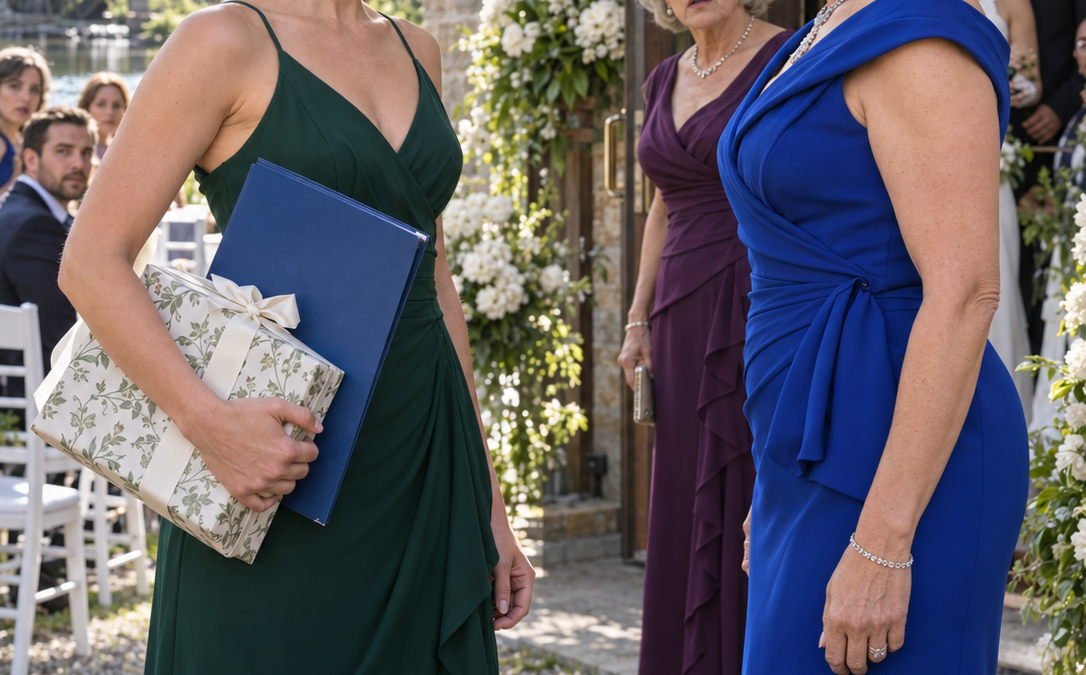
My mother met me at the entrance to my sister’s wedding with both hands folded over her purse and told me I could not go inside.
I had been awake since four that morning. I had crossed two airports, rented a car, steamed my dress in a hotel bathroom, and wrapped a set of cookware Belle had admired on a video call months before. I was carrying that gift in one arm and a thin blue wedding folder under the other.
The folder had my name on it. It had my signature on every contract for the reception, the flowers, the photographer, and the venue.
My mother looked at the folder, then at me, and said very quietly, “Aisha, please do not make this difficult.”
Behind her, music drifted through the open doors of the old mill house. Guests were finding their seats. My baby sister was somewhere inside, getting ready to walk down an aisle I had helped pay for.
“I am not making anything difficult,” I said. “I came to Belle’s wedding.”
My mother did not move.
“The Coles do not know the whole situation,” she said. “We told them you were not able to come. It is better if you leave before someone asks questions.”
For a second, I honestly thought I had heard her wrong.
Then a woman in a plum-colored dress stepped out behind her. She was elegant, silver-haired, and smiling the way people smile when they expect to be introduced to somebody important. I knew her from pictures.
Marlene Cole. Gavin’s mother.
“Denise, is everything all right?” she asked.
My mother turned toward her so quickly that I watched the expression change on her face. The worry vanished. In its place came a bright little smile I had seen my whole life, the one she wore when she wanted a room to believe she had everything handled.
“Perfectly fine,” she said. “This is my sister’s daughter, Aisha. She got turned around about the schedule.”
My sister’s daughter.
I was thirty-six years old, and I had just been reduced to a stranger standing on a gravel path in a dress I had bought for my own sister’s wedding.
Marlene looked from my mother to me. Her smile faded a little.
“Oh,” she said. “I thought Belle was your only child.”
My mother gave a small laugh. It sounded dry, almost painful.
“Families can be complicated,” she said.
I could have told Marlene everything. I could have opened the blue folder on the stone step and shown her the contracts. I could have asked her why a family that did not know I existed had been comfortable letting me sign for their son’s wedding.
But my sister was inside. Her ceremony was about to begin. I had no interest in making her marriage start with everybody turning to watch me cry.
So I set the gift on the step.
“It is for Belle,” I said.
My mother’s shoulders loosened just a little. She thought I was giving in the way I always had.
Then I handed her the folder.
“Keep this too,” I said. “You will need it.”
I walked back toward my rental car before either woman could answer.
That was a Saturday afternoon in late May. By the following Thursday, the unpaid balance in that folder had become the most expensive truth my family had ever tried to hide.
My name is Aisha Bennett. I am thirty-six, and at the time, I worked as a project manager for a software company in Seattle. My job was not glamorous, but it was steady. I handled schedules, risks, budgets, and the kind of small details that make a big project look easy from the outside.
Seattle had taught me how to build a life that did not need anybody’s permission. I rented a bright apartment with too many plants, paid my bills on time, and had friends who knew the sound of my real laugh.
Back home, though, I was still the oldest girl who could be called when something needed fixing. My family had always treated that steadiness as if it belonged to all of us.
When the water heater in my parents’ house quit, they called me. When Belle’s car needed tires, my mother called me. When my father had a gap in his insurance after changing jobs, I sent money because I did not want him worrying about a bill at his age.
I did not resent helping at first. I had been the older sister since I was nine years old. Belle was the baby, the funny one, the one who could make our father grin even when he had been quiet all day.
I was the dependable one. I made lists. I kept promises. I was the child who learned early that being useful was the closest thing to being praised.
When I moved across the country after college, my mother said she was proud of me. I believe she meant it then. But over the years, pride turned into distance.
She would tell people I was busy. She would say Seattle had changed me. She would talk about Belle’s life as if it were the life happening close enough to touch, while mine was an item she could mention if someone happened to ask.
I noticed it in small ways.
At Christmas, I would get a blurry photo of the table after dinner instead of a call while everyone was there. At my grandmother’s memorial, a neighbor asked my mother how many girls she had, and she answered, “Just Belle,” before looking over and seeing me holding a paper plate near the coffee urn.
She said it was a slip.
I accepted that explanation because I had spent years accepting explanations that hurt less than the truth.
Before I go further, tell me where you are listening from tonight. I always notice the cities and states people write in the comments, and it reminds me that somebody somewhere understands how a family can make you question what you already lived through.
When Belle called to say Gavin had proposed, I was genuinely happy for her. She was twenty-eight, bright and warm, and she had always wanted the whole wedding picture: flowers, music, a dress that made her feel like the room had opened just for her.
She called me from my parents’ kitchen, holding her hand up to the camera so the ring caught the light.
“He did it at the botanical garden,” she said. “His sisters were hiding behind a hedge taking pictures. It was ridiculous and perfect.”
I laughed.
“That sounds like Gavin. Congratulations, baby.”
My mother leaned into view from behind her.
“We are looking at the old mill house outside Bellwood,” she said. “It is lovely, but these places want deposits before they will hold a date.”
I asked when the wedding would be.
My mother looked at Belle first.
“Late May,” she said. “You do not need to rush to buy a ticket. We have a lot to sort out.”
That sentence left a small cold spot in my stomach, but I ignored it.
Two weeks later, my mother called during my lunch hour. She did not ask about the weather in Seattle or my work. She went straight to the practical part.
“The vendors need someone with established credit,” she said. “Your father and I are still cleaning up the refinance, and Belle does not have enough history. You know how these contracts work.”
I did know how contracts worked. That was why I asked to see them.
Four companies: a venue called Stonebridge Mill, a caterer, a florist, and a photographer. The deposits totaled a little under $4,000. The final balances would be due after the event.
Total exposure, if no one paid, came to $37,640.
I told my mother the number made me nervous.
“It is not your debt,” she said. “It is just your card holding the reservations. We will pay the invoices as they arrive. You are helping your sister begin her life.”
There are phrases that can reach into you because they sound like the person you have been trying to be all along.
Helping your sister.
I signed.
I read the contracts carefully. I knew the balances were real. I also knew I had enough savings to cover an emergency if I had to. My mother knew that too.
She had never said it directly, but families often know exactly where the strongest beam is before they start leaning on it.
For the next three months, I watched the wedding come together from my phone. Belle sent me pictures of invitation samples and table linens. I offered to help with the guest list, the music, the welcome bags.
She would respond with a heart and then disappear for days.
There was a group chat for the bridesmaids. I found out about it because Belle accidentally sent me a screenshot of them voting on dresses.
I asked whether she wanted me in the wedding party.
“I thought you would be too far away for all that,” she wrote.
I told her I could fly in for the weekend before the wedding if she needed me.
She did not answer that question.
My mother called only when there was another form to sign or a payment to confirm. Every time I asked about travel plans, she made it sound like I was adding work to an already busy day.
“We will tell you the schedule,” she said. “Just do not make this about you.”
I did not receive an invitation in the mail. I did not receive one by email either.
I told myself sisters did not need formal invitations. I told myself I was being sensitive because I lived far away.
Two weeks before the ceremony, Belle posted a picture from her bridal shower. She stood in the center wearing a white sundress. My mother was on one side. Gavin’s mother, Marlene, was on the other. Around them were cousins, friends, and women I had known since middle school.
The caption said, “All my people.”
I stared at it until the screen dimmed in my hand.
That night, I called Belle. She answered on the fourth ring, breathless, with music and women’s voices behind her.
“Hey,” she said. “Is everything okay?”
“I saw the shower pictures.”
The background noise went lower, like she had stepped away from the room.
“Oh,” she said. “Mom said you were busy.”
“Nobody asked me.”
She sighed in a way that sounded too much like our mother.
“Aisha, it was just local people. You would not have flown in for a shower.”
“Maybe not,” I said. “But I would have liked being invited to say no.”
There was a pause.
Then she said, “Can we not do this right now? Everybody is still here.”
Everybody.
That word opened something small and sharp in me.
“I am not everybody,” I said. “I am your sister.”
“I know that.”
“Do you?”
She did not answer.
Someone called her name from the other room, and she said, “I have to go. I love you.”
I said I loved her too because I did.
Love was never the part that was missing.
After we hung up, I sat on the edge of my bed in Seattle and looked around my apartment. The stack of vendor receipts was on my nightstand. A tracking number for her gift was in my email. My flight confirmation sat unread in another tab.
I had made myself useful in every way except the one that would have required them to make room for me.
Two days later, my mother called before work.
“Belle said you upset her at the shower.”
“I upset her from two thousand miles away?”
“You know what I mean.”
I was standing in my kitchen with a mug of coffee cooling beside my laptop. Outside, the city was gray and wet. I remember that because my mother sounded so certain, so warm in her disappointment, that the whole room around me seemed to go colder.
“Why was I not invited?” I asked.
“Because it was not practical.”
“Practical for who?”
“For everyone,” she said. “You make things heavy, Aisha. You ask questions when people are trying to celebrate.”
I almost laughed because there it was again.
My questions were the problem. Not the hiding. Not the silence. Not the way I had become a signature on a contract and a missing chair at the table.
“Mom, I signed for this wedding.”
“And we are grateful.”
“Then why am I being treated like a billpayer instead of family?”
She got quiet.
When she spoke again, her voice had that careful edge I had known since childhood.
“Do not punish your sister because you feel insecure.”
I looked at the phone for a long second. I wanted to say something cutting. I wanted to tell her I was not insecure.
I was tired.
But I had a nine o’clock meeting and a team waiting on a rollout schedule, so I swallowed the sentence.
“I am flying in for the wedding,” I said. “I expect to be treated like Belle’s sister.”
“Of course,” my mother said.
It was a simple lie.
The worst kind usually are.
That evening, my friend Laya came by with takeout and found me sitting at the kitchen counter with the picture still open.
“Did they leave you out?” she asked.
I tried to make it sound smaller than it was.
“It was probably just the local ladies.”
Laya did not argue. She just looked at me for a long moment and said, “Aisha, you keep giving them the kindest explanation. I hope they earn it someday.”
I did not tell her that I had already bought the ticket.
I flew from Seattle to Nashville on Friday morning. The trip was not eighteen hours, but it was long enough to make me tired and hopeful in equal measure.
I spent the layover in Denver revising a toast in my Notes app. I had written about Belle as a little girl, how she used to make me sit through her pretend weddings with stuffed animals arranged in rows. She always gave herself the bride’s veil made from a dish towel.
She gave me the role of officiant because, in her words, I was good at telling everybody what to do.
I thought it would make her laugh.
At the hotel, I hung my forest-green dress on the closet door and placed the cookware set on the desk. I texted my mother that I had arrived.
Her answer came almost an hour later.
Ceremony at 2.
Nothing else.
No, We cannot wait to see you.
No, Come have breakfast with us.
No, Your father has been asking when you get in.
I sat on the edge of the bed with my phone in my hand.
In the chair by the window was the blue folder I had brought in case anybody needed a vendor number. I had put it in my carry-on because that was the kind of thing I did.
I prepared for other people’s emergencies before they knew they had one.
That night, I could not sleep. I kept adding numbers in my head: the ticket, the hotel, the gift, the deposits, the years of transfers and last-minute help that I had never counted because counting might force me to admit I was not helping out of simple generosity anymore.
I was trying to purchase proof that I mattered.
Still, when I woke up on Saturday, I put on the dress. I did my makeup. I wrapped the gift in the gold paper I had packed in my suitcase.
I looked in the mirror and told myself my family was stressed, not cruel.
Some lessons take more than one morning to learn.
I had learned that lesson in smaller versions before.
When I was twenty-four, I sent my father money for a truck repair and found out months later that my mother had used part of it for Belle’s tuition deposit.
When I was thirty-one, I flew home for Thanksgiving and spent the evening helping cook while my mother introduced me to a neighbor as “my daughter who lives away.” She did not say my name until he asked.
None of those things seemed large enough to justify a fight by themselves.
That was how the pattern survived.
Every hurt arrived with a reason attached to it.
Mom was stressed. Dad did not mean it. Belle was young. I lived far away.
I was good at taking the loose ends of everybody else’s choices and tying them into something that looked like peace.
The wedding was different only because the loose end was standing in a parking lot holding a gift.
Before I left the hotel that morning, I had taken the blue folder from my carry-on and checked the vendor numbers one last time. I told myself I might need to answer a question about the final count or the catering deposit.
I did not know I was really carrying a record of the way my family had measured my usefulness.
When I handed it to my mother at the mill house door, I did not yet know what I would do with it.
I only knew I was tired of holding it alone.
Stonebridge Mill sat at the end of a narrow country road outside Bellwood, beside a creek and a line of tall sycamores. The place was beautiful in a way designed for photographs. There were white chairs on the lawn, candles in glass cylinders, and strings of lights under the covered porch.
I saw my father near the entrance first.
Floyd Bennett wore a dark suit that had been altered badly at the sleeves. When he saw me, he stopped talking to the man beside him. His eyes moved to the gift in my hands, then to the folder under my arm.
For one hopeful second, I thought he was going to walk toward me.
Instead, he looked away.
That was when my mother came outside.
You already know what she said. You know what she called me when Marlene Cole walked through the doorway.
What you do not know is that my father stayed inside the whole time.
He could hear every word.
When I got back to the hotel, I did not rip off my dress or throw anything against the wall. I sat in the armchair by the window and cried until there was nothing dramatic left in it, just exhaustion.
Then I opened the blue folder.
The venue contract had my electronic signature at the bottom. So did the catering agreement. The florist had sent a reminder that the final invoice would be charged within five business days.
The photographer’s payment schedule said the same.
I read every clause twice.
The deposits were nonrefundable. That money was gone. I had paid it willingly, even if I had been foolish about whom I trusted.
The remaining balance, however, depended on the cardholder’s authorization.
I had not been told I was excluded from the event. I had not agreed to finance a celebration for people who were willing to introduce me as somebody else’s child.
I put the folder on the bedside table and went downstairs to buy a bottle of water.
The clerk at the desk asked whether I had enjoyed the wedding.
“I did not attend,” I said.
Then I walked back to my room before she could ask why.
On Sunday morning, I changed my flight.
I was not staying for brunch. I was not going to wait in the hotel for a family that had made its answer clear.
At the airport, I drafted an email to the vendors. I did not send it yet. I wanted one night at home to make sure I was acting from judgment, not shock.
By Monday evening, I was at my own kitchen table in Seattle. Rain tapped against the window. My suitcase was still half open on the floor. The gift receipt was tucked in my purse, and the blue folder sat in front of me under the warm light of the little lamp I had bought after my first promotion.
I called the bank first.
I explained that I needed to replace the card on file because I was withdrawing authorization for future wedding charges.
The representative asked whether there had been fraud.
“Not exactly,” I said. “Just a situation I should have handled differently.”
She canceled the card and issued a new number.
Then I wrote four emails.
Each one was short.
I stated that I was the contract holder, that I was withdrawing authorization for any remaining charges, and that all future communication should go to the event hosts, Denise and Floyd Bennett, and the couple, Belle Bennett and Gavin Cole.
I attached the contact information my mother had supplied when she asked me to sign.
I did not accuse anyone. I did not tell the vendors the whole story.
They did not need the pain behind the paperwork in order to respect the paperwork.
The venue manager replied within an hour. She confirmed that the deposits would remain applied to the event and that the remaining balance would be invoiced to the hosts.
The caterer and florist sent similar responses.
The photographer asked whether I would like a copy of my signed cancellation notice for my records.
By Tuesday morning, the practical part of the mess had started moving on its own.
The first call came while I was leading a budget review at work. I saw a Tennessee number light up on my screen and let it go to voicemail.
Five minutes later, another number called, then another.
By lunch, my phone looked like it belonged to somebody being chased.
The venue coordinator, a woman named Elaine Porter, left a message so careful it was almost kind.
“Miss Bennett, this is Stonebridge Mill following up on the remaining event balance. We received your authorization withdrawal and have updated the billing contacts as requested. I want to confirm we will not attempt further charges to your account. Please call if you need written documentation for your records.”
I saved the voicemail.
Then the caterer called.
His voice was less careful.
“We have served the event,” he said when I returned the call. “Food, staffing, rentals, linens. The balance is due.”
“I understand,” I said. “I am no longer the payment contact.”
“Your signature is on the original estimate.”
“And my written authorization was withdrawn before the final charge. I sent the updated host contacts yesterday.”
He sighed, not angrily, just like a man who had invoices stacked on his own desk.
“I am not trying to be difficult,” he said.
“Neither am I.”
There was a short silence. I could hear paper moving.
“Did they tell you they were changing the billing?”
“No,” I said.
He paused again, and his voice softened by half an inch.
“All right. I will note the file.”
That was the thing about paperwork.
It did not hug you. It did not tell you that you deserved better. But sometimes it stood still long enough for you to catch your breath.
The photographer emailed me a PDF titled Client Authorization History. It showed the deposit, the signed agreement, the card used, and the date I removed permission for future billing.
I printed two copies.
One went in the folder. The other went into a plain envelope I labeled Timeline.
At 3:30, my bank called to confirm there had been no successful charge attempts. After the new card was issued, the representative asked whether I wanted to file a merchant dispute for the deposits.
I looked at the line where the venue deposit sat on my statement.
“No,” I told her. “Those were authorized.”
It hurt to say it.
It would have been easier to treat the entire thing like theft, but I had signed those first papers. I had said yes while trying to believe my family would do right by me.
I could admit my mistake without accepting the larger lie.
After work, I spread every page across my kitchen table. Contracts on the left, email confirmations in the middle, bank records on the right.
My apartment smelled like printer ink and reheated soup. Rain ran down the window in thin silver lines.
I made a timeline in a notebook.
January: Mom asks for help with venue hold.
February: Deposits paid.
March: Invitation question avoided.
April: Bridal-party question dismissed.
May: Shower posted. Not invited.
Wedding day: Denied entry.
Monday: Authorization withdrawn.
When I finished, the pattern looked almost too obvious.
It was not one ugly moment at a door.
It was months of people letting me stand close enough to pay and far enough away not to be seen.
My phone buzzed while I was washing my soup bowl.
It was my mother again.
This time, she did not call. She sent a photo.
It was an invoice from Stonebridge Mill with the balance circled in red.
Under it, she wrote, “Look at what you caused.”
I dried my hands on a towel and stared at those five words.
Then I typed, “No. Look at what you signed up for after deciding I was not family.”
I did not send it.
Not because it was untrue.
Because the folder already said it better.
I printed every email and placed it in the blue folder. Then I sent one final message to my parents and sister.
I told them I had withdrawn payment authorization. I told them the vendors would contact them directly about the final balances. I wished Belle and Gavin well in their marriage.
I also wrote that I would not discuss money until someone was prepared to discuss what happened at the entrance.
I read it three times before sending it.
There was no insult in it. No threat. No sentence I would regret when I was calmer.
I pressed Send and made myself tea.
My mother called eleven minutes later.
I let it ring once before answering.
“What did you do?” she asked.
There was no hello.
“I removed my card from the accounts.”
“Aisha, the invoices are almost forty thousand dollars.”
“I know. I read every contract.”
Her breathing changed.
I could hear traffic in the background, which meant she was probably sitting in her car outside the grocery store or the pharmacy, trying to keep her voice down while anger worked its way through her.
“You are punishing your sister because you were embarrassed for five minutes.”
I looked at the blue folder on my table.
“I was not embarrassed for five minutes,” I said. “I was told I did not belong in my own family. You told Gavin’s mother I was your sister’s child.”
“You do not understand what it has been like,” she said. “The Coles have a certain image of family. Belle was trying to make a good impression. You living all the way in Seattle, never married, never around—it made things complicated.”
There it was.
Not an apology.
An explanation shaped like one.
“I was not a complication until you needed my credit,” I said.
For a moment, she said nothing.
Then she tried the old path.
“Your father is upset. Belle is hysterical. Gavin’s parents are asking questions. Do you want your sister’s first week of marriage to be ruined by a bill?”
I thought about Belle in her white dress.
I thought about the way she had stopped answering questions, as if silence could excuse her from knowing what was happening.
“I did not ruin her wedding,” I said. “The wedding happened. I was not allowed through the door. The bill belongs to the people who chose that.”
My mother began to cry.
I had heard that cry before.
Sometimes it was grief. Sometimes it was fear. Sometimes it was the sound she made when she realized she could no longer control the room.
“After all we have done for you,” she said.
I almost laughed, but I was too tired.
“Mom, you could have told the truth. You could have said, ‘This is my oldest daughter, and I am proud of her.’ Instead, you asked me to disappear so you would not have to explain me.”
She hung up.
For a long time, I sat in the quiet kitchen with the phone face down.
The next call came from Belle that evening.
She was crying hard enough that I had to wait for her to find words.
“Gavin is furious,” she said. “His mother says she wants to know why Mom lied. His father says the venue is calling them. We do not have that kind of money, Aisha.”
“Did you know they were going to stop me at the door?”
The crying stopped.
It was not a long pause, but it was long enough.
“Mom said you might not come,” Belle said. “She said you were upset about something and it would be easier if we kept the day simple.”
“But you knew I was flying in.”
“I thought she would talk to you,” she said. “I did not think she would call you her sister’s child.”
“You saw me outside, Belle. You could have come out.”
She had no answer for that.
I loved my sister.
That was the painful part.
Love did not make the silence less real. It made it harder to look at.
“I am sorry you are scared,” I told her. “But I am not paying the balance. When you want to talk about what you allowed to happen, I will listen. I will not talk about a payment plan that belongs to you, Gavin, Mom, and Dad.”
She called me selfish.
Then she apologized for saying it.
Then she asked again whether I could at least cover half.
I ended the call when I realized she was still asking me to make the problem disappear instead of seeing me.
My father called the next afternoon.
That surprised me more than my mother had.
Floyd was not a cruel man. He was a quiet man who had made quietness into a habit so deep that it became a way of avoiding responsibility.
He could talk for an hour about baseball, lawn tools, or the best route through Tennessee traffic.
When the subject was feelings, he became almost invisible.
“Your mother is having a hard time,” he said.
“I know.”
“Maybe you can find a way to work this out.”
“Dad, did you know she told the Coles I did not exist?”
He did not answer.
“You were standing right there,” I said. “You watched her turn me away.”
“I should have said something.”
“Why did you not?”
His breath came out slowly over the phone.
“Because I did not want a scene.”
“Neither did I. That is why I left.”
He said he was sorry, but it sounded like a man apologizing from the far side of a closed door.
I told him I needed time.
He said he understood.
Then we hung up.
Two hours later, he sent me a text.
Your mother says you are refusing to talk. I want to understand what you need from us.
That sentence annoyed me more than the call had.
I stared at it while my laptop sat open to a spreadsheet I had not updated in ten minutes.
What I needed.
As if this were a negotiation over a holiday menu.
I wrote back, I need the truth said plainly.
He did not answer until the next morning.
Plain, how?
So I told him.
I need you to say that Mom lied about who I was. I need you to say I was invited to finance a wedding I was not welcome to attend. I need you to say you stood close enough to stop it and chose not to.
The typing bubbles appeared, disappeared, then appeared again.
Finally, he wrote, I do not know how to fix that.
For the first time since the wedding, I felt something other than anger move through me.
Not forgiveness. Not softness.
Just the tired recognition that my father had spent so many years avoiding hard sentences that he no longer knew how to build one.
I wrote, Start by not asking me for money.
He did not answer.
That evening, Laya came over with groceries because she said my refrigerator looked like it belonged to a person living on coffee and stubbornness.
She put eggs, spinach, yogurt, and a rotisserie chicken on my counter while I told her about my father’s messages.
“Do you want him to choose you over your mother?” she asked.
I thought about it.
“No,” I said. “I want him to stop choosing comfort over truth.”
She nodded and pulled two plates from my cabinet.
“That is harder for some people.”
“It should not be.”
“I did not say it should be. I said it is.”
That was why I loved Laya.
She did not turn my pain into a slogan. She put chicken on a plate and told me when a thing was hard without asking me to make it smaller.
Later that night, after she left, I opened the blue folder again.
The pages were already starting to curl from being handled.
I took out the first venue contract and read the signature line.
Aisha Bennett.
My name looked calm there.
It had no idea what it had been used to carry.
The person who did not need time was my aunt Renee.
Renee was my mother’s older sister. She lived forty minutes from my parents and believed with her whole chest that people should say what they mean before resentment got expensive.
My mother called her blunt.
Renee called herself tired.
She had been at the wedding. My mother had invited her because not inviting her would have raised more questions than she wanted.
Renee had seen me walk down the path.
She had seen my mother block the entrance.
She had not heard every word, but she had watched enough to know something was wrong.
When I told her the rest, she went quiet.
“She called you what?” Renee asked.
I told her.
“And Floyd stood there?”
“Yes.”
Renee was quiet again.
Then she said, “Baby, I am sorry. I should have walked outside sooner.”
It was the first apology I received that did not ask me to carry somebody else’s discomfort afterward.
I cried then.
Not because it fixed anything. It did not.
But someone had finally said the plain thing.
What happened to you was wrong.
Two days later, Renee called Marlene Cole.
She told me beforehand.
“I am not calling to fight,” she said. “I am calling because that woman deserves to know who signed those papers and why your mama was so afraid of a question.”
I did not tell her not to.
I had spent too many years protecting my mother from the consequences of stories she told about me.
Renee later told me Marlene listened without interrupting.
She explained that I was Denise’s eldest daughter, that I had flown in for the wedding, that I had been denied entry, and that the contracts had been placed in my name after my family asked for help.
She told Marlene that I had not disrupted the ceremony or demanded attention.
I had left quietly.
Marlene asked one question.
“Did Denise tell us she had only one child?”
Renee said yes.
Marlene thanked her and ended the call.
That evening, Gavin called Belle’s phone while she was sitting in my parents’ living room. I know because Belle called me afterward, angry that someone had told his mother.
But the truth did not belong to my mother just because she had worked hard to hide it.
Gavin asked why no one had told him about me. He asked why his mother had been led to believe Belle was an only child. He asked who had signed for the wedding and why the person who signed had been treated like an intruder.
For once, Belle did not have a quick answer.
Marlene called me herself the next morning.
I almost did not answer.
I had no obligation to explain my family to a woman who had known me for less than five minutes on a stone step.
But her voicemail was short and plain.
“Miss Bennett, this is Marlene Cole. I believe I owe you a conversation, and I would rather not let other people keep speaking around you.”
There was something in that sentence I respected.
When I called back, she answered from what sounded like a quiet kitchen. I could hear a kettle click off in the background.
“Aisha,” she said. “Thank you for returning my call.”
“I do not want to make things worse for Belle,” I said.
“I understand. I am not calling to ask you to do that.”
Then she paused, and I could tell she was choosing her words with care.
“I am calling because I stood there while your mother introduced you in a way that did not make sense to me. I accepted the discomfort because it was not my family and it was not my day. That was a mistake.”
I did not know what to say.
I had expected questions.
I had not expected accountability from someone outside my family before I got it from my own mother.
“Denise told us Belle did not have siblings,” Marlene continued. “She said you were a cousin who sometimes helped the family.”
I closed my eyes.
A cousin who sometimes helped the family.
That was worse than my sister’s daughter in one way because it sounded practiced.
“I am her oldest daughter,” I said.
“I know that now.”
“And I did sign the contracts. I signed because my mother told me your family already had expenses and she did not want Belle starting marriage under pressure.”
Marlene let out a quiet breath.
“She told us she and Floyd had the vendor arrangements handled.”
“They did not.”
“No,” she said. “They did not.”
We sat in silence for a moment, two women on opposite sides of a mess neither one of us had made alone.
Then Marlene said, “Gavin is angry. Not because of the bill only. Because he feels foolish. He feels like he married into a story that had been edited before he got to read it.”
“Belle knew enough to come outside,” I said.
“I believe that.”
Those three words landed harder than a long speech would have.
Before we hung up, Marlene told me she would not ask me for money.
She said the debt belonged to the people who hosted the wedding and the couple who agreed to it. She also said she and her husband might help Gavin and Belle with a financial counselor, not with a rescue check.
“A rescue check would teach them the wrong lesson,” she said.
I almost smiled.
“That sounds familiar.”
“I suspect it does.”
After that call, I sat at my desk for a long time with my hand on the blue folder.
It felt strange to be believed by someone who had every reason to protect her own child first.
Then I realized Marlene was protecting her child.
She was protecting him from building a marriage on a lie no one was allowed to name.
That afternoon, Belle sent me a text.
Why did you talk to Marlene?
I answered, Because she called me and asked me a direct question.
You are embarrassing me.
I stared at that sentence until my jaw hurt.
Then I wrote, No. The facts are embarrassing you.
She did not reply.
Later, Renee told me my mother had driven to her house and sat in her driveway for almost twenty minutes before coming to the door.
Renee watched from the kitchen window because, as she put it, “I was not about to meet nonsense halfway.”
When Denise finally came in, she did not ask for coffee. She stood by the sink with her purse still on her shoulder and said, “You had no right to call Marlene.”
Renee said, “And you had no right to erase your child in public.”
My mother said I had always been difficult.
Renee said, “Aisha has been useful. You just call it difficult when usefulness starts asking questions.”
I wish I could say that line changed my mother.
It did not.
People who have protected an image for years do not usually drop it because one sentence is true.
But it did something else.
It made the lie harder to pass around untouched.
The vendors did what vendors do.
They followed their contracts.
Stonebridge Mill offered my parents a payment schedule. The caterer agreed to divide the invoice over several months if my father signed the new agreement. The florist had already delivered the arrangements, so that balance was due in full.
The photographer held the final gallery until payment was resolved.
No one came after me.
I had the written confirmations. I had canceled the card. I had acted before the charge dates.
The deposits stayed gone.
That was my part of the cost.
Between the trip, the gift, and the deposits, I lost a little over $6,000.
I hated that number for a while.
It felt like the price tag on being foolish.
Later, I understood it differently.
It was not the price of leaving my family.
It was the price of finally seeing the arrangement clearly enough to stop funding it.
The news moved through Bellwood the way news does in a small town. Not as a clean headline, but through church parking lots, salon chairs, family cookouts, and people who had known my mother long enough to recognize when she was rehearsing a version of events.
My mother told some people I had overreacted. She said I had been estranged from the family for years. She said I was jealous of Belle.
She said I had misunderstood a stressful moment.
Renee did not argue with everybody.
She only corrected the people who asked her directly.
“Aisha was invited to sign contracts,” she told them. “She was not invited to sit with her family. Those are not the same thing.”
That sentence traveled farther than any of my mother’s explanations.








