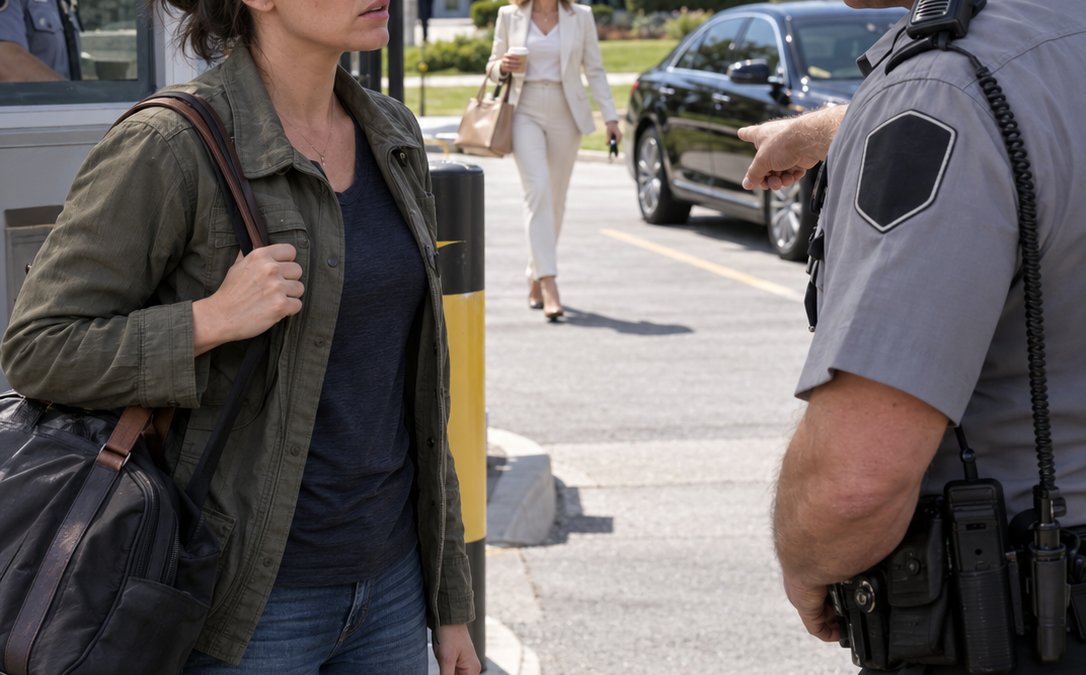
I decided to visit my dad at his job as a 4-star general. at the entrance, there was a sign that said “restricted area.” when i told the guard i was the general’s daughter, he laughed and said, “ma’am, i see his daughter every day! there she is, coming out right now.” so, i decided to play along…
I spent the next 3 weeks in a haze. I planned her funeral, cleaned out her small brick house, packed away her hospital scrubs, and cried until my eyes were raw. But in the back of my mind, that name kept circling like a bird looking for a place to land.
Alias Whitaker. General Alias Whitaker.
I searched online and there he was, a four-star general stationed at a base in Northern Virginia, 63 years old, silver-haired, decorated, a face I had never seen in any photograph my mother kept. I drove 10 hours from Bristol Ridge in my old blue Honda, my heart racing the entire way, playing out a thousand different versions of how our meeting might go.
Would he hug me? Would he cry? Would he even believe me?
I had a copy of my birth certificate in my bag, a lock of my mother’s hair, and one photograph from 1988 showing a young man in uniform with his arm around a laughing young Delphine on a boardwalk in Virginia Beach. That photograph was my proof. That photograph was my whole hope.
And now this, a guard laughing at me. A woman in a cream blazer who apparently held the title of General Whitaker’s daughter every single day of the week.
I forced my mouth to work.
“I am sorry,” I stammered. “There must be some kind of mistake. Could you please just call him? Tell him Delphine’s daughter is here. Deline Marley from Bristol Ridge, Tennessee. He will know that name.”
The guard’s smile faltered a little. He was maybe 50 with a neatly trimmed mustache and eyes that had seen too much to be surprised by anything. He glanced at his partner in the little security booth, a younger man tapping at a keyboard, and then he looked back at me.
“Ma’am,” he replied more gently. “I cannot just call a four-star general because someone walks up to the gate. I have my orders. If you have official business, you need to make an appointment through the base liazison office. If you have a family claim, that is a legal matter.”
I felt the blood drain out of my face.
Behind him, the black sedan pulled away from the curb and I caught one last glimpse of the woman in the cream blazer. She was on the phone laughing at something, tossing her hair back the way people do when they are completely at ease with the world.
I looked down at my hands. I noticed they were shaking.
And then, standing there in that Virginia sunshine with the smell of freshly cut grass in the air and an American flag snapping against a pole above me, I made a decision that would change everything.
I decided to play along.
Not right there, not with that guard. But something clicked in my brain, a cold, calm feeling that reminded me of my mother when she was working a double shift and refused to let anything break her.
If someone else was walking around this base wearing my name like a stolen coat, then I needed to find out who she was, why she was there, and how deep this rabbit hole went before I ever announced myself to Elias Whitaker.
I smiled at the guard.
“You know what, sir? I think I got the wrong base. My apologies. I will figure this out and come back another day.”
He nodded, relieved, and waved me on.
I walked back to my Honda parked across the visitors lot, sat down in the driver’s seat, and gripped the steering wheel until my knuckles went white. I did not start the car for 10 full minutes. I just breathed.
I stared at that stone building with its polished flag pole and its manicured hedges, and I let the anger settle into something useful.
I drove into the nearest town, a place called Woodbridge, and I found a small extended stay motel called the Riverbend Inn. I paid cash for a week. The clerk at the desk barely looked at me, which was exactly what I needed.
I hauled my suitcase into a beige room with a squeaky bed and a coffee maker that had seen better days, and I sat down at the little desk and pulled out my laptop.
The first thing I did was search for Elias Whitaker’s family. Not the man himself, but his wife and children. Society pages, base newsletters, charity events.
I found her within 20 minutes.
His wife, Carolyn Vance Whitaker, 61 years old, active in three charities, seen at ribbon cutings and gayla dinners. And their daughter.
Their daughter’s name was Seabine Whitaker, 35 years old, one year younger than me, graduated from William and Mary in 2012, worked as a communications director for a lobbying firm in DC, unmarried, lived in a townhouse in Alexandria.
There she was in photograph after photograph, cream blazer and half of them. Same woman who had walked out of that building past me. Same laugh, same tossed hair.
I stared at her face for a long time. She was pretty in that polished, expensive way. She had dark blonde hair cut in a sleek bob. She had my father’s eyes, or at least what I assumed were his eyes based on the photographs I had found of him online. Straight nose, strong jaw.
She looked like she had never once in her life had to wonder whether her father was alive or dead.
I looked at the photograph of my parents from 1988 that I had brought with me. My mother, 22, glowing in a yellow sundress. Elias, 26, in a crisp navy blue uniform with his arm around her waist.
The date on the back, written in my mother’s careful handwriting, said August 1988. I was born in June of 1989.
Seabine Whitaker was born in September of 1990, according to a birthday post from a college friend I found on a public page, which meant my mother had known Elias Whitaker first, which meant I was the older daughter, which meant that whatever story Elias had told his wife Carolyn about his life before her, it did not include a small town nurse in Tennessee and a baby girl named Marlo.
I closed the laptop, lay back on the bed, and stared at the ceiling. The cracks in the plaster looked like a map of a country I had never visited.
Somewhere out there, my father was probably signing papers or eating lunch or laughing at a joke. And he had absolutely no idea that his oldest child had just walked up to his gate and been turned away like a stranger.
Tomorrow, I decided, I would find Sabine Whitaker.
I would introduce myself. I would not tell her who I really was. I would play along exactly like the guard had suggested without knowing it, and I would learn everything I needed to know before I ever knocked on Elias Whitaker’s front door.
The next morning, I woke up at 5:30 before the sun had fully cleared the trees behind the motel, and I sat on the edge of the bed with my mother’s photograph in my hands, and I made her a quiet promise.
I would not do anything cruel. I would not tear this family apart out of spite. I would only pull the thread until the truth came out. And whatever pattern unraveled from that pulling, I would accept.
I got dressed in the nicest clothes I had packed, a navy blouse and a pair of dark slacks and a pair of low heels my mother had bought me for job interviews back when I was still working as a parallegal in Knoxville. I put on a little makeup. I brushed my dark hair back and pinned it into a low knot.
In the bathroom mirror, I looked professional and I looked nothing at all like the woman in the cream blazer. Which was good because I did not want anyone to see the resemblance yet.
By 7:45, I was parked half a block down from Seabine Whitaker’s townhouse in Alexandria. I felt a little sick doing it, sitting there watching her front door like some kind of investigator, but I reminded myself that she had walked into and out of that base yesterday under a title that belonged to me, whether she knew it or not.
At 8:17, she came out. Same brisk walk, same tossed hair, this time in a dove gray suit with a slim briefcase. She got into a small silver SUV and pulled out of her spot.
I followed her at a careful distance, three cars back, the way I had learned from watching too many crime shows on Sunday afternoons with my mother.
She drove into DC and parked in a garage on K Street. I circled the block twice and finally squeezed my Honda into a metered spot two blocks away. I hurried to catch up on foot and I made it to the entrance of a glass and steel office building just in time to see her step into an elevator.
The directory in the lobby listed her firm on the eighth floor.
Vance Merritt, Strategic Communications.
Vance, her mother’s maiden name.
I stood in that marble lobby for a long minute staring at the letters on the wall and something clicked into place. This was a family firm. Carolyn Vance Whitaker had connections. This was not just some job Sabine had gotten by grinding her way up. She had been placed there.
I did not go up. Not yet.
Instead, I walked back out onto K Street and I found a small coffee shop across the way with a window seat that gave me a clear view of the building’s entrance. I ordered a black coffee and a plain bagel. And I sat there for 3 hours watching, thinking, drafting, and reddrafting the approach in my head.
At 11:47, she came back out. She crossed the street and walked into the coffee shop.
My heart stopped.
She was 10 ft away. She was going to walk right past my table.
She did not even glance at me. She went straight to the counter, ordered a matcha latte, and stood there scrolling her phone. Up close, she looked younger than in her photographs, or maybe just softer.
She had a small scar on her chin, almost invisible. She wore a thin gold necklace with a tiny letter s charm on it.
I stood up. I walked toward the pickup counter as if I were also waiting for a drink. I positioned myself just close enough that when she turned, we almost collided.
“Oh, I am so sorry,” I gasped, catching her elbow to steady her. “I was not watching where I was going.”
She laughed a light, easy laugh.
“No, no, that was me. I get tunnel vision when I am on this thing.”
She held up her phone.
I smiled. I let my eyes go warm and open the way my mother used to teach me to do when I was working the front desk at the hospital as a teenager.
“I do the same thing. Are you okay?”
“I am fine, thank you.”
She started to turn back to the counter and then she paused. She looked at me again.
Something in her face flickered, a tiny hesitation. The way you look at someone when you feel like you should recognize them but cannot place them.
I extended my hand.
“I am Marley. Marley Reeves.”
I used my mother’s maiden name. It was not entirely a lie. It was just not the whole truth.
“Seabine,” she offered, shaking my hand. Her palm was cool and dry. “Sebine Whitaker. Are you new in the building?”
“Actually, I just moved to the area from Tennessee. I am a parillegal looking for work. I was hoping to drop off some resumes today, but I did not expect the buildings to be quite so intimidating.”
I let out a small nervous laugh.
Her face softened.
“Oh gosh, DC can be a lot at first. Where in Tennessee?”
“A small town called Bristol Ridge. You have probably never heard of it.”
She tilted her head.
“Bristol Ridge? That is funny. My mother has a friend from there, I think. Or maybe from Bristol itself. I always mix those up.”
My pulse jumped, but I kept my face perfectly still.
“It is a small town. Everybody knows everybody. What is your mother’s friend’s name? Maybe I know her.”
“Oh gosh, it was ages ago. I do not think they talk anymore.”
She waved it off and then the barista called her name and she picked up her drink. She turned back to me and hesitated again.
“You know what? This is going to sound strange, but if you are looking for parallegal work in the area, my firm sometimes needs freelance help with document review. Do you have a card?”
I did not have a card, of course, but I had prepared for this.
I pulled out a small notepad from my bag and scribbled my name and a burner phone number I had bought that morning at a drugstore.
“I do not have cards printed yet, just moved, like I said. But here.”
She took the paper and glanced at it.
“Marley Reeves. Okay, Marley. I am not making any promises, but I will pass this to our office manager. What is your background?”
“Family law and estate work mostly. 10 years.”
“Perfect. That is exactly the kind of thing we sometimes farm out. Do not get your hopes up too high, but who knows?”
She smiled, tucked the paper into her briefcase, and started to leave. Then she turned back.
“It was nice bumping into you, Marley.”
“You too, Seabine.”
She walked out.
I sat back down at my table, and I felt my whole body start to shake.
I had done it.
I had spoken to my halfsister, and she had not seen me at all. She had looked right at my face and seen a stranger.
For a moment, I felt sick with myself. This woman had done nothing to me. She was not the one who had lied to my mother or abandoned a baby in Tennessee or built a whole second life without ever looking back. She was just a woman living the life she had been given, drinking a matcha latte on a Wednesday afternoon.
But then I remembered the guard at the gate. I remembered his laugh.
“I see his daughter every day.”
And I remembered the way Seabine had walked out of that building yesterday, so at ease, so completely certain that the world belonged to her.
Two days later, my burner phone rang. It was a woman named Priya from Vance Merritt offering me a two-week freelance contract to help with a document review project on a family estate case their client was handling.
$25 an hour, 40 hours a week.
I accepted before she finished the sentence.
That Monday, April 14th, 2025, I walked into the offices of Vance Merritt Strategic Communications, wearing a black pants suit and carrying a leather portfolio.
Priya, a warm woman in her 40s with reading glasses on a chain, walked me back to a small conference room stacked with banker’s boxes.
“You will be reviewing these documents and flagging anything related to the Whitaker Foundation,” Priya explained. “Seabine is handling the communications strategy around a new family charitable initiative and she needs a clean summary of all prior related paperwork. Confidentiality agreement is on the top of that first box. Sign it before you touch anything.”
I nodded. I signed.
And then Priya left me alone in a room full of documents belonging to the family I had been born into and had never once been welcomed to.
I stared at those boxes for a long time before I opened the first one because I knew somewhere in that stack of paper, there was probably a version of my father I had never met, and I was not sure if I was ready to meet him yet.
But I opened the box anyway.
My mother had raised a woman who finished what she started.
The first box was mostly boring. Grant applications, board meeting minutes, tax filings from 2018 through 2022. The Whitaker Foundation was a family charity that gave scholarships to children of veterans, funded a homeless shelter in Norfick, and sponsored a summer camp for military kids in the Blue Ridge Mountains.
On paper, it looked lovely.
On paper, my father looked like a hero.
I made careful notes. I flagged the documents Priya wanted flagged. I did my job because if I got sloppy, I would get fired. And if I got fired, I would lose my only window into this family.
The second box was more interesting.
It contained personal correspondence from the foundation’s early days back when it was smaller, more informal. Handwritten thank you notes, photographs from ribbon cutings, a leatherbound guest book from the 2015 launch event.
I opened the guest book and I started turning the pages and halfway through I stopped breathing.
There in the middle of a page in handwriting I had known my whole life was my mother’s name.
Delphine Marley, Bristol Ridge, Tennessee, dated October 12th, 2015.
She had been here.
My mother had come to this foundation’s launch event. She had signed her name in this book and she had never told me.
I sat back in the chair and stared at the ceiling until the fluorescent lights blurred.
10 years ago, my mother had driven or flown to Virginia and walked into an event hosted by the man she had told me was dead.
What had she done there? Had she seen him? Had she spoken to him? Had he seen her and looked away? Or had he never even known she was in the room?
I pulled out my phone. I searched through the photographs I had saved to my private folder. Dozens of shots I had scraped from social media and public event pages.
And there at the 2015 gala, I found a photograph of Alias and Carolyn Whitaker cutting a ribbon.
And in the background, blurry but unmistakable, I saw my mother in the same yellow dress she had worn for every important occasion since I was a little girl, holding a small clutch and watching him with an expression I could not quite read.
She had gone to look at him, just to look, and then she had come home.
I closed the guest book. I sat very still. I let myself cry just a little, silently, the tears falling onto the sleeve of my jacket.
And then I wiped my face and I kept going.
The third box was where things got dark.
It was labeled legal historic. Inside were folders from the late 1980s and early 1990s. Personal legal matters.
A pre-nuptial agreement between Elias and Carolyn dated December of 1989. Their marriage certificate dated January 6th, 1990.
That was 3 months before Seabine was conceived and 7 months after I was born.
He had married Carolyn while my mother was still nursing me.
There were also documents relating to a legal action from 1991.
A woman named Delphine Marley had filed a paternity petition in Sullivan County, Tennessee, seeking child support for a minor daughter named Marlo Marley, born June 1989.
The petition had been withdrawn 6 months later in November of 1991.
There was a letter in the file on plain paper dated November of 1991 in my mother’s handwriting.
“Elias, I received the payment and the terms. I will honor the agreement. I will not contact again. I will tell Marlo whatever story keeps her safe and keeps her heart whole. But I want you to know that she is a beautiful child and she looks like her grandmother and someday she may come looking for you no matter what I say. I hope you will be ready. Delphine.”
I read that letter four times.
Then I read it a fifth.
My hands were shaking so hard I had to set the paper on the table to keep from crumpling it.
He had paid her off.
He had paid my mother to disappear, to lie to me, to bury him alive in a fake grave and let me mourn a man who was drinking coffee in Virginia.
And she had taken the money.
My mother, my honest, hard-working mother, had taken the money.
I sat with that for a long time, and then slowly my anger shifted because my mother had also worked two jobs my entire childhood. If she had taken a payoff, it had not been a large one or it had not lasted.
She had scrubbed floors and passed out medications for 30 years to keep a roof over our heads. Whatever deal Alias had forced on her, she had paid the real price of it every single day.
I photographed every document in that folder with my phone, every page, every signature. I saved them to a private cloud folder I had set up under a fake email. Then I put the folder back in the box exactly the way I had found it.
That night at the motel, I sat on the bed and I opened my laptop and I started building the case.
Not a legal case, not yet.
Just a personal one, a chronology. What I knew, when I knew it, and what I still needed to find out.
The next morning, I went back to Vance Merritt and I kept working.
Seabine dropped by the conference room around 10:00 with two cups of coffee. She handed me one.
“How is it going in here?” she asked, setting hers on the edge of the table.
“Slow but steady. There is a lot of history in these boxes.”
“There is. My grandfather started the family’s involvement in veterans causes back in the 60s, and my dad has kept it going. It is kind of the heart of who we are as a family.”
She smiled proudly.
I nodded and sipped the coffee.
“Your dad sounds like an incredible man.”
“He is. He is not perfect, but he is a good man. He always says the measure of a soldier is not what he does in battle, but what he does after he comes home.”
She glanced at the boxes.
“Anyway, Priya says you are doing great work, faster than the last person we had in here. If you want, when this contract ends, I can talk to my mom about bringing you on as a longerterm consultant for the foundation.”
“I would appreciate that very much.”
“Great. Actually, that reminds me. We have a small family dinner this Sunday at my parents house. Nothing fancy, just the foundation’s inner circle and a few family friends. If you are going to be working on this material, it might be useful for you to meet the people involved. Would you like to come?”
I looked at her.
I could feel the shape of the moment, the exact weight of it, the way a fisherman feels the tug of a fish deciding whether to take the bait.
“That is very generous of you. Are you sure I would not be intruding?”
“Not at all. It is casual. Come around 6:00. I will text you the address.”
She left.
I sat there holding the coffee cup and I felt the walls of my carefully controlled plan start to shake because on Sunday I was going to walk into my father’s house.
I was going to sit at his dinner table and I was going to smile at him and shake his hand and call him General Whitaker.
And he was going to have no idea that his firstborn daughter was sitting 3 ft away from him watching him eat his pot roast.
I told myself I could handle it.
I told myself I was in control.
That was the first lie I told myself in this whole story.
The Whitaker house sat at the end of a long gravel driveway in a wealthy pocket of MClean, Virginia, surrounded by old oak trees and boxwood hedges.
I pulled up at 557 on Sunday evening, April 20th, 2025. My hands were sweating on the steering wheel. I had bought a modest wrap dress in a deep green color, and I had done my hair the way my mother used to do hers for church, and I had rehearsed the small talk in my head for two full days.
The house was enormous but warm. White brick, black shutters, a wide front porch with rocking chairs, an American flag hung by the door.
I could hear laughter through the windows before I even rang the bell.
Seabine opened the door.
“Marley, you made it. Come in. Come in.”
She hugged me briefly and it caught me off guard.
I had not been hugged by a family member since my mother died.
My eyes stung. I blinked hard and stepped inside.
The foyer was full of framed photographs. Alias in uniform at various points in his career. Sabine as a little girl on a pony. Carolyn cutting the ribbon on a hospital wing.
A whole life documented and displayed.
I did not see myself anywhere, of course, but for one wild moment, I imagined a photograph of a small, dark-haired girl in Tennessee tucked into the corner, and my chest achd.
Seabine led me through to a large living room where about a dozen people were mingling. I clocked the faces I recognized from my research. A judge, two senators aids, a defense contractor’s wife, and then standing by the fireplace with a tumbler of something amber in his hand, was my father.
He was taller than I expected.
His silver hair was cut short. He wore a soft blue button-down shirt and khaki pants and no shoes, just gray wool socks.
He looked like anyone’s grandfather.
He looked nothing like the four-star general who had crushed my mother’s life with a stroke of a pen.
Seabine walked me right up to him.
“Dad, this is Marley Reeves. She is helping us with the Foundation Archive project.”
He turned, he smiled, he extended his hand, and I looked into my father’s eyes for the first time in 36 years.
They were hazel, flecked with brown, the same eyes I saw in the mirror every morning.
“Marley, welcome. Elias Whitaker, very glad to have you.”
His voice was low and warm. His handshake was firm, but not aggressive.
I found my voice from somewhere.
“Thank you, General. It is an honor to be here.”
“Please call me Alias. Not in my house. I get enough saluting during the week.”
He chuckled.
“Seabine tells me you are from Tennessee.”
“Yes, sir. A small town called Bristol Ridge.”
Not a flicker, not a twitch, not the slightest recognition.
He nodded politely and moved the conversation forward.
“Beautiful part of the country. I have driven through there many times. What brought you up to Virginia?”
“Family reasons. My mother recently passed and I needed a change.”
Every word I chose was a small knife I was handing him without him knowing it.
“She was a nurse. She raised me alone.”
His eyes softened.
“I am very sorry to hear about your mother. That is a terrible loss.”
“Thank you. She was a remarkable woman.”
Carolyn Whitaker joined us at that moment. She was elegant with sharp cheekbones and a warm silver bob, wearing pearls over a black cashmere sweater.
She kissed her husband’s cheek and turned her attention to me.
“Marley, welcome. Seabine has told me lovely things. Where in Tennessee are you from?”
“Bristol Ridge.”
Her smile did not waver, but something happened in her eyes. A tiny narrowing, a recalibration.
She had heard that name before.
She knew that name.
“How interesting. Well, we are so glad to have you. Please help yourself to a drink. Dinner will be in about 20 minutes.”
She touched my arm lightly and moved on to greet another guest.
I stood there next to Elias for a moment longer. He was looking at me with a slightly curious expression, but he did not push it. He just refilled his glass and asked me polite questions about my parallegal work and how I was finding Virginia so far.
I answered on autopilot.
My real attention was on Carolyn, who was now across the room, but glancing back at me every 30 seconds or so.
She knew or at least she suspected.
Dinner was in a formal dining room under a chandelier that probably cost more than my mother’s whole house. There was pot roast exactly like I had joked to myself. There were candles and cloth napkins and three kinds of wine.
I was seated between Sabine and an older gentleman named Colonel Ramsay who told me long stories about his time in Kuwait and did not require much response.
I watched Alias at the head of the table.
I watched him laugh at his wife’s jokes, ask the judge about his golf game, put more butter on his role.
I tried to hate him.
I could not quite manage it.
He was just a man. A man who had done a terrible thing 36 years ago and then built a whole life on top of it and probably rarely, if ever, thought about the woman and the baby he had erased.
After dessert, Caroline caught my eye across the table.
“Marley, would you help me bring in the coffee? I always seem to forget how to work my own espresso machine.”
Seabine started to get up.
“Mom, I can help.”
“No, darling. You sit and entertain our guests. Marley and I will manage.”
I followed her into the kitchen.
It was enormous with copper pans hanging above a marble island.
She closed the door behind us.
She did not turn on the espresso machine.
She turned to face me, folded her arms, and looked at me with an expression that was neither cold nor warm, but perfectly, terrifyingly still.
“Delphine Marley died recently, you said.”
I nodded.
“And you are her daughter.”
“I am.”
Her jaw tightened.
She was quiet for a long moment. Then she reached up to a shelf above the coffee maker and pulled down a small tin.
From the tin, she took out an envelope.
It was old, the edges yellowed, and it had my mother’s handwriting on the front.
She handed it to me.
“She wrote to me once in 1992 to tell me she was sorry. To tell me she had not known Alias was engaged when they were together, to tell me she was keeping her distance, and to please not blame the child.”
Carolyn’s voice was level, but her hand shook slightly.
“I have kept this letter for 33 years. I never told my husband I received it. I never told my daughter either.”
I stared at the envelope, my mother’s handwriting, small and neat and careful.
“You knew about me,” I whispered.
“I have known about you since you were 3 years old. I found out because I opened a piece of Elias’s mail that I was not supposed to open, and I have made my peace with it, Marley. Or Marlo, I assume, is your real name.”
“Yes.”
She nodded slowly.
“I recognized you the moment you walked in. You have his eyes and you have her mouth. I used to look at that photograph of the two of them in his old army foot locker back when we were first married. And I have never forgotten her face.”
I felt the ground tilt underneath me for the second time in a week.
“Why are you telling me this? Why now?”
Her eyes filled briefly and then cleared.
“Because I have watched you all night and I have seen how carefully you have measured yourself. And I know grief when I see it. I know what it looks like to lose a mother and I know what my husband did. And I have spent 33 years wondering when the girl in the photograph would show up at my door. Now she has. So the question, Marlo, is what do you want?”
I could not answer her right away.
I stared down at the envelope in my hands and I tried to breathe.
From the dining room came the sound of laughter, my father’s voice booming out about some old story from Fort Bennying. And I could not reconcile that jolly warm sound with the man who had made my mother write the letter I was now holding.
“I want the truth,” I finally managed. “That is what I want. I do not want money. I do not want a scandal. I want to sit across from him and I want him to look at me and know who I am and what he did.”
Carolyn nodded once slowly.
“That is fair. Have you told Sabine?”
“No, she has no idea. She adores her father. This will destroy her image of him.”
“He destroyed my image of him, too. He built me a fake grave to visit. My whole childhood, I thought he was a hero who died for his country. My mother lied to me because he paid her to lie.”
Carolyn closed her eyes briefly.
“I did not know he paid her. That is new to me.”
“There are documents. I have seen them. $6,000 in 1991. She withdrew a paternity petition and agreed to disappear.”
“$6,000.”
Caroline repeated it like she was tasting something rotten.
“For a child. He paid $6,000 for a child. For the eraser of a child.”
“Yes.”
She was quiet again.
She walked to the window and looked out at her dark garden. Then she turned back.
“Marlo, I need you to understand something. My marriage to Elias has been many things over the years. Sometimes good, sometimes very difficult. I love him, but I have never mistaken him for a perfect man. When I found out about you, I confronted him. Once he denied it, then admitted it, then swore it was over and that he had provided for you. I chose to stay. I chose to raise Sabine. I chose to keep the peace and I have carried the weight of that choice for a very long time.”
“That was your choice, Caroline. I was a baby.”
“I know.” Her voice cracked. “I know, and I am not asking for forgiveness. I am telling you where I stand so that you can decide what to do next.”
I looked at her.
This woman had known about me my entire life. She had lived in the same house as the man who had abandoned me, eaten breakfast with him, raised a daughter with him, hosted Sunday dinners with him, and she had never once picked up a phone or sent a letter or done a single thing to reach across that distance to me.
She was not innocent either, but she was also not the villain.
She was just another woman my father had used silence to control.
“I want to talk to him alone before I decide anything else. I do not want to do it here tonight with a house full of guests.”
“But soon this week, I can arrange it. He works from home on Fridays. Come at 11. I will make sure Seabine is at the office.”
“Thank you.”
“Do not thank me yet.”
She turned back to the espresso machine and finally began to make the coffee.
“I need to ask you one thing, Marlo. When you meet Seabine again, and when this all comes out, please try to remember that she is not her father. She is going to lose something on Friday. Try to be gentle where you can be.”
I thought of Seabine handing me a coffee that morning. I thought of her smile at the door when I arrived. I thought of the way she had said her father was a good man, imperfect, but good.
“I will try,” I promised. “But I cannot promise she will thank me for it.”
“None of us thanks anyone for the truth.”
At first, we carried out the coffee. I sat back down. I ate a piece of pecan pie and made small talk about the weather.
When I looked at Alias, I no longer felt afraid.
I felt something colder, cleaner, more focused.
I had a date.
I had a time.
I had a plan.
I stayed exactly the right amount of time. I helped clear a few dishes. I thanked Seabine warmly and told her I would see her at work on Monday.
I shook Elias’s hand and told him it had been an honor to meet him.
“The pleasure was mine, Marley. Come back anytime.”
I drove back to the motel with the envelope on the passenger seat.
I did not open it in the car.
I waited until I was sitting on the edge of the bed with the lamp on, and then I slid a finger under the flap, and I pulled out the letter my mother had written 33 years ago.
It was two pages long, front and back, in her small, careful hand.
“Dear Mrs. Whitaker,” it began. “I do not know if this letter will reach you or if you will read it, but I have to write it anyway. My name is Delphine Marley. I was involved with your husband in the summer and fall of 1988. I did not know he was engaged. He told me his engagement had been called off. When I discovered I was pregnant, I told him and I discovered the truth.
“I moved home to Tennessee before you and he were married. I did not want to intrude on your life and I have not tried to. My daughter Marlo was born in June of 1989. She is now 3 years old. She is a bright, healthy little girl.
“Elias has paid me a settlement, and I have signed papers agreeing to keep our lives separate from yours. I do not know what he has told you or if he has told you anything at all. But I could not go through my life without you knowing that a child exists.
“I am sorry. I am so deeply sorry. I did not know. I was a girl and I believed him and I made a mistake, but this child is not a mistake. I hope if you ever meet her, you will remember that she did not choose any of this.
“Sincerely, Delphine Marley.”
I read the letter three times.
I lay down on the bed with it against my chest, and I cried the deepest, ugliest sobs I had cried since my mother’s funeral because my mother had known.
My mother had known that a woman in Virginia was raising Alias Whitaker’s other daughter, and she had never breathed a word of it to me.
She had carried that weight alone for over 30 years, and she had died before she got to tell me the whole truth. She had only had enough breath at the end for a name and a rank.
I fell asleep with the letter still in my hand.
I dreamed of my mother in her yellow sundress, standing on a boardwalk somewhere, waving to me, but too far away to hear.
Monday and Tuesday and Wednesday and Thursday all blurred together.
I went to work at Vance Merit. I flagged documents. I smiled at Seabine when she brought me tea. I ate my sandwich in the little courtyard behind the building at lunchtime.
I performed the role of Marley Reeves so well that at one point I almost forgot who I actually was.
On Wednesday night, my burner phone buzzed.
A text from Carolyn’s number.
Friday, 11:00 a.m. He will be alone. I will make sure.
I texted back one word.
Thank you.
On Thursday, at the end of the workday, Seabine stopped by my desk. She was holding a small gift bag.
“Just a little something to say thank you for how hard you have been working. Mom really liked you on Sunday, by the way. She does not usually take to new people that quickly.”
I took the bag.
Inside was a small blue candle and a handwritten card.
Marley, welcome to Virginia. We are so glad you found us warmly. The Whitacres.
I stared at that word.
Whitacres.
I was one.
And I was about to tell him.
“Thank you, Seabine. That is very kind.”
She smiled and left.
I watched her walk away, sleek and confident. My sister, who did not know she was my sister, and I made one more silent promise.
Whatever happened on Friday, I would tell her myself.
Not through her mother, not through her father, not through a lawyer.
I would sit down across from Seabine and I would tell her the truth with my own mouth because she deserved that much from me even if I did not owe her anything else in the world.
Friday morning arrived cold and gray. Rain hung in the air threatening.
I drove to the Whitaker house with my mother’s photograph, my birth certificate, the documents I had photographed at the office, and my mother’s original letter to Carolyn, all tucked into a leather folder on the passenger seat.
My hands were steady.
My mind was clear.
Whatever I had been afraid of before, I was not afraid of it anymore.
Caroline met me at the door.
She was pale but composed. She wore a simple navy dress and no jewelry except her wedding ring.
“He is in his study. I told him I invited a parallegal over to discuss the foundation records. He is expecting a work meeting.”
She paused.
“Do you want me to be there or would you prefer privacy?”
I thought about it for a long moment.
“I want privacy, but I want you in the house. Not in the room, but in the house. If Sabine comes, I want you to handle her.”
“She will not come. I have arranged for her to be in a client meeting in Bethesda from 10:30 to 12:30.”
“Good.”
She led me down a hallway and pointed to a heavy wooden door.
“That is his study. Take as long as you need. There is coffee on the sideboard inside.”
“Marlo.”
I turned.
“Whatever he says today, please remember you are your mother’s daughter. She was a very strong woman. I could tell from that letter she was.”
Caroline walked away.
I stood at the door for one more breath.
Then I knocked.
“Come in.”
I opened the door and stepped inside.
The study was a warm room with dark wood shelves, hundreds of books, framed metals, a large mahogany desk, and a window overlooking the back garden.
Elias sat behind the desk in a green cardigan, reading glasses low on his nose, a stack of papers in front of him.
He stood up when he saw me.
“Marley, come in. Carolyn said you wanted to go over some archive questions. Please have a seat.”
I closed the door behind me.
I did not sit down.
“Elias, my name is not Marley Reeves. My name is Marlo Whitaker. I am Deline Marley’s daughter, and I am also your daughter.”
The color left his face like someone had pulled a plug.
His hand went to the back of his chair for balance. He stood there frozen for what felt like a full minute. His mouth opened and closed twice with no sound.
Then he sank back into his chair.
“Please,” he whispered. “Please sit down.”
I sat.
I set the leather folder on his desk. I did not open it yet.
I just watched him.
He took off his glasses and set them on the desk with a shaking hand. He looked at me the way you look at someone you thought was in another country, but who has just walked into your kitchen.
He looked at me like a ghost.
“How is your mother?” he finally asked, and his voice cracked.
“She died last month. Pancreatic cancer.”
He closed his eyes.
His face crumpled.
And for a moment, I thought he might actually break.
Then he studied himself, opened his eyes, and looked at me squarely.
“I am so sorry, Marlo. She was a wonderful woman. She deserved better than what I gave her.”
“She did.”
I let that sit between us.
“She told me on her deathbed that you were alive. Until then, I believed you had died in service to the country when I was two.”
He flinched hard.
“That was not the agreement. That was not what I told her to say.”
“What was the agreement?”
He swallowed.
“The agreement was that she would tell you I had been posted overseas permanently, that we had separated before you were born. That contact would not be possible. I did not know she had told you I was dead. I would have never asked for that.”
“But you did ask for silence. You did pay her to disappear.”
He looked down at his hands.
His shoulders sagged.
“Yes, I did.”
“Why?”
He was quiet for a long time.
When he spoke, his voice was low.
“Because I was 26 years old and engaged to a woman whose father was a two-star general and whose family was the reason I had made captain three years early. Because I had made a mistake with your mother and I had made a promise to another woman and I chose the promise that was going to secure my career.
“I told myself I was being responsible. I told myself the money would give you a good life. I told myself your mother was strong and would land on her feet. And she was and she did.
“But I was a coward. That is the whole truth, Marlo. I was a coward.”
I had prepared myself for excuses, for denials, for explanations.
I had not prepared myself for this, for a man who simply told the truth and did not try to dress it up.
It made me angrier, not less, because it meant he had always known exactly what he had done.
“I grew up thinking you were a hero,” I whispered. “I saluted the flag at every parade because of you. I stood at attention every Memorial Day because of you. I told my kindergarten teacher my daddy died so other kids could have a country. Do you understand what that did to me?
“I built a whole personality around a dead father who never actually died.”
“I understand.”
“You do not understand. You cannot understand. You have another daughter who grew up in this house, eating pot roast and taking dance lessons and going to William and Mary while I was watching my mother work double shifts at the hospital to keep our lights on because $6,000 in 1991 does not last forever. Alias, it does not last forever.”
His eyes filled.
“Marlo, I do not want your tears.”
“I want your truth. And then I want to decide what happens next.”
He nodded.
He wiped his face with the back of his hand.
“Ask me anything. I will not lie to you. Not one more time. Not ever again.”
I opened the folder.
I pulled out my mother’s letter to Carolyn.
“Did you know she wrote to your wife?”
He read the letter.
His hand shook harder.
He looked up.
“No.”
“Carolyn never told me.”
“She has known about me since I was three.”
He put the letter down.
He stared at the wall behind me for a long time.
“I do not know what to do with that information.”
“Neither did she. She kept her secret for you for 33 years.”
“That is not a gift. That is a debt she was owed by me.”
On that we agreed.
I pulled out the paternity documents, the withdrawal petition, the bank record I had found in the file. I laid them out on the desk in front of him.
He looked at them.
He did not deny any of it.
“What do you want, Marlo?” he finally asked, echoing his wife from 4 days earlier. “Money, recognition, a place in the family. I will give you whatever I can give.”
“I do not want your money.”
“Then what?”
I looked at him.
I thought about it carefully.
“I want you to tell Sebine yourself this weekend. In your own words. I do not want her finding out from lawyers or from strangers. She is my sister and she does not know I exist and she deserves to hear it from you. And I want to be there when you tell her, not to help you, to make sure you actually do it.”
He was silent.
Then he nodded.
“I will do that.”
“I also want the foundation to establish a scholarship in my mother’s name for nurses for working single mothers going back to school, a real one funded well. She wanted to be a nurse practitioner and she never got the chance because she was too busy raising me alone.”
“Done. Absolutely done.”
“And one more thing. I wanted in writing that I am acknowledged as your daughter publicly. I do not need a party. I do not need a photograph on the wall. I want a document filed with the appropriate legal offices that says Marlo Whitaker is the daughter of General Elias Whitaker and Delphine Marley. That is all. I want my name back.”
He looked at me for a long time and then, for the first time since I had walked into his study, he smiled.
It was a sad, exhausted, broken smile, but it was a real one.
“Your name was always yours, Marlo. I am only sorry it took you 36 years to come and take it.”
Seabine came to the house on Sunday afternoon at 3, expecting a quiet family lunch.
Caroline had asked her to come over because there was something she and her father needed to discuss with her.
I waited in the sun room at the back of the house, out of sight, listening to my heart pound in my ears.
I heard the front door open.
I heard Seabine call out.
I heard Carolyn’s voice, tight but calm, telling her to come into the living room.
I heard the murmur of Alias’s voice starting to explain.
Then I heard the silence, a long dreadful silence.
Then I heard Sabine’s voice high and thin and confused.
“What are you talking about, Dad? What are you talking about?”
I stood up.
I walked toward the sound.
When I stepped into the living room, Sabine was sitting on the edge of the sofa, still in her Sunday sweater, her handbag still on her shoulder.
Elias was in the armchair across from her, hunched forward with his elbows on his knees.
Caroline stood by the window.
Seabine saw me, her face changed.
Confusion, then recognition, then a kind of dawning horror.
“Marley,” she whispered.
“My name is Marlo,” I replied gently. “Marlo Whitaker. I did not lie to you about most things, Seabine. Just about my last name and why I came to Virginia. I am sorry.”
She stared at me.
She stared at her father.
She stared at her mother.
Her hand went to her mouth.
“Since when?”
Her voice was flat.
“I was born in June of 1989. I am one year older than you.”
“That is not what I asked.”
“Your father has known since before your mother married him. Your mother has known since I was three. I found out 3 weeks ago on my own mother’s deathbed.”
Seabine sat there for a long moment.
Then she stood up.
She turned to her father.
“You have known about her my entire life.”
“Yes.”
“And you never told me.”
“No.”
“And mom knew.”
Caroline stepped forward.
“Sebine—”
“Don’t.”
Sebine’s voice cracked.
“Don’t. Both of you just don’t.”
She turned and walked out of the room.
She walked out of the house.
She got in her car and she drove away.
Caroline started to go after her and I stopped her.
“Let her go. She needs time.”
“You do not know her the way I do.”
“I know I am the one she just found out about. Let her be angry at her father right now, not at his wife who followed her out the door.”
Caroline stood there for a moment and then she nodded and stepped back.
She sat down heavily on the sofa.
Elias put his head in his hands.
Nobody spoke.
I let myself out.
I drove back to the motel.
I checked my phone every 15 minutes for the next 4 hours.
Nothing.
At 9 that night, my burner phone buzzed.
A text from Seabine.
Meet me tomorrow, 700 a.m. There is a diner called Mara’s on Route 1 in Woodbridge. Come alone.
I texted back.
I will be there.
I did not sleep that night.
I sat at the little motel desk and I wrote out everything I wanted to say to my sister. I wrote three pages, then I threw them away. I wrote one page, then I threw that away, too.
In the end, I decided I would just answer whatever she asked.
She had earned the right to ask anything.
At 6:45 the next morning, I walked into Mara’s.
It was a classic roadside diner, red vinyl booths, a chalkboard with the daily special, a coffee pot that never stopped moving.
Seabine was already there in a booth by the window.
She looked like she had not slept either.
I slid into the seat across from her.
The waitress came over.
Seabine ordered black coffee.
I did the same.
Neither of us spoke until the coffee came.
Then Sabine took a long breath.
“I have been up all night. I have looked at everything. I have called my mother twice. I have called my father once. I have read the copy of your mother’s letter that my mother sent me around midnight. I have looked at your birth certificate. My father emailed it to me at 3:00 in the morning. He apparently had a copy in a safe deposit box in Alexandria that even my mother did not know about.”
She met my eyes.
“I do not know what to do with this, Marlo. I do not know how to feel. I am furious. I am heartbroken. I am confused. I am also, and this is the part I did not expect, a little bit relieved.”
“Relieved?”
She wrapped her hands around her coffee cup.
“My whole life, I have felt like my father was holding something back. Some part of himself that he never gave to me or to my mother. I always thought it was because of the military, because of the things he had seen. I told myself he came home from wars with wounds we could not see.
“And maybe some of that is true, but some of it was you. Some of it was the daughter he never let himself think about. And knowing that now, actually, it makes some things make sense that never made sense to me before.”
I did not know what to say.
I sipped my coffee.
“What did you want when you came here?” she asked. “Money, revenge?”
“The truth and my name.”
“That is what you told him yesterday.”
“Yes.”
“And now that you have both?”
“Now I do not know either. I did not plan past this part.”
She nodded slowly.
“Tell me about your mother.”
So I did.
I told her about Deline. About the double shifts at the hospital. About how she made me pancakes every Saturday morning, even after working the overnight.
About how she wore the same yellow sundress to every important event because it was the dress she had felt beautiful in when she was young.
About how she loved gardinas and hated country music and could quote every line from Steel Magnolia’s.
About how she cried when I graduated from high school as validictorian.
About how she never remarried and never really dated because she said her heart had already been full once and that was enough for one lifetime.
I told her about the cancer, about the seven weeks, about the whispered confession at the end.
Seabine listened.
She did not interrupt.
When I got to the part about my mother telling me his name, tears started rolling down her cheeks.
She did not wipe them.
When I finished, she was quiet for a long time.
“I am sorry,” she finally whispered. “I am so sorry, Marlo, for all of it, for 36 years of it. You did not do anything to me. I lived the life you should have had or half of it anyway.
“I had a father. I had his name. I had the summers at the lake house and the college fund and the dance recital he came to in his uniform. And you had a woman working double shifts and a fake grave to visit.
“That is not fair. That is not okay. And even if I did not cause it, I benefited from it and I have to sit with that.”
“You do?”
“I want to sit with it.”
She met my eyes.
“I do not know what our relationship is going to be. I do not know if we can be sisters or friends or something we do not have a word for yet, but I want to try if you are willing.”
I looked at my halfsister across the table in a highway diner in Virginia.
I thought of my mother in her yellow sundress.
I thought of 36 years of birthdays with no father.
I thought of all the things this woman had grown up with that I had grown up without.
And I thought of the fact that she was sitting here at 7 in the morning after a sleepless night trying.
“I am willing to try,” I told her. “But I am going to need time and I am going to need you to be patient with me when I am angry because I am going to be angry. Not at you, but sometimes it might feel like it is at you. I need you to not take it personally.”
“Deal.”
She held out her hand across the table.
I took it.
We shook.
And then we ordered breakfast and we sat in that diner for two hours and we talked and we laughed a little and we cried a little and by the time we walked out, something had shifted.
Not everything, not enough, but something.
Over the next 2 months, the paperwork moved forward slowly.
Elias hired a family lawyer named Rosalind Hurst, a nononsense woman in her 60s who had handled acknowledgements of paternity for other high-profile families and who did not seem particularly impressed by anyone.
She met with me twice in her office in Oldtown Alexandria.
At the second meeting in late May, she slid a document across the table.
“This is the formal acknowledgement. Once signed and filed with the county clerk and once the corrected birth certificate is issued through the Tennessee Department of Health, you will be legally recognized as Marlo Whitaker, daughter of Elias Whitaker.
“There is also a cautisle to your father’s will being drafted separately. He wants you to be aware that he is providing for you in it.”
“I told him I did not want his money.”
“You do not have to accept it, but he wants to make the offer.”
Rosalind lowered her voice slightly.
“For what it is worth, Miss Whitaker, in 35 years of practicing, I have rarely seen a man in his position simply agree to everything a claimant asked for without a fight. Usually, there are non-disclosure agreements, capped settlements, negotiations. Your father asked for none of that. He asked me only to make sure you got what you wanted, and quickly.”
I signed the acknowledgement.
2 weeks later, in early June, I received a copy of my new birth certificate.
It came in a plain manila envelope from the state of Tennessee.
I opened it at the little desk in the motel room where I was still living and I unfolded the certificate and I saw my name printed there in official black ink.
Marlo Delphine Whitaker born June 11th 1989 Bristol Ridge, Tennessee. Mother Delphine Anne Marley. Father Elias James Whitaker.
I sat there and I held the paper in both hands and I cried, the kind of tears you cry when a thing you have wanted your whole life finally arrives and you do not quite know what to do with it.
I called Sabine.
She came over that evening with a bottle of procco and two paper cups and we sat on the edge of the bed in that beige motel room and we toasted my new old name.
“To Marlo Deline Whitaker.”
“To Marlo Delphine Whitaker.”
I moved out of the motel a week later, not into the Whitaker house.
That would have felt wrong to both my mother’s memory and to Sabine.
Instead, I signed a lease on a small one-bedroom apartment in Falls Church with a view of a courtyard and a fig tree.
I bought secondhand furniture from a resale shop. I hung a photograph of my mother in her yellow sundress in the hallway where I would see it every time I came home.
Elias asked to have dinner with me alone, just the two of us.
He wanted to hear about my life, all of it.
I said yes.
We met at a small Italian place in Alexandria on a Wednesday night in midJune. He was already there when I arrived, sitting at a corner table, no uniform, just a soft gray shirt and jeans.
It was strange to see him look ordinary.
We ordered pasta.
We talked for 3 hours.
He asked me about kindergarten, about my first bicycle, about the boy I had gone to prom with, about my parallegal work, about the friends I had left behind in Tennessee, about what my mother’s laugh sounded like near the end.
He listened to every answer like he was memorizing it.
At the end of dinner, he set his fork down and looked at me.
“Marlo, I cannot get those 36 years back. I know that. I am not going to insult you by pretending that I can. But if you will let me, I would like to know you now, just as you are.
“Not to make up for what I did because I cannot. Only because you are my daughter and I have missed my whole life not knowing you.”
I looked at this man, this general, this coward, this father.
“I will let you try, Elias. But do not ever ask me to call you dad. That title belonged to a man who was never real. I am not ready to give it to you. Maybe someday, maybe never. That is not a promise I can make.”
“I understand.”
“And there is something else. I want you to know that I have forgiven you. Not because you deserve it, but because carrying that anger for the rest of my life would let you take more from me than you already have, and I am done letting you take.”
He nodded, his eyes filled.
He did not try to hide it.
He said only, “Thank you, Marlo.”
I thought that would be the end of the story.
A messy, complicated, imperfect ending, but an ending.
An acknowledged daughter, a forgiven father, a new sister, a private piece.
I was wrong.
The story was not over.
Two weeks later, on a Thursday morning in late June, I got a phone call from Priya at Vance Merritt.
She sounded shaken.
“Marlo, there is a reporter here from the Washington Post. He is asking about you and about General Whitaker and about the foundation. He says he has documents. He wants a comment.”
I set my coffee down.
“What kind of documents?”
“He would not say, but he mentioned your mother by name. He said he has information about a settlement in 1991 and about a corrected birth certificate. Someone leaked this to him, Marlo. Someone in your family or ours. And he is going to print it.”
I hung up.
I called Seabine immediately.
She picked up on the first ring.
“I know,” she said, her voice tight. “I just got a call from a different reporter. It is out. I do not know who talked, but it is out.”
“Your father?”
“He would not do this.”
“Your mother?”
“No, she would not either. She would have talked to us first.”
We were both silent.
Then Sabine said quietly, “There is someone else who might have talked. He has known for years. And he has hated my father for years.”
“Who?”
“My uncle. My father’s younger brother, Weston. They had a falling out about 20 years ago over the foundation. Weston felt he should have been made co-chair. He was cut out entirely. He and my mother have never gotten along. He knows about you.
“My father told him back in 1990 when it happened, and he has been sitting on that information for 35 years.”
“How do you know he did this?”
“Because he called me yesterday out of nowhere asking questions, saying he had heard some things. I brushed him off. I thought nothing of it. I should have known.”
I sat down on the edge of my bed.
This was going to blow up.
This was going to be in the paper.
This was going to become a public story about a four-star general’s secret daughter and a payoff and a small town nurse and a deathbed confession.
This was going to be everywhere.
And I had never wanted any of that.
I had wanted a quiet acknowledgement, a name, a scholarship, a father who tried and a sister who tried harder.
That was all.
“What do we do?” Seabine asked.
I thought about it and then I realized something.
If this story was going to be told, I wanted it told correctly.
I did not want it told by an uncle with a grudge or by a reporter chasing a headline or by anyone who had not been in the room.
If this story was going out into the world, then I was the one who would tell it.
“Sayine, call your father. Tell him to be at your parents house tonight. All three of you, I am coming over. We are going to decide together how this comes out because if we do not decide, someone else will decide for us, and I am done letting someone else decide who I am.”
I arrived at the Whitaker house at 7 that evening.
Caroline opened the door with red rimmed eyes.
She had already spoken to Weston on the phone.
It had not gone well.
“He does not deny it,” she reported as she led me into the living room. “He says the public has a right to know. He says Alias has built his entire career on an image of honor and that the truth about you is a matter of public interest. He is enjoying this, Marlo. I could hear it in his voice.”
Elias was already in the living room sitting stiffly on the sofa.
He looked older than he had two weeks ago at dinner.
Seabine was in the armchair, phone in hand, scrolling through news alerts.
“The post is running at Sunday,” she announced without looking up. “Front page of the metro section. The reporter has a copy of the 1991 paternity petition. He has the letter my mother received. He has confirmation of the corrected birth certificate. He knows about the settlement amount. He has an on there quote from Weston.”
Elias closed his eyes.
I sat down across from him.
I set my hands flat on my knees.
“Here is what we are going to do,” I began. “We are not going to let the post frame this story. We are going to give an interview first to someone else. To a reporter of my choosing, I will tell my own story in my own words before anyone else can tell it for me.
“We will confirm the basic facts. We will not deny anything. And we will announce the scholarship in my mother’s name, funded fully, and the acknowledgement of paternity.
“This becomes a story about a father owning up to a mistake and a daughter reclaiming her name, not a story about a scandal.”
Elias opened his eyes.
“Marlo, that will end my career.”
“Your career was going to end anyway. You are 63. You have a mandatory retirement in less than 2 years. And I am telling you plainly, Elias, if the choices between your career and this being told correctly, I am choosing correctly.”
He looked at me.
His jaw worked for a moment.
Then he nodded.
“You are right. Do it.”
Carolyn sat down beside him and took his hand.
She looked at me.
“Marlo, do it your way. All of it. We will not fight you on anything.”
Sabine set her phone down.
“I have a contact at a national morning show, a producer I worked with two years ago on a nonprofit campaign. She is fair and she is smart. If we call her tonight, we can probably record something Friday morning and air it Saturday before the post runs Sunday.”
“Do it.”
Seabine picked up her phone and stepped into the hallway.
I sat there for a long moment with my father and his wife.
Nobody spoke.
Then Elias cleared his throat.
“Marlo, if I ask you something, will you tell me honestly?”
“Yes.”
“Why are you protecting me?”
“I am protecting the truth,” I replied. “If we let Weston’s version win, my mother becomes a mistress. Sabine a spoiled princess and you a monster. My mother made a hard choice. Seabine is trying. You are finally doing the right thing. I will not let anyone tell it wrong.”
Alias wept while Caroline comforted him.
Seabine returned with news of a Friday television interview with veteran journalist Naen Ellsworth.
We agreed to total honesty for the exclusive.
During the interview, Naen asked about my mother, the deathbed confession, and the settlement.
When asked what people should take away, I looked at the camera.
“I want people to know my mother was a good woman who sacrificed so I could live. A name is who you are, and hiding it makes you feel incomplete. Secrets rot everyone. The only way out is the truth. And to any woman who felt small at a gate she had the right to enter, you get to walk in anyway.”
The piece aired Saturday and went viral.
Weston called, but Seabine hung up on him after 30 seconds.
Alias quietly resigned in July 2025.
Meanwhile, thousands sent messages of support.
In August, the Delphine Marley Scholarship Fund launched.
Alias personally funded it with $2 million.
I became the program director, meeting the first 12 nursing students and giving them my mother’s favorite advice.
“You are stronger than the room you are walking into. Walk in anyway.”
By October 2025, my life had transformed.
I worked in Alexandria with my mother’s photo on my desk.
Seabine joined the foundation as communications director and we grew close.
Caroline and I had bi-weekly lunches navigating our new dynamic.
Elias and I had quiet Sunday dinners.
He never pushed, just listened, learning to be my father.
In late September, I drove back to Bristol Ridge.
I visited my mother’s grave, told her everything, and left her favorite gardinas.
“Mom, I forgive you,” I whispered. “Everything good in me is you.”
On the drive back to Virginia, I stopped across the street from the military base gate where it all began.
And just looked at the sign.
Restricted area, authorized personnel only.
I got out of the car.
I walked up to the gate.
The same guard was there, silver mustache, same posture.
He recognized me.
I saw the flicker of it in his eyes.
“Ma’am,” he acknowledged.
“Sergeant.”
I looked at his name badge.
“Sergeant Develin, you may not remember me. I came here in April. I told you I was General Whitaker’s daughter. You laughed at me. You told me you saw his daughter every day.”
His face went red.
He remembered.
“Ma’am, I did not know.”
“I know you did not know. That is not why I am here. I am not here to shame you.”
I paused.
“I am here to tell you something.”
He waited.
“That morning when you laughed, I felt smaller than I had ever felt in my life. I felt like a fool. I felt like maybe I had made the whole thing up. My whole reason for driving 10 hours to a place I did not belong.
“And for one second, I almost got back in my car and drove home and never came back.
“If I had done that, none of the rest of this would have happened. My name would still be a lie. My father would still be a stranger. My sister would never know me. My mother’s name would not be on 12 scholarship certificates.
“That would have been the whole ending because of a laugh at a gate.”
He was very still.
“So I am here to tell you this, Sergeant Develin. You never know who is standing on the other side of your gate. You never know what they have driven through to get there. You never know what they are carrying in their pocket.
“When a woman walks up to you and tells you who she is, and it sounds strange, do not laugh. Just ask her name. Just make one phone call. Just take her seriously for the time it takes to check because someday the woman at your gate is going to be someone’s real daughter and your laugh could send her home.”
He nodded slowly.
“Yes, ma’am. Understood.”
“Thank you.”
I turned to walk back to my car.
He called after me.
“Ma’am, Miss Whitaker, if you want to go in, you can go in. I will call ahead.”
I looked back at him.
I smiled.
“I do not need to go in today, Sergeant. I know who I am.”
I drove home.
I got back to fall’s church late that night.
I made myself a cup of tea and I sat by the window with the fig tree and I thought about everything that had happened in the 6 months since a stranger in a uniform laughed at me at a gate.
I thought about how easy it would have been to walk away.
I thought about how much of my life I had spent believing a story someone else had told me about myself.
I thought about my mother, 23 years old, alone with a baby in Tennessee, signing a piece of paper that promised to disappear.
I thought about how she had honored that promise her whole life.
And how in the very last hour she had breath, she had broken it for me.
Because that is what mothers do.
Even when they have signed papers, even when they have taken money, even when they have lied for so long they have almost convinced themselves.
In the end, in the very end, they give you the truth.
Because they know you will need it to become who you were always meant to be.
If there is anything I have learned in these six months, it is that a name is not a small thing.
A name is not just letters on a page.
A name is the first inheritance a parent gives you.
And if that inheritance is broken or hidden or stolen, you have to go find it yourself.
You have to walk up to gates that were not built for you.
You have to sit in offices with stacks of documents that will hurt you.
You have to have hard conversations with people who lied to you for reasons you may never fully understand.
You have to forgive people who do not deserve forgiveness, not because they earned it, but because you deserve to put the weight down.
Boundaries are not walls.
Boundaries are gates.
They tell you what belongs to you and what does not.
My father tried to build a gate around my life without me.
He tried to keep me on the outside of my own name.
And it took me 36 years to walk up to that gate and open it for myself.
If you are watching this and you are carrying a secret that is eating you alive, tell it.
If you are watching this and you have been told a story about yourself that never quite fit, question it.
If you are watching this and you have been laughed at when you tried to claim what was yours, walk up to that gate again and again and again until the door opens.
Because someone on the other side of that door is waiting for you, even if they do not know it yet.
And even if no one is waiting, you are still worth the walk.
My mother’s name was Delphine Anne Marley.
She worked two jobs at a hospital in Bristol Ridge, Tennessee for 30 years.
She wore a yellow sundress to every important event of her life.
She loved Gardinas.
She raised a daughter alone on a nurse’s salary and a promise she should never have had to make.
She died on a rainy Sunday in March of 2025.
And with her last strength, she gave me back my name.
My name is Marlo Delphine Whitaker.
I am 36 years old and I am my mother’s daughter.
Thank you for listening to my story. If it moved you, if any part of it reminded you of your own life or your own mother or your own gate you had to walk through, please like this video and subscribe to the channel so more stories like this can find the people who need them.
And if you have ever been told a story about yourself that turned out to be a lie, or if you have ever had to reclaim your own name, please share your experience in the comments below.
I read them, all of them, because every story matters and no one should have to carry theirs alone.








