I came home from baghdad only to see my $154k parked in my parents’ driveway; my mom looked me dead in the face and said, “stop being dramatic,” i didn’t argue, i didn’t yell, i just walked away, then the fbi blocked their house, minutes later, my dad was in handcuffs.
Everything looked washed out and cold, like somebody turned the saturation down on the whole state. I sat behind the wheel and locked the doors. That’s when I opened my military banking app. The app had two-factor authentication, biometric login, encrypted verification, and enough security layers to protect nuclear launch codes. Army Medical Command didn’t exactly play around when it came to combat pay accounts. I pressed my thumb against the scanner. Loading. Loading. Then the number appeared. Available balance: $3.18. I stared at it for a full 10 seconds before my brain caught up. No freezing, no tears, no dramatic gasp, just math, because I knew exactly how much should have been there: $154,217.83.
Every dollar accounted for hazard pay. Overseas housing payments. Reenlistment bonus installments. Months of 12-hour trauma shifts patching up soldiers and contractors after mortar attacks. Christmases spent inside medical tents eating rubber eggs while facetiming family members who forgot the time difference every single year. That account was my exit plan. Not a mansion. Not some fake Instagram lifestyle. Just freedom. A small cabin somewhere quiet. A used truck that started in winter. Maybe nursing school later if I got tired of army life. Something simple. Something nobody could take from me except somebody already had. I refreshed the app. Then again. Then I opened the transaction history. Wire transfers.
Large ones, 30,000, 22,000, 18,000, all spread across the last 6 weeks while I’d been overseas finishing deployment processing. The blood drained from my face slowly, like my body didn’t want to waste energy on shock. I checked the account permissions page. That’s when I saw my father’s name, Richard Lynwood, authorized power-of-attorney access. I leaned back against the seat and laughed once. Not because it was funny, because my father had spent my combat pay with the confidence of a man returning a lawn mower he borrowed from a neighbor. Rain slid down the windshield in crooked lines while traffic hissed past the interstate exit ramp nearby. Somebody honked.
Somewhere in the distance, a siren wailed for half a second before disappearing again. Life just kept moving. I called my mother first, straight to voicemail. I called Chloe. My younger sister answered on the fourth ring, sounding half asleep. “Maya?” A pause. “Oh my God, are you home already?” “Apparently,” she yawned. “You still at the airport?” “No. Quick question, though. Did Mom or Dad buy a new car recently?” Silence, not shock silence. Guilty silence. Then I heard her lower her voice. “Why?” I closed my eyes for a second. That told me everything. “What color is it?” I asked. Another pause. “Sapphire blue.” Of course it was. My mother never met an expensive color she didn’t like.
I thanked Chloe and hung up before she could start crying. Chloe cried whenever conversations became inconvenient. It was like a reflex. Some people sweat under pressure. Chloe leaked mascara. I drove the remaining four miles to my parents’ neighborhood with both hands steady on the wheel. Maplewood Estates looked exactly the same as when I left. Identical brick homes, tiny decorative trees, mailboxes polished like they were preparing for military inspection. The entire subdivision smelled faintly like fresh mulch and debt. My parents lived at the end of a cul-de-sac in a two-story colonial house they absolutely could not afford 20 years ago and somehow still couldn’t afford now.
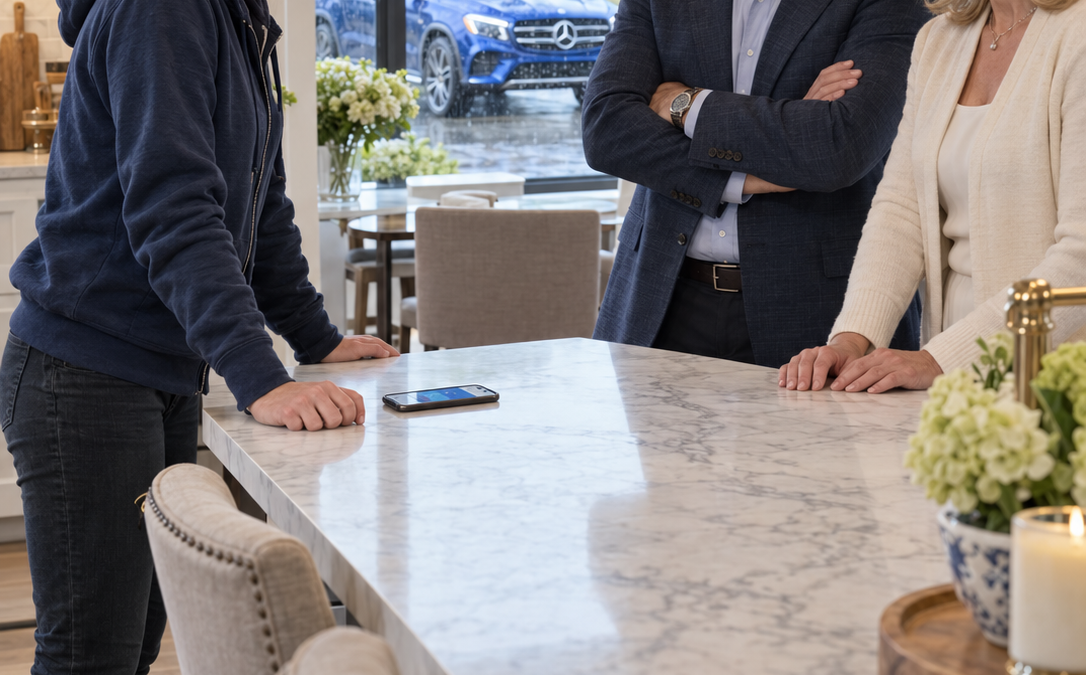
And there it was, parked across the driveway like a trophy. A brand-new 2025 Mercedes SUV in sapphire blue with dealer tags still attached. Rainwater slid across the spotless hood while chrome rims reflected the cloudy morning sky. The thing looked expensive enough to come with its own divorce attorney. I shut off the engine but stayed there for a moment watching through the bay window. My father sat at the kitchen island holding one of his stupid oversized coffee mugs that said Retired but Still Right. My mother laughed at something he said while wearing a cream-colored cardigan that probably cost more than my first rifle.
They looked warm, comfortable, completely at peace, like people who had never once worried about incoming mortar fire while eating dinner out of a plastic tray. And sitting 20 feet away from them was the physical shape of my missing money. Have you ever sacrificed years of your life for people who only loved what you could give them? And if your own family crossed a line you could never forgive, would you walk away quietly or make sure they finally faced consequences? Let me know in the comments. And if you believe family should never mean surrendering your dignity, subscribe to the channel. Then I opened the car door and stepped into the rain. Rain soaked through the shoulders of my hoodie before I even reached the front walkway.
My parents still hadn’t noticed me standing outside. That honestly tracked. When I was 17, I fractured my wrist during a softball game and drove myself to urgent care because my mother didn’t want to miss her spa appointment. My father later told people I was dramatic about pain. So, no, them missing their oldest daughter standing in the driveway after 14 months overseas wasn’t exactly shocking. I climbed the concrete steps slowly, my boots leaving wet marks across the porch. The new Mercedes sat before me like a physical insult. Sapphire blue paint, chrome trim package, panoramic roof, AMG wheels. My father had once called me irresponsible for buying a $12 sandwich at an airport.
Apparently, federal fraud loosened his budget philosophy. The dealer sticker was still attached to the rear passenger window. I glanced at it while passing by. MSRP: $94,780. I actually stopped walking for a second. 94 grand for a car Chloe would probably use twice a week. Drive to prenatal yoga and Target. I looked through the tinted window and saw beige leather seats so clean they looked medically sterile. Protective plastic still covered part of the touchscreen display. The whole interior smelled like fresh adhesive and bad decisions. Then I noticed the monogrammed baby seat already installed in the back. CBB. Chloe Bates Bennett. Of course, my sister had managed to turn reproduction into a luxury event sponsorship.
I reached for the side door instead of the front, out of habit. Growing up, we used the side entrance unless company was over because my mother thought the front door should look untouched for guests. The woman treated her own house like a furniture showroom. Nobody was allowed to sit inside. The side door was unlocked. Another thing that never changed inside. The kitchen smelled like cinnamon coffee cake and fresh paint. I stood there quietly for a moment taking it all in. New marble countertops, custom pendant lighting, white oak flooring, a built-in wine fridge that probably cost more than my first deployment bonus. My mother used to complain about money constantly when I was younger.
She clipped coupons with the intensity of a Wall Street trader. Meanwhile, now the kitchen looked like a suburban surgeon’s Pinterest fantasy. Funny how financial stress disappears when you steal from your own kid. My father sat at the island scrolling through his iPad while Fox News played softly from a mounted television in the living room. My mother leaned against the counter holding one of those giant ceramic mugs she collected from overpriced boutique stores. “Richard,” she laughed, “you cannot tell Mrs. Donnelly her hydrangeas look diseased.” “They do look diseased,” he replied. “Somebody had to say it.” Then my mother finally looked up. The smile vanished off her face instantly. Not guilt, calculation.
That was always her first emotion. “Maya,” she said carefully. “You’re home early.” Early? Like I’d just come back from Costco. “Flight landed ahead of schedule,” I answered. My father glanced over casually. “Hey, kiddo.” Kiddo. I was 32 years old and had spent the last year treating blast injuries in a combat zone. But to Richard Lynwood, I was still 12 unless he needed to brag about me to his golf buddies. Nobody moved toward me. No hug, no welcome home, not even a fake attempt. My mother set her mug down first. “You should have called before coming by.” “The house is a mess.” I looked around the spotless kitchen. “Looks catastrophic,” I said. My father chuckled like I’d made an actual joke. Then his eyes narrowed slightly.
Military people noticed details. We’re trained to notice tiny facial shifts, changes in breathing, hand movement, tone changes, and right there, I saw it happen. Both of them realized at the exact same moment that I probably knew. My mother crossed her arms first. Defensive posture. My father leaned back against the island and exhaled slowly through his nose like a man preparing for an annoying customer service phone call. That told me even more. People who feel guilty usually start apologizing before you ask questions. People who feel entitled wait for you to challenge them. I pulled my phone from my pocket and placed it on the counter between us. “My account’s empty.” Silence. The refrigerator hummed softly behind us.
Outside, rain tapped against the kitchen windows. My father spoke first. “Well, technically not empty,” he said. “There’s still a few dollars left.” I stared at him. He shrugged once. That was his sense of humor. My mother stepped in quickly. “Maya, before you overreact, there are things happening that you don’t fully understand.” I almost laughed. Nothing says trust me like stealing six figures before breakfast. “You took $154,000.” “We borrowed it,” she corrected immediately. There it was. The family dictionary. Borrowed meant stolen. Disrespectful meant disagreeing with them. Love meant obedience with a smile. My father folded his arms. “You were deployed. The money was just sitting there.” “Yeah,” I said quietly.
“That’s generally how savings accounts work.” His jaw tightened slightly. My father hated sarcasm unless he was the one using it. My mother moved closer to the marble island, lowering her voice like she was explaining something to a difficult child. “Chloe’s pregnant, Maya. She needed a reliable vehicle.” “A $95,000 reliable vehicle?” “It’s safe.” “So is a Honda.” “That’s not the point.” No kidding. The point was appearances. It was always appearances. My mother cared more about looking wealthy than actually being financially stable. Growing up, she’d return Christmas presents in January so she could afford country club dues.
One year our electricity almost got shut off while she spent $400 hosting a charity event for women she secretly hated, and somehow she always framed it as sacrifice for the family. Everything toxic sounds noble when you wrap it in family language. I looked toward the window at the Mercedes sitting proudly in the driveway. “When exactly were you planning to tell me?” My father answered without hesitation. “When you got settled.” Meaning never. My mother sighed dramatically. “Honestly, Maya, I thought after everything your sister’s been through, you’d be a little more compassionate.” I blinked slowly. Chloe had morning sickness and an Etsy birth plan binder. I had mortar alarms. But sure, let’s compare suffering.
“You forged military banking authorization forms,” I said. My father’s expression hardened immediately. “No one forged anything.” I held eye contact with him. That tiny pause before his answer told me more than the words did. Then my mother delivered the line that finally changed something inside me. “A good daughter wouldn’t make this into a big ugly situation.” Not angry, not loud, just cold. Because right then I understood something I should have admitted years ago. They genuinely believed they deserved my life more than I did. And standing there in that renovated kitchen, watching steam rise from their expensive coffee mugs while rain slid down the windows behind them, I realized the Mercedes wasn’t the real betrayal.
It was proof they never saw me as a person in the first place. My mother reached for her coffee again, like this was still a normal Tuesday morning that honestly irritated me more than the missing money. Not the amount, not the forged authorization, the calmness. The woman looked more emotionally affected by expired yogurt than federal fraud. She wrapped both hands around the mug and sighed. “You have to understand, the timing was terrible.” I stood there dripping rainwater onto her new hardwood floors while she talked about my stolen combat pay like somebody had accidentally double booked a brunch reservation. “What timing?” I asked. My father answered first.
“Cash flow.” There are phrases wealthy suburban people use when they don’t want to admit they’re broke. Cash flow problems. Overextended temporary liquidity issue. My personal favorite was, “And now Visa is sending threatening emails.” I looked around the kitchen again. The six-burner gas range, the custom cabinets, the ridiculous pendant lights hanging over the island that looked like upside down champagne glasses. This wasn’t survival spending. This was performance. “You renovated the kitchen, too,” I said. My mother immediately stiffened. “That came from our home equity line.” “Which you couldn’t pay because of your cash-flow problems.” Neither of them answered. That silence landed exactly where I expected it to.
My father pushed himself off the counter and walked toward the refrigerator, calm, casual, completely unbothered. “You’re acting like we gambled it away in Vegas,” he said. “The money stayed in the family.” I actually let out a short laugh. That phrase right there had ruined half my childhood. In this family, the family somehow always meant everybody except me. When Chloe dropped out of Arizona State after one semester because dorm life was emotionally draining, my college fund disappeared to help her find herself. When my father’s landscaping business collapsed after he ignored his accountant for two straight years, my mother emptied my savings bonds to keep the family afloat. Nobody ever asked, they informed.
Then they reframed theft as teamwork. I crossed my arms. “You emptied a federal military compensation account.” “And we’ll pay it back,” my mother snapped quickly. “With what?” “We’re working on it.” “How?” Another silence. My father opened the fridge, grabbed bottled water, then changed his mind, and grabbed orange juice instead. That’s the kind of detail you notice after years in military medicine. People reveal stress in weird little patterns. He took a long drink before answering. “We assumed you wouldn’t need the money immediately.” I stared at him for a second. Need. “You were overseas for 14 months,” he continued. “Food covered, housing covered, healthcare covered. You’ve got no husband, no kids, no mortgage.” There it was.
My life only mattered if it resembled theirs. Marriage, suburbs, country club memberships, babies with personalized diaper bags. Everything outside that framework became available inventory. My mother stepped closer and lowered her voice into what she probably thought sounded nurturing. “Maya, honey, your sister is about to become a mother.” “She’s 29, not 15.” “That’s not the point.” “It never is.” Her mouth tightened. My father hated confrontation. My mother hated losing control of the emotional atmosphere. Together, they operated like a corporate HR department for narcissists. My mother touched the sleeve of her cardigan and sighed dramatically.
“You know, Chloe’s anxiety has been horrible during the pregnancy.” I looked at her blankly. Anxiety, right? Because apparently my younger sister couldn’t safely raise a child unless the vehicle had heated seats and lane assist technology. Meanwhile, I once stitched a medic’s shoulder closed during a mortar lockdown using emergency flashlight batteries because the backup generator failed for 11 minutes. But yes, tell me more about hardship. “You committed fraud,” I said calmly. My father rolled his eyes. “No one committed fraud.” “You forged authorization.” “We had access.” “You created access.” “We’re your parents.” Like that explained everything. In Richard Lynwood’s world, fatherhood functioned like diplomatic immunity.
I walked toward the kitchen island and picked up a folded dealership brochure sitting beside my mother’s purse. Sapphire Series Performance Package. The brochure listed features like massaging seats and adaptive suspension. Jesus Christ. “You bought the luxury package, too?” My mother looked offended now. “The resale value is better.” That nearly broke me. Not emotionally, spiritually. There’s something uniquely exhausting about arguing with people who genuinely believe their greed is practical wisdom. My father pointed toward the driveway. “That car protects your nephew.” “I don’t even know if it’s a boy.” “Well, whichever.” He waved a hand dismissively.
Then he looked directly at me and delivered the sentence I think he actually believed would calm me down. “You’ve always been tougher than Chloe.” I just stared at him. That was their entire philosophy right there. Because I survived difficult things, I deserved difficult things. Because Chloe cried easier, she deserved protection. I’d spent my whole life being punished for functioning well under pressure. My mother softened her voice again. “A good daughter sacrifices for family sometimes.” I looked at her carefully. “You mean quietly.” Her expression changed for half a second. Tiny, but real. Because she knew I finally understood the system. Every role in our family had already been assigned years ago. Chloe received comfort.
My father received obedience. My mother received admiration. And I received responsibility. Even as a kid, I was the one expected to understand. When Chloe wrecked my car at 19, my parents told me not to upset her because she already felt terrible. When my deployment orders came through, my mother cried harder about missing Thanksgiving photos than the possibility of me getting killed overseas. That realization should have hurt more than it did. Instead, I just felt tired. My father leaned against the marble counter again. “Look, nobody’s saying this was ideal, but families help each other.” I nodded slowly. “You know what’s interesting?” “What?” “You keep using the word help.” Neither of them spoke.
“Help usually involves consent.” The kitchen went quiet again. Outside, the rain had started easing up. Water dripped steadily from the gutters while a neighbor walked her golden retriever down the sidewalk across the street. Normal suburban life. Meanwhile, inside this kitchen, my parents were trying to convince a combat medic that felony theft was basically an act of love. My mother finally crossed her arms tighter. “You’re blowing this completely out of proportion.” “And you’re pretending a crime becomes moral if the thief shares your last name.” That hit harder than I expected. Not because she looked guilty, because she looked insulted, like I’d failed some unspoken loyalty test.
And right then, standing in that warm, expensive kitchen they built using my deployment money, I realized neither of my parents feared hurting me. They feared losing access to me. I dried off in the motel bathroom using paper towels because the room only had two bath towels, and both smelled faintly like chlorine and cigarettes. The Sunset Motor Lodge sat 20 minutes outside Columbus beside a shuttered diner and a tire shop with a flickering open sign that buzzed all night long. Room 214 cost $68 after taxes, which felt appropriate considering my financial situation now technically qualified as recently robbed. The mattress sagged in the middle. The air conditioner rattled every 40 seconds.
Somebody upstairs kept dragging furniture across the floor like they were hiding a body. Honestly, after Baghdad, it still ranked above average. I sat cross-legged on the bed with my laptop balanced in front of me while rainwater tapped softly against the motel window. The room lights stayed off except for the yellow glow from the desk lamp near the television. No crying, no rage spiral, no calling to scream at them. That’s the thing about military training people don’t understand. Once you’ve spent enough time in emergency situations, your brain stops wasting energy on emotional theater. You stabilize first, process later, and right now stabilization meant documentation.
I logged into my federal banking portal again and opened the account authorization history. Three access modifications, one submitted 39 days earlier, two approved within 24 hours. I clicked deeper into the metadata, device origin, IP logs, authentication chain. My father had never been smart enough to cover digital footprints. Richard Lynwood still used the same password for half his accounts despite getting hacked by fake Home Depots twice. The submission IP traced directly back to my parents’ home internet provider in Maplewood Estates. Not subtle. Then I found the uploaded authorization file, power of attorney request form, PDF attachment. I downloaded, opened it, and there it was, my forged signature.
I stared at the screen quietly. It honestly wasn’t even a good forgery. The M curved too sharply. My last name slanted upward in a way I never wrote it. Whoever signed it had copied the shape without understanding the rhythm. Probably my father. He always forged confidence better than handwriting. I zoomed in further. Timestamp metadata showed the document had been created on a desktop running Windows 10 registered under Richard Lynwood’s user profile. Jesus Christ. The man committed federal fraud with the sophistication of a Facebook scammer. I opened another folder and started organizing files, transfer logs, wire records, account-access history. I named everything carefully because details matter when people start lying later.
Most family fights collapse into emotion and memory. Everybody talks over each other until the truth gets buried under personal history. But digital records don’t care about feelings. At 11:42 p.m. on April 18th, $30,000 moved from my combat savings into a temporary holding account. At 9:17 a.m. the next morning, $22,000 transferred into Crown Meridian Auto Group. At 2:06 p.m., another $18,000 cleared through a secondary account linked to my father’s business LLC. Money leaves fingerprints, and my parents had touched everything. I leaned back against the motel headboard and rubbed my eyes for a second. Exhaustion started creeping in around the edges now that the adrenaline was wearing off.
I’d slept maybe nine hours total over the last two days between flights, processing, customs, and airport delays. My phone buzzed beside me. Mom, I let it ring. Then came the voicemail notification immediately afterward. Then another text. “Maya, please stop overreacting and answer your phone.” Five minutes later: “Maya, your father is extremely upset right now.” That almost made me laugh. Richard Lynwood treated emotions like subscription services. Only his mattered and everybody else was expected to finance them. Another message appeared. “Maya, families work through things privately.” There it was. Translation: Don’t embarrass us publicly. Not, “We’re sorry.” Not, “How do we fix this?” Just reputation management.
I tossed the phone onto the bed and kept working. The dealership paperwork took longer to track down, but eventually I found wire confirmation receipts buried in the transfer chain. Crown Meridian Auto Group received multiple structured payments instead of one full transfer. That told me something important. The dealership payments had been structured, which meant somebody had intentionally broken up the transfers to avoid attention. That changed this from stupid to criminally deliberate. I downloaded every receipt. One included the VIN number for the Mercedes. Another contained my father’s electronic signature authorizing final delivery. The delivery address, my parents’ house. Help. Very helpful.
I created a master folder titled Lynwood Financial Fraud. Cold, simple, accurate. Then I started building a timeline. April 11th, initial authorization request submitted. April 12th, power of attorney access approved. April 18th, first unauthorized transfer. April 23rd, vehicle deposit submitted. May 2nd, final payment completed. May 9th, kitchen renovation contractor invoice processed. I stopped typing for a second. Kitchen renovation. So, it wasn’t just the car. They’d used my deployment money to rebuild the entire fantasy. New kitchen, luxury SUV, country club image maintenance, all funded by hazard pay earned while treating burn victims and shrapnel injuries 12 time zones away. My stomach turned a little at that.
Not because of the money anymore, because of how normal it probably felt to them. That’s the dangerous thing about entitlement. After enough years, people stop seeing exploitation as exploitation. It just becomes family structure. My father genuinely believed he outranked my future. And my mother believed preserving appearances justified almost anything. I checked the clock on the motel nightstand. 1:13 a.m. Outside, rain had finally stopped. The highway nearby hummed softly with late night traffic while neon from the motel sign flashed dull red through the curtains. Facts. Not fantasy. Facts. The room smelled like stale coffee and industrial cleaner. I opened one last document. Military deployment verification records.
Official dates. Official location. Official pay structure. Baghdad. 14 months. Every dollar earned legally. Every transfer unauthorized. I attached the records into the master file and exported everything into organized PDF folders. 73 pages total. Clean, chronological, undeniable. Then I uploaded backups into encrypted cloud storage because if deployment teaches you anything, it’s this. Never trust one copy of something important, especially when desperate people realize consequences are real. My phone buzzed again. This time it was Chloe. I stared at her name for a second before answering. Her voice came through small and shaky. “Maya, Mom’s freaking out.” I kept my eyes on the laptop screen.
“Good.” Silence, then softly: “They thought you’d calm down by now.” That sentence settled into the room heavier than anything else all day. Not because it surprised me, because it confirmed exactly how little they understood me. My entire adult life had been built on discipline, documentation, and procedure. I worked in military medicine. Panic gets people killed. Facts keep them alive. And sitting alone in that cheap motel room with 73 pages of evidence glowing on my screen, I realized something my parents still hadn’t figured out. I wasn’t building an argument. I was building a case.
I wore the same hoodie to the FBI office, partly because it was clean enough, mostly because I didn’t feel like pretending this was a normal family disagreement requiring business-casual clothing. Downtown Columbus looked gray and damp under low morning clouds as I parked outside the federal building at exactly 9:24 a.m. Government architecture always has the same personality no matter what state you are in: concrete, glass, metal railings, everything designed to quietly remind you that emotions no longer matter once paperwork gets involved. Honestly, comforting. I grabbed the thick Manila folder from the passenger seat and stepped out of the rental car. The folder weighed maybe 3 pounds. Consequences are surprisingly portable.
Inside, the lobby smelled like floor polish and burnt coffee. A security guard with a shaved head glanced at my military ID and immediately straightened his posture slightly. “Morning, Sergeant.” “Morning.” That tiny shift in respect almost caught me off guard after 24 hours of being treated like an inconvenience by my own family. I passed through security, collected my phone from the tray, and followed the signs toward financial crimes. Room temperature in federal buildings is always weirdly cold. Like the government collectively decided comfort encourages corruption. At 9:30 exactly, a receptionist guided me into a small interview room with gray walls, a rectangular metal table bolted to the floor.
No dramatic lighting, no television detectives nonsense, just fluorescent lights and paperwork. A few minutes later, the door opened. Special Agent Marcus Vance looked exactly like somebody who’d spent 20 years listening to liars professionally: mid-40s, dark suit, broad shoulders, close-cropped hair, starting to gray around the temples, calm eyes, not intimidating, just tired in a highly trained way. He sat across from me, holding a legal pad. “You’re Sergeant First Class Maya Lynwood?” “Yes, sir.” “You can call me Marcus.” “Fair enough.” He glanced down briefly at the intake notes. “So, according to the front desk, you’re here regarding financial theft involving family members.” “Federal wire fraud,” I corrected calmly.
That got his attention slightly, not fully yet. He leaned back in the chair. “Walk me through it.” I slid the Manila folder across the table. “My parents drained my military compensation account while I was deployed in Baghdad.” His expression stayed professionally neutral. People say insane things to federal agents every day. I’m sure “my parents stole my money” barely cracks the top 50 before lunch. Then he opened the folder and the room changed. Not dramatically, just gradually. First, cracks in the skepticism. Then concentration. Then silence. He flipped through the first few pages slowly. Authorization records, transfer logs, wire receipts, timestamped metadata. His eyes stopped on one page longer than the others.
“Your father submitted the power-of-attorney authorization himself.” “Yes.” “You didn’t authorize any of this?” “No.” He kept reading. Three minutes passed without either of us speaking. I watched his posture shift little by little as the scale became obvious. Federal investigators developed instincts around patterns and the pattern sitting in front of him practically screamed organized fraud by suburban idiots. Marcus flipped to the dealership transfer documents. “Crown Meridian Auto Group,” he read quietly. “Luxury dealership outside Dublin.” He nodded once. Then he reached another page showing the structured transfer breakdowns. That’s when his whole demeanor sharpened.
“You said local police haven’t been contacted.” “I came here first.” “Why?” “Because this isn’t a domestic argument.” I pointed toward the transfer records. “That account contains federally protected military compensation. The transfers crossed state banking systems, and the authorization documents were falsified digitally.” He looked at me for another second, then finally nodded. “Okay,” he said quietly. Yeah, that single word carried more weight than anything my parents had said in 2 days. Because for the first time since landing in Ohio, somebody else was looking at the situation without emotional distortion. No family politics, no guilt manipulation, just facts. Marcus opened another section of the file.
“These IP logs came from your home address.” “Yes.” “And this LLC routing account belongs to your father.” “Yes.” He exhaled slowly through his nose. “You organized this yourself?” “I work logistics and trauma coordination.” “That explains the tabs.” I almost smiled. Every section had color-coded labels, fraudulent access requests, account drain timeline, vehicle purchase documentation. Honestly, part of me wanted him to appreciate the formatting. Marcus leaned back slightly in his chair. “You understand? Once this process starts, things escalate quickly.” “I know.” No hesitation. I thought about that for a second. Not about my parents, about myself. Because people assume betrayal creates immediate hatred. Sometimes it doesn’t.
Sometimes it just removes the last excuse you kept making for someone. “I gave them opportunities to explain,” I said. “They explained.” That seemed to land with him. He flipped to the deployment records showing my Baghdad assignment dates. 14 months hazard pay classification. Medical operation support. He studied the pages quietly before asking, “Did they attempt repayment at any point?” “No.” “Did they notify you before taking the funds?” “No.” “Did they acknowledge using forged authorization?” “No. They called it borrowing.” Marcus actually laughed once at that, not because it was funny. Because federal agents probably hear criminals accidentally summarize their own charges all day long. He closed the folder carefully.
Then he asked the question that mattered most. “Do you believe this money still exists in recoverable assets?” “Yes.” “How?” I slid a separate sheet toward him. Vehicle VIN number, dealership invoice, kitchen renovation contractor payments, remaining linked accounts. “They spent visibly,” I said. That earned another small nod. Amateurs always spend visibly. That’s why lottery winners end up in documentaries. Marcus stood up and walked toward the room’s narrow interior window for a second, thinking quietly while traffic moved outside below the federal building. When he turned back around, the skepticism was completely gone. Now he just looked annoyed. Not at me, at them. “Your father’s an idiot,” he said matter-of-factly.
I blinked once. “That’s the official FBI assessment?” “That’s the unofficial one.” Honestly, after the last 48 hours, it felt incredible hearing a federal agent verbally confirm what I’d known since middle school. Marcus picked up the folder again. “You did the right thing coming here first. Local police would have buried this under family-dispute mediation until evidence disappeared.” “I figured.” “Yeah.” He tapped the paperwork lightly. “This is already past that point.” The room went quiet again for a moment. Outside, rain streaked the windows, while somewhere down the hallway, a copier machine hummed non-stop like it was being punished. Marcus finally sat back down. “All right,” he said calmly.
“Here’s what’s going to happen next.” And for the first time since I saw that red insufficient funds message at the gas station, I felt something settle inside me. Not revenge, not satisfaction, authority. Because my parents spent my whole life acting like they controlled reality itself. But sitting across from a federal agent with 73 pages of evidence between us, I realized something beautiful. Truth doesn’t care who raised you. I stopped checking my phone after the fourth voicemail from my mother. Not because the messages upset me, because they got repetitive. First came guilt, then outrage, then fake concern. Then the legal language started creeping in after they realized silence wasn’t working anymore.
“You’re misunderstanding the situation.” “Family shouldn’t weaponize mistakes.” “Your father’s blood pressure has been elevated all week.” That one almost deserved an award. Richard Lynwood treated cholesterol warnings like motivational quotes for 30 years. But suddenly I was responsible for his cardiovascular health because federal investigators existed. I spent most of those two weeks quietly. That surprised people. Chloe texted twice asking if we could talk woman to woman, which honestly sounded threatening coming from her. I ignored both messages. The FBI didn’t ignore anything. Marcus kept communication professional and minimal. A few confirmation calls. A request for additional deployment verification records.
One follow-up question about a secondary account linked to my father’s landscaping business. Otherwise, silence, which was good. People get nervous during silence, especially people addicted to controlling narratives. By the second week, my mother started posting aggressively cheerful photos online, brunches, country club lunches, inspirational quotes about gratitude over sunset pictures nobody asked for. Classic Valerie Lynwood strategy. If reality becomes uncomfortable, stage a prettier one. Then Sunday arrived. Bright skies, 74°, perfect suburban performance weather. I parked two blocks away from my parents’ house just after 1:00 p.m. with the windows rolled down and the engine off.
Kids rode bikes somewhere farther down the street while lawn sprinklers clicked rhythmically across expensive grass. The entire neighborhood smelled like grilled chicken skewers and fresh mulch. Maplewood Estates always looked like a place where nobody had ever screamed inside a bathroom before. From where I sat, I could see the top half of my parents’ front lawn gathering: white folding tables, glass pitchers full of orange juice, little decorative flower arrangements my mother absolutely made people compliment before allowing them near the food, and parked directly in the center of the driveway sat the sapphire blue Mercedes. Polished, waxed, positioned like a showroom centerpiece.
My father had angled it slightly toward the street for visibility. Of course he did. A breeze carried faint laughter down the block. Then I heard Richard’s voice booming above everyone else. “Smart investing, that’s all it is,” he announced proudly. I leaned back against the seat quietly. There’s something surreal about hearing the man who stole your deployment savings explain financial wisdom beside a luxury vehicle purchased through wire fraud. Honestly, if hell exists, it probably sounds exactly like upper middle class networking conversations. A woman laughed loudly near the driveway. My mother’s laugh followed immediately after. Polished, high-pitched, social. I knew that laugh well.
It was her everything is under control laugh. The same laugh she used after my father got sued by a former client in 2014. The same laugh she used when creditors called during dinner and she’d let the phone ring while pretending not to notice. Valerie believed appearances could outlast consequences if maintained aggressively enough. Sometimes she was right. Until now. I adjusted slightly in the driver’s seat and watched through the trees lining the sidewalk. My mother floated between guests wearing a pale green dress and oversized sunglasses even though they were standing under shade umbrellas. My father manned the grill like he was hosting a campaign fundraiser.
And Chloe sat near the patio, rubbing her pregnant stomach while two neighborhood women fussed over her like she was carrying the second coming of Christ. Nobody looked worried. That part fascinated me. Not one ounce of fear, which meant my parents truly believed the situation had passed. They thought my silence meant surrender. That hit me harder than the theft itself. Because they’d spent decades training me to absorb damage quietly. Don’t embarrass the family. Don’t create tension. Don’t make scenes. Be mature. Be understanding. Be the stable one. And eventually, they confused my self-control with weakness. I heard my father again. “Kids today don’t understand leverage,” he said to somebody nearby.
“You’ve got to move money intelligently.” I actually smiled at that. Move money intelligently. The FBI was currently tracing half his accounts. A man nearby asked what the Mercedes cost. My father answered proudly. “Sticker was just under 95.” Just under 95. Like he was discussing golf clubs instead of stolen military compensation. Then came my mother’s voice. “Well, Chloe deserves something safe for the baby.” There it was again. Deserves. Funny word. Nobody ever used that word for me growing up. I deserved responsibility. I deserved resilience. I deserved understanding. Meanwhile, Chloe deserved comfort. No matter who paid for it. A younger version of me probably would have cried sitting there listening to all this. Not now.
Now it just looked small. That’s the strange thing about distance. Once you stop emotionally chasing approval from toxic people, their behavior starts looking embarrassingly obvious. Like watching adults fight over assigned seating at Olive Garden. My phone buzzed softly in the cup holder. “Marcus,” I answered immediately. “You nearby?” he asked. “Yes.” “Good.” His voice stayed calm and measured like always. “We’re about 15 minutes out.” I looked toward the house again. My father had gathered three men near the Mercedes now, walking them through features he absolutely did not understand. He pointed at the dashboard confidently while nodding like somebody discussing aerospace engineering.
The man once microwaved aluminum foil because he wanted crisp leftovers. “Anything change?” Marcus asked. “No, they’re hosting brunch.” A pause. “Seriously?” “Yes.” I heard another agent laugh faintly somewhere on his end of the line. Marcus sighed. “That’s bold.” “No,” I said quietly while watching my mother refill champagne glasses on the lawn. “That’s entitlement.” Silence settled briefly between us. Then Marcus spoke again. “When this starts, stay in your vehicle until we secure the scene.” “Understood.” “And Maya?” “Yeah?” “You did everything correctly.” That shouldn’t have mattered as much as it did.
But after spending your entire life inside a family where truth gets twisted into disloyalty, hearing somebody say you handled things correctly feels almost disorienting. I thanked him quietly and ended the call. Then I sat there with the windows down listening to silverware clink against expensive plates while my parents celebrated themselves on a perfectly sunny afternoon. They genuinely believed they’d won. Not because they were smarter, because for 32 years, nobody had ever forced them to face consequences before. And watching them laugh beside that stolen Mercedes, I realized something almost sad. They still thought this story belonged to them. The first SUV turned onto the street exactly 12 minutes later.
Matte-black, no markings, slow enough to look intentional. The second followed immediately behind it. Then the third. Even from two blocks away, the energy changed instantly. Suburban neighborhoods operate on pattern recognition. Delivery trucks, dog walkers, Amazon vans, lawn crews. Everybody notices when something unfamiliar enters the ecosystem, especially three identical federal SUVs moving in formation like they already know where they’re going. Conversation on my parents’ lawn started thinning out before the vehicles even reached the driveway. I watched heads turn one by one. My father noticed last. That tracked, too. Richard Lynwood always assumed attention belonged to him unless proven otherwise.
The SUVs rolled forward and boxed the driveway in with smooth precision, trapping the sapphire blue Mercedes between them like evidence already waiting for inventory tags. Music from the patio speakers kept playing awkwardly for another few seconds. Some soft jazz playlist my mother probably found under elegant Sunday brunch. Then one of the guests hurried over and turned it off. Silence hit fast after that. Not complete silence, the kind filled with nervous shifting, folding chairs scraping concrete. Somebody whispering what’s happening too loudly. Driver doors opened almost simultaneously. Four federal agents stepped out. Dark tactical vests, calm movements, no rushing.
People who know they already control the situation never hurry. Marcus exited the rear SUV, holding a thick document folder in one hand. From where I sat, I could see my mother smiling nervously, already preparing her fake social voice. There are people who think charm functions like pepper spray. Valerie Lynwood was one of them. She walked forward quickly with both hands slightly raised. “Hi there. Can I help you, gentlemen?” Marcus didn’t answer immediately. He unfolded the warrant first. Then he spoke loudly enough for the entire lawn to hear. “Richard and Valerie Lynwood.” My father stepped forward from the grill, still holding barbecue tongs. Jesus Christ. Even federal investigations couldn’t stop this man from accessorizing.
“That’s us,” he said cautiously. Marcus glanced at the warrant once more. “Federal Bureau of Investigation. You are both being detained pending charges related to wire fraud, conspiracy, identity falsification, and unlawful transfer of federally protected military compensation funds.” The entire neighborhood froze. One woman near the mimosa table actually gasped out loud. My father blinked hard. “Excuse me?” Marcus remained perfectly calm. “You are instructed to keep your hands visible.” Then my mother laughed. Not normal laughter. Sharp, high-pitched, fast. “Oh my God,” she said, waving a hand dismissively. “This is some kind of misunderstanding.” Marcus didn’t move.
“No, ma’am, it isn’t.” That’s when my father finally looked angry instead of confused. “This is ridiculous,” he snapped. “We haven’t done anything illegal.” One of the agents moved toward the Mercedes immediately while another approached the house. Professional, efficient, completely uninterested in suburban emotional theater. Guests started backing away from the driveway, now like proximity itself might become contagious. Nobody touched the food anymore. Nothing kills brunch appetite like federal charges. My mother’s voice climbed another octave. “You can’t do this in front of people.” Marcus looked at her evenly.
“You should have considered that before committing the offense in front of banking institutions.” Honestly, I almost admired that line. My father pointed aggressively toward the agents surrounding the Mercedes. “That vehicle belongs to my daughter.” “According to financial records,” Marcus replied calmly, “that vehicle was purchased using stolen military compensation funds transferred through fraudulent authorization channels.” Richard opened his mouth again, closed it, then tried another strategy. Classic Richard. “Well, my daughter’s upset emotionally right now.” Marcus cut him off immediately. “Your daughter provided 73 pages of evidence.” That landed like a gunshot.
My mother physically turned pale because for the first time this stopped being a family argument they could emotionally manipulate. Evidence changes everything. Facts don’t get intimidated by louder voices. One of the agents spoke quietly into a radio near the driveway while another photographed the Mercedes from multiple angles. The neighbors watched all of it every single second. Maplewood Estates ran entirely on appearances. This was basically a public execution with hydrangeas. Then my mother finally lost control completely. “This is harassment,” she shouted. “I want to speak to somebody in charge.” Marcus looked around once theatrically. “I am somebody in charge.” That nearly ended me right there.
Not because it was funny, because I knew my mother hated being unable to escalate socially. Her entire worldview depended on finding managers, committees, or church friends capable of restoring her authority. Federal agents don’t care about Yelp culture. Meanwhile, my father had entered the bargaining phase. “Look,” he said quietly, stepping closer to Marcus. “We can resolve this privately.” Every nearby agent immediately stiffened. Marcus didn’t even blink. “Sir,” he said evenly. “Step back.” “I’m just saying there’s no reason to make a spectacle.” “You made the spectacle when you spent stolen deployment funds on a luxury SUV.” That one hit harder. I watched my father’s posture change then. Tiny shift, but real.
Because finally, finally, he realized this situation existed outside his control. One of the agents moved behind him. “Turn around, sir.” Richard looked stunned. Actually stunned. Like consequences were a policy affecting other households. “You’re handcuffing me?” he asked. “Yes, sir.” “This is insane.” “No,” Marcus replied calmly. “This is federal procedure.” The cuffs clicked around my father’s wrists beside the same Mercedes he’d spent two weeks bragging about to the neighborhood. And suddenly he looked older, smaller, not physically, structurally, like somebody removed the invisible stage he’d been standing on his entire life. My mother saw the handcuffs and completely unraveled. “Oh my God,” she whispered, then louder.
“Oh my God!” She grabbed the edge of the patio table hard enough to shake the glasses. Champagne spilled across the white tablecloth while guests backed away even farther. “No, no, no, no.” Her breathing turned shallow and frantic. I recognized it immediately. Panic response. Real one, not performative. Because at that exact moment, Valerie Lynwood finally understood something worse than prison. People were watching. Country club people, neighborhood people, the women she competed with socially for 20 years. They were all standing there watching federal agents seize her husband beside a stolen Mercedes. Her reputation wasn’t cracking. It was evaporating in real time. Then her knees simply gave out.
No dramatic scream, no movie style collapse. She just folded straight down onto the wet grass beside the driveway in her expensive green dress. One of the guests shouted her name. Another rushed forward awkwardly in wedge heels. Agents barely paused. Procedure continued. The Mercedes was photographed. The warrant was signed. The neighbors stared openly now. And sitting quietly inside my rental car two blocks away, I watched the entire polished world my parents spent decades building collapse in under 6 minutes. No violence, no revenge speech, no screaming match, just truth finally arriving with federal clearance. And the craziest part, I didn’t feel victorious watching it happen.
I just felt tired that it took this much for someone to finally tell my parents no. The tow truck arrived 23 minutes later. Bright orange lights flashed softly across the quiet neighborhood while the driver stepped out carrying a clipboard and chewing gum like this was the most ordinary Sunday of his life. Honestly, for him it probably was. People lose cars every day. Repossession, DUIs, divorces, bad gambling decisions. He had no idea this particular Mercedes had been purchased with deployment money earned under mortar fire halfway across the world. The driver walked around the SUV, slowly checking the VIN, while federal agents continued processing paperwork near the curb.
Neighbors still lingered nearby, pretending not to stare directly at my parents’ front lawn. Americans are incredible at fake privacy. Everybody suddenly becomes very interested in bushes and iced tea whenever public humiliation happens nearby. I stayed in my car. That part mattered to me because there’s a difference between witnessing consequences and feeding on them. My father sat handcuffed on the curb now beside one of the SUVs. His shoulders looked slumped for the first time in my entire life. One agent stood nearby while Marcus spoke quietly with another investigator near the driveway. My mother had regained consciousness a few minutes earlier. Barely.
One of the neighbors wrapped a cardigan around her shoulders while she cried into both hands with mascara streaking down her face. Even now, she kept glancing around between sobs, checking who was watching. Still curating the moment, still managing optics. Some habits survive almost anything. Chloe stood near the porch, holding her stomach with one hand while crying openly now. Her husband Daniel had finally arrived sometime during the chaos and looked deeply overwhelmed in the specific way men look when they marry into wealthy dysfunction accidentally. Poor guy probably thought he was marrying into brunch people. Turns out he married into federal indictments.
I watched the tow truck operator lower the metal rig behind the Mercedes with slow hydraulic clicks. Then he paused. “Transmission issue?” one of the agents asked. “No,” the driver replied casually. “Parking brake’s still on.” For some reason, that detail nearly made me laugh. Even at the end, Richard Lynwood managed to inconvenience somebody. The driver eventually climbed into the SUV carefully while an agent supervised beside him. A minute later, the brake released and the vehicle rolled backward onto the tow platform inch by inch. That stupid sapphire blue paint still gleamed perfectly under the afternoon sunlight. Beautiful car. Wrong life. I leaned my head back against the seat and closed my eyes for a second.
And that’s when the exhaustion finally hit me. Not dramatic exhaustion, not emotional collapse, just the deep physical heaviness that comes after carrying tension for too long. I’d spent years being the stable one, the reasonable one. The daughter who absorbed pressure quietly because everybody else in the family treated emotional accountability like a contagious disease. Even joining the army partly came from that instinct. Structure made sense to me because my family never did. In military medicine, procedures mattered more than personalities. Rank mattered more than manipulation. Facts mattered more than whoever cried loudest at dinner. That saved me probably more than I realized at the time.
A knock against my window pulled me back. Marcus stood outside the rental car holding a paper coffee cup. I rolled the window down further. “Thought you might need this,” he said. “Black coffee, no sugar.” I accepted it carefully. “Thanks.” He glanced toward the house. “Vehicle-seizure paperwork is complete.” I nodded once. “The recovery process on the funds will take time,” he continued. “But most of the assets are traceable.” “I figured.” Marcus rested one arm lightly against the roof of the car. “You okay?” Funny question. Not because it was unreasonable, because I honestly didn’t know how to answer it. Was I angry? Sure. Relieved?
Definitely sad, probably more than I wanted to admit, because no matter how toxic people become, there’s still something deeply unnatural about watching your own parents destroy themselves in public. I looked back toward the house. Tow chains tightened around the Mercedes. Neighbors whispered in clusters near the sidewalk. My mother sat trembling under that borrowed cardigan while Chloe cried beside her. And my father just stared blankly at the ground like somebody who still couldn’t understand why the rules suddenly applied to him. “I think,” I said slowly. “I’m just done carrying them.” Marcus nodded like he understood exactly what that meant. Then he stepped back from the window. “Well,” he said quietly.
“That sounds healthier than most family therapy sessions I’ve seen.” I smiled faintly at that. He gave me one last nod before returning toward the agents. And that was it. No cinematic speech, no final confrontation, no revenge monologue where I explain the moral lesson to everybody standing around. Real life rarely gives you perfect closing dialogue. Sometimes it just gives you a moment where you realize you’re free to leave. I placed the coffee in the cup holder and started the engine. The rental car rattled slightly before settling into a low hum. Sunlight filtered through the windshield while a warm breeze drifted through the open windows, carrying the smell of fresh-cut grass and gasoline from the tow truck.
Normal afternoon smells, normal life. For the first time since landing back in Ohio, my chest didn’t feel tight anymore. Not because the money was coming back. Honestly, the federal recovery process could take months and I’d still survive. I knew how to survive. Baghdad taught me that much. No, the real relief came from something else. Clarity. I finally understood that my entire life with my parents has been built around earning permission to exist comfortably. Permission to rest, permission to say no, permission to matter outside what I could provide. And once you stop asking for that permission, people lose the ability to control you. I shifted the car into drive.
Ahead of me, the road stretched toward the interstate, glowing softly under late afternoon sunlight. Traffic moved steadily in the distance while the tow truck slowly pulled away from the curb, carrying the Mercedes behind it. The last thing I saw before turning the corner was my father lifting his head slightly as the SUV disappeared down the street. For the first time in his life, something valuable was leaving him instead of me. Then Maplewood Estates vanished into the rearview mirror, and I kept driving toward the quiet life that should have belonged to me all along. I spent my first night completely alone 3 days after the arrests. Not lonely. There’s a difference.
I rented a small cabin near Lake Hope State Park about 90 minutes outside Columbus because I needed somewhere quiet that didn’t smell like somebody else’s expectations. The place had a creaky wooden porch, an old coffee maker that sounded like construction equipment, and exactly one chair facing the lake. Perfect. That first morning, I woke up at 5:42 a.m. out of pure habit and just sat outside holding black coffee while fog rolled across the water. No phone calls, no guilt trips, no pretending everything was normal so other people could stay comfortable, just silence. And honestly, silence can feel terrifying when your entire life has been built around managing other people’s emotions.
For years, I thought being a good daughter meant absorbing damage quietly. I thought maturity meant understanding everybody else’s behavior while nobody bothered understanding mine. That’s how a lot of toxic families survive, by the way. They assign emotional roles early. One kid becomes the fragile one, one becomes the successful one, one becomes the screw-up, and one becomes the person expected to carry everybody without complaining. Guess which role usually gets rewarded the least. I used to think my parents trusted me more because I was the strong one. Now I realize something uglier. They used me more because I tolerated more.
There’s a quote floating around online that says, “People treat you the way you allow them to treat you.” I don’t fully agree with that because manipulation usually starts long before you recognize it for what it is. Especially in families, kids don’t grow up thinking, “Wow, I’m being emotionally conditioned into self-sacrifice.” No, you grow up hearing things like, “Be the bigger person. Don’t upset your mother. You know how your father gets. Your sister’s sensitive. You’re stronger than this.” And after enough years, you stop noticing that all those phrases point in one direction toward you. I realized something else sitting by that lake. Part of the reason I kept giving my parents access to my life wasn’t loyalty. It was hope.
Hope that eventually they’d become the version of family I kept trying to earn. That’s the trap a lot of adults stay stuck inside. They aren’t attached to who their family actually is. They’re attached to who they keep hoping they’ll become someday. That realization hurt worse than the money because money can come back. Time doesn’t. Neither does emotional energy wasted trying to convince people to care about you correctly. Around noon that same day, I drove into town to buy groceries and passed a little roadside diner filled with church retirees eating pie at 11 in the morning.
One woman inside reminded me of my mother: perfect hair, big sunglasses, loud fake laugh, and for the first time in my life, I didn’t feel angry thinking about Valerie Lynwood. I just felt embarrassed for her. Imagine spending your entire existence performing wealth and status so aggressively that you eventually steal from your own child to maintain the illusion. That’s not success. That’s addiction with decorative pillows. I know some people listening to this story are probably thinking, “Well, they’re still your parents.” Yeah. And being biologically related to somebody does not give them unlimited access to your finances, your peace, or your identity. One of the most dangerous lies people repeat is family is family.
No, healthy family is healthy family. There’s a difference. A toxic relationship does not magically become noble because you share DNA. If anything, betrayal from family cuts deeper precisely because trust was supposed to exist there already. And before somebody comments that I should just forgive them privately, let me say this clearly. Forgiveness and access are not the same thing. You can forgive someone someday and still never hand them your bank information again. You can wish someone healing while refusing to let them continue hurting you. That’s called boundaries.
And if you grew up in a manipulative family system, boundaries will feel cruel at first because unhealthy people trained you to associate self-protection with selfishness. That conditioning runs deep. Even after the FBI investigation started, part of me still felt guilty randomly throughout the day. I’d catch myself thinking, “Maybe I overreacted.” Then I’d remember my father forged federal documents to buy a luxury SUV. That usually cleared things up pretty fast. One thing I really want people watching this to understand is that emotional manipulation almost always hides behind noble language. “Family comes first. Real daughters sacrifice. We all help each other.” Sounds beautiful.
Until you notice the sacrifice only flows one direction. If somebody constantly uses love to pressure you into financial risk, emotional exhaustion, or permanent obligation, that’s not closeness. That’s dependency disguised as morality. And please, for the love of God, protect your finances. I mean that. Seriously. Separate accounts. Monitor your credit. Lock important documents. Don’t hand relatives unlimited access just because Thanksgiving exists. Fraud inside families happens constantly because people confuse trust with immunity. My parents didn’t steal my savings because they were desperate. They stole it because they believed they deserved it more than I did. That’s an important distinction.
As the sun started setting over the lake that evening, I remember sitting on the porch realizing something strange. For the first time in years, I wasn’t trying to emotionally manage anybody. Not my mother, not Chloe, not my father’s ego, just myself. And I think that’s when real healing actually started. Not when the FBI showed up, not when the money got traced, not when the Mercedes disappeared. It started the moment I stopped volunteering to carry people who were perfectly comfortable standing on my back. I used to think being called strong was a compliment. Now, I think a lot of people use that word when they’ve decided you don’t need care anymore.
There’s a certain kind of exhaustion that comes from becoming everybody else’s emotional shock absorber. And if you’re good at functioning under pressure, people start treating your resilience like a public utility. That realization hit me a few weeks after everything happened. I was back on base handling paperwork and transition meetings when another medic I knew asked how I was doing. I gave the automatic answer, “Fine,” and she looked at me for a second before saying, “You don’t always have to be.” That sentence followed me around for days. Because I honestly didn’t know how to exist outside survival mode anymore. A lot of people listening to this probably understand exactly what I mean.
Oldest daughters, military families, nurses, teachers, first responders, people everybody depends on, but nobody really checks on because you’re the capable one. Capability becomes a trap if you’re not careful. My entire childhood trained me for it. If Chloe got overwhelmed, family dinner stopped. If my father got angry, everybody adjusted. If my mother got embarrassed, the entire house entered crisis management mode. Meanwhile, if I struggled, I got praised for handling it quietly. That’s not emotional health. That’s emotional outsourcing. One memory kept replaying in my head after the arrests. I was 14 years old, sitting in the DMV for four straight hours because my father forgot to renew his license plates again.
He spent the entire time complaining loudly about government incompetence while I organized paperwork and filled out forms for him “because you’re better at this stuff than I am.” At the end of the day, he patted my shoulder and said, “Good thing you’re low-maintenance.” I remember feeling proud. That’s the crazy part. Kids will accept emotional scraps as love if that’s all they’re offered consistently. And honestly, the military reinforced some of that conditioning, too. Army culture rewards composure. You learn to compartmentalize fear, exhaustion, grief, hunger, stress. You function because people rely on you. That can build discipline. It can also quietly destroy your ability to recognize when you deserve care, too.
I think that’s why I stayed emotionally connected to my family longer than I should have. Not because they treated me well, but because being needed felt familiar. There’s comfort in familiar dysfunction sometimes. At least you know the rules. And the rule in my family was simple. Maya survives things. So eventually everybody stopped asking whether I should have to. A few days after the FBI raid, I went to a grocery store near the cabin and accidentally stood frozen in the cereal aisle for almost 30 seconds because nobody needed anything from me. No emergency, no pressure, no emotional cleanup assignment, just cereal. That sounds ridiculous until you’ve spent years living as somebody else’s support structure.
Freedom feels suspicious at first. I’ve also realized something uncomfortable about families that constantly praise one person for being strong. A lot of times they’re really saying, “We’ve decided you can tolerate unfairness longer than the rest of us.” That label becomes permission—permission to give you less support, less empathy, less protection, more responsibility. And if you finally crack under the pressure someday, people act shocked because they built their entire comfort around your endurance. One thing I need viewers to understand is this. You do not owe endless access to people simply because they are struggling. That lesson took me years to learn. Helping somebody occasionally is healthy.
Sacrificing your peace permanently so irresponsible people never face consequences is not. There’s a huge difference between compassion and self-erasure. My mother used to call me independent anytime I stopped asking for things emotionally. Back then I thought she respected me. Now I realize independence was just more convenient for her. People benefit enormously from your silence, especially manipulative people. And here’s another hard truth nobody talks about enough. You do not need to overexplain boundaries to unhealthy relatives. I wasted years trying to communicate perfectly. Softer tone, better wording, more patience, longer explanations. None of it mattered.
Because people committed to misunderstanding you will treat every explanation like the opening round of a negotiation. No is enough information. That doesn’t make you cruel. It makes you an adult. I started applying that lesson in smaller ways, too. After everything happened, I stopped answering guilt-driven messages immediately. Stopped apologizing automatically for needing space. Stopped feeling responsible for fixing emotional discomfort I didn’t create. And weirdly enough, life became quieter almost immediately, not easier, just cleaner. I started building routines that belong to me instead of my family system. Morning runs, reading again, cooking actual meals instead of stress eating protein bars like I was still deployed.
Calling friends who knew me as a person instead of a role. That matters more than people realize. If your entire identity exists inside one toxic system, leaving feels impossible because you don’t know who you are outside it. That’s why building your own life matters so much. Friends, purpose, financial independence, communities that don’t require you to bleed in order to belong. And for anybody listening who constantly gets called the strong one, let me say something I wish somebody told me years ago. Strength is supposed to support your life, not replace it. You are allowed to rest. You are allowed to say no.
You are allowed to stop carrying people who treat your stability like a natural resource they’re entitled to mine forever. And the moment you finally believe that, a lot of relationships suddenly reveal what they actually were. About 6 months after everything happened, I bought a used Toyota Tacoma from a retired electrician named Ron outside Dayton. Paid cash. $12,400. Manual transmission. Two tiny dents near the rear bumper. Perfect. Ron spent 20 straight minutes explaining maintenance records nobody asked for while holding a gas station hot dog wrapped in foil.
Then he shook my hand twice before I left and told me, “Take care of her and she’ll take care of you.” And honestly, that truck felt more honest than most relationships I grew up around. By then, most of the legal process was still moving slowly through federal court. Asset recovery takes time. Lawyers drag things out. Paperwork multiplies like rabbits anytime the government gets involved. But something important had changed inside me. I stopped waking up angry. That surprised me more than anything. People assume healing looks dramatic, like one big breakthrough moment where music swells and suddenly you’re emotionally free. Real healing is usually quieter. It’s noticing you went 3 days without checking up.
It’s grocery shopping without anxiety sitting in your chest. It’s laughing at something stupid in a coffee shop and realizing your nervous system finally unclenched enough to allow happiness back in. I moved into a small apartment outside Lexington after transferring bases temporarily. Nothing fancy. Second floor, thin walls. Neighbor with an extremely committed karaoke hobby every Thursday night. Still better than family dinner. The apartment had exactly one thing my childhood home never really gave me. Peace. Not performative peace. Not “everybody smile because guests are coming over.” Peace. Real peace. The kind where nobody’s monitoring your emotional usefulness. The kind where silence doesn’t mean tension waiting to explode.
I started cooking again, too. That sounds small, but when you spend years in survival mode, you stop doing things that require gentleness. Everything becomes efficiency. Protein bars, fast food, microwave meals eaten standing up while answering messages from people demanding emotional labor. One night, I made spaghetti from scratch while listening to old country music and realized halfway through dinner that nobody was going to interrupt me with guilt, criticism, or some manufactured crisis. I almost cried over garlic bread. Healing’s weird sometimes. Chloe called once about 3 months after the arrests. I almost didn’t answer, but I did. Her voice sounded softer than I remembered, less polished, less protected somehow.
She apologized. Not perfectly, not dramatically, but honestly enough that I believed she meant it. And for the first time in my life, I heard fear underneath her personality. Real fear. The kind that appears once somebody grows up without parents cushioning every consequence. She admitted she knew the money situation felt wrong, but convinced herself Mom and Dad would handle it eventually. That sentence stuck with me for days because that’s exactly how toxic systems survive. Nobody feels fully responsible. Everybody just participates a little. I told her I loved her and I also told her things could never go back to the way they were. Both statements were true. That’s another lesson adulthood teaches eventually.
Love does not automatically rebuild trust. Some bridges stay damaged even after the fire’s out. And honestly, that’s okay. I think a lot of people stay trapped in painful relationships because they believe forgiveness requires full restoration. It doesn’t. You are allowed to heal without reopening every door that hurt you. You are allowed to outgrow people who only knew how to love the version of you that stayed convenient. That realization changed everything for me. For years, I thought protecting my peace made me selfish. Now I think protecting your peace is basic emotional hygiene. You lock your doors at night. You wear seat belts. You don’t hand your wallet to strangers in parking lots.
But emotionally, people will let the same toxic person drain them for 20 years because “that’s still my family.” No. At some point, adulthood means recognizing patterns instead of excuses. And if somebody consistently uses guilt, obligation, money, or emotional pressure to control access to you, that relationship is not healthy. No matter what title sits on top of it, mother, father, spouse. Love does not require you to disappear so somebody else can feel powerful. That’s not family, that’s consumption. A few weeks ago, I drove out near Lake Hope again in the Tacoma just before sunset. Same lake, same quiet roads, same little diner full of retirees eating pie at inappropriate hours.
I parked near the water and sat in the truck bed drinking a bad gas station coffee while the sun dropped behind the trees. And for the first time in a very long time, my future felt bigger than my past. Not perfect, not magical, just mine. That mattered more. If anybody listening to this story sees themselves somewhere inside it, I want you to hear me clearly. You are not selfish for protecting your peace. You are not cruel for creating boundaries. And you are not obligated to spend your entire life proving your worth to people who only notice you when they need something. Sometimes the bravest thing a person can do is leave the role they were assigned inside a toxic system, even if nobody applauds you for it, especially then.
And if you stayed with me through this whole story, thank you. I genuinely hope it reminds somebody out there that rebuilding your life does not require becoming bitter. You can walk away from toxic people without losing your humanity in the process. If stories like this mean something to you, stories about family, betrayal, resilience, boundaries, and rebuilding yourself the hard way, subscribe to the channel. There are a lot more people out there quietly surviving things nobody talks about. And sometimes hearing one honest story can help somebody finally choose themselves.








