I arrived at my wedding venue to find it locked… dark and empty; my in-laws had cancelled it 3 days earlier—without a word to me; 200 guests were already on their way; what i did in the next 90 minutes made the local news.
That February, my mother was diagnosed with stage-three pancreatic cancer, and the hospital bills started arriving faster than financial aid checks. I withdrew, picked up two part-time jobs, and spent eight months holding her hand in a room that smelled like antiseptic and bad coffee.
She died twelve days after my twentieth birthday.
I never went back to school.
Instead, I answered an ad for an event setup coordinator at a hospitality company in Rhinebeck. Fourteen-fifty an hour. I showed up early, stayed late, and discovered that the chaos of a live event felt like the only place my brain went quiet.
Within two years, I was running load-ins for corporate retreats. Within five, I managed vendor logistics for the whole Hudson Valley region. By 30, I was director of event operations at Ridgeline Hospitality, the firm that held master service agreements with eleven premium venues between Kingston and Cold Spring.
I didn’t have a degree on my wall.
I had a laminated run-of-show binder I carried to every site walk, every vendor meeting, every crisis call.
It was forest green, scuffed at the corners, tabbed with color-coded dividers I’d designed myself. My team called it the playbook.
My future mother-in-law would call it something else entirely.
The point is this: I built a career the way you build anything worth keeping—one shift at a time, with no safety net and nobody handing me the blueprint.
I met Daniel Brennan at a venue walkthrough. He was the architect reviewing a pergola installation at one of our partner estates. Tall, calm, the kind of man who asks your opinion and actually listens to the answer.
We dated for two years before he proposed.
He never once asked me to explain why I didn’t finish school.
His family was a different conversation.
The Brennans had been in the Hudson Valley since before the Thruway. Old money. Quiet money. The kind that builds a wing on a hospital and gets a plaque, but not a press release.
Diane Brennan, Daniel’s mother, sat on the board of the Asheford Country Club and chaired its annual gala. Roger, his father, played golf with judges. Brooke, Daniel’s younger sister, had an Instagram following built on tablescapes and trust-fund brunch.
Our engagement dinner was at the club.
I brought my binder because I’d come straight from a site visit and didn’t want to leave it in the car. I had contracts inside worth more than the dinner.
Diane spotted it the second I sat down.
“Oh, is that your little homework folder?” she said, loud enough for the table.
I smiled and tucked it under my chair.
Later, near the bar, I heard her talking to Roger’s sister. I wasn’t supposed to hear it, but sound carries in rooms with marble floors.
“She plans parties. She doesn’t belong at one.”
I stood there with a glass of sparkling water and let the sentence settle into my ribs like a splinter I’d deal with later.
I went back to the table. I laughed at Roger’s boat story. I held Daniel’s hand, and I told myself that proving people wrong was a waste of energy when you could just outlast them.
I was half right.
My father loved the Brennans the way a man loves people who make him feel like he almost belongs.
After the engagement, Roger offered Wade a consulting arrangement. Something vague about sourcing materials for a renovation project at one of Roger’s rental properties. It paid four hundred dollars a week and required almost nothing.
For the first time in thirty years, my father wore a collared shirt to something that wasn’t a funeral.
He started saying “we” when he talked about the Brennan family.
He’d call me on Sundays, not to ask how I was, but to tell me things Diane had said at brunch.
“Diane thinks June is too early for an outdoor ceremony.”
“Diane says your caterer is regional.”
I’d listen, then redirect.
The Sunday before invitations went out, he called again. I told him I’d been promoted. My team was now managing logistics for a three-day arts festival, the biggest contract Ridgeline had ever signed.
Six hundred attendees. Twelve vendors. A buildout on two acres.
He was quiet for a beat.
Then he said, “That’s nice, sweetheart. But you know what would really make your life easier? Finish your degree. Nobody takes a party planner seriously forever.”
I didn’t answer right away.
I’d spent thirteen years learning that silence is cheaper than an argument with someone who measures your life by the one thing you didn’t finish.
Then he said the line I’d heard in different forms since I was twenty years old. The one he pulled out whenever I mentioned a raise, a promotion, a win.
“You never finished anything, Vera. Why would today be different?”
I said goodbye.
I hung up and drove to the venue for a site walk because the arts festival wasn’t going to load itself in, and I had 62 pallets arriving at dawn.
Three months before the wedding, Diane offered to book the Hadley Estate.
She said it was her gift to us.
“My contribution to making this day perfect.”
The Hadley was a nineteenth-century riverside mansion with stone columns and a wraparound terrace that overlooked the water. It was also a venue I knew well. Ridgeline had managed events there before, and I’d walked those floors dozens of times with my binder under my arm.
But Diane wanted to book it through the family’s account.
“It’s simpler this way,” she said, smiling. “I’ll handle the deposit, the contract, everything. You just show up and be the bride.”
Daniel thought it was generous.
I thought it was efficient.
We’d already overspent on the photographer, and the Hadley’s deposit was $18,000.
I wrote Diane a check for $9,000, our half, and she said she’d handle the rest. The contract went into her name. The venue contact changed to her email, and when I asked to be CC’d on correspondence, Diane laughed lightly.
“Sweetheart, you coordinate events for a living. Take a weekend off.”
I told myself it was just paperwork. That a contract was a contract regardless of whose name sat on the first line. That trusting your future mother-in-law with a booking was not the same as handing her a weapon.
I was wrong about all three, but I didn’t know that yet.
I knew that the Hadley Estate had a 48-hour cancellation window, a nonrefundable deposit clause, and a force majeure provision standard under New York event law. I knew those things because I’d read hundreds of venue contracts in my career.
I just never imagined I’d need to read the one with my own wedding date on it.
Daniel and I were good together. Not showy. Not performative.
We cooked pasta on Tuesdays, hiked Breakneck Ridge on weekends when I wasn’t on site, and argued about whose turn it was to call the plumber.
He made me laugh in the middle of a load-in once. Texted me a photo of our cat sitting inside a shipping crate with the caption:
“New vendor. Very furry. Terrible references.”
I saved it.
That’s the kind of thing you save when the rest of your life runs on spreadsheets and freight schedules.
Two weeks before the wedding, Diane organized a groomsmen’s golf weekend at a resort in the Catskills.
“Just the boys,” she said. “Daniel deserves to relax.”
I didn’t argue.
He’d been working overtime finishing a commercial project, and he looked tired. He left on a Thursday. I kissed him at the door and told him to eat something besides bar food.
That same Thursday, I emailed the Hadley Estate to confirm the table layout and ceremony-to-cocktail transition.
No response.
I emailed again Friday morning.
Nothing.
I called the venue coordinator’s direct line. Voicemail. I tried the general office.
A receptionist I didn’t recognize answered.
“Oh, all communication for the Brennan-Fielding event has been consolidated through Mrs. Brennan. She asked us to route everything through her directly.”
My chest tightened.
I texted Diane immediately.
Hey, just checking the Hadley layout is locked in. Can you confirm?
Forty minutes later, she replied.
All confirmed, sweetheart. Table layout, ceremony, arch, cocktail transition—everything’s set. Stop worrying and enjoy being a bride for once.
I screenshotted the message and dropped it into my planning folder.
It was specific enough to settle my nerves.
And that was the point.
She’d given me exactly the answer a logistics person needs to hear so I’d stop asking questions.
It worked.
I had twelve vendor arrivals to coordinate that weekend for the arts festival. I had a seating chart I still hadn’t finalized. I had a hundred things to do, and reverifying a venue whose contract holder had just texted me a point-by-point confirmation was not going to be one of them.
So I let it go.
I went back to my binder.
I went back to work.
I’d been added to the Brennan family group text three months earlier, right after the engagement party.
Diane said it was for logistics—a shared thread where we could coordinate schedules, share updates, keep the wedding planning in one place.
In practice, it was Brooke’s broadcast channel.
Brooke Brennan was 29, five years younger than Daniel, and had the energy of someone who’d never been told no by anyone holding a checkbook.
She posted in the thread constantly. Links to floral arrangements she’d seen at a friend’s wedding. Passive-aggressive polls about bridesmaid dress colors. Commentary about the guest list that always circled back to the same theme: whether I was in over my head.
One afternoon, she posted a screenshot of our caterer’s website with a single comment.
“Is this where the rehearsal dinner is coming from? It looks like a lunch counter.”
Diane hearted the message.
Roger sent a thumbs-up.
I stared at my phone for ten seconds, then set it face down on my desk.
My assistant, Garrett, glanced over.
“Family stuff?”
“Wedding stuff.”
“Same thing.”
Unfortunately.
I’d learned something about group chats in my years managing event teams. They tell you who people are when they think they’re just being casual.
Diane rarely posted, but she liked almost everything Brooke wrote. Roger contributed only when it involved money. And Daniel—sweet, conflict-averse Daniel—would respond to every third message with a neutral emoji, the digital equivalent of changing the subject.
Nobody in that thread ever asked about my work.
Nobody asked about the festival, which was seventeen days out and the most complex project of my career.
To them, I was a line item.
The bride who planned parties but didn’t quite belong at one.
The thread buzzed in my pocket all week.
I stopped checking it after dinner.
Three days before the wedding, I noticed two things.
First, the Hadley Estate still hadn’t sent the day-of event timeline, the standard packet every venue sends the week before a booking with vendor load-in windows, parking assignments, and emergency contacts.
I would normally have followed up directly, but Diane had routed all communication through herself, and her text two weeks earlier had been specific enough that I’d filed it as confirmed.
Second, Diane had been unusually quiet since that text.
No follow-ups about centerpieces. No last-minute seating objections. No helpful suggestions delivered in the tone of someone who believed she was doing you a favor by pointing out your failures.
Just silence.
I mentioned it to Daniel over the phone that night.
He was at the resort, sounding loose and happy.
“Mom’s probably just busy with club stuff. You know how she gets before a big weekend.”
“She hasn’t said a word since that venue confirmation.”
“Daniel, that sounds like a gift.”
He laughed.
I laughed too because he wasn’t wrong, and because sometimes love means letting someone else’s calm hold your anxiety for a few minutes.
I hung up and sat at the kitchen table with my laptop open to my inbox.
Empty.
I pulled up the Hadley Estate’s website. The event inquiry page. The gallery. The contact form.
Everything looked normal.
Then I checked the Brennan family group text.
Nothing since Tuesday.
Four people. None of them talking.
In my line of work, silence three days before an event is never good news.
It means someone decided something and didn’t loop you in. It means a vendor changed a spec, or a permit fell through, or a deposit bounced.
Silence means you’re about to walk into a room that doesn’t look the way you left it.
But I was the bride, not the coordinator.
And I told myself for the last time that some rooms you are allowed to trust without standing in them first.
I closed my laptop.
I went to bed.
I should not have gone to bed.
Saturday morning, I woke up at six.
The house was quiet. The coffee maker was set to brew at 6:15 because I am the kind of person who programs a coffee maker the night before her own wedding.
I showered.
I did my hair, a low twist I’d practiced four times.
I put on the dress. Ivory crepe, fitted through the waist, simple. I’d picked it because it looked like something a woman wears when she means business and also happens to be getting married.
My maid of honor, Claire, arrived at 7:30. She brought champagne and a garment bag with her own dress.
She told me I looked beautiful.
I believed her, mostly because Claire doesn’t lie, and also because I’d been awake since four in the morning and had already cried once looking at a photo of my mother on the refrigerator.
At 8:45, the florist’s assistant dropped off my bouquet.
White peonies. Fat, layered, soft as tissue paper.
My mother had grown peonies in our backyard in Poughkeepsie, back when we had a backyard. She’d cut them in June and line them up in Mason jars along the kitchen windowsill.
They lasted about four days before they browned and dropped petals everywhere, and she never cared.
She said, “Beauty that stays forever isn’t real beauty. It’s plastic.”
I held the bouquet against my chest and felt the cool stems through the tissue wrap.
Claire snapped a photo.
“You ready?”
“I’ve been ready since I sent the deposit check.”
She didn’t know how true that was.
By ten, I’d loaded the car, checked my phone fourteen times, and confirmed pickup for my father at eleven.
The ceremony was at four.
I had five and a half hours.
That felt like plenty.
It wasn’t.
I keep a rule at work: never assume a room is ready until you’ve stood in it.
It saved me more times than I can count.
The gala where the stage wasn’t anchored. The corporate retreat where the AV setup was in the wrong ballroom. The outdoor ceremony where nobody checked the drainage and the aisle was a mud trench by noon.
You walk the room.
You confirm with your eyes.
Then you trust the plan.
I almost broke that rule on my wedding day.
Diane had told me not to come early.
“The coordinator has it handled. Just arrive at 3:30 and enjoy the moment.”
But my body knows the rhythm of an event.
By noon, I was restless.
By one, I was reorganizing the trunk.
By two, I told Claire I needed to go see the space just to settle my nerves.
If you’ve ever ignored a quiet feeling that something was off—that hum in your gut that says check the room—you already know how this part ends.
Stay with me. And if this is hitting close to home, hit subscribe.
I drove south on Route 9 with the windows cracked. The peonies sat in the passenger seat, wrapped in damp paper towels. Claire followed in her car.
The June air smelled like cut grass and river water.
I’d driven this route a hundred times for work. I knew every curve, every farm stand, every stone wall.
At 2:25, I turned onto the private drive that leads up to the Hadley Estate.
The gravel crunched under my tires. The oak trees lining the drive were full and green.
Everything looked the way it should until I reached the top of the hill and the building came into view.
No tent on the terrace.
No valet signs.
No catering van.
Just stone, glass, and silence.
The front doors were locked.
Not just closed.
Chained.
A padlock I’d never seen before hung between the handles, and a laminated notice was taped to the glass.
PRIVATE EVENT CANCELED. CONTACT OFFICE FOR INFORMATION.
I pulled the handle twice.
The chain rattled but held.
Through the glass, I could see the grand foyer where three months ago I’d stood with Diane and the coordinator, picking the exact spot for the ceremony arch.
The arch was gone.
The room was dark.
Empty.
I called the general office line.
It rang six times.
A man answered. Not the coordinator I knew, but a night-shift facilities manager pulling a weekend rotation.
“Hadley Estate. How can I help you?”
“This is Vera Fielding. I have a wedding here at four. The doors are locked.”
A pause.
Keyboard clicking.
“Ma’am, the Brennan-Fielding event was canceled three days ago.”
I held the phone against my ear and felt the peonies in my left hand, the stems pressing into my palm, the tissue wrap crinkling.
“Canceled by whom?”
“The contract holder. A Mrs. Diane Brennan. She called Tuesday afternoon. The refund was processed to the card on file by Wednesday morning.”
The parking lot was silent.
Claire was walking toward me across the gravel, her face shifting from confusion to concern.
Two hundred people had RSVP’d.
The caterer was loading a van in Kingston right now.
The florist was arranging centerpieces in a workshop six miles away.
The string quartet had confirmed that morning.
My future husband was driving down from the Catskills, freshly shaved, probably singing in the car.
And the building where all of them expected to celebrate tonight was locked, dark, and empty because the woman who signed the contract had unsigned it without telling a single one of us.
Here is what happens when you’ve spent thirteen years solving problems inside burning timelines.
Your body decides before your brain does.
I didn’t cry.
I didn’t sit down.
I walked back to my car, set the peonies on the hood, and opened my phone to the Hadley’s business office number—the one I had from my own work account, not the general line.
A woman named Linda picked up on the second ring.
“Linda, this is Vera Fielding. I’m also director of operations at Ridgeline Hospitality. I need you to tell me exactly what was canceled, when, and what the refund status is.”
She paused.
She knew Ridgeline. We’d run events at the Hadley four times in the last two years.
“Vera, I’m so sorry. Mrs. Brennan called Tuesday at 1:15. She said the event was off and requested a full cancellation. Per our policy, the nonrefundable portion—four thousand dollars—was retained, and the remaining fourteen thousand was refunded to the Visa on file.”
“Whose Visa?”
“Mrs. Brennan’s.”
Fourteen thousand dollars.
Nine of it was mine.
The check I’d written in March, handed to Diane in her kitchen while she poured me tea.
The other five was hers.
She’d canceled three days out, pocketed the refund, and left me standing in a parking lot in a wedding dress with two hundred guests ninety minutes from arrival.
I thanked Linda.
I asked her to email me the cancellation confirmation, timestamp, card last four, the whole record.
She said she’d send it in five minutes.
Claire was beside me now.
“Vera, what’s happening?”
“Diane canceled the venue.”
“What?”
“Three days ago. She got the refund.”
Claire’s face went white.
I looked at the locked doors one more time.
Then I walked to the trunk of my car and pulled out my binder.
My father arrived twelve minutes later.
He’d gotten a ride from Roger.
Of course he had.
He stepped out of a silver sedan wearing a suit I’d never seen before. Charcoal. Well fitted. Pocket square.
I could feel Roger’s money in the fabric from twenty feet away.
Wade walked up the drive, looking confused.
“Why is the lot empty? Where’s the setup crew?”
“Diane canceled the venue.”
He blinked.
He looked at the chained doors, then back at me.
I waited for the reaction I needed. Outrage. Disbelief. The protective anger of a father watching his daughter get ambushed on her wedding day.
Instead, he pulled out his phone.
“Let me call Diane. I’m sure there’s a mix-up. She probably moved it to the club. You know, they have that terrace space.”
“She didn’t move it, Dad. She canceled the contract and took the refund. Fourteen thousand dollars. Nine of it was ours.”
He put his phone back in his pocket.
He looked at the ground.
Then he said the thing that told me everything I needed to know about where his loyalty had been resting these past few months.
“Vera, listen. You’re getting worked up. Diane’s been doing this longer than either of us. Let her handle it. Be grateful someone in this family knows how to manage these things.”
Be grateful.
Manage these things.
Like I was a problem to be managed.
Like event logistics wasn’t the thing I did every single day for a living.
He straightened his pocket square and added quietly, as if he were doing me a favor.
“You never finished anything, Vera. Why would today be different?”
I looked at my father in his borrowed suit and his borrowed confidence.
I didn’t answer him.
I didn’t need to.
Not yet.
I sat in the driver’s seat with the door open and my feet on the gravel.
Claire was fielding calls from two bridesmaids who’d just left Kingston. Wade stood by the fountain, scrolling his phone with the posture of a man who believed the problem had already been delegated.
I opened the Brennan family group text.
I hadn’t checked it since Wednesday.
The thread had been quiet.
Or so I’d thought.
I scrolled up past the silence, past something about cocktail-hour music, and found what I was looking for.
Tuesday, 2:47 p.m.
Diane: It’s done. I handled the problem. The Hadley is off the books.
Tuesday, 2:49 p.m.
Brooke: Wait, seriously? OMG, what’s she going to do when she shows up?
Tuesday, 2:51 p.m.
Diane: Exactly what I told Roger she’d do. Fall apart. She plans parties, Brooke. She doesn’t belong at one.
Tuesday, 2:53 p.m.
Brooke: I cannot wait to watch her face. Should I record it?
Tuesday, 2:55 p.m.
Diane: Don’t be crass. Just be there.
Tuesday, 3:12 p.m.
Roger: Confirmed. Asheford has the small terrace available Saturday evening. Family only. Thirty people. This is how it should have been from the start.
I read the thread twice.
My hands didn’t shake.
My breathing didn’t change.
Fourteen years of managing vendor blowups and weather cancellations and freight delays had taught me how to process bad information without letting it process me.
This wasn’t a mix-up.
This wasn’t a miscommunication.
This was a plan.
Diane had canceled the venue, taken the refund, and coordinated a replacement ceremony at her club—a small, family-only affair where she controlled the guest list, the setting, and the story.
She’d given me a locked door, so I’d have no choice but to walk through hers.
I closed the group text.
I set my phone on the dashboard and looked at the passenger seat, where my binder sat between the peony bouquet and a tote bag full of emergency supplies.
Safety pins.
Double-sided tape.
A portable steamer.
A power strip.
Four granola bars.
The binder.
Forest green. Scuffed. Tabbed.
Inside it was every contact I’d built in thirteen years.
Caterers who owed me favors. Florists who trusted my timelines. AV techs who answered my calls before they answered their own wives. Venue managers who’d worked with me on thirty-plus events and knew that when Vera Fielding called with a problem, the problem was already half-solved by the time they picked up the phone.
Diane Brennan thought I was a girl who planned parties.
She thought I’d stand in this parking lot and cry until someone rescued me.
She’d built her whole play around the assumption that a woman without a degree would buckle the second the building disappeared.
She thought the building was the wedding.
She was wrong.
I opened the binder to the vendor directory.
Forty-three contacts, sorted by category, updated quarterly.
I ran my finger down the column labeled VENUES — MSA ACTIVE and found the third name on the list.
Lark’s Barn at Quarry Hill.
Twelve minutes south.
Stone walls. Vaulted ceiling. Fairy lights year-round. Capacity: 250.
I had a master service agreement with them through Ridgeline.
I had Carol Whitfield’s personal cell.
And I had roughly 87 minutes before the first guests would start arriving at a venue that no longer existed.
I picked up my phone.
I called Garrett Doyle, my operations second-in-command.
He answered on the first ring.
“Garrett, I need a full redirect. Two hundred guests. Ninety-minute window. I’ll explain later.”
He didn’t hesitate.
“Where am I sending them?”
You’re right, Diane.
I plan parties.
Watch me.
Carol Whitfield picked up on the second ring.
“Vera, it’s Saturday. Please tell me this isn’t a load-in emergency.”
“It’s my wedding.”
Silence.
Then:
“Talk to me.”
I gave her the short version.
Venue canceled. Contract holder sabotaged it. Two hundred guests arriving in 85 minutes at a building with a padlock on the door.
I needed Lark’s Barn, and I needed it now.
Carol exhaled.
“The barn’s open. We had a Sunday brunch cancel last week, so the space is clear. But, Vera, we’re not set up for a ceremony. No chairs out. No sound system.”
“I’ll handle setup. I need the space, the kitchen cleared for a caterer, and the parking lot open in forty minutes.”
“You’re serious.”
“I wrote the master service agreement you signed last October. Page six, section three. Ridgeline-affiliated events receive priority booking with twenty-four-hour notice waived in emergency situations. I’m invoking it.”
Another pause.
“You put that clause in on purpose, didn’t you?”
“I put it in because buildings fall through, Carol. I just never thought mine would be one of them.”
She told me she’d have the doors open in thirty minutes.
Garrett was already moving.
He’d called the caterer, a team out of Kingston I’d worked with on twelve events, and rerouted their van to Quarry Hill.
He’d called the florist and told them to hold the centerpieces in the van. New address incoming.
He’d pulled two setup techs from a Ridgeline warehouse crew on standby and dispatched them with folding chairs, a portable sound system, and six extension cords.
This is what thirteen years of logistics looks like when it stops being theoretical.
It’s phone calls, not panic.
It’s vendor relationships, not luck.
It’s a woman in a wedding dress making decisions from the hood of a car with a binder open on the paint.
The guest redirect was the hardest part.
Two hundred people were scattered across the Hudson Valley—in cars, in hotels, in brunch spots, in parking lots, adjusting bow ties and checking GPS.
I didn’t have a mass-notification system.
I had a phone tree and seven bridesmaids.
Claire took the first fifty names.
I divided the rest among the bridal party, each with a script I dictated in sixty seconds.
“Change of venue. Lark’s Barn at Quarry Hill, 412 Stone Ridge Road. Follow the signs from Route 44. Everything’s on schedule. See you at four.”
Clean.
Calm.
No explanation.
No drama.
I’d learned in my first year of event work that panicked instructions create panicked guests.
You give them an address, a time, and confidence.
They fill in the rest.
Garrett texted me a photo of the Lark’s parking lot. His car, Carol’s truck, and two Ridgeline vans already unloading.
Chairs going in now. Sound check in 20.
I typed back:
Ceremony arch?
I pulled the backup from the Rhinebeck warehouse. White birch. It’ll work.
I made one more call.
Janet Pruitt, an old friend of Claire’s, a lifestyle reporter for Channel 9 Hudson Valley and guest number 147 on our list.
She’d already heard the news from Claire.
“Vera, are you okay? What happened?”
“I’ll tell you everything later. Right now, I need you to post the new address in every group chat you’re in. Can you do that?”
“Already done. And, Vera, I’m bringing my camera crew. They were supposed to shoot a farmers’ market segment today, but this is better.”
“Janet—”
“This is a story, Vera. A good one. Let me tell it.”
I didn’t argue.
I had 71 minutes left and a barn to dress.
People think logistics is spreadsheets.
It isn’t.
It’s deciding what you can save and what you let go.
I let go of the building.
I let go of the stone columns and the river view and the terrace where I’d imagined standing with Daniel while the sun dropped behind the mountains.
I did not let go of the wedding.
If you’ve ever had to think clearly while something you built was falling apart around you, you know what I mean.
It’s not courage.
It’s practice.
Drop a comment if you get it, and keep watching.
I drove to Quarry Hill at 2:55.
The barn was coming to life.
Garrett had the chairs in rows. White folding chairs, not the upholstered ones we’d rented, but they were straight and clean and enough.
Carol had strung additional fairy lights along the stone walls.
The caterer’s van was backed up to the kitchen entrance, and I could see their team unloading chafing dishes through the propped-open door.
The florist arrived at 3:10 with the centerpieces still intact in the van—hydrangeas, eucalyptus, and candles in glass cylinders.
She looked at me standing in the barn doorway in my wedding dress and burst into tears.
“Don’t start,” I said. “We have 48 minutes.”
She laughed and got to work.
I walked the space with my binder.
Stone walls.
Timber ceiling.
Warm light.
It wasn’t the Hadley Estate.
It wasn’t grand or old money or the kind of place that came with a plaque.
But it was real, and it was ready, and it was mine.
Booked on my authority.
Set up by my team.
Filled with vendors who trusted me enough to pivot on a Saturday afternoon.
By 3:30, the arch was in place.
By 3:40, the first guests pulled into the lot.
The Brennan family group text exploded at 3:15.
I know because Garrett was monitoring it. I’d handed him my phone so I could focus on the barn.
He showed me the screenshots later.
Brooke, 3:15 p.m.: Wait, people are saying the wedding is at some barn. What’s happening?
Diane, 3:17 p.m.: That’s impossible. The Hadley is closed. There is no wedding.
Roger, 3:19 p.m.: I just got a call from Gary Holcomb. He says he’s driving to Quarry Hill. Someone sent out a new address.
Diane, 3:21 p.m.: She can’t do this. She doesn’t have the authority to book a venue.
Brooke, 3:22 p.m.: Mom, people are going. Like, a lot of people.
Diane, 3:24 p.m.: Everyone needs to come to Asheford. Roger, call the guests. Tell them the real ceremony is at the club.
Roger, 3:26 p.m.: Diane, I’ve called six people. They’re all going to the barn. One of them said a news crew is there.
Diane, 3:28 p.m.: A news crew?
Brooke, 3:29 p.m.: Mom.
Mom, what do we do?
Diane, 3:33 p.m.: We go. We go and we fix this.
Garrett handed me the phone back at 3:40.
I scrolled the thread once, put it in my pocket, and straightened a chair in the third row.
There was nothing in those messages I didn’t already know.
Diane had planned for a woman who would collapse.
She’d coordinated a fallback at the club, a small, controlled, family-only event where the story of the canceled wedding would be whatever Diane decided it was.
She hadn’t planned for a woman who would pick up a phone and move two hundred people in an hour.
She hadn’t planned for the playbook.
And she definitely hadn’t planned for Channel 9.
Guests started arriving in waves after 3:40.
They parked along Stone Ridge Road and walked up the gravel path to the barn, and every single one of them looked slightly confused and then immediately delighted.
The fairy lights were on.
The flowers were set.
The quartet—God bless them—had followed the redirect text and set up on a stone patio just outside the main doors.
They were playing Debussy when the first guests walked in.
Carol met people at the entrance with printed cards I’d asked Garrett to make at a FedEx Office on his way. Simple, cream-colored, with the revised schedule and a map of the grounds.
She was wearing a blazer she’d clearly thrown on over a flannel shirt.
And she was flawless.
At 3:52, two of the caterer’s team leads came to me with a question about the buffet flow.
“Director Fielding, do you want the carving station inside or on the patio?”
A woman standing nearby—Daniel’s aunt, someone I’d met exactly once—looked at me.
“Director?” she said.
I smiled.
“It’s my day job.”
“Wait. You organized all this since this afternoon?”
“Since 2:30.”
She stared at me for a long beat, then shook her head.
“Honey, I was told you were a party planner.”
“I am,” I said. “This is what that looks like.”
By four, the barn was full.
Two hundred people seated, quiet, waiting.
The arch stood at the front. White birch. Simple. Strung with a single line of greenery that the florist had woven in twelve minutes.
Candles flickered in glass cylinders on every surface.
The stone walls held the warmth.
It wasn’t the Hadley Estate.
It was better.
Because nobody in this room was here because Diane Brennan decided they should be.
They were here because I asked them to come.
And they came.
Daniel called me at 3:48.
He was still twenty minutes out, driving fast, and I could hear the tremor in his voice before he said a word.
“Vera, Claire just called me. Tell me this isn’t true.”
“Which part?”
“My mother canceled the venue?”
“Three days ago. She got the refund. Roger booked a terrace at the club for thirty people. Family only.”
Silence.
I could hear the road under his tires.
Then, very quietly:
“Where are you right now?”
“Lark’s Barn. Quarry Hill. 412 Stone Ridge Road.”
“Is it… are people there?”
“Two hundred of them. Seated. Waiting for you.”
Another silence.
Longer this time.
I could hear him breathing.
“How?” he finally said. “How did you do this?”
“It’s my job, Daniel.”
“This isn’t your job. This is your wedding.”
“Today, it’s both.”
He was quiet for a few seconds.
When he spoke again, his voice was steady but raw.
“I didn’t know. I swear I didn’t know. She sent me away on purpose. The golf weekend. She planned it so I wouldn’t be here.”
“I know.”
“I’m going to handle this, Vera. My parents, Brooke—I’m going to handle all of it.”
“You can handle it after we’re married. Right now, I need you to drive the speed limit and get here in one piece.”
He almost laughed.
“Wherever you are, that’s where the wedding is. It always was.”
He hung up.
I stood in the barn-side doorway, holding my phone and watching the sun move through the trees on the ridge above Quarry Hill.
The peonies were on a table near the arch, slightly wilted now, the outer petals soft and curling at the edges.
Still beautiful.
Still mine.
My mother was right.
Beauty that lasts forever isn’t real.
It’s plastic.
Diane, Roger, and Brooke arrived at the Hadley Estate at 3:55.
I know this because the groundskeeper told me later. The same man who’d been hosing the steps when I pulled in at 2:30.
He said a silver sedan came up the drive fast and a woman in a navy dress got out before it fully stopped.
She walked to the front doors, saw the chain, read the laminated notice, and stood there for a full minute without moving.
Then she turned around and saw the sign.
Garrett had made it.
A simple placard on a metal stake pushed into the grass beside the main drive.
BRENNAN-FIELDING WEDDING
NEW VENUE: LARK’S BARN AT QUARRY HILL
412 STONE RIDGE ROAD
FOLLOW ROUTE 44 SOUTH
ALL GUESTS WELCOME
Below the directions, in smaller print:
With love from the party planner.
The groundskeeper said Diane read the sign twice.
Then she pulled it out of the ground and threw it into the bushes.
Roger picked it up, dusted it off, and put it back.
Brooke was already in the car, typing furiously on her phone.
They drove to Quarry Hill.
It took them twelve minutes.
When they pulled into the lot at 4:10, the ceremony had already begun.
The barn doors were open.
The quartet was playing.
Two hundred guests were seated facing the arch, where Daniel stood waiting.
Diane stepped out of the car and heard the music.
She could see the crowd through the open doors. The candles. The flowers. The lights.
Everything she’d tried to erase was alive and glowing twelve minutes down the road.
Roger straightened his tie.
Brooke put her phone in her purse.
And Diane walked toward the barn with the expression of a woman who had just realized that the locked door she’d created had only locked her out.
They slipped into the back row.
I saw them from the corner of my eye.
Diane in navy.
Roger in a gray suit.
Brooke in the pale pink dress she’d posted three fitting photos of.
Wade was already seated on the groom’s side near the middle, arms crossed, watching me with an expression I couldn’t read from twenty yards away.
The officiant was a retired judge named Helen Hartley, a woman I’d met through a Ridgeline fundraiser.
She was mid-sentence when the Brennans sat down, and she didn’t pause.
She didn’t need to.
The room was calm.
The guests were calm.
I was standing at the front of a stone barn in a crepe dress, holding a bouquet of white peonies that were now three hours past their prime.
And I was calm.
Daniel stood beside me.
He’d arrived at 4:02, changed into his suit in Carol’s office in under four minutes, and walked to the arch without looking at anyone except me.
He took my hand.
His palm was sweating.
Mine wasn’t.
Helen asked if we were ready to proceed.
Daniel said yes.
I said yes.
And I meant it.
Not just the marriage.
All of it.
The 90 minutes.
The phone tree.
The rerouted caterer.
The backup arch.
The twelve-minute drive.
The binder open on the hood of my car.
I meant every decision I’d made since 2:30.
But we weren’t done.
Not yet.
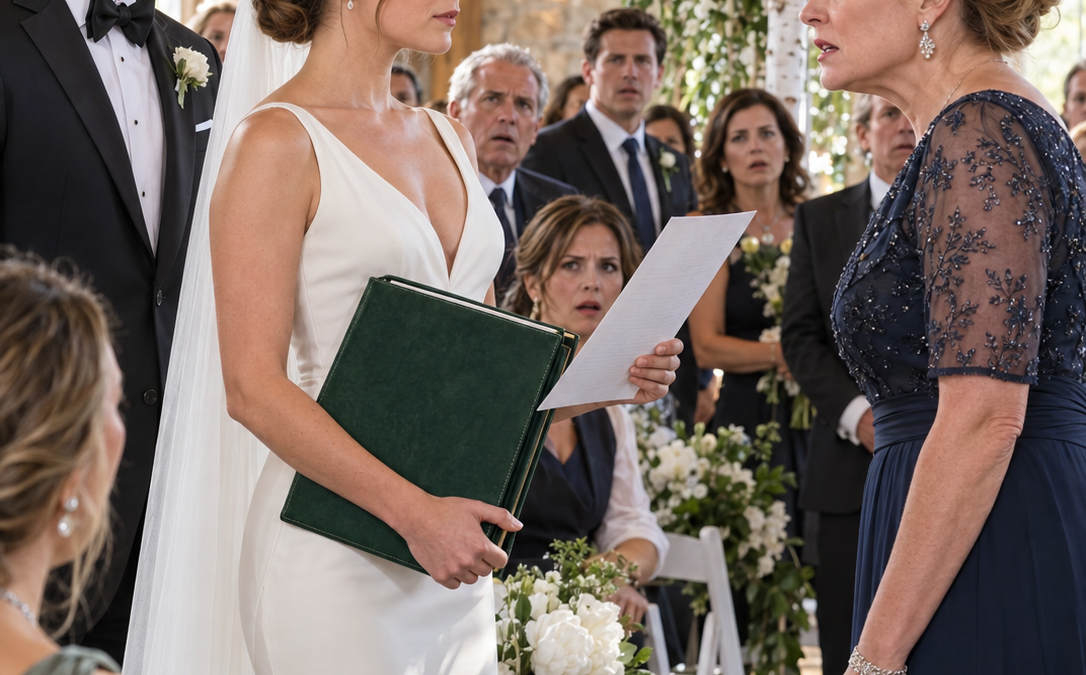
Helen had agreed to a brief pause in the ceremony between the readings and the vows for me to address the room.
She didn’t ask why.
I told her I needed to thank the people who’d made the day possible.
And that was true.
I just also needed to thank them for coming to a wedding that someone had worked very hard to make sure never happened.
Diane moved first.
During the pause between the reading and the vows, while Helen stepped aside, Diane stood up from the back row and walked to the center aisle.
She was smiling.
The generous, warm hostess smile I’d seen her practice at every club event.
“If I may,” she said, loud enough for the room, “I just want to say how wonderful it is that we’re all here tonight. There was a little hiccup with the original venue. One of those last-minute things that happen in event planning, as I’m sure Vera knows better than anyone.”
She laughed lightly.
A few guests shifted in their seats.
“But the Brennan family pulled together, as we always do. And look at this beautiful space. We couldn’t be happier.”
She pressed her hand to her chest, the rehearsed modesty of a woman who chaired galas.
“Daniel, sweetheart, your father and I are so proud. And Vera, welcome to the family.”
She turned to sit back down.
And for a moment, the room almost bought it.
The hiccup.
The family pulling together.
The gracious mother-in-law narrating the chaos into something charming and manageable.
I watched two hundred faces soften.
The polite reset of people who don’t want conflict at a wedding.
They wanted to believe her.
It was easier.
Cleaner.
The kind of story that makes a nice toast at the reception.
But I’d spent thirteen years reading rooms.
I knew when a crowd was settling for a comfortable lie because no one had given them the truth yet.
I looked at Daniel.
He looked at me.
His jaw was tight, but he nodded once, almost imperceptibly.
I stepped forward, still holding the peonies.
They were heavy now.
The stems were warm from my hand.
And for the first time that day, I was not solving a problem.
I was finishing one.
I didn’t raise my voice.
I didn’t need to.
The barn had good acoustics.
Stone walls will do that for you.
“Thank you, Diane. I appreciate the kind words.”
I paused.
Let the room settle.
“I want to thank every person in this barn tonight. You got a text three hours ago telling you the address had changed, and you came anyway. That means something to me.”
I held the bouquet against my waist.
The peonies were soft, browning at the edges.
Still here.
“But I owe you the truth about why you’re in this barn instead of the Hadley Estate. It wasn’t a hiccup. The venue wasn’t double-booked. There was no last-minute mix-up.”
I looked at Diane.
She was still standing in the aisle.
Her smile hadn’t dropped yet.
But her eyes had changed.
“Three days ago, the contract holder on our wedding venue—my mother-in-law, Diane Brennan—called the Hadley Estate and canceled our booking. She received a $14,000 refund to her personal credit card. Nine thousand of that was money Daniel and I paid in March.”
The room was quiet.
Not the polite quiet of a ceremony.
The loaded quiet of people recalculating.
“She did not tell me. She did not tell Daniel. She did not tell any of you. She coordinated a replacement ceremony at the Asheford Country Club. Thirty guests. Family. A version of today that she controlled.”
I pulled the cancellation confirmation from my binder, the printout Linda had emailed me at 2:42.
I held it up briefly, then set it on the table beside the arch.
“This is the cancellation record. Timestamp, card number, authorization code. It’s here if anyone would like to see it.”
I looked back at the room.
“I’m not telling you this to embarrass anyone. I’m telling you because you drove here on faith, and faith deserves facts.”
The peonies trembled slightly in my hand.
I set the bouquet down on the table next to the printout and folded my hands.
“Now, if it’s all right with everyone, I’d like to marry the man I came here to marry.”
Diane’s face went through three stages in about four seconds.
First, the frozen smile held in place by muscle memory and thirty years of public composure.
Second, the crack.
A tremor at the corner of her mouth.
A blink that lasted too long.
The micro-collapse of someone who has been outmaneuvered in a room full of witnesses.
Third, the pivot.
She stepped forward.
Her voice was thick with controlled trembling, the practiced quiver of a woman who had cried at fundraisers and board meetings when tears served her better than arguments.
“Vera, sweetheart, I don’t know what you’ve been told, but there has been a terrible misunderstanding. The venue had issues. Structural issues. And I was trying to protect you. I was trying to protect this family.”
“The venue was open three days ago, Diane. It’s open now. I called them.”
“I— That’s not— Roger. Tell them. Tell them about the structural report.”
Roger shifted in his seat.
He looked at his shoes.
He did not produce a structural report.
Diane’s quiver hardened.
The tears dried.
And there it was.
The real face beneath the performance.
Her voice dropped low and flat.
“You ungrateful little— Do you have any idea what this family has done for you? What we’ve given you? You had nothing. Nothing. You planned parties for a living, and we opened doors for you that you never could have—”
“She plans parties,” said a voice from the third row.
Daniel’s aunt.
The same woman who’d asked me about my job title at 3:52.
“She plans parties, Diane, and she just moved your entire guest list to a new venue in ninety minutes while you were driving to a country club to host thirty people.”
The room exhaled.
It wasn’t applause.
It was something better.
The collective recognition of a lie being replaced by a fact.
Diane stood in the aisle with her mouth slightly open.
I looked at her from the front of the barn, my hands still folded, my voice still even.
“You’re right, Diane. I plan parties.”
I paused.
“Watch me.”
I turned to my father.
He was sitting in the fifth row, groom’s side, his borrowed suit suddenly looking too big for him.
His arms weren’t crossed anymore.
They were in his lap, hands laced together, knuckles white.
I didn’t walk to him.
I didn’t need to close the distance.
The barn was small enough that when I spoke, he could hear me like I was sitting beside him.
“Dad.”
He looked up.
“You told me this morning that I should let Diane handle things. You told me to be grateful. You’ve told me a version of that my whole life. That I didn’t finish school. That nobody takes a party planner seriously. That I’d never finish anything.”
The room was silent.
Two hundred people and a camera crew.
And the only sound was the faint hum of the fairy lights along the stone wall.
“I left college at nineteen because Mom was dying and someone had to be there. That someone was me, not you.”
His jaw tightened.
I saw it.
The flinch that precedes either an apology or a deflection.
“I built a career without a degree. I run operations for a company that manages eleven venues in this valley. The vendors in this room tonight follow my timelines. The venue we’re standing in has a contract with my name on page one.”
I held his gaze.
“You said I never finished anything. I finished today in ninety minutes, in a wedding dress, while you stood in a parking lot and told me to be grateful.”
He didn’t speak.
His mouth opened, then closed.
I saw something shift behind his eyes.
Not quite shame.
Not quite recognition.
But the shadow of both.
A half second where he was just a sixty-year-old man sitting in a suit that wasn’t his, realizing his daughter had outgrown the smallest version of her he’d been carrying in his head.
Then he looked away.
He straightened his tie.
He didn’t say he was sorry.
I didn’t expect him to.
Some doors stay locked no matter who holds the key.
Helen Hartley stepped back to the arch.
“Shall we continue?” she said, as if the last ten minutes had been a weather delay.
Daniel took my hand again.
His eyes were red, but his grip was steady.
The vows were short.
We’d written them together on a Tuesday night, sitting on the kitchen floor with the cat between us, and they were plain and honest and didn’t try to be poetry.
He said he loved me for the way I solved problems before most people noticed they existed.
I said I loved him for letting me be the one who solved them without ever making me feel like I had to.
Helen pronounced us married at 4:32.
The barn erupted.
Not with the polished applause of a country-club ceremony, but with the raw, relieved, joyful noise of two hundred people who’d been sitting in a story they didn’t fully understand until ten minutes ago and were now watching it end the right way.
Daniel kissed me.
I kissed him back.
Someone whistled.
The quartet started playing again.
I picked up the peonies from the table next to the cancellation printout that nobody had bothered to examine because the truth had already been spoken.
I held them against my chest as we walked back down the aisle between rows of folding chairs and fairy lights and people who were standing now, reaching out to touch our arms, our shoulders, the edge of my dress.
Janet Pruitt was near the back with her camera operator.
She wasn’t recording the ceremony.
She was recording the crowd.
The faces.
The tears.
The hands.
Diane and Roger were gone.
They’d left during the vows.
Brooke was still there, sitting alone in the back row, staring at her phone with the blank expression of someone whose broadcast had turned into someone else’s headline.
We stepped outside into the last hour of daylight.
The ridge above Quarry Hill was gold.
And I was married.
Janet’s segment aired the following Tuesday on Channel 9’s evening broadcast.
She called it “90 Minutes: How a Hudson Valley Bride Saved Her Own Wedding.”
The piece ran four and a half minutes, long for a local lifestyle segment.
It opened with footage of Lark’s Barn lit up at sunset, then cut to interviews with three guests who described getting a last-minute text and driving to a venue they’d never heard of.
Janet didn’t editorialize.
She didn’t need to.
The facts told the story.
A wedding venue canceled without the bride’s knowledge.
A refund processed to someone else’s credit card.
And a woman who relocated two hundred people in under ninety minutes using a professional network the groom’s family didn’t know she had.
The segment didn’t name Diane directly.
It didn’t have to.
Within 48 hours, every member of the Asheford Country Club who’d been at the wedding had shared the clip.
Diane resigned from the gala committee the following Friday.
Roger stopped returning calls from three of his golf partners.
Brooke deleted an Instagram post she’d drafted about family resilience after the comments filled with people who’d seen the broadcast.
The money was simpler.
An attorney Daniel and I consulted the following week reviewed the cancellation record, the deposit receipts, and the refund trail.
She said that Diane’s cancellation of a contract funded in part by our money, without our knowledge or consent, may have constituted unauthorized conversion under New York law.
She said we could likely recover the $9,000 through a civil claim.
We kept the receipts.
We didn’t file.
The point had already been made in a room full of witnesses and a four-minute news segment seen by 40,000 people in the Hudson Valley.
Daniel called his parents the Wednesday after the broadcast.
It was a short conversation.
He told them he loved them, that the door was open if they ever wanted to have an honest relationship with us, and that the financial question would remain on the table until they were ready to discuss it.
Diane hung up.
Roger texted two hours later.
Your mother needs time.
She took it.
As of the day I recorded this, we haven’t spoken in five months.
I don’t know if that’s a boundary or a loss.
Most days, I think it’s both.
The binder sits on a shelf in my home office now, between a framed photo of my mother’s peony garden and the Lark’s Barn invoice stamped PAID.
I still carry a version of it to every event.
I probably always will.
Some tools earn their place not because they’re elegant, but because they were there when you needed them.
A diploma proves you sat in a room.
It never proved what I could do when the room was locked.
That’s my story.
A locked door.
A borrowed barn.
And ninety minutes that told me everything about who showed up for me—and who showed up to watch me fall.
If someone in your family ever measured your worth by a piece of paper, take this as your sign to stop letting them hold the contract.
Share this with a woman who needs it.
Drop a comment, hit subscribe, and I’ll see you in the next one.








