I arrived at my wedding to find every table gone. the flowers. the cake. even my chairs. my sister had moved everything to her engagement party. mom texted: “she’ll only get engaged once. you’ll understand.” my first guest arrived in 37 minutes. i sent one photo. eleven minutes later, three trucks turned around. my sister called first.
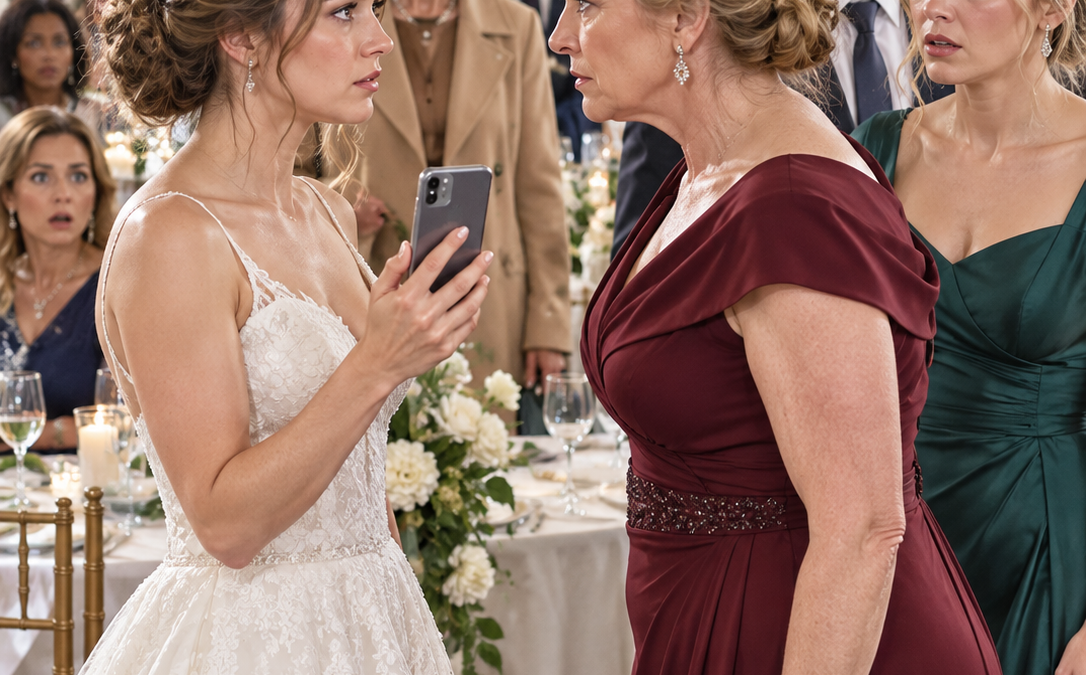
“You’ll understand,” my mother said the second I called her from the empty hall. “Colette only gets engaged once. You can always do this again.”
I was standing on the tape marks where my aisle used to be.
No tables. No chairs. No flowers. No cake.
My father had spent the morning driving every last piece across town so my sister could impress the family my parents actually valued.
Thirty-seven minutes until the first guest.
They had spent twenty years deciding I was the one who would always absorb the damage and keep quiet.
That afternoon, they learned what happens when the person they keep underestimating finally stops absorbing it.
My name is Gloria Theus. I’m thirty-four years old.
Welcome back to Hidden Shadows, where we tell the stories of women who were treated like they would never fight back—until the day they did. If someone in your family has ever decided your moment was less important than someone else’s, this one is for you.
Drop a comment and subscribe.
To understand how a family gets to a morning like that one, you have to understand what I do for a living—and how little they thought of it.
I build events for people. Weddings. Galas. Anniversary dinners. The kind of parties where a company wants to look like it has taste.
My company is called Larkspur & Co. I started it out of the trunk of a hatchback in 2013, and by that April, I had been doing it for a little over ten years. I have a warehouse now, a small crew I trust, and a reputation in three counties that I earned one folded napkin at a time.
Every arrangement I send out carries a small cream tag tied with waxed string. On the tag is a pressed sprig of larkspur, dried flat.
It is my maker’s mark.
I started it that first year because I was proud, and I kept it because it turned out to matter.
My florist, Delphine Carver, likes to say she could walk into any warehouse in the state blindfolded and find my work by feel. I always laughed when she said it.
I did not know yet how literally that would come true.
My family had a different word for all of it.
They called it “the flower thing.”
At dinners, my mother would introduce me to her friends as, “My daughter. She does little parties,” in the same voice she used to describe a hobby.
My father once asked me, with real curiosity, when I was going to get a real job with a real building.
I told him I owned the building.
He nodded like I’d said something charming and moved on.
The thing they never bothered to learn was who those “little parties” were for.
Because seven years before that wedding, in 2019, I got a call from a woman named Eleanor Ashford.
The Ashfords are the kind of family that a town like ours quietly arranges itself around. Old money. A foundation with their name on a wing of the hospital. A spring gala people angle for a year to be invited to.
Eleanor called because a planner had let her down and someone had given her my number.
I did her daughter’s rehearsal dinner in nine days.
She has not used anyone else since.
“Only you for the gala, Gloria,” she told me once in a text I still have. “No one else touches it.”
I never mentioned the Ashfords to my parents, partly because I don’t name-drop clients and partly because they never asked me a single question about my work that wasn’t a setup for a comment about Colette.
So it stayed where it lived—in my phone, in my warehouse, in Eleanor’s guest lists.
A whole part of my life my family didn’t know existed because they had already decided there was nothing there worth knowing.
That is the part that still gets me when I let it.
They didn’t underestimate me because they didn’t have the information.
They underestimated me because they never looked.
The one person who did look was Nolan.
I met Nolan Brandt in 2022 at a wedding I was breaking down at midnight while he waited politely for me to stop working so he could ask for my number.
He is an inspector for the county. Bridges, culverts, the unglamorous bones of a place. He notices when things are built to hold and when they’re built to look like they hold.
I think that’s why he noticed me.
We got engaged in the summer of 2025, and when we started planning our own wedding, I did something that surprised him.
I planned it myself.
All of it.
“You’re the only bride I know who’s also her own vendor,” he said.
“Cheaper that way,” I told him. “And nobody tags a chair like I do.”
I want to be honest about the money because the money is the whole spine of this.
Our wedding cost $62,000.
Of that, I paid $41,000 out of Larkspur’s account—my own labor at cost, my own relationships, my own deposits. Nolan covered the rest, about $21,000.
Not one dollar came from my parents.
Not one.
Every contract had my name on it. Every deposit cleared from my account.
My rental partner, Hollis Vandermir, put it in his blunt way when we signed.
“Your wedding, your account. I don’t move a single chair without your word.”
I laughed.
I didn’t know I would be quoting him back to himself before the day was over.
I should tell you about the three of them because they’re not extras in this.
Hollis has done rentals for thirty years and trusts almost no one. He started sending me his overflow clients in 2016 after I caught a load-bearing mistake in a tent setup that would have put a chandelier on a bride.
Delphine and I came up together—two broke women splitting a cooler in a van. There is no one alive who knows my hands better.
And Ruth Anne baked the cake for that warehouse mistake I mentioned and for a hundred jobs after. She’s buried two husbands and does not scare.
These are not people you can call with a stranger’s voice and redirect like a pizza.
They are people who, over ten years, learned that when a Larkspur order goes out, I stand behind every tag on it.
My family saw vendors.
I saw the only network I’d ever been able to build where my competence was the asset instead of the excuse.
Remember that.
Because in about an hour, it’s going to be the difference between a stripped room and a wedding.
There was one thing at that wedding that wasn’t a rental, wasn’t for sale, and wasn’t insured for anything close to what it was worth to me.
A small glass bud vase.
Cheap. A little cloudy at the base.
It was from the very first event I ever styled in 2013, a backyard anniversary for a couple whose names I’ve forgotten, where I put a single white ranunculus in that vase because I couldn’t afford real centerpieces.
It became the thing I set on my own table at every big moment since.
I planned to put it on the sweetheart table with one flower in it the morning of my wedding.
That vase is going to come back later.
Hold on to it.
If you’ve ever been the one in your family who was told you were “the capable one” right before someone used it as a reason to give you less, you already know the shape of what’s coming.
Stay with me.
Because to understand why my parents thought they could take my entire wedding and expect me to smile about it, you have to understand the pattern.
It didn’t start on my wedding day.
My wedding day was just the last time it worked the old way.
We grew up four years apart, Colette and me.
From the beginning, the family sorted us into roles the way some families do without noticing.
Colette was the delicate one. The one things happened to.
I was the one who could handle things.
It sounds like a compliment.
It is the most expensive compliment I have ever received.
When I was twelve, I saved for most of a year for a class trip. Two weeks before it, my sister needed braces urgently, and the trip money became the down payment on them.
“You’ll understand,” my mother said.
I remember thinking she was right.
I did understand.
That was the problem.
When I was in college, my parents co-signed a car loan for Colette and helped with two years of an apartment. When I asked once if they could help with a single semester, my father told me gently, “You’ve always been the easy one, Glow. Colette needs more help. That’s all.”
He wasn’t cruel about it.
That’s what I want you to hear.
There was no villain voice.
There was just a decision made so long ago that by the time I was an adult, it wasn’t even a decision anymore.
It was weather.
For years, I threw the family parties.
Every birthday. Every anniversary. Every holiday that needed a table set.
I did it for free, at a level I charged strangers thousands for.
When I once carefully suggested that maybe they could hire someone for my father’s sixtieth so I could actually attend as a guest, my mother looked genuinely confused.
“Why would we pay a stranger when we have you?”
I stopped asking them to see it a long time ago.
That’s the part people miss about women like me.
We’re not waiting for the confrontation.
We stopped waiting years before the story you’re hearing.
We just got quiet.
And quiet gets mistaken for consent.
There’s one more piece of the pattern I’ll give you because it’s a different flavor than the money, and it’s the one that actually taught me to keep my work to myself.
The month I signed the lease on my warehouse—the real one, with a loading dock and my name on the deed—I drove straight to my parents’ house to tell them.
I was thirty-one. I had built something out of nothing, and I wanted, one time, to hand them a thing they could be proud of without a catch.
My mother was on the phone when I walked in.
She held up a finger.
She was talking to Colette, who had just gotten a promotion at a job she’d keep for another eight months.
And my mother was saying, “That’s incredible, sweetheart. We have to celebrate. We’ll do a dinner.”
When she hung up, I told her about the warehouse.
She said, “Oh, good, honey. That’s a relief. Now you’ll have somewhere to keep all that stuff.”
That was it.
Somewhere to keep all that stuff.
There was no dinner.
There was never a dinner for the flower thing.
I didn’t cry about it.
I went back to my warehouse, and I looked at the pressed larkspur I’d started tagging everything with, and I decided that from then on, the people who understood what I’d built would be the people I built things with—not the people I was born to.
That decision is the entire reason this story has the ending it has.
My family taught me, without meaning to, to pour my loyalty somewhere it would be returned.
Then, years later, they were shocked when it was.
Late in 2024, Colette met Spencer Ashford.
I need you to understand what that meant in our house.
My parents did not fall in love with Spencer.
They fell in love with the Ashford name.
My mother started saying it the way some people say a brand.
The Ashfords this. The Ashfords that.
My father, who had never in his life cared about a fork, started asking Colette which fork the Ashfords used.
It would have been funny if it hadn’t been so naked.
Here is the detail that matters most—the one that will pay off later, so watch it go into the ground now.
Colette never once let me near the Ashfords.
At first, I thought it was scheduling.
Then I noticed the pattern.
Any dinner, any event, any moment where the two families might overlap, I was quietly uninvited.
“It’s just easier if you don’t come, Gloria,” she told me once, and she smiled when she said it, which was worse. “The Ashfords are a lot. You’d feel out of place.”
I would feel out of place with the Ashfords.
I didn’t correct her.
I could have.
I could have told her exactly how at home I was in Eleanor Ashford’s dining room, but I had spent thirty years watching my sister need to be the most impressive person in any room she entered.
And I understood, without any drama about it, that she had kept me away on purpose.
She didn’t want her competent older sister anywhere near the family she was trying to marry into.
She wanted to be the whole show.
So I stayed quiet, and I kept a secret I hadn’t gone looking for.
Because a few weeks before my wedding, while planning her engagement party, my mother said the name of the venue the Ashfords preferred, and the name of Eleanor’s assistant, and the name of the foundation dinner they’d be coming from.
And I realized, sitting at my parents’ kitchen table, that Colette’s Ashfords were my Ashfords.
The family my sister had spent a year keeping me away from was the family that had trusted me with everything they cared about since 2019.
“You could just tell them,” Nolan said that night when I told him.
“I’m not going to win my family by name-dropping,” I said. “If they ever see me, they’ll see me on their own.”
I meant it as dignity.
I didn’t know they were about to hand me the match themselves.
Here is how the two events were supposed to work, because the logistics are the whole reason any of this was possible.
My wedding was on Saturday, April 18, at four o’clock at a venue called Cedar and Oak.
One hundred twenty guests.
Colette’s engagement party was that same evening at six at Ivywood Hall, twenty-six miles away.
Two events.
One day.
When it first came up, I flagged it carefully, the way you flag anything with my family.
My mother waved it off.
“It all works out,” she said. “Yours is at four. Hers is at six. Plenty of room.”
Plenty of room.
I remember thinking it was a strange thing to say.
Room for what?
I didn’t ask.
I should have.
I designed my own wedding the way I design everyone else’s—as a job with a schedule.
My vendors were my closest working partners. Hollis on rentals, Delphine on flowers, Ruth Anne on the cake.
And because I know how a wedding day actually runs, I split the delivery into two waves.
The morning wave was the ceremony: the arbor, the aisle chairs, the runner, the structural pieces Hollis’s crew installs early.
The afternoon wave, timed for between one and three, was everything that couldn’t sit out for hours: Delphine’s flowers, Ruth Anne’s cake, and the reception rentals.
The dining tables. The linens. The settings for 120 people.
Every piece of it tagged.
Every piece of it mine.
A week before the wedding, the small ask started.
That’s how it always begins in my family.
Not with a theft.
With a favor.
“Could you just lend a few centerpieces for Colette’s party?” my mother asked. “You’ll have so many.”
“You have 120 seats,” Colette said on the phone in the same breath. “I only need forty. You won’t even notice.”
I said no.
Politely, but clearly, which for me was a lot.
I told them my rentals were counted and contracted, that I couldn’t pull from a booked order, that I’d help them find their own supplier.
I even offered to make some calls.
They said they understood.
They said fine.
And that, I have learned, is the sound my family makes right before they do the thing anyway.
Two days later, Hollis called me, mildly annoyed, to ask why my mother had phoned his office asking about the delivery schedule for the Theus event.
He told her he only discussed logistics with the client.
I thanked him, told him to keep it that way, and filed it under my family being my family.
Nosy.
Overinvolved.
Harmless.
I did not connect it to anything.
That’s the thing about a pattern you’ve lived inside your whole life.
You stop seeing it as a pattern.
You see it as the shape of the air.
My mother calling my vendor behind my back wasn’t a red flag to me.
It was Tuesday.
I know better now.
At the time, I just asked Hollis to loop me in on anything odd, and I went back to seating charts.
Somewhere in that last week, my mother came by Cedar and Oak “just to see it.”
She walked the room with her phone out, taking pictures of everything.
My tables.
My arbor.
My color story.
“The Ashfords would die for a table like this,” she said, running a hand along a linen. “Absolutely die.”
I thought she was proud of me.
For one warm, stupid second, I thought my mother was proud of me.
She was taking inventory.
The morning of the wedding, my family was busy in a way I couldn’t quite place—cheerful and a little too eager to keep me occupied.
My mother insisted on driving me to my hair appointment and lingered longer than she ever had.
My father, who normally couldn’t sit still, was nowhere.
I was in a chair with foils in my hair and my phone face down.
Exactly where they wanted me.
At around eleven, Delphine called.
I almost didn’t pick up.
“Hey, just confirming,” she said. “You didn’t move the date, right?”
“Move the date?”
“Somebody called this morning saying the wedding was postponed and to redirect the afternoon delivery.”
I laughed because it was absurd.
“Postponed? Delphine, I’m getting married in five hours.”
“That’s what I thought,” she said slowly. “The number wasn’t yours, so I figured I’d check. Okay. Ivywood’s got it wrong, then.”
Ivywood.
The word went past me.
I was under a dryer. I was happy. And I had spent my whole life trusting that my family’s chaos would resolve itself around me the way it always had.
I told her not to worry, that I’d sort it out, and I hung up.
I want you to sit with that.
Somebody used my family’s number to tell my florist my wedding was postponed, and I let it go because letting things go was my whole training.
By 2:30, I was dressed.
By quarter to three, I couldn’t reach my mother, which was unusual, and my stomach did the thing stomachs do before the mind catches up.
I drove myself to Cedar and Oak.
Nolan was meeting me there.
I remember the parking lot was too empty for a wedding that started in an hour.
I remember thinking the caterer was late.
I remember walking up to the doors with my dress over my arm and my keys in my hand.
Still, at that moment, a person to whom nothing had happened yet.
Then I opened the doors.
The room was gone.
I don’t mean it was messy.
I mean it was empty.
The arbor Hollis had installed that morning?
Gone.
The aisle chairs?
Gone.
The runner had been peeled up, the tape marks left behind on the floor like the outline of a body.
And the afternoon wave—the flowers and the cake and the tables that should have been arriving right then—had never come.
One hundred twenty people were going to walk into a bare rectangle of a room in thirty-seven minutes.
For a moment, I genuinely thought I’d walked into the wrong building.
That’s how complete it was.
I actually stepped back outside and looked at the sign over the door.
CEDAR AND OAK.
Then I stepped back in as if the room might reconsider.
It didn’t.
There was just the echo of my own heels on a floor that six hours ago had held my entire life, and the smell of cut grass coming in from a propped side door where someone had carried the last of it out.
The venue coordinator found me standing in the middle of it.
She looked apologetic and confused in equal measure.
“Where’s my setup?” I asked.
My voice came out very level.
“And where are my afternoon deliveries?”
“Your dad’s crew cleared the ceremony before noon,” she said carefully. “They said you knew. And the florist called. Somebody told her the date moved. It’s all going to Ivywood.”
The family, she had said.
Which family?
Mine.
That is the moment the old version of me ended.
Not with a scream.
With a fact arriving fully formed.
My family had emptied my wedding, and I was standing in the proof of it.
I took out my phone.
There was a photo in the family group chat posted twenty minutes earlier by Colette.
A wide, glowing shot of Ivywood Hall half-dressed for her engagement party.
My arbor against Ivywood’s wall.
My chairs in Ivywood’s rows.
My color story.
My design.
My hands’ work staged for my sister’s night.
And on every arrangement in the frame, catching the light, a small cream tag tied with waxed string.
“Look what came together for tonight,” she’d written, with a heart.
Came together.
As if it had assembled itself.
As if forty people hadn’t loaded my wedding into trucks that morning.
I called my mother.
She answered on the first ring, which told me she’d been waiting.
“You’ll understand,” she said before I’d said a word. “Colette only gets engaged once. You can always do this again.”
“Where is my wedding?”
“Gloria, it’s not gone. It’s just—it’s being useful. She needs to make an impression tonight. You know how to make do. You always land on your feet. That’s your gift.”
My gift.
My whole life, the thing they took from me was renamed a gift so I wouldn’t notice it being taken.
My father called while she was still talking.
I switched over.
“Don’t make a scene on your sister’s day,” he said.
No hello.
“I drove it over myself this morning. It’s handled. We’ll figure your thing out.”
“You drove it,” I repeated.
“It’s one afternoon, Glow. Be the bigger person.”
I hung up on both of them.
And that’s when I saw the rest of it.
The part that took the ground out from under me in a way the tables hadn’t.
The bud vase was gone.
Not a rental.
Not on any manifest.
Not something a crew grabs by accident.
My grandmother’s vase. My first vase. My one flower. The small cloudy glass I’d set on my table at every turning point of my adult life.
Someone had taken it off the sweetheart table and packed it with everything else.
It was sitting right then at my sister’s party in a room full of people who did not know what it was and would not have cared.
“They didn’t just take the rentals,” I said out loud to no one. “They took the one thing that was only mine.”
And then, standing there, I did the math I hadn’t let myself do.
The postponed call to Delphine.
The strange, busy cheerfulness that morning.
My mother’s photos.
My father’s truck at nine.
A phrase I would later see in a text he’d sent her that read:
“Truck at 9. Strip it before she’s even up.”
This wasn’t a bad decision made in a rush.
This was planned.
They had sat in a kitchen and decided that my wedding was raw material for my sister’s evening.
And they had made a bet.
This is the part that turned something in me from hot to very, very cold.
They had bet that I would understand.
Colette texted while I stood there.
“Don’t be dramatic. You always figure it out. That’s your thing.”
That’s your thing.
They were counting on me to cry and improvise and forgive—in that order, on schedule, the way I always had.
So I stopped crying.
I want to tell you exactly what happened next because this is the part my family still doesn’t fully understand, and it’s the part that matters.
There was no secret weapon.
There was no lawyer on retainer. No billionaire fiancé. No viral video.
There was only a woman who had spent ten years building the exact machine my family had just tried to steal—and who finally remembered, standing in an empty room, that she owned it.
Nolan came in behind me, still in his shirtsleeves, and read the room in about two seconds.
“What do you need?” he asked.
Not, What happened?
Not, Are you okay?
What do you need?
I have loved him for a lot of reasons.
That was near the top.
“Twenty minutes and my phone,” I said. “Hold the guests in the parking lot. Tell them we’re running late. Keep it light. Don’t let anyone in here yet.”
And I stopped being a bride.
I became the thing I actually am.
The person who runs the event.
I did what I do on any job that’s gone sideways, which is refuse to feel anything for exactly as long as it takes to think.
Panic is a luxury you spend after the problem is solved, not during.
I stood in the middle of my empty room and ran the checklist out loud, quietly, the way I would for a client whose tent had blown down an hour before a gala.
What’s actually lost?
What’s only misplaced?
What’s recoverable, and in what window?
Who has the authority to move each piece?
And does that authority run through me or around me?
I thought it through the way I think through any job that’s gone sideways.
Where is everything right now, physically?
Who is moving it?
Who has the authority to redirect it?
And the answer arrived clean because I’d built the answer myself months ago.
My father had taken the morning wave—the ceremony pieces—in his own truck.
That was gone.
I wasn’t getting the arbor back in time, and I knew it.
But the afternoon wave, the heart of the reception—the flowers, the cake, the 120 settings—had never gone in his truck.
It was on my vendors’ trucks.
Delphine’s van.
Ruth Anne’s van.
Hollis’s second truck.
And someone had told them to take it to Ivywood.
They were, at that moment, on the road.
Not delivered.
On the road between my warehouse district and Ivywood, carrying my wedding to my sister’s party because a lie in my family’s voice had pointed them the wrong way.
And those trucks did not answer to my mother.
They didn’t answer to my father.
Every one of those orders was booked and paid under my name, on the Larkspur account, with my closest working partners driving.
Hollis’s own words came back to me.
I don’t move a single chair without your word.
My phone buzzed.
Hollis, in our vendor thread.
Uneasy.
“We’re 15 out from Ivywood. Somebody said your date moved. Doesn’t feel right. Say the word and we flip.”
Say the word.
I could have written a paragraph.
I could have explained the whole ugly thing—the favoritism, the theft, my mother, my father, my sister’s heart-emoji caption.
I didn’t.
In my experience, the more you explain, the more you sound like someone asking to be believed.
I didn’t need to be believed.
I had the truth, and I had the receipts.
And the receipt, in this case, was a photo my own sister had posted twenty minutes earlier, bragging.
I forwarded Colette’s photo into the vendor thread.
The wide shot of Ivywood.
My arbor.
My chairs.
My tags catching the light.
And under it, I typed one line.
“My wedding wasn’t postponed. It was taken. Those are our tags at Ivywood. I’m asking as your client, not as anyone’s daughter. Bring it home to Cedar and Oak.”
Then I set the phone down on the empty floor.
And I waited.
Three seconds.
Nothing.
Then three little dots appeared all at once.
Three people typing.
Ruth Anne answered first.
She has run her bakery for twenty-two years, and she does not suffer fools.
“Cake’s coming to you. Nobody hijacks a Larkspur order.”
Delphine next.
“I knew that call was wrong. Turning around now. Bringing you every stem.”
And Hollis last, because Hollis was driving and had to pull over to type.
“With respect to whoever’s confused over there, it was never their account. Flipping now. ETA your venue: 25.”
I stood there and watched those three replies stack up on the screen.
And I want to be honest about what I felt because it wasn’t triumph.
It was something quieter and much larger.
It was the feeling of finding out, at thirty-four, that the thing I’d been told my whole life was a liability—that I was too much, too capable, too able to handle it—was the exact thing that was about to save me.
My family had spent decades treating my competence as a resource they were entitled to.
And in the end, the only reason I could stand in that room and fix it was that I’d spent those same decades building something they were not entitled to and never once thought to ask about.
You cannot steal a network.
You cannot subpoena loyalty.
You can only earn it slowly.
And my family had spent their earning on the wrong daughter.
I looked at the time.
Eleven minutes had passed since I sent the photo.
Eleven minutes, and three trucks that had been carrying my wedding away from me turned around on the road and started carrying it back.
I have styled hundreds of moments designed to make people feel something.
That one—standing alone in a stripped room in my wedding dress, watching three names in a group chat decide in real time whose side the truth was on—that one I felt in my teeth.
But a truck turning around twenty-five minutes out does not un-empty a room.
So I went to work on the problem I could actually touch.
The ceremony pieces were lost.
The arbor. The aisle chairs. All of it at Ivywood with my father’s fingerprints on it.
I wasn’t getting them back before four.
Fine.
I don’t need an arbor to get married.
What I needed was a room that didn’t look like a crime scene by the time 120 people walked in.
I called the coordinator over and asked her three questions in a row.
What did she have on site?
What could the venue’s own stock give me?
And where were the early guests?
She had folding tables in a back closet, a stack of house linens, and a garden out back with more blooming than most brides pay for.
And the early guests—because there are always early guests—were three of Nolan’s cousins and my friend Bri standing in the lot in their good clothes, texting each other about whether they had the right day.
I put them to work.
This is the part I love, honestly, when I look back.
My wedding got built by the people who came to watch it.
Bri, who I’ve known since college, kicked off her heels and started clipping branches from the garden with kitchen shears.
Nolan’s cousins carried the house tables in, and I set them the way I’d set a client’s—fast, by muscle memory, spacing them by eye.
I made an aisle out of two rows of chairs and a runner of nothing but instinct.
When someone asked where the flowers were, I said, “Twenty minutes out. Grab that end of the table runner.”
And they did.
Because when you sound like you know what you’re doing, people follow.
Then I hit the first new obstacle, the way you always do.
The house linens were counted for eighty, not 120.
I had forty bare places and no cloths coming until Hollis’s truck, and Hollis was still ten minutes out.
A younger version of me would have frozen on it.
Instead, I did the thing the job teaches you.
I stopped trying to solve the whole room and solved the next ten feet.
Bare wood, I decided, with a garden-clipped runner down the center of each.
Rougher than what I’d planned.
Warmer than what I’d planned.
And honestly?
Better than what I’d planned.
I sent two of Nolan’s cousins to the garden with the shears and a bucket and told them exactly what to cut and how long to leave the stems.
I texted the officiant to hold at 4:45 and confirmed it twice, because a delayed ceremony is only a disaster if the person marrying you doesn’t know it’s coming.
Then I made myself walk the room once, slowly, and look at it the way a guest would.
I fixed the three things a guest would notice first.
That’s the whole trick, if there is one.
Don’t fix everything.
Fix what gets seen.
At 3:30, the first official guest arrived.
My aunt, early as promised.
And instead of an empty room, she walked into a half-built one humming with people, a bride in an apron over her dress giving directions.
She stopped in the doorway.
I heard her say quietly to my uncle, “Wait. Isn’t she the one who does the Ashford events?”
It was the first time I’d ever heard my two lives said out loud in the same sentence, and it landed in that room like a small, strange bell.
A few heads turned.
The whisper moved.
“She does the Ashfords.”
“The Larkspur girl?”
“That’s her.”
For thirty years, my family had worked to keep those two facts apart.
It took a stripped wedding and a room full of witnesses about ninety seconds to put them together.
At 3:35, Delphine’s van pulled in.
She came through the doors with her arms full of my flowers.
My real flowers.
The ones meant for my tables.
She took one look at the garden-clipping operation I had going and grinned.
“Told you I could find your work blindfolded,” she said. “Now let’s put it back where it belongs.”
Hollis was three minutes behind her with the tables and the settings.
Ruth Anne rolled in with a cake that had been forty minutes from becoming my sister’s centerpiece and was now again mine.
Nobody made a speech about it.
They just started building, the way people who are good at their jobs do.
And the room began to come back the way a photograph comes back in a tray.
All at once.
And then all the way.
The cake had suffered for its road trip.
The top tier had shifted half an inch in transit, a hairline crack running down one side where it had been loaded, unloaded, and loaded again.
Ruth Anne looked at it for about two seconds, said a word I won’t repeat in front of a camera, and pulled a piping bag out of her kit.
She rebuilt the seam with fresh buttercream and a steady hand while Delphine handed her three garden roses to tuck over the worst of it.
By the time they stepped back, you could not have found the injury with a flashlight.
That is what competence looks like, by the way.
Not never having a problem.
Having a problem and fixing it before anyone reaches for their phone.
I stood there for one second and let myself feel how much I love those people.
Then I got back to the seating.
We were never going to make four o’clock.
I made the call and pushed the ceremony to 4:45, which any wedding planner will tell you is a Tuesday.
I texted the officiant.
I texted the guest coordinator.
And then I went to find twenty minutes to be a person instead of a machine.
That’s when my phone rang.
It was Colette.
My sister called first.
I want to be precise about that because of everything that happened later.
That’s the detail I hold on to.
She called before my mother.
Before my father.
Before anyone thought to apologize.
She called because something on her end had just started to go wrong.
And she assumed, the way she always had, that I was the reason and also the solution.
“What did you do?” she said.
No hello.
Same as our father.
“The flowers didn’t come. The cake didn’t come. The rental guy won’t answer me. What did you do, Gloria?”
“I didn’t do anything to your party,” I said. “I stopped it from being built out of mine.”
“They’re my vendors.”
“They were never your vendors, Colette.”
I kept my voice flat, which unnerved her more than shouting would have.
“They were never anyone’s but mine. You didn’t hire them. You redirected them with a lie using Mom’s phone. Ask Mom who she was trying to impress tonight. Then ask her whose name is on every one of those contracts.”
There was a pause.
And in the pause, I heard it start—the thing I’d been waiting most of my life to hear and took no pleasure in, which surprised me.
Confusion.
The first hairline crack in a person who had never once considered that the math might not run in her favor.
“Why are they listening to you?” she said.
Her voice had changed.
Smaller.
“Who are you to them?”
I didn’t answer that.
Some questions you let a person sit in.
“Your first guests get to Ivywood in a couple of hours,” I said. “You should go figure out what you’re going to feed them.”
I hung up.
Twenty-six miles away, my sister’s engagement party was quietly coming apart.
And I want to tell you how, because I heard all of it later—from Delphine, who has a friend on Ivywood’s staff; from a text chain I was eventually shown; and from the woman at the center of it, who told me herself.
It started with a staffer named Marlene Aught, who runs Ivywood’s floor and does not like surprises.
When Hollis’s crew came to pull the reception rentals back out—the tables my father hadn’t been able to fit in his truck, the pieces the vendors had started staging—Marlene stopped them and reasonably asked why furniture was leaving her building an hour before a party.
“Recall on the order,” Hollis’s guy told her. “Wrong venue. It belongs to Gloria Theus.”
Marlene turned to my mother.
“Ma’am, this order is under a Gloria Theus. Is that a relative?”
And my mother, for the first time in this entire story, did not have a smooth answer.
Because the honest answer—that Gloria Theus was the daughter whose wedding she’d stripped that morning to decorate this room—was not a thing you could say out loud at your other daughter’s engagement party and survive.
My parents scrambled.
My father got on the phone with Hollis and tried the voice he’d used on me for thirty years.
The reasonable one.
The one that says, Be sensible and let the men handle it.
Hollis let him finish.
“With respect, sir,” Hollis said, “it’s not your account. It was never your account. Your daughter said bring it home, so it’s going home.”
Then Hollis hung up on my father.
Which I would have paid money to witness.
It came apart in stages, the way these things do.
And every stage made the next one worse.
Delphine’s friend on the Ivywood staff told me later that my mother tried three vendors of her own in the span of twenty minutes.
A grocery-store florist.
A party-rental chain.
A bakery two towns over.
And she got the same answer from all of them at 4:30 on a Saturday.
Nothing available.
Not today.
Not with no notice.
She tried to get Marlene to let the party proceed with what was left, which by then was folding chairs and a rented sound system.
And Marlene, who had figured out most of the shape of it by then, said the sentence that I’m told finally cracked my mother’s composure.
“Ma’am, I’m not comfortable putting my building’s name on whatever this is.”
Even the venue didn’t want to be associated with it.
And the guests—the handful of Ashford cousins who’d arrived early, the exact audience the whole scheme existed to impress—stood in a half-empty hall watching a mother and a bride-to-be argue with a caterer and drew the conclusions people draw.
By the time Colette got in her car to drive to my wedding, the party wasn’t a party anymore.
It was a room with the lights on and nothing in it.
Which, when I think about the symmetry, is exactly what they’d left me that morning.
By the time the room was half stripped—my pieces peeling out of Ivywood the same way they’d peeled out of Cedar and Oak that morning—the symmetry of it was almost too clean.
The party was ninety minutes out, and Colette had no flowers, no cake, no reception rentals, and a mother who had run out of smooth answers.
She did the only thing left in her playbook.
She left.
She got in her car and drove the twenty-six miles to my venue—to the wedding she’d helped gut—to make me fix it.
Spencer, confused and worried, followed his fiancée out the door.
And Eleanor Ashford, who had just watched her son’s engagement party fall apart around a name she recognized, came too.
Because Eleanor is nobody’s fool.
And she had begun to understand that the Gloria Theus whose order was being recalled was very likely the Gloria she had trusted for seven years.
Meanwhile, at Cedar and Oak, I got married.
I’m not going to give you every second of it because some of it belongs to me.
But I’ll give you this.
At 4:45, in a room that 120 guests had helped rebuild without quite knowing they were doing it, with flowers that had been forty minutes from another woman’s party and a cake that had nearly become a stranger’s centerpiece, I married Nolan Brandt.
He’d written his own vows.
He’s not a talker, so they were short.
Near the end, he said, “You build beautiful things for everyone. Today, your people built one back for you.”
I looked out at the room.
At Bri, with garden dirt still under her nails.
At Delphine standing in the back with her arms crossed and her eyes wet.
At Hollis leaning in the doorway like a bouncer.
And I understood that he was right.
These were my people.
Not the ones I was born to.
The ones I’d earned.
I’d been to a hundred weddings for work, and I’d always kept a professional distance from the part where two people actually promise each other something.
I’d stand at the back with a clipboard and make sure the music cued.
I had never once let myself imagine it happening to me in a room I’d have to build twice in one afternoon.
And yet, standing there holding hands with a man who had asked me what I needed instead of what had happened, in a room stitched together from a garden and a group chat and thirty years of me quietly becoming good at something, I felt the strangest thing.
I felt like the setup had been perfect.
Not despite the morning.
Because of it.
The morning was how I finally found out who would show up.
The only thing missing was a small cloudy glass vase.
And I felt its absence on that table like a cold spot.
If you’ve made it this far, and you’ve ever had to build your own belonging because the one you were born into kept charging you rent on it, the next part is why I told you this whole story.
Because functionally, I’d already won.
I’d saved my wedding.
But saving the wedding was never going to be enough.
My family was, at that very moment, driving toward me with a different plan.
To walk in.
Spin the story.
And turn me back into the difficult daughter who had overreacted and ruined her sister’s night.
And that—the fight over whose version becomes the truth—is the fight I actually needed to win.
They arrived during the reception.
I was cutting the cake when the doors opened, and my mother came through them first.
Fast.
Wearing the bright, brittle smile she uses in public.
Colette was behind her, pale.
Behind Colette came Spencer.
And behind Spencer, in a camel coat she hadn’t had time to take off, came Eleanor Ashford.
My mother didn’t see Eleanor yet.
She only saw me, and a room full of people, and an opportunity.
“See?” she announced to no one and everyone, in the voice of a woman getting ahead of a story. “She pulled it off. I told you she would. Gloria always understands.”
She turned toward the nearest guests, radiant and conspiratorial.
“Sisters. You know how it is. A little mix-up over the flowers.”
“I understood exactly, Mom,” I said. “That’s the problem.”
The room had gone quiet in the way rooms do when they can feel something coming.
My mother kept smiling, but her eyes were working now, scanning for allies.
This is the part the usual story about my family gets wrong.
They are not monsters.
They are people who have always—always—been able to rewrite the last five minutes in their favor in front of an audience and win.
She fully expected to win this one, too.
“It was one afternoon,” she said, softer now, reasonable for the benefit of the listeners. “We borrowed a few things for your sister’s engagement. She only gets engaged once. Any family would.”
And for a second, I watched it happen.
A few of them almost bought it.
That’s the thing about my mother’s voice.
It’s built for exactly this.
A couple of guests near the front softened the way people do when someone offers them the comfortable version of a story.
A little mix-up.
Sisters.
You know how it is.
I could feel the room deciding whether to let her have it, whether to file this under family drama and go back to their cake.
That’s the moment women like me usually lose.
Not because we’re wrong.
Because the reasonable-sounding person always gets the benefit of the doubt.
And I have never once been the reasonable-sounding person in my mother’s presence.
So I didn’t try to sound reasonable.
I just reached for the facts in order.
“You didn’t borrow,” I said.
I didn’t raise my voice.
I have learned that the quietest person in a loud room is the one everyone eventually turns to hear.
“You told my florist my wedding was postponed so she’d deliver my flowers to Ivywood. You used your phone to do it. That’s not borrowing, Mom. Borrowing is when you ask and I say yes.”
I looked at her.
“I said no. You have the text where I said no.”
I took out my phone and did the only thing I ever have to do at the end of one of these.
Put the facts down in the right order and let them lock.
“These are the contracts,” I said, turning the screen so the front row could see. “Every rental. Every arrangement. The cake. All under my name, on my company’s account.”
I swiped.
“This is the message where I told you I couldn’t lend from a booked order.”
Another swipe.
“This is Colette’s post from three o’clock showing my tagged pieces staged at Ivywood with a heart.”
And then I stopped.
Just for a second.
“And this is Dad’s text to you this morning.”
I read it.
“Truck at 9. Strip it before she’s even up.”
Nobody in that room needed a lawyer to understand what “strip it before she’s even up” meant.
That’s the thing about receipts.
You don’t argue them.
You just watch people read them.
My mother tried the last door.
“You’re twisting this,” she said.
Her smile finally cracked.
“You’re humiliating your family at your own wedding. Why does everything have to be about you?”
And that was the sentence that did it.
Why does everything have to be about you?
At my wedding.
Said to me by my mother in front of 120 people about the day that was supposed to be mine.
I didn’t answer her.
I didn’t have to.
Because Eleanor Ashford stepped forward.
She had been standing at the back, taking it in.
Now she crossed the floor toward me with her hand out and her face doing something complicated.
And she said warmly, in front of my entire family, the thing that ended the war.
“Gloria, my God. This is your wedding.”
She took my hands in both of hers.
“Spencer, this is her. This is the Gloria. She’s designed every event our family has cared about since 2019.”
Then she turned toward my mother.
Her voice cooled by about ten degrees.
“I’m so sorry. I don’t think we’ve met. I’m Eleanor, and I’ve spent the last hour at a party that I now understand was furnished with this woman’s stolen wedding.”
I have replayed my mother’s face at that moment more times than I’d like to admit.
The recalculation.
The dawning understanding that the audience she’d spent a year trying to impress had just walked into the wrong room and found out exactly who her family was.
That the daughter she’d called “the flower thing” was the reason the Ashfords answered their phone.
Colette made a small sound.
Not a word.
Just the sound of a plan dying.
“You knew them?” she whispered to me. “This whole time, you—”
“You told me I’d feel out of place,” I said quietly, just for her. “With the Ashfords.”
Spencer had gone very still.
He looked at Colette.
Then at me.
Then at the phone still in my hand.
And something reorganized itself behind his eyes.
He is, I’ve since learned, a decent person.
Which is its own kind of tragedy for this story.
“Colette,” he said, “did your family take your sister’s wedding for our party?”
Colette didn’t answer.
That was the answer.
I want to tell you I delivered a devastating final line.
A mic drop.
The kind of sentence that ends up on a graphic.
I didn’t.
I’d learned by then that the strongest thing you can do in a moment like that is stop talking one beat before everyone expects you to.
So I turned to my mother and gave her back the only sentence she’d ever really given me.
“You always told me I’d understand,” I said. “I finally do. I just don’t agree anymore.”
Then, softer, because it was the only thing I actually wanted from any of them:
“And I’d like my grandmother’s vase back. It’s still at Ivywood.”
Eleanor looked at me.
“The little glass one on the head table?”
She had seen it, of course.
She’d been standing near it for an hour.
“I’ll have it back to you tonight.”
That’s how I found out the vase had made it.
A stranger.
The family my sister used to keep me from was the one who noticed it and brought it home.
Here is what I didn’t do.
And I want to be clear about it because this is the part that matters to me most.
I didn’t call the police.
Nothing was stolen in a way a report would fix, and I had no interest in that story.
I didn’t demand money.
I didn’t ruin Spencer’s night with a scene aimed at the Ashfords.
I let the facts do their quiet work.
And I stopped.
I didn’t say a single word designed to humiliate my sister beyond the truth she’d already handed everyone herself.
I finished cutting my cake.
I danced with my husband.
I let my family stand at the edge of my wedding and watch the version of the story they’d planned to tell fail to catch.
And then I let them leave.
They left within half an hour.
There was no dramatic exit.
My father muttered something about a misunderstanding.
My mother tried one more time to catch a sympathetic eye and found none.
Colette left with Spencer.
They were not speaking.
And I did not feel triumph watching it.
I felt the specific, tired sadness of finally seeing something clearly that you spent thirty years hoping you were wrong about.
The engagement party never happened.
There was nothing left to hold it up.
The fallout came slowly over the following months, the way real consequences do.
Not a courtroom.
Not a bankruptcy.
Just the steady arithmetic of trust withdrawn.
Eleanor Ashford brought the vase to my door herself two days later.
She stood on my porch and told me she’d known for years that I was good, and that she was sorry it took watching my family to understand how good I’d had to become.
She’s still my client.
She always will be.
Before she left, she said one thing I’ve kept.
“I’m so glad it was you they underestimated. It would have broken someone softer.”
The engagement did not survive the spring.
I don’t have the details, and I didn’t ask for them.
Spencer, from what I understand, could not unsee what he saw in my reception.
Not the theft itself so much as the ease of it.
The way my parents had done it without a flicker of doubt that it was theirs to do.
You can forgive a person a mistake.
It’s harder to marry into a family whose reflex is to strip a daughter for parts.
My mother lost the Ashford connection she’d wanted more than she’d ever wanted my respect.
There’s a kind of justice in that so exact I could not have designed it better.
And I design things for a living.
My parents and I are not estranged, exactly.
I still see them.
But I changed the terms.
And the terms are the whole point.
I don’t throw the family parties anymore.
When my mother called about my father’s next birthday, already assuming, I told her kindly, “I’ll come to dinners. I won’t come to fix things. That part is closed.”
She didn’t understand.
She may never.
For thirty years, my capability was the currency they spent on Colette.
And I have taken it off the table.
A family that ran on my labor is discovering how much of it was running on my labor.
My father, for what it’s worth, came the closest to an apology.
He called a month later and said, gruff and sideways, “I shouldn’t have driven the truck.”
Not, I shouldn’t have taken your wedding.
I shouldn’t have driven the truck.
As if the mistake were the logistics and not the thirty years.
I told him I appreciated him saying it because I did, and because a half-apology from a man who’d never apologized was still a door opening an inch.
But I didn’t rush through it.
I’ve learned that you can accept the peace someone can give you without pretending it’s the whole thing.
My mother left me a voicemail a few weeks ago.
“The Ashfords canceled the foundation thing,” she said. “Was that you?”
I didn’t call back.
Not to punish her.
Because I finally, genuinely, had nothing to fix.
Colette and I talk a little less than we did.
She has never apologized.
And I’ve stopped needing her to, which is its own kind of freedom.
The last time I saw her, she said, almost to herself, “I didn’t know you could do all that.”
And I understood that she was telling the truth.
And that the not knowing had never been an accident.
You can only underestimate someone you refuse to look at.
I think about her more gently now than I expected to.
For most of my life, I believed Colette was the winner in our family.
The favorite.
The one who got the trip money and the car and the front seat at every dinner.
It took watching her stand in my reception, white-faced, losing the exact thing she’d tried to buy with my wedding, to understand that being the favorite had cost her something, too.
She was raised to believe that the world would keep arranging itself around her.
That other people’s things were hers if she wanted them badly enough.
That she’d never have to build anything because things would simply be moved to her.
And then, at thirty, in one afternoon, that whole education failed her at once, in front of the family she was trying to marry into.
I don’t wish it on her.
I just don’t carry it for her anymore.
That’s the difference.
For thirty years, I carried the weight of everyone’s comfort.
Now I set it down.
And the people who were leaning on it had to learn to stand.
The vase sits on my dining table now, in the home Nolan and I built, with a single flower in it most weeks.
He asked me once, a while after the wedding, if I still tag everything at work.
“Everything that’s mine,” I told him, “so there’s never a question again.”
They spent twenty years sure I would understand.
They were right.
I understood exactly what they thought I was.
What they thought they could take.
And what it was actually worth.
I just finally stopped apologizing for it.
If your family ever taught you that being the strong one meant being the one who gets less, I hope this reminded you that capable is not the same as available.
And that you’re allowed to close that part of the table, too.
I’m Gloria.
Thank you for listening to Hidden Shadows.
Take care of yourself.








