Grandma gave me $120,000 for my first home. my parents bought my sister a house with it. mom said: “she gave us grandchildren. you gave us nothing.” dad added: “you’re single. you don’t need a house.” at thanksgiving, grandma asked, “how’s your new home?” my sister smirked. “i love it.” grandma went still. “you gave her my money?” mom shrugged. “she needed it more.” grandma picked up her phone. “good. then this call is long overdue.”
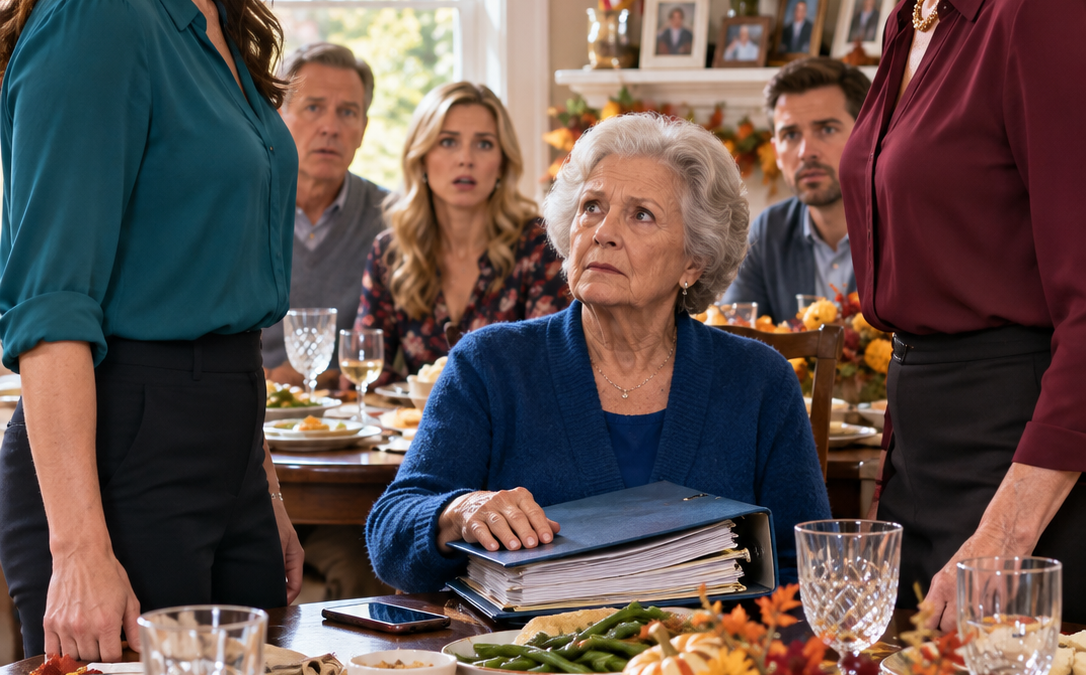
“She gave us grandchildren. You gave us nothing.”
My mother said it to my face at Thanksgiving.
My father added, “You’re single. You don’t need a house.”
In March, Grandma set aside $120,000 for my first home. By June, my parents had given that money to my sister, then told me a bank was holding it.
No bank was holding it.
I spent eight months looking at houses I could not buy. My sister spent those same months in a four-bedroom house with a yard.
Then Grandma asked how I liked my new home.
I didn’t have one.
Mom shrugged. “She needed it more.”
I thought Grandma had just found out.
She hadn’t.
She had waited all summer for that shrug. Then she picked up her phone.
They thought my house money was already gone.
They were about to learn it had never been theirs to give.
My name is Jessica Rhodes. I’m thirty-four years old.
Before I continue, if you find this story worth hearing, please take a moment to like and subscribe, but only if you genuinely connect with what I’m sharing. Drop a comment telling me where you’re watching from and what time it is there. I’d love to know.
My grandmother opened a bakery in Wichita in 1978, when she was thirty-four. She ran it for thirty-two years, leased the building out when her knees finally gave up, and in February of last year, she sold it.
Two hundred sixty thousand dollars for a brick storefront with a cracked front step and forty years of flour in the grout.
She called me before she called my mother.
I didn’t think about that at the time.
I should have.
I drove over on a Saturday and sat at her kitchen table, the same table I’d sat at for ten months back in 2014, when she’d had a small stroke and I was twenty-three and the only person in the family without a reason not to move in.
That table has a burn mark near one corner from a pie tin in 1983. She has never sanded it out.
She says a kitchen should show its work.
In 2014, I ate most of my meals at that table across from a woman relearning how to hold a spoon with her left hand. She hated being watched, so I’d bring work invoices from the job I’d left in Kansas City, spread them out, and pretend to be busy while she practiced.
Some nights, she’d get the spoon all the way to her mouth and look at me to see if I’d noticed.
I always had.
I always pretended I hadn’t.
My mother came by on Sundays with a casserole and stayed forty minutes. Brooke was planning her wedding. Nobody asked me to move in.
I just did.
And after ten months, I moved out again.
Nobody in my family has mentioned that year since.
Her recipe binder was lying in the middle of the table that Saturday. Blue cover. Spine coming apart. The first page was dated March 3, 1978, in her handwriting.
Rent: $200. Flour: $18.
She kept the books for the bakery in that same binder for years before she could afford a ledger. Recipes went on the right-hand pages. Money went on the left.
She slid a folded piece of paper across the table to me.
It was a note in her own hand.
$120,000.
Underlined once.
“Your grandfather said the bakery money should go to whichever one of you needed a roof first,” she said. “That’s you, sweetheart. It was always going to be you.”
I told her it was too much.
She told me she’d already decided, and that deciding was the only part of getting old she still enjoyed.
Then she said, “I’ll tell your mother after it’s in the account.”
Not before.
I didn’t ask why the order mattered to her.
The following Monday, March 10, we went to the credit union together. Prairie State, the one on Douglas, where she had banked since before I was born.
We already had a joint savings account there. We’d opened it in 2014 so I could pay her pharmacy bills while she recovered.
It had $412 in it and hadn’t been touched in years.
That was where she put the money.
One deposit.
$120,000 even.
The teller asked whether she wanted anything written on the memo line of the deposit slip.
“Jessica. First house,” Grandma said. Then she added, “I want it everywhere you can put it.”
The teller wrote it on the slip and typed it into the transfer description.
Grandma folded her copy into quarters and put it in her wallet behind her driver’s license.
On the way to the car, she stopped and put her hand on my arm.
“If your mother says anything about this money, you call me first. Not her. Me.”
I laughed.
I remember that.
She didn’t.
I had been renting a one-bedroom apartment in College Hill for six years. I’d saved $19,000 on my own, which, in this market, gets you a good look at a lot of houses you can’t afford.
I work in operations for a food distributor. I schedule trucks, reconcile invoices, and notice when a number on Tuesday doesn’t match the same number on Friday.
It is not a glamorous skill.
It was about to matter.
That Sunday, we had dinner at my parents’ house, the way we did most Sundays.
My mother, Denise, was fifty-eight and worked the front desk at a dental office. My father, Curtis, was sixty-one and used to own a tire shop.
My sister, Brooke, was three years younger than me. She was married to Tyler, and they had a five-year-old named Mason and a two-year-old named Ellie.
I told them about the money.
Brooke hugged me hard enough to knock my glasses crooked, and I believe she meant it.
My father laughed and said, “Well, at least you’ll have a spare room for the kids.”
Everyone laughed.
I laughed, too.
I’d been laughing at versions of that joke since I was twenty-five.
My mother’s first question was why Grandma hadn’t told her first.
Her second question was whether I understood how much money that was for someone who had never had a mortgage.
“Let me help you handle it, honey.”
I said, “Thanks. I’ve got it.”
Then I went to load the dishwasher.
I have sat in the chair nearest the kitchen at that table since I was twelve. It is the chair for whoever clears the plates. Nobody ever assigned it to me.
I just always ended up there.
After a while, it became the kind of thing nobody notices.
Including me.
While I was rinsing plates, I heard my mother in the living room talking to my father in the voice she uses for logistics.
“Brooke’s lease is up in June.”
Nobody said my name.
On April 3, I got a preapproval letter from Heartland Mortgage.
My loan officer was a woman named Pam Riley, who had the least dramatic email style of anyone I’d ever dealt with.
Up to $195,000 in financing. Ninety days to use it.
At the bottom was one sentence:
Once you’re under contract, I’ll just need a gift letter from your grandmother and one bank statement showing the funds.
That was it.
A letter and a statement.
I took a picture of the preapproval and put it in the family group chat.
Brooke sent a heart.
My mother wrote, “Don’t rush. Let’s talk this weekend.”
Grandma called that night.
She didn’t ask about the interest rate or the neighborhood.
“Buy something with a kitchen you’d want to be sick in,” she said. “That’s how you know it’s home.”
On April 12, my mother went to Grandma’s house with a printout.
I wasn’t there. I’ve pieced this together since from what Grandma told me and from the printout itself, which still exists.
It was an article from a mortgage website about gift funds, with the word seasoned circled in yellow highlighter.
My mother explained that lenders now required gift money to sit untouched for six months in the donor’s own account. She said Grandma being on my savings account would look like money laundering to an underwriter, and that the cleanest way to handle everything was to move the money into a new account at the same credit union.
An account my mother would manage on Grandma’s behalf, so Grandma wouldn’t have to deal with the paperwork.
“Mom, it’s just how banks are now. Six months. I’ll handle everything. Jessica has enough on her plate.”
She also said my lender had already explained all of this to her.
Grandma was eighty-one. She hadn’t had a mortgage since 1971.
For thirteen years, since my grandfather died, my mother had been the one who sat beside her at the credit union and pointed to where she should sign.
So Grandma signed for a new account.
My mother’s name first.
Grandma’s name second.
On April 14, $120,000 left the account with my name on it and went into the account with my mother’s name on it.
I found out because I opened my banking app on a Tuesday and the balance said $412.
I called Grandma first, just like she had asked.
She told me what my mother had told her, using my mother’s words.
Six months.
Lender rules.
She said it the way you repeat something you’ve been assured is true.
Then I called my mother.
She didn’t sound defensive.
She sounded tired.
That was worse, because tired sounds like someone doing you a favor.
“Pam said six months is standard for gift funds this size.”
She texted me afterward.
October, sweetie. Keep looking, but don’t put in an offer yet.
I looked at that text for a long time.
I thought about emailing Pam.
Then I didn’t, because emailing your loan officer to ask if your mother is lying is the kind of thing you can’t take back once you’ve done it.
I wasn’t ready to be the daughter who did that.
So October became the date.
I kept it in my head like an appointment.
It took my mother nine days to spend what she had told me would sit for six months.
I wouldn’t learn that for seven more months.
At the end of April, Brooke and Tyler started looking at houses in Derby.
It came up casually in the group chat, like weather.
A four-bedroom on a corner lot, built in 2019, with a fence and a swing set the previous owners were leaving behind.
By the first week of May, they were under contract.
$372,000.
Tyler installed HVAC systems and made about $72,000 a year. Brooke stayed home with the kids and sold baby gear online.
I asked her on the phone how they had managed the down payment.
I asked lightly.
I wanted to be the sister who was happy for her.
And mostly, I was.
“Mom and Dad helped,” she said. “And Grandma chipped in a little for the kids’ yard. Mom said not to make a big thing about it. You know how Grandma is about the kids.”
They closed on June 6.
Brooke posted a picture of Mason standing in the backyard holding a sign that said SOLD, with grass so green it looked painted.
That night, I did the math on my phone.
$372,000.
$72,000 a year.
Helped.
I typed a note to myself that I still have.
How much is a little?
The housewarming was on June 21.
My father spent most of it in Brooke’s new kitchen, running his hand along the granite like he had cut it himself.
I was standing beside him with a paper plate when he said, “Look, Jess, at your stage, you need a decent apartment and a 401(k), not a mortgage. Brooke’s got two kids. That’s different.”
I said, “Okay.”
I don’t know what else I would have said.
It wasn’t a fight.
It was a weather report.
He believed it the same way he believed the Chiefs would make the playoffs.
Through the sliding door, I could see Grandma sitting on the back patio in a lawn chair with a glass of lemonade.
She wasn’t drinking.
She was looking at the kitchen.
Not at the granite.
At the whole room, the way you look at a room when you’re trying to figure out what it cost.
On my way to the bathroom, I passed the refrigerator.
There was a list stuck to it with a magnet in Brooke’s handwriting.
Thank-you notes.
Tyler’s mom.
Grandma.
Mom and Dad.
I read it twice.
Grandma.
A thank-you note to Grandma.
For what?
If you’ve ever been told you needed less because you had less to show for your life, tell me in the comments.
My parents thought a woman without children came with a smaller list of needs.
I’d like to know how many of you have heard some version of that.
My preapproval expired on July 2.
I didn’t renew it.
There was no point until October.
And I had started thinking of October as a place instead of a month.
That summer, Grandma began calling me every Sunday at four.
The first Sunday was July 20.
“Did you find a house?” she asked before she said hello.
I said, “No. Not yet. October.”
She asked what my mother had said that week.
I told her.
She said, “Mm-hmm.”
Which is a complete sentence in my grandmother’s mouth.
Then she said, “Write that down somewhere, honey.”
I did.
I put a pencil G on the paper calendar on my refrigerator.
Every Sunday she called, mostly so I’d remember to call her back if I missed one.
By Thanksgiving, there were nineteen of them.
I thought she was lonely.
She was eighty-one. Her daughter was busy with Brooke’s new house. Her son lived in Colorado and hadn’t been home since 2012.
Lonely made sense.
I didn’t think about the fact that she asked the same question in the same order every week.
I didn’t think about the fact that she never once said, “I’m sure it’ll work out.”
I was keeping a log for someone else.
I just didn’t know it yet.
In August, I toured a house anyway.
I told myself it was research.
It was a 1920s bungalow in Riverside. Two bedrooms. A kitchen window over the sink that faced east.
The listing agent was a man in his sixties who didn’t push.
He let me stand at the sink for a full minute.
I could see exactly where the table would go and which corner would get the morning light.
And I thought about my grandmother’s line about a kitchen you’d want to be sick in.
I understood it for the first time.
You don’t want a beautiful kitchen when you’re sick.
You want one that already knows you.
“Are you thinking of making an offer?” the agent asked.
“Not yet. My funds are tied up until October.”
He nodded like he’d heard it before.
The house sold nine days later to someone whose funds weren’t tied up.
I drove past it twice that fall.
I don’t know why I’m telling you that except that I want you to know I wasn’t just waiting.
I was looking at what the waiting cost.
October came.
On the fourteenth, I texted my mother.
It’s October. Can we go to the bank this week?
She called instead of texting.
That was the first thing I noticed.
My mother texts.
She called, and her voice was heavy and patient, and she said the lender had changed its rules about gift funds again.
Pam had supposedly told her the safest thing now was to wait until after the holidays.
“These things are annoying,” Mom said. “But that’s banks for you.”
I asked her to forward me Pam’s email.
“It was a phone call, Jess. Not everything is an email.”
After we hung up, she texted anyway, as if to close the file.
Lender changed their rules on gift funds again. Pam said after the holidays is safest. Don’t rush this, honey.
I opened my old preapproval letter and read the last line again.
A gift letter and one bank statement.
Nothing about six months.
Nothing about seasoning.
Nothing about the holidays.
I didn’t call Pam that night either.
But I saved the text.
I saved the April one, too.
Some part of me had started keeping things without deciding to.
On October 19, a Sunday, I drove to Grandma’s with a loaf of bread from the bakery that had taken over her old building.
She likes to check whether they’ve ruined the crust.
We were in the kitchen when her landline rang.
The caller ID on the handset showed a number with a 970 area code.
Colorado.
She looked at the screen and let it ring.
“I’ll call back later,” she said.
My uncle Dale lives in Fort Collins. He is my mother’s younger brother, an engineer for the county out there.
I hadn’t seen him since my grandfather’s funeral.
Nobody in my family talks about him.
That is different from nobody talking to him, though I hadn’t learned the difference yet.
“Your uncle knows houses,” Grandma said. “That’s all it is. I’m asking some questions about this one. It’s old. I’m old.”
Then she said, “Mom doesn’t know. You talk to him.”
She put the bread on the cutting board and looked at it instead of me.
“Your mother doesn’t know a lot of things she thinks she knows.”
Then, as I was leaving with my hand on the screen door, she said, “Thanksgiving is at your mother’s this year. Come early. Sit next to me.”
Thanksgiving was November 27 at my parents’ house.
I got there at eleven, which in my family is early enough to be asked to peel something.
My father was carving nothing yet. The turkey was still in the oven. My mother was in the kitchen wearing oven mitts and pulling out a tray of rolls.
For once, it was just the three of us.
Brooke and Tyler weren’t due until noon.
Grandma was being picked up by Brooke on the way.
I hadn’t planned to say anything, but the preapproval letter was in my bag. The one that had expired in July.
It had started to feel like a bill I kept carrying around instead of paying.
“It’s almost December, Mom. When do we go to the bank?”
She set the tray down.
She took off the oven mitts one finger at a time.
And then she stopped talking about the bank.
I think she had been carrying it, too, and she was tired of the weight.
“The money went into your sister’s house, Jessica.”
I waited for the rest.
There is always a rest.
“She has two little kids. She needed stability. You’ll be fine. You always are.”
Then she looked at me the way she looks at a patient who is late.
“And honestly, she gave us grandchildren. You gave us nothing.”
My father didn’t look up from the counter.
“You’re single,” he said. “You don’t need a house.”
They said it like it was a decision that had already been voted on at a meeting I hadn’t been invited to.
Which, I suppose, it was.
I didn’t answer them.
I didn’t have an answer.
I turned to leave the kitchen.
That was when I saw Grandma standing in the hallway with her coat still on and her purse over her arm.
Brooke had dropped her at the door and gone back outside to unbuckle the kids.
Nobody had heard her come in.
Grandma didn’t look at my mother.
She looked at me.
“Sit next to me today.”
There were nine of us at the table.
My parents. Brooke and Tyler. The kids. Tyler’s mother. Grandma. And me.
I took the chair beside Grandma.
It was not the chair by the kitchen.
My mother noticed.
She looked at the empty chair for one second, then steered Brooke toward it.
“Jess, you’re usually—”
“She’s next to me today,” Grandma said.
Grandma kept her purse in her lap.
Every other year, she puts it on the hutch.
I noticed that I had started noticing everything about her by then.
I still didn’t know why.
My father carved the turkey. Ellie banged a spoon. Tyler’s mother said the sweet potatoes were the best she had ever had.
Then, into a lull, in exactly the voice she used to ask about the weather, Grandma turned to me.
“So, how’s your new home?”
I told the truth.
“I don’t have one, Grandma.”
Brooke, thinking the question had been for her, laughed.
“I love it. The kids have the whole backyard.”
Grandma set down her fork.
“You gave her my money?”
My mother shrugged.
A real shrug.
Shoulders up.
Shoulders down.
“She needed it more.”
“Mom, Jess is single,” my father said for the second time that day. “Brooke’s got a family. It went where it was needed.”
The first time he said it, in the kitchen, it had been private.
This time there were nine people at the table.
Including a woman who wasn’t related to any of us.
I didn’t understand yet that Grandma had needed the second version.
Grandma said nothing for five seconds.
I thought she was absorbing it.
She wasn’t.
She was finishing a sentence she had started in July.
My mother filled the silence because that is what she does.
“Family money should go where the family is growing. Jess will be fine. She’s always been fine. We meant to make it up to her later out of your estate, when the time came.”
Then Mom said, “You would have said yes if we’d asked. We just saved you the phone call.”
“You saved me a phone call,” Grandma said across the table.
Brooke had stopped smiling.
She had been told Grandma chipped in for the yard.
Now she was hearing that the whole down payment had been mine.
Tyler put down his fork very carefully.
Tyler’s mother looked at her plate.
Ellie kept banging the spoon, and for a moment, it was the only sound in the house.
I want to be careful about my sister here, because it would be easy to make her the villain of this paragraph.
She had been told a story.
She had liked the story.
And she hadn’t asked the kinds of questions a person asks when they don’t want an answer.
That is a real thing to be guilty of.
It is not the same thing as what my mother had done.
I didn’t know that yet, sitting at that table.
I only knew Brooke had stopped looking at me and started looking at her plate.
And Tyler was looking at her.
Grandma opened her purse.
She took out her cell phone, the one Brooke had set up for her two Christmases earlier, and pressed a name she had already saved.
“No scrolling,” Grandma said. “One press.”
Then she put the phone on speaker and set it on the tablecloth beside her plate.
“Good,” she said to nobody in particular. “Then this call is long overdue.”
It rang twice.
“Mom.”
My mother’s face changed.
She hadn’t heard that voice in thirteen years.
But you don’t forget your brother.
“Dale,” Grandma said. “I need you here next week. I’m selling the house, and I don’t trust anyone in this room to help me do it.”
“I’ll be there Thursday.”
She ended the call, turned the phone facedown, and picked up her fork.
“Mom.”
My mother’s voice had gone thin.
“You can’t be serious. Dale hasn’t been here in thirteen years.”
“I know exactly how long it’s been, Denise. I know who made sure of it.”
My father stood up.
“Lorraine, where exactly do you think you’re going to live?”
“Near the one who never asked me for anything.”
We didn’t stay for pie.
Brooke stood in the doorway while I walked Grandma to my car. She didn’t come outside.
I didn’t wave.
In the car, Grandma faced straight ahead with both hands on her purse.
The spare key to her house was on my key ring.
My mother had one, too.
That was how it had been since 2012.
“Sunday,” Grandma said. “Come alone. Bring nothing. I have some things to show you, and I owe you an apology for how long I took.”
I went on Sunday.
She had the kettle on and the blue binder open on the table.
She took a card out of the binder.
It was a thank-you card with a watercolor house on the front.
Inside, in Brooke’s slanting blue ink, it said:
Grandma, thank you for helping us get our house. The kids love the yard. Love, Brooke, Tyler, Mason, and Ellie.
Mason had drawn a house in the corner with a door bigger than the roof.
The envelope was postmarked July 7.
Grandma had received it July 8.
“I read it three times,” she said. “Then I made bread because my hands needed something to do.”
She hadn’t helped Brooke get anything.
She had given me money.
My mother had moved it “for the bank.”
And now there was a card thanking Grandma for a house that wasn’t mine.
So either Grandma was confused or I was.
Grandma said, “I’m eighty-one. I checked which.”
Then she took out the second thing.
An envelope from Prairie State Credit Union.
On July 15, she had driven herself to the branch, walked up to the desk, and asked for a printed statement on the account my mother had opened in April.
Grandma’s name was on it.
Second, but on it.
They printed the statement without a question.
She laid it flat on the table and set a wooden ruler across it.
That is how she reads everything now.
April 14: transfer in, $120,000.
April 23: transfer out, $112,000, to an account labeled Hensley B&T.
April 30: transfer out, $8,000, to a checking account in my mother’s name.
Balance: zero.
Nine days.
“Nine days,” I said.
“She told you six months,” Grandma said. “She told me six months. She needed nine days.”
I hadn’t known about the $8,000.
Neither had Brooke.
I would find that out later.
My mother hadn’t just moved my money into my sister’s house.
She had kept a piece of it.
I looked at the date on the statement, then at my grandmother, and finally asked the question I had been holding since Thanksgiving.
“Why didn’t you call me in July?”
She didn’t defend herself.
She explained.
If she had called me in July, my mother would have said I had put her up to it. That Jessica had gotten into her head.
If Grandma had gone to my mother privately, there would have been tears and a different version of the story, and nobody else would have heard either one.
What she needed was for my mother to answer in front of people.
In front of Brooke’s husband.
In front of Brooke’s mother-in-law.
In front of Brooke.
And she had needed to know something for herself.
“I wasn’t waiting to punish her, Jessica. I was waiting to find out who my daughter is. If I asked her straight, would she tell me the truth?”
Grandma looked at the statement.
“Now I know. That cost me more than the money.”
The Sunday calls, she explained, had been so she would know every week whether I was still being lied to.
She hadn’t been checking on my house hunt.
She had been checking on my mother.
“You wrote it down,” she said. “Every week, didn’t you?”
“Nineteen times.”
“Good.”
“And the phone call?” I asked. “At the table?”
“That I planned.”
She had called Dale for the first time on October 12 to ask about selling the house.
She wanted to move near me.
She wanted no part of the sale to pass through my mother’s hands.
Then she told me plainly what she was not going to do.
She was not going to sue anyone.
And she was not going to try to take Brooke’s house.
“I’m not putting two babies on the sidewalk for what their mother did,” she said. “That’s not justice. That’s just a different mess.”
But she would sell her house.
She would give me $120,000 from what it brought.
And she would stop a few things my mother didn’t yet realize she was about to lose.
“What things?”
She glanced at the drawer under the counter.
The one with the small brass lock.
The key hung on a hook beside the door, next to the house keys.
“Not tonight. I want your uncle here when we open that drawer.”
Then, as she walked me out, she said, “He’ll be here Thursday.”
On Monday morning, December 1, I was removed from the family group chat.
There was no announcement.
I opened my phone and the thread was simply gone from my list, the way a light goes out in a window across the street.
Brooke texted me separately an hour later.
Mom’s upset. Just give it a week.
I wrote back one line.
Did you know the money was mine?
Under it, the little gray word appeared.
Read.
Nothing else.
Not that night.
Not the next.
Silence can mean guilt.
Or it can mean someone is sitting in a parked car trying to breathe.
I didn’t know which one Brooke’s was.
I let it sit.
On Tuesday, my father went to Grandma’s house alone without calling first.
He didn’t apologize.
He was “worried about her.”
He said selling a house at eighty-one was foolish. Dale would take the money and go back to Colorado. That was what Dale did.
Who would drive Grandma to appointments?
Who would come when she fell?
Denise had done everything for thirteen years.
And this was how she was being repaid.
Grandma made him coffee and let him finish.
“Lorraine, when you get sick—and you will—who’s going to be there? Dale? Jessica with her job?”
Grandma looked at him.
“Curtis,” she said, “who’s been there for you?”
He didn’t understand the question.
I didn’t either when she told me about it that night.
I filed it with the other things she said that didn’t seem to attach to anything.
He left the coffee on the table without drinking it.
On the way out, he stopped at the counter and looked at the locked drawer.
“Since when do you lock that?”
On Wednesday, it was my mother’s turn.
She came with an empty banker’s box and a softer voice than the one she’d used at Thanksgiving.
Mom was moving, she said.
Moving was stressful.
There were things in the house that mattered. Photos. Keepsakes. Papers that shouldn’t get lost in a rush.
She would take them home and keep them safe.
She said safe twice.
Then she went straight to the shelf where the blue binder lived.
Grandma stepped between her and the shelf.
It was the first time in my life I had ever heard of my grandmother physically standing in anyone’s way.
“Mom, it’s a recipe book.”
“Then you won’t miss it.”
My mother tried again lightly.
The way you test a door you’re sure is unlocked.
Grandma told her she could have every photograph of my grandfather.
She could have the Christmas ornaments from the attic.
“The book stays with the person who will use it.”
My mother took the ornaments.
On her way out, she looked at the locked drawer.
That made two of them in two days.
She didn’t know what was in the binder.
She didn’t know the card and the statement were tucked behind the cinnamon-roll page.
But some part of her knew it was the only object in that house Grandma had ever refused to let go of.
That was enough to make her want it.
My uncle Dale arrived Thursday afternoon.
He had left Fort Collins at six in the morning and driven eight hours in a pickup with a toolbox in the bed and a canvas bag of clothes packed for, in his words, “a month, maybe more.”
The bag was old, with the bakery name stitched on the side.
It had been one of the bakery’s delivery bags.
He had taken it with him in 2012.
He hugged his mother in the doorway for a long time.
Then he shook my hand like I was a colleague.
“You’re the one who drove her to the credit union in March. Mom told me.”
He walked through the house with a notepad, writing down everything that would need fixing before it could be listed.
Loose gutter.
Water stain in the back bedroom.
Front step.
He was practical to the point of being restful.
“I’m not here to fight with your mother,” he told me in the kitchen. “I’m here so she can’t say it was you.”
Then he asked the question I had been avoiding for eight months.
“Has anyone actually asked your loan officer whether that six-month rule is real?”
Before I emailed Pam, I did something I could have done in April.
I went to the credit union myself.
My name was on the original account, the one from 2014, and I asked for a printed statement covering March through May.
The teller printed it without a question.
The same way she had printed Grandma’s.
March 10: deposit, $120,000.
Memo: Jessica, first house.
April 14: transfer out, $120,000, to an account ending in 5580.
I had had access to that piece of paper for eight months.
I had never asked for it because asking would have meant admitting I didn’t trust my mother.
And I had been raised to believe that not trusting your mother was a character flaw.
It turns out it is just a question you ask at a counter.
It takes about four minutes.
I put my statement in the binder beside Grandma’s.
Two accounts.
Two names.
One memo line.
And a transfer connecting them like a bridge somebody had built in the dark.
I emailed Pam Riley on December 9.
I kept it short.
Was there ever a six-month seasoning requirement for gift funds on my file?
And had she at any point spoken with my mother, Denise Rhodes?
Pam answered before lunch.
There has never been a six-month seasoning requirement for donor funds. A signed gift letter and one statement showing the money is all we ask. I have never spoken with your mother. If you’re ready to move forward, I can rerun your preapproval this week.
I read it standing at my kitchen counter.
Then I printed it.
Folded it.
Drove to Grandma’s.
And slid it into the blue binder beside the card and the statement.
Three pieces of paper now.
Inside a book of recipes.
Dale read the email, folded it back along the crease, and handed it to me.
“She used your loan officer’s name,” he said.
Then he said it again.
“That’s not a mistake. That’s a habit.”
That night, after Grandma went to bed, Dale told me why he had left.
When my grandfather died in 2012, my mother took over.
The funeral.
The bakery lease.
The bank.
The keys to the house.
Every decision came through her.
Every disagreement was framed as Dale making things harder for a grieving woman.
He fought once.
Lost.
And drove back to Colorado.
He called every Christmas after that.
Sometimes the phone rang and my mother answered and said Mom was asleep.
Sometimes the phone didn’t ring at all.
“I thought she stopped picking up,” he said. “Turns out she never got to.”
In October, when Grandma called him to ask about the house, she had asked why he hadn’t called in twelve years.
He told her he had.
Grandma hung up, went into the settings on the landline my mother had set up for her in 2013, and found his number on the blocked list.
She deleted it herself.
Six days later, he called back.
That was the 970 number I had watched her let ring.
So the phone call at Thanksgiving had been her unblocking him.
Dale said it out loud in front of the person who had blocked him.
Christmas came, and there were three of us.
My mother hosted at her house with Brooke and Tyler, the kids, and Tyler’s mother.
I wasn’t invited.
Dale wasn’t invited.
Grandma declined.
So the three of us stood in her kitchen with the blue binder open to page twelve.
The cinnamon-roll recipe.
The ink was so faded in places that Grandma recited it from memory while I measured.
She taught Dale to fold the dough the way she had taught him when he was nine.
“You still fold it wrong.”
“I’ve been folding it wrong in three states, Mom.”
It was the quietest Christmas I had ever had.
It was also the first Christmas in years when nobody asked me when I was going to settle down.
Brooke sent me one photograph that afternoon.
No caption.
Mason was on the living room floor at my parents’ house tearing paper off a box.
Behind him, on the coffee table, was a white envelope with a green logo in the corner.
Meadowbrook Academy.
His school.
I looked at the envelope longer than I looked at my nephew.
I didn’t know why yet.
Three days later, Dale sat down with Grandma to make a list of every account that would need a change of address before the house sold.
She still keeps a paper check register.
Brown leather.
Every entry in her handwriting.
He opened it to find her utilities and went backward instead.
The same line appeared on the first of every month.
Auto Blue Cross — $900.
Page after page.
He kept turning until he reached January 2020.
“Mom,” he said, “what’s this nine hundred dollars?”
She didn’t look up from the coffee she was pouring.
“That’s your sister’s health insurance and Curtis’s, since the shop closed.”
Dale turned one more page.
There was a second line beginning in August 2023.
$1,100.
Also on the first.
Also automatic.
We laid everything out on the table on January 10.
The three of us.
With the ruler.
When my father’s tire shop closed in 2019, he lost his insurance.
My mother’s dental office didn’t offer benefits.
In January 2020, Grandma set up an automatic transfer to cover their marketplace premiums.
$900 a month.
My mother had asked for it as a temporary arrangement “until Curtis finds something with benefits.”
He found a job at a parts counter.
It didn’t have benefits.
Nobody told Grandma to stop.
“So I didn’t,” she said.
Seventy-two months through December.
$64,800.
At Sunday dinners.
At Thanksgiving.
At Brooke’s housewarming.
My parents had told anyone who would listen that they were managing fine on their own.
My father had stood in Brooke’s kitchen and explained to me what I did and didn’t need while his mother-in-law paid his insurance.
She gave us grandchildren.
You gave us nothing.
The people who said that had been living, in part, on my grandmother’s money for six years.
I sat with that for a while.
What came up wasn’t the money.
It was the pattern.
When Brooke got married in 2015, my parents paid for the reception.
I had assumed they had saved for it.
When Mason was born, my mother took three weeks off work to help.
I had assumed the dental office was generous.
When I got promoted in 2022, my father asked whether the job came with a pension, then changed the subject to Tyler’s truck.
None of those things had been a crime.
I had filed each one under: That’s just how it is.
I had been filing things there for twenty years.
It took a check register to show me the folder had a name.
Then there was the $1,100.
I asked about that one.
Mason’s school.
Meadowbrook Academy.
A private preschool that became a private kindergarten that fall.
My mother had told Brooke that she and Dad were covering it.
Brooke believed her parents were paying for her son’s education.
She had believed it for two and a half years.
Twenty-nine months.
$31,900.
Grandma hadn’t known Brooke didn’t know.
“I thought Brooke knew,” she said. “Why wouldn’t she know? It’s her child.”
Dale did the addition on the edge of a newspaper.
$120,000.
$64,800.
$31,900.
He underlined the last number and pushed the paper across to me without comment.
I looked at it for a while.
Then I said what I had been thinking since the Christmas photo.
Brooke had to know.
Not to hurt her.
Not to win.
Because the meeting Dale was going to call about the house sale would be a lie if Brooke sat at that table believing my parents paid for her son’s school.
And because my mother had used Brooke the same way she had used me.
I was the one who didn’t need.
Brooke was the one who deserved.
Neither of us had been asked.
Dale wasn’t sure.
He said Brooke had been in the room at Thanksgiving and had kept her mouth shut.
Grandma decided.
“Tell her,” she said. “But tell her gently. She’s the only one in that house who ever thanked me. She just thanked me for the wrong thing.”
She took the thank-you card out of the binder and looked at Mason’s drawing.
The door bigger than the roof.
I texted Brooke that night.
Saturday morning. 10:00 a.m. Your place. Tyler should be there. Not a fight. I have some papers you need to see.
She wrote back in under a minute.
Okay.
Brooke’s kitchen island is the size of a small boat.
On January 17, I put three things on it.
The statement from April, with the ruler line still faintly visible where Grandma had pressed it.
Pam’s email.
And a question.
Tyler had made coffee, and instead of leaving the room the way husbands sometimes do when sisters talk, he pulled out a stool and sat down.
I was grateful for that.
Brooke looked at the statement without touching it.
She read the line Hensley B&T twice.
I watched her lips move on the second pass.
“Who pays Mason’s tuition?” I asked.
“Mom and Dad.”
I didn’t argue.
I had learned something from my grandmother by then.
You don’t win an argument with a person who has been lied to.
You give her the phone number.
“I’m not asking you to believe me,” I said. “I’m asking you to call the school on Tuesday. Monday’s a holiday. Ask whose name is on the autodraft.”
I wrote the front-office number on the back of Pam’s email and left it on the island.
Tyler had been quiet.
Now he reached over and turned the statement toward himself.
“That’s our account,” he said. “That’s the deposit we used for the down payment.”
He looked at Brooke.
Then at me.
“I signed off on a gift letter that said ‘from parents.’”
Brooke started to say something.
Stopped.
I picked up my coffee, thanked Tyler for it, and left.
Nobody hugged anybody.
It was the most honest visit we had had in years.
On Tuesday, Brooke called the school from the parking lot after drop-off.
The woman in the front office was helpful, the way front offices are when you ask a simple question.
Mason’s tuition was autodrafted from an account belonging to Lorraine Whitaker.
It had been since August 2023.
The monthly statements went to the mailing address on file.
My parents’ address.
Because that was the address the payer had listed on the enrollment paperwork.
My mother had filled out the paperwork.
Brooke had been busy with a newborn.
Brooke sat in her car with the engine running for twenty minutes.
Then she left me a voicemail.
I still have it.
“It’s Grandma. It was always Grandma. Mom told me—”
The recording cuts off because she hung up on herself.
That night, she went back through her text history with our mother.
She was looking for May.
She found it.
May 2.
Four days before she closed on the house.
I have seen the screenshot.
Don’t tell Jessica that Grandma’s money went into your house. She’ll make it about her. Let her think it was your dad and me.
In May, Brooke had read that as:
Grandma gave you a gift. Your sister is jealous. Keep the peace.
That was how it had been explained to her.
And that was how the words fit.
In January, with the statement on her island and the school’s voice in her ear, the same sentence read differently.
Grandma’s money.
Not a gift to Brooke.
Money that had been Jessica’s, routed through a house, with a mother asking one daughter to help keep the other daughter from finding out.
Same words.
Different information.
That is all a lie ever is.
On Wednesday, Brooke drove to our parents’ house.
I wasn’t there, and I have only heard Brooke’s version.
But Brooke has never in her life been a good liar.
That was why she had made such a convincing beneficiary.
My mother told her the same story she had told at Thanksgiving.
Jess would be fine.
Brooke had babies.
Grandma would understand.
Brooke put her phone on the counter with the May text on the screen.
My mother read it and said, “That’s not what that means.”
“Mom, what was the eight thousand for?”
My mother said something about closing costs.
Brooke said their closing costs had already come out of the money in their account.
My mother said it was complicated.
Then came the sentence.
“You’d side with her over your own mother.”
“I’m siding with the woman who pays for my son’s school,” Brooke said. “Turns out that’s not you.”
She left.
On Thursday, she called me.
“I’m coming on the seventh,” she said. “Whatever meeting Dale sets up, I’m coming, and I’m bringing my phone.”
“Don’t tell them you know.”
“They think you’re with them.”
“I know what they think.”
Dale called my mother on Saturday, January 24.
Not a text.
He wanted her to hear his voice.
A family meeting about Mom’s house, he said.
Saturday, February 7.
Two o’clock.
At Mom’s kitchen table.
Everyone.
My mother agreed.
Then she did what she always does.
She took control of the announcement.
She posted it in the family group chat, the one I had been removed from.
Brooke sent me a screenshot.
Dale wants a family meeting at Mom’s on the 7th, 2 p.m. Your dad and I will bring a plan. Mom shouldn’t be making decisions alone.
Brooke’s reply in the chat, for my parents to see, was simple.
Sounds good. We’ll be there.
My parents walked into the next two weeks believing three things.
That Brooke was on their side.
That Grandma had, at most, a thank-you card and a grudge.
And that nobody had ever thought to ask Pam Riley a question.
Two weeks.
Saturday.
Two o’clock.
Here is what was on the table.
The night before, I stayed at Grandma’s.
Dale went to bed early. He had spent the day patching the water stain in the back bedroom and was asleep by nine with paint still on his knuckles.
Grandma and I sat at the kitchen table with the blue binder between us.
The drawer under the counter was unlocked for the first time since I had known it was there.
She had let Dale open it that afternoon.
Inside were seventy-two folded autodraft notices and twenty-nine tuition confirmations, rubber-banded by year.
Grandma turned the binder to the first page.
March 3, 1978.
Rent: $200.
Flour: $18.
“I was thirty-four when I signed that lease,” she said. “Same as you.”
I knew the story of the bakery.
I didn’t know this part.
Her mother—my great-grandmother—had told her the bakery was a hobby.
Something to keep her busy until the children needed her.
Grandma already had two children then.
She kept the books anyway.
Thirty-two years.
Every dollar on the left-hand page.
“I didn’t pick you because you’re alone, Jessica,” she said. “I want you to hear that. Your mother thinks I picked you out of pity.”
She put her hand on the binder.
“I picked you because you were the one who came and sat at this table when I couldn’t stand up. Nobody sent you. You came.”
I looked at the burn mark near the corner.
The pie tin from 1983.
I thought about my mother’s sentence in the kitchen at Thanksgiving.
She gave us grandchildren. You gave us nothing.
And I understood, sitting there, that it had been said by someone who wasn’t at this table in 2014.
Someone who hadn’t really been at it for a long time.
Before she went to bed, Grandma walked to the hook beside the door.
There were two house keys hanging there.
Hers.
And the spare.
She took the spare down and set it on the counter beside the open drawer.
She didn’t explain.
“Tomorrow,” she said, “nobody cries at this table but me. If I cry. And I might.”
My parents arrived at two o’clock exactly.
Which, for my mother, is a form of aggression.
She was carrying a folder.
A real one.
With a printed label on the tab.
MOM’S TRANSITION PLAN.
My father carried nothing and looked like a man who had been told there would be a plan and had agreed not to read it.
Brooke and Tyler arrived five minutes later without the kids.
Tyler’s mother had them.
My mother patted Brooke on the arm as she came inside.
The way you pat a teammate.
Brooke let her.
Six of us sat at the kitchen table.
Grandma at the head, where she had sat since 1971.
Dale to her left.
Me to her right.
My parents across from me.
Brooke and Tyler at the far end.
My mother put the folder in the center of the table before anyone spoke.
“We’ve handled your mother’s business for thirteen years, Dale,” my father began. “Nobody’s questioning that you care. We’re saying let’s be practical.”
The plan, my mother explained, was simple.
Mom would move into their spare room while the house was listed and sold.
The proceeds would go into a care fund.
An account my mother would manage.
“So Mom doesn’t have to think about it.”
Dale had done a wonderful thing coming home.
Now he could go back to his life knowing his mother was looked after.
Grandma listened to all of it.
Then she picked up the blue binder from the counter behind her and set it down on top of my mother’s folder.
“Mom asked me to lay out what’s happened to her money since March,” Dale said. “Then we’ll talk about the house.”
Grandma opened her wallet.
She took out a slip of paper folded into quarters.
The deposit slip.
March 10.
$120,000.
Memo: Jessica, first house.
She smoothed it flat and put it on the table.
“That’s the day,” she said. “That’s the memo line. I asked them to put it everywhere.”
My mother smiled.
A small, tolerant smile.
“Mom, nobody’s disputing that.”
She reached into her own bag and pulled out the printout.
The article from April.
The one with seasoned circled in yellow.
She laid it beside the deposit slip as though the two documents belonged together.
“I did what the lender required. The money had to sit. Then a good opportunity came up for Brooke and the kids, and it made sense to use it while it was there. We always intended to make it right with Jess out of the estate.”
She looked at me.
“Ask Pam. I did exactly what Pam said.”
“I did,” I said.
I put Pam’s email on the table.
December 9.
There has never been a six-month seasoning requirement for donor funds. I have never spoken with your mother.
Under it, I put two printed text messages.
April 14:
Pam said six months is standard.
October 14:
Pam said after the holidays is safest.
“You used her name twice, Mom. She’s never heard yours.”
My father looked at my mother.
I have seen my father look at my mother in a lot of ways over thirty-four years.
I had never seen him look at her like he was reading something for the first time.
“That’s—” my mother started. “She’s misremembering. It was a phone call.”
Then she turned.
“Brooke, tell them what Grandma said about the yard.”
Brooke didn’t answer.
Grandma reached into the binder and took out the thank-you card.
She turned it so the writing faced my mother and set it down.
Grandma, thank you for helping us get our house.
“I got this on the eighth of July,” Grandma said. “I’d never helped Brooke get a house. So I went to the credit union, and I got the statement, and I read it with a ruler twice to be sure I wasn’t reading the wrong line.”
She told them about the Sundays.
Nineteen of them.
She told them she had known since July.
“I asked you at Thanksgiving because I already knew, Denise. I wanted to see what you’d do with a table full of people watching.”
She let that sit.
“You shrugged.”
My mother’s face did something I had never seen before.
Not anger.
Arithmetic.
She was counting backward through every conversation since July and finding her mother on the other side of all of them.
Grandma laid the ruler across the statement.
Dale read it aloud in the voice he probably uses for county budget meetings.
“April 14, in: $120,000.
“April 23, out: $112,000 to Hensley B&T.
“April 30, out: $8,000 to the checking account of Denise Rhodes.”
Brooke spoke for the first time.
“Mom, what was the eight thousand for?”
My mother didn’t answer.
Brooke put her phone on the table, screen up, and read the May text aloud without changing her voice.
“Don’t tell Jessica that Grandma’s money went into your house. She’ll make it about her. Let her think it was your dad and me.”
“I signed off on a gift letter that said ‘from parents,’” Tyler said.
He tipped his head toward me.
“The money was hers.”
Then Brooke took a folded sheet from her jacket and set it beside the statement.
Meadowbrook Academy.
Tuition confirmation.
Payer of record: Lorraine Whitaker.
Since August 2023.
“You let me thank you for my son’s school,” Brooke said. “For two and a half years.”
My father turned toward Grandma.
“Lorraine, you’ve been paying the school?”
He hadn’t known.
My mother had hidden it from him, too.
That was the moment the two of them stopped being one thing across the table and became two people who had each been managed.
Grandma opened her check register.
She didn’t read from it.
She put one finger on the line that said $900.
Then she looked at my parents.
“The transfers to you stop on the first,” she said. “Both of them.”
Then she looked toward Brooke.
“Mason’s school I’ll handle with his mother.”
Finally, she looked at my mother.
“Leave your key on the counter, Denise.”
The spare key had been sitting there since the night before.
My mother looked at it.
I watched her understand what it had been doing there.
“Mom, you can’t.”
And then she cried.
Real tears.
I’m not going to pretend they weren’t.
She talked through them.
She had been the one who was here.
She drove Mom to every appointment.
She had handled everything for thirteen years while Dale was in Colorado.
And Jessica was—
She looked at me.
“Just around.”
She had given up things.
She had been the one.
My father stood.
His voice was lower than I had ever heard it.
“You’d do this to us at our age?”
“I did it for you for six years, Curtis,” Grandma said. “Nobody said thank you. Brooke did, for the wrong thing.”
My mother turned to me, wet-faced.
“Are you happy?”
I had thought about what I would say for two weeks.
In the end, it was short.
“You said I gave you nothing. I’m the only one at this table who never took anything from her. That’s not nothing, Mom. That’s the only thing she ever asked for.”
My mother took the key off her ring and set it on the counter.
It made a small sound.
They were gone within two minutes.
My father held the door for her.
He didn’t look back.
Tyler walked out toward their car.
Then he turned around, came back inside, picked up the folder labeled MOM’S TRANSITION PLAN, and dropped it in the trash can on the porch.
Dale locked the door.
Brooke stayed.
She stood beside the sink with her arms wrapped around herself.
“Grandma,” she said, “I don’t know how to pay you back.”
“Start by staying for dinner.”
Grandma sat down at the head of her table.
She put both hands flat on the wood.
And she cried.
She had said she might.
She was the only one who did.
On March 1, a Sunday, $900 did not leave my grandmother’s account.
I know because my mother texted me on the third.
It was the first message she had sent since removing me from the family group chat.
It was not an apology.
Is she going to leave us with nothing?
I read it twice.
She had finally used the right word.
Just about the wrong person.
I didn’t answer.
Brooke told me the rest in pieces.
Over the following weeks, the insurance company sent a past-due notice.
My father picked up Saturday shifts at the parts counter.
My mother started working the dental office’s Saturday clinic.
They didn’t lose their house.
They didn’t lose anything they had earned.
What they lost was the thing they had spent six years protecting.
The story that they had been managing on their own.
Tyler’s mother had been at the Thanksgiving table.
By Easter, every cousin I have knew who had been paying for what.
My mother asked Brooke to talk to Grandma for her.
Brooke said no.
In April, my mother left me a voicemail.
She said she had been under a lot of pressure.
She said she had always meant to make it right.
She said she hoped I would let her see the new house when I was settled.
She did not say the word sorry.
I listened for it.
And I noticed myself listening.
I decided that noticing was enough for now.
I haven’t called back.
I might.
I don’t owe her the call.
And I have stopped keeping a list of the things I owe people who never kept a list of what they owed me.
Brooke and Tyler kept the house.
Grandma had meant what she said about the kids and the sidewalk.
But on March 1, the same day the transfer to my parents stopped, $600 went from Brooke and Tyler’s account into Grandma’s.
No paperwork.
No interest.
Nobody asked them to do it.
“Six hundred is what we can do without lying to the bank,” Tyler said. “I’m done lying to banks.”
Grandma kept paying Mason’s tuition.
But she called the school and had the monthly statement sent to Derby in her name, so every month my sister opens an envelope and sees who pays for her son’s education.
Brooke brings the kids to see Grandma on Sundays now.
Four o’clock.
That used to be my hour on the phone.
I don’t need it anymore.
I’m usually already there.
Grandma gave Brooke the spare key.
The one my mother left on the counter.
The house on Hollis Avenue went on the market on February 10.
Dale had fixed the gutter, the step, and the stain in the back bedroom.
He painted the fence.
And he refused to let anyone call it staging.
An offer came on March 2.
Closing was March 27.
$265,000.
For a house my grandparents bought in 1971 for $18,500.
Before Grandma locked the door for the last time, she stood in the empty kitchen and said to nobody, “I raised two children in there. One of them came back.”
Dale drove home to Colorado on the thirtieth.
He came back for Easter on a plane this time, and he has already told me he’ll be fixing my gutters in the fall whether I like it or not.
Grandma moved into a one-bedroom apartment at Linton Court, a senior building six minutes from the neighborhood where I had been looking.
She took the blue binder.
The ruler.
Her check register.
And the kitchen table.
The movers said the table wouldn’t fit through the apartment door.
Dale took the door off its hinges.
Pam Riley reran my preapproval on February 12, three days after the meeting.
This time, I didn’t wait for a date somebody else gave me.
I made an offer on March 14 on a bungalow in Riverside.
Built in 1928.
Two bedrooms.
A kitchen with an east-facing window over the sink.
$198,000.
On April 20, my grandmother wired $120,000 from her own account—hers alone—directly to the title company.
With a gift letter she had signed at her new kitchen table.
And a bank statement showing exactly what it needed to show.
We closed on April 24.
I brought one person with me.
When Pam saw who it was, she smiled.
“Same donor as last spring.”
“Same donor,” I said. “Different account.”
My mortgage is $78,000.
My payment is less than my rent was.
Easter had been at Grandma’s apartment.
Dale.
Brooke and Tyler.
The kids.
Me.
And a ham that didn’t fit in the oven until we took the rack out.
My parents weren’t there.
Nobody mentioned it.
That was the strangest part.
Nobody needed to.
Today is Sunday, May 10.
Mother’s Day, for people who observe it.
I’m baking cinnamon rolls in my own kitchen.
From page twelve of the blue binder, which is propped open against the flour canister.
The kitchen table is here.
Grandma decided last month that a table needs a kitchen more than it needs an apartment.
So Dale took another door off its hinges.
Now the burn mark from 1983 sits beneath the east window, where the light hits it around eight in the morning.
Grandma is at the table with her coffee.
She is telling me I’m folding them wrong.
I am folding them wrong.
Dale is on the phone, propped against the sugar bowl, watching me fold them wrong from Colorado.
At four o’clock, Brooke’s car pulls up.
She comes inside with Mason and Ellie and no flowers.
She stands in my doorway looking uncertain for the first time since we were children.
“I didn’t know what to call today,” she says. “For you.”
“It’s Sunday,” I tell her. “Grandma calls it four.”
Grandma doesn’t turn around.
“I’m already here. Sit down.”
The card is still in the binder.
Brooke’s thank-you card.
The one with Mason’s drawing of a house whose door is bigger than its roof.
It is tucked behind page twelve, where Grandma put it in July.
I have never moved it.
Brooke has seen it there.
She hasn’t asked me to take it out.
I wouldn’t.
Here is what I know now that I didn’t know a year ago.
My parents measured me by what I hadn’t given them.
My grandmother measured me by what I never took.
Only one of those numbers was ever mine.
The rolls come out at 4:20.
Mason gets the corner one.
Ellie gets the middle.
Grandma gets the one I folded worst because she asks for it.
If you’ve ever been measured by what you didn’t give someone, this one was for…








