For 16 years, i believed i ruined my brother’s life, at his rehearsal dinner, mom humiliated me in front of 65 guests, “pay $68k or don’t come, you took everything from him,” dad looked away, my brother turned red, i pulled out a document, “i don’t owe you $68k, the truth is right…” mom went pale the moment she saw it.
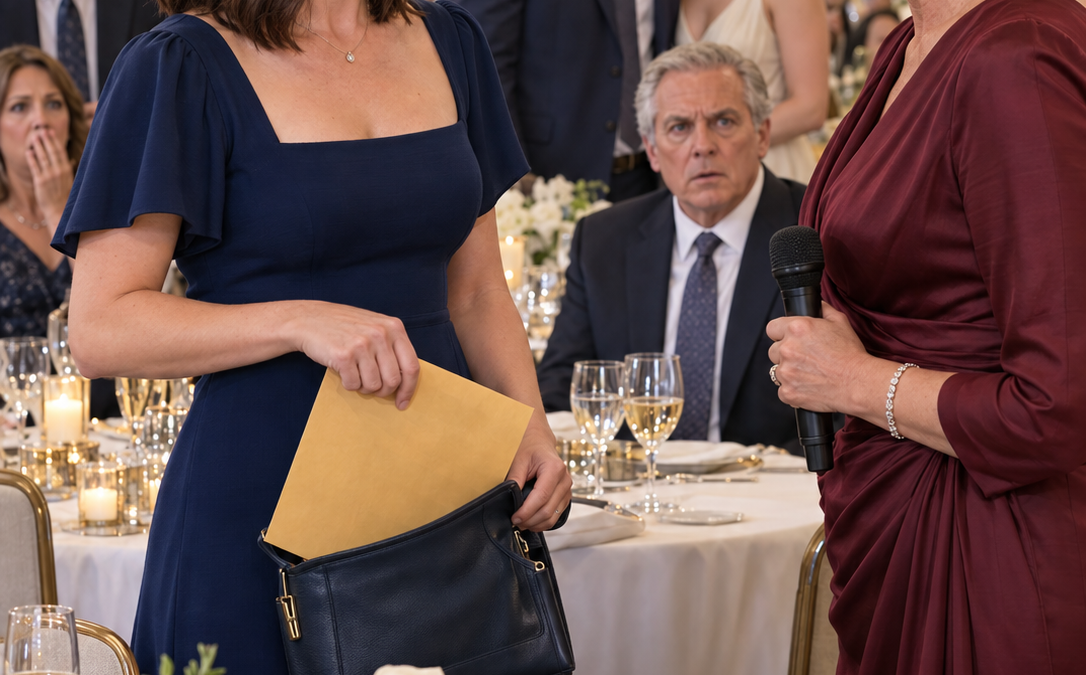
My name is Erica Coleman. I’m 33, and I’m a corporate transactions attorney in Denver. Four months ago, at my brother’s rehearsal dinner, my mother picked up a microphone and prepared to tell 65 guests that I was no longer part of our family.
My offense? Refusing to pay $68,000 for my brother’s wedding, even though I wasn’t even in the wedding party.
But that isn’t the real story.
The real story began 16 years earlier, on a rainy October night when I was 17. That was the night everything changed—a car accident, my little brother in the hospital, and a weight of guilt so heavy that I carried it with me every single day afterward, until I finally uncovered the truth my parents had been hiding from me all along.
[snorts]
Before I tell you what happened when my mother raised that microphone, and what I pulled from my bag in response, take a moment to like and subscribe—but only if you genuinely enjoy this story—and tell me where you’re watching from and what time it is there. There’s something comforting about knowing I’m not completely alone while telling something this personal.
[snorts]
Here’s what you need to understand. I spent almost half my life believing I had destroyed my brother’s future. I paid for that belief in every possible way—emotionally, financially, and through the quiet shame that followed me into every family gathering.
My mother made sure I never forgot what had happened. My father’s silence seemed to confirm everything she said, and Caleb’s injuries felt like evidence I had no right to argue with.
But four weeks before his wedding, when my mother demanded $68,000 and called it the least I could do, something inside me finally broke.
Not the way you might expect. I didn’t explode. I didn’t suddenly rebel.
Something simply opened.
And for the first time in 16 years, I began asking questions I should have asked a long time ago.
What I discovered changed everything.
So, let me take you back to where this really began. Not to the accident itself, but to four weeks before Caleb’s wedding, when my mother called and made the demand that finally forced me to stop running from the past and face it directly.
The call came on a Tuesday evening while I was reviewing contracts in my apartment in Denver. Mom’s name lit up my phone, and I hesitated before answering. Our conversations had followed the same pattern for years: polite words on the surface, deeper resentment underneath.
“Erica.” Her voice was crisp and business-like. “We need to discuss Caleb’s wedding.”
“Of course,” I said, putting down my pen. “I’m looking forward to it. When do you need me in Fort Collins?”
“The wedding is getting expensive,” she cut in. “Your father and I are doing everything we can, but Caleb deserves something special after everything he’s been through.”
There it was, that familiar weight settling onto my shoulders.
“Mom, I already sent Caleb and Natalie a $4,500 wedding gift, and I’m covering my own travel.”
“$68,000.”
I blinked.
“What?”
“We need you to contribute $68,000 toward the wedding expenses.”
Her tone was completely matter-of-fact, as though she were asking me to pick something up on the way home.
“It’s the least you can do, Erica. You took so much from him. His opportunities, his health, his confidence. Eighteen months of physical therapy because you were careless.”
My throat tightened.
“Mom, I’ve helped this family financially for years. I paid $18,500 toward Dad’s surgery. I covered five months of mortgage payments. I’ve never—”
“That was your responsibility, not generosity.”
Her words were cold.
“This is different. This is about Caleb. This is about finally making things right.”
“I don’t have $68,000 just sitting around,” I said.
That wasn’t entirely true. I had savings, but the amount was still staggering.
“You’re a senior attorney in Denver,” she said. “Don’t pretend you can’t afford it.”
Then she paused.
“$68,000, Erica. Or don’t bother coming to the wedding.”
The line went dead.
I sat there with the phone still in my hand, feeling 17 again. Small, guilty, completely powerless.
That night, I couldn’t sleep. My mother’s words kept circling through my head, pulling me back to the night that had shaped my entire adult life.
I was 17 then, a senior in high school with a nearly perfect GPA and college acceptance letters beginning to arrive. Caleb was 12, full of energy, obsessed with his travel soccer team.
That October evening, I had picked him up after practice. Mom and Dad were at a dinner with friends. Rain had been falling steadily for hours, the kind of rain that turns dark roads into mirrors.
“Can we get burgers?” Caleb asked, bouncing slightly in the passenger seat, his cleats still muddy from practice.
“Mom said to come straight home,” I told him, though I was smiling. “Maybe next time.”
The road through Pudra Canyon was winding and steep in places, but I knew it well. I had driven that route many times. I was going the speed limit. Both hands were on the wheel, just the way Dad had taught me.
Then, partway down the road, I pressed the brake pedal.
Nothing happened.
I pressed harder. The pedal dropped almost completely to the floor.
The car kept moving faster down the wet slope.
“Erica.”
Caleb’s voice suddenly sounded small.
“It’s okay. It’s okay,” I said, but panic was already rising in my throat.
I pumped the brakes.
Nothing.
I tried again.
Still nothing.
Then I pulled the emergency brake. The car fishtailed across the wet pavement, and suddenly I had almost no control at all.
Everything after that happened in seconds.
The road blurred. The car slid sideways. Then something solid appeared in front of us.
The impact threw us forward. The airbags exploded. Caleb screamed.
Then came silence, except for the hiss from the front of the car and the rain pounding against the roof.
Caleb was conscious, but he was crying. His leg was badly injured. I had a cut across my forehead, and blood was running toward my eyes.
Then came emergency lights. Colorado State Patrol. Paramedics. An ambulance. Hospital corridors. My parents arriving, my mother’s face nearly white with fear.
I remember hearing an officer mention something about a possible mechanical failure. But I was 17, injured, terrified, and barely processing what anyone was saying.
What I remember most clearly came later.
I was sitting in the hospital hallway when I heard my mother speaking to my father. She didn’t look at me.
“She was going too fast,” she said. “She wasn’t paying attention.”
My father didn’t correct her.
He said nothing.
And I believed her.
That weekend after the call about the $68,000, I drove from Denver to my parents’ house in Fort Collins. Mom had insisted on a family meeting to discuss the wedding details.
I arrived Saturday morning with a knot in my stomach and a box of pastries I’d picked up on the way—a small peace offering I wasn’t sure anyone needed.
Caleb and his fiancée, Natalie, were already at the dining table, surrounded by wedding magazines, color samples, and fabric swatches.
Caleb looked up when I walked in and smiled. It was warm and genuine.
“Hey, sis.”
I hugged him, relieved by how normal it felt.
“Congratulations again, Natalie. Everything looks beautiful.”
Natalie, petite, with kind eyes, squeezed my hand.
“We’re really glad you’re here.”
A moment later, Mom came in from the kitchen, with Dad following a few steps behind her.
“Erica, good. You’re on time. Sit down.”
We started with harmless conversation—the venue, the menu, the flowers, the seating arrangements. For a few minutes, it almost felt like an ordinary family meeting.
Then Mom set her coffee cup down with a deliberate clink.
“Erica, have you thought about what we discussed?”
My chest tightened.
“Mom, can we talk about this privately?”
“There’s no reason for privacy.”
Her smile sharpened.
“Everyone here knows what you owe this family.”
Caleb shifted in his chair. Natalie lowered her eyes to her hands. Dad stared down at his plate as though studying it required his full concentration.
“I’ve been thinking about it,” I said carefully. “But $68,000 is—”
“Exactly what you owe Caleb,” Mom cut in. “After what you did to him. After everything he lost because of you—his scholarship opportunity, his health, his confidence, eighteen months of physical therapy because of your carelessness.”
“Mom,” Caleb started.
“No, Caleb. You’ve always been too forgiving.”
She turned back to me.
“You’ve had 16 years to build your career, Erica. Sixteen years to become successful while Caleb had to recover from your mistake. This is your chance to finally make it right.”
I looked at my father.
I didn’t say anything. I didn’t need to. I was silently asking him to step in, to say something—anything.
He cleared his throat.
Then he looked away.
That was the moment I understood I was completely alone in this.
I drove back to Denver in silence. My mind ran through possibilities the way it did when I was preparing for a difficult negotiation.
Except this time, I wasn’t only the attorney.
I was also the person on trial.
That night, I sat in my apartment and pulled up my bank statement, savings accounts, and retirement balances.
$68,000.
It was possible. Barely.
I could move money around, drain most of my emergency fund, take a painful amount out of savings I’d spent years building. Months of careful planning would disappear almost overnight.
But sitting there, staring at the numbers, I knew the real problem wasn’t money.
If I paid, I would be confirming everything my mother had told me for 16 years: that I owed them. That my career and comfortable life somehow existed because Caleb had suffered. That no matter how much I gave, I would never finish paying off the debt.
There would always be another request, another reminder, another reason I was supposed to feel guilty.
And if I refused, Mom would follow through on her threat.
She would tell everyone at the wedding—extended family, Caleb’s friends, people from Front Range Advisory Group. Some of them moved in professional circles that overlapped with mine.
The story would spread easily.
Erica Coleman, the selfish older sister who refused to help the brother whose life she had ruined.
And I could lose Caleb.
Over the last few years, we had managed to grow closer again, carefully avoiding the subject that sat between us like buried glass. He was the only person in my immediate family I still loved without hesitation.
Worse, refusing to pay would seem to prove my mother right—that I was selfish, ungrateful, still the same careless 17-year-old who had hurt her little brother and never truly taken responsibility.
I sat at the kitchen table with my laptop open, staring at the figures on the screen. The apartment was quiet except for the refrigerator humming and the distant sound of traffic below.
[snorts]
This wasn’t about $68,000.
It was about control.
It was about keeping me exactly where my mother had kept me for 16 years: forever guilty, forever paying, forever trying to prove I deserved to belong.
The real question was how much I was willing to sacrifice just to break free from it.
Two days later, I called Caleb. He answered on the third ring, slightly out of breath.
“Erica, hey. Sorry, I just got back from a run. What’s going on?”
I paced across my living room with the phone pressed to my ear.
“Caleb, I need to ask you something, and I need you to be completely honest with me.”
“Okay.”
His voice changed immediately, more cautious.
“Do you actually want me to pay $68,000 for your wedding?”
There was a long silence.
Then he said, “Erica, I didn’t ask you for that. Mom just… she thinks it’s fair.”
“Fair?”
I stopped pacing.
“Caleb, you’re doing well. You have a successful career. You’re getting married. What did you actually lose?”
“I lost 18 months to rehab, Erica.”
His voice was quiet but firm.
“I lost my scholarship opportunity.”
“And insurance covered the medical expenses,” I said. “I checked. And a year later, you received an even better scholarship. You still graduated with honors.”
“That’s not the point.”
“Then what is the point?”
The question came out sharper than I intended.
“Because from where I’m standing, I’ve spent 16 years apologizing for something that happened when I was 17. I’ve helped Mom and Dad financially more times than I can count. I’ve covered medical bills, mortgage payments, and whatever else they needed. And now I’m supposed to wipe out most of my savings just to prove I’m still sorry.”
“You’re not wiping out everything.”
His voice tightened.
“You’re a senior attorney.”
I closed my eyes.
“That’s exactly what Mom said.”
Another silence.
Then Caleb sighed.
“Look, I don’t want to fight with you about this. Mom says you owe the family. I don’t know all the details about the insurance or the money. I just know what happened that night changed my life.”
“It changed mine too,” I said softly.
He didn’t answer for a moment.
Then he said, “I don’t want drama at my wedding, Erica. Just do what Mom is asking, okay? For me.”
The call ended before I could respond.
I stood there with the phone still against my ear.
Caleb wasn’t my enemy, but he wasn’t on my side either. He had lived with the same family version of that accident for 16 years.
[snorts]
The difference was that he had never been given a reason to question it.
The texts started the next morning.
Mom: Have you made the transfer yet?
By afternoon, another message arrived.
Mom: Caleb is counting on you. Don’t let him down again.
Over the next week, the messages kept coming.
Mom: Don’t embarrass us, Erica.
Mom: This is about family. Or doesn’t that matter to you?
Mom: Two weeks until the rehearsal dinner.
Every vibration brought another reminder of the guilt I had carried since I was 17.
Then, one week before the rehearsal dinner, the final message arrived.
Mom: You have until the rehearsal dinner to make this right. After that, everyone will know what kind of daughter you are and what kind of sister you are. I’ll make sure of it.
I stared at the screen, my hands trembling.
This was the ultimatum.
Pay $68,000 or be publicly humiliated in front of 65 people—family, friends, Caleb’s colleagues from Front Range Advisory Group, and people whose professional circles could easily overlap with mine.
I had seven days to decide what I was going to do.
The next day, I met my best friend, Brooke Whitaker, at a coffee shop in Cherry Creek. Brooke was a licensed clinical social worker. She had spent years listening to complicated family situations, broken relationships, and every kind of dysfunction imaginable.
[snorts]
If anyone could help me see this clearly, it was her.
I told her everything—the accident, 16 years of guilt, the $68,000 demand, the threats.
Brooke listened without interrupting.
“Erica, this is financial abuse,” she said. “And emotional blackmail.”
“What if I’m wrong? What if I really did ruin Caleb’s life?”
“Or have they told you that for so long that you stopped questioning it?”
Then she leaned forward.
“Get the official crash report. Not your mother’s version. The actual report. It was 16 years ago. Those records should still exist. Get the facts first, then decide what you want to do.”
I left the coffee shop with one thought repeating in my head.
The facts.
Right then, I searched for information on older Colorado State Patrol crash reports. I had six days until the rehearsal dinner.
The records office was in a plain government building not far from my parents’ home in Fort Collins. I took half a day away from work, telling my assistant I had a personal matter to handle.
The clerk behind the counter looked mildly bored when I approached.
“How can I help you?”
“I need a copy of a crash report from 16 years ago. October. Single-vehicle accident on Highway 14 in Pudra Canyon.”
She turned to her computer.
“Driver’s name?”
“Erica Coleman. I was driving.”
She typed for a while. The clock on the wall seemed impossibly loud. My heart was pounding.
Then she looked up.
“Found it.”
I almost forgot to breathe.
“That’ll be $22 for the copy.”
My hands shook slightly as I handed her my card.
She disappeared into the back. A few minutes shouldn’t have felt that long, but they did.
When she returned, she handed me a manila envelope.
“Here you go. Have a good day.”
“Thanks.”
I walked back to my car, almost automatically holding the envelope against my chest.
Once I was inside, I set it on the passenger seat and stared at it.
This was what Brooke had told me to find.
The facts.
The truth I had somehow gone 16 years without ever seeing for myself.
For a moment, I almost started the car and drove away. Part of me was terrified of what the report might confirm.
Then I picked up the envelope and opened it.
The report was several pages long, printed on official letterhead. I moved past the basic information.
Date. Time. Weather. Location. Vehicle: 2010 Ford Fusion.
Then I reached the section describing the cause of the crash.
I read the first line.
Then I stopped.
The words blurred for a second before coming back into focus.
Hydraulic brake line failure traced to a defective factory-installed component.
Vehicle inspection confirmed significant brake fluid loss caused by the failed connection.
No driver fault established.
No traffic citation issued.
Vehicle retained for evidence related to a potential product liability investigation.
I read it again.
Then a third time.
No driver fault established.
Defective component.
No citation.
Sixteen years.
Sixteen years of apologizing.
Sixteen years of believing I had destroyed my little brother’s life.
And it had never been my fault.
My hands started shaking so badly that the pages slipped from my fingers and scattered across the passenger seat.
I stared at them.
Official evidence of a truth no one in my family had ever shown me.
But almost as quickly as the relief came, another question pushed through it—a much worse one.
Did my parents know?
I drove straight to their house.
Mom’s car wasn’t in the driveway. She was usually at her book club that afternoon. Dad’s truck was parked in the garage.
I found him in his workshop, sanding a piece of wood for one of his furniture projects.
He looked up when I walked in. Surprise crossed his face.
“Erica, I thought you were in Denver.”
I held up the crash report.
“Did you know about this?”
He stopped moving. The sandpaper remained in his hand. His face slowly lost its color.
“Erica—”
“Did you know?”
My voice cracked despite everything I was doing to keep it steady.
“Did you know the accident wasn’t my fault?”
He couldn’t look at me.
“It’s complicated.”
“That’s not an answer.”
[snorts]
He rubbed both hands over his face.
“The insurance company… If they had pursued the manufacturing defect, they would have investigated the dealership. Your mother’s cousin was the service manager there, and the car had been inspected by his department shortly before the crash. If the investigation expanded into the dealership’s inspection records, your mother was terrified her cousin would be dragged into a lawsuit.”
I stared at him.
“So you let me believe I destroyed Caleb’s life for 16 years?”
“We thought it would be easier this way. You were young. We thought eventually you’d move on.”
“Move on?”
A short, bitter laugh escaped me.
“Dad, I’ve spent my entire adult life trying to make up for something I never did. I built my career around being financially secure enough to help this family. I paid for your surgery. I covered your mortgage. I’ve apologized at holidays, birthdays, every family gathering. And you knew.”
He still couldn’t meet my eyes.
“You knew the entire time.”
“Your mother needed someone to blame.”
His voice dropped almost to a whisper.
“Caleb was hurt. She was terrified. She needed some way to make sense of it.”
“So you sacrificed me so she could feel better.”
That finally made him look at me.
[snorts]
And for the first time, I saw something in my father’s face I had never seen before.
Shame.
“I’m sorry, Erica. I am. But please don’t bring this up now. Not with Caleb’s wedding this close. It would destroy your mother.”
I folded the crash report carefully and slipped it back into my bag.
“I’m not the one who destroyed anything, Dad.”
That evening, I thought about Victor Langford.
Victor had been a longtime family friend and an estate attorney our family had used for routine legal matters over the years. He had handled wills, property matters, and all the smaller legal issues my parents never wanted to deal with themselves.
He had known me since I was a teenager and, according to the guest list, he would be at the rehearsal dinner.
I called his office the next morning.
“Erica Coleman.”
His voice was warm when he answered.
“I haven’t heard from you in ages. How’s corporate law treating you?”
“It’s good, Victor, but I need to talk to you about something. It’s personal. Family-related.”
His tone changed immediately.
“Of course. I have an opening at three this afternoon.”
His office was in Old Town Fort Collins, lined with law books, framed degrees, and photographs collected over years of practice.
He motioned toward the chair across from his desk.
“What’s going on?”
I told him everything—the accident, 16 years of guilt, my mother demanding $68,000, her threats to expose me at the rehearsal dinner.
Then I placed the Colorado State Patrol report on his desk.
Victor read it slowly. The farther he got, the more serious his expression became.
When he finished, he set the pages down.
“Erica, this is very clear.”
I waited.
“You were not at fault.”
Even though I had already read the same words myself, hearing another attorney say them made something inside me loosen.
“And if your parents knew what this report said, but continued demanding money from you based on a version of events they knew was false, that crosses into financial coercion.”
“What can I do?”
“Legally, you owe them nothing. Financially, nothing. Morally, nothing.”
He tapped the report lightly.
“This document clears you.”
He paused, studying me.
“But I don’t think you came here because you needed legal advice.”
I shook my head.
“You’re trying to decide what happens at the rehearsal dinner.”
I nodded.
Victor leaned back.
“I’ll be there. If you need someone to verify this report, or confirm in front of others that it is an authentic, official document, I will.”
For the first time in weeks, I felt like I could take a full breath.
“Thank you, Victor.”
“The truth is on your side, Erica. Don’t let anyone convince you that defending yourself is something to feel guilty about.”
The rehearsal dinner was held at the Elizabeth Hotel in Fort Collins.
Sixty-five guests filled the private event space—Caleb’s college friends, Natalie’s extended family, relatives I hadn’t seen in years, and several people from Front Range Advisory Group.
I arrived exactly on time in a simple navy dress, carrying a small leather bag.
Inside that bag was the crash report, folded neatly inside the same manila envelope.
The room was full of conversation and laughter. White tablecloths. Candles flickering against glassware. Wine glasses touching during small toasts.
It looked exactly like what it was supposed to be.
A celebration.
Caleb noticed me first. He crossed the room in his suit and pulled me into a hug.
“You came?”
“Of course I came. I’m your sister.”
Natalie joined us, glowing in a cream-colored dress.
“Erica, I’m so glad you’re here. You look beautiful.”
“Thank you. So do you.”
We talked about the ceremony the next day, the weather, and their honeymoon plans to Costa Rica.
Normal conversation.
Safe conversation.
As if there weren’t a document in my bag capable of changing the way everyone in that room understood my family.
Mom moved from table to table like the perfect hostess. She wore burgundy silk and a carefully polished smile.
When she saw me, the smile stopped reaching her eyes.
“Erica, you’re here.”
“I wouldn’t miss Caleb’s wedding.”
Her expression barely changed.
“We’ll see about that.”
Then she walked past me to greet another group of guests.
Dad was standing near the bar with a drink in his hand. Our eyes met. He looked away almost immediately.
I found my assigned seat near the back of the room.
Not with my parents.
Not with Caleb.
The placement said enough on its own.
Victor was seated several tables away. When I looked toward him, he gave me a small nod.
I placed my bag on the chair beside me.
Around me, people laughed, raised glasses, and talked about the wedding.
None of them knew how much could change before the night was over.
Dinner was served. Salmon, roasted vegetables, easy conversation moving from table to table.
I barely tasted any of it.
My attention kept returning to Mom as she circulated through the room, smiling, laughing, playing the role she had always played so well.
After dessert, she walked to the front and picked up the microphone.
The room gradually fell quiet.
“Good evening, everyone. Thank you so much for being here to celebrate Caleb and Natalie.”
Her voice was smooth and practiced.
“We’re incredibly grateful to have all of you here as we come together as a family.”
She began talking about Caleb—his childhood, his determination, the obstacles he had overcome, his success despite everything.
People listened closely.
Then her tone shifted.
“Many of you know Caleb faced serious challenges when he was younger. A car accident when he was just 12 left him badly injured. He lost an important scholarship opportunity and spent 18 months in physical therapy.”
My stomach tightened.
She was doing it.
Right here.
Right now.
“But Caleb never gave up,” Mom continued. “He worked hard. He pushed through everything. And look at him today. Successful, happy, and about to marry this wonderful woman.”
The room broke into applause.
Caleb looked uncomfortable, but he managed to smile.
Then Mom’s eyes found me.
“And tonight, I want to acknowledge someone else who has been part of that journey. My daughter Erica.”
Sixty-five pairs of eyes turned in my direction.
Heat rushed into my face.
“Erica has done very well for herself. She’s a senior corporate attorney in Denver. Very successful.”
She paused just long enough for the words to settle.
“And we’ve been discussing how she might contribute to Caleb’s wedding as a way of showing her support for her brother.”
The applause was gone now.
The room had become noticeably quieter. A few people exchanged confused looks.
“Erica,” Mom continued, “you and I discussed a financial contribution toward the wedding. Have you made the transfer?”
My fingers tightened around the edge of the table.
So this was it.
The public humiliation she had promised.
Everyone was watching me, waiting to hear what I would say.
I stood slowly. The legs of my chair scraped against the floor, the sound carrying through the silent room.
“Mom, I think this conversation should be private.”
“No, Erica.”
Her smile remained perfectly controlled.
“Everyone here is family. They deserve to know.”
I kept my voice calm, professional—the same voice I used during difficult negotiations when everyone at the table was waiting for me to lose control.
“I’ve supported this family for years. I paid $18,500 toward Dad’s surgery. I covered five months of your mortgage payments. I’ve been there for Caleb.”
“That was your responsibility,” she said smoothly. “This is different. This is about making things right.”
I looked directly at her.
“I don’t owe you $68,000.”
A ripple moved through the room.
Soft gasps.
Whispers.
I saw Diane Reeves lean toward the man beside her and murmur something under her breath.
Caleb’s face turned red.
Mom’s expression hardened.
“After what you did to Caleb, you honestly believe you owe him nothing?”
“What I did…”
I took a breath.
“Mom, if we’re going to do this in front of everyone, then maybe we should talk about what actually happened.”
“Everyone already knows what happened.”
Her voice rose slightly.
“You were careless. You were driving too fast. You hurt your brother. He lost years of his life because of your recklessness.”
“That’s not the whole truth.”
The room changed.
People were no longer pretending they weren’t listening. Every conversation had stopped. Every face seemed turned toward us.
Mom’s fingers tightened around the microphone.
“What exactly are you suggesting? That you weren’t responsible?”
She continued, [snorts] “That Caleb’s injuries somehow weren’t your fault?”
“I’m saying there’s more to that accident than the story you’ve been telling people for 16 years.”
Caleb stood.
“Erica, please.”
But Mom cut him off before he could continue.
“No, Caleb.”
Then she looked back at me.
“If you’re not willing to support your brother, Erica, then maybe you shouldn’t be here at all.”
The room went completely still.
I stared at her.
“Are you asking me to leave?”
“I’m saying family requires sacrifice. And if you can’t do that, then maybe you don’t understand what being part of this family means.”
I could feel the weight of everyone watching.
Sixty-five people trying to decide who was telling the truth, who was selfish, who was wrong.
Mom turned toward the guests.
“I apologize for this unpleasant scene. My daughter has always struggled when it comes to accepting responsibility.”
“Mom, that isn’t fair.”
She turned sharply back toward me.
“Fair?”
The word came out almost as a laugh.
“You want to talk to me about fair?”
Her grip tightened around the microphone.
“Your brother spent 18 months in physical therapy. He lost part of his childhood recovering. And you spent 16 years building a career, living comfortably in Denver, traveling, becoming successful.”
Her eyes stayed fixed on mine.
“You got everything he lost.”
“That’s not true,” I said quietly. “Caleb has a successful career. He’s happy. He’s getting married.”
“Because he worked twice as hard to overcome what you did to him.”
Her voice cracked slightly.
Whether the emotion was real or calculated, I honestly couldn’t tell anymore.
“And now, when he’s finally having his moment, you can’t even do this one thing for him.”
[snorts]
Caleb stood again.
“Mom, please don’t do this here.”
“No, Caleb, you’ve always been too forgiving with her.”
She turned back toward the room.
“My daughter has refused to help her own brother after everything he has suffered because of her. She has the money. She simply doesn’t care enough to do what’s right.”
That was when I saw the shift in the room.
Not everyone, but enough.
Disappointment.
Judgment.
People looking at me differently.
Lorraine Hayes slowly shook her head. Wesley Grant leaned toward the person beside him and whispered something.
Mom held the microphone almost like a weapon.
Then she looked straight at me.
“So, Erica, what will it be?”
Her voice was quiet now.
“Are you family or are you not?”
That was the moment.
The point where there was no going back.
I reached toward my bag.
I know this is a lot to take in. It was for me, too. If you’re feeling the same anger and disbelief I felt in that moment, take a second to like and subscribe.
And tell me in the comments: Have you ever discovered something about your family that completely changed the way you understood your past?
Because what happened next at that rehearsal dinner was something I had spent 16 years believing could never happen.
Now, back to the moment I reached into my bag.
I opened it and pulled out the manila envelope.
My hands were steady now.
It was strange how much calmer I felt once there was nothing left to hide from.
“I am family, Mom.”
I looked directly at her.
“But I’m not going to let you control me with guilt anymore.”
I removed the Colorado State Patrol report and held it up where everyone could see the official letterhead.
“This is the crash investigation report from the accident 16 years ago.”
Mom’s face lost its color.
“The official report I saw for the first time six days ago.”
“Erica, this is not the time.”
“This is exactly the time.”
I unfolded the pages.
Then I began to read.
My voice was clear, controlled.
“Cause of crash: hydraulic brake line failure traced to a defective factory-installed component. Vehicle inspection confirmed significant brake fluid loss.”
I looked down at the next lines.
“No driver fault established.”
The room became completely silent.
“No traffic citation issued.”
Not a glass moved.
Not a chair shifted.
I lowered the report slightly.
“I wasn’t careless.”
My eyes stayed on Mom.
“I wasn’t reckless.”
Then I looked around the room.
“And I wasn’t speeding. The car had a defective brake line. The brakes failed completely. I was 17 years old, and I did everything I could to avoid that crash.”
I looked around the room, meeting people’s eyes.
“I was never at fault. Colorado State Patrol knew it. The insurance company knew it. And I’ve spent 16 years believing I destroyed my brother’s life when it was never my fault.”
[snorts]
Caleb’s face was frozen in shock.
Natalie had one hand over her mouth.
Mom tried to regain control.
“Erica, you’re taking this out of context.”
“There is no context that changes these facts.”
I held up the report again.
“This is an official crash investigation report. It’s part of the public record. Anyone in this room can request a copy and verify every word.”
Then I turned fully toward her.
“You knew, didn’t you, Mom? You knew it wasn’t my fault, and you still let me carry that guilt.”
Victor Langford stood from his table.
“May I see that report?”
I walked over and handed it to him.
The room watched as he examined the pages, his attorney’s eyes moving carefully over every line.
After a moment, he nodded.
“This is an official Colorado State Patrol crash report.”
His voice carried the calm authority of someone who had practiced law for decades.
“It’s clear and unambiguous. The crash was caused by a mechanical defect in the vehicle’s brake system. The investigating officer found no driver fault, and no traffic citation was issued.”
He looked toward my parents.
“Tabitha, Jeffrey, did both of you know about this?”
Dad stared down at the table.
Mom opened her mouth, then closed it.
“This is a family matter, Victor,” she finally said, her voice tight. “It’s not your concern.”
Victor’s tone stayed firm but controlled.
[snorts]
“Actually, Tabitha, it is. I’ve handled legal matters for this family for years. And if you’ve been demanding money from Erica based on information you knew was false, that isn’t just a family disagreement. That’s coercion.”
More whispers spread across the room.
I saw several guests pull out their phones, probably searching whether what Victor had said was accurate.
My uncle Douglas, Dad’s brother, stood up.
“Tabitha, is this true? Did you know Erica wasn’t at fault?”
“It was complicated,” Mom said.
But the confidence had disappeared from her voice.
“The insurance situation. My cousin ran the service department. We didn’t want him pulled into an investigation.”
“So you let your daughter believe she was responsible?”
Douglas sounded stunned.
“For 16 years?”
“We did what we thought was best for the family,” Dad said quietly, finally speaking. “We were trying to protect—”
“Protect who?” I asked. “Because it wasn’t me.”
The room erupted into conversation.
Some people sounded angry. Others looked confused. Some were staring at my parents with a kind of disappointment I had never seen before.
Caleb sat frozen, staring down at the table.
Then he stood abruptly, his chair scraping across the floor.
His face was flushed.
His hands were shaking.
“Erica.”
His voice cracked.
“Is this true?”
I nodded.
For the first time that night, tears threatened.
“I found out six days ago. I never knew, Caleb. I thought it was my fault. I believed that for 16 years.”
He turned toward Mom, and I saw something break in his expression.
“Mom, did you know?”
“Caleb, sweetheart. It was complicated. The insurance situation—”
“Did you know?”
Each word came out deliberate and hard.
Mom’s silence answered him.
“Oh my God.”
Caleb lifted a hand to his forehead.
“You let her believe that?”
He looked back at me.
“All this time, you let Erica think she ruined my life.”
“You were hurt,” Mom said, sounding desperate now. “You were scared. You needed—”
“I needed the truth.”
Caleb’s voice rose, something I had rarely heard from him.
“I needed my sister, and you took that away from both of us.”
He crossed the room toward me, tears in his eyes.
“Erica, I’m so sorry. I didn’t know. I swear to God, I didn’t know.”
“I know you didn’t.”
My voice was barely above a whisper.
“All those years, every time Mom brought it up and made you feel guilty…”
He shook his head.
“I never asked for that. I never wanted that.”
Natalie stepped beside him and rested a hand on his arm. She looked at me in disbelief.
“Erica, I had no idea. No one ever told me any of this.”
“It’s okay,” I said.
But nothing about that moment felt okay.
Caleb looked back toward our mother.
“I never wanted her money, Mom. I never asked Erica for $68,000. I never asked for any of this.”
His voice hardened.
“You did this. You created this whole thing.”
Mom stood rigid, her face carefully controlled, but I could see the cracks beginning to show.
The whispers around us grew louder.
I turned back toward my mother. The room was still buzzing, but I needed to say this for myself.
“Mom, I love you, but I won’t let you control me with guilt anymore.”
Her eyes flashed.
“Erica, you’re being dramatic.”
“No, I’m being honest.”
My voice stayed calm and steady.
“I’ve spent 16 years trying to earn your forgiveness for something I didn’t do. I’ve sent this family money. I’ve apologized at every holiday. I’ve made career choices based on being able to support all of you.”
I held her gaze.
“That ends tonight.”
“You’re going to throw away your family over this.”
Her voice wavered between anger and desperation.
“I’m not throwing away anything.”
I looked around the room, then back at her.
“I’m setting boundaries.”
She stared at me.
“You knew the truth, Mom. Dad knew the truth. And you both chose to let me suffer because that was easier than dealing with what really happened.”
“We were protecting the family,” Dad said quietly. “Your mother’s cousin. We were afraid the investigation would pull him into it.”
“You were protecting your reputation,” I corrected. “At my expense.”
I took a slow breath.
“I’m not paying you $68,000. I’m not paying you anything, because I don’t owe you. I never did.”
Then I turned toward Caleb.
“But I will be here for you. And I’ll still be here for this family, but on my terms, with boundaries.”
Caleb nodded, tears running down his face.
“I want you at my wedding, Erica. As my sister. Not as someone who owes me something. Just my sister.”
“Then I’ll be there.”
I smiled at him, the first genuine smile I’d felt in weeks.
“Congratulations, Caleb. I’m happy for you.”
Natalie stepped forward and hugged me.
“Thank you for telling the truth. And thank you for still being here for Caleb.”
I looked at my mother one more time.
“I’m not walking away from this family. But I am walking away from the guilt you’ve used to control me.”
Mom stood frozen, the microphone still clenched in her hand.
Her face had gone from pale to flushed, and the composure she had worked so hard to maintain was starting to fall apart.
“You’re making a scene,” she said.
But there was very little conviction left in her voice.
“You made the scene, Tabitha.”
It was my uncle Douglas again.
He stood with a hard expression.
“You brought this up in front of everyone. You tried to shame Erica publicly. And now everyone knows the truth.”
Other people began standing, too.
Lorraine Hayes came over to my table and placed a hand gently on my shoulder.
“Honey, I’m so sorry. I had no idea.”
One of Natalie’s aunts approached Mom.
“Tabitha, I think you owe your daughter an apology.”
“This is none of your business,” Mom snapped.
“You made it everyone’s business when you decided to bring it up here,” the woman replied calmly.
Dad finally stood, setting his drink down.
“Tabitha, they’re right. We were wrong. We should have told Erica the truth.”
Mom spun toward him.
“Don’t you dare turn against me now.”
“I’m not turning against you.”
His voice sounded exhausted.
“But we were wrong. And Erica deserved better than what we gave her.”
For the first time in my life, I saw my mother with nothing to say.
[snorts]
She looked around the room at the disapproving faces, the whispers, the judgment she had intended for me now coming back toward her.
Without another word, she lowered the microphone and walked out of the room.
The door closed behind her.
Dad looked at me, his eyes red.
“I’m sorry, Erica. I should have stood up for you a long time ago.”
I nodded because I didn’t trust myself to answer.
Slowly, the room began to come back to life.
Conversation started again, quieter than before.
But the atmosphere had changed completely.
The truth was out now.
There was no putting it back.
Over the next hour, several people came over to me.
Aunt Cynthia hugged me.
“I never knew the whole story. I’m so sorry.”
Diane Reeves took my hands.
“What your mother did was wrong. You did not deserve that.”
Victor found me near the bar.
“You chose the truth,” he said. “That is rarely the easiest choice.”
A little later, Dad approached me cautiously.
“Erica, can we talk tomorrow?”
I hesitated.
“Maybe. I need some time, Dad.”
He nodded.
“I understand. I’ll wait as long as you need.”
Caleb found me when people were beginning to leave.
He pulled me into another hug.
This one lasted longer.
Tighter.
“I love you, Erica, and I’m sorry for everything.”
“I love you, too.”
I held on to my little brother, the person I had spent 16 years believing I had hurt, and felt something inside my chest finally loosen.
For the first time in 16 years, I felt like I could breathe.
Not because I had won.
Because I was finally free.
The [snorts] wedding went ahead the next day as planned.
I almost didn’t go.
That morning, I sat in my hotel room staring at the dress I had bought for the ceremony. I wasn’t part of the wedding party, but I had chosen something nice, and part of me wondered whether showing up would only make everything more uncomfortable.
Then Caleb called me at 9:00.
“Please come.”
His voice was quiet.
“Please, Erica. I need you there.”
So I went.
The ceremony was held at the Gardens on Spring Creek in Fort Collins, surrounded by flowers and greenery.
Many of the same guests from the night before filled the seats, but the mood felt different—quieter, more sincere somehow.
Mom was sitting near the front with Dad. She wore a lavender dress and a carefully neutral expression.
When I entered, she looked away.
Dad caught my eye and gave me a small nod.
It wasn’t quite an apology, but it was an acknowledgment.
I sat toward the back beside Aunt Cynthia.
When Caleb and Natalie exchanged their vows, I cried.
Not because I was sad.
Because I was relieved.
My brother was happy.
He was whole.
And I hadn’t destroyed him.
At the reception, Caleb made a point of spending time with me. He introduced me to his friends without mentioning the accident.
“This is my sister, Erica. She’s a corporate attorney in Denver.”
That was it.
No explanation.
No guilt.
No debt.
Just my sister.
[snorts]
Natalie danced with me later when the dance floor opened.
“Thank you for coming,” she [clears throat] said. “And thank you for yesterday. I know it was hard.”
“It needed to happen,” I said.
“Caleb told me he wants to rebuild your relationship.”
“Really?”
“Rebuild it. No more guilt. No more walking on eggshells.”
“I’d like that.”
Mom kept her distance for the rest of the day. A few times, I caught her watching me from across the room. Her expression was impossible to read, but she never came over, and I didn’t go looking for her either.
Some relationships take longer to repair than others.
Some may never fully recover.
And I was beginning to understand that I could live with that.
In the weeks after the wedding, the fallout spread through the family.
Several relatives pulled back from Mom, and cousins began asking what had really happened 16 years ago.
The image she had built as the family matriarch had cracked.
“Your mother is having a hard time,” Dad told me during one of our careful phone calls.
“Has she apologized?”
“No. She’s not there yet.”
“Maybe she never will be. I can’t keep waiting for her to change.”
“I understand.”
Mom wasn’t pushed out of the family, but people treated her differently now, with more distance and less trust.
She would have to live with the consequences of her choices.
Mine had been built on a lie.
Hers were built on the truth.
I had also worried that what happened at the rehearsal dinner might damage my professional life.
Some of Caleb’s colleagues had been there. A few people in my parents’ social circle overlapped with people I knew professionally.
But the opposite happened.
Two weeks after the wedding, Jonathan Pierce, one of my CEO clients, asked me to meet with him.
I had previously helped his company with a major transaction.
“I heard about what happened at your brother’s rehearsal dinner,” he said.
My stomach dropped.
“I’m sorry if any of that reflects poorly on—”
He raised a hand.
“You stood up for yourself. You presented facts. You handled a very difficult situation with professionalism and dignity.”
He leaned back in his chair.
“That takes courage, and that’s the kind of judgment I want on my legal team.”
I blinked.
“Thank you.”
“I’m recommending you as lead transaction counsel for the North Peak Aldderon acquisition.”
For a second, I just stared at him.
The deal was worth around $185 million.
It was high-profile, high-pressure, exactly the kind of work people remembered.
“It’s a major transaction,” he continued. “And I trust you to handle it.”
At a networking event not long after that, a colleague pulled me aside.
“I heard what happened with your family. I’m sorry you had to go through that, but I’m glad you stood up for yourself. Too many people let family pressure compromise their judgment.”
Even Rebecca Sloan, our managing partner, made a point of saying something.
“Coleman, whatever is happening in your personal life, you’re handling it well. Your work hasn’t slipped. That matters.”
That was when I realized something.
Standing up for myself hadn’t damaged my reputation.
If anything, it had strengthened it.
People respected boundaries.
They respected someone who could stay calm, rely on facts, and hold her ground under pressure.
The truth had protected me in ways I hadn’t expected.
My professional life wasn’t merely intact.
It was stronger.
I had shown that I could handle pressure, stand by my principles, and keep my composure even when everything around me felt unstable.
Those were exactly the qualities my clients expected from an attorney.
Three months after the wedding, I sat in my apartment looking out over Denver.
For 16 years, I had built my life around guilt, believing I owed everyone something for a mistake I had never made.
There had been no mistake.
There had been a mechanical failure and a family that chose to let me believe I was responsible.
Learning the truth didn’t fix everything overnight.
I still had moments of doubt, and sometimes my mother’s name on my phone brought back that old pull of guilt.
But I was learning that boundaries weren’t selfish.
They were self-respect.
My relationship with Mom might never fully heal. She still hadn’t truly apologized.
But I no longer needed her apology to know the truth.
For the first time since I was 17, I had peace.
Caleb and I talked every week now.
Real conversations, not the careful, guilt-filled exchanges we’d had for years.
About once a month, I drove up to Fort Collins and we met for dinner.
One evening over burgers, Caleb looked at me and said, “I’ve been thinking about the accident. I don’t remember much. I was 12. I was hurt and scared, but I remember you holding my hand in the ambulance.”
“You do?”
“Yeah. You kept saying, ‘It’s okay. It’s okay.’ Even though you were bleeding, too.”
He looked at me.
“You were trying to protect me.”
“I’m your big sister. That was my job.”
“Mom made you sound careless. Reckless. But that’s not who you are. It never was.”
We were building something new now.
Something based on love instead of guilt or obligation.
Dad and I were rebuilding, too.
To my surprise, he started therapy.
“I need to understand why I stayed silent for so long,” he told me. “Why I let your mother control the story.”
“I appreciate that, Dad.”
“I can’t undo the past, but I want to be better. For you, for Caleb, and for myself.”
Mom stayed distant.
Since the wedding, we had exchanged only a few brief, polite messages.
I stopped waiting for her to change and started protecting my own boundaries.
I would still attend family gatherings.
I would still be civil.
But if she tried to manipulate me with guilt again, I would leave.
No arguments.
No explanations.
Just boundaries.
She tested them once at Thanksgiving with a comment about family loyalty.
I stood up, said goodbye to everyone else, and left.
She didn’t try it again.
So, here’s what I want you to know.
If you’re carrying guilt for something you didn’t do, it isn’t yours to carry.
You don’t owe anyone your peace.
I spent 16 years believing I owed a debt I could never repay.
I thought love had to be earned through apologies, guilt, and financial sacrifice.
And all of it was built on a lie.
Not a lie I told.
A lie that was told about me.
If someone is using guilt to control you, get the facts.
Look at the evidence.
Don’t accept a story simply because you’ve heard it your whole life, especially if that story always makes you the villain.
The truth may not be comfortable.
It may cost you relationships with people who preferred the lie, but it can give you something more valuable than approval.
Integrity.
I’m still healing.
Sixteen years of false guilt doesn’t disappear overnight, but I’m free.
I have a relationship with my brother based on love, not obligation.
I have a career I’m proud of.
I have boundaries that protect my peace.
And I have the truth that is worth more than $68,000.
It’s worth more than my mother’s approval.
It’s worth everything.
Thank you for listening to my story.
If it resonated with you, please like and subscribe and tell me in the comments.
Have you ever had to set a difficult boundary with family or discovered a truth that changed…








