At the family party, mom leaned over and said, “we’re only inviting you out of pity—so don’t stay long”; my sister laughed; i just finished my drink and quietly left; a weeks later, they found out i’d sold the family cabin they all counted on for summer vacations; then the bank statements started arriving—their joint accounts were closed, the property taxes were unpaid, and a lawyer’s letter was on its way… by 7:03 a.m., 49 missed calls…
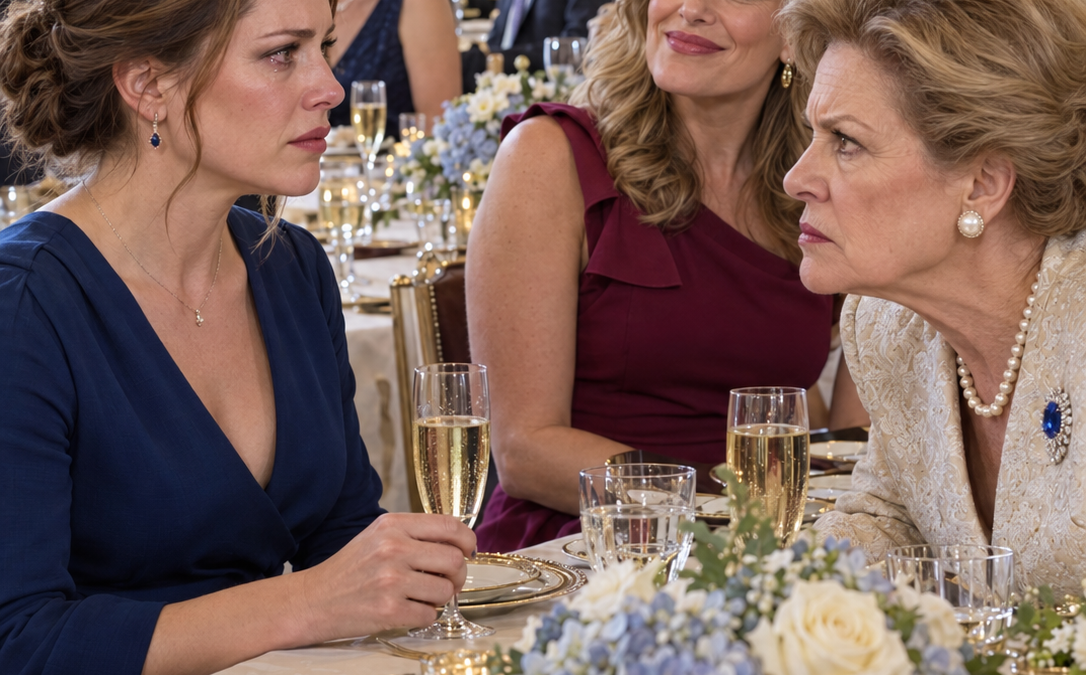
I looked at my mother, Ketta Prescott, 68 years old, wearing the sapphire brooch my grandmother had left specifically to me, but which my mother had claimed for herself before the will was even read. I looked at Ranata, 40 years old, 3 years my senior, wearing a dress I recognized from a boutique in Boston that cost more than my monthly mortgage. I looked at my father, Harlon Prescott, laughing with his golfing buddies at the other end of the table, oblivious or pretending to be. And then I looked down at my glass of champagne. It was still half full. I remember thinking very clearly that I would not leave a full glass behind. That felt important somehow, a small dignity. So, I picked up the flute and drank it slowly. Every last sip, I set it down on the tablecloth with a soft click. I folded my napkin. I stood up. I did not look at my mother again. I did not look at Ranata.
I walked through the dining room, past the sun room where the quartet was playing something by Debussy, past the foyer where my father’s assistant was accepting more gifts, and out the front door. I did not slam it. I did not cry in the driveway. I got into my rental car, a white sedan I had picked up at Logan Airport that morning, and I drove. I want you to understand something. I did not decide anything in that moment. I did not plot revenge in the car. I did not scream into the steering wheel. I just drove calmly the way you drive when you are numb enough to feel nothing at all. I drove past the coffee shop where Ranata had once told me at 15 that I would never be as pretty as her because I had inherited our father’s chin. I drove past the high school where my mother had skipped my graduation to attend Ranata’s college graduation the same weekend.
I drove past the church where my grandmother’s funeral had been held, where my mother had rearranged the seating chart, so I ended up in the third row while cousins I had never met sat in the front. I drove all the way to Cambridge to a small hotel near the river. And I checked in under my married name, which none of them had ever used because none of them had come to my wedding. That’s right. None of them came. Not my mother, not my father, not my sister. They had all claimed a scheduling conflict. Ranata had a spa weekend. My parents had a wine tasting in the Berkshires. My husband, Denver, who is a good and patient man, held my hand at the altar and said nothing when the pew reserved for my family sat empty. He knew the way I knew that they had chosen not to come. Denver had died 3 years ago. Pancreatic cancer, 41 years old. My family had sent one bouquet jointly with a card signed by all three of them in Ranata’s handwriting.
They had not attended the funeral either. My mother had said over the phone that funerals were depressing and she was already going through a rough patch with her book club. I sat on the edge of the hotel bed in Cambridge and I thought about Denver for a long time. I thought about how he used to tell me that my family was a puzzle I would never solve because the pieces had been cut wrong from the start. He used to say gently that I deserved better. I never let him finish that sentence. I always changed the subject. I did not want to hear it because hearing it meant I would have to do something about it. But Denver was gone and I was 37 years old and my mother had just used the word pity to describe her invitation to me. I opened my laptop. I did not cry yet. Crying would come later in waves at strange hours. Right then I was clear, clearer than I had been in years. I opened my email and I started making a list.
You see, there is something my family did not know about me. Something they had never bothered to ask. Denver had been a partner in a small biotech firm in Seattle. When he died, his share was bought out by his co-founders for a sum that would take most people’s breath away. Combined with his life insurance and the sale of our home in Bellevue, I had come into what my lawyer politely called generational money. I had not touched most of it. I lived modestly in a two-bedroom rental in Fremont. I worked as a freelance editor from home. I did not post about the money on social media. I did not tell my family. They had not asked. They also did not know that my grandmother, before she died, had left me something else. Not the brooch that had been stolen, but something better. She had left me the family cabin on Lake Winnipaki in New Hampshire. Four bedrooms, wraparound porch, private dock, sitting on almost 3 acres of shoreline.
Worth, by the last appraisal I had quietly commissioned, just over $1,400,000. My family assumed the cabin belonged to all of us. They spent every summer there. Ranata’s kids learned to swim off that dock. My father hosted his golf buddies there in September. My mother threw her book club retreat there every August. They kept a set of keys, a stocked pantry, a boat in the water. They treated it as theirs. But the deed, quietly, legally, and without fanfare, was in my name alone. My grandmother had known things about my family that no one else wanted to see. She had left me the cabin with a handwritten note that said, “Use this however you need to, my brave girl.” I had never used it. I had let them have it because letting them have it was easier than fighting. I sat in that Cambridge hotel room and I looked at the deed on my laptop screen. I looked at the appraisal. I looked at my grandmother’s note, scanned and saved in a folder I had not opened in years.
Then I picked up my phone and I called my lawyer, a woman named Anise Halvorson, who had handled Denver’s estate. It was almost midnight. She answered on the second ring, the way she always did. I told her what my mother had said. I told her about the champagne, the drive, the hotel. I told her I was done. I did not raise my voice. I did not cry. Then I told her what I wanted to do. All of it. The cabin, the joint accounts, the property taxes, the letter. There was a long pause on the other end of the line. Then, in her calm Norwegian accent, she said one sentence that I will remember for the rest of my life. “Are you absolutely certain, Marlo? Because once we start, we do not stop.” I looked out the hotel window at the lights on the Charles River. I thought about Denver. I thought about my grandmother. I thought about pity. “Yes,” I told her. “I am certain. Start tomorrow.” It started at 8:00 in the morning.
By 9, she had already emailed me a list of documents she needed and by 10:00 I had signed and returned every single one of them from the hotel business center. She worked fast when the client was serious and I had never been more serious about anything in my life. The first thing she explained gently was that I had more leverage than I realized. Not just the cabin, not just my personal wealth, but something my family had done years ago casually without thinking about the consequences that had left them exposed in ways they did not understand. Back in the early 2000s, when my father was still working as a regional insurance executive and my mother was climbing the ladder at a nonprofit, they had asked me to co-sign on a set of joint financial accounts. Not for them, for the family, they had said, for emergencies, for the cabin’s upkeep, for property taxes, for the shared expenses of being a Prescott.
I had been 21 years old, fresh out of college, working my first job at a small publishing house in Boston. I had said yes without reading the fine print, because that is what a good daughter does. I had signed the paperwork at a kitchen table while my mother poured coffee and my father talked about how nice it was to have everyone contributing. What I had not understood at the time and what my parents had also apparently not understood was that the way the paperwork was structured, I was not just a co-signer. I was the primary account holder. My Social Security number was the anchor on the accounts. My credit history was what the bank had used to establish the credit lines. My name came first on every single statement, though the statements went to my parents’ address, and I had never once seen one.
For 16 years, my parents had used those accounts to pay the property taxes on the cabin, to cover Ranata’s occasional overdrafts, to fund my father’s golf club membership, and to pay for the landscaping on the Newton house. They had treated the accounts like their own, because for all practical purposes, they were, but legally, they were mine. Anise walked me through this on a video call from the hotel room at 11 in the morning. She had pulled the account records, cross-referenced them with the original signing documents, and confirmed what she had suspected. I owned every dollar in those accounts. I owned the credit lines. I owned the responsibility for the property taxes on the cabin, which had been paid out of those accounts for the last 16 years. And I had the legal right to close every single one of them without notice, without explanation, without permission from anyone. I asked her how much was in the accounts. She checked and then she read me the number.
Just over $95,000 spread across three accounts. There were also two credit lines with a combined limit of $40,000 currently carrying a balance of about 12,000 that my parents were paying down slowly. All of it technically mine. I did not feel triumphant. I felt tired. Tired the way you feel when you finally put down something heavy you have been carrying so long you forgot it was heavy. I asked her what would happen if I closed the accounts. She explained that the balances would be transferred at my direction to whatever account I chose. The credit lines would be closed and the outstanding balances would become the responsibility of the secondary signers, which were my parents. The automatic payments for the property taxes, the golf club, the landscaping, and everything else would simply stop. My parents would receive a letter from the bank informing them of the closures. That was it. Clean, legal, and final. I asked her how long it would take.
Three business days, she said, for the account closures. The letters from the bank would arrive at my parents’ address within a week. I told her to do it. Then I told her to start on the cabin. Anise had a colleague, a real estate attorney in Concord, New Hampshire, who specialized in lakefront properties. She looped him in that same afternoon. His name was Bertram Kfax, and he was 72 years old, semi-retired, and he had known my grandmother personally. When Anise told him whose granddaughter I was, he laughed on the phone and said he had been wondering when I was going to do something about that cabin. I asked him what he meant. He told me gently that my grandmother had come to see him about a year before she died. She had wanted him to know in case anything ever happened, that the cabin was mine and mine alone, and that if my family ever tried to contest the deed after her death, he was to represent me pro bono.
She had paid him a small retainer to hold on to that promise. She had told him that her daughter, my mother, had a way of taking things that were not hers, and she wanted to make sure this one thing stayed protected. I sat on the hotel bed and I finally cried. Not for my mother, not for Ranata, for my grandmother who had seen everything I refused to see and who had left me a fortress I had never known I owned. Bertram had a buyer in mind. He knew a couple from Boston, a retired surgeon and his wife who had been looking for a lakefront property on Winnipaki for 2 years. They had missed out on three listings by hesitating. They were ready to move fast on the right one. He asked if he could reach out to them. I told him yes. By that evening, Bertram had a verbal offer. $1,380,000 cash, no contingencies, a two-week close. The buyers wanted to be in the cabin by the middle of July.
I asked Anise and Bertram if there was any risk, any legal exposure, any way my family could stop it. Bertram was calm. The deed is yours, he told me. The title is clean. Your grandmother made sure of it. Your family has no legal claim to that property. They have used it with your implied permission for years, but implied permission is not ownership. You can sell it tomorrow if you want. I told him to accept the offer. Then I did something I had not planned to do. I called my brother-in-law, Ranata’s husband, a man named Percy Ashb. Percy was a decent man, an accountant, quiet and thoughtful, and the only member of the extended family who had ever treated me like a full human being. He had sent me a card after Denver died, a real card with a long handwritten note. He had called me on my birthday for the last 3 years, always on the actual day. Percy answered on the third ring. He sounded surprised to hear from me. He asked if I was okay.
He said Ranata had come home from the party last night in a strange mood but had not said anything specific. I told him what my mother had said. I told him I had left. I told him that I was at that moment in the process of selling the cabin, closing the joint accounts, and severing every financial thread that connected me to the Prescott family. Percy was quiet for a long time. Then he asked me one question. He asked if I was doing this out of anger or if I was doing this because it was the right thing to do. I thought about that for a moment. I told him the truth. I told him I did not know the difference anymore. But I knew that if I did not do it now, I would never do it and I would spend the rest of my life being invited to things out of pity. Percy exhaled. Then he told me that he understood.
He told me that Ranata was not a good person and that he had known that for a long time and that he was staying with her only because of their two children who were 9 and 11 and who deserved a stable home. He told me that he would not warn her. He would not tell her what I was doing. He said, and I remember this exactly, that some lessons only land when they arrive without warning. Then he asked me one more thing. He asked if I would still be an aunt to his kids after all this was over. Whatever happens with Ranata, he said, “They love you.” I told him, “Yes, always. Yes. That door would stay open for the children no matter what.” I hung up. I sat in the hotel room. Outside, the sun was setting over the Charles River, painting the water gold and copper. My phone buzzed. It was an email from Anise confirming the account closures had been initiated. Another buzz. Bertram confirming the cabin sale was moving forward.
I ordered room service, a club sandwich, and a glass of wine. I ate slowly. I did not turn on the television. I just sat with the quiet, and I let myself feel for the first time in as long as I could remember that I was finally on my own side. The next morning, I drove to Logan and flew home to Seattle. I did not tell anyone I was leaving Boston. I did not send any messages to my mother or Ranata. I did not respond to a single one of the texts that had started trickling in around 11:00 the night before. Casual little probes from Ranata asking if I had left the party early because I was tired and one from my mother the next morning asking if I was joining them for brunch on Sunday. I ignored all of it, not out of spite, just out of exhaustion. I had nothing left to say to them. The flight home was 6 hours. I slept for four of them, the deepest sleep I had gotten in months.
When I landed in Seattle, the rain was coming down in that soft, steady way it does in June. And I took a cab to my little rental in Fremont and stood in the doorway for a long moment, just breathing in the smell of home. Books, coffee, the faint lavender from the diffuser Denver had bought me the last Christmas we had together. I put my bag down. I made a pot of tea. I sat at the kitchen table and I opened my laptop. The account closures were in progress. Bertram had drafted the purchase agreement for the cabin and sent it over for my review. Anise had prepared a formal letter, a very specific letter that she wanted me to authorize before she sent it to my parents. It was not a nasty letter. It was not emotional. It was, in Anise’s words, a boundary in envelope form.
The letter stated, in plain legal language, the following: effective immediately, all joint financial accounts previously held between Marlo Prescott and Coretta and Harlon Prescott had been closed at the primary account holder’s direction. That the outstanding balances on the associated credit lines would become the sole responsibility of the secondary signers. That the automatic payment authorization for the property taxes, homeowners insurance and utilities on the property located at Lake Winnipaki had been revoked. That the aforementioned property held solely in the name of Marlo Prescott by virtue of a bequest from the late Adelaide Marquetti had been placed on the market and was under contract for sale. That any personal belongings currently stored at the property should be retrieved no later than the closing date of July 15th, 2025, after which any remaining items would be handled at the discretion of the new owners. The letter closed with a simple line.
All future correspondence should be directed to the office of Anise Halvorson, attorney at law, at the address and phone number listed below. I read the letter three times. Then I told Anise to send it. She warned me kindly that the letter would arrive at the Newton house within two to three business days. She warned me that my phone would likely start ringing shortly after. She asked if I wanted her to help me draft a boundary statement, a brief prepared response I could use if my family reached out. I told her no, I did not plan to respond at all. She nodded through the video call. Then she said something that surprised me. She said, “Marlo, I have done this work for 26 years. I have seen many families come apart. And I want to tell you something. What you are doing is not revenge. What you are doing is repair. You are repairing a boundary that should have existed decades ago. Do not let anyone, including yourself, call it anything else.” I did not know what to say.
I just nodded. After the call, I sat at the kitchen table for a long time. I thought about my grandmother. I thought about the last summer I had spent with her at the cabin when I was 12 years old. She had taught me how to bait a hook. She had taught me how to make lemon bars from scratch. She had told me on the last night of that visit, sitting on the porch as the loons called across the lake, that I had a strong heart and that one day I would need to use it to protect myself from people who did not deserve me. I had not understood her at 12. I understood her now.
The next few days passed in an odd, quiet blur. I went for long walks along the canal. I met a friend for coffee. I read a novel I had been meaning to finish for months. I did not check my phone obsessively. I did not refresh my email. I let the machine of Anise and Bertram do its work in the background while I lived my life. On the third day, the accounts closed. Anise sent me a confirmation. $95,267 had been transferred to a new account in my name only. The credit lines had been officially terminated. The bank had sent notification letters to my parents by certified mail.
On the fourth day, my phone started buzzing. It began at 7:00 in the morning Pacific time, which was 10:00 in the morning on the East Coast, right about the time the mail would have arrived in Newton. The first call was from my mother. I let it ring. She called again 3 minutes later, and again 5 minutes after that, then my father, then my mother again, then Ranata. I sat at the kitchen table drinking my coffee, and I watched the phone light up and go dark. Light up and go dark. I did not answer. I did not read the texts as they came in, though I could see the notifications piling up on the lock screen. I turned the phone face down and I kept drinking my coffee. By noon, I had 32 missed calls. I finally picked up the phone at 1:00 in the afternoon, but only to text Anise. I told her the calls had started. She replied within a minute. “Good. Do not answer. Forward all communications to me. I will handle it.”
She sent me a template text I could copy and paste as a reply to any of them. It was short and polite. Please direct all further communication to my attorney, Anise Halvorson. I have provided her contact information in the letter you received. I will not be responding to personal messages at this time. I sent that text to my mother, my father, and Ranata. Then I put the phone back down. Within seconds, the calls started again. This time they were angrier. I could tell from the frequency and the way the texts were flooding in. My mother sent a paragraph that started with the word how and ended with the phrase after everything we have done for you. Ranata sent one that just said, “Are you insane?” My father sent nothing for a while and then he sent a single line, “Please call me. We need to talk.” I did not call him. I did not call any of them.
That night, I met my friend Odelise for dinner at a little Vietnamese place in Ballard. Odelise had been my closest friend since Denver’s diagnosis. She was a nurse practitioner, 42 years old, tough and warm in the way only people who work in oncology can be. I had told her everything about my family over the years. She had never once told me I was wrong to keep giving them chances, but she had also never pretended they deserved those chances. Over pho, I told her what I had done. All of it. The cabin, the accounts, the letter, the calls. She listened without interrupting. When I was done, she reached across the table and took my hand. She looked at me for a long moment. Then she said, “Marlo, I am so proud of you. I could cry.” I laughed and then I did cry right there in the middle of the restaurant with my noodles going cold in front of me. Odelise did not rush me. She held my hand and let me cry.
And when I was done, she signaled for the waiter and ordered us two glasses of the good wine. We toasted to my grandmother that night, to Adelaide Marquetti, who had known what was coming 40 years before it arrived and who had built me a lifeboat out of a lakefront cabin and a handwritten note. When I got home, my phone was still buzzing. I turned it off completely. I went to bed. I slept better than I had slept in years. At 7:03 the next morning, when I turned my phone back on, 49 missed calls loaded onto the screen. I stared at the number for a long time. 49. Almost as many years as my mother had been a mother, and she had finally found a way to make her presence felt. I did not answer any of the 49 calls. Instead, I made a fresh pot of coffee, sat down at my kitchen table, and started reading the voicemails as transcripts. Anise had told me it was smart to have a record of everything just in case.
I forwarded each transcript to her as I went, and I made notes in a small notebook next to my coffee cup. The voicemails told a story of their own. The first few from around 10:30 in the morning on the East Coast were confused. My mother, her voice tight and controlled, asking what on earth was going on with the accounts. My father sounding genuinely bewildered, asking me to call him back so we could sort this out. Ranata, sharp and cold, saying she had gotten a call from the property tax office in Carroll County and could I please explain what was happening. Then the tone shifted. By the 20th voicemail, my mother was crying, not sad crying. Angry crying. She accused me of stealing from her. She accused me of being ungrateful, of being cruel, of being just like my grandmother, which she seemed to think was an insult. She said I had ruined my father’s birthday. She said I had embarrassed the family.
She said I had always been difficult and she should have known I would do something like this. By the 30th voicemail, Ranata had taken over. She called me every name she could think of that would still leave her deniability if the recording ever surfaced. She said the cabin belonged to all of us. She said Grandma had promised it to her children. She said I had no right to sell it. She said her lawyer was going to have my head. I noted the mention of a lawyer and forwarded it immediately to Anise. By the 40th voicemail, my father had come back. His voice was different now, quieter. He was not yelling. He was asking, almost begging for me to call him. He said he did not understand what had happened at the party. He said, “Your mother told me you left early because you were tired.” Something in the way he said it made my chest ache for the first time all week. He did not know. My mother had not told him what she had said to me.
He had genuinely been in the dark. I underlined my father’s voicemails in the notebook and set them aside. I would deal with him separately. Later, the last nine calls from around 6:00 in the morning Pacific time to 7:03 were a mix. Ranata again threatening. My mother again, this time trying a new tactic, saying she was sorry, saying she had been drinking, saying she did not mean it the way it sounded. My father one more time asking me to please just tell him I was okay. I closed the notebook. I finished my coffee. Then I called Anise. She had been up for hours as usual. She had already received a voicemail on her office line from someone identifying himself as Ranata’s attorney, a man named Grover Howerin. Anise had looked him up. He was a small-time family lawyer in the Boston suburbs who handled mostly divorces and minor estate disputes.
He was not, in her words, a serious opponent, but he would need to be responded to, and she wanted to know how I wanted her to handle it. I told her to be firm and polite. Send him the deed. Send him the appraisal. Send him the letter of intent from the buyers. Send him my grandmother’s will and Bertram Kfax’s confirmation that the cabin had been left solely to me. Do not engage with any emotional arguments. Do not agree to any calls or meetings. If he wanted to pursue this in court, he was welcome to try, but he should understand that the case would be dismissed within a week and his client would be responsible for my legal fees. Anise agreed. She said she would have the package sent by end of day. Then she asked me about my father. I told her about his voicemails. I told her that I believed him. I told her that my mother had a habit of manipulating him, of keeping things from him, of controlling the family narrative. He was not innocent.
He had spent my whole life failing to stand up for me, but he was not the architect of what had happened and he deserved at least a conversation. Anise told me she thought that was fair. She suggested I call him from a landline she could patch through her office so the call would be logged and there would be a record. She suggested I keep the conversation short. She suggested I not agree to anything, not promise anything, not reveal my next steps. I agreed to all of it. That afternoon at 4 Pacific time, 7 Eastern, I called my father through Anise’s office line. He picked up on the first ring. His voice cracked when he said my name. Marlo. Oh, Marlo, thank God. I told him I was okay. I told him I was safe. I told him I was in Seattle. He asked me what had happened. So, I told him everything: the exact words my mother had used at the party. The way Ranata had laughed. The champagne, the drive, the hotel, the decision, the cabin, the accounts, the letter.
He was silent for a long time. So long, I thought the connection had dropped. Then I heard him take a deep, shaky breath. He said, “She said what to you?” I repeated it word for word. “We only invited you out of pity, so do not stay long.” He was quiet again. Then he said in a voice I had never heard him use before, a voice that sounded like a man who had just realized he had wasted 40 years believing a lie, “Oh my God, Marlo. Oh my God.” I did not say anything. I let him sit with it. He asked me why I had not told him at the party. I told him because he had been laughing with his friends at the other end of the table. Because he had not opened my gift. Because for as long as I could remember, when I had tried to tell him something about my mother or my sister, he had either not believed me or asked me to keep the peace. Because I had learned a very long time ago, that telling him would not help.
He started to cry, not loudly, just quietly, the way old men cry when they realize they have failed. I let him cry. I did not comfort him. That was not my job anymore. When he was done, he asked me what he could do. I thought about that for a moment. Then I told him the truth. I told him I did not know if there was anything he could do. I told him that I was not asking him to choose between me and my mother because that was a choice he should have made on his own years ago and no daughter should have to demand it. I told him that I was going through with everything. The cabin was being sold. The accounts were closed. I was not undoing any of it. I told him that if he wanted a relationship with me going forward, it would have to be on very different terms than the one we had before. I told him that meant no more taking my mother’s word for what had happened. No more asking me to keep the peace. No more birthday parties where I was invited out of pity.
He said he understood. He said he would do whatever it took. I told him not to make promises he could not keep. I told him to start small. I told him to think about it. And then I said goodbye and I hung up. I sat at the kitchen table for a long time after that. I did not feel triumphant. I did not feel sad. I felt something else, a kind of tender, complicated ache. My father was not the villain. My father was a man who had spent his life afraid of his wife and had let his fear cost him his daughter. That was its own tragedy, but it was not mine to fix. The phone kept buzzing. My mother again and again. Ranata. Again and again, I let them go to voicemail. I would deal with them in my own time.
That night, I made myself a proper dinner. Roasted chicken, green beans, a glass of the same wine Odelise and I had toasted my grandmother with. I ate slowly at the table with a candle lit for Denver. I thought, as I ate, about the word repair. Anise had used that word: repair. She was right. I was not destroying anything. I was repairing something that had been broken for a very long time. The letter from Ranata’s lawyer arrived at Anise’s office 3 days later. It was six pages long, single-spaced, and it accused me of, among other things, theft, fraud, breach of fiduciary duty, and emotional abuse. It demanded that I halt the sale of the cabin immediately, reopen the joint accounts, transfer the $95,000 back into them, and pay Ranata a sum of $50,000 in what the letter called compensatory damages for emotional distress. Anise read me the highlights over a video call. She was smiling the whole time, which was unusual for Anise.
She told me that the letter was, in her professional opinion, one of the weakest legal documents she had ever read. Grover Howerin had made three critical mistakes. First, he had accepted at face value that the cabin was jointly owned without ever asking Ranata to produce a deed. Second, he had claimed the joint accounts belonged to Ranata without any documentation showing that Ranata was even a signer on any of them. Third, he had demanded $50,000 in emotional distress damages based on a phone call from Ranata that described, in Ranata’s own words, a private family disagreement. Anise had already drafted the response. It was two pages long. It was polite, professional, and it demolished every claim in the letter with citations to the actual legal documents which she attached.
It closed with a paragraph inviting Mr. Howerin to file suit if he wished and reminding him that under Massachusetts law my client would be entitled to recover attorneys’ fees in the event of a frivolous action. Anise sent the response that afternoon. Within 24 hours, we heard back—not from Howerin, but from Ranata herself, calling Anise directly. Anise let it go to voicemail. Ranata left a rambling 5-minute message in which she cursed, cried, and eventually admitted that Howerin had told her he was withdrawing from the case because there was no case. Anise saved the voicemail and sent me a summary. Then Ranata started calling me directly again, 12 times in one afternoon. I did not answer. I sent her the same text I had sent before. Please direct all further communication to my attorney.
The cabin sale closed on July 15th, right on schedule. The retired surgeon and his wife wired the funds. Bertram walked them through the property. He called me that evening from the porch where he had gone alone after the buyers left. He said the loons were out. He said the sunset was extraordinary. He said my grandmother would have been proud. I asked him if there had been anything in the cabin, any personal items. He hesitated. Then he told me that yes, there had been quite a bit. My parents had not come to retrieve their things by the deadline. Neither had Ranata. The buyers, being kind people, had agreed to give me one extra week to arrange retrieval. Bertram had already contacted a local moving company. Everything had been packed into boxes and placed in a storage unit in Concord. The bill was on me, but he had got me a good rate. I asked him how much stuff there was. He laughed. A lot, Marlo. A lot. Your family had turned that cabin into their second home.
I asked him if any of it was my grandmother’s. He was quiet for a moment. Then he told me that yes, quite a bit of it appeared to be old furniture, photo albums, boxes labeled in her handwriting. He had made sure those were kept separate. I told him to ship all of my grandmother’s things to me in Seattle. Everything else could stay in the storage unit for 30 days, at which point I would notify my family that they had one final opportunity to collect their belongings, after which the storage company would auction the contents. Bertram said he would handle it.
Two weeks later, 17 boxes of my grandmother’s things arrived at my rental in Fremont. I spent an entire weekend going through them. Photo albums from her childhood in Vermont. Recipe cards in her looping handwriting, letters my grandfather had written her during the Korean War, a small wooden jewelry box containing several pieces I had never seen, including a delicate gold locket with a tiny black and white photo of me at age four inside. At the bottom of one of the boxes, wrapped carefully in tissue paper, I found the sapphire brooch, my grandmother’s brooch, the one my mother had claimed after the funeral, the one I had watched her wear at my father’s 70th birthday party 3 weeks before. I stared at it for a long time. Then I turned it over. On the back, in tiny engraved letters, were the words for Marlo on her wedding day from AM. My grandmother had engraved it for me before she died. My mother had worn it anyway.
And somehow at some point, my grandmother had taken it back and hidden it in the cabin, waiting for me to find it. I sat on the floor of my living room and I held that brooch and I cried for a long time. I cried for my grandmother. I cried for the wedding day she had missed. I cried for the years of pity I had accepted because I had not known I could refuse them. When I was done crying, I pinned the brooch to my shirt. I wore it for the rest of the day. I wore it while I made dinner. I wore it while I sat on the couch and watched the sun set over Fremont. I wore it to bed and put it on my nightstand.
The next morning, I put it in a safe deposit box at my bank. Meanwhile, the property tax bill for the cabin came due at the end of July. It was, of course, no longer my responsibility because I no longer owned the cabin. But there was a small complication. The bill was for the first half of 2025 when I had still owned the property. Under the terms of the sale, the buyers and I had prorated the taxes. I had paid my share out of the closing funds. My share had come to just over $8,000. But my parents did not know that. All they knew was that a property tax bill had arrived at the Newton house addressed to Coretta and Harlon Prescott because they had been listed as the tax mailing contacts for years. It was for $4,000 representing their alleged half of the taxes based on the assumption that they were joint owners. It was a mistake. The buyer’s agent had accidentally sent them a copy of the bill. My mother called Anise in a fury.
She said the tax bill was proof that she owned the cabin. She said she was going to pay it and then sue me for the property back. Anise calmly explained that the bill had been sent in error and that the buyer’s agent would be sending a correction. She explained that the taxes had already been paid in full at closing. She explained that if my mother wished to pay a bill that was not hers, she was welcome to do so, but she would not receive anything in return because she had no legal interest in the property. My mother hung up on her. Anise called me and reported the conversation. She was, as always, calm, but she added one thing at the end. She said, “Marlo, I want you to know that in 26 years of practice, I have never had a client’s family behave quite like this. Your mother is not simply upset. She is unhinged. Please be careful. Do not engage. If she shows up in Seattle, call the police.” I asked her if she really thought my mother would come to Seattle.
She hesitated. Then she said, “I do not know, but people who have used another person as a resource for their entire lives sometimes react very badly when that resource is taken away. Be alert.” I nodded. I thanked her. I hung up. Then I did something I had not done in years. I went to the front door and I put the deadbolt on, not because I was scared, because I was ready. My mother did not come to Seattle, but she did send my father. He arrived on a Tuesday afternoon in early August. He had booked his own flight. He had not told my mother he was coming. He had checked into a small hotel in downtown Seattle and taken a cab to my neighborhood. He had walked the last three blocks. He told me later because he wanted time to think about what he was going to say. He knocked on my door at 4 in the afternoon. I saw him through the peephole. My father, Harlon Prescott, 70 years old, standing in the rain in a wrinkled blazer, holding a small paper bag from a bookstore.
I opened the door. He looked at me for a long moment. Then he held up the paper bag. “I opened it,” he said. “The book you gave me. I read most of it on the plane. It is wonderful. Thank you.” I did not know what to say. My eyes filled up. I stepped aside and let him in. He sat at my kitchen table. I made him tea. He looked around the little apartment, at the bookshelves, at the framed photo of Denver on the mantle, at the small watercolor Odelise had painted for me the previous Christmas. “You have made a good home here,” he said quietly. I told him, “Thank you.” He asked me if we could talk, really talk. He said he did not want anything from me. He was not there to change my mind about anything. He was not there to defend my mother. He was there because he had realized in the four weeks since our phone call that he had spent 40 years being a coward and he wanted to try to be something different before he ran out of time. I sat down across from him.
I told him to go ahead. He talked for almost 2 hours. He told me about how he had met my mother when they were both 22 years old at a wedding in Providence. He told me how she had been beautiful and bright and how everyone had told him he was lucky. He told me how within the first year of their marriage, he had started to notice that she had a way of making him feel small when he disagreed with her and how he had learned very quickly that it was easier to just go along. He told me how by the time Ranata was born and then me 3 years later, the pattern had been set. He told me that Ranata had been my mother’s favorite from the start. That my mother had said when I was still a baby that she had never wanted a second child and that I was Harlon’s baby, not hers. He told me that he had known this and had not known what to do with it, so he had pretended not to notice. He told me that my grandmother had confronted him once when I was about 8 years old.
She had taken him aside at a family dinner and told him that he was failing his younger daughter and that if he did not start protecting me, he would lose me one day and it would be his own fault. He told me that he had gotten angry with her and had not spoken to her for almost a year. He told me that when she had died, he had never apologized. He told me that he thought about that almost every day now. He told me about the last time I had visited home before Denver died. He said he had noticed that my mother had been rude to Denver over dinner, making little comments about his profession, about our modest home, about the fact that we had not had children. He said he had noticed and he had said nothing. And when we had left the next morning, Denver had shaken his hand at the door and looked him in the eye and said, “Take care of yourself, Harlon.” He said he had thought about that look for 3 years.
He said he thought Denver had known in that moment that he was a coward. He said Denver had been kind enough not to say it out loud. He was crying by this point. So was I. He told me that when my mother had said what she had said at the party, he had not heard it, but he had noticed me leave. He had noticed the empty champagne glass on the table. He had asked my mother where I had gone. She had told him I was tired from the flight. He had believed her because believing her was easier than not believing her and 40 years of habit is hard to break. He told me that when the letter had arrived from the bank, he had understood before he even opened the second envelope from Anise that something enormous had happened and that he was going to have to face something he had been avoiding his whole life. He told me that he had not decided yet what he was going to do about my mother.
He said he was 70 years old and he did not know if he had the courage to leave a 48-year marriage. He said he did not know if he even wanted to leave. He said he just knew that something had to change and that he had come to Seattle to tell me in person that he was sorry, truly sorry for everything. I listened. I did not interrupt. When he was done, I got up and I made us both a fresh cup of tea. I sat back down. I told him that I appreciated him coming. I told him that his apology meant more than he probably realized. I told him that I was not going to make him promise anything and I was not going to demand anything from him. But I told him that I had one condition if he wanted a relationship with me going forward. He looked up. He asked what it was. I told him that I would never again be in a room with my mother. Not for holidays, not for birthdays, not for funerals. Not even for his own funeral someday. If my mother would be there, that was not negotiable.
If he wanted to see me, he would come to Seattle or we would meet somewhere neutral. If he wanted to talk to me, he would call me, not have my mother call for him. If he wanted to send me a card, he would sign only his own name. He asked me if that would ever change. I told him no. I told him that I had spent 37 years hoping my mother would become a different person and she never had and she was not going to. I told him that I had made peace with that and now he had to make peace with it too if he wanted me in his life. He nodded slowly. He said he understood. He said he accepted my condition. I told him something else too. I told him that I loved him. I had not said that to him in a very long time. Maybe not since I was a child. It felt strange coming out of my mouth and it felt strange to see the way his face crumpled when he heard it. But I said it and I meant it and it was true. He stayed in Seattle for 4 days. We had dinner together three times.
We went for a walk at Pike Place Market. He bought me a small ceramic bowl from a vendor there, hand-painted with blue flowers, and told me that he wanted me to have something from him that was chosen, not obligated. Before he left, he asked me one more thing. He asked me if I would ever forgive my mother. I thought about it for a long moment. Then I told him the truth. I told him that forgiveness was not the same as reconciliation. I told him that I could someday maybe forgive her in the sense of letting go of the anger. But I would never let her back into my life. And I did not think she wanted to be in my life anyway. I thought what she wanted was access and control and the ability to keep using me. And she was never going to have any of those things again. He nodded. He hugged me at the airport. He held on longer than he had ever held on to me in my entire life. And then he got on the plane and he flew home.
When my father got home, he told my mother what he had done. He told her he had gone to see me. He told her he had apologized. He told her that he was not going to defend her anymore and that if she wanted to keep her marriage, some things were going to have to change. I know this because he called me 3 days later and told me. He also told me that my mother had responded by throwing a crystal vase at the wall behind his head. She had missed, but it had been close enough that he had for the first time in his life packed a small bag and driven to a hotel for the night. He had come back the next morning. My mother had been contrite. She had cried. She had apologized. She had promised to go to counseling. He had agreed to give it a try. He was not leaving her, at least not yet, but something had shifted.
Meanwhile, Ranata was falling apart. I did not know this directly. I heard about it in pieces from Percy, who called me every couple of weeks with updates that were carefully neutral, but told the story anyway. Ranata had assumed apparently that I would eventually cave, that the pressure of the calls, the letters, the family drama, the threat of lawsuits would eventually break me down and I would return everything, apologize, and slink back into my old role. When it became clear over the course of July and August that I was not going to cave, she had started to unravel. She had been counting on the cabin. Her whole summer plan had been built around it. She had told her friends that they were spending a month at the family cabin. She had promised her kids swimming lessons off the dock. She had told her book club that she would host the annual retreat there. When it became clear that the cabin was gone, sold to strangers.
She had had to explain over and over again to people who did not really care, but who asked anyway, what had happened. She had been counting on the joint accounts, too. Percy told me delicately that Ranata had a habit of overdrafting her personal account and having the joint accounts cover the difference. When the accounts closed, she had bounced three checks in one week. Her credit score had taken a hit. Percy had covered the fees, but he had also for the first time in their marriage told her that he was not going to keep bailing her out. And then in early September, Percy told me something else. He told me that Ranata had months ago taken out a personal loan of $30,000 against what she had assumed was her future share of the cabin. She had used the money to renovate her kitchen. Now the loan was due and there was no cabin share to pay it off with and Percy had refused to touch their joint savings to cover it.
Percy told me all of this in a very quiet voice from what sounded like his car in a parking lot. He said he was not asking me to do anything. He said he was just telling me because he thought I should know. I asked him how he was doing. He was quiet for a long time. Then he told me that he had filed for divorce 2 weeks earlier. He had not told the family yet. He was going to wait until the papers were served. He was going to seek primary custody of the children. He had a good lawyer. He had documentation of years of Ranata’s financial irresponsibility and emotional volatility. And he was cautiously optimistic. I told him I was sorry. I told him I was also proud of him. I told him that whatever he needed, whatever support I could offer for the kids, I was there. He thanked me. Then he asked me one thing. He asked if once the divorce was finalized, once the dust had settled, I would come out and spend a weekend with him and the kids.
He said Fenna, his older daughter, had been asking about me. She was 11 now and she was old enough to notice that her aunt Marlo had disappeared and she wanted to know why. I told him yes, absolutely yes. I would come out as soon as he was ready. We hung up. I sat with the news for a while. I did not feel triumphant about Ranata’s unraveling. I felt something quieter. I felt the shape of a truth I had been circling for a long time. Ranata had built her life on the assumption that I would always be there to absorb her mistakes, that our parents would always be there to bail her out, that the cabin would always be there for her summers. She had never developed the muscles to handle her own life. And now at 40 years old, she was having to learn all at once what most adults learn gradually. It was going to be brutal for her, but it was not my job to save her from it.
My mother, meanwhile, went through several phases. There was the phase of angry calls which lasted through July. There was the phase of tearful voicemails which took over in August. There was the phase of guilt-tripping cards which arrived at my Seattle address in September. All of which I put unopened into a box in my closet. Then in early October, she tried something new. She showed up at my apartment. I had not been expecting her. I had come home from a walk on a Saturday afternoon and there she was sitting on the front step of my building wearing a beige trench coat and holding a small bouquet of yellow roses. I stopped at the corner. I stood there for a long moment watching her. She had not seen me yet. She was looking at her phone, scrolling through something, her mouth set in that tight line I had known my whole life. She looked older than I remembered, older than she had looked at the party in June. Something in her had shrunk in the four months since.
I turned around and I walked back to the coffee shop on the next block. I sat down at a corner table and I called Anise. Anise listened. Then she told me exactly what to do. Do not go home yet. Call the non-emergency police line and explain the situation. Ask them to send an officer to your address to inform your mother on your behalf that she is not welcome and that she needs to leave. Do not engage with her yourself. Do not go home until the officer confirms she is gone. I did what Anise told me. The dispatcher was kind and matter-of-fact. An officer would be sent within 30 minutes. I stayed at the coffee shop. I drank a cappuccino. I read a book. I waited. 40 minutes later, the officer called me. He had spoken with my mother. She had been, in his words, quite upset, but she had cooperated. She had left in a cab going back to her hotel. He had told her that she was not to return to my address and that if she did, she could be charged with trespassing.
He had also kindly given me his direct number in case anything else happened. I thanked him. I went home. My mother was not there. The yellow roses were on the step. I picked them up and I put them in the recycling bin. That night, my mother called me one more time. I did not answer. She left a voicemail. It was different from all the others. It was quiet, almost broken. She said, “Marlo, it is your mother. I came to Seattle because I wanted to see you. I wanted to apologize in person. I know you sent the police. I understand why. I am going home tomorrow. I do not know if you will ever want to see me again. I do not know if I would want to see me either, but I want you to know before I leave that what I said to you at the party was the ugliest thing I have ever said to anyone. I do not know why I said it. That is not true. I know why, but I am not ready to say why out loud. Not yet. I am going to try to figure it out. I am going to try to be a better person.
I do not expect you to care. I do not expect you to come back. I just wanted you to hear me say it. I am sorry.” The voicemail ended. I listened to it twice. I saved it. I did not call her back. But I did for the first time since June feel something that was not anger, not forgiveness either. Just a small tired sadness for her, for all of it. Autumn came to Seattle in that soft gray way it always does, and I found myself settling into a rhythm I had not felt in years. I worked on my editing projects. I took long walks along the water. I had dinner with Odelise every Thursday. I read novels. I started a small container garden on my balcony, tomatoes and basil, and a stubborn little rosemary bush that refused to die. I also quietly started making some changes with the money. The sale of the cabin had netted just over $1,340,000 after taxes and fees combined with the 95,000 from the joint accounts and combined with what I already had from Denver’s estate.
I was sitting on a sum of money that felt almost embarrassing. I had not earned most of it. It had come to me through inheritance and grief. I sat down with a financial adviser, a woman named Euro Bergstrom, who Odelise had recommended, and we spent several afternoons in her office in downtown Seattle, mapping out what I wanted my life to look like. I did not want to retire. I liked my work. I wanted to keep editing, but on my own terms, choosing projects I cared about. I wanted to buy a small house, something modest with a garden and a room that could be an office. I wanted to travel a little, not extravagantly, just enough to see the places Denver and I had always talked about and never gotten around to. And I wanted to give some of it away. Euro helped me set up a small foundation named after my grandmother, the Adelaide Marquetti Fund.
Its purpose was to provide grants to young women who were leaving controlling or emotionally abusive family situations and needed help with rent, first-month deposits, therapy, moving costs, and legal fees. Not huge grants. $2,000, $5,000, at most $10,000 each. Enough to make the difference between staying in a bad situation because you could not afford to leave and getting out. I put $500,000 into the foundation to start. Euro helped me set it up as a proper 501(c)(3) with a board of three people I trusted and a simple application process. We funded our first grant in November to a 24-year-old woman in Tacoma who was trying to leave a family that had been controlling her paychecks since she was 16. She wrote me a thank-you note that made me cry. I also, on Euro’s advice, set up a small trust for Percy’s children, Fenna and Torven, not enough to spoil them, just enough to guarantee their college educations, whatever they chose to study, wherever they chose to go.
Percy did not know about it. I planned to tell him at some point once things had settled with the divorce, but I wanted it in place before then so that whatever happened, they were taken care of. I bought the house in December, a small two-bedroom bungalow in a quiet neighborhood in Ballard with a fenced backyard and a fireplace and a kitchen that got morning light not far from the water. I paid cash. I moved in the week before Christmas. Odelise and her wife helped me unpack. We drank wine and ate takeout Chinese food off paper plates on the living room floor. And Odelise made me promise that I would host Thanksgiving at the new house the following year.
Christmas was quiet. I did not travel. I did not receive any calls from my mother or Ranata. My father sent me a card signed only by him with a small enclosed check for $25, which was what he had always given me for Christmas when I was a child. He had remembered. I framed the check. I never cashed it. In January of 2025, Percy called to tell me the divorce had been finalized. Ranata had not fought it as hard as he had feared. She had, in the end, been more concerned with the financial details than with the custody arrangements. Percy had ended up with primary custody of both kids with Ranata getting every other weekend and one weeknight. It was more than he had hoped for and probably about what Ranata actually wanted, which was less time with the demands of parenting and more time to figure out what she was going to do with her life. Percy asked if I could come out in March over the kids’ spring break.
He said he had told them I was coming and Fenna had immediately started planning the itinerary, museums, a bookstore, a specific pancake place, a trip to the aquarium. I told him I would be there. I flew to Boston in mid-March. Percy picked me up at the airport with both kids in the back seat. Fenna was almost as tall as me now, and Torven, nine, had a gap where his front tooth had been. They both hugged me hard at the curb. Fenna, in particular, held on for a long time. I stayed with them for a week. Percy had bought a small townhouse in Belmont, cozy and full of books. The kids had their own rooms. There were drawings on the refrigerator. There was a rescue dog, a scruffy little terrier named Biscuit, who followed me around the house. Fenna took me to her school on the third day. She wanted to show me her locker. She wanted to introduce me to her best friend. On the drive home, she asked me why I had not come to visit them before. I thought about how to answer.
Then I told her the truth in a way that was appropriate for an 11-year-old. I told her that some grown-ups in our family had not always treated me kindly and I had needed to take a step back to protect myself. I told her that I had always loved her and Torven from far away, but that it had been hard to stay in touch when I was trying to be careful with the grown-ups. I told her that things were different now and that I was going to be a real aunt from now on, the kind who came for visits and remembered birthdays and sent postcards from anywhere I traveled. Fenna listened seriously. Then she said, “My mom is one of the grown-ups who did not treat you kindly, right?” I did not lie to her. I said, “Yes, she was. But she is your mom, and it is not my job to tell you how to feel about her. That is between you and her. I will never say anything bad about her to you.” Fenna nodded.
Then she said, “She is not always very nice to me either, but my dad is, and I have you now, so I think I am okay.” I nearly crashed the car. I pulled over. I hugged her. On my last day in Boston, Percy asked me if I wanted to see my father. He said my father had asked quietly if I might be willing to have coffee with him while I was in town. Just the two of us. I said yes. We met at a little cafe in Cambridge. My father looked healthier than he had in August. He had lost some weight. He was going to counseling on his own without my mother, which he told me was one of the hardest things he had ever done. But also one of the most freeing. He and my mother were still married, still living together, but something had loosened between them. He had, in his words, stopped pretending. He asked me about my life. Really asked about my work, my new house, my garden, my foundation. He listened. He asked follow-up questions.
He wrote things down in a small notebook he had brought with him so he would remember. Before we parted, he told me one more thing. He told me that Ranata had reached out to him the previous week for the first time in months. She had asked him if he thought I would ever speak to her again. I asked him what he had told her. He told me that he had said, “I do not know, but I do not think it is my place to ask her on your behalf. If you want to know, you will have to reach out to her yourself, and you should be prepared for the answer to be no.” I looked at my father. This man who a year ago would have picked up the phone and begged me to give Ranata another chance. This man who was finally at 70 years old learning how to stop being a bridge for other people’s demands. I told him I was proud of him. He looked down at his coffee. His eyes were wet. He nodded. He did not say anything. We hugged at the corner outside the cafe. He walked one way. I walked the other.
It was a cool March afternoon in Cambridge, and the world felt for the first time in a very long time like a place I could live in on my own terms. Ranata reached out in April, not by phone, by letter. A real handwritten letter mailed to my Seattle address in her familiar loopy handwriting on cream-colored stationery I recognized from our childhood. I did not open it right away. I let it sit on my kitchen counter for 3 days. I looked at it every time I walked past it. On the fourth day, I made a cup of tea, sat down at the table, and opened it. The letter was eight pages long. She had written on both sides of each page. Her handwriting got smaller toward the end, as if she had been trying to fit everything in. I will not reproduce the whole letter here. It was long and rambling and in places self-pitying, but there were parts of it that surprised me, and those parts I want to share. She wrote about the party.
She wrote that she had known for at least a week beforehand that our mother was planning to say something cruel to me. She wrote that our mother had been complaining about my expected visit for days, saying that she wished I had not accepted the invitation, that I always made things awkward, that Ranata should have talked me out of coming. Ranata wrote that she had encouraged our mother. She wrote that she had in fact been the one who first used the word pity over lunch a few days before the party. She wrote that she was not sure our mother would have used that specific word if she, Ranata, had not planted it there. She wrote that when our mother had said it at the party and I had left and Ranata had laughed, she had felt for a moment a rush of pleasure. She wrote that she was ashamed of that pleasure.
She wrote that she had spent her whole life competing with me for our mother’s approval without understanding that our mother’s approval was not something worth winning because it was contingent on the destruction of someone else. She wrote about the cabin. She wrote that she had truly until the letter from the bank arrived believed that the cabin belonged to all of us. She wrote that our mother had always spoken of it that way. She wrote that when she found out I owned it and had sold it, she had felt betrayed, but that she had come to understand over the last several months that the betrayal was not mine. It was our grandmother’s for leaving it only to me. And then she wrote she had come to understand that even that was not a betrayal. Our grandmother had made a choice and the choice had been based on decades of watching how our family treated me and the choice had been correct. She wrote about her divorce.
She wrote that Percy had done the right thing by leaving her and that she was slowly coming to accept that. She wrote about therapy. She had started going once a week and it was uncovering things about herself that she did not like. She wrote that she was learning at 40 things she should have learned at 20. She wrote that it was humiliating and exhausting and probably necessary. She wrote about her kids. She wrote that Fenna had come home from the visit with me in March full of stories and that Fenna had said at dinner one night, “Aunt Marlo is the coolest person I know.” Ranata wrote that when Fenna said that, she had felt a stab of jealousy so sharp it had made her light-headed. And then she had felt on the heels of it, gratitude. Gratitude that her daughter had someone like me in her life. Gratitude that whatever failures Ranata had as a mother, her daughter was going to grow up with an aunt who saw her clearly.
She wrote that she was not asking for reconciliation. She was not asking for anything at all. She was writing the letter because her therapist had suggested that she write it, not to send it, but to work through what she needed to say. She had written it, and then she had realized that she wanted to send it. After all, she wrote that she understood if I never responded. She wrote that she understood if I never spoke to her again. She wrote that she would keep the door open from her side for as long as she was alive, but that she would not knock on mine. She signed it, “Your sister, Ranata.” I sat with the letter for a long time. Then I put it in a drawer. I did not respond right away. I wanted to be careful. I did not want to respond out of guilt or out of some old instinct to smooth things over. I wanted to respond if I responded at all from a place of clarity. I talked about it with Odelise. I talked about it with Anise.
I talked about it with my therapist, a woman named Priyanka, who I had been seeing since December. All three of them said different versions of the same thing. There was no right answer. Whatever I did, it should be what I wanted, not what I felt obligated to do. I sat with it for two weeks. In the end, I wrote back, but not a long letter, a short one, three paragraphs on plain white paper. I told Ranata that I had received her letter and had read it carefully. I told her that I appreciated the honesty. I told her that I did not know what a future between us might look like and that I was not ready to make any decisions about that. I told her that I was glad she was in therapy. I told her that the work she was doing on herself was for her own sake and for the sake of her children and that it should not be tied to any hope of getting me back in her life. Whether or not I ever came back, she needed to keep doing the work.
I told her that Percy and I had a good relationship and that I plan to remain in her children’s lives as an aunt. I told her that this meant at some point we might end up in the same room at a birthday party or a graduation. I told her that if and when that happened, I would be civil. But civil was the ceiling, at least for now. Anything more than that would have to be earned slowly over years through consistent action, not through letters. I signed it, Marlo. I mailed the letter. I did not tell my mother about it. I did not tell my father about it either. It was between me and Ranata. She wrote back once more, a much shorter letter thanking me. She said she understood the terms. She said she would not push. She said she hoped one day to prove herself and that was the last direct contact I had with her for the rest of the year.
My mother, meanwhile, continued to send cards. I continued to put them in a box unopened. I was not ready. I was not sure I would ever be ready. My father had told me gently that my mother had also started therapy on her own and that she was struggling with it, but that she was going. That was all he told me. I did not ask for more. The summer of 2025 came. I did not go back east. Percy and the kids came to Seattle for two weeks in July. We took a boat out to the San Juan Islands. We saw whales. Fenna kept a journal of the whole trip with sketches and pressed flowers. Torven caught his first fish. Percy and I sat on the deck of the boat one evening watching the sun go down over the water, and he told me that he had never been happier. I thought about the cabin, then about the loons on Lake Winnipaki, about the porch where my grandmother had told me I had a strong heart. I did not miss the cabin.
I had exchanged it for something better, a life I had built myself with people who chose me. In August, I went to Vermont for a week by myself. I rented a small cottage on a lake. I walked in the woods. I read. I wrote long letters to Denver in a notebook I did not intend to keep. I said things to him I had never said out loud. I thanked him for loving me when my own family had not. I told him about the foundation, about the house, about Fenna and Torven. I told him that I was doing okay. On the last night, I walked down to the dock. I sat with my feet in the water. The sun set over the trees. A loon called far out on the lake. I closed my eyes. I heard my grandmother’s voice, not literally, but clearly. She was telling me the same thing she had told me when I was 12 years old. You have a strong heart, my brave girl. Use it. I opened my eyes. The lake was gold and quiet. I sat there for a long time. Then I walked back to the cottage. I made myself dinner.
I slept well. And in the morning, I drove home. It has been just over a year now since the party, since the word pity, since the champagne and the drive and the 49 missed calls at 7:03 in the morning. I am 38 years old now. I turned 38 in September in the little bungalow in Ballard with a small gathering of the people who actually love me. Odelise and her wife brought a cake they had made together. Euro came with her husband and a bottle of very good wine. Priyanka, my therapist, was not there because that would have been inappropriate, but she had sent me a card that said, “Happy birthday to a client who is doing hard, brave work.” I framed the card. I keep it on the shelf in my office. Percy could not fly out for the birthday, but he called me on video. Fenna and Torven sang to me. Fenna held up a card she had made with a drawing of the two of us on a boat watching a whale.
Underneath she had written, “My aunt Marlo is the best aunt in the whole entire world, and I mean it.” My father called, too. He sang the birthday song, off-key and shaky. And then he told me that he loved me and then he cried a little and then he wished me a good year and hung up. It was the second birthday call he had made to me in as long as I could remember. The first had been the year before on my 37th right before the party. My mother did not call. I did not expect her to. She sent a card. I did open this one. Not because I had planned to, but because it had arrived on my actual birthday and something in me was curious. She had written simply, “Happy birthday, Marlo. I am thinking of you. I love you. I am sorry.” Signed, “Your mother.” I read it once. I put it in the box in the closet with the others. Ranata sent a card, too. Hers was shorter. It just said, “Thinking of you today. Wishing you good things.” R. I put that one on the mantle for the day.
Then I put it in a different drawer, one that was not the box. I have thought a lot over the past year about what I would say to someone who is watching this and going through something similar. Someone who is at a table in a dining room hearing a word from their own mother that they cannot unhear. Someone who is holding a half-full glass of champagne and trying to decide what to do. Here is what I would say. First, you do not have to decide anything in that moment. You can drink your drink. You can fold your napkin. You can walk out the door. You do not have to have a plan. The plan can come later. Second, the people who love you the least are often the loudest about how much they have done for you. They will remind you over and over of every favor, every gift, every invitation, and they will use that list as a leash. But love is not a ledger. Love does not keep score. If someone is keeping score with you, that is not love. That is control.
Third, you probably have more power than you think you do. Not necessarily financial power, not necessarily legal power, but the power of your own presence, your own attention, your own cooperation. When you stop giving those things to people who have never earned them, the whole shape of the situation changes. Sometimes dramatically, sometimes quietly, but it changes. Fourth, boundaries are not punishment. When I closed the accounts and sold the cabin, I was not punishing my family. I was removing myself from a system in which I had been used for decades as a resource. The consequences they experienced were not my punishment of them. They were the natural results of their own choices. My mother had chosen to say those words. My sister had chosen to laugh. My father had chosen for 40 years to look away. The consequences belong to them. Fifth, and this is maybe the most important one, family is not just the people you were born to. Family is the people who show up.
Odelise is my family. Percy is my family. Fenna and Torven are my family. Denver was my family and still is in the quiet way. The people we have lost are still with us. My father is becoming family slowly through his own hard work. My grandmother has been my family from beyond the grave in a way I did not appreciate while she was alive, but that I understand now. If the people you were born to do not treat you like family, you are allowed to find your family somewhere else. You are allowed to build it. You are allowed to choose it. And the people you choose will often in the end be more truly yours than the ones who share your blood.
The foundation is doing well. By the way, we funded 23 grants in our first year. 19 of them went to young women leaving controlling families. Four went to older women in their 40s and 50s who had finally decided they were done. The grants ranged from $2,000 to $8,000 each. We heard back from most of them. New apartments, therapy appointments, job trainings. One of them, a woman named Salve, who had left a family that had been controlling her for 30 years, sent me a photo of her first Christmas tree in her own apartment. She had decorated it entirely in blue. She had never been allowed to have a blue tree before. Her mother had insisted every year on traditional colors. Salve wrote on the back of the photo, “This is what freedom looks like.” I keep that photo on my desk. I still have my grandmother’s brooch. I wear it sometimes on important days. I wore it to the first board meeting of the foundation. I wore it on my birthday.
I plan to wear it every year on the anniversary of the day I walked out of that party as a reminder that I chose myself. And that choice has kept on choosing itself every day since. I am going to see Fenna and Torven at Thanksgiving. Percy is bringing them out to Seattle. We are going to cook together, all four of us. Fenna wants to make the pies. Torven wants to help me set the table. Odelise and her wife are coming too. And my father for the first time is flying out to spend Thanksgiving with me. He is coming alone. My mother is staying home. He asked months ago if that would be okay. And I told him yes. It will be his first Thanksgiving away from her in almost 50 years. He told me on the phone that he was scared but excited. I told him I felt the same way.
I do not know what the future will bring. I do not know if my mother will ever earn her way back into my life. I do not think she will, but I am open to being surprised. I do not know if Ranata and I will ever be sisters again in any real sense. I do not know if my father will finally leave my mother or if he will stay and keep growing inside the marriage or if he will slip back into his old patterns. I do not know. But I know this. At 7:03 in the morning last June, 49 missed calls loaded onto my screen. And I did not feel afraid. I did not feel guilty. I did not feel small. I felt for the first time in my whole life like I was standing on my own feet in my own life on my own terms. That is what I wanted to share with you. If you have made it all the way to the end of this story, thank you. It means a lot to me.
If any part of what I have said resonated with you, if you have been in a family that has used the word pity or love or family itself as a weapon, I want you to know that you are not alone. You are allowed to walk out. You are allowed to close the accounts. You are allowed to sell the cabin, whatever your cabin is. You are allowed to become the person your younger self needed. If this story meant something to you, please give it a like and consider subscribing to the channel. Because we tell stories like this every week, stories of people who chose themselves after a lifetime of not being chosen. And if you have your own story, your own moment of walking out, your own 49 missed calls, please share it in the comments below. I read them. I really do. And your story might be the one that gives someone else the courage to fold their napkin and stand up. Take care of yourselves.








